Patrology — Topic 15
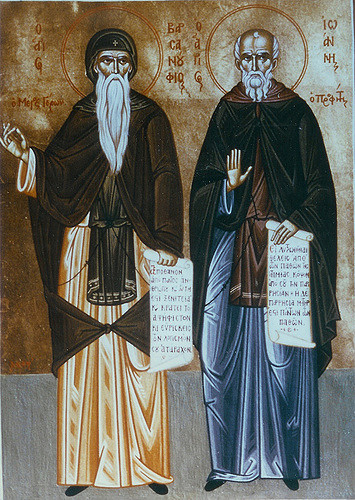
15.1 St. Barsanuphius and St. John
Saint Barsonophius the Great
Saint Barsonophius the Great was from Egypt. In his youth, he went as a pilgrim to the Holy Land, visited a number of monasteries, was tonsured by a hermit, asceticized with him, and after his death was for some time a travelling monk. Afterwards he settled in the monastery founded by Abba Seridus south of Gaza.
He first lived in a cell inside the monastery, and then he withdrew into seclusion, where he “imprisoned himself alive as in a tomb for the name of Jesus” and lived as an ascetic for 18 years, in total seclusion, making no exception even for the bishop and his own brother. Only Abba Seridus once a week brought him three small loaves and some water and administered the Sacraments, and he also read to him questions of visitors and wrote down the answers he offered. When, because of the total inaccessibility of Barsanuphius, many doubted his very existence and thought that the answers were composed by Abba Seridus himself, Barsanuphius received the monks and washed their feet. Barsonophy never abandoned his manual works, he sometimes forgot to eat food: ”…He did not eat or drink anything… His food, drink and garments were the Holy Spirit”. Because of his strict ascetic life and spiritual discernment, without leaving his hermitage, he became the spiritual leader of the brethren not only of his monastery, but also of other monasteries, as well as clerics and laymen, as is clear from his “Responses”.
He only once broke his seclusion and went to Constantinople to petition the emperor Justinian I (527-565) for the monks of his province who did not agree with Origenism. Feeling the uncertainty of the emperor, he advised him not to be afraid of anyone, and to act according to God’s will.
After the death of Abba Seridus, Barsanuphius withdrew into total seclusion, not receiving anyone, including the new abbot Elianus, refusing food and not answering questions. At that time he was already very old in age, and he soon died.
In the ninth century the relics of Saint Barsanuphius were transferred from Gaza to the city of Oria (Puglia, Italy), where they were placed in the church.
Saint John the Prophet
Much less is known about Barsanuphius’ friend, associate and collaborator, Abba John the Prophet. Of his closest spiritual unity with Barsanuphius, John wrote: “The two of us form a single whole”. John is referred to as “the other elder” in the “Responses”. For 18 years he asceticised in seclusion in the same monastery, in the cell, where originally dwelt Barsanuphius, and accepted no one, except Abba Seridus and Abba Dorotheus of Gaza, who for 9 years was his novice. John exercised spiritual guidance, as did Barsanuphius, through his answers, which were of a more direct and practical nature. Along with his various spiritual gifts, he possessed the special gift of clairvoyance and prophecy, which is why he was called ‘Prophet’. He wrote that he himself was not ordained to clergy. John died in 540, a few weeks after the death of Abba Seridus.
“Questions and Answers” (“Responses”). The only work by Barsonophius and John is the “Questions and Answers” or “Responses”. The order and total number of the “Responses” varies. The “Responses” are valuable primarily because they reflect the living tradition of spiritual guidance of the V-VI centuries, based on direct spiritual experience, rather than on theoretical knowledge.
Barsonuphius wrote, “I have written to you everything, from alpha to omega, from the dispensation of the novice to the perfect, from the beginning of the path to the end of it…” Barsonuphius and John lived a very strict way of life and taught the same to those who questioned them. The way of external asceticism is described by them in sufficient detail, although it is in itself, in their view, of no value. Thus, it is better to be content with one garment, but it is not to prohibited to have two or three. It is proper to sleep “half the night,” but “on the occasion of illness” one may rest an extra hour. One ascetic is strictly instructed to fast, while another is told, “Sickness … is imputed instead of fasting, and even more.” “If even ten times a day you eat, do not grieve, you will not be condemned for it”; ”[ sensual fasting] means nothing without spiritual fast.” In all moments of one’s life one must be guided by “the measure of abstinence.”
Two of the leitmotifs of the “Responses” are the teaching on the inadmissibility of bodily rest and on the necessity of tribulations and trials. “[Salvation] requires many sweats, toil, and perseverance.” ”…Do not relax in pleasing your body, or it will bring you down,” wrote Barsanuphius; “all bodily rest is abominable to our God.” Labor and tribulation must be chosen voluntarily (“our fathers chose their tribulations; is it not shameful for us to seek rest in everything?”), without fear or doubt, knowing that “God requires nothing from anyone above strength”.
There is a Christian joy and hope in the call to endure temptation, according to Barsanuphius, “Do not be afraid of temptation, but rejoice in it, because it leads you to spiritual prosperity. The reward for enduring tribulation is eternal life”.
One of the most key themes of the “Responses”is the struggle with thoughts until they are completely defeated. This is realized through their revelation to the spiritually experienced elder, to whom the asker “has faith as to God” and knows that only he can “bear his thoughts”. It is necessary to ask “not about all thoughts, not for those which are accidental, but about those that for a long time remain in a man and trouble him”. He who conceals thoughts that overtake him and does not ask about them will not be healed, because he himself cannot distinguish between good and evil thoughts, a gift bestowed only on those who have “reached the spiritual measure”. God gives the gift of discerning thoughts for “the toil of the heart”; “the work of the one who is saved is to thin out his soul as a cobweb”. Barsanuphius says: “Every thought that is not preceded by the silence of humility does not come from God, but clearly from the left side”.
Awareness of thoughts is achieved by daily work - attention to them and “consideration of oneself”. On the one hand, a certain time is appointed for paying attention to them; St. John admonished: “The Fathers appointed a time for paying attention to their thoughts, saying: ‘In the morning examine yourself, how you spent the night, and in the evening also, how you spent the day; and in the midday, when you are burdened with thoughts, examine yourself’”.
Barsanuphius offers an clear ascetic system. No passion can be overcome without repentance, weeping and prayer; for example, weeping and prayer are necessary to combat the carnal passions: “The passion is abolished by ceaseless prayer with weeping”. Christian virtues, such as humility, which “eradicates all pride”, remain the most important means of combating the passions. Barsanuphius tried to present the well-known truths in poetic form:
“Eta (η) is the abbot (ἠγούμενος). And the abbot is a guide.
He leads you to the light (τὸ φῶς), do not seek darkness (τὸ σκότος).
Leads you to righteousness (τὴν εὐθύτητα), do not seek falsehood (τὸ ψεῦδος).
Leading you to the truth (τὴν ἀλήθειαν), do not drift into delusion (τὴν πλάνην).
Lead you to peace (τὴν εἰρήνην), do not seek battle (τὴν μάχην).
Lead you to joy (τὴν χαράν), do not seek sorrow (λύπην).
Lead you to humility (ταπείνωσιν), do not come to pride (ὑπερηφανίαν).
Lead you to righteousness (δικαιοσύνην), do not seek iniquity (ἀνομίαν).”
In the “Responses” of St. Barsonophy and St. John, there are enumerated different kinds of prayerful action: psalmody, the reading of Sacred Scripture, oral prayer, and the inner work of testing and watching over one’s thoughts. In prayer, the person does not seek anything of his own: ”… the aim of prayer must be that what we ask may be according to the will of God”. In contrast to Evagrius, they write not so much about “prayer of the mind” as about prayer of the heart and the involvement of the whole person in prayer. Reading the Scriptures is also a kind of prayer that warms the heart: “Inspect continually the law of God, for by that the heart is warmed with heavenly fire”. John writes that the observance of the Abbot’s commands is also a prayer.
The views of Barsanuphius and John about heresy have a pronounced ethical connotation: a heretic is not only one who “blasphemes Christ,” but “anyone who does not keep the commandments of Christ.”
15.2 Dorotheus of Gaza
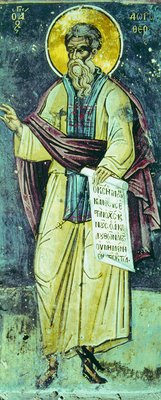
Abba Dorotheus was most probably born in Antioch in the early sixth century. He spent his boyhood and adolescence in the vicinity of Gaza with a family of considerable wealth. The brother of Dorotheus, “a good Christian and a great friend of the monks”, built a clinic in the monastery of Abba Seridus on his own account. Thanks to the care of his parents, Dorotheus received an “external education” under the guidance of a philosopher. According to Abba Dorotheus, he studied from early morning until late at night, forgetting food and sleep and holding a book before his eyes. At no time could his school friends persuade him to devote part of his time devoted to study to youthful amusement. In addition to his philosophical knowledge, Dorotheus could also acquire medical knowledge, which proved quite useful in the monastery - both in serving others and in maintaining his own frail health. The spiritual formation of Abba Dorotheus was influenced by the holy places of Palestine. His studies in the sciences served as a kind of propaedeutic to monastic life. His “Teachings” preserved the musings of the young ascetic: “If in the learning of external wisdom was born in me such a desire and such ardor because I was exercising in reading, and it appealed to me as a skill, so much the more will be it when teaching virtue”. In the monastery of Abba Seridus Dorotheus, guided by the example of the apostles, who left everything for the sake of Christ, with the same zeal with which he had once studied worldly wisdom, devoted himself to a virtuous life according to God.
The monastery chosen by Dorotheus was founded at the end of the fifth century, a few kilometers southwest of Gaza, at the site of Thavatha (Θαυαθά, Θαβατά, on the site of the ancient city of Gerar). The brotherhood of Abba Seridus, including the hegumen himself, was under the spiritual guidance of two “great elders” - the hermits Barsonophius the Great and John the Prophet.
Dorotheus did not enter the monastery at once. Initially, because of illness, he lived nearby on funds he retained from his large inheritance. Dorotheus, who for the time being was also preserving his personal library, was uneasy about his incomplete renunciation from the world, but the elders Barsanuphius and John treated him with particular kindness and persuaded him not to hurry, supposing that the renunciation of thoughts and the severance of the will is more important than hard physical ascetism: “The severance of the will is bloodshed… The word: “Behold, we have left all, and followed Thee” (Mt 19. 27) refers to perfection: it implies not only estates and small possessions, but also thoughts and desires”. Having endured a series of tempting impure thoughts, and having overcome the urge to leave the monastery, Dorotheus found that he was able to attain a profound peace of mind, which, as Abba John assured him, “is the natural fruit of perfect obedience and carelessness (ἀμεριμνία), acquired by cutting off his will”.
After a while, when Dorotheus was still a novice, he was entrusted with responsible obediences: he became the gatekeeper of the monastery and the superintendent of the hotel. A little later Dorotheus was entrusted the monastery hospital, and also with the blessing of the elders, he began to help Abba Seridus in his spiritual guidance - to receive revelations of the monastic brethren’s thoughts and bring up the youth Dositheus.
Dorotheus’ first novice was Dositheus, a relative of a noble military commander, who entered the monastery at a young age after a mysterious admonition he received before the image of the Last Judgment in Gethsemane during his pilgrimage to the Holy Land. After five years of ascetic life, during which not only the disciple’s humility and complete obedience, but also the wisdom and spiritual discernment of his preceptor were fully revealed, Dositheus died.
Not before 540 A.D., Dorotheus left the monastery of Abba Seridus and began to asceticize in the wilderness between Gaza and Mayum. The occasion for the departure from the monastery was the death of Abba Seridus and, 15 days later, the death of Abba John, as well as the complete seclusion of Abba Barsanuphius.
Soon disciples began to settle around the hermit, for whose sake he had to found a monastery between Gaza and Ascalon, which continued the spiritual traditions of the monastery of Abba Seridus. Because of the invasion by the Arabs the newly founded monastery was abandoned by the monks. There is no information about the fate of the monastery. Despite the historical cataclysms, Dorotheus’ discipleshave preserved their teacher’s works, most of which were written, probably, during the last period of his life.
During the stay at the monastery of Abba Seridus, Dorotheus was engaged in collecting and transcribing the “Responses” of Barsanuphius and John and, possibly, the writings of Abba Zosima. The body of works by Abba Dorotheus, written for the brethren in the monastery he founded, comprises Teachings , Epistles , short Sayings and “The Life of Dositheus”, completed at the end of the sixth century.
Abba Dorotheus occupies a special place in Christian literature as an ascetic writer. He did not want to say something new, but faithfully adhered to Holy Scripture and the sacred writings of the Fathers, to which he would frequently refer, reminding them of their perfect conformity to one another: “This is how the Elders and the Holy Scriptures all agree with one another”. The reading of Scripture, Abba Dorotheus considered one of the most important ascetic exercises, along with prayer: “Dissolve prayer with the study of Divine Scripture”.
The great knowledge of prior theological and ascetic traditions is witnessed by the variety of patristic writings cited by Dorotheus, which include ascribed to Clement of Rome, Basil the Great, Gregory the Theologian, John Chrysostom, Mark the Hermit, Abba Zosima, Evagrius of Pontus, and “Apophtegmata Patrum”.
The Teachings of Dorotheus emphasize the special role of ascetic work in the history of salvation. The primordial man who lived in paradise “in paradise pleasure, in prayer, in contemplation, in all glory and honor ” through disobedience to God and pride lost everything, becoming a slave to sin, the devil, passion and death. Only the Lord Savior who became incarnate, died and rose again can set him free.
According to Abba Dorotheus, one can be brought to salvation through the sacrament of Baptism and the observance of the Commandments, by which we mean the Christian moral lessons taught by Christ. Following the tradition of Evagrius and Mark the Hermit, Abba Dorotheus emphasizes that he who observes the commandments continues and completes the work of spiritual perfection, the beginning of which was in Baptism. Unlike the Old Testament Law, which only forbade sin, and even Baptism itself, “which destroys all sin,” the Lord’s commandments help to overcome the passions that underlie and are at the root of sin. The contrast between the passions that lead to sin and the sins themselves as acts of the passions is fundamental to a proper orientation in the spiritual life. Just as pride and following one’s will caused the fall of Adam and all sinners, meekness, humility, and obedience, exemplified perfectly by Christ, are the most important means of healing. “Without humility one cannot obey the commandments.”
The ascetic life is described by Dorotheus as a struggle with the main enemy and adversary of Christians, the devil, and with our own passions. Remembering the words of St John the Prophet, that “passions are demons”, Abba Dorotheus writes about the passions or “passionate thoughts” that tempt the ascetic. Both one’s complicity in sin and one’s overcoming sin are thought of as synergy with demons or with angels: “For whoever harms the soul promotes and helps the demons, and whoever benefits it, helps the holy angels.” The death of Christ defeated the devil, devils have lost their power over people and can return it only insofar as they give themselves to their own passions and their own will.
Passion, unlike the virtues were not put in human nature the Creator, like darkness, they do not have being in the proper sense of the word and belong to the category of non-existence, as well as evil, which is “an illness of the soul, deprived of its peculiar and natural health that belongs to her health, that is virtue”. And this disease is very dangerous: passions are rooted in the depths of the human spirit, as a large tree or as mold and rottenness in the bread, “beautiful outwardly, but spoiled from the inside”. Having no existence of their own, passions nevertheless become the existence of sinful man, turning into a dangerous and intractable “habit”. Therefore, it is necessary to engage in a struggle with passion as soon as it manifests itself: “Try to cut off passions before they turn into a habit for you.”
Passion is conceived or strengthened in a person after he, having entered into an dialogue with a sinful thought, accepts it. “And one thought (λογισμός) can remove a man from God as soon as a man accepts it and submits to it”. Thoughts are like a combustible material that increases the burning of sinful passions. The most important remedy against thoughts is their revelation (ἐξαγόρευσις) before an experienced elder.
There are two kinds of humility: the first, imperfect, is necessary at the initial stages of spiritual life, and the second, perfect, is characteristic of saints: “The first humility consists in considering their brother better than oneself and in all things more excellent and, in a word, as the holy fathers said, to esteem oneself below all. The second humility consists in ascribing our deeds to God”. This doctrine of humility reflects a unified process of spiritual perfection, beginning with the fulfillment of the commandments and ending with the spiritual fructification of the commandments in the ascetic’s soul, skillfully described by the example of the tree, which humbly bows its branches to the ground under the weight of its fruit.
The cornerstone of the building of the spiritual life is the fear of God , “which prompts the soul to keep the commandments”. There are two kinds of the fear of God: the fear of punishment that is characteristic of the beginners, and the fear that is characteristic of the saints who have reached the peak of love for God, and consists in the fear of losing that love. The first fear is felt by the mercenary and the slave, and the second fear is felt by the son who “loves the good for the sake of the good itself and is afraid because he loves”. The fear of God is acquired by the memory of death and the memory of torment. It preserves the soul from insolence, carelessness, and neglect.
According to Abba Dorotheus, love is the perfection of the virtues and the goal for which the commandments are kept. Perfect filial love for God is attained only by the saints, and those who are still in the stage of purification in the servile or mercenary ranks can only approach it from afar. The lesson of love for one’s neighbor was taught to Dorotheus by St. John, who encouraged him to humility, self-denial for the sake of his neighbor and to endure his burdens.
Abba Dorotheus zealously pursued the service of love in both deed and word. According to the teaching of Dorotheus, “to do good to one’s neighbor is a labor of love” and “all virtue is perfected by love for one’s neighbor”. Perfect love extends to covering the shortcomings and sins of their neighbor: the saints “do not hate or condemn the transgressor, do not turn away from him, but sympathize with him, mourn for him, admonish him, comfort him, heal him as a sick member, and do everything to save him”.
Abba Dorotheus often writes of constant and unceasing prayer and of being patient in prayer, which is connected with humility and with all the other virtues: “For he who prays incessantly to God… prays with humility, and is humbled by prayer, and the more he succeeds in virtue, the more he is humble.”
In Constantinople the writings of Abba Dorotheos became known owing to Theodore the Studite, who extensively cited his Teachings in his own Discourses , borrowing from Dorotheos a considerable part of his ascetic terminology. Excerpts from Abba Dorotheus can be found in the Philocalia.
15.3 John Moschus
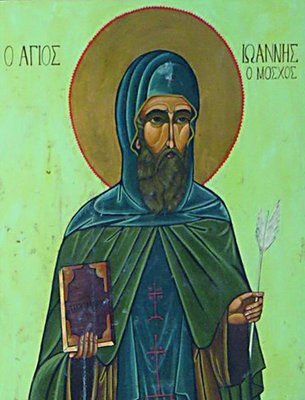
While already in holy orders, John Mosch took monastic vows at the monastery of Saint Theodosius near Jerusalem. Subsequently, he withdrew to the Lavra of Farran, where he spent 10 years. Then he set out on his first journey with Sophronius the Sophist (the future patriarch of Jerusalem) through Egypt, after which he asceticized for 10 years on Mount Sinai. Between 603 and 607 he traveled through Palestine, Phoenicia, and Cilicia to meet the ascetics and listen to their teachings.
After the invasion of Syria by the Persian troops of Chosroes II, John Moschus and Sophronius went to Alexandria, where they became assistants to the patriarch John the Merciful in his efforts to bring Chalcedonian orthodoxy back to Egypt. In view of the growing Persian threat to Alexandria, John Moschus and Sophronius, together with St. John, crossed over from Egypt to Cyprus. From there John Moschus went to Rome. There he engaged in arranging the recollections of his travels and there he died.
The only surviving work by John Moschus is the “Spiritual Meadow ” or “Limonarium” (Pratum spirituale), which was written in collaboration with Sophronius. John Moschus also wrote the Life of St. John the Merciful, of which only fragments survive.
The collection of histories in the “Spiritual Meadow ” gives an idea of Christian life in the Eastern Roman Empire in the 6th-7th centuries, of Christian morality, asceticism. The narratives touch on a variety of topics relevant to the church environment of the time - liturgical, ritual, and dogmatic. Many of the stories deal with everyday problems of the Christians of that time, on the marriage, children and family life. Refusal to fight the carnal passions deprives the Christian of the gracious gifts of God. Conon, an elder of the monastery, at the baptism of a woman, was tormented by the thought of fornication; he left the monastery and prayed to John the Baptist to free him from lust. “I desired that you should be rewarded for this battle, said John the Baptist to him, but since you were not willing, I will deliver you from the battle, but you will also lose the reward” (Prat. spir. 3). Chapter 108 deals with a special kind of ascetic behaviour of the laity, that is, sexual abstinence in marriage. An example of obedience is presented in Chapter 56: the disciple, sent by the elder to work, did not touch the bread given to him, for he had not received a command from the elder to take food.
On the power of the sacrament of Baptism see Chapter 198: “…those who bear the seal of baptism, even though they received it with the expectation of some worldly reward, are considered to have been baptized.” Chapter 176 cites the case of a Jew who was at death’s door in the desert, but, desiring to appear before the Lord a Christian, begged his companions to baptize him; instead of water they sprinkled sand on the young man’s head three times, saying: “The servant of God is baptized…” He recovered and was able to continue on his journey. When the travelers came to the city and told the bishop what had happened, he after long consultations with the clergy, who were hesitant to recognize or not the baptism of the young man, sent him to be baptized in the waters of the Jordan.
One of the themes of the Spiritual Meadow is the significance of the Eucharist and communion. The power of the prayer of exaltation is recounted in ch. 25: the brother sent for the loaves of bread for the liturgy, on his way to the monastery, recited prayers of anaphora over them - and they were sanctified by the Holy Spirit. The account, however, is not a confirmation that laymen may administer the sacrament of the Eucharist; on the contrary, the conclusion of the account conveys the injunction “that none of the unordained should memorize the words of the holy Eucharist, much less utter them as they happen, without discerning the time and outside the consecrated place.” Moschus mentions that in some places the priests would loudly recite the prayer of Eucharust consecration, and not only the lower clerics, but even the children who stood closest to the altar would memorize it and then use it in their games. In the neighborhood of Apamea, when the children, playing, put bread and a jug of wine on a stone, and one of them said a prayer of anaphora, fire came down from heaven and “devoured everything offered and completely scorched the very stone, so that no trace remained”. The signs spoken of in these chapters admonished the faithful to treat the great Sacrament with special reverence, even the utterance of the Eucharistic prayer should have no place except in the proper performance of the Eucharist by the bishop or presbyter.
The true Eucharistic Gifts and the rejection of heretical ones are described in ch. 29: There were two stylites in Cilicia, one a follower of Severus of Antioch, the other belonging to the Orthodox Church; illuminated from above, the Orthodox ascetic asked the Severian partisan to send him a portion of the Communion. When the latter, rejoicing at having converted the Orthodox into his heresy, sent a particle, the Orthodox put it into a heated vessel - it immediately disappeared; then he took a particle of the Holy Communion of the Orthodox Church and did the same - instantly the heated vessel cooled, and the Holy Communion remained intact.
The dogmatic aspects of The Spiritual Meadow are characterized by strict Chalcedonism. However, the apologetic goals are achieved most not through theological reasoning, but through accounts of miracles that testify that the truth is on the side of the Orthodox (e.g., chapters 48, 49, 79, 178, 188).
Chapters 45, 180, 181 speak about veneration of the holy icons, which save people from demonic temptation and help them to keep the memory of the omnipotence of God, about the help of the Mother of God and of the holy men of God. These chapters of the Meadow of the Spiritual, concerning the veneration of icons, were referred to later by John of Damascus and, following him, by the Fathers of the Ecumenical Council VII.
The path of pilgrimage, a journey to the holy places full of hardship and danger, leads to the rejection of the world, to the adoption of an ascetical life. John Moschus speaks of pilgrimage routes to Ephesus to worship St. John the Theologian, to Euchaita to venerate St. Theodore, to Seleucia of Isauria to venerate St. Thecla, to Resafa to venerate St. Sergius (Ch. 180), to Constantinople (Ch. 174). Moschus was particularly attracted by stylites (Ch. 129). The “Meadow ” contains information about Simeon the Stylite (chapters 96, 117, 118) and about Julian the Stylite (28).
15.4 John the Climacus
The provenance of John Climacus are unknown. At the beginning of his monastic life John entrusted himself to the spiritual guidance of Abba Martyrius. John Climacus began to asceticize in seclusion in the valley of Thola (Θολᾶς) at the foot of Mount Sinai. In addition to his prayerful labors, he worked the garden during the day and “composed books (δέλτια κατέταττε) in the evenings and at night. With the exception of a voyage to Egypt, when John was able to visit the hermitage of Skete and the monastery of Tavenissia, he spent his entire life in the Sinai desert, in a granite cave.
After 40 years of asceticism, John Climacus was made abbot of Mount Sinai against his will. By popular acclaim, the “second” or “new” Moses appeared at Sinai, who had reached the “heavenly Jerusalem.” Shortly before his death, John appointed Bishop George, his brother, as his successor in the administration of the monastery, and he retreated in silence in his former place, where he died.
Three texts of John Climacus have survived:
1. The “Ladder of Divine Ascent ” (Scala Paradisi) was written at the request of Saint John of Raithou, hegumen of the Raithou monastery, located 30 km from Sinai on the shore of the Gulf of Suez, and is addressed to the brethren. The title “Ladder” explains John’s plan for the structure of the work and is given by him in the epilogue, where ascent by the “ladder of intelligence” is understood as ascending “to the measure of the age of the fulfillment of Christ”.
2. “The Shepherd, or The Discourse to the Shepherd,” a brief work, is addressed to the Abbot John of Raithou. The word is devoted to the role of the spiritual father in the life of the monk. This work was not least influenced by St. Simeon the New Theologian.
3. “Response Letter to John of Raithou.” The Abbot of the Raifa monastery in his letter asks John to send “a precious edition” for the edification of his disciples; in response John promises to send his work, fearing “death through disobedience.”
The image of the ladder as applied to the spiritual life indicates, on the one hand, the need for spiritual perfection and elevation to God, and on the other, the gradualness of that elevation. This image is often found in Scripture and in ancient writings. One of the most famous examples from Scripture is the vision of the ladder to Jacob (Gen. 28, 12), to which John Climacus repeatedly referred.
“The Ladder” consists of 30 chapters, each corresponding to a particular virtue or vice. The chapters are quite independent, but at the same time are in close relationship and denote a kind of hierarchy of spiritual life. The first three chapters define the monastic life and are chapters on renunciation from the world (1), on breaking with worldly cravings (2), and on voluntary exile (3). The following chapters describe the fundamental virtues (chapters 4-7: obedience, penance, remembrance of death, lamentation) that the monk must gradually acquire, and the various passions (chapters 8-23: anger, despondency, gluttony, pride, etc.) with which he must struggle. As the fruit of a successful struggle, John Climacus describes simplicity (24), humility (25), and discernment (26), which raise the ascetic to the highest levels of stillness (27), prayer (28), impassivity (29), and love (30). The spiritual ladder has no last step. If the end of the ascent is love, then, according to the words of John Climacus, “we shall never cease to abound in it, neither in the present age nor in the age to come, adding to the light the light of reason”.
John Climacus was not a supporter of bookishness, he stressed the need for spiritual teaching not from books, but from one’s own experience: “The true teacher is he who directly received from God the book of spiritual reason, written in the mind by the finger of God, i.e. the action of shinning, and requires no other books”, “teachers are unfit to teach instructions written out from the works of others, just as painters, when they make only copies from the drawings of others”. On the other hand, he draws on the preceding tradition, although he quite rarely names the sources to which he refers. John Climacus mentions by name the following Christian authors: John Cassian of Rome, St. Gregory the Theologian, and St. Ephrem the Syrian, whom he calls simply ὁ Σύρος, the Syrian, as well as the “godless” Origen and Evagrius, “stricken with an evil spirit”. The Ladder cites examples from the Apophthegmata Patrum and from Palladius’ Historia Lausaica.
At the very beginning of the Ladder , John Climacus points out the many ways in which man can respond to God’s call. God is impartial and pours out His graces on everyone without exception. But each person, gifted with free will, determines for himself his attitude toward God: whether to be friend, slave (faithful or unfaithful), stranger, or even enemy of the Creator. A Christian, according to John, can only be called one who “imitates Christ as much as possible in words, deeds, and thoughts, believing rightly and blamelessly in the Holy Trinity”. Without denying the possibility of salvation in the world, he points out that it is possible to fully develop Christian virtues and achieve perfection only by renouncing the world.
Warning the monks against going to extremes, John Climacus exhorts them to follow the “royal way”, i. e., to follow the average of these lifestyles as the safest.
We repeatedly encounter in the Ladder the concept that the hermit’s life should be preceded by a life in the community: “Let us call the whitewash a community of the Lord, in which mental uncleanness, debility, and ugliness are destroyed; let the dye be the hermitage for those who put off lust, stubbornness and irritability, and from [the community] passing already to stillness”. However, this transition cannot be considered the general rule, because “only a few can reasonably pass through silence, those alone who have acquired divine consolation in their labors and God’s assistance in their battles”.
The image of the spiritual father as a phisician is especially largely employed in the Discourse to the Shepherd , with full use of medical terms: plasters, razors, instruments for bloodletting, etc.; the monsatery itself is repeatedly referred to in the Ladder as a hospital. John Climacus also compares the spiritual leader to the captain, who is only able lead the ship after having explored the way and all the possible dangers. In both comparisons, John Climacus gives particular weight to the experience of the spiritual leader. Only the skilled in spiritual combat can teach how to overcome temptation.
Along with the theme of spiritual guidance, John Climacus places the theme of repentance at the base of the Ladder of virtues, which combines three steps: about repentance (5), about remembering death (6), and about weeping (7). In defining repentance as a daily “renewal of baptism” and “reconciliation with the Lord,” John Climacus suggests that ascetics adhere to the maxim: “Whoever truly strives for his salvation regards as lost any day in which he does not weep for his sins”. The Ladder describes the practice of internal repentance, connected with ceaseless weeping for sins, and external repentance
- confession of transgressions and daily revelation of thoughts to the spiritual father. In general, according to the thought of John Climacus, the value of repentance is measured not by the amount of labor incurred, but by the degree of humility acquired.
What establishes repentance in the heart is the remembrance of death. “The remembrance of death is daily death,” notes John Climacus, recalling the words of St. Paul, “I die every day” (1 Cor. 15, 31). The idea that every day may be the last day keeps every Christian from rash actions and strengthens his resolution to keep God’s commandments.
Repentance, kindled by the remembrance of the last day, awakens weeping (πένθος) in the heart, by which he means not so much bodily tears as heartfelt contrition.
The enslavement of man to his passions is what John Climacus calls “slavery”. “Those who claimed that some passions are natural in the soul were deceived, not knowing that the praiseworthy properties of nature have been transformed by us into passions. For example, from nature in us is the seed for procreation, and we have turned it into fornication. There is in us a nature of irritation with the serpent, and we have turned it to our neighbor. There is jealousy in us to compete in the virtues, but we compete in evil. It is natural for the soul to desire glory, but not to despise the neighbor. It is natural to be proud, but before demons. It is also natural to rejoice, but over the Lord and the goodness of one’s neighbor.“
The Ladder offers a profound analysis for a number of passions. The most dangerous (anger, lying, gluttony, covetousness, greed, vanity, pride, etc.) are exposed as separate steps of the Ladder.
Nothing is so repugnant to penitents as irritability, because repentance requires great humility, and irritability is a sign of great exaltation. Anger, like no other vice, contradicts the ascetic life, it not only deprives the Christian of the angelic image, but turns him into a demon and deprives him of his mind.
The immediate generation of anger, rancor (μνησικακία), is connected with it as a ring in the same chain of passions.
The next stage after anger and remembrance is backbiting (καταλαλιά), a child of these passions. John Climacus calls backbiting a subtle affliction, because outwardly it seems safe and insignificant for the soul, but its consequences are serious. He compares this vice to a leech, “sucking out and consuming the blood of love”. Just as with rancor, true repentance is incompatible with backbiting: “Fire is as foreign to water as judgment of one’s neighbor is to one who wishes to repent”. In order to cure this disease, Saint John Climacus recommends taking care of one’s sins and mourning them, “so that a whole river of Jordan might come out of one’s eyes”, and noticing in one’s neighbor only virtues, like the gatherer of grapes, who tastes only ripe fruit. Finally, John Climacus suggests that it is better to disbelieve one’s own eyes than to condemn when sin is obviously committed.
Among the most dangerous consequences of an unrestrained tongue, John Climacus calls lying, which he classifies as a grave sin, because it is evidence of delusion and hypocrisy in the heart. It leads one from seemingly harmless acts, such as amusing others, to evil deeds and crimes.
Despondency (ἀκηδία) is the closing link in this chain; it is total delusion and reveals to the monk an upside-down, distorted world. It produces “weariness of soul, relaxation of mind, neglect of asceticism, hatred of the Christian vows”. Despondency slanders God Himself, as if He were unmerciful and inhumane. This idea is repeated in the “Ladder” many times: the deception of demons is that before the sin, they represent God mercifulness, and after the sin – His unforgiveness. The deception affects not only the soul, but also the body, leading it to tangible suffering: “At the third hour, the demon of despondency produces a chill, a pain in the head, and before that, a rumble in the stomach; when the ninth hour arrives, the sick man gathers his strength; and when a meal is offered, he rushes out of bed. But the hour of prayer has come, and again there is heaviness in the body; when he begins to pray, sleep overtakes him, and untimely yawning overcomes his mouth”.
The analysis of the prodigal passion (πορνεία), this “original son” of gluttony, is rather original in the Ladder. The struggle against fornication for purity requires the ascetic to assimilate the immaterial nature, and to transform the love of the flesh into the love of the divine, by which the attacks of lust will be won. Obviously, this change cannot be accomplished by human strength, “for it is an impossible thing for anyone to overcome his nature. Only He Who is greater than nature can overcome nature”, so the ascetic must lay the weakness of his nature upon God, and He Himself will “destroy the house of the flesh and build the house of the soul”. St. John identifies several basic ways of combating fornication: bodily labor, abstinence, vigil, humility, and angerlessness. Abstinence in food is one of the most effective means of extinguishing the fire of lust, since it is impossible to overcome lust, if one does not first destroy its parent: “…whoever pleases his womb and intends to overcome the spirit of fornication, is like him who tries to overcome a fire with oil”.
The final link in the chain of vices mentioned and the direct consequence of gluttony is insensibility (ἀναισθησία). Spiritual insensibility, similar to the necrosis of diseased organs of the body in the absence of treatment, St. John defines as the extreme degree of neglect; insensibility is embedded in the very nature of man: it is “the deadened feeling, which from a long illness and neglect has reached insensibility”. He calls a person who has reached this stage “the mad sage”. This appellation accurately reflects the essence of the bordering with insanity bifurcation in the soul, who “prays for deliverance from the passion and immediately fulfills it in practice… He speaks much about vigil and immediately lapses into slumber; he praises prayer, but flees from it as from a scourge; he exalts obedience, but is the first to disobey; he praises the impartial and is not ashamed of being vindictive and feuding over his shirtsleeve… He always reproaches himself and does not want to come to his senses, not to speak, he cannot”. John Climacus urges to arm oneself against this passion of insensitivity by unceasing prayer and the fear of God and to strive against the old passions that caused it.

15.5 Isaac the Syrian
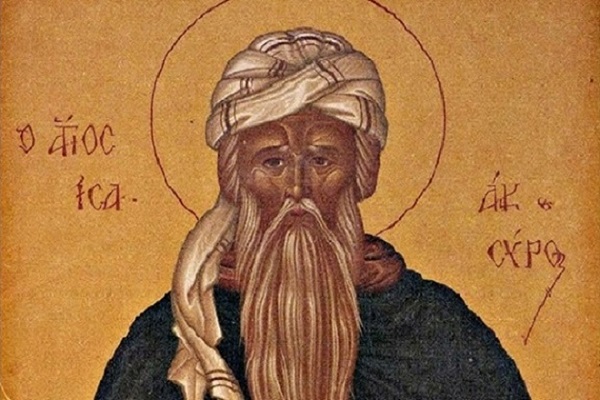
Isaac the Syrian or Isaac of Nineveh (613 – c. 700) was a bishop of Nineveh (now in Qatar). After holding the see for five months, Isaac renounced his bishopric and retired to Mount Matut and for some time “lived in silence with the hermits who were there”; later Isaac retired to the monastery of Rabban Shabur, where he reached a deep old age and was buried.
Isaac “studied the divine Scriptures very diligently”; this, along with his strict asceticism, caused him to lose his sight. Isaac led an ascetic life (“eating a piece of bread and vegetables three times a week”); when he became blind, the disciples wrote down his teachings after him and called him “the second Didymus”. Isaac’s childhood was spent near the sea - the province of Beth-Qatraya was on the western shore of the Persian Gulf. Sea imagery is constantly found in Isaac’s writings - he speaks of ships, of captains and sailors, of sea storms and tailwinds, of divers and oysters retrieved from the depths of the sea.
Isaac did not remain long in the bishopric. An Arabic account of his renunciation of the bishopric is preserved: when Isaac was in his residence on the first day after his consecration, two men came to him, one of whom, a rich man, demanded the return of the other’s debt, threatening to sue him in civil court. Isaac said to him, “Since the Holy Gospel teaches not to take away what is given, you should at least give this man a day to pay it back.” But the rich man replied, “Set aside the Gospel now!” Then Isaac said: “If the Gospel is not reckoned with here, why have I come here?” Realizing that the bishop’s ministry did not correspond to the hermit life, “the saint renounced his bishopric and withdrew into the wilderness.”
Sources speak of five or seven “volumes” of Isaac’s writings, but it is not known whether this is a different division of the body of texts that has come down to us or of any lost writings of Isaac.
At the turn of the eighth and ninth centuries, Abraamios and Patrikios, monks of the Lavra of Sava, made a Greek translation of the Western edition of the first volume of Isaac’s works.
Isaac was familiar with the writings of Aphraates and St. Ephrem the Syrian, whom he quoted, he was also familiar with the Corpus Areopagiticus , Macarius of Egypt, the Apophthegmata Patrum , Mark the Monk, Nilus of Ancyra and Abba Isaiah, and the Life of St. Anthony , written by Athanasius the Great.
God in Isaac’s understanding is first of all immeasurable and inexpressible Love. The idea of the God of Love is central and dominant in Isaac’s thinking: it is the main source of all his theological opinions, ascetic advice and mystical insights. Isaac’s theological system cannot be understood outside the context of this fundamental idea. Divine love is beyond human understanding and beyond all verbal description. But it can, according to Isaac, be known by considering God’s actions toward the created world and man: “Among His actions there is none that is not full of mercy, love and compassion: this constitutes the beginning and the end of His relationship to us”. Divine love was the main cause of God’s creation of the world and of His coming in the flesh; it is the main driving force behind creation: “The only reason for the creation of the world and the coming of Christ into the world is the manifestation of the abundant love of God, which brought both into being”. The power of God’s love toward creatures is reflected in the coming of Christ into the world.
God loves the righteous and sinners equally, making no distinction between them: “He has the same love for us and for the holy angels. It is the same with sinners as it is with the righteous. The Incarnation of God is its proof. Before man was created, God already knew of his future sinful life and yet He created him. God knew all men before they became righteous or sinners, and in His love He did not change them because of the change they underwent. Even man’s many reprehensible acts are accepted with mercy by God, “for God is good and merciful: it is not His custom to judge weaknesses of nature and works done of necessity, even if they are reprehensible.”
When God punishes a man, He does so out of love and for his salvation, not for impersonal punishment. Therefore one should not speak of the justice of God, but only of a mercy that surpasses all justice: “As a grain of sand does not balance a great quantity of gold, so the claims of God’s justice do not stand in balance with the mercy of God.”
In Isaac’s view, we should not take literally those Old Testament texts that speak of God’s wrath, hatred, or jealousy. If such anthropomorphic terms are found in Scripture, they are in the figurative sense, for God never does anything out of anger, hatred, or jealousy, all of which are alien to his essence.
If God is Love, then every person who has reached the state of perfect love and mercy for all creation becomes godlike: his perfect state of love for creation is a mirror in which he sees the true image and likeness of the divine Essence. All saints “strive to find in themselves the sign of full likeness to God - to become perfect in love of neighbor”.
Isaac saw man’s earthly life as an infancy, a time of spiritual growth. In the age to come every man will attain the full measure of his spiritual stature. The relationship between people and God will also have reached maturity; it will no longer be a relationship between children and a father who must continually watch over and correct children. If earthly life is a time of preparation, training, and maturing, in the life of the age to come the full potential of the human person will be realized. Then there will be no need for discipline and punishment. The boundary between earthly life and future age life is death. According to Isaac, death is that blessed Sabbath when human nature finds rest on the eve of its resurrection: “Six days are fulfilled in the doing of life by keeping commandments, the seventh day is spent in the tomb, and the eighth in the going out of the tomb… The true and incomparable Sabbath is the tomb, revealing and signifying perfect rest from the weight of the passions and from the workings that are contrary to rest.”
The Last Judgment is presented by Isaac as the moment of man’s encounter not only with God, but also with those people with whom he was bound in his earthly life. The judgment will mean either man’s entrance into Christ’s kingdom with the righteous, or his excommunication from them. This sentence, however, will be nothing more than a confirmation of the state one has reached in his earthly life. He who has been separated from his friends here by his sinful life will be separated from them there as well. The life of the age to come, according to Isaac, is “a permanent and unspeakable rest in God”. In the age to come all spiritual activity peculiar to this world will cease. In particular, prayer in its present form will be replaced by a supernatural state, which is “above prayer” and which the saints only sometimes experience in their earthly lives.
No one will enter the future bliss by compulsion: everyone must make his or her own choice in favor of God. This choice is made by people in their earthly life and is expressed in the renunciation of passions and in repentance: “Not by any compulsion, and not against their will, and not without repentance, will they inherit that future glory; but it pleased his wisdom that by their free will they choose good things and thus have access to him.”
The main adressee of all Isaac’s writings is the hermit monk as opposed to the monk of the monastic community. Solitude in Isaac is not synonymous with celibacy and the hermit life: it is first and foremost an experience of union with God. While most people escape from solitude, seeing it as a purely negative experience of forced isolation, abandonment, the absence of “another” with whom to share the joys and sorrows of earthly existence, for Isaac it is above all an experience of communion with God: “Solitude enables us to join the divine Mind and brings us to enlightened minds in a short time.”
According to Isaac, renunciation of the world for a solitary life in God is a prerequisite for entering the path to God: “No one can approach God unless he removes himself from the world”. The word “world” in this context is understood as a collective term for all the passions put together. Love for the world is incompatible with love for God; to acquire the latter, one must renounce the former: “The soul who loves God finds rest in God - and in Him alone. Renounce first all outward union, and then you can be with the heart in union with God, because union with God is preceded by renunciation of the material things.”
One of the major themes in Isaac’s writings is that of humility. According to Isaac, humility is one of the qualities of God that was revealed to the world in the incarnation of the Word. In the Old Testament God remained invisible and unapproachable to whoever approached Him; but when God put on humility and hid His greatness under human flesh, He became visible and accessible: “Humility is the robe of the Godhead. The Word incarnate was clothed in it and through it was communicated to us in our body. And everyone clothed with it is truly like Him who came down from His heights, who hid the virtue of His greatness and covered His glory with His humility, so that the creature would not be affected by His sight”. Every Christian is called to imitate Christ in humility. Humility, combined with Christian ascetism, makes one “a god on earth”. Adoption and resemblance to God are not so much through various ascetic deeds as through the acquisition of humility. Deeds without humility are of no avail, but humility without works is sufficient for adoption to God.
The signs of humility are both internal and external. The inner sign of humility is a deep sense of the divine presence that is born during prayer: “The truly humble will not dare to pray to God when they come to pray, or to consider themselves worthy of prayer, or to ask anything else, and they do not know what to pray for… They dare only speak and pray thus: according to Your will, O Lord, be with me.” Another intrinsic sign of humility is the death of man to the world: “He who has acquired humility in his heart has become dead to the world, and he who has died to the world has become dead to his passions.” Complete contempt for the glory of this world is a sign of humility that comes from spiritual wisdom. Another inner sign of humility is the awakening of the voice of conscience, which teaches us not to blame God and our neighbors for anything, not to place blame on the circumstances of life, and not to justify ourselves. Inner peace is a characteristic of humility, too. It is expressed in the absence of fear of the circumstances of life, in the certainty of God’s Providence protecting one from all evil.
Among the outward signs of humility is, in particular, the absence of interest in earthly entertainment and amusement, the desire to avoid the vanity of the world, carelessness, luxury. Another outward manifestation of humility is the uncomplaining tolerance of humiliation and offense. True humility, according to Isaac, is expressed in emphasizing respect for one’s neighbor: “When you meet your neighbor, force yourself to honor him above his measure… And when you are separated from him, say only good things and something honorable about him.”
Prayer is the most frequently discussed and most elaborated of Isaac’s ascetic themes. For Isaac, the conversation of the mind with God is the Christian’s highest work, with which no other work can compare: “Nothing so pleases God and is not dignified in the eyes of angels, nothing so humbles Satan or fears demons, nothing so makes sin tremble or restores knowledge, nothing so leads to compassion, washes away sin, helps man to humility, wooes the heart, gives comfort and gathers the mind like constant prayer… Such prayer makes the mind like God, and likens its movements to those of the age to come…”
-
15.1 St. Barsanuphius and St. John
- 15.2 Dorotheus of Gaza
- 15.3 John Moschus
- 15.4 John the Climacus
- 15.5 Isaac the Syrian
Ascetic writings
Related Concepts
- 1-cor-1210
- 1-john-41
- adoration
- apologetics
- backbiting
- confession-of-thoughts
- cutting-off-of-the-will
- demon-of-deception
- demonology
- demons
- discernment
- discernment-of-thoughts
- ecumenical-councils
- evil-as-privation
- gluttony
- gods-justice
- grace-and-free-will
- heb-514
- john-of-damascus
- judgment
- judicial-function
- likeness-to-god
- measure
- measure-of-abstinence
- neglect
- obedience
- passions-as-demons
- patristic-theology
- peace-of-mind
- physical-asceticism
- prayer
- priesthood
- prodigal-son
- psalm-50
- reading-of-scripture
- remembrance-of-death
- remembrance-of-torment
- renunciation
- repentance
- revelation-of-thoughts
- reward
- scripture
- self-contradiction
- seventh-ecumenical-council
- severus-of-antioch
- sin
- solitude
- stillness
- synergy-with-angels-and-demons
- the-devil
- unceasing-prayer
- vainglory
- vii-ecumenical-council
- virtue
- voluntary-tribulation
- watchfulness
- weeping
- concepts/weeping-πένθος