Patrology — Topic 9
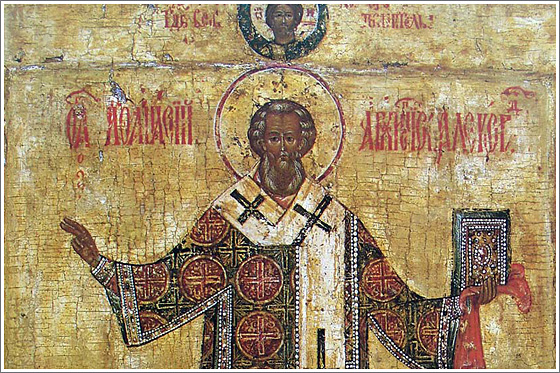
9.1 Nicene Fathers. Athanasius of Alexandria (295-373)
St. Athanasius, the Great Archbishop of Alexandria, born in 295 in Alexandria, is one of the most striking figures in the history of both Christian dogmatics and the history of the Church.
In his youth Athanasius received theological (most likely at the Alexandrian catechetical School) and secular education. The future saint’s spiritual development was affected by the fact that he became intimately acquainted with the monks of the Egyptian wilderness, Thebais. In 319 he was ordained a deacon and became secretary to the aged Alexander of Alexandria. In this capacity he accompanied Alexander to the First Ecumenical Council of 325, where he drew everyone’s attention with his powerful statements against the Arians.
In 328, after Alexander’s death, Athanasius was elected to the bishopric and he headed the Alexandrian Church till the end of his days (died in 373) with some forced interruptions. In this ministry he had to face various difficulties. Throughout his life he was expelled from his pulpit five times.
The first exile was between 335 and 337. In the early 330s, when Emperor Constantine was under the influence of the Arian hierarchs, either expelled or exiled after the First Ecumenical Council, wishing to confirm peace in the Church, Constantine demands that Arius be returned from exile and admitted into communion, but Athanasius refuses, knowing that Arius in fact has not repented of his errors. Then Arians gather a council and do not allow the 48 Egyptian bishops, who came with St. Athanasius, to be there, but turn the council into a trial of Athanasius. Athanasius is charged with a number of absurd accusations - in particular the murder of Bishop Arsenius of Egypt, that he allegedly cut off his hand and used it for witchcraft, the desecration of the temple (that he allegedly overturned the altar and the Holy Gifts), etc. But in spite of the evident refutation of these accusations (i.e. Bishop Arsenios was presented alive and in one piece before the assembly, etc.), the Arians nevertheless succeed in having Constantine expel St. Athanasius. They succeeded in convincing him that St. Athanasius is a very “troublesome figure”, because of whom all the troubles in the Church and the Empire happen (Arians began to accuse St. Athanasius in preventing the delivery of food from Egypt to Constantinople, etc.). Although Constantine tried not to trust these slanders and was sympathetic to St. Athanasius, he succumbed to the beliefs of the Arians and exiled St. Athanasius to Gaul to Trier (present-day Germany). In 337, after the death of Constantine, St. Athanasius was allowed to return to his homeland.
The second exile is from 339 to 346. The Western Church supports Athanasius and two Councils take place here under the presidency of St. Pope Julius - the Roman Council of 340 and the Council of Serdica in 343. Gregory of Cappadocia dies in 345, and Athanasius returns to Alexandria in 346.
The third exile was from 356 to 362. This was the third time Athanasius had to leave his cathedra. His leaving Alexandria was followed by dramatic events and even direct threat to his life, when during the all-night service the cathedral where St. Athanasius was celebrating his mass was surrounded by soldiers led by the military leader of Egypt, and the soldiers were given orders to arrest the saint by all means and deliver him alive or dead. Then St. Athanasius commanded everyone to sing Psalm 135 and to leave the church. He mingled with the crowd and passed through the soldiers. The soldiers rushed into the church, began to destroy everything, but Athanasius was not found.
At this time he takes refuge with Egyptian monks with whom he had long- standing friendships, and he stays here for six years - from 356 to 362. Here he wrote his anti-Arian historical and polemical works.
Constantius dies in 361 and is succeeded by Julian the Apostate (361-364). Julian the Apostate began to restore paganism throughout the empire, and set about it with such zeal that even the pagans themselves laughed at him. But Julian was nevertheless highly educated, even a philosopher (Neoplatonist), and showed political cunning in his struggle against Christianity. He realized that the Church could be weakened from within - all Christian bishops (no matter what confession they were) had to be returned from exile, and in this way the Christians themselves would weaken the Church in their dogmatic and personal squabbles.
So Julian allows St. Athanasius to return from exile, and he returns to Alexandria in 362. Here he continues his frantic activity for the unification of the Church. Particularly in 362 he convenes a local Council in Alexandria, in order to clear up the dogmatic misunderstandings between the Orthodox – and Omoiusians.
The fourth exile is from 362 to 364. Julian now expels Athanasius as “a destroyer of the world and an enemy of the gods” in 362. Then when Julianus ingloriously perishes in the Persian Crusade in 364, St. Athanasius returns to the cathedra.
The fifth exile is from 365 to 366. In 365, St. Athanasius is banished again, by the new emperor Valent. Nevertheless, Valent then allows Athanasius to return in 366, and in 373 St. Athanasius died.
For the most part St. Athanasius’ works are created in a polemical vein and against the Arians, but there are also works of ascetic and exegetical genres, an abundant epistolary heritage is preserved. It should be noted that St. Athanasius did not have the same desire for speculative theology as Origen, his eminent predecessor in the Alexandrian School; he was rather a practical dogmatist and developed his theological teaching as a response to the heretical challenges of his time. Nevertheless, his contribution to Christian teaching, and especially to triadology and soteriology in general, is invaluable.
His dogmatic works include: “Against the Gentiles” and “On the Incarnation of God the Word” (they are sometimes regarded as one work). The first work is apologetic, where St. Athanasius is critical of the Pagans and shows the futility and immorality of their idolatry.
The tract “On the Incarnation of God the Word and His manifestation to us in the flesh” is a work on soteriological themes that deals with a wide range of topics: the creation of man, his condition before the Fall, after the Fall, soteriology, and finally Christology - why was the Incarnation necessary and why exactly through the Incarnation God decided to save man and not through the Angels, etc. why Christ underwent death and why He died on the cross, why He rose again after three days, etc. The doctrine of the Incarnation is here defended against the attacks of Jews and Gentiles.
This is one of the earliest writings of St Athanasius (ca. 319) but in spite of its stylistic roughness (repetitions, etc.) it is written in a very lively language and can be considered as one of masterpieces of the thought of the Holy Fathers.
The three “Words against the Arians” (written c. 358) are detailed dogmatic- polemical treatises in which both the Arian teaching and the arguments of St. Athanasius against the Arians are expounded. Throughout, St. Athanasius seeks to affirm the truth that the Son of God is the Eternal Offspring of the essence of God the Father and is God, not a creature, as the Arians claimed. This same theme is continued in his work “On the Incarnation against the Arians”, as well as “On Some Statements of Dionysius of Alexandria”, in which St. Athanasius defends the orthodoxy of his holy predecessor in the pulpit against the Arians, who because of some of his anti-Sabellian polemical expressions falsely claimed that he, by calling the Son a creation, thought the same as they.
Historical and polemical works : “Apologia against the Arians” (357), “Apologia to Constantius” (357), “Apologia of his flight”, and “History of the Arians”, in which St. Athanasius, giving many important evidence, facts and documents for history, tries to reveal the essence of the Arian intrigues against him and prove his innocence.
Only a few exegetical works have survived: “To Marcellinus on the interpretation of Psalms”, which describes in detail the universal character of this book among other books of the Bible, combining in itself all the genres of biblical books and expressed in a special - poetic language. It also speaks of the messianic and prayerful interpretation of the Psalms.
Ascetic works are represented by the famous “Life of St. Anthony” (ca. 357), in which St Athanasius presents himself as a pioneer, compiling the first ascetic biography and, moreover, the ancestor of Christian monasticism - St Anthony the Great (+ ca. 356). Note that this work (being in its genre simultaneously a praise of a saint, a monastic hagiography and an ascetic treatise) had a great influence on the whole Christian world, including the West (soon to be translated into Latin), and helped to spread monasticism, and in particular the conversion of Blessed Augustine to Christianity). It is clear from the work that St. Athanasius himself communicated with St. Anthony and poured water on his hands when he was his disciple, i.e. the work is based on personal experience. The work depicts the monastic journey from its beginning to the Christian perfection, when Anthony overcomes all the temptations that hindered him, after a persistent struggle with the evil spirits. The gifts of grace and miracles of St. Anthony are also described, as well as the fact that the hermit was a staunch opponent of Arianism, when it is told that he left the desert only twice - the first time during the Pagan persecutions in Alexandria in the early 4th century, to support the martyrs, and the second time to speak out against Arianism, stating that Arianism was extreme heresy and the precursor of the Antichrist.
A great mass among the works of St. Athanasius are the epistles and letters.
The Festal Letters of St Athanasius are very important. Beginning in the 3rd cent. Alexandrian bishops established the tradition of addressing their vast flock with annual Easter epistles (soon after the Feast of the Epiphany), announcing the dates of the beginning of Lent and Easter and addressing various pressing issues. St. Athanasius continued this tradition. A number of these Letters have survived in the Syriac translation. Of the greatest interest was the so-called 39th Festal Letter (367), in which St Athanasius gives a list of the books of the Bible and classifies them in terms of their canonical membership.
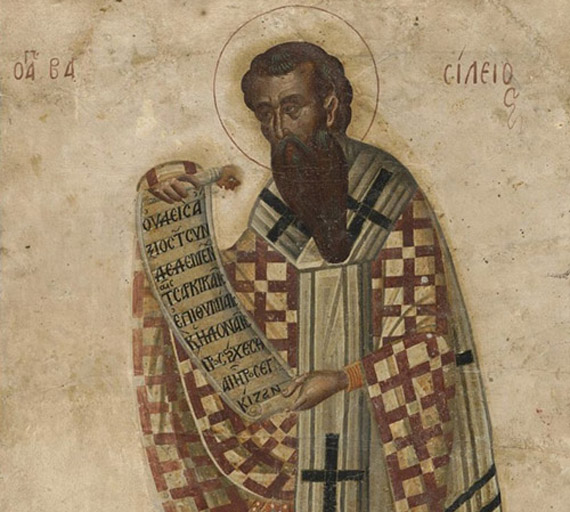
9.2 Cappadocian Fathers. Basil the Great
Saint Basil was born in Caesarea of Cappadocia around 330. St. Basil was noted for his talents in the study of the sciences. When he had already received his primary education in the provincial centers of learning (Caesarea and Constantinople), he finally arrived at Athens, then the capital of learning, where he proved to be a desirable student for many teachers, as everyone had heard of his talents.
He first studied rhetoric in Caesarea of Capadocia (from c. 346), then came briefly to Constantinople, and in 351 he found himself in Athens, where he met his lifelong friend, St. Gregory of Nazianzus, the Theologian.
He brilliantly mastered the sciences that he had studied there, his soul began to demand more than the brilliant accumulation of secular knowledge. In Athens he had time to learn a lot, which later he put as a rich gift into the treasury of the Church: the richest erudition and breadth of outlook. Here he studied both philosophy and medicine.
In Athens, St. Basil became also an excellent orator, and gave wonderful examples of oratory, although St. Gregory the Theologian surpassed him in rhetorical technique, but St. Basil is noted for simplicity of presentation and accessibility of thought, which cannot always be said about St. Gregory. St. Basil was also in correspondence with the famous pagan rhetorician and teacher of his time, Libanius the Sophist. St. Basil also mastered philosophical doctrine and dialectics - the conduct of philosophical dialogue, debate, reasoning. The result of this study was his famous refutations of the Arians, particularly his treatise against Eunomius.
After his stay in Athens, St. Basil returned to his homeland in the years 355
- 356, and traditionally, as a man with a rhetorical education, he began working as a lawyer in court. Thus he worked for no more than a year, perhaps only a few months. He realized that this was not his vocation, and decided to devote his life to God.
In a letter he writes thus:
“I have spent much time in vanity, and almost all my youth was lost in vanity, with which I exercised myself to understand the lessons of wisdom, converted by God to foolishness; but when at last, as if I had risen from a deep sleep, I turned my eyes to the marvelous light of the truth of the Gospel, and saw the futility of the wisdom of the princes of this age who are passing away (1 Cor. 2, 6), then, after shedding many tears over my miserable life, I wished that I might be given a guide to the church’s study of the dogmas of godliness”.
Saint Basil took the first step and was baptized in 356. He was greatly influenced in his ascetic life by his friendship with Eustathios of Sebastia, one of the leaders of the Omoiusian movement in Asia Minor. He was a famous ascetic, had many disciples, and St. Basil at first treated him with respect, but then it turned out that Eustathius was a pneumatomachist, and opposed the doctrine of the deity of the Holy Spirit.
When Saint Basil returned to his native land, Eustathios set out on a journey to the monasteries of Syria and Egypt, and Basil followed him, in order to find him there, but he did not find him there, but he himself visited many monasteries in Syria and Lower Egypt - Alexandria; probably he was not in the monasteries of Pachomius the Great and Macarius the Great. He was acquainted with the experience of ascetic life, which helped him later to become a legislator of ascetic life. He found many ascetics in other monasteries in Alexandria, Palestine, Syria and Mesopotamia. Of them he said that “they showed by the very act what it means to be aliens here”.
St. Basil wished to become an imitator of these men. After his return from this voyage, St Basil retired to a hermitage in his homeland. Friends begin to visit him and settle near him, and a community is formed where they engage in physical work, prayer work, and theology. When his friend Gregory of Nazianze arrives from Athens, they write the Philokalia, a collection of Origen’s texts, in their hermitage. This “Philokalia” has survived. After the death of Eusebius of Caesarea in 370, Saint Basil became bishop of Caesarea.
In 369, when a famine struck the region that was ruled by Basil, he used his own money to organize medical clinics and establish a city called Basilias, a hospital and a hospice. Through his church sermons, he encouraged the rich to resume selling bread (they tried to hold it back in order to raise the price) and to donate bread to the poor.
St. Basil sought to consolidate the Church, and in this his organizational talent showed itself. For great success in gathering together the disparate groups, he turned to the West and wrote a letter to Pope Damasus asking him to come and help unify, but unfortunately the West did not heed. The year 378 - emperor Valens died, all prerequisites for the victory of Orthodoxy are created, but the next year St Basil died too.
The Second Ecumenical Council of 381 put into practice what St. Basil had been preparing all his life for, the unification of all the Orthodox faithful on the ground of the Nicene confession.
The writings of Basil the Great were highly appreciated by his contemporaries. St Basil wrote on various topics: dogmatic treatises (“Against Eunomius”), ascetic treatises (a number of “Rules”), homilies and letters. St. Basil also proved himself to be a prolific exegete of Holy Scripture. His exegetical works are written in the genre of sermons (homilies and words). The most famous of these are the “Homilies on the Six Days of Creation”, which he composed in 370, when he was a preast. St. Basil consistently interprets God’s creation of the world and its elements in the 6 days of creation. The main task of this work he states repeatedly - to show that the visible world is, first of all, a place of teaching man, “a school for intelligent souls”, where man is given the opportunity to know through visible creatures the Creator, and to improve morally, taking examples from the world of insects, animals, fish… St Basil also left a number of Homilies on Psalms. The moral content predominates in them.
Twenty-eight homilies on various topics are also attributed to St. Basil.
There exists a vast collection of Basil’s letters - 365 letters. The letters are addressed to various persons (ca. 125): they are a valuable source both for the history of the period and for the history of dogmatic movements.
St. Basil is credited with the great ordering of worship; the Liturgy of St. Basil has come down to this day. Recent studies confirm the authorship of St Basil for the Anaphora prayers.
The center of his theology, of course, is triadology-the defense of the Nicene Creed against the Arians. St. Basil follows in the footsteps of his predecessor, St. Athanasius the Great, whom in one of his letters he calls his spiritual father, although there were differences in wording between them. The important role of St. Basil as a theologian is that he does not stop at what the Old Nicaeans (Sts. Alexander, Athanasius of Alexandria, Eustathius of Antioch) had achieved, but strives for terminological perfection, bringing it to greater clarity, and thus raising Christian Tradology to new heights. He establishes terms and explains the meaning of these terms which are intended to express, on the one hand, the unity of the Godhead, on the other hand, His trinity, and the difference of the Father, Son and Holy Spirit among themselves: “essence” (“ousia”) and “hypostasis”.
St. Basil argued that the persons of the Trinity - Father, Son and Holy Spirit should be considered hypostases, and in this he differed from the Sabellians. Thus, according to the Sabellians, God as a monad, as one self-contained Deity manifests Himself now as Father, now as Son, now as Holy Spirit, as if “putting on” the Faces, as “guises,” “masks”.
St. Basil denoted the unity in God by the word “essence” (ousia). The essence of God is the totality of all those divine properties which are inherent in all three Persons of the Holy Trinity and each of them, such as creative power, imperishability, eternity, omnipotence, etc.
St. Basil the Great also deals with the question of the Holy Spirit. St. Basil spoke rather cautiously about the deity of the Holy Spirit, and for this he received some reproaches. St. Gregory the Theologian, taking these reproaches away from St. Basil, convinces zealots of the dogmatic purity of Orthodoxy to understand Basil’s intention. This is done so as not to alienate people who are weak and to incur the untimely wrath of his adversaries. “He becomes weak in order to acquire the weak,” says Gregory the Theologian.
But most importantly: in his Treatise on the Holy Spirit and in other works, St. Basil the Great, even if he did not expressly state that the Spirit is God, all his other statements expressed the commonality of the nature of the Holy Spirit with God the Father and with God the Son. From this we can infer the deity of the Holy Spirit. On the other hand, Basil the Great, by his repeated statement that all Three Persons are hypostases.
Basil the Great correlates the Three Persons of the Holy Trinity and concludes that the action of the Persons of the Trinity is also one.
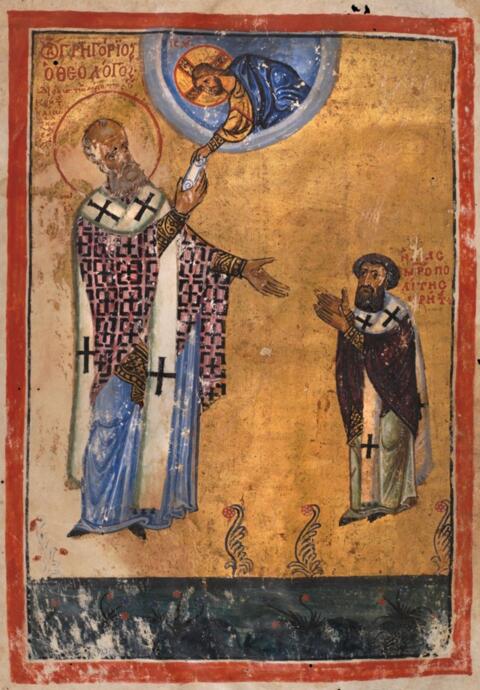
9.3 Gregory the Theologian
St. Gregory the Theologian or Gregory of Nazianzus (Nazianzene), like St. Basil the Great, came from an aristocratic family from Cappadocia. They were countrymen and of the same age. St. Gregory was born about 330, to a holy family. He was the son of the Christian bishop Gregory Nazianzene the elder, who was glorified by the Church as a saint. His mother Nona is likewise glorified as a saint. They were deeply pious people. But Gregory was particularly influenced by his mother. Even before he was born, his mother consecrated him to God and prayed fervently that the Lord would grant her a son who would please God. She loved him very much, brought him up in faith, and made every effort to make him worthy of the vow she had made to God. From a young age she gave him a home education, which consisted of reading the Scriptures, the lives of the saints, and patterns of high life. All this set Gregory’s soul to choose a highly pious life.
He first went to Caesarea of Cappadocia (“metropolis of the sciences”) here he meets Basil the Great, the future Archbishop of Caesarea. He is educated here, but, feeling dissatisfied, he asks for the blessing to study further, in more famous schools. He goes to Caesarea of Palestine, the city where Origen had spent the second half of his life and created his school. Here he studies with the then famous rhetorician Thespesius. He then comes to Alexandria, where there were a lot of schools and colleges, including Christian ones. Here he becomes thoroughly acquainted with the philosophy of Plato, with the theological doctrines of the Alexandrian theologians (Clement, Origen, Didymus). Here he also acquires some interest in Origenian theology, which he, together with Basil the Great, and Gregory of Nyssa, had as well. St. Gregory the Theologian studied for some time in Alexandria, but did not stay there long and went to Athens, the capital of sciences at that time. There came also Basil the Great, where their previous acquaintance and unity of belief and upbringing blossomed into a warm friendship.
After 5 years of studies, St. Basil departed for his homeland, while St. Gregory remained in Athens for about 3 years, where he even taught rhetoric, in which he excelled. Gregory returned home to his aged father. He, an aged bishop, needed support; the internal church situation was very difficult. His father began to persuade Gregory to become a presbyter. In the meantime Basil the Great returned to Pontus, and organized a small monastic community there. Gregory went to join him. They lived for some time in seclusion in ascetic exploits, prayer, study of the Scriptures, and physical labor. They make up a collection of Origen’s writings, the Philokalia. Anyway, Gregory the Elder summoned St. Gregory back to Nazianzus and here, in 361, on Christmas Day the bishop-father introduces him to the people as a new presbyter. He ordains Gregory against his will.
When this violence is done to Gregory, he once again flees to Basil’s desert.
At this time Basil the Great is elevated to the archbishopric (after the death of Bishop Eusebius). In the struggle that was breaking out between the Orthodox and the Arians, St. Basil needed faithful bishops. All the more so, that the emperor Valens, seeing in Basil an irreconcilable figure at the head of such a large diocese, resorts to cunning. He by his decree divides the metropolis of Caesarea into two: Cappadocia I, with its capital at Cappadocia, and Cappadocia II, with its capital at Tiana. Then St. Basil summons Gregory. He accepts ordination, submitting to obedience.
In 378 the Arian emperor Valens was killed in a battle with the Goths near Adrianople. The Orthodox minority of the Constantinople flock, sensing the moment in which it was possible to turn the situation in the dogmatic struggle in favor of the Orthodox, called St. Gregory, as the most suitable candidate for leading the Orthodox capital. Gregory agrees, arrives in Constantinople, finds disorder and confusion there, and takes up the cause of uniting all Orthodox forces. He opens and consecrates the Church of Anastasia (Resurrection) in the house of one of his relatives in the city center. At first the citizens of the capital laughed at him for his outward provincialism and inconsistency with the capital’s manners and splendor, and treated him with contempt. But when he began to preach, a great number of people began to flock to him.
In a short time the saint managed to turn the situation around. Although he had to endure a number of difficulties and collisions on the part of the enemies of the Church.
He was supported by the emperor Theodosius who on November 25, 380, after his victory over the Goths, triumphantly entered Constantinople and appointed Gregory Archbishop of Constantinople by decree.
The churches were taken away from the Aryans and given into the hands of the Orthodox, the Arians were banished and St. Gregory conducted service in the main church of Constantinople at that time - the church of the Holy Apostles.
The 2nd Ecumenical Council was organized in 381. The bishops come from all over, except for Egypt and Macedonia. Meletius of Antioch must have the president of the Council, but he died, and Gregory became the chairman himself. He presided over the Council for some time. But there was much intrigue at the Council and Gregory has many harsh remarks about the bishops in his works. At the head of the Council, he says, is a group of young men pursuing their own interests. Gregory was disgusted by this intrigue and voluntarily left (although the Council did not accede to his request). The emperor repeatedly called him back but Gregory did not return as he had been gravely ill in his later years. He returned to Nazianzus and devoted the rest of his life to ascetic and contemplative life. He died ca. 389 C.E.
9.4 Gregory of Nyssa
We know very little about the early period of Gregory’s life up to the year 371, when his Church ministry began.
When the notorious Edict of the Emperor Julian the Apostate, which forbade Christians to study and teach in educational institutions, was revoked in 364, Gregory, then about 30 years old, unexpectedly for all who knew him and his famous Christian family, left his Church obedience to pursue a secular career teaching rhetoric and oratory, which at the time fascinated him more.
St. Basil the Great and St. Gregory the Theologian urged him in every possible way to “adjust” his views and life choices.
Another incident also captures the unsteady spiritual state of young Gregory. In the “Sermon for the memory of the forty martyrs of Sebastia” Gregory describes how, while still a young man, when his mother, St. Emilia, arranged a feast in her estate in honor of the transfer of the relics of the martyrs, Gregory, being annoyed with her for having cut him off from his secular activities, listened with reluctance to the Church service taking place in the garden, and then went to sleep in a nearby arbor. In the dream he received a frightening warning, for when he saw the divine service taking place and wished to enter it, the light-bearing soldiers surrounding him would not let him in, but only through the intercession of one of them did he miraculously escape the punishment threatening him. After that Gregory, who had come to the service, in tears begged their forgiveness.
Basil ordained Gregory, his brother, as bishop of the small city of Nyssa. The city of Nyssa was situated on the road from Caesarea of Cappadocia to Ancyra (modern Ankara). Saint Gregory himself hints at its insignificance, at the fact that there has not yet been a bishopric here and at his somewhat “political” elevation here as bishop in a letter to Stagirius, ironically declining to call Nyssa a city.
Saint Gregory began his priestly ministry in the difficult conditions of a dogmatic and political struggle between the Orthodox and the Arians. He speaks about these difficulties in his tract “On the Life of Macrina.”
After the council in Ancyra, at which he himself was not even present and therefore could not defend himself, was arrested and escorted to Ancyra on the false accusation of illegal ordination. On his way, however, he managed to escape from under escort. St. Basil the Great in his letter to the governor Demosthenes explains the reason for “the absence” of Gregory in Ancyra.
In the spring of 376, a council of the bishops of Pontus and Galatia was assembled at Nyssa in the absence of St. Gregory, at which they deposed him in absentia. Gregory passes three years (376 - 378) in exile.
Not long afterwards, however, his joy at returning to the Church was overshadowed by the death in 379 of his closest family members: his brother, St Basil the Great, and his sister, St Macrina. St Gregory attended his brother’s funeral in Caesarea.
In 379, shortly before the triumph of Orthodoxy over Arianism, Gregory of Nyssa took part in another council meeting at Antioch, a major cultural center that rivaled Alexandria.
The Fathers of the Council of Antioch sent Gregory on a trip to the churches of Arabia and Palestine to find out what the people were saying about the Arian heresy. It is interesting that Gregory returned from this trip with a very negative impression of Jerusalem. The Holy Places, which had become a popular pilgrimage center at the time, did not inspire him with any enthusiasm. In one of his letters Gregory writes that God’s presence is everywhere and it is a great delusion to think that it is more evident in the Holy Land than in any other place.
In 381 Theodosius I the Great convened a Second Ecumenical Council in Constantinople, at which Nicene Orthodoxy triumphed. Gregory played an important role in this Council, the pinnacle of his activity both theologically and ecclesiastically. At the time of the council Gregory of Nazianzene (the Theologian), who was appointed archbishop of Constantinople for a short period, retired, and Gregory of Nyssa became one of the leading figures in the church affairs of the East. Gradually he gained a reputation as a major authority and became something of a court theologian. In 385 he delivered the eulogy at the funeral of Empress Flacilla.
In the late 80s and early 90s his activity declined. He died presumably in 394, surrounded by the respect of his contemporaries.
Subsequently, after the condemnation of Origen (553), who had a strong influence on Gregory’s way of thinking, his theological authority suffered a little, but the Seventh Ecumenical Council restored it again. Yet it is precisely because of his Origenism that Gregory of Nyssa is not surrounded in church tradition with the same fame and attention as his friend St. Gregory of Nazianzene (the Theologian) and his brother St. Basil the Great. Be that as it may, Gregory of Nyssa’s influence on Orthodox theological thought was enormous.
He was an extremely prolific writer, and we shall confine ourselves to mentioning only the most important of his works. They may be divided into three groups.
The first includes his dogmatic writings:
1. Books Against Eunomius. Eunomius was a representative of extreme Arianism, who maintained that the Son was not like (anomoios) the Father, for the essence of God consists in His “inability to be begotten.” In dismantling this anomoian heresy, St. Gregory sets forth his teaching on the Trinity and on the knowledge of God.
2. On the same subject is written the Epistle to Ablabius on the fact that there are not three Gods.
3. In his Against Apollinarius , Gregory analyzes the heretical doctrine which stated that Christ has no human mind (or soul).
4. The “Great Catechism ” sets forth the main dogmas of St. Gregory’s teaching in a positive form (though not without hidden polemics): on faith, on the Holy Trinity, on the Incarnation, on the Redemption, on the sacraments of Baptism and the Eucharist, and on the last destinies of the world.
The second group of St. Gregory’s writings contains writings mystical or ascetic: “On Virginity ”. Following many Christian writers of the time, St. Gregory defends virginity as the highest way of life. Interestingly, St. Gregory wrote this treatise immediately after his own marriage. (St Gregory of Nyssa was one of married bishops, an ancient practise which persisted until 7th cent. C.E.)
To the third group may be attributed exegetical writings, in which we also find mystical and ascetic themes. It is characteristic that St. Gregory was mainly engaged in the interpretation of the Old Testament texts. His aim was undoubtedly, using allegory, to explain the Old Testament in terms close to the Greek reader:
1. “The Six Days.”
2. “On the Creation of Man.”
These essentially apologetic works represent a polemic with Platonic notions of the creation of the world, supplementing and continuing the thought of St. Basil. Gregory contrasts Plato’s doctrine of the eternity of matter with the biblical notion of the creation of the world in time “out of nothing”. St. Gregory sees in the biblical texts eternal, God-revealed truths, but he interprets the details of the Biblical description of creation allegorically, not regarding them as exact “scientific” information. Of particular importance is St. Gregory’s teaching on the spiritual nature of man.
3. “On the Life of Moses.” In this book the life of the great legislator is interpreted in terms of mystical revelation, as an allegory of spiritual ascent to God, initiation into the divine mysteries.
4. In the allegorical commentaries on the Song of Songs, Ecclesiastes, the Commandments of the Beatitudes, and the Inscriptions of Psalms, the influence of the Alexandrian school of Origen is felt strongly.
The literary legacy of Saint Gregory of Nyssa also includes other, rather numerous, but smaller works on theological or ascetic themes, as well as sermons and letters.
-
9.1 Nicene Fathers. Athanasius of Alexandria (295-373)
- 9.2 Cappadocian Fathers. Basil the Great
- 9.3 Gregory the Theologian
- 9.4 Gregory of Nyssa
B. The Golden age of Patristic literature. Great trinitarian and
christological debates: mid-4th - mid-5th cent.
Nicene Fathers
Cappadocian Fathers
Related Concepts
- alexandrian-school
- anaphora
- anglican-liturgy
- annunciation
- anomoeanism
- anthony-the-great
- apocrypha
- arianism
- arius
- arius-letter-to-eusebius
- ariuss-exile-and-death
- ascetic-biography
- athanasius
- athanasius-contra-mundum
- athanasius-the-great
- basil-the-great
- basilian-rules
- biblical-studies
- body-of-christ
- canonical-membership
- cappadocian-fathers
- christology
- church-tradition
- contingency
- cosmology
- council-of-nicaea
- creation-by-will
- creation-out-of-nothing
- concepts/creature-κτίσμα
- divine-freedom
- divine-will-vs-divine-nature
- divinity-of-the-holy-spirit
- essence
- eternal-plan-of-creation
- eunomius
- eusebian-party
- festal-letters
- first-ecumenical-council
- fountains-of-salvation
- freedom
- genesis
- gift
- great-catechism
- gregory-of-nyssa
- gregory-the-theologian
- heresies-and-refutation
- hexaemeron
- historicity-of-revelation
- holy-spirit
- hypostasis
- incarnation
- john-114
- liturgical-system
- liturgy-of-st-basil
- lords-supper
- mystical-theology
- natural-theology
- nicaea
- nicene-creed
- on-the-creation-of-man
- on-the-incarnation
- on-the-life-of-moses
- only-begotten-son
- ousia
- person
- plato
- pneumatomachism
- prosopon
- proverbs-822
- resurrection
- sabellianism
- sacraments
- second-ecumenical-council
- sirmium
- sirmium-creed
- soteriology
- st-anthony
- st-athanasius-the-great