Old Testament — Topic 22
JOB
Outline
1:1–3:26 Prologue and Job Wishes He Had Never Been Born
1:1–2:13 Prologue: Job’s Change from Blessedness to Affliction
3:1–26 Job Wishes He Had Never Been Born
4:1–37:24 The Speeches of Job, His Friends, and Elihu
4:1–14:22 First Round of Speeches
15:1–21:34 Second Round of Speeches from Job and His Friends
22:1–26:14 Third Round of Speeches from Job and His Friends
27:1–31:40 Job’s Concluding Monologues
32:1–37:24 The Monologue of Elihu
38:1–42:17 God’s Speech to Job and Epilogue
38:1–41:34 God’s Speech to Job
42:1–17 Job Repents, God Rebukes Job’s Friends, and God Restores Job’s
Fortunes
God’s Testing of a Righteous Man: The Problem of Suffering, Evil, and God’s Sovereignty
The book of Job is classified as biblical wisdom literature (how wisdom is used for ethics and for understanding God and life) and specifically as disputational wisdom (i.e., challenges other “wisdoms”). The book is structured as a hybrid of prose and poetry. The book’s narrative (prose) frame of a prologue and epilogue introduces righteous and pious Job, provides the background for Job’s suffering (how God through satan tests Job’s piety for its own sake rather than for material/personal blessing), and concludes with Job’s restoration following his “passing” of God’s test. However, as for the rest of the book, its majority is poetry. Through poetic speeches, Job, his three friends (Eliphaz, Bildad, and Zophar), and Elihu (the interloper) dispute suffering, the problem of evil, and other related themes. God enters into the dialogue through the last poetic speeches, declaring his sovereignty and omniscience. This poetic middle contains poetry laden with pain, anger, and frustration, both from Job and his friends as the debates become heated. It contains some of the Bible’s starkest poetic metaphors—rightly so, since only poetic metaphor may capture both the conceptions and affections dealing with the complex problem of suffering and God’s sovereignty. But Job and his friends do not only debate substantively but also with flair through the rhetoric of poetry itself. Because Job and the other human voices never know of God’s test, the book’s frame and poetic middle come into tension, calling into question the fairness of Job’s suffering. Perhaps, this itself is a sign of the problems in pondering the problems of suffering and evil.

The book opens with a narrative prologue that alternates between scenes on earth and heaven. It begins by introducing Job: a God-fearing, blameless, righteous man who avoids evil. His life is blessed by God both materially and in family. In the heavenly scenes, God allows satan (his accusing angel) to test whether Job indeed fears God for its own sake. In chapter 3, the book transitions into its poetic body with Job’s first words upon his disasters. Through this emotion-laden poetry, Job expresses his pain and desire that he had never been born. With the stage set, in the next division of the book Job, his three friends, and Elihu go back and forth in poetic dialogue to argue the how, why, and resolutions for Job’s suffering.
Prologue: Job’s Change from Blessedness to Affliction (1:1–2:13)
The prologue (and epilogue) is distinct from the rest of the book in that it is a narrative (story) as opposed to a poetic dialogue of the book. This section divides into two main passages revolving around Job’s afflictions (chapters 1–2 respectively). The first round of afflictions involves only Job’s wealth, possessions, and his children. In the second round, God consents to Satan’s request for bodily harm on Job to determine whether Job truly fears God. Following each affliction, the narrator shares respectively how Job does not sin (1:22), nor does he sin with his lips (2:10). However, in the following section of Job’s lament (chapter 3), readers are left to wonder just how close Job is to sinning with his lips.
Job Wishes He Had Never Been Born (3:1–26)
Following the narrative introduction to the book, Job’s first lengthy speech is a poetic lament in which he wishes not only for death but to have not ever been born. The poetry is raw with pain and sorrow. This section divides into three paragraphs (3:1–10, 11–19, 20–26). While all three contain similar imagery regarding light (life) and darkness (death), this imagery is most prominent in the first paragraph. The second paragraph centers on death as ease, and the third focuses on the incongruity of how Job may only live for pain. Ultimately, Job’s lament for his own life leads to his friends’ comforting words in the next division (4:1–37:24).

Job by Léon Bonnat (1880)
Chapters 4–37 form the heart of the book, in which the human voices of the book debate both theologically and poetically (especially in metaphor and imagery) the source and resolution for Job’s suffering. This division is structured into five sections. Job argues with his three friends through three rounds of speeches (4:1–26:14), in which each friend alternatingly debates with Job (sections 1–3). Job shows himself to be the victor of these debates through his friends’ acquiescence upon his concluding monologue (27:1–31:40; section 4). In section 5, this division ends with the monologues of Elihu, a somewhat surprising new voice to the cycles of speeches. However, Elihu serves appropriately as the transitional voice to God’s own speeches in the ensuing division in how much of his own words anticipate God’s speeches with Job.
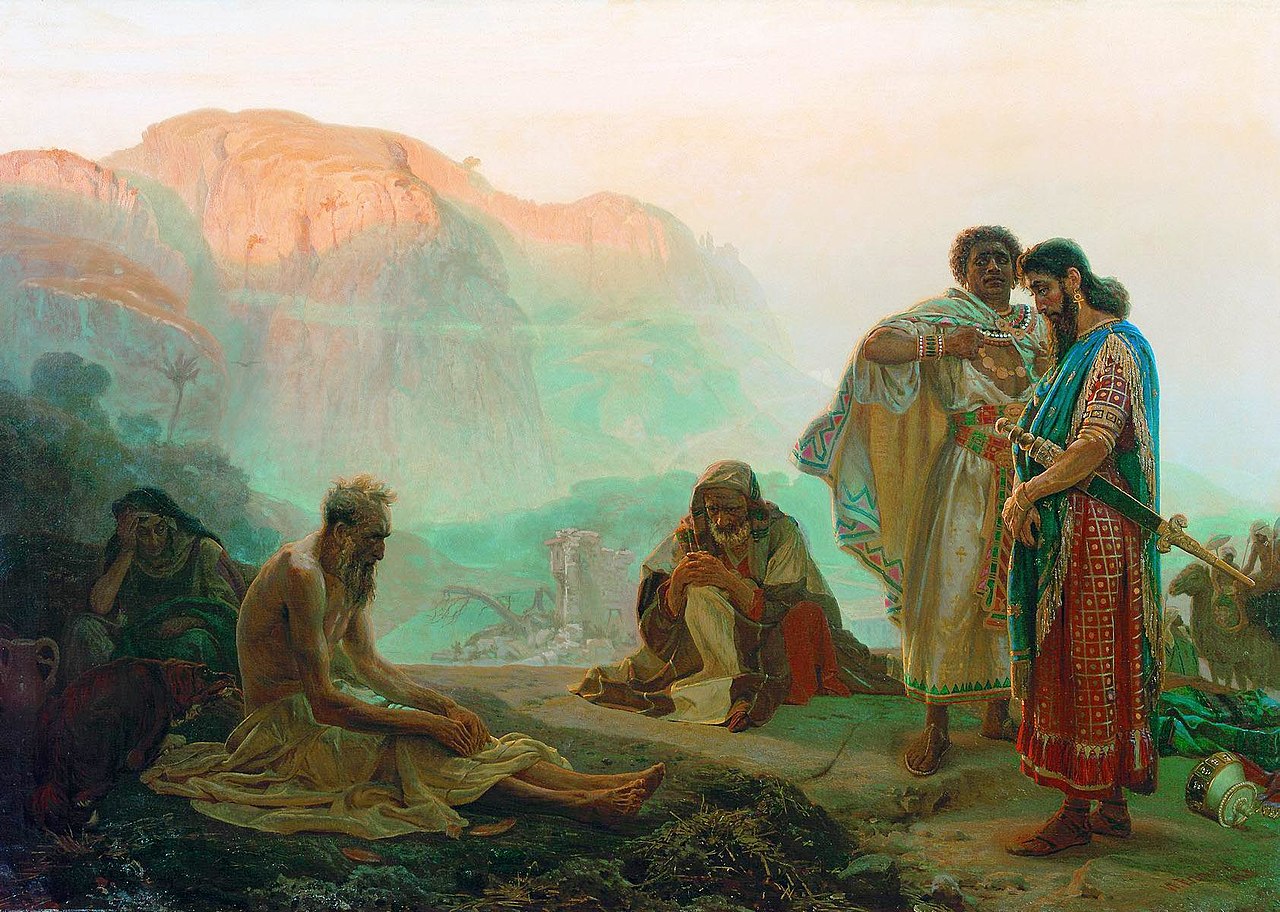
Job and His Friends by Ilya Repin (1869)
First Round of Speeches (4:1–14:22)
In the section of the first round of speeches, the three friends alternatingly converse with Job about the source of his suffering. All three propose the fundamental argument that because Job indeed has sinned, he is now suffering the negative consequences of those sins through God’s discipline. Each friend also admonishes Job to accept this suffering as God’s correction (i.e., repent) for his sin(s) so that he may have restoration. However, Job vehemently proclaims his innocence and righteousness, and laments his powerlessness before God. While the conversation begins politely, they do begin to devolve through the exchange of poetic barbs (compare 4:1–2 [Eliphaz] versus 6:14–17 [Job]) and worsen with each following cycle (sections 2–3).
Second Round of Speeches from Job and His Friends (15:1–21:34)
The speeches in round 2 have a different tone in how the friends change tactics to admonish Job to seek restoration through God’s discipline. They focus on portraying the fates of the wicked. They have moved from positive (restoration through repentance) to negative consequences in order to force Job to reconsider his self-acclaimed innocence. While none of the friends directly accuses Job of being a wicked sinner, their approach suggests that they are rhetorically bullying Job with fear. Job counters by becoming bolder in his affirmations of innocence and unwarranted suffering (e.g., 16:11–17), questioning God’s justice (e.g., 21:17), all the while growing into deeper hopelessness (e.g., 19:7–12). This gradual devolvement of the friends’ “comforting” eventually reaches a head in the final cycle (section 3).
Third Round of Speeches from Job and His Friends (22:1–26:14)
In this third and final round, a few peculiarities emerge among the speeches. Eliphaz directly accuses Job with a string of sins (which are in contrast to the prologue’s introduction of Job). Bildad’s own speech is a mere six verses (25:1–6), and Zophar’s speech is “missing.” These are perhaps a sign of how the debate is coming to its end. Eliphaz grows desperate in his disingenuous accusations, Bildad is running out of things to say, and Zophar has nothing to say. While Job continues to complain about God’s justice and to proclaim his innocence, Job’s own arguments resemble his friends’ words (24:18–25; 26:5–14). Perhaps this similarity is a display of Job’s dominance in the debate: Job is mocking his friends. In the following section of Job’s concluding monologue (27:1–31:40), Job wraps up all that he has to say to both his friends and God.
Job’s Concluding Monologues (27:1–31:40)
Following on Job’s final reply in the third round of speeches, Job gives two extended monologues in which each divides respectively into chapter-length passages (27–28; 29–31). In chapter 27 Job continues his “victory lap” over his friends in affirming his innocence (27:1–12) and perhaps mocks his friends by imitating their arguments (27:13–23). In the second passage (chapter 28), Job offers an exquisite poem on his meditations on wisdom. In the second monologue, though Job is understood as addressing his friends still, each passage is building toward his desired confrontation with God. In chapter 29, Job recounts his former blessed life in society through his wisdom and righteousness, and in chapter 30, he laments his present state of undeserved societal rejection. In the finale of chapter 31, Job offers up a series of self-imprecations to challenge his guiltiness in order to force God to reply. However, before God answers, Elihu comes onto the scene in the next division (32:1–37:24) as a transitional voice that foreshadows God’s own answers.
The Monologue of Elihu (32:1–37:24)
Following on Job’s challenge to God for a meeting, the narrator surprisingly introduces the reader to Elihu, who has been listening to Job and his friends this whole time. Incensed by Job’s affirmation of his righteousness over God’s and the failure of Job’s friends to refute Job, Elihu is compelled to correct Job and his friends through his wisdom. Elihu claims to speak not through human-learned wisdom but divinely inspired wisdom (compare 32:7–10; 36:1–2). Elihu offers four speeches that correspond to this section’s four passages (32:1–33:33 [includes narrative introduction]; 34:1–37; 35:1–16; 36:1–37:24). Elihu’s claim to speak on God’s behalf is confirmed in how his speeches mirror and anticipate God’s own words (esp. in the fourth passage) in Job’s awaited confrontation with God in the book’s final division.
In the book’s concluding division (with two sections), Job receives his awaited audience with God. This first section (38:1–41:34) contains God’s two speeches, in which God takes Job on a poetic tour of creation. The first focuses on creation’s physical elements and its feral creatures, and the second on mythic, terrifying beasts. In the final section (42:1–16), following on God’s speech, Job has nothing to counter and simply repents. In the epilogue, Job receives vindication over his friends through God’s denouncement of Job’s friends (but not Elihu!) and affirmation of how Job spoke rightly. The epilogue concludes with Job’s restoration doubled over what he lost and his resumption of life in fullness.
God’s Speech to Job (38:1–41:34)
This section is composed of Job’s long-desired audience before God. God gives two speeches respectively in two passages (38:1–40:5; 40:6–41:34). Following on God’s first speech, the awestruck Job utters only a few words, conveying his humbled inability to respond before the Almighty (40:3–5). In the first speech, God asserts his sovereignty by questioning Job’s knowledge and power over creation’s physical mechanics (38:4–38) and over his creation and sustenance of wild (i.e., nondomesticated) animals (38:39–39:30). In the second speech, God goes further by questioning Job concerning Leviathan and Behemoth, mythic beasts that are the epitome of the mysterious, powerful, and exotic. These questions over matters that Job surely cannot know are God’s means to have Job submit before his sovereignty and omniscience, which Job acknowledges in the book’s concluding section (38:1–42:17).
Job Repents, God Rebukes Job’s Friends, and God Restores Job’s Fortunes (42:1–17)
This section concludes both the book and the story of Job’s life. The section contains two passages: Job’s repentance (42:1–6) and Job’s restoration (epilogue; 42:7–17). The first passage details Job’s confession of how he was wrong to question God’s sovereignty and omniscience, speaking of things far too wondrous for him. The final passage details two main events: Job’s vindication before his three friends and his restoration to a full life. God condemns Job’s friends for speaking incorrectly and affirms how Job spoke rightly. In the concluding passage, God restores Job’s wealth in double along with his social standing and gives him new children, and Job lives a life in full by seeing even his great-great-grandchildren.
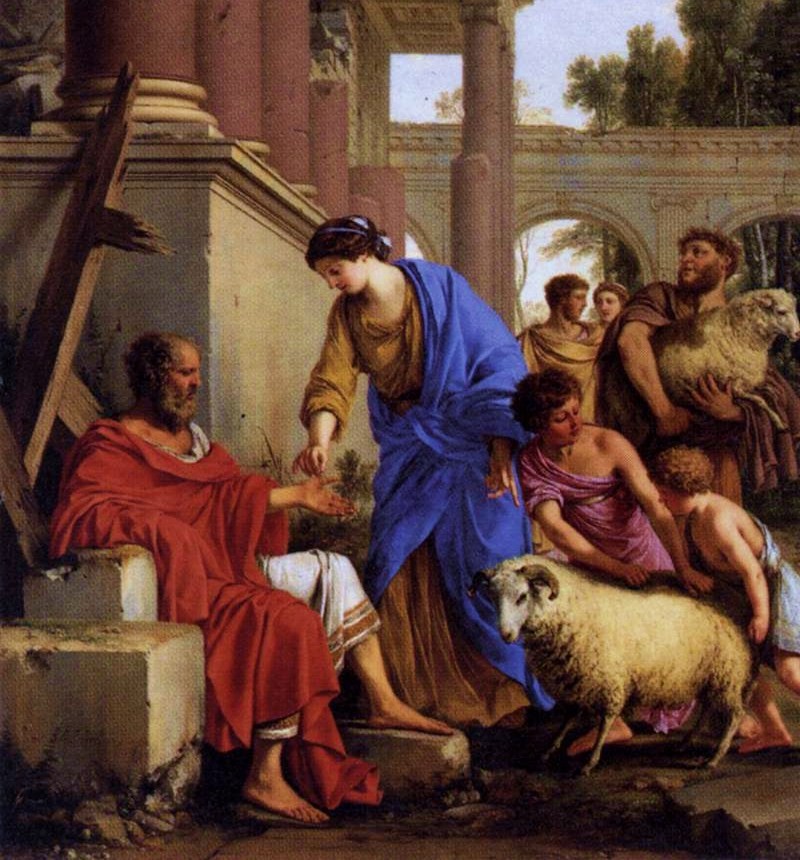
Job Restored to Prosperity by Laurent de La Hyre (1648)
The Book of Job stands as a monumental text in the Orthodox spiritual tradition, a “God-inspired book” as the Liturgy calls it. It is not merely a philosophical discourse on the problem of evil, but a prophetic icon and a typological narrative that prefigures the passion and victory of Jesus Christ. Job is the ultimate “type” of the suffering Righteous One, and his story provides the spiritual lexicon for understanding Christian asceticism and the mystery of the Cross.
1. Job as the Proto-Type of the Suffering Righteous One
From the very beginning, Job is described as a man of unparalleled virtue: “that man was blameless and upright, and one who feared God and shunned evil” (Job 1:1, NKJV). His righteousness is the catalyst for the cosmic drama that unfolds.
-
Christological Interpretation: Job is a clear type of Christ , the only truly innocent and righteous Man. Just as satan requests to “sift” Job like wheat (compare Luke 22:31), he is given permission to assault Christ. Job’s sufferings—the loss of possessions, children, health, and social standing—prefigure Christ’s Kenosis (self-emptying) in His Passion, where He is stripped of everything, betrayed, and abandoned.
-
Ascetical Understanding: Job’s initial response to catastrophe is the model for Christian detachment and faith: “Naked I came from my mother’s womb, and naked shall I return there. The LORD gave, and the LORD has taken away; blessed be the name of the LORD” (Job 1:21). This is the essence of apatheia (dispassion)—not a lack of feeling, but the liberation of the heart from dependence on worldly and physical comfort, placing its blessing and trust entirely in God, regardless of circumstances.
2. The Messianic Prototype: “I Know That My Redeemer Lives”
Amidst the despair of his physical affliction and the accusations of his friends, Job erupts with one of the most decisive messianic prophecies in the Old Testament.
“For I know that my Redeemer lives, And He shall stand at last on the earth; And after my skin is destroyed, this I know, That in my flesh I shall see God, Whom I shall see for myself, And my eyes shall behold, and not another. How my heart yearns within me!” (Job 19:25-27, NKJV)
-
Christological Fulfillment: This is the heart of the book’s Christ-centeredness. The “Redeemer” (Hebrew Go’el) is the kinsman-redeemer, the one who has the right and power to vindicate and restore a relative who has lost everything. This is fulfilled in Jesus Christ , who, “in all things He had to be made like His brethren… to make propitiation for the sins of the people” (Hebrews 2:17). He is the Redeemer who stands upon the earth, conquering death through His Resurrection.
-
Patristic and Liturgical Understanding: The Fathers, especially St. John Chrysostom, saw this as a clear prophecy of the General Resurrection. Job’s hope to see God “in my flesh” is the hope of every Christian, fulfilled in the resurrection of the body. This verse is central to the Orthodox Funeral Service. It is sung triumphally, transforming the service from a mere mourning of loss into a proclamation of Paschal victory, affirming that death is not the end but a passage to beholding God.
3. The Mystery of Suffering and the Revelation of the Cross
The core of the book’s dialogue revolves around the flawed theology of Job’s friends, who insist that suffering is always a direct punishment for personal sin. God Himself refutes this at the end, telling Eliphaz, “you have not spoken of Me what is right, as My servant Job has” (Job 42:7).
-
Christological Interpretation: The book dismantles a simplistic retributive theology and opens the door to the mystery of vicarious and redemptive suffering. Job’s innocent suffering, which ultimately brings blessing and intercession for his friends (Job 42:8-10), prefigures the suffering of Christ, the “lamb without blemish” (1 Peter 1:19), Who suffers not for His own sins but for the sins of the world, bringing salvation to humanity.
-
Ascetical Understanding: This provides the Christian with a radically new perspective on trials. Suffering is not necessarily a sign of God’s displeasure but can be a “therapy of love,” a means of participation in the Cross of Christ for the purification of the soul and the salvation of others. As St. John Cassian teaches, God allows trials to humble us, to burn away our self-reliance, and to lead us into deeper communion with Him. The goal is not to understand the “why” of suffering intellectually, but to encounter (!) God within it, as Job does. The Lord did not appear to Job to rebuke him. He appeared to make it clear to the righteous that the measure of suffering for any of us is in His hand. Instead of dry theological concepts, the Lord made Job understand: “I’m with you,” and that was enough for him.
4. The Theophany and the New Testament Parallel
God finally answers Job not with an explanation, but with a revelation of His transcendent majesty and wisdom in creation (Job 38-41).
-
New Testament Parallel: This finds its ultimate fulfillment in the Cross of Christ. At Golgotha, the problem of evil is not solved with a philosophical argument but is confronted and defeated by an act of divine love. The Cross is the ultimate theophany, where God’s power is made perfect in weakness (2 Corinthians 12:9). Just as Job’s questions were silenced by the overwhelming reality of God’s presence, so too are our doubts and sufferings taken up and transformed in the presence of the crucified and risen Lord.
-
Liturgical Understanding: The Church reads the Book of Job during Holy Week , specifically on Great and Holy Monday. This placement is profoundly theological. Job is the icon of the suffering Christ at the beginning of the Passion. The hymns of the day explicitly connect them: “Job, who was formerly on a dunghill, is now seated in glory, having received the crown of victory… he depicted in himself the image of the sufferings of Christ, and proclaimed the Resurrection to all.”
5. The Restoration: A Type of the Resurrection and the Age to Come
The book concludes with Job’s restoration: his health is healed, his fortunes are doubled, and he is given a new family.
- Christological Interpretation: This restoration is a type of Christ’s Resurrection and the life of the Age to Come. It is not a mere “happy ending” but a revelation that God’s ultimate will for His faithful is not suffering, but eternal life and glorification. The “double portion” (Job 42:10) prefigures the “abundant life” (John 10:10) and the “inheritance imperishable… reserved in heaven” (1 Peter 1:4) that we receive through Christ’s victory.
Conclusion: Job as a Christ-Centered Narrative
The Book of Job is fundamentally Christ-centered because it enacts the entire Paschal mystery in a single human life:
-
Innocence and Kenosis: Job’s righteousness and subsequent stripping prefigure Christ’s sinlessness and self-emptying.
-
The Passion: His physical and spiritual agony prefigures the Cross.
-
The Proclamation of Hope: “I know that my Redeemer lives” is the cry of Holy Saturday, the hope of Sheol itself.
-
The Resurrection and Restoration: His vindication and double restoration prefigure Christ’s Resurrection and the promise of our own.
Job teaches us that the path to glory passes through the Cross. He is not just a patient man, but a prophet of the Resurrection, a champion of faith, and a living icon of our Lord Jesus Christ, Who, for the joy that was set before Him, endured the Cross (Hebrews 12:2). In his story, we find the pattern of our own salvation.
Prototypical elaboration
The Patristic Interpretation: Job’s Wife as a New Eve
The Fathers do not see Job’s wife as a mere, unfortunate woman driven to despair. They interpret her role typologically, as a spiritual actor in the cosmic drama of temptation.
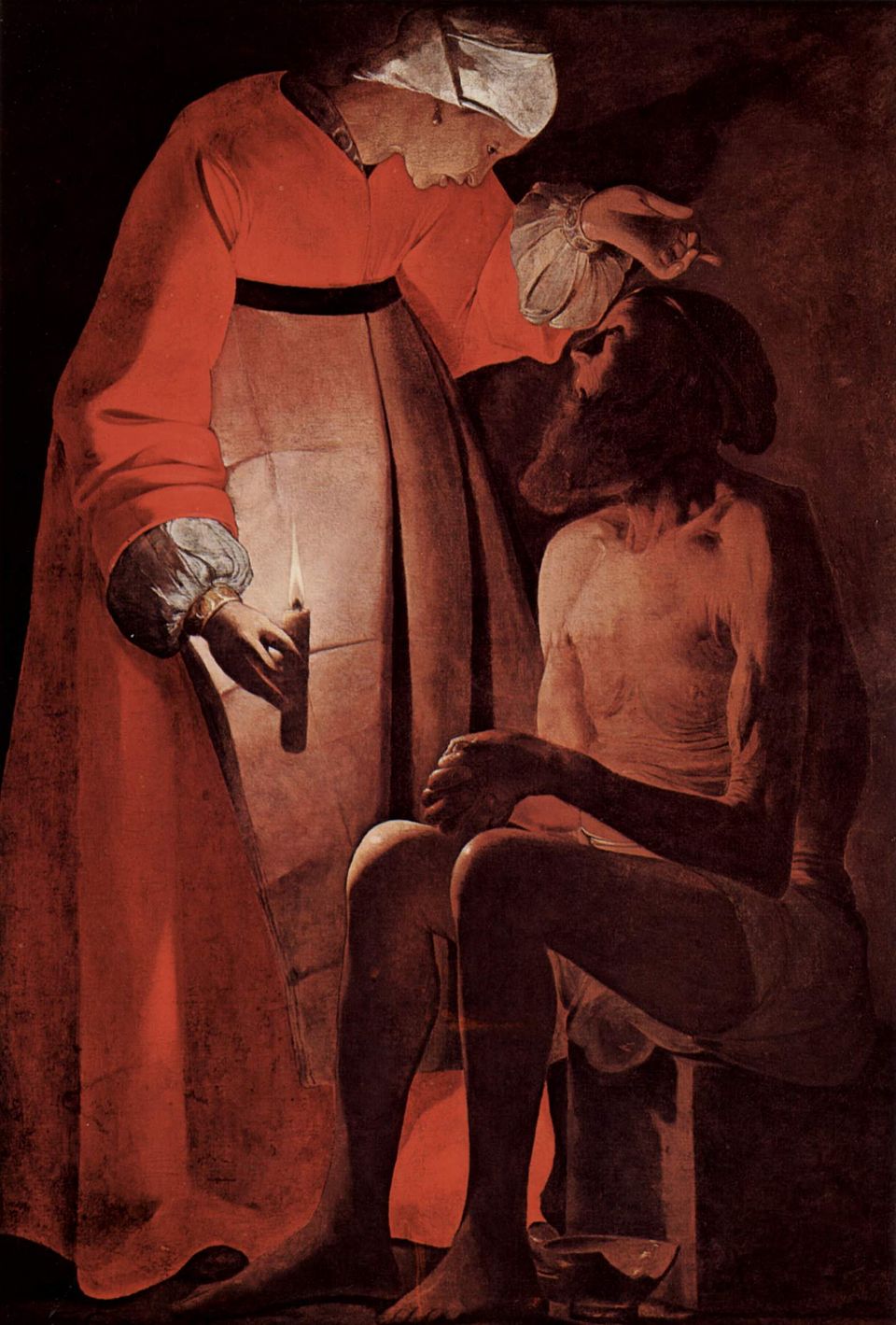
- St. John Chrysostom, in his Homilies on Genesis , makes the connection directly. He states that just as the devil did not dare to attack Adam directly first, but used the woman as an intermediary, so too in the story of Job, after failing to break Job through direct calamity, satan uses the wife as his final, most intimate instrument of temptation. Her words, “Do you still hold fast to your integrity? Curse God and die!” (Job 2:9, NKJV), are the functional equivalent of the serpent’s words to Eve: “You will not surely die. For God knows that in the day you eat of it your eyes will be opened, and you will be like God…” (Genesis 3:4-5, NKJV).
- St. Gregory the Great, in his monumental Moralia on Job , develops this typology extensively. He writes:
“By a woman [Eve] the devil poured into the ear of the man the poison of his persuasion; and by a woman [Job’s wife] he endeavours to pour into the mind of the holy man the poison of despair… The old enemy rose against the first man by the woman, and rose against this latter man by the woman also. But the latter he found not of like mind with the former. For Adam, following the woman’s counsel, transgressed the commandment of God; but this man, rejecting the counsel of his wife, did not forsake the righteousness of God.”
The Parallels in Detail:
1. The Strategy of the Tempter: In both cases, satan attacks the man through his closest, most trusted human relationship. He does not create a new weapon but corrupts an existing, God-given bond. This reveals his cunning: he targets the point of greatest potential influence and vulnerability.
2. The Nature of the Temptation: The core of the temptation is the same: to distrust God’s goodness and to seize autonomy from Him.
o To Eve , the temptation was: “God is withholding something good from you (knowledge). Disobey Him, and you will be like Him.”
o To Job, through his wife , the temptation is: “God has been unjust and cruel to you. Your fidelity is pointless. Reject Him, and end this suffering (die).”
o Both temptations paint God as either a liar, a withholder of good, or a cruel tyrant.
3. The Contrast in Response: The New Adam vs. The Old Adam
This is the most critical Christological point. The Fathers present Job as the
“New Adam” who, when faced with the same pattern of temptation, does not
fall.
o Adam listened to the voice of his wife over the command of God (Genesis 3:17). He failed in his role as the head and guardian of piety.
o Job rebukes the voice of temptation from his wife, holding fast to the fear of God: “You speak as one of the foolish women speaks. Shall we indeed accept good from God, and shall we not accept adversity?” (Job 2:10, NKJV).
o Job’s steadfastness rectifies the failure of Adam. He becomes a type of Christ , the ultimate New Adam, who resists the temptations of satan in the wilderness (Matthew 4:1-11) and remains obedient to the Father unto death, even death on a cross (Philippians 2:8).
Ascetical Understanding for the Spiritual Life:
The Church Fathers apply this typology directly to the inner warfare of every Christian soul.
- Job’s Wife as the “Carnal Mind”: In ascetical literature, Job’s wife is often interpreted as symbolizing the “carnal mind” or the “voice of the passions.” When the soul is undergoing severe trials (the “furnace of affliction”), the lower, passionate part of our nature will often cry out in despair, urging us to take the easy way out—to abandon prayer, to compromise our faith, to become bitter, to “curse God and die” spiritually.
- The Call to Vigilance: The story teaches that our greatest spiritual battles can come from within our own “household”—from our own thoughts, emotions, and attachments. We must, like Job, have the discernment to recognize this inner voice of despair for what it is: a temptation from the enemy. We must “take every thought captive to obey Christ” (2 Cor. 10:5).
- The Path of Victory: Victory is found not in listening to the counsel of the “carnal mind” but in reaffirming our unconditional trust in God’s providence, whether He gives or takes away. Job’s response is the ultimate model of apatheia —the dispassionate acceptance of God’s will, which is the foundation of spiritual freedom.
Job speaking to his wife , as depicted by Georges de La Tour (1593–1652) in Musée départemental d’art ancien et contemporain d’Épinal
Conclusion:
The parallel between Eve tempting Adam and Job’s wife tempting Job is not only present in the Holy Fathers but is a cornerstone of their Christocentric reading of the book. It transforms the narrative from a story of personal endurance into a cosmic drama of recapitulation. In this drama, Job, as a type of Christ the New Adam, reverses the failure of the first Adam, demonstrating the perfect human response of faith and obedience, thereby foreshadowing the One Who would ultimately crush the head of the serpent through His own suffering and resurrection.
22.4 God’s Speech to Job and Epilogue (38:1–42:17)
God’s Speech to Job (38:1–41:34)
Job Restored to Prosperity by Laurent de La Hyre (1648)
22.1 God’s Testing of a Righteous Man: The Problem of Suffering, Evil, and
God’s Sovereignty
22.1 God’s Testing of a Righteous Man: The Problem of Suffering, Evil, and
God’s Sovereignty
22.2 Prologue and Job Wishes He Had Never Been Born (1:1–3:26)
Job Wishes He Had Never Been Born (3:1–26)
Job by Léon Bonnat (1880)
22.3 The Speeches of Job, His Friends, and Elihu (4:1–37:24)
Job and His Friends by Ilya Repin (1869)
First Round of Speeches (4:1–14:22)
Job’s Concluding Monologues (27:1–31:40)
The Monologue of Elihu (32:1–37:24)
22.4 God’s Speech to Job and Epilogue (38:1–42:17)
God’s Speech to Job (38:1–41:34)
Job Restored to Prosperity by Laurent de La Hyre (1648)
22.5 An Orthodox Insight into the Book of Job
1. Job as the Proto-Type of the Suffering Righteous One
2. The Messianic Prototype: “I Know That My Redeemer Lives”
3. The Mystery of Suffering and the Revelation of the Cross
4. The Theophany and the New Testament Parallel
5. The Restoration: A Type of the Resurrection and the Age to Come
Conclusion: Job as a Christ-Centered Narrative
Prototypical elaboration
The Patristic Interpretation: Job’s Wife as a New Eve
The Parallels in Detail:
Ascetical Understanding for the Spiritual Life:
Conclusion:
- 22.1 God’s Testing of a Righteous Man: The Problem of Suffering, Evil, and God’s Sovereignty
- 22.2 Prologue and Job Wishes He Had Never Been Born (1:1–3:26)
- 22.3 The Speeches of Job, His Friends, and Elihu (4:1–37:24)
- 22.4 God’s Speech to Job and Epilogue (38:1–42:17)
- 22.5 An Orthodox Insight into the Book of Job
22.2 Prologue and Job Wishes He Had Never Been Born (1:1–3:26)
Job Wishes He Had Never Been Born (3:1–26)
Job by Léon Bonnat (1880)
22.3 The Speeches of Job, His Friends, and Elihu (4:1–37:24)
Job and His Friends by Ilya Repin (1869)
First Round of Speeches (4:1–14:22)
Job’s Concluding Monologues (27:1–31:40)
The Monologue of Elihu (32:1–37:24)
- God’s Testing of a Righteous Man: The Problem of Suffering, Evil, and God’s Sovereignty
- Prologue and Job Wishes He Had Never Been Born (1:1–3:26)
- The Speeches of Job, His Friends, and Elihu (4:1–37:24)
- God’s Speech to Job and Epilogue (38:1–42:17)
Related Concepts
- 1-peter-119
- 1-peter-14
- 2-corinthians-105
- 2-corinthians-129
- abundant-life
- allegory
- behemoth-and-leviathan
- boaz-as-type-of-christ
- boaz-typology
- carnal-mind
- christological-interpretation
- christs-temptations
- colossians-118
- cross
- cross-of-christ
- crossing-jordan-as-baptism
- crucifixion
- davidic-line
- detachment
- divine-condescension
- divine-permission
- divine-sovereignty
- divine-warrior
- double-portion
- dramatic-irony
- ecclesiastes
- elihus-speeches
- emotion-in-scripture
- epistle-of-barnabas
- fairness-of-jobs-suffering
- fall-of-man
- funeral-service
- general-resurrection
- genesis-3
- gods-rebuke-of-eliphaz
- gods-speech
- hebrew-poetry
- hebrews-214-17
- hebrews-217
- humility-of-christ
- incarnation-as-near-kinsman
- incorruptibility
- inner-warfare
- job
- job-121
- job-1925-27
- job-192527
- job-2910
- job-3
- job-3841
- job-42
- job-428-10
- job-42810
- job-as-type-of-christ
- jobs-innocence
- jobs-piety
- jobs-repentance
- jobs-righteousness
- jobs-suffering
- john-1010
- kenosis
- last-judgment
- law
- levirate-marriage
- narrative-frame
- nehemiah-as-type-of-christ
- new-adam
- new-eve
- old-testament-interpretation
- old-testament-theology
- paran
- passion
- philippians-2
- philippians-2-hymn
- philippians-28
- philippians-hymn
- poetic-metaphor
- poetic-rhetoric
- problem-of-suffering
- prologue
- prophets
- proverbs
- psalms
- satan
- sinai
- song-of-solomon
- temptation
- the-problem-of-evil
- theological-anthropology
- theophany
- therapy-of-love
- transfiguration
- typology
- vicarious-suffering
- voluntary-sacrifice
- writings