Fundamental Theology — Topic 10. The Problem of Evil and Theodicy
Having examined in the previous lectures the main types of worldview, we can now arrive at the following conclusion: the views of any given person are formed in the attempt to answer the ultimate questions of human existence — the questions of suffering and death. It is precisely these questions that constitute the deepest challenge to theistic belief and that give the problem of evil its peculiar and inescapable urgency. When a person stands at the bedside of a dying child, or contemplates the historical record of war, oppression, and systematic cruelty, the abstract convictions of philosophy are put to the most severe possible test. How can one affirm, in the face of such realities, that the universe is governed by a God who is simultaneously all- powerful, all-knowing, and all-good? This question — formulated with lapidary precision by Epicurus in antiquity and never definitively silenced since — is the question of theodicy. The word itself, coined by the philosopher Gottfried Wilhelm Leibniz in his treatise of 1710, is formed from two Greek words: theos, God, and dike, justice. Theodicy is, literally, the justification of God — the attempt, by means of rational argument, to demonstrate that the existence of evil in the world is compatible with faith in a perfectly good and omnipotent Creator.
This lecture is divided into four parts. In the first part, we survey the principal pre-Christian and philosophical approaches to the problem of evil — the pessimistic and optimistic trajectories of natural human thought. In the second part, we examine the specifically Christian and biblical account of the nature and origin of evil, which provides the decisive theological framework for any adequate response. In the third part, we turn to the principal models of theodicy that have been developed in the history of philosophy and theology, from Augustine and Leibniz through the modern analytical tradition. In the fourth and final part, we consider the contemporary debate in the light of the challenges posed by the events of the twentieth century, and assess the enduring significance of theodicy for the practice of apologetics and the life of faith.
- Introduction
- Section 1. Natural Human Thought and the Problem of Evil: Optimism and Pessimism
- Section 2. The Biblical and Christian Account of Evil
- Section 3. Models of Theodicy: From Augustine and Leibniz to Contemporary Analytical Theology
- Section 4. Theodicy in the Contemporary World: After the Catastrophes
The development of religious and philosophical reflection on the origin of evil in antiquity proceeded along two broad trajectories, which we may designate the optimistic and the pessimistic.
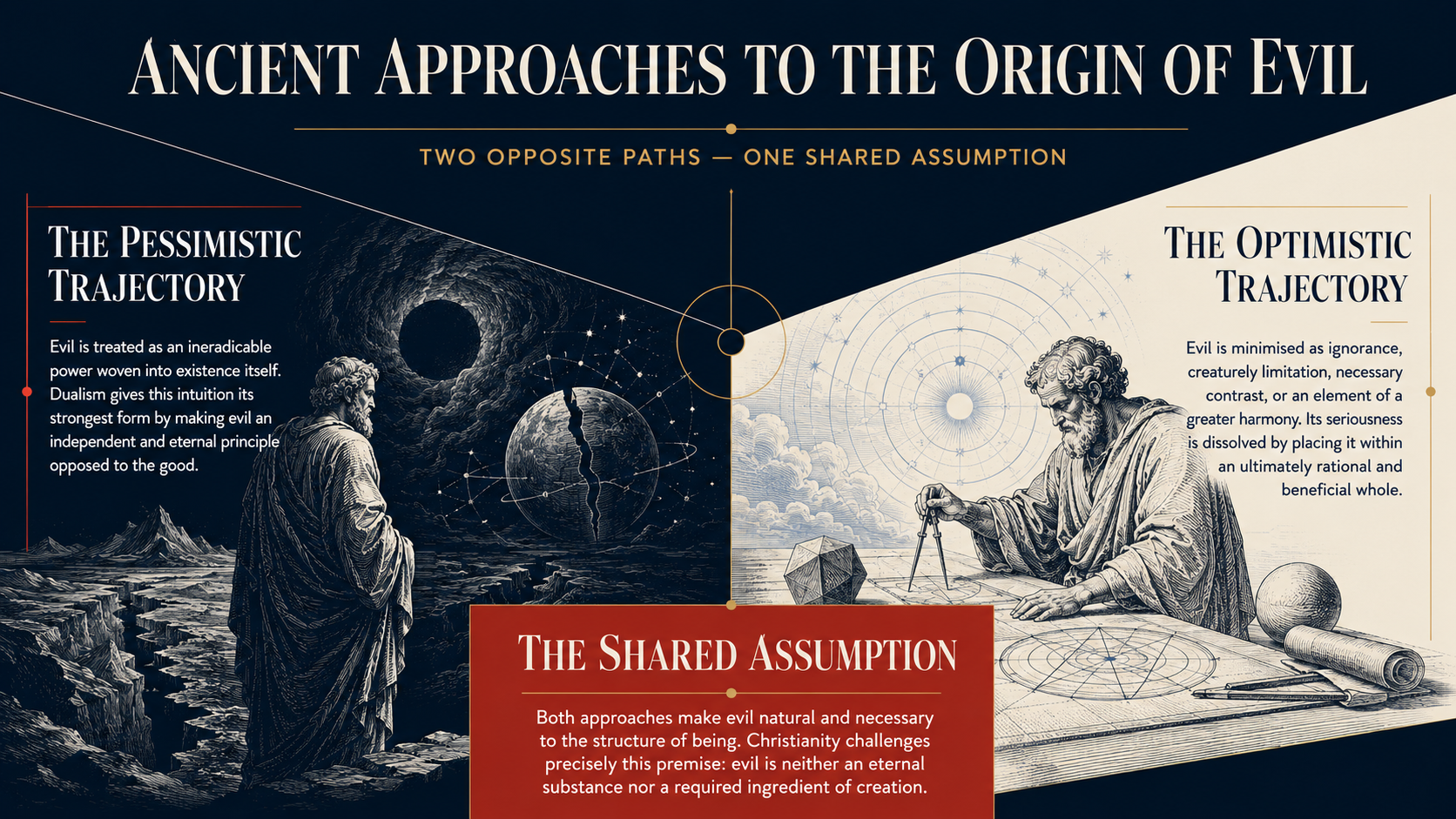
These two trajectories represent, in a sense, the two extreme poles between which ordinary human thought oscillates whenever it confronts the reality of evil and suffering. The pessimistic tendency exaggerates the power and necessity of evil, seeing it as an ineradicable feature of the structure of existence itself; the optimistic tendency minimises evil, seeking to dissolve its apparent seriousness by showing that it is, in some ultimate perspective, either illusory, necessary, or secretly beneficial. What is striking about both tendencies — however opposed they may appear on the surface — is that they share a common assumption: namely, that evil is in some sense natural and necessary, that it belongs to the fundamental order and structure of being. It is precisely this shared assumption that the Christian understanding of evil most fundamentally challenges.
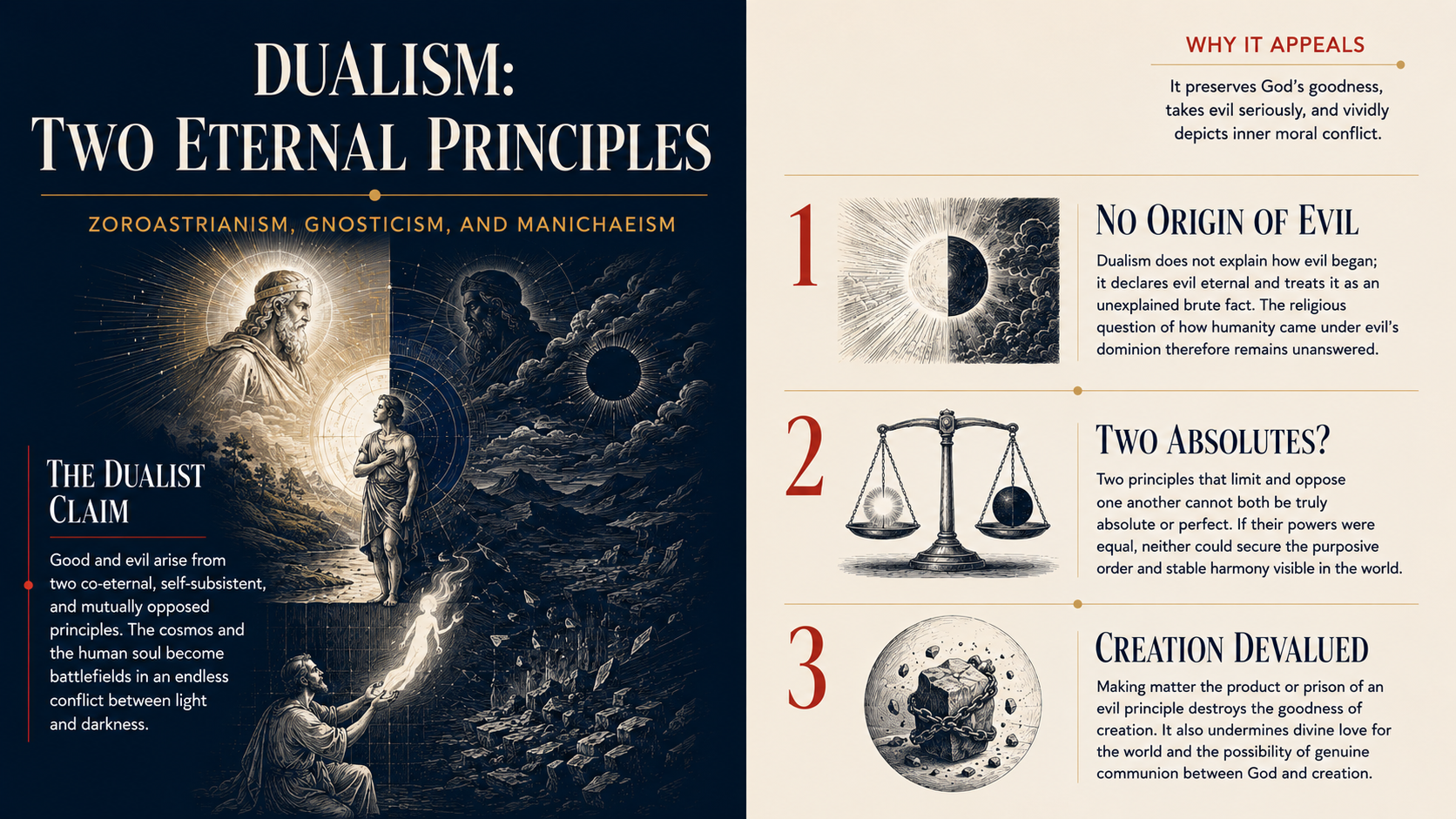
The pessimistic view found its most systematic expression in the theory of dualism. As the great nineteenth-century Russian philosopher and theologian Viktor Nesmelov observed, ‘the most widely trodden path along which ancient religious and philosophical thought made its attempt to explain the existence of evil in the world was undoubtedly opened by the dualistic representation of being.’ Dualism proposes that evil has its source in a self-subsistent principle independent of God — a primordial darkness or anti-divine force that is co-eternal with the divine light. The most historically significant expression of ethical dualism in the ancient world was the religion of Zoroaster, the reformer of ancient Persian religion, who taught that all the phenomena of cosmic life, both good and evil, are reducible to two co-eternal, self-subsistent, and absolutely opposed principles: Ahura Mazda (Ormuzd), the lord of light and goodness, and Angra Mainyu (Ahriman), the lord of darkness and evil. These two principles are engaged in eternal cosmic warfare, and the human soul is the battlefield on which their struggle is played out. Dualistic ideas of this kind found expression also in various Gnostic systems and, most influentially in the ancient Western world, in Manichaeism, the religion founded by Mani in the third century of the Common Era. The Manichaeans acknowledged the co-eternal existence of two hostile principles — the kingdom of God as the realm of goodness and light, and the kingdom of Satan as the realm of evil and darkness — and held that in every human person there inhabit two souls, a luminous and good soul and a dark and evil one. The human body, on this account, is not the glorious creature of a good God but the prison- house of a spirit that belongs to the realm of light; the fundamental task of the moral life is accordingly the liberation of the soul from the chains of matter.
The appeal of dualism is obvious. It preserves the goodness of God by positing an independent principle of evil against which God contends; it takes the reality of evil with complete seriousness, refusing to explain it away; and it provides a vivid account of the inner moral conflict that every reflective human being experiences in his own soul. But the fatal weaknesses of the dualist position are equally manifest. In the first place, dualism does not, in the proper sense, explain the origin of evil at all. It merely declares evil to be eternal, positing its existence as a brute, unaccountable fact. But the religious consciousness, as Nesmelov pointed out, is not satisfied with a mere declaration that evil has always existed; it needs to understand how the human person came to be under the dominion of evil, and why an omnipotent God could have permitted such a dominion to be established. In the second place, the concept of two co-eternal, self-subsistent, and absolutely opposed principles is incoherent from a strictly rational point of view. Neither of two mutually limiting and opposing principles can be truly absolute or truly perfect; each is constrained by the existence of the other. As the Russian theologian Butkevich argued, if we suppose the co-eternal existence of two equal and opposing principles — a good one and an evil one — then the purposive order and harmony of the world would be impossible, since each principle would perpetually frustrate the designs of the other. And in the third place, dualism is theologically ruinous: by making the material world the product of an evil principle, it destroys any meaningful sense of the divine love for creation and any possibility of genuine union between God and the world he has made.
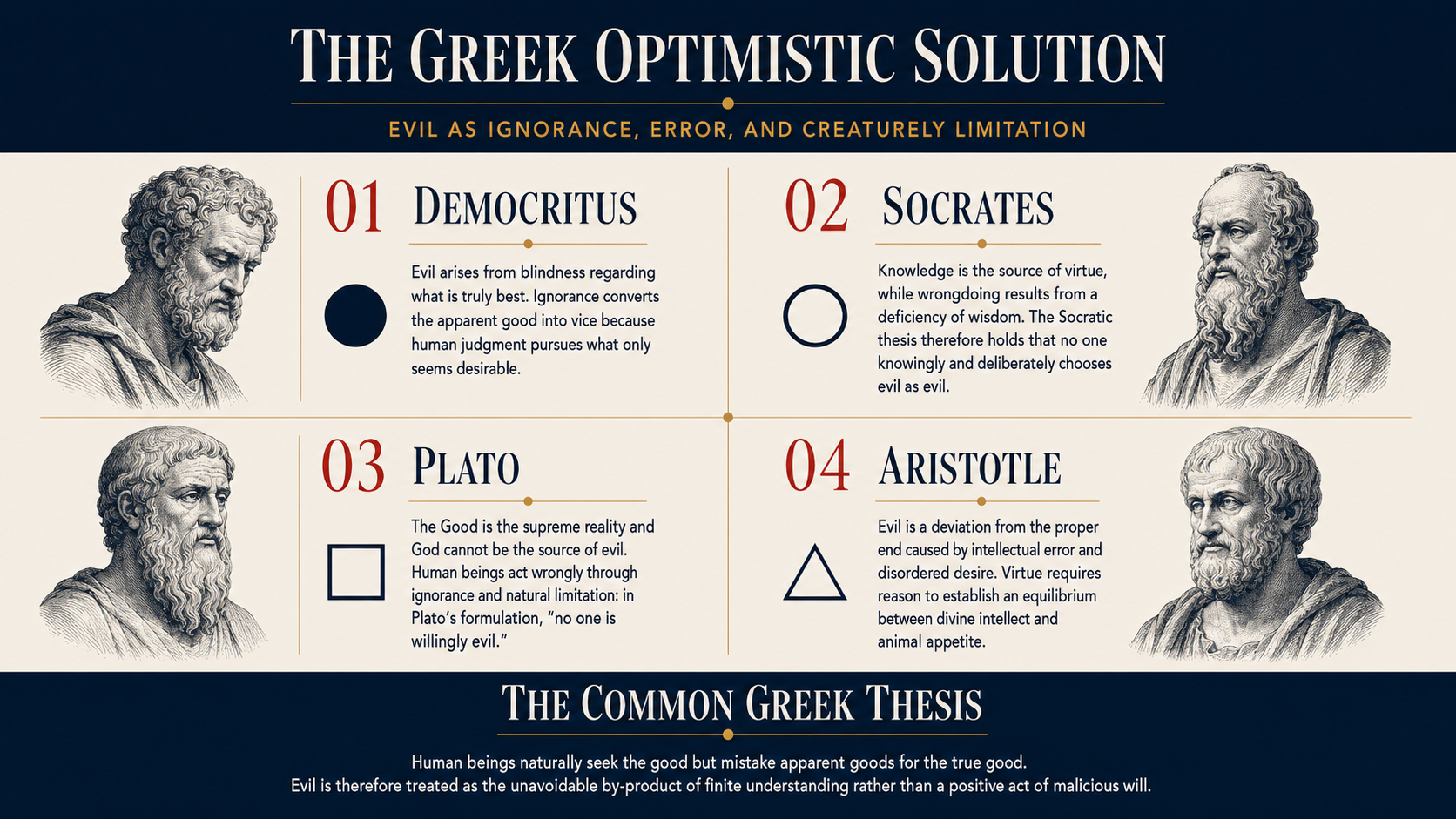
The optimistic trajectory in ancient thought found its classic expression in the philosophy of ancient Greece. For the great Greek philosophers, the radical opposition of good and evil as two absolute principles was unthinkable; the human intellect demands the unity of the absolute source of being. If God, as the source of the order existing in the world, is good and does not will evil, then the appearance of evil in the world is evidently contrary to his will. This gives rise to a dilemma: either God did not foresee the emergence of evil, or he was unable to prevent it — and in either case he is deprived of a divine attribute. The Greek solution to this dilemma was to deny the substantial opposition of good and evil and to affirm instead the natural necessity of evil: the existence of evil was interpreted as a consequence of the imperfection of the human intellect. The Greek philosophers held that by his nature the human person strives towards the good, but by reason of his limitations he can err and devote his energies to the pursuit of apparent goods, acting contrary to the divine will — but doing so not deliberately, since his error is born of ignorance rather than malice. Evil on this account is not truly evil; it is the inevitable by-product of creaturely finitude.
Democritus held that the cause of evil is ignorance of what is best: ‘the cause of the transformation of the good into evil Democritus located in the blindness of the human reason, in ignorance and unknowing of what is most excellent, regarding ignorance as the cause of all vices.’ Socrates held a closely related view: moral evil is the consequence of the human being’s not knowing the good, and of a deficiency of wisdom. The source of goodness, for Socrates, is knowledge, and the source of evil is intellectual ignorance. Plato defined the good as that which constitutes the object of the highest human striving, identifying the idea of the good as the primordial and supreme idea from which all else derives. God is identical with absolute goodness; Plato explicitly states that ‘God cannot be the source of evil.’ Evil has its foundation in the intellectual ignorance of human beings, connected with the natural limitations of human nature: ‘No one is willingly evil,’ he writes in the Timaeus. For Aristotle, evil is a deviation from the proper goal, arising through the error of the intellect; the intellect is therefore the principal condition of virtue, though because the animal energy in the human being is very great, a complete victory of reason over desire is unachievable, and even good people, according to Aristotle, merely achieve an equilibrium between the divine intellect and animal desire.
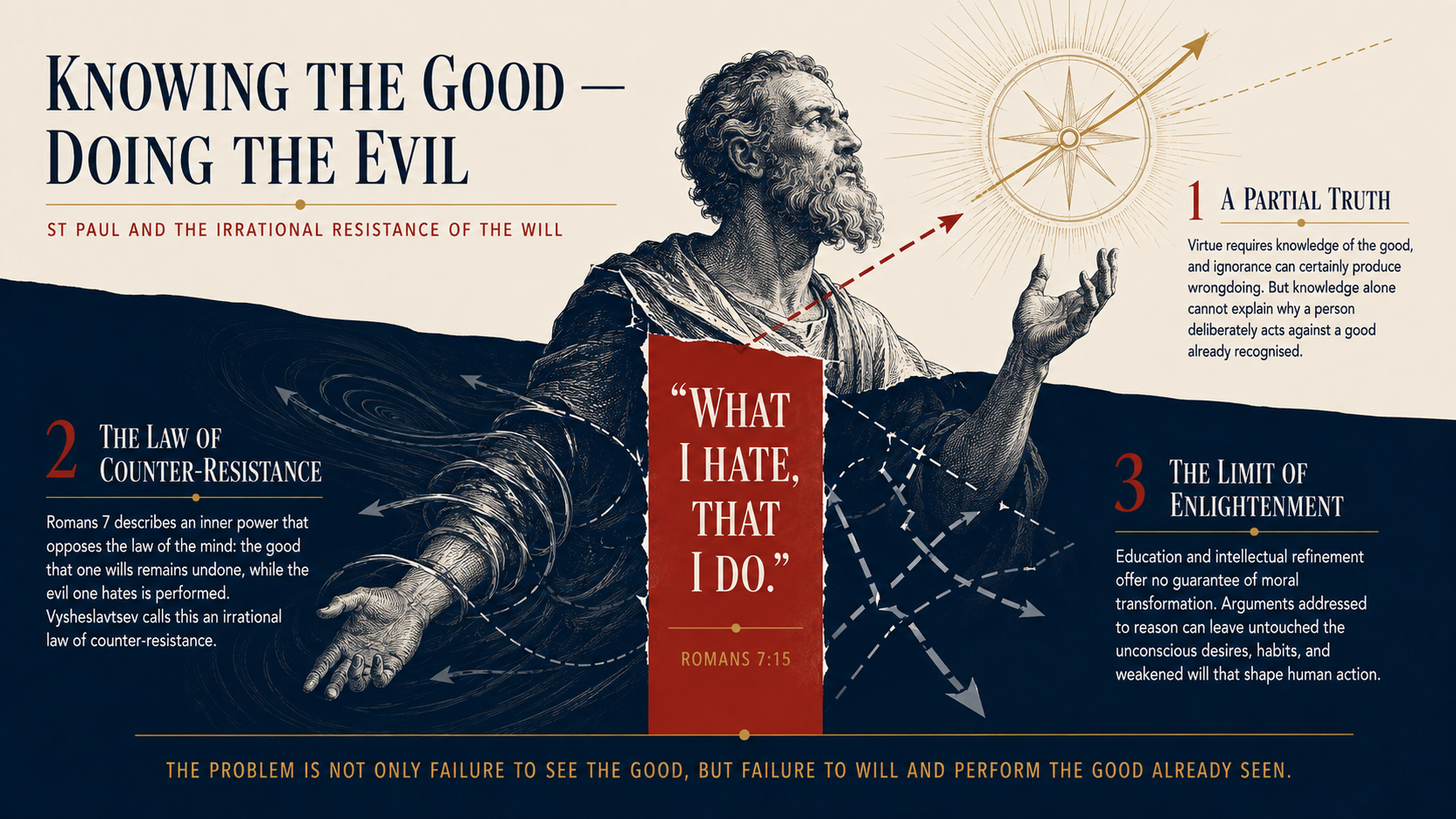
This theory — that evil is nothing more than ignorance of the good — has a certain genuine partial truth, and its appeal is understandable. Certainly one cannot be truly virtuous without some knowledge of the good, and the relationship between goodness and knowledge is indeed very intimate. Yet as a complete account of moral evil the theory is radically deficient. Its central weakness is that it entirely ignores the phenomenon that the Apostle Paul describes with such devastating precision in the seventh chapter of Romans: the irrational law of resistance that operates within the human person not against ignorance but against knowledge — ‘for I do not understand what I do: for what I wish to do, I do not do; but what I hate, that I do’ (Romans 7:15). ‘The good that I wish to do, I do not; the evil that I do not wish, that I do’ (Romans 7:19). The principal problem of the human condition, in other words, is not lack of knowledge about the good; it is the absence of the will and the strength to perform what one already knows to be good. The philosopher Boris Vysheslavtsev described this phenomenon as an ‘irrational law of counter- resistance’ — irrational precisely because it is opposed to and incomprehensible to the intellect itself. Enlightenment and intellectual development provide no guarantee of moral life; all moral knowledge, insofar as it addresses the intellect, leaves untouched the irrational unconscious and subconscious dimensions of the inner life of the person. This is the reality to which Paul points when he speaks of ‘another law in my members, warring against the law of my mind’ (Romans 7:23) — and a purely intellectual explanation of the origin of evil has no resources with which to address it.
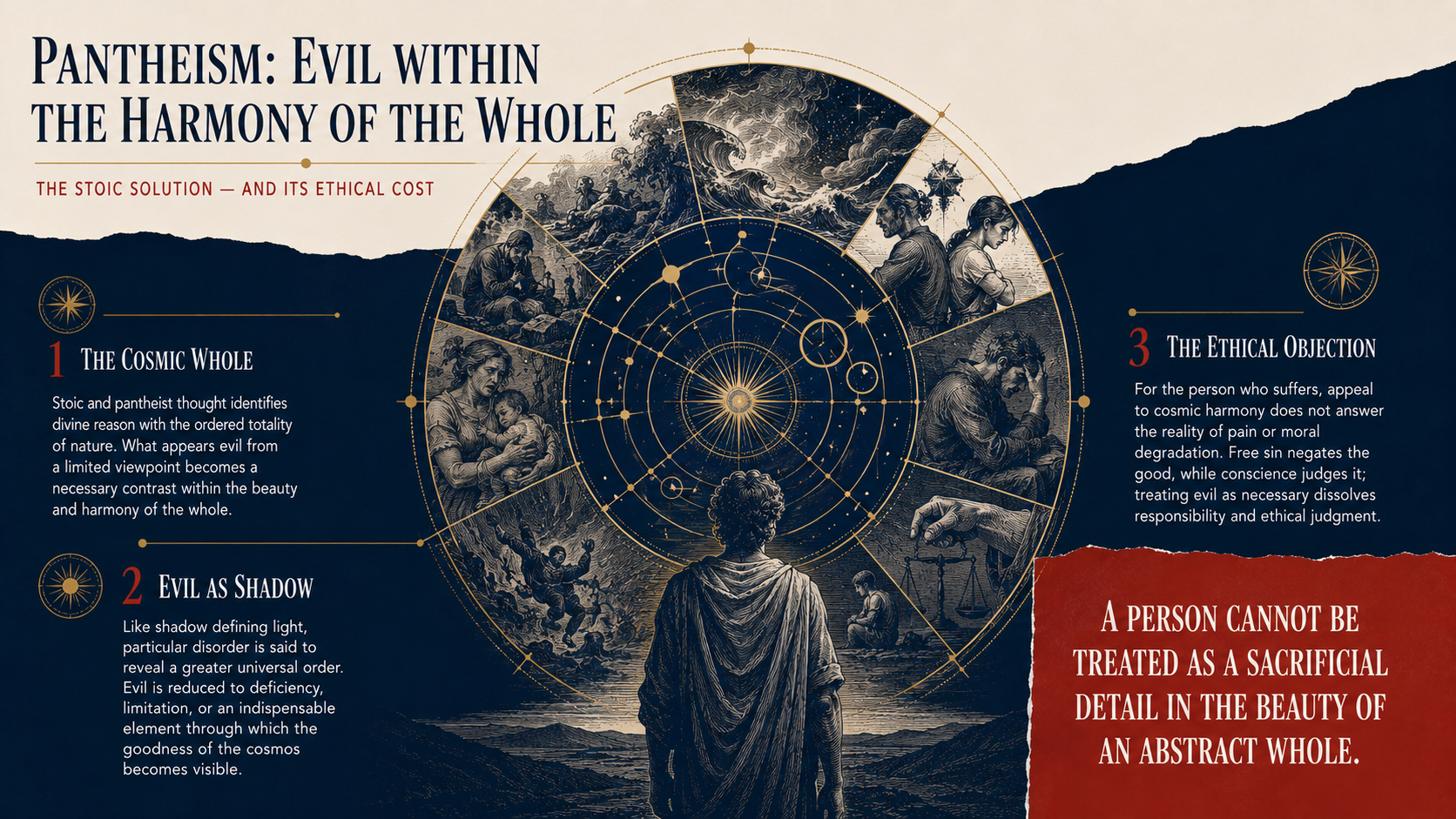
The optimistic trajectory also found expression in the pantheist solution, which represents a sustained attempt to minimise the significance of evil by absorbing it into the all-encompassing harmony of the whole. The pantheist tradition, whose roots in the ancient world go back to the Stoics, proposes that the world should be contemplated as a single harmonious whole — as cosmos, as order and beauty — and that what appears to us as evil is in reality simply a necessary element in the pattern of that whole. The Stoics identified the spiritual and the material, reason and nature, with the divine principle itself, and recognised in matter a force that they called the soul of the world. For the Stoics, evil is a necessary ingredient of the cosmic fabric, a kind of shadow that gives definition and depth to the light. Leibniz, as we shall see more fully in Part III, developed a sophisticated philosophical version of this insight: ‘evil is disorder in the particulars, revealing beauty in the whole; that is, good is set off by evil, of which there is nevertheless undoubtedly less. Evil is the shadow, so that the good stands out more sharply, just as darkness is merely the absence of light, and cold the absence of warmth. Evil is the deficiency of good.’ The fatal objection to all such accounts is practical before it is theoretical. When a human being is experiencing suffering from the negative impact of the surrounding world, it is entirely irrelevant to him that in so doing he is contributing to the harmony of cosmic being. One cannot accept sin as a condition of the good, because sin is the direct and resolute negation of the good; committed by the free choice of rational beings, it leads to the destruction of being itself. The voice of conscience, reproaching a person for sin and for moral degradation, becomes an inexplicable mystery on pantheist premises. The solution proposed by the pantheists eliminates all possibility of ethical judgment.
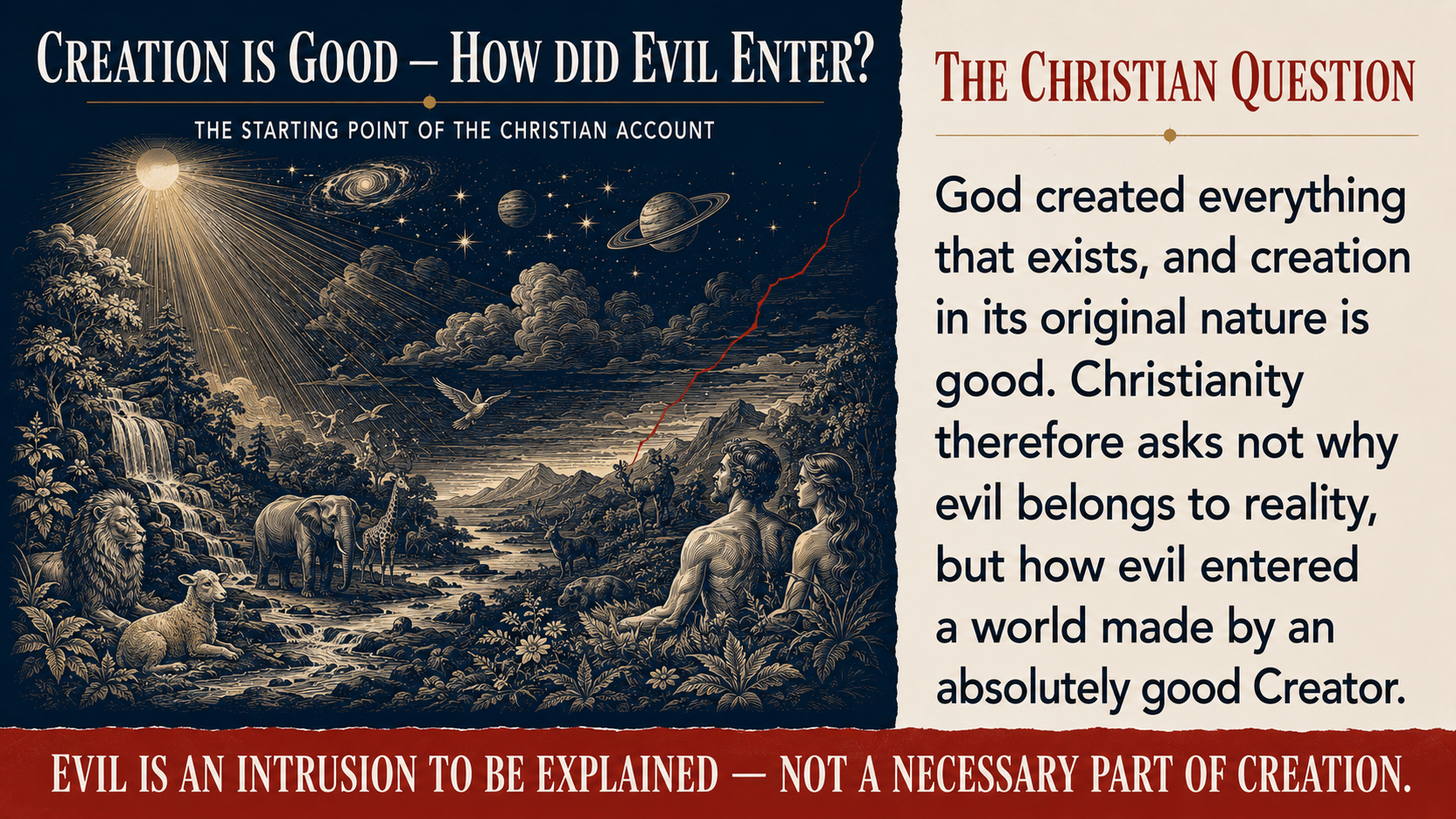
Христианское размышление о природе и происхождении зла начинается не с философской гипотезы, а с богословского убеждения: что всё сущее сотворено Богом, и что всё Божье творение, рассматриваемое в своей первоначальной природе, благо. Первые главы Книги Бытия торжественно повторяют это утверждение: «И увидел Бог, что это хорошо». Поэтому сразу же возникает вопрос не «почему существует зло?», а «как зло вошло в мир, сотворенный добрым?» — и именно на этот вопрос призваны ответить как повествование о грехопадении в Бытие 3, так и разрозненные, но ценные упоминания о первоначальном восстании ангельского мира (1 Тимофею 3:6; Иуде 1:6; Откровение 12:4, 9). Следует сразу сказать, что проблема зла в самом фундаментальном смысле является специфически христианской проблемой. Именно христианство, с его бескомпромиссным утверждением благости творения и абсолютной благости Творца, делает вопрос о существовании зла в мире столь острым и неотложным.
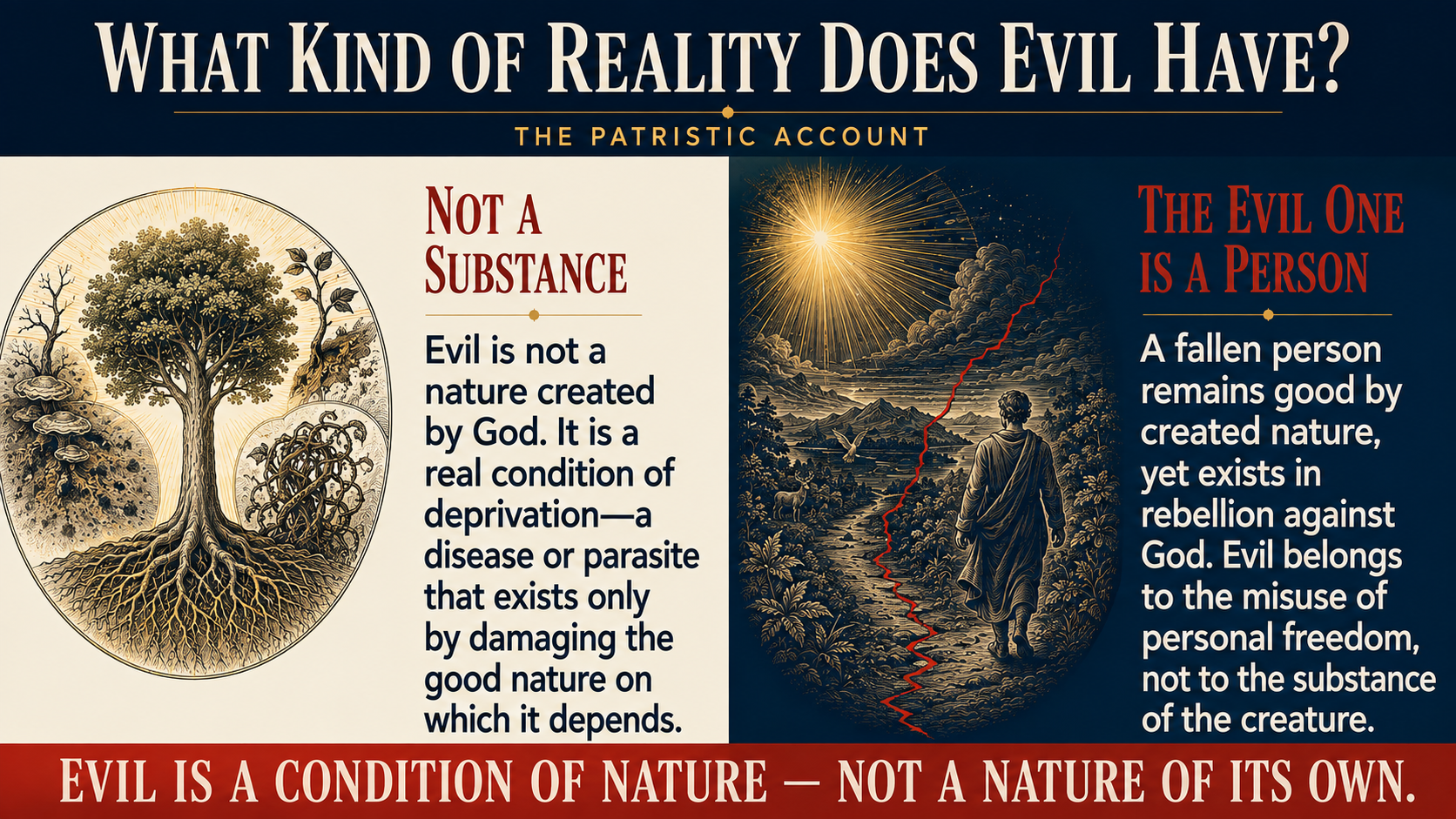
Понимание зла в Церкви, основанное на библейском тексте и развитое в патристической традиции, можно резюмировать следующим образом. Зло не имеет онтологического статуса как природа или субстанция; оно не существует в том виде, в котором существуют сотворенные вещи. Как уже утверждали великие каппадокийские отцы и, до них, Ориген и Климент Александрийский: «Всякое зло — ничто, хотя оно существует как небытие; добро тождественно бытию, и противостоит добру зло или плохое, как небытие противостоит бытию; из чего следует, что зло и плохое есть небытие». Дионисий Ареопагит выражал то же убеждение: «Зло участвует в завершении всего и обеспечивает целому способность не быть неполным». Зло, в патристическом понимании, — это не природа, а состояние природы — образ бытия или способ существования, в котором природа, лишенная своей надлежащей полноты, не соответствует тому, чем она должна быть. Это реальное состояние, и в этом смысле оно действительно существует — но существует оно, как заметил русский богослов Владимир Лосский, подобно болезни или паразиту, поддерживаемому лишь той природой, которой оно питается.
Молитва Господня, в которой в церковных прошениях рассматривается проблема зла в терминах «злого духа», дает здесь глубокую богословскую направленность. Злой дух, как отмечал Лосский, не может быть субстанцией или природой — ибо его природа, сотворенная Богом, должна быть доброй. «Злой дух» — это личность, кто-то, а не нечто. Таким образом, зло принадлежит к личностному измерению существования, а не к онтологическому: это состояние, в котором природа личностных существ существует в своем отношении к Богу как источнику бытия. Это состояние бунта против Бога, и его источник лежит в свободе сотворенных существ — в аномальной, неправильной, противоречащей воле Бога реализации их способности к самоопределению. Зло рождается только из свободы существа, которое его создает. «Зло — это нечто случайное, не субстанциальное — то, чего не должно было быть, что противоречит воле Божьей и что не вошло как конститутивная и необходимая часть в божественный план творения». «Это то, чего Бог не сотворил».
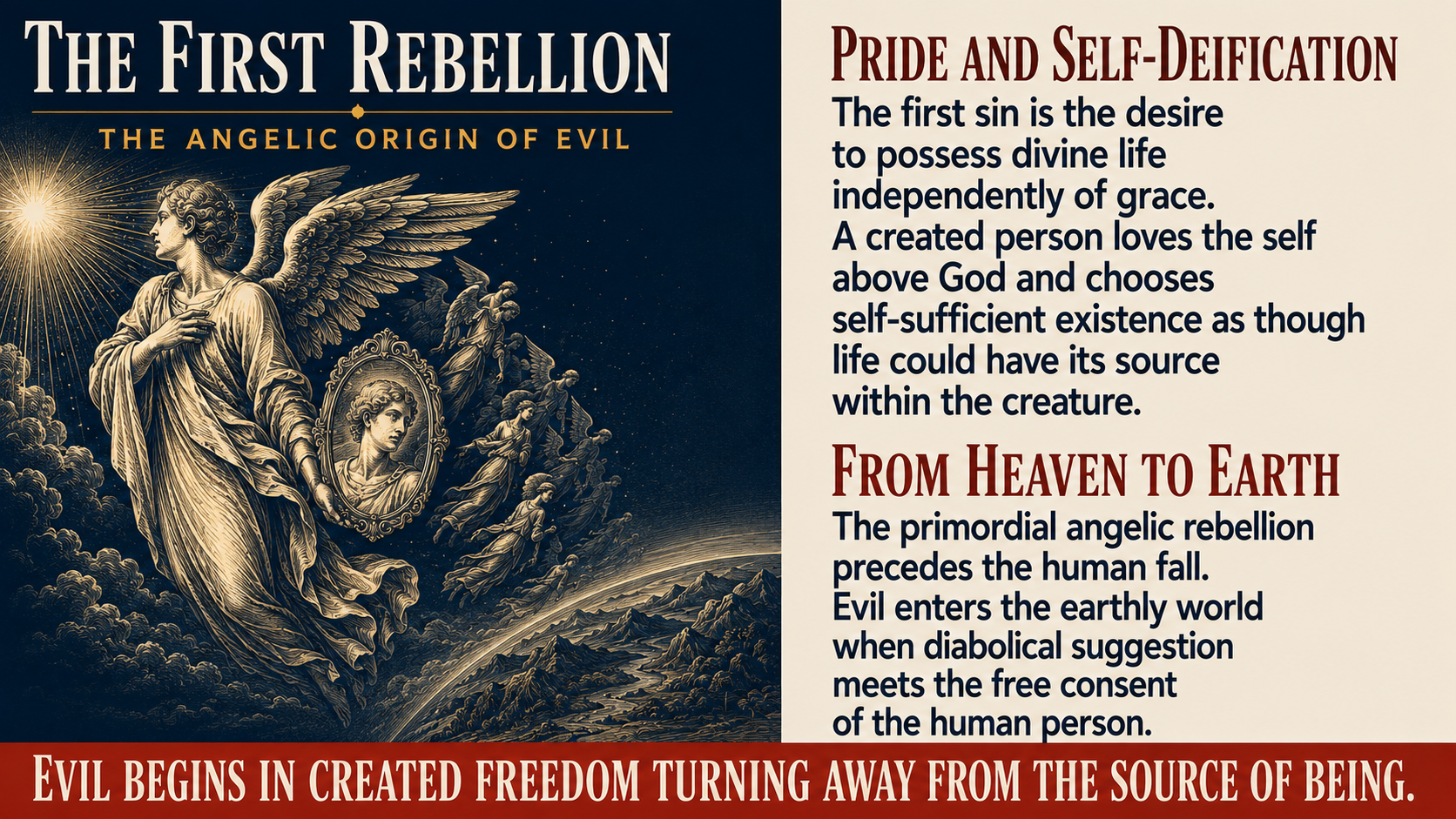
Священное Писание свидетельствует о том, что зло проникает в мир, в земной космос, через человека и с его свободного согласия. Но человек не выбирает зло самостоятельно или спонтанно: оно внушается ему дьяволом, падшим членом ангельского мира. Согласно библейскому тексту, зло берет свое начало в грехе одного ангела. Его источником была гордость — стремление к самодостаточности — и оно проявилось как бунт против Бога. «Призванный к обожению по благодати хотел стать Богом Самим Собою, от Себя; поэтому корень греха — жажда самообожествления, ненависть к благодати», — писал Лосский. Сатана, зная совершенство Бога, отверг Его по собственной воле, в результате любви к своему «я», которая была больше, чем должна была быть. Согласно свидетельству апостола Иуды и книге Откровения, Сатана своим примером привлек к себе треть ангелов, которые не сохранили своего должного достоинства и оставили свое истинное жилище. Драма, начавшаяся на небесах, нашла свое продолжение на земле в осознании дьявольской ненависти к сотворенному Богом существу — ненависти, направленной на его уничтожение и истребление.
Рассказ о грехопадении в Бытие 3 не следует рассматривать как простую мифологию. Это глубокое богословское повествование о структуре морального выбора и его последствиях. Чтобы понять природу первого греха, необходимо постичь смысл заповеди, данной первым людям относительно дерева познания добра и зла. Метафорический характер библейского повествования следует уважать: «вкусить» означало сделать что-то частью себя, включить это в свою жизнь. Добро и зло, о которых говорится в заповеди, — это не просто концептуальные противоположности, а два принципиально разных способа реализации человеческого существования, два пути жизни. Первый, добрый путь, — это путь единения с Богом, путь обожения — всё большее участие в полноте божественной жизни. Условием пребывания на этом пути единения с Богом через благодать является любовь, понимаемая как добровольное подчинение человеческой воли божественной воле. Второй, злой путь, — это способ существования, диаметрально противоположный первому. Этот путь основан на стремлении индивидуальной природы — природы, обладающей способностью к самоопределению, — найти свою собственную причину и цель бытия только внутри себя. Этот путь привлекает иллюзорной возможностью автономии и самообожествления. Когда дьявол говорит человеку: «Ты будешь как боги», он говорит полуправду — ибо и дьявол, и человек знают, что человек действительно призван к обожествлению. Но этот путь иллюзорен, потому что он ведет не к Богу, а к небытию: «за пределами божественного бытия — абсолютное ничто». Разрывая свою связь с Богом и выбирая путь самодостаточного бытия, человек отрывается от Источника жизни и, не имея источника жизни внутри себя, будучи творением и условным существом без причины или источника существования в себе, определяет себя к небытию и смерти.
Таким образом, христианское понимание зла принципиально отличается от всех философских концепций, рассмотренных в Части I. Оно отличается от дуализма тем, что настаивает на том, что зло — это не совечный принцип, а случайное отступление сотворенной свободы от ее истинной ориентации на Бога. Оно отличается от греческой интеллектуальной традиции тем, что настаивает на том, что зло — это не интеллектуальная ошибка, а личное моральное решение — решение, затрагивающее не только интеллект, но и всю личность, включая те глубины воли и желания, которые лежат ниже порога сознания и недоступны чисто когнитивным подходам, рекомендуемым греческими школами. Оно отличается от пантеизма и от версии космологического оптимизма Лейбница тем, что настаивает на том, что зло — это не необходимый элемент космической гармонии, а вторжение — нечто, чего не должно было быть, нарушение божественного плана, рана в ткани бытия, которая взывает к исцелению и искуплению, а не к оправданию. И оно отвечает на возражение, обвиняющее Бога в существовании зла, указывая на внутреннюю связь между свободой, любовью и личностью. Бог, Который Сам есть Личное Бытие и Который создает человека по Своему образу, не может создать подлинную личность, не наделив её способностью к самоопределению. Свобода — условие любви, а любовь — цель творения. Без свободы не может быть любви; без возможности отвержения Бога не может быть подлинного выбора Бога. Как писал русский богослов Зенковский: «Без свободы человек не мог бы быть личностью во всей полноте и силе своих качеств — он мог бы быть лишь высшим животным, живущим инстинктивно; только в свободе раскрывается наша воля, только на открытых пространствах свободы созревает в духе творчество идей, развиваются художественные, нравственные и религиозные движения. Но свобода — это свобода только тогда, когда она безгранична — в этом заключается её божественное подобие».
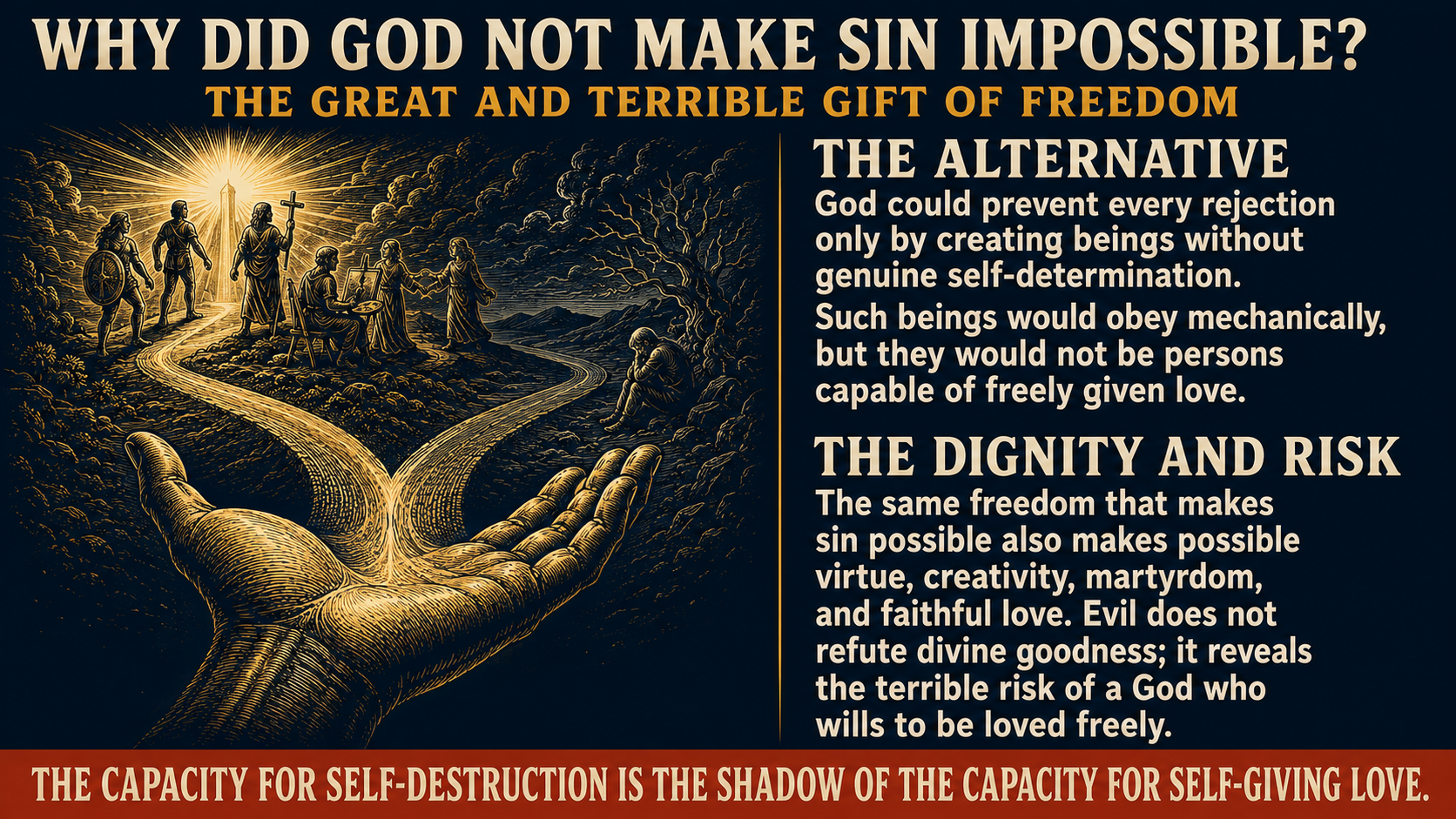
Этот ответ не лишен трудностей, и честный богослов должен их признать. Можно спросить: разве Бог, предвидевший падение Люцифера и грех прародителей, не мог сотворить ангелов и людей таким образом, чтобы зло и грех не могли возникнуть? Ответ таков: не мог, не сотворив существ, которые не являются подлинно личностными, а следовательно, не являются подлинно по образу Божьему. Личностное бытие обязательно подразумевает способность к самоопределению; эта способность обязательно подразумевает возможность выбора зла как альтернативы Богу. Дар свободы одновременно велик и ужасен — велик потому, что он делает возможной подлинную любовь и подлинную добродетель, ужасен потому, что он несет в себе способность к самому радикальному саморазрушению. Но даже ужасающее измерение свободы относится к достоинству личности, а не к ее унижению; это та же самая способность, которая, будучи правильно направлена, делает возможными святого, мученика и любящего родителя. Поэтому присутствие зла в мире не является опровержением Бога, который добр и могущественен; Это следствие того, что Бог желает, чтобы Его любили свободно, а не служили Ему механически.
The history of theodicy in the Western philosophical and theological tradition can be read as a succession of attempts to provide a rationally adequate account of why a perfectly good, perfectly powerful, and perfectly knowing God should have created — or permitted — a world containing the evils we actually observe. Four broad explanatory models have dominated this history, and it will be useful to examine each in turn before considering the most important contemporary contributions.
The first and most foundational model is what we may call the privation theory of evil, classically formulated by Augustine of Hippo. Augustine’s theodicy moves along two axes — metaphysical and aesthetic. The metaphysical axis holds that evil has no positive ontological status: it is not a being or a substance but a privation of good, a deficiency of the being that a thing ought to possess in order to be fully what it is. Just as blindness is not a thing but the absence of a capacity that properly belongs to a seeing creature, so evil is the absence of the goodness that properly belongs to the being in question. ‘What else is that which is called evil but the privation of good?’ Augustine asks in the Enchiridion. ‘As in the bodies of living creatures diseases and wounds mean nothing other than the deprivation of health (and the self-healing process aims not at transferring the evil that has entered the organism to some other place, but at destroying it completely), so various kinds of damage to the soul exist as the deprivation of natural good… Where there is no good at all, there can be no evil.’ The aesthetic axis holds that evil in the created order, though genuinely negative considered in itself or from a limited human perspective, serves within the comprehensive picture of the whole to set off and enhance the beauty of the good — as shadow defines the form that receives the light, or as the dissonance in a musical composition deepens the resolution into harmony. On this account, sin and vice, though bad in themselves, exist in order to strengthen faith and virtue, and for this purpose God permits their arising.
The Augustinian account is immensely influential and contains genuine insight. The insistence that evil is non-substantial — that it has no positive ontological foundation but is always and only a diminution or corruption of something that is in itself good — protects both the absolute goodness of God as Creator and the genuine goodness of the created order. It appears in the Eastern theological tradition as well as in the Latin West: the Cappadocian Fathers, Pseudo-Dionysius, and the entire patristic heritage affirm the non- substantiality of evil. The Russian thinker Lev Karsavin, in his essay ‘On Good and Evil,’ expresses the same conviction with philosophical precision: ‘There is no evil; it does not exist in the most exact and absolute meaning of the word. Therefore even the concrete evil that confronts us in life, if it exists, can only be an insufficient good, revealing its insufficiency through comparison with the fullness of good.’ And yet the purely privative account of evil faces a serious objection, identified by the philosopher Andrei Guseinov: if evil is acknowledged as the deprivation of good, it loses its dynamic character, its existential reality, becoming merely a pale shadow of the principles of being. The problem of the actual significance of evil as something genuinely existing among other existing things, its actuality as the undeniable competitor of the good, remains unresolved.
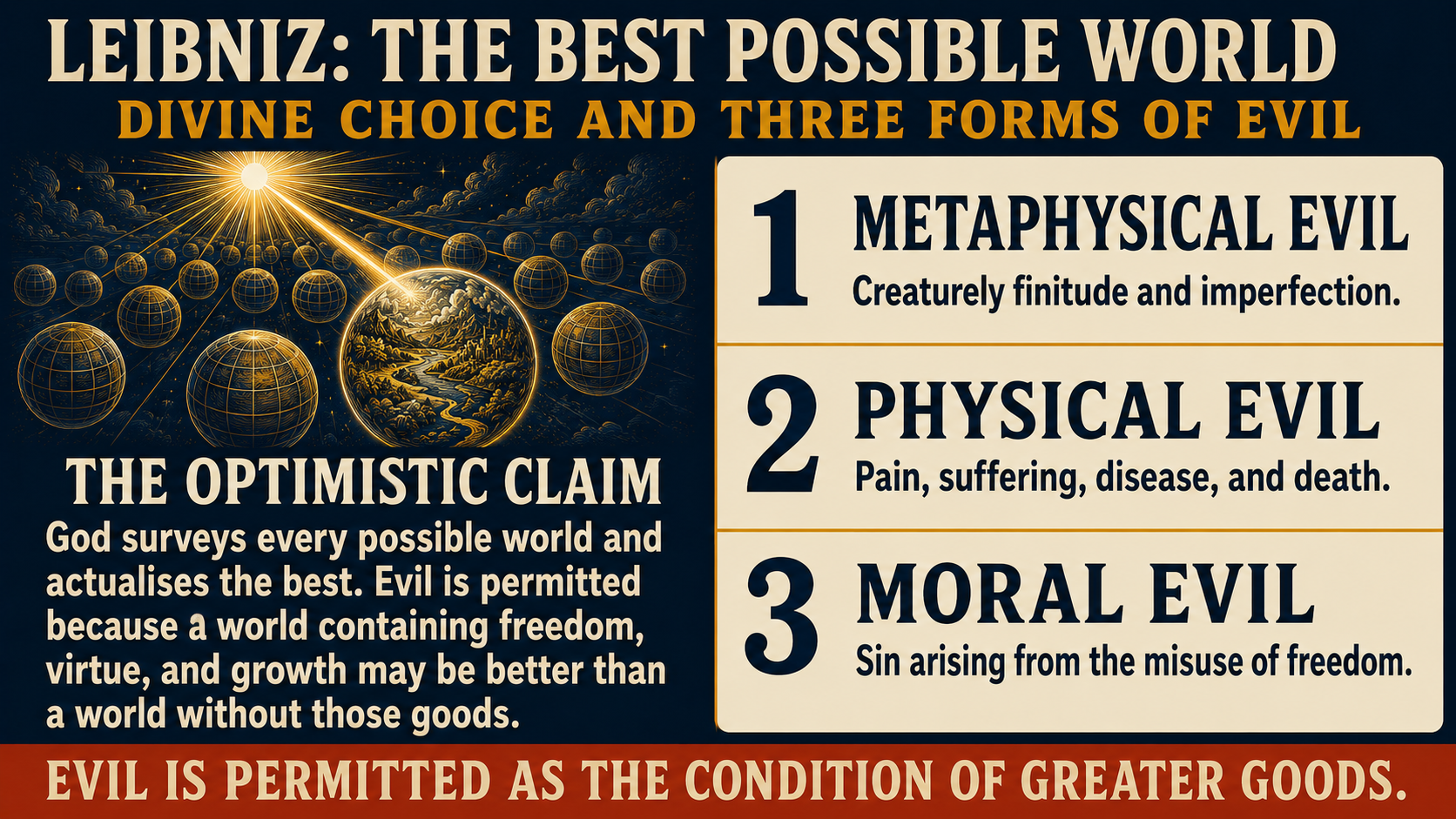
The second great model of theodicy in the Western tradition is associated with Gottfried Wilhelm Leibniz, who coined the term ‘theodicy’ in his treatise of 1710. Leibniz’s approach is essentially optimistic: he seeks to show that the existence of evil in the world is not only compatible with divine perfection but is actually necessitated by it, in the sense that a world without any evil would be a lesser world than the one God in fact created. God, in Leibniz’s scheme, surveys all possible worlds before creation, selects the best possible world to actualise, and creates it. The world we actually inhabit is therefore, despite all appearances to the contrary, the best of all possible worlds. Evil exists in it in three forms: metaphysical evil, which consists in the simple imperfection or finitude of created things; physical evil, which consists in pain and suffering; and moral evil, which consists in sin. Metaphysical evil is strictly unavoidable: any created world, however excellent, will fall short of the infinite perfection of God, since if a created world were equal in perfection to God, it would simply be God, not a distinct creation at all. Physical and moral evil, while not strictly unavoidable, are permitted by God because their presence in the world is the condition of greater goods that could not otherwise be realised — among them, above all, the goods of genuine freedom, moral virtue, and spiritual growth. Evil is not, for Leibniz, the negation of good but its deficiency, a lesser degree: ‘Evil is the shadow that makes the good stand out more sharply, just as darkness is merely the absence of light, and cold of warmth. Evil is the deficiency of good.’
Leibniz’s theodicy was subjected to devastating critique in his own century — famously by Voltaire in his poem on the Lisbon earthquake of 1755 and in the satirical novel Candide (1759), and more philosophically by Immanuel Kant in his essay ‘On the Failure of All Philosophical Attempts at Theodicy’ (1791). Three principal objections must be noted here. First, as was argued in Part I of this lecture, the concept of limitation by itself does not imply the necessity of evil. A limited thing can possess its own proper perfection — limited and relative, but real — consisting in the correspondence of the thing to its purpose and destiny. The true cause of moral imperfection is not ontological limitation but the perversion of the will. Second, good and evil are not quantities that differ only in degree but realities that are mutually exclusive in kind: evil always reveals an evil will, an orientation opposed to and negating the good; there is no smooth transition from evil to good if the difference is merely quantitative. Third, and most forcefully, as Kant argued, to justify evil as the consequence of the imperfection understood as limitedness of the human person is to justify every kind of evil whatsoever. God in that case remains ultimately responsible for evil — since he is, first, the one who permits evil; second, the one who is the source of the human person’s limitedness; and third, the one who himself turns out to be limited and contradictory, since he cannot realise any purposes without the permission of evil. The Russian philosopher Boris Vysheslavtsev also criticised the Leibnizian theodicy as borrowed from Stoic cosmology, arguing that any theodicy that excludes the dimension of tragedy — that builds the cosmic good upon the sufferings of individuals — reduces the justification of God to ‘vulgar optimism,’ in which the juridically conceived relationship between God and creation is arranged by means of the necessary quantity of sufferings.
The third model — which has dominated modern analytical philosophy of religion — is the free will defence, developed in its most rigorous contemporary form by Alvin Plantinga. Plantinga’s contribution is both analytical and theological. He begins by distinguishing between a ‘defence’ and a ‘theodicy’: a defence seeks only to show that the existence of evil is logically compatible with the existence of an omnipotent and perfectly good God; it does not attempt to explain why God permits evil, only to show that there is no logical contradiction between theism and the reality of evil. A theodicy, by contrast, attempts to provide actual reasons why God might permit evil. Plantinga acknowledges that the epistemic distance between God and the human person means that we shall never be able fully to understand the divine reasons for permitting evil; he therefore focuses primarily on the logical compatibility question. His argument runs as follows: God, being perfectly good, wishes to create free beings capable of genuine moral virtue and genuine love. Genuine freedom implies the real possibility of choosing evil; a world of beings who are mechanically determined to always choose the good would contain neither genuine freedom nor genuine virtue. It is possible — indeed, more than logically possible — that every world God could have actualised that contains free beings would also contain moral evil. If this is so, then an omnipotent God cannot create a world of free beings that contains no moral evil; the apparent paradox resolves itself.
Plantinga’s own positive proposal for a theodicy draws on the Christological tradition of felix culpa — ‘happy fault’ — associated in the Latin liturgical tradition with the Easter Vigil. The argument is that the world we actually inhabit, a world that includes the Incarnation and Redemption of the eternal Son of God, is a world of incomparably greater value than any world that might have existed without the Fall and without the need for redemption. ‘Can we even imagine something that surpasses this divine love?’ Plantinga asks, referring to the kenosis of the Incarnation, the suffering of the Cross, the acceptance of God-forsakenness to the point of death, and the Resurrection that conquers death. In a world that contains the Incarnation and the Redemption, the aggregate of divine goodness exceeds any possible aggregate of evil — because the value of the Absolute is incommensurable with the value of created things. If God actualises a genuinely good possible world, he creates a world of Incarnation and Redemption, which necessarily contains evil, since without evil there is no need of salvation from the Fall, and without that need there is no Redemption. Thus evil and sin are necessary conditions of the most perfect world. Plantinga acknowledges three objections to his own proposal: why does God permit the evil of sin? Why does God permit so much suffering and evil? And does not God’s manipulation of events through evil treat human persons as mere puppets? He responds that free beings have the freedom to create evil, that suffering serves a formative role in moral development and preparation for eternal life, and that following Christ through suffering is the condition of sharing in his Resurrection.
The fourth major model is the soul-making theodicy associated most prominently in the modern period with John Hick, and drawing inspiration from the second- century theologian Irenaeus. Hick observes that two quite different theodicy traditions have existed in Christian thought. The Augustinian tradition, dominant in the West, sees the Fall as the catastrophic corruption of an originally perfect creation, and understands redemption as the restoration of that original perfection. The Irenaean tradition, more prominent in the Greek East, sees creation not as originally perfect but as originally immature — as a beginning rather than a completion. Human beings, on this account, are created not as fully formed moral and spiritual beings but as beings possessing the image of God who must develop and grow, through the exercise of freedom in a world containing genuine challenges and genuine moral hazards, into the likeness of God. Suffering, conflict, and moral struggle are not therefore accidents to be regretted but the necessary conditions of genuine moral and spiritual formation. A world without pain, without moral challenge, without the friction of genuine resistance, would produce not virtuous beings but comfortable ones — beings who had never been required to choose, and who therefore lacked the depth and solidity of character that only struggle can produce. The process of soul-making requires a world that is genuinely difficult, unpredictable, and sometimes terrifying. The vast extent of natural evil — earthquakes, disease, predation, death — is not an aberration but a feature of the kind of environment in which genuine persons can be formed.
Richard Swinburne, approaching the problem from a perspective that is both theistic and empirical, distinguishes between natural evil and moral evil, and argues that the core of any theodicy must be the free will defence as applied first to moral evil and then, by extension, to natural evil. He argues that the freedom of the will as a responsible human choice between good and evil necessarily implies the natural — that is, not previously determined — possibility of evil. Such freedom he regards as a great good for the human person, because it opens for him the possibility of influencing his own future, the future of those close to him, and the future of the world. God, like a good father, delegates responsibility to the human person so as to allow the creature to participate in creation. Swinburne also makes the important observation that the sufferings a person experiences do not necessarily represent loss alone and can have a positive effect, since everything good in life is not exhausted by sensory pleasures, nor everything bad by physical pain. Suffering can arrest a person in the course of the wrong realisation of his freedom. According to Swinburne, the problem of evil becomes so acute primarily because of the prevalence of a hedonistic type of thinking in the contemporary world.
Chad Meister, in his extensive engagement with contemporary atheistic arguments against theism grounded in the abundance of evil and suffering in the world, offers important observations on the argument from evil as formulated by John Mackie. Mackie’s argument runs: a perfectly good being always eliminates evil as far as it is able; for an omnipotent and omniscient being there are no limits to this capacity; therefore such a being eliminates evil completely; but evil has not been completely eliminated; therefore such a being does not exist. Meister challenges the first premiss, which demands that God eliminate the free will of rational created beings who abuse it — but such a demand is internally contradictory, presupposing incoherence in God’s own action. Meister also makes the notable point that the problem of evil is not exclusively a Christian problem: it confronts representatives of the atheist worldview as well, and the latter are scarcely in a better position. For the theist, the existence of evil presupposes the existence of objective moral values, which have firm metaphysical foundations. Therefore for the theist evil is merely a deviation from the norm and a disruption of the order of being — but simultaneously an affirmation of what it violates. Correspondingly, the position of one who stands before the temporary silence of God differs greatly from the hopeless position of one who hears only the eternal silence of the blind universe.
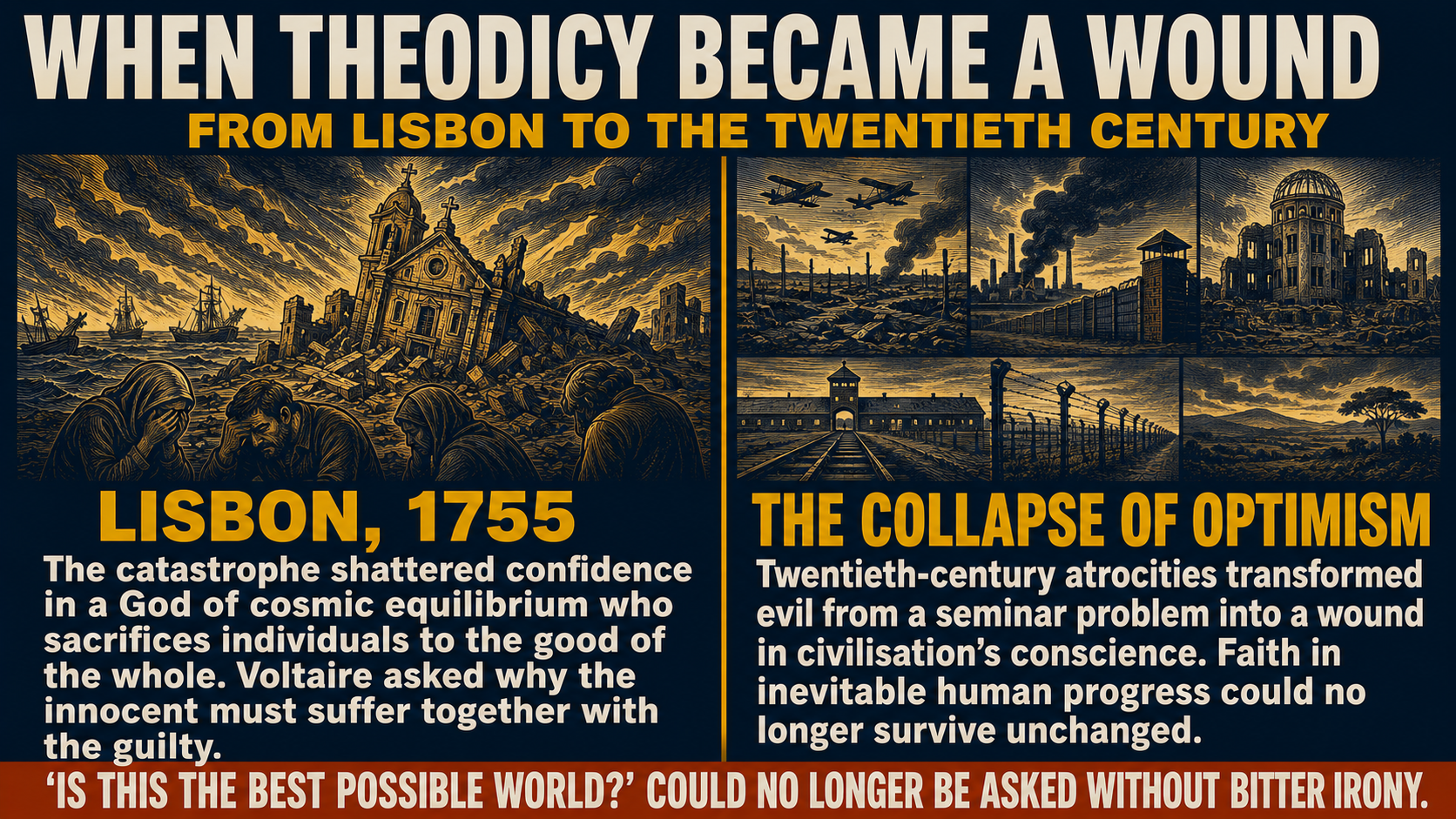
The problem of theodicy did not remain a purely academic question in the twentieth century. It became a wound in the conscience of civilisation. The two World Wars, the Holocaust, the Gulag, Hiroshima and Nagasaki, the Rwandan genocide — these events presented the problem of evil not as a logical puzzle to be solved in the seminar room but as a reality of almost incomprehensible proportions that shook the faith of believers and hardened the convictions of atheists. The collapse of the optimistic faith in human progress that had characterised the late nineteenth century — Leibnizian optimism transposed into a secular key — meant that the question ‘is this the best of all possible worlds?’ could no longer be asked without a bitter irony that no philosophical argument seemed adequate to address. As the Russian Orthodox theologian Sarkis Sanayants has observed, antiquity and the Christian classical tradition did not attach to the problem of evil the significance it has acquired since the second half of the twentieth century. The moral and ontological aspect of evil, though it raised questions, could safely be answered in the spirit of St Basil the Great: only the evil generated by the freedom of human choice is genuinely evil; other kinds of evil are not evil in themselves. After the collapse of the humanistic hopes for a new world, caused by two world wars, theologians and philosophers began to ask in Leibniz’s manner: do we live in the best of possible worlds? How is it possible to believe in the God proclaimed by Christians and at the same time permit the presence of such a quantity of suffering, given that the Lord is endowed with omnipotence and absolute goodness?
The Lisbon earthquake of 1755 had already, in the preceding century, given a powerful impetus to the critical reassessment of traditional theodicy. This catastrophe, which killed between thirty and forty thousand people on All Saints’ Day as they worshipped in their churches, produced an immediate and anguished debate in the European intelligentsia. Voltaire’s bitter poem on the disaster asks: ‘When the Creator so good, why does the creature suffer?’ Giving no clear answer, he concludes: ‘The all-perfect cannot have produced evil.’ The deistic understanding of God as completely good and yet uninvolved in this catastrophic evil is, as the American theologian David Bentley Hart has argued, in certain respects more evangelical than it appears: Voltaire is not destroying the theistic faith of the Gospel but the faith of deism, in which God is the god of cosmic equilibrium who prefers the good of the whole to the good of the individual. Voltaire asks with particular force a question that remains unanswered to this day: ‘Why must the innocent, bound together with the guilty, bow down before universal and sovereign evil?’ All this testifies to the fact that in the middle of the eighteenth century the problem of theodicy comes to the fore and receives no coherent answer in the West.
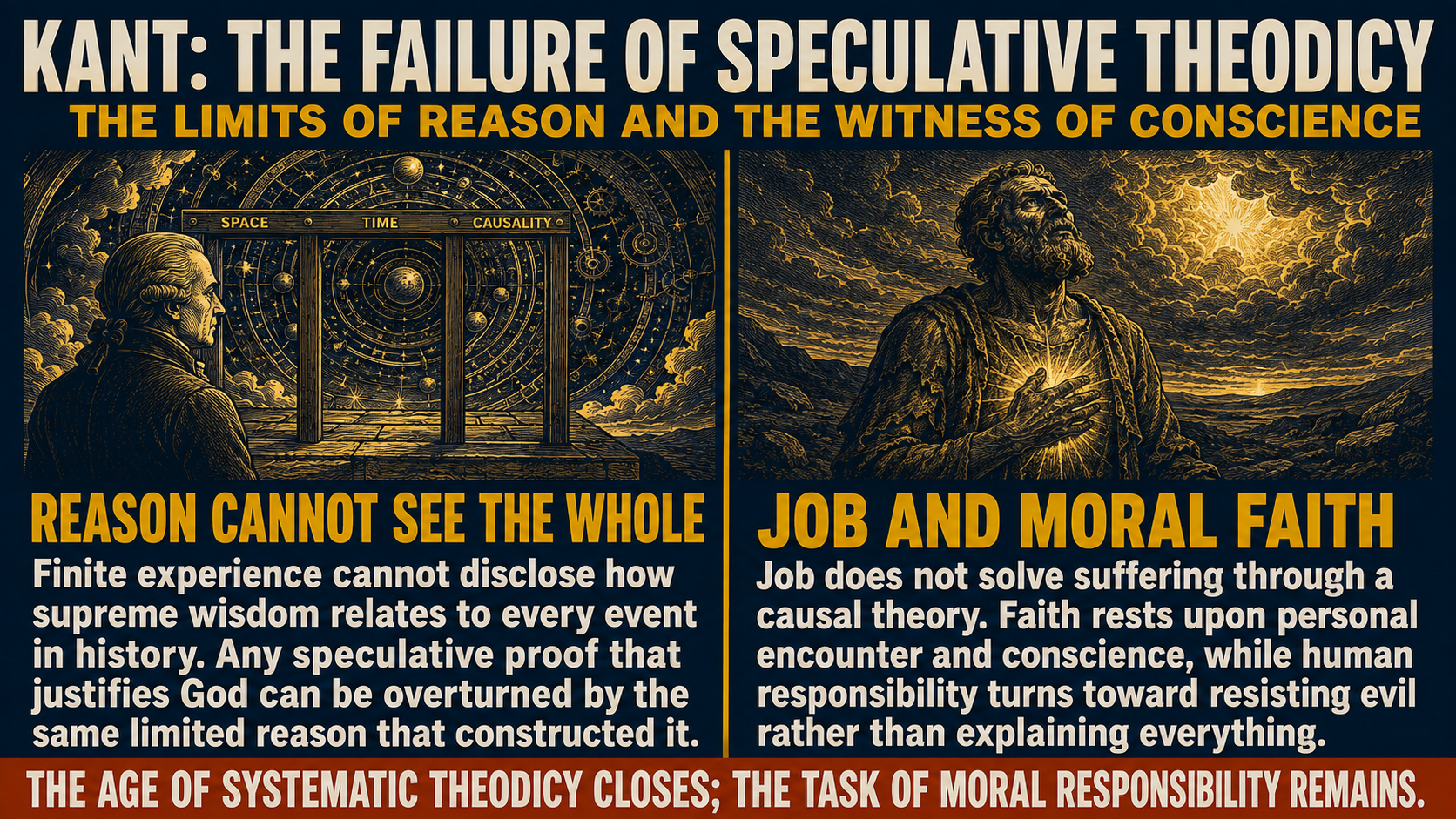
Immanuel Kant, who subjected all previous attempts at theodicy to a devastating critique in his essay of 1791, argued that the human reason, operating within the conditions of space, time, and our own perceptual limitations, cannot construct any theodicy capable of withstanding rational objection. Our experience, bounded by the categories of the understanding and by the limits of finite perception, cannot provide any adequate account of the connections between Supreme Wisdom and what happens in this world. The very attempt to demonstrate, by means of speculative argument, that God’s wisdom and goodness are compatible with the presence of evil in the world necessarily fails, because it can always be overturned by the same reason that made the attempt. Only one biblical book gives a genuine answer to the question of theodicy — the Book of Job — in which the sufferer grounds his faith on personal experience and on the testimony of his own conscience. Ethics, for Kant, is primary: the conscience is the key to the resolution of the problem of suffering, and in submitting oneself to its guidance one can work towards the elimination of evil in the world. Kant’s verdict on theodicy, as the historian of philosophy K. Geyer observed, ‘closes the age of theodicy,’ making the very question of seeking causes and answers senseless by reason of the limitations of our intellect. The accent shifts to the human person, who henceforth becomes responsible for all the evil happening in the world. The hope in God as a saving principle is lost; it yields to another active subject in the struggle against evil — the human person, who is called to co-operate in the realisation of divine justice in the world. The divine is gradually reduced to the human, which subsequently leads to the ideas of ‘God is dead’ in Hegel and Nietzsche.
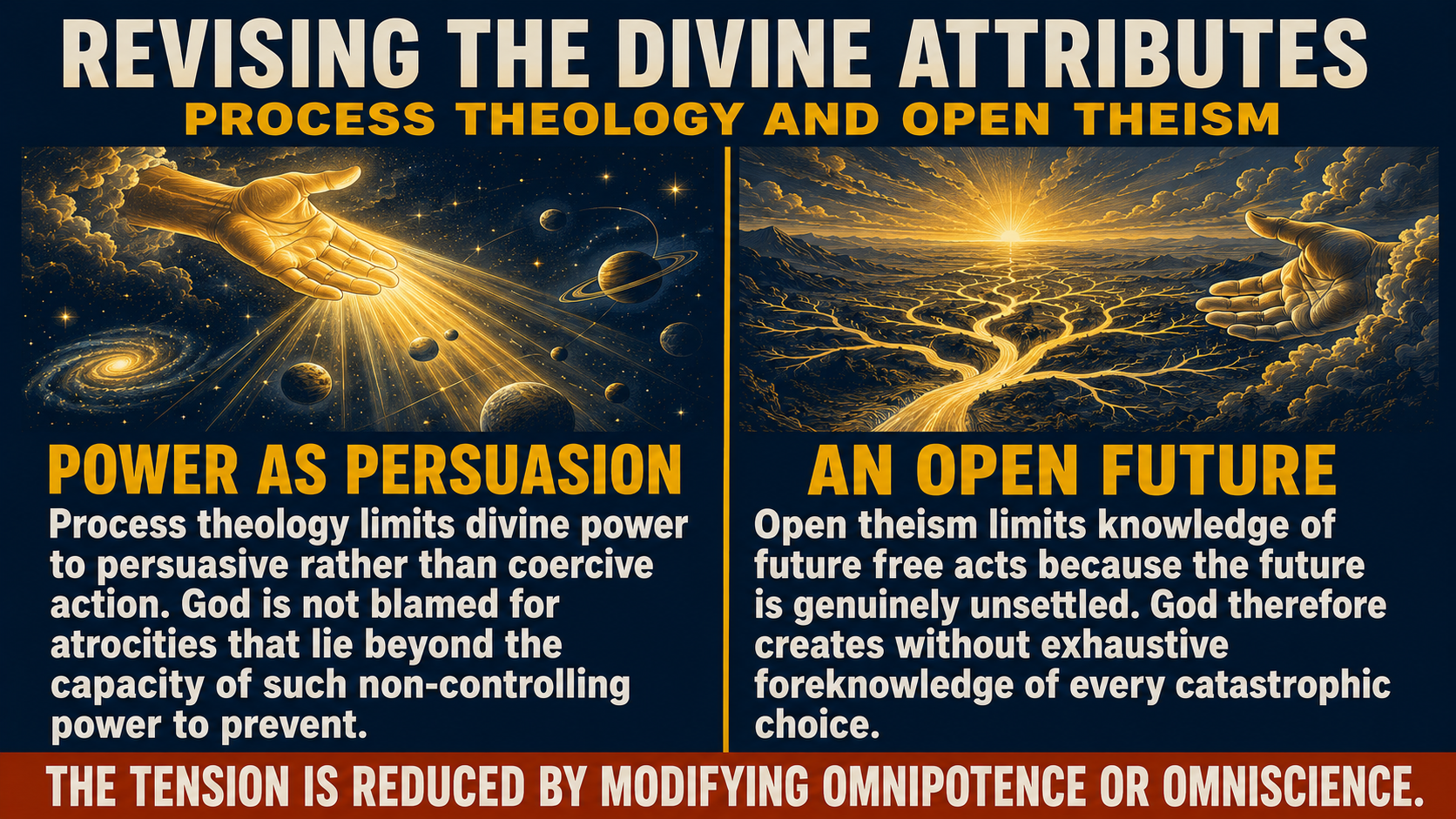
The twentieth century, using certain developments in philosophy from previous centuries, subjected the classical representations of the divine attributes to radical revision in the light of theodicy. ‘Process theology’ and the ‘theology after the Holocaust,’ present in both Christian and Jewish intellectual environments, represent one prominent example of this revisionary project. The interest in the divine nature and its attributes is prompted above all by the problem of evil, since the divine attributes — omnipotence, omniscience, impassibility — are directly connected with the question of God’s relation to the world. Is our understanding of these qualities adequate? Can we speak of the Creator as an unchanging, impassible Absolute, capable of looking down impassively from the heavens at the thick empirical reality of the world’s evil, thereby removing from himself the charge of responsibility for what is happening? Contemporary process theologians, open theists, and proponents of the theology of the ‘suffering God’ have all proposed, in varying ways, to resolve the tension by modifying or limiting the classical divine attributes. If God is not omnipotent in the traditional sense — if the power of God is the power of persuasion rather than coercion — then God cannot be blamed for failing to prevent atrocities that are in principle beyond his capacity to prevent. If God is not fully omniscient with respect to future free actions — if the future is genuinely open even for God — then God cannot be blamed for creating a world whose catastrophic possibilities he could not foresee.
The Orthodox scholar Vladimir Shokhin has rightly pointed out that all these liberalising tendencies exact their concessions unilaterally from Christianity, without placing similar demands upon Islam, Hinduism, or any other tradition. The implicit assumption — recognisably deist in its structure — is that there exists a neutral, universal, rational standpoint from which all religions can be judged equally, and that Christianity, insofar as it makes exclusive claims about the uniqueness of the Incarnation and the finality of Christ, is in tension with this rational universal. What this assumption conceals is that the ‘universal rational standpoint’ is not neutral at all; it is a specific historical product of post-Enlightenment Western liberal culture. The process theist’s God — who is good and loving but limited in power — addresses one dimension of the theodicy problem but creates others: can such a God be worshipped, in the sense in which Christian, Jewish, and Islamic worship has always understood that word? Does not the reduction of divine omnipotence to the power of persuasion ultimately make God merely the highest of created beings, rather than the uncreated source of all being? And does not the modification of divine omniscience in the direction of ‘open theism’ threaten to undermine the very providential narrative that gives history its meaning?
The most compelling contemporary response to the problem of evil, in the judgment of this lecturer, is that which combines rigorous philosophical argument with the specifically Christian theological affirmation of the Cross and the Resurrection. The arguments of Plantinga, Swinburne, and Meister, surveyed in Part III, establish that the existence of evil is logically compatible with the existence of an omnipotent and perfectly good God — and that the objections from evil to the existence of God, while powerful in their rhetorical force, are not logically compelling. But the rational arguments of philosophical theodicy are not sufficient, by themselves, to address the full depth of the problem. The problem of evil is not only a logical puzzle but a wound — an existential reality in which the person is not merely perplexed but shattered, despairing, bereft of hope. At this level, the only adequate response is not an argument but a presence: the presence of the God who has himself entered into the depths of human suffering, has carried it from within, and has transformed it by the power of the Resurrection.
Frank Turek makes the important point that the problem of evil, properly analysed, actually supports the existence of God rather than refuting it. The very concept of evil presupposes the concept of good; the concept of good presupposes a moral law according to which good and evil are distinguished; and a moral law presupposes a Lawgiver who is its ultimate ground. In the worldview of consistent materialism — in which, as Richard Dawkins puts it, human behaviour is ‘the dance of DNA’ — all behaviour in natural reality is determined, and the categories of good and evil are simply inapplicable. The atheists, in other words, borrow their moral concepts from the very worldview they deny, and then deploy them as weapons against theism. If evil is real, then God exists — because the acknowledgement of evil as genuinely evil presupposes a standard of goodness that only a transcendent God can provide. As Meister observes: the position of the person who faces the temporary silence of God differs greatly from the hopeless position of one who hears only the eternal silence of the blind universe.
The problem of theodicy has a practical and pastoral dimension that students of fundamental theology cannot afford to ignore. Archbishop Michael Mudyugin, in his lectures that remain a standard text in many Orthodox seminaries, made the important observation that a diffuse and unreflective form of what might be called ‘everyday deism’ represents the de facto religious condition of a large number of people in contemporary societies who nominally identify as Christians but who live their daily lives without prayer, without Scripture, without the sacraments, and without any sense that God has any particular claim on their decisions or their conduct. Their God is a remote first cause who set the world in motion and has shown no further interest in it. Such people have not understood what authentic Christian faith requires; they imagine that a vague and undemanding acknowledgement of a higher power is fully compatible with a thoroughly secular mode of life. Understanding the inadequacy of theodicy in its purely rationalist forms — and understanding why the problem of evil cannot be resolved by reason alone — helps us to see with greater clarity what is missing in this widespread contemporary attitude, and to articulate with greater precision what the Christian faith actually claims.
The enduring significance of theodicy for apologetics must also be noted. Theodicy is necessary because it is capable of fulfilling apologetic goals for the religious worldview before the face of contemporary secular reason; at the same time it can serve as an answer for believers themselves, who have stood before the problem of the suffering of the world and the goodness of the Creator. The foundation of ministry to those who suffer is scarcely possible without some attempt to explain to the person what the meaning of his suffering is and why God permits evil. If the sufferings of the person seem to him entirely senseless, they can only embitter him and lead him away from faith in God. Therefore theodicy can serve both an apologetic and an intra- ecclesial purpose — providing answers to the questions about the meaning of life in the ‘vale of tears.’
It is necessary, however, to maintain a crucial distinction — one that both Plantinga and the Orthodox tradition have consistently emphasised — between the question of the logical compatibility of theism and the existence of evil, which can be addressed rationally, and the question of why God permits any particular instance of evil, which may lie beyond the reach of human understanding in any given case. ‘None of the theodicies,’ as Plantinga honestly concedes, ‘remove and will never remove the permanent antagonism in the complex problem of evil, but perhaps theodicy removes the tension of the human perception of the problem and provides the means for a deeper assessment of the salvific meaning of suffering.’ The principle of mystery — what biblical scholars in the tradition of V. S. Olkhovsky have identified as the fifth principle of biblical interpretation of evil and suffering — is not a counsel of despair but an acknowledgement that our understanding of the meaning of evil, as finite creatures, is inevitably limited: ‘This principle turns out to be useful in two respects. First, it takes us beyond the framework of limited interpretation, which in some cases is impossible, and thereby opens the way to an alternative and possibly more adequate solution. Second, by its greatness it compels us to feel the vastness and mystery of the entire universe, as well as the necessity of humility, patience, and faith in our searches for the solution of the problem of concrete evil and suffering. Christians acknowledge that the understanding of the meaning of evil by us, as finite creatures, is inevitably limited.’
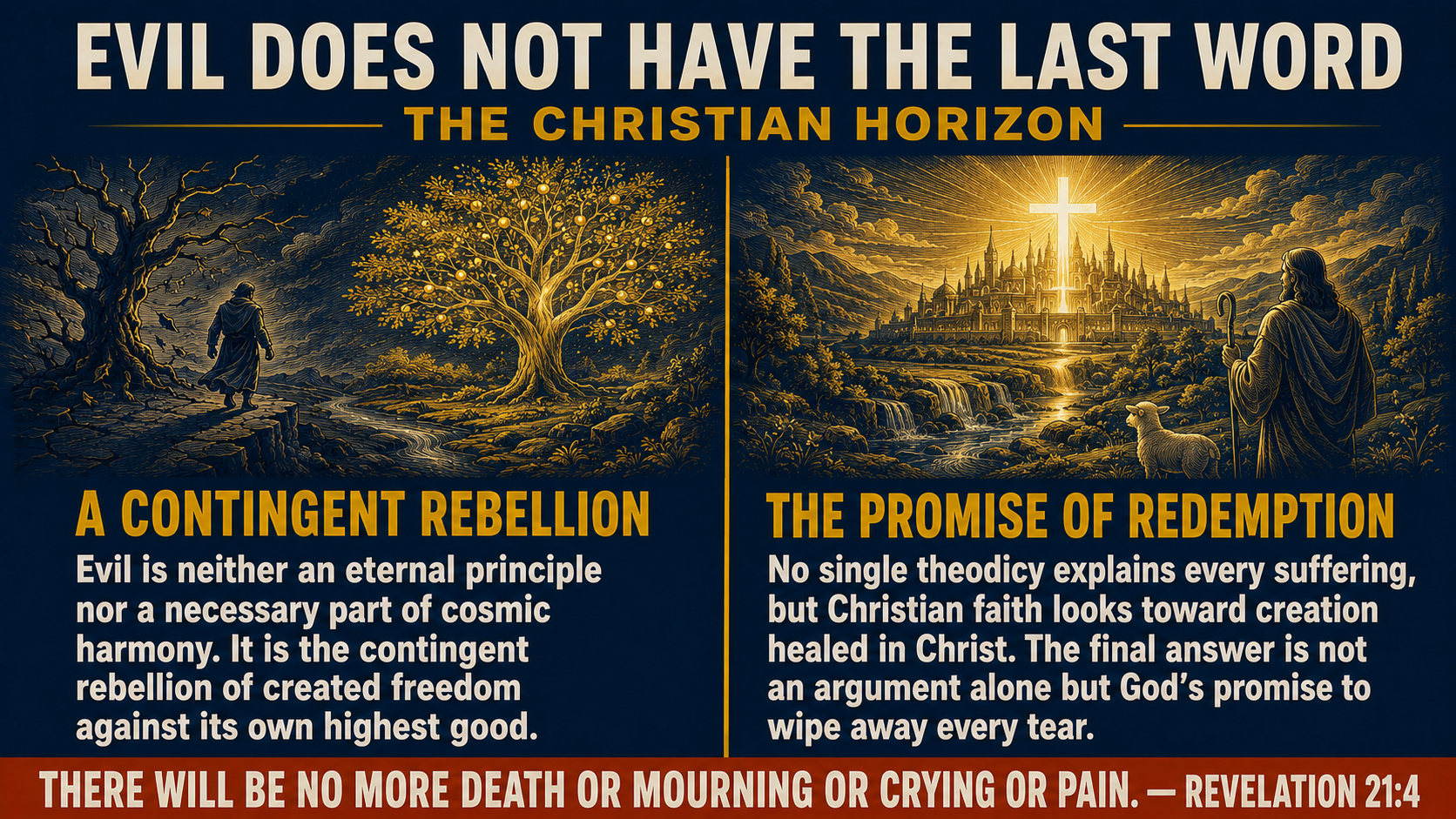
In conclusion, the problem of evil and theodicy remains one of the most profound and intractable questions that the human mind confronts. Natural human thought, oscillating between the extremes of pessimistic dualism and optimistic pantheism, proves incapable, without supernatural Revelation, of providing a satisfactory account of the essence and origin of evil. The biblical and Christian account — grounded in the narrative of the Fall, the theology of freedom, and the doctrine of Redemption — provides the framework within which evil can be understood not as a necessary feature of the cosmic order but as a contingent, inexplicable, and ultimately defeatable rebellion of created freedom against its own highest good. The history of theodicy from Augustine through Leibniz to Plantinga and Swinburne documents a succession of rational attempts to show that the existence of evil is compatible with faith in the God of Christian confession — attempts that, taken together and properly understood, constitute a serious intellectual achievement, even if no single theodicy is fully adequate to the complexity of the problem. And the eschatological horizon of Christian faith — the conviction that God ‘will wipe away every tear from their eyes; there will be no more death or mourning or crying or pain, for the old order of things has passed away’ (Revelation 21:4) — provides not a rational solution to the problem of evil but something more important: the assurance that evil, however real and however terrible in the present experience of the world, does not have the last word.
Related Concepts
- 2-peter-14
- adoption
- ahriman
- apologetics
- aristotle
- augustine
- christ
- christ-as-true-god-and-true-man
- christs-passion
- cosmological-optimism
- determinism
- devil
- divine-goodness
- dualism
- easter-vigil
- evil
- evil-as-parasite
- fall-of-the-angels
- free-will-defence
- freedom
- gnosticism
- goodness-of-creation
- habakkuk
- hedonism
- holy-spirit
- hope
- human-nature
- image-and-likeness
- irenaeus
- job
- john-hick
- kant
- leibniz
- logical-problem-of-evil
- marcionism
- maximus-the-confessor
- metaphysical-evil
- moral-evil
- mystery
- natural-evil
- natural-necessity-of-evil
- nominal-christianity
- obedience
- optimism
- orthodox-critique
- pastoral-theology
- personhood
- pessimism
- physical-evil
- plantinga
- plato
- platonism
- positive-redemption
- pride
- privation
- privation-of-good
- problem-of-evil
- resurrection
- revelation-214
- romans-7
- romans-723
- salvation
- satan
- shokhin
- socrates
- spiritual-growth
- stoicism
- subconscious
- suffering
- swinburne
- the-two-ways
- theodicy
- theology-after-the-holocaust
- vladimir-lossky
- zoroastrianism