Patrology — Topic 10
10.1 Ephrem the Syrian
Ephrem, born ca. 306, only a few years after the persecution, is the most important witness to the life of Christians in Nisibis in the early fourth century. His Carmina Nisibena describe the personalities and accomplishments of the first bishops whose names enter into the historical record there: Jacob, Babu, Vologeses and Abraham. When Jacob was appointed the first bishop of Nisibis in 308/9, it is probable that his appointment was made through the hierarchy within the Roman Empire rather than in Persia—an indirect consequence of the reestablishment of RomanImperial control in the region. Perhaps for the first time, then, the church of Nisibis was brought into substantial contact with the churches of the West and with Western notions of orthodoxy and heresy.
Ephrem portrays Jacob as a stern but loving parent, firmly leading the people from their immature ways:
by his simple [words] he gave milk to his infants…
[The Nisbene Church] was childlike with [him].
As with a child, he loved her and threatened her…
The womb of him who gave birth to the flock bore her infancy…
The first priest gave milk to her infancy…
The wealthy father, laid up treasures for her childhood.
During his thirty-year episcopacy major changes took place. Of the first importance was Constantine’s rise to power and his subsequent adoption with Licinius of measures not only ending the persecutions of Christians in the Roman Empire but also restoring their confiscated property and even suggesting that the policy of persecution was wrong. No doubt as a consequence of the new freedom enjoyed by Christians throughout the Roman Empire, the bishop undertook the construction of a church building at Nisibis between 313 and 320. The Council of Nicea in 325 C.E. intensified the relatively new focus on Orthodox doctrine in general and on Trinitarian theology in particular. Perhaps Bishop Jacob availed himself of the emperor’s offer of the use of the Imperial post to travel to Nicea for thisfirst ecumenical council, since his presence there is well-attested.
Meanwhile Ephrem had spent his early years in this newly prospering church. On the basis of his own words in the Hymms Against Heresies, we may deduce that his parents were members of the Christian community and that he was baptized in his youth after a period of study and reflection, perhaps in the context of a formal catechumenate:
By our Lord stand both:
[the time] when I was to enter into the creation
and when it would be good to leave it.
In the way of truth was I born
even though I as a child did not yet perceive it.
Examining, I acquired it for myself, as I perceived it.
My faith despised the confusing paths that came toward me.
Upon his return from Nicea, Jacob appointed Ephrem interpreter or exegete of Nisibis. Two centuries later the official historian of the School of Nisibis would look back to this event as constituting its birth. We may safely assume that Ephrem’s production of hymns and prose works began in this period. While some of these works may have beenaddressed to clergy in training, at least the hymns must have been written for a broader audience. Beginning characteristically with the unique Syriac type of ante-Nicene Christianity, its encratism, Gnosticism and special relationship to Judaism, Ephrem introduced these features into an Orthodox Christian framework, often through polemics. Although he freely and adeptly used the imagery of the non-canonical biblical literature, his work is self-consciously Orthodox. He wrote commentaries not only on the canonical scripture but also on Tatian’s Diatesseron , the most widespread version of the New Testament among the earliest Syriac-speaking Christians. Like the Odes of Solomon , Ephrem’s hymns sometimes use graphic feminine imagery for God. His Hymns on the Pearl take up and develop the image of salvation as a precious pearl, an image which has roots not only in the New Testament but also in the Gnostic Hymn of the Pearl in the Acts of Thomas. Yet his Hymns Against Heresies are polemical, attacking Mani, Marcion, Bardaisan and the astrologers.
Likewise with respect to Judaism he is unusually well-informed yet often strongly polemical. His Hymns on Paradise and his commentary on Genesis and Exodus are permeated with non-canonical Jewish traditions. The Carmina Nisibena represent an appropriation of the prophetic tradition of the Old Testament. On the other hand, the Sermons on Faith combine opposition to Judaizing with anti-Arian arguments, the Paschal Hymns combine polemics on the proper understanding of Jewish scripture and custom with a positive theology of the crucifixion and resurrection, and the Nativity Hymns present a developed theology of the incarnation and mariology in the context of a strong anti-Jewish polemic.
From the political standpoint, Ephrem’s early years in the service of the church of Nisibis were relatively secure. Constantine’s reign brought peace and even patronage for the Christians of the Roman Empire. The Christians of a border garrison like Nisibis might participate in this sense of well-being as long as relations between the two empires remained peaceful. Even when the Persian governor Shapur II reached his majority and began to consolidate his power in the year 325, he turned first to internal affairs and then to the East. Not until 335, when he had finished the task of bringing order to the Eastern and central portions of his empire, did he turn toward his western frontier to begin the enterprise that would occupy the remainder of his long reign, the reconquest of Mesopotamia. When, as a first step he raided Armenia, he was quickly rebuffed by Constantine, who sent an army at the request of the Armenian nobility. Constantine’s letter to Shapur, preserved in Eusebius’ Vi t a Constantini may have been written at this time. In the letter he asserts his faith in God, the providential nature of his own rule, and the certainty of Divine vengeance on thepersecutors of Christians. His wishes that both Shapur and the Christians in the Persian realm prosper would probably have been overshadowed in Shapur’s mind by the audacity of his imterpretatio christiana of recent history, virtually an assertion that in a conflict between Persia and Rome, the latter would surely be victorious. Still more presumptuous is the Roman emperor’s commendation of the Persian Christians to the Sassanid ruler’s care, a veiled threat that they would be loyal to him rather than to their own sovereign in the event of war. Whether or not it was this letter that provoked Shapur’s hostility to the Christians within his realm, he took advantage of Constantine’s death in 337 to undertake a military campaign in Mesopotamia the following spring. In the course of this conflict Christians in the Persian Empire were treated as potential or actual traitors.
The Christians of Persia had themselves contributed to the mixing of religious interpretations with political and military events. Aphrahat, writing in an unknown location within the Persian Empire, was disposed to view the conflict in apocalyptic terms as a battle between the forces of good and evil with virtually no room for nuance or compromise. Upon returning from his first Mesopotamian campaign Shapur imposed a double head-tax on the Christians of his empire. Many either refused or were simply unable to pay. Simeon bar Sabba’e, bishop of Seleucia-Ctesiphon and thereby representative of the Persian Christian community to the Sassanid government, informed the emperor that his people could not pay the double tax. As a consequence he and several of his associates met their deaths, and a lengthy and brutal persecution of Christians in the Persian Empire began.
The worsened relations between Christians and their Persian ruler could be expected to have an immediate effect on the determination of the Roman cities of Mesopotamia to resist capture. A second effect, not as immediately obvious, was the deterioration of relations between Christians and Jews. The Jewish community had constituted a substantial minority throughout the region for nearly a millennium. Nisibis itself had long been the center for the collection and transmission of the Temple offering from the Jews of northern Mesopotamia. Since the early secondcentury C.E. there had been a rabbinic school there, and the city had become a major center for rabbinic Judaism. Although the Jewish community had been the object of some political and religious intolerance under the early Sassanid rulers, their lot had improved steadily just as the Christians’ situation was declining. Certain of the acts of the Persian Christian martyrs accuse the Jews of inciting the persecution by suggesting that the Christians were potentially disloyal to the Persian government. No matter whether or not this accusation is true, Jews were never more than minor characters in the Persian state persecution. Yet the dramatic disparity between the conditions of the two communities in the Persian territories gave an apologetic advantage to the Jews, who apparently exploited the opportunity to recoup some of their losses in the competition for converts. Under the circumstances relations between the two religious communities were bound to be strained.
The restoration of Nisibis to the Roman Empire and Constantine’s endorsement of Christianity had suddenly reversed the prospects of the Jews and Christians, but the reversal would last only as long as the city resisted Persian attack. Political and religious issues were tightly interwoven, and Ephrem was necessarily deeply involved in the conflicts. At least part of his task as the exegete of the Christian school of Nisibis must have been the elaboration of a Christian interpretation of the Old Testament — one that could compete with the growing sophistication of therabbinic schools and attract to Christianity the uncertain, whether of Aramean pagan or Jewish background. In gathering festimonia that Jesus had fulfilled the Jewish expectations of a messiah and that he was anticipated invirtually every word and symbol of the Old Testament, Ephrem was not engaged in a novel enterprise. The debate with Judaism is as old as Christianity; it is well-attested and has been studied in Greek and Latin sources prior to and contemporary with him. The uniqueness of his endeavor lay in the fact that he taught in a city where the rabbinic traditions were well-established and sophisticated and where the Jewish community may have been more prosperous and numerous than its Christian counterpart.
Political developments in this border garrison in the mid-fourth century, moreover, had intensified this disparity. These conditions partially account for Ephrem’s extraordinary bitterness toward the Jews, to whom he often refers as “slanderers,” “crucifiers,” or “murderers.”
One of the cities unsuccessfully besieged by Shapur in his first Mesopotamian campaign was Nisibis. In his Carmina Nisibena Ephrem credited Bishop Jacob with the salvation of the city from this first siege, and later tradition was to magnify his role considerably. Ephrem’s mentor died soon after the successful rebuff of Shapur in 338, His successor, Babu, cared for a church beset with the problems of wartime. The hymnodist praises him for his almsgiving and for his efforts at ransoming captives. Although he also lauds his “plain teaching,” his “interpretation [of scripture],” his orthodoxy and eucharistic ministry, the hymns give few clues as to the specific social or ecclesiastical issues of this episcopacy other than the ongoing warfare and its accompanying hardships. The Emperor Constantius stationed a larger army in Mesopotamia and personally visited the fortresses to add force to Roman claims to the area. Yet his preoccupation with difficulties in the West allowed Shapur to make inroads into the area, besieging Nisibis for three months in 346 and again for four months in 350.
In his Carmina Nisibena, Ephrem contemplated all three sieges of his native city, but it was the third siege that fascinated him, as it did the future Emperor Julian and Ammianus Marcellinus. This siege was marked by Shapur’s bold attempt to undermine the city’s fortifications by diverting the River Mygdonius to engulf them. Although he succeeded in breaching the wall, the intrepid Nisibenes quickly rebuilt it, while Shapur’s elephants, under attack from insects, floundered in mud. Whereas their valiant efforts inspired Julian to Homeric comparisons, Ephrem was reminded of Noah’s ark as well as of the resurrection of Christ after three days in the tomb:
[Nisibis speaks]
Hear and weigh my likeness with Noah,
and since my pain is less than his,
may Your grace be equal to our salvation,
for my children stand like Noah
between the wrathful and the destroyers.
Make peace, my Lord, with the besieged,
and cast down before me the besiegers,
to double my victory.
Since the killer three times [expressed] his anger,
[express] three times the mercy of Your Third One.
Grant not victory over Your beloved to the Evil One
whose avarice You [defeated] twice and three times.
Allow my victory to fly over the whole world
to acquire glory for You in the whole world.
O He Who was revived the third [day],
put me not to death in the third [trial]!
This dramatic incident inspired in the hymnodist not only the discernment of these intricate typological patterns but also a pure paean to faith and grace:
He saved us without a wall and taught that He is our wall.
He saved us without a king and made known that He is our king.
He saved us in all from all and showed He is all.
He saved us by His grace and again revealed
that He is freely gracious and life-giving. From each who boasts
He takes away the boast and gives to him His grace.
When Shapur abandoned the siege in the fall of 350 to attend to troubles farther east near the Caspian Sea, the Armenians re-allied themselves with Rome while the Nisibenes celebrated the freeing of their city and began the task of restoring her to her former status as queen of Mesopotamia. Apparently Bishop Babu did not live to enjoy the happier decade that followed. His successor, Vologeses, constructed the city’s first baptistery in 359. At this time as well, Ephrem looked back over the previous history of the city and wrote his hymns characterizing the first threeepiscopacies as three phases in the growth of the Christian city: childhood, adolescence and adulthood. He portrays each of the three prelates, Jacob, Babu and Vologeses, as uniquely suited to the ruling of the Christian community at the time appointed. Whilst the first two bishops administered a combination of love and discipline appropriate to childhood and youth, Vologeses’ gentleness and humility are better suited to the mature community he shepherded. Despite the fact that heresies, especially Arianism, divided the Nisibene Christians, Ephrem defended his bishop against critics who demanded a more severe approach.
Within a decade Shapur had restored his position in the East and turned his attention once again to Armenia and Mesopotamia. Negotiations had come to a halt when Shapur’s determination to recover his “forefathers’ empire” encountered Constantius’ insistence that it would be “absurd and silly to surrender what we have long preserved unmolested.” In 359 Shapur “armed with the help of savage tribes which he had subdued, and burning with superhuman desire of extending his domain, was preparing arms, forces, and supplies, embroiling his plans with infernal powers and consulting all superstitions about the future… He planned with the first mildness of spring to overrun everything.” A combination of betrayal and ill-preparedness led the Romans to destroy the north Mesopotamian countryside to deprive Shapur of fodder during the anticipated invasion.” Ephrem portrays the city seeking divine assistance on behalf of the population both within and without her walls:
My Lord, my children have fled like chicks
pursued by an eagle. They are hidden in a refuge!
Let Your Peace return to them!”
I have lifted up my eyes to all the squares; they are deserted.
Ten are left from a hundred and a thousand from ten thousand.
Grant peace, let the clamor of my inhabitants fill my squares.
Return those outside and make those inside rejoice.
Great enough is Your grace to extend inside and outside.
Let the wings of Your grace gather my chicks.
Let the prayer of my just ones preserve my fleeing ones.
The unbelievers broke me, but the believers sustained me,
By the believers deprive the unbelievers!
In the spring of 359 the Persian army arrived in Mesopotamia. Bypassing Nisibis, Shapur first attempted to strike more deeply into Roman territory while Constantius was occupied in Gaul. Frustrated in this attempt, he turned back to fight the Roman army in Mesopotamia and to attempt once more the capture of the major fortresses there. When he had besieged and captured Amida, Shapur ordered all its citizens to be killed or enslaved as punishment for their refusal to surrender and for their provocative behavior. After wintering across the Tigris, Shapur returned, captured Singara and deported its people. Again bypassing Nisibis, guarded by the Roman army, he besieged and captured Bezabde, slaughtered its inhabitants and rebuilt its fortifications. At last Constantius arrived. Having passed through Edessa and mourned over the ashes of Amida, he attempted to retake Bezabde but abandoned the enterprise aswinter approached.
The emperor’s defense of Roman Mesopotamia was hampered by the refusal of his Gallic troops to come to his aid in the East and their acclamation instead of the young Caesar Julian as a rival Augustus. While Shapur and Constantius faced off across Mesopotamia in the spring of 361, Julian openly stepped forth as a rival augustus. As he set out against his rebellious cousin, Constantius died, thus leaving the way clear for the young apostate emperor to define his own policies. Initially content to promote the public practice of pagan religions and to defend its intellectual integrity, Julian expected that internecine rivalry among Christians would suffice to undermine the church. In time, however, his measures became more directly anti-Christian. These developments coincide more or less with his movement toward the East. Arriving at Antioch in 362, Julian engaged in a prolonged struggle with its population over religious and social mores as he attempted to impose his ascetic and philosophically-interpreted version of paganism on the city, The emperor’s religious policies were closely related to his Persian military campaign.” Like most of his contemporaries, including Ephrem, Julian believed that military victory would go to those who had offered suitable worship to the correct God or gods. Much of his time in Antioch had been spent in the offering of sacrifices and the consultation of oracles and auguries. At the outset of his Mesopotamian campaign, he stopped at Harran to worship its celestial deities. While in Constantinople in the spring of 362, Julian had hastily composed a hymn to the Great Mother of the gods, in which he displayed his strongly neo-Platonic interpretation of her cult, and he had visited her shrine at Pessinus en route from Constantinople to Antioch. Now he led his army to Hierapolis, the Mesopotamian city particularly identified with her cult in its syncretistic form, Cybele having been identified with the Semitic Atargatis-Anahitha-Astarte as well as the Greek Hera. Finally, Julian paused in his march down the Euphrates to celebrate her feast on March 27. Ephrem recorded the emperor’s celebration with angry disgust:
Agreeable to him was the feast of the detestable idol
on whose feast-day women and men rave,
virgins fornicate and wives become lascivious,
vomit out [and] speak words of shame.
As a part of his program of restoration of traditional temples, and possibly also as an anti-Christian measure, Julian had undertaken to rebuild the Jewish Temple in Jerusalem.” At about the same time he had issued a new coin displaying the image of a bull with two stars. From Ephrem’s perspective, these two measures were linked not only to each other but also to the emperor’s general promotion of paganism:
Perhaps because of that money on which the bull was portrayed,
the Jews were overjoyed that [Julian] carried it in his heart
and also in his purse and in his hand
as a type of that calf of the wilderness
that was before his eye and heart and mind;
and probably in his dreams he used to see the calf.
At the same time Julian’s attitude toward the Christians of Mesopotamia had worsened. He had pointedly refrained from visiting Edessa, well-known by this time as a center of Christianity, In a letter sent from Antioch he had ironically informed the Christian citizens of his intention to confiscate their property to help them to conform more closely to the ascetic ideal of their religion. Ephrem claims further that Julian sent a threatening letter to the Christians of Mesopotamia, or perhaps of Nisibis itself;
For he foretold and promised and wrote and sent to us
that he would come down and trample it; Persia he would disperse.
Singara he would rebuild. [This was] the threat of his letter.
The poet responded with a hymn of encouragement to the Christians of Nisibis to persevere under conditions of duress, following the example of Elijah and Daniel in rebuking idolatrous rulers. Nevertheless, an idol was set up in the city with an accompanying public cult, and the Christians of Nisibis did nothing to eliminate it.
Julian’s choice of a route through Roman Mesopotamia was not dictated solely by religious motives, however. After feigning an intent to proceed across the north to Adiabene, he abruptly changed direction and, taking part of his troops with his navy, proceeded boldly down the Euphrates directly toward the Persian capital, Seleucia-Ctesiphon. Shapur meanwhile followed a tactic of withdrawal, allowing the Romans to penetrate into Persian territory so that retreat would be difficult in the event that they overextended their campaign. This Julian did. He found himself at the gates of the Persian capital without the forces to take the city.
Shapur’s army was lying in wait just to the east; the Roman reinforcements had not yet arrived from the north. Following the advice of a supposed traitor, who was in fact a Persian agent, Julian destroyed his own fleet. Then, as he retreated through Mesopotamia with the Sassanid forces destroying the crops in his path, he was killed in battle. In Ephrem’s view, Julian’s death was virtually a suicide in the face of a hopeless situation:
When he saw that his gods were confuted and exposed
and that he could neither gain victory nor flee,
[that] between fear and disgrace he was prostrate and beaten,
cunningly he stripped off his armor in order to be wounded,
in order to die so that the Galileans would not see his shame.
Sometime during all these upheavals, Vologeses, the bishop of Nisibis, had died and had been succeeded by a much younger man, his protegé Abraham. Ephrem composed several hymns, including one upon the new bishop’s installation, filled with advice. Now in his fifties, the hymnodist had not only passed from childhood to adulthood with respect to his bishops, he was now ready to assume the role of the wise parent.
In addition to the advice that he be firm and imitate his worthy predecessors, Ephrem adds the hope that the episcopal power will work effectively with the imperial power. For after the death of Julian, the Roman army had chosen a new emperor, Jovian, an orthodox Christian.
Seeing no alternative to surrender under the disadvantageous terms offered him by Shapur, Jovian accepted them. These terms included cession to Persia of the city of Nisibis without its inhabitants. The city was, in Ephrem’s eyes, the sacrificial lamb that saved the Roman army. Unlike Ammianus Marcellinus, however, who portrays the fate of Nisibis in exclusively negative terms, Ephrem stresses that, although the city itself was ceded to Persia, the Persian ruler showed respect for its Christian churches and permitted its citizens to depart for Roman territory rather than executing them, enslaving them or exiling them into the eastern reaches of the Persian Empire, as had been the fate of the inhabitants of other recalcitrant Mesopotamian cities.“ To celebrate his victory and show appropriate disdain for the religion of the Roman army that had attacked his empire, the Persian king was apparently satisfied to destroy the pagan temples associated specifically with Julian.
Still the entire Christian population of this fortress city migrated within a short time to the adjacent cities of the Roman Empire. Ephrem was among those who went first to Amida, then to Edessa, where he would spend his last ten years. Thus the heroic struggle of his native city, a symbol of Rome and of Christianity, against the mighty Persian Empire, a struggle which had occupied most of his adult life, ended in defeat and disgrace. The “constant, unwearying herald” was surrendered to the Persians. As he meditates on these events in his Carmina Nisibena and in his Hymns against Julian , Ephrem shows himself to be a genuine heir to the Jewish prophetic tradition, interpreting historical events as directed by divine Providence toward the attainment of justice in this world. There must be a reason for God’s allowing Nisibis to be taken. For him that reason is clear; the apostasy of the Christian Roman emperor and of those who followed him in reinstating pagan worship:
Who else has so multiplied altars?
Who else has so honored all the evil spirits?
Who else has so pleased all the demons?
He angered only the One, and he was broken.
In him was confuted the entire faction of wrong,
a force unable to support its worshippers!
Ephrem arrived in Edessa in 363 to find a city that retained much of its unique cultural and religious heritage. The city had been ruled by a dynasty of Nabatean kings who had deftly navigated the political struggles of the Hellenistic and early Roman periods until it was incorporated into the Roman Empire in the early third century. Like Nisibis, Edessa had been the object of the Roman struggles with Parthia, Sassanid Persia and Palmyra and had been definitively recovered for Rome by Diocletian.
Likewise as at Nisibis, the population, its culture and religion were mixed. Pagan worship of several varieties is clearly attested. From the ancient Mesopotamian pantheon, Bel and Nebo are found, often associated as father and son. Bel is Bel Marduk, the chief god of Babylonian religion, “kosmokrator, lord of planets and stars who guided the world and gave it fertility.” From his function as cosmic ruler, astrology had come to be associated with Bel. A major New Year festival, which took place in his honor in April, continued to flourish, Nebo, son of Bel, was the “Babylonian god of wisdom and human fate,” who had become the patron of wisdom and of the art of writing as well as a powerful mediator between his father and humankind. From the native Aramean culture came Hadad, Baal Shamin, lord of the heavens in the sense of master of the weather, storms, rain and fertility, who was symbolized by both the bull and the cagle. His consort, Atargatis, a female fertility goddess associated with fish and water, had surpassed him in importance in the Hellenistic and Roman periods when she had acquired the characteristics of Cybele, the Great Mother of Asia Minor. Her cult, as described by Lucian of Samosata in On the Syrian Goddess, with its castrated priests and musical processions, was centered at neighboring Hierapolis, It was clearly important at Edessa as well, where large ponds containing sacred fish were associated with her worship. The moon god, Sin, and the Arabian deities, Azizos and Monimos, received homage here. Also clearly attested is the presence of a substantial and prosperous Jewish community associated with the silk trade and with their correligionists in Nisibis.
Fourth-century Edessa was a proud center of Christianity with legends and associations sufficient to capture the imaginations of such Western Christians as Eusebius and Egeria. According to the Doctrine of Addai, an early version of which Eusebius had read in the city’s archives, Jesus himself had corresponded with King Abgar of Edessa. In responseto the king’s recognition of his messianic role and his offer of refuge, Jesus had assured him that an apostle would be sent to teach him and to heal him of an illness. By the end of the fourth century it was held that Jesus’ letter had the capacity to protect the city, and that Jesus had also sent his portrait to Abgar, and within a few more decades that portrait was proudly functioning as the palladium of the city.” Although the non-canonical Acts of Thomas associate their protagonist not with Edessa, but with India, both they and the gospel attributed to him may have originated in Edessa. Although the Doctrine of Addai claims only that Addai, or Thaddeus, one of the seventy, was sent to the city by the apostle Thomas, by Ephrem’s time the bones of Thomas himself were venerated there. Aware of a conflict between this development and the tradition of the apostle’s death in India according to the Acts of Thomas, the hymnodist alludes to a transferral of the bones:
The evil one wails, “Where then
can I flee from the righteous?
I incited Death to kill the apostles
as if to escape from their scourges
by their death. More than ever now
I am scourged harshly. The apostle I killed in India
[has come] to Edessa before me. Here is he and also there.
I went there, there he is.
Here and there I found him, and I am gloomy.
Did that merchant carry the bones?
Or perhaps, indeed, they carried him!”
A decade or two later, Egeria would come to the Syrian city expressly to see the martyrium of Thomas, whom she believed to be the apostle sent to Abgar by Jesus.
In addition to their claim to apostolic foundation and royal endorsement, the Christians of Edessa could lay claim to most of the earliest Syriac literature. The first Syriac author whose name has been preserved, Bardaisan composed his one hundred fifty hymns there in the second century. His work consists of a unique blend of ideas and imagerydrawn from Christianity, Aramaean paganism, astrology and later Platonism. Bardaisan was the originator of the madrasé, a hymn composed in isosyllabic verse, which uses parallelism, rhyme, alliteration and a variety of word play to achieve its effects. Composing hymns in the same form to combat the heretic’s views, Ephrem became theunquestioned master of the genre.
Edessa also had its Diocletianic martyrs, Shamona, Gurya and Habbib, as well as less reliable legends of earlier martyrs. Despite its early apostolic traditions, its literature and martyrs, the city’s succession of bishops is problematic until 313, when Bishop Qona is said to have undertaken the construction of a new cathedral church, just coinciding with the new status of the church under Constantine. The city was also represented at the Council of Nicea. Even more clearly than in the case of Nisibis, however, the concept of orthodoxy was of more recent vintage than the presence of a Christian community. For when Ephrem arrived in 363 C.E. he found a city in which the orthodox were identified by the name of a predecessor of Qona, Palut, who had been ordained by the bishop of Antioch. Likewise the Marcionites, Bardaisanites, Manichaeans, Arians and all other Christians were identified by the epithet of their group to distinguish them among the larger group of Christians. Such identifications could not be accepted by orthodox Christians, Ephremargued. They and they alone had the right to be called by the name of Christ. Just as the image of the emperor for the manufacture of coins is strictly controlled, so is the image of the Lord not to be used by just anybody. Indeed, all the heretics should be designated by the names of their founders, but orthodox should be known simply as “Christians,” not as “Palutians.”
Clearly the Gnostic and Manichaean forms of Christianity, and Arianism as well, had substantial followings in Edessa, and just as in Nisibis Ephrem did not hesitate to enter the polemical fray. Many of his Hymns against Heresies , composed in Nisibis, were refutations of the doctrines of Mani, Marcion and Bardaisan; in his new home he supplemented these polemics with more hymns as well as prose refutations. Likewise Ephrem had already written his Sermons on Faith against Arianism in Nisibis, but this struggle assumed a larger role in his Edessene period.
In the later historical Carmina Nisibena and in the Hymns on Faith , he defends not only the Orthodox doctrine but also the anti-Arian bishops, Barsai and Vitus of Harran, against the machinations of their episcopal and imperial opponents. In a less polemical vein are the collections entitled Hymns on the Church and Hymns on Virginity , which set forth most fully his symbolic theology in the context of scriptural interpretation and ecclesiology. As at Nisibis Ephrem probably taught in a school, perhaps one he himself founded. Here, too, Ephrem is said to have founded choirs of women whom he personally instructed in the singing of his hymns. Ephrem’s admiration of the ascetic life and his enthusiasm for Christian virginity are evident throughout his writings in his descriptions of bishops he admired as well as in more general treatments.
Ephrem was ordained to the diaconate at Edessa, and in the course of caring for the sick in an outbreak of the plague, he died there on 9 June 373 C.E.
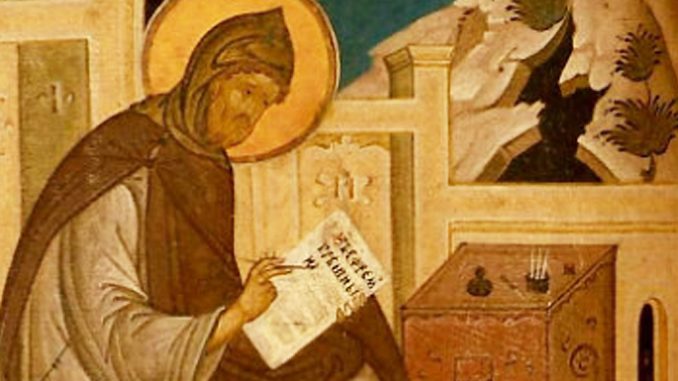
10.2 Biblical Exegesis: Diodore of Tarsus. Theodore of Mopsuestia.
Diodore of Tarsus
Diodore (305-310 to 394) was born into a noble family; his name, indicating dedication to Zeus, suggests a pagan origin. Diodore’s secular education was completed in Athens (c. 330-335). Diodore’s brilliant secular education is evidenced by both the numerous titles of his writings against Plato, Aristotle, Stoics, Epicureans, astrologers, etc.
At the end of his studies in Athens, Diodore came to Antioch, where he was baptized and then became a monk. St. John Chrysostom attests to Diodoros’ missionary service: Diodore “once led the whole city across the river and taught sound doctrine” (Laus Diodori). He devoted himself to ascetic exploits, living a life of complete piety, not even having a defined home and eating what his friends gave him. His Christian self-denial, devotion to prayer and service to others attracted the disciples to Diodore and from these he founded the monasteries and ascetical brotherhoods that later spread throughout Antioch. Among Diodore’s disciples during the period of his teaching in Antioch were St. John Chrysostom, Maximus, bishop of Seleucia, and Theodore, bishop of Mopsuestia. He was brought up in Omoiusianism. He became friends with Flavian (later bishop of Antioch) and joined his community. In 350, Diodore and Flavian opposed Arianism together.
As a counterbalance to the Arian assemblies, Diodore and Flavian organized solemn litanies outside the city with other Antiochian monks, during which the people, chanting sacred hymns, offered prayers to the One God venerated in Trinity. Some time later, Diodore began to lead his followers to the tombs of the martyrs for all-night services and the Eucharist. Under his leadership Antiochian Orthodox Christians spent their nights recounting the deeds of the martyrs, singing Psalms and hymns in honor of the triune God and His saints. According to Theodoret, Diodore introduced into Antiochian divine service antiphonal singing in order to increase the influence of these hymns on the people.
In Julian’s reign Diodore defended the Church against philosophical paganism. In 362 Julian arrived in Antioch, where he wrote anti-Christian writings. His personal acquaintance with Diodore is evidenced by the emperor’s letter to the heretic Photinus, in which Julian expresses extreme irritation at Diodore’s attacks on paganism, while in his struggle against Diodore he pins his hopes exclusively on the gods, who, in his opinion, are already punishing Diodorus “for worshiping their new god, the Galilean.”
At the end of 378 St. Meletius and Diodore returned to Antioch. In deciding to fill the vacant bishoprics in the cities of the Diocese of Antioch, St. Meletius appointed Diodore as bishop of Tarsus, the main city of the Cilician metropolis. Diodore took part in the Council of Antioch in 379 and in the Ecumenical Council II in 381. Saint Meletius died at the time of this Council, and Flavian was chosen to his seat. After St. Gregory the Theologian stepped down as president of the Council and retired, Diodore proposed as his successor Nectarius, a resident of Tarsus whom he had known at the time. Nectarius’ candidacy was put on the list of worthy persons for the presidency of Constantinople and was approved by the emperor Theodosius. In 386, during Diodore’s visit to Antioch, he visited the church, where St. John Chrysostom preached, and he gave a eulogy in honor of Diodore in his presence. In the early 90s of the 4th century Diodore was joined in Tarsus by his disciple Theodore.
The final development of the Antiochian historico-grammatical method of interpreting Scripture is connected with the name of Diodore. According to Leontius of Byzantium, Diodore wrote interpretations of all the books of the Old and New Testaments.
The Commentary on the Psalms is preserved in eight manuscripts. The text is a commentary by the author, not a collection of anonymous katens. The author presents a typically Antiochian mode of interpretation, which employs grammatical-stylistic and historical analysis of the text of Holy Scripture, giving preference to the contemplative method (θεωρία), in contrast with the Alexandrian allegory.
There are fragments of Diodorus’ Interpretations of the Pentateuch and the Books of Judges and Kings.
Diodore’s dogmatic-polemical writings include the surviving fragments of the treatise Πρὸς τοὺς Συνουσίαστάς (Adversus Synusiastas), written probably in 373-376, while Diodorus was in Armenia.
At the time of the Nestorian controversy, Diodore was counted among Nestorius’ predecessors. A connection between Diodore and Nestorius was first proclaimed by St. Cyril of Alexandria: “Diodore had Nestorius as his disciple” (Epist. 45). After him the accusation of Diodore of Nestorianism was supported by St. Anastasios of Sinai, Leontios of Byzantium, Bardesan, some representatives of Monophysitism (Severus of Antioch), St. Photius.
Nestorius tried to support his Christological views with references to the authority of the famous theologians of Antioch - Diodore and Theodore, from whom he allegedly borrowed his doctrine. The decree of Emperor Theodosius II after the Council of Ephesus regarding the eradication of Nestorianism was understood by many as a condemnation not only of Nestorius, but also of those whom he had called his teachers, including Diodore. At the request of some of the monks of Constantinople and Antioch, St. Cyril of Alexandria wrote an op. “Against Diodore and Theodoros” in 3 books, which has survived only in fragments. St Cyril’s work against Diodore and Theodore was sharply criticized by Theodoret of Cyrus. In his Apology in Favor of Diodore and Theodoros , he takes apart the arguments of St Cyril point by point, insisting on the full orthodoxy of Diodore. Theodoret points out that St. Cyril does not accurately quote from Diodore’s writings, does not always make use of his original works, distorts his views and twists them for the sake of making polemics convenient. In his epistles to Proclus and John of Antioch, written soon after the writings of St. Theodoret, St. Cyril expressed the need for a lenient attitude toward the dead in peace with the Church. It was probably not without St. Cyril’s influence that the new imperial decree put an end to the controversy about Theodore, and with him also about Diodore.
10.3 Catechetical preachers: Cyril of Jerusalem
Saint Cyril (ca. 315-387) was ordained a presbyter in 349, and already in the year 350 he was elected bishop of Jerusalem. At that time, the Church was experiencing serious difficulties caused by the Arian disorder. Until the year 337, the empire was ruled by Constantine I, who, at the end of his life, patronized the Arians and deposed most of the Orthodox bishops from their sees. In 336 Arius himself was allowed to return from exile, and would have been received back into the fold of the Church, had not his sudden death prevented his return.
What place does Cyril of Jerusalem have in all this? Many theologians of antiquity and later times ranked him as an Arian on the grounds that he received consecration as bishop from the Arian Acacius of Caesarea. Such an argument is not entirely fair: in fact, St. Basil the Great, who was certainly an Orthodox saint, was consecrated in the year 370, when almost everybody in the East was still rejecting the Orthodox Nicene Creed. In the Second Ecumenical Council Cyril of Jerusalem participated on the Orthodox side, and his way of thinking is also quite consistent with the Orthodox faith.
It was at this time that Cyril became bishop of Jerusalem. His position was very difficult from the beginning. Ordained by the convinced Arian Acacius, he at the same time supported St Athanasius when he was in hiding from the persecution of the Orthodox. Cyril was thrice deposed by the Arians from the bishopric and thrice restored, but still, when in 381 the Second Ecumenical Council in Constantinople restored Orthodoxy, some had doubts about the orthodoxy of his views. In 382 a council was convened at which the question was specifically discussed. The Council sent a letter to the Pope, which reported that Bishop Cyril “fought against the Arians” and had an Orthodox way of thinking.
Of St. Cyril’s works, especially well-known is his collection of sermons to the catechumens in three parts:
1. The Procatechism, a “preliminary” sermon, a kind of introductory course for those preparing for baptism.
2. Eighteen Catechetical Sermons addressed not to all the catechumens, but only to those who will be baptized during the coming Easter (after the fourth week of Great Lent, an “exam” was held for the catechumens, and those who “passed” were admitted to “Enlightenment”, that is, to the Baptism).
3. Five Mystagogic S ermons addressed to the newly baptized. According to the custom of the time, the catechumens were not allowed even to be present at the Eucharistic sacrament. They studied the Holy Scriptures, Christian morals and prayers, but knew nothing of the sacramental life of the Church. Therefore they were given a special explanation of Baptism and the Eucharist after they were baptized.
The collection of Sermons of St Cyril is the most valuable source of information about the liturgical life of the Eastern Church in the fourth century. Three other collections are extant: those of St John Chrysostom and Theodore of Mopsuestia, representing the Antiochian tradition, and of the Western Father of the Church, St Ambrose of Milan. In spite of their separation in space, their content reveals remarkable similarities in liturgical customs and only minor divergences, reflecting the common tradition of the pre-Nicaean Church.
Those preparing for the Sacrament of Enlightenment (Baptism) were told that they were standing on the threshold of a great mystery. They were about to hear very serious things about which they could not speak to just anyone. The early Church made a strict distinction between dogmatic teaching and preaching (Greek « kerygma »). The former concerned the inner, “intimate” life of the Church in the sacraments and was accessible only to the initiated-even the voiced could not be present at the administration of the sacraments. The preaching or kerygma was the teaching concerning everything else - morals, St. Scripture, spiritual life, including also the formal doctrine which is called “dogma” in modern theology. The kerygma was proclaimed outside the Church and was available to all.
On the meaning of the sacrament of Baptism St. Cyril speaks as follows:
«The great work is the coming Baptism, it is the atonement of the captives, the remission of sins, the death of sin, the renewal of the soul, the light garment, the holy indestructible seal, the chariot to heaven, the delight of heaven, the foreknowledge of the Kingdom, the granting of adoption ».
In this passage it is particularly interesting that baptism is seen almost exclusively in its positive dimension: as liberation, as a threshold to eternal life. In the Latin catechisms (as well as in the Orthodox, written under the influence of the Latin ones), Baptism carries the negative meaning of purification or the juridical meaning of deliverance from original sin inherited from Adam. In the Eastern Fathers we do not find this idea. It is not so much guilt as mortality that is inherited from Adam. The devil, “the murderer of men from the beginning,” rules the world through death. Therefore the rite of baptism begins with the expulsion of the unclean power from the person being baptized (exorcism), and all prayers speak of deliverance from slavery to the devil and death.
As in our days, in the early Christian baptismal rite the candidates had to read aloud the creed (confession) of faith as the conclusion of the instruction received and the expression of their willingness to be “united with Christ”. In the fourth century the Nicene Creed was not yet binding on all churches. Each local church had its own text. In the expositions of St. Cyril, a symbol is given, which was used in the Jerusalem church (probably composed by Cyril himself).
St. Cyril also discusses the question of what the Church is. Sermon 18 contains the famous definition “and into one, holy, catholic Church”, which is interpreted as follows:
«The Church is called catholic, because it is in the whole universe from the limits of the earth to the limits of it, and because it universally and without any omission teaches everything which must be a part of human knowledge, doctrines about visible and invisible, about heavenly earthly things. Also because it subjects to godliness all human race, and leaders and subordinates, learned and unlearned, at last, because, as everywhere it heals and cures all sorts of sins, committed by soul and body; so in it is gained all called the virtue of any kind - and in deeds, and in words, and in all spiritual endowments».
Whereas for St. Ignatius of Antioch the concept of the catholic Church is connected with the concept of the local community (“Where Christ is, there is the catholic Church”), St. Cyril above all emphasizes the universality of the Church. The Church is catholic (i.e. embraces everything), first of all, in its geographical sense (“it is in the whole universe”), which became practically possible when Constantine I granted the Church freedom and proclaimed Christianity to be the state religion of the Empire. Second, the Church is catholic because it preaches the fullness of truth (“without any omission it teaches all … dogmas”). Thirdly, because it embraces all human society without distinction of classes, professions, etc. (“and chiefs and subordinates, scientists and non-scientists”). Fourthly, it is in contact with the totality of human morality (“it heals … sins, … in it all that is called virtue is acquired”). Thus, for St. Cyril, the catholicity or synodality of the Church means its fullness, its capacity to embrace all aspects of human existence, both physical and spiritual.
The term “catholic” itself essentially means the same thing as “orthodox”. It comes from the Greek καθ᾽ ὅλον kath ’ olon (“according to the whole”). The Orthodox Church calls herself Catholic, and the Roman Catholic Church also calls herself Orthodox. The choice of the word “Orthodox” to designate the Eastern Church was accidental, and the two terms are essentially interchangeable.
The Greek word for church, ἐκκλησία ekklesia (from the Greek ἐκκαλέω ekkaleo , « to call, to summon »), denotes an assembly of those who are summoned or invited. This is not a random gathering, not a crowd, but a gathering of people united by a common purpose, who responded to a personal invitation, a personal call. The Slavic word “tserkov” does not carry this meaning. Like the German “Kirche” and the English “Church,” it denotes a building or room where people gather on Sunday (i.e. “the day of the Lord,” Greek κυριακή ἠμέρα kiriaki imera), and ultimately goes back to the Greek word κύριος kyrios « Lord ».
St. Cyril connects the work of the Holy Spirit in the Church with the diversity of people who belong to it and with the great multitude of gifts of the Spirit distributed among them:
« The Holy Spirit is great, almighty and wonderful in gifts. Count how many of you there are now, how many souls there are here. He works for everyone, and being in the midst of us, he sees everyone’s disposition, he also sees our thoughts and advice, and what we say and what we think. This is a great thing that we have truly said, but it is not enough. For when thou, whose mind is already enlightened by the Spirit, perceive how many Christians there are in all this flock, how many there are in all Palestine; and from that region turn thy thought to the whole Roman Empire; and from it turn thy eyes to the whole world, to the tribes of the Persians, the Indian nations, the Goths, the Sarmatians, Gauls, Spaniards, Moors, Libyans, Ethiopians, and other tribes unknown to us by name, for many of them remain unnamed with us. And in each nation take note of the bishops, of the presbyters, of the deacons, of the monks, of the virgins, and of the other laity. And imagine the great Provider of gifts, who in the whole world gives to whom purity, to whom constant virginity, to whom mercy, to whom piety, to whom power to drive out evil spirits. As the light gives light to all in one ray, so the Holy Spirit enlightens those who have eyes. For if one, being blind, is not blessed with grace, let him reproach not the Spirit, but his own unbelief ».
In this passage St. Cyril is clearly alluding to the descent of the Spirit at Pentecost (Acts 2). The Holy Spirit always comes personally to each of us. In the presence of the Holy Spirit, the community of people, the multitude, becomes a meaningful assembly, the Church. Gift differentiation does not lead to division, but to unity. To be different is a great good, and the Church sanctifies and reunites individuals and peoples in all their diversity.
Like all the Greek Fathers, St. Cyril understood baptism as more than just the remission of sins. By annihilating the power of death through His death and Resurrection (“by death death death is tainted”), Christ brought mankind out of the captivity of death, which had illegally seized power over human nature. By partaking of Christ’s sufferings through Baptism, we partake of this victory.
Speaking of the meaning of anointing, St. Cyril dwells on the connection between the words “anoint” (Greek χρίω chrio , hence Christ, meaning “Anointed one”) and “Christian”. To be a Christian means to be an anointed one, to have been anointed by the kings of the Old Testament, by the priests and finally by Christ himself:
« In Christ, having been baptized and having put on Christ (Gal. 3, 27), you have become conformed to the Son of God (Rom. 8, 29). For God, who predestinated us to adoption (Eph. 1, 5), has made us conformed to the glorious body of Christ (Phil. 3, 21). Therefore, becoming partakers of Christ (Hebrews 3, 14), you are rightly called anointed … And ye were made anointed, because ye received the image of the Holy Ghost. As Christ washed in the river Jordan and made the waters smell of the Godhead, and came up out of the waters and the Holy Spirit came upon Him (because the like lays upon the like), so likewise unto you also, who came out of the pool of holy waters, is given the anointing which is like unto Christ, the anointing. And this is the Holy Ghost. For Christ was not anointed with oil or bodily oil, but the Father, who predestinated Him to be the Savior of the whole world, anointed Him with the Holy Spirit… »
In a remarkable description of the Eucharist, Cyril says that the invocation of the Holy Spirit is essential for the transubstantiation of the Holy Gifts:
« Then… we beseech God, who is kind to man, to send down the Holy Spirit upon the gifts set before us, that he may make the bread the body of Christ, and the wine the blood of Christ. For there is no doubt that whatever the Holy Spirit touches is sanctified and transfigured ».
The writings of St. Cyril also contain an important commentary on the Lord’s Prayer.
« Ordinary bread is not daily bread, but this holy bread is daily bread, that is, it has an effect upon the essence of the soul. This bread does not go into the belly and then comes out of it (Matt. 15, 17), but is communicated to your whole body, for the benefit of soul and body. And the word “day” is used instead of “daily,” just as Paul said: “compel one another every day, as long as it is possible to speak now” (Heb. 3, 13) »
10.4 John of Constantinople (Chrysostom)
Saint John Chrysostom is without doubt the most famous of the Fathers of the Eastern Church. He gained popularity during his lifetime by his extraordinary human qualities. The date of his birth is not precisely known - 344 or 354. Chrysostom died in 407. His church ministry began during the reign of Emperor Theodosius the Great (380-395), that is, during the period of great reforms. Formally Theodosius was the first Christian emperor in the sense that he was not baptized on his deathbed like his predecessors, but during his active life. He and his family went to Church regularly. By virtue of the laws he issued, Christianity became the official religion of the empire. The imperial court consisted only of Christians, the pagan temples and universities were gradually closed, and the church, supported by the government, grew, built, and prospered both materially and theologically. In 381 the Second Ecumenical Council was held in Constantinople, which finally confirmed Nicene Orthodoxy.
After the death of Theodosius, the empire was divided between his two sons: Honorius went to the West and Arcadius to the East. The latter was married to Eudoxia, and this couple later played an important role in the life of St. John.
The biography of Chrysostom was written by Palladius of Hellenopolis. John came from an educated Greek family. His nationality is not known, but it appears that he spoke only Greek. He had been educated in Antioch, the largest cultural center and the third important city of the Roman Empire. Antioch was the capital of Syria, but the Antiochian intelligentsia spoke, wrote, and thought in Greek. Chrysostom was lucky with his professors: he studied Classical Greek under the famous sophist Linus, a true Greek and an excellent rhetorician, who was, however, alien to Christianity. John studied exegetics under Theodore of Mopsuestia, who may have been his theological mentor. But somehow John managed to avoid those aspects of his teaching for which his teacher was later condemned as a heretic.
After his mother’s death in 374, John has withdrawn in a hermitage where has lived till 375, but ascetical life has not come to him to please. He understood ascetical life as an ideal society and believed that the whole world should strive for perfection so that there would be no need for monasteries at all.
In 381, John Chrysostom was ordained a deacon by Bishop Meletius of Antioch. Meletius was a friend and like-minded of the Cappadocian Fathers and an adherent of the “moderate” version of the Nicene faith. He died in the same year 381, and was succeeded by Flavian who five years later (386) ordained John as a presbyter and later, being an elderly man, fully relied on him in Church affairs. To this period belongs Chrysostom’s book “On the Priesthood” in which the meaning of episcopal ministry is mainly discussed.
It was at that time in Antioch that St. John preached his famous sermons “On the Statues”. The occasion for them was a popular uprising in 387 against the establishment of a new tax. The furious crowd toppled the statues of Empress, which stood in the streets. The same situation had arisen shortly before in Thessalonica, where during the suppression of the uprising imperial police killed seven thousand people. When Emperor Theodosius arrived in Milan afterwards, St. Ambrose, bishop of Milan, refused to let him into the church without repentance. There was a problem of relations between the formally “Christian” emperor (and secular power in general) - on the one hand - and the Church - on the other. Of course, nothing could be more natural for a Roman emperor than to let people die for the sake of state well-being (as he understood it). But how could he remain a good Christian and go to church and think that murder was a mortal sin? The insult to his majesty in Antioch brought about a new outburst of imperial wrath. In hope to stop bursting persecutions old bishop Flavian has gone to Constantinople to intercede for the people, and John meanwhile preached in Antioch, consoling and encouraging people. In these sermons we have a most precious source of information about various aspects of social life at that time: customs, entertainment, manners, taxes, family relations, etc. Thanks to the intercession of Flavian, Theodosius pardoned the Antiochians.
Here in Antioch Chrysostom delivered most of his sermons on the Gospels of Matthew and John and on the Epistles of the Apostle Paul. It should be noted that Chrysostom wrote very few systematic works: most of his writings are sermons originally delivered orally.
During this same period, St. John gains pastoral experience and becomes a great teacher of the Christian life. In his sermons he is invariably human. For example, repeatedly returning to his favorite theme - the sinfulness of circus visits, he always expresses sympathy, understanding of the passion for the spectacle. But nothing can be done about it - sin remains sin, even considering that Theodosius forbade bloodshed in the arena, leaving innocent entertainment like horse racing.
Another Antiochian theme of Chrysostom was his refutation of the “Anomian” heresy, a variant of Arianism that affirmed the “otherness” (anomoios) of Christ with God the Father.
The atmosphere in the Church was then quite different from what it is now. The people appreciated eloquence, and the church applauded the successful comparisons and apt expressions of the preachers. Chrysostom, as it is known, was a brilliant orator, for which he received his nickname, “Mouth of Gold”. He received such popularity that people purposely would come to church to listen to his sermons, after which many would leave immediately, without waiting for communion, in what Chrysostom would reproach them in the very next sermon.
In the year 397, on the advice of the minister Eutropius and by order of the emperor Arcadius, Saint John was transferred to the capital and elected bishop of Constantinople. The Antiochians did not want to release their beloved shepherd, and he was taken away by deceit.
Constantinople only recently, at the Second Ecumenical Council, was declared to be the Empire’s second city after Rome, a New Rome, which caused great displeasure among its rival cities - Alexandria and Antioch, the ancient centers of culture and Christianity. Alexandria had long been the Empire’s second city after Rome, and Constantinople was an upstart in the eyes of the Alexandrians. Antioch, which John himself in one of his sermons called “the head of oriental cities”, did not like Alexandria. In the light of this rivalry between the churches, the invitation of the brilliant Antiochian preacher to the new capital was above all a political move. Besides that, the Constantinople Church was in need of fresh forces: the predecessor of Chrysostom Bishop Nectarius was elected bishop at the age of 70, and had not even been baptized before. As Saint Ambrose of Milan, he was baptized and ordained at short notice. After fifteen years of his ministry there was disorder, waste and dissoluteness of morals in the Church of Constantinople.
Such was the situation which Chrysostom inherited. According to his biographer Palladius, he did not want to leave Antioch, however he had to obey, and on February 26, 398 it has been consecrated in a dignity of bishop. He was ordained by Bishop Theophilus of Alexandria, who was just then visiting Constantinople. It seemed that Chrysostom’sbishopric in the new capital opened a period of ecclesiastical peace.
John immediately embarked on active preaching. In order to understand the impression made by his sermons, it is necessary to consider that in a sense Chrysostom was a man of a bygone age: his manner of preaching and his ethical views did not fit well with the frivolous atmosphere of the capital. It was a new city in which new orders had only recently been announced; it was a time of change, of hope, of simmering minds and morals. John Chrysostom, with his strict moralistic sermons, seemed old-fashioned and provincial. He spoke to this vast, turbulent crowd in the same manner that had brought him fame and love in Antioch. Here in Constantinople it produced a somewhat different effect. Hardly anyone could have liked it when he reported that only a few of the thousands present would be saved. John immediately had his detractors. This number also increased, because he immediately began to bring order to the Church. His predecessor Nectarius led a luxurious life, hosted receptions and dinners and completely dissolved the court clergy, which in the proximity of the imperial court, and without that suffered from excessive rigor of manners.
John did not arrange receptions: he suffered from a stomach ulcer and preferred to eat in solitude, giving the grounds for reproaches in unsociability and other defects. He dispersed the so-called “spiritual sisters” – consecrated virgins and deaconesses – who were present in the houses of the bishop of Constantinople. The clergy, including again the deaconesses, were forbidden to attend receptions. Widows were commanded to remarry or to behave in accordance with their widowhood. The monks, who preferred the strict communal discipline to aimless wandering from place to place, were ordered to return to their monasteries. Nectarius has squandered church treasury on entertainments, John put things in order here too. The most part of church money now was spent on the help poor and on arrangement of hospitals. He liked long services and litanies that resolutely was not to the taste of the capital clergy accustomed differently to dispose the time. He criticized everyone indiscriminately, directly to their faces, without any diplomacy, telling people what he thought of them.
In 399 in Constantinople mercenary Goths revolted ; they were Arians. Rebellious barbarians have overthrown the Byzantium prime minister, that same eunuch Eutropius who so hassled for transfer John in Constantinople. Fleeing from persecution, Eutropius hid himself in the church and, grasping the pillar of the altar, stood for several days (according to the Old Testament custom, enshrined in Roman law, the person seeking refuge at the altar is ensured inviolability). When Sunday came, the people gathered in the Church for the liturgy, and poor Eutropius stood there, clinging to the altar. This was the subject of another sermon of Chrysostom, which begins as follows:
« Always, but especially now it is good to say vanity of vanities, all vanity (Ecclesiastes 1, 2). Where are the splendid furnishings of the consulate now? Where are the bright lights? Where are the applause and cheering, the feasts and celebrations? Where are the wreaths and veils? Where is the noise of the city and the shouts of praise at the horse races and the flattering speeches of the spectators? All this is gone: suddenly the wind blew and tore the leaves, bared the tree and shook it to the ground with such force that it seemed to uproot it with the root and destroy its very fibres. Where are the court friends now? Where are the feasts and dinners? Where were the crowds of idlers, and the daily libations of wine, and the refinement of the cook’s art, and the admirers of might who flattered in word and deed? All this was as a night and a dream, and with the coming of day vanished… » (On Eutropius 1).
Continuing in the same spirit, John attacks the excessive pomp of the court and the dissolute and frivolous lifestyle of the courtiers, criticizing wealth as such and its abuse by its owners.
Not surprisingly, Chrysostom soon made enemies not only among the monks and clergy, but also in the influential strata of secular society. With his attacks on the luxury of women’s attire and adornments and vanity of behaviour he irritated the ladies of the capital, including the Empress Eudoxia herself. Eudoxia remained his enemy forever, and this had a direct impact on John’s fate.
As already mentioned, the clergy also turned on him. The reasons for this, in addition to those already stated, were abundant. One day John became aware that the bishop of Ephesus was trafficking in church office. He went to Ephesus and deposed the unworthy bishop, though canonically he had no right to do it : only a council of bishops can do this. But Chrysostom was not interested in canonicity of his behavior - he cared only about establishment of justice and order.
Another case occurred in 401, when fifty Egyptian monks appeared in Constantinople, whom Theophilus of Alexandria had excommunicated from the Church on the charge of Origenism. John received the monks and after having talked to them, he came to the conclusion, that they say nothing dangerous, they believe in Christ, and the accusation of heresy is hardly serious, because the monks appeared illiterate. But John did not stop there, and asked the emperor to invite Theophilus to Constantinople to explain. There Theophilus got annoyed - why on earth should he give an account of his behavior to his competitor, the bishop of Constantinople? Theophilus complained to his friend, Saint Epiphanius of Cyprus, about John. Epiphanius, despite of his old age (he was almost hundred years then), arrived to Constantinople and submitted his accusations to John. Chrysostom so did not take it seriously that he refused even to receive Epiphanius. But at that time Theophilus also arrived to the capital and there the real trouble began. Being a shrewd politician, Theophilus very quickly grasped the situation and realized that John had many enemies. He managed to convince emperor Arcadius to remove the bishop of Constantinople, and in 403 Theophilus convened a council about which we know from the detailed description in Patriarch Photius’ Bibliotheca. The Council was held in a villa provided by the emperor called “Under the Oak” in the outskirts of Constantinople, hence it has remained in history as “the Council under the Oak”. Gathered clergy, including fifty bishops who have specially arrived from Egypt, unanimously condemned John whom all of them were obviously disfavored.
Against Chrysostom came two accusers: his own former deacon John and Bishop Isaac. The Bibliotheca of Patriarch Photius presents the accusations of each of them separately: it is nothing but a collection of gossip, many of an utterly ridiculous character. The deacon John accused Chrysostom of illegally persecuting him, John, for striking one of his servants. Further, a certain monk named John was beaten and shackled along with the demoniacs. Also Chrysostom has was accused of sale of sacred vessels and the marble intended for furnish of church. It is quite possible, that so it was and that John had used money on the help poor. It was said also that Chrysostom insulted clergy, calling them people without honor, dissolute and worthless paupers. And this may well have been - and not without reason - the case. Further: Chrysostom allegedly said that Bishop Epiphanius was insane; organized a conspiracy against Bishop Severian, setting the higher clergy of Constantinople against him; wrote a slanderous book against the clergy; called a meeting of the clergy, and accused the three deacons, Acacius, Eugraphus, and John, of hiding his clothes in order “to use for God knows what”; elected as bishop Antoninus, of whom he was allegedly known to have “robbed the tomb”.Obviously, the accusations were either outright slander or a perversion of the actual state of affairs. The accusations of Bishop Isaac were of a similar kind, and particularly emphasized the links with the Origenists.
Chrysostom himself did not attend the council, three times declining the invitation to appear. After the third no-show it has been removed in absentia and exiled from Constantinople. This aroused the indignation of some bishops and common people, who were on John’s side. Street riots broke out in the capital. In order to avoid disturbances he decided to submit voluntarily to the orders of the council and went to his place of exile in Bithynia, not far from Constantinople. Theophilus of Alexandria did not hesitate to take church affairs into his own hands and began to restore the clergy deposed under Chrysostom. But then an unforeseen event took place which changed the course of things.
Barely John left for exile, as there was an earthquake in the capital. The empress Eudoxia saw in it a sign of the wrath of heaven against the persecution to which the righteous man had been subjected, so by imperial decree John received an invitation to return to Constantinople. Stopping at the gates of the city, he demanded the convening of a council to officially restore him to the archbishop see. But the enthusiasm of the crowds was so great, the people so begged him to hurry back, that it was decided to disregard the formalities. Immediately after his return Chrysostom delivered his next accusatory sermon in the cathedral. To describe everything that happened to him, he uses an allegory of the marriage between Sarah and Abraham as an image of the union between the bishop and his Church. In spite of Pharaoh’s attempts to take Abraham’s wife, Sarah preserved her purity. Pharaoh was instantly recognized as Theophilus, whose mention was greeted with indignant whistling by the crowd.
As before, he reproved the evils of society in his sermons and denounced the luxury of the court and the dissoluteness of manners. When on the occasion of the feast of John the Baptist the statue of Eudoxia was erected in the capital city, Chrysostom again used this as a theme for an angry sermon in which the empress was compared with Herodias.
In a short time he again brought the court against him and led to extreme irritation of the imperial family. The question of the illegality of the restoration of the deposed archbishop was raised. On Christmas Day, 403, the imperial court did not attend the service. At Easter on 17 April 404 the emperor ordered that John be forbidden to officiate. The bishop, who had been expelled from his church, celebrated the Easter mass in the open air in the fields, in the ruins of old baths, gathering crowds of people around him, so that the police had to intervene to maintain order.
On 9 June 404 John was arrested and forcibly exiled. His second deposition caused again the indignation of the people and street riots, during which the whole center of the capital and the church were burned. The chair of the archbishop of Constantinople was taken over by the aged Arsacius. In Antioch in place of the deceased Flavian was appointed hostile to Chrysostom Porphyrius. There was nobody to intercede for Chrysostom now: all east sees were occupied either by his enemies, or people who had no influential connections.
At first Chrysostom was exiled to the town of Cucus in Caucasus, where he spent two years. From there he was exiled to Picius (as Pitsunda was then called), but he did not arrive there, for he died on the way in Komana on 14 September 407. The cause of his death was poor health, aggravated by bad treatment.
The memory of John Chrysostom was vividly preserved among the people who loved him. His popularity was so great that already in 417 the successor of Arsakios, Bishop Atticus, restored the name of John in the diptychs. In 438 his relics were solemnly transferred to Constantinople and placed in the church of the Holy Apostles.
Most of John Chrysostom’s writings are sermons on various books of Holy Scripture. They have survived both in his own redaction and in the edited notes of stenographers. His main works are considered to be the following:
1. Sermon on the Book of Genesis (67 sermons).
2. On Psalms (58 sermons).
3. On the Book of Isaiah (6 sermons).
4. On the Gospel of Matthew.
5. On the Gospel of John.
6. On the Acts of the Apostles.
7. On all the Epistles of the Apostle Paul.
8. Catechetical Sermons.
9. Several sermons on moral topics.
10. Treatise on the Priesthood.
11. “On the Incomprehensibility of God”, a theological treatise containing an apophatic doctrine of God in the context of a polemic with Anomoians.
While in his presentation of dogmatic doctrine Chrysostom is not outstanding among the teachers of the Church, he is the unsurpassed interpreter of the Holy Scriptures. His exegesis is in the Antioch tradition: clear, simple, almost completely devoid of allegorization, but replete with typological interpretations. It is impossible to present his thought systematically.
Chrysostom’s approach to the New Testament writings often anticipates the critical problems posed by scholars in our day. For example, when discussing the issue of the four Gospels, Chrysostom says that having four different authors writing in different places, at different times, and independently of one another makes a strong case for the authenticity of the Gospel story. Even the discrepancies between the evangelists speak in favor of the Truth. These essentially minor differences in descriptions of specific events-although there is complete agreement on substance -prove that the evangelists wrote about the same things without collusion.
In his theological polemic against Arianism (or rather, “Anomoians”) Chrysostom mainly followed St. Gregory of Nyssa and other Cappadocians. From Gregory he adopted mainly apophatic theology.
In Christological matters, St. John always avoided ambiguous terminology. He was a disciple of Theodore of Mopsuestia and lived on the threshold of the Christological controversy. John Chrysostom does not once, not in any of his works, use such names as Our Lady, the Virgin Mary, or the Human Mother of God, which only a short time later gave rise to such heated debates. In one of his sermons on the Epistle to the Philippians we read: “While remaining what He was, He became what He was not.” Avoiding vague terms, St. John never went into philosophical subtleties and has forever remained in church history as an ideal Christian pastor and preacher of high Christian morality.
In his views on life St. John Chrysostom was a man of the pre-Constantine era. He always told people to their faces what he thought about them. In other words, he lacked tact and diplomatic flair in dealing with people. Often it put him in a difficult position, especially taking into account his closeness to the court and the need to involuntarily, directly or indirectly participate in political affairs. This disadvantage followed directly from his strictly Christian attitude to the world. Whatever Chrysostom spoke of, he was always interested in the ethical side of the situation and invariably related it to St. Scripture.
In Sermon 10 on Rom. 5, 12 Chrysostom explains his understanding of Paul’s thought: “For in it (death) all have sinned” means that death, having entered human life through the sin of one man, Adam, has spread to all men who, though they have not sinned, have inherited mortality from Adam. Mortality is a kind of sickness that causes fear, which in turn causes a struggle for existence. In this struggle, everyone seeks to emerge victorious at the expense of his neighbour; this is the essence of sin, which is the opposite of love, that is, giving everything to a neighbour. It is interesting that this explanation, generally accepted by the Eastern Fathers of the Church, is not connected, as in the case of Blessed Augustine to the idea of inherited guilt and the sinfulness of sexual relations. Consistent Christian behavior, an inner victory over the fear of death is described by the beatitudes: we must not think about tomorrow, we must leave everything and ultimately life itself - this is love and true life.
Thus, in the doctrine of St. John Chrysostom the result of original sin is inherited mortality which in turn generates sin. Sin and death, mutually generating each other, form a vicious circle, in which the person has been made before arrival of the Christ. The Savior’s death and resurrection broke this cycle and brought salvation to the world, whereby Christians, by the grace of God, can now live outside the bondage of sin and mortality. The grace of God means in Christ, His grace, which we put on in Baptism, dying and rising again with Him, and in the Eucharist, which is “the medicine of immortality” (according to St. Irenaeus of Lyons).
The result of the victory over death was the forgiveness of sins: we do not baptize infants because they are sinful, but because they are mortal.
The Eucharist is the focus of Chrysostom, who tended in his understanding of this sacrament towards direct realism, towards almost physical demonstrativeness. In Sermon 46 on the Gospel of John, discussing the meaning of the Apostle Paul’s words on the Church as one Body, he says the following about communion: « …to bring us into greater communion with Himself and to show His love for us, He has given those who wish not only to see Him, but also to touch and eat and to touch His flesh with their teeth ».
In his views on family life St. John, although he always remained a strict moralist, nevertheless revealed a deep understanding and tolerance. He had a positive attitude towards the family and never insisted on the necessity of monastic life for all. Teachings on family life are scattered in many of his sermons, especially in his commentaries on the Epistles to the Corinthians, Ephesians, and Colossians. In one of his sermons on Colossians, for example, he speaks of the great Sacrament in which two persons become one, but then in children this unity becomes many. Speaking of the greatness of this Sacrament, which serves as a type of relationship between Christ and the Church, Chrysostom uses it as an occasion to condemn the unbridled merriment, drunkenness and dancing that accompany weddings.
St. John uses all kinds of pretexts to discuss social problems, especially the problem of property, about which perhaps no Christian writer has written more than he did. Chrysostom believed that property and wealth are a great temptation and that they stand in the way between man and God. In the Sermons on the Statues he repeatedly speaks of the vanity of material wealth: “…there is nothing more unreliable than wealth; true wealth and abundance consist in goods that are perfect and not subject to any change” (O n the Statues, 2).
Chrysostom’s objections to riches especially concern the Church. The Church is supposed to be concerned about human souls and not about its own interior decoration. During the Last Supper, the Savior did not give his disciples the golden cup to drink, but gave them the commandment to love one another.
Among other things, wealth comes from inequality and therefore from injustice. This is quite consistent with the understanding of original sin as a defeat of mortality and fear of death, which in turn causes one to seek an imaginary and temporary salvation through the accumulation of wealth. According to St. John, everything belongs to God, so words like “mine,” “yours,” etc. should be banished from the Christian community. The problems of property are discussed comprehensively in his C ommentary on the Acts of the Apostles.
Concerning the existence of the State, Chrysostom argued that power is a consequence of sin and did not hide his disapproval of the methods of punishment practiced by the State, contrasting them with the principle of mercy exercised in the Church. An example of his attitude can be seen in the already mentioned case of Eutropius, who sought refuge at the altar. The long sermon delivered that Sunday essentially boiled down to this: you see where politics has led you, and now you have come to the Church for protection!
Recognizing the secular authority of the emperor, Chrysostom considered the priesthood to be much higher. He fearlessly opposed the imperial authority in all those cases when it tried to interfere in church affairs. On the other hand, he never tried to use state authority to solve church problems, as his Western contemporary St. Ambrose of Milan did. Just as a man of the pre- Constantinian era, Chrysostom was alien to the principle of “symphonia” that originated in Byzantium. On the contrary, he was inclined to make a clear distinction between the spheres of Church and State influence.
-
10.1 Ephrem the Syrian
- 10.2 Biblical Exegesis: Diodore of Tarsus. Theodore of Mopsuestia.
- 10.3 Catechetical preachers: Cyril of Jerusalem
- 10.4 John of Constantinople (Chrysostom)
Syriac Fathers
Antiochian theological tradition and its Constantinople and Jerusalem
branches
Related Concepts
- adam
- adoption
- allegory
- ambrose-of-milan
- antiochene-school
- aristides-of-athens
- augustinian-inherited-guilt-contrasted
- augustinianism
- baptism-as-liberation
- baptismal-examen
- bardaisan
- body-of-christ
- cappadocian-fathers
- cappadocians
- carmina-nisibena
- cataphatic-theology
- catechumenate
- choirs-of-women
- christian
- commentary-on-acts
- communion
- creator-and-creation
- daily-bread
- death-and-sin-as-a-vicious-circle
- diodore-of-tarsus
- disciplina-arcani
- divine-transcendence
- ecstasy
- edessa
- concepts/enlightenment-φωτισμός
- eutropius
- exorcism
- fear-of-death
- fullness
- galatians-327
- gregory-of-nyssa
- historico-grammatical-exegesis
- holy-spirit
- hymns-against-heresies
- hymns-against-julian
- hymns-on-virginity
- incomprehensibility-of-god
- inherited-mortality
- john-chrysostom
- julian-the-apostate
- kerygma
- knowledge-of-god
- kyrios
- lystra
- medicine-of-immortality
- monotheism
- mortality
- mystagogic-sermons
- mystical-knowledge-of-god
- mystical-theology
- neoplatonism
- nicene-orthodoxy
- noah
- on-the-incomprehensibility-of-god
- on-the-priesthood
- on-the-statues
- original-sin-as-fear-of-death
- palut
- priesthood
- prophetic-tradition
- seal-of-the-spirit
- sin-death-cycle
- concepts/the-lords-day-κυριακή-ἡμέρα
- theodore-of-mopsuestia
- theodosius
- three-days
- universality-of-the-church
- unknowability-of-god
- virginity
- vladimir-lossky
- zeon
- concepts/θεωρία
- concepts/κύριος
- concepts/χρίω-christ
- concepts/ἐκκλησία