Patrology — Topic 2
2.1 Pre-Nicaean period (late 1st and early 4th centuries)
This period is important for several reasons. It was the period in which
Church writing and Church theology were formed and its foundations were laid, which in turn allowed Church theology to flourish in the 4th and early 5th centuries, known as the “Golden Age of Church History”. The pre-Nicaean period consists of two and a half centuries, during which the church writing went a long way from its simplest forms to the most complex ones.
In the 2nd century, schools of theological thought and major theological and other works were created (by such authors as Tertullian, Clement of Alexandria, Origen).
The 3rd and early 4th century produced at least three theological and literary centres (Alexandria, Antioch, Latin Africa) and a considerable number of individual ecclesiastical authors living throughout the Roman Empire.
The pre-Nicaean period can be divided into several sub-periods:
-
Apostolic Fathers
-
Early Christian Apologists
-
Polemical works against Gnostics and Montanists
-
Beginnings of catechetical and exegetical schools.
2.2 Clement of Rome
St. Clement of Rome, as can be deduced from the testimonies of antiquity
about him, was an eminent and revered ancient ecclesiastical figure. An eloquent proof of his high authority and veneration is the basilica in Rome dedicated to him, which is already mentioned by Jerome.
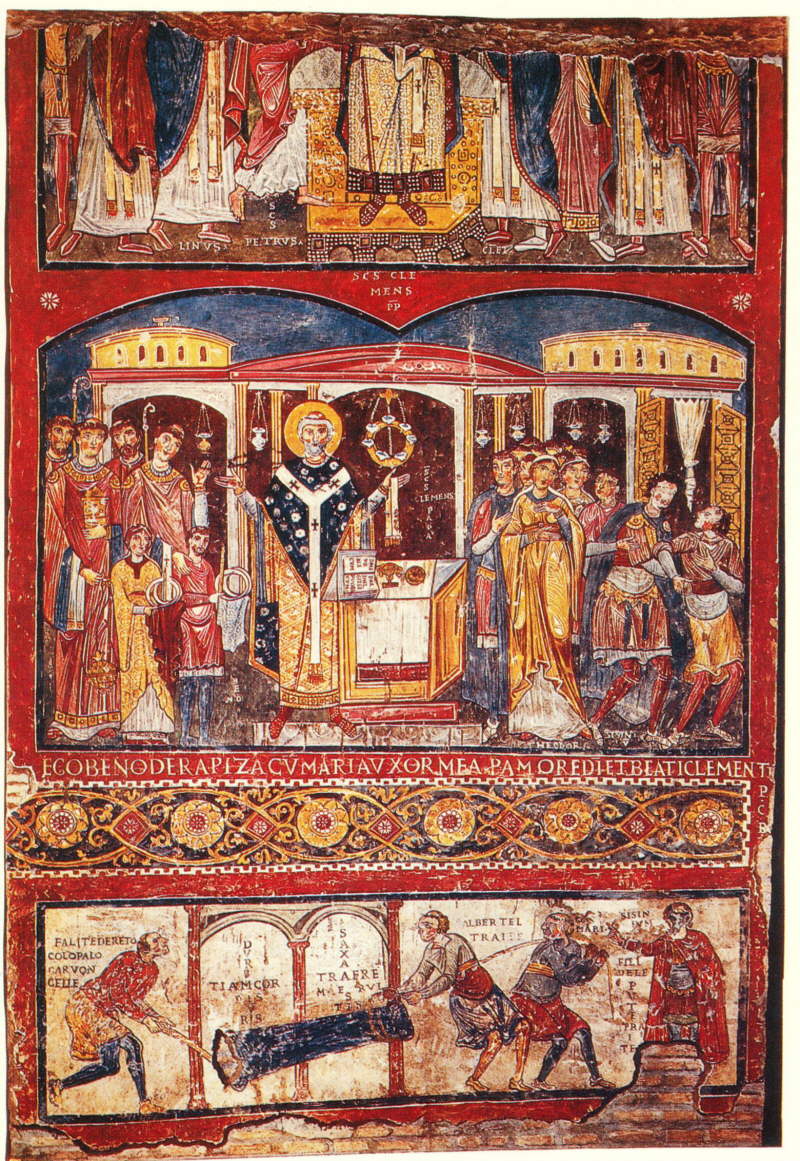
Clement became bishop before the third year of Trajan’s rule, i.e. before 100-101. Irenaeus testifies that Clement saw the blessed Apostles, dealt with them, and had the preaching of the apostles in his ears and the preaching of them before his eyes. John Chrysostom affirms that Clement, in the preaching of the faith was a collaborator with Paul, suffered with him at Philippi, and shared the dangers and labors of apostolic ministry in other places. Origen directly calls him a disciple of the apostles, Jerome calls Clement apostolical man, and Clement of Alexandria even an apostle (ἀπόστολος Κλήμης). According to the unanimous witness of antiquity, Clement was one of the first successors of the Apostles to the bishop’s chair at Rome.
The earliest writers report nothing about the nature of Clement’s death. Irenaeus does not seem to know of his martyrdom, for from Linus to Eleutherius he names only one martyr, Telesphorus. Eusebius and Jerome speak of his death without a word hinting at his martyrdom. But in the Roman calendars and liturgies since Rufinus and Pope Zosima Clement is constantly called a martyr; and the Martyrium S. Clementis, composed in the fourth century, crowns his glorious life with an equally glorious end: under Trajan he was banished to the Taurian Chersonese and, after a very successful missionary activity there, found a martyr’s end in the sea waves.
The historical significance of Clement is best illustrated by the fact that ancient tradition makes him the author of a number of works. In addition to his first epistle to the Corinthians, he is attributed many other epistles (the so-called “Second Epistle to the Corinthians,” two epistles to the virgins, two to James the brother of the Lord, to all churches and all believers, to the two disciples of Clement, Julius and Julian, to the Christians of Jerusalem).
But of all the works bearing the name of Clement, only one indisputably belongs to him: the first Epistle to the Corinthians. This is an extensive pastoral epistle, written on behalf of the Roman Church to the Church of Corinth. The existence of the epistle as early as the beginning of the second century is attested by the undoubted use of it by Polycarp of Smyrna, who cites many passages from it almost literally in his Epistle to the Philippians. But Polycarp does not mention the name of its author.
Clement’s Epistle to the Corinthians, written in Greek, is now known in two Greek manuscripts: 1) in the Alexandrian Codex, a 5th-century Greek Bible list (now in the library of the British Museum in London); in it the eleven last pages of the manuscript contain the first and so-called second epistle of Clement. One page was lost, but the gaps in the Alexandrian codex are filled by the text in the Jerusalem codex of 1056 (which also contains Διδαχή); this codex contains the full text of both epistles. Besides manuscripts of the Greek text, three translations are now known: the Syriac, the Latin, and the Coptic.
After a brief greeting and an explanation that the unexpected and successive calamities which had befallen the Roman Church had prevented his earlier attention to the controversial matters at Corinth, the author mentions the occasion for writing the epistle: the criminal and impious Corinthian rebellion, which a few impudent and arrogant men have stirred up to such madness, that the venerable, famous and universally admired name of the Corinthian Church has become the subject of great desecration.
In exhorting readers to sincere repentance, the letter sets as the basic and highest rule of Christian life constant conformity to the will of God: only through humble submission to Him can we reach our goal on earth and in eternity. The author supports his instructions with numerous examples from the Old Testament. Without the virtue of humility and obedience, in which Christ is our ideal, there can be no order in the Church. Even the sun, the moon, and the faces of the stars, in harmonious harmony, make the paths preset for them by the Creator. We must come to God in holiness of soul, with clean and pure hands, so that we may partake of the great and glorious promises that are prepared for those who trust in Him. Doing God’s will is the way to Christ, the High Priest of our offerings.
The second part of the epistle contains instructions directly concerning the rebellion at Corinth against the Church hierarchy. And in Christian society there is an order established by God and Christ through the apostles. The hierarchical order is also so determined, why it is unjust to deprive of the ministry those who are placed by the apostles themselves, or after them by honorable men, with the consent of the whole Church. The epistle then turns from general judgments about the ecclesiastical order to the particular case which gave rise to the writing of the epistle, and with a series of examples and sayings from the Scriptures shows the criminality of the Corinthian Christians’ conduct.
In the conclusion the author persuades them to submit to what has been said and to return to peace and unity, and finally asks them to let the messengers go immediately so that they may soon proclaim the longed-for peace and harmony in Corinth.
Antiquity associated the name of Clement of Rome with a whole coollection of texts, known under the general name Pseudo-Clementines (Κλημέντια), which depict the life of Clement and his conversion to Christianity. These include:
- Clement’s “Conversations” (Όμιλίαι); 2) “Encounters” (“Αναγνώσεις, Recognitiones), and 3) “Abbreviations” (Επιτομή) in two editions. Clement is said to have been tormented by doubts concerning the immortality of the soul, the origin and demise of the world, the afterlife, etc. In order to reach a resolution of these questions he attended philosophical schools, but in vain. Clement resolved to travel to the East. On his way to Alexandria, he met the Apostle Barnabas; in Caesarea (Palestine) he was introduced by Barnabas to apostle Peter. Peter, who soon induced Clement to accept Christian teaching and invited him to be a witness to the controversy with Simon Magus. The texts recount the acts of apostle Peter and his religious interviews with Simon Magus.
2.3 Ignatius of Antioch
There is not much known about Ignatius of Antioch, just like about other
Apostolic Fathers: in the 3rd book of the “Ecclesiastical History” of Eusebius of Caesarea the following is reported:
“Ignatius, who is still glorified by many, is the second bishop of Antioch after Peter. It is said that he was sent from Syria to Rome and put to death for confessing Christ. Passing through Asia he strengthened the believers and persuaded them to beware of heresies and urged them to hold fast to the Apostolic Tradition, which he considered necessary to set down in writing, while being martyred. Thus, while in Smyrna, he wrote a letter to the Church of Ephesus… another to Magnesia… He also wrote to the Roman Church, begging them not to intercede for him and not to deprive him of his martyrdom”.
It seems that Ignatius was not of Jewish origin, but a Gentile convert and his name probably indicates a Roman origin. In tales of the later period the name “God-bearer” is connected with the fact that Ignatius was the very child whom the Lord took in his arms in order to set an example for his disciples, who argued about primacy. However, St. John Chrysostom says that St. Ignatius did not see the Lord physically. On the other hand, as can be seen, Ignatius himself calls all Christians - God-bearers or temple-bearers, Christ-bearers and some other lofty epithets of a similar kind. That is, he regards the Christian ideal itself as “bearing” God, Christ, in the soul and body of the Christian as a kind of temple.
A piece of information on the liturgical heritage of Ignatius is given by the church historian Socrates:
“Ignatius, the third bishop of Syrian Antioch after apostle Peter, who was an apostle himself, saw in a vision the angels singing a solemn song to the Holy Trinity on two opposite sides, and he introduced this chant into the Antioch Church. From here this tradition passed on to all the other Churches. This is what they say about the singing of the antiphons” (Socrates Scholasticus, Ecclesiastical History VI: 8).
The martyrdom of Saint Ignatius occurred during the reign of emperor Trajan (98-117), (approximately in 107) in Rome in the arena of the Colosseum. St Ignatius wrote on his way to Rome for execution from Antioch, under the supervision of guards:
“On my journey from Syria to Rome I am fighting day and night, on land and sea with wild beasts, ten leopards, in other words, a group of ten warriors who, if I am kind to them, become even worse”.
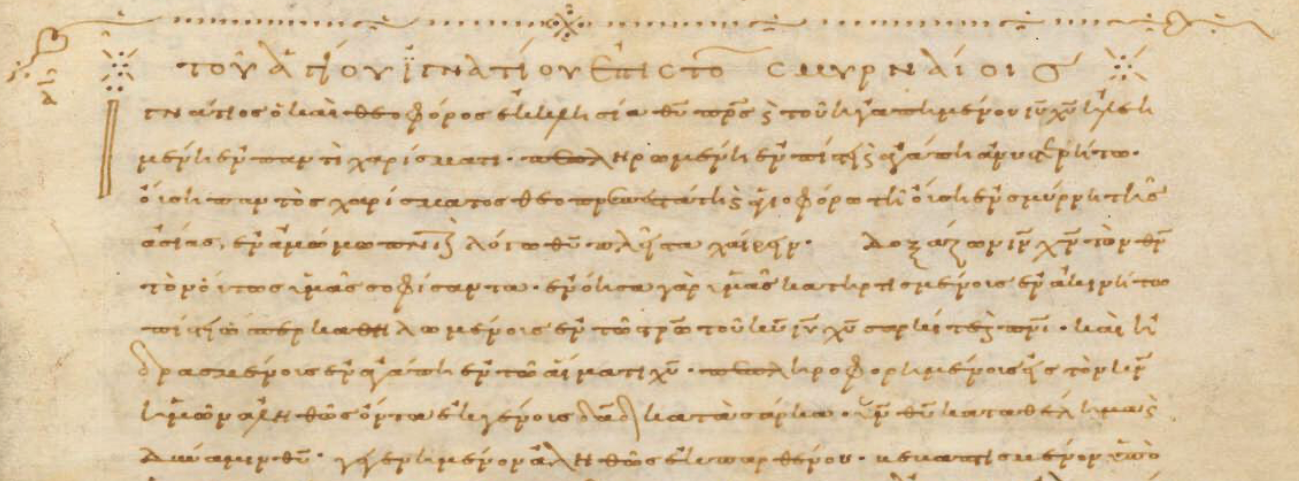
There are seven Letters of St Ignatius, considered authentic in scholarship, which have survived in the so called ‘middle’ edition dated to the 10th and 11th centuries (Letters to Ephesians, to Magnesians, to Trallians, to Romans, to Philadelphians, to Smyrnaeans, to Polycarp). They are already mentioned by Eusebius of Caesarea. The ‘brief’ Syriac edition includes only three of these seven Letters. The so-called ‘long’ version includes six more Letters in addition to these seven, which scholars believe to be forged and traceable to the Apollinarists of the 5th century. The authentic version is beleived to be the ‘middle’ version, i.e. the seven Letters listed above.
Already in antiquity we see important assessments of these epistles. Thus St Polycarp of Smyrna, one of the addressees of the Letters, wrote: “You may profit greatly from them: they contain faith, patience and instruction in the service of the Lord”.
From these epistles themselves we can make ourselves a spiritual portrait of St Ignatius, an important feature of whom would be genuine humility and self- abasement. He writes, to the Ephesian Christians: “I am your humbleservant”; to the Magnesians: “As I am in bondage, I am not worthy to be called one of you, the free men”; to the Trallians he writes that he is not worthy to bear the name of the Syrian Church; to the Romans. In his letter to the Trallians, St Ignatius as if to reveal a truly Christian reason for this attitude towards himself: “I know much about God, but I humble myself, lest I perish by vanity. In the present time I must be even more careful, and pay no heed to those who mock me, for in praising me they wound me. I am willing to suffer, but I do not know whether I am worthy…”
St Ignatius even admits himself unworthy of the martyrdom awaiting him. Therefore he asks for spiritual prayer support from all the addressees of his letters: “For I have need of your prayers and love in God” (Magn.), “And pray for me, for I have need of God’s mercy, and of your love, that I may be worthy to receive the lot that is set before me, to which I aspire, and not to find myself rejected” (Trall.), “but ask God for me internal and external power, that I should not only speak, but also desire, that I should not be called only a Christian, but also be one in reality” (Rom.).
In his letter to the Romans, St Ignatius, wary that Roman Christians might use their influence at the imperial court to induce the authorities to leniently punish them, categorically dissuades them from doing so:
“I am the wheat of God: let the teeth of beasts grind me down, that I may become the pure bread of Christ. Then I shall truly become a disciple of Christ, when even my body shall not be seen by the world… Oh, that I should not be deprived of the beasts prepared for me! I pray that they will rush upon me eagerly…”
Main themes he addresses in his epistles are a struggle against heresies (Docetism), Christology, ecclesiology.
St Ignatius is engaged in a polemic with the Gnostic semi-Christian groups confessing Docetism, which had also penetrated into the Church ; they taught that the Incarnation of God, His Crucifixion and Resurrection were only seemingly phantom events. The Docetes based their teaching on the dualistic philosophy of Platonism, which affirmed the essential division between the world of matter and the world of spirit, with matter recognized as evil and degraded in comparison with spirit. God, being a spiritual being, from their point of view, by virtue of his impassivity and transcendence (transcendence), could not come into contact with evil matter, and therefore could not unite with the body and suffer on the Cross. Therefore the Gnostic thinkers could not accept the idea of the Incarnation, suffering and resurrection - why should God take on this corruptible matter? So they somehow thought that this Incarnation was only ghostly, and that the Lord did not go through the stages of maturity (infancy, childhood, maturity), as it is common to every human being, but appeared at the age of 30 in the synagogue of Capernaum, preaching immediately. So, they considered the events of the Incarnation, Tribulation and Resurrection to be some kind of ghosts, “phantoms”.
In contrast, St Ignatius repeatedly stresses the reality of the Incarnation of God and its essential role in our salvation. In connection with St Ignatius’ denial of the human nature of Christ, he emphasises the properties and functions of this very - human nature of the Saviour:
“Therefore do not listen when anyone tells you anything other than about Jesus Christ, who came of the lineage of David from Mary, was truly born, ate and drank, was truly condemned under Pontius Pilate, was truly crucified and died, in the sight of heaven, earth and underworld. - Who was raised from the dead because his Father raised him up, who in like manner will raise us who believe in Jesus Christ…”.
St Ignatius is one of rare authors who expose a “Theology of martyrdom”. St Ignatius’ view here is based on the idea of Christlikeness, “God-imitation”. True Christians, “God-imitators” are always true imitators of Christ, including His suffering. Therefore the truest Christian is the martyr. It is known that the Gnostics, from the Christological idea of denying the authenticity of the Incarnation of God (God cannot and should not be united with the flesh), had some practical conclusions: denying the Resurrection of the flesh at the end of time, they (unlike Christians) also denied the need for martyrdom, when they were forced to do so and allowed the offering of pagan sacrifices to idols and the eating of idolatrous sacrifices. Indeed - if Christ did not suffer in the flesh, why should they themselves be tortured? St Ignatius, on the other hand, saw the closest connection between Christ’s sufferings and the sufferings of the martyrs. In his conviction, Christ, by His suffering, validated the exploit of martyrdom, and the suffering of the martyrs, in turn, proved the authenticity of the suffering (and Incarnation) of Christ Himself.
St Ignatius exclaims:
“And if others, like some godless ones, that is, unbelievers, say that He suffered only as a ghost, - they themselves are a ghost - why am I in bondage? Why do I ardently strive against the beasts? Or do I die in vain? Am I then speaking a lie about the Lord?” (Tral.)
We see that the confession of the reality of the Incarnation of God in St Ignatius not only took the form of a theological view, but also was closely understood and most importantly, was experienced by him in connection with the forthcoming exploit of martyrdom. It was for himself a kind of argument in favour of an unambiguous solution to the problem of the ontological status of the human flesh of Christ.
2.4 Polycarp of Smyrna
Polycarp was one of the disciples of the Apostle John. This is attested by
Polycarp’s disciple, Irenaeus of Lyon, who reports that, in his youth, listened to the sermons of an elderly bishop of Smyrna, who made such a strong impression on him that the image of the preacher vividly stood before the spiritual eyes of Irenaeus when he himself grew old and served as bishop in the faraway Gaul. We know nothing definite as to the time of Polycarp’s birth and the circumstances of his early life.
In his unwavering commitment to the doctrine he received from the Apostles, Polycarp was a reliable foundation against the dangers that threatened the Church from different directions. “He always taught what he had learned from the apostles, what the Church also transmitted, and what alone is true,” why he is “the most reliable and trustworthy witness to the truth,” is what St. Irenaeus says of him. This explains the strong influence of Polycarp on the Churchesof Asia Minor.
We have more complete information concerning the last years of Polycarp’s life. At the end of his life he visited Rome when Anicetes was on the Roman see (154/155 - 166/167). In his letter to Victor, Irenaeus states that Polycarp and Anicetes had a discussion about many ecclesiastical issues of our time, especially about the feast of Easter, a matter of Church concern. Anicetes stood for the Western practice, Polycarp for the Eastern practice of Apostle John and the other Apostles, and no agreement was reached “because neither Anicetes could persuade Polycarp not to observe what he had always observed, living with John, the disciple of our Lord, and handling the other Apostles, nor could Polycarp persuade Anicetes to observe, for Anicetes said that he had to keep the customs of the elders who had preceded him. In spite of this state of affairs, they were, however, in mutual communion, so that Anicata, out of respect for Polycarp, permitted him to celebrate (in his Church) the Eucharist, and they both parted in peace” (informs Eusebius in his ‘Historia ecclesiastica’). Irenaeus reports that while in Rome Polycarp converted to the Church of God many Valentinians, Marcionites; he also met Marcion himself, and when the latter asked him, “Do you recognize me?”, - he answered, “I recognize the first-born of Satan”.
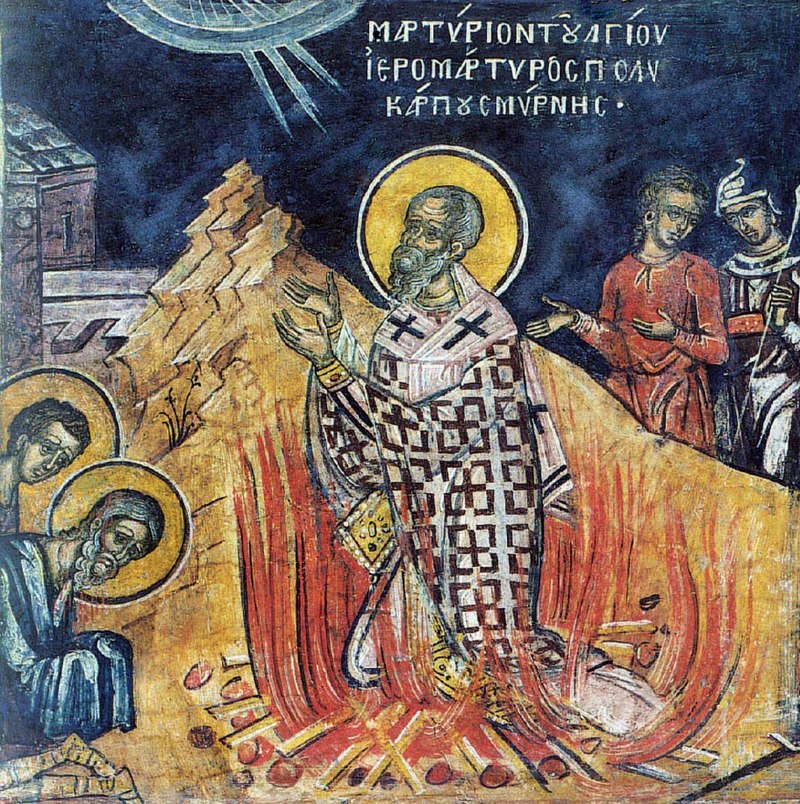
The aged bishop of Smyrna died a martyr during the persecution of the Christians that broke out in Smyrna in 155.
Irenaeus, in his letter to Florinus, speaks of the epistles of Polycarp written in part to individual brethren for the purpose of exhorting and instructing them; when Irenaeus wrote his letter to Florinus, the epistles of Polycarp were still in existence. Among these epistles, Irenaeus especially notes the Epistle to the Philippians: “There is,” he says, “anepistle of Polycarp, written to the Philippians, from which those who wish and care for their salvation may learn both the character of his faith and the preaching of the truth” (Adv. haer. III, 3.4).
The text of Polycarp’s epistle to Philippians is very poorly attested. No authentic Greek text of the entire epistle exists. The eight later manuscripts of the Greek text of the epistle are copies of the older models. The full text of the epistle is only contained in a Latin translation
Polycarp’s epistle to the Philippians represents a response to a letter from the Philippians to Polycarp that has not come down to us. The city of Philippi was on Ignatius’ journey to Rome. He was cordially received by the local Church and asked the Philippians to send greetings to the Antiochian Church on the occasion of the cessation of the persecutions. The Philippians complied with the request of St. Ignatius and his message. Ignatius and sent their message to the bishop of Smyrna with another message in his name. In the latter they asked Polycarp to send their message to Antioch, they reported Ignatius’ stay with them and the events of the internal life of the Philippian Church, in particular the covetousness and falsehood of Presbyter Valentus and his wife, which had caused much trouble to the Church, they asked Polycarp for words of instruction and exhortation and, finally, they requested that the messages of Ignatius be sent them, which were known to him.
Polycarp replied to the Philippians on behalf of himself and the presbyters of the Church of Smyrna. The author expresses his joy that the Philippians received with such love “specimens of true love” - Ignatius and his companions, and that “the firm root” of their “faith, known from ancient times, abides to this day and bears fruit worthy of the LordJesus Christ”. All must arm themselves with the weapons of righteousness and teach themselves first, and then the wives, to remain in the faith given, in love and purity, to love their husbands with all sincerity and to bring up their children in the fear of God; to teach widows to keep away from all slander, malice, false testimony, covetousness and every vice, and to know that they are the altar of God. Special instructions are given to deacons, young men and virgins: all must be blameless in all things; young men must obey the elders and deacons, and virgins must live with a blameless and pure conscience.
The author dwells with heartfelt concern on the case of Presbyter Valentus, who forgot his ministry and indulged in covetousness. All should avoid covetousness and other vices, and Valentus and his wife should not be regarded as enemies, but strive to reform them as members of the afflicted and lost. He had no further need to write to them, for they themselves had well studied the Scriptures. May God Himself establish them in faith and truth and in all virtues. They should pray for all Christians, for kings, for authorities and princes, for persecutors and haters and for enemies of the Cross.
He says he attached the epistles of Ignatius, as many as he had, to his letter and asks the Philippians to give him reliable information about Ignatius and his companions. In conclusion, Polycarp asks to receive with honor Crescentus, through whom the message was delivered, and his sister.
Polycarp had as his model the first epistle of Clement of Rome, to which he often adheres almost literally. Nevertheless, Polycarp’s brief epistle had many attentive readers, and through reading in the liturgical assemblies of Asia Minor it received ecclesiastical approval. Particularly heartfelt and emphatic are the moral precepts, which briefly set forth the duties of all believers according to their ecclesial and social standing, and extracted from the apostolic epistles.
The epistle was written soon after Ignatius’ death, because it suggests that he had already reached his proper place with the Lord; but at the same time Polycarp asks for reliable information about Ignatius; hence the details of Ignatius’ martyrdom were not yet known in Smyrna.
- 2.1 Pre-Nicaean period (late 1st and early 4th centuries)
- 2.2 Clement of Rome
- 2.3 Ignatius of Antioch
- 2.4 Polycarp of Smyrna
Polycarp was one of the disciples of the Apostle John. This is attested by
Polycarp’s disciple, Irenaeus of Lyon, who reports that, in his youth, listened to the sermons of an elderly bishop of Smyrna, who made such a strong impression on him that the image of the preacher vividly stood before the spiritual eyes of Irenaeus when he himself grew old and served as bishop in the faraway Gaul. We know nothing definite as to the time of Polycarp’s birth and the circumstances of his early life.
St. Clement of Rome, as can be deduced from the testimonies of antiquity
about him, was an eminent and revered ancient ecclesiastical figure. An eloquent proof of his high authority and veneration is the basilica in Rome dedicated to him, which is already mentioned by Jerome.
There is not much known about Ignatius of Antioch, just like about other
Apostolic Fathers: in the 3rd book of the “Ecclesiastical History” of Eusebius of Caesarea the following is reported:
St Ignatius exclaims:
This period is important for several reasons. It was the period in which
Church writing and Church theology were formed and its foundations were laid, which in turn allowed Church theology to flourish in the 4th and early 5th centuries, known as the “Golden Age of Church History”. The pre-Nicaean period consists of two and a half centuries, during which the church writing went a long way from its simplest forms to the most complex ones.
-
Apostolic Fathers
-
Early Christian Apologists
-
Polemical works against Gnostics and Montanists
-
Beginnings of catechetical and exegetical schools.
A. Ante-Nicene Period (2nd - early 4th cent.)
Apostolic Fathers
Related Concepts
- aphthartodocetes
- apostolic-age
- apostolic-custom
- apostolic-fathers
- christian-identity
- christlikeness
- church-order
- church-unity
- creeds
- docetism
- easter-controversy
- episcopal-succession
- eucharistic-communion
- gnosticism
- god-imitation
- indwelling-of-god
- liturgical-custom
- liturgical-tradition
- mediation
- moral-instruction
- obedience
- order-in-the-church
- paschal-controversy
- passion-of-christ
- patristic-periodization
- polycarp-of-smyrna
- pre-nicaean-period
- priesthood
- purity
- quartodeciman-practice
- reality-of-the-incarnation
- resurrection
- schism-at-corinth
- schools-of-alexandria-and-antioch
- self-abasement
- temple-imagery
- unity-in-diversity
- voluntary-martyrdom