Old Testament — Topic 13
13.3 Israel’s Degeneration in the Time of the Judges, When There Was No
King (17:1–21:25)
The pattern of disloyalty, apostasy, and depravity that became ever more prominent in the central section of Judges (3:7–16:31) reaches its zenith in the book’s conclusion. Whereas the book began with a record of Judah’s obedience in completing the conquest (1:1–20), the book ends with the same tribe leading a campaign against their brethren in the tribe of Benjamin (20:1–48). In this section, it is not only regional governors (i.e., judges) who lead the people astray; the Levitical priesthood is responsible for ignoring, inciting, and even affirming the apostasy of the nation. Under their influence, the people of God commit the period’s most heinous crimes and the most rebellious violations of their covenant with God. These dark circumstances offer the historical background for the book of Ruth, in which loyalty to the God of Israel and hope for the wayward nation reemerge from the most unexpected of places and individuals.
Micah and the Danites Illustrate Israel’s Religious Corruption (17:1–18:31)
Following three detailed narratives of faltering Israelite leadership come two concluding sections, in which the religious leadership of the day plays a prominent role. The first of these sections (17:1–18:31) revolves around a Levite who works first for a man named Micah (17:1–13) and then for the tribe of Dan (18:1–31). These two episodes portray a time when Israel lacks godly leadership and “everyone [does] what [is] right in his own eyes” (17:6). In the case of Micah, this includes creating his own shrine and employing a Levite to assist in his worship of false gods. In the case of the tribe of Dan, this involves abandoning the land allotted to them by God, persuading Micah’s Levite to join them, violently conquering a peaceful territory, and setting up their own shrine to idols. The depth of religious corruption that comes to the fore in this text is surpassed only by that of the second concluding section (19:1–21:25), in which the failure of a Levite leads to violence, destruction, and betrayal in the heart of Israel.
A Levite’s Concubine and the Fate of the Benjamites Illustrate Israel’s Moral Corruption (19:1–21:25)
The account of the establishment of a shrine in Dan (18:1–31) by Micah’s Levite is followed by a second section reflecting on the depravity of religious leadership. Here another Levite visits Bethlehem in an attempt to woo back his estranged concubine. Welcomed with abundant hospitality, the Levite feasts and relaxes until he departs with his concubine. Arriving in the Benjamite town of Gibeah at nightfall, he expects more hospitality but instead finds himself the intended victim of gang rape. In an act of self- preservation, he turns his concubine over to the lustful crowd, much like Lot had in Sodom (Gen 19). And yet, unlike in Sodom, the discarded woman is violently raped and left for dead. In the chapters that follow, these events have national ramifications: the Levite alerts all Israel to the crime by gruesomely dismembering his concubine and distributing the pieces to the tribes of Israel (19:27–30). As a result, the Israelites all but destroy the tribe of Benjamin (20:1–48). Finally, in an act of pity, the rest of Israel attempts to rejuvenate the surviving Benjamites by stealing wives for them (21:1–25). At this point in the book of Judges, the narrator hardly needs to note that “everyone did what was right in his own eyes.” The depravity of God’s people has reached its peak: victimizing the vulnerable, turning against their countrymen, and delighting in godless immorality. It is against this hopeless backdrop that the book of Ruth will unfold, in which the reader discovers that somewhere in such darkness, God is working in faithful people to make a way for Israel.
13.1 The Gradual Unraveling of the Unfaithful People
JUDGES:
1:1–3:6 Israel’s Failure to Obey After the Days of Joshua, and God’s Response
1:1–36 Israel’s Failure to Conquer Canaan Due to Its Sin
2:1–3:6 God’s Response to Israel’s Failure and Idolatry
3:7–16:31 The Cycle of Sin, Judgment, Oppression, Repentance, and then
Deliverance by Judges Whom God Raises Up
3:7–5:31 God Raises Up Othniel, Ehud, Shamgar, Deborah, and Barak to Deliver
Israel from Oppressors
6:1–10:5 God Raises Up Gideon to Deliver Israel from the Midianites
10:6–12:15 God Raises Up Jephthah to Deliver Israel from the Ammonites
13:1–16:31 God Raises Up Samson to Deliver Israel from the Philistines
17:1–21:25 Israel’s Degeneration in the Time of the Judges, When There Was No
King
17:1–18:31 Micah and the Danites Illustrate Israel’s Religious Corruption
19:1–21:25 A Levite’s Concubine and the Fate of the Benjamites Illustrate
Israel’s Moral Corruption
Set in the time after Joshua’s death, the book of Judges recounts the early days of Israel in the land of Canaan, between the time of their initial conquest and the appointing of Israel’s first kings. Judges describes the cycles of sin among the generations of God’s people who are removed from the miraculous work of God in the Pentateuch and Joshua. Judges tells a story of God’s continued faithfulness to his people, despite their doubt, disloyalty, and eventual abandonment of their covenant with him. The book unfolds in three parts: (1) an introduction highlighting the failure of most tribes to complete the work Joshua started (1:1–36) and the challenges they will face as a result of this failure (2:1–3:6), (2) a central section demonstrating a downward spiral of false worship and immorality among Israel’s people (3:7–16:31), and (3) a conclusion that focuses on Israel’s religious leaders, demonstrating the depth of the people’s depravity and abandonment of Yahweh (17:1–21:25). The book’s final chapters are punctuated by the refrain that Israel lacked a king, and “everyone did what was right in his own eyes”. Israel lacked godly leadership that pointed them to God’s sovereign rule, and they were therefore bereft of a moral compass and any sense of their vocation as God’s covenant people. The horrific stories at the end of the book show the Israelites mired in greater depravity than that of the Canaanites whom God drove out of their land. Only in Ruth—the next book in the canon, and the next narrative in Israel’s history—the readers will once again witness any of God’s people acting obediently and embodying the grace and faithfulness of the God of Israel, a God who is consistently working for their redemption.
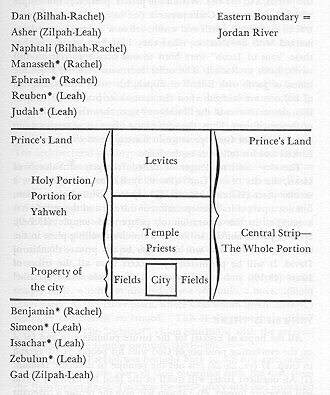
Israel’s Failure to Obey After the Days of Joshua, and God’s Response (1:1–3:6)
The death of Joshua and his generation is the backdrop against which the book of Judges unfolds. More than a sign of the absence of godly leadership, the notice about the emergence of a new generation (2:10) signals to the reader that Israel now lacks those who remember the exodus and the mighty victories of God during the conquest of Canaan. The two-part introduction explores the ramifications of this reality by highlighting, first, the failure of most tribes to properly drive out the land’s inhabitants (1:1–36) and, second, the way in which God responds to that failure—by testing their allegiance through repeated battles from which he miraculously saves them (2:1–3:6). This initial summary sets the stage for the rest of the book, which demonstrates just how decidedly Israel fails to follow God’s instructions and remain loyal to him.
Israel’s Failure to Conquer Canaan Due to Its Sin (1:1–36)
Judges begins where Joshua ended, i.e., with the land of promise having been won in battle, but not entirely settled or fully conquered. In fact, many of the land’s pagan, Canaanite inhabitants remain. The first chapter summarizes the attempts of God’s people to adhere to the charge to remove the people and the religious influence of Canaan from the land they were allotted. The first half of the chapter (1:1–20) relays the success of Judah and Simeon in this endeavor. The remainder of the chapter (1:21–36) outlines the increasingly ineffective efforts of the rest of the tribes to do the same. Ultimately, they compromise their exclusive loyalty to Yahweh. Because of the failure of God’s people to follow his instructions, in the next chapter he will respond by confronting them through a divine messenger and testing their allegiance through the serial occupation of the land by oppressors of various kinds.
God’s Response to Israel’s Failure and Idolatry (2:1–3:6)
God answers the covenant breach committed by the people in chapter 1 by reminding them of the defining moment in their relationship: the exodus. In this speech (2:1–5), the messenger accuses God’s people of unfaithfulness and reminds them of the consequences of their disloyalty, namely, the difficulties posed by the nations remaining in their midst. However, the generations after Joshua are so far removed from past miracles that they have lost sight of their unique relationship with Yahweh and have fallen into worshiping the gods of the nations. God responds with a series of military conflicts designed to expose their sin and demonstrate his gracious deliverance through the judges. However, the people refuse to acknowledge their waywardness. Therefore, God reiterates that the nations will continue to live among his people “to see whether Israel would obey the commands of Yahweh” (3:4). As the rest of the book will demonstrate, the people will fail this test miserably.
13.2 The Cycle of Sin, Judgment, Oppression, Repentance, and Then
Deliverance by Judges Whom God Raises Up (3:7–16:31)
The central section of the book includes a series of narratives depicting the same kind of military encounters and the same pattern of divine response that were outlined in the introduction (2:11–19). While the earlier narratives highlight God’s ability to overcome Israel’s formidable oppressors (3:7–5:31), the latter narratives focus on the failure of the people to recognize God’s work, trust in his power, and show him allegiance (6:1–16:31). Ultimately, this section of Judges details a downward spiral in which God’s people show him less and less loyalty, and the nation’s leaders are more and more visibly complicit in the people’s waywardness. The final chapters of the book (17:1–21:25) record the most poignant examples of this trajectory, as the nation unravels under the influence of depraved religious leaders, who exemplify a people that “does whatever is right in [its] own eyes” (17:6; 21:25). Only in the book of Ruth does the story shift to one of abundant faithfulness on the part of the people and their covenant God.
God Raises Up Othniel, Ehud, Shamgar, Deborah, and Barak to Deliver Israel from Oppressors (3:7–5:31)
Following God’s declaration in the previous section of the book that the waywardness of the people will result in continued conflict with the nations, three narratives and one short report of those conflicts follow. In each case, God raises up individuals as instruments of his deliverance—Othniel against Mesopotamia (3:7–11), Ehud against Moab (3:12–30), Shamgar against Philistia (3:31), and Deborah and Barak against Canaan (4:1–4:24). In each of these narratives, God demonstrates his ability to counter mighty foes, whether wicked, such as Cushan Rishathaim; well allied, such as Ehud; or well armed, such as Jabin, king of Canaan. The section culminates with a song from the prophet Deborah, who accentuates that even a fledgling army such as Israel’s can be victorious when Yahweh leads them to battle; all he requires is their loyalty. Ultimately, the story of Gideon that follows (6:1–10:5) demonstrates that the people and their leaders fail to take this message to heart.
God Raises Up Gideon to Deliver Israel from the Midianites (6:1–10:5)
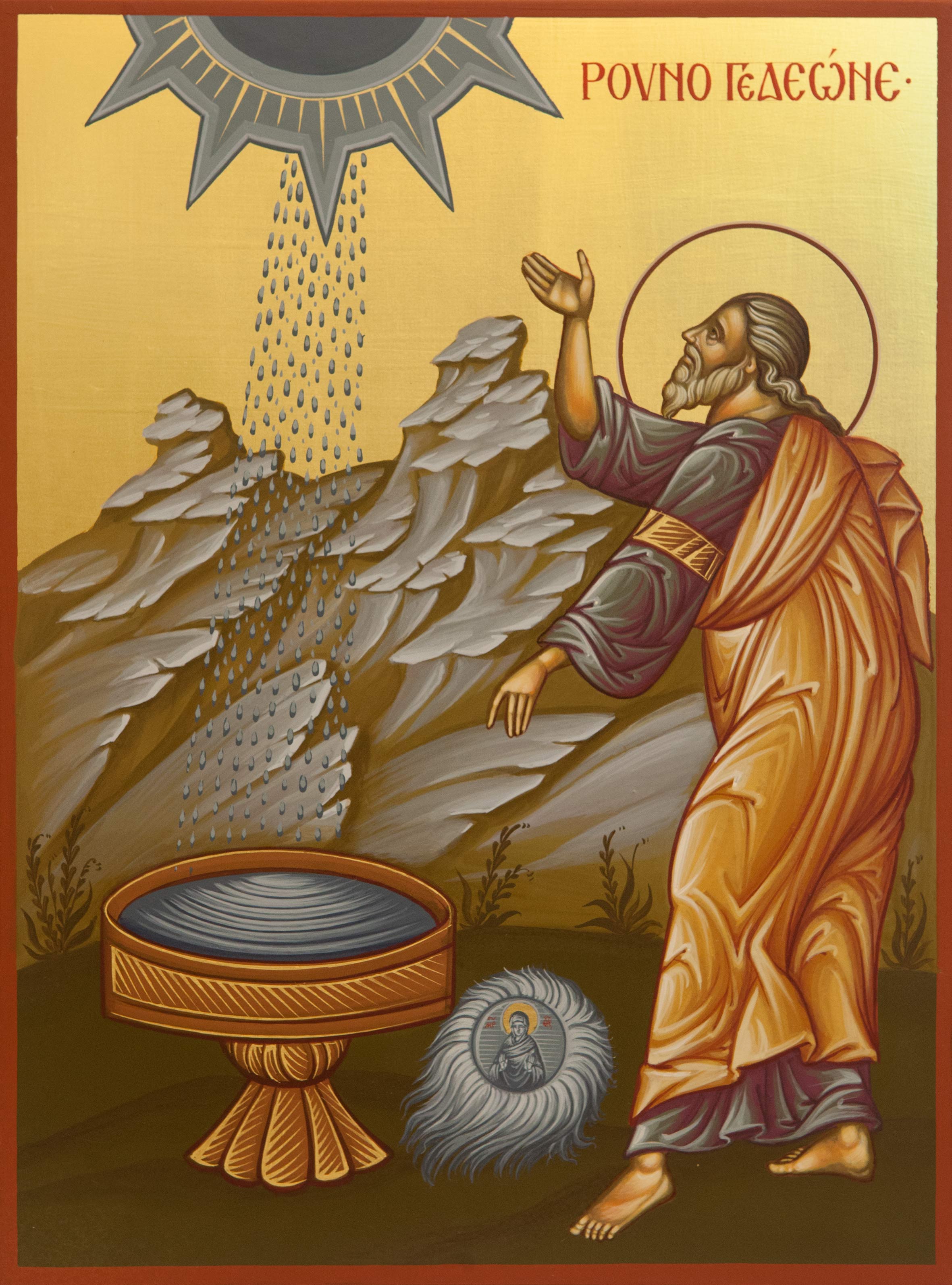
After several accounts of God’s mighty deliverance (3:7–5:31), Gideon’s narrative opens with a new threat—the army of Midian. Despite the prophet’s impassioned song in the preceding chapter (5:1–31) and the rebuke of a second prophet (6:8–10), Gideon accuses God of failing to act in miraculous ways in recent times (6:13). After some initial doubts, God convinces Gideon to act as a deliverer. Before assuming the role of judge, Gideon asked for a sign from God, and he was given the sign of a fleece (wool) twice; on the first morning, all the wool was wet with dew, and the ground around was dry. On the second morning, dew fell everywhere on the ground, but the wool remained dry. In the sign of the Fleece, Christian interpreters saw the prototype of the Virgin Mary, Who miraculously received the Son of God in Her womb. On the Feast of the Annunciation we sing, “He shall come down as rain upon the fleece.” In the first Nativity Canon we hear, “As dew upon the fleece, You have descended into the womb of the Virgin, O Christ.” The word translated fleece usually means “clippings of grass”; here, it is clippings of wool. Gideon put out the fleece, asking God to send dew on the fleece only, not on the ground. Why? So Gideon would know it was God’s intention to save Israel by my hand (v. 37 ). Thus, there is meaning beyond the miracle itself: the dew is the Son of God; the fleece is Mary; the result is the Incarnation, through which Israel — and all men — can be saved.
Specific elaboration
The Dewy Fleece of Gideon: A Prophetic Icon of the Incarnation
The account of Gideon’s fleece in Judges 6 is one of the most striking and theologically rich passages in the Old Testament. For the Orthodox Church, this narrative is not merely a historical account of a judge seeking confirmation of God’s will; it is a divinely orchestrated prophecy , a living icon that prefigures the mystery of the Incarnation and the unique role of the Most Holy Theotokos in the salvation of the world.
1. The Biblical Account: A Sign of Reversal and Grace
The narrative unfolds during a time of great national crisis. Israel is oppressed by the Midianites, and Gideon is called by God to be their deliverer. Seeking assurance, Gideon asks God for a sign—twice.
The First Sign: The Wet Fleece on Dry Ground
“Look, I shall put a fleece of wool on the threshing floor; if there is dew on the fleece only, and it is dry on all the ground, then I shall know that You will save Israel by my hand, as You have said.” (Judges 6:37, NKJV). God grants this sign: the fleece is soaked with dew while the ground remains dry.
The Second Sign: The Dry Fleece on Wet Ground
Gideon, seeking further confirmation, asks for the reverse:
“Do not be angry with me, but let me speak just once more: Let me test, I pray, just once more with the fleece; let it now be dry only on the fleece, but on all the ground let there be dew.” (Judges 6:39, NKJV). God grants this second sign as well: the fleece remains dry while the ground is covered with dew.
This double miracle—the reversal of the natural order—is the key to its prophetic significance. It is a supernatural sign, indicating that God’s work of salvation is not according to the natural course of events, but is a direct, miraculous intervention of divine grace.
2. The Patristic Interpretation: The Fleece as the Theotokos
The Holy Fathers, guided by the Holy Spirit and the liturgical tradition of the Church, saw in Gideon’s fleece a profound prophecy of the Virgin Mary and the Incarnation of the Son of God.
A. The Fleece ( Πόκος) as the Womb of the Virgin:
St. Gregory of Nyssa , in his Life of Moses , explicitly draws the parallel: “The fleece, which received the dew while the earth was dry, prefigured the Virgin, who conceived the Word of God within her womb while the whole world was barren of grace.” The fleece, a pure and soft material, represents the pure, undefiled humanity of the Theotokos, chosen to receive the divine Word.
St. John of Damascus , in his Homilies on the Nativity of the Theotokos , echoes this: “Gideon’s fleece, which alone received the dew from heaven when the earth was dry, foreshadowed thee, O Virgin, who alone wast filled with the grace of the Holy Spirit, while the world was parched with unbelief.”
The First Sign (Wet Fleece, Dry Ground): The Incarnation:
This sign prefigures the conception of Christ in the womb of the Virgin.
The dew from heaven is a symbol of the Holy Spirit and the divine
grace that descends upon Mary. The fleece, receiving the dew, represents the
Virgin’s womb, which alone received the divine Word. The dry ground represents
the rest of humanity, which, in the economy of salvation, did not receive the
Word in the same unique way. Christ was conceived only in Mary, “without
seed,” by the power of the Holy Spirit (Luke 1:34-35). The “dew” of divinity
was exclusively on the “fleece” of her humanity.
B. The Second Sign (Dry Fleece, Wet Ground): The Perpetual Virginity:
This second, reversed sign has profound significance for the doctrine of
Mary’s perpetual virginity. The fleece that remains dry after the dew has
been given represents the Virgin’s womb remaining inviolate and virginal even
after the birth of Christ. The dew (the Holy Spirit) has descended and
accomplished its work, yet the fleece (the Virgin) remains dry—her physical
integrity is preserved. Meanwhile, the “ground” (the world) is now wet with
the dew of grace—the salvation and sanctification that flows from the
Incarnation to all creation.
The fleece was wet with dew, and the earth was dry; again the fleece was dry, and the earth was wet with dew. This clearly proclaims the mystery: the Virgin conceived the Word, and the world received grace.
3. The Connection to Psalm 71 (72):6
The Church’s liturgical tradition explicitly links Gideon’s fleece to a Messianic Psalm:
“He shall come down like rain upon the mown grass, Like showers that water the earth.” (Psalm 72:6, NKJV; Psalm 71:6 in the Septuagint numbering).
The Septuagint reads: “He shall come down like rain upon a fleece, and like drops that drop upon the earth.”
This is a direct reference to Gideon’s sign! The Psalmist, speaking prophetically of the Messianic King, declares that He will descend “like rain upon a fleece” (ἐπὶ _ πόκον_). The “rain” is the divine Word, the Son of God. The “fleece” is the Virgin Mary. This verse is a clear, inspired commentary on the Judges account, confirming its Messianic and Mariological interpretation.
Liturgical Use: This verse from Psalm 71 (72) is sung at the Royal Hours of the Nativity of Christ and during the Vespers of the Nativity , directly applying it to the Incarnation. The Church sings:
“He shall come down like rain upon the fleece, and as drops that water the earth. The Virgin has conceived, and the Word has become flesh.”
4. The Liturgical Understanding: The Fleece in Orthodox Worship
The image of the dewy fleece permeates Orthodox hymnography, particularly in the services for the Nativity of the Theotokos (September 8) and the Annunciation (March 25).
From the Vespers of the Nativity of the Theotokos:
“Today the barren Anna conceives the pure Virgin, who is the fleece of Gideon, from whom the heavenly dew descended, even Christ, the Word of God, who came to save our souls.”
From the Canon of the Annunciation:
“Gideon prefigured the mystery of thy conception, O Virgin, when he saw the fleece receive the dew from heaven, and the earth remain dry. Thy womb, O Pure One, received the divine Word, while the world was barren of salvation.”
The Nativity Icon: In the Orthodox icon of the Nativity of Christ, the scene of the Virgin and Child in the cave is often surrounded by stylized rays of light or “dew” descending from heaven, visually recalling the dew upon the fleece.
5. The Ascetical Understanding: Receiving the Dew of Grace
For the individual Christian, the symbol of the dewy fleece is a profound ascetical lesson.
The Fleece as the Human Heart: The fleece of wool represents the human heart—soft, receptive, and humble. The dew is the grace of the Holy Spirit.
The Call to Receptivity: Just as the fleece received the dew while the ground remained dry, the heart that is open to God, that is humble and contrite, receives His grace. The “dry ground” represents the hardened, unrepentant heart, closed to the dew of divine grace.
The Prayer of the Heart: The ascetical practice of the Jesus Prayer (“Lord Jesus Christ, Son of God, have mercy on me, a sinner”) is the means by which we cultivate the “fleece” of the heart, making it soft and receptive to the descent of the Holy Spirit. Through watchfulness (nepsis) and repentance, we allow the dew of God’s grace to penetrate our being, transforming us from within.
The Danger of Pride: The second sign warns us against spiritual pride. Just as the fleece alone was dry while the ground was wet, a soul that has received great grace can become dried up through pride and self-reliance. We must always remain humble, recognizing that all grace is a gift from God.
Conclusion: The Fleece as a Sign of Salvation
The Dewy Fleece of Gideon is a multifaceted jewel of Old Testament prophecy, revealing the mystery of the Incarnation with stunning clarity. It prefigures:
The Virgin Mary as the pure, receptive vessel of the Word of God.
The Holy Spirit as the heavenly dew descending upon Her.
The Incarnation as the miraculous union of divine and human nature in Her womb.
The Perpetual Virginity of the Theotokos, preserved even after the birth of Christ.
The Universal Grace that flows from the Incarnation to the entire world.
For the Orthodox Christian, Gideon’s fleece is not a distant historical curiosity but a living icon of hope. It assures us that God’s grace descends not according to the natural order of merit and deserving, but according to His own loving-kindness. It calls each of us to become like the fleece—humble, open, and receptive to the dew of the Holy Spirit, so that Christ may be conceived and born within us, and we may become partakers of the divine nature. This is the ultimate fulfillment of the sign: not just that the Word took flesh in Mary, but that He may be born in our hearts, making us children of God and heirs of His eternal Kingdom.
Unfortunately, the hesitancy that marks Gideon’s early actions blossoms into outright violence and apostasy, until the entire nation abandons their Lord and worships an ephod (8:1–35). Gideon is a turning point in the book of Judges, from mostly good judges to increasingly sinful ones. Gideon’s legacy of violence and institutionalized apostasy continues with his son, who rises up not as a deliverer, but as an oppressor of Israel, naming himself a king and killing those who might oppose him (9:1–57). Though God rescues his people from Abimelech’s tyranny, the next three judges of Israel seem to reflect Gideon’s faithlessness, each living more like a king than a deliverer (10:1–5). The level of depravity to which the nation has descended comes to a head in the next section, where God will declare that his deliverance of the people will no longer be decisive (10:13–14).
God Raises Up Jephthah to Deliver Israel from the Ammonites (10:6–12:15)
The apostasy that emerged under Gideon and flourished under Abimelech becomes widespread enough in this section that God addresses the people once more, this time announcing that he will send two oppressors, the Philistines and the Ammonites, and that the people will not be delivered entirely from them. God will “save [them] no more” (10:13). In this period of occupation Jephthah emerges as a tribal leader, and God uses him to spare his people from destruction by the Ammonites—a success Jephthah secures for himself by making a vow to Yahweh that will result in the pagan-like sacrifice of his daughter. Ultimately, like Gideon and Abimelech before him, Jephthah’s chilling legacy is one of violence against fellow Israelites (12:1–6). After his death, four more judges govern in Israel, but the people never again experience the “rest” that God brought in days past (3:11, 30; 5:31; 8:28). Like Jephthah, the next prominent judge will only “begin” to save Israel from the second oppressor, the Philistines (13:5; compare 10:18).
God Raises Up Samson to Deliver Israel from the Philistines (13:1–16:31)
Given the violence and apostasy that characterized the last two sections of Judges (6:1–12:15), the miraculous birth account that begins Samson’s narrative strikes a hopeful tone. Set apart from infancy for the task of protecting God’s people from the Philistines, imbued with miraculous strength, and prepared for a lifestyle of holiness (as a Nazirite), Samson has every advantage. But despite being prepared for a life of faithfulness, Samson’s life is marked by petty disputes, sexual indiscretions, and even marriage to a woman prohibited in the book’s introduction (3:1–6). Despite Samson’s questionable character, God uses Samson’s personal conflicts to protect Israel from the Philistines and diminish their hold over God’s people. Ultimately Samson dies in a miraculous feat of strength, through which he accomplishes his most effective offensive against Philistia (16:30). The increasing corruption of the people and their leaders in these last narratives sets the stage for what follows, in which the people of Israel—including religious leadership—reach the zenith of their collective corruption.
13.3 Israel’s Degeneration in the Time of the Judges, When There Was No
King (17:1–21:25)
13.4 An Orthodox Synthesis of the Book of Judges: The Book of Our Captivity
and the Desire for the True King
The Book of Judges presents a challenging narrative cycle of sin, captivity, cries for mercy, and divine deliverance. On the surface, it is a bleak account of Israel’s spiritual and political disintegration after the death of Joshua. Yet, through an Orthodox Christological lens, this very darkness serves a profound prophetic purpose. Judges is not merely a history; it is a diagnosis of the human condition and a cry for the Messiah. It demonstrates, through a relentless cycle of failure, that humanity cannot save itself through temporary, flawed leaders. It points unequivocally to the need for an eternal, sinless, and divine King—Jesus Christ.
**The Cyclical Typology: The Anatomy of Sin and the Pattern of
Salvation**
The famous cycle of Judges (Sin → Captivity → Cry for Help → God raises a Judge/Deliverer → Peace → Return to Sin) is the book’s primary theological structure. This cycle is a typos (type) that reveals a deep truth about salvation:
-
Sin and Idolatry: This represents humanity’s fundamental turning away from God, choosing the “gods” of passion, wealth, and the world (the passions).
-
Captivity to Enemies: The natural consequence of sin is slavery—to the devil, to death, and to our own sinful passions. The Philistines, Moabites, and Canaanites are types of these spiritual enemies.
-
Crying Out to the Lord: This represents the first step of repentance (metanoia), the recognition of our desperate state and our helplessness to save ourselves.
-
The Raising of a Judge: God, in His mercy, responds to genuine repentance by providing a savior (Hebrew: moshia). These judges are types of the one true Savior (Soter), Jesus Christ.
-
The Period of Rest: This prefigures the peace, or hesychia , that comes from reconciliation with God, a foretaste of the eternal rest in the Kingdom of Heaven.
This cycle shows that salvation is always initiated by God’s mercy, not human merit.
The Judges as Flawed Types of Christ
Each judge, in their specific calling and victory, reveals an aspect of Christ’s saving work, while their dramatic flaws highlight the absolute necessity for a perfect Savior.
-
Othniel (Chapter 3:7-11): The Spirit-Anointed Deliverer.
-
Narrative: The Spirit of the LORD comes upon him to deliver Israel.
-
Christological Typology: Christ is the Anointed One (Messiah/Christos) par excellence, upon whom the Holy Spirit rested without measure (Isaiah 11:2, Luke 4:18). He is the ultimate source of deliverance.
-
-
Ehud (Chapter 3:12-30): The Unexpected Savior.
-
Narrative: A left-handed man from the smallest tribe delivers Israel through a hidden dagger and a cunning plan.
-
Christological Typology: Christ’s victory was achieved through the “foolishness” and “weakness” of the Cross—a stumbling block to the world but the power of God for salvation (1 Corinthians 1:23-25). His divinity was the “hidden dagger” that defeated the enemy.
-
-
Deborah and Barak (Chapters 4-5): Victory Through Obedience.
-
Narrative: A prophetess and a hesitant general win a victory where God Himself fights from heaven.
-
Christological Typology: Christ is the true Prophet who perfectly declares the Father’s will and the true Commander who leads the hosts of heaven. The song of Deborah (Ch. 5) finds its ultimate echo in the song of Moses and the Lamb in Revelation 15:3.
-
-
Gideon (Chapters 6-8): The Weak Warrior Made Strong.
-
Narrative: The least member of the weakest clan is called a “mighty man of valor” by the Angel of the LORD. He leads a tiny army to victory with torches, jars, and trumpets.
-
Christological Typology: Christ chooses the weak and foolish of the world to confound the strong (1 Corinthians 1:27). Gideon’s small army prefigures the “little flock” of the faithful (Luke 12:32) who triumph through Christ’s power, not their own. The breaking of the jars to reveal the light is a powerful image of the Christian life: our earthen vessels are broken to reveal the light of Christ within (2 Corinthians 4:7).
-
-
Samson (Chapters 13-16): The Nazirite Who Finally Gives His Life.
-
Narrative: Set apart as a Nazirite from birth, Samson is immensely strong but is ultimately enslaved by his passions (lust, anger, pride). His final act, pulling down the temple of Dagon upon himself and the Philistine rulers, delivers Israel.
-
Patristic Insight: The Fathers (e.g., St. Augustine) saw Samson as a profound type of Christ, albeit a deeply flawed one.
-
His Nazirite consecration points to Christ’s holy and sinless nature
-
His final, self-sacrificial death is a clear type of Christ’s death on the Cross. By his death, he destroyed the power of the enemies of God’s people. “He killed many more in his death than he had killed during his life” (Judges 16:30) prefigures the truth that Christ’s death on the Cross destroyed the power of the devil (Hebrews 2:14).
-
The Angel of the Lord: The Pre-Incarnate Christ
A central messianic figure in Judges is the Angel of the LORD (Malakh Yahweh).
To Gideon (Judges 6): The Angel of the LORD appears to Gideon and accepts his sacrifice, consuming it with fire from a rock. He is then called “the LORD” (Yahweh) Himself (6:14, 22-24).
* **Patristic Understanding:** The Church Fathers universally identified such theophanies as manifestations of the **Logos** , the pre-incarnate Son of God. This is not a created angel but God Himself in a visible form. This Angel is Christ before His birth from the Virgin Mary. His acceptance of Gideon's sacrifice prefigures His role as the ultimate High Priest who offers and is Himself the acceptable sacrifice to the Father.
The Conclusion: The Cry for a King
The book’s dismal conclusion (Chapters 17-21) paints a picture of utter chaos: idolatry, tribal civil war, and the horrifying refrain, “In those days there was no king in Israel. Everyone did what was right in his own eyes” (Judges 21:25).
  * **Theological Meaning:** This is the ultimate message of the book. The problem is not the lack of a human political ruler, but the lack of  _God as King_. Doing "what is right in one's own eyes" is the definition of sin. The failure of the judges proves that temporary, charismatic deliverers are not enough.

  * **Christological Fulfillment:** This cry creates the longing that propels the narrative into the books of Samuel and Kings. It finds its ultimate answer not in Saul or David, but in **Christ the King** , the eternal Son of the Father. He is the King who rules not by force but in the human heart through grace, healing our fractured humanity and establishing a Kingdom of righteousness, peace, and joy in the Holy Spirit (Romans 14:17).
Liturgical Understanding
The Church lives the reality that Judges could only prefigure. The cycles of sin and repentance are met not with another fallible judge, but with the perpetual offering of Christ in the Divine Liturgy. The prayers of the Church are our “crying out to the Lord,” and the Eucharist is the gift of the true Savior, our permanent “period of rest” and foretaste of the Promised Land.
Conclusion: A Diagnosis That Demands the Gospel
The Book of Judges is Christ-centered precisely because it is a devastatingly accurate diagnosis of the disease for which Christ is the only cure. It shows:
  1. Humanity is trapped in a cyclical prison of sin and death.

  2. All human efforts at self-salvation are partial, temporary, and ultimately flawed.

  3. God, in His mercy, responds to repentance by providing salvation from Himself.

  4. The world's true need is for a perfect, divine, and eternal King.
Judges ends in darkness not to leave us in despair, but to make us yearn for the light. It prepares the way for the Gospel by making the world’s need for Christ utterly undeniable. The true and final Judge (John 5:22, Acts 10:42) is its Savior.
13.5 The Faithfulness of God Overcomes Calamity Through the Faithfulness of
His People
RUTH:
1:1–22 Naomi and Ruth Come to Bethlehem from Moab
1:1–5 Elimelech’s Family Introduce
1:1–2 Elimelech and His Family Seek Food in Moab During a Famine
1:3–5 Naomi’s Husband and Sons Die, Making Three Widows
1:6–18 Naomi’s Daughter-in-Law Ruth Loyally Accompanies Naomi to Bethlehem
1:6–7 Naomi and Her Daughters-in-Law Depart Moab for Judah
1:8–9 Naomi Pleads With Orpah and Ruth to Return to Moab
1:10–14 Naomi Attempts to Dissuade Orpah and Ruth from Accompanying Her to
Judah
1:15–18 Ruth Commits Herself to Following Naomi
1:19–22 Naomi and Ruth Enter Bethlehem
1:19–21 Naomi Tells Surprised Bethlehemites of Her Bitter State
1:22 Naomi and Ruth Arrive at the Start of the Barley Harvest
2:1–23 Ruth Meets Boaz
2:1–17 Ruth Goes to Glean With Naomi’s Blessing, and Boaz Shows Her Favor
2:1–3 Ruth Providentially Arrives at Boaz’s Field
2:4–7 Boaz’s Servant Identifies Ruth
2:8–13 Boaz Permits Ruth to Glean
2:14–17 Boaz Shows Favor to Ruth
2:18–23 Naomi and Ruth Enjoy the Blessing of Boaz’s Kindness
2:18–20 Naomi Informs Ruth That Boaz Is a Close Relative
2:21–23 Ruth Gathers With Boaz’s Female Servants Through the Barley and Wheat
Harvests
3:1–18 Ruth Asks Boaz to Redeem Her
3:1–15 Ruth Approaches Boaz, and He Responds
3:1–5 Naomi Plans for Ruth to Approach Boaz for Marriage
3:6–9 Ruth Follows Naomi’s Instructions
3:10–13 Boaz Assures Ruth She Will Be Redeemed
3:14–15 Boaz Discreetly Sends Ruth Home
3:16–18 Ruth and Naomi Discuss Ruth’s Meeting With Boaz
3:16–17 Ruth Recounts Her Meeting With Boaz to Naomi
3:18 Naomi Expresses Confidence in Boaz
4:1–22 Ruth and Boaz Marry and Have a Son
4:1–12 Boaz Redeems Ruth at the Gate of Bethlehem
4:1–2 Boaz Gathers the Nearer Relation and the Elders
4:3–6 Boaz and the Nearer Relation Negotiate Ruth’s Redemption
4:7–8 Boaz and the Nearer Relation Certify Their Legal Agreement
4:9–10 Boaz Charges the Elders and People as Witnesses
4:11–12 The Elders and People Accept Their Responsibility
4:13–22 Boaz and Ruth Begin a Family
4:13 Ruth Gives Birth to a Son
4:14–15 The Women of Bethlehem Bless Naomi
4:16–17 Naomi Becomes Obed’s Nanny
4:18–22 David’s Genealogy Traced Through Obed
The book of Ruth is situated in the English Bible between Judges and the Samuel narratives. In this context, the reader leaves the Judges narrative wondering how God will rescue Israel from their flagrant disobedience. Since “there was no king in Israel” (Judg 21:25), apparently a king would bring order to the calamity in Israel. The book of Ruth provides the answer to the hullabaloo of Judges, but that answer is not apparent until the last word of the book. Those who know this story will be tempted to miss the beauty of the narrative leading up to the revelation that this family perpetuates the lineage of David, a lineage that eventually leads to Jesus Christ. Not only was the judges period calamitous, but Elimelech’s family had their share of disastrous events, not the least of which was the loss of all of the male providers. But in God’s providence, Naomi’s fateful exchange of two sons for one daughter-in-law, Ruth, leads to her restored joy and provision. Boaz and Ruth are both described as having valiant moral character (Ruth 2:1; 3:11), and their faithfulness to torah is a clear demonstration of God keeping his covenant faithfulness to those who fear him and are careful to do his commands (Deut 6). Through the faithfulness of this one family, God demonstrates his loving-kindness to his people Israel to provide for them a king (David) who prefigures the King whom God’s people need and desire. With the knowledge that this family perpetuated the lineage of David (4:18–22), the reader is now poised to discover Samuel (1 Sam 1–3), who will anoint the grandson of Obed (1 Sam 16), the offspring of Ruth and Boaz.
_
_
David’s Genealogy Traced Through Obed (4:18–22)
With the primary narrative now complete, the author ties the importance of the book of Ruth together. The biggest need in the judges period is a king, since “everyone did what was right in his own eyes” (Judg 21:25). Certainly the original audience of this book would know David, or else this final genealogy would make no sense. Yet here the author points out that this idyllic story of redemption by a faithful family has not only led to the Lord’s providential provision, but indeed to the faithful provision of a king, David. The genealogy begins with Perez, who was also the offspring of a tumultuous scenario (Gen 38). Even now, several generations removed, the author of Ruth clarifies that God’s providential care for his people has not failed, nor will it fail. A king has come, and this story focuses the attention on God’s covenant faithfulness to his people by presenting a story of his covenant faithfulness through his people.
13.6 An Orthodox Synthesis of the Book of Ruth: The Book of Covenant Love
and the Gentile Bride
The Book of Ruth, set against the dark backdrop of the time of the Judges, stands as a luminous narrative of faithfulness, redemption, and divine providence. In the Orthodox tradition, this short book is far more than a touching story; it is a rich theological typology that prefigures the incorporation of the Gentiles into the people of God, the role of the Theotokos, and the redemptive work of Christ Himself. It is a Christ-centered book because it reveals the workings of loyalty and loving-kindness—which finds its ultimate source and expression in Jesus Christ.
The Setting: Exile and Return
The story begins with a famine, a biblical sign of covenant curse, which forces a Bethlehemite family into exile in Moab, a nation traditionally opposed to Israel. This exile results in death and emptiness: Naomi is left without her husband or sons, and her Moabite daughter-in-law, Ruth, is left a childless widow. Their return to Bethlehem (the “House of Bread”) at the beginning of the barley harvest signals a reversal from death to life, from famine to fullness. This movement from exile to return is a microcosm of the human condition: exiled from God through sin and returning to Him through repentance and redemption.
Key Typological Figures: Christ and His Church
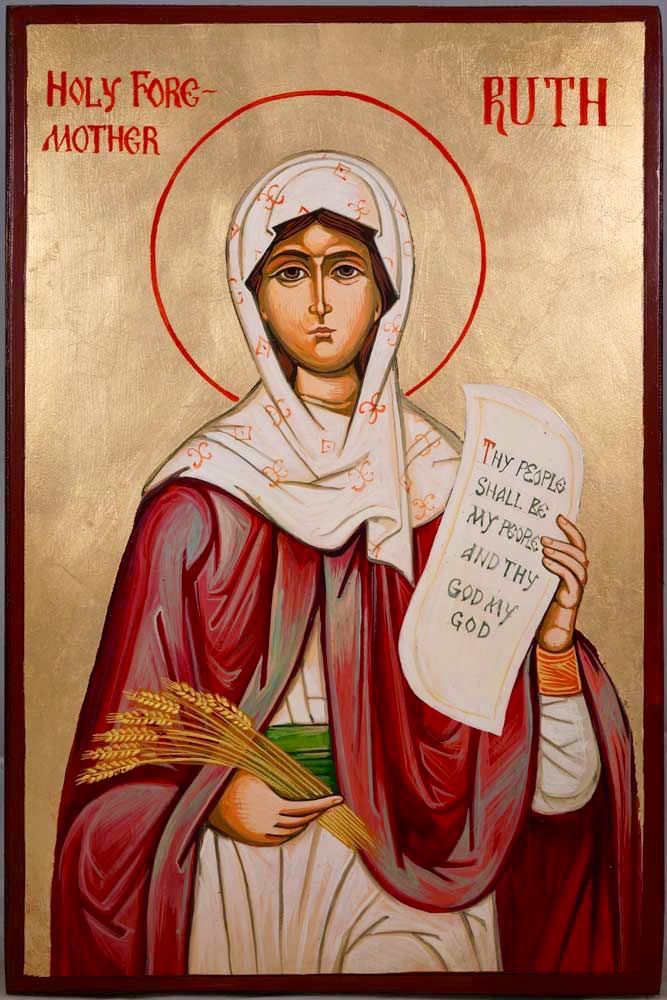
1. Ruth: A Type of the Faithful Gentile Church
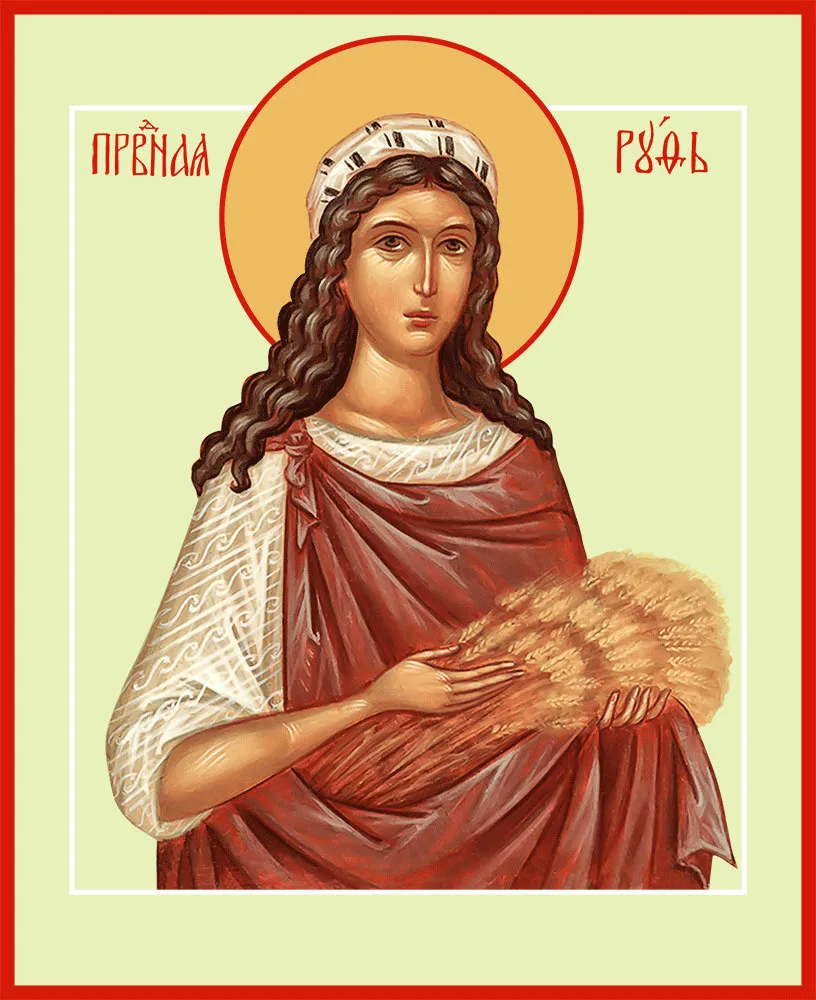
Ruth, the Moabitess, is the central figure. Her famous pledge of loyalty to
Naomi is a profound confession of faith:
-
“Your people shall be my people, and your God, my God.” (Ruth 1:16)
-
Patristic Understanding: The Fathers saw Ruth as a prefiguration of the Gentile Church , which was once outside the covenants of Israel but, through faith and love, is grafted into the people of God. She leaves her pagan past (Moab) and clings to the people of Israel, just as the Gentile Church clings to Christ. Her humility and hard work in gleaning in the fields represent the soul diligently acquiring the nourishment of divine grace.
2. Boaz: A Type of Christ the Kinsman-Redeemer
Boaz, a wealthy and righteous man from the clan of Elimelech, is the central
Christological figure. He acts as a go’el —a kinsman-redeemer.
-
The Role of the Go’el : In Israelite law, the go’el had the duty to (1) redeem family land that had been sold (Leviticus 25:25), (2) redeem a relative who had been sold into slavery (Leviticus 25:47-49), and (3) marry the widow of a deceased relative to raise up an heir for him (Deuteronomy 25:5-10).
-
Fulfillment in Christ: Boaz is a clear type of Christ, our heavenly Go’el :
-
He is a mighty man of wealth (Ruth 2:1), representing Christ, Who possesses the infinite riches of divinity.
-
He shows compassion and protection to the foreigner Ruth, extending grace beyond the strict requirement of the Law, just as Christ extends salvation beyond the boundaries of Israel.
-
He redeems the land and takes the Gentile bride , Ruth, to himself. Christ redeems the inheritance of Adam (the whole creation) and takes the Church, His Gentile bride, to Himself (Ephesians 5:25-32).
-
He is a near kinsman who is able to redeem. Christ, in His Incarnation, became our near kinsman, sharing in our flesh and blood (Hebrews 2:14-17) so that He would have the right to redeem us.
-
3. Naomi: A Type of Israel and a Participant in the Plan
Naomi, who returns from exile empty and bitter, becomes the instrument through
which Ruth finds Boaz. She instructs Ruth on how to approach him and acts as a
mediator. In this sense, she can be seen as a type of Israel , through
whom the Gentiles receive the knowledge of the true God and are guided to the
Messiah.
The Messianic Genealogy: The Fruit of Redemption
The ultimate proof of the book’s Christ-centered nature is its concluding verses (Ruth 4:17-22). The fruit of the union between Boaz (the redeemer) and Ruth (the faithful Gentile) is a son:
- Obed, who becomes the father of Jesse, the father of David.
This genealogy is the theological climax of the book. It demonstrates that the line of the Messiah-King, the Son of David, flows directly through this act of covenantal love (hesed) between a Jewish redeemer and a Gentile convert. It is a hidden prophecy that the Messiah would come for both Jew and Gentile. This genealogy is explicitly cited in the Gospel of Matthew’s genealogy of Christ (Matthew 1:5-6), forever cementing Ruth’s place in the history of salvation.
Liturgical Understanding
The Church sees its own story reflected in the Book of Ruth.
-
The Feast of the Nativity of the Theotokos: There is a strong traditional connection between Ruth and the Virgin Mary. Just as Ruth’s “yes” to Naomi and to Boaz brought her into the lineage of David, the Theotokos’s “yes” to God (“Let it be to me according to your word,” Luke 1:38) made Her the living vessel through which the Son of David entered the world.
-
The Eucharistic Imagery: Ruth gleans in the fields of Boaz and is nourished. This is a powerful image of the faithful who glean the grains of divine grace in the field of the Church, ultimately partaking of the Bread of Life, Christ Himself, in the Eucharist. Boaz’s command to his workers to deliberately leave extra grain for Ruth (Ruth 2:16) is an image of God’s superabundant grace offered to those who seek Him.
Conclusion: A Story of Love Fulfilled in Christ
The Book of Ruth is a masterful narrative about covenantal loyalty (hesed). It shows:
-
Ruth’s hesed toward Naomi and Naomi’s God.
-
Boaz’s hesed toward Ruth, a foreign widow, by fulfilling his role as redeemer.
-
Ultimately, God’s hesed working through these human actors to orchestrate salvation history.
This hesed is the very nature of God, and it is perfectly revealed in Jesus Christ. He is our Boaz, our near Kinsman-Redeemer, who:
-
Pays the price we cannot pay to redeem our lost inheritance.
-
Takes the Church , gathered from all nations, as His pure bride.
-
Produces fruit from this union: the salvation of the world and eternal life.
Therefore, the Book of Ruth is not a quaint interlude but a crucial chapter in the Gospel narrative. It proclaims that God’s plan of salvation encompasses all who display faithful love, and it prefigures the glorious truth that Christ came to redeem all humanity, making us, who were once strangers and foreigners, fellow citizens with the saints and members of the household of God (Ephesians 2:19).
- The Gradual Unraveling of an Unfaithful People
-
The Cycle of Sin, Judgment, Oppression, Repentance, and Then Deliverance by Judges Whom God Raises Up (3:7–16:31)
-
Israel’s Degeneration in the Time of the Judges, When There Was No King (17:1–21:25)
-
An Orthodox Synthesis of the Book of Judges: The Book of Our Captivity and the Desire for the True King
-
The Faithfulness of God Overcomes Calamity Through the Faithfulness of His People
-
An Orthodox Synthesis of the Book of Ruth: The Book of Covenant Love and the Gentile Bride
-
13.2 The Cycle of Sin, Judgment, Oppression, Repentance, and Then
Deliverance by Judges Whom God Raises Up (3:7–16:31)
Specific elaboration
1. The Biblical Account: A Sign of Reversal and Grace
The First Sign: The Wet Fleece on Dry Ground
The Second Sign: The Dry Fleece on Wet Ground
Gideon, seeking further confirmation, asks for the reverse:
3. The Connection to Psalm 71 (72):6
From the Vespers of the Nativity of the Theotokos:
From the Canon of the Annunciation:
Conclusion: The Fleece as a Sign of Salvation
13.5 The Faithfulness of God Overcomes Calamity Through the Faithfulness of
His People
_
_
David’s Genealogy Traced Through Obed (4:18–22)
13.1 The Gradual Unraveling of the Unfaithful People
Israel’s Failure to Conquer Canaan Due to Its Sin (1:1–36)
God’s Response to Israel’s Failure and Idolatry (2:1–3:6)
- The Gradual Unraveling of an Unfaithful People
- The Cycle of Sin, Judgment, Oppression, Repentance, and Then Deliverance by Judges Whom God Raises Up (3:7–16:31)
- Israel’s Degeneration in the Time of the Judges, When There Was No King (17:1–21:25)
- The Faithfulness of God Overcomes Calamity Through the Faithfulness of His People
Related Concepts
- annunciation
- antichrist-typology
- anxiety
- baptismal-typology
- betrothal-of-joseph
- boaz-as-type-of-christ
- boaz-typology
- boazs-generosity
- captivity-to-passions
- captivity-to-the-passions
- christ-the-king
- covenant-people
- davidic-line
- davidic-messiah
- deuteronomy-6
- divine-attributes
- divine-mercy
- divine-plan
- ehud-as-unexpected-savior
- ephesians-219
- exile-and-return
- feasts-of-the-theotokos
- fleece-typology
- general-resurrection
- gideon-as-weak-made-strong
- gospel-preparation
- grafting-in
- hebrews-214-17
- hebrews-217
- hesychia-rest
- high-priesthood-of-christ
- holy-spirit
- hymnography
- incarnation-as-near-kinsman
- israel-and-the-nations
- jesus-prayer
- job-1925-27
- job-192527
- josephs-children
- judges-ends-in-darkness-to-make-us-yearn-for-light
- law-and-grace
- lawgospel
- levirate-marriage
- levitical-priesthood
- liturgical-hermeneutics
- logos
- mariology
- mary
- mary-mother-of-james-and-joses
- matthew-15-6
- mediation
- messiah-king
- messianic-line
- moral-compass
- natural-revelation
- need-for-a-savior
- othniel-as-spirit-anointed
- perpetual-virginity
- psalm-71-726
- receptivity
- religious-corruption
- romans-1417
- ruth-as-answer-to-judges
- ruth-narrative
- ruths-confession
- samson-as-self-sacrificing-nazirite
- samson-typology
- the-cry-for-a-king
- theotokos-at-the-cross
- vow