Old Testament — Topic 10
EXODUS:
1:1–18:27 God Delivers Israel from Egypt
1:1–2:25 Pharaoh Oppresses Israel, but God Prepares Moses
3:1–6:30 God Commissions Moses
7:1–11:10 God Plagues Egypt
12:1–13:16 God Commissions the Passover and Israel Departs Egypt
13:17–18:27 God Leads Israel Through the Reed Sea to Sinai
19:1–40:38 God Dwells With Israel at Sinai
19:1–31:18 God Gives His Law
32:1–34:35 Israel Breaks God’s Law, but God Renews His Covenant
35:1–40:38 God Commissions the Tabernacle
Exodus continues the story begun in Genesis, narrating what happens to Abraham and Sarah’s “seed” (their descendants) as the divine-human relationship continues. Just as Yahweh called them out of Ur to faithful obedience, so he calls their progeny out of Egypt. As in Genesis, the constancy of Yahweh preserves his chosen people in spite of their waywardness, albeit at a national level. Two specific occasions in Exodus highlight human failure and divine faithfulness: the deliverance Yahweh gives them in their exodus from Egypt (chapters 1–18) and the instruction Yahweh gives them at Sinai (chapters 19–40). Indeed, the purpose of Exodus is to demonstrate the outworking of the Lord’s unique relationship with his people through these two major events. Together with the installation of the tabernacle, these events mark Exodus as the center of the Pentateuch. They also culminate in the drama of divine presence that has been lacking since the first human pair was driven from the garden (Gen 3:22–24). As he did at Babel, Sodom, and Mount Moriah, God “comes down” in Exodus to “see” and visit his creatures. However, through the provision of the tabernacle he remains among his people (Exod 40:34–38). Likewise, Leviticus picks up with the human dimension, outlining the functional elements of the tabernacle that are lacking in Exodus: the Levitical priesthood and its sacrifices. Where Genesis anticipates this reality while leaving the seed in Egypt, Exodus and Leviticus move Israel out of Egypt to Sinai as a nation with an emphasis on this divine-human relationship and its maintenance.
God Delivers Israel from Egypt (1:1–18:27)
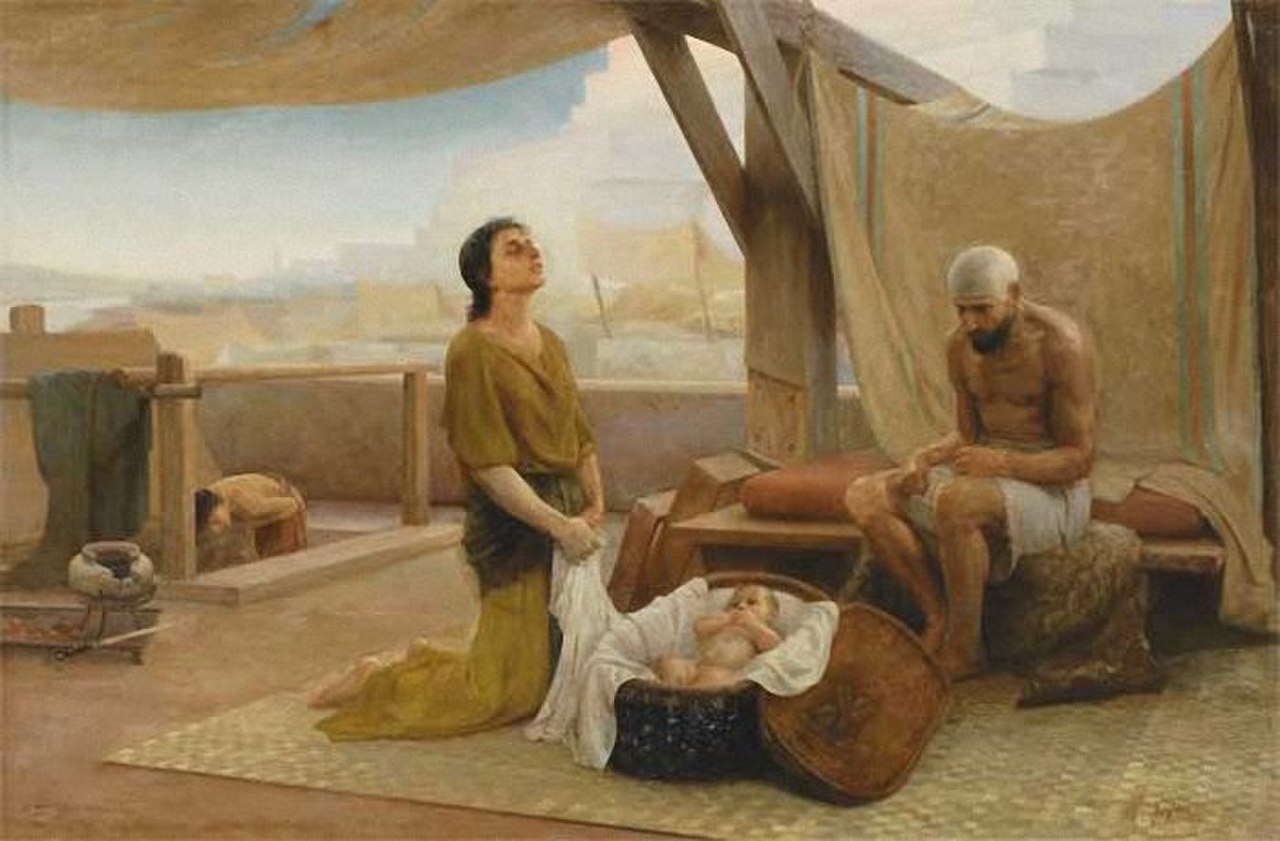
Isaak Asknaziy “Moses’ parents”, 1891 (The State Russian Museum, St. Petersburg)
Where Genesis closes with the family of Israel living securely in Egypt under a pharaoh loyal to Joseph (and therefore kind to Abraham’s seed), Exodus opens generations later with national Israel dwelling insecurely under a new pharaoh without such ties. In paranoia this pharaoh enslaves Israel and demands the demise of all its boys in the waters of the Nile. Nevertheless, his own daughter ironically rescues a Hebrew boy from the river, Moses. More irony ensues as Moses is raised in the Egyptian court, and through the call of Yahweh he becomes the hero of Israel and the downfall of Egypt. With a final ironic twist, Moses leads Israel through the Reed Sea, which becomes the watery grave for Egypt’s military might. Free of Egyptian bondage, Israel now looks forward to a new life with Yahweh their God as they journey through the wilderness toward Sinai, where they will officially become a nation and receive God’s covenant.
Pharaoh Oppresses Israel, but God Prepares Moses (1:1–2:25)
After Israel, Abraham’s seed grows into a people the size of a nation; it experiences extreme oppression under new Egyptian leadership, which has forgotten Joseph. God providentially raises up a deliverer through the women surrounding baby Moses: Hebrew midwives, the boy’s sister and mother, even the daughter of the oppressor, along with her handmaiden. Adopted by the Egyptian princess into the royal household and raised in his formative years by his biological mother, Moses becomes a passionate man seeking justice for his people. However, killing an Egyptian seals his immediate fate. Both rejected by his people for his hypocrisy and hunted by the pharaoh for his crime, Moses flees to Midian. There he begins a new life and his own family. Nevertheless, God is not finished with Moses or his desire to deliver Israel from Egypt.
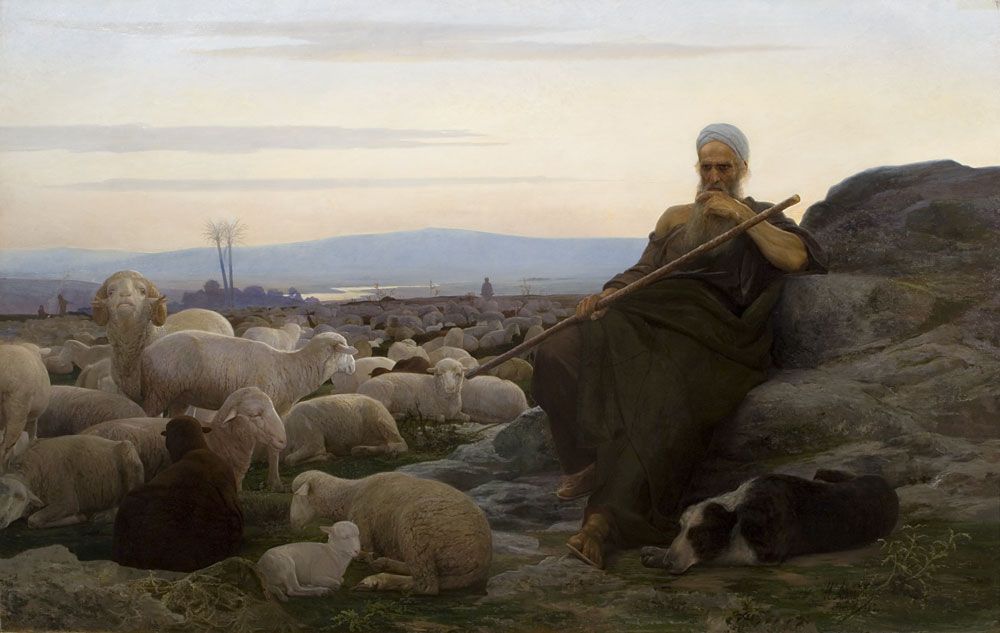
Isaak Asknaziy “Moses in the wilderness” (1885)
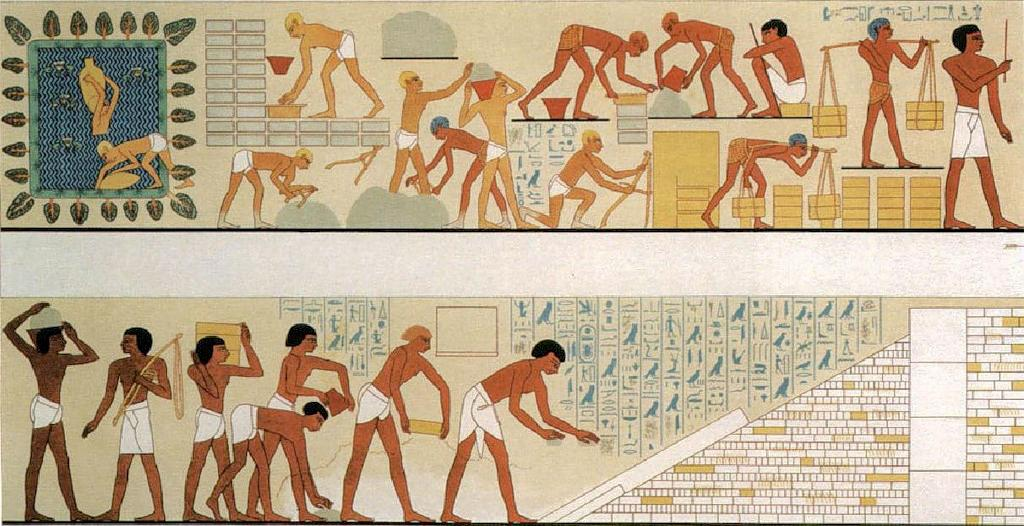
Fresco. Slaves build pyramids in Egypt
After Moses’ moral feelings of solidarity with his people lead him to escape from Egypt, and after having settled in Midian for decades, Moses encounters the strange sight of a bush that is on fire but remains unconsumed. God commissions Moses from the bush as his hero to deliver Israel from Egypt. Anticipating the reticence of his chosen vessel, God turns Moses’ staff into a serpent and covers his hand in disease. In spite of these signs, Moses remains headstrong. Indeed, for one complaining of his inability to speak properly, Moses is quite verbose. Nevertheless, God graciously calls Aaron, Moses’ brother, to accompany his reluctant vessel back to Egypt. There Israel’s elders gladly receive the message of promised deliverance. In retaliation Pharaoh behaves even more unreasonably with his Hebrew slaves. Pharaoh remains, ironically, just as obstinate as Moses and will demonstrate his hard heart repeatedly in the coming section.
God Plagues Egypt (7:1–11:10)
God has just commissioned Moses and Aaron to appeal to Egypt’s pharaoh to let God’s people go. Pharaoh’s stubborn streak takes on epic proportions as he is confronted by Moses in a duel between Yahweh and the deities of Egypt. His own sorcerers’ ability to replicate Moses’ opening salvo cements the pharaoh in his madness. In a sardonic reversal, the Egyptian people now suffer at the hands of Israel’s God: water turns to blood; the land is plagued with frogs, gnats, and flies; livestock perish; painful boils erupt; hail falls; locusts devour everything; and palpable darkness threatens to unhinge Egypt. Moses becomes a giant among the Egyptians, while Pharaoh diminishes more and more. In a final act of gracious restraint, Yahweh warns Pharaoh of the impending doom gathering against Egypt’s firstborn.
After warning Pharaoh of the tenth and climactic plague, Yahweh institutes Passover as the means for escaping this plague. He instructs his people to make the feast an annual celebration, more than implicitly promising successful deliverance from Egypt. The feast includes several key elements: consecration of the firstborn, a roasted lamb, blood on the doorframe, bitter herbs, and unleavened bread. Additionally, each participant must be ready to depart at a moment’s notice. Yahweh’s protection extends to both the firstborn of Israel and those of participating neighbors (12:4). However, Pharaoh remains unmoved in his insanity, costing him and all nonparticipants their firstborn children. In anguish Pharaoh and all Egypt lavish the mixed multitude of Israel with gifts and drive her from their borders. Laden with Egyptian treasures, Israel hastily departs toward the Reed Sea, which will become the site of an even greater divine victory over Israel’s oppressors.
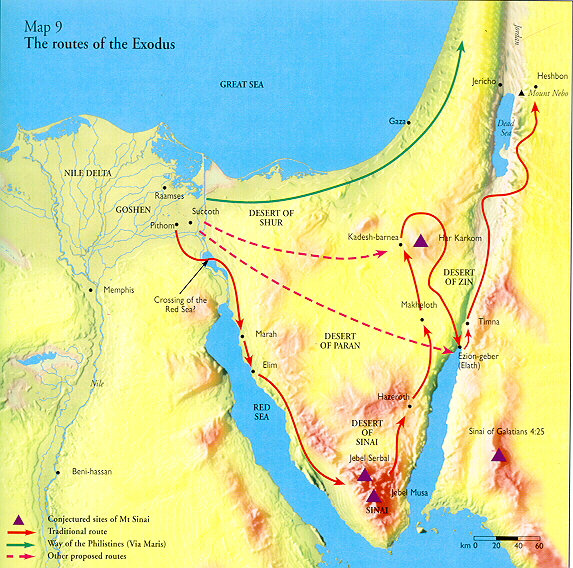
The routes of the Exodus
God Leads Israel Through the Reed Sea to Sinai (13:17–18:27)
The newly escaped Israelites, laden with Egyptian booty, head toward the land God promised to their patriarch Abraham. With a pillar of cloud by day and fire by night, Yahweh steers the rapidly departing Israel deeper into the wilderness. Mistaking this as meandering, Pharaoh replaces his grief with rage and chases after them. Hemmed in by the Red Sea and the Egyptian army, Israel cries out for divine intervention. Through Moses’ upraised hands, Israel passes safely through the parted waters, which come crashing down to annihilate the pursuing enemy. Yahweh steps in again and again to deliver his people on their way to Sinai: the waters of Marah are made sweet, manna provides sustenance, water issues forth from flint, and Amalek is defeated. Nevertheless these events cannot prepare Israel for the experience that awaits them at Mount Sinai.
After being delivered from Egypt, Israel arrives at Sinai. Here Yahweh dramatically appears atop the mountain, where in terror they dare not approach. The hero Moses rises as their intermediary, through whom Yahweh graciously provides his covenant expectations on two tablets. Israel meanwhile waits impatiently for Moses’ return, as dramatized in the golden calf scandal. Moses responds by shattering these documents, while Yahweh graciously provides his covenant expectations again on a second pair of tablets. God ensures his lasting presence among his people, Abraham’s seed, by providing instructions for his dwelling place—all in spite of his ill-tempered hero and his capricious people. As on Sinai, God’s glory appears in the completed tabernacle, yet Moses is unable to enter. For access one must look to Leviticus, which completes the Sinai event.
God Gives His Law (19:1–31:18)
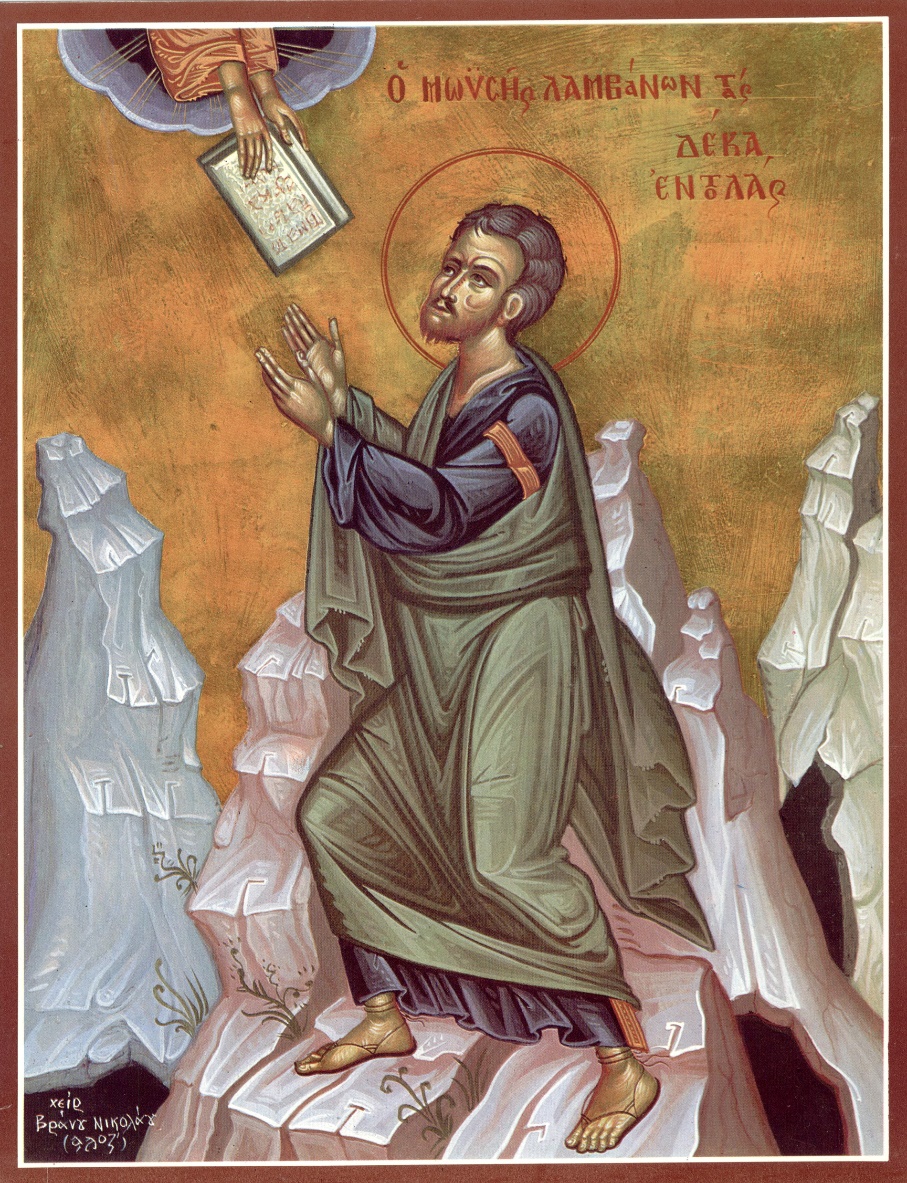
At last the escaped Israelite ex-slaves arrive at the foot of Mount Sinai. In abject terror they listen as God gives them his law directly from the mountain, accompanied by a firestorm of thunder and lightning. While Moses approaches the fiery spectacle with a few chosen leaders, he alone ascends and descends the mountain multiple times. There Yahweh provides the Ten Commandments and many other divine expectations for Israel. These laws concern proper worship, human relationships, suitable restitution, and social justice. Israel accepts the covenant, which her leaders ratify through a sacrificial meal before Yahweh (24:9–11). Moses ascends the mountain once more, where Yahweh provides additional instructions regarding a tabernacle, its priesthood, and their accoutrements. Meanwhile Israel impatiently waits for Moses’ return.
Ten Commandments (Exod. 20:1-17)
And God spoke all these words, saying:
«I am the LORD/YHWH /יְהוָה** your God, who brought you out of the land of Egypt, out of the house of bondage. You shall have no other gods before Me.**
«You shall not make for yourself a carved image-any likeness of anything that is in heaven above, or that is in the earth beneath, or that is in the water under the earth; you shall not bow down to them nor serve them. For I, the LORD/YHWH /יְהוָה** your God, am a jealous God, visiting the iniquity of the fathers upon the children to the third and fourth generations of those who hate Me, but showing mercy to thousands, to those who love Me and keep My commandments.**
«You shall not take the name of the LORD/YHWH /יְהוָה** your God in vain, for the LORD/YHWH/יְהוָה**** will not hold him guiltless who takes His name in vain.**
«Remember the Sabbath day, to keep it holy. Six days you shall labor and do all your work, but the seventh day is the Sabbath of the LORD/YHWH /יְהוָה** your God. In it you shall do no work: you, nor your son, nor your daughter, nor your male servant, nor your female servant, nor your cattle, nor your stranger who is within your gates. For in six days the LORD/YHWH/יְהוָה**** made the heavens and the earth, the sea, and all that is in them, and rested the seventh day. Therefore the LORD/YHWH/יְהוָה**** blessed the Sabbath day and hallowed it.**
«Honor your father and your mother, that your days may be long upon the land which the LORD/YHWH /יְהוָה** your God is giving you.**
«You shall not murder.
«You shall not commit adultery.
«You shall not steal.
«You shall not bear false witness against your neighbor.
«You shall not covet your neighboŕs house; you shall not covet your neighboŕs wife, nor his male servant, nor his female servant, nor his ox, nor his donkey, nor anything that is your neighboŕs». (NKJV edited)
PLEASE, LEARN THIS MARKED TEXT WELL!
Israel Breaks God’s Law, but God Renews His Covenant (32:1–34:35)
Unwilling to wait any longer on an absent Moses (who has gone up Mount Sinai to be with the Lord) to begin worshiping Yahweh, Israel’s leaders take matters into their own hands. Aaron caves to their incessant pressure and authorizes the casting of a golden calf. Interrupting his own instruction, Yahweh warns Moses of this terrible event. After racing down the mountain, Moses shatters the tablets God has given him, thereby symbolizing Israel’s breach of the covenant. Soundly rebuked both by Moses and by Yahweh, Israel then stands in danger of divine abandonment. Nevertheless, the intercession of Israel’s hero and the graciousness of Yahweh preserve her from this fate. God renews his covenant with a new set of tablets. This time Israel patiently waits and is rewarded by the return of Moses, albeit transformed by the divine presence. He proceeds to reveal instructions for maintaining the presence of God in their midst: the tabernacle.
God Commissions the Tabernacle (35:1–40:38)
Upon his return from Mount Sinai, the transfigured Moses captures the attention of Israel. Gathering the people together, he requests material donations for constructing the tabernacle and its accessories, as well as materials for the priestly vestments. Israel responds with overflowing abundance. Yahweh likewise raises up many artisans, whom he empowers for the creative task. Each item is wrought according to divine specification: the tabernacle, the ark, the lampstand, the altar of incense, the altar of burnt offering, the bronze laver, and all the priestly garments. After construction is at last finished, Moses has the structure carefully set up. The glory of Yahweh fills the tabernacle, such that not even a transformed Moses can enter as he awaits further instructions regarding the priesthood.
For the Orthodox Church, the Book of Exodus is far more than a historical account of Israel’s liberation from Egypt. It is the great typos (prefiguration) of humanity’s redemption from the slavery of sin and death through the saving work of Jesus Christ. Every event, person, and institution in Exodus is read by the Holy Fathers and experienced in the Liturgy as a prophecy in action, pointing toward its ultimate fulfillment in the New Testament. Exodus is, fundamentally, a book about Christ.
The Framework of Salvation: From Slavery to Worship
The entire narrative arc of Exodus establishes the pattern of salvation:
-
Enslavement to Pharaoh (Sin and Death): Egypt is a type of the world under the dominion of the devil, the “pharaoh” of this age. Slavery represents the human condition bound by sin and corruption.
-
The Passover Lamb (The Sacrifice of Christ): God provides the means of liberation through the blood of a lamb.
-
The Passage Through the Red Sea (Baptism): The people pass through the waters from death to life, leaving the old master behind.
-
The Journey to Sinai (The Christian Life): The time of testing, temptation, and divine provision (manna, water from the rock).
-
The Giving of the Law and the Tabernacle (The Church): God establishes a covenant with the redeemed people and comes to dwell in their midst.
This entire process is recapitulated and fulfilled in the work of Christ.
Key Messianic Figures and Texts: Christ Revealed in the Old Israel
1. Moses: The Type of the Prophet and Mediator
Moses is the premier human type of Christ in the Old Testament.
-
Rejected then Accepted: Moses is rejected by his people (2:14) and flees, only to return as their savior. This prefigures Christ, Who “came to his own, and his own people did not receive him” (John 1:11).
-
Mediator of the Covenant: Moses ascends Mount Sinai to receive the Law from God and mediates the Old Covenant (Chapters 19-24). Christ is the new and greater Moses Who ascends the heights of heaven, mediates the New Covenant (Hebrews 8:6), and gives the new law of the Sermon on the Mount.
-
Intercessor: After the sin of the Golden Calf, Moses stands between a righteous God and a sinful people, offering his own life for theirs (32:32). This is a profound prefiguration of Christ’s high-priestly prayer (John 17) and His intercession for us at the right hand of the Father.
2. The Passover Lamb (Chapter 12): The Central Type of Christ’s Sacrifice
The Passover is the heart of Exodus and the cornerstone of its Christological
interpretation.
-
The Unblemished Lamb: The lamb had to be “without blemish” (12:5). St. Peter applies this directly to Christ: “…you were ransomed… with the precious blood of Christ, like that of a lamb without blemish or spot” (1 Peter 1:19).
-
The Blood of the Lamb: The blood applied to the doorposts caused the Angel of Death to “pass over” the homes of the Israelites. This saving blood prefigures the precious blood of Christ shed on the Cross, which saves us from eternal death.
-
The Lamb is Eaten: The faithful were commanded to eat the lamb whose blood saved them. This finds its ultimate fulfillment in the Holy Eucharist , where we partake of the Lamb of God Who takes away the sin of the world (John 6:53-57).
-
Liturgical Understanding: The entire Paschal (Easter) Liturgy is saturated with imagery from Exodus. The hymn proclaimed by the priest at Pascha encapsulates this: “Christ is risen from the dead, trampling down death by death, and upon those in the tombs bestowing life! ” The Passover from death to life in Egypt becomes the type of our Passover from death to life in Christ’s Resurrection.
3. The Passage Through the Red Sea (Chapter 14): The Type of Baptism
St. Paul explicitly identifies this event as a type of Baptism: “…all were
baptized into Moses in the cloud and in the sea” (1 Corinthians 10:1-2).
-
Death to the Old Life: The waters of the sea become a tomb for the army of Pharaoh, the symbol of sin and death. In Baptism, the water becomes a tomb in which our old, sinful self is put to death.
-
New Life of Freedom: The Israelites emerge from the sea onto the shore as a free people, newly born into a covenant relationship with God. In Baptism, we emerge from the font as new creations, freed from sin and united to Christ.
-
Liturgical Understanding: The blessing of the water at the Feast of Theophany (Christ’s Baptism) draws heavily on this imagery, proclaiming God’s power over water as an instrument of salvation, from the Red Sea to the Jordan.
4. The Manna and Water from the Rock (Chapters 16-17): The Type of the Eucharist
-
The Bread from Heaven: God feeds His people with miraculous bread from heaven. Christ reveals Himself as the true “bread from heaven” (John 6:31-35), the living manna that gives eternal life.
-
The Water from the Rock: St. Paul again provides the interpretation: “…all drank the same spiritual drink. For they drank from the spiritual Rock that followed them, and the Rock was Christ” (1 Corinthians 10:4). The rock struck by Moses to give life-giving water to the people in the desert is a type of Christ, Who is struck on the Cross, and from Whose pierced side flows the living water of the Holy Spirit (John 7:37-39).
5. The Tabernacle (Chapters 25-40): The Type of the Theotokos and the
Church
The detailed instructions for the Tabernacle are not arbitrary; they reveal a
heavenly reality.
-
The “Tent of Meeting”: The Tabernacle is where God dwells (skenoo) among His people (25:8). St. John’s Gospel uses this exact language to describe the Incarnation: “And the Word became flesh and dwelt [literally, tabernacled] among us…” (John 1:14). Christ Himself is the true Tabernacle.
-
The Theotokos as the Living Tabernacle: The Fathers saw the Ark of the Covenant, made of pure gold and containing the Word of God (the tablets), the manna (the bread of life), and Aaron’s rod (priestly authority), as a type of the Virgin Mary. She became the living Ark who contained the true Word of God, the Bread of Life, and the eternal High Priest.
-
The Church as the Tabernacle: The structure of the Tabernacle—with the Outer Court, the Holy Place, and the Holy of Holies—is seen as a type of the Church, where the faithful progressively enter into the presence of God through the sacraments.
Conclusion: From Shadow to Reality
The Book of Exodus presents the shadow and promise of which Christ is the reality and fulfillment.
-
The blood of the lamb points to the Blood of Christ.
-
The Passover points to the Eucharist and the Resurrection (Pascha).
-
The passage through the sea points to Baptism.
-
The manna points to the Body of Christ.
-
The water from the rock points to the Holy Spirit.
-
The Law of Moses points to the Grace and Truth of Christ.
-
The Tabernacle points to the Theotokos and the Church.
In the Orthodox vision, Exodus does not merely tell an old story; it unveils the eternal plan of God for our salvation. It shows that the God who acted in power to save Israel from Pharaoh is the same God who, in the person of Jesus Christ, acts in power to save all humanity from sin, death, and the devil. The journey from the bondage of Egypt to the glory of God filling the Tabernacle is our journey from the bondage of sin to theosis, accomplished by the true Savior prefigured in every page: our Lord Jesus Christ.
-
10.1 Divine Deliverance from Egypt and Divine Presence at Sinai
-
10.2 God Commissions Moses (3:1–6:30)
-
10.3 God Commissions the Passover and Israel Departs Egypt (12:1–13:16)
-
10.4 God Dwells With Israel at Sinai (19:1–40:38)
-
10.5 An Orthodox Synthesis of the Book of Exodus: The Book of Redemption and the Image of the Savior
-
Divine Deliverance from Egypt and Divine Presence at Sinai
- God Commissions Moses (3:1–6:30)
- God Commissions the Passover and Israel Departs Egypt (12:1–13:16)
- God Dwells With Israel at Sinai (19:1–40:38)
Related Concepts
- 1-corinthians-10
- 2-corinthians-129
- absaloms-rebellion
- adoption-as-sons
- advocacy
- ark-of-the-covenant
- ark-procession
- ascension
- blood-of-christ
- body-and-blood-of-christ
- christocentric-exegesis
- christological-exegesis
- communion
- communion-with-god
- covenant
- covenant-of-peace
- covenant-renewal
- cross-of-christ
- cyril-of-alexandria
- death-and-resurrection
- divine-holiness
- divine-warrior
- eden
- esau-as-flesh
- esther-as-type-of-christ
- eucharist
- everlasting-covenant
- fall
- fulfillment
- glorification
- glory
- haman-as-type-of-satan
- healing
- heart
- hebrews
- high-priest
- holy-gifts
- holy-humility
- holy-spirit
- intercession
- job-3841
- john-17
- john-6
- judgment
- kingdom-of-priests
- law
- lawtorah
- liturgical-interpretation
- love-of-god
- manna
- mariology
- mediation
- mediator
- mordecai-as-type-of-christ
- mount-zion-as-church
- new-moses
- noah
- nuptial-union
- old-covenant
- pascha
- passover
- patristic-theology-of-the-name
- paul
- people-of-god
- personhood
- priesthood-covenant
- recapitulation
- restoration-of-human-nature
- revelation
- romans-321
- sacramental-theology
- salvation
- sign-of-jonah
- sin
- tabernacle
- teaching
- theosis
- union-with-god
- zwinglianism