New Testament — Topic 21
Accommodation for the Weak
Paul’s discussion of “the weak” and “the strong” in chapter 14 of Romans has become a touchstone for Christian ethics. Paul taught that the Jewish dietary laws were no longer relevant for those who were justified by faith; throughout his ministry he was adamant that such restrictions not be imposed upon Gentiles (see Gal. 2:14). But now he deals with a complicating factor: if a person believes (erroneously) that eating certain foods is sinful, then it actually is sinful for that particular person to consume those foods (14:23). The strong in faith know that “nothing is unclean in itself” (14:14), but the weak in faith do not know this, and they should not be tempted or encouraged to do what they themselves believe is wrong. Those who are strong must not do anything that will prove to be a hindrance to those who are weak, even if this means giving up food that it would be appropriate for them to eat otherwise. Thus, Paul counsels the Roman Christians to evaluate their behavior in broader terms than “what is acceptable or allowed.” They must consider the effects that their actions have on others and strive to avoid doing anything that might be perceived as evil (14:16) or that might cause another to stumble (14:21). This matter also comes up in 1 Corinthians 8–10.
Conclusion
A prominent Roman Catholic scholar once said that it would be only “a slight exaggeration to say that Western Christianity is divided into Catholic and Protestant churches today because of Paul’s letter to the Romans and disputes over how it is to be interpreted” (Raymond E. Brown, An Introduction to the New Testament [New York: Doubleday, 1997], 559). In fact, the first Protestant textbook on Christian doctrine ever written organized its topics according to an outline of Romans (Philipp Melanchthon, Loci communes, published in 1521). In the twentieth century, the theological giant Karl Barth began his program of neoorthodoxy with a commentary on Romans (1933). And in the present day, Paul’s letter to the Romans is still regarded as “home base” for many Lutheran theologians, and yet it is vigorously studied by Christians of all persuasions. The most widely used and highly respected critical commentaries on the letter are volumes by an Anglican (James Dunn), a Roman Catholic (Joseph Fitzmyer), a Methodist (Robert Jewett), and two Baptists (Douglas Moo, Thomas Schreiner). Clearly, the letter has been a theological sounding board for Christians of all persuasions.
In addition to the themes touched on in this chapter, Paul’s letter to “God’s beloved in Rome” (1:7) gets consulted for theological questions regarding baptism (6:3-4), original sin (5:12-21), predestination (8:29-30; 9:11-12; 11:25-26), and numerous other subjects. Despite the heady character of this letter, however, faith was not just an intellectual exercise for Paul. He expects those who believe the gospel that he presents here to be “transformed by the renewing of (their) minds” (12:2). They will think differently about themselves (12:3), other believers (12:16), total strangers (12:13), and their enemies (12:19-21).
Paul certainly did not want his message to be a source of division: his plea (12:6) and prayer (15:5) is for his readers to “live in harmony with one another.” There are some matters on which Christians can simply agree to disagree: “Let all be fully convinced in their own minds” (14:5). In any case, they should not pass judgment upon one another (14:10-13) but rather must make every effort to live peaceably with all (12:18) so that all believers may “with one voice glorify the God and Father of our Lord Jesus Christ” (15:6).
Historical Background
We do not know when Christianity came to Rome or who was responsible for the first missionary work there. Perhaps churches were established gradually as Christians moved from other places to the capital city of the empire. In any case, there appear to have been a surprising number of believers in Rome by the year 49. In that year, the emperor Claudius expelled a segment of the Jewish population due to what the historian Suetonius calls “a disturbance over Chrestus” (Life of Claudius 25). It is widely believed that by “Chrestus” Suetonius means Christos (Greek for “Christ”) and that the Jews expelled included ones who believed in Jesus (see Acts 18:2). Thus, within twenty years of the crucifixion of Jesus, there appear to have been enough Christians in Rome to create a disturbance worthy of the emperor’s attention. In any case, Claudius died in 54, and after his death the Jews whom he had expelled (including Jewish Christians) began to trickle back.
Paul writes to the Christians in Rome a few years later, probably around 57 or 58. He appears to be in Corinth and is near the end of what would be his third missionary journey (see Acts 18:23-21:15, especially 20:2-3). He tells the church in Rome of his plans to make a trip to Jerusalem to deliver an offering that has been collected for “the poor among the saints” (15:25-26). After that, he hopes to visit the Roman Christians before he embarks on another ambitious missionary venture, westward to Spain (15:23-24, 28). The hopeful and joyful manner in which he announces these plans (15:29, 32) has a tragic ring for those who know the rest of the story: according to the book of Acts, Paul’s trip to Jerusalem ended with his arrest (21:17-33), and when he did arrive in Rome, it was as a prisoner under guard (28:16).
Against this background of events, scholars are able to discern a number of specific reasons why Paul might have written this letter: he wants to introduce himself to the Roman Christians in preparation for his visit; he wants to garner support for his eventual work in Spain; he wants to solicit their prayers regarding his upcoming trip to Jerusalem; and he wants to offer pastoral counsel concerning problems that have arisen or might arise within the congregation.
Still, Paul could have accomplished such purposes with a much shorter and less complicated letter. The real question concerns why he would write this letter—his magnum opus, so to speak—to this particular group of people. A few scholars have said that he didn’t write it for them, or at least not just for them: he intended to produce a generic summary of his views that could be copied and distributed to lots of churches. Most scholars, however, prefer to look for reasons why the contents of this letter would be pertinent to the particular situation of the Romans.
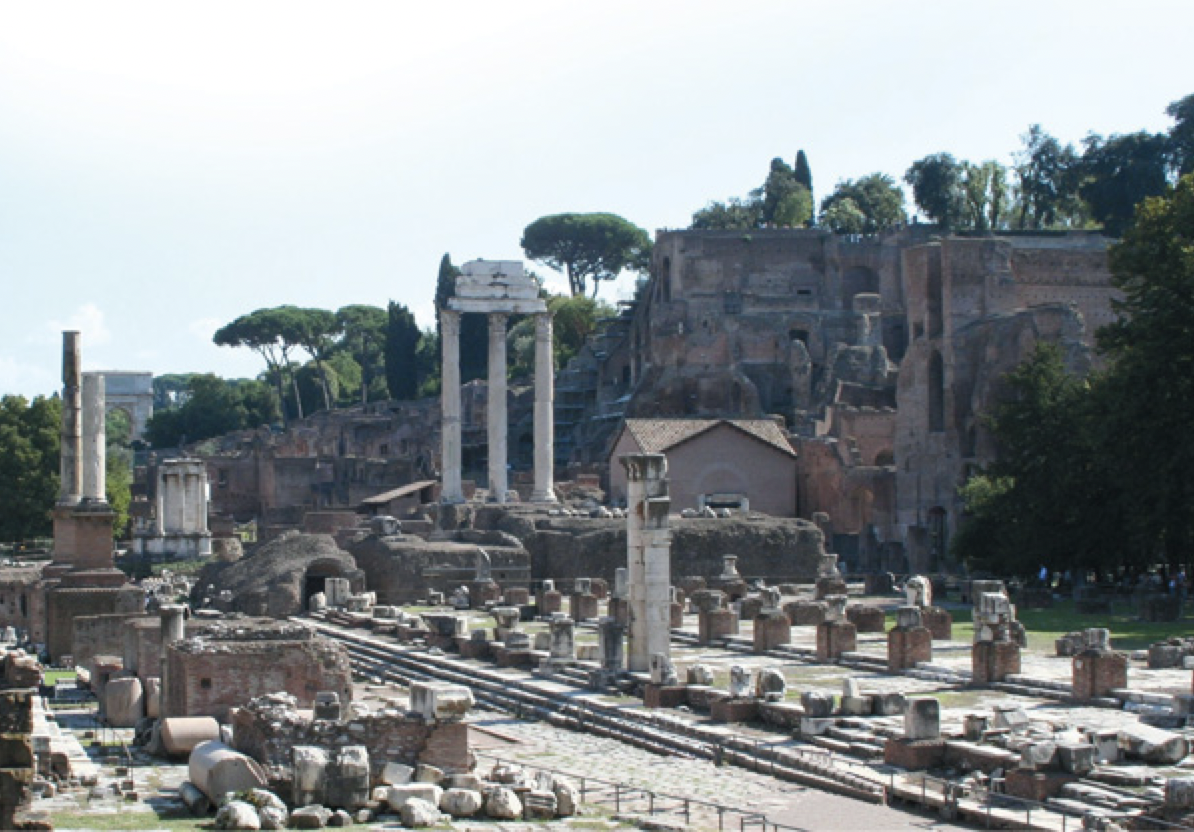
These ruins of the Roman Forum still inspire millions of tourists each year to marvel at the might of a city that once ruled the world
Much of the letter is devoted to discussing implications of Paul’s claim that the gospel puts Jews and Gentiles on the same footing, with regard to both their need for salvation and God’s provision of that salvation through Christ. How would that message fit with Paul’s particular agenda for the Roman Christians? At least three answers can be given, and they are not mutually exclusive. Paul may have written this letter the way he did for any or all of these reasons:
1. Since he is personally unknown to most of these Christians but wants them to sponsor his mission trip to Spain, he needs to explain key tenets of the ministry that he hopes they will agree to support. Paul says that he wants to be “sent on” by the Roman Christians (15:24), implying that he hopes they will offer financial support for his work in the west. But Paul also seems to think that the Roman Christians might be suspicious of him. He needs to clear up points on which he has been misrepresented (3:8) and to anticipate objections that might arise (3:1, 3, 5, 8; 6:1, 15; 7:7, 13; 11:1, 11). Basically, he writes to set the record straight concerning his famous “law-free gospel” and to answer the questions that always come up (Did God renege on promises to Israel? Does “law-free” mean “anything goes”?).
2. His mind is on the upcoming trip to Jerusalem, and he is rehearsing the summary and defense of his gospel that he may need to offer there. Paul asks the Roman Christians to pray not only that he will be kept safe “from the unbelievers” as he travels to Jerusalem, but also that the offering that he is bringing will be acceptable to the Jerusalem saints (15:30-31). That last part seems odd. Why wouldn’t the offering be acceptable? Do churches usually turn away money? We know, however, that Paul previously quarreled with representatives of the Jerusalem church (Gal. 2:12-13) and that his ministry among the Gentiles has been a source of contention in those quarters (Gal. 2:4; Acts 15:1-5). Paul hopes that the gift that he is bringing will symbolize the mutual interdependence of Gentile and Jewish Christians (Rom. 15:27). Acceptance of the gift would imply that the Jewish Christians in Jerusalem recognize the legitimacy of the Gentile churches that Paul founded in Macedonia and Achaia. People in the Jerusalem church who are opposed to Paul and to his ministry may see this as an opportunity to make a statement: “Let’s tell Paul and his Gentile Christians that we don’t want their help.” Thus, according to this theory, Paul writes to the Romans what he plans to say (if necessary) to the Christians in Jerusalem. He is, at least, rehearsing his defense. Beyond that, he may also hope that some influential persons in the Roman church will serve as intermediaries with their counterparts in Jerusalem, paving the way for him to be received favorably there.
3. He wants to effect reconciliation among Jews and Gentiles in the Roman church itself. If indeed the Jewish Christians had been expelled for a time but are now making their way back, there could have been a power shift in the interim: the Gentiles are now in charge. Any number of issues discussed in the letter could be informed by Paul’s sensitivity to such dynamics (see, e.g., the tensions between the “strong” and the “weak” in chap. 14). Much of the letter seems to be addressed to Gentile believers (1:13; 11:13), and since Paul thinks that he has been called by God to be the “apostle to the Gentiles” (1:5; 11:13; cf. Gal. 2:7-8), he may consider it his charge to speak pastorally to Gentile believers whether they know him personally or not (15:15-16).
Introduction
In the year 386 a young pagan named “Augustine” was converted to Christianity by reading two verses from Paul’s letter to the Romans (Rom. 13:13-14). He says, “I had no wish to read further; there was no need to. For it was as though my heart was filled with a light of confidence and all the shadows of my doubt were swept away.”
Your experience with Romans may be different, but no one can doubt the enormous impact that this book has had in the history of Christianity. It probably has been the single most influential book of the Bible for the development of Christian doctrine and theology. This is not to say that it has been the most popular. Romans has a reputation for being Paul’s most difficult letter; it captures the apostle at his most brilliant, engaged in some heavy- duty thinking.
- Introduction
- Overview
- Historical Background
- Major Themes in Romans
- Other Major Themes in Romans
- Obedience to the Government
- Accommodation for the Weak
- Conclusion
Major Themes in Romans
The Epistle to the Romans, with its dense theological language, has been a battleground for interpretive traditions, often leading to confusion for Orthodox Christians seeking to understand their own faith in contrast to Western Protestant and Catholic frameworks.
An Orthodox Insight into the Epistle to the Romans: The Gospel of Theosis
The Epistle to the Romans is not, in the Orthodox understanding, a systematic treatise on forensic jurisprudence, but rather the most profound apostolic exposition of the divine economy of salvation —the way in which God in Christ rescues humanity from the bondage of sin and death and restores us to communion with Himself. The central question Paul addresses is not merely “How can a guilty sinner be declared innocent before a holy God?” but rather, “How can a dead man be made alive?” The answer is the Gospel: the power of God unto salvation (Romans 1:16), which is nothing less than participation in the life of the risen Christ.
1. The Righteousness of God (****Δικαιοσύνη****Θεοῦ**)**
This is the foundational concept of the entire epistle, and its misinterpretation has led to centuries of confusion.
The Western Forensic Interpretation:
In the wake of the Reformation, “the righteousness of God” was often
understood as the punitive justice of God —His strict, holy demand for
perfect obedience and His wrath against sin. In this framework, humanity
cannot possibly satisfy this demand. Therefore, Christ, as our substitute,
perfectly obeyed the Law and bore the punishment for our sins. His
“righteousness” is then imputed (legally credited) to the believer. God can
now declare the sinner “just” without actually making him just, because the
legal penalty has been paid.
The Orthodox Therapeutic (Curative) Interpretation:
The Orthodox tradition, rooted in the Greek Fathers, offers a radically
different and more holistic understanding. The Greek word dikaiosyne means
righteousness, justice, but also, and crucially, “righteousness” as a state
of being right, whole, and well-ordered.
A. God’s Righteousness as His Saving Action: For the Fathers, the “righteousness of God” in Romans is not primarily an attribute of God’s wrath, but rather God’s own faithfulness to His covenant, His saving power, and His divine energy at work to set things right. As St. John Chrysostom explains, “The righteousness of God is His victory, His power, His glory.” It is God’s active intervention in history to defeat the powers of sin and death and to restore His fallen creation.
B. The Key Text (Romans 1:17): “For in it the righteousness of God is revealed from faith to faith; as it is written, ‘The just shall live by faith.’”
-
Orthodox Reading: This does not mean that God reveals a legal verdict that can be accessed by faith. It means that God’s saving action—His own divine life and power—is revealed and made present within the believer through faith. The “righteousness” is a dynamic, transformative reality , not a static, forensic status.
-
Patristic Witness: St. Athanasius the Great , in On the Incarnation , argues that Christ became man so that we might become divine. The “righteousness of God” is the restoration of the divine image in us, accomplished through the Incarnation, Death, and Resurrection of Christ. We are made actually righteous (participants in God’s own life), not merely declared righteous.
C. Theosis (Deification): The ultimate goal of God’s saving righteousness is theosis —union with God. As St. Maximus the Confessor teaches, God’s righteousness is His love in action, working to make us “partakers of the divine nature” (2 Peter 1:4). The believer is transformed from glory to glory (2 Corinthians 3:18) into the likeness of Christ.
Summary Table:
| Aspect | Western Forensic View (Popular Protestant) | Orthodox Therapeutic (Healing) View |
|---|---|---|
| Righteousness of God | God’s punitive justice and demand for perfect obedience | God’s saving action and divine energy to restore creation |
| The Problem | Guilt and legal condemnation | Corruption, mortality, and alienation from God |
| The Solution | Imputation of Christ’s legal merit | Participation in Christ’s divine life (Theosis) |
| Aim | Being declared “not guilty” | Becoming actually and really righteous, holy, and divine by grace |
2. Justification by Faith (****ΔικαίωσιςἐκΠίστεως)
Having understood the “righteousness of God” as His saving power, we can now understand justification not as a legal verdict, but as the transformative process by which God makes us righteous within.
A. The Meaning of “Justify” (δικαιόω): In the Old Testament (LXX), the Greek word dikaioō means “to make righteous” or “to set right,” not merely “to declare righteous.” For the Fathers, justification is an ontological reality, not merely a legal one. It is the beginning of the process of healing and transformation.
B. Faith (πίστις- Pistis): In the New Testament, pistis means more than mere intellectual assent. It means faithfulness, trust, loyalty, and personal surrender to God. It is the act of entrusting oneself wholly to Christ, obeying Him (see below), and being united to Him.
C. Faith Working Through Love (Galatians 5:6): The Orthodox understanding of justification by faith does not exclude works, but it subordinates them to a proper place. We are not saved by works as if they earned a reward. We are saved by faith, which is a living, active principle that manifests itself in works of love. Faith is the root; works are the fruit. As St. James says, “faith without works is dead” (James 2:26).
D. Patristic Synthesis: St. John Chrysostom , commenting on Romans 3:28 (“man is justified by faith apart from the works of the law”), clarifies: “He does not say ‘apart from works’ generally, but ‘apart from the works of the Law.’” The works of the Mosaic Law (circumcision, dietary laws, sacrificial rituals) cannot justify. But the works of love and virtue, which flow from a living faith, are essential to the life of justification. St. Clement of Rome states, “We are justified by faith… but not only by faith, but also by works that follow faith.” The two are inseparable.
E. The Synergy of Justification: Orthodox theology speaks of synergy —cooperation between divine grace and human freedom. Justification is initiated by God’s grace, but it requires our active cooperation. We must freely open the door to Christ who knocks (Revelation 3:20). This is not “works-righteousness,” but the necessary response of a free creature to the saving initiative of God.
3. The Obedience of Faith (****Ὑπακοὴ****Πίστεως**)**
This phrase, which opens (Romans 1:5) and closes (Romans 16:26) the epistle, is the key to understanding Paul’s entire purpose.
The Text: “Through Him we have received grace and apostleship for obedience to the faith among all nations for His name.” (Romans 1:5, NKJV).
A. The Meaning of “Obedience of Faith”:
-
The phrase is a hendiadys—two words expressing one idea: “the obedience which consists in faith” or “the faithful obedience” .
-
It signifies the total, personal response of the human person to the Gospel. It is not merely believing a set of facts, but submitting one’s entire life to the Lordship of Jesus Christ.
-
This is the very heart of Christian discipleship: to hear the word of God and to do it (Matthew 7:24).
B. Adam’s Disobedience vs. Christ’s Obedience: Paul draws a parallel between Adam’s act of disobedience, which brought death, and Christ’s act of obedience, which brings life (Romans 5:12-21).
-
Christ’s obedience is the model for the “obedience of faith.” He “became obedient to the point of death, even the death of the cross” (Philippians 2:8).
-
To be “in Christ” is to share in His obedient Sonship. The Christian life is a continuous life of hypakoē (obedience/attentive listening) to the will of the Father, through the Holy Spirit.
C. Ascetical and Liturgical Understanding:
-
Ascetically , the “obedience of faith” is the heart of the ascetical struggle. It is the ongoing effort, empowered by grace, to submit our will to God’s will, to reject the “law of sin” in our members (Romans 7:23), and to present our bodies as “a living sacrifice” (Romans 12:1).
-
Liturgically , this obedience is embodied in the Divine Liturgy. The faithful gather to hear the Word of God (Epistle and Gospel) and respond with the “Amen” of obedience. They offer themselves and the entire creation back to God in the Eucharistic sacrifice, the ultimate act of obedient faith, saying “Thine own of Thine own we offer unto Thee.”
Conclusion: Romans as the Gospel of Theosis
For the Orthodox Church, the Epistle to the Romans is not a cold, legal document. It is a fiery, pastoral letter that lays out the mystery of our salvation in Christ.
The Righteousness of God is His loving, saving power, not His punitive wrath.
Justification by Faith is not a legal fiction, but the real, transformative process of being made righteous and incorporated into Christ.
The Obedience of Faith is the total, synergistic response of the human person—mind, heart, and will—to the Gospel, lived out in the ascetical and liturgical life of the Church.
This understanding is encapsulated in the paschal hymn of the Church: “Christ is risen from the dead, trampling down death by death, and upon those in the tombs bestowing life!” This is the ultimate fulfillment of the righteousness of God, the justification of humanity, and the great goal of the obedience of faith—not just to be forgiven, but to be raised from the dead and made alive in the eternal, deified life of the Holy Trinity. This is the Orthodox Gospel of Theosis.
Obedience to the Government
Paul’s words regarding obedience to the governing authorities in Romans 13:1-7 are often cited in discussions of church-state relations. He says that Christians should not resist political rulers, for these have been put in place by God. This advice invites comparison with what is said elsewhere in the Bible. In the Gospel of Luke, the devil claims to be responsible for installing rulers over the kingdoms of the earth (Luke 4:4-5), and in the book of Acts, Christians declare, “We must obey God rather than any human authority!” (Acts 5:29). The presupposition of Paul’s counsel seems to be that the authorities to be respected are carrying out their divine mandate to administer justice, punishing wrongdoers and supporting those who do right (Rom. 13:3-4). Scholars often suggest that Paul wrote these words during the first half of the emperor Nero’s reign, when the Roman government was exercising relatively good behavior. Within a few years, that emperor would turn out to be a tyrant responsible for monstrous injustice, much of which was directed specifically against Christians. In fact, Paul himself would die as a martyr in the waves of persecution that this particular governing authority instituted.
Major Themes in Romans
Summary Table:
A. The Meaning of “Obedience of Faith”:
C. Ascetical and Liturgical Understanding:
Conclusion: Romans as the Gospel of Theosis
Universal Availability of Salvation
Paul proclaims a gospel that promises “salvation to everyone who has faith, to the Jew first and also to the Greek” (1:16). The idea that divine blessings once available only to Israel are now offered through Christ to all people runs like a thread through this letter (1:5, 17; 3:21-23, 29–30; 4:16; 5:18; 10:4, 12; 11:32). Indeed, some scholars think that this might be Paul’s main point, and they claim that the significance of the matter has often been missed. Paul’s main point is that because people are justified by faith rather than through obedience to the covenant law of Israel, salvation is now equally available to all.
Death and Resurrection
Paul closely connects justification and salvation with the death and resurrection of Christ, and he does so in a way that brings out present and future dimensions of Christian experience. He interprets Christian baptism as a participation in the death and resurrection of Christ (6:3-4). Through Christ’s death, believers have been put right with God, justified by faith so that they enjoy peace with God in their lives here and now (5:1, 6–9). Because of Christ’s resurrection, believers experience the newness of a life free from bondage to sin (6:4-11), and they will ultimately be saved from a life that is marked by suffering for a life of glory marked by the fulfillment of hope (5:2-5; 8:18-25). Notably, Paul uses past tenses to speak of reconciliation with God, present tenses to speak of justification by faith, and future tenses to speak of salvation: “we were reconciled” (5:10); “we are justified” (5:1); “we will be saved” (5:9, 10; 10:9, 13; but cf. 8:24). This seems to be Paul’s way of expressing the already/not yet dynamic of Christian experience that is also evident in Jesus’ teaching about the kingdom of God.
God and Israel
Paul devotes three chapters of this letter to discussing questions raised by the stark fact that most Jewish people did not accept the gospel of Christ. How could such a development fit into God’s plan, and what would ultimately become of God’s chosen people, Israel? In thinking about these matters, Paul maintains that scripture does allow for this seeming anomaly: he cites precedents and prophecies to assure his readers that Israel’s rejection of Christ and possible loss of salvation does not mean that the word of God has failed (9:6). He also maintains that election is God’s business: God can choose to accept or reject whomever God wishes (9:18), and people have no right to question God’s decisions (9:20). God’s faithfulness is evident in the remnant of Jews who have accepted the gospel, a remnant of which Paul himself is a part (11:1-6). Beyond these initial observations, Paul claims that Israel’s rejection of Christ has served a good purpose, facilitating the spread of the gospel to the rest of the world (11:11-24). He holds out hope that many Jews will recover from what will turn out to have been a temporary misstep and will come to faith in Christ after all. Indeed, he yearns for this with such passion that he would give up his own salvation in order to make it happen (9:3). Finally, Paul declares confidently that “all Israel will be saved” (11:26), but it is not clear what he means by this. Some interpreters think that Paul is speaking prophetically of a literal conversion of Jews to come about in the end times. Others think that he is entertaining the notion that God’s mercy will extend to the Jews whether they accept Christ or not, since “the gifts and calling of God are irrevocable” (11:29). Still others question whether Paul is using the term Israel to refer to an ethnic group (see 9:6; cf. 2:29); the point could be that God’s covenant promises will be fulfilled for those who accept Israel’s messiah (be they Jews or Gentiles), and in that sense “all Israel” will be saved.

Paul says that Gentile Christians have been joined to God’s people Israel in the same way that branches from a wild olive tree can be grafted on to the trunk of a cultivated olive tree (Rom. 11:17-24).
Overview
The letter begins with Paul greeting the Romans (1:1-7), giving thanks for their renowned faith (1:8-10), and stating his intention to visit them soon (1:11-15). Then, in 1:16-17 he offers what many regard as a sort of “thesis statement” for the letter: the gospel that he preaches conveys the power of God for salvation to everyone who has faith, to Jews first but also to Gentiles. This gospel reveals the righteousness of God through faith for faith. This thesis is then developed in two stages. First, Paul claims that both Gentiles and Jews are under the wrath of God (1:18-3:20). The Gentiles may not have had scripture (the law) to guide them in doing God’s will, but this does not excuse their behavior, for by worshiping idols and engaging in homosexual acts they have failed to live according to what should be obvious from nature. They violate human conscience, ignoring the “law written on their hearts” (2:15). The Jews, meanwhile, have had scripture to guide them, but they have not obeyed it. Next, Paul claims that both Gentiles and Jews are the beneficiaries of God’s grace (3:21-5:21). The Old Testament patriarch Abraham becomes an example of how people may be reckoned as righteous because of their faith. Likewise, God’s action in Jesus Christ has restored human beings to a right relationship with God, such that they are justified by faith (5:1). Through Jesus Christ both Jews and Gentiles may enjoy peace with God and live in confident hope of eternal life.
Having summarized the gospel, that he preaches in this way, Paul takes up several potential questions (or objections). If salvation comes by grace, why shouldn’t people just “continue in sin in order that grace may abound”? (6:1-7:6). What now is the role of the law: does it still have a place in the lives of Christians? (7:7-8:39). And what about God’s covenant promises to the Jews: are those nullified by a gospel that places Jews and Gentiles on even terms (9–11)? In answering these questions, Paul develops a number of themes: he maintains that the righteousness of God works an inner transformation in believers such that, through baptism, they die to sin and come alive to Christ (6:11). The law serves to show people their sin, but true obedience to God’s will comes with a life that is lived “according to the spirit” rather than “according to the flesh”; the Spirit of God makes possible what mere human effort cannot achieve (8:3-4). And as for the promises to Israel, Paul remains confident that “all Israel will be saved” (11:26) while also maintaining that “not all Israelites truly belong to Israel” (9:6).
Finally, Paul addresses the Roman Christians with a number of exhortations regarding the Christian life, a life marked by inner transformation that yields conformity to the will of God (12:1-2). They are to live in harmony with one another, recognizing the different gifts that various members exercise within the community (12:3-13). They are also to live peacefully with society (12:14-13:10), respecting the authority of the secular government (13:1-7). And with regard to various matters of controversy, particularly those that arise from the clash of Jewish and Gentile traditions, they are to respect divergent opinions (14:5) and avoid passing judgment on one another (14:10). Paul counsels those who accept the full implications of the gospel that he preaches (he calls them “the strong in faith”) to be patient with those who continue to follow various rules and restrictions that he considers unnecessary (14:1-15:13).
The letter concludes with a description of Paul’s travel plans (15:14-32), a list of greetings to various individuals (16:1-24), and a final doxology (16:25-27).
Romans.
Related Concepts
- 1-corinthians-8-10
- adams-disobedience
- adoption-as-sons
- all-israel-will-be-saved
- ascetic-life
- augustine
- augustinianism
- bondage
- calvin
- calvinism
- choice
- christian-ethics
- christian-liberty
- christification
- christs-obedience
- concupiscence
- condemnation
- conquest
- constantius
- covenant-faithfulness
- divine-energies
- divine-energy
- divine-human-cooperation
- divine-inspiration
- ecumenical-councils
- election
- ezekiel-1820
- fall
- forensic-interpretation
- free-will
- freedom
- galatians
- god-and-israel
- good-works
- healing
- hendiadys
- hope
- human-mind
- human-responsibility
- imperial-authority
- imputation
- imputation-vs-participation
- infant-baptism
- james-226
- jew-and-gentile
- jewish-gentile-reconciliation
- jewish-gentile-tensions
- judgment-of-others
- kiev-period
- luther
- macarius
- messianic-prophecy
- mission-to-the-nations
- moral-effort
- mutual-forbearance
- natural-contemplation
- newness-of-life
- obedience-of-faith
- obedience-to-god
- objective-and-subjective-salvation
- ontology-vs-forensics
- participation-in-christ
- perestroika
- persecution
- perseverance
- pistis
- post-soviet-revival
- predestination
- religious-policy
- righteousness-of-god
- romans-121
- romans-512
- romans-7
- romans-9-11
- sacramental-theology
- salvation
- satan
- sinlessness-of-christ
- sonship
- soviet-atheism
- soviet-persecution
- st-augustine
- st-gregory-palamas
- st-john-cassian
- st-theophan-the-recluse
- stumbling-block
- supernatural-birth
- synergy
- synodal-period
- the-strong-and-the-weak
- universal-sinfulness
- vision-of-god
- what-has-not-been-assumed-has-not-been-healed
- works-of-the-law