Fundamental Theology — Topic 11. Polytheism, Dualism, and Monotheism
This lecture has traced the logic of the movement from non-theistic worldviews through the various forms of theistic religion to the specific claims of Christian monotheism. That movement is not arbitrary, and it is not driven by confessional loyalty to a particular tradition. It is driven by the internal logic of the questions that serious philosophical and religious inquiry must address.
Polytheism, despite its historical prevalence and despite the genuine insights it contains, cannot account for the unity of the cosmos or sustain a coherent concept of divine perfection. It fragments what should be unified and limits what should be unlimited. Dualism, despite its moral seriousness and its honest acknowledgment of evil, cannot maintain the co-equality of its two principles without generating incoherence, and it dissolves genuine moral agency into a cosmic determinism. Abstract monotheism achieves the unity and uniqueness of God but leaves unexplored the implications of divine personhood and the possibility of genuine relationship between God and creature.
Christian monotheism — Trinitarian monotheism — represents not an arbitrary addition to these positions but their philosophical completion. It preserves their genuine insights, overcomes their specific failures, and develops in a coherent and theologically adequate direction what the concept of God as the personal, living, and loving ground of all reality actually requires. The God who is one in being and three in persons is the God whose unity does not exclude community, whose love does not require a creation in order to have an object, whose relationship to the world is not that of an external cause but that of a sustaining and redeeming presence.
“Deity is perfect, without defect in goodness, wisdom and power, without beginning, without end, eternal, uncontained — and simply speaking, perfect in all respects. Therefore, if we say that there are many gods, there must of necessity be differences among them. For if there is no difference between them, there is one God rather than many.” — John of Damascus, Exact Exposition of the Orthodox Faith
“When I speak of God, I speak of Father, Son and Holy Spirit — not because I suppose that Deity is divided, for that would be to return to the confusion of the false gods; and not because I think it concentrated into one person, for that would be to impoverish it.” — Gregory the Theologian
In the preceding lectures we examined the principal varieties of non-theistic and borderline worldviews: atheism in its classical and contemporary forms, pantheism, and deism. Each of these positions was assessed on its philosophical merits, and in each case we found either an internal incoherence or an inability to account for the full range of facts — the existence of contingent being, the intelligibility of the natural order, the reality of consciousness, the objectivity of moral obligation — that a comprehensive worldview must address.
In showing why pantheism falls short (because it dissolves the distinction between God and the world and leaves no room for genuine divine personal agency) and why deism is philosophically unstable (because it posits a Creator who is, by definition, indifferent to the creature) we were progressively narrowing the range of positions that serious philosophical and religious inquiry can sustain. The logic of the argument has been driving us toward theism: the position that the ground of all contingent reality is a personal Being, infinite in perfection, who stands in a genuine and active relationship to the world He has made.
But theism is not a single, undifferentiated position. It is a family of positions, and the members of that family differ from one another in ways that are not merely terminological. In this lecture we examine the three principal forms that theistic religion has taken in human history: polytheism, dualism, and monotheism. A complete survey of the world’s religious traditions lies beyond the scope of fundamental theology. Our purpose is analytical and apologetic: to understand what each form of theistic religion claims, to assess those claims on their philosophical merits, and to show why monotheism — and specifically Christian monotheism — represents not merely one option among equals but the most coherent, most philosophically rigorous, and most theologically adequate of the available positions.
- Introduction
- Section 1. The Setting: From Non-Theism to Theism
- Section 2. Polytheism: The Many Gods and Their Limits
- Section 3. Dualism: The Two Principles and the Problem They Create
- Section 4. Monotheism: The Unity of God and Its Implications
- Section 5. Forms of Monotheism: Abstract and Concrete
- Section 5. Forms of Monotheism: Abstract and Concrete
- Conclusion
Before engaging with the specific forms of theistic religion, it is worth pausing to understand why the move from non-theistic positions to theism of some kind represents genuine intellectual progress. In earlier lectures we established that the existence of contingent being — being that exists but might not have existed — requires an explanation that terminates in:
· a being whose existence is not contingent:
· a being that exists necessarily,
· that is its own sufficient reason for existence.
This is the being we call God. The cosmological and teleological arguments converge on the conclusion that such a being exists. The arguments from consciousness and from moral experience point in the same direction: the existence of a universe that contains minds and that generates unconditional moral obligations is more intelligible on the hypothesis of a personal ground of reality than on any impersonal alternative.
Atheism fails because it cannot account for the existence of anything at all, let alone for the specific character of what exists. Pantheism fails because it cannot preserve the distinction between the divine and the non-divine that any coherent account of creation requires, and because it dissolves personal agency — both God’s and ours — into an impersonal process. Deism fails because, having acknowledged a Creator, it has no principled reason to deny that the Creator sustains a continuing relationship with the creation, and because the God of deism is, as we noted, a God who creates persons and then deliberately withholds the personal communication they need.
All of these failures point in the same direction. The most coherent account of the origin and character of contingent reality requires not just a ground of being but a personal ground of being: a Being who acts, who knows, who wills, who loves. This is what theism claims. The question that remains is: what kind of theism? How many divine persons are there? What is the relationship between God or the gods and the world? Are the forces that govern reality unified or divided, harmonious or in conflict? These are the questions that distinguish polytheism, dualism, and monotheism from one another, and they are the questions we must now address.
Polytheism is the belief in a plurality of divine or quasi-divine beings, each possessing supernatural powers, and each typically associated with a particular domain of nature, human activity, or cosmic function. It is the oldest and most widespread form of organised religion in human history, attested in every major ancient civilisation: Mesopotamia, Egypt, Greece, Rome, India, Scandinavia, and the pre-Columbian Americas, among others. The variety of polytheistic traditions is enormous, and it would be a serious error to treat them as equivalent. The philosophical polytheism of certain strands of later Platonism, for instance, is very different from the popular religion of ancient Athens, which was in turn different from the highly systematised theology of Egypt. Nevertheless, certain structural features are common to polytheism in its various forms, and it is these structural features that philosophical analysis must assess.
The first question to ask is: what explains the emergence of polytheism? Two answers have been proposed, and both contain truth. The first, associated with the evolutionary school in the history of religions and represented most influentially by James Frazer, holds that polytheism represents a primitive stage in the evolution of religious consciousness, which gradually develops from animism through polytheism toward monotheism. This account is not without empirical support: there are transitions in the history of religion that look like this progression. But as the comparative study of religion has deepened, this evolutionary schema has come under increasing pressure. Several considerations count against it. The oldest surviving textual sources — the tablets of Ebla, the early chapters of Genesis, the Book of Job — contain monotheistic conceptions of divinity that are not obviously inferior to, or later than, the polytheistic conceptions found in the same period. The anthropologist Wilhelm Schmidt devoted a major study, The Origin of the Idea of God, to demonstrating that the most ancient religious traditions across the globe contain a conception of a supreme divine being that is not a later development but a primitive datum. The universality of what Mircea Eliade called the ‘sky god’ — a supreme, transcendent deity associated with the heavens and acknowledged even in highly polytheistic traditions — is a striking phenomenon that the evolutionary schema does not explain satisfactorily.
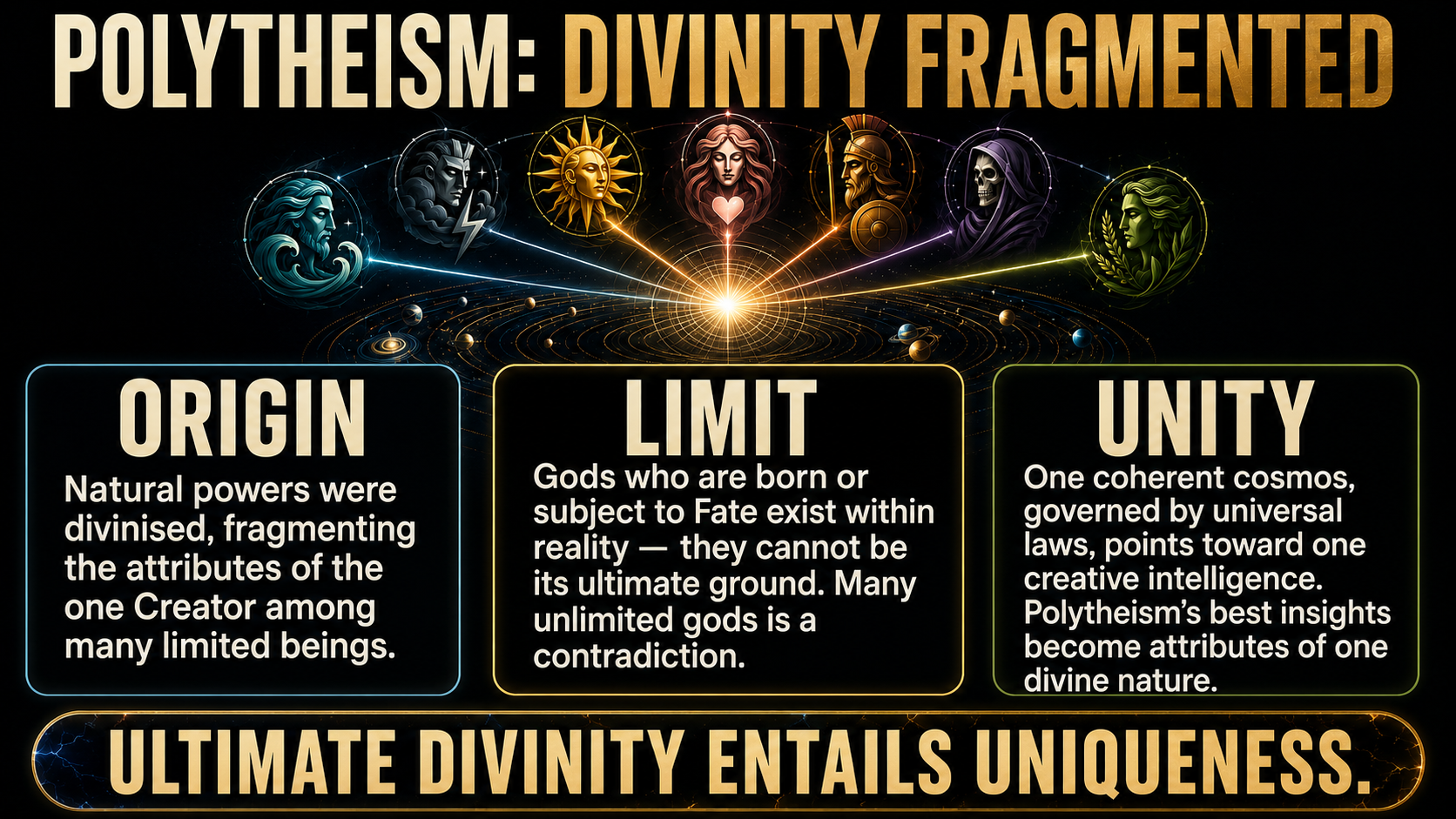
The Christian and biblical tradition offers a different account of polytheism’s origin, and it is philosophically the more interesting one. According to the analysis in the first chapter of Paul’s letter to the Romans and in the Wisdom of Solomon[1], polytheism is not a primitive stage on the way to a higher religious consciousness, but a degeneration from an original apprehension of the one God. The argument runs as follows. The created order discloses, to attentive intelligence, the existence of a Creator — a Being of power, wisdom, and goodness whose character is impressed upon the works of His hands. This natural disclosure is genuine and real. But when human beings, in the disorder of their moral and intellectual life, fail to follow this disclosure to its proper conclusion, they tend to divinise what is merely part of the created order: the powers of nature, the forces of history, the categories of human experience. The sun, the sea, the storm, death, love, war — these become divine because they are impressive, powerful, and in some sense inexplicable. The many gods of polytheism are, on this account, a fragmentation of what should have been recognised as the unity of the one Creator: a scattering of the divine attributes across a plurality of limited powers, each real as a natural force or a dimension of human experience, but none identical with the ground of all reality.
This account has a structural consequence that is philosophically significant. The gods of polytheism, as classically described — in Homer, in Hesiod, in the Vedas — are not truly divine in the sense that monotheism requires. They are powerful, but not omnipotent. They are wise, but not omniscient. They are long-lived, perhaps immortal in some traditions, but not the uncaused cause of all contingent being. They are, in a word, participants in reality rather than its ground. They have origins — theogonies, divine genealogies — which means that their existence is derivative, contingent, and therefore in need of the same explanation that all contingent existence requires. A being that can be born, that has a history, that is limited by other powers and by impersonal forces like Fate or Necessity — such a being is not the ultimate ground of reality. It is a very powerful item within reality, but it is not the answer to the philosophical question with which theism properly begins.
John of Damascus articulated argument against polytheism. If there are many gods, there must be differences between them, since if there were no differences there would be only one. But if there are differences, then none of them can be perfect — because a being that differs from another being in any respect lacks whatever that other being possesses. And a being that lacks anything cannot be the ultimate ground of all reality, which must itself be unlimited and perfect. The hypothesis of many gods, each genuinely divine in the fullest sense, is self-contradictory. If each is truly unlimited, they would be identical, not many. If they are many, they are limited, and therefore not truly divine. The concept of divinity, properly understood, entails uniqueness.
There is also a cosmological version of this argument. If many gods govern the universe, who coordinates their governance? If they are truly independent, the universe would be subject to irreconcilable conflicts of divine will, and the remarkable order and coherence of the natural world would be inexplicable. The unity of the cosmos points toward the unity of its ground. A universe governed by many independent powers in potential conflict is not the universe we actually inhabit, where a single set of physical laws applies with extraordinary consistency across all times and all places. The unity, intelligibility, and ordered beauty of the world is the signature not of a committee of deities but of a single creative intelligence.
None of this means that polytheistic traditions have contributed nothing of value to human religious and philosophical reflection. The analysis of the divine in terms of distinct attributes — wisdom, power, justice, love, beauty — that polytheism expresses through a plurality of divine figures captures something real about the richness and diversity of the divine character. The Greek philosophical tradition, which grew up in dialogue with polytheism, made exactly this move: the transition from Olympian religion to philosophical theology is in part the recognition that what appeared as many gods are better understood as distinct aspects of the single divine nature. Plato’s dialogues can be read, in part, as precisely this kind of philosophical purification of the religious tradition. But this philosophical purification is already a movement toward monotheism, and the question is whether it can stop short of monotheism without losing its coherence. The evidence of the history of philosophy suggests that it cannot.
[1] Chapter 13-14 - Surely vain are all men by nature, who are ignorant of God, and could not out of the good things that are seen know him that is: neither by considering the works did they acknowledge the workmaster; But deemed either fire, or wind, or the swift air, or the circle of the stars, or the violent water, or the lights of heaven, to be the gods which govern the world. With whose beauty if they being delighted took them to be gods; let them know how much better the Lord of them is: for the first author of beauty hath created them. But if they were astonished at their power and virtue, let them understand by them, how much mightier he is that made them. For by the greatness and beauty of the creatures proportionably the maker of them is seen. But yet for this they are the less to be blamed: for they peradventure err, seeking God, and desirous to find him. For being conversant in his works they search him diligently, and believe their sight: because the things are beautiful that are seen. Howbeit neither are they to be pardoned. For if they were able to know so much, that they could aim at the world; how did they not sooner find out the Lord thereof? But miserable are they, and in dead things is their hope, who called them gods, which are the works of men’s hands, gold and silver, to shew art in, and resemblances of beasts, or a stone good for nothing, the work of an ancient hand. Now a carpenter that felleth timber, after he hath sawn down a tree meet for the purpose, and taken off all the bark skillfully round about, and hath wrought it handsomely, and made a vessel thereof fit for the service of man’s life; And after spending the refuse of his work to dress his meat, hath filled himself; And taking the very refuse among those which served to no use, being a crooked piece of wood, and full of knots, hath carved it diligently, when he had nothing else to do, and formed it by the skill of his understanding, and fashioned it to the image of a man; Or made it like some vile beast, laying it over with vermilion, and with paint colouring it red, and covering every spot therein; And when he had made a convenient room for it, set it in a wall, and made it fast with iron: For he provided for it that it might not fall, knowing that it was unable to help itself; for it is an image, and hath need of help: Then maketh he prayer for his goods, for his wife and children, and is not ashamed to speak to that which hath no life. For health he calleth upon that which is weak: for life prayeth to that which is dead: for aid humbly beseecheth that which hath least means to help: and for a good journey he asketh of that which cannot set a foot forward: And for gaining and getting, and for good success of his hands, asketh ability to do of him, that is most unable to do any thing.
Again, one preparing himself to sail, and about to pass through the raging waves, calleth upon a piece of wood more rotten than the vessel that carrieth him. For verily desire of gain devised that, and the workman built it by his skill. But thy providence, O Father, governeth it: for thou hast made a way in the sea, and a safe path in the waves; Shewing that thou canst save from all danger: yea, though a man went to sea without art. Nevertheless thou wouldest not that the works of thy wisdom should be idle, and therefore do men commit their lives to a small piece of wood, and passing the rough sea in a weak vessel are saved. For in the old time also, when the proud giants perished, the hope of the world governed by thy hand escaped in a weak vessel, and left to all ages a seed of generation. For blessed is the wood whereby righteousness cometh. But that which is made with hands is cursed, as well it, as he that made it: he, because he made it; and it, because, being corruptible, it was called god. For the ungodly and his ungodliness are both alike hateful unto God. For that which is made shall be punished together with him that made it. Therefore even upon the idols of the Gentiles shall there be a visitation: because in the creature of God they are become an abomination, and stumblingblocks to the souls of men, and a snare to the feet of the unwise. For the devising of idols was the beginning of spiritual fornication, and the invention of them the corruption of life. For neither were they from the beginning, neither shall they be for ever. For by the vain glory of men they entered into the world, and therefore shall they come shortly to an end. For a father afflicted with untimely mourning, when he hath made an image of his child soon taken away, now honoured him as a god, which was then a dead man, and delivered to those that were under him ceremonies and sacrifices. Thus in process of time an ungodly custom grown strong was kept as a law, and graven images were worshipped by the commandments of kings. Whom men could not honour in presence, because they dwelt far off, they took the counterfeit of his visage from far, and made an express image of a king whom they honoured, to the end that by this their forwardness they might flatter him that was absent, as if he were present. Also the singular diligence of the artificer did help to set forward the ignorant to more superstition. For he, peradventure willing to please one in authority, forced all his skill to make the resemblance of the best fashion. And so the multitude, allured by the grace of the work, took him now for a god, which a little before was but honoured. And this was an occasion to deceive the world: for men, serving either calamity or tyranny, did ascribe unto stones and stocks the incommunicable name. Moreover this was not enough for them, that they erred in the knowledge of God; but whereas they lived in the great war of ignorance, those so great plagues called they peace. For whilst they slew their children in sacrifices, or used secret ceremonies, or made revellings of strange rites; They kept neither lives nor marriages any longer undefiled: but either one slew another traiterously, or grieved him by adultery. So that there reigned in all men without exception blood, manslaughter, theft, and dissimulation, corruption, unfaithfulness, tumults, perjury, Disquieting of good men, forgetfulness of good turns, defiling of souls, changing of kind, disorder in marriages, adultery, and shameless uncleanness. For the worshipping of idols not to be named is the beginning, the cause, and the end, of all evil. For either they are mad when they be merry, or prophesy lies, or live unjustly, or else lightly forswear themselves. For insomuch as their trust is in idols, which have no life; though they swear falsely, yet they look not to be hurt. Howbeit for both causes shall they be justly punished: both because they thought not well of God, giving heed unto idols, and also unjustly swore in deceit, despising holiness. For it is not the power of them by whom they swear: but it is the just vengeance of sinners, that punisheth always the offence of the ungodly.
Dualism, in its religious and philosophical form, is the doctrine that ultimate reality consists of two independent and irreducible principles, typically characterised as good and evil, light and darkness, spirit and matter, order and chaos. It arises, in almost all of its historical manifestations, from the attempt to account for the undeniable reality of evil, suffering, and disorder in a world that is also, undeniably, characterised by order, beauty, and goodness. If there is one omnipotent and perfectly good Creator, the dualist asks, why does evil exist? The dualist’s answer is that evil must have an independent source — a second principle that is not derived from the good God but co-eternal with Him, or at least not fully under His control.
The most historically significant form of dualism is Zoroastrianism, the ancient Persian religion attributed to the prophet Zarathustra, in which the universe is governed by the conflict between Ahura Mazda, the good and wise Lord, and Angra Mainyu (Ahriman), the destructive spirit of evil. The world is a theatre for this cosmic conflict, and human beings are called to align themselves with Ahura Mazda through truthful speech, righteous action, and the rejection of the lie. This is an ethically serious religion, and its influence on later Western religious thought — including, through Persia, on certain strands of Jewish thought during the Exile, and through Manichaeism on early Christian theology — has been considerable. The dualist framework also appears in Gnostic traditions of the first several centuries of the Common Era, where the material world is the creation of an inferior or even malevolent demiurge, and salvation consists in the liberation of the spiritual self from its material prison. Manichaeism, the religion founded by Mani in the third century CE — which famously attracted Augustine of Hippo before his conversion to Christianity — extended this framework into a comprehensive cosmological and ethical system. Medieval European dualism appears in the Cathar and Bogomil movements, which taught a sharp opposition between the material world, the creation of an evil god, and the spiritual world, the domain of the good God.
Dualism arises, as its defenders have always insisted, from the refusal to explain away evil. It takes evil seriously as a genuine, irreducible feature of the world. In this respect it has an honest seriousness that certain forms of monistic optimism — which dismiss evil as mere illusion, or as a necessary element in a larger harmony, or as the privation of good — lack. The dualist looks at the reality of suffering, cruelty, and moral failure and refuses to pretend that it is not what it appears to be: a genuine affront to the good, a real opposition to what ought to be. This is a genuine philosophical virtue, and it explains the persistent attractiveness of dualistic positions.
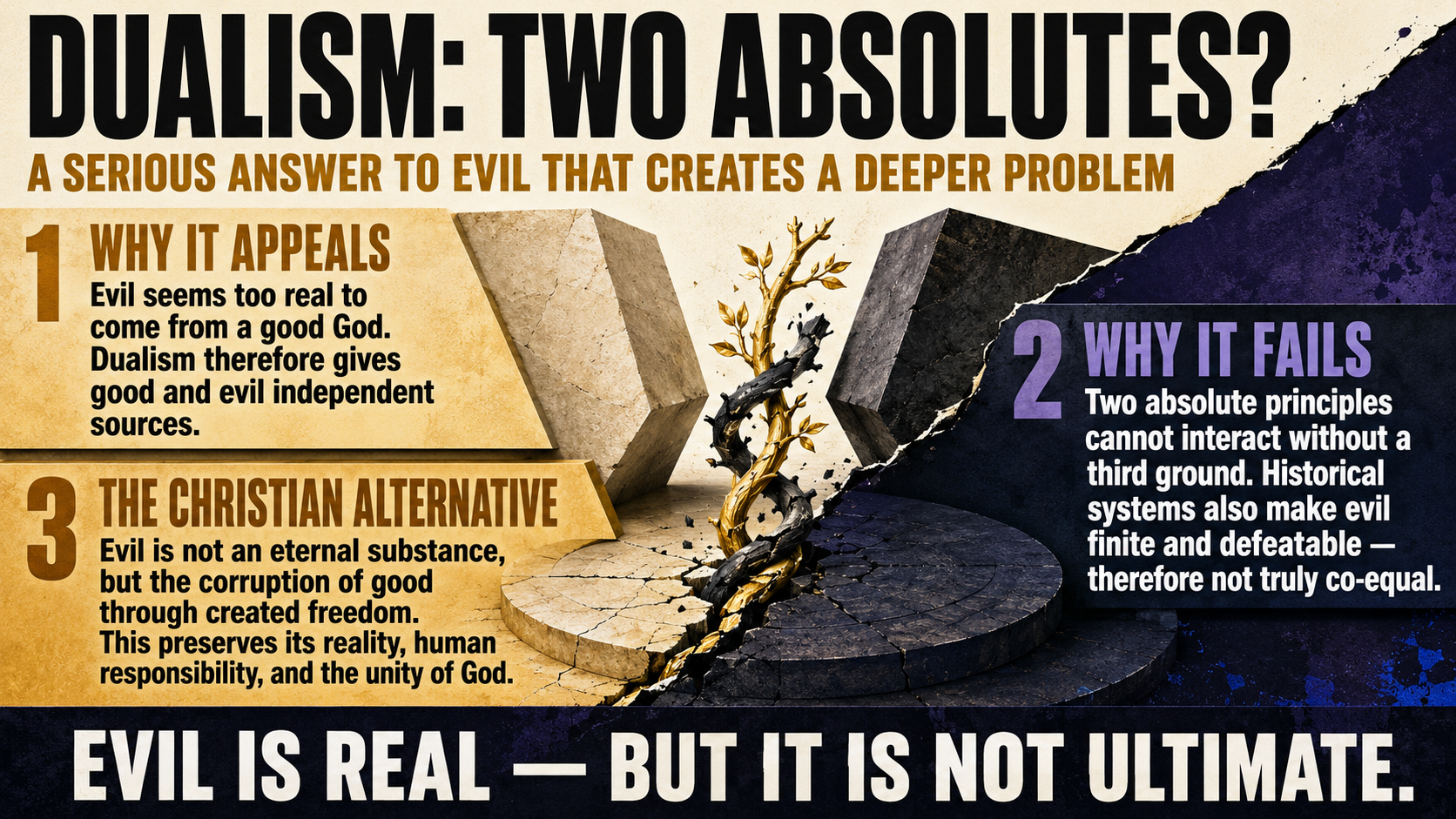
But dualism, when examined carefully, generates more problems than it solves. The first and most fundamental problem is the one identified by the ancient critics of Zoroastrianism and later by the patristic opponents of Gnosticism and Manichaeism: if there are two independent, co-eternal principles, what explains their interaction? Two truly absolute and independent principles cannot interact without some third reality that provides the conditions for their interaction. They would be, by definition, mutually external and mutually impenetrable. And if there is a third reality that conditions their interaction, then neither of the two supposed absolutes is truly absolute, and the problem recurs at the level of the triadic structure. Dualism does not solve the problem of ultimate explanation; it displaces it.
The second problem is that dualism typically cannot maintain its own internal consistency. In virtually every historical form of dualism, the evil or negative principle turns out not to be truly co-equal with the good principle. In later Zoroastrianism, Angra Mainyu is destined to be defeated; the good God will ultimately prevail. In Gnostic systems, the material world is a falling away from the divine pleroma, not its equal competitor. In Manichaeism, the kingdom of darkness is bounded and finite, while the realm of light is unlimited. These qualifications are not accidental: they reflect the deep intuition that absolute co-equality of good and evil would be unbearable and ultimately unintelligible. But once the negative principle is acknowledged to be limited and ultimately defeatable, dualism has conceded the essential point to monotheism. A limited evil principle that cannot ultimately prevail is not a genuine threat to divine omnipotence; it is simply a powerful creature — a fallen angel, in traditional Christian terms — that has been permitted to exercise its destructive capacity within limits set by the good God.
The third problem is that dualism, despite its intention to take evil seriously, actually undermines the moral seriousness that motivates it. If evil is an independent and co-eternal principle, then the moral struggle is not between genuine freedom and genuine responsibility, but between two external forces contending for the possession of the human soul. Human beings become pawns in a cosmic conflict rather than genuine moral agents. The tradition that insists on human freedom and human responsibility for evil — and this is precisely the tradition that the biblical account of the Fall represents — is more, not less, serious about evil than the tradition that attributes evil to an independent divine counter-principle. To say that evil originates in the free choice of created beings — angels and human persons — is to say that evil is real, that it matters, that someone is responsible for it, and that it can in principle be overcome. To say that evil is an eternal principle co-equal with God is to say that the universe is, at its deepest level, a battlefield, and that good and evil are simply different kinds of power rather than genuine opposites of value.
The biblical tradition contains many dualistic-sounding passages — the contrast of light and darkness in John’s Gospel, the Pauline language of spiritual warfare, the apocalyptic imagery of the book of Revelation — but the tradition consistently refuses to elevate these contrasts to the level of ultimate metaphysical principles. Evil, in the biblical account, is always and only the corruption, the privation, the contradiction of a good creation. It has no independent ontological standing; it is parasitic on the good. And the origin of evil lies not in a co-eternal counter-principle but in the free rejection, by created beings, of their created goodness. This account — traditionally formulated as the doctrine of the Fall — preserves both the seriousness of evil and the unity of God, which dualism achieves the former only by sacrificing the latter.
Monotheism is the belief that there is one God — one ultimate source of all reality, one ground of being, one perfectly wise and good Creator who is the measure and origin of all truth, goodness, and beauty. It is the theological position that Jewish, Christian, and Islamic traditions share as their common foundation, and it is the position that the philosophical arguments we have been developing throughout this course have been converging upon. The question now is not whether monotheism is correct — the arguments already given provide strong reasons to think it is — but what it means, what it implies, and how different forms of monotheism are to be assessed.
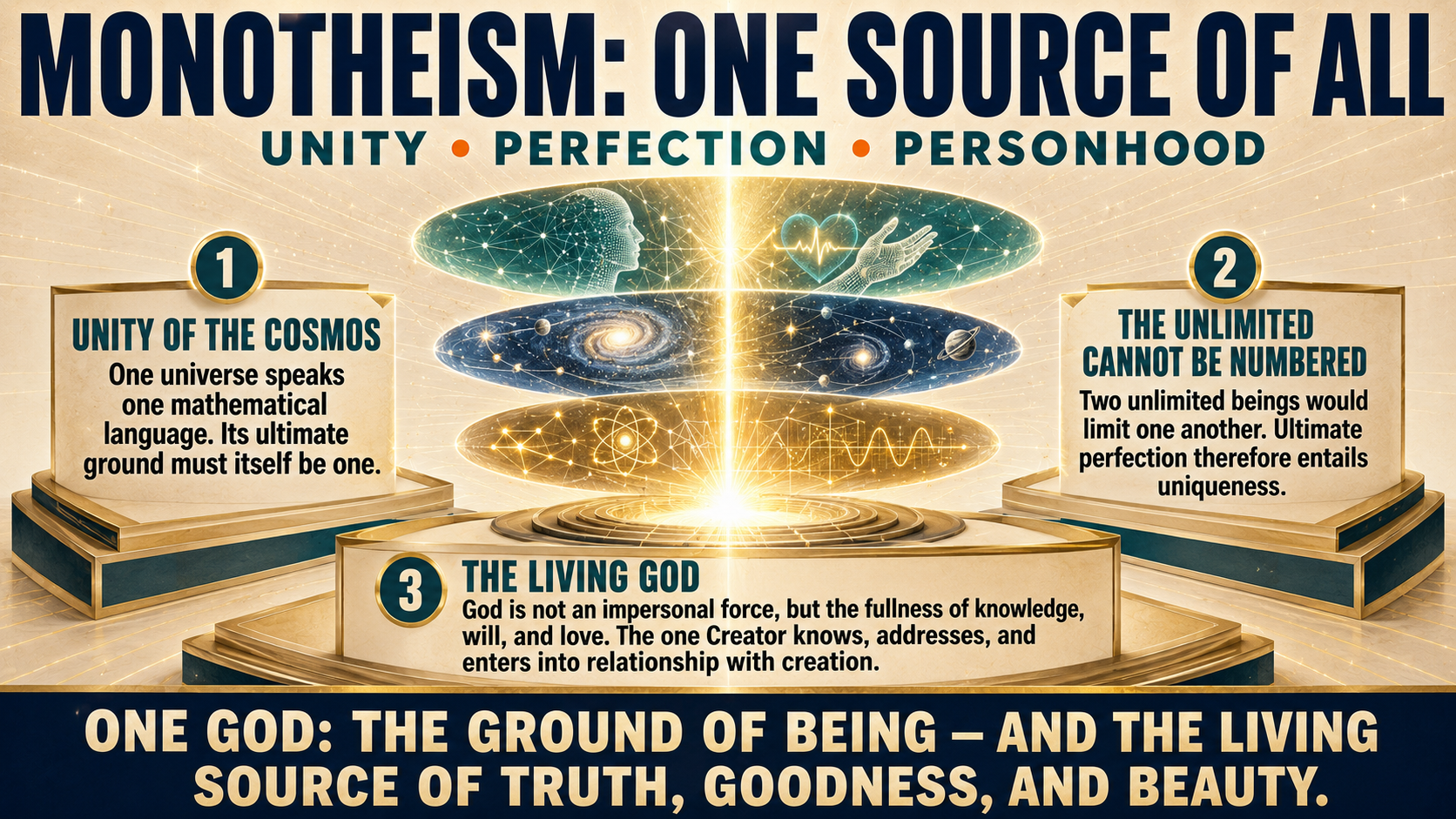
The philosophical case for monotheism can be stated concisely. The universe is one: governed by a single set of mathematical laws, characterised by a deep structural unity that allows a single science to describe its operations from the quantum level to the cosmological. The ground of a unified universe must itself be unified. If the ultimate source of reality were multiple, the unity of the universe would be unexplained, and the remarkable fact that the universe is intelligible — that it speaks a single mathematical language — would be merely contingent. The unity of the cosmos is the signature of the unity of its Creator. This argument, which appears already in Plato’s Timaeus and is developed in the patristic tradition by Athanasios of Alexandria and John of Damascus, is one of the most powerful in natural theology.
There is also a conceptual argument, which we encountered in the previous section. The concept of God, properly understood, is the concept of a being of unlimited perfection: a being that possesses all genuine perfections to an unlimited degree, and that lacks nothing that could add to its perfection. But if God is unlimited, there can be only one such being. Two unlimited beings would, by definition, limit one another — each would lack the properties possessed exclusively by the other — and therefore neither would be truly unlimited. This is the argument from divine perfection to divine uniqueness, and it is decisive. Any being that can be numbered — any being that stands alongside other beings in a series — is, by that fact, limited. The unlimited cannot be numbered.
These philosophical arguments establish monotheism on the basis of reason and natural theology. But monotheism is not merely a philosophical position; it is a religious one, and the religious dimension of monotheism includes specific claims about the character of the one God and about the relationship between God and the world that reason alone cannot fully establish. This is where the three major monotheistic traditions — Judaism, Islam, and Christianity — diverge in their accounts of what the one God is like, and what He has done and continues to do in relation to the creatures He has made.
The most basic claim that monotheism makes about God — the claim that distinguishes it most sharply from both polytheism and from the impersonalist monism that characterises certain forms of pagan philosophy and modern pantheism — is that God is personal. This is not the claim that God is a person in the way that human beings are persons: bounded, particular, located in space and time, with a specific history. It is the claim that God is the kind of being to whom the categories of knowledge, will, and love apply in their fullest and most unlimited sense. God knows, not in the way that a finite knower knows — partially, perspectivally, subject to error and revision — but fully and unfailingly. God wills, not in the way that a creature wills — constrained by its nature, limited by its options, liable to frustration — but freely and sovereignly. God loves, not in the way that created love loves — motivated by the perceived value of the beloved, limited by capacity, subject to change — but as the very source of love itself, whose love is the ground of the beloved’s existence and value rather than a response to it.
The concept of God as personal is what makes religion possible, in any serious sense of that word. As we argued in an earlier lecture, religion is not merely the recognition of a supreme power or an ultimate ground of reality: it is a relationship, and a relationship requires two parties who are genuinely capable of entering into genuine mutual engagement. The God of Aristotle — the Unmoved Mover, the self-thinking Thought — is philosophically respectable, but He is not the object of prayer, of trust, of gratitude, of repentance. He knows Himself, but He does not know us; He does not hear, does not respond, does not act in history. Aristotle’s God is the most refined product of pagan philosophical theology, but He is a God with whom no human being could have a religion in the full sense. Monotheism, in its biblical and Abrahamic forms, insists that God is not only the ground of all being but the living God who addresses the creature, who enters into covenant, who hears prayer, who acts in history. This is not a primitive anthropomorphism that more sophisticated theology must purge; it is the central conviction of Abrahamic religion, and it is philosophically defensible in a way that the impersonalist alternatives are not.
The philosophical defence of divine personhood runs as follows. Among the kinds of being we know, personal being — being characterised by knowledge, will, and love — is the highest. It exceeds impersonal being not merely in complexity but in kind: a being that knows is more than a being that merely exists; a being that wills is more than a being that merely acts according to fixed laws; a being that loves is more than a being that merely processes information. If we are seeking the most adequate concept of the ultimate ground of reality, and if personal being is the highest kind of being we know, then we have good reason to think that the ultimate ground of reality is personal rather than impersonal. To attribute less than the highest kind of being to God is not philosophical humility; it is philosophical inconsistency. The philosopher who acknowledges that human personal being transcends mechanical causation, and who then denies that the ground of all being is personal, is applying one standard of philosophical reasoning to the world and a different — and lesser — standard to God.
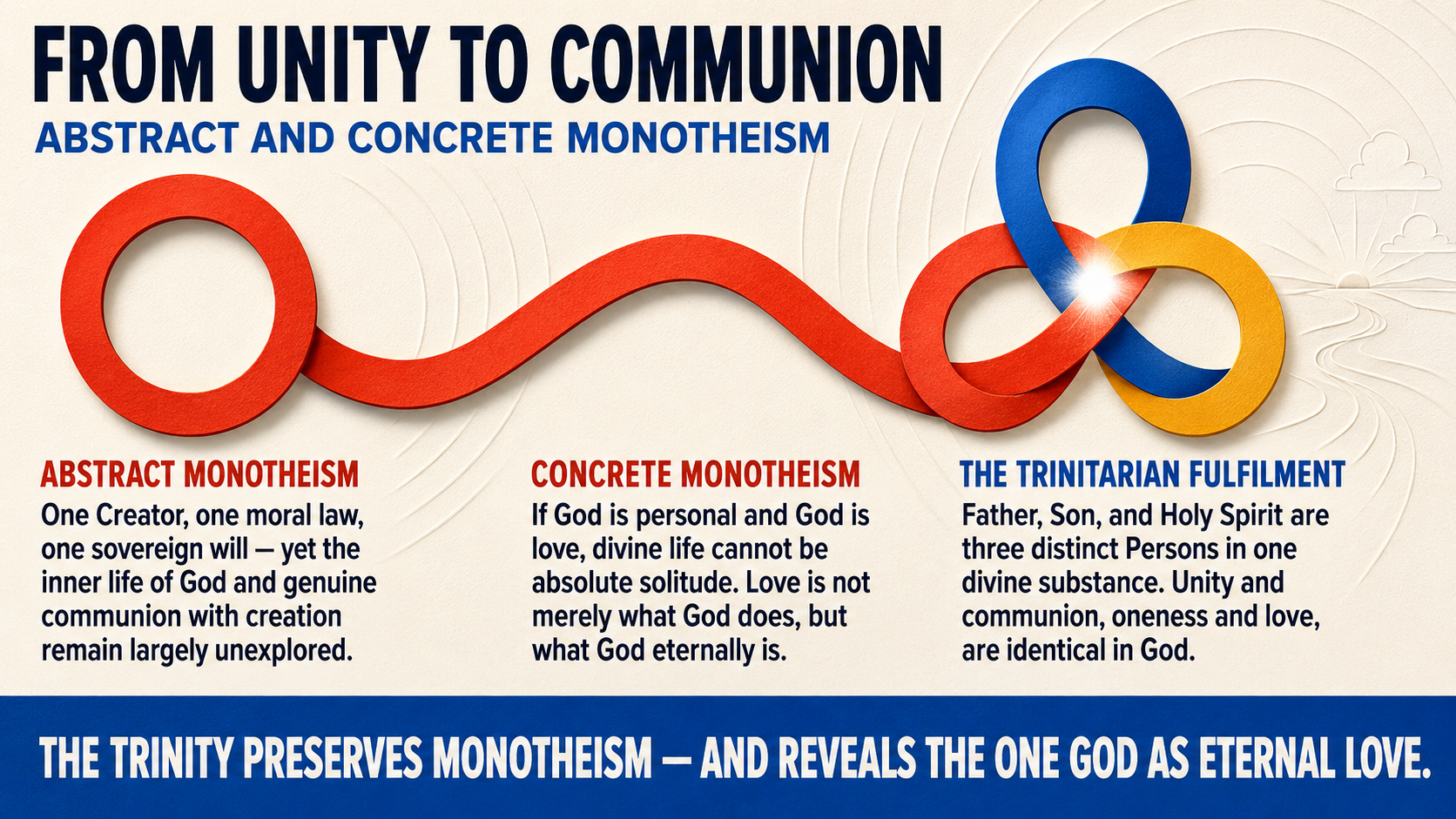
Not all forms of monotheism are equally coherent or equally adequate to the full range of facts that religion and philosophy must address. It is useful to distinguish what we might call abstract monotheism from concrete monotheism, and to assess them accordingly.
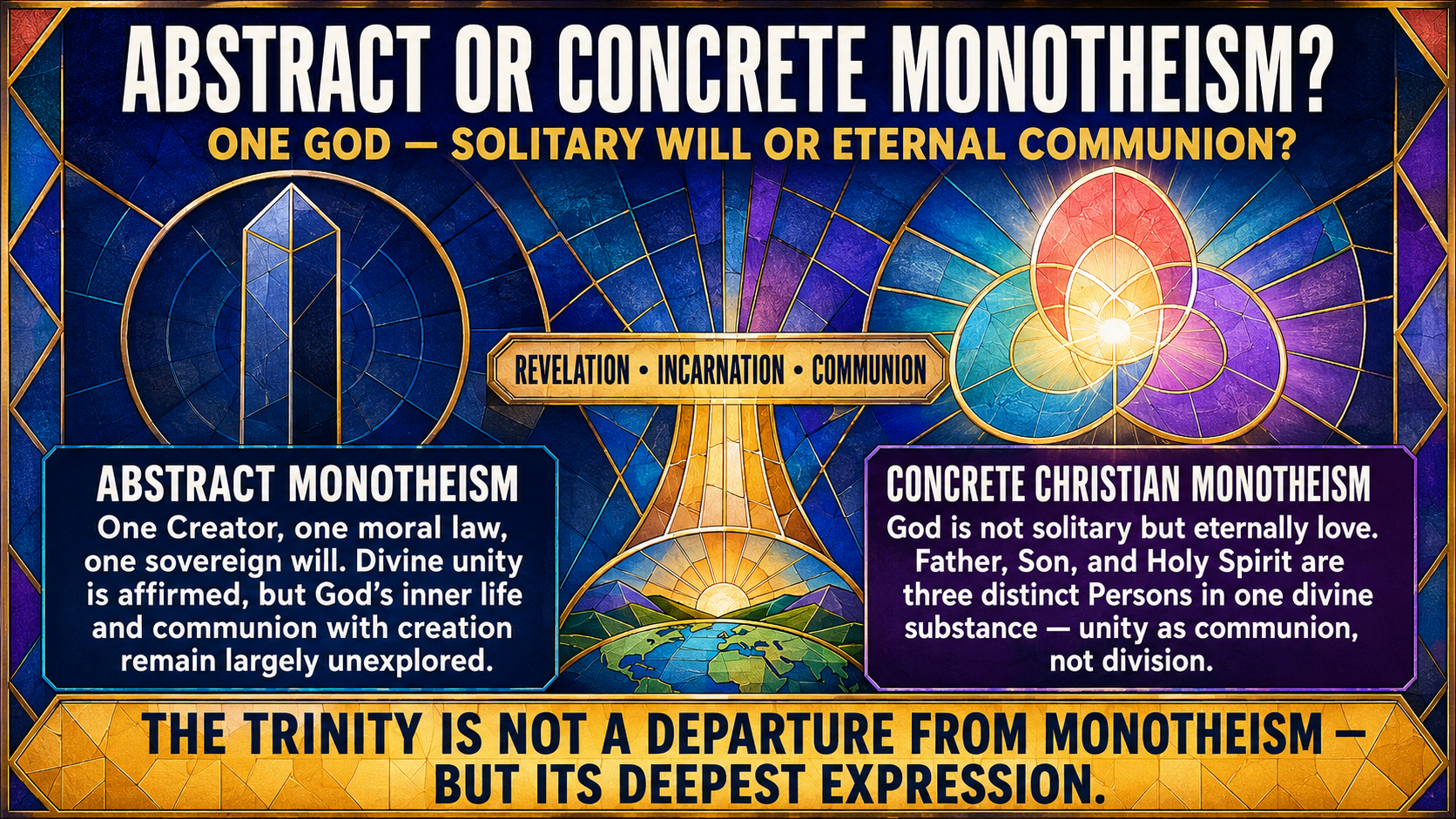
Abstract monotheism affirms the existence of one God, the Creator of all things, the source of moral law, and the ultimate reference point for human life. It insists on the unity and uniqueness of God, and it excludes polytheism and dualism as philosophically and religiously inadequate. But it does not say very much about the inner life of God, about the relationship between God and the created world in any depth, or about the ways in which human persons can enter into genuine knowledge of and communion with God. The God of abstract monotheism is affirmed to exist, to be one, to be the source of all things — and then remains largely silent. The relationship between the believer and this God tends to be one of submission to an authoritative will, rather than a relationship characterised by the kind of mutual personal engagement that the best human relationships exhibit. Abstract monotheism, in other words, affirms the unity of God but does not explore or develop what that unity means for the character of the divine life and for the relationship between God and creation.
In the history of religion, this abstract form of monotheism is most closely approximated by certain forms of Islam and by a certain strand of post- biblical Judaism. The God of Islamic theology, in its dominant Asharite form, is radically transcendent, absolutely one, and related to creation primarily through the category of will and command. The relationship between God and the believer is paradigmatically one of obedience: the very name Islam means submission. The divine attributes — knowledge, power, will — are affirmed, but the inner life of God, any notion of divine self-giving or self-communication in the most personal sense, remains unexplored. This is not a criticism of the spiritual seriousness of Islam — which is manifestly profound — but an observation about the limits of the theological framework within which that spiritual seriousness is expressed.
Concrete monotheism, by contrast, does not merely affirm the existence and unity of God but explores what the divine life is like from the inside, how God relates to creation not merely as its external cause and ruler but as its sustaining ground and loving father, and how the gap between infinite Creator and finite creature is bridged. It takes seriously the implication that if God is personal — if the categories of knowledge, will, and love apply to God in their fullest sense — then there must be something within the divine life that corresponds to what personal life means at its highest: not isolation but community, not monologue but conversation, not solitary existence but a life of genuine mutual relation. The concept of God as love, which Christianity insists is not a pious metaphor but a metaphysical description, implies precisely this: that love is not merely something God does but something God is, and that love, which requires a relation between distinct persons, is not an accident of the divine life but its essence.
This is the point at which Christian monotheism diverges most significantly from Jewish and Islamic monotheism, and it is the point at which the Christian doctrine of the Trinity becomes not a speculative addition to a simpler monotheistic base but a theological necessity. If God is love in a fully personal and metaphysically serious sense, then the divine life cannot consist of an absolute solitary monad who, before creation, had no object for His love and no partner in His life. The doctrine of the Trinity — the teaching that the one God exists eternally as Father, Son, and Holy Spirit, three distinct Persons in one divine substance — is the Christian answer to the question of what God’s inner life is like. It is not a departure from monotheism but its deepest expression: the affirmation that unity and community, oneness and love, are not in tension in God but identical.
Gregory the Theologian, whose words stand at the head of this lecture, articulated this with his characteristic precision: to speak of God is to speak of Father, Son, and Holy Spirit — not because divinity is divided (which would be to return to polytheism) and not because it is contracted into a single undifferentiated point (which would be to impoverish it). The Trinitarian understanding of God preserves, in a single formula, both the unity that monotheism rightly insists upon and the community that the concept of God as love requires. It avoids the fragmentation of polytheism without falling into the sterility of an absolute divine solitude. And it does so, as Christian theology has consistently insisted, not as a speculative hypothesis but as the disclosure of what God has revealed about Himself in the history of salvation that culminates in the Incarnation.
Related Concepts
- ahriman
- anthropomorphism
- aristotles-god
- aristotles-unmoved-mover
- asharite-theology
- athanasios-of-alexandria
- contingency
- creation-as-gift
- curses
- degeneration
- determinism
- divine-communion
- divine-infinity
- divine-necessity
- divine-perfection
- divine-solitude
- divine-unity
- dualism
- first-commandment
- gnosticism
- god-as-love
- good-creation
- gregory-the-theologian
- idolatry
- intelligibility-of-nature
- islam
- john-of-damascus
- judgment
- marcionism
- monotheism
- moral-agency
- necessary-being
- pessimism
- philosophical-theology
- plato
- platonism
- platos-timaeus
- polytheism
- post-biblical-judaism
- privation
- problem-of-evil
- romans-1
- second-commandment
- the-fall
- theogonies
- wisdom-of-solomon
- zoroastrianism