Dogmatic Theology — General
General news and announcements
Introduction to Dogmatic Theology
Syllabus
Course audience: This course is accesible for all, and designed both for those who have no previous instruction in dogmatic theology, and for students of theology looking to refresh, continue and deepen their knowledge of Orthodox Dogmatics.
Method of teaching: Distance learning
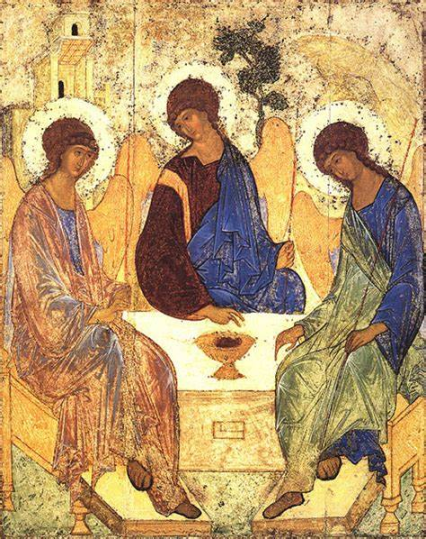 Course Objectives: In this course the student will be
immersed in a wide range of theological topics that cover the full spectrum of
dogmatic theology from God in Himself, God as Creator of the World,
Christology, Soteriology,
Ecclesiology, Sacrament-ology and finally
Eschatology. The courses goal is to introduce the student to the most
important teachings and tenets of the Orthodox Church. Although some of the
historical development of these dogmas is covered in this course, it does not
intend to present an in-depth analysis of historical context and development.
Rather is provides a solid base and structure to continue studying more deeply
after its completion.
Structure of course: 3 sections, 16 lessons.
Section I: God in Himself – The Trinity
1. Introduction to Orthodox Dogmatic Theology
Recommended reading: Pomazansky – pp. 29-52
2.On Knowledge of God
Recommended reading: Pomazansky – pp. 53-76
** 3.Trinitology – God in Himself**
Recommended reading: Pomazansky – pp. 77-82
** 4. Trinitology – The Dogma of the Holy Trinity**
Recommended reading: Pomazansky – pp. 82-101
5. Trinitology – Heresies and their refutation
Recommended reading: Gnosticism; Monarchians; Marcionites; Montanists; Manichæism; Origen and Origenism // Catholic Encyclopedia, vols. 6, 9, 10, 11, New York: Robert Appleton Company, 1909-11.
Section II: God as Creator of the World
** 6.God and Creation**
Recommended reading: Pomazansky – pp. 107-113; Rose – pp. 106-144
7. Man, the Crown of Creation
Recommended reading: Pomazansky – pp. 123-142; Rose – pp. 145-190
** 8.The Fall of Man**
Recommended reading: Pomazansky – pp. 143-169; Rose – pp. 191-216 (217-246)
Section III: The Economy of
Salvation
9. Christology –The Economy of Salvation
Recommended reading: Pomazansky – pp. 170-176
10. Christology – The Incarnation
Recommended reading: Pomazansky – pp. 177-188 (189-196)
11. Christology – Heresies and their refutation
Recommended reading: Chapman, J., Monophysites and Monophysitism; Monothelitism and Monothelites; Nestorius and Nestorianism // Catholic Encyclopedia, vol. 10, New York: Robert Appleton Company, 1911.
12. Soteriology – the Dogma of Redemption
Recommended reading: Pomazansky – pp. 197-215 (216-223)
13. Soteriology – On (Saving) Grace
Recommended reading: Pomazansky – pp. 260-264
14.Ecclesiology
Recommended reading: Pomazansky – pp. 229-259
15. On the Sacraments
Recommended reading: Pomazansky – pp. 266-310
** 16.Eschatology**
Recommended reading: Pomazansky – pp. 332-354
Bibliography:
Patristic Sources:
• John of Damascus. The Fountain of Knowledge. Trans. Frederic H. Chase // The Fathers of the Church: A New Translation. Vol. 37. Washington D.C.: Catholic University of America Press, 1958.
• Basil the Great. On the Holy Spirit. Trans. Blomfield Jackson // Nicene and Post-Nicene Fathers. 2nd Series, vol. 8. Buffalo, NY: Christian Literature Pub. Co., 1895.
Literature:
• Meyendorff, John. Byzantine Theology: Historical Trends and Doctrinal Themes. New York: Fordham University Press, 1999.
• Pomazansky, Michael (Protopresbyter). Orthodox Dogmatic Theology. Trans. Seraphim Rose (Heiromonk). Platina: St. Herman of Alaska Brotherhood, 2015.
• Rose, Seraphim (Hieromank). Genesis, Creation and Early Man: The Orthodox Christian Vision. Platina: St. Herman of Alaska Brotherhood, 2000.
• Cunningham M.B. and Theokritoff E. Eds. The Cambridge Companion to Orthodox Christian Theology. Cambridge: Cambridge University Press, 2008.

_This course is accesible for all, and designed both for those who have no
previous instruction in dogmatic theology, and for students of theology
looking to refresh, continue and deepen their knowledge of Orthodox Dogmatics.
_
Lesson media
Video lesson available in the offline course archive (not hosted online).
Related Concepts
- annunciation
- anthropology
- ascension
- athanasius
- body-of-christ
- christian-faith
- christology
- creation
- divine-essence-and-persons
- ecclesiology
- eschatology
- false-teaching
- final-judgment
- god-as-creator
- godliness
- gregory-of-nyssa
- heresies-and-refutation
- historicity-of-revelation
- holy-trinity
- hypostatic-properties
- incarnation
- joel
- john-114
- last-days
- last-judgment
- man-as-crown-of-creation
- millennium
- moral-interpretation-of-dogma
- on-the-incarnation
- only-begotten-son
- orthodox-church
- orthodox-dogmatics
- redemption
- resurrection
- sacramentology
- second-coming
- soteriology
- supernatural-knowledge
- theology-and-ethics
- trinitology
- universal-resurrection