Patrology — Topic 4
4.1 Early Christian Apologists
Apologetics means « defending ». Early Christian Apologists produced a
considerable number of works with the title “Apology” and in the genre of apologia. The Greek term “apologia” is a defence speech, often in a court of law. In what and against whom were the Apologists defending Christianity?
In the person of the early Christian apologists, the Christian Church, for the first time ever, begins to address the pagan world in the language of that world. Of course, the apostolic sermon was reaching the Gentiles, but it was only in the late 1st and early 2nd century that Christianity begins to draw close and often hostile attention from the “authorities and wise men of this age” (1 Cor. 2:6-8). Among the emperors specially known for their persecution of Christians were, in addition to those of the 1st century, Nero (54-68) and Domitian (81-96); in the 2nd and 3rd centuries: Trajan (98 - 117), Hadrian (117 - 138), Antoninus Pius (138 - 161), emperor and philosopher Marcus Aurelius (161 - 180), Septimius Severus (196 - 211). Many of them and their close associates were well educated people, but they hated Christianity and therefore used all the power of the state machine against the forbidden religion of Christianity.
Educated pagans also began to oppose Christianity. Around 170, Lucian of Samosata mocked Christians in his satirical work “The Death of Peregrinus”. Marcus Aurelius, who was himself a Stoic philosopher and wrote about the ideals of patience, prudence, etc., had a violent persecution of Christians during his reign. In 188, - the Platonist Celsus - also spoke out against Christians ; Origen subsequently wrote his “Against Celsus” in response.
Along with the official persecutions of Christians, one should not forget the hatred of the Pagan priests towards the Christians, who were progressively losing their influence and income because of their followers growing desertion to the Christian Church; the hatred of the pagan populations who saw the anger of pagan gods in the numerous natural catastrophes of their time because of the Christians. Such hatred often led to spontaneous outbursts of hatred against Christians by the pagan plebs.
The Jews sometimes contributed to the persecution of Christians too (for example, they are reported to have brought firewood to burn St. Polycarp of Smyrna, etc.).
As can be seen from the defensive works of the Christian Apologists, pagans made three main accusations against Christians:
godlessness,
opposition to imperial authority,
and immorality: eating human flesh and group copulation at “nights of love” - agape.
Despite the unquestionable absurdity of the accusations, we can discern some basis for them. For example, the accusations of godlessness and disloyalty to authority were based on Christians’ refusal to participate in pagan religious ceremonies in honor of gods and emperors, because Christians rejected pagan gods . However, since the ancient were convinced that someone “without God at heart” is capable of any crime, this transgression of Christians seemed to be extremely hypertrophied. It is also worth mentioning the general suspicion of the authorities towards various closed (including religious) communities of that time - and Christians were just such closed community with a special “secret discipline” (disciplina arcana), so that for Roman authorities they seemed a source of plots and revolts and therefore subject to persecution. The latter two accusations of cannibalism and amoralism stemmed obviously from misunderstood and distorted rumours about the Supper of Love (understood by a corrupt pagan mind in a corrupt manner) and about Christians eating someone’s flesh and blood in the Eucharist, i.e. eating human flesh.
There was, however, a certain truth in the accusations of amoralism, but it was peculiar to certain Gnostic sects, who also called themselves Christians, while the Gentiles did not go into the distinction between Christians and heretics, and therefore they attributed all these accusations to Christians.
The Apologists sought to prove that the charges were totally inapplicable to Christians: accusations of atheism - because Christians are not atheists, but believe in one God and in His Son - Christ; they explained non-participation in religious rites of paganism with the impossibility of combining true worship with false worship (hence here the Apologists had to explain both the doctrine and practice of the Christian religion). The Apologists had respect for the person of the emperor and were therefore intended to reject accusations of Christian disloyalty to the state. Charges of immorality were rejected by explaining both the content of Christian worship and the moral teachings of Christianity, which excluded such accusations. Importantly, the apologists spoke in the “high” language of the philosophy and culture of the educated class of the day.
Among the Christian Apologists, a distinction is made between Greek (2nd century) and Latin (2nd - 3rd century) ones. Among the Greek apologists we should mention Quadratus, Aristides, Tatian (who was a disciple of Justin), Athenagoras of Athens, St. Theophilus of Antioch, St. Meliton of Sardis, etc. The most prominent figure, however, is Justin Martyr.
Among the Western Apologists (2nd and 3rd centuries) we could mention Minucius Felix, Tertullian, Arnobius and Lactantius.
It was the Apologists who were the first Christian thinkers who actively employed the conceptual apparatus of Greek philosophy for the needs of Christian theology, a procedure that later Church Fathers took over.
4.2 Aristides of Athens
The history of Aristides’ Apology resembles that of the work we know under the title of ‘Didache’. This Apologyis mentioned by St Jerome. But it was not until 1878 that the Armenian monks discovered a part of this apologia and in 1889 that Harries discovered the complete text of the apologia in a 7th century Syriac codex in the monastery of St Catherine in Sinai. But when Harris accidentally gave the text of the apology to his colleague, the scholar Robinson, he was surprised to discover that it reproduced literally a portion of the ‘Story of Barlaam and Joasaph’, transmitted under the name of St John of Damascus and popular since the Middle Ages.
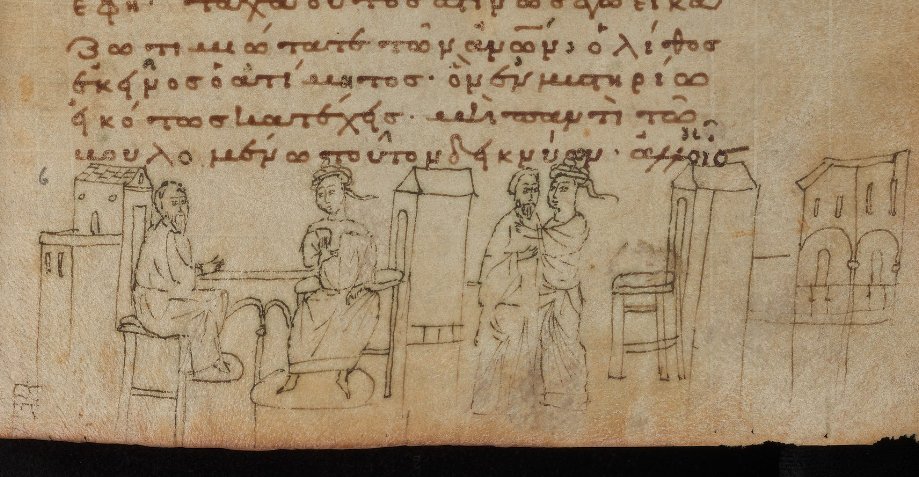
At the beginning of the apology the teaching about the attributes of the divine nature is given:
“He is the God of all things, who created all things for men’s sake… He is unborn, uncreated, infinite, immortal, perfect, and incomprehensible. Because He is perfect, He has no lack and suffers no need for anything; on the contrary, everything is in need of Him. He is without beginning, for all that has a beginning has an end, and all that has an end is destroyed. He has no name, for naming is a common characteristic of created beings. He has no colouring or appearance, for he who possesses them is thereby joined to the class of created things. In Him there is no distinction of masculine and feminine, for he in whom this is found is subject to passions. Heaven does not embrace Him, but He contains heaven and all things visible and invisible in Himself. He has no adversary, as there is no one who is stronger than He is. He is not possessed by envy and anger as there is nothing that can resist Him. Error and ignorance are alien to His nature, which is all perfect wisdom and knowledge. Everything is contained in Him. And He needs no sacrifice or libation or anything visible, but everything has need in Him”.
This is probably the first presentation in philosophical and theological language of the doctrine of God and His attributes in apophatic (i.e. negative) terms. On the other hand, this presentation shows the greatness of the Christian God and His dissimilarity with the gods of the pagan pantheon. The conclusion is that this God does not need sacrifices in the manner of the pagans and therefore they are unnecessary for Christians.
The author of the Apology divides people into four categories - Barbarians, Hellenes, Jews and Christians. The difference between them is that Barbarians worship the elements (fire, wind, water, heavenly bodies), while Hellenes worship anthropomorphic gods, which, from the moral point of view, are obviously not exemplary in any way. He appreciates the Jews for their monotheism, on the one hand, and on the other for their strict morality, which, however, he assesses as not conforming to the spirit of the Christian moral teaching. Finally, Christians are the ones who possess the full truth and know God and the Creator in his Son and the Holy Spirit.
Aristides also explains the superiority of Christian moral teaching over the morals of the pagans. Christ’s commandments are written in the hearts of Christians, they believe in the resurrection of the dead and the eternal life to come. Moral offences among Christians are considered inadmissible, they themselves show examples of high morality, virginity is very common among them, they lay down their lives for each other and for Christ.
4.3 Athenagoras of Athens
He was more sympathetic to Hellenic culture and philosophy than Tatian. He is regarded by scholars as one of the finest stylists and rhetoricians among the early Christian Apologists. He likes to take quotations from poets and philosophers as illustrations and uses rhetorical expressions and philosophical terms.
Little is known about his personality and life. The title of one of his works speaks of him as of a Christian from Athens. Two of his works have come down to us - “The Petition for Christians” and “On the Resurrection of the Dead”.
The “Petition for Christians” is a classic early Christian apologia, addressed to the emperor Marcus Aurelius and his son and coemperor Lucius Aurelius Commodus around 177. The main idea of the work is that the Apologist wants to bring to light the injustice of Christian suffering, against the law of the Roman Empire and against common sense. He refutes the accusation that Christians are guilty of three crimes: atheism, cannibalism and amoralism.
Athenagoras says that Christians cannot be called atheists because if they do not believe in pagan gods, it does not mean that they do not revere God at all: “I have sufficiently proved that we are not atheists when we acknowledge one God, infinite, eternal, invisible and impassible, immense and immeasurable, comprehensible by mind and intellect, full of light and beauty, spirit and infinite power, who by his word created and arranged everything, and contains everything. We also acknowledge the Son of God”. So, Christians believe in One God and there is nothing wrong with this monotheism.
Athenagoras cites a number of testimonies from ancient Greek philosophers and poets where they speak in a monotheistic spirit. Christians are not polytheists. That is why they do not recognise pagan sacrifices, do not worship pagan gods and do not idolise the world.
Christians are neither guilty of cannibalism and eating babies. He proves that Christians do not kill anyone, while it is the pagans who love gladiatorial fights and enjoy them. Furthermore, the very resurrection of the dead should have deterred Christians from eating human flesh. Accusations of incest he rejects on the grounds that Christ commanded not even to look at a woman with carnal lust and, therefore, Christians are extremely distant from such crimes, and do not allow them even in their thoughts.
Athenagoras ends his apology with a plea for good treatment of Christians:
“Ye sovereigns, in all respects, both by nature and by education, so good, moderate, humane, and worthy of the kingdom, honour me with your royal approval for having refuted the slanders and proved our piety, meekness, and virtue. What people are more deserving to receive what is asked for than we, who pray for your authority, that the son may, as justice demands, inherit the kingdom from the father, and that your authority may be more and more established and extended, and all may obey you? It is good for us also, that we may lead a quiet and serene life (1 Tim. 2:2) and willingly obey your commands.”
The treatise “On the Resurrection of the Dead” is one of the first surviving Church writings specifically devoted to this dogma. Here Athenagoras proves to a greater extent by arguments from reason that the resurrection is not at all ridiculous, as the pagan philosophers tried to show (cf. Acts 17). Then the immortality of the soul was quite tolerated by some philosophical thought (for example by the Platonists and Pythagoreans), but not by others (Stoics, Epicureans and Peripatetics). But the Resurrection of the Dead - seemed pointless, unnecessary and utterly ridiculous.
Athenagoras’ theses are as follows: The Resurrection is both possible and necessary.
1. Resurrection is first of all possible because of Divine omnipotence, as God, being the creator of human nature in the original creation created non- existent human bodies and their very beginnings, He will in some way resurrect the broken bodies with the same ease, so for Him this is equally possible.
To the objection of how it is possible to resurrect bodies already eaten by animals, in turn eaten by others, etc. Athenagoras answers that not everything is eaten, but something remains, and from this, as from a seed, God is able to “sprout” human flesh at the right moment. And God has the creative power to reproduce again from the same substance the same flesh.
- Still, the Resurrection is also necessary for human nature, because man is created for eternity, he is composed of soul and body, not only soul. Man is an integral being, and this unity is not accidental, but organic, and being dissolved by death, the human soul finds itself in a not quite natural state, and this unity must therefore be restored, so that man may live exactly as man, and not as some spirit.
Finally, man is called to bliss, which cannot be attained here, but only in eternal life and in its fullness - only in the Resurrection.
In his moral teaching Athenagoras exalts virginity as a fruit of virtue and explains why it is necessary to be united with God more closely. He justifies Christian marriage only for the purpose of having children. At the same time, the Apologist also considers a fetus in the womb as a living being with the right to exist.
4.4 Tatian the Syrian
Tatian calls Assyria his homeland. It is evident from his texts, that in search of truth he had tried many philosophical and religious teachings of that time, had taken part in mystics, etc., until he came to Rome and became a pupil of St. Justin the Philosopher, who founded one of the first known Christian schools in Rome, and after the execution of St. Justin in 166 he took over the leadership of this school and then left for the East and his traces are lost in Syria.
It is evident that Tatian was a man of restless disposition and a highly educated author. Although we clearly see his considerable potential as an educated man and a polemicist, theologian, unfortunately he drifted from the Church into Gnostisism.
Only one of his works came down to us, “Discourse against the Hellenes”; some other fragments survive. Tatian, as a non-Greek, now sharply opposes the Hellenistic culture and defends the idea that all the achievements of culture and civilization, which the Greeks (and with them the Romans, who borrowed a lot from the Greeks) boast of, have an eastern origin, be it astronomy, magic, writing, geometry, poetry, music, etc.). The “Discourse against the Hellenes” is a kind of anti-cultural or even anti-civilization text, in which Tatian speaks out against all modern civilization, as having reached a dead end of godlessness, delusion and moral depravity. He criticizes all the achievements of Hellenistic civilization, especially art and philosophy, as instruments of replicating such delusions. The art is subjected by Tatian first of all to moral evaluation from the point of view of Christian morality: the great ancient sculptors only depicted beautiful fallen women while the Hellenes nowadays admire them. Philosophy is criticized by Tatian from the point of view of philosophers’ life, common sense and Christian teaching: after retelling different unattractive stories that circulated in antiquity about philosophers, Tatian shows the arbitrariness of their teachings, their multiplicity, and their main disagreement with each other:
“…you follow the teachings of Plato, and here the Epicurean sophist openly rebels against you. Again, you want to follow the teachings of Aristotle, and you are scolded by some followers of Democritus”.
Nevertheless, behind all this criticism of pagan civilisation, Tatian, addressing his listeners (or readers) does not forget the most important thing
- the defence of Christian teaching. Tatian sees nothing wrong with the very notion of barbarism. And the fact that Christianity is not some dark and beastly superstition, and may well be comparable with examples of Greek philosophical thought, is proved here by this comparative analysis:
”…Some say, that God is body, I say, that He is immaterial; they say, that the world is indestructible, I affirm, that it will be destroyed; they say, that the burning of the world happens at different times, I affirm, that it will be once… So what harm are we to you, Hellenes?”
On the whole, however, Tatian does not acknowledge any essential results for Greek philosophy: the Greek philosophers have not succeeded at all in the knowledge of God: “But you do not know God, and disputing among yourselves you subvert one another, speaking as a blind man to a deaf man.” It is natural that Tatian leaves no stone unturned in the Greek pagan religion. He criticizes it from two different angles:
-
from a religious point of view, appealing to the doctrine of the concept of euhemerism - that the gods of the pagans are once living, but after death deified historical people.
-
from a moral point of view: Even before Christ’s birth many educated pagans and philosophers found the narratives and myths about the gods of the folk Olympic religion morally absurd and monstrous (Plato refused to let Homer, Hesiod and other mythological poets into his ‘State’). All the same, only more strengthened and ruthless arguments against immoral descriptions of gods are put forward by Tatian. Many antique thinkers, however, found a way to deal with the pagan myths without, at the same time, rejecting them so as not to be labelled as atheists or criminalised by pagan society. They interpreted the myths allegorically in terms of abstract philosophical and natural science concepts: elements, parts of the soul and body, moral categories, etc. Tatian, being well acquainted with such allegories of myths, declares as follows: “Hellenes, explain neither your fables nor your gods allegorically. If you allow this to happen you will destroy your gods. Your gods are either ungodly, if they are such as you imagine them to be, or if you turn them into natural phenomena, they are no longer what you say about them”, that is, they are no longer gods.
Tatian’s severe and uncompromising temper and harsh judgement led to him finally breaking with the Church and forming his own Gnostic sect, the “encratites” (“enkrateia” - abstinence), or “aquarians” (aqua - water, because they celebrated their “liturgy” on water and did not recognise wine). Apparently during the Gnostic period of his life, Tatian compiled the so- called “Diatessaron”, a harmony of Gospel narrative. It seems that he removed from his “Diatessaron” those fragments of the Gospels which speak of the Saviour’s birth, of His childhood and His age up to 30 years old. And although the “Diatessaron” was very widespread in the East, in the 5th century it was withdrawn from use in the Christian Church.
Apologetics means « defending ». Early Christian Apologists produced a
considerable number of works with the title “Apology” and in the genre of apologia. The Greek term “apologia” is a defence speech, often in a court of law. In what and against whom were the Apologists defending Christianity?
godlessness,
opposition to imperial authority,
- 4.1 Early Christian Apologists
- 4.2 Aristides of Athens
- 4.3 Athenagoras of Athens
- 4.4 Tatian the Syrian
Early Christian Apologists (1)
Aristides, Athenagoras, Tatian
Related Concepts
- accusations-of-immorality
- amoralism-accusation
- anthropology
- aquarians
- aristides-of-athens
- atheism-accusation
- biblical-text
- bioethics
- cannibalism-accusation
- cappadocian-fathers
- cappadocians
- cataphatic-theology
- christian-doctrine
- closed-communities
- creator-and-creation
- critique-of-hellenism
- critique-of-pagan-sacrifice
- critique-of-paganism
- deification-of-human-nature
- diatessaron
- divine-attributes
- divine-essence-and-providence
- divine-omnipotence
- ecstasy
- encratism
- epicureans
- eternal-life
- euhemerism
- fetal-life
- gnosticism
- gospel-harmony
- greek-philosophy
- gregory-of-nyssa
- hellenism
- human-nature
- immortality-of-the-soul
- incomprehensibility-of-god
- inculturation
- knowledge-of-god
- lystra
- monotheism
- moral-teaching
- mystical-knowledge-of-god
- myth
- neoplatonism
- pagan-accusations
- pagan-myths
- pagan-religion
- pagan-suspicion
- patristic-exegesis
- patristic-method
- patristic-theology
- peripatetics
- persecution
- platonists
- purification-and-detachment
- purification-from-passions
- resurrection
- rhetoric
- sadducees
- sanctity-of-life
- son-of-god
- stoics
- tatian
- unknowability-of-god
- virginity
- vladimir-lossky