Patrology — Topic 3
3.1 « The Teaching of the Twelve Apostles » (Didache)
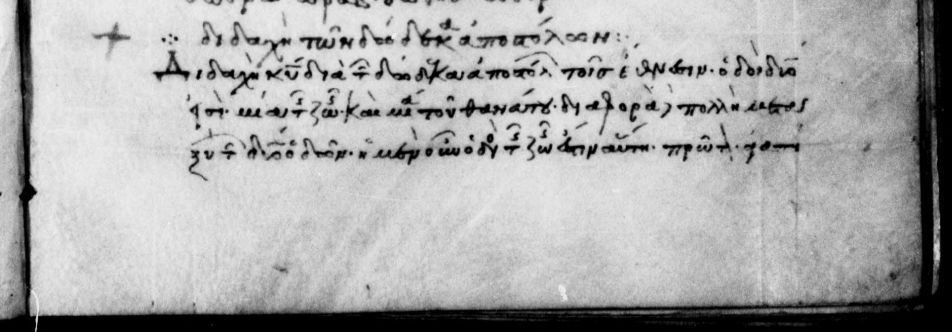
The short title of this work is “The Teaching of the Twelve Apostles”
(Greek: Didache), the fuller title is “The Teaching of the Lord, taught through the twelve Apostles to the Gentiles”. As is now considered in scholarship, this work was not the work of the actual twelve Apostles , and is defined as anonymous, but nevertheless reflects the original Church teaching of the Christian church communities in the East. It is one of the ancient versions of the Christian catechism, or a concise summary of Church teaching.
The history of this work is interesting. It is most likely of Syriac origin and originated at the beginning of the second century. The Didache was very well known in Christian antiquity and is mentioned by Clement of Alexandria, Eusebius of Caesarea, and St. Athanasius the Great. Clement of Alexandria even includes the Didache in the canon of New Testament books, but, starting from the fourth century, Eusebius of Caesarea and St. Athanasius the Great have some doubts about the apostolic authorship of this work, although its moral and instructive value is not diminished, and it is not declared heretical or in some way erroneous.
By the fifth century the Didache had gradually fallen out of ecclesiastical use, the text did not reach the New Age and was lost. It was only in 1873 that the Greek Metropolitan Philotheus Vriennios discovered a copy of the Didache and had it published in 1883.
The structure of this rather short work breaks down into four thematic parts:
- the ethical part, which contains one of the versions - most vivid in its style of presentation - of the Church’s teaching on morality in the ancient Church
- in the form of the doctrine of the two paths - life and death.
-
The liturgical part, which tells us how to pray and worship.
-
the canonical part, which tells of the internal discipline of the Church.
-
The eschatological part as a conclusion.
It is pointed out that the Liturgy was celebrated on Sunday. The Church hierarchy mentioned in the Didache is specific: the four main ranks in the Church are mentioned here: prophets, apostles, bishops and deacons. Note that the presbyters are not mentioned.
It can be seen that the apostles and prophets were not permanent members of Christian communities, but itinerant ministers of the Church. The apostles here are preachers to the Gentiles, and the prophets are also preachers, but most likely to the Christian communities. The prophets had a prophetic ministry proper, giving direct revelations from God, and in addition, along with bishops and deacons, had the right to serve the liturgy, and the text even states explicitly that the prophets are “your high priests”.
The Didache gives a rule for distinguishing true apostles and prophets from false ones - if an apostle remains in the congregation for the third day, he is false, or if he demands money for his ministry, he is also recognized as false. The same applies to prophets. If one, in the midst of prophecy, demands money for himself “in the Spirit”, then he is no longer worthy of listening to.
We can see that in the Christian community, as the Didache draws us, there are also bishops and deacons. It appears that they were elected by the community, were its permanent members, had liturgical, administrative and financial responsibilities, but their activities, compared to those of the prophets and apostles, were limited to the community in which they were located.
The Church in the Didache is called One, Holy, and Sanctified, and its symbol is the Eucharistic bread: “As this broken bread, having been scattered over the hills, and being gathered together made one, so may Thy Church be gathered from the ends of the earth into Thy kingdom.”
3.2 The Epistle of Barnabas
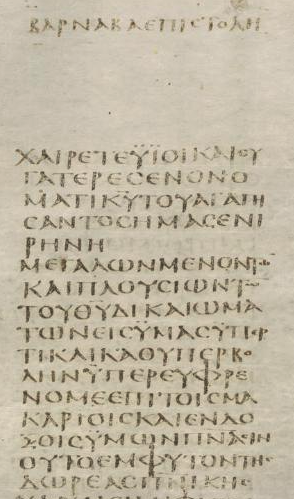
Most likely it was written between the years 115 and 140, the place of writing probably being Alexandria. As in the case of the Shepherd of Hermas, the ancient Church theologians of Alexandria (Clement and Origen) and St. Justin the Philosopher classified this work as a canon of New Testament books. Clement of Alexandria calls Barnabas, the author of the epistle, an Apostle and a prophet. In the Sinai Codex of the fifth century, the Epistle of Barnabas stands after the last Biblical book, the Revelation of John the Theologian. As early as the fourth and fifth centuries, the authorship of the apostle Barnabas began to be questioned, for example, Eusebius ranked it either as forged or as dubious books.
It is also characterized by a peculiar Christian method of interpreting the Scripture, which was later called typology. The main subhect of the epistle is the Incarnation of God, which was prefigured by the Old Testament Law and the Prophets.
Christians have a secret knowledge of the Old Testament, they have the gift of interpretation, and therefore they clearly see that in its main content the Old Testament speaks specifically of Christ, who was to appear in the future and establish the New Covenant with God. In the light of this, the seemingly paradoxical assertion of the epistle that the Old Testament is not essentially the domain of the Jews, but the domain of the Christians, who understand this Christological content, is quite justified.
The paradox of this statement is the obviousness of the fact that it was to the Jewish people that the Old Testament Revelation was given through the Prophets, and the Jewish scribes have kept and interpreted the books of the Old Testament for centuries.
All that was in the Mosaic law of the Old Testament was understood by the Jews in a literalistic, spiritless, and therefore distorted way. For example, they interpreted the commandment of circumcision literally, but some other nations besides the Jews are also circumcised, but the Jews pride themselves on their circumcision as saving. But even the Old Testament prophets spoke of spiritual circumcision, circumcision of the heart, hearing, etc., that is, of moral perfection.
The interpretation of an important Jewish rite of circumcision for Abraham, who circumcised 318 of his servants, is noteworthy. The author says that Abraham had in his mind the mysterious meaning of the three letters (the numbers denoted by the letters, 10 - iota, 8 - eta, - the beginning of the name Jesus, and 300 - the letter tau, which signifies the Cross. All of this together is an indication of Jesus, who was to suffer on the cross.) From this we see that the mystery of the coming incarnation, suffering, and resurrection of Christ was already laid down in the Old Testament.
The author also views the hopes of the Jews for the temple in Jerusalem as futile, especially since the author mentions that the temple had already been destroyed by the time the epistle was written (i.e., after 70 A.D.). But the Divine Scriptures do not speak of the temple as a temple for blood sacrifices, but as a temple of the Spirit, as every Christian is called to be:
“Having received the remission of sins and the hope in the name of the Lord, we are made new, completely newly created; therefore in the habitation of our hearts, God truly dwells in us… He has opened to us, slaves of death, the doors of the temple, that is, the mouth, He has given us repentance and brought us into an incorruptible temple… This is the spiritual temple that the Lord is building!“
3.3 “The Shepherd of Hermas”
This text was known, like the Didache, to many ancient Church authors of the second and third centuries, such as St. Irenaeus of Lyon, Tertullian, Clement of Alexandria, and Origen, who saw in Hermas an inspired prophet, referred to him, and even added him to the canon of Holy Scripture. However, in the fourth century, the attitude somewhat changes : St. Athanasius the Great called this book very useful, especially for the converted, but did not include it in the canonical Scripture, and the Church scholar and historian Eusebius of Caesarea called it fake, even despite his own testimony that it was read in Church: “This book, as we know, was read in churches among all people, and tradition says that the oldest writers used it”.
It is worth noting that, although the work itself was most likely written in Greek, its origins are Roman, a fact which is supported by geographical references, indicating that the events described took place in Rome and its surroundings. Nevertheless, in Italy, and in the West in general, as evidenced by St. Jerome of Stridon in the fourth century, this work gradually falls out of use, and it becomes more widespread in the East.
There has been much speculation as to the authorship of this work. Paul’s Epistle to the Romans (Rom. 16:14) mentions Hermes or Hermas, one of the Seventy Apostles, who is said to have become a bishop of Dalmatia, and Origen is inclined to think that this is the author of the Shepherd. But later scholars have had a number of indications that the authorship was “shifted” from the apostolic era to a somewhat later time, closer to the middle of the second century. In the late 18th century, the Italian researcher Muratori discovered and published a fragment of a corrupted Latin text of the Bible, (in 1740) which contains a list of works accepted as canonical, probably in Rome in the second half of the second century (c. 170). It mentions that “in a recent time in the city of Rome Hermas, brother of Pius the bishop of Rome, wrote a book called The Shepherd,” which suggests that the book was written around 139-156, the years during which Pius I ruled.
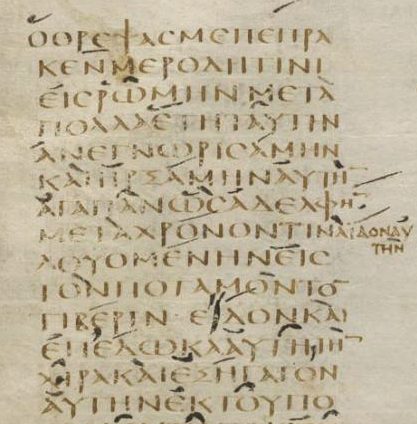
The narrative is told in the first person, on behalf of a certain Hermas, who in his youth was a slave. When, some time later, he was set free and became an entrepreneur, he became rich. He was unhappy in his family life; his wife was of a grumpy nature; his children, whose upbringing he did not supervise, led a dissolute life. Other calamities soon came upon him ; he lost his estate, which had probably been confiscated during the persecution of the Christians, and his children not only denied the Lord, but also betrayed their parents. Hermas, however, patiently endured the misfortunes that befell him. He himself was tilling the field that was left of his property. At that time, he received the gift of prophecy and the revelations that revealed his sins and called for repentance from him, his family, and the Christian community of Rome. He recorded all these revelations in the book The Shepherd, so called because most of the revelations were communicated to Hermas by an Angel, who appeared in the form of a shepherd with a bag on his shoulders and a staff in his hand.
The book is divided into three large parts:
- Visions. In the Visions Hermas appears to the Church in the form of an old woman and calls on Erm and his entire family to repentance. The coming fate of the Church, the coming persecutions are communicated.
-
Commandments. There are in total 12 commandments: 1) about faith in one God; 2) about simple-heartedness in relation to others; 3) about spiritual purity - about love of the truth and the need to avoid falsehood; 4) about bodily purity - about keeping chastity even in thoughts; 5) about abstaining from anger; 6) about the need to obey the suggestions of the good Angel, but not obey the suggestions of the evil one; 7) to fear God, but not fear the devil; 8) to abstain from evil and all kinds of vice, but by no means abstain from doing good; 9) to abstain from doubt (to always ask in prayer with the hope to receive what is asked) and 10) to abstain from discouragement, which clouds the mind of the believer.
-
Similitudes : The “likenesses” or “images” (parables) are vivid and colorful symbolic visions that communicate Christian teaching and the future destiny of the Church and humanity.
The main content of The Shepherd of Hermas is the theme of repentance. It is evident from some of the expressions in this book that the Church was experiencing some moral decline at the time, and that many of its members, having become attached to the riches of this world would prove unprepared for the coming persecution of the Church. Christians must reform their lives according to the Gospel commandments, which are once again reminded here, and then they can have hope of salvation. Repentance is like a second Baptism that washes souls from sins and falls, and it is available to all who will resort to it. God also instituted repentance after Baptism because He knew all the wickedness and guile of the devil against Christians. It is said, however, that repentance is one-time, and the salvation of one who falls into the same sins is in great jeopardy.
The whole penitential discourse of the Shepherd of Hermas is represented by the image of the Church as of a tower being built. The Church, like a tower, is built on the waters (implying the waters of Holy Baptism), and on a huge ancient white stone with a new door in it. This stone is Christ, the Son of God, Who recently (that is, in His Incarnation) opened people’s access to the Father and to salvation. Here it speaks of the various stones being prepared for the building of the tower, that is, the various ranks of those who are saved and those who are lost. In the tower, builders (Angels) put different stones, which fit together perfectly. These are the righteous, martyrs, apostles, bishops and other faithful. Not all of the stones are placed in the Tower that is being built. Some that are flawed are set aside for a time (these are the ones who have enmity in their hearts, round stones mean the rich whose wealth needs to be hewn so that the stones can fit well with the other stones in the building of the Tower). Some roll away from the Tower and signify those who have totally fallen away from God, those who doubt the necessity of receiving Holy Baptism and those who think of finding salvation outside the Church.
- 3.1 « The Teaching of the Twelve Apostles » (Didache)
- 3.2 The Epistle of Barnabas
- 3.3 “The Shepherd of Hermas”
The short title of this work is “The Teaching of the Twelve Apostles”
(Greek: Didache), the fuller title is “The Teaching of the Lord, taught through the twelve Apostles to the Gentiles”. As is now considered in scholarship, this work was not the work of the actual twelve Apostles , and is defined as anonymous, but nevertheless reflects the original Church teaching of the Christian church communities in the East. It is one of the ancient versions of the Christian catechism, or a concise summary of Church teaching.
- The eschatological part as a conclusion.
Liturgico-Canonical Texts
Christian Apocalyptical Texts
Related Concepts
- absaloms-rebellion
- allegory
- apocalyptic
- apostolic-authorship
- ark-procession
- athanasius
- barnabas
- canon-formation
- canonical-discipline
- charismatic-ministry
- christ
- christ-as-foundation
- christological-interpretation
- church-discipline
- church-hierarchy
- church-order
- church-tradition
- crossing-jordan-as-baptism
- davidic-line
- didache
- epistle-of-barnabas
- esther-as-type-of-christ
- eucharistic-ecclesiology
- eusebius
- false-prophets
- haman-as-type-of-satan
- holy-spirit
- indwelling
- itinerant-ministry
- jewish-interpretation
- job-as-type-of-christ
- jude
- judgment
- last-things
- local-clergy
- moral-catechesis
- moral-perfection
- moral-reform
- mordecai-as-type-of-christ
- old-testament-interpretation
- penance
- penitential-discipline
- shepherd-of-hermas
- tears-of-compunction
- typology