Old Testament — Topic 26
SONG OF SOLOMON: «SONG OF SONGS»
Outline
I. Title: Solomon’s Song of Songs (1:1)
II. The First Meeting: Love’s Desire (1:2–2:7)
III. The Second Meeting: Aspiring Courtship (2:8–3:5)
IV. The Third Meeting: Solomon’s Wedding Procession (3:6–5:1)
V. The Fourth Meeting: The Bride’s Search for Her Lover (5:2–6:3)
VI. The Fifth Meeting: Union of Spouses (6:4–8:4)
VII. Strength of Devoted Love (8:5–7)
VIII. The Conclusion (8:8–14)
Introduction: The Key to Reading the Song
The Song of Songs (Hebrew: Shir HaShirim) stands as a unique book within the Biblical canon. On its literal level, it is a beautiful and poetic celebration of human love between a bride (often identified as the Shulamite) and her bridegroom (King Solomon). It extols the virtues of committed, passionate, and virtuous love within marriage.
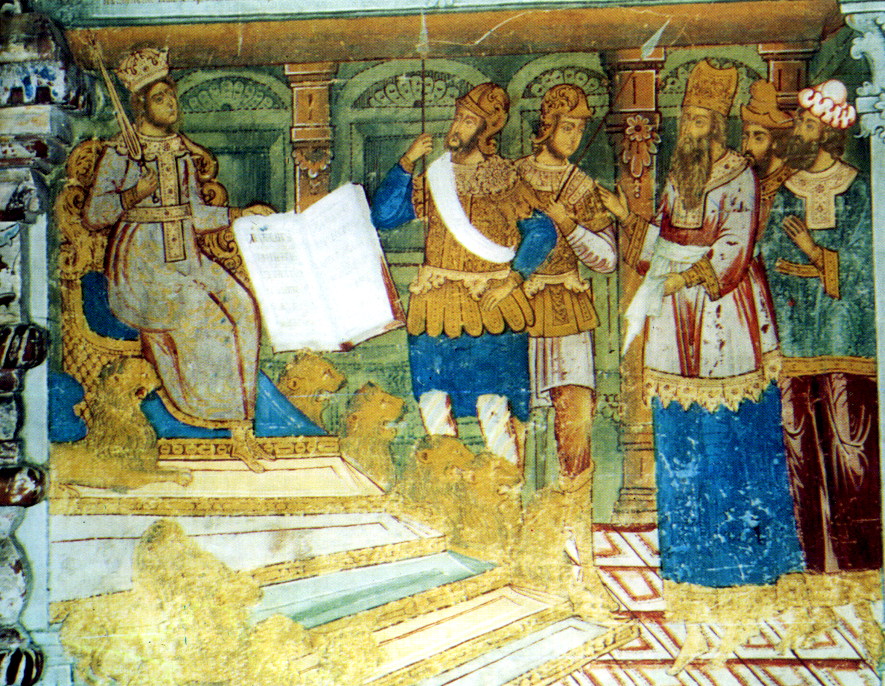
King Solomon. Fresco of the Church of the Resurrection, Romanov- Borisoglebsk. 1679-1680
The peculiarity of this book is that, unlike the rest of the books of Holy Scripture, not one of the Names of God is ever used here – the Lord, the Almighty, the Most High, the Creator – there are no prayers addressed to God, nor the blessings of the Almighty. Nevertheless, on the pages of this Solomon poem, the most sublime and mysterious name of God sounds – “Beloved.” In the first verse of the fifth chapter of the book of Isaiah, the Lord is called the Beloved: “Now let me sing to my Well-beloved a song of my Beloved regarding His vineyard” (Isaiah 5:1). The New Testament says that God is Love, which is the highest of all Divine Names, and prophetically anticipating this gospel truth of the Christian faith, the Lord is called Beloved in the Song of Songs – God is an Omnipotent and Transcendent Person, He is absolutely Free and Righteous, All–Good and Wise, and perfect and incomprehensible love is the image of His Divine being.
The Holy Fathers and the liturgical tradition of the Orthodox Church, say that the literal meaning, while good and God-given, is the starting point , not the destination. The book is understood as divine allegory and typology. The passionate love it describes is the God-intended symbol (typos) of a deeper, ultimate reality: the love between Christ (the Divine Bridegroom) and His Church (the Bride) , and by extension, the love between God and the individual soul. St. Gregory of Nyssa says that the Song of Songs is the Holy of Holies of the Old Testament canon.
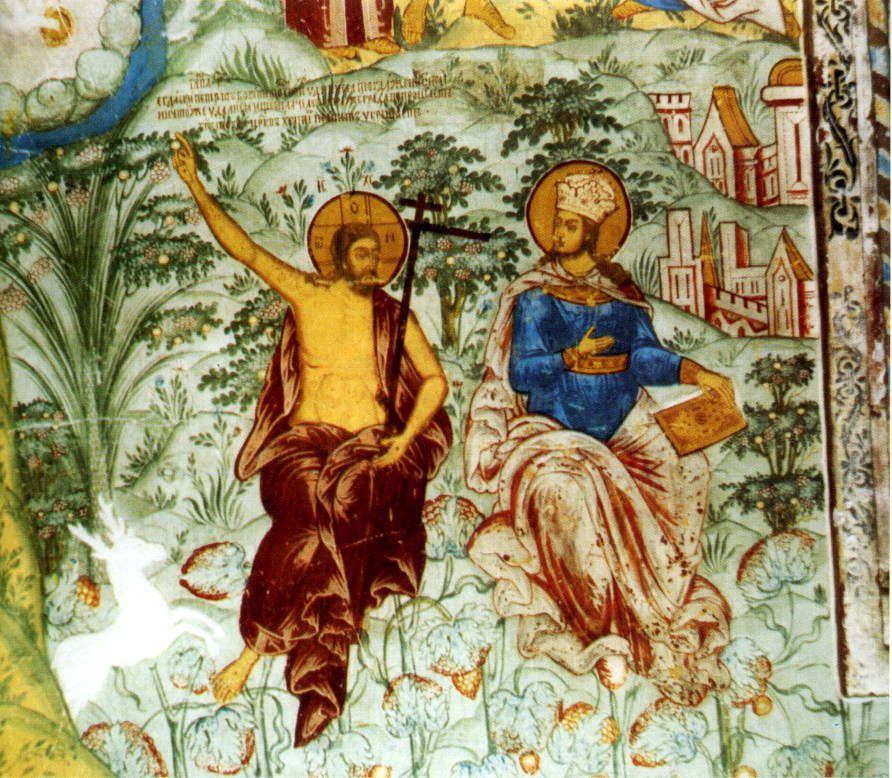
Fresco of the Church of the Resurrection, Romanov-Borisoglebsk. 1679-1680. The _Union of Christ and the Church. _With His right hand raised high, Christ points to a Dove descending on the Bride in a heavenly cloud of light; this is the Holy Spirit with Whom the Lord baptized and sanctified the Church for Himself.
The Christian Church’s interpretation of the Song as evidence of God’s love for his people, both collectively and individually, began with Origen. Saint Gregory of Nyssa wrote fifteen Homilies on the Song of Songs, which are considered the pinnacle of his biblical exegesis. In them, he compares the bride to the soul and the invisible groom to God: the finite soul is incessantly reaching out towards the infinite God and remains continually disappointed in this life due to the failure to achieve ecstatic union with the beloved, a vision which enraptures and can be achieved fully and perfectly only in life after death. Similarly, following the allegorical interpretation of Ambrose of Milan, Saint Augustine of Hippo stated that the Song of Songs represents the wedding between Jesus Christ and the Church, pure and virgin, within an ascetic context. However, going against the prevailing opinion, Theodore of Mopsuestia, influenced by the School of Antioch, interpreted the Song of Songs literally, understanding it as simply a love poem written by Solomon to the daughter of Pharaoh. But, since the allegorical view was so predominant, his interpretation was condemned at the V Ecumenical Council (553). As a result, his writings on this book were lost, and only his literalist position is known, which would later (from the 18th century onwards) become predominant among biblical scholars. So, we can conclude, that the “Song of Songs” cannot be taken literally. This is not a story about the love of a man and a woman. This was decided at the Fifth Ecumenical Council - the literal understanding of it is forbidden. The meaning of the Song of Songs is exclusively symbolic.
Due to the large number of metaphors from love lyrics that could be interpreted literally, in some Jewish communities there was a ban on reading the “Song of Songs” before the age of thirty. And because of the free and explicit translation of the book into Arabic at the end of the 19th century, the book was banned from distribution in Baghdad.
The allegorical interpretive approach is not a negation of the text’s beauty but its fulfillment and sanctification. As St. Paul states, marriage is a “great mystery” because it refers to “Christ and the Church” (Ephesians 5:32). The Song of Songs is the poetic unpacking of that mystery.
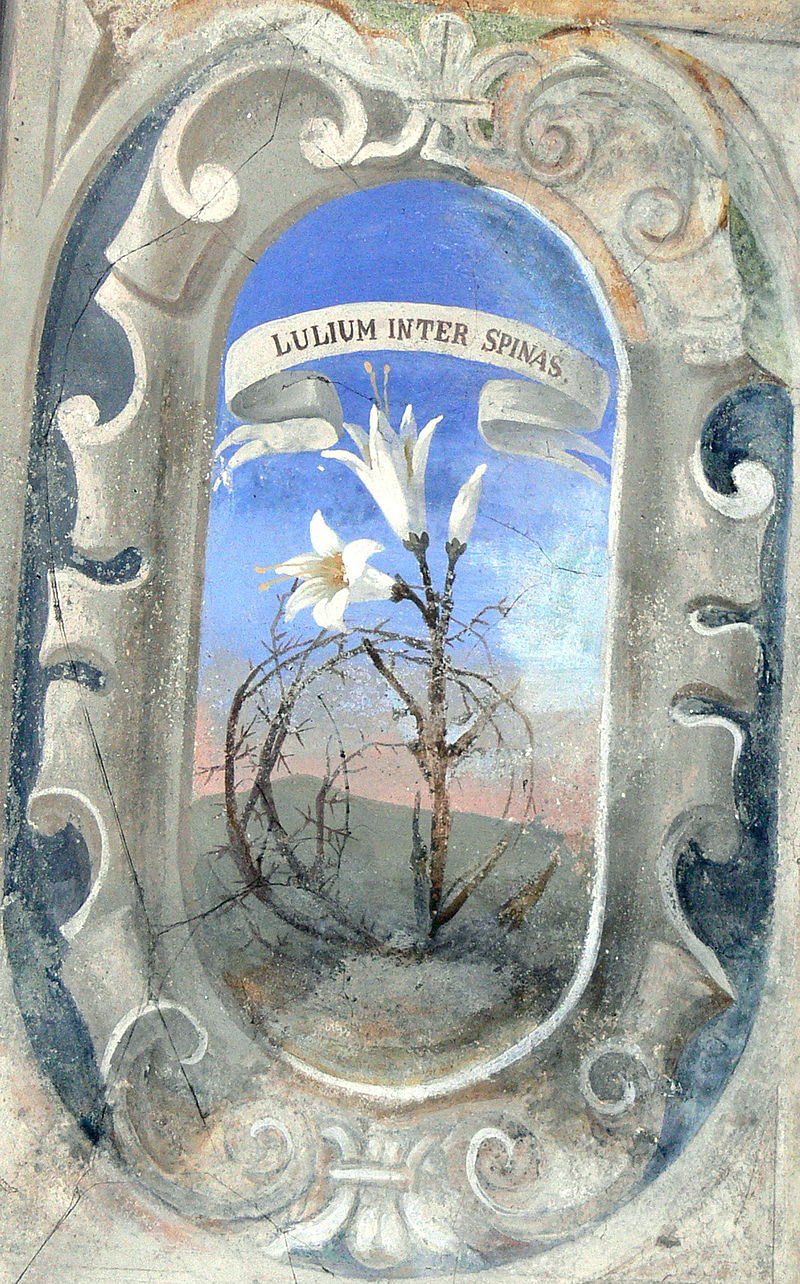
Fresco from the hermitage of Santa Caterina del Sasso (Varese, Italy). It depicts a lily among thorns, according to a quote from the Song of Solomon (2:2)
The Song of Songs awakens longing for God in the human heart, revives in him the search for Divine Love and incorruptible beauty. The essence of religious life is faith in God and love for Him, the search for God and prayerful standing before Him. Our soul is a royal daughter and beloved bride of the Most High, the highest goal of her existence is eternal Communion with God, without which she is unhappy, her hopes are in vain, and life is meaningless. So, the Song of Songs is a mysterious book of the Old Testament, the Holy of Holies of our faith, the most precious treasure of biblical wisdom, a poem about the love between God and the soul, Christ and the Church – an undying and ineffable love.
I. Title: Solomon’s Song of Songs (1:1)
- Literal level:
The title ascribes authorship to Solomon, the son of David, known for his wisdom, wealth, and many marriages (1 Kings 4:32). “Song of Songs” is a Hebrew superlative, meaning “The Most Excellent Song”, just as the “Holy of Holies” (Heb 9:3) means the holiest of all places. The author is Solomon, whose name means “Peace.” This is significant because the greatest song belongs to One Who Himself is the “Prince of Peace” (Is 9:6). Thus, Solomon is a type of the King of Peace, Christ, throughout this allegory. Christ Himself is portrayed by the Bridegroom (Is 62:5), and the song is that of the marriage of the Lamb (Rev 19:7–9).
-
Orthodox Synthesis (Allegorical/Christological):
-
Solomon as a Type of Christ: The peaceful and wise King Solomon, the son of David, is a classic typos of Christ, the ultimate Son of David, the Prince of Peace, and the incarnate Wisdom of God (Sophia). The Song is ultimately His song, sung to His Bride.
-
The Church’s Song: It is also the song of the Church, inspired by the Holy Spirit, about her beloved Bridegroom. It is “of Songs” because it speaks of the highest and most perfect form of love— agape —divine love made manifest.
-
II. The First Meeting: Love’s Desire (1:2–2:7)
-
Literal level: The bride expresses intense longing for her bridegroom’s kisses and love. She feels dark from working in the sun but beautiful. They exchange words of admiration.
-
Orthodox Synthesis:
- The Soul’s Longing for God: The Bride’s initial cry, “Let him kiss me with the kisses of his mouth!” (1:2), is understood as the soul’s deepest desire for intimate communion with God through His Word (Christ) and the gifts of the Holy Spirit. The “kiss” symbolizes the sharing of spirit and life.
According to an ecclesiological understanding here the Holy Church, long awaiting the Lord’s coming, proclaims here her desire for intimacy with God. “The more abundantly she is filled up with His beauty, the more vehemently her longings abound” (Gregory of Nyssa). The Lord sent angels, patriarchs, and prophets to Israel, all of whom brought spiritual gifts, but far better than the gifts or their bearers is the Giver Himself. The Bride seeks these heralds no longer, but the presence of her true Love Himself, the Son of God in His Incarnation.
* **"I am dark but lovely" (1:5):** The soul acknowledges its own sinfulness and damage from the "sun" of worldly passions and tribulations ("my mother's sons were angry with me"). Yet, it is "lovely" because it is created in God's image and has a fundamental orientation toward Him. This is the state of the penitent soul.

* **"My beloved is to me a sachet of myrrh..." (1:13):** Myrrh is used for anointing and burial. The Fathers see this as a profound reference to Christ's death. The Bride (the Church/soul) holds the mystery of the Cross close to her heart, finding sweetness and redemption in it.

* **"I am the rose of Sharon..." (2:1):** Christ speaks of His own humility and beauty in His Incarnation. He is the flower that bloomed from the root of Jesse in the field of the world.

* **"His banner over me was love" (2:4):** The banner is the Cross, under which the faithful are gathered and protected. The word for "love" here is  _agape_ , divine, self-sacrificial love.
III. The Second Meeting: Aspiring Courtship (2:8–3:5)
-
Literal level: The bridegroom comes leaping over the mountains, beckoning the bride to come away. The bride searches for him at night but cannot find him.
-
Orthodox Synthesis:
-
The Incarnation and Second Coming: “The voice of my beloved! Behold, he comes leaping upon the mountains, skipping upon the hills.” (2:8). The mountains represent the prophets and saints who foretold and prepared for His coming. This is seen as a prophecy of Christ’s Incarnation, His resurrection (“leaping”), and His eventual Second Coming.
-
“Arise, my love, my fair one, and come away” (2:10): This is the call to the spiritual life, to ascesis. It is a call to leave the winter of sin and passions and enter the springtime of grace and renewal.
-
“Catch us the foxes… that ruin the vineyards” (2:15): The “little foxes” are the small, subtle passions and thoughts (logismoi) that can destroy the soul’s growth (the vineyard) before it can bear fruit. Spiritual vigilance is required.
-
The Nocturnal Search (3:1-4): The soul’s anxious search for Christ when He is absent—a common experience in the spiritual life known as acedia or spiritual dryness. The soul must persevere through this “night” (“I will rise now…”, 3:2) and seek Him through prayer and the “watchmen” (the saints, the clergy, the guidance of the Church). Finding Him, she “will not let him go”—a symbol of clinging to prayer until grace returns.
-
IV. The Third Meeting: Solomon’s Wedding Procession (3:6–5:1)
-
Literal level: A lavish description of King Solomon’s wedding procession on the day of his wedding. The bridegroom praises the bride’s beauty from head to toe.
-
Orthodox Synthesis:
-
The Ascension and Heavenly Liturgy: Solomon’s procession (“Who is this coming up from the wilderness, Like pillars of smoke…?” 3:6) is seen as Christ’s glorious Ascension into heaven, having conquered the “wilderness” of death and Hades. The “pillars of smoke” signify the prayers of the saints and the incense of the heavenly liturgy.
-
The Praise of the Bride (4:1-15): This is Christ’s loving description of His pure and spotless Church, adorned with the virtues of the saints.
-
“Your eyes are doves” (4:1): Symbolizing the purity and simplicity of faith.
-
“Your lips are like a strand of scarlet” (4:3): Confessing the faith, even to the point of martyrdom (scarlet=blood).
-
“Your neck is like the tower of David” (4:4): Symbolizing strength and obedience, refusing to bow to idolatry.
-
“A garden enclosed is my sister, my spouse” (4:12): The Church and the soul are a protected paradise, filled with the fruits of the Spirit (“all the chief spices,” 4:14), reserved for God alone.
-
-
The Eucharistic Invitation (5:1): “Eat, O friends! Drink, yes, drink deeply, O beloved ones!” This is the climax of the heavenly wedding feast: the Holy Eucharist. Christ invites the faithful (“friends”) to partake deeply of His Body and Blood. The Church responds with the joy of communion.
-
V. The Fourth Meeting: The Bride’s Search for Her Lover (5:2–6:3)
-
Literal level: The bridegroom knocks, but the bride is slow to answer. When she opens the door, he is gone. She searches for him and is wounded by the watchmen.
-
Orthodox Synthesis (Ascetical): This is one of the most profound passages for the individual soul’s struggle.
-
“I sleep, but my heart is awake” (5:2): This verse is a cornerstone of Hesychast spirituality and offers a profound insight into the state of the praying soul (see an elaboration in the end of the lesson).
-
The Knock at the Door: “It is the voice of my beloved! He knocks…” This is the call of God through conscience, a Scripture reading, or the words of a spiritual father. It is a call to repent and open the door of the heart.
-
The Bridegroom knocks at the door of the heart when He says, “Behold, I stand at the door and knock. If anyone hears My voice and opens the door, I will come in to him and dine with him, and he with Me” (Rev 3:20). Although omnipotent, like a gentle and unyielding lover the Lord enters only when invited. “If they open to Him, He enters in, but if they delay and will not, He departs from them” (Athanasius the Great).
* **The Slothful Response (5:3):**  _"I have taken off my robe; how can I put it on again?"_ The soul makes excuses, clinging to the comfort of its passions.

* **The Withdrawal of Grace (5:6):** The delayed response leads to a sense of God's absence (_"I opened for my beloved, But my beloved had turned away and was gone."_). This is a pedagogical experience to awaken the soul to what it has lost.

* **The Charge to the Daughters of Jerusalem (5:8-16):** The wounded soul now fervently preaches to the "daughters" (weaker souls or the unillumined) about the beauty of the Bridegroom, describing Him from head to toe—a profound exercise of testimony and memory. This is the soul's  _apologia_ for its faith.

* **"My beloved has gone to his garden" (6:2):** The soul realizes that Christ is always present within His Church, tending to the gardens of faithful souls. To find Him, one must go to where He is—in prayer, the sacraments, and the community of faith.
VI. The Fifth Meeting: Union of Spouses (6:4–8:4)
-
Literal level: The bridegroom returns and praises the bride’s unique beauty. The bride expresses her desire for permanent union.
-
Orthodox Synthesis:
-
“You are beautiful as Tirzah… terrible as an army with banners” (6:4): Christ praises the Church, both in her divine beauty (“Tirzah” means “she is my delight”) and her spiritual power in battling evil. The Church is both Bride and Warrior.
-
“There are sixty queens… but my dove, my perfect one, is unique” (6:8-9): Among many peoples and nations (the “queens” and “concubines”), the Church, the New Israel, is the one unique Bride chosen by God. The “daughters” and “queens” praise her (6:9), meaning the angels and saints rejoice in the Church’s glory.
-
The Return from the Wilderness (7:5, 8:5): “Who is this who comes up from the wilderness, Leaning upon her beloved?” This is the soul, having passed through the trials and purification of the spiritual life (the wilderness), now intimately united with and fully supported by Christ. It is an image of theosis in progress, of a soul attaining holy humility and dependence on God.
-
VII. Strength of Devoted Love (8:5–7)
-
Literal level: A powerful poetic declaration that love is as strong as death and that many waters cannot quench it.
-
Orthodox Synthesis:
-
“Set me as a seal upon your heart…” (8:6): This is the prayer of the Church and every Christian. The “seal” is the seal of the Holy Spirit received in Chrismation , marking us as Christ’s own. It is a seal against the passions and the evil one.
-
“For love is as strong as death” (8:6): This finds its ultimate meaning in Christ’s love. His love was stronger than death, conquering Hades and destroying its power. The love (agape) between Christ and His Church is the unquenchable flame of divine life.
-
“Many waters cannot quench love” (8:7): The “many waters” are the floods of persecution, heresy, sin, and tribulation. Throughout history, nothing has been able to extinguish the Church, the object of Christ’s love. This is a prophecy of the Church’s indefectibility.
-
VIII. The Conclusion (8:8–14)
-
Literal level: The brothers discuss the bride’s youth, and the bride affirms her own purity. The final words are an invitation for the beloved to come.
-
Orthodox Synthesis:
-
The Little Sister (8:8-10): The “little sister” who has no breasts represents the nascent Church, or the newly illumined soul, which must be guarded and nurtured (“we will build a battlement of silver”) until it is mature and ready for Christ (“then if she is a wall…”).
-
The Bride’s Maturity (8:10): “I am a wall, And my breasts like towers; Then I became in his eyes As one who found peace.” The mature Church/soul is strong in faith (“a wall”), abundant in nurturing love and wisdom (“breasts like towers”), and has found shalom —wholeness and peace—in communion with God.
-
Solomon’s Vineyard (8:11-12): Solomon (a type of the world or the Old Covenant) had a vineyard that yielded fruit for its keepers. But the Bride’s vineyard (herself, the Church) is her own to give; she gives its fruit to her Beloved alone. The Church’s treasures of grace are for Christ, not for the world.
-
The Final Invitation (8:13-14): The book ends not with closure, but with an open-ended, eschatological yearning.
-
“You who dwell in the gardens, The companions listen for your voice—Let me hear it!” (8:13): Christ, dwelling in the gardens of the saints, is asked to speak to us through them.
-
“Make haste, my beloved, And be like a gazelle… Upon the mountains of spices.” (8:14): This is the final prayer of the Church: “Come, Lord Jesus!” (Revelation 22:20). It is a prayer for His swift return in glory, leaping upon the mountains of the saints (the “mountains of spices”), to consummate the marriage feast of the Lamb for all eternity.
-
-
The Mariological Interpretation
While the primary allegory is Christ and the Church, the Church Fathers also saw in the figure of the pure, beautiful, and obedient Bride a profound type of the Most Holy Theotokos. She is the perfect embodiment of the Church, the ultimate “Daughter of Zion.” Every praise of the Bride’s beauty and purity is applied superlatively to Her who contained the Uncontainable God. She is the “enclosed garden” and “sealed fountain” (4:12) par excellence. Her Fiat (“Let it be to me according to your word”) is the ultimate response of the Bride to the Divine Bridegroom, making Her the model for every Christian soul.
The Theotokos as the “Bed of Solomon” (Songs 3:7-10)
The Holy Fathers, most notably St. Gregory of Nyssa and St. Ambrose of Milan applied the image directly to the Most Holy Theotokos.
She is the “Palanquin” or “Bed of Solomon” because She is the one Who carried the Divine King, Jesus Christ, within Her most pure womb. This interpretation sees the passage as a specific prophecy of the Incarnation.
- “Behold, the bed of Solomon!”: “Behold” signals a moment of awe and revelation. The “bed” is no longer a thing, but a person: the Virgin Mary. She is the living, human “palanquin” Who bore the King of Kings. Solomon’s bed was made of precious woods and metals; the living bed of the true Solomon was a human being, the most-pure Virgin.
- “King Solomon made himself a palanquin…”: This is understood as a reference to the divine initiative in the Incarnation. Christ, the true Solomon, “prepared for Himself a body” (Hebrews 10:5) within the womb of the Virgin. He fashioned for Himself this most-holy vessel through Her purity and obedience, which was itself a gift of His grace.
- The Guard of Sixty Mighty Men: This is interpreted as the angelic host protecting the mystery of the Incarnation and the unique Woman Who was to bear God.
- The Archangel Gabriel is the chief messenger (Luke 1:26-38).
- An angelic host appears to the shepherds to announce the birth (Luke 2:13-14).
- An angel protects the Christ Child and His Mother by warning Joseph to flee to Egypt (Matthew 2:13). The “fear in the night” is the constant threat of the enemy (Herod, the devil) who sought to destroy the Christ Child.
- The Precious Materials:
- Trees of Lebanon: The humanity of Christ, taken from the “wood” of the Virgin’s lineage (the House of David). It also subtly prefigures the wood of the Cross, the purpose for which He was born.
- Pillars of Silver: Silver symbolizes purity. The Theotokos is the Ever-Virgin, pure before, during, and after childbirth. She is the “unblemished treasury of virginity.”
- Back of Gold: Gold symbolizes divinity. This signifies that the One She carried was God Himself. Her womb became more spacious than the heavens for it contained the Uncontainable God.
- “Its interior a mosaic of love”: The interior life of the Theotokos—Her soul, Her heart, Her will—was utterly adorned and permeated with divine love (agape) and humility. Her response to God’s call was, “Let it be to me according to your word” (Luke 1:38), the ultimate expression of loving obedience. The “daughters of Jerusalem” can be seen as the righteous women of the Old Covenant (like Anna, Hannah, Sarah) whose faith and longing for the Messiah prefigured and, in a sense, “prepared” the love that would find its fulfillment in her.
Liturgical Expression:
This theology is not abstract; it is sung and celebrated in the Church’s worship. For example, in the Akathist Hymn, a profound poem sung especially during Great Lent, we find direct echoes:
“Rejoice, vessel of the wisdom of God; Rejoice, treasury of His providence. Rejoice, You Who prove philosophers fools; Rejoice, You Who prove logicians illogical… Rejoice, for You are the throne of the King. Rejoice, for You carry Him, Who carries all. ”
Here, She is the “vessel” and the One Who “carried the Carrier of all,” a direct parallel to being the “Palanquin of Solomon.”
****Elaboration on “I sleep, but my heart is awake” (Song 5:2) in
Hesychast Understanding****
The Text (Song of Songs 5:2):
“I sleep, but my heart is awake. It is the voice of my beloved! He knocks, saying, ‘Open for me, my sister, my love, my dove, my perfect one; For my head is covered with dew, My locks with the drops of the night.’”
1. Literal Understanding:
In the narrative of the Song, the Bride is in a state of repose, perhaps already retired for the night. She is asleep, yet her heart—the seat of her love and longing—is so alert and attentive to her Beloved that it perceives his approach and his knock at the door before she is fully roused to action. It is a state between sleep and wakefulness, where the subconscious desire for her lover keeps a part of her vigilant.
2. Hesychast Synthesis: The Paradox of Spiritual Prayer
For the Church Fathers and the masters of the Hesychast tradition, this verse is a perfect description of the state of the soul engaged in deep, interior prayer, particularly the Jesus Prayer (“Lord Jesus Christ, Son of God, have mercy on me, a sinner”).
The phrase encapsulates the core paradox of the spiritual life: a state of serene rest that is simultaneously a state of intense alertness.
-
“I sleep…” (ἐγὼ καθεύδω / ego katheudō):
-
This “sleep” is not the sleep of negligence or spiritual sloth (which is condemned elsewhere in Scripture). Instead, it signifies:
- The stillness of the passions (apatheia): The soul is at rest from the chaotic impulses of anger, lust, envy, and fear. The noisy demands of the ego and the senses have been quieted.
- The sleep of the faculties: The intellect (nous) is no longer engaged in its typical, discursive activity—analyzing, fantasizing, planning, or remembering. It has “fallen asleep” to the distracting chatter of the world and the self.
- Humble self-forgetfulness: The practitioner has ceased striving by their own willpower and has entered a state of receptive quiet, a ” Sabbath rest” for the soul (Hebrews 4:9-10).
-
“…but my heart is awake.” (ἡ δὲ καρδία μου ἀγρυπνεῖ / he de kardia mou agrypnei):
While the outer faculties are at rest, the core of the human person—the heart (kardia)—is supremely alert and active. In the Biblical and Patristic worldview, the heart is not merely the seat of emotions but the deep spiritual center of the human being, the place where the intellect (nous) is meant to dwell and where communion with God occurs. This wakefulness of the heart signifies:- Attentiveness (prosoche): A continuous, gentle attention held in the depths of the heart, focused on God’s presence.
- The Activity of the Holy Spirit: The heart is “awake” because prayer is now being prayed within it by the Holy Spirit (Romans 8:26). It is a state of grace-filled alertness to the divine.
- The Guard of the Mind: The heart stands watch like a sentry, guarding against the “drops of the night”—the subtle, intrusive thoughts (logismoi) that seek to disrupt prayer.
This state—outer stillness and inner, luminous wakefulness—is the very definition of hesychia (ἡσυχία), the divine quietude sought by the Hesychast.
3. The Practice of Unceasing Prayer
The Jesus Prayer is the practical tool given to achieve this state. The goal is to internalize the prayer so deeply that it moves from the lips to the intellect, and finally descends into the heart, where it becomes self- activating—“unceasing” (1 Thessalonians 5:17).
- The process begins with vocal prayer (the lips).
- Through repetition and ascetical struggle, it becomes mental prayer (the intellect).
- By the grace of God and through purification, it descends into prayer of the heart.
- At this stage, a person can be outwardly engaged in tasks (“I sleep”—the intellect is quiet) while inwardly the prayer continues effortlessly in the heart (“my heart is awake”), maintaining a constant, living connection to Christ the Beloved.
The Beloved’s Knock: In this state of hesychast prayer, the “knock” of the Beloved is not a one-time event but a continual reality. It is the gentle, persistent call of Christ through:
- The Memory of God: A constant, subtle awareness of His presence.
- The Inspiration of the Holy Spirit: Promptings to deeper love, repentance, or compassion.
- The Jesus Prayer Itself: Each invocation is both our call to Him and His knock upon the door of our heart.
4. Patristic Commentary
The Church Fathers saw this verse as a master key to understanding contemplative prayer.
- St. Gregory of Nyssa (4th century): In his Homilies on the Song of Songs , he explains that “sleep” represents the withdrawal of the soul from the illusion of sensory phenomena. The “awake heart” is the soul’s faculty of spiritual perception becoming more active and luminous as it turns away from the world. He writes:
“The sleep of the spouses is a withdrawal from all worldly things… It is a waking sleep and a sleeping wakefulness. The soul is asleep to sin and the illusions of the world but is awake to the truth and to God.”
- St. Hesychios the Priest (8th-9th century): In his text On Watchfulness and Holiness , a central manual of Hesychasm, he uses this verse to define the very practice of watchfulness (nepsis):
“Watchfulness is a spiritual method which, if sedulously practiced over a long
period, completely frees us with God’s help from passion-ridden thoughts,
words and evil deeds. It leads, in so far as this is possible, to a sure
knowledge of the invisible God… The watchful heart says: I sleep, but my
heart is awake (Song 5:2).”
He further states that the Jesus Prayer, “held in the heart,” is the means by
which the heart is kept ever-awake.
- St. Theophan the Recluse (19th century): A modern Russian master of the inner life, he succinctly captures the essence for the contemporary world:
“The essential thing is to stand with the mind in the heart before God, and to go on standing before Him unceasingly day and night, until the end of life.” This is the practical application of “my heart is awake.”
Conclusion for the Spiritual Life
“I sleep, but my heart is awake” describes the pinnacle of the Orthodox practice of prayer. It is the state where human effort synergizes with divine grace. The ascetic “sleeps”—having struggled to still the passions and quiet the mind—so that the “heart” can be “awake”—fully alive and attentive to the ever-present, ever-knocking Beloved, Jesus Christ.
This verse assures the believer that the goal of the spiritual life is not a tense, anxious vigilance, but a peaceful, restful alertness—a heart so filled with the Name of Jesus that it prays without ceasing, perpetually listening for and responding to the knock of the One who stands at the door and desires to enter (Revelation 3:20).
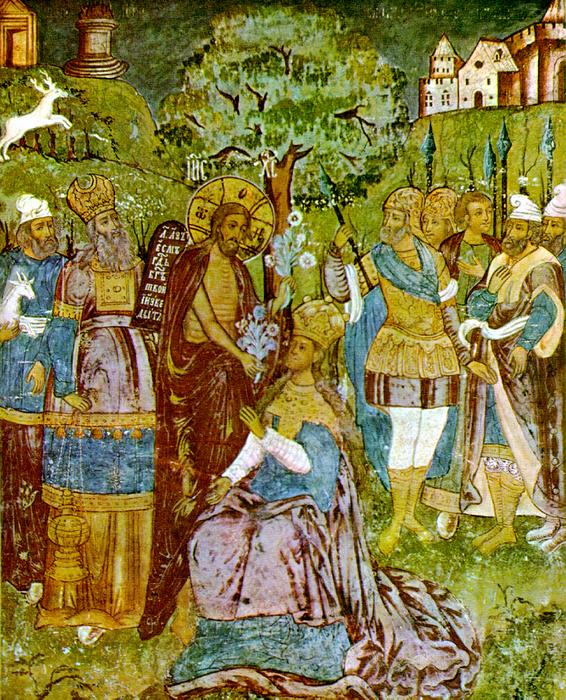
**
**
_Fresco of the northern porch of the Church of Elijah the Prophet.
Yaroslavl. 1715-1716. The fresco introduces us to the contemplation of the mysterious union of Christ and the Church, God and the human soul. The bride stretched out her hand for the flowers, accepting the heavenly beauty of the gifts of the Holy Spirit from the hand of Christ. Christ and the Bride are not alone. The watchmen are angels. Their leader is Archangel Michael. The nobles, the mighty men before God, are the righteous of the OT, who waited for Christ. The apple tree in the background is the tree of the Life-giving Cross_
GENERAL CONCLUSION: The Song of Songs is the mystical heart of the
Old Testament. It reveals that the deepest desires of human love are a sacred pointer to humanity’s ultimate destiny: nuptial union with God. It is a map of the soul’s journey from longing and struggle to purification and joyful communion. It is not merely a book to be studied, but a prayer to be lived, drawing us into the divine and everlasting love between Christ, our Bridegroom, and His spotless Bride, the Church.
-
26.1 The Song of Songs: True Love in a Dark World (An Orthodox Theological Synthesis)
-
True Love in a Dark World
-
True Love in a Dark World
Related Concepts
- adoption-as-sons
- agape
- annunciation
- anointing
- apatheia
- archangel-gabriel
- ascension
- ascesis
- athanasius
- attention
- body-of-christ
- bride-of-christ
- choice
- christification
- christological-interpretation
- christs-victory
- church-as-bride
- communion
- communion-with-god
- conquest
- cross
- divine-human-cooperation
- divine-inspiration
- divine-names
- enclosed-garden
- ever-virginity
- fiat
- freedom
- glorification
- glory
- good-works
- gregory-of-nyssa
- healing
- heart
- heavenly-worship
- hesychia
- hesychios-the-priest
- historicity-of-revelation
- holy-communion
- holy-humility
- holy-spirit
- hope
- house-of-david
- human-responsibility
- incarnation
- incense
- indefectibility
- isaiah-51
- john-114
- logismoi
- macarius
- mariological-interpretation
- marriage-of-the-lamb
- maturity
- moral-effort
- nepsis
- new-israel
- nocturnal-search
- nuptial-mysticism
- nuptial-response
- nuptial-union
- obedience
- obedience-of-faith
- on-the-incarnation
- only-begotten-son
- origen
- peace
- persecution
- perseverance
- personhood
- prince-of-peace
- psychosomatic-method
- resurrection
- revelation
- revelation-2220
- romans-826
- salvation
- seal
- second-coming
- shalom
- son-of-david
- song-86
- sophia
- st-gregory-palamas
- st-theophan-the-recluse
- synergy
- theophan-the-recluse
- theosis
- union-with-god
- watchfulness
- watchmen