Old Testament — Topic 12
The title “Deuteronomy” (Greek: δευτερονόμιον, “deuteronomy”, Deut 17:18) means “repeated law”: the main part of the book repeats and supplements the laws and regulations given in other books of the Pentateuch (Exodus, Numbers, Leviticus) . The book of Deuteronomy takes place in the 40th year after the Jews left Egypt, just before entering the Promised Land. The Prophet Moses addresses a new generation of Israelis, reminds them of the history of the people and the commandments given by God at Horeb (Mount Sinai), while adding new commandments. The book is based on four speeches of Moses, delivered by him across the Jordan on the eve of his death, but the book received its final literary revision, probably, at a later time. Deuteronomy differs from the other four books of the Pentateuch in its sublime preaching style; the imagery and language of Deuteronomy were perceived and developed by the prophets of the VII–VI centuries BC. The historical books following him in the Bible are close to Deuteronomy: Joshua, Judges and 1-4 Kings.
Structure.
The Book of Deuteronomy consists of four speeches (sermons) of Moses:
I speech contains an overview of the history of Israel’s journey from Sinai to Canaan (1:1-4:43).
II speech is the legislative core of the book. It includes the Decalogue, other important commandments, laws on worship and holidays, as well as civil statutes (4:44-26:19).
III speech gives the ritual of renewal of the Covenant, which should have been performed in Shechem after the conquest of the promised land (27:1-30:20). The climax of the passage is the 28th chapter, which contains blessings and curses. This part ends with a call to keep the Covenant. The Prophet stresses the need for obedience after they have settled in Israel.
IV speech includes the last instructions of Moses, his song and blessings, as well as a narrative of his death (31:1-34:12)
Basic content
God’s love for His people. People’s love for God and for the neighbour
The book of Deuteronomy, like no other book, focuses on the topic of God’s Covenant with people. The Covenant is based not on the merits of the Israelites, but on the good will of God: “Not because you were more numerous than all the nations, the Lord received you and chose you … but because the Lord loves you…” (Deut 7:7-8). Having loved this people and made a covenant with them, God became the Father of Israel, its Parent and Protector. Therefore, the very first and main commandment sounds like this — “Listen, Israel, the Lord our God, the Lord is one, and love the Lord your God with all your heart, and with all your soul and with all your strength” (Deut 6:4). Deuteronomy prescribes to have this commandment “before the eyes” on the forehead and on the hand (Deut 6:8) — this means that people in all their actions and thoughts should be guided by the Law of the Lord.
During prayer, many Israelis tied boxes on their foreheads and on their right hands, in which small scrolls with fragments from the Law were kept (Heb. “tefilin”, Greek. “phylacteries”). To remind them of the commandments, God commanded the Israelites to make tassels on the four edges of their clothes and insert threads of blue wool into them (Num. 15:38-40 — Heb. “tzitzit”). We can assume, that these tassels were also worn by Jesus Christ Himself (in Luke 8:44 it is said that a woman suffering from bleeding touched them). Compare also Mt 23:5 translated as: “the borders of garments”.
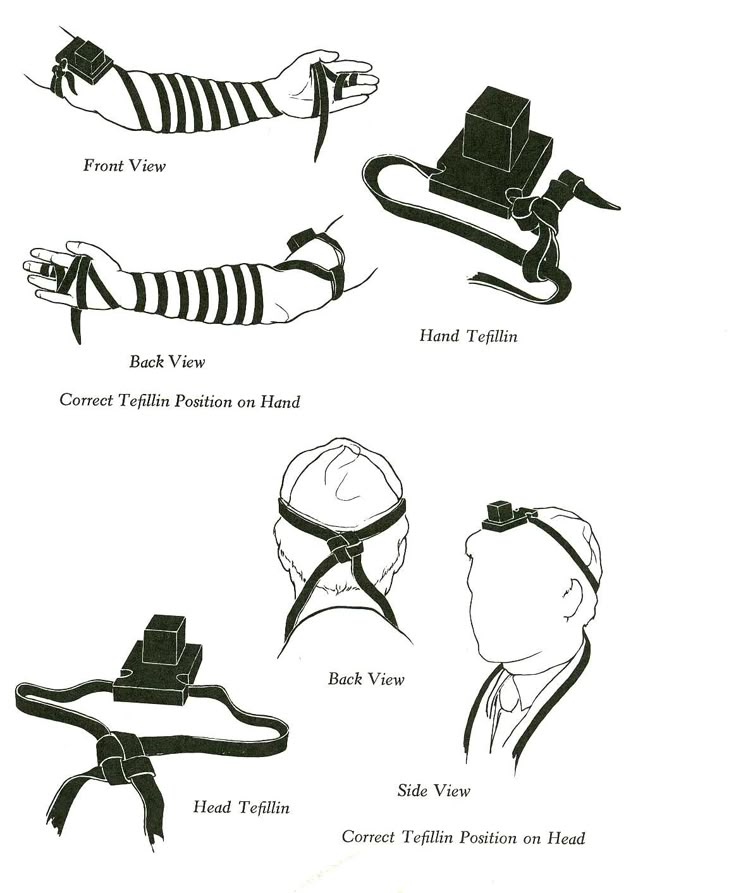
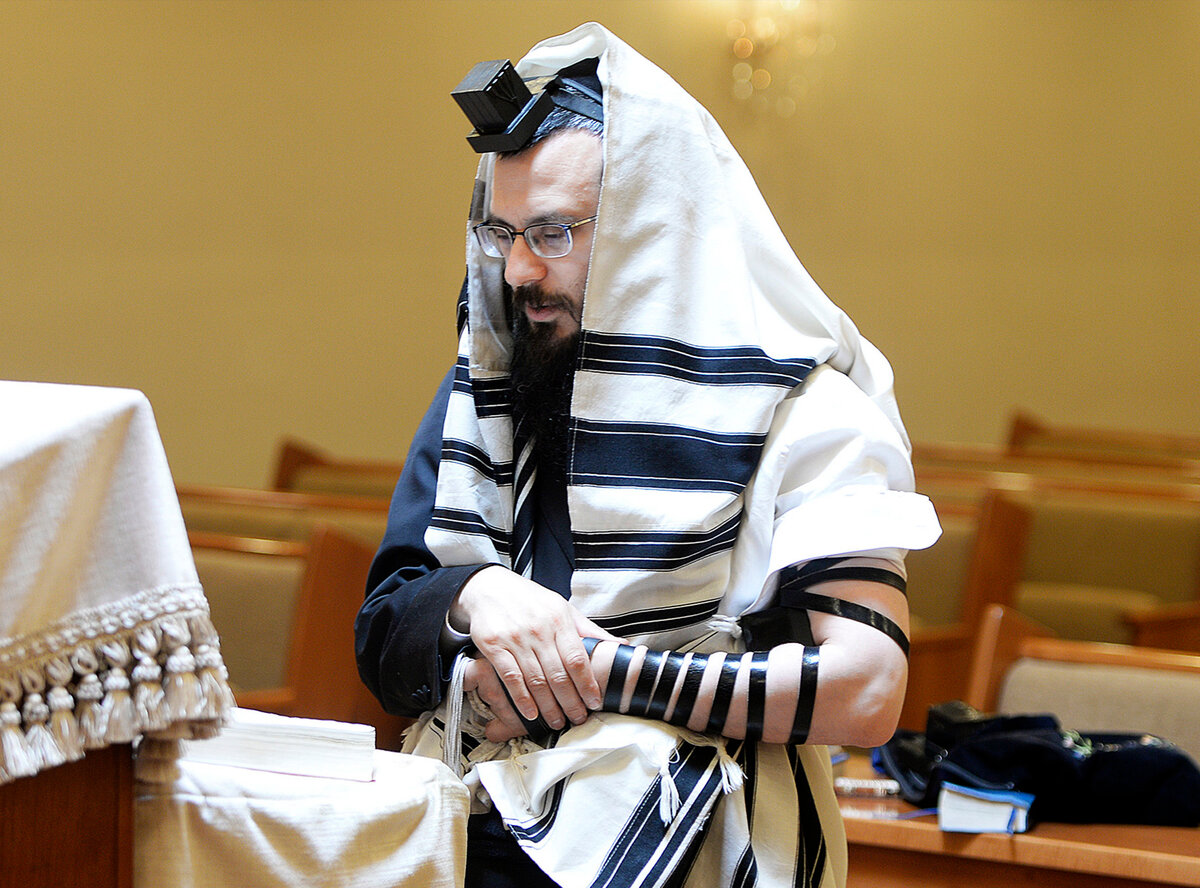
A man wearing a Tefilin, a Talit (prayer shawl) with Tzitzit attached at its borders
The Israelites who are faithful to God should also love their neighbors, not only their fellow tribesmen, but also strangers living on their land (Deut 10:19).
According to Deuteronomy, all Jews are equal and are “brothers”. “Many of the prescriptions of Deuteronomy are aimed at affirming love, mutual assistance, and mercy among the people towards brothers in need (Deut 14:28-29; 15:1-18; 22:1-4; 24:10-15,19-21)”.
A single place of worship of God and severe warnings against idolatry
The Book of Deuteronomy emphasizes the need to have only one religious center: “To appear before Him, come only to the place that the Lord your God will choose on the earth of one of your tribes and make a dwelling for His name” (Deut 12:5). It is obvious that in the early history of Israel, people sacrificed in different places (Abraham, Jacob, Moses, Samuel did this), and this was not only not forbidden by God, but God Himself commanded different people to build altars in one place or another. However, the commandment of Deuteronomy at that time was a means to promote the unity of the tribes and prevent the mixing of sacred rites with pagan cults, which often happened among the Israelites. According to Deuteronomy, idolatry is the main danger for Israel (Deut. 12:30-31). The One God is a “jealous God” — it is impossible to honor the true Living God simultaneously with false gods. God grants prosperity to the people only if they are faithful to Him and keep the commandments of the Covenant. In case of treason to the Covenant, God will strike the Israelites with terrible disasters, similar to the Egyptian executions (Deut 28:15; compare also Lev 26). Extensive descriptions of curses were supposed to inspire awe in the “stiff-necked” Israelis. But Moses stressed all the time that “the Lord your God is a merciful God; He will not forsake you or destroy you, and will not forget the covenant with your fathers, which He swore to them” (Deut 4:31).
Two ways. The Song of Moses
At the end of the third speech of Moses, a kind of summary of the content of Deuteronomy is summed up: “I now call heaven and earth to witness: I have offered you life and death, blessing and curse. Choose life — and then you and your descendants will be alive, and you will love the Lord, your God, and obey Him, and be faithful to Him. In Him is your life, a long life in the land that He swore to give to your forefathers Abraham, Isaac and Jacob…” (Deut 30:19-20). God allows man to freely make his choice, but directly says what awaits him on each of these two paths. The Prophet calls on everyone: “Follow the Lord, your God, fear and honor Him, do His commands, obey Him, serve Him, remain faithful to Him!” (Deut 13:4).
Foreseeing that in the future the Israelites will depart from God, the prophet Moses utters a solemn song for future generations (chapter 32): “«Give ear, O heavens, and I will speak; And hear, O earth, the words of my mouth. Let my teaching drop as the rain, My speech distill as the dew, As raindrops on the tender herb, And as showers on the grass. For I proclaim the name of the LORD: Ascribe greatness to our God” (Deut 32:1-3).
The narrative of the book of Deuteronomy ends with the last episode of the life of Moses: At the age of 120, Moses ascends Mount Nebo, blesses all the Israelites and, having looked at the Promised Land, to which he led the people for 40 years, dies (Deut 34). The great prophet of Israel was buried in the land of Moab, and no one knows the exact place of his burial. Literally, the text of Deut 34:5-6 can be translated as: “Yahweh buried him.” This surrounds with mystery the death of a leader, lawgiver and prophet, whose life was filled with extraordinary signs and great events.
Connection with the New Testament and the particular relevance to us today
Researchers note that Deuteronomy is quoted more often in the New Testament than many other Old Testament books (about 83 times). Thus, when asked about the greatest commandment in the Law, Jesus Christ cited the first commandment in the wording of Deuteronomy: “You shall love the LORD your God with all your heart” (Deut 6:5; Mt 22:37). When the devil offered Jesus three temptations, all of Christ’s answers were quotations from Deuteronomy (“Man does not live by bread alone, but by every [word] that proceeds from the mouth of the Lord, man lives” (Deut 8:3) “Do not tempt the Lord your God, as you tempted him in the Mass” (Deut 6:16); “Fear the Lord your God, and serve Him [alone]” (Deut 6:13; 10:20).
Deuteronomy contains an important prophecy — God will send people a prophet equal to Moses: “I will raise up to them a prophet from among their brothers, like you, and I will put my words in his mouth, and He will tell them everything that I command him…” (Deut 18:18-19). In the history of Israel, there were many great prophets who communicated with God and revealed His will to the people, but Deuteronomy states that no one achieved the ideal of Moses (Deut 34:10). The role of Moses is truly unique: Moses was the leader who led the people out of slavery, the mediator between God and the people who made a Covenant, and the prophet who conveyed to people the fullness of God’s will — the Law. Only a Prophet, especially one close to God, the Messiah, could bring about a spiritual outcome — to bring people out of slavery to sin. Apostle Peter announced to the people that this Prophet had visited the world in the person of Jesus Christ (Acts 3:22-24; compare the words of the people about Jesus in John 6:14). The point is that Christ will be the new Lawgiver, having no less power than Moses. In connection with this prophecy, the words of the Sermon on the Mount acquire a special meaning: “You have heard what was said to the ancients… And I tell you…” (Mt 5:21-22).
Apostle Paul explains the meaning of the death of Jesus Christ on the basis of the verse of Deuteronomy “cursed before God is [everyone] who is hanged [on a tree]” (Deut 21:23; Gal 3:13). When an innocent sinless Man was nailed to the “cursed” tree of the cross, the curse of the Law could not work on Him — and He now has the power to free all believers in Him from the curse and spiritual death.
Deuteronomy teaches sincere love for God and the Law given by Him. Moses’ call to choose “life or death, good or evil” was addressed to the ancient Israelites, but it is no less relevant for each individual — everyone must at some point decide on what principles he will base his life on. Later, Jesus Christ will also speak about the “narrow path” leading to salvation and the “wide path” leading to destruction (Mt 7:13-27). It is significant that the book of Deuteronomy, and with it the entire Pentateuch of Moses, ends its story at the moment of the people’s stay at the very border of the long- awaited Promised Land - the narrative of the most important Old Testament books for Jews has an “open end”. We understand that God has given the Israelites every opportunity to start a good life full of joy and abundance, but what exactly the future will be depends now on the people themselves.
The Book of Joshua.
Historical Books. A brief description of the historical books of the Old Testament
After 40 years of wandering in the desert, a new stage in the history of the Israeli people begins. Its description is given in books called “historical”. There are 12 canonical historical books in total: the Book of Joshua, the Book of Judges of Israel, the Book of Ruth, the First and the Second Book of Samuel, the First and the Second Book of Kings, the First and Second Books of Chronicles, the First Book of Ezra, the Book of Nehemiah and the Book of Esther; seven non-canonical historical books are adjacent to them (The Books of Tobit and Judith, the Third and Fourth Books of Ezra, the First, Second and Third Books of the Maccabees).
The Catholic tradition calls the non-canonical books “deuterocanonical” and equates them with the books of the canon (Tridentine Council). Catholics explain the name “deuterocanonical” by the fact that they were included in the Bible later than others (they refer to the 3 Maccabees as apocrypha). The Protestants, on the contrary, call the non-canonical books «apocrypha» and usually do not include them in their editions of the Bible.
The historical books follow the five law-positive books and smoothly continue the description of the history of the people of God, which began in the law- positive books. At the end of the book of Deuteronomy, Joshua is listed as the successor of Moses (Deut 34:9), and the events of the Book of Joshua begin on the day after Moses’ death. The narrative of historical books covers the period from the settlement of the chosen people in the Promised Land (1405/1270 BC, the Book of Joshua) to the return from captivity and the restoration of the Jewish community (428 BC, 1st Book of Ezra); the presentation of the non-canonical Maccabean books ends a century and a half before the birth of Jesus Christ, in 142 BC.
The narrative of all historical books is very dynamic, there are a lot of events that are described in vivid and vivid language, life stories are full of exciting twists. Reading the descriptions of completely different epochs and persons, one can notice that a common theme is manifested everywhere — people’s relationship with God, their loyalty or infidelity to Him and God’s response to people’s deeds. As we have already said in connection with the Book of Genesis, the biblical authors very honestly describe both the spiritual “ups” and “downs” of the people. It can be said that the authors of historical books are interested not so much in the history of Israel itself as in its religious meaning — how the hand of God guided the millennial history depending on the moral state of the people.
The subject and structure of the Book of Joshua
The Book of Joshua is named after the central acting figure — Joshua the son of Nun from the tribe of Ephraim (his name was originally Hoshea, but Moses renamed him Joshua (Num. 13:17), the successor of Moses, who after his death became the leader of the Israelite people (Num. 27:18; Joshua 1). The time has come for the fulfillment of God’s ancient promises about the inheritance of the land of Canaan, which were given to Abraham (Gen. 12:1-2; 15:1-21). This land was inhabited by the Canaanites and many other peoples who built fortified cities and had well-armed and trained warriors. But God’s will was for the people of Israel to take possession of this land — with this hope, Joshua leads the people to battle and wins.
The content of the book, which has 24 chapters, is divided into three parts:
Chapters 1-12. The conquest (occupation) of the Promised Land by the Israelites under their new leader, Joshua.
Chapters 13-21. The territorial division of the Promised Land among the twelve tribes of Israel. Many of the native people still had to be conquered.
Chapters 22-24. Conclusion of the book. The end of Joshua’s life and his farewell to Israel
Main content
Entering the Promised Land
After the death of Moses, Joshua, inspired by God, miraculously led the people of Israel across the Jordan river and brought them out of the desert to the borders of the land of Canaan (Joshua 3).
The Israelis had to remember crossing the Jordan. For this purpose, two monuments were erected: one in the water, the other on land. Under Joshua’s direction, twelve stones were placed at the place where the priests stood with the ark of the covenant in the middle of the Jordan while the people were crossing the river (Joshua 4:3,8, 9 and 20). Twelve men representing the twelve tribes of Israel each carried a stone to Gilgal for the construction of a second monument, which reminded subsequent generations of the miraculous providence of God and His care in crossing the Jordan. Thus, God’s great deeds were to be preserved in the memory of the people for all the years to come.
The goal of the journey has been achieved. In the Promised Land, Joshua solemnly expressed his fidelity to the Covenant with God — he performed the rite of circumcision of all Israelites and the celebration of Passover (Joshua 5). And God gave the leader a sign of His protection and help: a mysterious “leader of the army of the Lord” appeared to Joshua with a sword in his hand, and Joshua worshiped him (Joshua 5:13-14).
Like Moses at the burning bush, the messenger of God commanded Joshua to take off his shoes, saying: “The place where you stand is holy.” The “leader of the Lord’s army” who met Joshua, according to a number of Christian interpreters, was the Archangel Michael, the heavenly patron of the Jewish people (Dan 10:21; 12:1). Therefore, in the Orthodox Church, this passage of the Book of Joshua is read on the memorial day of the Archangel Michael.
Even earlier, the Israelis sent two scouts (“spies”) to the nearby city of Jericho (Joshua 2). The city authorities noticed the strangers and sent soldiers to seize them, but the scouts were saved by the harlot Rahab, a resident of Jericho. She hid them on the roof of her house in sheaves of flax, and for this service she made them promise to keep her and her family alive when the Israelites conquered Jericho. The identification sign was supposed to be a red rope in the window of her house. Rahab said that all the inhabitants of Jericho were seized with horror: they felt that the Lord of Israel was an almighty God, and by His definition this land should be given to the people of Israel.
The beginning of the triumphal conquest of the Promised Land — the capture of Jericho and Ai
At Jericho, the great help of the Lord was revealed in an obvious way for everyone. God promised Joshua victory over Jericho if the priests would carry the ark of God around the city for seven days in a row, blowing trumpets, and “all those capable of war” would participate in this procession. Joshua fulfilled the command of God, and after the procession went around the city seven times on the seventh day, with a powerful trumpet sound and the cry of the people, the city walls fell by themselves (Joshua 6). Jericho was taken; Joshua put a “curse” on the city (Heb. “herem”) — this meant that everything in it belonged to God and had to be destroyed. Of the inhabitants of the city, the Israelites left alive only the harlot Rahab and all her relatives. Rahab married Salmon from the tribe of Judas and was accepted into the people of God. She became one of the progenitors of Jesus Christ — the name Rahab is mentioned in His genealogy (Mt 1:5). St. John Chrysostom emphasizes the following comparison: “Joshua, who says, “Let the harlot live,” was a prototype of the Lord Jesus, Who says: fornicators and publicans precede you in the kingdom of heaven (Mt 21:31)”
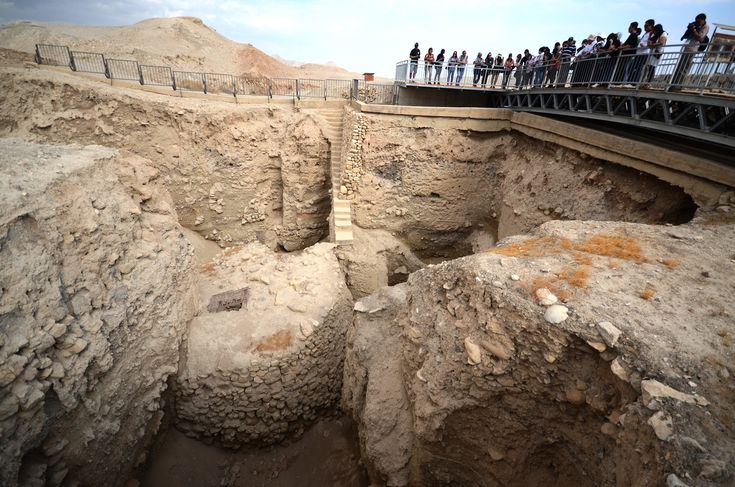
Ancient Jericho
One Israeli broke the spell — he secretly appropriated several valuable things from Jericho. After that, the people ceased to feel God’s help; “the hearts of the Israelites froze with fear and became like water” (Joshua 7:5). The inhabitants of the small town of Ai inflicted a crushing defeat on them. When the culprit was discovered and executed, everything got better again: in a new battle with Ai, the Israelis pretended to flee, and the residents of Ai gave chase, but another group of Israelis ran out of ambush and cut off the enemy’s way to retreat to the city. Ai’s army was surrounded and defeated.
The brilliant victories of the people of Israel and the division of the land among the tribes
Another vivid episode of the book is the battle for the big city of Gibeon. Gibeon was located not far from the Israeli camp; the Gibeonites were afraid of the inexplicable strength of the Israeli people and, with the help of cunning, concluded an alliance with the Israelites. The kings of all the surrounding cities found out about this and, united, went to war on Gibeon. Joshua came to the aid of the allies. A huge battle ensued, in which the Israelites were completely successful, and Joshua even offered a prayer to God so that the persecution of the enemies could continue as long as possible: “Stand, the sun, over Gibeon, and the moon, over the valley of Aialon!” (Joshua 10:12). It was a special day; the strongest hail that fell from the sky beat many enemy soldiers, and the foreigners fled in terror. Throughout the Book of Joshua, it is emphasized that great victories and the seizure of territories were accomplished not by the power of the Israelites, but by the power of God — “The Lord fought for Israel” (Joshua 10:14).
Thus, the first historical book of the Old Testament depicts the period when the Israelites were faithful to God, and therefore their history developed along the “positive” path prepared by God, marked by triumph over enemies and prosperity (compare Deut 30:15 and following).
The whole land of Canaan was divided by lot — nine tribes and half of the tribe of Manasseh received their inheritance in it, and the tribes of Reuben, Gad and half of the tribe of Manasseh got the lands beyond the Jordan. The Levites did not receive a separate inheritance (Joshua 14:1-3). Joshua built a single altar to God in the city of Shechem in front of the tabernacle, then the altar was moved to Shiloh. “And Jesus wrote there on the stones a list from the law of Moses. And then he read all the words of the law before the whole assembly of Israel, before men, and women, and children, and strangers” (Joshua 8:32-35).
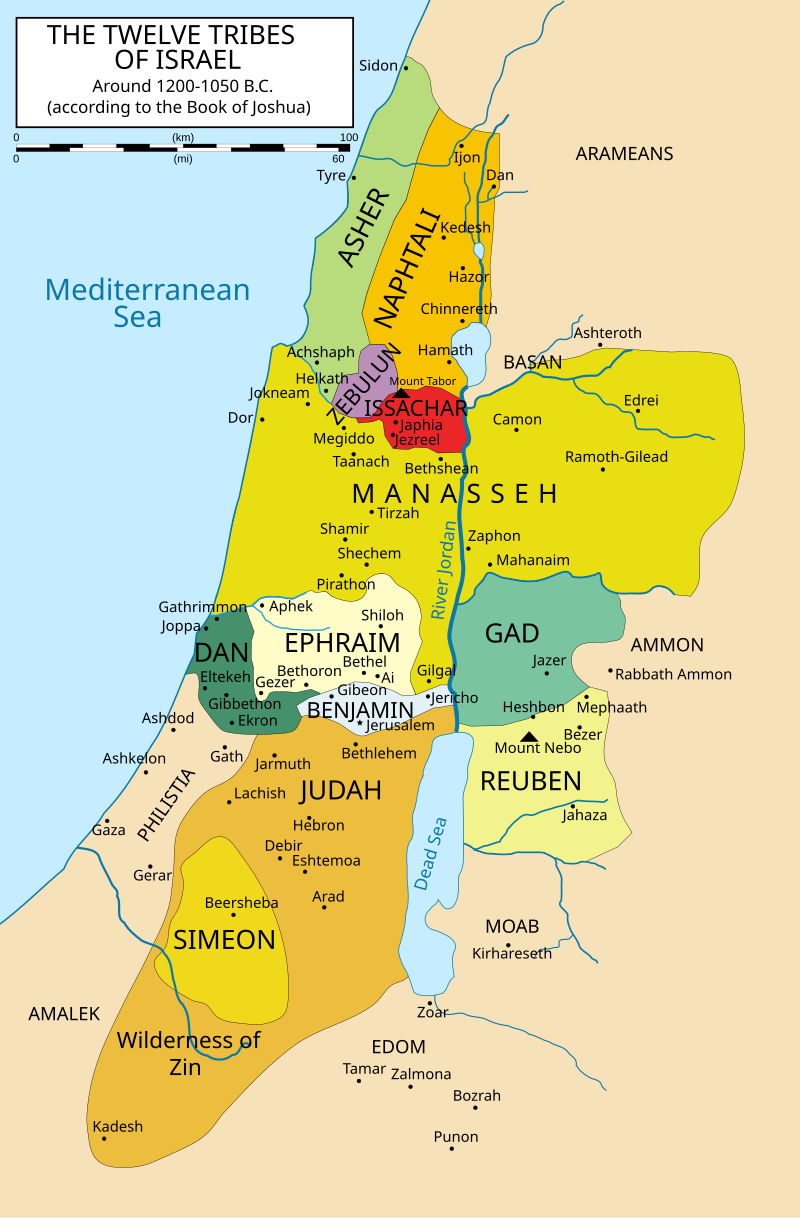
The book describes in detail how the eastern tribes built an altar to God in the land of Gilead near the Jordan; this caused the condemnation of other tribes, and a civil war almost arose. But the eastern tribes explained that they made only a “likeness” of the altar, as a symbol of the unity of all Israel. “The existence of this altar, if we take into account what was said in Deut 12:10-14, was an encroachment on the unity of the cult and already at that time gave rise to the danger of schism and separatism (1Kings 12:26-31). Those who erected the altar, on the contrary, presented it as evidence of religious unity, which the Israelis agreed with.
Before his death, Joshua encouraged the Israelites to always be faithful to God and warned them: “The holy God, the jealous God, will not tolerate your iniquity and your sins. If you forsake the Lord and serve other gods, He will bring evil upon you and destroy you” (Joshua 24:19, 20).
The problem of the book’s “cruelty”
The moral criteria of the Book of Joshua often outrage modern readers: it turns out that the Israeli invaders killed civilians, and God blessed and approved of such a genocide. You need to know that in ancient times such a practice was not exceptional; you can recall the Assyrians, who not only killed the entire population of the conquered peoples, but even burned their land. The book itself contains the idea that because of the multitude of sins, the inhabitants of the Canaanite land deserved God’s punishment, and the Israelites acted as an instrument of their punishment. The narrative of the book should be perceived from a religious point of view, and then the actions of the Israelis appear in a different light. Everything that was in the city after its capture was declared “cursed” — that is, the property of God Himself; thus, all the pagans killed passed into the possession of the true God.
Abraham was also told that his descendants would take possession of this land, but not immediately, because “the measure of the iniquities of the Amorites has not yet been filled” (Gen. 15:16). That is, God has been waiting for changes for the better for many centuries, He appointed some invisible line, a “measure of lawlessness”, beyond which this entire civilization was waiting for destruction. And it can hardly be called too cruel: the bad infinity of sin would be much worse…the Israelites — perhaps for the first time in world history — refused to exterminate enemies of their own will, handing the decision into the hands of their God. Yes, they waged bloody wars, but they were “wars of the Lord”, wars with those who acted as His enemy. If they invaded someone else’s land, it was not because they liked this land very much or its inhabitants offended them in some way, but because evil had to be exterminated. And those who use this book to justify their own military campaigns are completely wrong: no one has the right to distribute what was said to Joshua in a specific historical situation to other times and other peoples
In the person of Israel, God created a special people and entrusted him with the precious revelation of His will. There was a real danger that the Israelis would assimilate, “dissolve” among peoples superior to them culturally, and would not be able to preserve God’s gift. The entire native population of Palestine was pagan, and it is known that the Canaanites sacrificed their children to Baal (compare Jer 19:4-5), and the cult of Baal was accompanied by debauchery and orgies. Paganism was so rooted in the life and customs of the entire surrounding population that it could spread to the settlers like an infectious disease. Therefore, in order to avoid spiritual “infection” of Israelis, measures are required to ensure a kind of “quarantine”. These measures were temporary in nature, and in the perspective of the New Testament it becomes clear that in the end they served for the benefit of the pagan peoples themselves: after centuries, the Messiah will shine from the Israelite people, “the light to enlighten the Gentiles” (Luke 2:32). In the comments of Christian authors, the formidable intransigence of the Israelites towards the Gentiles receives a spiritual and ascetic interpretation — it is an image of an irreconcilable struggle with sin and striving to overcome it with the help of God.
Christian interpreters saw in the figure of Joshua a significant prototype of Jesus Christ. The name “Jesus”, Hebrew “Yehoshua” means God-salvation; by the command of God, this name was given to the Messiah (Mt 1:21; Lk 1:31). Joshua leads the people of God across the Jordan to the Promised Land — Jesus Christ leads the baptized into the Kingdom of God. The possession of the promised Land serves as a prototype of entering the Kingdom of God, which requires effort (Mt 11:12). The conquest of territories by Joshua was considered by interpreters as a prototype of the victorious spread of the Church throughout the world.
The main idea illustrated by the Book of Joshua can be formulated as follows: God is faithful to His promises, His saving definitions will certainly be fulfilled (compare Joshua 1:3), but this requires the reciprocal action of the person himself. Joshua fulfilled the Lord’s parting words: “Be strong and courageous, do not be afraid and do not be terrified, for the Lord your God is with you wherever you go” (Joshua 1:9). God assigns many benefits to people, but in order to receive them, it is necessary to work and show perseverance, even in difficult and new circumstances. As in the books of Genesis and Exodus, the Book of Joshua illustrates the most important principle of “synergy” — the “collaboration” of God and man.
Deuteronomy and Book of Joshua. Overview, structure, connection with the New Testament.
-
12.1 DEUTERONOMY.
-
12.2 JOSHUA.
-
DEUTERONOMY.
- JOSHUA.
Related Concepts
- acts-3
- allegory
- altar
- catechesis
- choice
- christification
- christological-interpretation
- conquest
- covenant
- covenant-of-peace
- crossing-jordan-as-baptism
- curses
- davidic-line
- degeneration
- didache
- divine-human-cooperation
- divine-inspiration
- epistle-of-barnabas
- everlasting-covenant
- first-commandment
- folly
- freedom
- good-works
- herem
- human-responsibility
- idolatry
- job-as-type-of-christ
- judgment
- law
- love-of-god
- macarius
- messiah
- moral-effort
- name-jesus
- narrow-path
- new-lawgiver
- noah
- obedience-of-faith
- old-covenant
- old-testament-interpretation
- people-of-god
- perseverance
- priesthood-covenant
- romans-1
- second-commandment
- shechem
- shema
- shiloh
- social-laws
- song-of-moses
- spiritual-life
- st-gregory-palamas
- st-theophan-the-recluse
- synergy
- tefillin
- typology
- tzitzit
- wisdom
- wisdom-of-solomon