Old Testament — Topic 34
HAGGAI
Outline
1:1–11 Haggai Delivers His First Prophetic Message: God Is Judging the Remnant
for Her Failure to Rebuild the Temple
1:1–4 Haggai Confronts Zerubbabel and Joshua Over the Remnant’s Failure to
Rebuild the Temple
1:5–11 Haggai Explains That the Drought in Judah Is a Result of the Remnant’s
Failure to Rebuild the Temple
1:12–15 The Remnant of Israel Obeys God’s Command, and Haggai Delivers His
Second Prophetic Message: God Is Present With His People
1:12 The Remnant Listens to Haggai’s Prophetic Message and Fears God
1:13–15 Haggai Affirms God’s Presence, and the Lord Stirs the Remnant to
Rebuild the Temple
2:1–9 Haggai Delivers His Third Prophetic Message: God’s Presence and Future
Promise Provide Encouragement
2:1–5 Haggai Offers Immediate Encouragement to the Remnant Rebuilding the
Temple
2:6–9 Haggai Offers Future Hope to the Remnant Rebuilding the Temple
2:10–19 Haggai Delivers His Fourth Prophetic Message: The Lord Curses
Disobedience and Blesses Obedience
2:10–14 Haggai Uses a Legal Question to Make an Analogy Between the Remnant’s
Uncleanness and the Unfinished Temple
2:15–19 Haggai Promises Divine Blessing to the Remnant for Rebuilding the
Temple
2:20–23 Haggai Delivers His Fifth Prophetic Message: God Reveals His Plan to
Zerubbabel
2:20–22 Haggai Informs Zerubbabel of God’s Plan to Overthrow the Kingdoms and
Nations of the Earth
2:23 Haggai Informs Zerubbabel of His Divine Appointment to a Significant Role

Haggai(watercolor circa 1896–1902 by James Tissot)
Completing the Temple
The Book of Haggai is named after the prophet and central figure of the book, who, along with the prophet Zechariah, ministered to the people of God who had returned from Babylonian exile to Jerusalem around 536 BC. It records how Haggai leads the returned exiles to complete the rebuilding of the temple in 515 BC after the Babylonians, led by Nebuchadnezzar, destroyed it seventy years earlier. Hence, the first exiles to return from Babylonian captivity were Haggai’s original audience. Although there is no mention of its author, it is reasonable to conclude Haggai wrote the book.
From a historical perspective, the book’s purpose is to provide a record of how and when the rebuilding of the temple was completed. Beyond that, the book contains five messages Haggai brings to Jerusalem’s inhabitants. In the first (1:1–11), Haggai rebukes them for stopping their work on the temple. In the second (1:13), God assures the people of his presence. In the third (2:1–9), Haggai encourages them with promises of a future glory and salvation that will be associated with this temple. In the fourth (2:10–19), Haggai warns them of impurity and its consequences. Finally, in the fifth (2:20–23), Haggai foretells how God will overthrow their enemies and reestablish the throne of David through the Messiah.
Haggai Delivers His First Prophetic Message: God Is Judging the Remnant for Her Failure to Rebuild the Temple (1:1–11)
Haggai delivers his first prophetic message at the end of the summer of 520 BC to Zerubbabel, the governor of Judah, and to Joshua, the high priest. His message is that the people need to rebuild the temple. Instead, they have turned their attention to their own concerns, neglecting God and his temple. The people must procure the necessary building materials and rebuild the temple so that the Lord will be pleased and be glorified. The people also need to recognize the Lord sent a drought and is frustrating their endeavors because of their failure in the matter. The following section contains the people’s response.
Haggai Confronts Zerubbabel and Joshua Over the Remnant’s Failure to Rebuild the Temple (1:1–4)
Darius’ second year was about 520 BC. At this time, Haggai confronts Judah’s civil and religious leadership. Zerubbabel is the governor of Judah and a descendant of David, and Joshua is the high priest. When the exiles initially returned to Jerusalem, they built the temple’s foundation and altar. However, when opposition influenced the king into halting their work, the people abandoned the project. Now, they are saying it is not the right time to resume it. Haggai rebukes them for self-centeredly having time to build their own houses but not the Lord’s house. Haggai continues by revealing the consequences of their decision in the following verses.
Haggai Explains That the Drought in Judah Is a Result of the Remnant’s Failure to Rebuild the Temple (1:5–11)
After confronting Judah’s leadership concerning the people’s failure, the Lord issues two commands through Haggai. First, the Lord says the people need to recognize the consequences of their self-centeredness and unwillingness to complete the rebuilding of God’s house. Because they are prioritizing their own houses over God’s house, God is disciplining them with a drought on the land and is frustrating all the people’s efforts to flourish. If their situation is to turn around, the people must act on the Lord’s second command by going to get the necessary materials and rebuilding the temple so that the Lord will be pleased with it and glorified. The next verses contain the people’s response.
The Remnant of Israel Obeys God’s Command, and Haggai Delivers His Second Prophetic Message: God Is Present With His People (1:12–15)
After their leaders and the people hear Haggai’s prophetic message, they realize it is from the Lord and immediately obey what the Lord their God commanded. Their negligence of the house of the Lord is replaced with a fear of the Lord when they consider the consequences of their lack of attentiveness to God’s house. When the people repent and fear the Lord, the Lord responds by reaffirming his covenant with Israel and promising his support in the project by assuring them of his presence. Then the Lord stirs up both the leaders and people to commence the project. In the following passage, Haggai reveals God has extraordinary plans for the future of this temple.
The Remnant Listens to Haggai’s Prophetic Message and Fears God (1:12)
The governor, the high priest, and all the people in Judah recognize Haggai’s message is from the Lord. Therefore, upon hearing God’s prophet, acknowledging their error, and realizing they themselves are the cause of their difficulties, both the leaders and the people repent and obey their God. What’s more, all of them fear the Lord. The fear of the Lord is a deep-seated reverence and awe for God that causes humans to want to please him at all costs and avoid his loving discipline. It involves wonder, submission, worship, love, and admiration inspired by his eternal attributes and authority. In the next passage we see how the people’s response to Haggai’s message elicits a response from God.
**
**
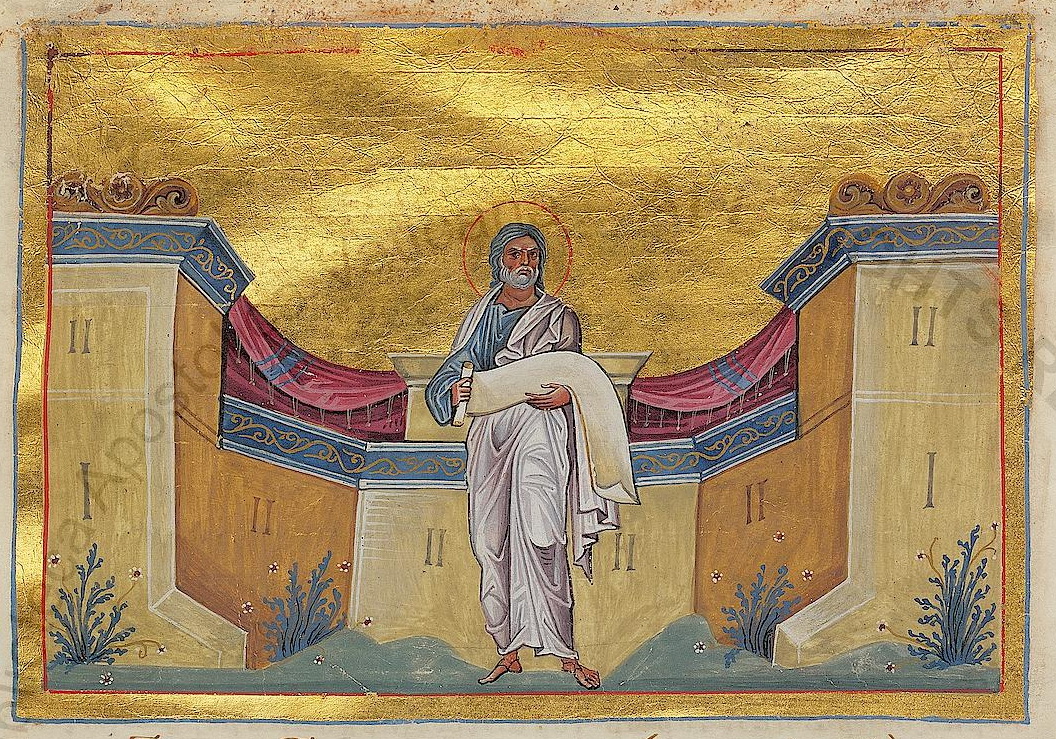
Haggai (Miniature from the Menologion of Basil II, X c.)
Haggai Affirms God’s Presence, and the Lord Stirs the Remnant to Rebuild the Temple (1:13–15)
With the response of both the leaders and the people to God’s word through the mouth of God’s messenger, the Lord’s response to them is twofold. Speaking through Haggai, first of all, the Lord assures them he is with them. The promise of God’s presence reaffirms he is keeping his covenant with them just as he faithfully kept it with their forefathers. Moreover, the Lord’s presence is a guarantee that they will have his support as they rebuild the temple. Second, the Lord arouses Zerubbabel, Joshua, and the people from their spiritual slumber and prompts them to get to work. In the next verses, Haggai will continue to encourage the people as they labor.
Haggai Delivers His Third Prophetic Message: God’s Presence and Future Promise Provide Encouragement (2:1–9)
It is not long after the people had begun rebuilding the temple that many of them become discouraged. They realize this temple is not nearly as impressive as was Solomon’s temple. However, through Haggai his prophet, the Lord encourages them by first reminding them he is with them and that his Spirit abides in their midst. Second, the Lord reveals by his divine omnipotence he is going to execute a global event, leading people from all of the nations to bring their wealth to this temple. The result will be that this temple will have a greater glory than that of Solomon’s temple.
Haggai Offers Immediate Encouragement to the Remnant Rebuilding the Temple (2:1–5)
Less than two months after Haggai initially confronted the people of Judah, who immediately repented and began working on the temple, Haggai delivers his second message. It is one of encouragement. Those working on the temple who were old enough to remember Solomon’s temple are embarrassed and disheartened by what they are building because it fails to compare to the magnificence and splendor of Solomon’s temple. Even those who have only heard of Solomon’s temple must know this. Therefore, the Lord exhorts them to keep up the good work and not be anxious because his Spirit is with them. What’s more, Haggai is about to make an incredible promise regarding this temple.
Haggai Offers Future Hope to the Remnant Rebuilding the Temple (2:6–9)
After encouraging the people to keep working since the Lord’s Spirit is with them, Haggai delivers an amazing promise from God. As he has done in the past, the Lord is going to do something extraordinary having a global effect. God will establish a new order, when all of the nations will submit to him and come to his temple bearing precious gifts in worship of him. This temple will be more glorious than the first. Haggai anticipates not only the temple’s glory that will come with the wealth of the nations but even a greater glory that will come when the Lord Jesus Christ enters it and goes on to inaugurate this new order (Luke 2:21–38). Haggai continues to encourage the people in his next address.
Haggai Delivers His Fourth Prophetic Message: The Lord Curses Disobedience and Blesses Obedience (2:10–19)
Haggai delivers his fourth message about four months after he gave his third. The purpose of this message is to teach the people about holiness. He begins it in dialogue with the priests concerning the transference of holiness and defilement. The priests confirm that the holiness of something devoted to God cannot be transferred to something else it touches. In contrast, something that is defiled will defile anything else it comes in contact with. The point is that even though Israel was God’s holy people, their sin of neglect defiled them and made everything they touched defiled. Only God can purify them and bless their endeavors. Next, Haggai will deliver his final message.
Haggai Uses a Legal Question to Make an Analogy Between the Remnant’s Uncleanness and the Unfinished Temple (2:10–14)
Three months after the people began the reconstruction of the temple, Haggai delivers his fourth address. The Lord instructs Haggai to consult the priests on two matters concerning ritual holiness. Something that is holy cannot transfer its holiness when it comes in contact with something else. On the contrary, something that is unclean will transfer its uncleanness to something it touches. Once Haggai reminds the people of these truths, he applies the lesson to the people. Even though God called Israel to be a holy nation, their sin of failing to rebuild the temple made them defiled, and their defilement contaminated everything they touched. God has more to say on the matter in the next verses.
Haggai Promises Divine Blessing to the Remnant for Rebuilding the Temple (2:15–19)
The second part of Haggai’s fourth address points to it being a new day for the people of God. When they refused to repent, were self-centered, and turned their backs on the Lord’s temple, he thwarted everything the people tried to accomplish. However, when their spirits were stirred and they set their hearts to obey God’s command to rebuild the temple, this change ushered in a new day. From this day forward God will bless them and cause their crops to be bountiful and everything they do to flourish. The people must remember to consider the consequences of disobedience in contrast to the blessings of obedience. Next, Haggai will conclude his book by revealing God’s plans for the future.
Haggai Delivers His Fifth Prophetic Message: God Reveals His Plan to Zerubbabel (2:20–23)
Haggai brings his book to a conclusion by delivering his fifth and final message on the same day he gave his fourth. However, Haggai addressed all of the people of Judah in his fourth message, whereas this message is particular and personal, specifically addressing Judah’s governor, Zerubbabel. This message foretells a global overthrow of every seat of human power. Then, keeping his covenant with David, God will replace them with a descendent of David, who will rule over every nation. What’s more, God will use Zerubbabel, a descendant of David, to be part of the Davidic line that brings to fruition the coming of the Lord’s Servant, his King, his chosen one—the Messiah.
Haggai Informs Zerubbabel of God’s Plan to Overthrow the Kingdoms and Nations of the Earth (2:20–22)
Unlike his fourth message, in which he addressed all of Judah, Haggai delivers his final message on the same day but to a particular person, Zerubbabel. Zerubbabel was the grandson of Jehoiachin, the King of Judah whom Nebuchadnezzar took into captivity as part of the second deportation of Jews from Jerusalem in 597 BC. Therefore, Zerubbabel is a descendant of David and the rightful heir to Judah’s throne. Under these circumstances, mention of his being governor is a reminder that the people of God are still under a foreign power. Nonetheless, Haggai describes a future cataclysmic event when God will overthrow the power of the kingdoms and nations of this world. The following verse reveals God’s plans for Zerubbabel when this happens.
Haggai Informs Zerubbabel of His Divine Appointment to a Significant Role (2:23)
Haggai continues his address to Zerubbabel, revealing that not only is Zerubbabel to have an important part in God’s plans for the reconstruction of the temple, but he will also play a key role in the future. “On that day” when Yahweh comes and vanquishes the power of the kingdoms and nations, when all those who fear the Lord, including those among the nations, are incorporated into the Lord’s new kingdom, God will use Zerubbabel to fulfill the divine covenant with David to reestablish the Davidic throne. The signet ring is a symbol of royal authority. This anticipates the Lord’s servant, his chosen one, the Messiah, who will one day rule over all the nations (Isa 42:1; 49:6–7; Ezek 34:23–24).
The Book of Haggai, though one of the shortest prophetic books, delivers a message of immense theological weight. Prophesying after the Babylonian Exile, Haggai confronts the spiritual apathy of God’s people who have neglected the Temple while living in “paneled houses” (Hag. 1:4). For Orthodox Christianity, Haggai is not merely a historical figure urging reconstruction; he is a prophet of divine priority, the glory of God’s presence, and the ultimate restoration to be fulfilled in Jesus Christ and His Church.
1. The Central Theme: Prioritizing the Temple of God
Haggai’s primary charge is that the people have prioritized their own comfort over the house of God, resulting in spiritual and material barrenness: “You have sown much, and bring in little;… and he who earns wages, earns wages to put into a bag with holes” (Hag. 1:6, NKJV). The solution is to “Go up to the mountains and bring wood and build the temple, that I may take pleasure in it and be glorified,” says the LORD” (Hag. 1:8).
-
Ascetical Understanding: This is a foundational ascetical principle. The “paneled houses” represent our passions, self-interest, and the cares of this world. When we invest our energy solely in these, our inner life becomes barren and unsatisfying. The command to “build the temple” is a call to the ascesis of prioritizing God’s Kingdom (Matthew 6:33). It is the work of purifying the heart (the inner temple) through prayer, fasting, and repentance, so that God may be glorified in us. St. John Chrysostom consistently taught that the greatest wealth is to be found in dedicating one’s resources to the glory of God and the care of the Church, the true Temple.
-
New Testament Parallel: The Apostle Peter applies this same Haggai-like theology to the spiritual house of the Church: “Coming to Him as to a living stone, rejected indeed by men but chosen by God and precious, you also, as living stones, are being built up a spiritual house, a holy priesthood, to offer up spiritual sacrifices acceptable to God through Jesus Christ” (1 Peter 2:4-5, NKJV).
2. The Messianic Prophecy: The Glory of the Latter House
The core Christological text in Haggai is the prophecy concerning the future glory of the Temple. The people are discouraged because the second Temple seems inferior to Solomon’s. Haggai delivers a stunning prophecy:
“For thus says the LORD of hosts: ‘Once more (in a little while) I will shake heaven and earth, the sea and dry land; and I will shake all nations, and they shall come to the Desire of All Nations, and I will fill this temple with glory,’ says the LORD of hosts. ‘The silver is Mine, and the gold is Mine,’ says the LORD of hosts. ‘The glory of this latter temple shall be greater than the former,’ says the LORD of hosts. ‘And in this place I will give peace,’ says the LORD of hosts.” (Haggai 2:6-9, NKJV)
-
Patristic and Christological Interpretation: The Church Fathers unanimously see this fulfilled in Jesus Christ.
-
The Shaking: The “shaking” of heaven and earth signifies the cataclysmic, cosmic event of the Incarnation. This is directly quoted in Hebrews 12:26-28 , where the author explains that in Christ, we receive an unshakable Kingdom, fulfilling Haggai’s prophecy. The old covenant, with its earthly temple, is being shaken and removed to make way for the new.
-
The “Desire of All Nations”: This is a title for the Messiah. While the nations may not have consciously articulated it, their longing for truth, beauty, and reconciliation—their innate desire for God—is fulfilled in Christ, who draws all people to Himself (John 12:32).
-
The Glory of the Latter Temple: The glory of Solomon’s Temple was the cloud of God’s presence (1 Kings 8:10-11). The glory of the second Temple was not its architecture but the fact that God Himself in the flesh, Jesus Christ, walked in its courts (e.g., Luke 2:22-38, the Presentation). He is the true glory of the Father (John 1:14). As St. Cyril of Alexandria comments, the latter temple’s greater glory was that it received the “living Word of God.”
-
“In this place I will give peace”: Christ is our Peace (Ephesians 2:14). The peace He gives is not as the world gives (John 14:27) but is the reconciliation of humanity with God, accomplished through His Cross and Resurrection.
-
-
Liturgical Fulfillment: This prophecy is central to the liturgical understanding of the Church as the true Temple. The Divine Liturgy is the experience of this “shaken” yet unshakable reality, where heaven and earth meet. The building itself is considered a temple, but the primary temple is the community of the faithful, filled with the glory of the Holy Spirit through the Eucharist. The hymns of the Feast of the Presentation of the Lord are a direct fulfillment, as the infant Christ, the “Desire of All Nations” and the “Glory of Israel,” is brought into the Temple, filling it with a glory far greater than any physical splendor.
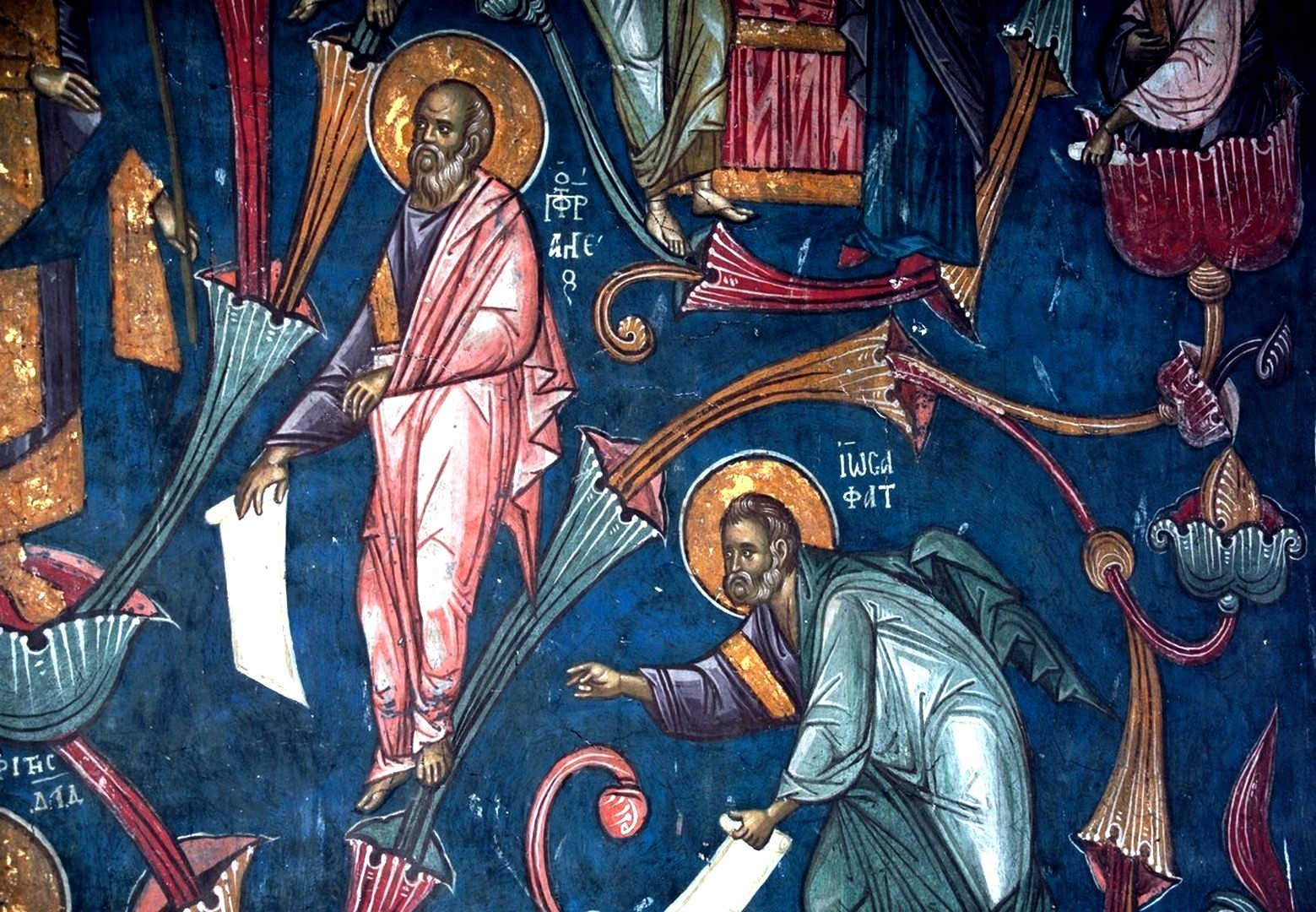
”The Prophet Haggai and King Jehoshaphat ”, fragment of the fresco
“The Root of Jesse” (“The Vine of Jesse”, “The Tree of Jesse”). Location: Visoki Dečani Monastery, Kosovo and Metohija, Serbia. Date of creation: before 1350.
3. The Messianic Signet Ring: The Royal Priesthood
The book concludes with a personal messianic prophecy for Zerubbabel, the governor from the line of David:
“‘And I will take you, Zerubbabel My servant, the son of Shealtiel,’ says the LORD, ‘and will make you like a signet ring; for I have chosen you,’ says the LORD of hosts.” (Haggai 2:23, NKJV)
-
Patristic Interpretation: A signet ring was used to seal official documents, representing the king’s full authority and identity. Zerubbabel is a type of Christ, the true chosen Servant and Son of David, in whom the Father places His full authority. St. Jerome, in his commentary, sees this as a direct promise of the restoration of the Davidic Kingship in the Messiah.
-
New Testament Parallel & Ecclesial Application: This promise is ultimately fulfilled in Christ, the final and chosen King (Matthew 3:17). Furthermore, through Christ, the faithful become part of this royal lineage. The Apostle Paul tells us we are “sealed with the Holy Spirit of promise” (Ephesians 1:13), and St. Peter declares that we are “a chosen generation, a royal priesthood” (1 Peter 2:9). The Church, as the body of Christ, becomes God’s “signet ring” in the world, bearing His authority and image.
Conclusion: Haggai as a Christ-Centered Book
The Book of Haggai is a powerful call to order our lives around the reality of God’s presence. It moves from:
-
A Call to Asceticism: Repent from building your own Kingdom and prioritize the Temple of God—first in your heart, then in the community of the Church.
-
A Prophecy of Christ: The true glory of God’s Temple is not a building, but the Person of Jesus Christ, the “Desire of All Nations,” whose Incarnation shook the cosmos and established a new, unshakable reality.
-
A Promise to the Church: In Christ, we are chosen and sealed as God’s signet ring, a royal priesthood, called to be the living Temple filled with the Holy Spirit.
Thus, Haggai’s message to the post-exilic community is God’s eternal message to His people in every age: “Build my Temple, for I am about to fill it with a Glory that will transcend all former things, and in this place, you will find true Peace.” This is fulfilled in the Theandric Person of Jesus Christ and the life of His Holy Church.
34.1 Completing the Temple. The Prophetic Message of Haggai
Haggai(watercolor circa 1896–1902 by James Tissot)
Completing the Temple
**
**
Haggai (Miniature from the Menologion of Basil II, X c.)
- Completing the Temple. The Prophetic Message of Haggai.
-
An Orthodox Insight into the Book of Haggai
-
-
34.1 Completing the Temple. The Prophetic Message of Haggai
-
34.2 An Orthodox Insight into the Book of Haggai
-
Completing the Temple. Haggai Delivers His First Prophetic Message: God Is Judging the Remnant for Her Failure to Rebuild the Temple (1:1–11).
Related Concepts
- 1-peter-2
- 1-peter-24-5-9
- 1-peter-25
- allegory
- blessing-and-curse
- book-of-hebrews
- christological-interpretation
- covenant-renewal
- crossing-jordan-as-baptism
- davidic-line
- divine-discipline
- emmanuel
- ephesians-113
- epistle-of-barnabas
- eschatology-on-that-day
- glory-of-god
- glory-of-the-temple
- hebrews-1226-28
- holy-spirit
- job-as-type-of-christ
- john-1232
- john-219
- kingdom-of-god
- living-stones
- matthew-633
- messiah
- messianic-typology
- mission
- nepsis
- obedience
- old-testament-interpretation
- prayer-and-fasting
- presentation-of-the-lord
- priesthood
- purgation-of-passions
- purification-of-the-heart
- purity-laws
- royal-priesthood
- sealing-with-the-holy-spirit
- signet-ring
- sin-as-contagion
- sin-as-contamination
- spiritual-sacrifice
- temple
- the-branch
- the-church-as-spiritual-house
- the-church-as-temple
- the-heart
- theophanycloud-of-glory
- typology
- universal-salvation
- wisdom
- zerubbabel
- zerubbabel-typology