Old Testament — Topic 29
EZEKIEL
Outline
1:1–24:27 God Commissions Ezekiel and Gives Him Visions and Prophecies Against
Judah for Its Iniquity
1:1–11:25 Ezekiel’s Commission, Initial Visions, and Prophecies of Judgment
Against Judah
1:1–3:27 Ezekiel’s Dramatic Commission: Divinely Empowered Preacher to a
Rebellious Nation
4:1–5:17 Minidramas of the Siege and Destruction of Jerusalem
6:1–7:27 Coming Judgment on the Land of Judah
8:1–11:25 The Vision of Abominations; the Departure of God’s Glory; a Future
Hope
12:1–24:27 Ezekiel’s Further Prophecies of Judgment Against Judah
12:1–14:23 Coming Exile Dramatized; Certain Judgment on False Prophets and
Elders
15:1–16:63 Jerusalem to Be Judged for Its Unfaithfulness; Yet Future Hope
17:1–19:14 The Eagle and the Vine; the Soul That Sins Shall Die; a Lamentation
for the Princes of Israel
20:1–24:27 Judgment and Purging of Israel for Its Foul Corruption; Jerusalem
Besieged
25:1–48:35 God’s Judgment on the Nations; Future Blessings of a Faithful
Covenant God
25:1–33:33 Prophecies of Judgment on the Nations
25:1–28:26 Prophecies and Laments Against Canaanites
29:1–33:33 Prophecies and Laments Against Egypt and Pharaoh; Ezekiel as
Watchman
34:1–48:35 God’s Promised Blessings for Israel and the Nations
34:1–39:29 God Promises Restoration to the Land and Salvation of Souls
40:1–48:35 God’s Glory Comes to a New Temple
The Lord Is With Us
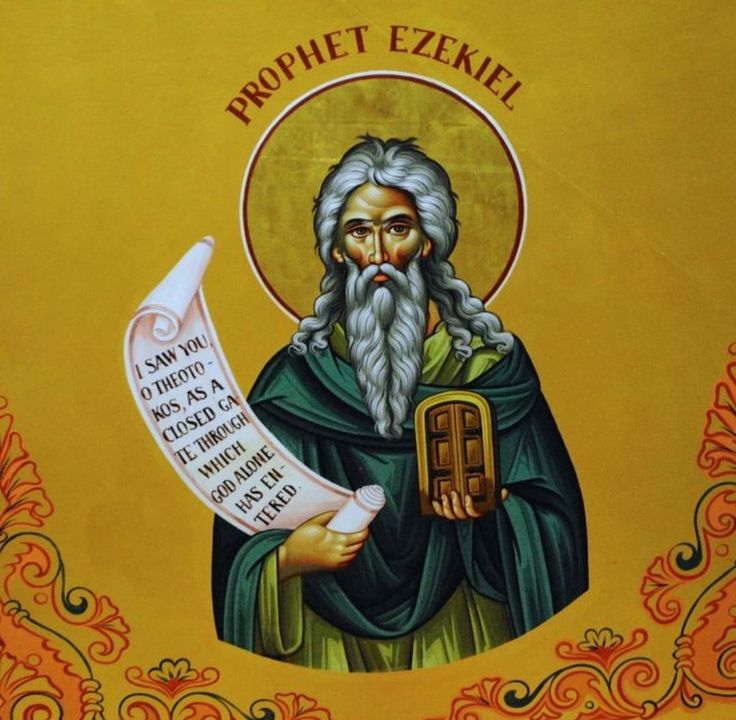
Ezekiel, a priest by descent and prophet by calling, begins his ministry with a vision of “the appearance of the likeness of the glory of the Lord.” As God’s watchman, he will proclaim God’s imminent righteous judgment against a sinful and idolatrous people. The people are altogether corrupt—leaders, (false) prophets, men, and women. For all her history, Israel has been an unfaithful bride to the Lord, in pursuit of the idols of the nations. Idolatry has permeated the temple itself. God will remove His glory from the city and raise up the nation of Babylon to bring judgment. But God will also bring judgment on the nations, particularly those who rejoiced over and abetted in the Babylonian destruction of Jerusalem. And He will gather the remnant of His people. God will enter into a covenant with them. They will be ruled by a righteous Davidic shepherd‐king, be indwelt by the Spirit of God, and walk in the holy statutes of God. God will richly provide for them and protect them from all their enemies. And He will dwell with them in holiness. The prophecy closes with an extended vision of a new temple, in which the restored people worship the bountiful and life‐giving God who dwells in their midst.
God Commissions Ezekiel and Gives Him Visions and Prophecies Against Judah for Its Iniquity (1:1–24:27)
The call of the prophet Ezekiel, who ministered among Judahite exiles in Babylon, impresses on him the glory and majesty of God, even as his priestly descent anticipates his ministry’s emphasis on the holiness and transcendence of God. Ezekiel is God’s watchman, summoning Israel to repent. Throughout this section, the prophet is mute, indicating that he is prevented from interceding on behalf of Israel. Ezekiel enacts God’s coming judgment through a number of dramatic signs, including the sudden death of his wife upon the siege of Jerusalem (chapter 24; see chapters 4–5; 12). God is judging Judah because she has profaned the temple with idolatry, prompting God to withdraw His glory (chapters 8–10). God’s people are like a worthless vine (chapter 15), a disloyal vine (chapter 17), and an ungrateful, unfaithful bride (chapters 16; 23), even as God has demonstrated longstanding patience to her (chapter 20). God condemns her corrupt leaders (chapters 11; 14; 19), her false prophets (chapter 13), and the people themselves (chapters 9; 18). All are guilty of multiple transgressions—against God and people (chapter 22)—which merit the sword of divine judgment (chapter 21) and the unsparing wrath of the Lord (chapter 7). Although this section ends in prophesied judgment (chapter 24), there are hints of mercy and restoration to come (chapters 11; 16; 20).
Ezekiel’s Commission, Initial Visions, and Prophecies of Judgment Against Judah (1:1–11:25)
Ezekiel opens with the prophet’s vision of the transcendent majesty and glory of God, and God’s call to him to bring the divine word to the rebellious people of Judah, who are on the cusp of final conquest and exile. The prophet dramatically symbolizes this coming judgment, which will be just, complete, and unsparing. The temple itself has been defiled through the people’s idolatry, and the prophet witnesses the withdrawal of God’s glory from the temple and the city of Jerusalem. God, however, will one day gather the scattered remnant and give them new hearts, so that they may obey Him as their God.
Ezekiel’s Dramatic Commission: Divinely Empowered Preacher to a Rebellious Nation (1:1–3:27)
The first section of Ezekiel describes God’s call to the prophet. Ezekiel received his first prophetic vision while in captivity “by the Chebar canal” (1:3). He will minister to the exiles of Judah. He first sees “the appearance of the likeness of the glory of the Lord” (1:28). This vision of God impresses on Ezekiel the divine transcendence and majesty. This vision is followed by God’s prophetic call to Ezekiel. In it, God emphasizes the rebellious character of the exiles to whom Ezekiel will minister (2:3, 5–8). Ezekiel, as God’s “watchman” (3:17), will bring “words of lamentation and mourning and woe” (2:10) to a resistant and stubborn people (3:7–9).
Minidramas of the Siege and Destruction of Jerusalem (4:1–5:17)
The second section of Ezekiel provides two enacted dramas of the judgment Ezekiel proclaims. The prophet is commanded to build a model of Jerusalem under siege (4:1–3). He must lie on his left and then his right sides for set times, symbolizing the punishment of Israel and Judah, respectively. Judah will be reduced to eating food not only in rationed supply, but also in defilement. Ezekiel must then shave his head and beard, and divide his cut hair into three parts (5:1–3, 12). Each of the three parts is consigned to judgment. A remnant of that cut hair is spared, but even a portion of the remnant will be destroyed (5:4).
Coming Judgment on the Land of Judah (6:1–7:27)
The third section of Ezekiel continues the message of judgment. Ezekiel prophesies against Israel’s mountains, the scenes of the people’s idolatry (6:1–7). A remnant will survive this judgment and “will be loathsome in their own sight” for their sins (6:9). The prophet then details the divine judgment in its finality (7:2). It is an outpouring of the wrath of God (7:8, 19), is unsparing (7:4), and will affect all sectors of society (7:13, 26–27). Money and idols will be useless to deliver Judah from this judgment (7:19–21). In this judgment, Judah will come to “know that I am the Lord” (7:4, 9, 27).
The Vision of Abominations; the Departure of God’s Glory; a Future Hope (8:1–11:25)
The fourth section of Ezekiel takes place in the temple in Jerusalem. The prophet is transported in the Spirit to Jerusalem to witness not only the “image of jealousy” and engravings of idolatrous images on the walls of the temple (8:5, 9–10), but also the elders, women, and men of Judah engaged in idolatrous worship (8:11–12, 14, 16). God sends out “executioners” to execute judgment on everyone who does not mourn over Israel’s idolatry (9:5–6). The glory that Ezekiel had seen at his call (1:4–28) departs from the temple and the city (10:18–19, 11:22–23). God tells Ezekiel that Jerusalem’s leaders should not presume to think that they will escape the coming judgment (11:1–13). God will scatter His people in judgment, but He will restore them to the land, giving the remnant a “heart of flesh” to keep God’s commands (11:17–20).
Ezekiel’s Further Prophecies of Judgment Against Judah (12:1–24:27)
After dramatically enacting the coming judgment on Jerusalem, the prophet pronounces judgment against the false prophets and the leaders of Judah. The nation, like a vine suitable to be burned and like an ungrateful, unfaithful wife, is guilty of treachery in her dealings with the nations. God does not accept the excuse of the people that their calamity is due to their ancestors’ sins. The prophet calls a guilty people to repent and laments their ungodly leadership. Not only has Judah been unfaithful to God throughout her history, but her present sins against God are enumerated. The prophet finally learns that the city of Jerusalem is under siege.
Coming Exile Dramatized; Certain Judgment on False Prophets and Elders (12:1–14:23)
The fifth section of Ezekiel begins with an enacted drama of coming judgment. Ezekiel will dig through the city’s walls, carrying his baggage and leaving the city (12:1–7). In this way, the exiles will leave the city, never to return (12:8–16). God then condemns the false prophets, who speak words of false peace (13:10; see 12:21–28). They are like those who whitewash a collapsing wall (13:10–16). God also condemns those who practice divination (13:17–23). Finally, God condemns the elders who have “taken their idols into their hearts” (14:3) and reiterates the certainty of the judgment He declares (14:6–23).
Jerusalem to Be Judged for Its Unfaithfulness; Yet Future Hope (15:1–16:63)
The sixth section of Ezekiel describes unfaithful Judah in two images. Jerusalem is like the wood of the vine, useful only to be burned (15:1–8). Jerusalem is also like an unfaithful wife. God found her “cast out … on the day that [she was] born” and made her to “live” (16:4–6). He took her as His wife and arrayed her in beautiful garments (16:8–15). But she devoted herself, her garments, and her children to idolatry, forgetting her husband (16:21–26). God likens Judah’s pursuit of the nations to the solicitations of a prostitute, but of a kind far worse (16:23–34). For this, God will deliver Judah to the nations in judgment. But God will restore Judah, alongside Sodom and Samaria. His restoration of Judah will be in keeping with His “everlasting covenant” with her (16:60).
The Eagle and the Vine; the Soul That Sins Shall Die; a Lamentation for the Princes of Israel (17:1–19:14)
In the seventh section of Ezekiel, God, through a parable, declares judgment on Judah for her treachery toward Babylon, and His intention to restore Judah and cause her to flourish (17:1–24). The prophet is called to rebuke Judah for blaming her calamity on the sins of her ancestors (18:3). Judgment comes on Judah for her own sins, and she is commanded to repent to avert judgment (18:30). Ezekiel is then called to lament the “princes of Israel,” who are like a predator, once powerful but now captive, and also like a burnt vine (19:1–14).
Judgment and Purging of Israel for Its Foul Corruption; Jerusalem Besieged (20:1–24:27)
In the eighth section of Ezekiel, the prophet concludes his oracles of judgment against Judah. Although Israel has been unfaithful to the Lord since her beginnings, the Lord will restore her from judgment and bring her “into the bond of the covenant” (20:37). But God will certainly raise His sword of judgment against Jerusalem for her sins (21:1–32). For Judah’s idolatry, violence, immorality, and greed, God will bring His wrath on the people (22:1–31). God recounts the history of Israel and Judah as two unfaithful brides, who will be judged for their “sinful idolatry” (23:49). Finally, the prophet learns of the siege of Jerusalem (24:1–14). He is forbidden to mourn the sudden death of his wife—a “sign” to Judah of their impending loss (24:24).
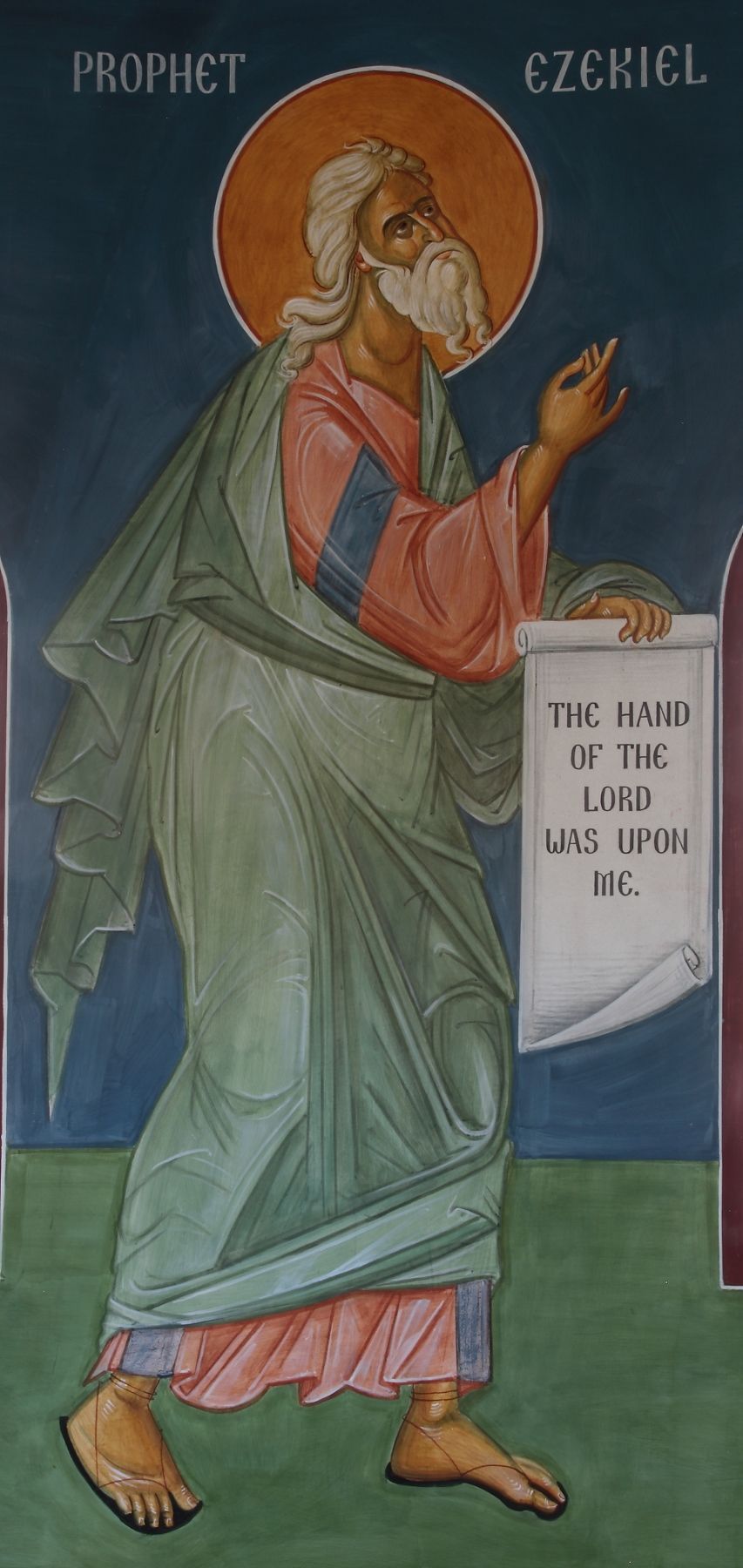
Ezekiel turns to the nations, prophesying the judgment to come against them. Initially, Ezekiel prophesies against the nations surrounding Israel—Ammon, Moab and Seir, Edom, and Philistia (chapter 25). They have gloated over and even participated in the Babylonian conquest of Judah. God will execute His vengeance on them, and they will know that He is the Lord. Ezekiel then turns to Tyre (and Sidon), who sought to profit from Judah’s misfortune. God will bring Babylon in judgment against them and make them a spectacle of horror (chapters 26–28). Finally, the prophet turns to Egypt, on whom Judah had relied to drive back Babylon. Egypt will be laid waste and reduced to insignificance, never again to return to her former power and glory (chapters 29–32). In the final section of the book, Ezekiel turns to the future of the people of God. God will gather them from the nations to the land, and set over them a shepherd and King, David (chapter 34). He will make a new covenant with the people, and He will cause His Spirit to dwell in them (chapter 36). This work will bring the dead to life (chapter 37). God will provide for and protect His people from all harm (chapters 35; 38–39). The prophecy closes with a description of the new temple, in which God once again dwells with his people in holiness (chapters 40–48).
Prophecies of Judgment on the Nations (25:1–33:33)
Ezekiel turns from oracles of judgment against Judah to oracles of judgment against the nations. He begins with the nations that neighbor Israel. The goal of these judgments is to bring these nations to the realization that God is the Lord. Ezekiel then turns to Tyre and Sidon, two economically powerful and exploitative nations. God will bring these haughty nations low, and onlookers will respond in terror and with derision. Amid this work of judgment, God will gather His remnant and restore them to the land. This ingathering will impress on Judah’s neighboring nations that God is the Lord.
Prophecies and Laments Against Canaanites (25:1–28:26)
In the ninth section of Ezekiel, God pronounces a series of judgments against Judah’s neighboring nations. In 25:1–17, Ezekiel proclaims judgments against Ammon, Moab and Seir, Edom, and Philistia. God reiterates that through these judgments the nations shall know that He is the Lord (25:7, 11, 17; see 25:14). Then follow judgments against Tyre (26:1–28:19)—the city and her King—and Sidon (28:20–23). God will bring these lofty cities low, to the terror and derision of the watching peoples (26:16; 27:36; 28:19). In the midst of this judgment, God will gather his remnant to the land and thus show Israel’s “neighbors” that He is the Lord (28:26).
Prophecies and Laments Against Egypt and Pharaoh; Ezekiel as Watchman (29:1–33:33)
In the tenth section of Ezekiel, God pronounces judgments against Egypt, on whom Judah futilely relied in her last days against Babylon. In similar form to the oracles of judgment against Tyre, Ezekiel pronounces judgments against Egypt (29:1–21) and Pharaoh (31:1–18), each of which is followed by a lament (30:1–26; 32:1–32). In this work of judgment, the Egyptians will come to know that God is the Lord (29:6, 9, 16, 21; 30:19, 26; 32:15). In Ezekiel 33, God once again reiterates Ezekiel’s call to be “watchman” over Israel (33:7, see 3:17–27). True to God’s word, judgment befalls Jerusalem, and the mute prophet’s mouth is opened (33:21–22; see 3:26–27).
God’s Promised Blessings for Israel and the Nations (34:1–48:35)
The final section of Ezekiel concentrates on the future blessings that God has in store for His restored people. He will gather His people, provide a shepherd and King over them, and enter into covenant with them. He will richly provide for them and protect them. In giving them hearts of flesh, He will place His Spirit within them to cause them to obey Him. This work of the Spirit is a work of resurrection. God will completely vanquish the nations who gather against His restored people. The final nine chapters describe the life of God with His people in terms of a restored temple, from which flow life‐giving waters.
God Promises Restoration to the Land and Salvation of Souls (34:1–39:29)
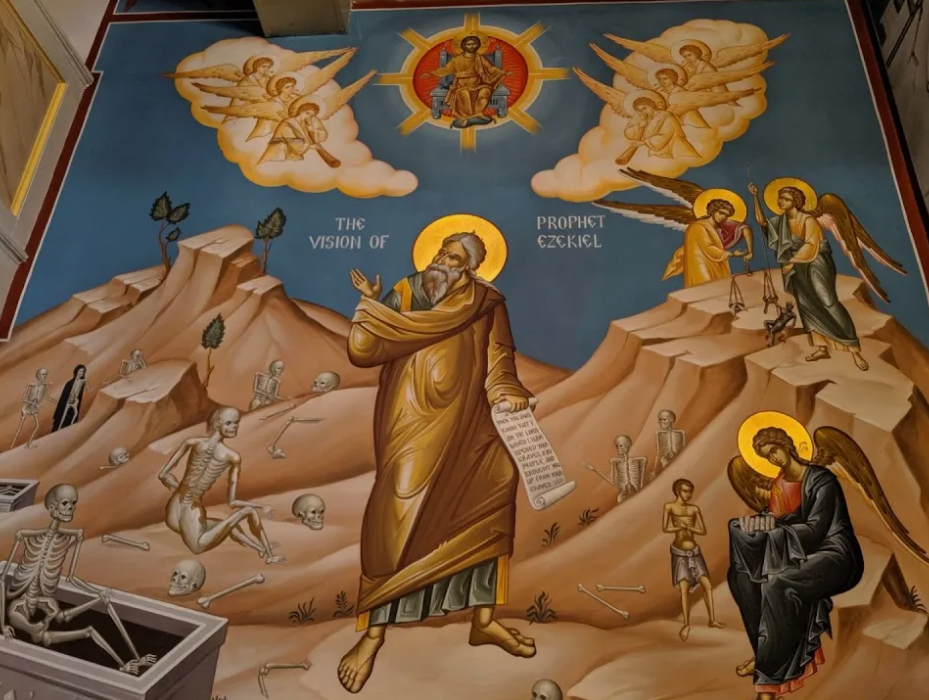
In the eleventh section of Ezekiel, the prophet’s oracles declare future blessing. God will gather His scattered sheep, set up His Davidic shepherd over them, and make a covenant of peace with them (34:11–16, 23, 25). In prophesying against the mountains of Edom and to the mountains of Israel, God pledges to safeguard His restored people (36:1–15). He will settle them, provide for them, and give them hearts of flesh (36:22–38), a work that will be a divine work of resurrection (37:1–28). In one final battle, God will utterly defeat the nations that set themselves against his people (38:1–39:29).
God’s Glory Comes to a New Temple (40:1–48:35)
In the final section of Ezekiel, the prophet describes life with God among the restored remnant. God will build a new temple (40:1–42:20), and fill it with His glory (43:1–12). Then God describes the altar within the temple (43:13–27) and the duties of the priests who minister in the temple (44:1–31). The land around the temple is apportioned (45:1–6), and the offerings and feasts of the temple are detailed (45:7–46:24). Ezekiel follows the life‐giving waters from the temple, and God then sets the boundaries for the land and the divisions by tribe within the land (47:1–23). The prophecy closes with a description of the gates of the city and of the name of the city—“the Lord is there” (48:35).
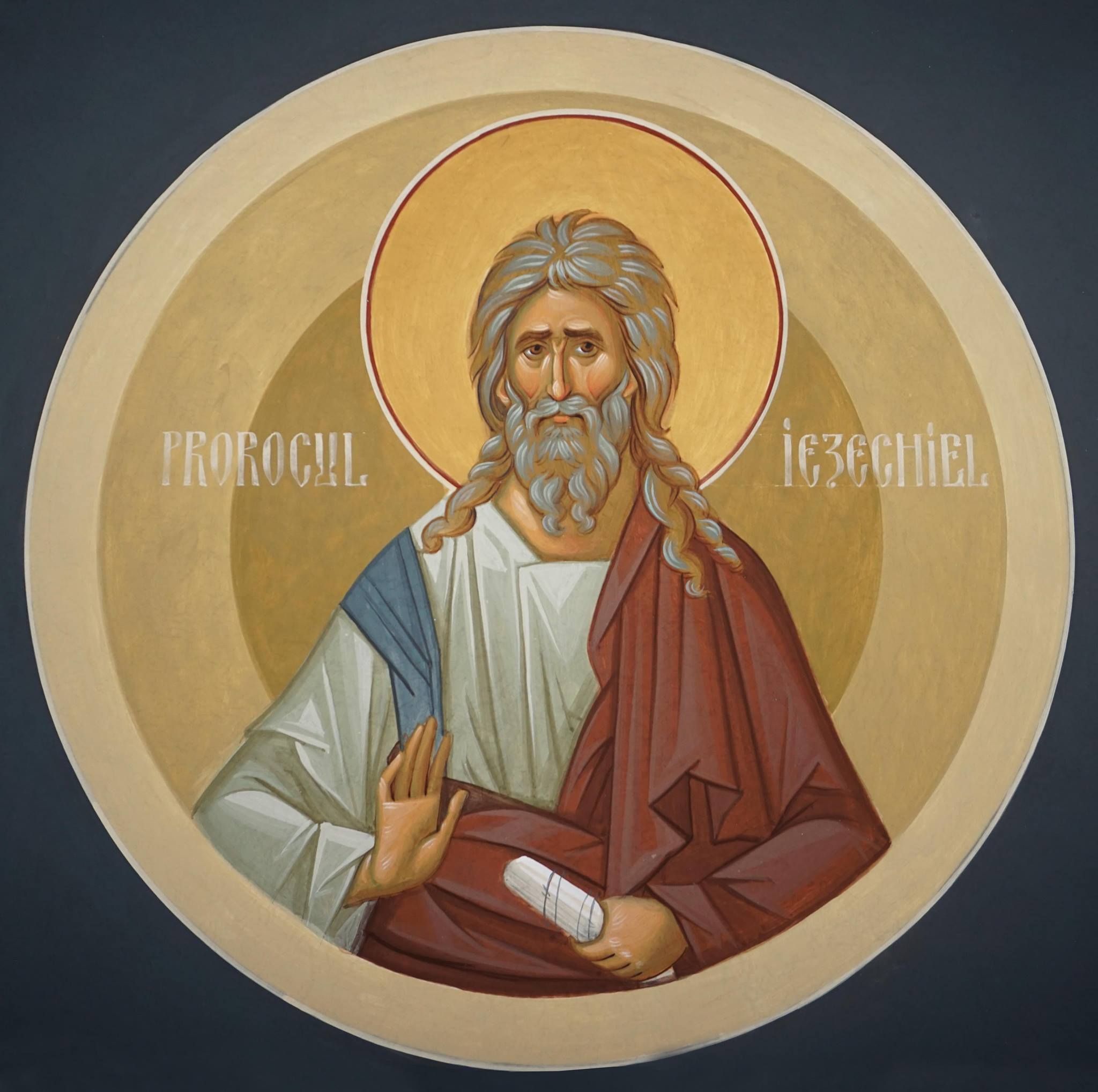
The Book of Ezekiel is a dramatic and visionary text, often marked by mystifying symbolism and potent prophecies of judgment and restoration. For the Orthodox Church, Ezekiel is far more than a prophet of the Babylonian exile; he is a seer of the Divine Glory, a herald of the true Shepherd, and a prophet of the New Creation that finds its fulfillment in Jesus Christ and His Church. His book is fundamentally Christ-centered because it reveals the departure and return of God’s Glory, the necessity of a new heart, and the ultimate source of life and sanctification in the Messiah.
1. The Vision of the Divine Glory (The “Merkabah”)
Ezekiel’s calling begins with a breathtaking vision of the divine chariot- throne, a central theme for Orthodox mystical theology.
- The Text: “Then I looked, and behold, a whirlwind was coming out of the north, a great cloud with raging fire engulfing itself… Also from within it came the likeness of four living creatures… and above the firmament over their heads was the likeness of a throne, in appearance like a sapphire stone; on the likeness of the throne was a likeness with the appearance of a man high above it.” (Ezekiel 1:4, 5, 26, NKJV).
- Christological Interpretation: The Fathers, particularly St. Gregory the Great and St. John of Damascus, saw in this “appearance of a man” high upon the throne a profound pre-incarnate revelation of the Son of God , the Second Person of the Trinity. This vision affirms that the God of Israel is not an abstract force but a Personal God Who can be seen in human form, foreshadowing the Incarnation. The four living creatures, with their faces of a man, lion, ox, and eagle, are universally understood in the Church as types of the Four Evangelists , whose Gospels carry the revelation of Christ to the four corners of the earth.
- Liturgical Understanding: The vision of the chariot-throne is commemorated in the Church’s hymnography, especially during the Great Feast of the Transfiguration. The uncreated Light that shone from Christ on Tabor is the same Glory that Ezekiel beheld. Furthermore, the Cherubic Hymn sung at the Great Entrance of the Divine Liturgy—“We who mystically represent the Cherubim…”—directly echoes this throne-room vision, placing the liturgical assembly in the presence of the same divine King.
2. The Shepherds and the One True Shepherd
Ezekiel delivers a powerful indictment against the failed shepherds (rulers and priests) of Israel and promises a single, Davidic Shepherd.
- The Prophecy of the True Shepherd:
- Text: “I will establish one shepherd over them, and he shall feed them—My servant David. He shall feed them and be their shepherd. And I, the LORD, will be their God, and My servant David a prince among them; I, the LORD, have spoken.” (Ezekiel 34:23-24, NKJV).
- New Testament Fulfillment: Christ declares Himself to be this promised Shepherd: “I am the good shepherd. The good shepherd gives His life for the sheep” (John 10:11). He is the “son of David” Who comes to gather the lost sheep of the house of Israel and bring them into one flock (John 10:16).
- Ascetical Understanding: This prophecy condemns the passion of neglect and self-interest. For the Christian, it is a call to practice spiritual stewardship. Parents are shepherds of their children, priests of their flocks, and every believer is a shepherd of the gifts God has given them. The model is Christ, the Good Shepherd, Whose leadership is defined by sacrificial love, personal knowledge of His sheep, and a mission to seek and save the lost.
3. The Resurrection of the Dry Bones: The Hope of New Life
One of the most iconic visions in all of Scripture is Ezekiel’s prophecy of the valley of dry bones.
- The Text: “Thus says the Lord GOD to these bones: ‘Surely I will cause breath to enter into you, and you shall live… Then He said to me, ‘Son of man, these bones are the whole house of Israel.’” (Ezekiel 37:5, 11, NKJV).
- Christological and Ecclesiological Fulfillment: The Fathers see this as a prophecy of both the General Resurrection and the spiritual resurrection of humanity in Christ. The “dry bones” represent all of dead humanity, lifeless due to sin. The “breath” (pneuma , also meaning “spirit”) that enters them is the Holy Spirit , whom Christ sends from the Father. This is fulfilled at Pentecost , when the Spirit gives life to the Church, the New Israel. The vision finds its ultimate fulfillment in the future resurrection of the dead at the end of the age, when Christ, the “firstfruits,” will raise our mortal bodies (1 Corinthians 15:20-23).
- Ascetical Understanding: This is a powerful image of personal repentance. The soul, dead in sin, is a valley of dry bones. The prophetic word of God (Scripture, the teachings of the Church) calls us to life. The Holy Spirit, received through the Mysteries of the Church, is the divine breath that re-animates us, granting us spiritual life and uniting us into the one Body of Christ.
4. The New Heart and the New Spirit
Ezekiel diagnoses the core problem of humanity and proclaims God’s solution.
- The Text: “I will give you a new heart and put a new spirit within you; I will take the heart of stone out of your flesh and give you a heart of flesh. I will put My Spirit within you and cause you to walk in My statutes…” (Ezekiel 36:26-27, NKJV).
- New Testament Fulfillment: This is the very promise of the New Covenant in Christ. The “heart of stone” is the old, unregenerate man, enslaved to the passions. The “heart of flesh” is the new creation in Christ, capable of loving God and neighbor. This is accomplished in Holy Baptism , where we are given the “washing of regeneration and renewing of the Holy Spirit” (Titus 3:5). The “My Spirit” that God puts within us is the gift of the Holy Spirit at Chrismation.
- Ascetical Understanding: The entire ascetical struggle is the process of cooperating with God’s grace to soften the “heart of flesh” and to allow the indwelling Spirit to “cause [us] to walk” in His ways. The Jesus Prayer—“Lord Jesus Christ, Son of God, have mercy on me, a sinner”—is the primary tool for this, descending from the mind into the heart to melt its stoniness and fill it with divine grace.
5. The Life-Giving River from the Temple
Ezekiel’s final vision is of a restored temple from which a miraculous river flows, bringing life to the desert.
- The Text: “Then he brought me back to the door of the temple; and there was water, flowing from under the threshold of the temple… and everything will live wherever the river goes.” (Ezekiel 47:1, 9, NKJV).
- Christological and Sacramental Understanding: The Fathers unanimously interpret this temple as the humanity of Jesus Christ. From His side, pierced on the Cross (the new Temple, John 2:19), flowed blood and water (John 19:34)—the symbols of the Holy Mysteries of the Eucharist and Baptism. This river is the grace of the Holy Spirit , which flows from the glorified Christ through His Church, giving life to the world. Wherever the Church and her Sacraments go, spiritual life flourishes.
- Liturgical Understanding: This imagery is invoked in the hymnography for major feasts, particularly Theophany (Epiphany) , which celebrates the manifestation of the Holy Trinity and the sanctification of all water. The troparion of the feast proclaims Christ as having “hallowed the waters” by His baptism, making them a source of purification and life.
5. The vision of the “shut gate” (44:1-3) as a prophetic icon of the Ever- Virgin Mary, the Theotokos
The Text: Ezekiel 44:1-3 (NKJV)
“Then He brought me back to the outer gate of the sanctuary which faces toward the east, but it was shut. And the LORD said to me, ‘This gate shall be shut; it shall not be opened, and no man shall enter by it, because the LORD God of Israel has entered by it; therefore it shall be shut. As for the prince, because he is the prince, he may sit in it to eat bread before the LORD; he shall enter by way of the vestibule of the gateway, and go out the same way.’”
This passage is understood on multiple levels: historically, Christologically, and finally, in its deepest spiritual sense, Mariologically.
1. The Literal and Historical Context
In its immediate context, Ezekiel is witnessing a vision of the restored Temple (the eschatological temple). The eastern gate was the primary entrance, through which the glory of the Lord had previously departed (Ezekiel 10:18-19; 11:22-23). Now, the Lord reveals that this same gate is permanently shut because “the LORD God of Israel has entered by it.” This signifies the permanence of God’s return to His people—His presence is so definitive that the gate of His entry is sanctified and closed for common use. The “prince” mentioned is a temporal leader who has a special role but does not use the sanctified gate itself.
2. The Christological Fulfillment: The Entry of the Lord
The “LORD God of Israel” Who enters the temple is understood by the Church as a prophecy of Jesus Christ , the incarnate God. He is the true Glory of Israel returning to His temple. This finds its fulfillment in Christ’s earthly life and ministry.
3. The Mariological Interpretation: The Gate of the Incarnation
The Holy Fathers, including St. Gregory of Nyssa , St. Jerome , and St. John of Damascus , powerfully applied this imagery to the Virgin Mary. The “gate” is seen as a symbol of the womb of the Theotokos. The prophecy is interpreted as follows:
- “The outer gate of the sanctuary which faces toward the east, but it was shut”: The Theotokos is the “gate” through which the Sun of Righteousness, Christ, enters the world (Malachi 4:2). The “east” symbolizes Christ, the “Dayspring from on high” (Luke 1:78). Her womb is the “sanctuary” and the “gate” that was “shut” signifies her perpetual virginity —before, during, and after the birth of Christ (in partu et post partum). This was a miraculous, unique event that did not violate her physical integrity.
- “This gate shall be shut; it shall not be opened, and no man shall enter by it”: This is a direct prophecy of Mary’s ever-virginity. No other human being (“no man”) was conceived or born from her. She is the one and only Mother of God, and her virginity remains eternally intact, a unique miracle of God.
- “Because the LORD God of Israel has entered by it; therefore it shall be shut”: This is the core of the prophecy. The reason for the gate being permanently shut and sanctified is that God Himself passed through it in the Incarnation. The divine Person of the Word took flesh from her, making her womb the holiest of all sanctuaries. Because God Himself entered the world through this “gate,” it is set apart for all eternity and cannot be used for a common or earthly purpose. It is exclusively the gateway of the King of Glory.
Ascetical Understanding
For the faithful, this prophecy teaches the supreme virtue of purity and holiness.
- The Theotokos, as the “shut gate,” represents the human person fully open to God and closed to the defilement of sin.
- It calls the Christian to guard the “gates” of their own soul—the senses and the mind—to make them a fitting dwelling place for God through the Holy Spirit.
- It inspires a deep reverence for the mystery of the Incarnation and for the one who was chosen to be the human instrument of our salvation.
So, Ezekiel 44:1-3 is a foundational Mariological text in Orthodoxy. It prophetically reveals the Ever-Virgin Mary as the sanctified and perpetual “Gate” through which the King of Glory, the LORD God of Israel, entered the world without violating her virginity. This interpretation, confirmed by the liturgy and the Fathers, is not an allegorical stretch but a deep reading of Scripture that sees the Old Testament as a prefiguration of the New. It glorifies not only the Theotokos but, through her, the God who humbled Himself to be born of a Virgin for our salvation.
Conclusion: Ezekiel as a Christ-Centered Book
The Book of Ezekiel is a grand narrative of loss and recovery, centered on the person of Christ:
- The Glory that departs the temple of stone (Ezekiel 10) returns to dwell in the temple of Christ’s body (John 1:14).
- The Failed Shepherds are replaced by the one Good Shepherd who lays down His life.
- The Dry Bones of dead humanity are resurrected by the breath of the Spirit sent by Christ.
- The Heart of Stone is replaced by a heart of flesh through the grace of the New Covenant in Christ’s blood.
- The Life-Giving River flows from the side of the true Temple, Christ crucified and risen.
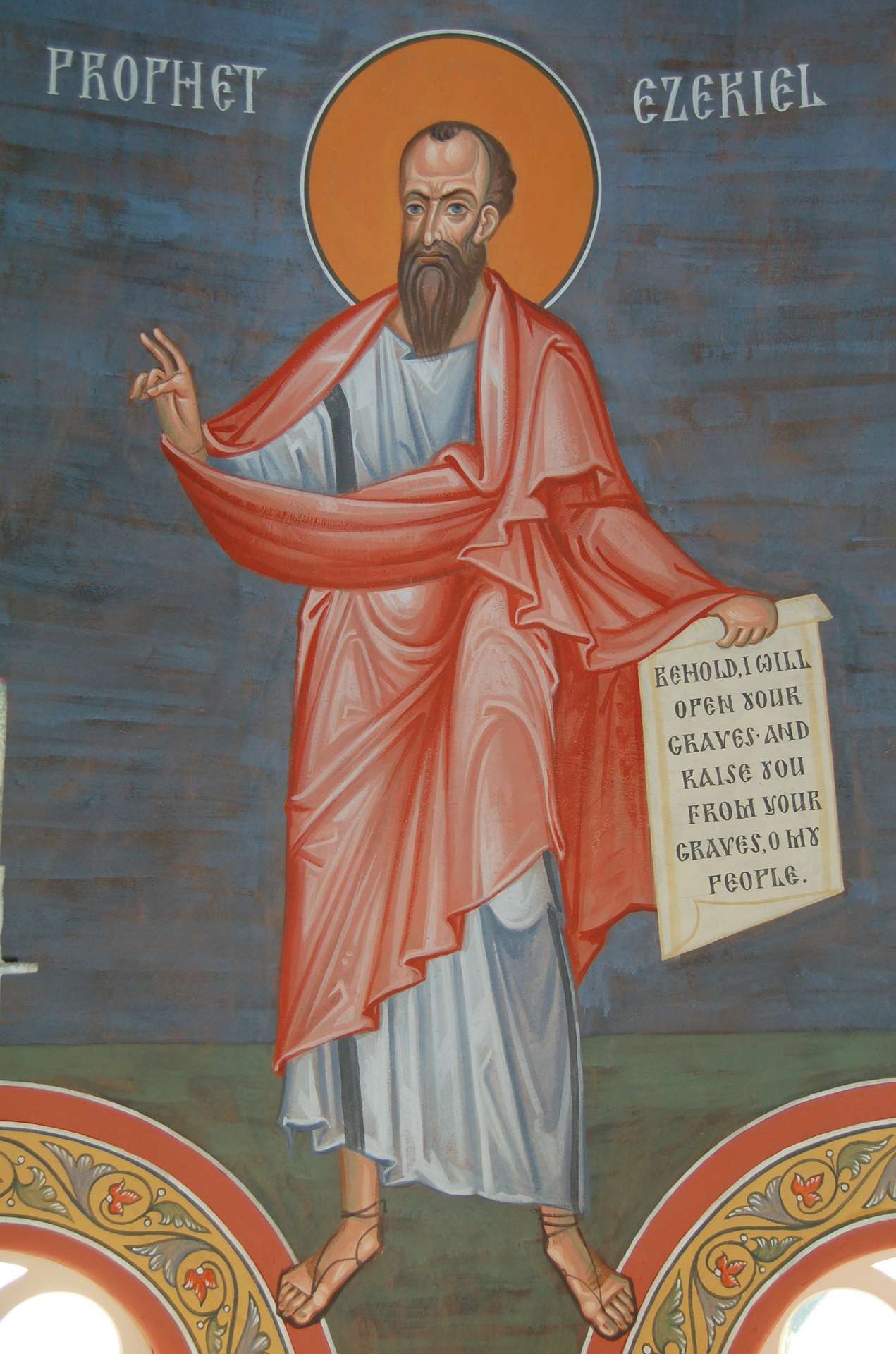
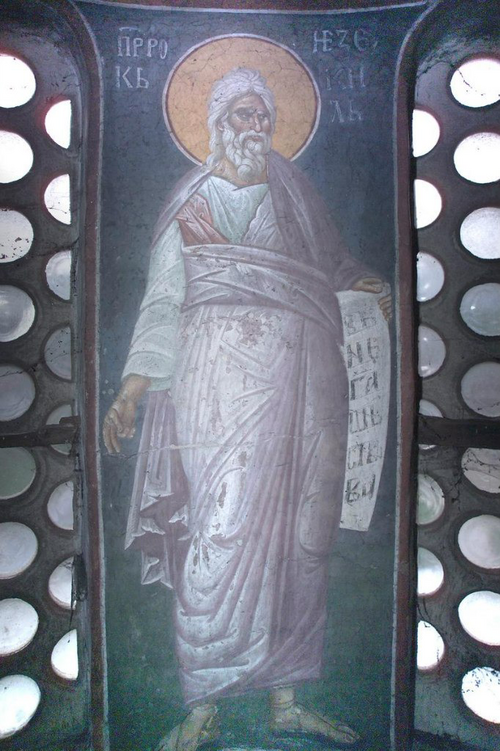
The Prophet Ezekiel , Fresco in the Serbian monastery of Gračanica, 14th century
Thus, Ezekiel reveals that the entire divine economy—from judgment to restoration—is a preparation for and a revelation of our Lord Jesus Christ, who is the true Glory, the true Shepherd, the Resurrection, and the Source of Life for the world.
29.2 God’s Judgment on the Nations; Future Blessings of a Faithful Covenant
God (25:1–48:35)
Prophecies of Judgment on the Nations (25:1–33:33)
Prophecies and Laments Against Canaanites (25:1–28:26)
God’s Glory Comes to a New Temple (40:1–48:35)
29.1 The Lord Is With Us. God Commissions Ezekiel and Gives Him Visions and
Prophecies Against Judah for Its Iniquity (1:1–24:27).
The Lord Is With Us
Coming Judgment on the Land of Judah (6:1–7:27)
29.2 God’s Judgment on the Nations; Future Blessings of a Faithful Covenant
God (25:1–48:35)
Prophecies of Judgment on the Nations (25:1–33:33)
Prophecies and Laments Against Canaanites (25:1–28:26)
God’s Glory Comes to a New Temple (40:1–48:35)
29.3 An Orthodox Insight into the Book of the Prophet Ezekiel
1. The Vision of the Divine Glory (The “Merkabah”)
2. The Shepherds and the One True Shepherd
4. The New Heart and the New Spirit
5. The Life-Giving River from the Temple
The Text: Ezekiel 44:1-3 (NKJV)
1. The Literal and Historical Context
Ascetical Understanding
Conclusion: Ezekiel as a Christ-Centered Book
- 29.1 The Lord Is With Us. God Commissions Ezekiel and Gives Him Visions and Prophecies Against Judah for Its Iniquity (1:1–24:27).
- 29.2 God’s Judgment on the Nations; Future Blessings of a Faithful Covenant God (25:1–48:35)
- 29.3 An Orthodox Insight into the Book of the Prophet Ezekiel
29.1 The Lord Is With Us. God Commissions Ezekiel and Gives Him Visions and
Prophecies Against Judah for Its Iniquity (1:1–24:27).
The Lord Is With Us
Coming Judgment on the Land of Judah (6:1–7:27)
- The Lord Is With Us
- God’s Judgment on the Nations; Future Blessings of a Faithful Covenant God (25:1–48:35)
Related Concepts
- cherubic-hymn
- covenant
- covenant-of-peace
- covenant-responsibility
- curses
- degeneration
- departure-of-glory
- divine-glory
- divine-wrath
- everlasting-covenant
- first-commandment
- firstfruits
- fulfillment
- good-shepherd
- holy-spirit
- hope
- idolatry
- ingathering
- jesus-prayer
- john-10
- judgment
- judgment-of-the-nations
- knowledge-of-god
- law
- love-of-god
- merkabah
- merkabah-vision
- messiah
- new-heart-of-flesh
- noah
- old-covenant
- pentecost
- people-of-god
- perpetual-virginity
- priesthood-covenant
- prophetic-ministry
- restoration
- resurrection
- romans-1
- second-commandment
- spiritual-stewardship
- temple
- transfiguration
- watchman
- wisdom-of-solomon
- witness-to-the-nations