Old Testament — Topic 28
JEREMIAH
Outline
1:1–20:18 The Lord Calls Jeremiah to Minister to Judah in a Degenerate Era
1:1–3:5 Jeremiah’s Call to Ministry and God’s Prosecution of Judah
3:6–6:30 Wicked Judah Must Repent or Perish
7:1–10:25 Judah’s Lamentable Hypocrisy Will Be Punished by the Matchless God
11:1–13:27 Doom on Covenant-Breaking Judah
14:1–15:21 God Is Implacable to Judge Corrupt Judah but Is Tender Toward His
Prophet
16:1–17:27 Warnings of God’s Judgment for Sin and Promises of Redemption
18:1–20:18 A Merciful God Will Bring Judgment on Intransigent Judah
21:1–39:18 Jeremiah’s Ministry to the Leaders in Judah Up Until the Fall of
Jerusalem
21:1–23:40 Jeremiah’s Messages to the Kings and Prophets of Judah
24:1–25:38 Judgment for Sin and Yet Restoration to Come
26:1–29:32 Persecutions and Prophecies of Jeremiah
30:1–33:26 Grace Will Reign in the End by a New Covenant and the Davidic King
34:1–36:32 The Evil Character and Future Doom of the People and Kings of Judah
37:1–39:18 Jeremiah Is Persecuted, Jerusalem Falls, King Zedekiah Is Blinded
and Exiled
40:1–52:34 Jeremiah’s Ministry After Jerusalem’s Fall, Prophecies Against the
Nations, Epilogue
40:1–45:5 Narrative of Jeremiah’s Ministry After Jerusalem’s Fall
46:1–52:34 Jeremiah’s Prophecies Against the Nations, Historical Epilogue
God Will Judge Apostate Judah but Will Bring Redemption Through a New Covenant and the Davidic Branch
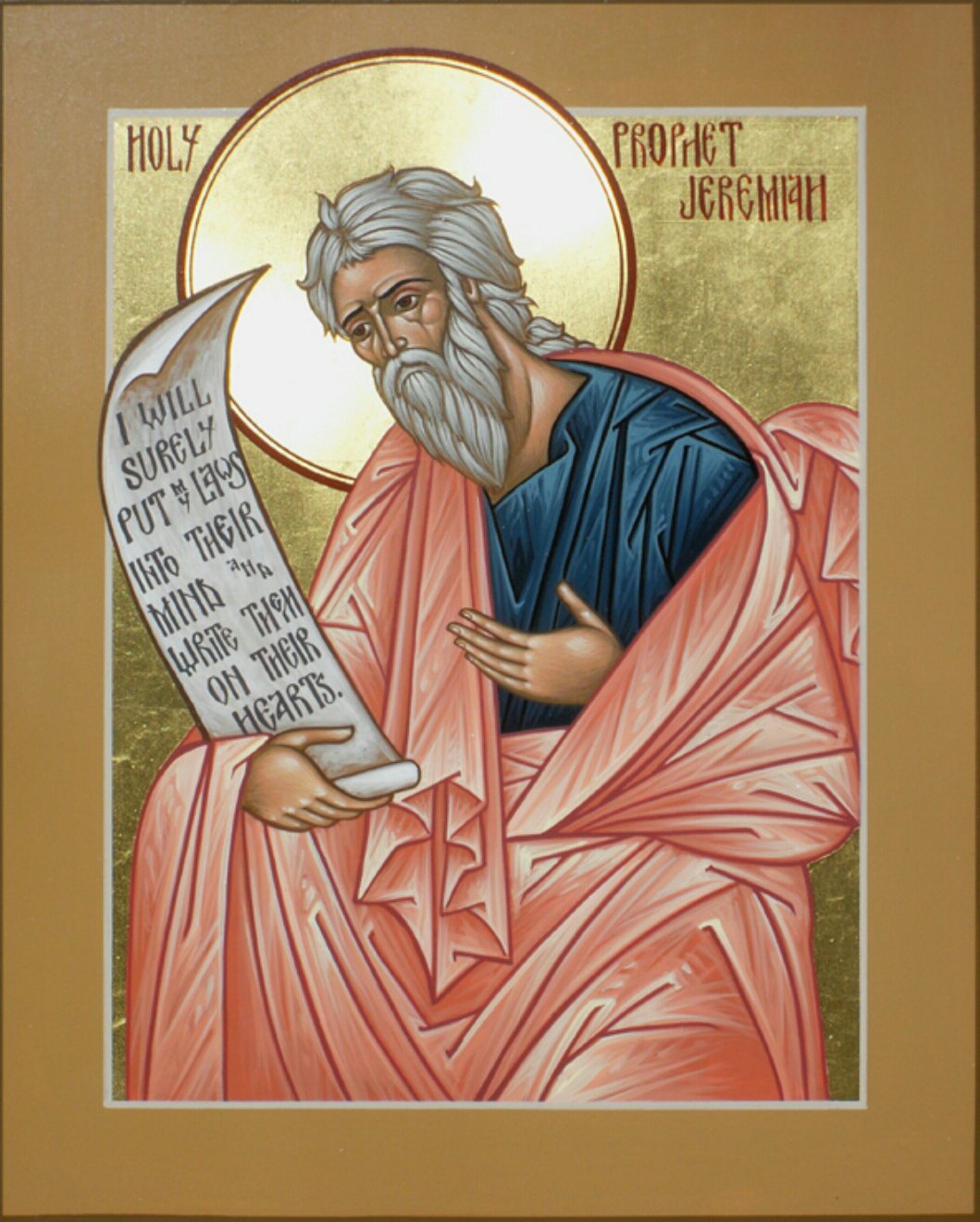
In the book of Jeremiah, God explains the epochal shift that takes place in the exile of his people, Judah. With the Northern Kingdom (Israel) already exiled over one hundred years prior, Judah alone remains with its temple and King in the late 600s BC. But Jeremiah demonstrates that Judah has become worse than Israel: the people are addicted to idolatry (2:28), sexual immorality (5:8), and exploitation of the poor (2:34). Although Jeremiah calls them to repentance, their stubborn refusal demonstrates that their hearts cannot repent (6:10; 18:12). The only course left for God is to bring the ultimate covenant curse of exile (Deut 28:63–65), which he does with righteous anger (Jer 6:11). But if God uproots and destroys, he will also build and plant (Jer 1:10; 31:28). God promises that after the exile, he will establish a new and better covenant, which will transform the people’s hearts (31:31–34). He also promises that he will restore the Kingdom under a righteous son of David (23:5–6). The book of Jeremiah thus sets a pattern of judgment unto restoration, a pattern that finds its climax in the death and resurrection of Jesus Christ.
The Lord Calls Jeremiah to Minister to Judah in a Degenerate Era (1:1–20:18)
This division shows the prophet not only as a messenger but as a person. His message is twofold: he is to uproot and overthrow, but also to build and to plant (1:10). This division (1:1–20:18) is dedicated to the first half of the message (judgment). In a series of visions and sermons, God exposes the people’s sin and need for judgment. But instead of repentance, the people only insist on their innocence and refuse to change (2:35; 7:24). Jeremiah delivers this message, but also wrestles with God’s purposes. The division ends with uncertainty about whether Jeremiah and Judah have a future, questions that the next unit takes up.
Jeremiah’s Call to Ministry and God’s Prosecution of Judah (1:1–3:5)
This section introduces the three main characters of the book: the prophet, the people, and YHWH. In the thesis statement of the book (1:10), YHWH commissions Jeremiah with a message of uprooting (judgment) and planting (restoration). The prophet is fearful of opposition, but YHWH assures him (1:18–19). YHWH then condemns his people for their flagrant spiritual adultery: as a faithful husband, YHWH liberated his people from Egypt and gave them a good land, but they have abandoned him to whore after other gods (2:13). Most grievous of all, they insist on their innocence (2:35). What future could this relationship possibly have?
Wicked Judah Must Repent or Perish (3:6–6:30)
Judah’s heart is desperately wicked, but 3:6–4:4 shows a path forward: repentance will lead to a glorious new beginning (3:14–18). But how can a hard-hearted people ever repent? Only if God himself heals their faithlessness, as he promises to do when they are in exile (3:22). The sequences in 4:5–6:30 then depict the sorrows leading up to exile: the complacent sinfulness prior to judgment (6:14), the sudden terror of an enemy attacking (4:19), and all the while a people hardened against repentance. The web of contradictions in such sinful hearts requires deeper exposition in the next section.
Judah’s Lamentable Hypocrisy Will Be Punished by the Matchless God (7:1–10:25)
The previous section hinted at a strange duality that this section develops: on the one hand, the people are confident of their standing before God and of their deliverance from their enemies. But they reject God, and God actually plans to hand them over to their enemies. God challenges them that the temple does not give them immunity from judgment (7:10). Chapters 8–9 then show the dismay and lamentation that will come when YHWH crushes the people’s false expectations. They pinned their hopes on powerless idols, which cannot save (10:1–16). But does this judgment mean that YHWH has been faithless to his covenant?
Doom on Covenant-Breaking Judah (11:1–13:27)
YHWH is about to judge Judah, who thinks she is immune from judgment because of God’s covenant with her. Now YHWH shows that for him to be faithful to the covenant he must enact justice for her flagrant defiance (11:1–13; compare Deut 28:15–68). Still, YHWH laments the terrible reversal of the marital love he and his people once shared (Jer 11:15; 12:7). The people were to be like a beautiful garment about his waist (13:11), but now they have disintegrated into tatters by their unshakable pride. Repentance is no more possible for them than for a leopard to change its spots (13:23); is there any way for her to avoid judgment?
God Is Implacable to Judge Corrupt Judah but Is Tender Toward His Prophet (14:1–15:21)
YHWH’s judgment is based on the people’s stubborn refusal to repent. But what if they did repent? In the midst of a drought, Jeremiah leads the people in a prayer of repentance, asking God not to forsake them (14:7–9). Surprisingly, YHWH refuses to accept their prayer (14:10), silences Jeremiah from further petitions on their behalf (14:11), and says that even if the greatest of prophets were to stand before him, he would not listen (15:1). They have passed the point of no return. Jeremiah objects to YHWH’s ways and the persecution he has endured, but YHWH insists on his obedience. The prophet’s relationship with God is on the verge of boiling over.
Warnings of God’s Judgment for Sin and Promises of Redemption (16:1–17:27)
The inevitability of judgment casts a dark shadow on the book. Jeremiah’s own life pictures Judah’s bleakness: while in the land, Jeremiah may not marry or have children, nor may he enter houses of feasting or mourning (16:1–13). And yet, even though Judah has no immediate future, there is a glimmer of light ahead, the restoration from exile (16:14–15). But this hope comes only after judgment (16:18), which cannot be bypassed. The people’s sin demands punishment: even when offered a clear choice between self-reliance and humble trust (17:5–8), between death and life (17:24–27), the people will always choose death. Their desperately wicked hearts (17:9) are about to be exposed.
A Merciful God Will Bring Judgment on Intransigent Judah (18:1–20:18)
This section brings three threads to a climax. First, the people’s stubborn hearts reject any offer of mercy that would require them to abandon their sin (18:12). They strive to silence and humiliate Jeremiah (18:18; 20:1–2). Second, on the basis of this final rejection, Jeremiah shows that the opportunity for repentance and mercy is now past: the once-soft clay of the people (18:6) has now hardened into a vessel of wrath that God will certainly break in pieces (19:10). Third, Jeremiah himself breaks down: he accuses God of deception and he curses the day of his birth (20:7, 14). Can there be a future for people or prophet?
Jeremiah’s Ministry to the Leaders in Judah Up Until the Fall of Jerusalem (21:1–39:18)
The previous division highlighted an apparently impossible dilemma: If Judah is incurably sinful and her whole society must be utterly dismantled, how can she possibly have a future? This division answers paradoxically that a future for Judah can only be found through judgment. Only those who accept judgment and go into exile will then be resurrected to a new beginning (21:9; 24:4–7). Jeremiah describes this restoration as a new-covenant order, which God will graciously inaugurate, where sin’s power and sin’s consequences are all reversed (chapters 30–33). What remains is to show what this message means for the nations and those left in the land after exile.
Jeremiah’s Messages to the Kings and Prophets of Judah (21:1–23:40)
The first twenty chapters emphasized the people’s hopeless sin and God’s inescapable judgment. Jeremiah faithfully proclaimed judgment, but has broken down in the end. Now an amazing reversal begins: Jeremiah reemerges, arguing that hope can be found, but only by accepting judgment (21:1–10). But the rulers will have none of this: the Kings continue to oppress (21:11–22:30), and the prophets falsely promise peace (23:9–40). Accordingly, YHWH dismantles them all. Yet for the line of David there is hope, but only on the other side of judgment (23:1–8). The chapters ahead will emphasize how judgment gives way to hope.
Judgment for Sin and Yet Restoration to Come (24:1–25:38)
Exile is coming. But is exile the end of Israel’s story? Astonishingly, the vision of the figs emphasizes that, in contrast with those who remain in Jerusalem, the exiles are the ones with a future! Just as crucifixion gives way to resurrection, those who are judged will be planted again in the land and receive new hearts (24:4–7), while those who remain in the land after the first deportation must still endure God’s wrath (24:8–10). Judgment must have its season: seventy years (symbolic for a lifetime; compare Ps 90:10) while Babylon reigns as God’s appointed instrument of wrath. But then Babylon too must drink its own poison. How then should God’s people live in this time?
Persecutions and Prophecies of Jeremiah (26:1–29:32)
Chapters 21–25 provided God’s timeline: judgment first, and then restoration. Now Jeremiah helps people live obediently in this plan. For those still in the land, they must capitulate to the King of Babylon and accept his authority (27:12). For those already in exile, they must accept the long duration of exile and put down roots in the foreign land (29:4–7). For those who obey in these ways, God will grant repentance and restoration (29:10–14). But many oppose this message: a violent King (26:23) and—confusingly for the people—other prophets who counter Jeremiah’s preaching (28:10–11). Yet God will vindicate his honor. Restoration—on God’s terms—draws near.
Grace Will Reign in the End by a New Covenant and the Davidic King (30:1–33:26)
After chapters filled with uprooting and destruction, Jeremiah preaches God’s glorious plan to build and plant his people forevermore (1:10; 31:28). Judgment needed to come first, and now we understand a redemptive motive: God judged not only out of justice, but also to bring to a close the old covenant, which was never able to overcome the power of sin (31:32). God will take the initiative to bring a new and better covenant, which will deal decisively with the reason for the old covenant’s ruin: the intractably wicked hearts of his people (31:33–34). In so doing, God will reverse every consequence of judgment (loss of King, of land, of joy—everything).
The Evil Character and Future Doom of the People and Kings of Judah (34:1–36:32)
Having painted the epic landscape of God’s plan for both judgment and restoration, Jeremiah returns to the present to deal with three possible responses. One response is counterfeit obedience, illustrated by King Zedekiah’s releasing the slaves only to take them back again (chapter 34). Another response is overt rebellion, illustrated by Jehoiakim’s burning the scroll (chapter 36). For all their outward differences, both of these are the same: they reject YHWH’s word through his prophet, and they will be judged. In contrast, the Rechabites remembered and honored their ancestor’s instructions, and they continue to obey him, just as Judah should have done for YHWH (chapter 35). This alone is the path of blessing; which will Judah choose?
Jeremiah Is Persecuted, Jerusalem Falls, King Zedekiah Is Blinded and Exiled (37:1–39:18)
Having provided three object lessons (chapters 34–36), Jeremiah narrates the final days of Jerusalem’s siege, showing Zedekiah’s tragic failure to heed these lessons. Jeremiah offers Zedekiah a path of hope: if he surrenders to Nebuchadnezzar, he and his household will live (38:17). But Zedekiah is ruled by fear. In his weakness, he allows Jeremiah to be thrown in a cistern, and Jeremiah is only rescued when a brave foreigner, Ebed-melech, intervenes (38:7–13). The result of Zedekiah’s fear is death: Jerusalem falls, Zedekiah’s children are murdered, and the people are exiled (chapter 39). But Jeremiah remains in the land, and the next section tells his story.
Jeremiah’s Ministry After Jerusalem’s Fall, Prophecies Against the Nations, Epilogue (40:1–52:34)
This division seals the message of uprooting and planting found in the previous two units. First, chapters 40–44 show that not even the Babylonian scourge can reverse the sin of Judah’s heart, as the people continue to reject the prophet in their flight to Egypt. Second, chapters 46–51 demonstrate God’s impartiality: the nations will also experience the wrath that Judah experienced, especially Babylon, the very agent of Judah’s demise. Chapter 52 concludes the book by indicating that Jeremiah’s prophecy of doom has come about, which excites hope that his prophecy of restoration will soon arrive. This fulfillment came through Jesus Christ, whose blood secured the new covenant (Luke 22:30).
Narrative of Jeremiah’s Ministry After Jerusalem’s Fall (40:1–45:5)
Will all the horrors of Jerusalem’s fall be sufficient to change the people’s hearts? Chapters 40–44 narrate a sordid sequence of one atrocity after another among the few people who remain in the land. Gedaliah, the governor appointed by Babylon, is murdered, along with other innocent people (41:1–7). The murderers are chased away, and the remaining people make a pretense of seeking YHWH’s will (42:1–6). But when Jeremiah tells them to remain the land, again fear triumphs and they flee to Egypt. There we leave Jeremiah, whose final action is to confront ongoing idolatry (chapter 44). Punishment alone will not change Judah; YHWH must do something new.
Jeremiah’s Prophecies Against the Nations, Historical Epilogue (46:1–52:34)
At the outset of the book, Jeremiah was made a prophet over “nations and Kingdoms” (1:10). But to this point, almost all of his words have been for Judah. Now he preaches against the nations the same message of judgment. Babylon itself will fall! God shows no partiality. Jeremiah even hints of a redemptive future for these nations following their judgment, just as there was for Judah (e.g., 48:47). The final narrative chapter (chapter 52) is significant: Jeremiah’s prophecies of judgment have become historical reality. Now the stage is set for his restoration prophecies to come about too, which they one day do, in the work of God the Son, Jesus Christ.
28.1 God Will Judge Apostate Judah but Will Bring Redemption Through a New
Covenant and the Davidic Branch
Wicked Judah Must Repent or Perish (3:6–6:30)
Doom on Covenant-Breaking Judah (11:1–13:27)
Persecutions and Prophecies of Jeremiah (26:1–29:32)
The Book of Jeremiah presents a powerful and poignant narrative, not merely of a prophet warning of impending doom, but of a suffering servant whose life and message become a living icon of Jesus Christ. For the Orthodox Church, Jeremiah is the prophet of the heart , the herald of the New Covenant, and a preeminent type of the Lord’s own suffering and compassion. His book is fundamentally Christ-centered because it diagnoses the terminal illness of the Old Covenant and prescribes its only cure: the grace and truth incarnate in the Messiah.
1. Jeremiah as a Type of the Suffering Christ
Jeremiah’s personal sufferings prefigure the Passion of Christ in a strikingly detailed manner. He is the “prophet like unto me” whom Moses foretold (Deuteronomy 18:15), embodying in his own life the rejection that the ultimate Prophet would face.
- Rejection by His Own People:
- Text: “For even your brothers, the house of your father, Even they have dealt treacherously with you…” (Jeremiah 12:6, NKJV). He was plotted against by his own townsmen (Jeremiah 11:18-23).
- New Testament Fulfillment: Christ was rejected in His own hometown and ultimately by His own people: “He came to His own, and His own did not receive Him” (John 1:11).
- Being Plotted Against and Arrested:
- Text: Jeremiah was arrested, beaten, and imprisoned by the priests and false prophets (Jeremiah 20:1-2; 37:15-16).
- New Testament Fulfillment: Christ was arrested by the temple guards, beaten, and tried before the high priest and the Sanhedrin (Matthew 26:57-68).
- The Lamenting Weeping Prophet:
- Text: Jeremiah is known as the weeping prophet, author of the Book of Lamentations, mourning the fate of Jerusalem: “Oh, that my head were waters, And my eyes a fountain of tears, That I might weep day and night For the slain of the daughter of my people!” (Jeremiah 9:1, NKJV).
- Christological Fulfillment: Christ embodies this divine sorrow, weeping over Jerusalem: “O Jerusalem, Jerusalem… How often I wanted to gather your children together, as a hen gathers her chicks under her wings, but you were not willing!” (Luke 13:34, NKJV). His tears at the tomb of Lazarus (John 11:35) reveal the God who enters into human grief.
- Ascetical Understanding: Jeremiah’s life teaches that true prophecy and communion with God often involve sharing in His sufferings. The Christian ascetical life involves “the fellowship of His sufferings” (Philippians 3:10). When we are misunderstood, rejected for our faith, or weep over the sin and brokenness of the world, we participate in the same prophetic spirit of Jeremiah and, ultimately, in the compassion of Christ.
- Jeremiah as the “Suffering Servant”. Jeremiah 11:19 (NKJV):
“But I was like a docile lamb brought to the slaughter; and I did not know that they had devised schemes against me, saying, ‘Let us destroy the tree with its fruit, and let us cut him off from the land of the living, that his name may be remembered no more.’”
This verse is part of Jeremiah’s personal lament. He had been faithfully proclaiming God’s message, which included condemning the idolatrous covenant- breaking of his people (Jeremiah 11:1-17). In response, the men of his own hometown, Anathoth, conspired to kill him to silence his prophetic voice (Jeremiah 11:18-23). This verse is his prayerful reflection on their plot.
a. The Typology: “A Docile Lamb Brought to the Slaughter”
This is the central Christological image of the verse.
- Innocence and Voluntary Submission: Jeremiah describes himself as a “docile” or “gentle” lamb. This emphasizes his innocence regarding the plot (“I did not know”) and his non-resistant posture in the face of violence. He does not fight back or flee with fury, but endures the betrayal with a spirit of submission to God’s will.
- Christological Fulfillment: This imagery finds its ultimate and perfect fulfillment in Jesus Christ, the Lamb of God.
- The Silent Lamb: The Prophet Isaiah describes the Messiah as one who “was led as a lamb to the slaughter, and as a sheep before its shearers is silent, so He opened not His mouth” (Isaiah 53:7). This was fulfilled during the Passion when Jesus, before Herod and Pilate, offered no defense (Matthew 27:12-14, Luke 23:9).
- The Precious Lamb: St. John the Baptist identifies Jesus explicitly as “Behold! The Lamb of God who takes away the sin of the world!” (John 1:29, 36). The entire Paschal narrative is framed by this identity.
- The Voluntary Sacrifice: Christ’s submission was not passive weakness but active, voluntary obedience. He said, “No one takes [my life] from Me, but I lay it down of Myself” (John 10:18). Jeremiah’s docility is a pale shadow of Christ’s divine, self-emptying love (kenosis) on the Cross.
b. The Malice of the Conspirators: “Let Us Destroy the Tree… Cut Him Off”
The words of the conspirators reveal a hatred that seeks not just murder, but total obliteration.
- “Let us destroy the tree with its fruit”: This signifies a desire for complete annihilation—to destroy not just the prophet, but his legacy, his influence, and any “fruit” (disciples, future generations) that might come from him.
- “Let us cut him off from the land of the living, that his name may be remembered no more”: This was the ultimate curse in the ancient world: to be utterly erased from memory. This mirrors the plots against Christ, where the chief priests and Pharisees sought not just to kill Jesus, but to quash His movement (see John 11:48-50, “If we let Him alone like this… the Romans will come and take away both our place and nation.”).
- The Divine Irony: The conspirators’ plan backfired spectacularly, both for Jeremiah and for Christ. They sought to make Jeremiah’s name forgotten, yet his prophecy is immortalized in Scripture. They sought to erase Jesus, “cutting Him off” by crucifixion, but God raised Him from the dead and “gave Him the name which is above every name” (Philippians 2:9). The name they sought to destroy is now glorified for all eternity in every Divine Liturgy.
c. Patristic and Liturgical Understanding
The Church Fathers saw this verse as a direct prophecy of the Passion.
- St. Jerome , in his commentary on Jeremiah, explicitly connects the plot of the men of Anathoth to the conspiracy of the Jews against Christ. He writes that the prophet’s suffering prefigures the greater suffering of the Lord.
- Liturgical Use: While not as prominent as the “Man of Sorrows” from Isaiah 53, the imagery of the silent, slaughtered lamb is the very heart of Orthodox worship. The entire Divine Liturgy is centered on the one, eternal sacrifice of the “Lamb of God who takes away the sin of the world.” The priest prepares the Eucharistic gifts with a lance, recalling the piercing of Christ’s side, while saying, “The Lamb of God is sacrificed.” The prayer before Communion echoes the words of John the Baptist. In this liturgical context, Jeremiah’s experience is understood as a participation in the prototype of all righteous suffering: the Passion of Christ.
d. Ascetical Understanding
For the individual Christian, this verse provides a profound model for spiritual warfare and enduring injustice.
- The Call to Non-Retaliation: Jeremiah’s “docile” response is a prefiguration of Christ’s command: “But I tell you not to resist an evil person. But whoever slaps you on your right cheek, turn the other to him also” (Matthew 5:39). The ascetical struggle is to conquer the passion of anger and the desire for revenge, replacing it with forgiveness and trust in God’s ultimate justice.
- Sharing in the Sufferings of Christ: When a believer is betrayed, misunderstood, or persecuted for their faithfulness, they are called to unite their suffering to Christ’s. As St. Paul said, “I now rejoice in my sufferings for you, and fill up in my flesh what is lacking in the afflictions of Christ” (Colossians 1:24). Jeremiah’s experience teaches that suffering for righteousness’ sake is not a sign of God’s abandonment but a participation in the path of the Cross.
- Trust in Divine Vindication: The core of Jeremiah’s lament is not despair, but a plea to God (Jeremiah 11:20, “But, O LORD of hosts, You who judge righteously…”). The ascetical lesson is to follow this model: when faced with unjust schemes, we do not take judgment into our own hands but entrust ourselves and our cause to the God who “judges righteously” (1 Peter 2:23).
So,**** Jeremiah 11:19 is a diamond of messianic prophecy, capturing in a single verse the essence of the innocent, suffering servant. It reveals:
Christ as the Docile Lamb , silently accepting death for the salvation of the world.
The Futility of evil , as the plots of men are overturned by God’s redemptive power.
The Christian Vocation , to follow the Lamb with docility, entrusting our lives to the Father, especially when we are called to bear the cross of injustice. In Jeremiah’s suffering, we see a reflection of our Lord’s, and in his ultimate vindication, we find our hope.
2. The New Covenant: The Heart of the Book and of the Gospel
The most explicit and glorious messianic prophecy in Jeremiah is the promise of a New Covenant, which forms the very foundation of the Christian faith.
- The Prophecy of the New Covenant:
- Text: “Behold, the days are coming, says the LORD, when I will make a new covenant with the house of Israel and with the house of Judah… I will put My law in their minds, and write it on their hearts; and I will be their God, and they shall be My people… For I will forgive their iniquity, and their sin I will remember no more.” (Jeremiah 31:31-34, NKJV).
- New Testament Fulfillment: This is the central text of the New Testament. At the Last Supper, Christ explicitly fulfills it: “This cup is the new covenant in My blood, which is shed for you” (Luke 22:20). The Epistle to the Hebrews quotes this passage in full (Hebrews 8:8-12; 10:16-17) to demonstrate that Christ is the Mediator of a superior, final covenant that supersedes the old.
- Patristic and Sacramental Understanding: The Fathers, such as St. Cyril of Alexandria, taught that this “writing on the heart” is the work of the Holy Spirit at baptism and chrismation. The external, stone-written law is replaced by the internal, grace-empowered law of love. The promise “I will remember their sin no more” is actualized in the Sacrament of Confession , where God’s forgiveness is personally applied.
- Ascetical Understanding: The New Covenant calls for an internal asceticism. The struggle is not merely to follow external rules but to allow the Holy Spirit to purify the very source of our thoughts and actions—the heart (kardia). The goal is theosis , the healing and deification of the entire human person, so that God’s law becomes our natural will.
3. The Righteous Branch: The Messianic King
Jeremiah prophesies the coming Messiah from the line of David, who will execute perfect justice and righteousness.
- The Text: “Behold, the days are coming, says the LORD, That I will raise to David a Branch of righteousness; A King shall reign and prosper, And execute judgment and righteousness in the earth. In His days Judah will be saved, And Israel will dwell safely; Now this is His name by which He will be called: THE LORD OUR RIGHTEOUSNESS” (Jeremiah 23:5-6, NKJV; see also 33:15-16).
- Christological Fulfillment: Christ is this “Branch” (Anatole in the Septuagint, translated as “Dayspring” or “Branch” in Luke 1:78). He is the righteous King, the Son of David. The name “THE LORD OUR RIGHTEOUSNESS” is a stunning declaration of Christ’s divinity and His work of justification. We have no righteousness of our own; He Himself is our righteousness (1 Corinthians 1:30).
4. The Broken Cisterns and the Fountain of Living Water
Jeremiah diagnoses the human condition with a powerful metaphor that Christ Himself will complete.
- The Text: “For My people have committed two evils: They have forsaken Me, the fountain of living waters, And hewn themselves cisterns—broken cisterns that can hold no water.” (Jeremiah 2:13, NKJV).
- New Testament Fulfillment: Christ fulfills this image perfectly. He declares Himself to be the true fulfillment of this longing: “If anyone thirsts, let him come to Me and drink. He who believes in Me, as the Scripture has said, out of his heart will flow rivers of living water.” (John 7:37-38). He is the Fountain of living water, the Holy Spirit, which He gives to the faithful.
- Ascetical Understanding: This is a core theme of Orthodox spirituality. The “broken cisterns” represent the passions —wealth, pleasure, fame, power—to which we turn for fulfillment, only to find them empty and leaking. The ascetical life is the process of repenting from digging these broken cisterns and turning back to the one true Fountain of Living Water , God Himself, through prayer, the sacraments, and the cultivation of virtue.
 Conclusion: Jeremiah as a Christ-Centered Book
The Book of Jeremiah is a profound journey from the failure of the Old Covenant to the promise of the New. It is Christ-centered because:
- The Prophet’s Life prefigures Christ’s rejection and compassionate suffering.
- The Prophet’s Central Message is the New Covenant, inaugurated by Christ’s blood and applied by the Holy Spirit.
- The Prophet’s Hope is the Righteous Branch, the Lord our Righteousness, who is Jesus Christ.
- The Prophet’s Diagnosis of the human heart finds its cure in Christ, the Fountain of Living Water.
Jeremiah shows us that God’s response to the failure of His people is not abandonment, but a deeper, more intimate, and eternal covenant established in the Person of His own Son. In the tears of Jeremiah, we hear the compassion of Christ; in his prophecies, we see the blueprint of our salvation.
The Holy Prophet Jeremiah. Fresco of the Church of St. Nicholas in the Monastery Curtea de Argeș (Romania) The 14th century
LAMENTATIONS
Outline
1:1–22 First Dirge: The Destruction of Jerusalem
1:1–11 A Description of the Destruction of Jerusalem
1:12–17 Jerusalem Cries Out for Comfort
1:18–22 Jerusalem Confesses Its Sin
2:1–22 Second Dirge: God’s Judgment on Jerusalem
2:1–9 The Lord’s Hostility Against Jerusalem
2:10–13 Jerusalem’s People Suffer
2:14–17 False Prophets, Enemies, and Jerusalem
2:18–22 Jerusalem Tearfully Prays to the Lord
3:1–66 Third Dirge: One Man in Jerusalem Struggles Through to Hope
3:1–21 One Man Describes His Misery
3:22–39 One Man Finds Hope
3:40–66 One Man Urges and Models Prayer
4:1–22 Fourth Dirge: The Lamentations of the People
4:1–11 Jerusalem Remembers Better Times
4:12–20 The Results of Jerusalem’s Sin
4:21–22 The Coming Results of Edom’s Sin
5:1–22 Fifth Dirge: Jerusalem Suffers Because of Its Sin and Yet Pleads for
Divine Mercy
5:1–14 The Many Sufferings of the People of Jerusalem
5:15–18 Jerusalem Confesses Its Sins
5:19–22 Jerusalem Pleads With the Lord for Restoration

Rembrandt J eremiah lamenting the destruction of Jerusalem
From Mourning to Hope
Lamentations consists of five poetical dirges mourning the Babylonians’ destruction of Jerusalem (or “Zion”) in the sixth century BC. It was written by an eyewitness of the event, possibly the prophet Jeremiah. The first four dirges are Hebrew acrostics. This literary form suggests the totality of Jerusalem’s suffering: everything “from A to Z” has been devastated. Three of the five dirges begin with the Hebrew word for “how” (1:1; 2:1; 4:1), highlighting the vast extent of Jerusalem’s suffering and leading the editors of the Hebrew Bible to title the book “How.”
- The first dirge describes the city’s desolation with a kaleidoscope of excruciating images (1:1–22).
- The second dirge focuses more on the origin of the desolation: God’s punitive anger (2:1–22).
- In the third dirge one citizen finds hope by reflecting on Yahweh’s loyal love, and he urges his compatriots to repent and wait for restoration (3:1–66).
- The fourth dirge returns to the horrors of Jerusalem’s punishment, with special emphasis on the sins of the city’s spiritual leaders (4:1–22).
- The chapter’s closing announces that Zion’s suffering will end. This prepares the way for the final dirge, a contrite plea to Yahweh to deliver his people (5:1–22).
Though Lamentations’ five poems are not linked tightly to each other, the book’s overall movement is from the anguish of judgment to hope for restoration by means of repentance and reliance on God. The lengthy third chapter captures this process most thoroughly and provides a lens through which to read the whole book. Despite its heavy tone, Lamentations mirrors the Bible’s story of salvation from judgment by God’s grace.
First Dirge: The Destruction of Jerusalem (1:1–22)
Lamentations 1 begins the book with a jolt, launching immediately into the agony of Jerusalem’s destruction. Verses 1–11 describe how the city has been devastated socially, emotionally, militarily, and physically. Three statements trace the suffering to Jerusalem’s sinfulness (1:5, 8, 9). Two brief prayers for deliverance (1:9, 11) punctuate this section and prepare for the remainder of the chapter, where the city itself is the primary speaker. In 1:12–17 Jerusalem cries out for comfort, calling on passers-by to consider its unique sorrow under the wrath of God. Verses 18–22 confess to Yahweh Jerusalem’s rebellion and ask him to punish its enemies for their own sins. Chapter 2 further details God’s anger against his people’s sins.
A Description of the Destruction of Jerusalem (1:1–11)
This opening passage depicts Jerusalem’s suffering in excruciating detail. The city is bereft of people, enslaved, overcome with grief, and betrayed. The entire tribe of Judah has been carted off into exile, while the roads and gates into Jerusalem lie empty. Such defeat has come as divine judgment for the city’s abundant rebellion. Jerusalem’s leaders have lost their power, and all the people suffer humiliation because of their defiling behavior. They ask Yahweh to look on their affliction. Enemy nations have invaded even the temple. The people are starving and again ask the Lord to take note. The city speaks at length in the next passage.
Jerusalem Cries Out for Comfort (1:12–17)
Whereas in the previous passage Jerusalem spoke in two brief prayers for deliverance (1:9, 11), the present passage consists almost entirely of words of the personified city. The addressee of these words, however, is not God but people observing the city’s anguish. Jerusalem urges them to recognize that its sorrow is unparalleled. The source of the irresistible calamity is Yahweh’s anger, but the city freely admits that its own sins are the cause. Its armies have been unable to defend the capital from divinely appointed adversaries. Jerusalem weeps inconsolably at the desolation of its inhabitants. Verse 17 elaborates on this comfortless condition before the next passage expands on the theme of confession.
Jerusalem Confesses Its Sin (1:18–22)
Continuing the approach of 1:12–17, personified Jerusalem bemoans its misery. Yahweh has been righteous in judging its rebellion so severely. Former allies have abandoned Jerusalem, so the city is cast on the Lord alone. The city is deeply distressed in pondering the excessiveness of its sin. Confession is mingled with entreaty as Jerusalem complains that her enemies are happy about its punishment. The chapter closes with a prayer that Yahweh would bring on these enemies the judgment they deserve for their own evildoing. This points forward to relief before the second dirge resumes the lamenting with even stronger passion.
Second Dirge: God’s Judgment on Jerusalem (2:1–22)
Lamentations 1 identified Yahweh as the origin of Jerusalem’s suffering, but chapter 2 concentrates primarily on this theological point. Verses 1–9 depict the Lord as actively hostile against the city, bringing in foreign powers to crush his people. Verses 10–13 describe the effect of the invasion on the people, focusing on the heartbreaking plight of mothers and their children. The next passage, 2:14–17, indicts false prophets for misleading the people and recounts the joy of Jerusalem’s enemies as part of Yahweh’s punishment. Finally, urged by the speaker, the tearful city pleads for mercy from its angry God. Chapter 3 goes on to encourage more such praying.
The Lord’s Hostility Against Jerusalem (2:1–9)
Following up on various statements in chapter 1 (especially 1:12‒15), this passage introduces chapter 2 with a painful exposition of Yahweh’s righteous wrath as the origin of Jerusalem’s suffering. The first three verses alone feature four occurrences of wrath terminology. After some general statements of God’s destruction of his prized city, this destruction is described in terms of a flaming fire and a deadly bow. Yahweh actually took up the role of an enemy against his people. He destroyed his own temple and brought worship gatherings to an end. Jerusalem’s protective wall was also demolished. Its civil and spiritual leaders could no longer provide direction. Thus, Jerusalem is devastated and leaderless, and the next passage summarizes the harrowing implications for the city’s inhabitants.
Jerusalem’s People Suffer (2:10–13)
The preceding passage described how God poured out his wrath on Jerusalem, and these verses explore the agony this brought on those remaining in the city. Old men and young women mourn in humiliation. The speaker himself is distraught with grief. The smallest of children are dying from starvation, and their mothers have no food to give them. Nor can the speaker say anything to comfort Jerusalem as it suffers such profound depredation.
False Prophets, Enemies, and Jerusalem (2:14–17)
This passage deals with two groups of people and their negative impact on Jerusalem. First it asserts that the prophets proclaimed false visions instead of exposing the people’s sins. Then it speaks of the enemies of Jerusalem. Passers-by mock as they witness the reversal of Jerusalem’s fortunes, while the city’s attackers gloat as they look on their vanquished foe. The last verse presents the message that the prophets should have preached and also the ultimate explanation for the victory of Jerusalem’s enemies: Yahweh’s determination to judge his people.
Jerusalem Tearfully Prays to the Lord (2:18–22)
Prayer is the proper response to the anguish detailed in this dirge. Thus, the speaker urges Jerusalem to give full vent to its sorrow and to pour out its heart to God, especially on behalf of the city’s starving children. Jerusalem then begins pleading with the Lord to look on the despondency of various categories of people. In keeping with the emphasis of the chapter, the prayer traces all the destruction to Yahweh’s anger. It ends without resolution or an assurance of deliverance. But the assumption is that since God is the source of the suffering, he alone can relieve it. This fact spurs the reader to continue into the next chapter in search of hope.
Third Dirge: One Man in Jerusalem Struggles Through to Hope (3:1–66)
This chapter is unique in several ways. First, it is three times as long as Lamentations’ other chapters. Second, its Hebrew acrostic is more complex: each passage consists of a triplet, and each line of the triplet begins with the same letter of the alphabet. Third, rather than centering on the suffering of Jerusalem as a whole, chapter 3 records in first person the experience of one man living in the city, likely the same person as the speaker throughout the book. Fourth and most importantly, though the man bemoans his affliction, he finds his hope renewed as he calls to mind the character of Yahweh. In 3:1–21 he describes his bitter affliction and hopelessness, yet the direction changes dramatically at the end of this passage. Verses 22–39 then explain the turning point: the speaker meditates on God’s benevolent disposition and is assured that the Lord will yet restore his people. Finally, the man urges his fellow citizens to repent and cast themselves on Yahweh for deliverance, and his own prayer serves as an inspiring model for them (3:40–66). This keeps hope alive as chapter 4 refocuses on Jerusalem’s suffering.
One Man Describes His Misery (3:1–21)
Speaking in first person, a man in Jerusalem details his own suffering at the destruction of the city. The angry God has repeatedly afflicted him. The man describes this experience with a raft of graphic images. Worst of all, the Lord refuses to hear his prayers (3:8). The man has no endurance or hope left (3:18). Surprisingly, however, he finds enough strength to pray again (3:19). He affirms that he has hope after all (3:21), but the explanation is not given until the next section.
One Man Finds Hope (3:22–39)
The hope that surfaced in 3:21 finds its source in various divine attributes that speak to Yahweh’s constant disposition of benevolence toward his people. The speaker is so convinced of God’s goodness that he concludes it is good for Jerusalem’s youth to bear the yoke of exile. They should humbly submit to Yahweh’s judgment and wait for his restoration. In time the Lord will have compassion because judgment is not his innermost desire. He also disapproves of unjust behavior by those in positions of power. Nevertheless, he has ordained the present calamity as punishment for the sins of his people, so they should not resist it.
One Man Urges and Models Prayer (3:40–66)
Having encouraged the people of Jerusalem with the truth of Yahweh’s goodness, the speaker exhorts them to confess their sins and cry out for restoration. He even gives them the words to pray, though he is overcome with emotion in view of their desperate condition. Beginning at 3:52, the speaker records a prayer of his own, one that recounts a past experience of answered prayer. This should motivate his fellow citizens to pray about their own needs. The chapter closes with a spirit of God-reliant confidence that reverses the opening atmosphere of dejection. This sets the stage for devastated Jerusalem to experience hope through the remaining chapters.
Fourth Dirge: The Lamentations of the People (4:1–22)
After chapter 3 details the hopeful experience of one man in Jerusalem, chapter 4 widens back out to the pitiful state of the city as a whole. Verses 1–11 emphasize the contrast between Jerusalem’s past blessings and its present devastation. Divine punishment has utterly reversed the condition of everyone in the city, including children, princes, and mothers. Verses 12–20 specify further results of Jerusalem’s sins. Because they are guilty of bloodshed, the city’s spiritual leaders are roundly rejected as unclean. The people have nowhere to turn for help as their enemies overtake them. The chapter closes with an abrupt shift toward hope, however. Verses 21–22 predict the punishment of Edom, one of Jerusalem’s enemies, and deliverance for God’s beloved city. This sets the stage for chapter 5’s extended prayer for restoration.
Jerusalem Remembers Better Times (4:1–11)
The opening word, “how,” signals a move from the personal account of chapter 3 back to a collective description of Jerusalem (compare 1:1; 2:1). Verses 1–11 concentrate on the difference between Jerusalem’s happy past and sorry present. Its formerly prized citizens are worthless now. Jerusalem’s children unsuccessfully beg for food. The wealthy are reduced to poverty. Those known for attractiveness and health suffer humiliating deprivation. Mothers are so hungry that they eat their own children. These ghastly reversals are owing to the unleashing of God’s wrath, more severe than his ancient punishment of Sodom.
The Results of Jerusalem’s Sin (4:12–20)
This passage catalogs additional consequences of Jerusalem’s rebellion against the Lord. People the world over are surprised that the great city has fallen to its enemy. Jerusalem’s spiritual leaders come into view as a major cause of the problem. They shed the blood of righteous people. This has made them defiled and detestable, and they are repudiated by everyone far and near. Meanwhile, Jerusalem waits in vain for an ally nation to bring deliverance. Enemy forces invade the city and overtake runaways, including the king.
The Coming Results of Edom’s Sin (4:21–22)
These two verses bring a surprising conclusion to the chapter. The previous passage emphasized the irresistible victory of Jerusalem’s enemies. Suddenly, however, the text asserts that one of those enemies—Edom—will itself face God’s wrath against its own sins. At the same time, Jerusalem is assured that its punishment will end. Thus, as in chapter 3, mourning gives way to hope.
Fifth Dirge: Jerusalem Suffers Because of Its Sin and Yet Pleads for Divine Mercy (5:1–22)
Lamentations’ final dirge has several distinctive features. First, unlike the other chapters that concentrate on the collective suffering of Jerusalem, it does not begin with the exclamation “how” (compare 1:1; 2:1; 4:1). This coheres with the second feature: instead of being a description of destruction with prayer intermingled, the entire chapter is a prayer. Third, though it contains the same number of verses as the number of letters in the Hebrew alphabet, chapter 5 is the only one in the book not structured as an acrostic. This freer form suits the highly emotive tone of the chapter. Verses 1–14 rehearse the abundant sufferings of Jerusalem. Verses 15–18 center on a confession of the people’s sin. Finally, 5:19–22 pleads desperately for restoration. The text does not record a response to the prayer, but the book’s overall thrust leaves the reader expecting Yahweh to show mercy to his people.
The Many Sufferings of the People of Jerusalem (5:1–14)
The opening address to Yahweh indicates that this passage is a prayer. The people of Jerusalem implore the Lord to take note of their suffering. They list multiple examples of that suffering, reminiscent of examples recounted throughout the book. These include financial catastrophe, family devastation, enslavement, rape, and torture. Individuals of all ages and social strata have been ravaged. Verse 7 traces the people’s misery to wrong alliances made by their ancestors.
Jerusalem Confesses Its Sins (5:15–18)
Jerusalem’s inhabitants continue describing their affliction, but in more general terms than 5:1–14. The focus is not so much on the destruction itself but on the resulting emotional turmoil. At the heart of the passage is the people’s straightforward confession of their own sins (5:16). This provides a counterpoint to their earlier bemoaning of their ancestors’ sins (5:7).
Jerusalem Pleads With the Lord for Restoration (5:19–22)
This passage brings Lamentations to an impassioned close as the people of Jerusalem make their final plea to Yahweh. They express faith in his sovereignty, appeal to his compassion, and cry out for restoration. The concluding verse indirectly appeals to his covenant loyalty. Even though the book does not add an assurance of restoration at this point, earlier portions—especially 3:21–33—clearly point in the direction of hope.
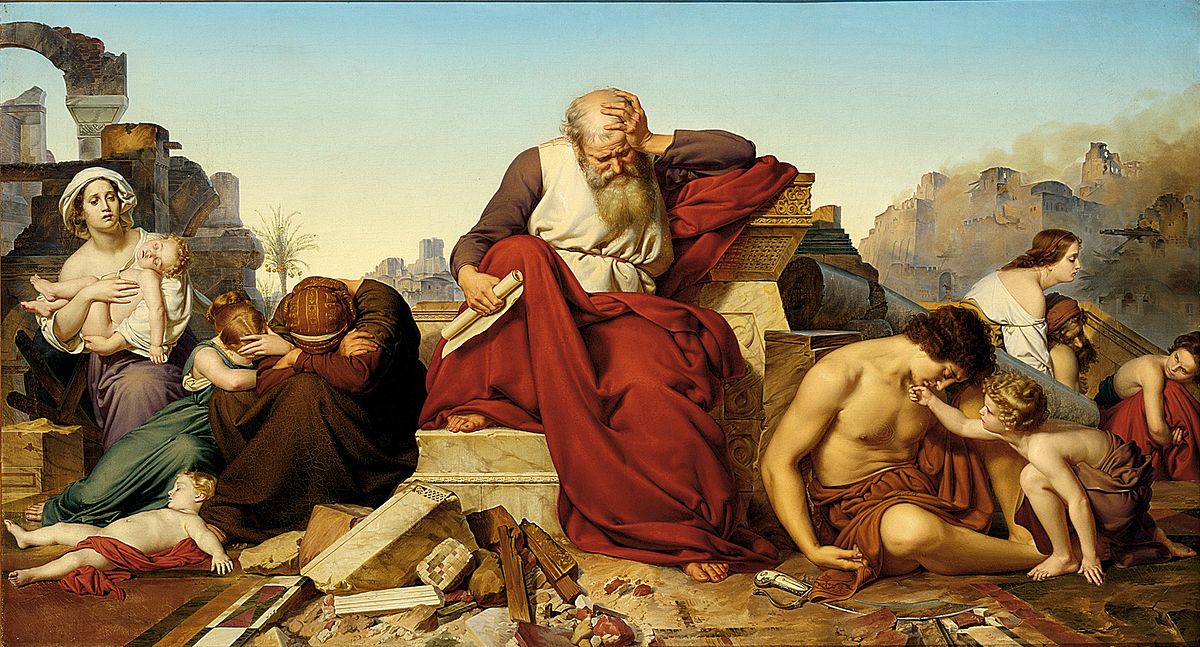
Eduard Bendemann Jeremiah seated in the ruins of Jerusalem
The Book of Lamentations is a unique and poignant text: a collection of five poetic dirges mourning the destruction of Jerusalem and the Temple in 586 BC. For the casual reader, it may appear to be only a record of national despair. However, through the lens of Christ and the Church’s wisdom, Lamentations is revealed as a profound and essential Christ-centered book. It is the voice of the human soul and of all creation, groaning under the consequences of sin, while simultaneously pointing to the only one who can bear this sorrow and transform it into hope: the suffering Messiah, Jesus Christ.
1. The Voice of Christ in the Midst of Dereliction
While Lamentations speaks with the corporate voice of Jerusalem (“she”), its deepest spiritual meaning is found when it is heard as the voice of Christ, the true Israel, in His Passion.
-
The Suffering Righteous One:
-
Text: “I am the man who has seen affliction by the rod of His wrath. He has led me and made me walk in darkness and not in light… He has filled me with bitterness, He has made me drink wormwood.” (Lamentations 3:1-3, 15 NKJV).
-
Christological Interpretation: The Fathers, such as St. Jerome, saw in this “I” the prefigured voice of Christ in His agony. Christ is the ultimate “man of sorrows” (Isaiah 53:3) who truly “walked in darkness” from Gethsemane to Golgotha. He was given the “wormwood” of the world’s sin to drink upon the Cross. This personalizes the suffering of the city, showing that God does not remain distant from human pain but enters into it fully in the Person of His Son.
-
-
The Rejected and Mocked King:
-
Text: “The breath of our nostrils, the anointed of the LORD, was caught in their pits, Of whom we said, ‘Under his shadow we shall live among the nations.’” (Lamentations 4:20, NKJV).
-
Patristic Insight: While historically referring to King Zedekiah, the title “the anointed of the LORD” (Christos in Greek) points prophetically to Jesus Christ , the true Anointed King. He was “caught in their pits”—the plots of the Sanhedrin and the Romans—and rejected by those who should have lived under His protective shadow. His own people chose Caesar over their true King (John 19:15).
-
2. The Hope Within Despair: The Lord’s Mercies are New Every Morning
At the very center of the book, in the heart of the central chapter, shines one of the most brilliant rays of hope in all of Scripture.
-
The Core Messianic Hope:
-
Text: “Through the LORD’s mercies we are not consumed, Because His compassions fail not. They are new every morning; Great is Your faithfulness. ‘The LORD is my portion,’ says my soul, ‘Therefore I hope in Him!’” (Lamentations 3:22-24, NKJV).
-
New Testament Parallel: This unwavering hope in God’s faithful mercy finds its ultimate fulfillment in Jesus Christ. He is the embodiment of the Father’s “compassions” and the proof that His “mercies” are not exhausted. In the Resurrection of Christ, God’s mercy is indeed “new every morning.” This is the foundation of the Christian life: our hope is not in our own righteousness, but in the faithful, covenantal love of God revealed in Christ.
-
Ascetical Understanding: This passage is a masterclass in spiritual warfare against despair. When the soul is in a state of spiritual desolation—the “dark night”—it is called to do what the author does here: to actively recall God’s character rather than its own circumstances. The Jesus Prayer, “Lord Jesus Christ, have mercy on me, a sinner,” is the practical application of this, a cry for the “new mercies” found only in Christ.
-
3. The Yoke of Affliction and the Call to Repentance
The book powerfully links suffering to sin and calls for a response of patient endurance and repentance.
-
The Good of the Yoke:
-
Text: “It is good for a man to bear the yoke in his youth. Let him sit alone and keep silent, Because God has laid it on him; Let him put his mouth in the dust— There may yet be hope.” (Lamentations 3:27-29, NKJV).
-
Christological Fulfillment: Christ invites all who labor and are heavy laden to take His yoke upon them (Matthew 11:28-30). The yoke of Lamentations is the yoke of the Law and its curses; the yoke of Christ is the yoke of grace and sonship, which transforms suffering from a mere punishment into a means of purification and communion with Him.
-
Ascetical Understanding: This is the essence of Orthodox asceticism. To “bear the yoke” is to embrace the ascetical discipline of the Church—fasting, prayer, and obedience. To “sit alone and keep silent” is the practice of hesychasm, inner stillness. To “put his mouth in the dust” is the virtue of profound humility. Through this, the soul finds hope not in the cessation of suffering, but in being united to Christ within it.
-
Conclusion: Lamentations as a Christ-Centered Narrative
The Book of Lamentations is Christ-centered because it:
Gives Voice to Christ’s Passion: It provides the vocabulary for the human and spiritual suffering endured by the God-man on the Cross.
Anchors Hope in Divine Mercy: Its central confession of hope is fulfilled in the Resurrection, the ultimate proof of God’s unfailing faithfulness.
Provides an Ascetical Map: It teaches the soul how to bear the yoke of suffering with patience, silence, and humility, which are the very virtues Christ embodies.
In Lamentations, we do not hear a hopeless cry into the void, but the divinely-inspired groan of a creation that knows its plight and, in its deepest consciousness, yearns for a Redeemer. That Redeemer has come, and in His light, the tears of Jeremiah and of all the ages are gathered up and given meaning.
28.3 From Mourning to Hope
From Mourning to Hope
First Dirge: The Destruction of Jerusalem (1:1–22)
A Description of the Destruction of Jerusalem (1:1–11)
Jerusalem Cries Out for Comfort (1:12–17)
Jerusalem Confesses Its Sin (1:18–22)
Second Dirge: God’s Judgment on Jerusalem (2:1–22)
The Lord’s Hostility Against Jerusalem (2:1–9)
Jerusalem’s People Suffer (2:10–13)
False Prophets, Enemies, and Jerusalem (2:14–17)
Jerusalem Tearfully Prays to the Lord (2:18–22)
One Man Describes His Misery (3:1–21)
One Man Finds Hope (3:22–39)
One Man Urges and Models Prayer (3:40–66)
Fourth Dirge: The Lamentations of the People (4:1–22)
Jerusalem Remembers Better Times (4:1–11)
The Results of Jerusalem’s Sin (4:12–20)
The Coming Results of Edom’s Sin (4:21–22)
The Many Sufferings of the People of Jerusalem (5:1–14)
Jerusalem Confesses Its Sins (5:15–18)
28.1 God Will Judge Apostate Judah but Will Bring Redemption Through a New
Covenant and the Davidic Branch
Wicked Judah Must Repent or Perish (3:6–6:30)
Doom on Covenant-Breaking Judah (11:1–13:27)
Persecutions and Prophecies of Jeremiah (26:1–29:32)
- God Will Judge Apostate Judah but Will Bring Redemption Through a New Covenant and the Davidic Branch
-
An Orthodox Insight into the Book of the Prophet Jeremiah
-
From Mourning to Hope
-
An Orthodox Insight into the Book of Lamentations
-
-
28.1 God Will Judge Apostate Judah but Will Bring Redemption Through a New Covenant and the Davidic Branch
-
28.2 An Orthodox Insight into the Book of the Prophet Jeremiah
-
28.3 From Mourning to Hope
-
28.4 An Orthodox Insight into the Book of Lamentations
-
God Will Judge Apostate Judah but Will Bring Redemption Through a New Covenant and the Davidic Branch
- From Mourning to Hope
Related Concepts
- 1-corinthians-130
- adoption-as-sons
- ascension
- baptism-and-chrismation
- barlaam-of-calabria
- christ
- communion
- communion-with-god
- corrupt-leadership
- covenant-curse
- cross
- cross-and-resurrection
- crucifixion
- dayspring
- desolation
- divine-condescension
- divine-initiative
- divine-light
- edom
- exile
- faithfulness
- false-prophets
- fasting-and-obedience
- fellowship-of-his-sufferings
- fig-vision
- glorification
- glory
- gregory-palamas
- healing
- heart
- heart-transformation
- hesychasm
- holy-humility
- holy-spirit
- hope
- humility-of-christ
- imputedgiven-righteousness
- internal-asceticism
- isaiah-53
- jeremiah-31
- jesus-prayer
- john-7
- john-the-baptist
- judgment
- justice
- kenosis
- kingship
- lamentations
- last-supper
- literary-form
- lords-supper
- messiah
- nations
- nehemiah-as-type-of-christ
- new-hearts
- non-retaliation
- nuptial-union
- passion
- patient-endurance
- personhood
- philippians-2
- philippians-2-hymn
- prophecies-against-the-nations
- prophet
- prophetic-poetry
- prophetic-typology
- psalm-90
- rejection
- remembrance
- remnant
- restoration
- resurrection
- revelation
- sacrament-of-confession
- salvation
- sin
- suffering
- suffering-servant
- theosis
- union-with-god
- weeping-prophet