Old Testament — Topic 25
ECCLESIASTES
Outline
1:1–6:12 The Preacher Searches for Meaning
1:1 Title: The Observations of the Preacher
1:2–11 A Poem Establishing the Theme of Ecclesiastes: All Is Vanity
1:12–18 The Preacher Observes the Vanity of Wisdom
2:1–11 The Preacher Observes the Vanity of Wealth
2:12–17 The Preacher Again Observes the Vanity of Wisdom
2:18–26 The Preacher Observes the Vanity of Work
3:1–8 A Poem: A Time for Every Matter Under Heaven
3:9–15 The Preacher Observes That God’s Toil Endures While Man’s Does Not
3:16–17 The Preacher Observes Injustice Under the Sun
3:18–22 The Preacher Observes That All Alike Die
4:1–3 The Preacher Observes the Vanity of Oppression Without Comfort
4:4–6 The Preacher Observes the Vanity of Work Arising from Envy
4:7–12 The Preacher Observes the Vanity of Toiling Without a Partner
4:13–16 The Preacher Observes the Vanity of a Wise Ruler Being Forgotten
5:1–3 The Preacher Urges His Readers to Fear God by Speaking Few Words
5:4–7 The Preacher Urges His Readers to Fear God by Paying Their Vows
5:8–9 The Preacher Observes the Vanity of Politics and Government
5:10–12 The Preacher Observes Again the Vanity of Wealth
5:13–17 The Preacher Observes the Vanity of Wealth Kept and Lost
5:18–20 The Preacher Observes That Wealth Is a Gift of God
6:1–6 The Preacher Observes the Vanity of Unenjoyed Wealth
6:7–9 The Preacher Observes the Vanity of the Never-Satisfied Human Appetite
6:10–12 The Preacher Observes the Vanity of Life and Words Under the Sun
7:1–12:14 The Preacher Offers Advice
7:1–4 The Preacher Observes That Mourning Is Better Than Feasting
7:5–14 The Preacher Offers Wise Counsel
7:15–18 The Preacher Observes the Vanity of Complacent Righteousness and
Pretensions to Wisdom
7:19–20 The Preacher Again Offers Wisdom
7:21–22 The Preachers Cautions Against Taking to Heart What People Say
7:23–29 The Preacher Considers the Difficulty of Finding Wisdom Among Men or
Women
8:1 The Preacher Commends the Value and Rarity of Wisdom
8:2–9 The Preacher Offers Counsel for Relating to the King
8:10–9:1 The Preacher Considers the Work of God Toward the Righteous and the
Wicked
9:2–10 The Preacher Observes Again That All Alike Die
9:11–12 The Preacher Observes That Time and Chance Happen to All
9:13–18 The Preacher Observes an Example of Wisdom Unrewarded
10:1–4 The Preacher Offers Various Pieces of Wisdom
10:5–7 The Preacher Observes Rulers Setting Folly in High Places
10:8–11 The Preacher Again Offers Various Pieces of Wisdom
10:12–14 The Preacher Offers Wisdom on Words
10:15–11:8 The Preacher Again Offers Various Pieces of Wisdom
11:9–12:8 The Preacher Offers Counsel to the Young
12:9–14 The End of the Matter
Finding Joy in a Fallen World
Qohelet lives in an unvarnished, polarized world: On the one hand, suffering and death have resulted from the curse. Death is a constant, overhanging threat, and humanity’s inability to transcend their limitations proves frustrating and enigmatic. On the other hand, advantages such as increasing in wisdom, discovering what is good, and enjoying life are consequences of God’s design in his originally good creation. Many maintain that the message of Ecclesiastes is primarily negative by focusing on passages reflecting the curse. This understanding concludes rightly, in part, that Qohelet has searched realistically for wisdom, meaning, and purpose by examining human perspectives and achievements such as wisdom, folly, pleasure, toil, and wealth. Yet this perspective fails to correlate Qohelet’s own conclusions and emphases. Qohelet turns down many blind alleys before coming to his final judgment, which is ultimately positive. His seven commendations of joy emphasize wisely appropriating God’s good and measured gifts by eating, drinking, finding satisfaction in work, luxuriating in finery and refreshment, and enjoying life with one’s spouse (2:24; 3:12–13, 22; 5:18–20; 8:15; 9:7–9a; 11:7–12:1). In tandem, Qohelet admonishes people to fear and obey God as the basis for incorporating the benefits of wisdom (3:14; 5:6; 7:18; 8:12–13; 12:13). Finding joy and fearing God thus constitute the essence of Qohelet’s counsel on how to make the most of life in navigating the tragedies and adversities of the fallen world.
The Preacher Searches for Meaning (1:1–6:12)
The opening section of Ecclesiastes recounts the Qohelet’s quest for meaning in life under the general headings of wisdom (1:12–18; 2:12–17), wealth and pleasure (2:1–11), and work (2:18–26). Can any of these pursuits resolve the enigma of finding fulfillment and meaning in life? Although each of these quests ultimately proves futile, there are hints that each offers a God-given blessing (2:10, 13, 24; 3:11–13) without the lasting fulfillment Qohelet seeks (1:14; 2:1, 15, 17, 19, 21, 23, 26). He then considers the impact of injustice, death, and oppression on the meaning of human existence, compounded by the lack of anyone to set things right (3:9–4:3). This state of affairs also underscores the corruption of humanity. Then come observations about the vanity of labor driven by envy or independent gain (4:4–12) and the ephemeral legacy of a wise ruler (4:13–16). The Preacher shifts from observation to instruction about worship (5:1–8) and the pursuit of wealth (5:8–6:12) in the final passages of the section.
Title: The Observations of the Preacher (1:1)
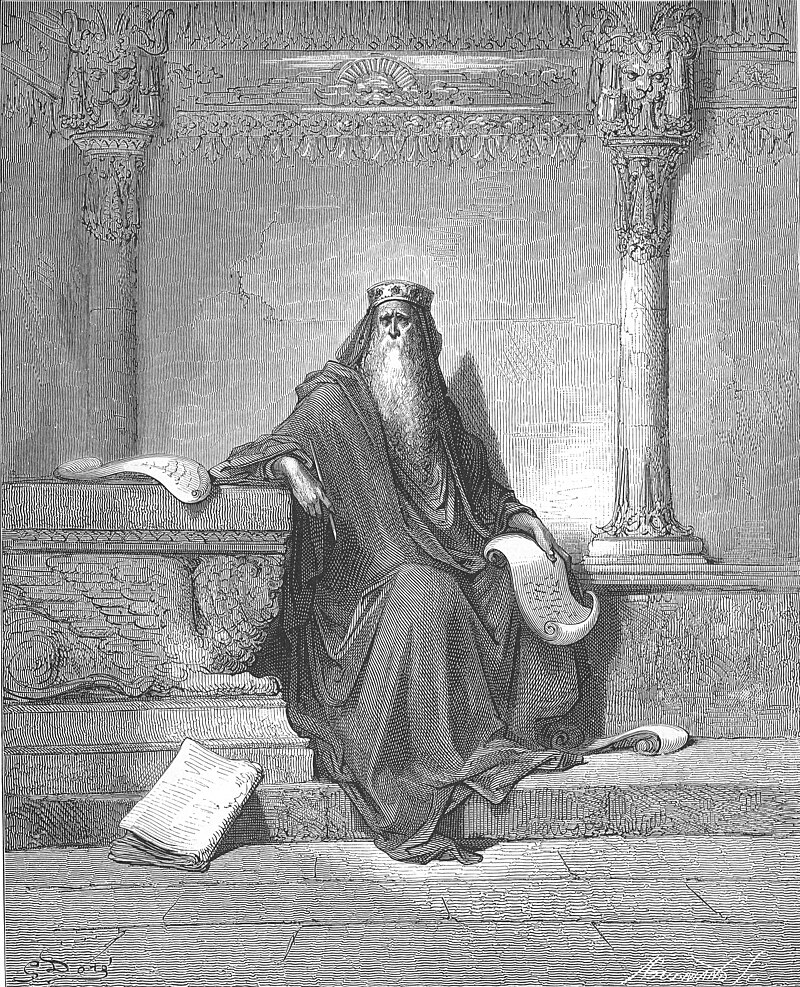
As other OT wisdom literature such as Proverbs (1:1; 10:1; 25:1; 30:1; 31:1) and Song of Songs (Song 1:1), Ecclesiastes begins with a superscription identifying the sage who stands behind the work and is likely the author. “Qohelet” comes from a verb meaning “to gather an assembly” and is translated traditionally as “Preacher” (ESV, NASB) or “Teacher” (NIV, NET), although “Convener” might be more apt. “Son of David” points to his descent from King David. This phrase applies to prominent members of the Davidic line, usually Solomon in the OT (1 Chr 29:22; 2 Chr 1:1) but also Jesus (Matt 1:1). “King in Jerusalem” suggests a reign prior to the division of the monarchy (compare 1:12).
**
**
King Solomon in Old Age by Gustave Doré (1866)
A Poem Establishing the Theme of Ecclesiastes: All Is Vanity (1:2–11)
The opening section begins with a framing motto (compare 12:8) judging everything the Preacher has observed to be “most enigmatic” or “a merest breath of wind.” The programmatic question sets the agenda for the book, asking what advantage or gain humans can find in all their toil during their lives (1:3). The poem highlights the relentless rhythm of the finite created order (1:4–11). The endless course of human generations (1:4), cycles of the sun (1:5), wind patterns (1:6), and water streams (1:7) speak of constant movement without accomplishment or change. These cycles mirror humanity’s inability to achieve anything that is ultimately new, lasting, or satisfying (1:8–11).
The Preacher Observes the Vanity of Wisdom (1:12–18)
Qohelet invokes the language of the ancient royal inscription to outline his experimentation into the realms of human achievement, wisdom, and pleasure. Qohelet’s reign over Israel from Jerusalem points to the figure of Solomon (1 Kings 1:34; 3:1). His quest is first to observe and assess human achievement (1:13–15). Qohelet concludes that everything is enigmatic (1:14) and that humans are finite and thus powerless to alter certain realities of the postfall world (1:15). Qohelet then assesses human intellect and epistemology (1:16–18). He concludes that the accumulation of learning and wisdom is ultimately ineffective, as these virtues add only to one’s frustration and grief (1:18).
The Preacher Observes the Vanity of Wealth (2:1–11)
Having proved the futility of human achievement and wisdom, Qohelet turns to explore pleasure and labor. Concerning pleasure, Qohelet moves quickly from aim (2:1a) to conclusion (2:1b) to validating principle (2:2). He determines that laughter is a mere step from lunacy and that pleasure is pointless. Qohelet then evaluates his work, stating his aim in labor (2:3), his achievement (2:4–10), and his evaluation (2:11). On a grand scale, he constructs buildings and plots (2:4–6) and amasses people and livestock (2:7–9). In the end, he concludes that his toil—together with its pleasure and wealth—is enigmatic and elusive because it offers no ultimate advantage or value (2:11).
The Preacher Again Observes the Vanity of Wisdom (2:12–17)
Qohelet transitions from a reflection on pleasure to one on the nature and value of wisdom as compared with folly. Qohelet assesses here the worth of his earlier quest to grasp the totality of human knowledge, wisdom, and folly (1:16–18). He does this in four parts. First, his method and objective are to probe wisdom and madness/folly to determine the best course of action (2:12). Second, he arrives at a thesis: wisdom is superior to folly (2:13–14a). Third, he realizes that death offsets the advantage wisdom offers (2:14b–16). He concludes, finally, that life in a fallen world is enigmatic and frustrating (2:17).
The Preacher Observes the Vanity of Work (2:18–26)
Qohelet transitions to his final reflection propounding his disillusionment and distaste for life due to the realization that nothing he achieves will last. He assesses here the value of his first quest to explore human effort and achievement (1:13–15). Qohelet’s successor (2:18) threatens to ruin whatever success Qohelet has achieved (2:19). In sum, his efforts to discover human achievement, wisdom, and pleasure have resulted only in enigmas and frustrations (2:20–23). Therefore, the best course for humans is to find joy by taking satisfaction in the simple pleasures of life—eating, drinking, and enjoying work—because these are gifts from God (2:24–26).
A Poem: A Time for Every Matter Under Heaven (3:1–8)
Qohelet considers the outworking of his programmatic question (1:3) with respect to the experience of time. The discourse shifts from prose to poetry, with a high degree of cadence. The structure is chiastic, with two stanzas (3:2–4, 5–7) and a closing couplet (3:8). Qohelet offers a succession of fourteen antitheses that demonstrate opposite, mutually exclusive activities that involve the whole person and encompass the full range of human aspirations and experiences as divine image bearers, starting with birth/death and ending with war/peace. The poem tilts slightly positive, affirming the goodness of life despite the brokenness of the world, as evident in the movement of each concluding couplet from mourning to joy (3:4) and mourning to renewal (3:7).
The Preacher Observes That God’s Toil Endures While Man’s Does Not (3:9–15)
Qohelet restates the programmatic question (3:9), resumes his observations and reflections (3:9–15), and reactivates the first-person thread (“I have seen”), which appears in each succeeding unit (3:10, 16; 4:1, 4). Qohelet reflects on the time poem (3:1–8) in several ways. First, he concludes that time is a burden because it imposes limitations that nullify the effectiveness of human labor (3:10–11). Due to this restriction, Qohelet calls for joyful reflection through eating, drinking, and enjoying labor because these are God’s gifts to humankind (3:12–13). He concludes by emphasizing the dissonance between the human experience of time and the perplexing reality of hidden divine sovereignty, which often counteracts humanity’s strenuous labor (3:14–15).
The Preacher Observes Injustice Under the Sun (3:16–17)
Qohelet resumes his observations (“I have seen”), now concerning the prevalent problem of human oppression and injustice. The opening adverb (“furthermore”) signals the beginning of a new unit, while also providing a link back to the previous. In evaluating the courts and legal process, Qohelet concludes that corruption is endemic to every human institution, even where justice and integrity should be most prominent (3:16). He offers two reflections based on this observation, first here and then in the next unit. He concludes that a significant redress for rampant injustice is that God will judge the righteous and the wicked (3:17). The judgment here envisioned is most likely future, postmortem judgment, wherein God justifies the righteous and condemns the wicked.
The Preacher Observes That All Alike Die (3:18–22)
Qohelet’s second reflection on human injustice leads him to determine that social injustices remind fallen humans of their own corruption and mortality (3:18–21). People are in a certain sense no better than the animals: we come from the same dust, are alike animated by breath/spirit, return to that dust, and are confounded by a lack of knowledge about the afterlife. Due to human limitations and fallibility, living people cannot know for certain even what the experience of death will be like prior to passing through it (3:21). Humans know only that their bodies will return to dust because they were created from dust and labor under the sin curse (3:20; compare Gen 3:19). In view of this, Qohelet commends the enjoyment of work, which is humans’ God- given portion (Eccl 3:22).
The Preacher Observes the Vanity of Oppression Without Comfort (4:1–3)
Qohelet resumes his observations (“Again I saw”) with a consideration of oppression. The unremitting exploitation of the poor is widespread and constant, and this reality grieves him because there is no one to console them (repeated twice in 4:1). The phrase “under the sun” emphasizes the sphere of this extortion (mortal human lifetime) and provides a framing device with its recurrence at the opening and close of the unit (4:1, 3). This sad reality pushes Qohelet to the somewhat egregious conclusion that the dead are better off (4:2), although this statement must be balanced with his later one that the living, not the dead, still have hope (9:4). Those who have not seen this evil are better off than both (4:3).
The Preacher Observes the Vanity of Work Arising from Envy (4:4–6)
Qohelet observes this time the motivation and fruit of human labor. The repetition of “labor” at the beginning and end of the unit provides a framing device (4:4, 6). He concludes that human labor is motivated by greed and envy and that such striving is futile and pointless (4:4). He supports this conclusion with two contrasting proverbs. First, the fool expends his labor merely to consume his own flesh: Work is senseless if it merely destroys the worker (4:5). Second, modest means with repose is better than affluence gained through strife (4:6). Work without peace and enjoyment is merely aggravation.
The Preacher Observes the Vanity of Toiling Without a Partner (4:7–12)
Qohelet observes (“Again I saw”) that labor is fruitless if the worker toils alone (4:7–8), and thus the companionship of two surpasses the weakness and isolation of one (4:9–12). The first part comprises the observation (solitary worker; 4:7–8a), diagnostic rhetorical question (“For whom do I toil?”; 4:8b), and evaluation (a futile and harmful task; 4:8c). The second part consists of a better-than saying (4:9a) and a four-part rationale (better wage, mutual aid, companionship, and reciprocity; 4:9b–12). The unit opens with reference to “futility (hebel) under the sun” (4:7), and the next unit concludes with “futility (hebel) and chasing the wind” (4:16), providing a frame. This unit emphasizes companionship with the catchwords “second” (4:8, 10) and “two” (4:9, 11, 12).
The Preacher Observes the Vanity of a Wise Ruler Being Forgotten (4:13–16)
Qohelet begins a supporting example story with a better-than saying: the wisdom of poor and obscure individuals, although often discounted, is better than the all-too-common folly of the powerful. The mention of “king” (4:13) activates his reflections on rampant injustice that frame his warning about proper worship: “King” (4:13–16)—“God” (5:1–7)—“King” (5:8–9). While discerning the details of the unit has proved challenging, the gist appears to be that leadership succession is frustrating and enigmatic given the fickle and feckless whims of the people. The sad reality is that today’s bright young things are merely tomorrow’s old codgers.
The Preacher Urges His Readers to Fear God by Speaking Few Words (5:1–3)
The subject matter and tone change from reflection (4:1–16) to instruction (5:1–7). For the first time Qohelet addresses the reader directly with an imperative to “guard” his step (5:1). The first and final words of 5:1–7 are commands (“guard” and “fear”), framing Qohelet’s admonitions concerning proper worship. The section of 5:1–7 comprises two strophes (5:1–3, 4–7a) with a conclusion (5:7b). The strophes present an alternating pattern of imperative/rationale (2x; 5:1–2, 4–6) followed by a supporting proverb (vv. 3, 7a). This first strophe emphasizes that the worshiper must watch what he says and does before God.
The Preacher Urges His Readers to Fear God by Paying Their Vows (5:4–7)
Verse 4 begins the second strophe of the section, with fourteen lines addressing the appropriate use of vows. This strophe begins with a negative command (“do not delay”) concentrically arranged with a central positive command (“pay what you vow”) and two negative commands (“do not give”; “do not say”). While the previous strophe warned against rash words, this strophe focuses on the fulfillment of vows. The supporting proverb is difficult but likely should be read as “With many enigmatic dreams come also many words.” Illusory and fleeting dreams only multiply words to the dreamer’s detriment. Wise worshipers instead reverence God (5:7b) and reject empty talk by following through on their commitments.
The Preacher Observes the Vanity of Politics and Government (5:8–9)
The change of topic, literary features, and keywords signals a new section. This unit reaches back to reintroduce concepts from chapter 4, with the larger section (4:1–5:20) providing observations and reflections on the themes of society, wealth, authority, and religion. Qohelet advises that corruption is a constant in political government because corruption often goes all the way to the top (5:8). Yet this may be rectified to some extent by a good King. Verse 9, the most difficult text in the book, should read as “Yet a King over all who is devoted to cultivated fields is an advantage to a country.” In a fallen world exploitation and injustice are to be expected rather than a cause of alarm, but Kings who are committed to order, stability, and productivity can mitigate this.
The Preacher Observes Again the Vanity of Wealth (5:10–12)
Qohelet offers observations and reflections concerning the limited value of material goods, culminating in an example story about the uncertainty of riches (compare 4:4–12). The flow of thought follows a rough chiasm: “satisfaction” (5:10) to “eats” and “increases” (5:11a), to the focal statement, a rhetorical question: What advantage do the owners have (5:11b)? He returns to “eats” and “much” (5:12a) and concludes with the overglutted “satisfaction” of the sleep-deprived rich (5:12b). Emphasis comes through repetition of the theme: the materialist strives after goods without enjoyment (“no satisfaction”; 5:10), possesses goods yet is deprived of enjoyment (“others enjoy”; 5:11), and possesses goods with misplaced enjoyment (“oversatiated”; 5:12).
**
**
The Preacher Observes the Vanity of Wealth Kept and Lost (5:13–17)
This unit shifts focus with lexical repetition and a forward, rather than backward, gaze to the concluding call to joy (5:18–20). Keywords include “sickening evil” (5:13, 17), “goes” (5:15 [2x], 16), “in his hand” (5:14, 15), “nothing” (5:14, 15), and “toil” (5:14, 16). A loose chiasm of terms and themes grieves lost wealth by centering on the echo of Job 1:21 in 5:15: “Sickening evil” (5:13)—“Nothing in his hand” (5:14)—“As he came from his mother’s womb naked shall he return” (5:15a)—“Nothing in his hand” (5:15b)—“Sickening evil” (5:16). The physical and emotional toll of misused wealth encompasses darkness, frustration, sickness, and anger (5:17).
The Preacher Observes That Wealth Is a Gift of God (5:18–20)
The backdrop of the miserable existence of the miser (5:13–17) sets in relief the call to temperate and joyful use of possessions. Qohelet’s commendation of joy reaches backward and forward to connect to the other six commendations of joy as the book’s key theme (2:24; 3:12–13, 22; 8:15; 9:7–9a; 11:7–12:1). A number of catchwords link these calls to joy, including “seeing good” (2:24; 3:13, 22; 5:18; 11:7), “eating and drinking” (2:24; 3:13; 5:18; 8:15; 9:7), “rejoicing” (3:22; 5:19; 8:15; 11:8–9), “gift of God” (3:13; 5:19), “under the sun” (5:18; 8:15; 9:9), and “portion” (3:22; 5:18; 9:9). The commendation of joy provides a resolution to the problems of human insatiability and envy earlier observed: contented joy is God’s gift and portion.
The Preacher Observes the Vanity of Unenjoyed Wealth (6:1–6)
Qohelet provides more example stories on the uncertainty of possessions. Here he presents two scenarios: a situation where a person’s wealth is enjoyed by strangers (6:1–2) and one where a wealthy man cannot find satisfaction in the abundance of his possessions, posterity, and long life (6:3–6). The first scenario weighs down oppressively because it is a perversion (6:1). The second scenario evokes grief and bafflement because finding no contentment is a fate worse than the stillborn child (6:3). Possessing wealth is never ultimate because death is inevitable no matter whether one thinks he can escape it (6:6).
The Preacher Observes the Vanity of the Never-Satisfied Human Appetite (6:7–9)
Qohelet presents his conclusion about toil and appetite/desire in four parts. The latter term frames the unit (6:7, 9). He offers a proverb about desire and toil: people work so they may consume but are never satisfied (6:7). He asks two rhetorical questions, expecting a negative answer, that explain this dilemma (6:8). First, what advantage has the wise over the fool? Second, what advantage has the impoverished wise man? His third part is a “better-than” saying about desire: the possessor is better off content with what he has than with always wanting more (6:9a). He concludes that this is a frustrating and elusive enigma (6:9b).
The Preacher Observes the Vanity of Life and Words Under the Sun (6:10–12)
Qohelet reflects on divine sovereignty and human finitude in four parts. First, he states his theme: humans cannot escape their limitations nor alter what God has ordained (6:10). Humankind is a keyword emphasizing humanity’s existential limits, repeated four times (6:10, 11, 12 [2x]). Second, he provides a rationale for humanity’s limitations: endless talk is fleeting and futile, offering no ultimate advantage (6:11). Third, he explains this quandary with a rhetorical question: How can humankind know what is good for them in their short, fleeting lives (6:12a)? Fourth, he offers a rationale with another rhetorical question: no one can know what is good because no one can tell people what happens after they are gone (6:12b).
The Preacher Offers Advice (7:1–12:14)
Qohelet provides instruction by contrasting the benefits of a variety of paired activities: mourning versus feasting, wisdom versus folly, the beginning versus the end of a matter, and righteousness versus wickedness (7:1–18). He concludes by advocating the fear of God and recognition of humanity’s moral weakness when engaging others, even the King (7:19–8:9). Qohelet then steps back to consider human activity in light of eternity and how the work of God affects the calculus of derived benefit (8:10–9:18). Next he considers the destructive impact of folly on otherwise positive things before commending the advantage that wisdom and skill offer (10:1–11:8).The book concludes with an exhortation to remember one’s Creator before it is too late and an epilogue about Qohelet himself (11:9–12:14).
The Preacher Observes That Mourning Is Better Than Feasting (7:1–4)
Qohelet responds to his earlier question about what is good for humankind (6:12) with a series of instructional sayings about what is better (the word “good” appears 8x in 7:1–12). This unit ties together with the contrast between “house of mourning” and “house of feasting/pleasure” (7:2, 4). The day of death is better than the day of birth because a person’s reputation is sealed (7:1). A funeral is better than a party because it provokes the living to sober reflection (7:2). Sorrow is better than laughter because momentary grief produces lasting discernment regarding the brevity of life (7:3–4).
The Preacher Offers Wise Counsel (7:5–14)
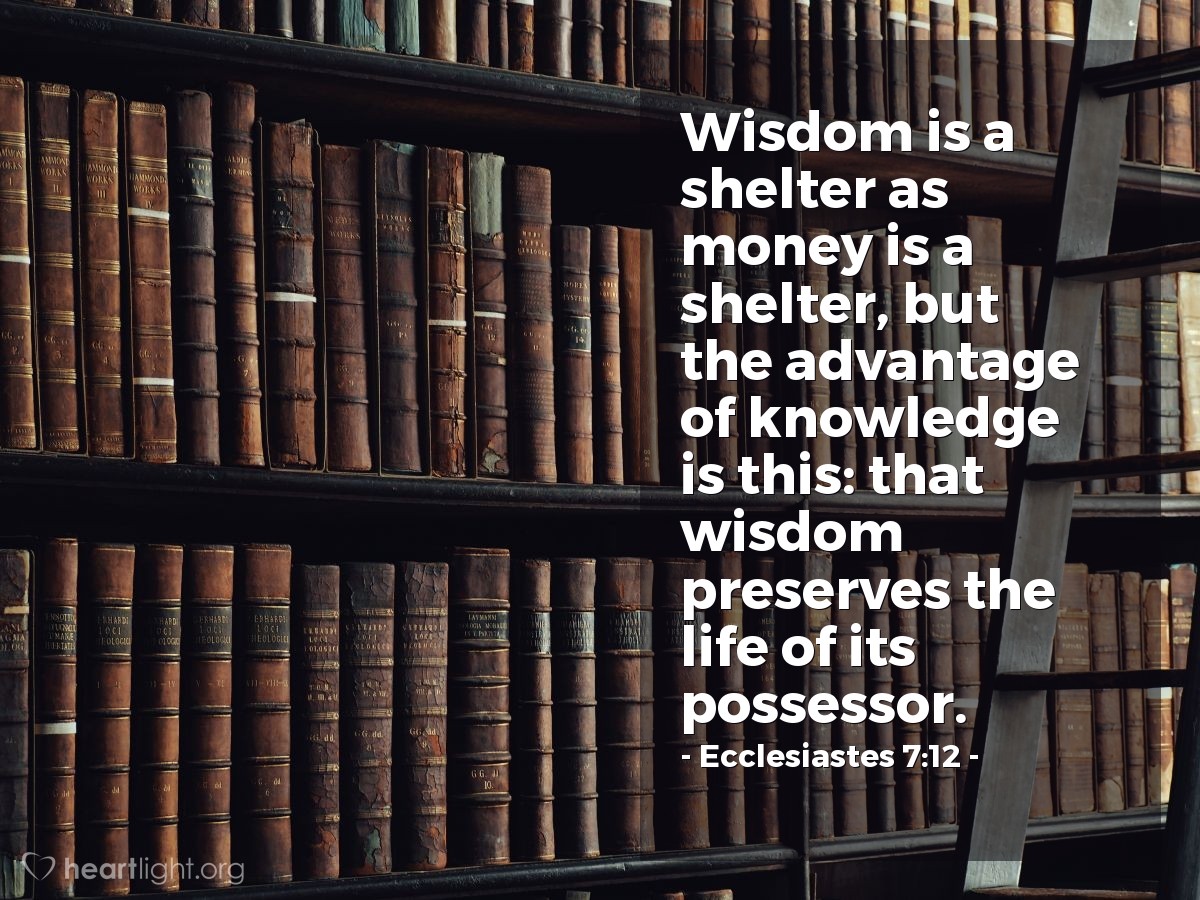
The second part of Qohelet’s instruction comprises several better-than sayings with motivations and a reflection on the work of God. Repeated terms “day” and “good” frame the units (7:1, 14). The first saying commends the wise man’s rebuke over the raucous songs of fools in the house of pleasure (7:5). The rationale is that fools’ laughter is empty and fleeting (7:6) and that oppression and corruption often marginalize the counsel of the wise (7:7). The second saying commends the outcome of a matter over its inception (7:8). The motivation includes two prohibitions: one should not become easily provoked into folly (7:9) and one should not pine for illusory days of the past (7:10). The third saying commends wisdom (7:11) because it provides protection (7:12). He instructs, finally, to align oneself with the unalterable work of God (7:13) by appropriating sober joy (7:14).
**
**
The Preacher Observes the Vanity of Complacent Righteousness and Pretensions to Wisdom (7:15–18)
Here Qohelet reflects on the paradox of righteousness/wisdom and wickedness/folly. The frustrating enigma is that often the wicked persist while the righteous perish before their time (7:15). The antidote is a warning against complacent self-righteousness and pretensions to wisdom on the one hand (7:16) and capitulation to evil and folly on the other (7:17). He commends the righteous and wise person who successfully treads the narrow path between extremes by fearing God (7:18).
The Preacher Again Offers Wisdom (7:19–20)
Qohelet offers two distinct sayings that build on his previous counsel. First, wisdom in the fear of God (7:18) is better than self-righteousness or hypocritical pretensions (7:16) because its inherent power surpasses the collective experience of leaders (7:19). Second, recognition of humanity’s moral fallibility is better than mere capitulation to evil and folly (7:17) because no one is righteous: everyone sins by omission (“no one does good”) and commission (“and does not sin”; 7:20).
**
**
The Preachers Cautions Against Taking to Heart What People Say (7:21–22)
Qohelet goes on to consider the danger of listening to superfluous and idle talk by means of a prohibition and a motivation. Universal sin (7:20) is evident in the vindictive speech of others, so one must not take it to heart (7:21). Sometimes ignorance is bliss. A second motivation is that a person knows the reality of this problem by how often he himself has engaged in such behavior. His own experience with such talk is enough evidence that vindictive words and inaccurate speech are pervasive (7:21).
The Preacher Considers the Difficulty of Finding Wisdom Among Men or Women (7:23–29)
Qohelet resumes his first-person thread with a further testing and exploration of wisdom. The unit emphasizes the themes of “not finding” (7x) and the “scheme” of things (7:25, 27, 29). He describes his two-part pursuit of wisdom by noting his initial resolution to seek out wisdom (7:23a) and the reasons he failed to attain it (7:23b–24). He recommenced his pursuit of wisdom (7:25), only to find bitter results (7:26–29). He finds, first, that the adulteress who ensnares is more bitter than death (7:26). Second, he finds, while seeking to determine the scheme of things, that virtuous people are exceedingly rare (7:27–28). Third, he discovers that humanity was created upright but turned devious in searching out many schemes (7:29).
The Preacher Commends the Value and Rarity of Wisdom (8:1)
Qohelet provides a conclusion to his earlier wisdom sayings. He commends the wise by underscoring how rare they are (8:1a). By understanding how to interpret sayings and events, they best discern the “scheme” of things together with, to some degree, correlating the hidden providences of God. Wise people are discernibly gracious and penetrating in their demeanor, able to soften even the hard edges and harsh expressions of those who oppose them.
The Preacher Offers Counsel for Relating to the King (8:2–9)
Qohelet begins by commanding allegiance to the King—reminiscent of his instruction on proper reverence for God in 5:1–7—and continues with a series of reflections on time and judgment. He gives three commands/prohibitions followed by three motivations (8:2–4): obey the King’s command, do not hastily leave his presence, and do not join an evil cause because the King does whatever he wants, his word is supreme, and no one can oppose him. He reflects on the benefit of heeding the King’s authority: avoidance of calamity and insight into the proper time and judgment (8:5). While everything has a right time and judgment (8:6a), often such insight is thwarted by the pervasiveness of evil (8:6b), ignorance of the future (8:7), and impotence to stave off the day of death (8:8).
The Preacher Considers the Work of God Toward the Righteous and the Wicked (8:10–9:1)
Qohelet reflects on injustice, which he finds perplexing, and offers antidotes. First, the wicked are honored despite their evil (8:10). This leads to greater evil since unpunished deeds prompt acts of bolder wickedness (8:11), while the longevity of the evildoers seems to commend them (8:12a). Despite this, those who fear God are better off (8:12b–13). Second, the rewards and punishments for righteousness and evil are often inverted (8:14). Despite this, reflective joy is the best solution in view of life’s brevity (8:15). Notwithstanding piety and joy, humankind is frustrated by the unceasing difficulty of toil in a fallen world (8:16), the inability to fathom God’s work (8:17), and the incapacity to dictate the future (9:1).
The Preacher Observes Again That All Alike Die (9:2–10)
Qohelet reflects further on the perplexities of inequity. He contrasts six oppositional pairs and concludes that, despite virtue and piety, death overtakes everyone (9:2–3a). Moreover, irrationality and folly consume most people while they live (9:3b). Yet the living have advantages (9:4): they can make the most of their lives while they have time (9:5a), but the dead no longer accrue knowledge or reward, and the memory of them quickly perishes (9:5b–6). Qohelet’s recommended antidote is again reflective joy, capitalizing on the opportunities and gifts God provides (9:7–9). The wise make the most of their prospects through diligence and ingenuity because no one in the afterlife can affect the present (9:10).
The Preacher Observes That Time and Chance Happen to All (9:11–12)
Qohelet reflects on the unpredictability of time and chance, which leads to five unexpected results: instead of winning, often the swift, the strong, the wise, the discerning, and the knowledgeable are bested by their rivals (9:11). “Time and chance” refer to the caprice of calamity (troubles are unpredictable, inescapable, and sudden) and touch on the limits of wisdom. This enigma brings focus to the central phrase: “Humankind does not know his time” (9:12a). Instead, people are often caught abruptly and inextricably in an evil time like ensnared fish or birds (9:12b).
The Preacher Observes an Example of Wisdom Unrewarded (9:13–18)
Qohelet reflects on the enigma of undervalued wisdom. Keywords are “wisdom”/”wise” (7x) and “poor” (3x). He introduces the dilemma (9:13), illustrates with an example story (9:14–15), closes with a validating aphorism (9:16), and reaffirms with two more salient principles (9:17–18). The latter portion comprises a loose chiasm: “Wisdom is better” (9:16a)—“his words are not heeded” (9:16b)—“the words of the wise” (9:17)—“wisdom is better” (9:18). The story concerns an obscure sage who delivers his city against overwhelming odds and then is promptly forgotten (9:14–15). From this Qohelet infers that wisdom, although often unheeded or unappreciated (9:16b–17), is better than sheer might (9:16a, 18).
The Preacher Offers Various Pieces of Wisdom (10:1–4)
Qohelet contrasts the value of understanding (“heart” [3x]) over folly (“fool”/”foolishness” [3x]). The unit closes with links to the previous unit through the catchwords “quiet”/”rest” (9:17; 10:4 [2x]), “rule” (9:17; 10:4), and “sin” (9:18; 10:4). Wisdom, like costly things in general, is vulnerable and easily spoiled by the interposition of small doses of folly (10:1). The wise person moves constantly in the correct direction, while the fool moves in the opposite (10:2). In the ordinary activities of life the senseless person’s folly is manifest to everyone (10:3). The wise mitigate the anger of their superiors through calm composure, which arises from self-control, awareness, and maturity (10:4).
The Preacher Observes Rulers Setting Folly in High Places (10:5–7)
Qohelet observes a common mistake among the elite (10:5), followed by a two- part identification of the mistake, which bespeaks social upheaval and disintegration (10:6–7). His identification of this mistake as evil under the sun recalls earlier censures of hoarded and lost wealth (5:13; 6:1), and the phrase “I have seen” opens and closes the unit (10:5, 7). The mistake is identified first as a principle and, second, as a concrete example. First, fools garner positions of influence and power while the wealthy are humiliated (10:6). Second, slaves ride horses (indicative of power and prestige) while princes are forced to walk on the ground like slaves (10:7).
The Preacher Again Offers Various Pieces of Wisdom (10:8–11)
Qohelet offers advice on the risks of daily work (10:8–9) followed by two qualifications concerning the advantage or disadvantage work brings (10:10–11). The repetition of “snake” and “bite” frames the unit (10:8, 11). Work carries four potential dangers that revolve around horizontal (spatial: digging pit, demolishing wall) and vertical (materials: stone quarry, lumberyard) dimensions, so workers should be aware that corollary damages often occur. The first qualification is that while the lack of expertise may result in excessive effort and failure, skill/wisdom brings an advantage (10:10). The second qualification is that premature implementation may result in failure, bringing a disadvantage (10:11).
The Preacher Offers Wisdom on Words (10:12–14)
Here the sage contrasts the sound advice of the wise with the destructive folly of the fool, which is manifest by his excessive talk. Keywords are “fool”/”folly” (10:12, 13, 14 [3x]) and “words” (10:12, 13, 14 [3x]). Words reveal character: in the case of the wise, gracious favor (10:12a); in the case of the fool, self-destruction (10:12b), self-delusion (10:13), and self- aggrandizement (10:14a). Yet his talk reveals only his ignorance. No one can expound, let alone understand, what the future will bring (10:14b).
The Preacher Again Offers Various Pieces of Wisdom (10:15–11:8)
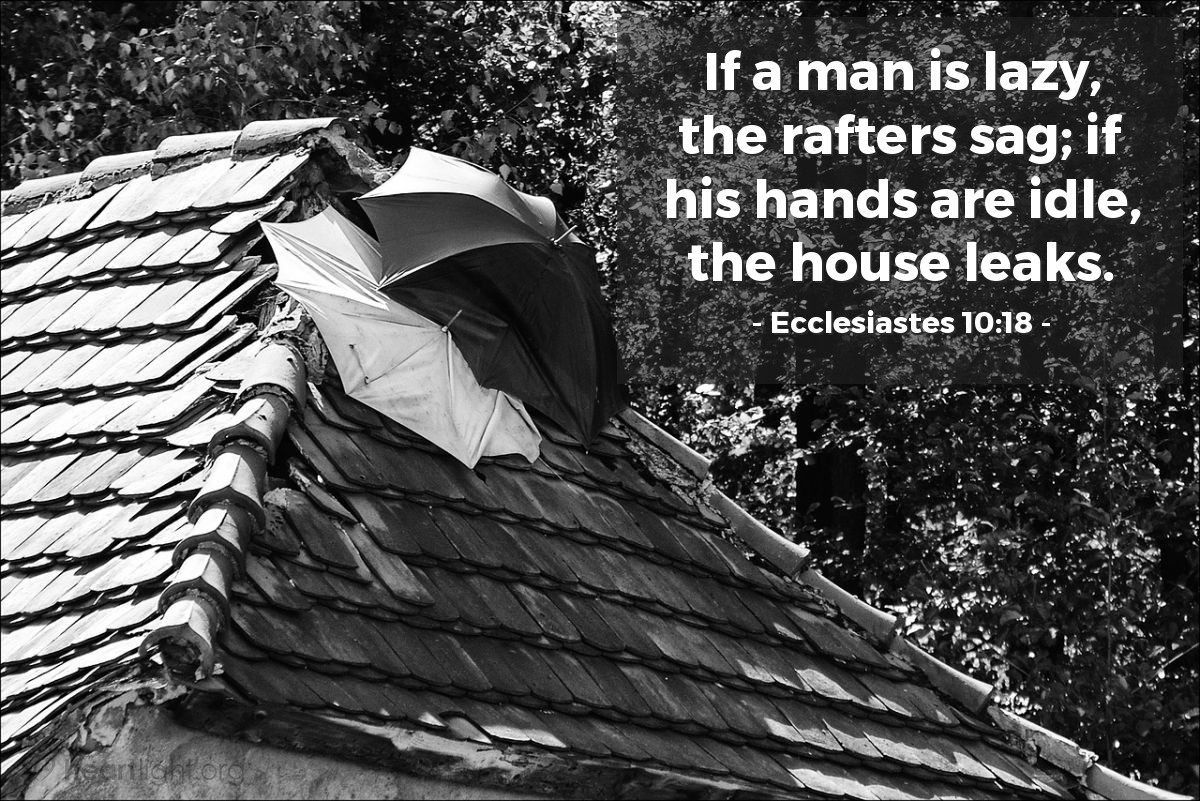
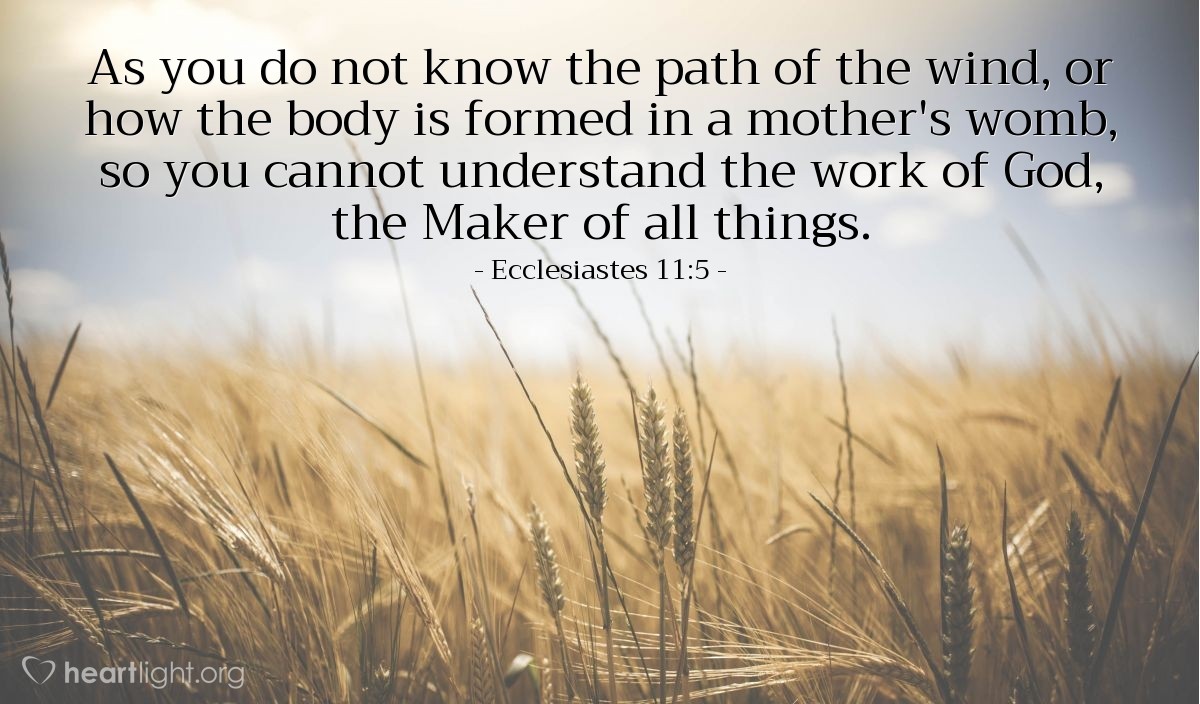
Qohelet provides miscellaneous instructions about wisdom, citizenship, wealth, and work. He reflects on the futility of the fool’s work (10:15), on navigating the uncertainties of leadership and authority (10:16–20), on dealing with the unpredictability of work and wealth (11:1–6), and on enjoying opportunities in view of life’s perplexity (11:7–8). Catchwords bind these units, including (not) “knowing” (10:15; 11:2, 5, 6), “king” (10:16, 17, 20), “hand” (10:18; 11:6), “bread” (10:19; 11:1), and “rejoice” (10:19; 11:8). The subunit of 10:16–20 gives wisdom concerning national and private matters: in the former, mature leadership is key (10:16–17), in the latter diligence and restraint (10:18–20). The next subunit (11:1–6) encourages initiative and persistence in view of life’s uncertainties and difficulties.
**
**
The Preacher Offers Counsel to the Young (11:9–12:8)
Qohelet provides his final call to joy (11:9–10), followed by an exhortation for the reader to remember his Creator before old age and death snatch the opportunity (12:1–8). The first part follows a loose chiasm focusing on the juxtaposition of youthful vitality with divine judgment: youth (11:9a)—heart and eyes (11:9a)—God will judge (11:9b)—heart and flesh (11:10a)—youth (11:10b). The second part is bound through the imperative “remember: followed by a threefold repetition of “before,” emphasizing the progression from old age to frailty to death: remember your Creator (12:1a) before the evil days come (12:1b), before the sun/moon/stars grow dark (12:2), before the silver cord is snapped (12:6). The final verse (12:8) provides a closure device by reiterating the frame motto that everything is enigmatic (compare 1:2).
The End of the Matter (12:9–14)
The final verses provide an epilogue (12:9–11) and closing exhortation (12:12–14), most likely part of the original composition than a later addition. The section divides with the repetition of “beyond this” (wəyōter) in 12:9, 12, and the change in tone from characterizing Qohelet in the third person (12:9–11) to an imperatival warning about the limits of wisdom and necessity of fearing God (12:12–14). The epilogue is key to the more positive reading of the book, as Qohelet is identified as an attentive and thoughtful sage who penned delightful and truthful sayings derived from Yahweh himself (“one Shepherd”). The final exhortation enjoins reverence for God and obedience in view of human limitations and the reality of divine judgment.
The Book of Ecclesiastes (Qohelet) stands as a unique and penetrating voice in the Canon. Its stark refrain, “Vanity of vanities, all is vanity” (Eccl. 1:2, NKJV), can be misread as despair or nihilism. This is one of the most mysterious and controversial books of the Old Testament. There is no vivid evidence of faith, miracles, or threatening prophecies in it. Everything sacred here seems to have been eroded, only human impotence and fatigue are exposed. It is no coincidence that many researchers have called this book the most “unbiblical,” so much so that its main motive is the meaninglessness of human existence, which seems to contradict the spirit of Holy Scripture. Even the very inclusion of Ecclesiastes in the Jewish biblical canon caused a tense dispute between the Hillel and Shamai rabbinic schools in the 1st century A.D. The fate of the book was decided by the fact that it was traditionally attributed to King Solomon, whose authority for Jews was indisputable. However, through the lens of Christ and the Holy Fathers, it is revealed as a divinely inspired therapeutic discourse designed to heal the soul of its attachment to the fallen world. It is a necessary, preparatory “dark night” that exposes the emptiness of life “under the sun” apart from God, thereby creating an existential thirst for the One Who is Life Himself. This book, in fact, asks a question. Ecclesiastes is a question, and the answer is the Gospel.
1. The Diagnosis: “Under the Sun” and the Curse of Vanity
The Preacher’s method is to examine every aspect of human endeavor—wisdom, pleasure, wealth, labor, and power—from a purely earthly perspective, “under the sun.” His conclusion is that all is hevel (Hebrew for “vanity,” “vapor,” “breath”)—transient, futile, and unable to provide ultimate meaning.
-
Text: “I have seen all the works that are done under the sun; and indeed, all is vanity and grasping for the wind.” (Eccl. 1:14, NKJV). “For in much wisdom is much grief, And he who increases knowledge increases sorrow.” (Eccl. 1:18, NKJV).
-
Christological Interpretation: This is not a denial of God’s good creation, but a diagnosis of creation subjected to futility because of the Fall (Romans 8:20). The “vanity” is the existential distortion caused by sin and death. The Preacher’s quest mirrors the state of humanity without Christ: intelligent, searching, but ultimately finding only a dead end. He is, in a sense, the voice of the Old Covenant’s limitations—it can diagnose the sickness but cannot provide the final cure.
-
Ascetical Understanding: This is the foundational stage of the spiritual life: detachment (apostasia or apatheia). Ecclesiastes functions as a spiritual director, systematically stripping away our illusions and idols. It teaches the soul to see the ultimate emptiness of worldly wisdom, pleasure, and glory, thereby freeing it from passion and preparing it to seek God alone. This “holy despair” in the world is the prerequisite for true hope in God.
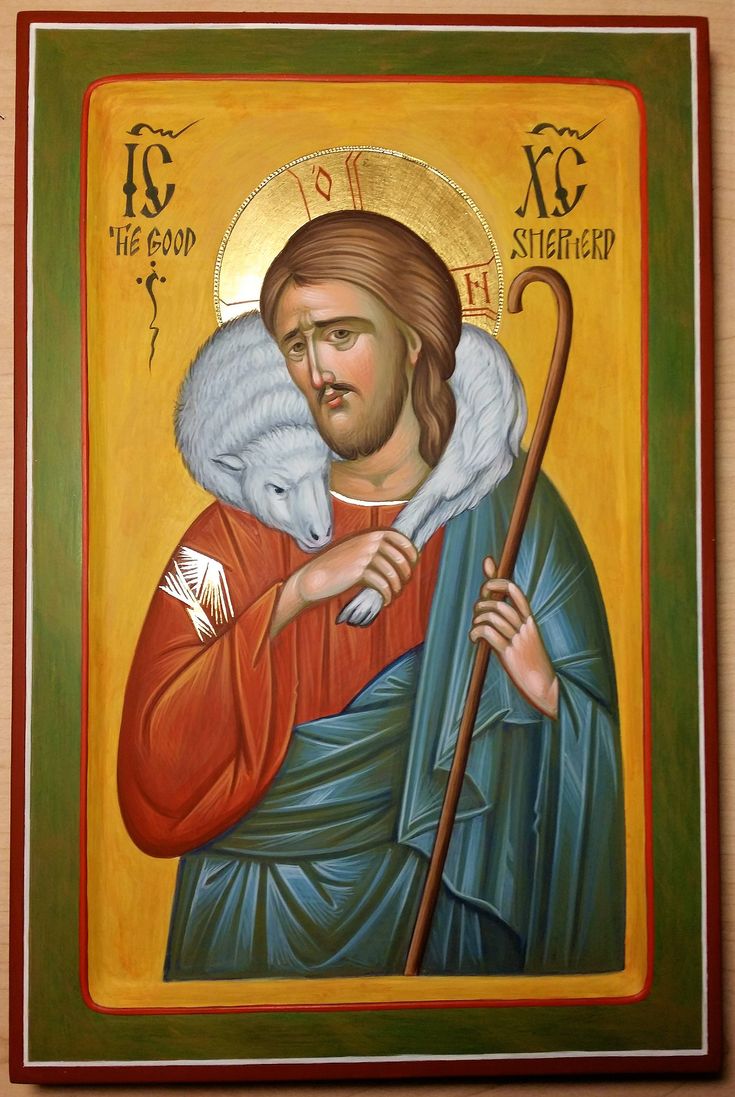
2. The Prototypical Messianic Longing: The “One Shepherd” and the “Good”
Amidst the cyclical despair, flashes of divine hope break through, pointing toward a solution beyond “under the sun.”
-
The One Shepherd:
-
Text: “For what has man for all his labor, and for the striving of his heart with which he has toiled under the sun?… The words of the wise are like goads, and like nails firmly fixed are the words of the masters of assemblies, which are given fromone Shepherd**.”** (Eccl. 12:8, 11, NKJV).
-
Christological Fulfillment: The Fathers, such as St. Gregory of Nyssa, identified this “one Shepherd” as Jesus Christ. He is the ultimate source of all true wisdom and the one who gives enduring meaning to human toil. He is the Good Shepherd (John 10:11, 14) whose words are the ultimate “goad” to repentance and the “firmly fixed nail” of truth upon which we can hang our lives.
-
-
The “Good” in a World of Vanity:
-
Text: “Here is what I have seen:It is good and fitting for one to eat and drink, and to enjoy the good of all his labor in which he toils under the sun all the days of his life which God gives him; for it is his heritage.” (Eccl. 5:18, NKJV).
-
Patristic Insight: The Preacher is not advocating hedonism. He is pointing to the simple, grateful reception of God’s gifts as a temporary antidote to despair. This “good” finds its ultimate fulfillment in Christ, who sanctifies the material world. The true “good” is to receive every blessing—from daily bread to life itself—as a gift from the Father and to enjoy it in Eucharistic thanksgiving. The “heritage” is no longer just a plot of land, but the Kingdom of God.
-
3. The New Testament Parallels: Fulfilling the Quest
The themes of Ecclesiastes are directly addressed and fulfilled in the teachings of Christ and the Apostles.
-
The End of the Quest for Meaning: The Preacher’s futile search for meaning “under the sun” finds its answer in Christ, who transcends the sun. He declares, “I am the light of the world. He who follows Me shall not walk in darkness, but have the light of life.” (John 8:12, NKJV). The search for wisdom ends in Him who is the “wisdom of God” (1 Corinthians 1:24).
-
The Vanity of Earthly Treasure: Ecclesiastes’ lament over the futility of toil and wealth is fulfilled in Christ’s command: “Do not lay up for yourselves treasures on earth… but lay up for yourselves treasures in heaven… For where your treasure is, there your heart will be also.” (Matthew 6:19-21, NKJV). Christ provides the eternal, non-perishable “gain” that the Preacher could not find.
-
The Final Judgment: The Preacher’s deep injustice at seeing the righteous suffer and the wicked prosper (e.g., Eccl. 3:16, 4:1) is a cry for a final judgment. This cry is answered in Christ, who “will come again in glory to judge the living and the dead,” righting every wrong and ending the reign of vanity forever.
4. The Liturgical and Ascetical Understanding
The spirit of Ecclesiastes permeates the Orthodox ethos, particularly in its ascetical and liturgical life.
-
The Lenten Spirit: The book is quintessentially a “Lenten” text. Its theme of repentance, its call to remember God in the days of one’s youth before “the dust returns to the earth as it was, And the spirit returns to God who gave it” (Eccl. 12:7), and its stark confrontation with mortality align perfectly with the services of Great Lent. It cultivates the “godly sorrow” that leads to repentance (2 Corinthians 7:10).
-
The Monastic Ideal: The ascetical rejection of the world, wealth, and fame in monasticism is a lived embodiment of Ecclesiastes’ diagnosis. The monk, by voluntarily embracing the “vanity” of the world, seeks to attain the one thing that is not vanity: God Himself.
-
The “Remembrance of Death” (Memento Mori): The closing chapter’s powerful poetic depiction of aging and death (Eccl. 12:1-7) is the basis for the Orthodox spiritual practice of the “remembrance of death.” This is not a morbid fixation, but a wise and sober tool to reorient the soul toward eternal priorities, urging it to “Remember now your Creator in the days of your youth” (Eccl. 12:1).
Conclusion: From Vanity to Incarnation
Ecclesiastes is a profoundly Christ-centered book because it performs the essential, painful surgery of removing our false hopes. It is the ultimate via negativa (negative theology) of the Old Testament, demonstrating what God is not —He is not found in the futile cycles of a fallen world.
The book’s true meaning is unlocked in the Incarnation. The eternal Word, the “one Shepherd,” entered into our world of “vanity,” into the very “dust” to which we return. He subjected Himself to the futility of death on the Cross. By doing so, He filled the emptiness with His divine presence, transformed the dust of death into the glory of resurrection, and turned our vain striving into a pilgrimage toward His Kingdom.
Thus, Ecclesiastes does not end with despair, but with a directive that points toward Christ: “Fear God and keep His commandments, For this is man’s all. For God will bring every work into judgment, Including every secret thing, Whether good or evil.” (Eccl. 12:13-14, NKJV). In Christ, the fear of the Lord becomes loving reverence, the commandments become the law of liberty, and the final judgment becomes the hope of resurrection and eternal life, where vanity is finally and forever swallowed up by victory.
25.1 Finding Joy in a Fallen World
Finding Joy in a Fallen World
The Preacher Searches for Meaning (1:1–6:12)
Title: The Observations of the Preacher (1:1)
**
**
King Solomon in Old Age by Gustave Doré (1866)
The Preacher Observes the Vanity of Wisdom (1:12–18)
The Preacher Observes the Vanity of Wealth (2:1–11)
The Preacher Observes the Vanity of Work (2:18–26)
A Poem: A Time for Every Matter Under Heaven (3:1–8)
The Preacher Observes Injustice Under the Sun (3:16–17)
The Preacher Observes That All Alike Die (3:18–22)
**
**
The Preacher Offers Advice (7:1–12:14)
The Preacher Offers Wise Counsel (7:5–14)
**
**
The Preacher Again Offers Wisdom (7:19–20)
**
**
The Preacher Observes Again That All Alike Die (9:2–10)
The Preacher Offers Various Pieces of Wisdom (10:1–4)
The Preacher Offers Wisdom on Words (10:12–14)
**
**
The Preacher Offers Counsel to the Young (11:9–12:8)
The End of the Matter (12:9–14)
25.2 An Orthodox Insight into the Book of Ecclesiastes: The Cure for Vanity
1. The Diagnosis: “Under the Sun” and the Curse of Vanity
2. The Prototypical Messianic Longing: The “One Shepherd” and the “Good”
-
The One Shepherd:
-
The “Good” in a World of Vanity:
3. The New Testament Parallels: Fulfilling the Quest
4. The Liturgical and Ascetical Understanding
Conclusion: From Vanity to Incarnation
- Finding Joy in a Fallen World
-
An Orthodox Insight into the Book of Ecclesiastes: The Cure for Vanity
-
-
25.1 Finding Joy in a Fallen World
-
25.2 An Orthodox Insight into the Book of Ecclesiastes: The Cure for Vanity
-
Finding Joy in a Fallen World
Related Concepts
- 2-corinthians-710
- accountability
- anti-hedonism
- ascetical-detachment
- commandments
- community
- contentment
- creation-goodness
- creation-subjected-to-futility
- curse
- curse-of-the-fall
- detachment
- diagnosis-of-the-sickness
- divine-judgment
- eschatological-consciousness
- eternal-temple
- eucharistic-thanksgiving
- fall-and-curse
- final-judgment
- finitude
- genesis-319
- gift-of-god
- godly-sorrow
- good-shepherd
- gospel-answer
- hevel
- holy-despair
- hope-of-the-living-94
- human-limits
- joy-as-gift
- joy-commendations
- kingdom-of-god
- lenten-spirit
- luke-132-33
- memento-mori
- messianic-longing
- mutual-aid
- narrow-path-between-extremes
- one-shepherd
- patristic-interpretation
- portion
- portionheritage
- remembrance-of-death
- resurrection
- resurrection-hope
- romans-13
- romans-820
- second-coming
- secular-estimation
- solomonic-authorship
- the-fall
- time
- universal-sin-720
- vanity-of-labor
- via-negativa
- wealth-as-gift
- wisdom-limits
- wisdom-vs-folly
- youth-and-mortality