Old Testament — Topic 23
PSALMS
Outline
1:1–41:13 Book I: Orientation—Torah and Kingship
42:1–72:20 Book II: Disorientation—Covenant Failure and Petition
73:1–89:52 Book III: National Disaster
90:1–106:48 Book IV: Reorientation—Divine Enthronement and Thanksgiving
107:1–150:6 Book V: God Reigns!
Numbering
Psalms are usually identified by a sequence number, often preceded by the abbreviation “Ps.” Numbering of the Psalms differs – mostly by one – between the Hebrew (Masoretic) and Greek (Septuagint) manuscripts. Protestant translations use the Hebrew numbering, but other Christian traditions vary:
Catholic official liturgical texts, such as the Roman Missal, use the Greek numbering.
Modern Catholic translations often use the Hebrew numbering (noting the Greek number).
Eastern Orthodox and Eastern Catholic translations use the Greek numbering (noting the Hebrew number).
The variance between the Masorah and Septuagint texts in this numeration is likely due to a gradual neglect of the original poetic form of the Psalms; such neglect was occasioned by liturgical uses and carelessness of copyists. It is generally admitted that Psalms 9 and 10 (Hebrew numbering) were originally a single acrostic poem, wrongly separated by Massorah and rightly united by the Septuagint and the Vulgate. Psalms 42 and 43 (Hebrew numbering) are shown by identity of subject (yearning for the house of Yahweh), of metrical structure and of refrain (comparing Psalms 42:6, 12; 43:5, Hebrew numbering), to be three strophes of one and the same poem. The Hebrew text is correct in counting as one Psalm 146 and Psalm 147. Later liturgical usage would seem to have split up these and several other psalms. Scholars combine into what they deem the original choral odes: Psalms 1, 2, 3, 4; 6 + 13; 9 + 10; 19, 20, 21; 56 + 57; 69 + 70; 114 + 115; 148, 149, 150. A choral ode would seem to have been the original form of Psalms 14 and 70. The two strophes and the epode are Psalm 14; the two antistrophes are Psalm 70. It is noteworthy that, on the breaking up of the original ode, each portion crept twice into the Psalter: Psalm 14 = 53, Psalm 70 = 40:14–18. Other such duplicated portions of psalms are Psalm 108:2–6 = Psalm 57:8–12; Psalm 108:7–14 = Psalm 60:7–14; Psalm 71:1–3 = Psalm 31:2–4. This loss of the original form of some of the psalms is considered by the scholars to have been due to liturgical practices, neglect by copyists, or other causes.
[In this course material, dedicated to the Psalms, we will use the Hebrew numbering (Masoretic) order for reference. In the concluding quizzes the Greek numbering (Septuagint) order will be used].
| Hebrew numbering (Masoretic) | Greek numbering (Septuagint) |
|---|---|
| 1–8 | 1–8 |
| 9–10 | 9 |
| 11–113 | 10–112 |
| 114–115 | 113 |
| 116 | 114–115 |
| 117–146 | 116–145 |
| 147 | 146–147 |
| 148–150 | 148–150 |
Verse numbers were first printed in 1509. Different traditions exist as to whether to include the original heading into the counting or not. This leads to inconsistent numbering in 62 psalms, with an offset of 1, sometimes even 2 verses.
Human Experience as Praise
The book of Psalms confronts us with a wide spectrum of human experience in a fallen world. Its content extraordinarily demonstrates that God accepts his people both at their best and at their worst. In ironic contrast, its English title means “praises,” a meaning reflected by its Greek (Psalmoi) and Hebrew (Tehillim) origins. In the “Psalms,” both our joys and our sufferings are “praises” before God. As the book was compiled across generations, we encounter poems from authors and time periods from Moses (Ps 90) to the postexilic era (e.g., Ps 137). In spite of this diverse and often messy relational reflection, the book boasts several collections, including the Elohistic Psalter (Pss 42–83), the Yahweh Reigns collection (Pss 93; 95–99), the Songs of Ascent (Pss 120–34), and the Hallel collections (Pss 104‒6; etc.), among many others.
Similarly, the book encapsulates its manifold content and collections within a fivefold division at the highest level: Book I (Pss 1–41), Book II (Pss 42–72), Book III (Pss 73–89), Book IV (Pss 90–106), Book V (Pss 107–50). All but the last conclude with a formulaic doxology (benediction) appearing only in these four locations: a form of “Blessed is Yahweh” coupled with “Amen!” The exaltation of God’s Torah and his chosen King provides a fitting introduction (Pss 1–2), while the Final Hallel (Pss 146–50) concludes the book with resounding hallelujahs. Some suggest this organization reflects the fivefold division of the Pentateuch. In other words, these divisions were probably introduced by the final editors to imitate the five-fold division of the Torah.
- Book 1 (Psalms 1–41)
- Book 2 (Psalms 42–72)
- Book 3 (Psalms 73–89)
- Book 4 (Psalms 90–106)
- Book 5 (Psalms 107–150)
Book I: Orientation—Torah and Kingship (1:1–41:13)
The exaltation of God’s Torah and his chosen King (Pss 1–2) introduces the Psalter and characterizes Book I. Of its remaining thirty-nine psalms, approximately twenty are widely classified as laments. This tone sets the stage for the movement of Books I–III toward national disaster. David as the primary voice in book I strengthens this poetic arc, draws attention to his troubled life, and sharply focuses the God who faithfully delivered him. Strategically organizing this distressing backdrop are four symmetrically arranged hymns devoted to the Creator (Ps 8), Torah (Ps 19), kingship (Ps 29), and wisdom (Ps 37). They collectively call on us to reflect on our Creator with wisdom, challenge us to consider our stance toward God’s word and his Anointed, and encourage us to patiently wait for divine deliverance during times of suffering.
Book II: Disorientation—Covenant Failure and Petition (42:1–72:20)
The lament characterizing David’s prayers in Book I continues in Book II, albeit mixed with those of the Korahites (Pss 42–49), Asaph (Ps 50), and the anonymous psalmist (Pss 66–67, perhaps 71). These voices collectively transform into an idealized Teacher who speaks with God’s voice. Couched within these petitions is either benediction or malediction, aimed at those who are faithful or are unfaithful to God’s covenant. Indeed, the opening emphasis on the cosmic reign of God in Book II anticipates the dramatic cessation of the Davidic monarchy concluding book III, as well as God’s enthroned exaltation in Books IV–V. Nevertheless, Ps 72 closes the section with a dedication for the next crown prince before the King of all kings. Book II continues the poetic development of Israel’s theologized history and calls the worshiper to a life characterized by covenant faithfulness and dependence on God as King.
Book III: Nadir—National Disaster (73:1–89:52)
Book III brings the sorrow characterizing the first three books of the Psalter to a close. A wisdom psalm (Ps 73) opens the section, a royal psalm (Ps 89) provides closure, and scattered throughout its many laments are three hymns of Zion (Pss 76; 84; 87). This canonical focus calls for wisdom against a backdrop of lamentation with Zion and her kings at its heart. In contrast, the voice of David appears but once (Ps 86), replaced by those of Asaph, Korah, and Ethan. Where David maintained covenant faithfulness in Books I–II, here his descendants utterly founder. Against God the poet laments: “You rejected the covenant of your servant, you defiled his crown in the dirt!” (89:39). The poetic arc for the salvific history of God’s people falls to its lowest point. Nevertheless, opening wisdom reminds us that “God is indeed good to Israel” (73:1). Where human institutions fail, God, the King of all human sovereigns, will never fail.
Book IV: Reorientation—Divine Enthronement and Thanksgiving (90:1–106:48)
Contrasting with the disaster concluding Books I‒II, Books IV‒V reorient God’s people through a collective focus on God as King. In Book IV the voice of David (Pss 101; 103) remains reduced, replaced almost entirely by the anonymous psalmist. This democratized Teacher of wisdom opens with the voice of Moses (Ps 90). Indeed, Book IV takes us back to Moses’ leadership in the theocracy. While anticipated in Book III (77:20), in Book IV Moses appears at the beginning (90:1), throughout (99:6; 103:7; 105:26), and at its conclusion (106:16, 23, 32). He appears nowhere else in the Psalter. Against this backdrop the rule of God takes center stage in six hymns celebrating Yahweh’s enthronement (Pss 93; 95–99). Nevertheless, David promises monarchical covenant faithfulness in a royal psalm (Ps 101). This Davidic voice adds to the collective voice of wisdom, anticipating the reign of God through an unnamed royal figure.
Book V: Zenith—God Reigns! (107:1–150:6)
Like Books I–II, Book V once more focuses the voice of David through several psalms (Pss 108–10; 122; 124; 131; 138–45). Similarly, human kingship once more comes to the fore in three strategic places (Pss 110; 132; 145). This reemphasis on royalty lies couched on a backdrop colored by hymns, pivots about the exaltation of Torah in Ps 119, and collectively celebrates God and his word. The poetic arc comes back full circle to the opening of the Psalter with its two-pronged focus on Torah and kingship (Pss 1–2). While the identity of the royal figure anticipated in Book IV remains obscure, Book V pulls back the veil a bit more. Psalm 110 demonstrates that he is a Davidide, a scion whom David himself calls Lord. The Final Hallel (Pss 146–50) concludes Book V and the entire Psalter with resounding hallelujahs to the God who reigns over all and has set his chosen King over Zion.
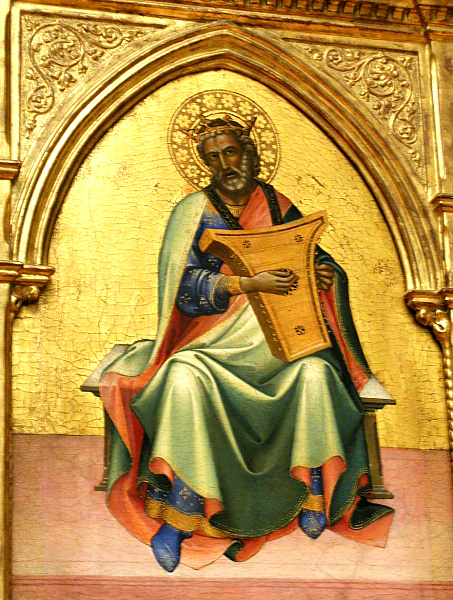
Lorenzo Monaco, David , circa 1408/1410
23.1 Human Experience as Praise
Numbering
Human Experience as Praise
Book I: Orientation—Torah and Kingship (1:1–41:13)
Book III: Nadir—National Disaster (73:1–89:52)
Book V: Zenith—God Reigns! (107:1–150:6)
Lorenzo Monaco, David , circa 1408/1410
23.1 Human Experience as Praise
Numbering
Human Experience as Praise
Book I: Orientation—Torah and Kingship (1:1–41:13)
Book III: Nadir—National Disaster (73:1–89:52)
Book V: Zenith—God Reigns! (107:1–150:6)
Lorenzo Monaco, David , circa 1408/1410
-
23.1 Human Experience as Praise
-
Human Experience as Praise
The psalms attributed to David in the headings in Hebrew are Psalms 3–9; 11–32; 34–41; 51–65; 68–70; 86; 101; 103; 108–110; 122; 124; 131; 133; and 138–145, approximately half the Psalter. It has sometimes been claimed that ledāwîd in these headings does not mean ‘by David’ but rather ‘concerning David’, being comparable to such expressions in the Ugaritic texts as lbʿl ‘concerning Baal’. However, this view is difficult to sustain. We may take, for instance, the superscription to Psalm 7, ‘A Shiggaion ledāwîd, which he sang to the Lord concerning Cush a Benjaminite’, or Psalm 18, ‘A psalm ledāwîd the servant of the Lord, who addressed the words of this song to the Lord on the day when the Lord delivered him from the hand of Saul. He said: …’ It is impossible to suppose that ledāwîd in these instances is anything but an ascription of authorship.
There is now general agreement that these headings should not be taken as factually authentic. Although some psalms may be as old as the time of David (e.g. Psalm 110), it would be a bold scholar who could claim any particular psalms to be by him (but compare now M.D. Goulder). Sometimes the headings specify particular events in David’s life as the occasion for the psalm in question (Psalms 3; 7; 18; 34; 51–52; 54; 56–57; 59–60; 63; 142), usually referring to episodes known from the books of Samuel. However, there is no doubt that these headings are later additions to the text, since they hardly ever match the actual contents of the psalm in more than a very general way, and sometimes they are quite inappropriate. They thus provide evidence of the history of interpretation of the psalms, rather than of their original setting. The increasing tendency to ascribe more and more psalms to David is illustrated by the Greek Septuagint, where the number rises from 73 to 85 (including the additional Psalm 151), sometimes with further precise details of circumstances.
Although most of these psalms are not even royal, let alone by David, it is quite likely that a large number of them derive from the pre-exilic period, when the Davidic monarchy ruled. They are especially concentrated in books 1–2 of the Psalter, which appear to contain many of the earliest psalms, those dating from before the exile.
The Psalms of the Sons of Korah
The following psalms have headings which associate them with the sons of Korah: Psalms 42–49; 84–85; and 87–88 (Psalm 88 is also attributed to Heman the Ezrahite). Of these Psalms 42/43; 46; 48; 84; and 87 are especially concerned with Mt Zion, and their strong emphasis on its inviolability (compare Psalms 46; 48) suggests a pre-exilic origin before the first temple was destroyed (contra G. Wanke). There are no good reasons for disputing an origin in Jerusalem, which their pervasive Zion theology suggests. This has not, however, prevented two scholars from suggesting quite different origins. Thus, J. Maxwell Miller sees the Korahite psalms as originating from southern Judah, while M.D. Goulder (who does not discuss Miller’s suggestion) views them as having originated at the other end of Israel at the sanctuary of Dan in the Northern Kingdom, specifically in the Autumn festival.
Miller’s arguments start from the fact that reference is made to the bny qrḥ ‘sons of Korah’ on an ostracon found near the sanctuary at Arad in southern Judah (compare Y. Aharoni, Arad Inscriptions, no. 49, line 2). This may or may not refer to the levitical sons of Korah of the Bible, but even if it does, it cannot be gainsaid that there are no clear references to southern Judah in these psalms, whereas allusions to Zion are all-pervasive. Miller thinks that the reference in Ps. 48:2 to Mt Zion’s being ‘in the far north’ supports his view of the southern vantage-point of these psalms. However, it is far more likely that the phrase in question is a mythical one, to be rendered ‘in the heights of Zaphon’. Zaphon was the name of Baal’s mountain-dwelling in the Ugaritic texts and is associated with the divine name Elyon (‘the Most High’) in Isa. 14:13–14, El-Elyon (‘God Most High’) being the name of the Jebusite deity of Jerusalem, equated by the Israelites with Yahweh (compare Gen. 14:18–20, 22). The Jerusalemite divine name Elyon is actually employed in the related Korahite psalm, Ps. 46:4, and there are other clear mythical allusions of a distinctly Jerusalemite character in both Psalms 46 and 48. In Ps. 46:4 we find the mythical ‘river whose streams make glad the city of God, the holy habitation of the Most High (Elyon)’, mentioned elsewhere in connection with Jerusalem (compare Isa. 8:5; 33:21; Ezek. 47:1ff.; Joel 3:18; Zech. 14:8), while in Ps. 48:7 we read of the shattering of ships, apparently within sight of Jerusalem (compare v. 8), a mythical motif also associated with Jerusalem.
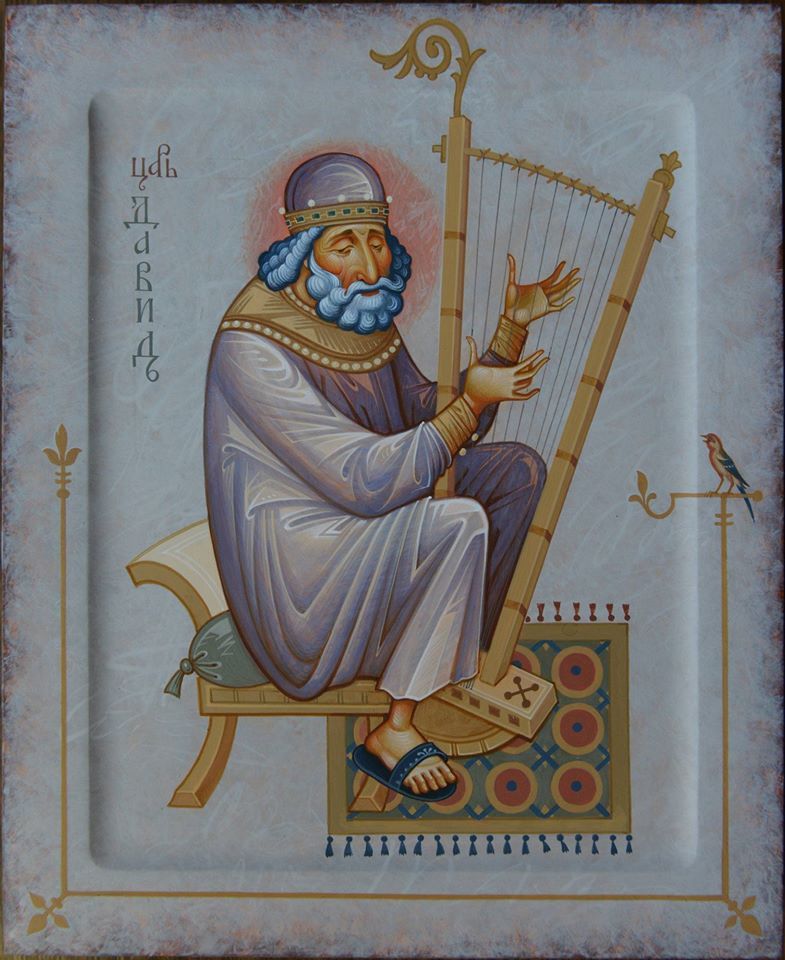
David prophet and king of Israel (a modern Russian icon)
-
23.2 The History of Interpretation of the Psalms by the Jews and in the Christian Church
-
The Theology of the Psalms**
**
* An Orthodox Insight into the Book of Psalms: The Songbook of Christ
Related Concepts
- anointed-king
- asaph
- authorship
- benediction
- blessing-and-curse
- book-iv
- canonical-shaping
- choral-odes
- collections
- copyists
- covenant-failure
- davidic-kingship
- divine-enthronement
- divine-kingship
- divine-names
- elyon
- exodus
- final-editors
- final-hallel
- fivefold-structure
- hallel
- history-of-interpretation
- human-experience
- hymns-of-zion
- imprecation-and-benediction
- jerusalem
- kingship
- korahites
- lament
- leadership
- liturgical-use
- malediction
- messiah
- messianic-kingdom
- mountain-of-the-lord
- national-disaster
- obedience
- orientationdisorientationreorientation
- patience
- petition
- poetic-form
- praise
- psalm-110
- psalm-12
- psalter-conclusion
- reorientation
- roman-missal
- royal-psalms
- temple
- textual-transmission
- theocracy
- vulgate
- wisdom
- yahweh-reigns-collection
- zion