Old Testament — Topic 21
ESTHER
Outline
1:1–2:23 Esther the Jew Becomes Queen of Persia
3:1–7:10 Queen Esther Intercedes to Save the Jews from Haman’s Plot to Kill
Them
8:1–10:3 Queen Esther and Mordecai Aid the Jews and Establish the Feast of
Purim
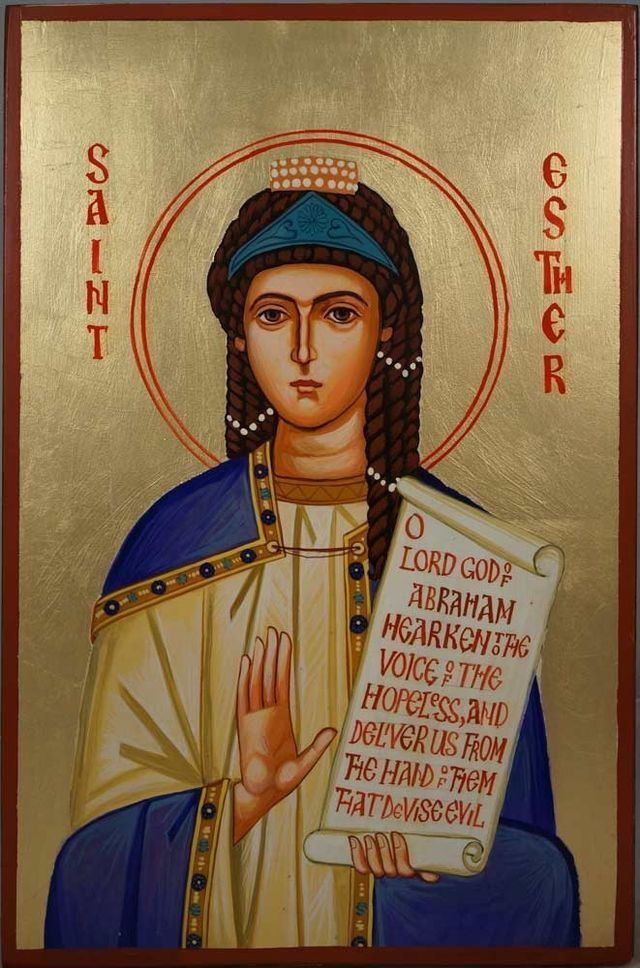
Our Faithful God Works in Unexpected Ways
The book of Esther is a masterfully narrated account relating God’s salvation of the Jewish people from their total destruction devised by Haman the Agagite, all of which takes place during King Ahasuerus’ reign in the Persian period. Some have struggled to understand or even accept this book, because God is never mentioned and the characters do not seem appropriately pious; however, the power of the book lies specifically therein. As in our own lives, the characters are imperfect. As in our own lives, God’s presence and action are recognized by faith, not by sight. Through Mordecai and Esther, imperfect Jews from the tribe of Benjamin whose ancestors were exiled to Babylon, God works to reverse Haman’s plan and to deliver his people from destruction throughout the Persian Empire. The celebration of this deliverance, the annual Feast of Purim, is inaugurated in Esth 9 and continues to be celebrated among Jews to this day. Though the book itself does not make this explicit, this salvation allows God’s promises to Adam, to Abraham, to Judah, and to David to carry forward toward their consummation in Jesus Christ, whose work also takes place in unexpected ways.
Esther the Jew Becomes Queen of Persia (1:1–2:23)
The story of Esther occurs in approximately 480 BC, a time during which many of God’s people remain in exile—a time after the reconstruction of the temple under Zerubbabel (516 BC) but before the return of more Jewish people under Ezra (458 BC). The narrative begins as Persian King Ahasuerus demonstrates his glory through two extravagant feasts. When commanded to appear, beautiful Queen Vashti refuses. After consulting advisers, the enraged Ahasuerus decides to replace Vashti. Later, with his anger abated, Ahasuerus again follows advice by gathering beautiful virgins from throughout his empire from whom he is to choose a queen. Mordecai and Esther, Benjaminite Jews descended from earlier exiles, now appear in the narrative. Beautiful, shapely Esther, an orphan under the care of her cousin Mordecai, is taken among the virgins and finds favor with all. Ahasuerus loves her, crowns her, and honors her with a feast. This section leads into the next as Mordecai saves the King by working through Esther to thwart a plot against Ahasuerus.
Queen Esther Intercedes to Save the Jews from Haman’s Plot to Kill Them (3:1–7:10)
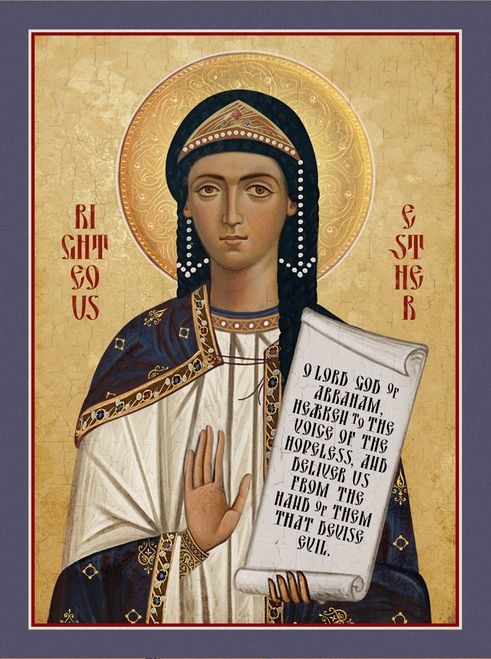
Though the previous section ends with Mordecai saving Ahasuerus, this section begins with Ahasuerus honoring Haman the Agagite. Because Mordecai refuses to bow to Haman, Haman determines to annihilate all Jews in the empire, setting a date by lot. Mordecai sends Esther to the King, risking her life to do so but encouraging her to consider—in one of the book’s passive nods to the providence of God—whether she may have come into her place for precisely “such a time as this.” After hesitating, Esther agrees and invites Ahasuerus and Haman to two feasts. Between feasts, Haman plots to execute Mordecai but ends up honoring him at the King’s command. At the second feast, Esther reveals Haman’s plot. Enraged, Ahasuerus has Haman hanged on the very pole Haman had prepared for Mordecai. This leads to the final section of the book, in which Ahasuerus honors Mordecai and Mordecai institutes a plan to save the Jews.
Queen Esther and Mordecai Aid the Jews and Establish the Feast of Purim (8:1–10:3)
In the previous section, Esther revealed Haman’s murderous plot to King Ahasuerus, and Haman was hanged on the pole he had prepared for Mordecai. In this section, Ahasuerus puts Mordecai in Haman’s place, gives Esther Haman’s possessions, and gives Esther and Mordecai permission to enact a decree to counteract Haman’s plan to annihilate the Jews. The Jews throughout the empire are given permission to defend themselves. They do so rather successfully on two separate days, and they then celebrate with feasting and the giving of gifts. A decree is made that these days shall be celebrated each year in memory of their deliverance—the days of Purim. The book ends extolling the greatness of Mordecai and noting that he (and implicitly his God) has worked for the “welfare” of all the Jews (10:3).
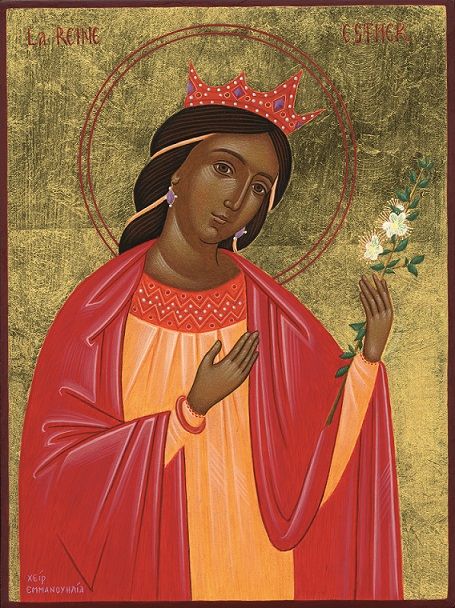
The Book of Esther holds a unique place in the Orthodox Old Testament. While the name of God is never explicitly mentioned, His presence, providence, and power are palpable in every event. For the Fathers, this “hiddenness” is not an absence but a profound theological statement: God works secretly and sovereignly within the complexities of human history to save His people. The story of Esther is a masterful icon of Christ’s hidden descent into the flesh, His victory over the evil one, and the establishment of His Church.
1. The Hidden God and the Hidden Messiah
The most striking feature of the book is the absence of God’s name. This mirrors the “hidden” nature of God’s activity in the world, particularly in the period before the Incarnation.
- Theological Interpretation: God’s providence (pronoia) is at work behind the scenes, orchestrating events—from the dethroning of Vashti to Esther’s rise to queen and Mordecai’s discovery of a plot—to achieve salvation for His people. This can be an image of the “hidden years” of Christ’s life in Nazareth, where the God-man lived in obscurity before His public ministry, while at the same time being the “King of Kings and Master of rulers” (Akathist to Our Sweetest Lord and God and Saviour Jesus Christ, Ikos 9).
- Patristic Insight: The Fathers, such as St. John Chrysostom, saw this as a lesson in faith: we must discern God’s hand not only in miraculous interventions but also in the seemingly random and political machinations of history. God writes straight with crooked lines.
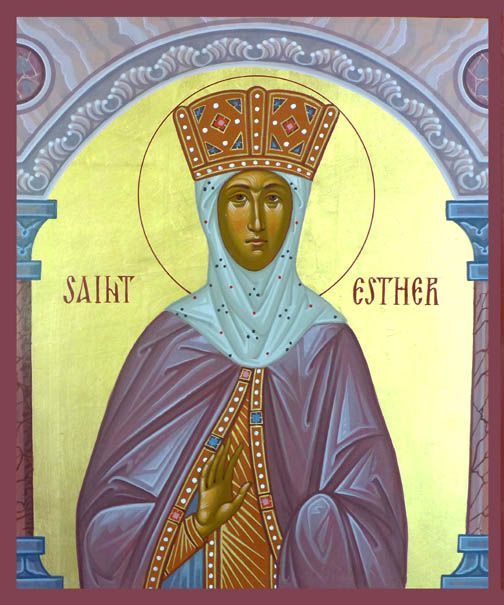
2. Esther as a Type of Christ: The Kenotic Intercessor
Esther’s journey from an obscure Jewish maiden to the queen of Persia is a profound narrative of kenosis (self-emptying) and intercession.
- The Text: Faced with the genocidal decree orchestrated by Haman, Mordecai tells Esther, “Who knows whether you have come to the Kingdom for such a time as this?” (Esther 4:14, NKJV). Esther’s response requires total self-sacrifice: “Go, gather all the Jews who are present in Shushan, and fast for me; neither eat nor drink for three days, night or day. My maids and I will fast likewise. And so I will go to the King, which is against the law; and if I perish, I perish!” (Esther 4:16, NKJV).
- Christological Interpretation: Esther is a powerful type of Christ.
- Kenosis: She leaves her private, secure life to enter the court of the King, risking her life for her people. This prefigures Christ, Who left the glory of Heaven to enter the “court” of this fallen world, taking on human flesh.
- Intercession: She stands as an advocate and intercessor before King Ahasuerus, pleading for the life of her people. This prefigures Christ , our eternal High Priest Who “always lives to make intercession” for us before the Father (Hebrews 7:25).
- Voluntary Sacrifice: Her words, “if I perish, I perish,” echo Christ’s prayer in Gethsemane, “not as I will, but as You will” (Matthew 26:39). She willingly embraces potential death to save others.
- Ascetical Understanding: Esther’s three-day fast is an icon of the Christian path of salvation. The soul, aware of the “decree of death” hanging over it (the consequence of sin), must engage in intense prayer and fasting (ascetical struggle) to prepare itself to approach the King of Kings. The call is to risk everything—to die to self—in order to find life for oneself and for the community of the faithful (see Mk. 8:35).
3. Haman and Mordecai: The Cosmic Battle Reversed
The conflict between Mordecai the Jew and Haman the Agagite (a descendant of Amalek) is not merely personal; it is the continuation of a generations-long spiritual war (Exodus 17:8-16).
- The Text: Haman, enraged that Mordecai will not bow to him, seeks to destroy not just one man, but his entire people. He erects a gallows 50 cubits high for Mordecai (Esther 5:14). In a dramatic reversal, the King honors Mordecai and orders Haman to be hanged on the very gallows he prepared. Let us recall here Ps. 7:16-17: “He made a pit and dug it out, and has fallen into the ditch which he made. His trouble shall return upon his own head, and his violent dealing shall come down on his own crown.”
- Christological Interpretation: This is a profound typology of Christ’s victory over satan.
- Haman is a type of the devil, who, in his pride, seeks the worship that belongs to God alone and devises a plan to destroy the people of God.
- The Gallows prefigures the Cross. The devil intended the Cross to be the instrument of Christ’s shame and death, but God used it as the very means to triumph over him. As St. Paul says, Christ “disarmed the principalities and powers… triumphing over them in it [the Cross]” (Colossians 2:15). Haman hanged on his own gallows is satan defeated by his own weapon of death.
- Mordecai is a type of Christ the Victor, who is exalted from humiliation and dressed in royal robes (Esther 6:6-11), receiving the authority and ring of the King (Esther 8:2).
4. The Feast of Purim and the Messianic Banquet
The salvation of the Jews leads to the establishment of the Feast of Purim, a day of “feasting and joy, of sending presents to one another and gifts to the poor” (Esther 9:22).
- Liturgical Understanding: While Purim is a Jewish feast, the Church sees in it a foreshadowing of the joy of the Messianic Banquet—the Eucharist and the eternal joy of the Kingdom of God. It is the joy of a people snatched from the jaws of death, a joy that must be shared in community and charity. The celebration mirrors the Paschal joy of the Church, which celebrates Christ’s victory over the ultimate enemy, death.
5. New Testament Parallels and the Church
- The Church as Esther: The Church, the New Israel, is like Esther—a people dwelling in the “diaspora” of this world, often facing persecution from a hostile spiritual “Haman.” The Church’s role is to intercede for the world through prayer and sacrifice, offering herself to God for the salvation of all.
- The Intercessory Role of the Theotokos: In a secondary and wholly human sense, Esther’s brave intercession before the King is seen as a faint image of the intercessory role of the Theotokos , Who, as Queen of Heaven, confidently intercedes for Her spiritual children before Her Son, the King of Kings.
Conclusion: Esther as a Christ-Centered Narrative
The Book of Esther is a powerful drama of salvation that reveals the pattern of the Gospel:
- A hidden God works His will through the kenotic sacrifice of a willing intercessor (Esther/Christ).
- The pride of the enemy (Haman/satan) becomes the instrument of his own destruction.
- A seemingly certain decree of death is overturned into a victory of life.
- This victory is celebrated in a joyous feast (Purim/Eucharist) that defines the saved community.
Thus, the story of Esther is not a tale of mere political cunning, but a divine revelation of how God, in His transcendent wisdom, enters the shadows of human history to work our salvation, prefiguring the ultimate deliverance wrought by our Lord Jesus Christ, the true Mordecai and the heavenly Esther, Who by His Cross has “trampled down death by death” and bestowed upon us life everlasting.
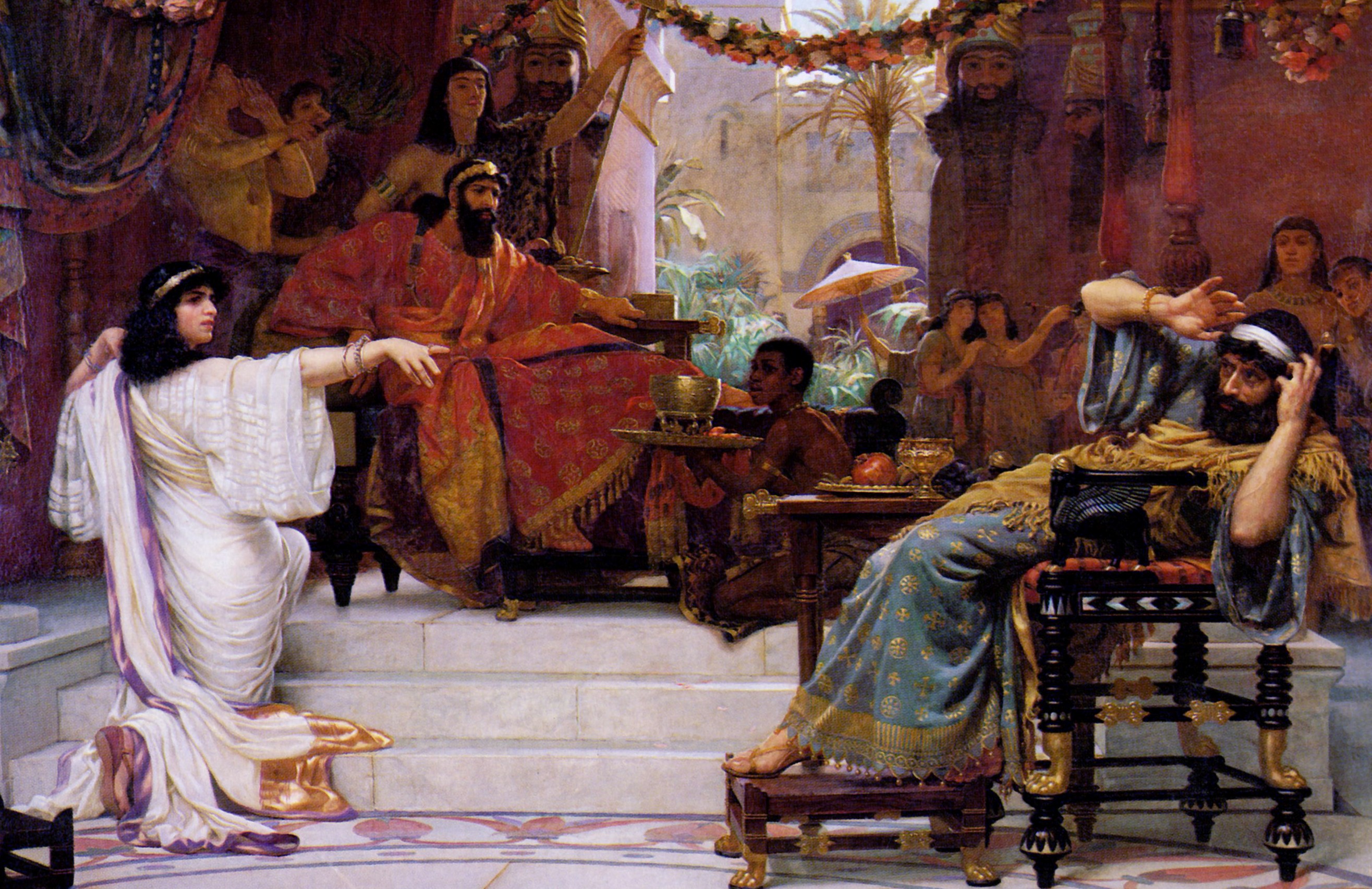
**Esther Denouncing Haman **(1888) by Ernest Normand
A Particular Specification : The Foundational Typology: Amalek, the Archetypal Enemy
The story begins not with Haman, but centuries earlier in the wilderness, with the nation of Amalek (Exodus 17:8-16). Amalek launched an unprovoked, treacherous attack on the Israelites from behind, targeting the weary and the stragglers.
- The Spiritual Significance: The Fathers, such as St. Gregory of Nyssa and St. John Cassian, interpret this not merely as a historical battle but as a prototype of the devil’s warfare against the soul.
- Amalek represents the spirit of malice, treachery, and the relentless, irrational hatred the devil has for humanity , God’s chosen people.
- Their tactic—attacking the faint and weary—symbolizes how the demons assault us when we are spiritually weak, tired from our journey through the wilderness of this life, and have let our vigilance down.
- The Divine Decree: Because of this, God declares an eternal war against Amalek (Exodus 17:16). This is not a call for ethnic genocide but a spiritual proclamation: the spirit of Amalek—the demonic hatred for God and His creation—must be utterly eradicated. It has no place in the Kingdom of God.
Haman as the Embodiment of Spiritual Amalek
The Book of Esther explicitly identifies Haman as “the Agagite ” (Esther 3:1). Agag was the King of Amalek whom King Saul failed to utterly destroy, contrary to God’s command (1 Samuel 15). This genealogical note is the key that unlocks the typology.
- The Unfinished Battle: Saul’s failure to eradicate Amalek allowed the spiritual poison to fester and re-emerge generations later in the person of Haman. This symbolizes how unmortified passions, if spared and tolerated, will inevitably grow back and threaten our very existence.
- Haman’s Character as a Mirror of the devil:
- Pride: Haman’s rage is ignited because one man, Mordecai, will not bow to him (Esther 3:5). This mirrors the pride of Lucifer, who said, “I will ascend into heaven, I will exalt my throne above the stars of God… I will be like the Most High” (Isaiah 14:13-14). The devil demands worship that belongs to God alone, and he is enraged when the human soul, created in God’s image, refuses to bow to his temptations.
- Deception and Accusation: Haman deceives King Ahasuerus, presenting a false accusation against the Jewish people, claiming they are disloyal and obey different laws (Esther 3:8). This is the classic role of the devil, whose names are “the Deceiver” and “the Accuser of our brethren” (Revelation 12:9-10).
- Genocidal Hatred: Haman’s wrath is not satisfied with killing Mordecai; he seeks to destroy his entire people. This reflects the devil’s intent, who “was a murderer from the beginning” (John 8:44) and “prowls around like a roaring lion, seeking someone to devour” (1 Peter 5:8). His hatred is total and directed at the entire human race, the laos (people) of God.
The Ascetical Understanding: Spiritual Amalek in the Human Heart
This is where the typology becomes intensely personal and practical for the Orthodox Christian. The Fathers apply this battle directly to the inner life.
- Spiritual Amalek is the Passions: In ascetical literature, “Spiritual Amalek” is the collective manifestation of our passions —the logismoi (evil thoughts) of pride, anger, lust, and envy that wage war against the soul (1 Peter 2:11).
- The Soul as Israel: The individual human soul, or the collective community of the Church, is the new Israel, journeying toward the Promised Land (the Kingdom of Heaven).
- The Warfare: Just as physical Amalek attacked the weak and weary Israelites, our passions attack us when we are spiritually lethargic, neglecting prayer, the sacraments, and vigilance (nepsis). They attack “from behind”—through subtle thoughts, memories, and seemingly innocent suggestions that we fail to guard against.
The Patristic Application and the Path to Victory
The Fathers use this typology to prescribe the cure for the soul.
- St. John Cassian, in his Institutes and Conferences , consistently teaches that the only way to overcome the demons (the spiritual Amalekites) is through the combination of divine grace and intense human ascetical effort. We must not make a “truce” with any passion, just as Saul was wrong to spare Agag and the best of the spoils.
- The “Spiritual Exodus”: The victory over Amalek in Exodus came when Moses prayed on the mountain while Joshua fought in the valley. This is the model for the spiritual life: we must ascend the mountain of prayer and contemplation (the “Jesus Prayer”), while simultaneously fighting the battle in the valley of our daily actions and thoughts. Our “Joshua” (the name is identical to “Jesus” in Greek) is Christ Himself, Who fights for us and through us.
- The Gallows and the Cross: Haman was hanged on the gallows he built for Mordecai. This is the ultimate ascetical hope: that the devil and our passions are defeated by their own weapons. The Cross, the intended instrument of shame and death for Christ, became the weapon of victory. So too, the very struggles, humiliations, and temptations the devil sends to destroy us can, through faith and patience, become the means of our sanctification and his defeat. We defeat the passion of pride by embracing humility; we defeat hatred by practicing love.
Conclusion: The Unending War
The link Haman**→(the Agagite)→Amalek→the devil→**the Passions is a cohesive and powerful chain in Orthodox theology. It teaches us that:
- The spiritual war is real and has a historical, cosmic dimension.
- The enemy we face externally (temptation, persecution) is the same enemy we face internally (the passions).
- There can be no compromise with this enemy. We are commanded to “utterly destroy” Amalek within us—to wage all-out war on our passions through repentance, confession, and the ascetical disciplines of the Church.
- The final victory is assured not by our own strength, but by the Cross of our true Mordecai, Christ the King, Who has already hanged the prince of this world on his own gallows and established for us the Feast of Purim—the eternal Pascha—in His Kingdom.
- Our Faithful God Works in Unexpected Ways
-
An Orthodox Insight into the Book of Esther
-
- 21.1 Our Faithful God Works in Unexpected Ways
- 21.2 An Orthodox Insight into the Book of Esther
21.1 Our Faithful God Works in Unexpected Ways
Our Faithful God Works in Unexpected Ways
Esther the Jew Becomes Queen of Persia (1:1–2:23)
- Our Faithful God Works in Unexpected Ways
Related Concepts
- absaloms-rebellion
- advocacy
- agag
- allegory
- ark-procession
- census
- christological-interpretation
- church-as-esther
- colossians-215
- community-charity
- cross
- crossing-jordan-as-baptism
- crucifixion
- davidic-line
- deception
- divine-condescension
- divine-irony
- epistle-of-barnabas
- esther
- esther-as-type-of-christ
- esthers-vocation
- god-writes-straight-with-crooked-lines
- haman
- haman-as-type-of-satan
- haman-the-agagite
- hebrews-725
- hidden-god
- hidden-years-of-christ
- high-priest
- history
- humility-of-christ
- intercession
- jesus-prayer
- job-as-type-of-christ
- john-17
- kenosis
- kingdom-of-god
- logismoi
- mariology
- mediation
- mordecai-as-type-of-christ
- nehemiah-as-type-of-christ
- nepsis
- new-israel
- obedience
- old-testament-interpretation
- pascha
- paschal-joy
- passion
- persecution
- philippians-2
- philippians-2-hymn
- philippians-28
- philippians-hymn
- plague
- psalm-7
- purim
- queen-of-heaven
- satans-defeat
- sunday
- sword-of-the-spirit
- typology
- voluntary-sacrifice
- watchfulness
- wednesday-and-friday