Old Testament — Topic 19
19.1 A Genealogical Summary of Israel’s History, Instructions for Worship
in Yahweh’s House, and Encouragement to Follow Yahweh Wholeheartedly
1 CHRONICLES:
1:1–9:44 Genealogies from Creation to Judah’s Restoration in the Land
1:1–4:43 Origins of Israel and Surrounding Nations; Genealogies of Judah and
Simeon
5:1–7:40 Genealogies of Other Israelite Tribes
8:1–9:44 Benjamite Line Focusing on Saul; Returned Exiles in Jerusalem After
the Restoration
10:1–29:30 The Reign of David, Yahweh’s Chosen King
10:1–12:40 The Fall of King Saul and Rise of King David
13:1–16:43 David Defeats the Philistines and Brings God’s Ark to Jerusalem
17:1–20:8 The Davidic Covenant and David’s Subjugation of Surrounding Nations
21:1–22:19 David Chooses the Site for Yahweh’s House and Charges Solomon to
Build the House
23:1–26:32 David Organizes the Priests and Levites
27:1–29:30 David’s Officials and David’s Commissioning of Solomon as King
Written after the Jews returned from the Babylonian exile, the books of Chronicles are the final ones in the Hebrew OT. 1 Chronicles begins by summarizing the history of the Israelite people by means of genealogy. It then gives a narrative account of the reigns of the Davidic kings that emphasizes worshiping Yahweh as he prescribed and trusting him to save in difficult circumstances. 1 Chronicles 1–9 presents genealogies—mostly of Israelite tribes—that stretch back to the beginning of human history. 1 Chronicles 10–29 recounts King David’s reign and his preparations for building Yahweh’s house.
19.5 A Genealogical Summary of Judah’s History, Instructions for Worship in
Yahweh’s House, and Encouragement to Follow Yahweh Wholeheartedly
2 CHRONICLES:
1:1–9:31 The Glorious Reign of Solomon, David’s Heir
1:1–2:18 Solomon Obtains Wisdom and Wealth and Prepares to Build Yahweh’s
House
3:1–4:22 Solomon Builds Yahweh’s House and Fashions Its Furnishings and
Utensils
5:1–7:22 Solomon Dedicates Yahweh’s House
8:1–9:31 The Glory of Solomon’s Reign
10:1–36:23 A History of the Kings of Judah from Rehoboam to the Exile
10:1–12:16 Rehoboam’s Reign Over Judah
13:1–16:14 The Reigns of Abijah and Asa
17:1–20:37 The Reign of Jehoshaphat
21:1–24:27 The Reigns of Jehoram, Ahaziah, Athaliah, and Joash
25:1–26:23 The Reigns of Amaziah and Uzziah
27:1–28:27 The Reigns of Jotham and Ahaz
29:1–32:33 The Reign of Hezekiah
33:1–35:27 The Reigns of Manasseh, Amon, and Josiah
36:1–23 The Final Kings of Judah, the Fall of Jerusalem, and Cyrus’
Proclamation
The book of 2 Chronicles is the final book in the Hebrew OT. 2 Chronicles 1–9 shows how Solomon built Yahweh’s house and became renowned throughout the world. 2 Chronicles 10–36 records the reigns of Solomon’s descendants and focuses on how they prospered when they followed Yahweh and suffered when they abandoned him. The books of Chronicles serve as a fitting end to the Hebrew OT because its genealogies summarize other biblical history. The genealogies also connect the books’ original postexilic Jewish audience to their ancestors, whom Yahweh chose to be his people. Furthermore, the narratives in Chronicles depict for the postexilic audience how they are to worship Yahweh while giving them encouragement to follow Yahweh wholeheartedly into the future.
The Glorious Reign of Solomon, David’s Heir (1:1–9:31)
After David dies, Solomon reigns as King of Israel. In this division, the author of Chronicles describes in detail how Solomon builds Yahweh’s house. The author then recounts the world-renowned splendor of Solomon’s reign. When Solomon asks Yahweh for wisdom, Yahweh promises him wisdom, riches, and honor greater than any other King (1:7–13). Solomon then builds a magnificent house for Yahweh (chapters 2–4) and dedicates it with prayer and feasting together with all Israel (chapters 5–7). Solomon’s wisdom and wealth astound the rulers of other nations, who come to visit him (9:1–9, 22–23). In the next division, his descendants will rule over Judah until they are exiled to Babylon.
Solomon Obtains Wisdom and Wealth and Prepares to Build Yahweh’s House (1:1–2:18)
In the previous section, David’s death left Solomon as King of Israel. Now Solomon goes with all Israel to Gibeon and sacrifices there at the tabernacle (1:2–6). That night, Solomon asks God for wisdom, and God grants him wisdom, riches, and honor (1:7–12). Solomon does business trading chariots and horses and makes Jerusalem wealthy (1:14–17). Then Solomon sets his mind toward building Yahweh’s house (2:1). Solomon negotiates with Hiram King of Tyre for a skilled craftsman and for timber from Lebanon (2:3–16). He also conscripts Israel’s resident aliens as laborers (2:2, 17–18). With materials and personnel in place, Solomon will build Yahweh’s house in the next section.
Solomon Builds Yahweh’s House and Fashions Its Furnishings and Utensils (3:1–4:22)
Having made ready the necessary materials and personnel, Solomon builds Yahweh’s house (chapter 3). On the site that David chose (3:1), Solomon constructs its porch, large house, and most holy place (3:4–9). He makes two wooden cherubim overlain with gold for the most holy place and two pillars for the front of the house (3:10–17). Next, Solomon fashions the house’s furnishings and utensils with the help of Hiram and Huram-Abi (chapter 4). They make a bronze altar, a cast-metal sea, bronze basins, gold lampstands, gold tables, and a plethora of utensils made of bronze and gold. In the next section, Solomon will dedicate the completed house of Yahweh.
Solomon Dedicates Yahweh’s House (5:1–7:22)
In the previous section, Solomon built Yahweh’s house. Now, he dedicates it. First, he and all Israel bring God’s ark to the house (5:1–10). When the musicians sing, Yahweh’s glory fills the house (5:11–15). Solomon then blesses Yahweh for fulfilling his promise to make Solomon King and builder of his house (6:1–11). Solomon asks Yahweh to answer any prayer made toward his house (6:12–42). In answer, fire comes down from heaven and consumes the burnt offering, and Yahweh’s glory fills the house again (7:1). After Solomon sends the people home (7:10), Yahweh appears to Solomon and promises to grant Solomon’s request (7:12–15). The next section will describe the glory of Solomon’s reign.
The Glory of Solomon’s Reign (8:1–9:31)
After showing how Solomon dedicated Yahweh’s house, the author describes the glory of Solomon’s reign. Solomon builds cities throughout his Kingdom (8:1–6). He promotes proper worship of Yahweh by offering burnt offerings according to Mosaic law and by appointing divisions of priests and Levites as David had instructed (8:12–15). When the queen of Sheba visits Solomon, she is amazed by his wisdom and by the happiness of his people (9:1–9). Solomon surpasses all the world’s other Kings in wealth and wisdom, and he rules over the nations around Israel (9:13–28). Solomon then dies (9:29–31), setting the stage for his son Rehoboam to reign in his place in the next section.
19.6 A History of the Kings of Judah from Rehoboam to the Exile
(10:1–36:23)
After Solomon’s glorious reign ends, his kingdom splits (chapter 10), and his descendants reign over Judah until the Babylonians carry Judah into exile. Three Kings follow Yahweh as faithfully as David did (17:3; 29:2; 34:2), expending much effort to promote proper worship. Others follow Yahweh, but not wholeheartedly (25:2, 26:4). Still others act more wickedly than the Kings of pagan foreign nations (33:9, 22). In the end, Judah’s leaders reject Yahweh utterly (36:15–16), so Yahweh brings the Babylonians, who destroy Jerusalem and carry the people of Judah into exile (36:17–20). However, the book of Chronicles, the last book in the Hebrew OT, ends with hope for restoration with the decree of Cyrus (36:22–23).
Rehoboam’s Reign Over Judah (10:1–12:16)
After Solomon’s reign ends, his son Rehoboam becomes King of Israel and loses much of what David and Solomon had attained during their reigns. At the beginning of Rehoboam’s reign, he provokes the northern tribes of Israel to rebel against him, leaving only Judah and Benjamin under his rule (10:1–11:4). Rehoboam and his people follow Yahweh for three years, but they soon abandon Yahweh’s law (11:16–17, 12:1). As a result, Shishak King of Egypt strips all the treasures from Yahweh’s house and Rehoboam’s house (12:2–9). After ruling wickedly over Judah for seventeen years, Rehoboam dies (12:13–16). The next section continues the narrative with the reigns of Rehoboam’s descendants, Abijah and Asa.
The Reigns of Abijah and Asa (13:1–16:14)
In the previous section, King Rehoboam abandoned Yahweh’s law, losing much of Judah’s wealth. This section uses the reigns of Judah’s Kings Abijah and Asa to emphasize the importance of worshiping Yahweh properly and relying on him for victory. When Abijah battles Jeroboam, Abijah boasts that Yahweh fights for Judah since Levites and Aaronic priests administer Judah’s worship (13:10–12). Yahweh gives Abijah’s army victory when they cry to Yahweh for help (13:13–18). Asa trusts in Yahweh and so defeats a vast enemy army (14:9–13), but later Asa is rebuked when he relies on foreign allies (16:1–9). Asa does much to promote proper worship of Yahweh (14:3–5, 15:1–18). In the next section, King Jehoshaphat will also follow after Yahweh.
The Reign of Jehoshaphat (17:1–20:37)
In the last section, Abijah and Asa promoted proper worship of Yahweh and relied on him for victory. Now King Jehoshaphat does what is right in Yahweh’s sight as he rules over Judah (20:32). Jehoshaphat removes Asherim from his Kingdom and teaches Yahweh’s law throughout Judah (17:6–9). The King appoints judges throughout the land and urges them to fear Yahweh (19:4–11). Jehoshaphat responds to the threat of invasion with prayer and fasting, so Yahweh delivers him and his people (20:1–28). Although Jehoshaphat devotedly follows Yahweh, the marriage alliance that Jehoshaphat makes with Israel’s wicked King Ahab (18:1) leads Jehoshaphat’s descendants to forsake Yahweh in the next section.
The Reigns of Jehoram, Ahaziah, Athaliah, and Joash (21:1–24:27)
In the previous section, Jehoshaphat King of Judah followed Yahweh but married his son Jehoram to the daughter of wicked Israelite King Ahab. As a result, Jehoram follows in Ahab’s footsteps, leading Judah away from Yahweh (21:6, 11). Jehoram’s son Ahaziah also rules wickedly due to the influence of his mother, Athaliah (22:2–4). The wickedness culminates in Athaliah’s taking the throne and wiping out most of Judah’s royal household (22:10–11). Six years later, Jehoiada the priest overthrows her, placing young King Joash on the throne (22:12–23:15). Joash remains faithful to Yahweh throughout Jehoiada’s lifetime (24:2) but later forsakes Yahweh (24:17–18). Joash is then assassinated, leaving Amaziah and then Uzziah to reign in the next section.
The Reigns of Amaziah and Uzziah (25:1–26:23)
As King Joash of Judah served Yahweh for a time but later forsook him, so Joash’s successors, Amaziah and Uzziah, start out following Yahweh but then become unfaithful. Amaziah justly punishes his father’s assassins (25:3–4) and trusts Yahweh for military victory over Edom (25:5–12). However, Amaziah soon turns to worship Edom’s gods and suffers military defeat as a result (25:14–24). Likewise, Amaziah’s son Uzziah seeks Yahweh at first (26:4–5). But after God gives Uzziah prosperity, Uzziah pridefully usurps the priestly role of burning incense (28:16–18). Yahweh then makes him a leper—a social outcast (28:19–21). Uzziah’s son Jotham takes over Uzziah’s royal duties (28:21), setting the stage for the reigns of Jotham and Ahaz.
The Reigns of Jotham and Ahaz (27:1–28:27)
In the last section, Judah’s Kings Amaziah and Uzziah followed Yahweh for a time but became unfaithful. Uzziah’s son Jotham does what pleases Yahweh, but Jotham’s son Ahaz commits abominations against Yahweh. Jotham builds a gate for Yahweh’s house (27:3), and Yahweh makes him strong for his faithfulness (27:6). Ahaz, however, makes idols, serves foreign gods, and even burns some of his children as sacrifices (28:2–3, 22–23). Even after Yahweh brings him military defeat for his unfaithfulness (28:5–7, 16–21), Ahaz cuts the vessels in God’s house to pieces and shuts the house’s doors (28:24). After Ahaz dies, his son Hezekiah will restore the Yahweh’s house and proper worship of Yahweh.
19.2 Genealogies from Creation to Judah’s Restoration in the Land
(1:1–9:44)
1 Chronicles opens with a summary of Israel’s origins by means of genealogy. The author begins at the beginning of human history, tracing the origins of the nation of Israel from Adam to Israel and his sons (1:1–2:2). The following genealogies list descendants of each of Israel’s sons except Dan and Zebulun (2:3–8:40). David’s royal line (2:9–15, 3:1–24), the high-priestly line (6:1–15, 50–53), and Saul’s royal line (8:29–40) receive special attention. This division concludes by listing the returned exiles (9:1–34) and by repeating Saul’s royal line (9:35–44), which sets the stage for Saul’s death and the ascension of King David.
Origins of Israel and Surrounding Nations; Genealogies of Judah and Simeon (1:1–4:43)
1 Chronicles begins by bringing the reader back to the book of Genesis, recounting the origins of Israel and nations surrounding it by summarizing genealogical accounts from Genesis (Gen 5; 10; 11:10–26; 25:1–18; 36). From there, the text moves into genealogical accounts of Israelite tribes, starting with the tribe of Judah (1 Chr 2:1–4:23). The genealogy of Judah lists many descendants of Judah, but it highlights the ancestry of David (2:9–15) and David’s descendants (chapter 3). The genealogy of the tribe of Simeon (4:24–43) sets the stage for other tribal genealogies in the following chapters.
Genealogies of Other Israelite Tribes (5:1–7:40)
After the genealogies of Judah and Simeon come genealogies for all the other Israelite tribes except Dan and Zebulun. Some of the tribal genealogies include the number of fighting men in the tribe, significant events involving members of the tribe, and/or areas the tribe inhabited.
- The Transjordan tribes are listed first (chapter 5),
- followed by the Levites (chapter 6),
- then the other tribes (chapter 7).
The entry for the Levites focuses on the high-priestly line (6:1–15, 50–53), the ancestry of significant musicians from David’s time (6:31–48), and the cities where the Levites lived (6:54–81). After the tribal genealogies, the tribe of Benjamin returns to center stage in the next section.
Benjamite Line Focusing on Saul; Returned Exiles in Jerusalem After the Restoration (8:1–9:44)
The tribe of Benjamin returns to the limelight following the genealogies of the Israelite tribes. Many descendants of Benjamin appear here who were not listed in the previous section’s genealogy of Benjamin. However, the ancestry and descendants of King Saul receive the focus (8:29–40). A list of returned exiles from multiple tribes follows Saul’s line (9:1–34). The author outlines not only the exiles who returned but also an assortment of Levitical duties (9:17–34). This section ends by laying out Saul’s ancestry and descendants a second time (9:35–44), which sets up the account of his death.
19.1 A Genealogical Summary of Israel’s History, Instructions for Worship
in Yahweh’s House, and Encouragement to Follow Yahweh Wholeheartedly
19.2 Genealogies from Creation to Judah’s Restoration in the Land
(1:1–9:44)
Genealogies of Other Israelite Tribes (5:1–7:40)
19.3 The Reign of David, Yahweh’s Chosen King (10:1–29:30)
Having summarized Israel’s origins by means of genealogy, the author of Chronicles describes the reign of David, Yahweh’s chosen King. The author focuses on David’s efforts to promote the worship of Yahweh. After Saul dies (chapter 10), David becomes King (chapters 11–12). David brings the ark of God to Jerusalem (chapters 13; 15–16), and Yahweh chooses David’s line to reign forever over Israel (chapter 17). David then chooses the location of Yahweh’s house (21:1–22:1), makes preparations for its construction (22:2–19), and organizes its personnel (chapters 23–26). After giving final instructions to Solomon (28:9–21), David dies (29:26–30), leaving Solomon to reign and to build Yahweh’s house.
The Fall of King Saul and Rise of King David (10:1–12:40)
The genealogy of King Saul (9:35–44) sets up the scene of his death. The Philistines wound Saul in battle, and he then commits suicide (10:1–6). Because Saul broke faith with Yahweh, Yahweh puts Saul to death and makes David king (10:13–14). Chapters 11 and 12 form a chiasm that is bookended by passages describing how all Israel makes David King at Hebron (11:1–3, 12:38–40).
- The next level inward lists the warriors who come to make David King (11:10–47, 12:23–37).
- The middle of the chiasm gives an account of the warriors who supported David while Saul was still King (12:1–22).
With his Kingdom established, David sets out to bring the ark of God to his city in the next section.
David Defeats the Philistines and Brings God’s Ark to Jerusalem (13:1–16:43)
After David is crowned King, he sets out to bring the ark of God up to Jerusalem (13:1–4). As all Israel is celebrating the momentous occasion, God executes Uzzah, who is transporting the ark contrary to God’s instructions (see Num 7:4–9). David then leaves the ark in a nearby home (1 Chr 13:5–14). After God empowers David to defeat the Philistines (14:8–17), David makes a second attempt to bring the ark to Jerusalem. He appoints Levites to carry the ark as God instructed (15:1–15) and to be musicians ministering before the ark (15:16–24, 16:4–42). David and all Israel bring the ark into Jerusalem with great festivity (15:25–16:3). In the next section, God will make a covenant with David.
19.4 The Davidic Covenant and David’s Subjugation of Surrounding Nations
(17:1–20:8)
After David brings God’s ark to Jerusalem, he expresses a desire to build a house for Yahweh (17:1–2). Yahweh responds by promising to build David a house and to establish one of his sons as King forever (17:11–15). David praises Yahweh for the magnanimous promise (17:16–27). Next, David defeats and subjugates the nations surrounding Israel (chaps. 18–20). David wins victories over Philistia, Moab, Syria, and Edom (18:1–13). The text gives detailed accounts of David’s victories over Ammon and Syria (19:1–20:3) and of the Philistine giants whom David’s men slew (20:3–8). In the next section, the text will describe how Ornan’s threshing floor is chosen as the site for Yahweh’s house.
David Chooses the Site for Yahweh’s House and Charges Solomon to Build the House (21:1–22:19)
After David subjugates the nations around Israel, Satan incites him to take a census of Israel (21:1). As punishment for David’s sin, God sends pestilence that kills many Israelites (21:7–14). David repents and purchases Ornan’s threshing floor, on which he builds an altar and makes sacrifices to God to end the pestilence (21:16–27). David then decides that Ornan’s threshing floor will become the site of Yahweh’s house (22:1). David amasses large quantities of building materials for the house (22:2–5), and he charges his son Solomon and the leaders of Israel to build it (22:6–19). Next, David will organize the priests and Levites.
David Organizes the Priests and Levites (23:1–26:32)
Having charged Solomon and the leaders of Israel to build Yahweh’s house, David proceeds to organize the priests and the Levites (23:2–6). Then the text lists the descendants of Levi (23:7–24), it describes tasks assigned to the Levites who served in Yahweh’s house (23:28–32). Next, David organizes the priests into divisions (24:1–19). David then sets apart Asaph, Jeduthun, Heman, and their sons to serve as musicians in Yahweh’s house (chapter 25). The text moves on to list Levites who served as gatekeepers, treasurers, officers, and judges (chapter 26). The next section will list David’s officials and tell of David’s commissioning Solomon as King.
David’s Officials and David’s Commissioning of Solomon as King (27:1–29:30)
David’s organization of the priests and Levites is followed up by a list of David’s officials (chapter 27). The list describes David’s military leaders (27:1–15), tribal leaders (27:16–22), stewards of David’s property (27:25–31), and others in his court (27:32–34). Next, David commissions Solomon as King and builder of Yahweh’s house. David commands Solomon and all the leaders of Israel to follow Yahweh (28:1–10) and gives Solomon the plans for Yahweh’s house (28:11–19). David’s contributions toward the building of Yahweh’s house prompt many others to give (29:1–9). After he blesses Yahweh (29:10–19), David dies, leaving Solomon as King (29:22–30). Solomon will then prepare to build Yahweh’s house.
19.5 A Genealogical Summary of Judah’s History, Instructions for Worship in
Yahweh’s House, and Encouragement to Follow Yahweh Wholeheartedly
The Glorious Reign of Solomon, David’s Heir (1:1–9:31)
Solomon Dedicates Yahweh’s House (5:1–7:22)
The Glory of Solomon’s Reign (8:1–9:31)
19.6 A History of the Kings of Judah from Rehoboam to the Exile
(10:1–36:23)
Rehoboam’s Reign Over Judah (10:1–12:16)
The Reigns of Abijah and Asa (13:1–16:14)
The Reign of Jehoshaphat (17:1–20:37)
The Reigns of Amaziah and Uzziah (25:1–26:23)
The Reigns of Jotham and Ahaz (27:1–28:27)
19.7 The Reign of Hezekiah, Manasseh, Josiah and the final kings of Judah
(29:1–36:31)
In contrast to his father Ahaz, who desecrated Yahweh’s house, Judah’s King Hezekiah restores Yahweh’s house and proper worship of Yahweh as soon as he becomes King. Hezekiah reconsecrates Yahweh’s house (29:3–19) and reestablishes the priestly burning of offerings (29:20–35). Judah’s King holds such a joyous Passover feast (chapter 30) that it outshines anything that happened in Jerusalem since Solomon reigned (30:26). Hezekiah ensures provision for the priests and Levites (31:4) and trusts Yahweh for victory over Sennacherib’s army (32:1–22). All in all, Hezekiah follows Yahweh as much as godly King David did (29:2). Sadly, after Hezekiah’s death, his son Manasseh will follow in the footsteps of evil King Ahaz.
The Reigns of Manasseh, Amon, and Josiah (33:1–35:27)
Unlike Judah’s righteous King Hezekiah, Manasseh leads the people of Judah into more evil than even the land’s prior inhabitants had practiced (33:9). When Yahweh punishes him, Manasseh repents and restores proper worship of Yahweh (33:10–17). Manasseh’s son Amon does evil like Manasseh did but does not repent (33:22–23). Amon’s son Josiah, however, follows Yahweh like David did (34:2). Josiah destroys idols and their altars (34:3–7), repairs Yahweh’s house (34:8–13), covenants to follow Yahweh (34:29–33), and holds a great Passover feast (35:1–19). Because of Josiah’s humble heart, Yahweh’s curses for Judah’s prior disobedience will not take effect until after Josiah’s death (34:22–28). Only then will Judah go into exile.
The Final Kings of Judah, the Fall of Jerusalem, and Cyrus’ Proclamation (36:1–23)
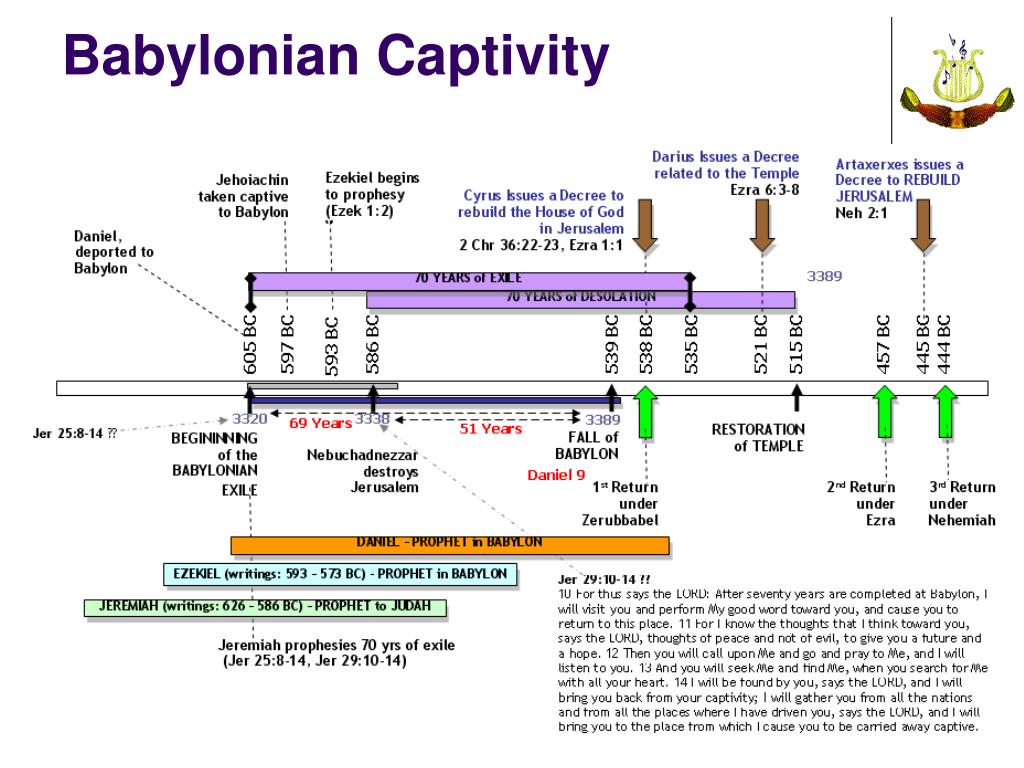
After righteous King Josiah dies, four Kings rule Judah in succession (36:1–14). Two of them rule for only three months, and none follow Yahweh. Although Yahweh sends messengers to call them back to himself, Judah’s leaders reject his message (36:15–16). As a result, Yahweh brings up Babylonian King Nebuchadnezzar, who destroys Jerusalem, burns down God’s house, carries off the house’s vessels, and takes Judah’s inhabitants into exile (36:17–20). Despite such utter devastation, the final section of Chronicles ends with the hope of restoration. When Cyrus of Persia comes to power, Yahweh moves him to declare that he will rebuild Yahweh’s house and that Yahweh’s people can return to their land (36:22–23).
19.8 The Babylonian Captivity: Divine Pedagogy for the Pious Remnant
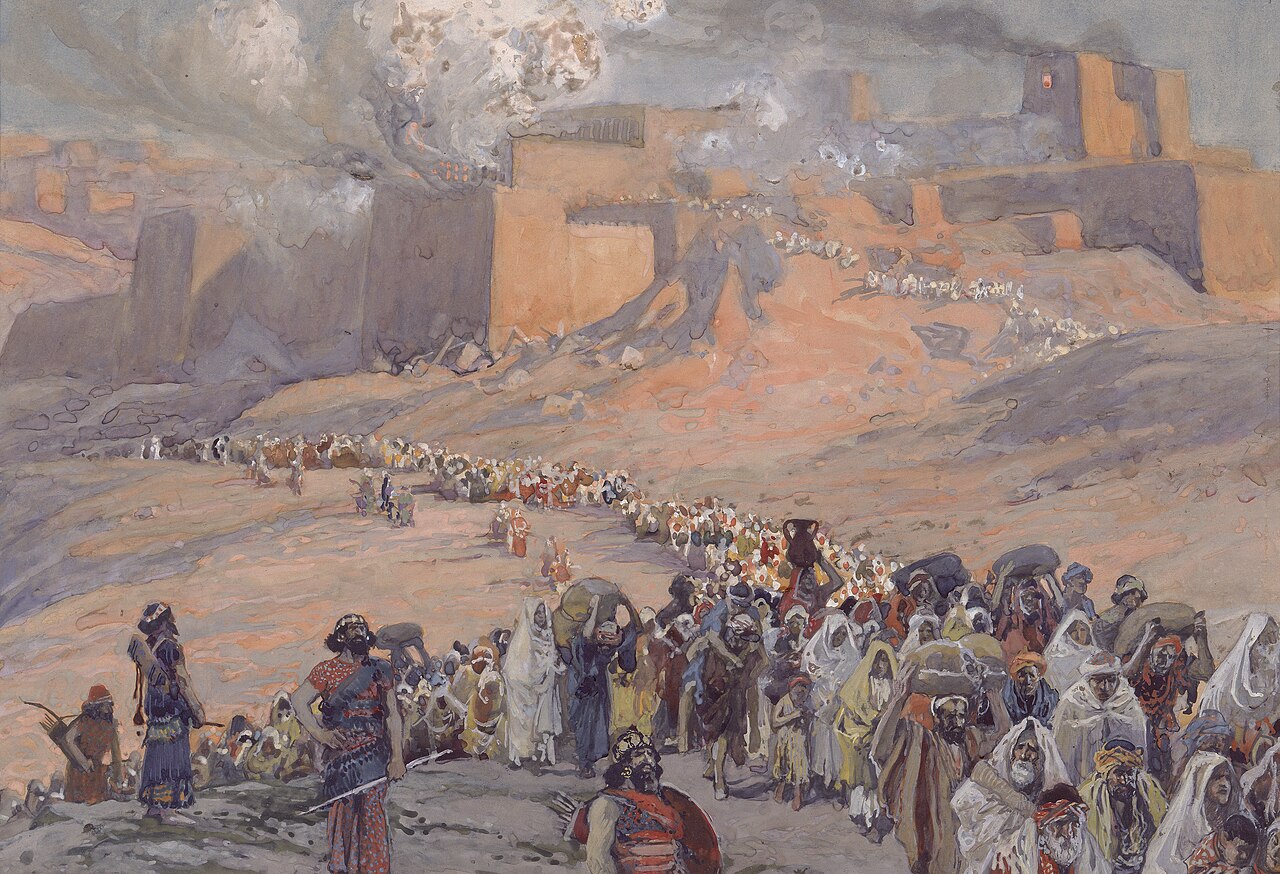
The fate of Israel presents a profound and paradoxical truth: the history of Israel, from its glorious promises to its apparent collapse, is not a story of divine failure but the very unfolding of a mysterious and salvific plan. The image of Abraham’s descendants returning to the land of the Chaldeans, from which he was once called, is not a sign of God’s mistake, but a revelation of the depth of human sin and the boundless wisdom of God’s Providence. The Babylonian Captivity was not a Plan B; it was a necessary, purgative fire within the divine oikonomia (economy of salvation) to slay the idolatrous “old man” of Israel and give birth to the “small flock” that would await the Messiah.
**
**
The Flight of the Prisoners(1896) by James Tissot; the exile of the Jews from Canaan to Babylon
I. The Captivity as Divine Surgery: Separating the Remnant
The core purpose of the exile – the purification of the “remnant” (in Greek, ho leimma). The visions of the prophets Jeremiah (the good and bad figs) and Isaiah (“a remnant shall be saved”) are not mere predictions but divine diagnoses. The majority of the people, including many in Jerusalem, had become spiritually “rotten” through syncretism and a superficial, externalized worship. They honored God with their lips while their hearts were far from Him.
- The Furnace of Babylon: The comparison of Babylon to a “melting pot” (Jeremiah 9:7) is central to the Orthodox understanding. God, like a master metallurgist, placed His people in the furnace of exile to burn away the dross of idolatry. This was an act of severe mercy. The “human material” was of low quality; a short, corrective punishment would not suffice. The seventy years prophesied by Jeremiah were a full generation, allowing the old, idolatrous mindset to die out and a new one to be forged.
- The Ascetical Parallel: This is the foundational ascetical model for the Christian life. The soul, which through baptism has been given the promise of the Kingdom (the Promised Land), often falls into the idolatry of passions—love of pleasure, wealth, and pride (the “gods of the Chaldeans”). God, in His mercy, permits the soul to be taken captive by the consequences of its sin—despair, confusion, and the loss of spiritual consolation (the “loss of Temple, king, and service”). This state of spiritual “Babylon” is a painful but necessary school where the soul, stripped of all it once relied upon, learns what truly matters: fidelity to God’s Law, which is the law of love and repentance.
II. The Reformatting of True Worship: From External Temple to Internal Law
Let’s notice the most critical liturgical and spiritual shift of the exile: the transition from Temple-centric worship to a worship centered on the Word of God. With the Temple destroyed, the people were forced to ask: “How do we worship without the Sacrifice?”
- The Birth of the Synagogue and the Primacy of the Word: The emergence of the synagogue was a providential revolution. It was not a temple—for there is only one Temple, a prefiguration of the one Sacrifice of Christ—but an assembly (ekklesia in Greek, the very word for Church). In the synagogue, worship was reoriented from the blood of animals to the “blood of the Word”—the reading, studying, and internalizing of the Law and the Prophets. This was a monumental step in preparing humanity for the Christian worship, where the faithful are “a royal priesthood” (1 Peter 2:9) who offer the “sacrifice of praise” and listen to the Word of God in the Scripture readings before approaching the one Eucharistic Sacrifice.
- The Sabbath as an Anchor: The careful observance of the Sabbath in exile underscores this shift. Without a land to sanctify, they sanctified time. This prefigures the Christian sanctification of time through the liturgical cycle, especially the Lord’s Day (Sunday), the new Sabbath of Christ’s Resurrection.
III. The Liturgical and Hymnological Fulfillment: From Babylon to Pascha
The Church, in her wisdom, has always seen the Exodus from Babylon as a direct type of the soul’s liberation from sin and death through Christ’s Pascha.
- The Liturgical Cry: The Sunday Antiphon of the 3rd Tone is a perfect example: “You have taken captivity from Babylon, and You have brought me from passions to the life, O Word!” Here, the Church’s liturgical voice identifies our sinful state as “Babylon” and Christ (the Word) as the liberator. This is not a mere historical memory but a present reality in the life of every believer. The return from exile is an icon of repentance (metanoia), the journey back from the land of passion and death to the freedom of the children of God.
- The Broader Hymnography: This theme is ubiquitous. The Kontakion for the Feast of the Meeting of the Lord proclaims: “Christ God, the joy and redemption of all, has appeared to those on earth… He has freed us from the pagan worship of idols.” The “pagan worship of idols” is our spiritual Babylon, from which Christ liberates us. The Canon of St. Andrew of Crete, read during Great Lent, is filled with imagery of exile and return, calling the soul to “escape from the land of the Chaldeans” by fleeing from sin.
IV. The Dispersion as a Providential Mission
Many Jews chose not to return, leading to the birth of the Diaspora. From a purely nationalist perspective, this seems like a failure. From a theological perspective, it was a divine strategy.
- Preparing the World for Christ: The Jewish Diaspora became the divine “network” for the spread of the Gospel. By the time of Christ, synagogues filled with God-fearing Gentiles were found throughout the Roman Empire. These communities, already acquainted with the Septuagint (the Greek Old Testament) and monotheism, became the fertile ground where the Apostles first preached. The “fiery tongues” of Pentecost fell upon Jews “from every nation under heaven” (Acts 2:5)—the very nations of the Diaspora. Thus, the exile, a punishment for sin, was transformed by God’s providence into the means of preparing the oikoumene (the inhabited world) for the coming of the Messiah.
**
**
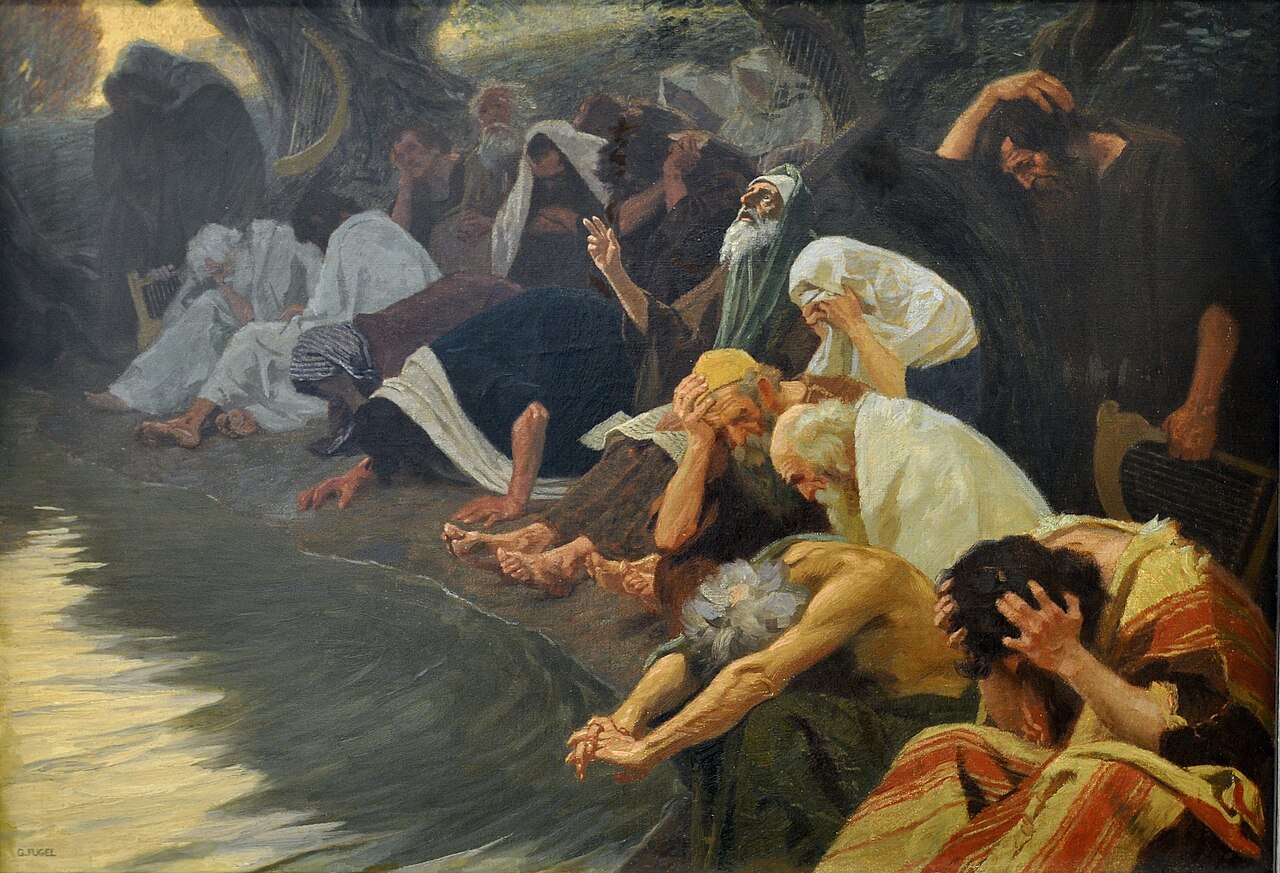
Waters of Babylon (1920) by Gebhard Fugel; Jews sit on the banks of the Tigris, which flows through Babylon, and remembering Jerusalem. Psalm 136 tells us about this event: “By the rivers of Babylon, there we sat down, yea, we wept, when we remembered Zion”. (136:1) “If I forget thee, O Jerusalem, let my right hand forget her cunning.” (136:5)
Conclusion: The Captivity as a Typicon of Salvation
The period of the Kings ended in failure because it revealed the impossibility of a purely political, earthly Kingdom fulfilling God’s promise. The Babylonian Captivity was the necessary death that preceded the resurrection of a renewed Israel. It taught God’s people that:
1. True worship is of the heart, not confined to a single geographical location. In exile the Jews learned that Yahweh could be worshipped away from the Temple in Jerusalem, even in a foreign land. He could be worshipped in their way of life anywhere.
2. Fidelity to God’s Word is the ultimate bond of the covenant community.
3. Suffering, when accepted with repentance, is a purifying fire that burns away idolatry.
In the end, the “small flock” that returned from Babylon was not the same nation that was taken captive. It was a reformed community, cured of its primary illness—idolatry—and focused on the Law and the hope of the Messiah. This purified remnant, living in expectation, was the soil from which the Holy Theotokos, the Forerunner, and the Apostles would spring. Therefore, the Babylonian Captivity stands as an eternal testament to the truth that God can write straight with our crooked lines, and that He leads us through the necessary captivity of our passions to bring us into the true freedom of the New Jerusalem, which is His Church.
- A Genealogical Summary of Israel’s History, Instructions for Worship in Yahweh’s House, and Encouragement to Follow Yahweh Wholeheartedly
- Genealogies from Creation to Judah’s Restoration in the Land (1:1–9:44)
- The Reign of David, Yahweh’s Chosen King (10:1–29:30)
- The Davidic Covenant and David’s Subjugation of Surrounding Nations (17:1–20:8)
- A Genealogical Summary of Judah’s History, Instructions for Worship in Yahweh’s House, and Encouragement to Follow Yahweh Wholeheartedly
- A History of the Kings of Judah from Rehoboam to the Exile (10:1–36:23)
- The Reign of Hezekiah, Manasseh, Josiah and the final kings of Judah (29:1–36:31)
- The Babylonian Captivity: Divine Pedagogy for the Pious Remnant
19.4 The Davidic Covenant and David’s Subjugation of Surrounding Nations
(17:1–20:8)
David Organizes the Priests and Levites (23:1–26:32)
19.3 The Reign of David, Yahweh’s Chosen King (10:1–29:30)
The Fall of King Saul and Rise of King David (10:1–12:40)
19.7 The Reign of Hezekiah, Manasseh, Josiah and the final kings of Judah
(29:1–36:31)
The Reigns of Manasseh, Amon, and Josiah (33:1–35:27)
- A Genealogical Summary of Israel’s History, Instructions for Worship in Yahweh’s House, and Encouragement to Follow Yahweh Wholeheartedly
- Genealogies from Creation to Judah’s Restoration in the Land (1:1–9:44)
- The Reign of David, Yahweh’s Chosen King (10:1–29:30)
- The Davidic Covenant and David’s Subjugation of Surrounding Nations (17:1–20:8)
- A Genealogical Summary of Israel’s History, Instructions for Worship in Yahweh’s House, and Encouragement to Follow Yahweh Wholeheartedly
- A History of the Kings of Judah from Rehoboam to the Exile (10:1–36:23)
- The Reign of Hezekiah (29:1–32:33)
Related Concepts
- allegorical-reading-of-the-ot
- apostasy-of-ahaz
- apostolic-call
- ascetical-model
- ascetical-parallel
- asherim
- baptismal-dying-and-rising
- canon-of-st-andrew-of-crete
- christ-as-king
- christ-as-son-of-david
- church-as-new-jerusalem
- church-as-temple
- conditionality-of-royal-blessing
- conversion
- covenant-fidelity
- davidic-dynasty
- dedication
- divine-pedagogy
- eternal-covenant
- eternal-kingdom
- feast-days
- feasts
- fidelity-to-the-word
- forerunner
- god-fearers
- concepts/gods-relenting-niḥam
- great-canon
- great-lent
- hymnography
- internal-law
- isaiahs-remnant
- jeremiah-97
- jeremiahs-good-and-bad-figs
- kingship
- levitical-ministry
- levitical-order
- liturgical-cycle
- liturgical-order
- lords-day
- loss-of-temple-king-and-service
- messiah
- messianic-prophecy
- metanoia
- mission
- oikoumene
- old-man-and-new-man
- pascha
- pentecost
- postexilic-community
- priestly-divisions
- primacy-of-the-word
- prosperity-and-suffering
- psalm-50
- purgative-suffering
- purification-through-suffering
- reform-of-hezekiah-and-josiah
- renunciation
- repentance-of-manasseh
- retribution-pattern
- retribution-theology
- royal-priesthood
- royal-psalms
- sackcloth
- sacrifice-of-praise
- scripture-readings-in-the-liturgy
- severe-mercy
- shekinahglory
- solomon-as-davids-heir
- synagogue
- temple
- temple-cult
- temporal-consequences
- the-theotokos-and-the-forerunner-as-fruit-of-the-remnant
- transformation
- typology-of-christ-the-king
- uzzah
- uzzahs-death
- uzziahs-usurpation
- yahwehs-chosen-king