Old Testament — Topic 16
16.4 Abandoning the Way of David: The Impiety and Folly of Solomon (Compare
9:4–5) (11:1–43)
This is one of the saddest chapters in the books of Kings. Structurally, the combination of the narrator’s citation of Solomon’s religious and spiritual crimes (11:1–8), followed by Yahweh’s impassioned verbal response (11:9–13) and a description of his execution of his predicted actions (11:14–39) gives this entire chapter the character of a prophetic judicial proceeding. The record of the evidence and Yahweh’s accusations in 11:11–12 demonstrate that the Israelite and Davidic covenants provide the lens through which the Yahweh will adjudicate and establish the parameters of the divine reaction. With his actions here, Solomon sets the history of Israel and the Davidic dynasty on a course that will be difficult to correct, resulting not only in the decision of the Kingdom of David into two separate nations but ultimately leading to the demise of both.

“Ecclesiastes or Vanity of vanities; all is vanity”. Isaak Asknaziy illustrates an old and meditative King Solomon, 1899-1900. (Scientific Research Museum of the Russian Academy of Arts, St. Petersburg)
16.1 Forgetting God’s Grace and God’s Covenants: The Downward Spiral of the
Kingdom of Israel
1 KINGS / 3 KINGDOMS (Orthodox tradition):
1:1–14:31 Rotting at the Roots: The Rise and Demise of Solomon’s World
1:1–2:46 The Crisis of Succession: The Demise of David and Emergence of
Solomon
3:1–4:34 Walking in the Footsteps of David: The Piety, Wisdom, and Fame of
Solomon
5:1–9:9 Completing the Theological Vision of David: Construction of the Temple
for Yahweh
9:10–10:29 Fulfilling the Royal Mandate of David
11:1–43 Abandoning the Way of David: The Impiety and Folly of Solomon (Compare
9:4–5)
12:1–14:31 The Division of Solomon’s Kingdom
1 KINGS 15:1–2 KINGS / 4 KINGDOMS 1:18 Rotting in the Branches, Part I: The
House of Omri and the Ministry of Elijah
15:1–16:7 Background to the Rise of the House of Omri: Early Conflict Between
Judah and Israel
16:8–28 The Emergence of the House of Omri in Israel
16:29–19:21 The Conflict Between Yahweh and Baal, Part II: The Idolatrous
Reign of Ahab
1 Kings 20:1–2 Kings 1:18 The Demise of Ahab and His World
2:1–13:25 Rotting in the Branches, Part II: The House of Omri and the Ministry
of Elisha
2:1–25 The Transition of Prophetic Authority from Elijah to Elisha
3:1–8:29 The Reign of Jehoram and Yahweh’s Response
9:1–11:20 The End of the House of Omri
11:21–13:25 Flickers of Light in the Branches
14:1–25:30 Rotting to the Core: The Demise of the Kingdoms of Israel and Judah
14:1–15:7 Background to the Demise of Israel and Judah: Later Conflict Between
Judah and Israel
15:8–17:41 The Fall of the Northern Kingdom of Israel to Assyria, Yahweh’s
Agents of Doom
18:1–25:30 The Fall of the Southern Kingdom of Judah to Babylon, Yahweh’s
Agents of Doom
Although David is the principal character in 1–2 Samuel, the “book of David” does not end there. This is obvious in 1 Kings 1–2, which describes the King’s demise, but the memory of David and God’s dynastic covenant with him runs in the background of 1–2 Kings like the operating system on a computer. Some of the major concerns throughout are: What has happened to the dynastic promise that God made to David in 2 Samuel 7, and to what extent have his successors fulfilled Yahweh’s ideals for the king as Moses spelled them out in Deuteronomy 17:14–20? The narratives that make up the two books of Kings begin with the crisis of succession that attends David’s death (1 Kings 1:1–2:46) and end with the complete collapse of the “throne of David” at the hands of the Babylonians (2 Kings 25).
However, the books of Kings are also concerned about the fate of the covenant that Yahweh made with Abraham (Gen 15; 17), established with his descendants at Sinai (Exod 19–Lev 26), and reaffirmed with the conquest generation (Deuteronomy). Accordingly, readers must keep their eyes on the prophets and godly characters, and their ears open to the words that come from God, the prophets, godly Kings, and yes, the assessments of the narrator, whose theological commentary is vital to grasping the point of these two magnificent books. The story line in 1–2 Kings involves three significant movements, each of which demonstrates the nature and effects of Israel’s amnesia regarding God’s past grace and his covenants with them: (1) the early loss of memory under David’s successor, Solomon (1 Kings 1:1–14:31); (2) the significance of this loss in the division of the nation into Northern and Southern Kingdoms, dominated by a case study in the effects of the loss of memory evidenced in abandoning Yahweh and his covenants in the two Kingdoms, with remarkable attention (vis à vis Chronicles) to the Northern Kingdom of Israel under the Omrides (1 Kings 15:1–2 Kings 13:25); and (3) the demise of the Kingdoms of Israel and Judah because of this loss of memory (2 Kings 14:1–25:30). The composition ends with an enigmatic but hopeful note for the dynasty and with it the nation of Israel (2 Kings 25:27–30).
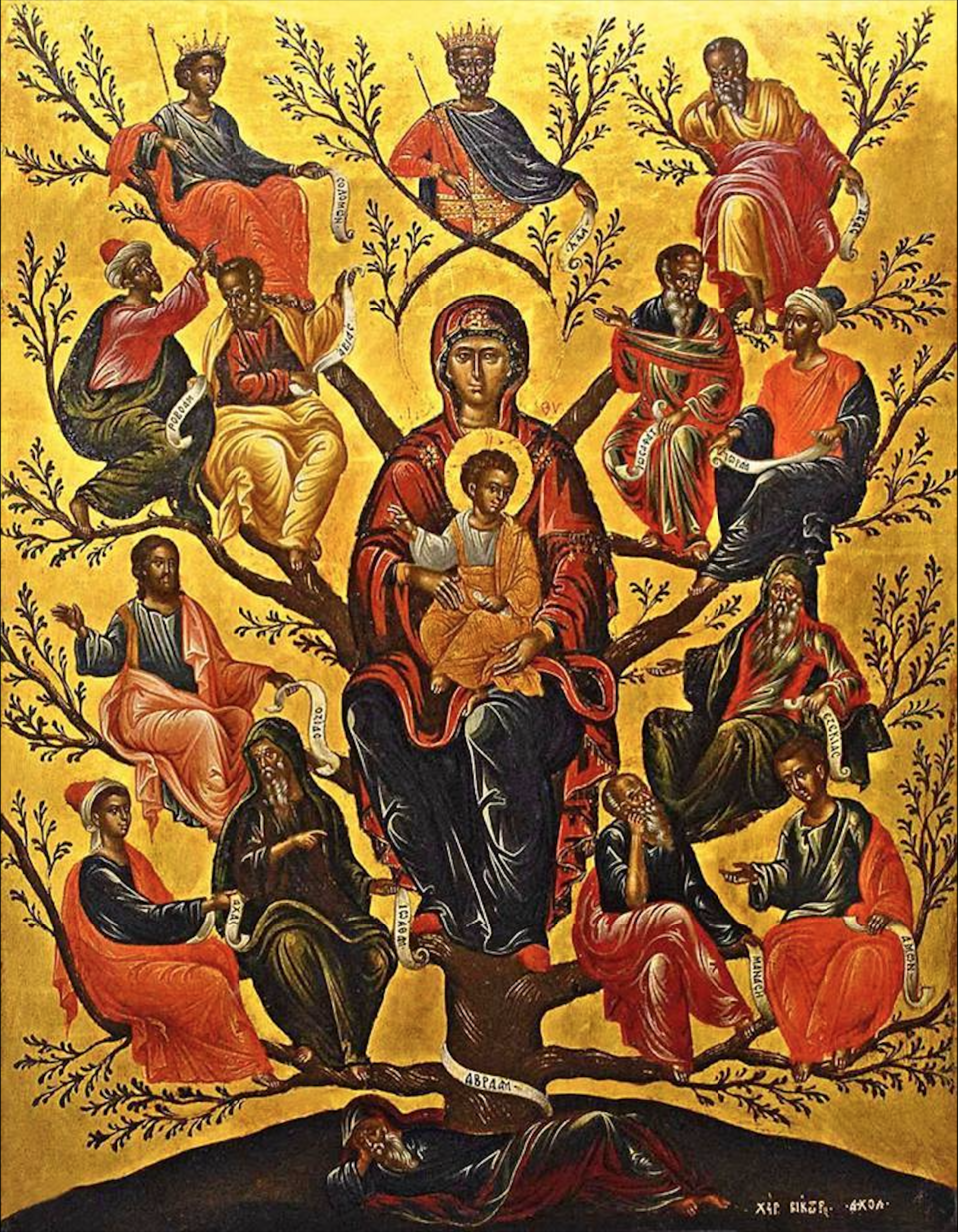
“Tree of Jesse” by Victor (Cretan iconographer), 1674, it features David, Solomon and the Davidic Line with Abraham as its root
16.1 Forgetting God’s Grace and God’s Covenants: The Downward Spiral of the
Kingdom of Israel
16.2 Rotting at the Roots: The Rise and Demise of Solomon’s World
(1:1–14:31)
The narrative of David’s death would have provided a natural conclusion to the story of his life after 2 Sam 24. By dividing 2 Samuel from 1 Kings this way, the transition parallels the transition between 1 and 2 Samuel. Saul’s death occurs in 1 Samuel, but David’s response opens 2 Samuel, and the chapters that follow concern David’s succession as the King of all Israel (2 Sam 2:1–5:10), just as 1 Kings 1–2 focuses on the succession of Solomon after the death of David. Indeed, David’s efforts to set his house in order before his demise by securing Solomon’s accession to his throne dominate 1 Kings 1:1–2:11. Following the resolution of this issue, Solomon’s reign divides into two uneven but extremely contrasting phases. The first (1 Kings 3–10) portrays him as incredibly wise and righteous in his administration of the kingdom, while in the second his performance as king is incredibly foolish and compromising (1 Kings 11). The consequences of Solomon’s latter-day forgetting of Yahweh’s grace in establishing him on David’s throne and elevating him as ruler over the people (compare the queen of Sheba’s comment, 10:8–9) to embody covenant righteousness before them (Deut 17:18–20) prove disastrous for both the dynasty and the nation of Israel. During his tenure, the seeds of division into kingdoms germinate, and upon his death the kingdom governed by the Davidic house is reduced primarily to territory inhabited by Judah. Furthermore, whereas in the period of the judges, the impulse to forget Yahweh and to turn to the gods of the nations characterized the population generally (Judg 2:1–5, 10–23; 18:6; 21:25), under Solomon, the first successor to David, the court in Jerusalem becomes the sponsor of apostasy. The following narratives will show that after the division in 931 BC, Jeroboam and his successors in the North intensify this sponsorship of evil. In the end, both kingdoms fall to foreign emperors because they have forgotten Yahweh their redeemer and the covenantal mission to which he called all descendants of Jacob/Israel (compare 1 Kings 18:36; 2 Kings 13:23). Although the narrator appears to mark the historical midpoint of Solomon’s reign as a turning point (9:10), many interpreters divide this unit differently, with the first ending with the death of Solomon and the second beginning with the accession of Rehoboam in chapter 12. However, chapters 1–11 and 12–14 are tightly linked. First, the grammatical construction of 12:1 invites us to see what follows in chapter 12 as the natural outgrowth of events in chapter 11. Second, the figure of Solomon holds these sections together. Remarkably, while his name appears six times in chapters 12–14, it never occurs again until the last chapters (21:7; 23:13; 24:13; 25:16). Third, the involvement of the prophet Ahijah binds these two parts into a single larger literary unit. In 12:15 the narrator declares explicitly that Yahweh is behind Rehoboam’s hard-hearted refusal to adopt a softer style of rule that he might confirm the word that he spoke through Ahijah to Jeroboam in 11:29–39. Furthermore, whereas in Ahijah’s first appearance to Jeroboam as God’s agent inviting him to assume the throne of the Northern Kingdom he ends that prophetic utterance with a charge to adopt David as his model of rule (11:29–39), in 14:1–18 he reappears to announce Jeroboam’s doom for not having done so. Literarily, the text divides into six segments, dealing respectively with:
- Solomon’s accession (1:1–2:46);
- a commemoration of Solomon’s piety, wisdom, and fame (4:1–34);
- the construction of the temple, fulfilling David’s dream (5:1–9:9);
- fulfilling David’s royal mandate (9:10–10:29);
- Solomon’s latter decades of impiety and sponsorship of idolatry (11:1–40);
- the tragic effect thereof in the wake of his death (12:1–14:31).
The Crisis of Succession: The Demise of David and Emergence of Solomon (1:1–2:46)
In the ancient world, the death of a King often precipitated a crisis of leadership in the state. In this opening division, the narrator adapts the typical form of a death story to describe how the crisis plays out in the first dynastic transition in Israel. In the providence of God, David is able to guide the succession of Solomon, though not without impetus from outside. Nathan’s initiative suggests that David’s memory has lapsed—not of Yahweh’s covenant with him or with Israel, but simply of Yahweh’s earlier revelation to him that Solomon is to be his successor. The narrator’s summary announcements that Solomon’s Kingdom is firmly established in 2:12 and 2:46 divide this section formally into two parts. The first part concerns the identification and declaration of Solomon as David’s chosen successor. This text does not explicitly declare that Yahweh has chosen him, but the narrator notes that at the time of his birth, Yahweh was covenantally committed to him (Heb. ʾāhav , usually rendered “loved him”) and through his prophet Nathan he sent word of his love by naming him Jedidiah, which plays on the name “David” and means “beloved of Yahweh” (2 Sam 12:24–25). Responding to Adonijah’s challenge and Nathan’s and Bathsheba’s encouragement, David declares Solomon to be his successor (1 Kings 1:29–30), and charged Zadok the priest, Nathan the prophet, and Benaiah his military adviser to anoint and proclaim his King (1:33–34). In David’s last published act, he charges Solomon to live and govern according to the covenant standards called for in the Torah of Moses (Deuteronomy) to ensure the success of his reign and to deal wisely with his opposition (2:1–9). With this charge, the narrator can declare Solomon’s throne officially established (2:12). The rest of this section involves eliminating internal challenges to his Kingship from Adonijah, a rival claimant to the throne; Abiathar, a priestly rival to Zadok; Joab, a rival to Benaiah’s military command; and Shimei, who represents the last remnant of the old Saulide rivalry.
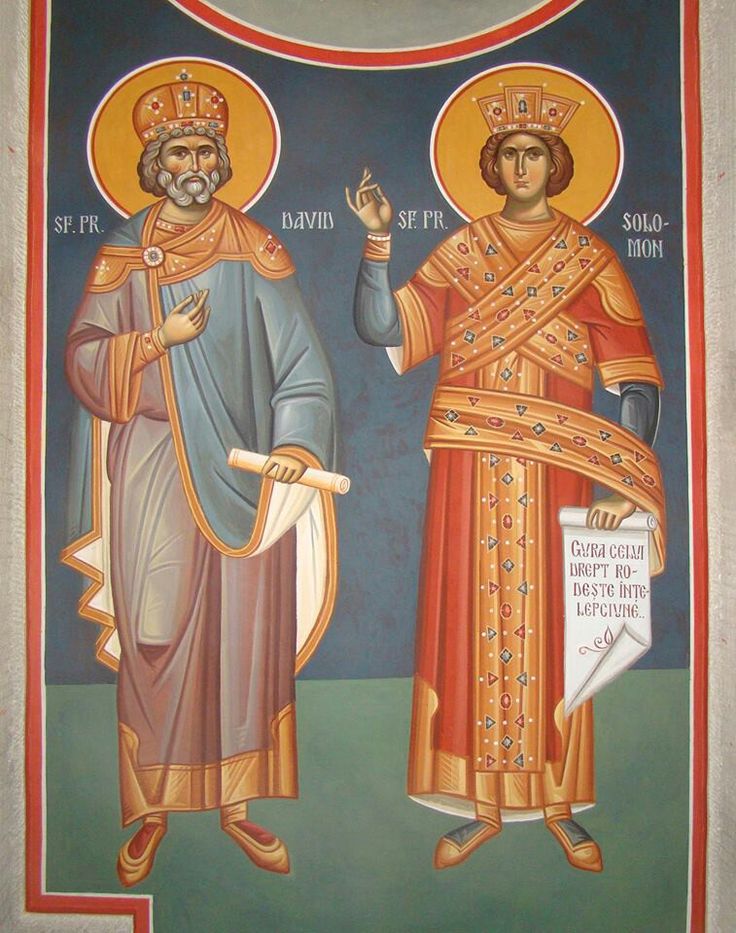
16.3 Walking in the Footsteps of David: The Piety, Wisdom, and Fame of
Solomon (3:1–4:34)
The first of four divisions describing Solomon’s reign paints an extremely positive picture of the man. The narrative (3:1–4:34) begins with an advance summary assessment of Solomon’s reign highlighting his modesty and his wisdom as a special divine endowment (3:1–15), followed by an illustration of his judicial wisdom through a case study involving two prostitutes (3:16–27), resulting in all Israel recognizing his wisdom (3:28). By listing Solomon’s officials (4:1–19), the narrator also acknowledges the King’s administrative gifts. This segment concludes with an idyllic picture of the benefits that accrue to both the King and his subjects when spiritual and intellectual integrity combine (4:20–34).
Completing the Theological Vision of David: Construction of the Temple for Yahweh (5:1–9:9)
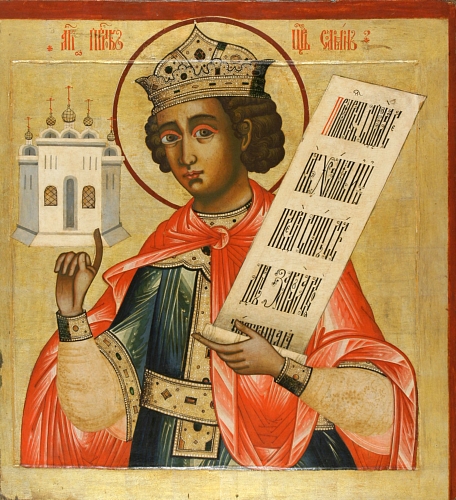
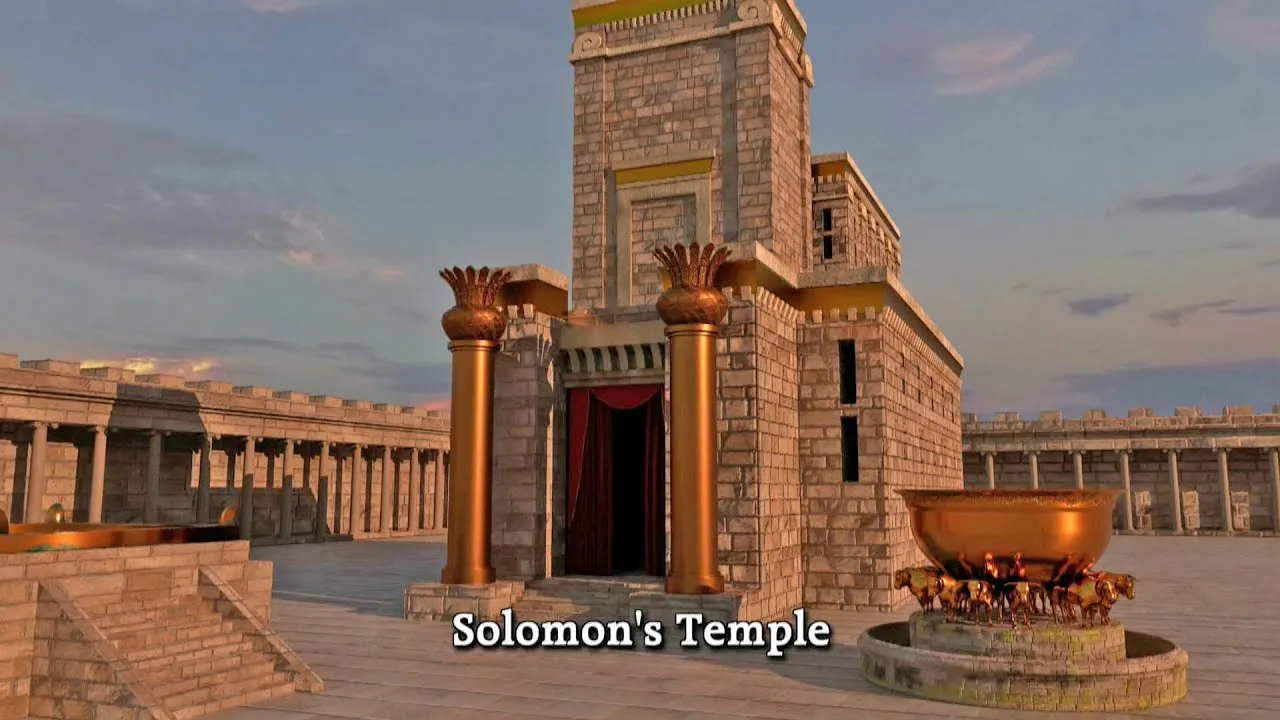
Without doubt, Yahweh’s denial of David the honor of building him a house imprinted with his name and symbolizing his presence amid his people was the biggest disappointment of his life (2 Sam 7:1–13). However, David’s disappointment opened the door for Solomon’s grandest achievement. The narrator highlights its significance by ascribing more than one-third of the account of his reign to this venture and by the detail with which he describes it from its planning to its dedication. The account incorporates detailed specifications for the building, its decoration, and auxiliary furnishings (6:1–38; 7:13–51), as well as embedded divine speeches (6:11–13; 9:3–9), prayers (8:22–54), blessings (8:14–21, 54–61), and a public address by Solomon (8:12–13). In keeping with the glory of the divine resident of the temple, Solomon draws on resources from far and wide and engages the best artisan from Tyre. The prayers and speeches associated with the dedication of the temple represent the theological heart of the account, providing a vast resource for developing a biblical theology of sacred space and serving as a profound symbol of the glory of the God of Israel and the privilege the Israelites enjoy in being his people before the watching world (8:43, 53, 60).
**
**
Russian icon of King Solomon holding a model of the Temple (18th century, iconostasis of Kizhi church, Russia).
Fulfilling the Royal Mandate of David (9:10–10:29)
The narrator signals the onset of a new section with a date notice in 9:10 that divides Solomon’s forty-year reign into two halves. In a sense, this division reinforces the image of Solomon in 3:1–4:34. Structurally these sections exhibit a chiastic ABC-CBA relationship in which, among other features:
- the A elements explicitly declare Solomon’s wisdom (3:6–12; 10:23–25),
- the B elements present cases involving women that illustrate his wisdom (3:16–28; 10:1–13),
- the C elements involve statistical evidence for his administrative acumen (4:1–28; 9:10–28).
The queen of Sheba’s acknowledgment of Israel’s blessed state and her blessing of Yahweh represent the theological heart of this narrative (10:8–9). Although a passing comment in 10:11–13 credits Solomon with investing some of the treasures that poured into the royal coffers in the temple, we may detect a few flies in this ointment. Apparently in violation of the prohibitions in Deut 17:16–17, Solomon appears to use these resources largely for personal luxuries, while his multiplication of horses stands in direct violation of Moses’ “charter for Kingship.” The opening reference to his multiplication of foreign wives (11:1–8) reinforces this conclusion. On closer examination, we note that over time Yahweh’s speeches to the King change significantly in tone, and that, after Solomon’s addresses to Yahweh in the context of the dedication of the temple in chapter 8, the narrator never has him communicating with God again. Although the first successor to David has fulfilled the royal mandate of his monarchy, he is losing its heart.
16.4 Abandoning the Way of David: The Impiety and Folly of Solomon (Compare
9:4–5) (11:1–43)
16.5 An Orthodox Insight into 1 Kings 1-11: The Saga of Solomon
The narrative of Solomon is one of the most theologically rich and paradoxical in the Old Testament. He begins as the quintessential wise king, a type of the Messiah, and ends as a cautionary tale of spiritual decline. For the Orthodox Church, Solomon’s story is not merely a historical account but a prophetic icon that finds its ultimate meaning in Jesus Christ, the true and eternal King who possesses wisdom incarnate and builds the everlasting Temple.
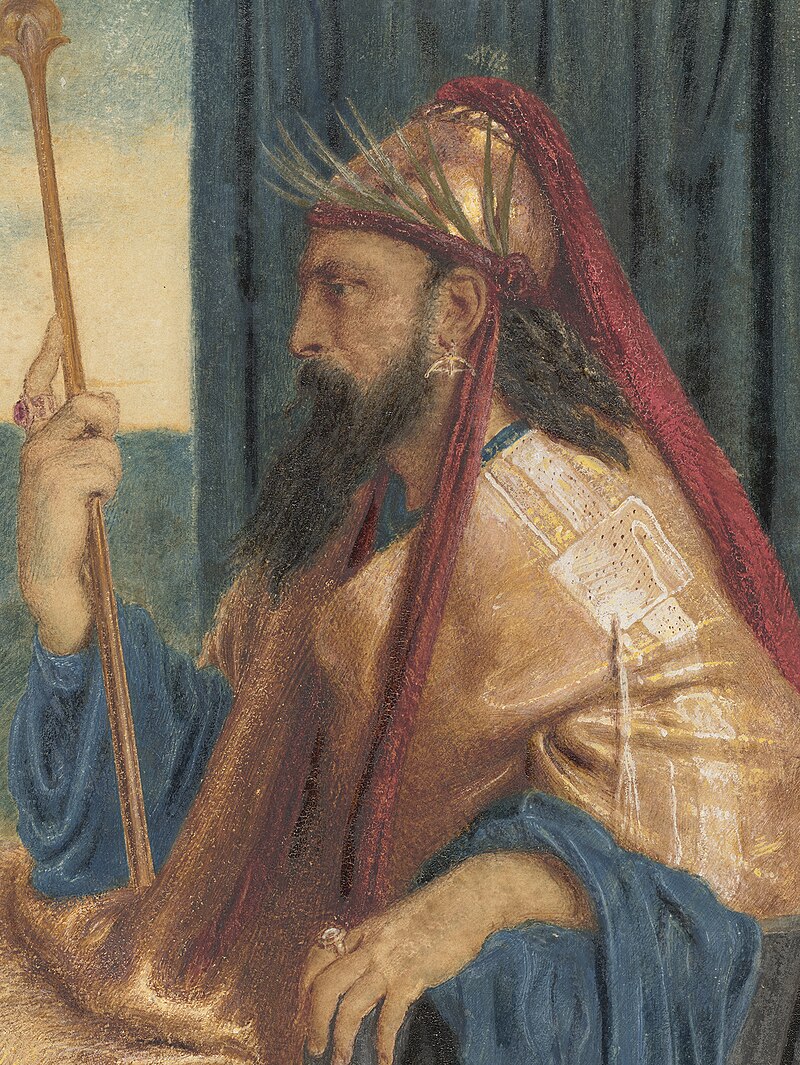 1.
Solomon’s Anointing: The Peaceful King
The story opens with the aged David ensuring that his son Solomon, whose name means “peace” (Shalom), inherits the throne, bypassing the ambitious Adonijah.
“Then King David answered and said, ‘Call Bathsheba to me.’… ‘As I swore to you by the LORD God of Israel, saying, “Assuredly Solomon your son shall be King after me, and he shall sit on my throne in my place,” so I certainly will do this day.’” (1 Kings 1:28, 30, NKJV)
King Solomon (1872) by Simeon Solomon
- Christological Typology: David, the warrior king, prefigures God the Father, who establishes a covenant of peace through His Son. Solomon, the “man of rest” (1 Chronicles 22:9), is a type of Christ, the Prince of Peace (Isaiah 9:6). His anointing as King, while a rival (Adonijah, a type of the world’s power) claims the throne, prefigures Christ’s Kingship, which is established not by worldly force but by the Father’s decree, even while the “ruler of this world” holds sway.
- Ascetical Understanding: The struggle for the throne represents the inner spiritual battle. The soul must enthrone Solomon (divine wisdom and peace) through obedience to God’s will, putting to death the rebellious passions represented by Adonijah and his followers.
2. The Gift of Wisdom: The Divine Logos
Solomon’s prayer at Gibeon is the defining moment of his early reign, where he asks not for wealth or long life, but for a “hearing heart” to judge God’s people.
“Therefore give to Your servant an understanding heart to judge Your people, that I may discern between good and evil.” (1 Kings 3:9, NKJV).
God responds:
“Behold, I have done according to your words; see, I have given you a wise and understanding heart, so that there has not been anyone like you before you, nor shall any like you arise after you.” (1 Kings 3:12).
- Christological Fulfillment: Solomon’s God-given wisdom is a profound type of Christ, in whom “are hidden all the treasures of wisdom and knowledge” (Colossians 2:3). Christ is the Divine Logos (Word/Wisdom) of God incarnate (John 1:1, 14). The judgment of Solomon, where he discerns the true mother by threatening to divide the child (1 Kings 3:16-28), reveals a wisdom that seeks to save life. This prefigures Christ, the true Judge, whose wisdom saves humanity through His own self-sacrifice, not merely through a brilliant legal decision.
- Patristic Insight: The Fathers, such as St. Athanasius, saw Solomon’s wisdom as a participation in the uncreated Wisdom of God, which is fully revealed in Christ. The Church sings of Christ in her hymns as “the Power of God and the Wisdom of God” (1 Corinthians 1:24).
3. The Building of the Temple: The True Dwelling Place of God
Solomon’s greatest achievement is the construction of the Temple in Jerusalem, a dwelling place for the Name of the Lord.
“And it came to pass, when the priests came out of the holy place, that the cloud filled the house of the LORD, so that the priests could not continue ministering because of the cloud; for the glory of the LORD filled the house of the LORD.” (1 Kings 8:10-11, NKJV).
- Christological and Ecclesiological Fulfillment: The Temple is the central messianic type in Solomon’s story.
1. Christ’s Body: Jesus Himself said, “Destroy this temple, and in three days I will raise it up” (John 2:19). The Evangelist explains, “He was speaking of the temple of His body.” The glory that filled Solomon’s Temple finds its ultimate fulfillment in the glory of the Transfiguration and Resurrection of Christ.
2. The Church: The Temple is also a type of the Church , the “living stones” built into a spiritual house (1 Peter 2:5). The dedication prayer of Solomon (1 Kings 8) finds its fulfillment in the Eucharistic liturgy, where heaven and earth meet, and God dwells among His people through the Holy Mysteries.
- Liturgical Understanding: The hymns of the Feast of the Transfiguration and the Dedication of the Church (e.g., the Kathisma for the Feast) often draw parallels between the cloud of glory in the Temple and the uncreated Light of Tabor. The very structure of the Orthodox temple, with the Holy of Holies (altar) separated by the iconostasis (the veil), reflects the architecture of Solomon’s Temple, now fulfilled in Christ who tears the veil (Matthew 27:51) and grants us access to the Father.
4. The Queen of Sheba: The Gathering of the Nations
The visit of the Queen of Sheba, drawn by Solomon’s wisdom, is a pivotal messianic event.
“Now when the queen of Sheba heard of the fame of Solomon concerning the name of the LORD, she came to test him with hard questions… and she said to the King: ‘It was a true report which I heard in my own land about your words and your wisdom… Blessed be the LORD your God, who delighted in you, setting you on the throne of Israel!’” (1 Kings 10:1, 6, 9).
- New Testament Parallel: Jesus Himself uses this event as a sign pointing to Himself: “The queen of the South will rise up in the judgment with this generation and condemn it, for she came from the ends of the earth to hear the wisdom of Solomon; and indeed a greater than Solomon is here.” (Matthew 12:42).
- Patristic Interpretation: The Queen of Sheba represents the Gentile nations coming to the light of the Messiah. Her journey prefigures the Magi coming to worship the Christ child and the eventual evangelization of the entire world. She is an icon of the soul seeking and finding true Wisdom in Christ.
5. The Fall of Solomon: The Ascetical Warning
Solomon’s tragic decline is the most critical ascetical lesson of his narrative. Despite his wisdom, he disobeyed God’s command by multiplying wives, who turned his heart to idolatry.
“For it was so, when Solomon was old, that his wives turned his heart after other gods; and his heart was not loyal to the LORD his God, as was the heart of his father David… So the LORD became angry with Solomon, because his heart had turned from the LORD God of Israel.” (1 Kings 11:4, 9).
- Ascetical Understanding: Solomon’s fall is a masterclass in spiritual warfare. It demonstrates that:
1. Knowledge is not Salvation: One can possess great theological knowledge and wisdom yet fall into grave sin. Salvation is found in humility, obedience, and the guarding of the heart (nepsis).
2. The Danger of Compromise: Solomon’s sin began with political alliances and “innocent” compromises (Deuteronomy 17:17), which slowly eroded his loyalty to God. This teaches the ascetical principle of guarding the senses and the mind from influences that can lead the heart astray.
3. The Warfare of the Heart: His story is the ultimate warning against spiritual pride. The one who built the Temple for God ended up building high places for idols. This illustrates the patristic teaching that the greatest battles are fought not externally, but within the human heart.
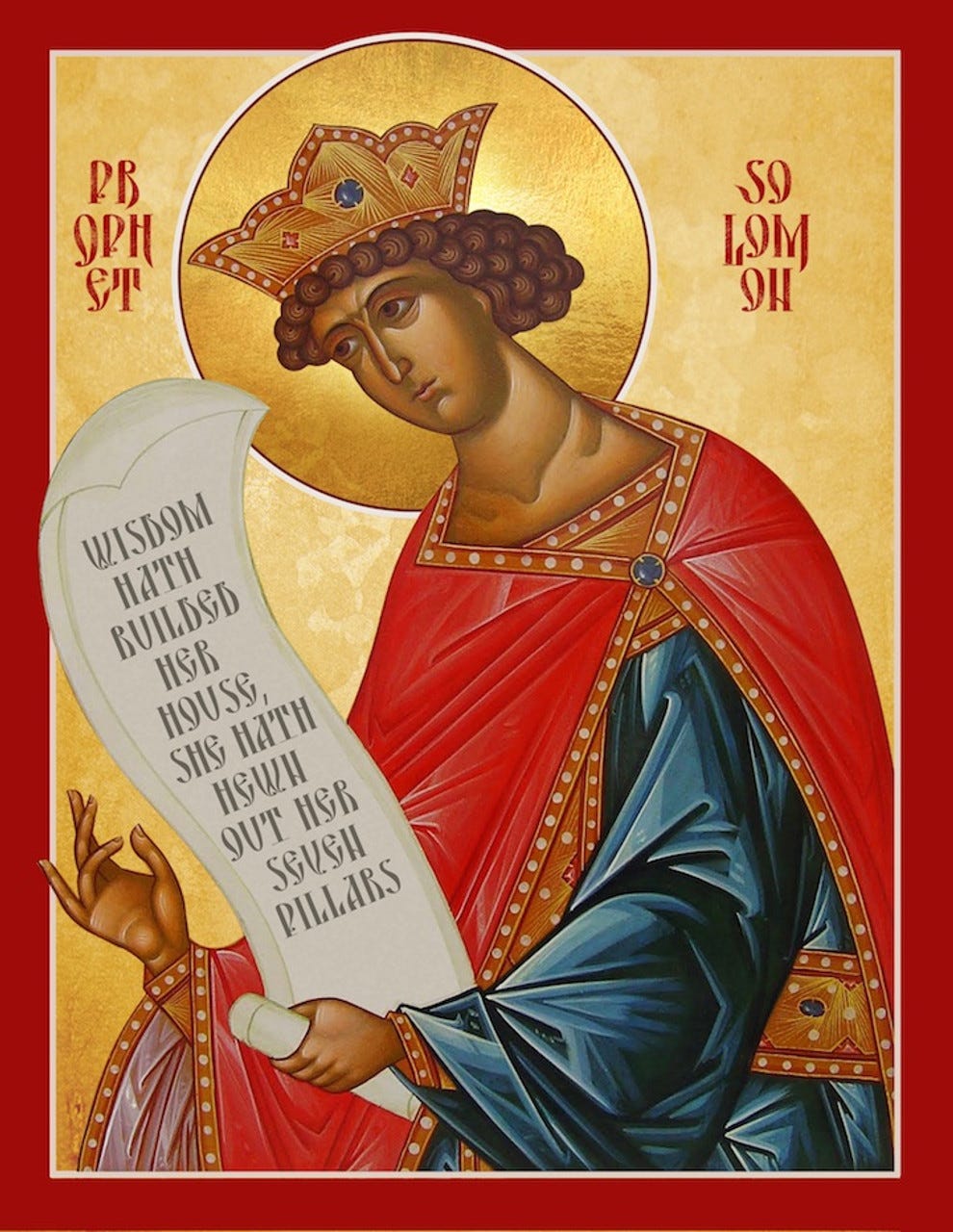 Conclusion:
Solomon as a Christ-Centered Narrative
The narrative of Solomon in 1 Kings 1-11 is a profound and complex icon of Christ:
- Solomon in his Glory points to Christ in His Kingdom : He is the peaceful, wise, and glorious King who builds the true Temple of God—His own Body, the Church—and draws all nations to Himself.
- Solomon in his Fall points to Humanity’s Need for Christ : He reveals the ultimate insufficiency of human wisdom and power to save itself. The wise King who fell becomes a prophetic witness that the world awaits a greater Son of David, one whose heart will remain perfectly loyal to the Father, and whose Kingdom will have no end.
Thus, the story of Solomon finds its true and final meaning in Jesus Christ. He is the greater Solomon, whose wisdom is incarnate, whose Temple is eternal, whose reign is forever, and whose heart is perfectly united to the will of the Father, fulfilling the promise of the Davidic covenant and establishing a Kingdom of unending peace.
Meanwhile a small specifical digression
The juxtaposition of 1 Kings 10:14 and Revelation 13:18
The Texts
- 1 Kings 10:14 (NKJV): “The weight of gold that came to Solomon yearly was six hundred and sixty-six talents of gold.”
- Revelation 13:18 (NKJV): “Here is wisdom. Let him who has understanding calculate the number of the beast, for it is the number of a man: His number is 666.”
On the surface, one is a historical record of immense wealth, and the other is an apocalyptic code for evil. Yet, in the Patristic and Orthodox interpretive tradition, they are powerfully linked.
The Link: The Corruption of Kingly Power and Wisdom
The key to understanding this connection is to see King Solomon not just as a historical figure, but as a paradigm of God-given Kingship and wisdom that becomes corrupted through worldly attachment.
1. Solomon as the Lord’s Anointed: Solomon was the recipient of unprecedented divine blessings. He was granted wisdom, peace, and wealth directly from God (1 Kings 3). His Kingdom was a foreshadowing of the Messianic age.
2. The 666 Talents as a Symbol of Worldly Preeminence: The 666 talents of gold represent the absolute pinnacle of material success and power in the ancient world. It is a number of superlative, “perfect” worldly wealth.
3. The Downfall: However, this very wealth became Solomon’s snare. The Law of the King in Deuteronomy 17:17 explicitly warned: “But he shall not multiply horses for himself… neither shall he greatly multiply silver and gold for himself.” Solomon violated all these commands. His accumulation of gold (1 Kings 10:14), horses, and wives (1 Kings 10:26-11:3) led directly to his heart turning away from God to idolatry (1 Kings 11:4-5).
Thus, the 666 talents of gold mark the precise point where God’s anointed King, endowed with divine wisdom, reaches the apex of worldly power and begins his tragic descent into spiritual failure. The gift (wealth) becomes the idol that rivals the Giver (God).
The Fulfillment in Revelation: The Beast as a Perversion of Kingship
In Revelation, the Beast is a demonic parody of Christ the King. He has a false resurrection, demands worship, and exercises authority over every tribe and tongue. His number, 666, is the number of a man—a human Kingdom exalted to the point of claiming divinity.
- A System of Imperfect and Godless Power: In Biblical numerology, the number seven is the number of divine perfection and completion (e.g., the seven days of creation, the seven spirits of God). The number six, therefore, consistently falls short of seven. It is the number of imperfection, incompletion, and the unfulfilled creation. The triple six (666) is thus a powerful symbol of a trinity of imperfection —a system, power, or entity that relentlessly aspires to the place of God (the divine Trinity) but is fundamentally and irrevocably created, fallen, and imperfect. It is the ultimate expression of humanism and worldly power divorced from God.
- The Connection Made: Solomon, the wise King, becomes the archetype of this very temptation. His 666 talents symbolize a Kingship that has become utterly dependent on and defined by its material wealth and political power, thereby “falling short” of its divine calling. The Beast in Revelation is the ultimate embodiment of this principle: a global, political, and economic system that seduces humanity with promises of peace and prosperity (a new “Solomonic golden age”) but demands ultimate allegiance, replacing the worship of the true God with the worship of human achievement and power—the worship of the creature rather than the Creator (Romans 1:25).
Patristic and Ascetical Understanding
The Church Fathers saw this not merely as a historical or future event, but as a constant spiritual reality.
- St. Andrew of Caesarea, in his commentary on Revelation, states that the number 666 signifies “a total failure of the devil’s wisdom” and represents those who, in their love for the world, have “abandoned the knowledge of God.”
- The Ascetical Interpretation (The Warfare of the Soul): For the Orthodox ascetic, the “number of the beast” is not just a future barcode but a spiritual reality to be resisted daily.
- The “Beast” is the Passions: The beast represents the logosmoi (passionate thoughts) of pride, avarice, and love of pleasure, which, when entertained, wage war against the soul.
- “666” is the Measure of Worldly Attachment: The number signifies the soul’s capitulation to a “trinity of passions” that mirror Solomon’s fall:
1. The Love of Money (Avarice) -Philargyria : The 666 talents of gold. This is the inordinate desire for wealth and material security, which St. Paul identifies as “a root of all kinds of evil” (1 Timothy 6:10).
2. The Love of Pleasure (Lust) -Philhedonia : Solomon’s 700 wives and 300 concubines. This is the passion for sensual gratification that turns the heart away from God.
3. The Love of Power (Pride) -Philarchia : Solomon’s vast military and political apparatus (horses, chariots). This is the desire for control, honor, and dominance over others.
To “calculate the number of the beast” is to have the spiritual wisdom (nous) to recognize these passions at work in one’s own soul and in the systems of the world. The ascetical life—through prayer, fasting, and almsgiving—is the means by which we resist being “marked” by this number. Almsgiving fights avarice, fasting battles lust, and prayerful humility conquers pride.
Conclusion: From Solomon’s Gold to the Soul’s Allegiance
The link between 1 Kings 10:14 and Revelation 13:18 provides a profound and sobering insight:
Solomon’s 666 talents of gold were the historical precursor and symbolic prototype of the Beast’s 666. It represents the seduction of God’s anointed (whether Israel, the Church, or the individual soul) by a worldly system of power, wealth, and pleasure that demands ultimate allegiance.
The narrative warns that the greatest spiritual danger is not poverty or persecution, but prosperity and power without spiritual vigilance. The story of Solomon teaches that it is possible to begin in the Spirit and end in the flesh, to build the Temple of God and yet have one’s heart turned to idols.
The ultimate fulfillment is in Jesus Christ , the true Solomon and perfect King. He rejected the devil’s offer of all the Kingdoms of the world (Matthew 4:8-10), which is the ultimate offer of the “666” system. He owned no gold, wielded no political sword, and embodied a Kingship of divine love and sacrifice. In Him, we see the true model of Kingship and the only one worthy of our worship, freeing us from the mark of the beast and sealing us with the Name of the Father, the Son, and the Holy Spirit.
- Forgetting God’s Grace and God’s Covenants: The Downward Spiral of the Kingdom of Israel
- Rotting at the Roots: The Rise and Demise of Solomon’s World (1:1–14:31)
- Walking in the Footsteps of David: The Piety, Wisdom, and Fame of Solomon (3:1–4:34)
- Abandoning the Way of David: The Impiety and Folly of Solomon (Cf. 9:4–5) (11:1–43)
-
An Orthodox Insight into 1 Kings 1-11: The Saga of Solomon
16.2 Rotting at the Roots: The Rise and Demise of Solomon’s World
(1:1–14:31)
16.3 Walking in the Footsteps of David: The Piety, Wisdom, and Fame of
Solomon (3:1–4:34)
**
**
Fulfilling the Royal Mandate of David (9:10–10:29)
- Forgetting God’s Grace and God’s Covenants: The Downward Spiral of the Kingdom of Israel
- Rotting at the Roots: The Rise and Demise of Solomon’s World (1:1–14:31)
- Walking in the Footsteps of David: The Piety, Wisdom, and Fame of Solomon (3:1–4:34)
- Abandoning the Way of David: The Impiety and Folly of Solomon (Cf. 9:4–5) (11:1–43)
Related Concepts
- 1-kings-1014
- 1-peter-2
- 1-peter-25
- 2-kings-252730-hope
- 666
- 666-talents
- adversaries-as-agents-of-judgment
- ahijah
- ahijahs-prophecy
- ascetical-discipline
- ascetical-warfare
- ascetical-warning
- avarice
- beast-as-parody-of-christ
- beast-as-parody-of-christ-the-king
- christ-as-greater-son-of-david
- christ-as-son-of-david
- christ-as-wisdom
- christ-the-wisdom-of-god
- christs-body-as-temple
- christs-refusal-of-worldly-kingdoms
- conditionality-of-royal-blessing
- covenant-lawsuit
- covenant-obedience
- covenant-righteousness
- dedication-prayer
- divine-decree-vs-worldly-force
- divine-judgment
- divine-logos
- division-of-the-kingdom
- downward-spiral
- eternal-covenant
- eternal-kingdom
- eucharistic-assembly
- exile
- greater-solomon
- greater-son-of-david
- greater-than-solomon
- guarding-the-senses
- high-places
- humanism-and-worldly-power
- iconostasis-and-veil
- incarnate-logos
- incarnate-wisdom
- ingratitude
- inner-spiritual-battle
- jeroboams-sin
- john-219
- judges-period-forgetfulness
- judgment-of-the-two-prostitutes
- knowledge-versus-salvation
- law-of-the-king
- living-stones
- lust
- magi
- mark-of-the-beast
- matthew-1242
- messianic-expectation
- messianic-typology
- mission-to-the-gentiles
- national-decline
- nepsis
- omrides
- participation-in-uncreated-wisdom
- political-expediency
- prelestspiritual-pride
- pride
- prince-of-peace
- prophetic-word
- queen-of-sheba
- queen-of-sheba-and-the-magi
- revelation-1318
- romans-125
- royal-mandate
- royal-priesthood
- royal-psalms
- servant-kingship
- solomons-corrupted-kingship
- solomons-decline
- solomons-horses-and-666-talents
- spiritual-pride
- spiritual-sacrifice
- the-branch
- trinity-of-passions
- true-temple
- uncreated-light-of-tabor
- worldly-power
- yahwehs-chosen-king