Old Testament — Topic 14
1 SAMUEL / 1 KINGDOMS (Orthodox tradition):
1:1–7:17 Israel’s Great God Raises Up Samuel and Deposes Eli and His House
1:1–3:21 God Raises Up Samuel as Prophet Over Israel
4:1–7:17 God Deposes Eli’s House, Defeats the Proud, and Exalts Himself
Through His Ark
8:1–15:35 God Raises Up and Rejects Saul, a King After Israel’s Heart
8:1–12:25 God Establishes Saul as King After Israel Disobediently Demands One
13:1–15:35 God Rejects Saul as King Due to His Faithlessness and Disobedience
16:1–31:13 God Raises Up and Preserves David, a King After His Own Heart
16:1–20:42 David Exalted but Driven Out by Spiritually Oppressed Saul
21:1–28:2 David’s Divinely Preserved Life as a Fugitive in Exile
28:3–31:13 David’s Life Preserved, Saul’s Demise
In the judges period the Israelites were doing what was right in their own eyes. The nation was in desperate need of a king who would provide spiritual guidance. The book opens with the Lord giving barren Hannah a son. She expects the Lord to provide a king for Israel to deliver the nation, as he has delivered her from shame. The Lord fulfills her expectation, but not without some bumps along the way. When Israel foolishly demands a king like the nations, the Lord does not abandon them but gives them a ruler, who will be subject to the Mosaic law’s regulations of kingship. This king, Saul, fails, prompting the Lord to remove him and paving the way for 2 Samuel’s account of David’s rise to kingship
Israel’s Great God Raises Up Samuel and Deposes Eli and His House (1:1–7:17)
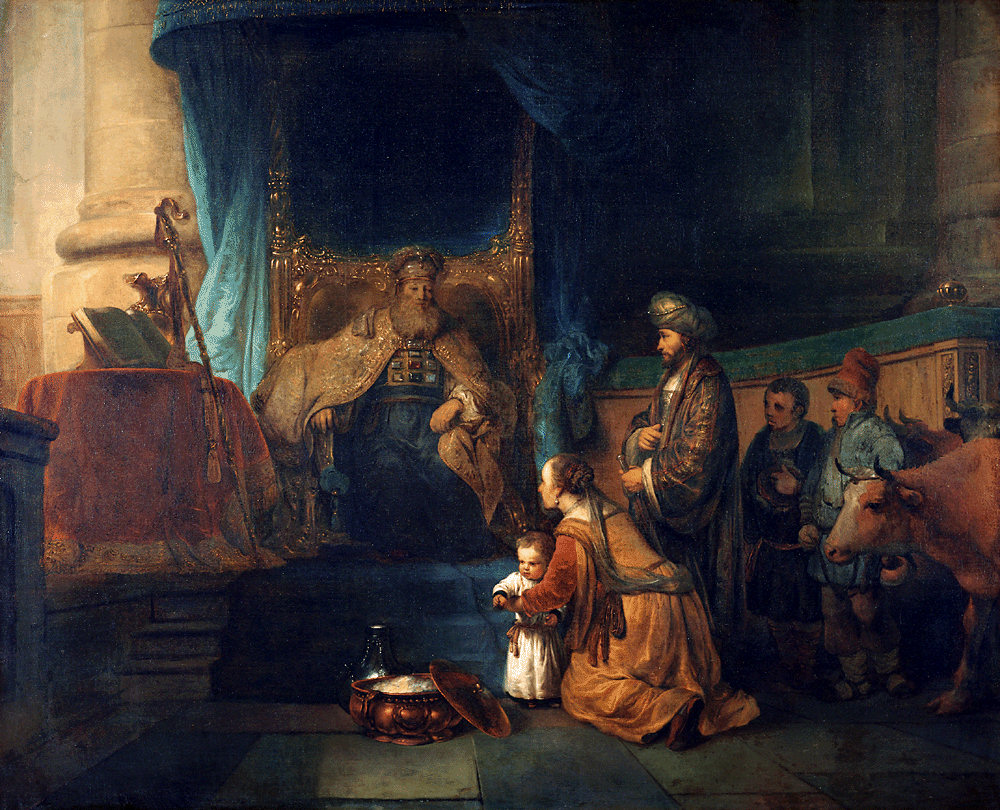
Gerbrand van den Eeckhout – Hannah presenting her son Samuel to the priest Eli c. 1665 (Louvre Museum)
Judges tells of the abuse of women, so it is no surprise when Samuel begins with Hannah suffering oppression from a rival wife. The Lord delivers Hannah from shame by giving her a son, Samuel, whom she dedicates to the Lord. The Lord chooses Samuel as his prophet, while he judges Eli’s house for its failure to honor him. Eli’s wicked sons die in battle, the Philistines capture the ark, and Eli drops dead. The ark devastates the Philistines, who return it to Israel. Israel repents, the Lord defeats the Philistines, and Samuel leads Israel well. But the story will take a downturn in the next division.
God Raises Up Samuel as Prophet Over Israel (1:1–3:21)
Israel needs leadership, and the Lord meets that need through barren Hannah. He gives a son, Samuel, whom she dedicates to the Lord’s service. She praises the Lord for his compassion to the downtrodden and anticipates a divinely empowered king. Samuel serves under Eli and experiences the Lord’s favor, but Eli’s evil sons abuse their position and reject Eli’s rebuke. The Lord decrees judgment on Eli and his sons for their failure to honor him. He reveals himself to Samuel and reiterates his intention to judge Eli. The Lord continues to reveal his prophetic word to Israel through Samuel, but the prophesied judgment must fall.
God Deposes Eli’s House, Defeats the Proud, and Exalts Himself Through His Ark (4:1–7:17)
The Lord fulfills his word. The Philistines defeat Israel and capture the ark, Eli’s sons die in battle, and Eli dies at the news. The Philistines put the ark in Dagon’s temple, but the Lord destroys the idol and strikes Ashdod with a plague. They send the ark to Gath and then Ekron, but death follows it. The Philistines return the ark to Israel, but the Lord kills some of his own people when they disrespect the ark. Israel repents of its sin. When the Philistines attack, Samuel prays, and the Lord defeats the enemy. But Israel is not satisfied, as we see in the next section.
God Raises Up and Rejects Saul, a King After Israel’s Heart (8:1–15:35)
Despite the Lord’s provision, Israel demands a king like all the nations. The Lord chooses a ruler, Saul, whose name means “the one asked for.” Samuel anoints Saul, who must abide by the rules governing kingship. Saul is hesitant, but the Lord empowers him, and he defeats the Ammonites. Samuel confirms Saul’s kingship and warns Israel and the king to remain faithful to the Lord. However, Saul disobeys the Lord’s orders on two occasions, forfeiting his dynasty and then his kingship, as the Lord announces his intention to replace Saul. The narrator introduces this new king in the next division.
God Establishes Saul as King After Israel Disobediently Demands One (8:1–12:25)
Despite the Lord’s provision through Samuel, Israel demands a king like the other nations. Samuel warns them this king will be oppressive, but they repeat their demand. The Lord chooses Saul and encourages him to deliver Israel, but Saul is hesitant. Samuel presents Saul to Israel, informing them the king is under the Lord’s authority. When the Ammonites attack, God’s Spirit empowers Saul, who defeats them. Samuel reconfirms Saul as king but accuses the people of sinning by desiring a king. The people confess their guilt, and Samuel assures them of the Lord’s support and warns them not to rebel. Unfortunately, their new king will prove unworthy.
God Rejects Saul as King Due to His Faithlessness and Disobedience (13:1–15:35)
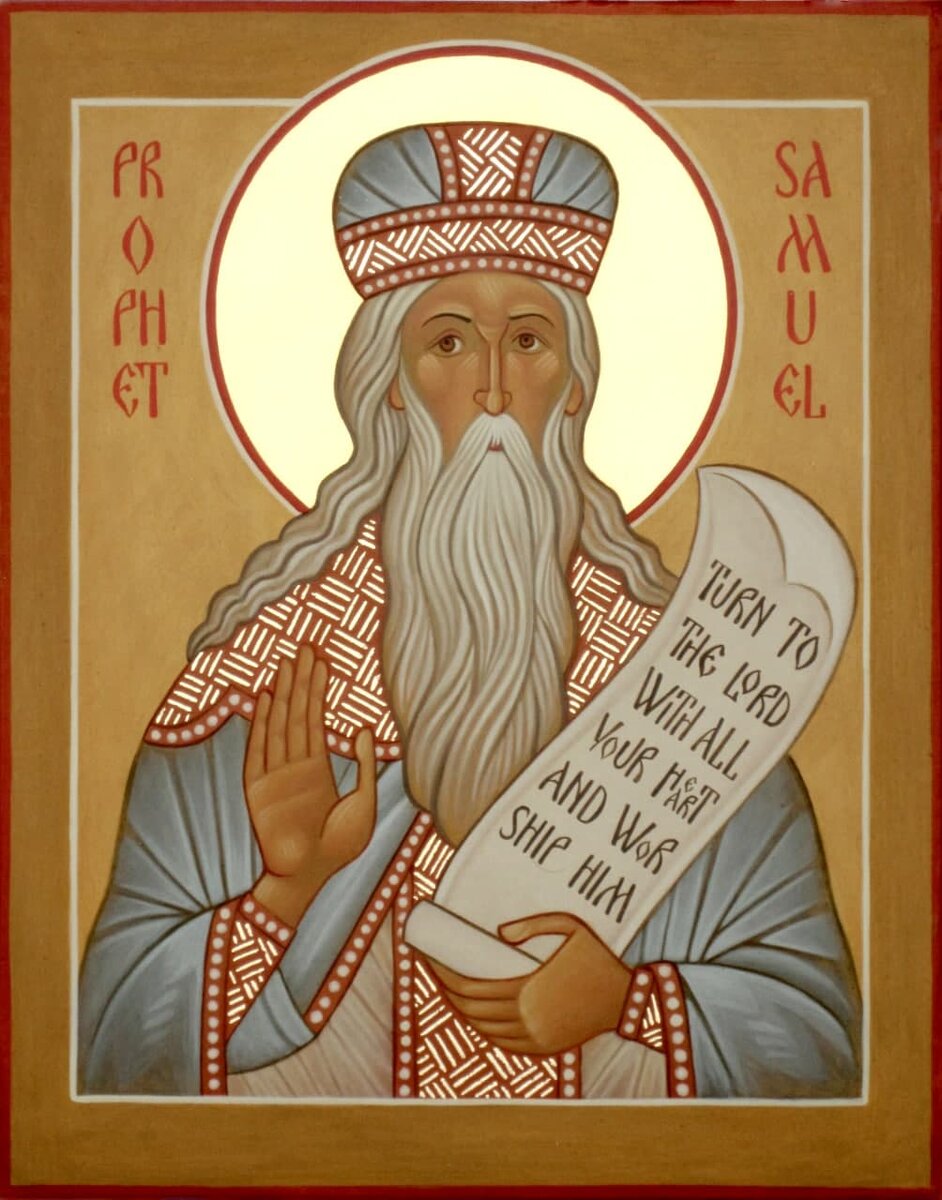
The time comes for Saul to fulfill his mission. He prepares for battle, but Samuel arrives late, so Saul offers a sacrifice. Samuel accuses Saul of foolishly disobeying and announces the termination of Saul’s dynasty. Jonathan ignites a battle, and a God-induced panic overwhelms the Philistines. When Jonathan unwittingly violates Saul’s restriction on the army, Saul wants to execute him, but the army intervenes. Next, the Lord orders Saul to annihilate the Amalekites, but Saul fails to do so. Samuel reminds Saul that the Lord demands obedience and tells him the Lord has rejected him as king. The new king appears in the next section.
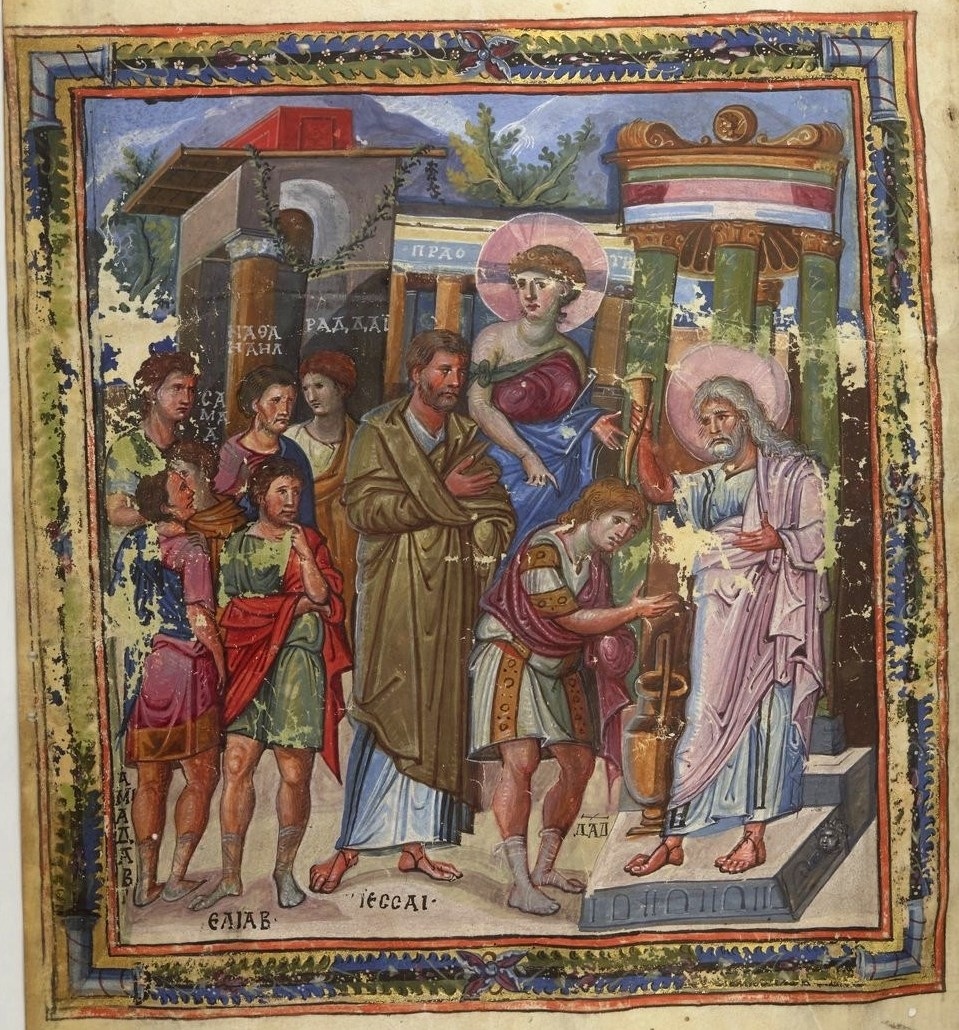
Samuel anoints David king (miniatures of the Paris Psalter, 10th century)
The new king anticipated by Samuel appears. The Lord chooses David, who has a heart for God, and through the Lord’s enablement David defeats the Philistine champion, Goliath. As David’s popularity grows, jealous Saul seeks to kill David, who becomes a fugitive. The Lord thwarts Saul, who twice acknowledges David’s innocence when David spares his life. David flees to Gath and serves as a Philistine mercenary. The Lord prevents David from having to fight against Israel. Saul asks a medium to contact Samuel, who announces Saul’s imminent death, which opens the door for David to take the throne, as described in the following division.
David Exalted but Driven Out by Spiritually Oppressed Saul (16:1–20:42)
Samuel anoints the new king, David, who receives the Lord’s Spirit after it was taken from Saul and replaced by a tormenting spirit. Goliath challenges Israel to single combat. David accepts the challenge, confident in the Lord’s enablement, and defeats Goliath with his sling. David’s success arouses Saul’s jealousy. He plots to kill David, hoping he will die at the hand of Philistines while acquiring Michal’s bride price. But David achieves greater success. Saul renews his attempts to kill David, who takes refuge with Samuel. The Lord thwarts Saul’s attempt to arrest David, and Jonathan warns David to run for his life. David becomes a fugitive, as described in the following section.
David’s Divinely Preserved Life as a Fugitive in Exile (21:1–28:2)
Now a fugitive, David gets aid from the priest Ahimelech. He goes to Gath, but becomes fearful, pretends to be insane, and is sent away. Saul accuses Ahimelech of disloyalty and executes the Lord’s priests and their families. Saul pursues David, but twice David spares Saul’s life, forcing him to acknowledge David’s innocence. Through the wise advice of Abigail, the Lord prevents David from killing evil Nabal. The Lord strikes Nabal dead, and David marries Abigail. David becomes a mercenary to the king of Gath, who expects him to fight against Israel in an upcoming battle. The next section resolves this disturbing plot twist.
David’s Life Preserved, Saul’s Demise (28:3–31:13)
The tension between Saul and David needs resolution. Saul seeks the Lord’s guidance, but receives no response. He visits a medium, hoping she can conjure up the departed spirit of Samuel. Samuel appears, confronts Saul again with his disobedience, and announces he will die in battle the next day. The Philistine leaders do not trust David and force Achish to dismiss him and his men. While David and his men are away, the Amalekites kidnap their families. Guided by the Lord, David defeats them and recovers the kidnapped families. During this time, Saul dies in battle, opening the door for David to take the throne.
The First Book of Samuel (known as 1 Kingdoms in the Septuagint) is a pivotal narrative of transition: from the rule of Judges to the monarchy, from the priesthood of Eli to that of Samuel, and from the failure of Saul to the rise of David. For the Orthodox Church, this history is not merely a record of events but a prophetic and typological revelation preparing the world for the eternal King and High Priest, Jesus Christ. The book is fundamentally about kingship, obedience, and the Lord’s sovereign choice, all of which find their ultimate fulfillment in Christ.
1. Hannah’s Song: The Prophetic Prologue of the Magnificat
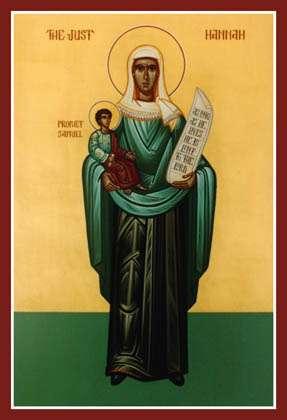
The book opens not with a king or a judge, but with a barren woman, Hannah, whose prayerful anguish God transforms into joyful fruitfulness. Her song of thanksgiving (1 Samuel 2:1-10) is the theological keynote of the entire book.
-
The Text: “The LORD kills and makes alive; He brings down to the grave and brings up. The LORD makes poor and makes rich; He brings low and lifts up. He raises the poor from the dust and lifts the beggar from the ash heap, to set them among princes and make them inherit the throne of glory… He will give strength to His king, and exalt the horn of His Anointed” (1 Samuel 2:6-8, 10, NKJV).
-
New Testament Parallel & Patristic Insight: Hannah’s song is the prototype of the Theotokos’s Magnificat (Luke 1:46-55). Just as Hannah bore Samuel, the one who would anoint kings, the Theotokos bore Christ, the King of kings. The Fathers, such as St. Athanasius, saw in Hannah’s exaltation of God who “brings down” the mighty and “lifts up” the humble the core of the Gospel message. The “horn of His Anointed” (Christos in Greek) is a direct prophecy of the Messiah.
-
Liturgical Fulfillment: The themes of Hannah’s song echo throughout the hymns of the Church, particularly in the Feast of the Nativity of the Theotokos , Who is the fulfillment of the barren woman made fruitful, becoming the living cradle of the King.
-
Ecclesiology. An insightful ecclesiological reading of 1 Samuel 2:5. Within the Orthodox hermeneutical tradition, which sees the Old Testament as the prefiguration and promise of the New, this verse becomes a powerful prophecy of the transition from the Old Covenant to the New. Let’s elaborate on this understanding. “Even the barren has borne seven, And she who has many children has become feeble (1 Samuel 2:5, NKJV)”. Historically, this refers to Hannah (the barren) and her rival Peninnah (who had many children). However, the Church Fathers, following the apostolic example (e.g., Paul’s use of Hagar and Sarah in Galatians 4), see in this a deeper, spiritual meaning concerning the two covenants.
Ecclesiological Elaboration: The Two “Mothers”
1. “She who has many children has become feeble”: The Old Covenant
Assembly of Israel
This figure represents the Old Testament Church, the people of Israel. They were, in a sense, the initially “fruitful” wife of God.
* **"Many Children":** Israel was given every spiritual blessing: the covenants, the law, the temple worship, the prophecies, and the promise of the Messiah (Romans 9:4-5). They were numerous and, as God's chosen people, produced a great lineage of faithful patriarchs, judges, and prophets. They were the "vine" God brought out of Egypt (Psalm 80:8).

* **"Become Feeble" (or "languishes," "fails"):** By the time of Christ, the Old Covenant structure, particularly its leadership in the form of the Scribes and Pharisees, had become spiritually weak and sterile. It had, in the words of Christ, become a "barren fig tree" (Matthew 21:19). It focused on the external observance of the Law while often neglecting its weightier matters of "justice and mercy and faith" (Matthew 23:23). Its ability to bring forth the fruits of the Kingdom of God had failed. It could not, by the Law alone, give birth to eternal life. Its feebleness was revealed in its failure to recognize and receive its own Messiah (John 1:11).
2. “The barren has borne seven”: The New Covenant Church of the Nations
This figure represents the New Testament Church, born from the side of Christ on the Cross and empowered by the Holy Spirit at Pentecost. This Church was gathered primarily from the Gentiles.
* **"The Barren":** The Gentile world was spiritually barren. They were "alienated from the commonwealth of Israel and strangers to the covenants of promise, having no hope and without God in the world" (Ephesians 2:12). They did not have the Law or the prophets to guide them to the true God and were trapped in idolatry and spiritual death. They were the "not-a-people" who would become God's people (1 Peter 2:10).

* **"Has Borne Seven":** This is the glorious reversal. Through the preaching of the Gospel, the Holy Spirit made the Gentile world incredibly fruitful.

  * **The Number Seven:** In the symbolic language of Scripture, seven is the number of **perfection, fullness, and covenant completion**. The "seven" children signify the perfect and complete Church, the "whole fullness of him who fills all in all" (Ephesians 1:23). It is not a small remnant, but a vast, multitude from every nation (Revelation 7:9).

  * **The Fruitfulness:** This New Covenant Church, born from the seemingly foolish "message of the cross" (1 Corinthians 1:18), gave birth to a countless number of saints, martyrs, confessors, and faithful throughout the ages. It produces the "fruit of the Spirit" (Galatians 5:22-23) and brings forth new children of God through the womb of the baptismal font.
Patristic and Liturgical Witness
The Church Fathers explicitly make this connection.
* **St. Augustine,** in his writings, frequently contrasts the "barren" Gentile church with the "fruitful" but fading synagogue. He sees Hannah as a type of the Church, which, though once barren, now bears spiritual children for God.

* **St. John Chrysostom** and other Greek Fathers, in their homilies, often contrast the spiritual sterility of the Judaizers with the fruitfulness of the Gospel preached to the Gentiles.
This understanding is also embedded in Orthodox liturgical poetry. The hymns for the Feast of the Meeting of the Lord, for instance, often present a dialogue between the Christ Child (the New) and the Temple (the Old), where the Old must give way to the New. The Canons of the great feasts are filled with such typological interpretations, celebrating the Church’s gathering of the once-barren nations.
Synthesis and Conclusion
The ecclesiological reading of 1 Samuel 2:5 reveals a core dynamic of salvation history:
1. **The Judgment of the Old:** The Old Covenant, for all its God-given glory, was "fading away" (2 Corinthians 3:7-11). Its spiritual efficacy was dependent on its fulfillment in Christ. When it rejected Him, its "feebleness" was fully manifested.
2. **The Grace of the New:** The New Covenant in Christ's blood, while first offered to the Jew, was powerfully received by the Gentiles. Through the outpouring of the Holy Spirit, what was once barren (the pagan world) became the mother of a perfect and complete (_seven_) people, the Catholic (Universal) and Apostolic Church.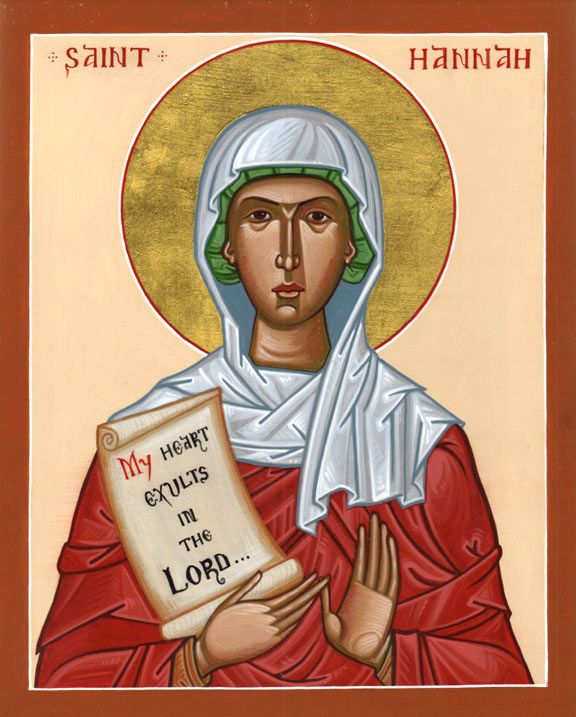
This verse is a beautiful and prophetic summary of the great mystery Paul expounds upon: that in Christ, the dividing wall of hostility is broken down, and from “two peoples,” He creates “one new man” (Ephesians 2:14-15). The once-feeble and the once-barren are united in the one, holy, catholic, and apostolic Church, which is the true “Israel of God” (Galatians 6:16) and the fruitful Bride of Christ.
2. The Ark of the Covenant: The Presence and Victory of God
The narrative of the Ark’s capture by the Philistines and its subsequent return (1 Samuel 4-6) is a profound theological lesson on the nature of God’s presence.
-
The Text: The Israelites treat the Ark as a magical talisman, and it is captured, leading to the death of Eli and the glory departing from Israel (1 Sam. 4:21-22). Yet, among the Philistines, the Ark brings devastation, demonstrating that God is not a controlled power but the sovereign Lord.
-
Patristic Insight: The Fathers interpreted the Ark as a type of the Theotokos. Just as the Ark held the stone tablets of the Law, the manna, and Aaron’s rod, the Theotokos contained the new Lawgiver, the Bread of Life, and the eternal Priest, Jesus Christ. Her title “Ark of the Covenant” in the Akathist Hymn flows directly from this typology. The “captivity” of the Ark prefigures Christ’s descent into Hades, where His presence defeats the “Philistines” of hell and death from within.
-
Liturgical Fulfillment: The hymnography for the Feast of the Dormition and the Great Feast of the Theotokos consistently uses this imagery: “The ends of the earth rejoice in you, O Theotokos, the spotless one, the noetic paradise… the sacred treasure of the glory of God, who was carried by the cherubim.”
3. The King After Man’s Heart vs. The King After God’s Heart
The people’s demand for a king “like all the nations” (1 Samuel 8:5) represents a rejection of God as their King. God grants their request, giving them Saul, a man who embodies human stature and potential but lacks obedience.
-
Saul: The Type of Disobedience: Saul’s presumptuous offering (1 Sam. 13:8-14) and his disobedience in sparing Agag and the spoil (1 Sam. 15) reveal a heart oriented toward self-preservation and public opinion rather than God’s will. The prophet Samuel declares, “To obey is better than sacrifice” (1 Sam. 15:22). Saul represents the failed Old Adam and the Law which cannot save because of the weakness of human flesh.
-
David: The Type of Christ: David is chosen not for his appearance but for his heart (1 Sam. 16:7). He is anointed king while Saul is still on the throne, prefiguring Christ who was anointed by the Spirit at His baptism while the “ruler of this world” still held sway.
-
The Messianic Champion: David’s victory over Goliath (1 Sam. 17) is a classic type of Christ’s victory over satan, the “strong man” (Matthew 12:29). David, the representative of his people, defeats the enemy they could not, just as Christ, the New Adam, defeats sin and death on our behalf. The five stones can be seen as a type of the five wounds of Christ.
-
The Rejected King: David’s patient endurance of persecution from Saul, refusing to lift his hand against the “Lord’s anointed” (1 Sam. 24:6, 26:9), is a profound icon of Christ’s kenosis (self-emptying). Though He was the true King, He endured rejection and persecution without retaliation, entrusting Himself to the Father who judges justly (1 Peter 2:23).
-
4. The Ascetical Understanding: The Struggle for the Kingdom Within
The book of 1 Samuel is a masterful text of ascetical theology, illustrating the inner struggle for the soul’s kingship.
-
Obedience vs. Self-Will: The central ascetical theme is encapsulated in Samuel’s word to Saul: “To obey is better than sacrifice.” The Fathers, like St. John Cassian, use this to teach that external religious acts are worthless without inner obedience and humility. Saul’s downfall was his logismos (evil thought) of trusting in himself, while David’s strength was his reliance on God (“The LORD who delivered me from the paw of the lion and the paw of the bear will deliver me…” - 1 Sam. 17:37).
-
The Heart as the Battlefield: The story of David playing the harp for Saul to soothe the evil spirit (1 Sam. 16:14-23) is a powerful ascetical image. It shows that only the sweet, harmonious “psalmody” of a heart attuned to God can calm the passions and demonic temptations that torment the soul ruled by jealousy and pride.
-
The Jesus Prayer in Narrative: David’s repeated cries to God in the Psalms (many of which are contextually linked to this period, e.g., Psalm 57 [56 LXX] “Be merciful to me… for my soul trusts in You…”) model the practice of constant prayer. His life as a fugitive, dependent entirely on God’s providence, is an icon of the monastic and Christian journey through the wilderness of this world.
Conclusion: 1 Kingdoms as a Christ-Centered Book
The First Book of Samuel is a foundational Christological text. It reveals:
-
Christ the Anointed King: Prefigured in David, the shepherd-king anointed to rule, who establishes a new kingdom.
-
Christ the Obedient Son: In contrast to the disobedient Saul and the sons of Eli, Christ is the perfectly obedient One who does the Father’s will.
-
Christ the Victor: As David defeated Goliath, Christ trampled down death by death.
-
Christ the Humble Sufferer: As David was rejected and persecuted, Christ was “despised and rejected by men.”
-
The Theotokos as the New Ark: The vessel that contained the very presence of God.
Ultimately, the book traces God’s faithful work to establish a true and everlasting kingship through the line of David, a lineage and a throne that find their eternal fulfillment in our Lord Jesus Christ, the true King of Israel and the cosmos.
-
14.1 The Rise of David’s Kingdom Over Saul’s
-
14.2 God Raises Up and Preserves David, a King After His Own Heart (16:1–31:13)
-
14.3 An Orthodox Insight into the First Book of Samuel (1 Kingdoms)
-
The Rise of David’s Kingdom Over Saul’s
- God Raises Up and Preserves David, a King After His Own Heart (16:1–31:13)
- An Orthodox Insight into the First Book of Samuel (1 Kingdoms)
Related Concepts
- 1-peter-223
- abigails-counsel
- akathist-hymn
- allegory
- anointing
- ark-of-the-covenant
- ascetical-theology
- charismatic-leadership
- christ-as-new-adam
- christs-descent-into-hades
- christus-victor
- courage
- dagon
- david
- davidic-typology
- disobedience
- divine-election
- divine-favor
- dormition
- ephesians-123
- free-will
- fruitfulness
- galatians-4
- gentile-mission
- goliath
- hannahs-song
- israel-of-god
- judgment
- judgment-belongs-to-god
- kingship
- logismos
- loyalty
- magnificat
- matthew-1229
- messiah
- messiahchrist
- messianic-prophecy
- moral-theology
- mosaic-law
- name-of-god
- new-covenant-church
- non-retaliation
- old-adam
- old-testament-fulfillment
- patience
- philistines
- praise
- psalmody
- psalter
- restraint
- revelation-79
- reverence-for-authority
- royal-psalms
- saul
- sauls-death
- sauls-rejection
- st-john-cassian
- suffering
- the-heart