New Testament — Topic 37
The Johannine Letters: 1 John, 2 John, 3 John.
The author of 1 John affirms his readers, assuring them that they are doing well and that they enjoy a positive status before God:
· They have had the word of life revealed to them (1:1-2).
· They have an Advocate with the Father, Jesus Christ (2:1).
· They have assimilated the truth of the new commandment (2:8).
· They have received forgiveness of sins (2:12).
· They know the Father, the one who is from the beginning (2:13-14).
· They have overcome the evil one (2:13-14).
· They are strong, and the word of God abides in them (2:14).
· They have been anointed by the Holy One and know the truth (2:20-21).
· They do not need anyone to teach them (2:27).
· They are children of God already, and they will be like Christ (3:1-2; 5:19).
· They have Christ abiding in them, and he has given them the Spirit (3:24; 4:13).
· They are from God and have conquered spirits of the antichrist (4:3-4, 6).
· They are indwelt by one who is greater than the one who is in the world (4:4).
· They have experienced love being perfected among them (4:17).
· They have faith that conquers the world (5:4).
· They believe in the name of the Son of God (5:13).
· They have boldness before God in prayer (5:14-15).
· They have been given understanding to know God (5:20).
· They are in the God who is true, through his Son, Jesus Christ (5:20).
We might wonder how things could get this bad in a community organized around a Gospel that emphasizes friendship (John 15:13-15), humble service (John 13:14-15), and mutual love (John 13:34; 15:12). Certainly, the crisis must have tested their sense of identity, to say nothing of compromising their witness to outsiders (see John 13:35). Given the circumstances, it is somewhat remarkable that 1 John is so free of polemic (cf. Jude; 2 Pet. 2). Despite what has happened, the author is confident and joyful (1 John 3:21; 5:14; 3 John 4). He does not (here) offer any personal attack on the secessionists or even seek to refute their positions. Instead, the focus is on those who remain with the church, affirming them in ways that will reestablish their spiritual self-esteem and calling them to remember what makes them who they are. There is an unusually strong emphasis on the intimacy of their relationship with God, and this is worked out in a reciprocal way: the readers abide in God or Christ (1 John 2:6, 24, 27–28; 3:6, 24; 4:13, 15–16; cf. 2:10; 4:16) and God abides in them (1 John 3:24; 4:12-13, 15–16; cf. 2:14, 24, 27; 3:9; 2 John 2). Most of all, the readers need to realize how much God loves them (1 John 4:8-11, 16). Then, they just need to let God’s love be perfected in them (1 John 2:5; 4:12, 17–18) and love one another, not just in word or speech, but in truth and action (1 John 3:18). When this happens, the author’s joy will be complete (1 John 1:4).
The church historian Eusebius (ca. 311) recounts what he regards as “a memorable tale” regarding the apostle John, a story that is told also by Irenaeus (ca. 180), who claims to have gotten it from Polycarp (ca. 69–155):
One day John the apostle went into a bathhouse to take a bath, but when he found out that Cerinthus was inside, he leapt from the spot and ran for the door, as he could not endure to be under the same roof. He urged his companions to do the same, calling out: “Let’s get out of here, for fear the place falls in, now that Cerinthus, the enemy of the truth, is inside.” (Eusebius, Ecclesiastical History 3.28.6; 4.14.6)
This story probably is not historical, but it did become a popular “urban legend” in the early church. One version has John fleeing the bathhouse naked, like the man who fled the garden of Gethsemane in Mark 14:51-52.
The story captures one aspect of the man who probably founded the community with which the Johannine Letters are associated: he was remembered as someone who took heresy or false doctrine very seriously. This is true of the Johannine Letters. But the story also recounts a response motivated by fear, and that does not sound like the author of these letters at all. The position taken in the Johannine Letters is that “perfect love casts out fear” (1 John 4:18). One ought not welcome the deceiver (2 John 10), but there is no need to flee the bathhouse.
In English Bibles, these three books are labeled very nicely for us: “The First Letter of John,” “The Second Letter of John,” and “The Third Letter of John.” Thus, all three are letters, all three are written by someone named “John,” and they are presented in a definite order (first, second, third). Of course, these titles were added much later, for our convenience, and one does not have to look very hard to see that there is little in these books to justify the designations. For one thing, the book called “1 John” does not appear to be a letter: it neither opens nor closes like a letter, nor does it have a sender and recipient. It appears to be a theological treatise or tract. Beyond this, none of the three “letters” (we will call them that) indicates that it is by John: the first one is anonymous, and the latter two are by someone who calls himself “the elder” (2 John 1; 3 John 1). And, finally, there is virtually nothing in these books to indicate the sequence or order in which they might have been written (except, possibly, for the comment in 3 John 9).
So, where do the titles come from? In the early church, the works came to be ascribed to the apostle John, a disciple of Jesus. This may have been based on two considerations: (1) the language, style, and outlook of the three letters are similar to that of our Fourth Gospel, leading many to believe that the four books had the same author; (2) the author of that Gospel had come to be identified with the apostle John on the basis of verses indicating that some of its material had been put into writing by “the disciple whom Jesus loved” (John 21:24). No one knew anything about the order in which these books were written, so the three “letters” were simply arranged and numbered according to length, from longest to shortest. A few modern scholars maintain that this construal of the evidence still holds up, but most amend it slightly. The dominant view today is that John’s Gospel was produced in stages: the apostle John may have been responsible for the “first draft” of that Gospel, but others expanded and edited it. Accordingly, the three Johannine Letters usually are ascribed to one of these later editors of John’s Gospel rather than to the apostle John himself. A popular theory holds that the letters may have been written by a person known to us from church history as “John the Elder.” According to Eusebius, John the Elder was a disciple of the apostle John and was a member of his congregation. He may be the “elder” responsible for 2 John and 3 John; he may also have been the author of 1 John and one of the final authors/editors of John’s Gospel. What seems certain is that the voice behind 1 John, 2 John, and 3 John is steeped in the language and theology of John’s Gospel. Furthermore, it is a voice that speaks both pastorally and authoritatively, expecting to be recognized by the readers as providing them with a reliable declaration of the message that has been proclaimed “from the beginning” (1 John 1:1).
God is love.” Just about everyone knows that the Bible teaches this. Some people might think that it’s found in every book of the Bible and on practically every page. But only twice does the Bible come right out and say, “God is love,” and both occurrences are in the same book: the first of three letters attributed to John (1 John 4:8, 16).
What does it mean to say that God is love? It does not mean that God and love are exactly the same thing, any more than saying “God is light” (1 John 1:5) means that God and light are the same thing. Still, it means something more than just saying “God loves” or “God is loving.” Love is not just one of God’s behaviors or characteristics; love is a defining attribute of God, an ultimate quality that must always be taken into account. Love is the motive for everything that God says and does, the harsh words as well as the kind ones, the acts of judgment and punishment as well as the acts of salvation and mercy.
At first, the Johannine Letters may seem like an odd setting for such an insight to be developed, for they were written in the midst of conflict and discord. Still, there it is: the fundamental insight that “God is love” stands at the heart of these three letters. It was originally presented as a focal point in a crisis, and for many in the Christian church (which has never lacked for crises), it has remained that ever since.
- Introduction
- Overview: 1 John
- Overview: 2 John
- Overview: 3 John
- Historical Situation
- Similarities between the Johannine Letters and the Gospel of John
- Who Is the Elect Lady?
- Major Themes in the Johannine Letters
- Affirmation in 1 John
- Conclusion
The Humanity of Christ
The Johannine Letters emphasize the reality and significance of Jesus’ humanity. The prologue of 1 John recalls the first words of John’s Gospel through its use of the words “in the beginning” (1 John 1:1; cf. John 1:1). But there is a difference: in the Gospel, “the beginning” referred to the beginning of time, before the heavens and earth were created (cf. Gen. 1:1; but see also 1 John 2:13-14); in the letter, it refers to the life and ministry of Jesus, who was an actual person, a man who could be heard and seen and touched (1 John 1:1-3; cf. 2:7, 24; 3:11). This emphasis on the physical reality of Jesus surely sets the stage for the later claim that only spirits that confess “Jesus Christ has come in the flesh” are from God (1 John 4:2-3). In the Gospel of John, some people thought that since Jesus was a human being, he could not really be divine (6:42). Now it appears that the same logic has been applied in reverse: some people think that since Jesus was a divine being, he could not really be human. Still, the letters emphasize Jesus’ humanity without giving any ground on his divinity: his identification with God remains so close in 1 John that it’s often impossible to tell whether pronouns refer to “God” or to “Jesus” (1:9-10; 2:3-6, 27–28; 3:23-24; 4:17). In time, most Christian churches would ascribe to a doctrine of the “two natures of Christ,” insisting that Jesus Christ was both “fully divine” and “fully human” in a manner compatible with what is presented in the Johannine writings.
Atonement
_ _ One aspect of Christ’s humanity that is emphasized in these letters is the significance of his death for salvation (see 1 John 2:2; 3:16; 4:10; cf. 1:9). One explanation for the curious affirmation that Jesus Christ came by water and blood and not water only (1 John 5:6) is that the author wants to emphasize the significance of Jesus’ baptism and crucifixion in the face of some who must have thought that only his baptism was important. Specifically, 1 John refers to Jesus’ death as a hilasmos (translated “atoning sacrifice” by the NRSV). The meaning of this word, used in 1 John 2:2; 4:10, is greatly disputed: it might mean either “propitiation” (placating an offended God) or “expiation” (cleansing or removing defilement). For centuries, exegetes have disagreed as to which meaning is intended, and theologians have worked out different conceptions of atonement theory accordingly.
Sin
_ _ In 1 John we perceive an undeniable tension between the reality of sin and an ideal of sinlessness. On the one hand, the person who abides in Christ does not sin (3:6), and those who have been born of God are unable to sin (3:9); on the other hand, those who say that they have no sin deceive themselves and make a liar out of God (1:8, 10). How can both be true? Likewise, 1 John maintains that people who sin do not know God and are from the devil (3:8), but then it also seems to recognize sin as typical of Christian experience, exhorting believers to confess their sins (1:9; cf. 2:1-2; 5:16). Numerous explanations for this paradox have been offered: perhaps the author means to say that those who “willfully continue in sin” do not abide in Christ and are not born of God. Or, maybe his point is that a person who sins is not “born of God” or “abiding in Christ” at that moment—that is, in the instance of sinning. More often, scholars assume that the point is rhetorical, not logical: the author wants to motivate his readers to seek a life without sin, while also recognizing pragmatically that what sins are committed should be acknowledged (see 2:1).
In any case, the topic of “sin” in 1 John is complicated by a strange reference to “mortal sin” (NRSV) or “sin that leads to death” (NIV): the readers are instructed not to pray for anyone who commits such a sin (5:16-17). This could mean that it is inappropriate to pray for those who have died in their sins (once they are physically dead), but most interpreters understand the reference as being to sin that leads to spiritual death. Is the reference, then, to sins that are especially serious (e.g., idolatry [cf. 5:21] or denying Christ [cf. 2:22])? Or to sins that are willful and persistent? Or what? Theories abound, with no clear conclusion.
Love
The author of 1 John summarizes the expectation and demands of God with a single two-part commandment: “We should believe in the name of his Son Jesus Christ and love one another” (3:23; cf. Matt. 22:36-40; Mark 12:28-31; Luke 10:25-28). The exhortation to “love one another” is repeated seven times in these letters (1 John 3:11, 14, 23; 4:7, 11, 12; 2 John 5; see also 1 John 3:10, 18; 4:8, 19, 20–21; 5:2). The letters do not provide a detailed description of what such love entails (as Paul does in 1 Cor. 13:4-8), but three points seem to stand out:
People love one another when they keep God’s commandments (1 John 5:2-3). The commandments specify what it means to love, so people who obey God’s commandments are practicing love. This is one reason why the “new commandment” to love one another is really an old commandment (1 John 2:7; 2 John 5).
· People love one another when they imitate God (1 John 4:9-11) and when they imitate Jesus (1 John 3:16).
· People love like God (1 John 4:11-12) when they live like Jesus, walking “as he walked” (1 John 2:6) and laying down their lives for others as he laid down his life for them (1 John 3:16).
· People love one another when they use their material resources to provide for brothers and sisters who are in need (1 John 3:17). This is the only concrete example that the letters offer for what it means to show love to another member of the community; thus, it stands out as a matter of special importance.
Beyond this, we should note that this community’s love ethic is solidly grounded in its theology: the letters teach that both the possibility and the necessity of loving one another have their origin in God, who is love (1 John 4:8, 16) and who takes the initiative in love (1 John 4:10, 19). All love is from God (1 John 4:7), and so “knowing God” and “loving one another” go together. No one can love without knowing God (1 John 4:7), and no one can know God without loving (1 John 4:8).
In a slightly different vein, many readers cannot fail to note that the emphasis in these letters is on loving one another—that is, “brothers and sisters” or other members of the community of faith. Nothing is ever said about loving one’s neighbor, much less about loving one’s enemies (cf. Matt. 5:44; Luke 6:27). In fact, 2 John 10 issues a strong prohibition against welcoming (or even greeting!) anyone whose teaching contradicts that of the elder—that doesn’t seem very loving. And community members are instructed not to love the world (1 John 2:15). The usual explanation for this narrow focus on loving “one another” is that these letters reflect only one aspect of a church in the middle of a crisis: the immediate need is for strengthening internal bonds. For this church, right now, containing the current crisis and preventing the spread of a schismatic heresy is deemed a higher priority than maintaining dialogue or even civil relations with the heretics.
Conflict and Schism
_ _ Since these letters seem to be the products of a church in crisis, they often are examined for what they reveal about the dynamics of church conflict. In particular, 2 John and 3 John seem to be concerned with establishing boundaries within a divided community. At the heart of the matter may be a doctrinal dispute, a disagreement over something so serious that the elder is prepared to claim that those who have the wrong teaching do not have God (2 John 9). But apart from the theological issues (as important as those may be), there appear to be power struggles within the church that are coming to a head over issues of hospitality. In 2 John, the elder sets forth a policy that churches are not to provide lodging and meals for visiting representatives of the schismatic faction (v. 10). Those who do provide such hospitality, even if they don’t subscribe to the teaching of that group, are participating in the evil deeds of these deceivers (v. 11; cf. v. 7).
Such a policy implies a negation of neutrality, and this is seen further in 3 John, where the elder seems to be receiving a taste of his own medicine: we discover now that there is a church led by Diotrephes that has instituted a “no hospitality” policy with regard to representatives of the elder’s community. Significantly, the elder does not identify Diotrephes as one of the secessionists or as someone who holds to any false doctrines himself. Rather, Diotrephes appears to favor a “pox on both your houses” approach to this controversy: his church refuses to welcome representatives from either side. But the elder attributes Diotrephes’ actions to personal dysfunctions: he says that Diotrephes likes to put himself first and has problems acknowledging authority (v. 9). Thus, from the elder’s perspective, Diotrephes is not maintaining neutrality but rather is exploiting the controversy to enhance his own position as leader of what will now be an independent church. In any case, there can be no neutrality. The elder sees things in line with words of Jesus uttered in the midst of conflict: “Whoever is not with me is against me” (Matt. 12:30); this is a very different perspective from that espoused by Jesus in happier times: “Whoever is not against us is for us” (Mark 9:40).
The letter opens with a prologue grounding the “word of life” that it offers in the personal experiences of the author or authors (1:1-4). The message of the letter is introduced with a contrast between walking in darkness and walking in the light of God (1:5-2:2). The love of God is made perfect in those who obey God’s commandments, especially the command to love one another (2:3-11). After a poetic oracle to various groups in the community (2:12-14), the letter offers an impassioned plea for its readers not to love the world (2:15-17).
The author distinguishes his readers, who know the truth, from “antichrists” who have left the community (2:18-27). The readers are encouraged to fix their hope on the coming of Jesus (2:28-3:3). A clear delineation is made between children of God and children of the devil (3:4-10) and between people who hate fellow believers and people who have God’s love in them (3:11-24). The author proposes two tests for identifying false prophets: they do not confess that Jesus came in the flesh, and they do not heed the tradition preserved from the beginning (4:1-6). Then, the author returns to his main point: love is the sign and source of a true relationship with God (4:7-21). He emphasizes that victorious faith accepts various testimonies to Jesus and leads to a life that is lived in him (5:1-13). In conclusion, the author urges the readers to pray confidently for others (5:14-17), and then he offers a series of concluding proclamations (5:18-20) and a final warning against idolatry (5:21).
A salutation identifies the letter as being from “the elder” to “the elect lady and her children” (vv. 1-2). The elder begins by highlighting faithfulness that has been exhibited by some (v. 4). He urges his readers to love one another and to keep God’s commandments (vv. 5-6). Then, he warns them to be on guard against deceitful antichrists and urges them not to welcome anyone who fails to keep to the teaching of Christ (vv. 7-11). He expresses hope to visit them soon and sends greetings from their “elect sister” (vv. 12-13).
The letter opens with a salutation from “the elder” to a beloved man named “Gaius” (v. 1). The elder offers a prayer for Gaius’s health (v. 2) and commends him for providing hospitality for missionaries (vv. 3-8). He then censures a church leader, Diotrephes, who has aggressively opposed support for these missionaries, rejecting the elder’s authority (vv. 9-10). Finally, he urges Gaius to avoid evil and do good, then offers a brief testimony on behalf of a highly regarded man named “Demetrius,” and concludes with travel plans and greetings (vv. 11-15).
light and darkness (1 John 1:5-7; 2:9-11; cf. John 8:12; 12:46)
unity of Father and Son (1 John 1:3; 2:22-24; 2 John 9; cf. John 5:20; 10:30, 38; 14:10) references to “the truth” (1 John 2:21; 3:19; 2 John 1; 3 John 3, 8; cf. John 8:32; 18:37)
use of “Paraclete” (1 John 2:1; John 14:16, 26; 15:26; 16:7)
being hated by the world (1 John 3:13; cf. John 15:18-19; 17:13-16)
God sending Christ into the world out of love (1 John 4:9; cf. John 3:16)
Jesus coming in the flesh (1 John 4:2; 2 John 7; cf. John 1:14)
Christ laying down his life for others (1 John 3:16; cf. John 10:11, 15, 17–18; 15:12-13)
being born of God (1 John 2:29; 3:9; cf. John 1:13; 3:3-8)
knowing God (1 John 2:3-5, 13–14; 3:1, 6; 4:6-8; cf. John 1:10; 8:55; 14:7; 16:3)
abiding in God/Christ (1 John 2:6, 27–28; 3:6, 24; 4:13-16; cf. John 6:56; 15:4-10)
new and old commandments (1 John 2:7; 2 John 5; cf. John 13:34)
loving one another (1 John 2:27-28; 3:11, 23; 2 John 5; cf. John 13:34; 15:12)
water and blood (1 John 5:6-8; cf. John 19:34-35)
that joy may be complete (1 John 1:4; 2 John 12; cf. John 15:11; 16:24; 17:13)
Most interpreters think that the three letters were written at about the same time and probably after the Gospel (or at least after a time when the Gospel was almost in its final form). By most reckonings, this would place them somewhere in the 90s (for discussion of a likely date for the Gospel of John, see pp. 173–76). In any case, the letters presuppose a setting in which a number of “house churches” in different localities relate to each other through mutual friendship, hospitality, and support. The elder (2 John 1; 3 John 1), Gaius (3 John 1), and Diotrephes (3 John 9) apparently are leaders of churches in neighboring communities.
The occasion for all three letters is the outbreak of conflict and schism in this network of churches. The letters speak of “deceivers” (2 John 7), “liars” (1 John 2:4, 22; 4:20), “false prophets” (1 John 4:1), and “antichrists” (1 John 2:18, 22; 4:3; 2 John 7), at least some of whom are to be identified with former church members who have left the dominant community (1 John 2:19) but who continue to seek converts for their position (2 John 7–11). The letters provide no description of what these secessionists believe, but we may gain some clues by noticing what the letters condemn or commend.
On the one hand, these letters speak very negatively of people who
· claim to be without sin (1 John 1:8-10)
· claim to know God but disobey God’s commandments (1 John 1:6; 2:4)
· claim to love God but do not love their brothers and sisters (1 John 2:9, 11; 3:10-18; 4:8, 20) love the world or things that are worldly (1 John 2:15-16; 4:5; 5:19)
· deny that Jesus is the Christ (1 John 2:22)
· deny that Jesus has come in the flesh (2 John 7)
· deny the Father and the Son (1 John 2:22-23)
· do not confess Jesus (1 John 4:3)
· do not abide in the teaching of Jesus (2 John 9–11)
On the other hand, they speak positively of people who
· confess that Jesus has come in the flesh (1 John 4:2)
· confess that Jesus is the Son of God (1 John 4:15; 5:5, 10, 13)
· affirm that Jesus Christ came with water and blood, not water only (1 John 5:6)
Some of these remarks could be general comments that have nothing to do with the schism that has occurred, but most scholars see it as logical to assume that the secessionists exhibited some of the condemned tendencies (and failed to exhibit the commended ones).
Many scholars also think that the secessionists believed that they were deriving their ideas from the Gospel of John itself (or at least from the traditions within the community that were being incorporated into an early form of that Gospel). This is not unthinkable. We know, for instance, that the gnostics of the second century prized the Gospel of John, interpreting it somewhat selectively in ways that supported their ideas. John portrays Jesus as a divine figure who comes from heaven to earth and reveals secrets about the divine realm and how to enter it (John 3:1-15); his teaching conveys knowledge that sets people free (John 8:32). These points, at least, were wholly compatible with Gnosticism (see pp. 39–41). In a similar fashion, the secessionists associated with the Johannine Letters might have tried to justify ideas that are condemned in the three Johannine Letters on the basis of a rival interpretation of the Gospel of John (highlighting certain passages, ignoring others):
· the preexistent Logos and Son of God comes into the world as light (John 1:1-3), not as an actual flesh-and-blood human being (cf. 1 John 4:2; 2 John 7; but see also John 1:14);
· salvation results from God sending the Son into the world (John 3:16), not by Jesus’ earthly life or death (cf. 1 John 4:10; but see also John 1:29);
· people are spared condemnation by believing in the Son (John 3:17), not by keeping commandments (cf. 1 John 1:6; 2:4; but see also John 14:21).
There is some indication that the secessionists thought of themselves as “progressives,” pushing the church to “go beyond” the original teaching of Christ to embrace new revelation (2 John 9). The Johannine Letters, by contrast, call their readers back to what they have heard “from the beginning” (1 John 1:1; 2:7, 14; 3:11; 2 John 5–6). Perhaps the secessionists claimed to be inspired by the Spirit, who, according to John’s Gospel, would continue to teach people new truth when they were ready to receive it (John 16:12-13); in response to such a claim, 1 John insists that “spirits” need to be tested (1 John 4:1-3), for there is not only a “Spirit of truth” (cf. John 14:17; 15:26; 16:13) but also a “Spirit of error” (1 John 4:6).
The second of the Johannine Letters is explicitly addressed to “the elect lady and her children” (2 John 1). Who was this person? Was there some prominent woman in the early church to whom this letter was written?
Some interpreters have thought that the “elect lady” might be the leader of a house church, similar to those churches that are apparently led by Gaius (3 John 1) and by Diotrephes (3 John 9) and by the elder himself.
The more common view, however, is that “elect lady” is a metaphorical expression for the church itself: the lady is the church in some particular vicinity, and her children are the members of that church. In support of this interpretation, scholars note that the elder seems to refer to his own church as the lady’s “elect sister” (2 John 13).
The purpose of all three letters is to deal with some of the repercussions of such conflict and schism in the church. In 1 John we encounter a general treatment for the benefit of those who have remained in the community, offering them counsel and guidance for the difficult time. In 2 John we have a letter addressed to a local church at some distance from the main community, warning the congregation that missionaries from the schismatic group may come to them and advising that no hospitality or audience be granted to such people (2 John 10). In 3 John we have a letter of recommendation on behalf of a missionary from the elder’s own community, a man named “Demetrius” (3 John 12). The elder wants Gaius, the recipient of the letter, to grant Demetrius hospitality, something he has done for other missionaries in the past (3 John 5–8). This simple request is complicated, however, by the fact that a leader in a nearby church, Diotrephes, is trying to prohibit anyone from doing this.
There is no sure way to know which letter was written first, second, or third. One attractive proposal suggests that 1 John had been developed as a tract to help congregations in the Johannine tradition deal with the aftermath of the schism and that, as such, multiple copies were sent to different congregations. According to this theory, 2 John may be the “cover letter” accompanying this tract (1 John) when it was sent to one particular church, perhaps the one led by Gaius, and 3 John may be a personal note for Gaius that the elder drafted to accompany the other two pieces of correspondence (cf. 3 John 9). What we have in our New Testament, then, is essentially a “three- letter packet” that was received by one church, similar to other packets that might have been sent to other churches.
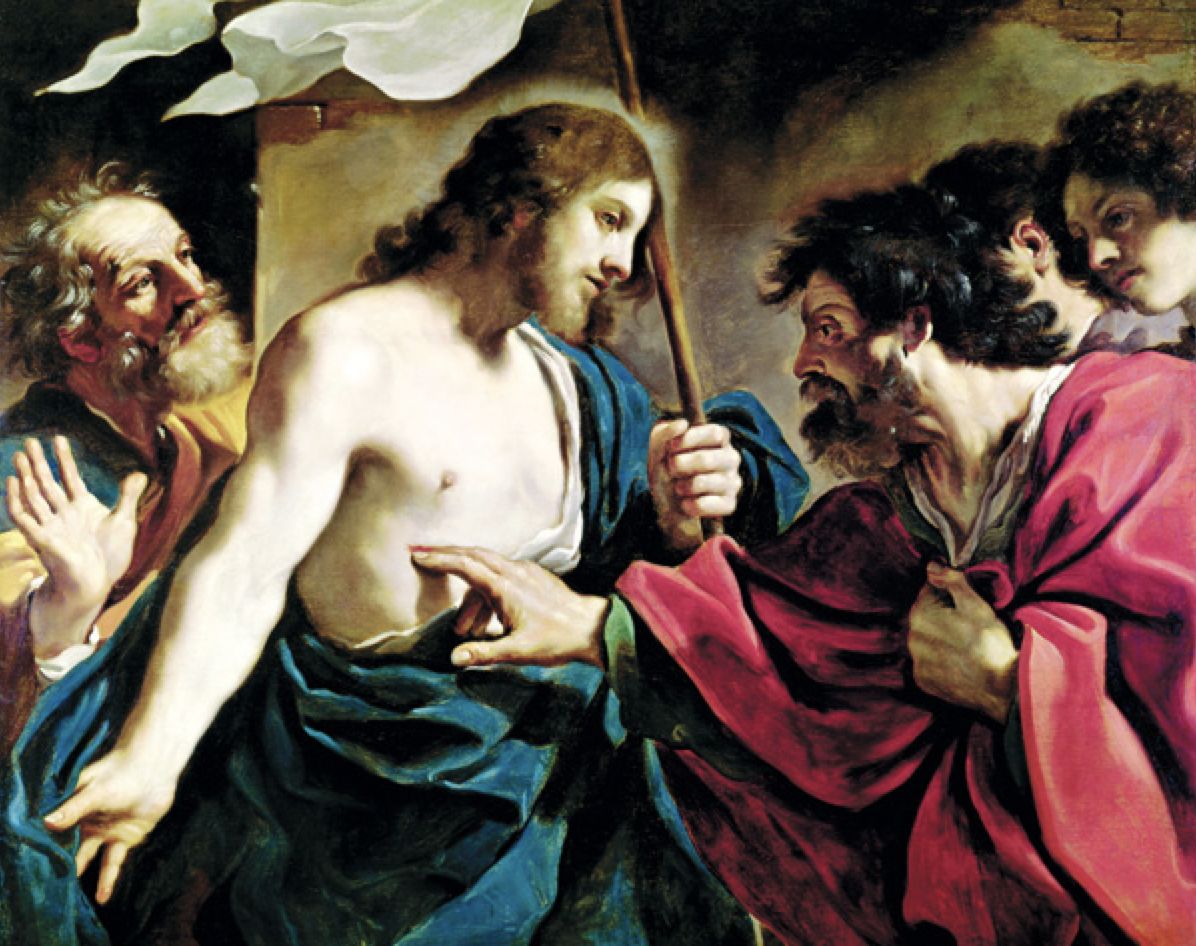
What We Have Touched. The Johannine Letters insist that Jesus Christ came to earth as a flesh-and-blood human being who could be touched with human hands (1 John 1:1; 4:2-3; 2 John 7). This painting illustrates a story from the Gospel of John that made a similar point: the disciple Thomas must touch Jesus with his hands to be convinced Jesus is not a spirit or a ghost (20:27).
Related Concepts
- advocateparaclete
- agony
- anointing
- antichrist
- apostasy
- assurance
- atonement-theory
- authority-in-the-church
- boldness-before-god
- chalcedonian-doctrine
- children-of-god
- commandments
- confession-of-jesus
- confession-of-sins
- death-of-christ
- discernment
- divine-power
- divinity-of-christ
- farewell-discourse
- gift-of-the-holy-spirit
- god-is-light
- holy-spirit
- house-churches
- judgment
- love-and-hatred
- love-of-neighborenemies
- love-of-one-another
- love-perfected
- love-to-the-end
- missionaries
- mortal-sin
- new-birth
- paraclete
- prayer-for-others
- purification
- resurrection-of-lazarus
- secessionists
- spirit-of-error
- spirit-of-truth-and-spirit-of-error
- spiritual-death
- truth
- vine-and-branches
- water-and-blood