New Testament — Topic 33
Both the letter of James and its titular author have had a tough time earning respect in Christian history. There has been little outright hostility; more often, they have faced the ignominy of “faint praise”: the man James is an “acknowledged” pillar of the church, though that does not necessarily mean anything to God (so Paul [Gal. 2:6, 9]); his letter contains many good things, provided one is looking for “straw” rather than gold (so Martin Luther). How would James have responded to such assessments? Perhaps he would have considered it a joy to suffer affronts sure to produce endurance and train him in humility (1:2-4; 4:6; 5:11).
In any case, the letter of James has come to the fore now and then in Christian history, being given pride of place in, for instance, the “Social Gospel” movement of the nineteenth century and among liberation theologians in the twentieth. It may be largely because of James that many theologians now speak not only of orthodoxy (“right thinking” or “correct doctrine”) but also of orthopraxis (“right practice” or “correct behavior”), and specifically of the orthopraxis of the church as a whole in a way that transcends concerns for personal morality. It is also largely due to James that many theologians now speak of “God’s preferential option for the poor” and discuss the accompanying motif of faith being expressed through social (and sometimes, political) action. The letter of James has also been prized by various peace movements for its keen insight into the reasons for conflict, war, and strife (3:18-4:3).
James has come increasingly to be regarded as a book of the church: it depicts the practical life of a community where people pray for each other and confess their sins to one another (5:16), and where people are committed to social ministry on behalf of those in distress (1:27). It is a community where the suffering and the cheerful gather for prayer and praise, a place where diseases are healed, sins are forgiven, and souls are saved from death (5:15, 20; cf. 1:21). The community is composed of people who love the Lord (1:12; 2:5) and who are committed to loving their neighbors (2:8). But they are also sinners (4:8; 5:16; cf. 1:21; 2:9-10; 3:9-10; 4:4, 17; 5:15, 19–20), people who struggle with temptation (1:12-16) and sometimes yield to partiality (2:1-4, 9), pride (3:14; 4:5-6, 13, 16), and worldly cravings (4:1-3). The whole tone of the letter, therefore, assumes readers who are open to correction, who have God’s seed implanted in them (1:21) but who want to draw closer to God and experience spiritual growth and intimacy (4:5, 8). The letter is written for believers who truly do want to be friends with God (cf. 2:23) but need the sort of evangelical exhortation that the book provides if they are to avoid double-mindedness and overcome the temptation to be friends with the world (4:4, 8).
Finally, the lasting appeal of James may be attributed to its unflinching realism. While espousing the highest of ideals, the book manages to keep its feet on the ground: it urges believers to make every effort to “bridle their tongues” (1:26) while recognizing how terribly difficult this is to do (3:7-8). This is a winsome characteristic of wisdom literature, evident also in the Didache (mentioned at the start of this chapter). That book pulls out all the stops to implore Christians to follow the right path in every possible way, and then at one point it simply concludes, “If you can bear the entire yoke of the Lord, you will be perfect; but if you cannot, do as much as you can” (Didache 6:2). Likewise, James insists that temptation must be resisted, and he declares that sin leads to death (1:14-15), but he also acknowledges that “all of us make many mistakes” (3:2). So, Christians will sin, and they need to confess their sins to one another (5:16) and let their leaders pray for them so that their sins may be forgiven (5:15). We all make many mistakes, but the path that leads to life is not traveled alone (cf. 5:19-20).
The first verse of this letter says that it is written by “James, a servant of God and of the Lord Jesus Christ” and directed to “the twelve tribes in the Dispersion.” Accordingly, the letter is traditionally attributed to Jesus’ brother James, who became the leader of the church in Jerusalem. This individual is known to us from the Gospel stories, the book of Acts, and occasional references in Paul’s letters. He is sometimes called “James of Jerusalem” or “James the Just” (a nickname that was widely used for him in early Christianity, at least as early as the second century). The view that James wrote this letter and sent it to Christians who lived outside of Palestine (“in the Dispersion”) is still widely held by many Christians and scholars today, but it was questioned in the early church and has continued to be debated throughout history.
In one of the most famous poems in American literature, “The Road Not Taken,” Robert Frost writes of two roads that “diverged in a yellow wood” and reflects on how his choice of the one less traveled made “all the difference” for his subsequent life. This theme of divergent roads also figured in the teaching of Jesus, where the difference is amplified: the well-trodden path often leads to destruction while the less popular road leads to life (Matt. 7:13-14). An early Christian writing, the Didache (ca. 100–120), seized upon this theme as its controlling motif: there are two paths (one of life, one of death), and people must choose between them. No one can walk in two different directions at once; likewise, believers should not be “of two minds” with regard to which path they want to follow (Didache 2:4; 4:4).
The letter of James is the biblical book most attentive to this theme: it presents Christianity as a way of life (not just a system of beliefs), and it warns Christians against the danger of being “double minded” (1:8; 4:8), of trying to maintain simultaneous friendships with God and with the world (4:4). Though it is unmistakably Christian, the book has a very Jewish feel to it. Jesus is mentioned by name only twice (1:1; 2:1; cf. 5:7-8), and there are no references to the saving effects of his death and resurrection or to the gift and work of God’s Holy Spirit. Instead, there are a lot of “dos and don’ts” (59 imperative verbs in just 108 verses). The book provides a guidebook for following the path to life (1:12) and avoiding the way that leads to death (5:19-20), and in so doing it offers something more: a fundamental consideration of the nature of faith (2:17-18, 26) and the character of true religion (1:27).
The Synoptic Gospels report that Jesus had four brothers—James, Joses, Judas, and Simon—plus an unknown number of sisters, whose names are also unknown (Mark 6:3). Since James is listed first, he is often thought to be the oldest of these brothers, although perhaps he is listed first simply because he was the one who became best known.
The Gospels indicate that the brothers of Jesus did not “believe in him” during the time of his ministry (John 7:5). At one point, they attempt to seize him and take him home for a forced retirement from doing and saying things that are leading people to think he is “beside himself” (Mark 3:21, 31–35). The Gospel of John even presents Jesus on the cross choosing one of his disciples to care for his mother after his death, which seems like an affront to James and his other brothers (John 19:25-27).
After Easter, things changed. Paul mentions in 1 Corinthians that the risen Jesus appeared to James (1 Cor. 15:7). The book of Acts indicates that the brothers of Jesus (all of them?) were part of the early church in Jerusalem (Acts 1:14) and, apparently, were present for the great event on the day of Pentecost (Acts 2:1-4). A short while later, James appears to be the leader of the church in Jerusalem (Acts 12:17; 21:18). He presides over the apostolic council described in Acts 15 and offers a final authoritative ruling that he expects to be disseminated and accepted by Christians everywhere (Acts 15:19-29; 21:25).
James’s importance as a leader in the church is also acknowledged by Paul in Galatians, albeit somewhat grudgingly (Gal. 1:19; 2:6, 9). Paul disagreed sharply with James’s policies regarding the continued relevance of certain markers of Jewish identity within the Christian community (Gal. 2:11-14). Still, he devoted a considerable portion of his ministry to supervising a collection for Christians in Jerusalem, where James was the recognized leader (Rom. 15:25-29; 2 Cor. 8–9).
The Jewish historian Josephus reports that James was murdered in 62 (see Jewish Antiquities 20.199–201). During an interim between on-site Roman rulers (when “Festus was dead and Albinus was still on the way”), the high priest Ananus II seized the opportunity to move against those whom he considered to be “lawbreakers.” He convened the judges of the Sanhedrin and delivered James and certain others to be stoned. Josephus notes that “the inhabitants of the city who were considered to be the most fair-minded and who were strict in their observance of the law were offended at this.” Furthermore, Josephus maintains that the action was judged to be illegal, and Ananus II subsequently was deposed by the new procurator on this account. A later Christian tradition, reported by Clement of Alexandria (third century) reports that James was killed by being thrown off the pinnacle of the temple, but this account is generally regarded as legendary.
Other traditions about James emphasize his traditional Jewish piety and his devotion to the law. Eusebius (fourth century) reports that he received his nickname “the Just” because he lived as a Nazirite, an ascetic who was especially devoted to God. Another oft-repeated tradition (reported by Eusebius) holds that James spent so much time praying in the temple that his knees became as calloused as those of a camel.
The apocryphal Gospel of Thomas (first or second century) contains an overwhelmingly positive affirmation of James. In one curious passage, Jesus’ disciples ask him who their leader will be after he departs; he answers, “You are to go to James the Just, for whose sake heaven and earth came into being” (Gospel of Thomas 12).
We have only a little information about the other brothers of Jesus. Paul refers to them as Christian missionaries, noting specifically that (unlike him) they were married and often accompanied by their wives (1 Cor. 9:5). Judas (= Jude) is the putative author of another New Testament letter.
wisdom literature/tradition: biblical and other ancient materials that focus on commonsense observations about life; examples include the books of Proverbs, Job, and Ecclesiastes.
diatribe: a rhetorical device derived from Greek philosophy in which an author argues with an imaginary opponent, proposing objections and then responding to them.
The letter may, in any case, be linked to three major strands or traditions that seem to have influenced its ideas and literary style.
First, the letter of James has much in common with Jewish wisdom literature. Some examples of this literature are found in the Old Testament (Proverbs, Ecclesiastes, Job), and a strong overlap of themes can be found between James and these writings. Even closer analogies can be found between James and other examples of Jewish wisdom literature, such as the books of Sirach and Wisdom of Solomon, which are part of the Old Testament Apocrypha. Like these wisdom writings, James appeals to what is usually called “common sense”: he attempts to reason with his readers (2:14; 4:13; 5:1), and he uses secular examples and images drawn from the world at large (e.g., 3:3-4, 11). Thus, James maintains that the behavior that he advocates is not only what God demands but also the wisest course of action (3:13).
Second, the letter of James shows many rhetorical and stylistic similarities to Greco-Roman literature, especially those philosophical writings that employed the literary technique called “diatribe.” James engages his readers in direct conversation, addressing them as “you,” with an occasional switch to “we” for the purpose of contrast (3:1) or to describe universal tendencies (3:3, 9). He makes ample use of rhetorical questions (2:14, 21; 3:13; 4:1-5) and, at times, appears to be dialoguing with an imaginary opponent, refuting claims that such a person might make (1:13; 2:18; 4:13)—a common feature of the diatribe style that was adopted by Paul in some of his letters.
Third, the letter of James draws more heavily than any other New Testament letter on sayings of Jesus. There are numerous passages in James that echo words attributed to Jesus in the Synoptic Gospels (particularly sayings contained in the Sermon on the Mount). Scholars who study these parallels generally conclude that James is not quoting directly from the Gospels (the wording is not that precise); rather, he appears to have independent knowledge of many things that Jesus said. It is interesting, however, that the letter never actually tells us that Jesus said these things; instead, the sayings are simply presented as James’s own teaching rather than as “Jesus quotes.” Why would this be? One possibility is that the author has so integrated the ideas of Jesus into his teaching that he naturally draws upon those ideas when offering advice without conscious awareness that he is doing so (cf. Paul’s words in Rom. 12:14, which seem to reflect the teaching of Jesus in Matt. 5:44 without explicitly quoting Jesus).
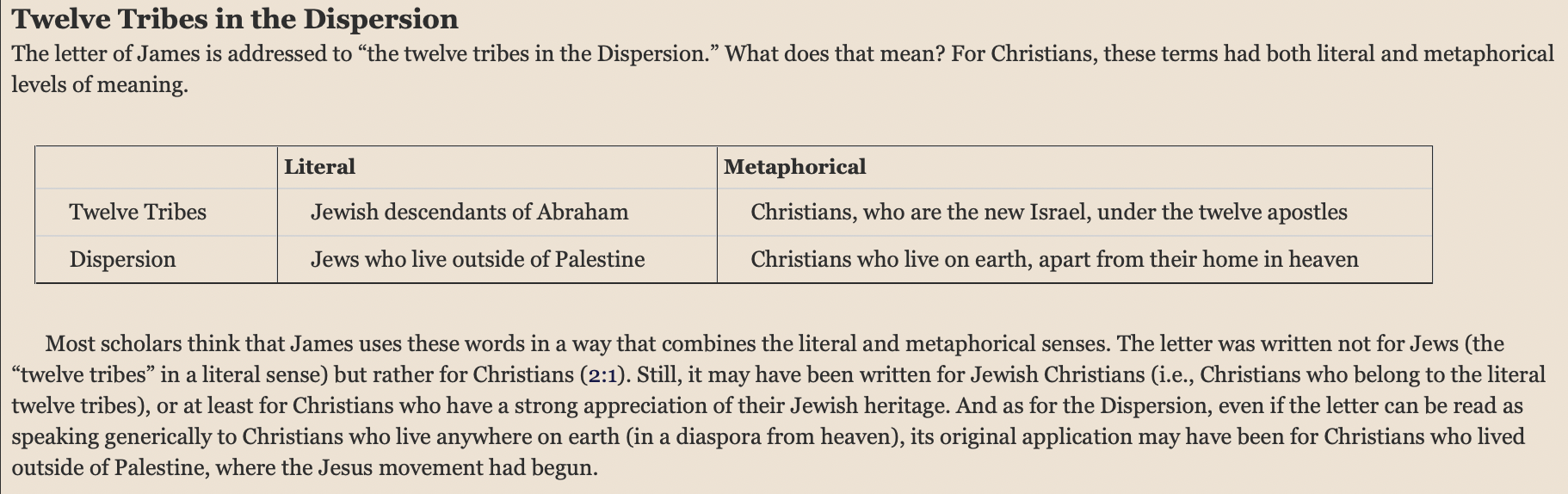
To whom might this letter have been written? James is the first of seven writings in the New Testament that traditionally are called the “Catholic (or General) Epistles” because they are thought to be addressed to the whole church rather than to specific individuals or congregations (see p. 216). Indeed, after the first verse, the “letter” of James does not seem very much like a letter at all. It conveys no personal news and mentions no one by name; it makes no reference to specific situations, past or present; there is no hint of the author’s particular relationship with the readers or basis for addressing them. And then, when we get to the end, we find that there is not even a formal closing or signature (cf. the ending of 1 John). Accordingly, most interpreters regard James as a general treatise or series of short homilies rather than a letter in the traditional sense. This does not mean, however, that it was simply intended for “all people everywhere” (or even for all Christians everywhere). The author has a “target audience” in mind, and he indicates as much by addressing his work to “the twelve tribes in the Dispersion” (1:1). That designation can be interpreted in different ways (see box 24.3), but consideration of the letter’s literary influences discussed above suggests an audience of Christian readers who are appreciative of both Jewish wisdom traditions and Hellenistic rhetoric.
Beyond this, projections concerning the historical circumstances that gave rise to the letter depend on decisions regarding its author. If the letter is attributed to James of Jerusalem, then probably he sent it to Christians who had been scattered due to persecutions in the area (Acts 8:1; 11:19) or to congregations that had been established by missionaries sent out from Jerusalem. As for the date, such a letter could have been written almost anytime prior to 62, when James was killed, but a date in the late 40s to mid-50s might make the most sense, given apparent connections to ideas expressed in some of Paul’s letters that were written during that period. If the letter is not attributed to James of Jerusalem, the circumstances of its composition become impossible to determine. Scholars who regard the letter as pseudepigraphical usually assume that it is written a few decades after James’s death, possibly in the period of 80–100, but they admit that all this is uncertain.
The purpose of the letter is to offer evangelical counsel and pastoral exhortation to believers who might be tempted to compromise their faith through devotion to the world.
The letter of James exhibits these common features of wisdom literature:
James Tries to Reason with His Readers
· He uses expressions such as “Come now, you who say …” (4:13) and “Come now, you rich people …” (5:1).
· His letter is peppered with words such as because and for, which introduce reasons for the points that he is making (1:3-4, 20, 23; 2:10-11, 13, 26; 3:1-2, 16; 4:14), and words such as therefore and so, which introduce conclusions to be derived from what he has said (1:21; 2:17, 23; 4:12, 17; 5:7, 16).
· Sometimes, James asks his readers to consider the benefit or profit of their actions: “what good is it?” (2:14); “what is the good of that?” (2:16) (see also 1:16, 20, 26; 2:20, 26; 4:5).
James Uses Secular Images Drawn from the World at Large
· the billowing sea (1:6)
· the scorching sun (1:11)
· a reflection in a mirror (1:23-24)
· a bit in a horse’s mouth (3:3)
· a ship’s rudder (3:4)
· a forest fire (3:5)
· domestication of animals (3:7)
· a freshwater spring (3:11)
· a fig tree (3:12)
· a grapevine (3:12)
· salt water (3:12)
· a vanishing mist (4:14)
· the rainy seasons for crops (5:7)
In both of these ways, James presents his teaching as “common sense”: he is advocating the wisest course of action, as should be obvious from logical reasoning and observation of nature.
- Introduction
- James and the Wisdom Tradition
- Overview
- Historical Background
- James and Other Brothers of Jesus
- Major Themes in James
- Propositions about God in the Letter of James
- Rich and Poor in James
- Conclusion
Trials and Temptations
The letter of James opens with a declaration that the readers should “consider it nothing but joy” when they face trials of any kind, since the testing of their faith helps them to mature (1:2-4). A few verses later, the letter pronounces a beatitude on any who endure temptation, promising to them the “crown of life” (1:12). These thoughts are related: in the Greek text, the same word (peirasmos) is used for what the NRSV translates as “trials” in 1:2 and “temptation” in 1:12. Thus, James promotes the common idea that the testing of faith is ultimately beneficial to believers, but he develops that concept as applying specifically to the sort of testing that comes from resisting temptation to sin. Most writings that deal with the testing of faith focus on external trials, such as the hardships of life and, especially, the persecutions that come as a result of faith (see Rom. 5:3-4; Heb. 12:3-12; 1 Pet. 1:6-7). James would grant the benefit of those things also (“trials of any kind” [1:2; cf. 5:10-11]), but he seems especially focused on the tests to faith that come from within.
James emphasizes that God is not the source of any temptation to sin (1:13; cf. Sir. 15:11-13). The culprit, rather, is “one’s own desire” (1:14)—the human heart, which is enticed by pleasure (4:1-3) and selfish ambition (3:14, 16). Nevertheless, the person who is tempted to sin should view that temptation as a test: yielding to temptation gives birth to sin, which, when fully grown, gives birth to death (1:15). But those who submit to God (4:7) and purify their hearts (4:8) make the joyful discovery that the devil flees from those who resist him (4:7) and that God draws near to those who draw near to God (4:8). In this way, temptation to sin, though it does not come from God, may become a trial that, like other trials, helps believers toward their goal of being “mature and complete, lacking in nothing” (1:4).
Wisdom from Above
_ _ The wisdom tradition in Jewish literature is often contrasted with the prophetic tradition in that the former deals more with what can be known through reason and observation (what should be apparent to all), whereas the latter presents revealed truth (“Thus says the LORD …”). Such a distinction, however, is somewhat simplistic. The letter of James, which has much in common with the Jewish wisdom tradition, is specifically interested in “wisdom from above” (3:17)—that is, wisdom that must be given by God (1:5). Such wisdom often is compatible with what should be generally apparent (since God is the source of all truth), but it also transcends and even contradicts conventional ways of thinking, which are driven by envy and selfish ambition and should be dismissed as “earthly, unspiritual, and devilish” (3:15).
The content of the wisdom from above is primarily ethical: how people ought to live in relation to God and to each other. Such wisdom favors humility (1:9; 4:10), meekness (1:21), mercy (2:13), gentleness (3:13), peace (3:18), and patience (5:7-8, 10) while decrying envy, selfish ambition, and boasting (3:14-16). It promotes endurance in trials (1:3-4; 5:11) and moral fortitude in the face of temptation (1:12-16). It involves controlling one’s tongue (1:26; 3:5-10) and being quick to listen, slow to speak, and slow to anger (1:19), as opposed to cursing those made in God’s likeness (3:9-10) and grumbling or speaking evil against one another (4:11; 5:9). God wants people to love their neighbors (2:8), to care for orphans and widows (1:27), to clothe the naked and feed the hungry (2:14-15), and to avoid both the lure of wealth (1:9-11) and the tendency to show favoritism to the wealthy (2:1-9). James summarizes the “wisdom from above” in one verse: it is “first pure, then peaceable, gentle, willing to yield, full of mercy and good fruits, without a trace of partiality or hypocrisy” (3:17).
Readers may note that there is nothing here exclusive to Christian teaching; many secular authorities would commend this behavior as well. But James maintains that such a lifestyle requires knowledge of God. For example, people who know that God is generous and just are able to live unselfishly in ways that promote cooperation and peace (3:13-18); people who lack this understanding inevitably buy into the world’s system of competition, acquisitiveness, and lust, which ultimately leads to adultery, murder, and war (4:1-4). Thus, the wisdom from above is a philosophy based on friendship with God, and, conversely, friendship with the world is enmity with God (4:4). The real problem for believers is what James calls “double-mindedness” (1:8; 4:8; cf. Sir. 1:28): people try to retain friendship both with God and with the world, embracing the generosity of God while at the same time striving to fulfill self-interests. Such double-mindedness involves halfhearted commitment and compromise unbecoming of those who are truly wise and understanding (3:13).
The letter opens with a salutation identifying it as correspondence from James to “the twelve tribes in the Dispersion” (1:1). It then offers some quick evangelical counsel or advice on different subjects: trials that test one’s faith (1:2-4); divine guidance (1:5-8); the value of poverty and the ephemeral character of riches (1:9-11); resisting temptation (1:12-16); God’s generosity (1:17-18); anger (1:19-21); acting on God’s word (1:22-25); controlling one’s tongue (1:26); and the marks of pure religion (1:27).
The letter then presents a series of short essays on various topics, some of which have already been mentioned. First, James discusses how attitudes and practices that show partiality to the rich violate the royal command to “love your neighbor as yourself” (2:1-13). Next, he maintains that faith must be revealed or demonstrated in action, for “faith without works is dead” (2:14-26). He issues a warning to those who aspire to be teachers (3:1), which leads to a homily on the power of speech and the need for all people to control what they say (3:2-12). He then reflects upon two types of wisdom—that which is of God and that which is of the world—and calls his readers to repent of being double-minded with regard to these incompatible philosophies (3:13-4:10).
The letter concludes with another series of evangelical counsels on various topics: speaking evil against one’s neighbor (4:11-12); the arrogance of human planning (4:13-16); sins of omission (4:17); condemnation of the wealthy (5:1-6); patience and endurance (5:7-11); swearing oaths (5:12); prayer and healing (5:13-18); and restoration of backslidden sinners (5:19-20).
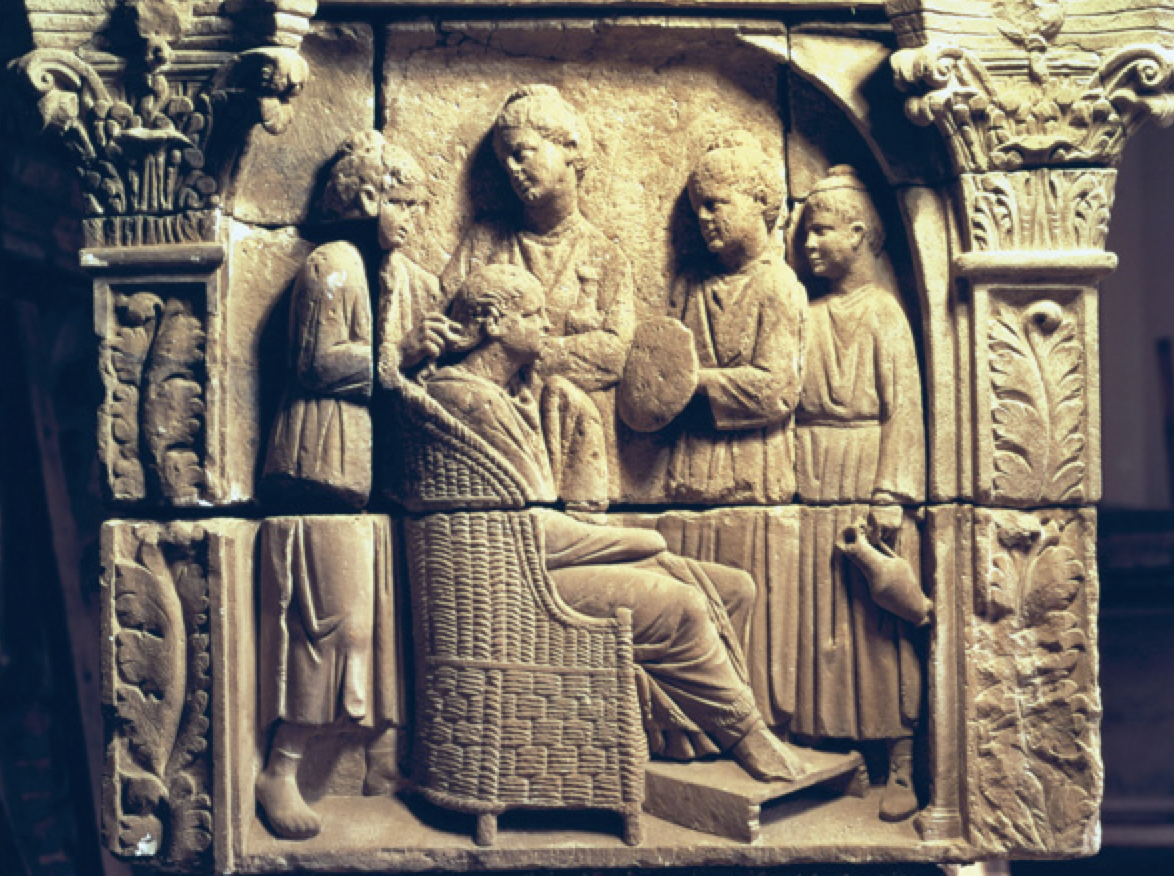
The Mirror Analogy. This relief panel from a second-century grave monument displays a woman fixing her hair with the aid of an ancient mirror (probably a sheet of polished bronze). James says that people who are “hearers of the word and not doers” are like those who look into a mirror and then forget what they were like (1:23-24). The point seems to be that a mirror reveals one’s appearance while one is actually looking into it; likewise, James says, the scripture speaks to some people only while they are actually reading (or hearing) it. Believers should not use the Bible in such a cavalier way but rather should allow its words to shape their life and conduct at all times.
The letter of James is primarily concerned with ethical teaching, but the principles that it espouses do assume a generic theological foundation.
Thus, the letter also offers several propositions about God’s nature and character:
· God gives to all, generously and ungrudgingly (1:5).
· God has promised a crown of life to those who love God (1:12).
· God cannot be tempted by evil, and God tempts no one (1:13).
· God is “the Father of lights, with whom there is no variation or shadow” (1:17).
· God created us by the word of truth (1:18).
· God favors the poor (2:5). God is one (2:19).
· God is the “Lord and Father” and has made humans in the likeness of God (3:9).
· God answers the prayers of the righteous (4:2-3; 5:16-18).
· God yearns jealously for our spiritual devotion (4:5).
· God opposes the proud but gives grace to the humble (4:6, 10).
· God draws near to those who draw near to God (4:8).
· God is both lawgiver and judge, able to save and destroy (4:12).
· God’s will trumps all human plans (4:13-15).
· God hears the cries of the exploited and oppressed (5:4).
· God is compassionate and merciful to the patient (5:11).
· God heals the sick and forgives sins (5:15).
It is often noted that although all of these points are important for Christians, they are not specifically Christian declarations. These things would also be confessed by Jews (and, for that matter, by Deists, Muslims, and adherents of other religions).
As for Jesus Christ, this letter tells us only that he is our “glorious Lord” (2:1; cf. 1:1) and that his coming (as judge) is near (5:7-9).
Faith and Works
__ The most renowned section of the letter of James is the one in which the author addresses anyone who might say, “I have faith but not works” (see 2:14). He responds by insisting that faith without works is dead (2:17, 26) and, indeed, by declaring that “a person is justified by works and not by faith alone” (2:24). This seems to be a direct contradiction to the teaching of Paul that “a person is justified by faith apart from works prescribed by the law” (Rom. 3:28; cf. Gal. 2:16). James even seizes upon a key biblical passage that Paul employed to make his point and interprets it in a way that makes the opposite point. Paul says that Abraham was justified by faith and not by works because he “believed God, and it was reckoned to him as righteousness” (Rom. 4:3; Gal. 3:6; cf. Gen. 15:6). James points out that Abraham did not only believe God; he also acted on that belief by offering his son Isaac. Thus, Abraham was justified not by faith alone but rather by faith “brought to completion” by works (James 2:22; cf. 2:24).
Most theologians agree that there is no real argument here. Paul and James appear to be talking past each other, using words such as justification, works, and faith to mean different things. For instance, James wants to insist on the necessity of “good works” or acts of obedience to God; Paul is concerned with establishing the nonnecessity of “works prescribed by the law,” by which many scholars think that he means circumcision and other ritual requirements that grant Jews a privileged position. More to the point, James seems to think of faith as mere intellectual assent, the act of knowing or believing certain things to be true (see James 2:19). For Paul, faith is a radical orientation toward God that transforms one’s entire being and produces a “new creation” (2 Cor. 5:17). The notion of faith that does not affect one’s actions (or lifestyle) would be literally unthinkable for Paul; he would not dignify such a phenomenon by calling it “faith.” Many things in Paul’s letters indicate that he would agree with the point that James is trying to make. Paul’s concept of “faith working through love” (Gal. 5:6) is not much different from James’s notion of faith “brought to completion” by works (James 2:22). Paul’s insistence that faith without love is nothing (1 Cor. 13:2) is not much different from James’s claim that faith without works is dead (James 2:26). And Paul’s assertion that “it is not the hearers of the law who are righteous in God’s sight, but the doers of the law who are justified” (Rom. 2:13) concurs well with James’s call for believers to be “doers of the word, and not merely hearers” (James 1:22; cf. 1:23, 25; 4:11).
James typically is read as responding not to Paul but rather to a misunderstanding of Paul. It could be that James himself has misunderstood Paul and is trying to counter what he thinks Paul is teaching. Or, since he does not mention Paul by name, it could be that he is responding to others who are using Paul’s ideas or slogans in ways that Paul himself would not have intended. Or, he might be contending against an imaginary opponent, indicating what he would say to some hypothetical person who claimed to have saving faith without works (2:14 [compare Paul’s hypothetical response to an outlandish position in Rom. 6:1-4]). In any case, James’s words should be read on their own terms and not simply evaluated in terms of their compatibility with the words of Paul or other teachers. What James wants to promote is consistency of belief and action or, indeed, of speech (verbal confession) and conduct. Christians are to practice what they preach (cf. Matt. 23:2-3), and they need to think through the implications of their faith commitments for every aspect of their lives in this world. This would be a significant point even if James were simply focused on the relationship of individual faith to personal conduct. In truth, however, he seems to have moved already to another plane, to a consideration of what the faith of the entire community has to say about its social responsibilities in the world at large (cf. Matt. 5:13-14).
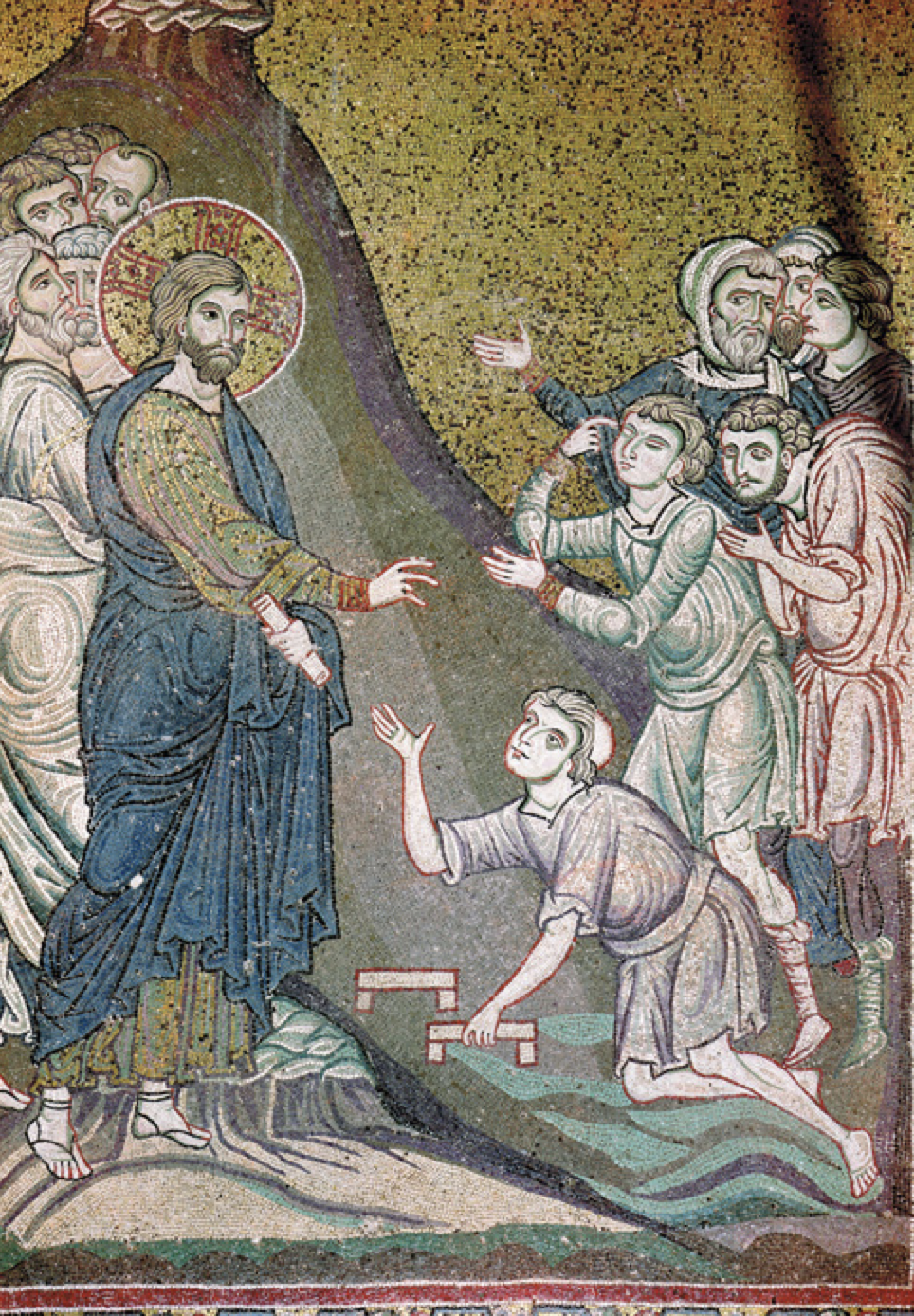
Friend to the Poor. This Byzantine mosaic from the twelfth century portrays Jesus healing the poor, the crippled, and the blind. In the letter of James, helping the poor is a mark of “pure religion” (1:27-2:5).
Rich and Poor
The letter of James evinces the twin themes of “concern for the poor” and “hostility toward the rich.” Indeed, these themes are emphasized more in James than in any other writings of the New Testament except for Luke and Acts, books written by someone who had a high opinion of the man James and of the church that he led in Jerusalem. Like those writings, the letter of James denounces wealthy persons who attain or preserve their position at the expense of others. Rich landholders drag debtors into court and confiscate their property or force them into slavery (2:6). Rich employers exploit their laborers, defrauding them of wages by either not paying them at all or not paying them what is fair (5:4). These fools live in luxury and pleasure without taking into account the terrible judgment of God: no one wants to be the plumpest calf in the stall when the butcher arrives. So, James calls out with ironic delight, “Come now, you rich people, weep and wail for the miseries that are coming … you have fattened your hearts in a day of slaughter” (5:1, 5). In passages such as this, the letter of James has less in common with the Jewish wisdom tradition than with prophetic writings of the Old Testament (cf. Isa. 3:11-15; 5:8-10; 9:18-10:4; Amos 2:6-7; 5:11-12; 6:4-6; 8:5-6; Mic. 2:1-5).
The treatment of this theme, however, goes beyond condemnation of easy targets (a corrupt and uncaring upper class that oppresses the poor without mercy). James also upbraids Christian congregations that show partiality or favoritism to wealthy persons (2:1-4). Some rich people, then, are religious individuals who participate in the Christian assemblies. In this regard, James has a few more things to say:
· Riches do not last, and the rich will not be rich forever (1:9-11; 4:13-14).
· Pure and undefiled religion involves caring for widows and orphans and keeping oneself unstained by the world (1:27).
· God has “chosen the poor in this world to be rich in faith and to be heirs of the kingdom” (2:5).
What, then, should rich Christians do? They should boast in “being made low” (1:10)—that is, take pride in losing their status as “rich people” and in becoming people of humble means and lowly circumstances. Simply put, they should give away their money, use it to care for the needy and to serve God rather than spending it on fine clothing or gold rings (2:2) or hoarding it for an uncertain future. They should also reevaluate their priorities so that their life plans are concerned not with how to make money but instead with how to fulfill the will of God (4:13-15).
The Poor
· the lowly (1:9)
· orphans and widows (1:27)
· persons dressed in dirty clothes or naked (2:2, 15)
· those who lack daily food (2:15)
· day-laborers defrauded of wages (5:4)
· dishonored by those who show partiality (2:3-4, 6, 9)
· will be raised up (1:9)
· focus of concern for pure and undefiled religion (1:27)
· bodily needs will be met by believers whose faith is not dead (2:14-17)
· chosen by God to be rich in faith (2:5)
· heirs of the kingdom promised to those who love God (2:5)
· cries have reached the ears of the Lord of hosts (5:4)
The Rich
· persons with gold rings and fine clothes (2:2)
· receive preferred treatment even in the church (2:3)
· live in luxury and pleasure (5:5)
· plan for a year how to do business and make money (4:13)
· oppress others and drag them into court (2:6)
· blaspheme the name of Christ (2:7)
· defraud workers of fair wages (5:4)
· condemn and murder the righteous, who do not resist (5:6)
· will disappear like a flower in the field (1:10)
· a mist that appears for a while and then vanishes (4:14)
· should boast in being brought low (1:10)
· should weep and wail for the miseries coming to them (5:1)
· riches will rot and clothes will be moth-eaten (5:2)
· gold and silver will rust and eat their flesh like fire (5:3)
· have fattened their hearts in a day of slaughter (5:5)
James’s attitude toward the rich is in keeping with the overall perspective of his letter. First, the rich believers may be understood as a prime example of those who are double-minded: they are trying to be a part of God’s community, but they still cling to the value system of the world. Second, James’s expectation of the rich is simply that they obey the royal commandment to “love your neighbor as yourself,” the law by which they will be judged (2:8, 12; cf. 1:25). What does this commandment mean for people who have more than they need, when others have less? For James, the answer is obvious.
Finally, let’s return briefly to the thought that God “has chosen the poor in the world to be rich in faith and to be heirs of the kingdom” (2:5). James goes beyond calling the rich to repentance and divestment; he declares that God has a preference for the poor, both in this life and the next. This means, at least, that God takes the side of the poor because God is kind and helps those in need, and because God is just and defends those who are oppressed. Beyond this, it also seems to imply that the poor are intrinsically more godly, more likely to have a spirit that responds to God with the love and devotion that God both desires and rewards (4:5; cf. 1:12; 2:5). This could be because the poor are less likely to be “double-minded” (1:8; 4:8), stained by the world (1:27), or distracted by material concerns (4:2-4, 13–15). Or it may simply be that God gives the poor an added measure of faith, blessing them with a generous spiritual gift more precious than any worldly object of desire (cf. 1:17; 4:3).
James.
Related Concepts
- abraham
- anointing-of-the-sick
- bridling-the-tongue
- common-sense
- community
- confession-of-sins
- crown-of-life
- diatribe
- didache
- divine-justice
- doers-of-the-word
- double-mindedness
- endurance
- faith-and-works
- greco-roman-rhetoric
- human-desire
- intellectual-assent
- intimacy-with-god
- james-of-jerusalem
- jewish-christianity
- liberation-theology
- maturity
- meekness
- orthopraxis
- pastoral-accommodation
- peace
- poverty
- restoration-of-sinners
- rhetorical-question
- rich-and-poor
- secular-imagery
- sin-and-death
- single-hearted-devotion
- sirach
- social-gospel
- social-ministry
- spiritual-growth
- the-kingdom-of-god
- the-law
- the-royal-law
- torah-observance
- way-of-death
- way-of-life
- wisdom-of-solomon
- word-of-truth