New Testament — Topic 32
We have noted a few problems that Christian readers have had with Hebrews over the years. The book was slow to be accepted into the canon, in part because it was anonymous. It has not always been appreciated at a popular level because of its intellectual cast and seemingly arcane subject matter. Its threats of condemnation regarding apostasy seem to go too far, denouncing the backslidden in a way that rules out any possibility of their recovery. To these, we might add a couple of more concerns: first, a writing dedicated to establishing the superiority of Christianity over Judaism may not read well in an era that emphasizes interreligious tolerance, cooperation, and dialogue; second, interpreters have detected some tension between the claim in Hebrews that God’s new covenant through Christ has rendered the old covenant with Israel obsolete (8:13) and Paul’s insistence that “the gifts and calling of God are irrevocable” (Rom. 11:29).
Still, we may focus on the positive contributions that Hebrews has offered the Christian church and individual believers. Above all, its theology has helped to define orthodox positions on the identity of Christ and on the meaning of his death and exaltation. Beyond these doctrinal considerations, however, the book has retained a special appeal for Christians who think of themselves as pilgrims dedicated to following Jesus. For many, it becomes a guidebook for a trek that leads them “outside the camp” of social acceptance and respectability (13:13). Ostracized by relatives and neighbors, they find themselves in the midst of a new community composed of historical saints (12:1), incognito angels (13:2), and fellow outcasts (10:24-25). It is a trek marked by struggles and suffering (10:32) but one that is undertaken with joy (10:34; 12:2) and thanksgiving (12:28; 13:15). For those who are convinced that there is “no lasting city” on earth (13:14), no created thing that cannot and will not be shaken (12:26-28), Jesus remains the pioneer whose life, death, and exaltation open a pathway to eternity.
Although this book is traditionally called the “Letter to the Hebrews,” it doesn’t look very much like a letter, at least not until the very end. It closes like a letter, but it doesn’t open like one. The author refers to his work as a “word of exhortation” (13:22), using exactly the same term employed in Acts 13:15 for a sermon. Perhaps that is what Hebrews is: a sermon, preached from afar and sent through the mail to those who needed to hear it. A few scholars have thought that chapters 1–12 make up the original sermon—an elegant treatise structured with alternating patterns of exposition and exhortation—and chapter 13 is a personal note affixed to this sermon when it was sent to the congregation for which it had been composed.
But who were those intended recipients? The letter (let’s call it that) reveals a number of things about its readers:
· They are Christians (3:6; 4:14; 10:23).
· They are either Jewish Christians or at least Christians with a strong interest in sacrificial practices and other matters of Jewish faith.
· They heard the message of salvation from people who heard it from Jesus (2:3); thus, they are second-generation Christians, but not third- or fourth-generation Christians.
· They have witnessed signs and wonders and various miracles and have received diverse gifts of the Holy Spirit (2:4).
· They are sufficiently educated and astute to understand arguments that employ both Hellenistic rhetoric and allusive reasoning based on the Jewish scripture.
· They have gone through a hard time that required them to endure abuse, persecution, and suffering (10:32-33).
· Some of them had property that was plundered (10:34), but thus far the abuse has not involved bloodshed (12:4).
· They have been exemplary in good works (6:10), such as showing compassion to those who suffer (10:34).
· They nevertheless have now become “dull in understanding” (5:11) and potentially “sluggish” (6:12; cf. 12:12).
· They seem to be in danger of apostasy, renouncing their faith or drifting away from the truth (2:1-3; 3:12-14; 4:1; 10:35-36); some are already neglecting to meet with the community (10:25).
- Overview
- Why Don’t the Quotations Match?
- Historical Background
- The Basics of Faith
- Major Themes in Hebrews
- The Divine and Human Christ in Hebrews
- Conclusion
Christianity and Judaism
As Christianity developed, different conceptions emerged regarding how this new faith should be understood relative to its parent, Judaism. At one extreme, some Christians appear to have insisted that Christianity was part of Judaism. One could not be a Christian without being a Jew. Gentiles who became Christians should get circumcised (become Jews) and observe all of the traditional Jewish rituals and regulations. Paul likely was dealing with people who thought this way when he wrote his letter to the Galatians (see p. 311). The opposite extreme, however, held that Judaism was a false religion. The Jewish God was evil and the Jewish scriptures were to be rejected. This view was favored by the second-century Christian Marcion and was also prominent among gnostics (see pp. 39–40). The book of Hebrews steers a course between these approaches, stressing the continuity of Christianity with Judaism while also emphasizing the supremacy of Christianity over Judaism.
The continuity of Christian and Jewish religion is evident in that the God who has now spoken through the Son is the same God who spoke through the Jewish prophets (1:1-2). The Jewish scriptures are quoted authoritatively throughout Hebrews as reliable expressions of God’s will and plan (see, e.g., 1:5-12; 4:3, 7; 7:21; 8:8-12). Thus, Hebrews affirms that Christians and Jews worship the same God and read the same Bible. Hebrews also insists, however, that Christianity is superior to Judaism in two highly significant ways. First, Jesus Christ is superior to all other figures from Israel’s illustrious history, including Moses (3:1-6), Joshua (4:1-11), Aaron (4:14-5:10), and Levi (7:1-22). He is more glorious than angels (1:4-11; 2:5-18), and he brings a revelation superior to that of prophets (1:1-3). Second, the salvation that Jesus brings is superior to that which Israel attained through the old covenant (8:1-13). He offers a superior sacrifice (10:1-18) in a superior tabernacle (9:1-28) and can be said to save people “completely” (7:25). In making this case, the author of Hebrews draws upon two different traditions of thought. In terms informed by an almost rabbinic understanding of the Jewish scriptures, he claims that Christ provides the fulfillment of the new covenant that historic Judaism has promised (8:7-13). In terms informed by Hellenistic Judaism or Greek philosophy, he claims that Christ offers the true, eternal salvation for which Judaism provides a lesser, earthly representation (8:5-6; 9:23; 10:1).
The letter (or sermon) opens with an eloquent prologue that presents God’s Son as the definitive revelation of God (1:1-3). The author proposes that the Son is superior to angels (1:4-14) and then issues a plea for the readers not to drift away from the truth that they have received (2:1-4). Returning to the theme of the Son’s superiority, the author explains that the temporary humiliation of Jesus was necessary for human salvation and led to his glorious exaltation (2:5-18). He argues that Jesus is also superior to Moses (3:1-6), which leads to a warning not to rebel and fail to enter into God’s rest as did some of those who were delivered from Egypt under Moses (3:7-19). The readers should make every effort to enter God’s Sabbath rest (4:1-11). This exhortation is punctuated by a reminder of the piercing power of God’s word to reveal secret intentions of the heart (4:12-13).
The author then launches into a long exposition on the role of Jesus as high priest (4:14-10:39). First, the author shows that Jesus possesses two qualifications for being such a priest (4:14-5:10): he is able to sympathize with humans, and he has been appointed by God to be a priest after the order of Melchizedek. This gives way to another excursus: the author rebukes the readers for their spiritual immaturity, urges them to press on toward perfection, and expresses confidence that they will persevere (5:11-6:20).
Returning to the main theme, the author expounds upon what is meant by identifying Jesus as a priest according to the order of Melchizedek (7:1-28). He then spells out the implications of what he has been saying: the earthly sanctuary where priests offer sacrifices is only a sketch or shadow of the heavenly one, and the old covenant has been made obsolete by the new and better covenant in Jesus (8:1-13). These points are elaborated through a treatise on the many ways in which the sacrifice of Christ is superior to the sacrifices of the Levitical priests (9:1-10:18).
Hebrews 6:1-2 lists six matters as “basic teaching” that mature Christians should have down pat. It is a little embarrassing that we lack clarity regarding things that are supposed to be so obvious that no instruction is necessary, but sometimes that is the case.
· Repentance from dead works. Believers should reject “dead works,” but what are those? The reference may be to sinful behaviors that lead to death; or, it could be to ritual practices of the Jewish religion that Christ has rendered obsolete. See also Hebrews 9:14.
· Faith toward God. Believers should trust radically in God and in God’s promises (cf. Heb. 11:1-12:2).
· Baptisms. Why is this in the plural? Perhaps it refers to various purification rites practiced by Jews (cf. Heb. 9:10). Did the readers of this letter practice those rituals? Or did they have some variant understanding of Christian baptism as an action practiced more than once or for diverse functions (cf. 1 Cor. 15:29, a verse that also refers to some primitive baptismal practice about which we have no knowledge).
· Laying on of hands. This refers to a rite through which human touch accompanies or imparts divine authorization or empowerment (cf. 2 Tim. 1:6), but it could be practiced for a variety of reasons: conveying the gift of the Holy Spirit to believers (Acts 8:17; 19:6); commissioning leaders (Acts 6:6; 1 Tim. 5:22); healing the sick (Acts 9:12; 28:8).
· Resurrection of the dead. All persons will be raised to new life when Christ returns.
· Eternal judgment. God will judge all people, granting them salvation or condemnation (cf. Heb. 9:27; 10:26-27; 13:4).
Taking all of these points together, many scholars have surmised that the crisis that this letter wants to address is a specific temptation for some Christians to embrace what the author regards as outmoded aspects of the Jewish religion or even a return to that religion in a way that compromises their Christian confession. Most scholars today think that Hebrews was written for a mixed audience of Jewish and Gentile Christians, either in Jerusalem or (and this is the dominant theory) in Rome. The specific situation eludes us, but the author of Hebrews seems to view the Jewish religion (or aspects thereof) as a primary competitor for the hearts, minds, and souls of the letter’s intended audience. This could account for two motifs that are emphasized repeatedly: the superiority of Christ and the dire consequences of apostasy. Those two themes seem interwoven throughout the letter. Perhaps that is because the author feared that the readers might prove susceptible to one specific form of apostasy, adopting Judaism in a way that failed to reckon with or appreciate the unqualified supremacy of Christ.
The King James Version of the Bible titles this work “The Epistle of Paul the Apostle to the Hebrews,” but the attribution to Paul was a guess, and probably not a very good one. The letter itself is anonymous, and its distinctive style and theology set it apart from Paul’s writings. The letter to the Hebrews actually had some trouble in gaining acceptance as part of the Christian canon because of its anonymity. It eventually came to be regarded as scripture on the strength of intrinsic factors (sound theology, eloquent presentation), but the question “Who wrote the letter to the Hebrews?” has continued to draw the interest of interpreters throughout the ages, like some great unsolved detective story. There are clues, but they are inconclusive. And there are suspects—the history of interpretation has provided a long list of impressive possible authors—but the case still remains open. At present, most scholars would agree with the verdict reached more than seventeen hundred years ago by Origen, a prominent teacher of the early church. After investigating the matter, he concluded, “Who wrote this epistle? Only God knows!” (reported in Eusebius, Ecclesiastical History 6.25.13).
We probably can assume, however, that the author of Hebrews was a person of prominence in the early church. He knew people who had known Jesus (2:3) and was well educated with regard to both Greek rhetoric and the Jewish scriptures. The author also knows the readers personally and assumes a mandate to speak to them authoritatively, even though he does not appear to have been the founder of their community. Indeed, the author is planning to visit the readers soon (13:19, 23), which may indicate that he exercises a supervisory role for the congregation beyond that of its local leaders (13:7, 17, 24).
Since the author and the readers apparently belong to a second generation of believers (2:3), and since they have been believers for a while (5:12; 10:32), the letter is usually thought to have been written at least as late as 50 (or, more often, as late as 60). It probably had to have been written before 90, since Clement of Rome knows it and cites it in a letter that was written probably around 96 (1 Clement 36:1-5; cf. Heb. 1:3-5, 7, 13). Efforts to determine a more precise date usually focus on the question of whether Hebrews was written before or after 70, when the temple in Jerusalem was destroyed. Since the letter never mentions the temple (using instead the ancient tabernacle for all its sacrificial imagery), some scholars reason that the temple was no longer a viable institution, that it had been destroyed. But others maintain that if the temple had been destroyed, the author surely would have mentioned this to clinch his argument that the Jewish sacrificial system was now obsolete (8:13). Readers sometimes note that the letter refers to sacrifices in the present tense, as though they are still being offered (7:8; 8:3; 9:6-7, 9, 13; 13:11), but this is not as conclusive as it may at first seem, since the Greek language sometimes uses the present tense for describing historical acts. Both Josephus (Jewish Antiquities 4.102–150, 151–187) and Clement of Rome (1 Clement 41) talk about sacrifices in the present tense in writings produced after the temple destruction (and in any case, Hebrews is actually referring to sacrifices offered in the ancient tabernacle). Still, many scholars do find the reasoning of Hebrews 10:2 to be highly suggestive of a pre-70 date: the argument seems to turn on an insistence that the offering of sacrifices (identical or similar to those offered in the tabernacle) was still taking place at the time when this letter was being written.
The bottom line is that we know less about the historical circumstances for this letter (if indeed it is a letter) than for almost any other New Testament book. It was written by an unknown, eloquent, and probably prominent Christian to a group of Jewish and/or Gentile Christians in some city (unknown to us, but possibly Rome) between 50 and 90 (possibly, but not certainly, before 70). The purpose of the composition, however, is fairly clear: it proclaims the superiority of Christ as the divine Son of God, and the superiority of faith in Christ over all other confessions, especially Jewish religion. It does so, negatively, to forestall apostasy (i.e., to persuade Christians not to abandon their faith) and, positively, to encourage perseverance appropriate to receiving the favor and benefits of God bestowed on those who are faithful. Such perseverance is justified in light of what the earthly Son has done to bring believers into God’s favor, and it is sustained through the intercessions that the exalted Son continues to offer on their behalf.
The Divine Christ
the one through whom worlds were created (1:2)
the mirror image (reflection) of God’s glory (1:3)
the exact imprint of God’s very being (1:3)
the one who sustains all things (1:3)
seated at the right hand of God in glory (1:3)
superior to angels (1:4)
and worshiped by them (1:6)
without sin (4:15)
and able to sanctify others (2:11)
will return to save those who wait eagerly for him (9:28; 10:37)
The Human Christ
a person of flesh and blood, like all children of God (2:14; cf. 2:11)
became like us in every respect (2:17)
was tested by what he suffered (2:18)
is able to sympathize (or empathize) with our weaknesses (4:15)
has been tested (or tempted) in every respect as we are (4:15)
offered prayers to God with loud cries and tears and reverent submission (5:7)
learned obedience through suffering (5:8; cf. 2:10)
an example of perseverance that others can follow (12:1-3)
Christology
__ The letter to the Hebrews says, “Jesus Christ is the same yesterday and today and forever” (13:8). This letter’s portrait of who Jesus Christ is and its sketch of what Jesus Christ means for humanity are broad and nearly comprehensive: much of what is affirmed about Christ in other books of the New Testament is found here, but that information is supplemented by distinctive elements and particular nuances that have been influential on Christian faith and theology.
Hebrews speaks of Christ’s preexistence (1:2; 10:5), incarnation (2:14-18; 10:5-7), sacrificial death (1:3; 2:9; 7:27), resurrection (1:3), heavenly intercession (7:23-25; cf. 2:18; 8:1-2), and return for judgment (9:27-28; 10:25). The first two items on this list (preexistence and incarnation) express the idea that the person now known as Jesus Christ existed as a divine being (the Son of God) prior to becoming a human being (see also John 1:1-2, 14; Phil. 2:5-7). The fifth element on the list (heavenly intercession) refers to the notion that Jesus Christ is currently in heaven, where he prays for his followers in ways that support and sustain them on earth (see also Rom. 8:34; 1 John 2:1).
Hebrews testifies to what would become standard Christian dogma regarding “the two natures of Christ”: Jesus Christ is to be confessed as both fully divine and fully human. Jesus is actually equated with God in Hebrews 1:8 (cf. John 20:28; Titus 2:13), and he is said to represent the “exact imprint of God’s very being” (1:3; cf. Col. 1:15; 2:9). He is presented as the agent through whom God created the worlds and sustains all things (cf. John 1:3; 1 Cor. 8:6; Col. 1:16-17). Some scholars have wondered whether this presentation of Christ might be influenced by Jewish writings that personified Wisdom as the agent of God. The Wisdom of Solomon (part of the Old Testament Apocrypha) says that Wisdom is “a reflection of eternal light, a spotless mirror of the working of God, and an image of his goodness” (Wis. 7:25-26; cf. Heb. 1:3). Elsewhere, Wisdom is identified as an active agent in creation (Prov. 8:22-23; Wis. 7:22; 9:9) and in the ongoing preservation of the created realm (Wis. 7:27; 8:1). Thus, Hebrews might be understood as applying to the Son what some Jewish writings were attributing to Wisdom.
But Hebrews also presents Jesus as fully and profoundly human—a person who, like other human beings (2:11, 17–18), had to be made perfect or complete through obedience to God (2:10; 5:8). Such obedience, furthermore, was something that he had to learn (5:8). The notion of Jesus needing to learn things (to grow in knowledge or wisdom) is rare in the Bible (cf. Luke 2:52), and the idea of Jesus needing to learn obedience (to grow in faithfulness to God) is unique to Hebrews. The book makes clear that Jesus did not sin (4:15) but nevertheless alleges that a prolonged process of testing (4:15) and suffering (5:7-9) brought Jesus to progressive levels of faithfulness that marked growth in obedience and, eventually, perfection.
The humanity of Christ is theologically significant in this book because
· being human allows Christ to suffer and die and thus to offer an ultimate sacrifice for sin and destroy the power of death (2:14-15; 7:27);
· being human enables Christ to identify with human beings in every respect so that he is able to sympathize mercifully with the weak and wayward (2:17; 4:15; cf. 5:1-2);
· being human allows Christ to become a credible example for others who suffer testing and must persevere as he did (12:1-3).
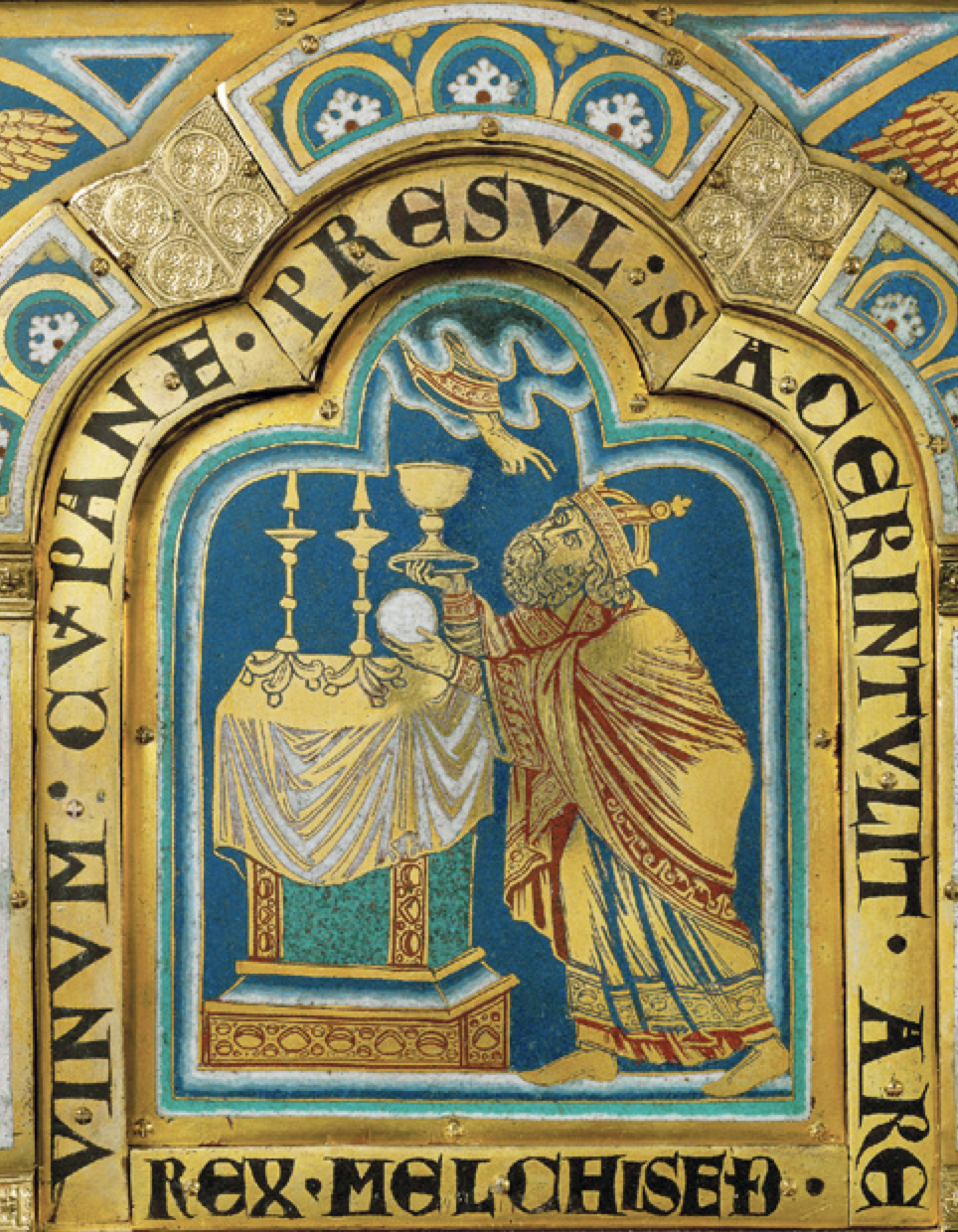
Melchizedek. This depiction of Melchizedek, the priest who appears to Abraham (Gen. 14:18-20), is from the Verdun Altar in northeast France, constructed in 1181.
Jesus as High Priest
__ One of the most striking aspects of Hebrews is its prominent identification of Jesus as high priest (2:17; 3:1; 4:14; 5:5, 10; 6:20; 7:26; 8:1; 9:11; 10:21). At first, such an identification may seem surprising because the historical Jesus certainly was not a priest and, indeed, seems to have been critical of temple practices and at odds with the Jerusalem priesthood (Mark 11:15-18). The author gets around this by an appeal to the obscure Old Testament figure of Melchizedek (Gen. 14:18-20; Ps. 110:4). In the Bible, Melchizedek is identified as a priest centuries before the hereditary order of the Levitical priesthood was established; thus, for the author of Hebrews, Jesus can be a nonhereditary priest “according to the order of Melchizedek” (5:6, 10; 6:20; 7:17; cf. Ps. 110:4). Since Melchizedek came first chronologically, he should be deemed greater than the later Levitical priests; furthermore, Abraham paid tithes to Melchizedek, which effectively means that all of Abraham’s descendants (including Levi and all of the Levitical priests) paid homage to Melchizedek as well (7:9-10). The fact that neither the genealogy nor the death of Melchizedek is reported in the Bible indicates that the superior priesthood that he represents is an eternal one, having neither beginning nor end (7:3); what better candidate could there be for such a priesthood than the preexistent and ever-living Jesus?
The image of Jesus as a “priest” is almost absent elsewhere in the New Testament; the closest we get to a parallel is John 17:19, where Jesus sanctifies himself so that others might also be sanctified (see also John 10:36). The more common motif pictures Jesus not as a priest but rather as a sacrificial animal (John 1:29, 36; Rom. 3:25; 1 John 2:2). Curiously, Hebrews does not substitute one image for the other but instead doubles up on them, providing us with one of the most outstanding mixed metaphors of all time: Jesus is both the priest and the sacrifice; he offers his own sinless blood, which is obviously a much greater sacrifice than the blood of sheep or goats (9:12-14; 10:4-10; 13:12). He does so, furthermore, in the superior heavenly sanctuary rather than in an earthly tabernacle (8:1-2; 9:24). So, we have a better priest offering a better sacrifice in a better sanctuary. The result is that the priestly ministry of Jesus offers a once-for-all purification from sin; it never needs to be repeated (9:25-26), and since the need for subsequent sacrifices has been eradicated, the entire sacrificial system is rendered obsolete. The ministry of Jesus as high priest continues, however, as he offers heavenly intercession for his followers, supporting them before God with prayer and supplication (7:25).
Rest
Some Favorite Terms in Hebrews
Eternal
eternal salvation (5:9)
eternal judgment (6:2)
eternal redemption (9:12)
eternal Spirit (9:14)
eternal inheritance (9:15)
eternal covenant (13:20)
Heavenly
heavenly calling (3:1)
heavenly gift (6:4)
heavenly sanctuary (8:5)
heavenly things (9:23)
heavenly country (11:16)
heavenly Jerusalem (12:22)
The book of Hebrews uses the concept of “divine rest” as an image for salvation (4:1-11). First it speaks of the “rest” that God promised to Israel in the biblical stories of Moses and Joshua—the rest that Israel was to experience after the exodus and conquest of Canaan. Subsequent history has made clear that this rest was not received. Quoting Psalm 95:7-11, the author of Hebrews says that the reason was that the Israelites did not listen to God’s voice: they were unbelieving (3:12, 19), rebellious (3:16), disobedient (4:6, 11), and hard of heart (3:13, 15; 4:7). The importance of hearing God’s voice today is exponentially greater because the rest that remains for God’s people is not simply that of Canaan: it is the Sabbath rest of God (4:9-11; cf. Gen. 2:2).
Pilgrim People
The book of Hebrews employs a pilgrimage motif to present Christians as people on a journey. One possible reason that the author uses the tabernacle rather than the temple for his descriptions of Israelite sacrifices is that it better serves this theme. The tabernacle (described in Exod. 25–27) was a portable worship space, a tent with curtains and screens that could be hung over a wooden framework. The Israelites carried this with them, along with the ark of the covenant, which was placed behind a curtain to symbolize God’s presence with the people (cf. Heb. 6:19; 9:3; 10:20), and an altar on which sacrifices could be offered (cf. Heb. 7:13; 9:4; 13:10). But, according to Hebrews, the journey of God’s people to the promised land of Canaan was only a temporal and earthly representation of the greater spiritual journey of God’s people toward an eternal city in a heavenly country (11:16).
People who believe in Christ are on this ultimate journey, and the author of Hebrews offers a litany of examples for his readers to consider when troubles beset them and the notion of turning back crosses their minds:
· The first example, somewhat ironically, is their own history. They have endured hard struggles in previous times and proven that they are not people who shrink back and are lost; rather, they are people who persevere and are saved (10:32-39).
· The second example is the witness to faith provided by heroes of the Bible who have borne all manner of suffering and shame in mere anticipation of what is now at last becoming a reality (11:1-12:1).
· The third and greatest example is Jesus, for whom the joy of exaltation to God’s presence proved sufficient to endure hostility without growing weary or losing heart (12:2-3). As one tested in every way as we are (4:15), Jesus established himself as a “pioneer” who can guide those on the journey that he completed (2:10; 12:2).
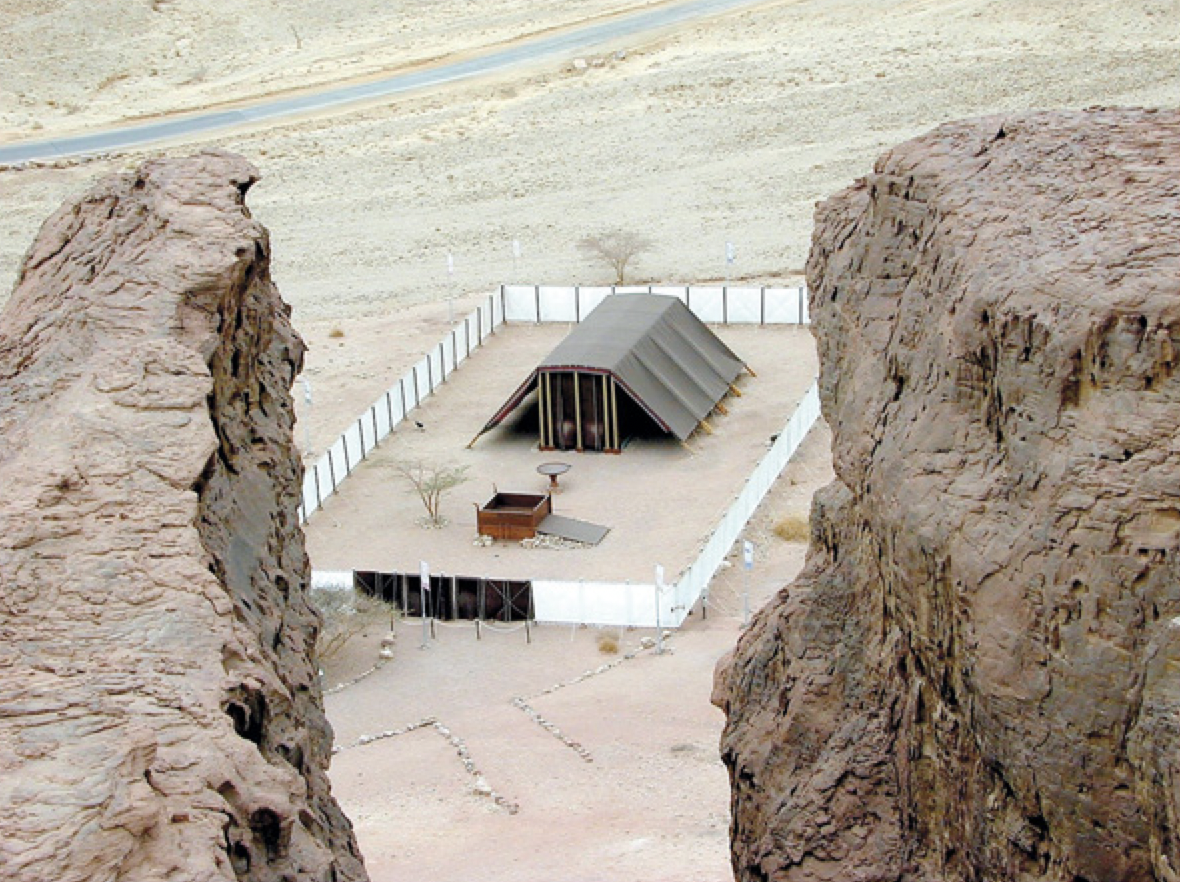
The Tabernacle. The tabernacle, a portable sanctuary, served as the primary place for worship and sacrifices during Israel’s wilderness period (see Exod. 25–30; 35–40). According to the book of Hebrews, the earthly tabernacle has a heavenly counterpart (8:2, 5; 9:22).
Suffering and Shame
The Christian pilgrimage depicted in Hebrews is marked by a paradoxically positive evaluation of suffering and shame. First, Hebrews suggests that suffering may be a form of discipline (12:4-13). God may sometimes punish people through suffering, but God also teaches or trains people through suffering. The experience of trials may serve to strengthen commitment and to advance disciples who are following Jesus in a trek toward perfect obedience (2:10; 5:7-9; cf. Rom. 5:3-4; James 1:2-3; 1 Pet. 1:6-7; 4:12-16). Thus, the book of Hebrews can encourage its readers to consider any loss of status or social reputation that they have experienced because of their faith as an ironic badge of honor. Since God disciplines those whom God favors (12:5-6), such trials may be viewed as an indication of God’s approval.
Stern Warnings in Hebrews
The book of Hebrews is also noted for the intensity of its warnings against apostasy, which seem to go beyond what is usually said in scripture or confessed by the church. Three passages stand out:
· Hebrews 6:4-6 says that it is impossible for those who have been enlightened (come to faith in Christ) and then fallen away to be restored to repentance.
· Hebrews 10:26-31 makes clear that those who willfully persist in sin after receiving knowledge of the truth in Christ will discover that no sacrifice for those sins remains, and indeed they will suffer a worse punishment of hellfire than those who sinned without such knowledge.
· Hebrews 12:16-17 confirms the teaching that apostates cannot be restored to faith, offering an analogy to Esau, who repented of giving away his birthright and then sought to recover the blessing only to find that his repentance was rejected and his tears were shed in vain.
The Christian church has struggled with these texts almost since the time they were written. Some scholars speculate that they might have arisen as a reflection on the tradition of an “unforgivable sin” referenced in the Synoptic stories of Jesus (Matt. 12:31-32; Luke 12:10). Still, the assertion that those who fall away from the faith cannot be forgiven or restored seems to conflict with biblical teaching elsewhere (Matt. 18:12-14, 15, 21–22; Luke 15; John 6:39-40; 10:27-29; Gal. 6:1; James 5:19-20; 1 Pet. 1:4-5; 2 Pet. 3:9; 1 John 2:1), as well as with the Gospel tradition that the apostles themselves had been apostates, recovered after deserting and denying Jesus (e.g., Mark 14:50, 66–72; 16:7; cf. Luke 22:31-34). It also runs counter to numerous doctrines held by various Christian churches and denominations (justification by grace, election, eternal security).
Many interpreters take these passages as instances of prophetic hyperbole, a rhetorical ploy according to which God’s spokesperson insists that divine patience has come to an end even though, inevitably, God turns out to be more merciful than anyone had a right to expect (something like this also seems to inform Paul’s seemingly absolute but inevitably revocable rejections of Israel in Acts 13:46-47; 18:6; 28:25-28). In any case, this much is clear: the readers of Hebrews are expected to recognize that “it is a fearful thing to fall into the hands of the living God” (10:31; cf. 12:29); they are to consider what Jesus Christ has done for them and ask, “How can we escape if we neglect so great a salvation?” (2:3).
Astute Bible readers sometimes note that Old Testament passages quoted in the letter to the Hebrews do not quite match what is actually said in the Old Testament itself. For example:
Psalm 8:5: “lower than God”
Hebrews 2:7: “lower than the angels”
The letter to the Hebrews regularly quotes from the Septuagint, a Greek translation of the Old Testament. Almost all modern Bibles contain translations of the Old Testament that were done from the Hebrew, not from the Septuagint (so as not to produce a translation of a translation).
The Hebrew word in Psalm 8:5 is elohim, which usually means “God,” though it might sometimes mean “angels.” Almost all Bible translators have thought that the psalmist intended the word to mean “God,” and almost all English Bibles translate Psalm 8:5 as “lower than God.” The Septuagint, however, translates elohim as “angels” in this one verse, and the author of Hebrews relied on that somewhat idiosyncratic translation in making his point.
Something similar happens a number of other times in the letter. For example, in Psalm 40:6 we read “you have given me an open ear” in modern translations of the Old Testament, but Hebrews 10:5 follows a Septuagint reading in quoting the text as “a body you have prepared for me.”
The author concludes his theological homily on Christ’s high priesthood by exhorting readers to respond appropriately (10:19-39). He then offers a roll call of biblical heroes whose lives have testified to faith as “the assurance of things hoped for” (11:1-40). They constitute a great cloud of witnesses, to which Jesus may be added as the ultimate example of one who proved faithful in suffering and prepared the way for others to follow (12:1-3). The author urges readers to endure their trials and reflects briefly on the positive role that suffering can play when viewed as discipline from a loving God (12:4-11). These exhortations to faithfulness give way to a contrast between the covenants of Mount Sinai and Mount Zion: the readers are receiving a kingdom that cannot be shaken, but those who fail to obtain the grace of God offered through this new covenant will not escape God’s judgment (12:12-29).
The letter begins to draw to a close with numerous admonitions (13:1-17): the readers ought to follow the example of former leaders; they need to avoid getting caught up in strange doctrines; they should be willing to suffer ostracism for their faith; they are to worship God with praise and good works; and they should submit to their current leaders. The book closes in the typical style of a letter, with prayer requests, benedictions, and personal greetings (13:18-25).
Hebrews.
Related Concepts
- 1-john-21
- abraham
- acts-1315
- acts-238
- agony
- apostasy-warnings
- authorship
- better-sanctuary
- catechesis
- chalcedonian-doctrine
- clement-of-rome
- cloud-of-witnesses
- confession-of-jesus
- divine-discipline
- divine-mercy
- divine-power
- divinity-of-christ
- eternal-priesthood
- exaltation
- example
- faith
- farewell-discourse
- genesis-14
- genre
- hebrews-914
- high-priesthood
- jeremiah-31-background
- laying-on-of-hands
- love-to-the-end
- marcion
- mark-114-15
- melchizedek
- no-lasting-city
- obedience
- origen
- outside-the-camp
- perseverance
- pilgrimage
- pioneer
- platonichellenistic-judaism
- priest-and-sacrifice
- psalm-1104
- psalm-406
- psalm-85
- rest
- resurrection-of-lazarus
- revelation
- romans-834
- sacrifice-of-christ
- sermon
- superior-salvation
- supersessionism
- textual-criticism