New Testament — Topic 31
Whatever limitations may have attended Paul’s approach to slavery as a systemic social institution, he does go out of his way to assist one particular slave. He values Onesimus (vv. 11-12) and regards him as an equal (vv. 16-17). And his appeal on behalf of Onesimus is perhaps all the more poignant when we recall that he is making that appeal as a prisoner: it is because of Christ that Paul has lost his own freedom, and it is for Christ’s sake that he now seeks the freedom of another. We cannot know for certain whether Philemon did as Paul requested, but, as many scholars have pointed out, it seems unlikely that any copies of this letter would have been preserved if it had not proven effective and met with a favorable response.
A possible postscript to the story surfaces some fifty years later via the writings of the church leader Ignatius of Antioch. Ignatius reveals that the bishop of the church of Ephesus at that
Paul is in prison (vv. 1, 9, 23), and several of his co-workers are with him (vv. 1, 23). He is writing to a friend named “Philemon.” This letter does not say where Philemon lives, but since two members of his household (Archippus [v. 2] and Onesimus [vv. 10-16]) are also mentioned by Paul in Colossians 4:9, 17, we probably can conclude that he lives in or near Colossae. Philemon apparently is a wealthy and influential man, since he owns slaves (vv. 15-16) and is able to host gatherings of the church in his home (v. 2). Paul knows Philemon well enough to call him a “dear friend and co-worker” (v. 1), but they are not exactly equals. The relationship is one of apostle to disciple: Paul apparently was responsible, directly or indirectly, for Philemon’s conversion to Christianity, and for this reason Philemon owes Paul his very “self” (v. 19). Paul assumes that he has authority over Philemon in matters of faith and duty (v. 8).
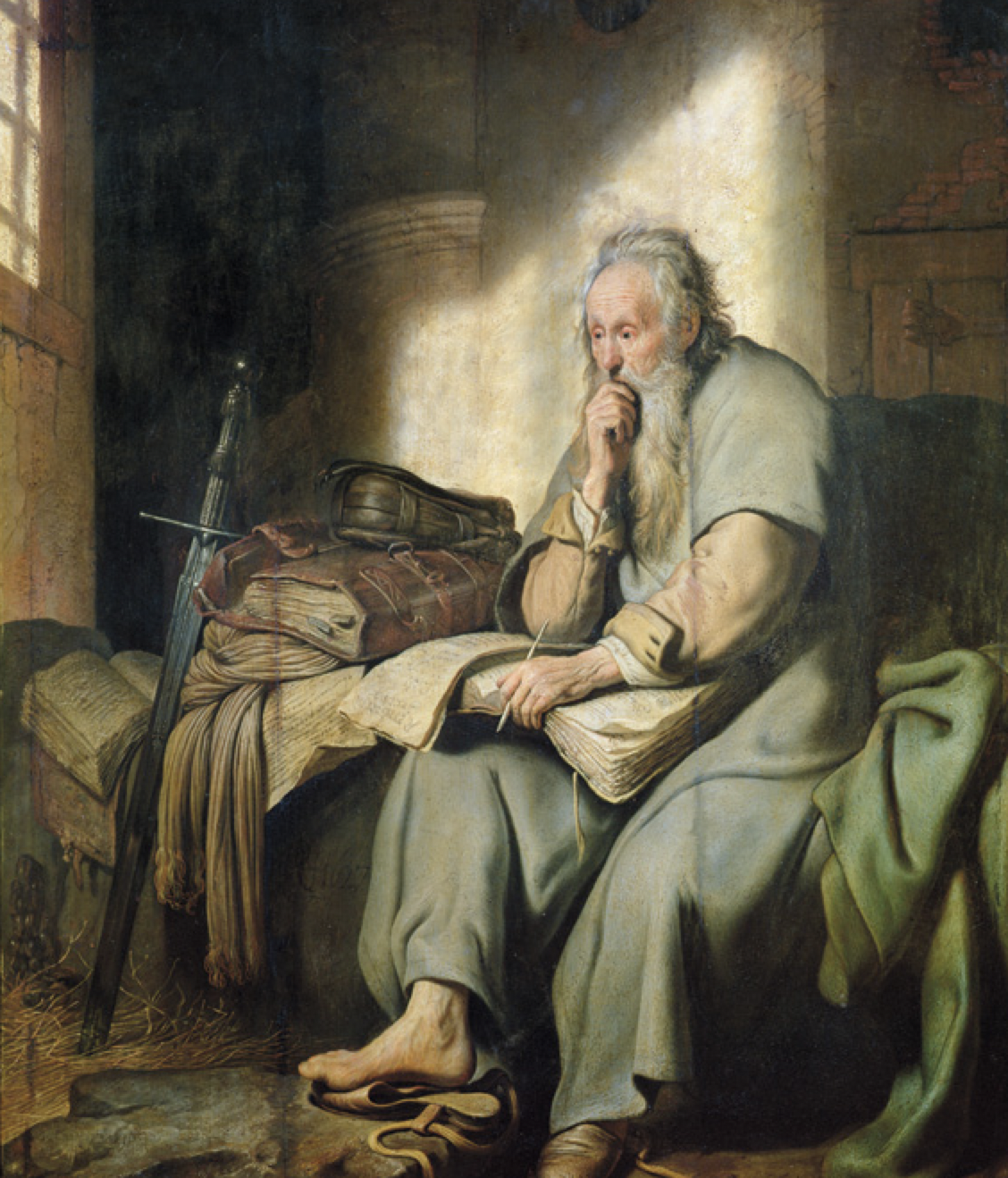
Paul in Prison. The sword in his cell is meant to symbolize his impending martyrdom.
But now a problematic situation has arisen: one of Philemon’s slaves, Onesimus, is with Paul, and Paul has come to value him personally and professionally. Paul says that Onesimus is like a son to him (“my own heart” he calls him [v. 12]) and affirms that Onesimus is useful to him and could continue to be of service to him, especially during his time of imprisonment (vv. 10-13). Onesimus is also a Christian, probably as a result of Paul’s ministry (cf. v. 10 with 1 Cor. 4:14-15). Indeed, the language of Paul’s letter suggests that Onesimus has only recently come to Christ: his status has changed from “useless” to “useful” (v. 11) and from being only a slave to being “a beloved brother” (v. 16). But there is a wrinkle in all this: Philemon apparently believes that Onesimus has wronged him in some way, most likely in a way that caused him financial loss (v. 18). Thus, Paul writes to make an appeal on behalf of Onesimus (v. 9) and to urge Philemon to welcome his slave back in a manner befitting the gospel. He is to receive Onesimus as he would receive Paul himself (v. 17). Paul even offers to stand good for whatever debt Philemon has incurred on account of Onesimus, putting a guarantee to that effect in his own handwriting (v. 19). It is possible that Paul had the financial resources to do this (cf. Phil. 4:12), but he probably wants Philemon to count the loss as a partial repayment of the inestimable debt that Philemon owes Paul for his salvation.
You owe me one.” “One hand washes the other.” “I’ll scratch your back if you scratch mine.” Such quotations from modern life express a basic notion of reciprocity—the idea that people can (and probably should) do things for each other in ways that are mutually beneficial.
This idea was even more pronounced in the Roman world than it is in ours. In that society, friendship was defined more often with reference to an exchange of favors than with regard to compatible personality types. People could be close friends in what we might regard as a professional sense even if they had never met. Social relationships were construed in terms of patronage, and people were remarkably adept at keeping track of who owed favors to whom.
Paul’s letter to Philemon is the shortest of all his letters (335 words in Greek), and it is the only undisputed letter of Paul addressed primarily to an individual rather than to a congregation. It is a personal letter between friends, and yet clearly it is written from a perspective that understands friendship in terms of reciprocity. Philemon owes Paul a favor, and Paul writes to request a favor from him. But there is a twist: the favor that Paul seeks is not for himself; rather, it’s for a slave, a person at the bottom of the social ladder who had no right to ask anyone for anything. Paul uses Philemon’s obligation to him to make an appeal on behalf of someone to whom Philemon owes nothing, indeed on behalf of someone who appears to have incurred Philemon’s wrath.
- Introduction
- Overview
- Historical Background
- Slavery in the Roman World
- Sanctuary for a Runaway Servant
- Major Themes in Philemon
- Conclusion
Powers of Persuasion
Paul employs a number of persuasive tactics in this brief letter to ensure that Philemon will comply. For one thing, he brackets his personal message for Philemon with salutations and greetings for the entire church, indicating that the letter is to be read to the community (vv. 2, 25). Thus, there will be public knowledge of the request that Paul is making, and the whole congregation will know whether Philemon responds as Paul hopes. Then, Paul plays on Philemon’s reputation for generosity (vv. 4-7) and reminds Philemon that he is indebted to Paul for his very salvation (v. 19). He even plays the “sympathy card” by reminding Philemon three times that he is in prison (vv. 1, 9, 23) and by indicating that the favor he asks would be a nice thing to do for an “old man” (v. 9). In short, Paul manages in a few sentences to place Philemon in a position in which it would be rather awkward for him to deny this request of his “dear friend” (v. 1), especially one who is planning to come and visit him soon (v. 22). We don’t know whether Paul resorted to what we might consider to be manipulative tactics because he suspected that Philemon needed this sort of pressure, or because the situation was particularly delicate, or simply because this was how requests were made in that culture.
Paul’s Attitude toward Slavery
Paul’s letter to Philemon affords scholars an opportunity to investigate further the attitude of Paul toward slavery. In Galatians 3:28, Paul says that “there is no longer slave or free … for all of you are one in Christ Jesus” (see p. 320). But does this mean that Christians should reject the institution altogether, refuse to own slaves, and work for the emancipation of slaves? In 1 Corinthians 7:21-24, Paul seems to regard the status of slavery as simply irrelevant: since all are equal in the eyes of God, it doesn’t matter what state one occupies in this life. A number of other letters present Paul as insisting that slaves be obedient and loyal to their masters (Eph. 6:5-8; Col. 3:22-25; 1 Tim. 6:1-2; Titus 2:9-10), but not all scholars believe that Paul authored those letters.
Against this background, there is debate about what Paul wants Philemon to do. Obviously, he wants Philemon to be magnanimous in welcoming Onesimus back, despite any loss or injury that Philemon might have suffered (v. 17). But beyond that, what is the favor (v. 20) that Paul wants Philemon to do for him? A few scholars have thought that Paul wants Philemon to present Onesimus to Paul as a gift, so that Onesimus would now become Paul’s slave and serve him in his imprisonment (v. 13). More often, however, the suggestion is that Paul wants Philemon to set Onesimus free so that he can return to Paul and serve willingly among Paul’s company in a manner similar to Paul’s other companions and disciples. Paul does not say this outright, but many interpreters think that this is what he means when he expresses confidence that Philemon will do “more than” what has been officially requested of him. Further, Paul’s insistence that Philemon now regard Onesimus as “a beloved brother … both in the flesh and in the Lord” (v. 16) implies that Philemon is to regard the slave as his equal.
In any case, many modern interpreters have expressed disappointment that Paul was not more forthright in denouncing the social institution of human slavery. Paul believed the distinction between Jew and Gentile to be spiritually irrelevant (Gal. 3:28), and he acted on this belief by insisting on the abolition of practices that perpetrated such a distinction (Gal. 2:11-14). Why didn’t he draw similar conclusions with regard to slavery? He might at least have forbidden Christians from participating in the institution. He might have told Philemon in unequivocal terms that it was wrong to keep a human being as a slave and that, to please Christ, he needed to set Onesimus free.
Rather than focus on what Paul does not do, many interpreters want to emphasize the positive steps against slavery that are offered in this letter. Paul insists that Philemon is not to regard Onesimus as mere property but rather is to “welcome him as you would welcome me” (v. 17). Thus, it is often said that Paul lays the groundwork for the abolition of slavery or implies that such abolition would be a good thing. Nevertheless, many Bible-believing Christians throughout history did end up condoning slavery as a viable social institution, with full confidence that the Bible did not prohibit the ownership of slaves. The letter to Philemon often was studied and quoted in debates over slavery, and abolitionists always had to contend with the fact that in this letter Paul does return a slave to his master without prohibiting the continuance of slavery.
Most scholars today think that Paul did not approve of slavery and that his appeal to Philemon on behalf of Onesimus was merely couched in language appropriate for addressing a prominent and powerful individual with regard to a “touchy subject.” Still, if Paul had been less subtle in stating his views on the matter, the history of Western Christianity (particularly in the United States) might have been very different.
After a brief salutation and blessing (vv. 1-3), Paul offers a prayer of thanksgiving for Philemon’s faith and for how he has refreshed “the hearts of the saints” (vv. 4-7). Then he turns to the matter at hand: an appeal on behalf of Philemon’s slave Onesimus (vv. 8-21). Paul says that Onesimus has become like a son to him during his imprisonment (v. 10), but that he is now sending Onesimus back (v. 12). He does so reluctantly and hints that Philemon might allow Onesimus to return to him (vv. 13-14). In any case, Paul wants Onesimus to receive a favorable reception, and he offers to repay any debt that Philemon has incurred because of him, though Philemon also owes a great debt to Paul—his “own self” (vv. 15-19). Paul expresses confidence in Philemon’s obedience (v. 21) and asks him to have a guest room prepared for when he comes to visit (v. 22). He closes the letter with a series of greetings from his companions (vv. 23-24).
A letter from Pliny the Younger written in the late first century offers an appeal to a certain Sabinianus on behalf of a runaway servant. It makes for an interesting comparison to Paul’s letter to Philemon, written on behalf of Onesimus:
· To Sabinianus. Your freedman, whom you lately mentioned as having displeased you, has been with me; he threw himself at my feet and clung there with as much submission as he could have done at yours. He earnestly requested me with many tears, and even with the eloquence of silent sorrow, to intercede for him; in short, he convinced me by his whole behavior, that he sincerely repents of his fault. And I am persuaded he is thoroughly reformed, because he seems entirely sensible of his delinquency. I know you are angry with him, and I know too, it is not without reason; but clemency can never exert itself with more applause, than when the cause for resentment is most just. You once had an affection for this man, and, I hope, will have again: in the meanwhile, let me only prevail with you to pardon him. If he should incur your displeasure hereafter, you will have so much the stronger plea in excuse for your anger, as you show yourself more exorable to him now. Allow something to his youth, to his tears, and to your own natural mildness of temper: do not make him uneasy any longer, and I will add too, do not make yourself so; for a man of your benevolence of heart cannot be angry without feeling great uneasiness. I am afraid, were I to join my entreaties with his, I should seem rather to compel, than request you to forgive him. Yet I will not scruple to do it; and so much the more fully and freely as I have very sharply and severely reproved him, positively threatening never to interpose again in his behalf. But though it was proper to say this to him, in order to make him more fearful of offending, I do not say it to you. I may, perhaps, again have occasion to entreat you upon his account, and again obtain your forgiveness; supposing, I mean, his errors should be such as may become me to intercede for, and you to pardon. Farewell.
Some information from the Roman world may help us to understand why Paul would write such a letter. First, Roman law required that fugitive slaves be returned to their masters, so if Onesimus actually was “on the run” from Philemon, Paul would have been obligated by law to send him back. More to the point, however, Roman jurisprudence allowed a slave who was on the outs with his or her master to seek arbitration with a colleague or friend of that master; in such instances, the slave was not considered to be a fugitive and could be granted sanctuary under the mediator’s care until the difficulty was resolved. Something of this nature seems to provide a reasonable context for understanding Paul’s letter to Philemon: Onesimus has sought out his master’s friend for assistance in resolving a dispute. He is willing to return home to Philemon, but he wants to do so with a letter from Paul encouraging his possibly angry master to be more favorably disposed toward him than he might have been otherwise.
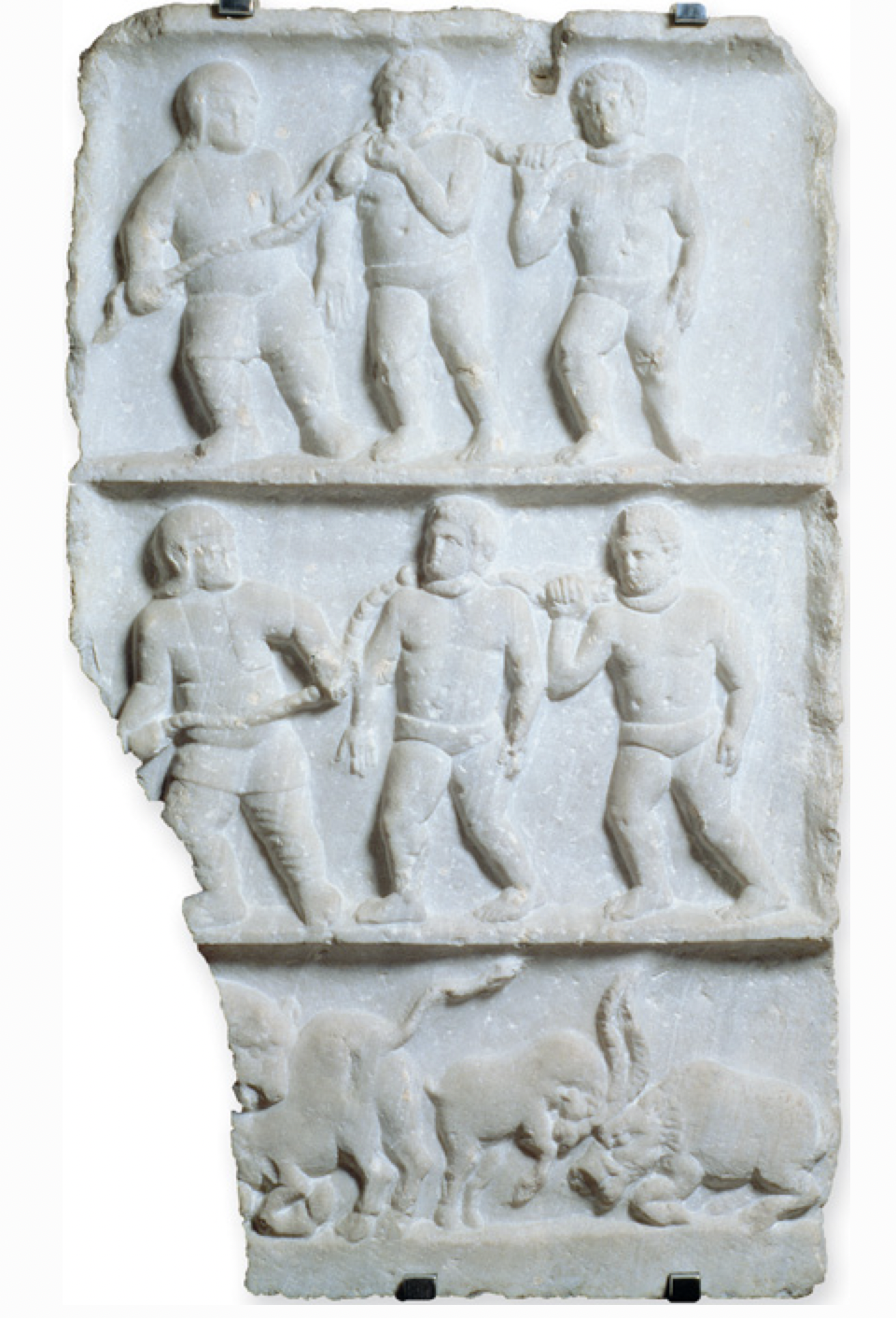
Men in Chains. This Roman stela portrays men who became slaves because they were taken as prisoners in a war. But people could become slaves for many reasons, defaulting on debt being the most common one. Between one-fourth and one-third of the people in the Roman Empire were slaves.
Paul provides Onesimus with such a letter but seems to take things a step or two further. He asks Philemon for a favor: “Let me have this benefit from you in the Lord” (v. 20). What exactly does he want? The strong hint is that he would like for Philemon, as a voluntary good deed (v. 14), to send Onesimus back to Paul to be of service to him (v. 13). While in prison, Paul probably needed to rely on people on the outside to tend to his needs (bring him food, changes of clothing, etc.). Still, he seems to have had a number of persons with him who could do those things (v. 24), and he expects to be released soon (v. 22). Thus, he must be thinking long term: Onesimus can join his team and aid him in his missionary work of spreading the gospel. It may be (see below) that Paul is also suggesting that Philemon grant Onesimus his freedom.
Paul probably is writing to Philemon from Ephesus around 54–55, or from Caesarea around 58–60, or from Rome around 60–61. Scholars debate which of these options is best, but none of them can be ruled out with certainty, and such precision is not needed to understand the letter’s essential points and message.
The institution of slavery was deeply ingrained in Roman society. Roman conquests often led to the enslavement of resident populations, and slave hunters captured victims in provinces not yet overtaken by Rome (cf. 1 Tim. 1:10; Rev. 18:13). Individuals could be sentenced to slavery as punishment for various offenses, and entire families were sold into slavery when someone defaulted on a debt. Since children born to slaves were automatically slaves themselves, the passage of generations guaranteed growth of a large slave population. By the time of Paul, between one-fourth and one-third of all people in the empire were slaves.
The life and condition of slaves seems to have varied enormously. Social decorum encouraged humane treatment, and the extreme abuse or killing of slaves was prohibited by law. Still, the welfare of slaves generally depended on the disposition of their masters. In some cases—notably, for slaves who worked in mines or rowed the oars of galley ships—the conditions of life were appalling. In other instances, however, slaves were given an education and provided with a lifestyle that they probably would not have been able to attain on their own. Indeed, many persons willingly sold themselves into slavery in exchange for being taught a trade or obtaining employment that would improve their lot in life.
Slavery was not always permanent. In some cases, slaves were paid a wage and allowed to purchase their freedom after a period of time; in other cases, slaves were automatically freed when they reached the age of thirty. Nevertheless, slaves had few legal rights. They could be beaten at the discretion of their master, they could not legally marry, and any children they produced were the property of their master (cf. Matt. 18:25, 34; 24:48-51; 25:30). They had virtually no autonomy—no ability to make decisions regarding their own lives or destinies—and in a world that valued honor above all else, they occupied the bottom tier of the social pyramid. A slave was a person with no honor—a person who literally lived in disgrace.
There has been much speculation with regard to the details of the Onesimus situation. Almost all scholars assume that Onesimus has run away from his master. Some think that he also robbed him (to finance the escape?) and that this is the financial loss to which Paul refers (v. 18). Or, perhaps, Onesimus mismanaged some business interest for Philemon in a manner that caused a loss, and that is what prompted him to run away. In either case, he could be in big trouble, for runaway slaves often were punished severely or even executed by their masters as an example to other slaves. Another possibility (since the text does not actually say that Onesimus ran away) is that Onesimus was simply out of town representing Philemon on some business matter and, because the deal went bad, was afraid to return home. Still, whether he fled or merely tarried, his time away from home has been noticed and can only have compounded the problem. Paul tries to put a positive spin on this part of the situation by pointing out that the time when Onesimus was absent from his master did eventuate in his conversion. In Paul’s mind, there is sometimes a “reason” that things happen the way they do (v. 15), a hidden divine purpose that lies behind the mundane or apparently random events of this life (cf. Rom. 8:28).
Philemon.
Related Concepts
- abolitionism
- adoption-as-sonship
- atonement-imagery
- baptismal-identity
- beloved-brother
- biblical-interpretation-and-slavery-debates
- church-order
- conversion-of-onesimus
- debt-of-grace
- equality-of-believers
- friendship
- galatians-328
- gratitude
- hospitality
- kingdom-of-god
- mediation
- pastoral-prudence
- persuasive-rhetoric
- public-reading
- regeneration
- rhetoric
- roman-law
- romans-828
- slavery
- social-ethics
- social-obligation
- worry