New Testament — Topic 30
The Pastoral Letters: 1 Timothy, 2 Timothy, Titus.
The Pastoral Letters have fallen on hard times in the modern church and in modern society. At the very least, these letters might not read well in a climate that tries to resist polemic and stereotyping. In 1 Timothy there is reference to superstitious legends as “old wives’ tales” (4:7). The letter to Titus indicates that Jews (“those of the circumcision”) are especially given to being “rebellious people, idle talkers, and deceivers” (1:10), and it agrees with a pagan perception that natives of Crete are “always liars, vicious brutes, lazy gluttons” (1:12-13 [the original quotation has been traced to a certain Epimenides of Cnossus of the sixth century BCE]). Such language is no longer “politically correct”; it is considered rude and inappropriate in our modern culture. Likewise, the penchant in these letters for ad hominem attacks on ideological opponents (1 Tim. 4:1-2; 6:3-5; 2 Tim. 3:2-9; Titus 1:10-16; 3:10-11) may strike modern readers as petty or mean. Even the household directions in these letters base their instructions on specific (and not very complimentary) assumptions regarding age and gender (1 Tim. 2:8-15; 5:1-16; 6:1-2; Titus 2:2-10). They move away from the ideal of “mutual submission” found in other letters attributed to Paul (Eph. 5:21), instead giving advice that is one-sided: wives are to submit to their husbands (Titus 2:5; cf. 1 Tim. 2:11), but nothing is said about the husbands’ responsibilities for their wives (cf. Eph. 5:25-33; Col. 3:19); slaves are to submit completely to their masters (1 Tim. 6:1-2; Titus 2:9-10), but nothing is said about the masters’ attitude or behavior toward their slaves (cf. Eph. 6:9; Col. 4:1).
At a deeper level, the Pastoral Letters as a whole (especially 1 Timothy and Titus) often are viewed as domesticating Paul in a way that takes the edge off radical, countercultural Christianity. They are said to advance “the institutional church,” emphasizing ecclesiological order and structure; some Protestants have complained that they are a stark example of “early Catholicism.” Such assessments, of course, have not altered the universal affirmation of Christian communities that the Pastoral Letters are inspired and authoritative scripture. Within churches of all denominations, preachers, teachers, and everyday believers continue to engage the letters as scripture, including those passages that they find awkward or challenging.
The Pastoral Letters are probably best understood as compositions written under duress: they engage two severe threats to the evolving Christian religion. One of these threats, violent persecution, is simply embraced as an inevitable consequence of adopting a faith that is at odds with the ways of the world. The second threat, however, is more insidious because it comes from within: the threat of “heresy,” representations of faith that claim to be authentic but, if accepted, would redefine the substance of what the developing religion claims to be true. St. Paul responses to heresy involved the triad of “clergy, creeds, and canon,”:
· Clergy: the church developed a more controlled administrative structure, with recognized leaders who could determine and declare what sort of teaching was acceptable (cf. 1 Tim. 3:1-2; 5:17; 2 Tim. 2:2; Titus 1:9).
· Creeds: the church identified summary statements of accepted belief and doctrine (cf. 1 Tim. 2:5-6; 3:16; 2 Tim. 2:11-13; Titus 2:11-14).
· Canon: the church designated certain writings as authoritative and appealed to these as a hedge against ideas that could be declared “unscriptural” (cf. 1 Tim. 4:13; 2 Tim. 3:16).
Interestingly, the book of Revelation praises the church in Ephesus (to which 1 Timothy appears to be directed) for having rejected false teachers (Rev. 2:2); a second-century writing to that same church from Ignatius of Antioch (ca. 110) likewise affirms that the Ephesian Christians remained steadfast in faith, avoiding the attraction of unorthodox ideas (Ignatius, To the Ephesians 8:1).
Timothy and Titus, to whom these letters are addressed, are known to us from other references in the New Testament. Both were among Paul’s inner circle of assistants, persons he is known to have entrusted with significant roles in shaping and leading the early church.
Timothy is the better known of the two, and three things stand out with regard to what we learn of him elsewhere. First, Paul seems to have sent Timothy on frequent missions, including ones that involved dealing with difficult situations (1 Cor. 4:17; 16:10; Phil. 2:19, 23; 1 Thess. 3:2, 6). Second, Timothy is listed as the co-author of many of Paul’s letters: 2 Corinthians, Philippians, Colossians, 1 Thessalonians, 2 Thessalonians, and Philemon (see also Rom. 16:21). Third, Paul pays tribute to Timothy with words that identify him as a specially valued colleague (1 Cor. 16:10; Phil. 2:19-23; 1 Thess. 3:2): he says that Timothy is “like a son” to him (Phil. 2:22; 1 Cor. 4:17) and insists, “I have no one like him” (Phil. 2:20).
Titus: A Biographical Sketch
Titus was a Gentile Christian, possibly from Antioch, who was brought to Jerusalem by Paul and Barnabas as a sort of test case for the church in deciding whether Gentile converts to Christianity needed to be circumcised (Gal. 2:1-3). The extent of his involvement with Paul’s subsequent missionary work is unknown, but Paul did come to regard him as a “partner and co-worker” (2 Cor. 8:23), and he appears to have been with Paul during portions of what is called the third missionary journey. In the mid-50s, Paul sent him from Ephesus to Corinth, carrying a painful letter that Paul had written to that church. He was successful in mediating a reconciliation between Paul and the congregation, and he brought Paul news of this in Macedonia (see 2 Cor. 2:4, 13; 7:6-8, 13–15). Later, Titus returned to the Corinthian church as one of the agents responsible for administering the offering that Paul was collecting for Jerusalem (2 Cor. 8:6, 16–18, 23; 9:5; cf. 12:18). We know nothing else for certain, though there are references in the Pastoral Letters to Titus conducting ministry in Dalmatia (2 Tim. 4:10) and in Crete (Titus 1:4-5).
Titus is never mentioned in the book of Acts, but his name does come up in Paul’s letter to the Galatians and second letter to the Corinthians. Titus was one of the first Gentiles to be attracted to the Christian faith, and he became one of Paul’s principal examples for how a Gentile could be put right with God through faith in Christ without first becoming Jewish (Gal. 2:1-3; cf. Rom. 3:28-29; Gal. 2:16; 3:11). Like Timothy (who was a Jewish Christian), Titus became one of Paul’s emissaries, visiting churches as his representative and serving as something of a troubleshooter in dealing with difficult situations (2 Cor. 7:6-8, 13–15).
The letters addressed to these individuals presume particular situations in the life of Paul, but those situations do not quite fit with what we know of Paul’s career from his other letters and from the book of Acts.
· The letter to Titus presumes that Paul and Titus had been ministering together in Crete but that Paul has left, entrusting Titus to continue the work (1:5); Paul is now writing to Titus from some unspecified location (possibly Ephesus), and he plans to spend the winter in Nicopolis, where he hopes that Titus will be able to join him (3:12).
· The first letter to Timothy presumes that Paul and Timothy had been ministering together in Ephesus but that Paul has now left there for Macedonia; he is writing back to Timothy, who is now in charge of the Ephesian church (1:3).
· The second letter to Timothy presumes that Paul is in prison in Rome (1:16-17; 2:9; 4:16), where he expects to be executed (4:6); he wants Timothy (whose whereabouts are unspecified) to come to him (4:9, 13).
Scholars working out a Pauline biography have long noted that these scenarios do not quite fit with their reconstructions of Paul’s career. For example, there is no indication anywhere else in the New Testament that Paul sought to evangelize the island of Crete (cf. Titus 1:5) or that he left Timothy in charge of the church in Ephesus while engaged in a mission in Macedonia (cf. 1 Tim. 1:3). Likewise, some of the information on Paul’s judicial hearing in Rome provided in 2 Timothy (4:16-17) is not attested elsewhere, and many scholars think that Timothy actually was with Paul in Rome from the start of his imprisonment there.
Scholars generally follow one of two proposals for dealing with the biographical anomalies.
Scenario One: Gaps in the Record Theory According to this proposal, we are simply missing key information about Paul’s life and ministry. Neither the outline of travels in the book of Acts nor the occasional references to trips and locations mentioned in Paul’s letters allows us to develop a comprehensive account of his missionary work. Thus, the presumed situations for the Pastoral Letters described above should simply be taken at face value, as evidence of otherwise undocumented moments in Paul’s career. According to this theory, 1 Timothy and Titus can be dated to the mid-50s, when Paul spent time in the general area of the Aegean Sea, while 2 Timothy can be dated to the time of his imprisonment in Rome in the early 60s.
Scenario Two: Second-Career Theory
According to this proposal, all three Pastoral Letters can be assigned to a period of Paul’s life later than what is reported in the book of Acts or alluded to in any of his other letters. This theory depends on a hypothesis that Paul survived the imprisonment in Rome that we hear about in Acts. He was released from captivity and went on to have a second career as a missionary, going places and doing things that are not mentioned elsewhere in the New Testament. The primary support for this theory comes from a letter ostensibly sent by the Roman bishop st. Clement to the Corinthian church around the end of the first century. This letter indicates that Paul took the gospel to “the extreme west” (1 Clement 5:6-7). Clement apparently thought that Paul had gone to Spain, which he would have had to have done after his imprisonment in Rome (cf. Rom. 15:22-24). If Paul did survive the imprisonment to go to Spain, this theory holds, he also could have returned to Ephesus with Timothy and gone to Crete with Titus, writing back to his associates after leaving them in those locations. Then, after he was arrested again, he could have served a second imprisonment in Rome and written 2 Timothy before being executed. According to this theory, all three Pastoral Letters can be dated to the mid-60s—that is, to a time later than the traditional date for Paul’s death.
Whatever view is adopted concerning the historical situations for the Pastoral Letters, the overall purpose of the letters seems clear. The letters want to ensure that the Pauline tradition gets carried forward in the face of competing ideas: the preservation of that tradition is now being entrusted to emissaries and to faithful leaders they appoint. In addition, all three letters have a strong parenetic character: they are filled with exhortations to good behavior, for conduct appropriate within “the household of God” (1 Tim. 3:15; cf. Eph. 2:19).
Three letters in the New Testament—1 Timothy, 2 Timothy, and Titus—are commonly called the “Pastoral Letters” because they are addressed to individuals charged with oversight of congregations. Two of these letters are specifically addressed to Timothy and one is addressed to Titus; all three indicate that they were written by st. Paul.
The Pastoral Letters differ from most other letters ascribed to Paul in that they are addressed to individuals; the only other letter from Paul to an individual is Philemon, a brief note that deals with a personal matter rather than with issues of pastoral leadership. The Pastoral Letters have other things in common as well, which is why they usually are treated together. There is benefit to considering each of these three letters individually, but at an introductory level, it can be helpful to learn what they have to offer as a group, as three letters that are similar to each other in both style and content.
- Introduction
- Overview
- Timothy: A Biographical Sketch
- Titus
- Historical Background
- Major Themes in the Pastoral Letters
- Conclusion
Church Government
The appointment of church officers and leaders is a primary concern in the Pastoral Letters, especially in 1 Timothy and Titus (see 1 Tim. 3:1-13; 5:3-22; 2 Tim. 2:2; Titus 1:5-7). Several offices are mentioned, but we don’t know what their various functions were.
From the beginning of the 2nd century, the Christian Church attests to three degrees of the priesthood, which are still preserved in modern Orthodox Church practice (bishop, priest, deacon). However, it is important to be aware that in the 1st century, these three terms were used somewhat differently.
“Deacon” means “servant” in Greek (διάκονος). From Christian sources of the first centuries, it is known that deacons were primarily engaged in social service — they took care of the poor members of the community, distributed food (Acts 6:1–6; also Phil 1:1; 1 Tim 3:8), helped to administer communion to the sick, and so on. This service was also performed by women — they were called “deaconesses” (cf. 1 Cor 16:1; 1 Tim 3:11).
The relationship between the terms “presbyter (elder)” (πρεσβύτερος) and “bishop” (ἐπίσκοπος) is more complex. For each community, the apostles appointed “elders” (presbyters) (Acts 14:23); “presbyter” literally means “elder” or “senior” — the leaders of the communities were called so because in all ancient cultures, old age was associated with wisdom and experience, honor and respect. Moses also placed 70 elders at the head of the Israelite people, and in the era following the Babylonian captivity, the Jews were governed by the Sanhedrin — a council of priests and elders (cf. also the Russian word “starosta”; the Latin “senate” comes from the word “senex,” meaning “old man”). “Bishop” literally means “guardian,” “overseer” — in antiquity, this was the usual term for a person who oversaw the performance of work and was responsible to a higher authority.
The Office of Widows
The office of widows receives special attention in the first letter to Timothy (1 Tim. 5:3-16). The idea behind this vocation was that widows who had no family members to care for them could be supported financially by the church while devoting themselves to prayer and good works. But two problems seem to have arisen:
Some church members were taking advantage of the program and abdicating their personal responsibility to care for family members (1 Tim. 5:4, 8). Some younger widows apparently were taken into the program and then they dropped out, deciding to remarry.
Thus, Timothy is told to limit enrollment in the program to those who are “real widows”—that is, those who have been “left alone” with no one to care for them (1 Tim. 5:1, 3, 5, 16). He is also to limit enrollment to widows over sixty years of age, and to women who have demonstrated a capacity for the life of prayer and good works that are expected of those in the program.
Both 1 Timothy and Titus focus on qualifications for these church offices (1 Tim. 3:1-13; Titus 1:5-9). The emphasis clearly is on character: all of the officers are to be responsible and respectable persons whose lives may be described as “blameless” (Titus 1:6) and “above reproach” (1 Tim. 3:2), persons whose example will reflect favorably on the church in the public eye (1 Tim. 3:7). They must be thoroughly grounded in the faith (1 Tim. 3:6, 9–10; Titus 1:9) and capable of demonstrating self-restraint with regard to temper and passions (1 Tim. 3:2-3, 8, 11; Titus 1:7-8). In particular, their family life must be in order; parenting skills are a prime indicator of whether one has the competence for church leadership (1 Tim. 3:4-5, 12; Titus 1:6), since the church may be construed as “the household of God” (1 Tim. 3:15). And they must not be greedy or lovers of money (1 Tim. 3:3, 8; Titus 1:7), for the love of money is a root of all kinds of evil (1 Tim. 6:10). The general advice to Timothy with regard to church leaders is “Do not ordain anyone hastily” (1 Tim. 5:22); a shortage of leadership in the church is preferable to appointment of leaders who may disgrace the community (cf. 1 Tim. 5:19-20).
False Teaching and Sound Doctrine
All three Pastoral Letters exhibit concern to correct false teaching in the church (1 Tim. 1:3-7; 4:1-3, 7; 6:3-5; 2 Tim. 2:14, 16–18, 25–26; 3:6-9; 4:3-4; Titus 1:9-16). All three also place an emphasis on sound doctrine (1 Tim. 1:10; 2 Tim. 4:3; Titus 1:9, 13; 2:1), on knowledge of the truth (1 Tim. 2:4; 4:3; 2 Tim. 2:25; 3:7; Titus 1:1; cf. 1 Tim. 3:15; 6:5; 2 Tim. 2:15, 18; 3:8; 4:4; Titus 1:14), and on persons accepting orthodox teaching (1 Tim. 1:10; 4:6; 6:3; 2 Tim. 1:13) so that they can be “sound in faith” (Titus 1:13; 2:2).
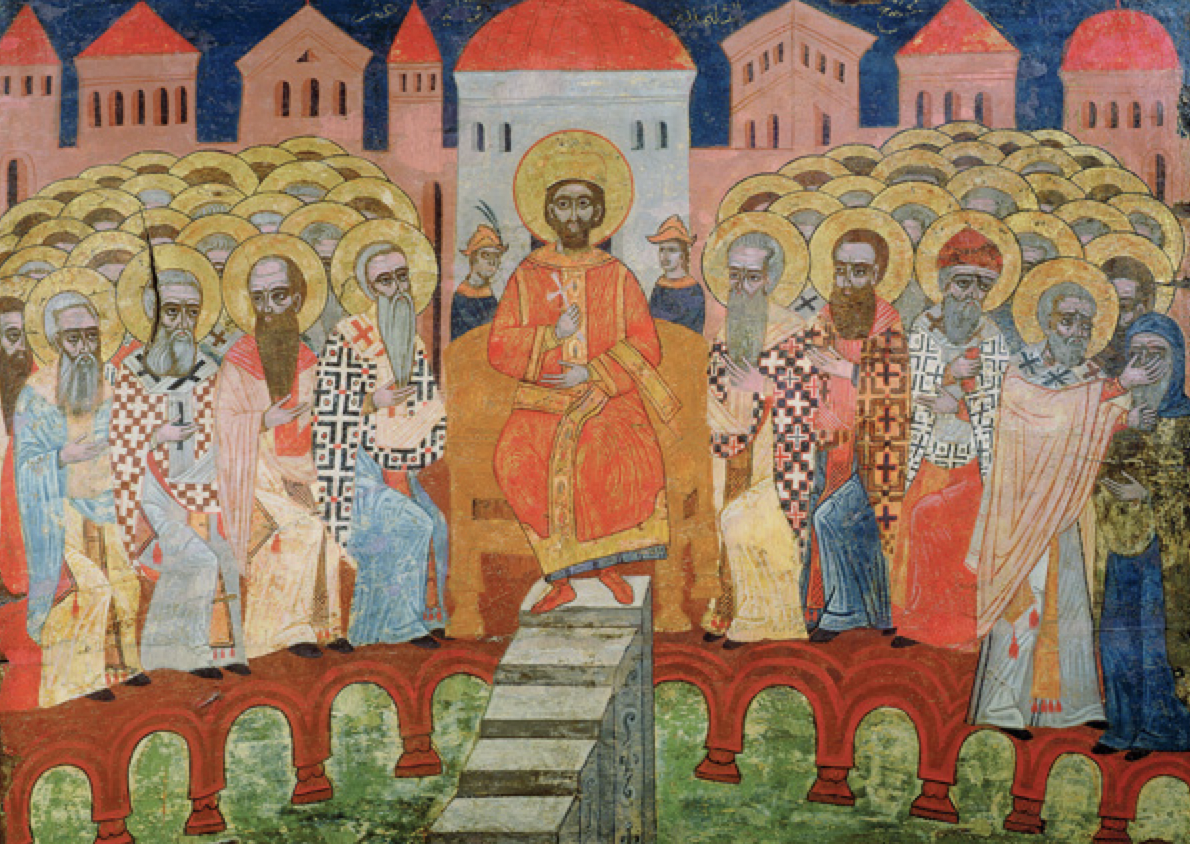
A Gathering of Bishops. This painting depicts church leaders gathering at the Council of Nicea (323 CE) to deal with the teaching of Arius that Jesus was godlike but not fully divine. The Pastoral Letters indicate that a primary responsibility of bishops is to promote and enforce sound doctrine in the church.
The specific brand of false teaching opposed in these letters is difficult to determine; it appears to involve a mixture of ideas, some drawn from Jewish circles and others drawn from what later became known as Gnosticism. The letters actually spend less time describing the teaching that is to be rejected than they do disparaging the teachers responsible for those ideas. The methods, morals, and motives of these teachers are put on display as examples of what Christians should avoid. The problem, however, is not just that such teachers exist, but also that there are people in the church willing to listen to them. The folly of such teaching eventually becomes evident to all (2 Tim. 3:9; cf. 1 Tim. 5:24-25), but in the short term, plenty of people have “itching ears” and want “teachers to suit their own desires” (2 Tim. 4:3)—that is, teachers who will tell them what they want to hear. For example, some of the false teachers “make their way into households and captivate silly women” who, because they are “overwhelmed by sin and swayed by desires,” take these teachers seriously (2 Tim. 3:6). Apparently, the teachers enroll these naive women in programs that promise a gradual revelation of spiritual knowledge; the women may pay fees for help in attaining successive levels of so-called spiritual maturity, and so they end up “always being instructed” without ever actually arriving at “knowledge of the truth” (2 Tim. 3:7).
Concern for Social Respectability in the Pastoral Letters
The Pastoral Letters seem to be especially concerned with the social respectability of Christians:
· A bishop is to be someone “well thought of by outsiders” (1 Tim. 3:7).
· Slaves are to accept their lot so that “the name of God and the teaching may not be blasphemed” (1 Tim. 6:1).
· Young women are to be submissive to their husbands “so that the word of God may not be discredited” (Titus 2:5).
· Young widows should remarry “so as to give the adversary no occasion to revile us” (1 Tim. 5:14; cf. Titus 2:8).
In general, Christians are to be productive and obedient, good citizens whose lives are free of anything offensive or scandalous (1 Tim. 2:1-3, 9–10; 3:2-13; 2 Tim. 2:22-25; Titus 1:5-8; 2:3-10; 3:1-2, 14). The virtue of “self- control” receives particular emphasis (2 Tim. 1:7; Titus 1:8; 2:5-6, 12). Thus, these letters make clear that Christianity is not socially subversive and that the gospel has a certain “civilizing function”: it trains those who would otherwise be “vicious brutes” (Titus 1:12; 3:3) to live in ways that are “self-controlled, upright, and godly” (Titus 2:11-12).
The response to this crisis of false teaching, then, must be twofold: first, the teachers themselves need to be silenced (Titus 1:11), and second, the Christian congregations need to be protected from the influences of such persons. Titus is to rebuke the troublemakers sharply (Titus 1:13); he is to declare what is right and to reprove “with all authority” those who do not accept it (Titus 2:15). He is not to be drawn into argument with people who cause divisions; rather, he should simply give them two warnings and, after that, be done with them (Titus 3:10-11). Likewise, Timothy is to “instruct people not to teach any different doctrine” than that which Paul imparted to him (1 Tim. 1:3). He is to be insistent (1 Tim. 4:11) and persistent (2 Tim. 4:2) in seeing that this tradition is maintained.
In terms of caring for the congregations, a primary strategy seems to be the appointment of prominent and exemplary leaders who will proclaim sound doctrine and teach the tradition inherited from Paul. Beyond this, Timothy is told to set an example for the believers through his own teaching and lifestyle (1 Tim. 4:12, 16). And, in addition to exhortation and teaching, he is to give attention to the public reading of scripture (1 Tim. 4:13). He has relied on scripture since childhood; now, he is to rely on it in public ministry for teaching, reproof, correction, and training in righteousness (2 Tim. 3:15-16).
The overall emphasis, then, is on teaching sound doctrine so that the church might be a bulwark of truth (1 Tim. 3:15) against the novel speculations of those who want to divide the church with “profane chatter” (2 Tim. 2:16-17) or “stupid controversies” (2 Tim. 2:23; Titus 3:9). Sound doctrine seems to take two forms: (1) brief and easily memorized creedal statements that summarize key ideas in the church’s teaching about Christ (see 1 Tim. 2:5-6; 3:16; 2 Tim. 2:11-13; Titus 2:11-14); and (2) specific instructions about moral behavior (Titus 2:1-10; cf. 1 Tim. 3:14-15). The latter directions are important because these letters suggest that moral conduct is the proof of correct belief. The false teachers profess to know God, but they deny God by their actions (Titus 1:16). Sound doctrine, by contrast, leads to “love that comes from a pure heart, and a good conscience, and a sincere faith” (1 Tim. 1:5); it is “teaching in accordance with godliness” (1 Tim. 6:3). Thus, the Pastoral Letters insist that those who have come to believe in God devote themselves to good works (Titus 3:8; cf. 1:16; 2:7; 3:14; also 1 Tim. 2:10; 5:10, 25; 6:18; 2 Tim. 2:21; 3:17). If Paul’s colleagues show themselves to be models of good works and, in their teaching, display the integrity, gravity, and sound speech that their opponents’ teaching lacks, the opponents “will be put to shame, having nothing evil to say” (Titus 2:7-8).
Married Only Once?
The letter of 1 Timothy indicates that bishops (3:2) and deacons (3:12) are to be married only once (or, literally, to be “the husband of one wife”).
What does this mean? Four suggestions:
· They are not to practice polygamy. This seems to be obvious, but perhaps it needed to be stated, given converts from many cultures.
· They are to practice fidelity, fulfilling the role of husband only for the woman to whom they are actually married. Again, this seems to be an obvious expectation, though no doubt an important one.
· They are not to remarry after being divorced. This seems consistent with Paul’s teaching elsewhere (1 Cor. 7:10-11; cf. Mark 10:11-12). They are not to remarry after being widowed.
· This seems stricter than Paul’s usual policy (Rom. 7:1-3; 1 Cor. 7:39). Still, Paul does say elsewhere that it is best not to remarry (1 Cor. 7:8, 32–35, 40), and the bishops and deacons may be expected to model ideal behavior beyond what would be requirements for all.
Suffering and Shame
In 2 Timothy, Paul’s final words from prison are presented in a way that calls for fortitude in the face of suffering and shame. For many people in Roman society, the humiliation of “being chained like a criminal” (2 Tim. 2:9) would be an almost unbearable disgrace, and 2 Timothy acknowledges that many of Paul’s associates deserted him in the face of such hardship (2 Tim. 4:10, 16). Readers familiar with the passion story of Jesus may recall how Jesus was deserted by his closest followers in his hour of trial (Mark 14:27, 50). Still, 2 Timothy makes clear that Paul is not ashamed of any humiliation that he has suffered (2 Tim. 1:12; cf. 3:10-11), and the letter also names Onesiphorus as a positive example of one who was not ashamed of Paul’s chains (2 Tim. 1:16). Beyond this, 2 Timothy indicates that “all who want to live a godly life in Christ Jesus will be persecuted” (2 Tim. 3:12). Timothy is invited to join Paul in “suffering for the gospel” (2 Tim. 1:8).
Within this context of persecution, humiliation, and possible martyrdom, messages of good news are proclaimed. First, the word of God is not chained (2 Tim. 2:9); thus, those who harm God’s messengers will not thwart the purposes of God. Second, suffering for the sake of the gospel can serve God’s purposes, helping to bring salvation to others (2 Tim. 2:10). Third, a glorious reward awaits those who suffer for Christ: those who endure hardship and humiliation now will reign with Christ in glory forever (2 Tim. 2:12; 4:18). Fourth, even those who fail to endure will be protected by Christ’s inestimable mercy; outright apostasy may bring people into condemnation (2 Tim. 2:12; 4:14), but the weak and cowardly should know that the faithfulness of Christ to his followers is greater than their faithlessness to him (2 Tim. 2:13; cf. 4:16).
1 Timothy
After an opening salutation and greeting (1:1-2) Paul urges Timothy to curtail those who teach false doctrines and to promote faithful instruction that recognizes the proper role of the law (1:3-11). Paul’s own story as a former blasphemer saved by Christ Jesus is a testimony to the extent of divine mercy (1:12-17). Other persons who have suffered “shipwreck in the faith” exemplify the judgment that comes upon those who reject conscience and continue to blaspheme (1:18-20). The letter encourages fervent prayer, especially for those in authority (2:1-4), and quotes a confession that describes Christ as “the mediator” whose herald and apostle Paul is (2:5-7). It offers gender- specific instructions regarding the roles of men and women, emphasizing that the latter should dress modestly and learn “in silence with full submission” (2:8-15). It then provides summary qualifications for church leaders (3:1-15), including bishops (3:1-7) and deacons (3:8-13).
After another quote from a Christian confession or hymn (3:16), the letter issues further warnings about false teachers (4:1-5) along with positive exhortations regarding Timothy’s own behavior and ministry (4:6-5:2). This leads to specific advice concerning widows (5:3-16), elders (5:17-20), and slaves (6:1-2), along with more personal exhortations to Timothy (5:21-25). The topic of false teaching is taken up again, with specific attention to the corrupting influence of money (6:3-10). The letter then concludes with charges for Timothy to be faithful (6:11-16), some advice for the wealthy (6:17-19), and a final charge for Timothy to guard what has been entrusted him against what is “falsely called knowledge” (6:20-21).
2****Timothy
The letter opens with a salutation and greeting (1:1-2). Paul gives thanks for the faith of Timothy (1:3-5) and offers words of encouragement for his continued zeal (1:6-7). Timothy is told not to be ashamed of Paul’s gospel or of the suffering that it brings (1:8-14). Paul’s status as a prisoner has caused many to turn away, but Timothy should follow the positive examples of Paul and a certain Onesiphorus (1:15-18). Indeed, Timothy is charged with seeing that Paul’s teaching gets passed on (2:1-2). He is urged to faithfulness with analogies from daily life (a soldier, an athlete, a farmer) and with lines quoted from a Christian confession or hymn (2:3-13). Timothy is to avoid those things that have been the downfall of false teachers, and he is to strive for the qualities that will allow God to use him as a favored vessel (2:14-26). He is warned about distressing times to come and of false teachers who will take advantage of others during those times (3:1-9). As things go from bad to worse, he must remember Paul’s own life and ministry and commit himself wholeheartedly to learning and teaching the scriptures (3:10-17). The need for Timothy’s diligence and persistence in such faithful ministry is made more urgent by the certainty of God’s judgment (4:1-5) and by the fact that Paul’s own days on earth are coming to an end (4:6-8). As the letter winds to a close, it offers some personal instructions and provides updated information regarding various individuals and circumstances (4:9-18). It concludes with greetings and a benediction (4:19-22).
The originality of the Pastoral Epistles
The Pastoral Epistles are distinguished by a special uniqueness; in terms of many internal characteristics, they can be considered a separate, cohesive group within the corpus of the Apostle Paul’s epistles. Comparing them with earlier epistles, one cannot help but notice that 1 Tim, Titus, and 2 Tim reflect a different historical situation, a new stage in the existence of the Church. The management of church communities begins to take on a more regulated character. It is noteworthy how clearly the roles of Titus and Timothy change: if in the early years they were the apostle Paul’s constant companions, periodically carrying out his one‑off assignments to this or that community (for example, to the Thessalonians, see 1 Thess. 3:2, 6, or to the Corinthians, see 1 Cor. 4:17), then in the pastoral epistles they appear as permanent guardians (Greek… “bishops”) of the preached Tradition and the established order in specific Christian communities (in Crete and Ephesus). Unlike 1 Corinthians and Ephesians, the Pastoral Epistles do not mention charismatic ministries that stem from special gifts of the Holy Spirit (prophecy, speaking in tongues, interpretation of tongues, etc.).
The focus is on the ministry of presbyters and deacons, which anticipates the hierarchical structure of the Church, as recorded in the early 2nd century in the letters of Bishop Ignatius of Antioch (“the God‑bearer”). The main concern of the Apostle Paul, expressed in 1 Tim, Titus, and 2 Tim, is to preserve the communities in fidelity to Christian teaching, the “tradition” (1 Tim 6:20), and to maintain the necessary moral purity of the believers.
It is noteworthy that the pastoral epistles play an important role for concepts that do not appear in the other epistles of the Apostle Paul: “piety” (εὐσέβεια), “chastity” (σωφροσύνη), “good conscience” (συνείδησις ἀγαθῆ), and “manifestation” (ἐπιφάνεια), as well as the expressions “sound doctrine” (ὑγιαινοῦσα διδασκαλία) and “true word” (πιστὸς ὁ λόγος). However, the distinctive features of the pastoral letters can be explained by the specifics of the historical period in which they were written.
In the later epistles, the emphasis shifts somewhat, and topics that previously seemed less important come to the fore. The epistles are addressed to the apostle’s close associates, who were well acquainted with their teacher’s theology, and perhaps that is why Paul did not consider it necessary to repeat things they already knew. Numerous factors associated with the gradual onset of a new historical period prompted the Apostle Paul to write about things he had previously not considered necessary to write about. Accordingly, both the style and the subject matter of his letters change compared to his more expressive early epistles. What remains unchanged is Paul’s deeply personal attitude toward entire communities and toward individual people, especially his assistants. This is precisely what cannot be artificially imitated, and it would have made no sense to do so.
The distinctive style and word usage in the pastoral epistles, compared to Paul’s earlier epistles, may be explained by the work of the apostle’s secretaries.
Timothy, the son of a Gentile man and a Jewish woman, lived in the town of Lystra in southeastern Asia Minor; his mother was a believer, but his father was not (Acts 16:1-3). Timothy embraced the Christian faith, and Paul recruited him as a companion for his second missionary journey, circumcising him so as not to offend the Jews (Acts 16:1-3). Toward the end of that journey, Paul sent him back to Macedonia to strengthen the Thessalonians (1 Thess. 3:2). Timothy then rejoined Paul in Corinth, bringing him good news about the Thessalonian church (Acts 18:5; 1 Thess. 3:6) and helping him to evangelize the Corinthians (2 Cor. 1:19). Later, he accompanied Paul on his third missionary journey and thus was with Paul during his lengthy stay in Ephesus (Acts 19). Paul sent him once again to Macedonia (Acts 19:22) and repeatedly to Corinth (1 Cor. 4:17; 16:10). Timothy later spent a winter with Paul in Corinth (from which Romans was written [see Rom. 16:21]) and then went on to Troas, where Paul spent a week with him on his way to Jerusalem (Acts 20:4-5).
After this, we lose track of Timothy. He may have continued ministering in Troas, where Paul’s own work had been cut short due to crises in Corinth (2 Cor. 2:12-13). Later on, he may have gone to Rome to be of service to Paul during his imprisonment there (see Phil. 1:1; Col. 1:1; 4:10; Philem. 1 [but were these letters written from Rome?]). He may have been imprisoned himself at some time (see Heb. 13:23), but we have no information as to when or where this would have been.
The two letters addressed to Timothy add only minor details to this portrait: his mother’s name was “Eunice,” and his grandmother, also a believer, was named “Lois” (2 Tim. 1:5); he was young in comparison to Paul (1 Tim. 4:12; 5:1); he suffered from frequent illnesses (1 Tim. 5:23); and he had received a spiritual gift through prophecy and the laying on of hands (1 Tim. 4:14; 2 Tim. 1:6).
The letter opens with an unusually expansive salutation, which identifies the writer as Paul (1:1-4). Paul indicates that Titus is to appoint elders in the towns of Crete and lists qualifications for the office of bishop (1:5-9). These instructions segue into a description of the corrupt persons whom the bishops will need to refute (1:10-16), followed by specific advice regarding what Titus is to say to older men, older women, younger men, and slaves (2:1-10). The letter then provides a stirring summary of the gospel and its consequences for human behavior (2:11-14). Titus is exhorted to declare these things in a manner that is both authoritative and tactful (2:15-3:2). This leads to a second summary of the gospel message, one that provides personal testimony to the salvation that Paul and Titus share in Christ (3:3-7). Titus is to insist on this message and avoid “stupid controversies” and things that cause divisions (3:8-11). The letter concludes with some discussion of future plans, final greetings, and a benediction (3:12-15).
Related Concepts
- 1-clement
- apostasy
- authorship
- bishop
- christs-faithfulness
- church-leadership
- church-order
- civilizing-function
- creedal-statements
- deacon
- deceivers
- deposit-of-faith
- endurance
- false-teaching
- family-life
- family-responsibility
- gnosticism
- godliness
- good-citizenship
- good-works
- historical-background
- household-code
- ignatius-of-antioch
- institutional-church
- itching-ears
- leadership
- moral-conduct
- moral-transformation
- pauline-biography
- pauline-corpus
- pauline-vocabulary
- persecution
- presbyter
- public-reputation
- scripture
- self-control
- spain
- succession
- truth
- widows