New Testament — Topic 29
Although 2 Thessalonians perhaps lacks the warmth and affection of the first letter addressed to the church at Thessalonica, it does convey a fundamentally positive message. The harsh tone must be understood against the backdrop of the letter’s two most prominent concerns: virulent persecution of Christians on account of their faith and an alarming misinterpretation of doctrine that threatens to undermine that faith.
The letter tries to put a positive spin on the afflictions that the believers have had to endure: not only will the Thessalonian believers be vindicated by God’s justice on the final day, but already, in the present, their suffering is having positive effects. Their endurance in these trials has made them steadfast, so that their faith is growing abundantly and their love for one another is increasing (1:3-4). The first letter to the Thessalonians maintained that God’s faithful people are destined to suffer (3:3-4); now the second letter to them reveals why: persecutions and afflictions are intended to make people “worthy of the kingdom of God” (1:5).
The eschatological teaching in 2 Thessalonians also conveys a fundamentally positive message: Christians are encouraged to view themselves as living in what might be regarded as an initial phase of the end times. The events of the last days seem to be under way (2:7), but they have only just begun. The coming of Christ is soon, but not immediate. The time that remains is not to be wasted on fanatical speculation or idle anticipation. The Thessalonians should look forward to their almost imminent deliverance, but they should view the waiting period as a time to be used productively for Christian growth and mission, as a time for “doing what is right” (3:13).
Our knowledge regarding the historical background of this letter is uncertain. Let’s start with a brief review of what we do know. Thessalonica was the capital city for the Roman province of Macedonia (located in what is now northern Greece). Paul founded a church composed mainly of Gentiles in this city sometime around 48–51. He was forced to leave the city amidst growing persecution, and he wrote the letter that we now know as 1 Thessalonians to the struggling church that he had left behind.
What happened next? One possible scenario is pretty straightforward. A few months after writing 1 Thessalonians, Paul received word back from the church that a new crisis had erupted: the Thessalonians were so eager and excited about the imminent return of Christ that some of them had bought in on a rumor that “the day of the Lord is already here” (2 Thess. 2:2). We are not certain exactly what they thought this meant or where they would have gotten this notion (an enthusiastic prophecy by one of their members, or a forged letter from someone claiming to be Paul, or a misinterpretation of the teaching in 1 Thessalonians?). In any case, Paul realized it was time to write them another letter and sort things out. According to this scenario, the letter known as 2 Thessalonians was written from Corinth by Paul and his companions a few months after 1 Thessalonians, some time between 50 and 53. The main point of the letter comes in 2:1-12, where Paul teaches the Thessalonians about what must happen before the day of the Lord arrives.
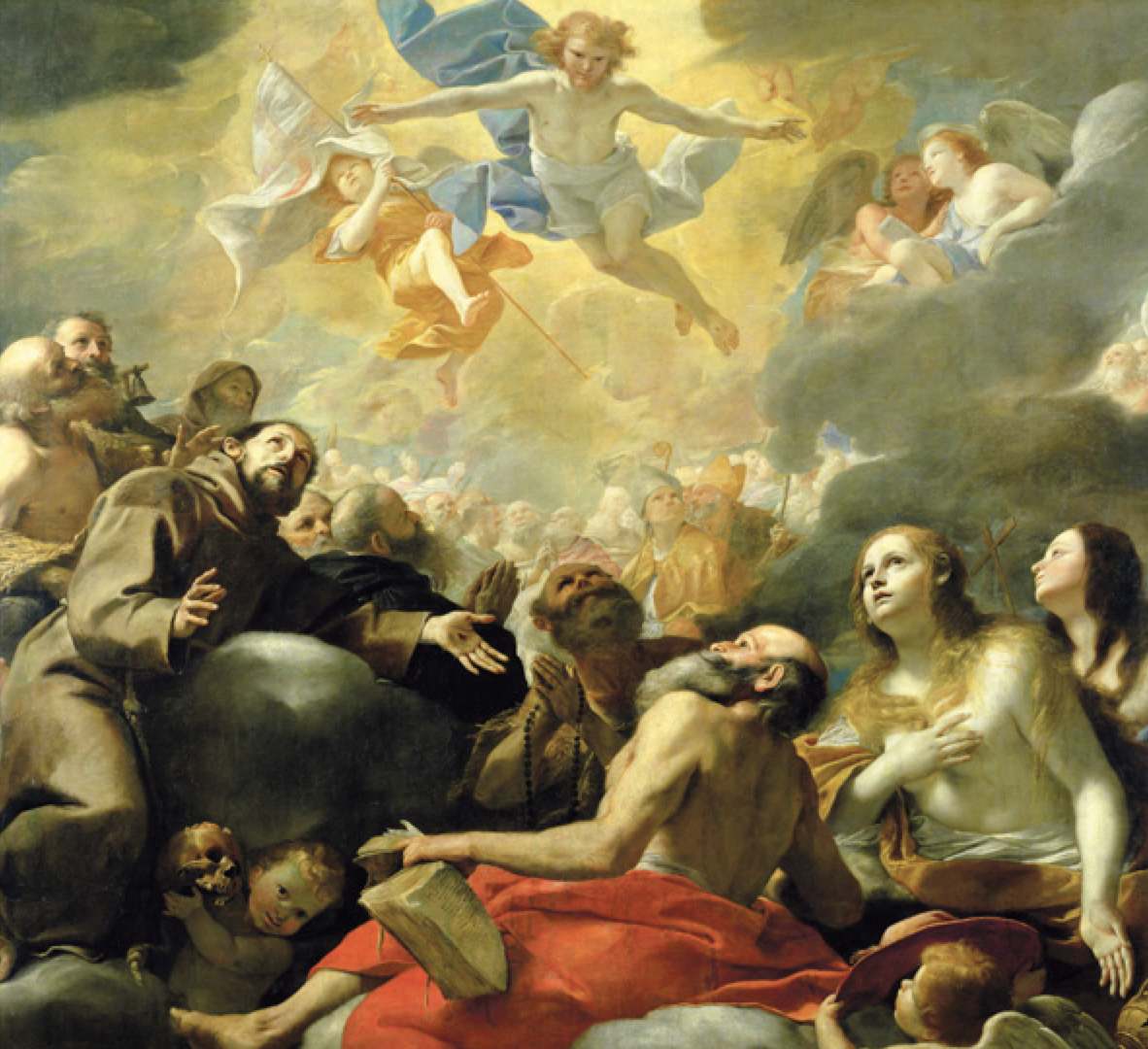
The Day of the Lord. A rumor circulated among the Thessalonians that “the day of the Lord” had already come. The apostle Paul’s teaching on the topic reveals his belief that it would be a day that no one could miss (see 1 Cor. 15:51-57; 1 Thess. 4:13-18).
In some respects, the letter in our New Testament known as 2 Thessalonians might be thought of as “a cover version” of the letter known as 1 Thessalonians. The content and format are remarkably similar, but the tone has changed. The first letter mentioned destruction that will come upon unbelievers on the day of judgment (1 Thess. 5:3); the second seems to relish such condemnation (2 Thess. 1:6-9; 2:11-12). The first letter said that idlers should be admonished (1 Thess. 5:14; cf. 4:11); the second says that they should be denied food (2 Thess. 3:10). The first letter said that everyone in the community was to hear what the letter said (1 Thess. 5:27); the second says that they are to obey what it says or else be shunned by other church members (2 Thess. 3:14).
- Introduction
- Overview
- Historical Background
- Major Themes in 2 Thessalonians
- Conclusion
The Certainty of Judgment
The author of 2 Thessalonians assures the Christian believers that those who are persecuting them will have to answer to God for their misdeeds (1:6). When the Lord Jesus comes, accompanied by angels, He will bring “flaming fire” and will wreak a terrible vengeance on those who do not know God and on those who do not obey the gospel (1:7-8). Thus, all opponents of Christianity—Gentile and Jew alike—will “suffer the punishment of eternal destruction,” separated from God’s presence forever (1:9). A number of scholars have noted that Paul does write elsewhere about judgment and the wrath of God (Rom. 1:18; 2:5-8; 12:19; 1 Thess. 1:10; 2:16), but usually he does not relish the eventual suffering of his enemies as he is sometimes thought to do here. Nevertheless, the accent in this section of the letter (1:5-12) perhaps is not on the negative aspects of judgment but rather is on the relief of the afflicted (1:6-7) and on the vindication of Jesus, whose name will be glorified at last (1:10, 12).
The Coming of the “Lawless One”
The most significant “new content” in 2 Thessalonians concerns the teaching that the day of the Lord (2:2)—the second coming of Jesus Christ (2:1)—will not occur until after “the rebellion comes” and “the lawless one is revealed” (2:3). This lawless one may already be present: the “mystery of lawlessness” concerning him is already at work (2:7). For the moment, however, he is being restrained by someone or something (2:7-8). After this restraint is removed, the lawless one will be revealed. He will take his seat in the temple of God and declare himself to be God (2:4). And then, the Lord Jesus will blow him away—literally (2:8; cf. Isa. 11:4)!
We do not know for certain what this means. Scholars usually assume that he had filled the Thessalonians in on details that are unavailable to us (see 2:5-6). Interpreters often have assumed that some of the references in this section of the letter are to recent or current events in the Roman Empire, but there are many guesses as to which events those might be: various offenses to Christianity associated with Caligula (37–41), Nero (54–68), or Domitian (81–96) would qualify. In any case, the main point of the passage seems to be to establish a chronology of events that disprove the notion that the day of the Lord is already here: the restraining agency has not yet been removed; therefore, the lawless one has not been revealed; therefore, the day of the Lord has not arrived.
Who (or What) Is the Restrainer?
In 2 Thessalonians 2:6-7 it is indicated that “the lawless one” is currently being restrained by someone or something that eventually will be removed. The Thessalonians knew who or what this restrainer was (2:5-6). Interpreters since then have had to guess:
God or God’s power or the Holy Spirit
the angel Apollyon (mentioned in Rev. 9:11)
the archangel Michael (Jude 1:9; Rev. 12:7)
the Christian Church
some prominent Christian leader (Paul himself or James of Jerusalem)
the Gentile mission, which had to be completed first (cf. Mark 13:10)
the Roman Empire and/or the emperor (cf. Rom. 13:1-7)
Such ideas are sometimes combined: 2:6 seems to speak of a restraining force (“what is now restraining him”), while 2:7 seems to speak of a person (“the one who now restrains”).
In the fifth century, Augustine’s comment on 2:6-7 was, “I must admit that the meaning of this completely escapes me” (City of God 20.19).
There are a few points of contact with what is presented here and in other New Testament writings. The “lawless one” described in this passage probably is to be equated with the antichrist referred to in the Johannine Letters (1 John 2:18; cf. 1 John 2:22; 4:3; 2 John 7) and with the beast mentioned in Revelation (Rev. 11:7; 13:1-18). The idea that people in the last days will be deceived by satanic signs and wonders resonates with some ideas presented in the Synoptic Gospels (Mark 13:22; Matt. 24:24), as does the claim that the end-times scenario will involve a great act of apostasy in the temple (Mark 13:14; Matt. 24:15). The unique element in 2 Thessalonians is the reference to someone or something that restrains the lawless one until the appointed time (2:7-8)—a point that apparently is not made elsewhere.
The Problem of Idleness
The author of 2 Thessalonians addresses a problem of idleness that was mentioned in the first letter addressed to this church (2 Thess. 3:6-12; cf. 1 Thess. 4:11; 5:14). This time, a command is given: “Anyone unwilling to work should not eat” (3:10). It was common in those days for Christians to share a common meal together (see Acts 2:42, 46; 1 Cor. 11:33; Gal. 2:12), and some lazy individuals may have viewed the provision of free food as a way to survive off the largesse of the community. It is also possible that some people tried to offer spiritual rationalizations for not being gainfully employed: they were devoting themselves to prayer or to “waiting on the Lord” (see p. 381). Yet another possibility is that this rebuke of idleness is addressed to rich persons who had no need to work for a living and so spent their lives as “mere busybodies, not doing any work” (3:11). Whatever the situation, the point obviously is not to deprive persons who are unable to work (or unable to find work); rather, those who are unwilling to work are to be excluded from the community meal. Paul and Timothy and Silas set an example for all by holding down full-time jobs as manual laborers while evangelizing the city and founding the church (3:6-9).
A brief salutation (1:1-2) identifies 2 Thessalonians as being from Paul, Silas, and Timothy, who testify to how the Thessalonians’ mutual love and faithfulness in persecution have inspired pride and thanksgiving among the churches of God (1:3-4). This is followed by a promise that God will wreak vengeance on those who afflict the Thessalonians, punishing them with eternal destruction on the day of judgment (1:5-12). The mention of that day leads to instruction on a significant issue: some people have been telling the Thessalonians that the “day of the Lord” has already arrived (2:1-2). Paul assures them that this is not the case and that, indeed, that day will not come until after the “lawless one” mounts a final and futile opposition to God (2:3-12). Paul is confident that the Thessalonians will not be among those deceived by this satanic foe, provided they hold fast to what he taught them (2:13-15). He offers the Thessalonians his blessing in this regard (2:16-17), asks for their prayers in return (3:1-2), repeats the affirmation of confidence (3:3-4), and offers another blessing, similar to the first (3:5). Then, the letter turns to another topic, addressing the problem of idleness: the Thessalonians ought to follow the example of productive labor that Paul set for them, and they should avoid association with believers who do not follow this example (3:6-15). The letter closes with two benedictions and some words in Paul’s own handwriting by which the readers will be able to recognize the authenticity of this letter as coming from him rather than from someone using his name to mislead them (3:16-18).
2 Thessalonians.