New Testament — Topic 28
eschatology: a study or focus on “last things,” such as the return of Christ, final judgment, or other phenomena associated with the end times.
Much more could be said about Paul’s first letter to the Thessalonians, short as it is. Theologians are interested in the correspondence not only for its contribution to eschatology (study of the end times) but also for what it has to offer regarding such themes as election (1:4), predestination (3:3; 5:9), sanctification (4:3; 5:23), the word of God (1:5, 6, 8; 2:13; 4:15, 18), and the gospel (1:5; 2:2, 4, 8, 9; 3:2). The letter refers to these subjects without offering much in the way of teaching on them—a point of frustration for theologians—but it is notable that what are often regarded as “advanced Christian teachings” are referenced so casually in what is usually taken to be the earliest surviving Christian document. The letter typically is dated somewhere between fifteen and twenty years after the crucifixion of Jesus. In that short span of time a movement that began with a small circle of Jewish peasants in rural Galilee became an organized religion with Gentile adherents in major cities of the Roman Empire. The simple fact that there is a Christian church in Thessalonica is remarkable; that this church already evinces an awareness of many key issues that would be debated among intellectuals for the next two millennia is truly amazing.
Still, for Christians who are not professional theologians, Paul’s first letter to the Thessalonians has been valued probably more for its contributions to spiritual life than to Christian doctrine. This letter is saturated with prayer, and it describes prayer as a continuous activity: Paul and his companions constantly remember the Thessalonians as they give thanks to God (1:2), they pray “night and day” that they might see them again (3:10), and they invite the Thessalonians to “pray without ceasing” (5:17). Further, the Thessalonians are urged to “rejoice always” (5:16) and to “give thanks in all circumstances” (5:18). Such references (“constantly,” “night and day,” “without ceasing,” “always,” “all circumstances”) envision prayer as an attitude and a lifestyle, not simply a verbal activity.
One striking characteristic of 1 Thessalonians is the number of times that Paul reminds his readers of things that they already know.
“You know what kind of persons we proved to be” (1:5).
“You yourselves know … our coming to you was not in vain” (2:1).
“As you know, we had courage in our God” (2:2).
“As you know … we never came with words of flattery” (2:5).
“You remember our labor and toil” (2:9).
“You are witnesses … how pure, upright, and blameless our conduct was” (2:10).
“As you know, we dealt with every one of you like a father” (2:11).
“You yourselves know that this is what we are destined for” (3:3).
“We told you beforehand that we were to suffer … so it turned out, as you know” (3:4).
“You know what instructions we gave you” (4:2).
“The Lord is an avenger … as we have already told you” (4:6).
“Concerning love … you do not need to have anyone write to you” (4:9).
“Work with your hands, as we directed you” (4:11).
“Concerning the times and seasons … you do not need to have anything written to you” (5:1). “You yourselves know very well that the day of the Lord will come like a thief” (5:2).
After Paul, Timothy, and Silas had spent a few months in this city, they were suddenly forced to leave. Separated from the Thessalonians, they were distraught and worried about what would become of the new believers in the midst of the persecution that they were experiencing (2:14; 3:3-4). The nature of that persecution is not described. It is not impossible that it involved physical violence, such as Paul later would indicate had befallen him throughout his ministry (cf. 2 Cor. 6:4-5; 11:23-25). But it is also possible that the tribulation took the form of social ostracism and public shaming. In any event, Paul knew that Satan, the tempter, was behind this distress, and he wondered whether the young Christians would be able to withstand the trial (3:5). He tried repeatedly to come to them, but Satan thwarted his plans (2:18). At last, he managed to send Timothy to them (3:2-3), and Timothy returned with good news: the Thessalonians were standing firm in the Lord (3:8), and they continued to think well of Paul and his companions (3:6).
It was in response to this news that Paul (with Silas and Timothy) wrote the letter that we know as 1 Thessalonians. The date for the letter’s composition is somewhere between 49 and 52, if we assume that he is writing “a short time” after founding the church (see 2:17). By now, he is probably in the city of Corinth, living with his friends and fellow tent-makers Aquila and Priscilla and spending days in the Corinthian marketplace attempting to replicate the evangelistic success that he had achieved in Philippi and Thessalonica (see Acts 18:1-4).
The primary purpose of the first letter to the Thessalonians is to celebrate and cement the good relationship that Paul has with the believers in the community. The letter has a general tone of “reminding,” alerting the Thessalonians to the continued relevance of what they have seen and heard and know to be true (see box 19.1). But Paul also wants to respond to one new matter that has come up, a question that has precipitated a faith crisis within the community. Not surprisingly, it is a question involving the Thessalonians’ favorite subject: the second coming of Christ.
In New Testament times, the region that is now known as Greece consisted of two provinces: Macedonia in the north and Achaia in the south. The cities of Thessalonica and Philippi were in Macedonia, while Athens and Corinth were in Achaia (see map on p. 326). The apostle Paul spent quite a bit of time in Greece on what are traditionally called his second and third missionary journeys, and he wrote letters to three of the four cities just named. Thessalonica (modern-day Thessaloniki or Salonika) was the capital city of Macedonia, and it was in many respects the most important city of the region. Located at the crossing of four major roads, it also possessed one of the best natural harbors on the northern Aegean Sea. A bustling metropolis with a population that may have ranged as high as one hundred thousand, the city appears to have been home to a wide variety of religious groups: archaeology reveals multiple shrines and temples for deities such as Isis, Osiris, Serapis, and Cabirus.
Paul’s second missionary journey brought him to Thessalonica around 48–51. According to the book of Acts, he crossed over to Europe from what is now western Turkey. He landed at Neapolis (see p. 276) and went first to Philippi, where he managed to found the church to which he would later write his letter to the Philippians (Acts 16:11-40). Then he moved down the Via Egnatia about one hundred miles west to Thessalonica (Acts 17:1). He appears to have stayed in this city for several months, receiving financial assistance on at least two occasions from the new church in Philippi that he had just left behind (Phil. 4:16).
insula: a building common in Roman cities in which the top floor consisted of living quarters and the bottom floor of shops that opened out onto the street.
The brief sketch of Paul’s Thessalonian ministry in the book of Acts focuses on his preaching in the Jewish synagogue (17:2-4), but comments in his first letter to the Thessalonians indicate that his ministry in the city must have taken on a broader compass. Paul refers to the recipients of 1 Thessalonians as people who “turned to God from idols” (1:9). He also mentions that he and his companions “worked night and day while proclaiming the gospel to the Thessalonians” (2:9), which perhaps offers a literal description of how the evangelization of these Gentile idol-worshipers took place. Many Roman cities, including Thessalonica, featured market buildings called insulae that contained shops on the ground floor and living quarters for the shopkeepers on the floors above (see photo on p. 375). The shops opened out onto the street and became principal sites for social interaction in addition to commerce. Many scholars think that Paul, Timothy, and Silas (= Silvanus) rented an Insula shop in Thessalonica where they could practice their trade as leather- workers or tent-makers (Acts 18:3). Paul may have preached in synagogues on Sabbath days, but on the other six days of the week Paul and his friends turned their leather shop into an arena for religious dialogue, offering their Christian testimony to clients, customers, colleagues, and curious passersby. They apparently did this with great success, for Paul’s letter refers to the market encounters rather than to the synagogue engagements as the primary context out of which the church at Thessalonica was born.

Via Egnatia. This is the actual road that Paul walked as he traveled from Philippi to Thessalonica. The Via Egnatia was a major land route across northern Greece and Asia Minor (modern-day Turkey). A tribute to Roman engineering, it also proved to be a great boon to Christian missionaries in spreading the gospel.
We may wonder, of course, how Paul went about persuading pagan Gentiles to worship the Jewish God and to become followers of the Jewish Messiah. In this letter, he makes frequent mention of matters that he addressed while among the Thessalonians, and some of the points seem similar to the teachings of philosophical schools that were popular in the Greco-Roman world. For example, Paul says that he directed the Thessalonians to aspire to live quietly, to mind their own affairs, and to work with their hands (4:11); this is advice that might just as well have been offered by the Epicureans. Thus, Paul may have established some contact with these Gentiles by presenting Christianity as a meaningful moral system that allows people to live with integrity and dignity. But, of course, Paul would want to say that the Christian faith is much more than just “good advice,” and this letter makes clear that he also taught the Thessalonians about topics more specific to Christian doctrine—for example, that there is only one true and living God (1:9), and that Jesus is the Son of God (1:10), who died for them (4:10, 14), and whom God raised from the dead (1:10; 4:14). The point that comes up more than anything else, however, is the Christian declaration that Jesus is coming again to rescue people from God’s wrath (1:10; 2:19; 3:13; 4:15-17; 5:2-5, 23). This appears to have been a matter of special interest to the Thessalonians—a dominant, driving concern of their faith. In any event, Paul appears to have brought the Thessalonians quite a ways in a short period of time. He was in the city less than a year, and yet by the time he left, there were leaders in the church who had responsibility for admonishing others in the Lord (5:12). It is somewhat amazing to realize that these trusted and respected church leaders apparently were persons who a few months earlier had never even heard of Jesus.
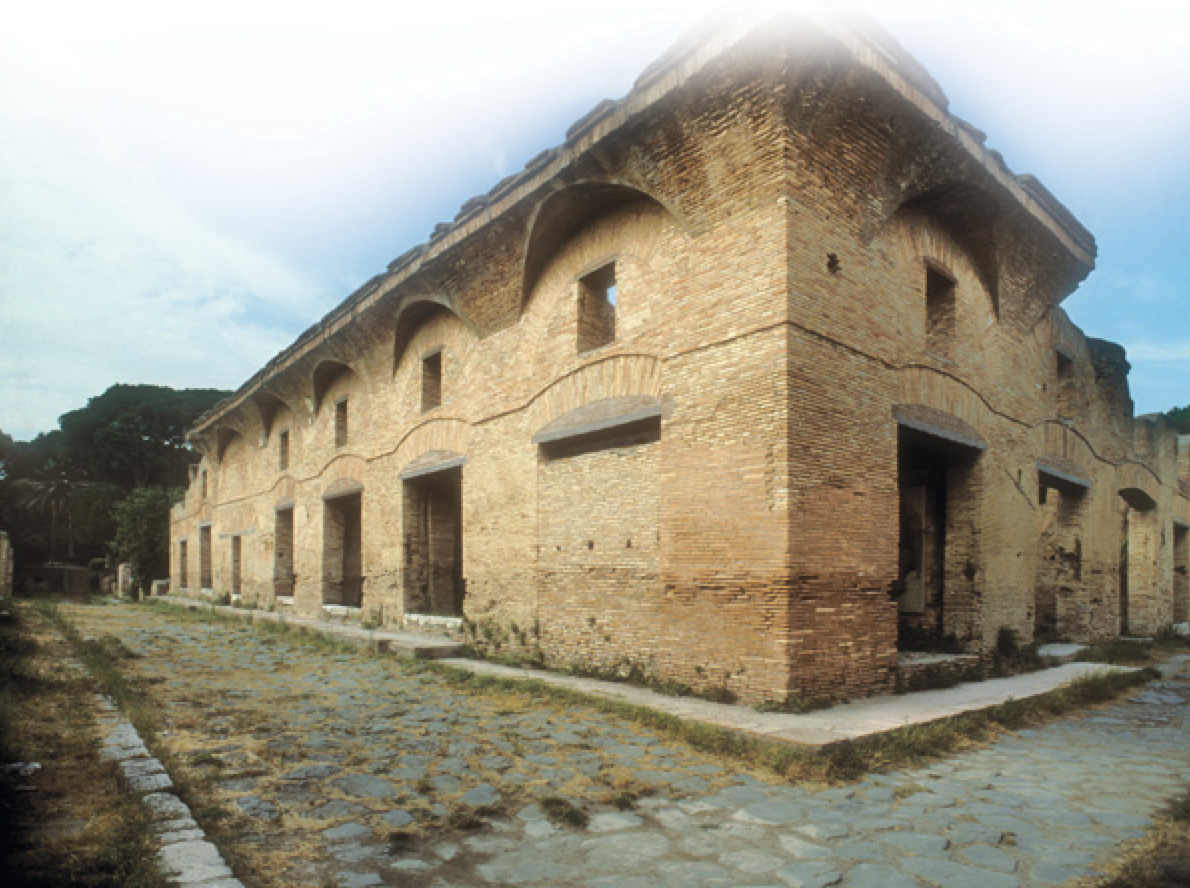
A Roman Insula. These remains of a Roman insula from the city of Ostia may look similar to the building in Thessalonica where Paul is likely to have worked while spreading the gospel.
This may be where it all began. Most New Testament scholars believe that Paul’s first letter to the Thessalonians is the earliest of any of his letters that have been preserved for us. If they are right, then almost certainly it was written before any of the other books now found in our New Testament, which would make it the earliest surviving Christian writing of any kind. The letter ostensibly is written from “Paul, Silvanus, and Timothy,” but first- person singular references pop up often enough (2:18; 3:5; 5:27) to indicate that Paul is the primary author.
The man who wrote this letter, the apostle Paul, was an avid student of scripture: the law of Moses, the psalms of David, the oracles of the prophets. It seems unlikely that he could have imagined that people would one day be reading this letter alongside those works, regarding his own words as scripture. He certainly did not imagine that people would be doing that two thousand years later, for he did not think it likely that anyone would still be around two thousand years hence—or two hundred years, or even twenty years, for that matter. The man who wrote 1 Thessalonians expected Jesus Christ to return soon, and assumed that he would be alive to see it happen (4:17).
What was it like to be a Christian in those very early days? In this letter, Paul tells us. He even tells us how he practiced his ministry, how he went about the task of spreading what he calls “the gospel of God” (2:2). The focus, we will see, is not simply on the message he shared but also on the manner in which he shared it.
- Introduction
- Overview
- Historical Background
- Evangelical Reminders
- Major Themes in 1 Thessalonians
- Conclusion
The Conduct of Paul’s Ministry
Paul reminds the Thessalonians of the way that he and his companions behaved (1:5; 2:1-12). They showed courage in the midst of opposition (2:2) and did not compromise God’s message to earn approval from mere mortals (2:3-6). They cared so deeply for the Thessalonians that they worked overtime to earn their own keep and not be a burden on anyone (2:8-9). Their conduct was “pure, upright, and blameless” (2:10). They did not even make the sort of demands that it might have been appropriate for them to make as apostles; they chose to forgo what would have been their due, for they preferred to regard the Thessalonians as family rather than as students or disciples. Indeed, family imagery in this letter is both pervasive and diverse. First, Paul and his companions say that while they were with the Thessalonians, they filled the role of parents; they were as tender and gentle as a nursing mother (2:7), and they offered each individual fatherly advice and encouragement (2:11). Then, when forcibly separated from the Thessalonians, they felt as though they were the children—the anguish made them feel like orphans (2:17). And now, writing the letter, they regard the Thessalonians as their “brothers and sisters”: the sibling terminology is used a remarkable fifteen times in what is a fairly short letter (1:4; 2:1, 9, 14, 17; 3:2, 7; 4:1, 6, 9, 10, 13; 5:1, 12, 26).
Why does Paul spend so much time explicating the depth of his devotion for the Thessalonians and reminiscing about the nobility of his ministry and motives? Some scholars wonder whether he might be on the defensive. Perhaps he has opponents or detractors in the city who are deriding his ministry in ways that he wants to negate. It is also possible that some of the Thessalonians might blame him for the persecutions that they are suffering, persecutions that he himself has managed to avoid by leaving town; thus, Paul goes out of his way to let them know that he has suffered for their sake (2:2), that he remains concerned for them (2:17-3:5), and that in some sense he continues to share in their distress (3:4, 7).
It is also possible, however, that Paul offers this recap of his ministry not for defensive reasons but rather as a model for the Thessalonian Christians to follow as they become imitators of him, sharing the word with others (1:6-8). Furthermore, Paul may want to remind the Thessalonians how well they were treated as a way of honoring them: they have suffered the shame of being reviled by their own compatriots (2:14), but they were (and still are) deemed worthy of exemplary devotion from three prominent church leaders. Whatever their fellow citizens might say about them, Paul, Timothy, and Silas say, “You are our glory and joy!” (2:20; cf. 3:8-9).
Kissing Christians
Paul closes his letter to the Thessalonians with this exhortation: “Greet all the brothers with a holy kiss” (5:26). The NRSV and other English versions render the Greek word adelphoi here as “brothers and sisters,” assuming that Paul did not mean to limit this greeting to males only. He closes three of his later letters with the more generic exhortation “Greet one another with a holy kiss” (Rom. 16:16; 1 Cor. 16:20; 2 Cor. 13:12).
In the early years of Christianity, followers of Jesus were noted for kissing each other (probably, though not necessarily, on the lips) and for making the exchange of such greetings a part of their public liturgy. Paul’s emphasis that this greeting was to be a “holy kiss” (cf. 1 Pet. 5:14) makes clear that nothing erotic was implied. Still, the practice was a novel one.
In the biblical world, kissing appears to have been commonplace between family members (Gen. 27:26-27; Exod. 18:7) and friends (1 Sam. 20:41). Men kissed men (2 Sam. 20:9) and women kissed women (Ruth 1:9, 14) as expressions of welcome (Gen. 29:13; Exod. 4:27), favor (2 Sam. 15:5), blessing (Gen. 48:9-10; 2 Sam. 19:39), farewell (Gen. 31:28, 55; 1 Kings 19:20), grief (Gen. 50:1), and reconciliation (Gen. 33:4; 45:15). However, there does not appear to have been any precedent in Jewish or Greco-Roman society for kissing between men and women who were not either relatives (Gen. 29:11-12) or lovers (Song 1:2; 8:1).
The New Testament contains references to kisses similar to what is found elsewhere in the Bible (Mark 14:45; Luke 15:20; Acts 20:37), but it also introduces this new concept of a “holy kiss” that might be shared by believers regardless of gender, rank, or race. This practice probably can be traced to the teaching of Jesus that identified his followers as family members (Mark 3:35). Based on this idea, a greeting shared between literal brothers and sisters became a symbolic act expressing the spiritual relationship between those who were one family in Christ.
In the second century, the ritual exchange of a “kiss of peace” became a standard component of the Sunday morning liturgy (see Justin Martyr, First Apology 66).
Honor and Shame
Several points in this letter may be read in light of a concern just mentioned: the Thessalonians have been shamed by their compatriots, and Paul wants to offer them a somewhat ironic restoration of honor. The reason for the shaming probably was that the new Christians repudiated much that was (literally) sacred to Gentile society: they did not join in festivities associated with the city’s temples and shrines; they did not honor the emperor with worshipful tributes or accolades; they did not participate in banquets and parties and other amusements. As a result, while the Jews of Thessalonica would have viewed the Thessalonian Christians as heretics, the Gentile population probably styled them as irreligious, unpatriotic, and antisocial. Becoming a Christian in mid-first-century Thessalonica almost certainly meant a loss of esteem and social prestige.
Paul wants to tell the Thessalonian Christians that although they are not honored in the eyes of this world, they are honored in the eyes of God. He also goes out of his way to assure them that they are highly regarded among other believers: their story is told as an inspiring example of faith in churches throughout Macedonia and Achaia and, indeed, “in every place” (1:7-9). Further, he suggests that their unbelieving neighbors (the ones who shame them) are the ones behaving in a manner that is truly unworthy of honor: they mistreat others (2:2) and live as people who do not know God, controlled by lustful passions (4:5). All this will be exposed when the day of God’s wrath arrives: utter destruction will come upon those who blithely talk of “peace and security” (5:3-4). Thus, the Thessalonian Christians should not be concerned with what their doomed neighbors think, but Paul does offer two practical suggestions that might help their situation. First, the Thessalonian believers ought to build each other up, for this provides an affirmation of honor within the community that they no longer enjoy in society at large (4:18; 5:11, 14). Second, they should be careful about their behavior toward outsiders: if they refrain from meddling in the affairs of others and if they remain good productive citizens (4:11-12), they may mute some of the criticisms leveled against them. So, they must look beyond their current situation to their ultimate destiny (5:9; cf. 3:3), but in the meantime, they are to abound in love and do good for one another (3:12) and to outsiders as well (5:15).
Sexual Morality
Paul offers the Thessalonians advice regarding how they are to live in order to please God (4:1; cf. 2:9). First, he emphasizes that they are to be holy and honorable in matters of sexual morality: they are to abstain from sexual relations outside of marriage and from anything that is exploitative or expressive of lustful passion (4:3-7). Had the Thessalonian believers mainly been Jewish converts, they would have needed little instruction in this regard, but for Gentiles who until a short time ago did not know God (cf. 4:5), chastity and monogamy may have seemed like novel ideas. Paul has told them all this before (4:2), but either because of something Timothy told him or simply because of his own intuition or knowledge of human nature, he figures that it is worth mentioning again. He also emphasizes that this teaching is not based on human authority but rather comes directly from God (4:8).
Working for a Living
Paul urges the Thessalonian believers to work with their hands and be dependent on no one (4:11-12). This charge seems to pick up on the example that he and his companions set by working night and day so as not to be a burden on anyone (2:9). There appear to have been idlers in the Thessalonian community who needed to be admonished to work for a living (5:14). Such a problem perhaps resulted simply from laziness, but many interpreters have wondered whether the idleness in the Thessalonian community was connected to the church’s expectation of an imminent second coming. Perhaps some church members had quit their jobs in eager anticipation of the end times, and now Paul needs to tell them that loitering for Jesus is not an appropriate way to await his coming. This matter will come up again in another letter addressed to this community (2 Thess. 3:6-13) (see box 20.3 on p. 394).
Death of Believers Prior to the Parousia
A very interesting question, which deserves a thorough, Orthodox, patristic response and elaboration.
Firstly, let us cite an excerpt from a classical Protestant commentary on 1 Thess. 4:13-18:
“Near the end of 1 Thessalonians, Paul takes up a question that seems to have been troubling the congregation. Some persons in the church have died, and the grief-stricken Thessalonians wonder whether this means that their loved ones will miss out on what Paul had promised them. No, Paul says, when Christ returns, the dead in Christ will rise and then all believers, living and dead, will be caught up in the clouds to meet the Lord in the air (4:16-17). This all seems fairly clear; in fact, to many scholars, it seems a bit too clear. In a letter that is largely devoted to reminding people of things that they already know, 1 Thessalonians 4:13-18 stands out as the one section of the letter in which Paul provides new information. But it seems like such a basic matter. Did the Thessalonians really not know that the dead would be raised to new life? Had Paul neglected to tell them that?
Some scholars think that the presentation of this question indicates how primitive Paul’s theology may have been at the outset of his ministry. He naively assumes that he will still be alive at the time Christ returns (see 4:17: “we who are alive”). Perhaps in those early years he was so eagerly awaiting the second coming that he hadn’t even stopped to think about what would happen to people who died. He had never even talked about it with Timothy or Silas, but now that the Thessalonians broached the question, he had to think it through and come up with an answer: Of course! The dead will be raised, just as Jesus was”.
Let us respond:
Introduction: So, Was Paul really Naive?
The Protestant commentary we’ve cited reflects a common historical-critical assumption: that Paul, in his early ministry, held a “primitive” theology, naively expecting to be alive at Christ’s return. When the Thessalonians raised the question of what happens to believers who die before the Parousia, Paul supposedly had to improvise a solution—the resurrection of the dead—which he had never before considered.
This reading, however, is fundamentally flawed. It imposes a modern, skeptical hermeneutic on the Apostle, treating him not as a divinely inspired apostle but as a fallible, evolving thinker who had to “come up with an answer.” The Orthodox Church rejects this approach entirely. Paul was not naive. He was not improvising. He was revealing a mystery, confirming what he had already taught, and applying the unchanging Gospel to a specific pastoral crisis.
The Orthodox understanding of 1 Thessalonians 4:13-18 is grounded in:
-
The reality of the intermediate state — the souls of the departed are alive in Christ.
-
The certainty of the bodily resurrection — at the Parousia, the dead in Christ will rise.
-
The pastoral use of “we who are alive” — this is a rhetorical, homiletic “we,” not a chronological prediction.
-
The liturgical and ascetical application — this passage is read at every Orthodox funeral and shapes the Church’s entire eschatological consciousness.
I. The Context: Why Did the Thessalonians Grieve?
1.1. The Pagan Background
The Thessalonians were primarily Gentile converts (Acts 17:4 mentions “a great multitude of the devout Greeks”). In pagan Greco-Roman culture, death was often seen as the end of all conscious existence—a shadowy, joyless afterlife in Hades. There was no hope of resurrection. The epitaphs on ancient tombs frequently read: “I was not; I became; I am not; I care not.”
When some believers in Thessalonica died, their surviving family members grieved as those who had no hope (1 Thessalonians 4:13). Paul does not say they grieved because they thought their loved ones would miss the Parousia. He says they grieved because they did not understand that death is not the end for those in Christ.
1.2. What Had Paul Already Taught?
The Protestant commentary claims that Paul had “neglected” to teach about the resurrection of the dead. This is absurd. Paul’s entire Gospel was centered on the resurrection of Christ, and from that, the resurrection of believers. He had taught them “the word of the Lord” (1 Thessalonians 4:15)—a phrase suggesting a direct, authoritative revelation from Christ.
Paul’s Gospel was not a collection of disconnected ideas. It was a unified message: Christ died, Christ rose, Christ will come again, and those who are in Christ will share in His resurrection. The Thessalonians knew this. Their problem was not ignorance of doctrine but the application of that doctrine to their concrete grief.
II. The Orthodox Reading of “We Who Are Alive”
2.1. The Rhetorical “We”
The phrase “we who are alive and remain” (1 Thessalonians 4:15, 17) has been misread by Protestant and secular commentators alike as a chronological prediction. Paul, they say, expected to be alive when Christ returned. When he later realized he would die, he had to revise his theology.
This is a profound misunderstanding of Paul’s language. In Greek, the first- person plural is often used rhetorically to include the speaker in the community he is addressing, without any implication about chronology. It is a pastoral “we,” not a predictive “we.”
Examples in Paul :
╬ “We who live are always delivered to death for Jesus’ sake” (2 Corinthians 4:11). Here, “we” includes Paul and all believers, yet Paul clearly did not think all believers would suffer the same way he did.
╬ “For we must all appear before the judgment seat of Christ” (2 Corinthians 5:10). This “we” includes all believers of all times.
╬ “We who have believed do enter that rest” (Hebrews 4:3). This “we” is the community of faith, not a specific generation.
In 1 Thessalonians 4:15, 17, Paul uses “we” in the same way: he identifies himself with the living community of believers, not because he knows he will be alive at the Parousia, but because he is speaking as a member of the Body of Christ, which spans all generations.
2.2. Paul’s Own Expectation of Death
Did Paul expect to die? Yes. He says so explicitly:
╬ “For I am already being poured out as a drink offering, and the time of my departure is at hand” (2 Timothy 4:6, NKJV).
╬ “For to me, to live is Christ, and to die is gain” (Philippians 1:21, NKJV).
╬ “We had the sentence of death in ourselves, that we should not trust in ourselves but in God who raises the dead” (2 Corinthians 1:9, NKJV).
Paul did not naively expect to be alive at the Parousia. He knew he would die. His use of “we who are alive” is a rhetorical identification with the living, not a chronological prediction.
2.3. Patristic Witness: St. John Chrysostom
St. John Chrysostom, in his Homilies on 1 Thessalonians , addresses this very question:
“When Paul says ‘we who are alive,’ he does not mean that he himself will be alive at the coming of Christ. He speaks as a member of the Church, identifying himself with the living. For he knew that he would die, as he says elsewhere: ‘I am already being poured out.’ But he speaks in the person of the Church, which always has some living members who will greet the Lord at His coming.”
Chrysostom also emphasizes that Paul’s purpose is pastoral comfort , not chronological speculation:
“Do not grieve as others who have no hope. The dead in Christ are not lost; they are asleep. And they will rise first, so that they may not seem to be inferior to the living. All will be together with the Lord.”
This is the Orthodox reading: Paul is not predicting his own survival. He is assuring the Thessalonians that their departed loved ones are not excluded from the glory of the Parousia.
III. The Intermediate State: Where Are the Departed?
3.1. The Biblical Witness
The Orthodox Church teaches that after death, the soul is not annihilated nor does it sleep in unconsciousness. It enters into a conscious state of existence —a foretaste of the final resurrection. Christ said to the thief on the cross: “Assuredly, I say to you, today you will be with Me in Paradise” (Luke 23:43, NKJV). Paul says: “to be absent from the body and to be present with the Lord” (2 Corinthians 5:8, NKJV).
In the Parable of the Rich Man and Lazarus (Luke 16:19-31), the rich man and Lazarus are both conscious after death—one in torment, one in comfort. This is not a “soul sleep” but a conscious intermediate state.
3.2. The Orthodox Understanding: A Foretaste of the Kingdom
The departed in Christ are not in a state of oblivion. They are alive in Christ, awaiting the resurrection of their bodies. They experience a foretaste of the Kingdom—a partial, anticipatory communion with God. At the Parousia, this foretaste will be completed and perfected when the body is raised and reunited with the soul.
This is why Orthodox Christians do not grieve as those without hope. We mourn the separation, but we know that our loved ones are alive in Christ. This is also why we pray for the departed: not because they can be “saved” after death, but because our prayers, offered in love, are a participation in the communion of saints—a communion that transcends death.
3.3. The Liturgical Witness: The Funeral Service
The Orthodox Funeral Service is saturated with the hope of the resurrection. The departed are called “asleep in the Lord,” not dead. The hymns proclaim:
“O Christ, who by Your Passion delivered us from death, and by Your Resurrection granted us life, grant rest to the soul of Your departed servant, for You alone are immortal.”
“The choir of saints has found the fountain of life and the door of Paradise. May I also find the way through repentance. I am a lost sheep: call me, O Savior, and save me.”
The Funeral Service is not a service of despair but of Paschal hope. The departed are not gone; they have passed from death to life (John 5:24). They are in the presence of Christ, awaiting the resurrection.
IV. The Parousia: What Does “Meeting the Lord in the Air” Mean?
4.1. The Meaning of “Air” ( ἀήρ**)**
The phrase “caught up together with them in the clouds to meet the Lord in the air” (1 Thessalonians 4:17) has generated much speculation, especially in modern Dispensationalist theology with its doctrine of the “Rapture.” But the Orthodox reading is different.
The Greek word ἀήρ (aer) means “air” or “atmosphere.” In Jewish and early Christian thought, the “air” was not a physical location but a spiritual realm —the domain of the demons (Ephesians 2:2, “the prince of the power of the air”). To be caught up in the air is to be delivered from the realm of the demonic and brought into the presence of Christ.
The “clouds” are not meteorological phenomena. In Scripture, clouds are the vehicle of divine presence :
-
God descended on Mount Sinai in a cloud (Exodus 19:9).
-
Christ ascended in a cloud (Acts 1:9).
-
He will return in the clouds (Matthew 24:30; Revelation 1:7).
To be “caught up in the clouds” means to be enveloped in the divine glory , to participate in the Shekinah—the presence of God.
4.2. The Purpose of the Meeting: To Welcome the King
The phrase “to meet the Lord” (εἰς ἀπάντησιν τοῦ Κυρίου) is significant. In the ancient world, when a king visited a city, the citizens would go out to meet him and then escort him back into the city in a triumphal procession.
This is the imagery Paul uses. The believers are caught up to meet Christ as He comes , not to be taken away to heaven forever, but to welcome Him and accompany Him as He establishes His Kingdom on earth. The Parousia is not an escape from the world but the coming of the King to reign.
4.3. The Orthodox Rejection of the “Rapture”
The Orthodox Church rejects the Dispensationalist doctrine of a secret “Rapture” of the Church before a seven-year Tribulation. This doctrine is a modern innovation, unknown to the Fathers. The Orthodox understanding is:
╬ There is only one Second Coming of Christ, not two.
╬ At His coming, the dead will rise and all believers will be transformed.
╬ This will be a public, visible, cosmic event , not a secret rapture.
╬ The Church will pass through the Tribulation, not be removed from it.
╬ The goal is not to escape the world but to welcome the King and participate in the renewal of all things.
V. Patristic Understanding
5.1. St. John Chrysostom
Chrysostom emphasizes that Paul’s purpose in this passage is comfort , not speculation:
“He does not say these things to satisfy curiosity about times and seasons, but to comfort those who grieve. The dead in Christ are not lost; they are asleep. And they will rise first, so that they may share in the glory of the Lord.”
Chrysostom also insists that the “we who are alive” is not a prediction:
“Paul speaks as one of the living, not because he will be alive, but because he speaks in the person of the Church. The Church always has living members.”
5.2. St. Augustine
Augustine, in The City of God , addresses the question of the resurrection and the Parousia. He emphasizes that the exact time of Christ’s return is unknown, and speculation about it is futile:
“Why do you ask about the time? Christ said, ‘It is not for you to know the times or seasons.’ What matters is that you are ready, watching and praying.”
Augustine also emphasizes the bodily resurrection : the same body that dies will be raised, transformed and glorified.
5.3. St. Irenaeus of Lyons
Irenaeus, in Against Heresies , emphasizes the unity of the resurrection : Christ’s resurrection is the guarantee of ours. He writes:
“If the dead are not raised, then Christ has not been raised. But Christ has been raised, the firstfruits of those who have fallen asleep. And as He was raised, so we shall be raised—in our bodies, in our flesh, in our entirety.”
For Irenaeus, the resurrection is not a metaphor. It is the restoration of the whole person —body and soul—to communion with God.
VI. Liturgical Understanding
6.1. The Funeral Service
As noted above, 1 Thessalonians 4:13-18 is read at every Orthodox funeral. It is the Church’s answer to grief. The departed are not lost; they are “asleep in the Lord.” They will rise. We will meet them again.
The Kontakion of the Departed proclaims:
“With the saints give rest, O Christ, to the soul of Your servant, where there is no pain, no sorrow, no sighing, but life everlasting.”
6.2. The Paschal Liturgy
The theme of the resurrection is central to the Paschal Liturgy. The Catechetical Homily of St. John Chrysostom, read at the Paschal Vigil, declares:
“Let no one fear death, for the Savior’s death has set us free… O death, where is your sting? O Hades, where is your victory? Christ is risen, and you are overthrown!”
This is the ultimate answer to the grief of the Thessalonians. Death is not the end. Christ is risen, and in Him, all who have fallen asleep will rise.
6.3. The Sunday Services
Every Sunday is a celebration of the Resurrection. The hymns of the Octoechos repeatedly proclaim:
“Christ is risen from the dead, trampling down death by death, and upon those in the tombs bestowing life.”
This is the Church’s constant reminder that the dead in Christ are not dead. They are alive in Him, awaiting the final resurrection.
VII. Ascetical Understanding
7.1. The Remembrance of Death
The Orthodox ascetical tradition emphasizes the remembrance of death (memento mori). This is not morbid. It is the key to spiritual vigilance. If we remember that we will die, we will not waste our lives on trivialities. We will live in expectation of the Parousia.
The Desert Fathers often said: “Keep death before your eyes daily, and you will never sin” (see WSirach 7:36).
7.2. Watchfulness and Prayer
Christ said: “Watch therefore, for you know neither the day nor the hour in which the Son of Man is coming” (Matthew 25:13, NKJV). The Orthodox ascetical life is a life of watchfulness(nepsis)—guarding the heart, praying without ceasing, living in constant readiness for the coming of the Lord.
The Jesus Prayer—“Lord Jesus Christ, Son of God, have mercy on me, a sinner”—is the primary tool of this watchfulness. It keeps the mind focused on Christ, ready to meet Him at any moment.
7.3. Love for the Departed
The Orthodox ascetical life includes prayer for the departed. This is not because they can be “saved” after death, but because the Church is one Body, and death does not sever the bonds of love. We pray for the departed as an act of love, trusting in the mercy of God and the communion of saints.
St. John Chrysostom writes:
“Let us not weep for those who have fallen asleep, but let us pray for them. Let us give alms, let us offer the Holy Sacrifice. This is the greatest comfort we can give to the departed—and to ourselves.”
VIII. Conclusion: Paul Was Not Naive
The Protestant commentary above cited is wrong. Paul was not a naive, primitive thinker who had to improvise a solution to the Thessalonians’ grief. He was a divinely inspired apostle who revealed the unchanging truth of the Gospel:
-
The dead in Christ are not lost. They are alive in Him, in a conscious intermediate state, awaiting the resurrection.
-
The resurrection is certain. Christ is the firstfruits; those who are His will rise at His coming.
-
“We who are alive” is a rhetorical identification , not a chronological prediction. Paul knew he would die; he spoke as a member of the Church, which spans all generations.
-
The Parousia is the coming of the King , not an escape from the world. We will meet Him in the air—in the realm of divine glory—and welcome Him as He establishes His Kingdom.
-
The goal is not speculation but comfort. Paul’s purpose is pastoral: “Comfort one another with these words” (1 Thessalonians 4:18).
For the Orthodox Christian, 1 Thessalonians 4:13-18 is not a puzzle to be solved but a mystery to be lived. It is the Church’s proclamation of hope in the face of death. It is the assurance that those we love in Christ are not gone. They are waiting. And one day, together with them, we will be caught up to meet the Lord—not to escape the world, but to welcome Him as He makes all things new.
This is the Apostolic faith. This is the true Gospel. This is the comfort of the saints.
As for us, dear friends, we “have written to you briefly, exhorting and testifying that this is the true grace of God in which you stand” (1 Pet. 5:12).
After a brief salutation (1:1), Paul and his companions give thanks to God for the Thessalonians’ faithfulness (1:2-3). They recall the powerful spiritual transformation that occurred in the lives of the letters’ recipients: the Thessalonians responded to the gospel by turning to God from idols and, despite persecution, became an inspiring example to believers everywhere (1:4-10). Paul reminds them of the purity and integrity with which he conducted his ministry among them (2:1-12), and also of the conviction with which they accepted the gospel as the very word of God (2:13). He tells them that the suffering that they have had to endure from Gentiles is analogous to what Christian Jews have had to experience from Jews who reject Christ (2:14-16). Although he regrets not having been able to visit them, he has received word from Timothy of their continuing steadfastness (2:17-3:10). Paul concludes this “thanksgiving” portion of his letter with a threefold benediction (3:11-13). He then offers the Thessalonians advice on a few matters. He reminds them that they must be pure and holy with regard to sexuality (4:1-8). He says that they should live quiet, productive lives, marked by mutual love for other believers and commendable behavior toward outsiders (4:9-12). Paul then takes up a topic that apparently has been troubling the Thessalonians: the fate of those who have died. He assures them that the departed will not miss out on the resurrection, or even on the parousia (the second coming of Christ): when Christ returns, the dead in Christ will rise to meet him in the air, and then believers who are alive will be caught up in the air to join them (4:13-18). Exactly when and how this will occur cannot be known, but the assurance is that both those who live and those who die in Christ are destined for salvation (5:1-11). Having offered this encouragement, Paul concludes the letter with a number of final exhortations, blessings, and greetings (5:12-28).
1 Thessalonians.
Related Concepts
- 1-corinthians-15
- 2-cor-411-510-heb-43-as-parallels
- apostolic-example
- apostolic-fatherhood
- ascension
- attention
- augustine-on-not-knowing-the-times
- baptismal-unity-in-christ
- communion-of-saints
- deliverance
- divine-calling
- empty-tomb
- eschatological-consciousness
- eschatology
- eucharistic-liturgy
- evangelism
- final-judgment
- firstfruits
- funeral-service
- good-citizenship
- grief-and-hope
- hesychios-the-priest
- historical-critical-and-modern-theological-innovations
- holy-kiss
- honor-and-shame-reversal
- idleness
- imminent-parousia-expectations
- insula-shop-ministry
- joel
- judgment
- kingdom-of-god
- last-days
- last-judgment
- lenten-spirit
- love-stronger-than-death
- mark-335
- meeting-the-lord-in-the-air
- millennium
- mount-sinai
- mutual-love
- mutual-upbuilding
- nepsis
- paradise-and-hades
- pastoral-comfort
- patristic-consensus
- persecution
- post-resurrection-appearances
- psychosomatic-method
- rejection-of-the-rapture
- rejoicing-always
- renewal-of-all-things
- restoration-of-the-whole-person
- resurrection
- salvation
- sanctification
- satan-the-tempter
- second-coming
- sexual-morality
- social-ostracism
- soul-sleep-rejected
- theophan-the-recluse
- theosis-like-communion-with-god
- tribulation
- watchfulness
- witness-to-outsiders
- youth-and-mortality
- concepts/ἀήρ