New Testament — Topic 27
Similarities
· Both Colossians and Philemon are said to be written from prison (Col. 4:3, 18; cf. 1:24; Philem. 9, 10, 13).
· Both are said to be co-authored by Paul and Timothy (Col. 1:1; Philem. 1).
· Both letters mention many of the same individuals: Archippus (Col. 4:17; Philem. 2), Onesimus (Col. 4:9; Philem. 10), Epaphras (Col. 1:7; 4:12-13; Philem. 23), Mark (Col. 4:10; Philem. 24), Aristarchus (Col. 4:10; Philem. 24), Demas (Col. 4:14; Philem. 24), and Luke (Col. 4:14; Philem. 24).
Differences
· Philemon indicates that Epaphras is in prison with Paul, and Aristarchus is not (23–24); Colossians gives the impression that it is the other way around (4:10, 12).
· Colossians makes no mention of an impending visit from Paul, while Philemon indicates that Paul hopes to come to visit soon (22).
The letter to the Colossians presupposes a particular situation: the readers are in danger of being deceived by “plausible arguments” (2:4) and taken captive through “philosophy and empty deceit” (2:8). Much attention has been devoted to trying to spell out exactly what this seductive ideology may have been, but the letter provides only generalities. What is sometimes called the “Colossian heresy” seems to have had something to do with appeasing or revering the “elemental spirits of the universe” (2:8, 20), which might be equated with the “rulers and authorities” mentioned in 2:15 or even with the “angels” referred to in 2:18. The reference to “worship of angels” in the latter verse is intriguing. If spiritual powers were thought to control human destiny, the Colossian Christians might be tempted to believe that honoring them as minor deities could help to ensure positive outcomes in life. Or, perhaps, they were simply invoking the help and protection of angels in ways that the author of this letter considers inappropriate and polemically dismisses as “worship.” It is also possible that the phrase “worship of angels” refers to worship offered by angels; in that case, the point could be that the Colossian Christians are being invited to participate in mystical rites that will transport them spiritually to a heavenly plane where they can worship God in the company of the hosts of heaven (cf. Ezek. 1:4-28; 1 Cor. 11:10; 2 Cor. 12:1-5; Heb. 12:22-23). Either way, this teaching also seems to have encouraged or required ascetic practices and ritual observances: dietary restrictions (2:16), festival and Sabbath observance (2:16), self-abasement (2:18), taboos regarding what to handle, taste, or touch (2:21), and quite possibly, circumcision (2:11). Paul, or whoever is responsible for this letter, deems all these things unnecessary for saints in Christ; they are a mere shadow of the substance to be found in him (2:17).
The proponents of this philosophy may have been proselytizing the Colossian Christians from within the church as fellow believers or from outside the church as adherents to a rival religion. Or, perhaps, the letter is simply issuing a generic warning regarding ideas in the region to which Christians might be attracted. Either way, the basic claim of the “Colossian heresy” seems to have been that something more than faith in Christ was needed for people to survive (or at least to grow or mature) in a world ruled by powerful supernatural beings. The primary purpose of the letter is to caution readers against such a notion.
As for the specific circumstances of the letter’s composition, most scholars believe that Colossians is either one of the last letters in the New Testament to have been written by Paul or one of the first of the pseudepigraphical epistles to have been written in his name. Decisions about these circumstances are based on comparisons between Colossians and other letters.
First, Colossians bears many close parallels to Ephesians. Indeed, most scholars think that Colossians was written first and then used as a template for Ephesians (which offers an expanded and more general version of content that is more context specific in Colossians).
Second, Colossians appears to be closely tied to Paul’s brief letter to Philemon. Two different explanations are offered for this: either (1) Paul wrote the letter to the Colossians around the same time that he wrote Philemon and under similar circumstances; or (2) someone else had a copy of Paul’s letter to Philemon and borrowed the personal references to make a pseudepigraphical letter to the Colossians appear to be an authentic Pauline composition.
Third, Colossians may be compared with the “undisputed letters” of Paul—that is, letters that all modern scholars recognize as being written by the apostle. There are some stylistic differences, but these might be explained by Paul’s use of an amanuensis or secretary. At a deeper level, the letter expresses some theological ideas that seem to be enhanced or developed beyond what Paul says elsewhere. The points seem to be on a trajectory with Pauline thought, but taken a step further. There is a normal explanation for this state of affairs: Paul has developed his ideas further than in some of his other letters, prompted perhaps by the necessity of responding to the philosophy that he wants to combat in Colossae.
The letter to the Colossians has contributed significantly to the development of Christian doctrine, especially Christology. In recent years, furthermore, Colossians has become a pivotal text for considering the place of human beings in the universe and the relationship of people to their environment. Theologians and scientists have found its “cosmic Christology” provocative for an era in which we know infinitely more about the vastness of space and time than anyone knew when this letter was composed. Ecological awareness, furthermore, is driven by the Colossian position that everything in heaven and on earth was created through Christ, in Christ, and for Christ (1:16). Although there is some indication here that believers are not to focus their minds on earthly concerns (3:2), there is also the remarkable affirmation that Christ is the one in whom the universe (including the natural environment) “holds together” (1:17). The reasoning for many theologians, then, goes something like this: if Christ is responsible for keeping the environment sound (holding it together), and if the church is the body of which Christ is the head (1:16; 2:19), then the church must view the protection and preservation of the natural world as a primary calling. Believers are to “seek the things that are above, where Christ is” (3:1), but if it is Christ’s agenda to maintain the coherence of all things created through him and for him, then caring for the earth becomes a heavenly concern.
The letter to the Colossians seems to expand upon many ideas found in other (undisputed) letters of Paul, taking the points a step further or to another level:
· Romans says that believers have died and been buried with Christ through baptism and will someday be united with him in resurrection (6:4-6); Colossians says that believers have already “been raised with Christ” through baptism (2:12; cf. 3:1; but see also Rom. 6:11).
· Romans says that believers have died to sin (6:2); Colossians says that they have “died to the elemental spirits of the universe” (2:20).
· Romans says that no spiritual being or power will “be able to separate us from the love of God in Christ” (8:39); Colossians says that Christ disarmed the spiritual rulers and authorities and “made a public display of them, triumphing over them” (2:15; cf. 1 Cor. 15:24).
· First Corinthians says that Jesus Christ is the one “through whom are all things, and through whom we exist” (8:6); Colossians presents Christ as the one “in whom all things in heaven and on earth were created” (1:16) and in whom “all things hold together” (1:17).
· Second Corinthians says that Paul’s sufferings manifest the death of Jesus in his body (4:8-12); Colossians says that his sufferings serve the vicarious function of “completing what is lacking in Christ’s afflictions for the sake of the church” (1:24).
· Philippians refers to Christ as “being in the form of God” (2:6); Colossians refers to Christ as “the image of the invisible God” (1:15) and as the one in whom “the whole fullness of deity dwells bodily” (2:9).
Distinctive Style
Compared to the undisputed letters, Colossians uses more long sentences (both 1:3-8 and 2:8-15 are just one sentence in Greek), more redundant adjectives (e.g., “holy and blameless and irreproachable” [1:22]), far more participles and relative clauses, and far fewer conjunctions.
Distinctive Theology
Compared to the undisputed letters, Colossians is said to evince a higher Christology, a more developed ecclesiology, and a more “realized” view of eschatology (i.e., more emphasis on present benefits than future hope).
The usual view is that Paul wrote the letter late in his life (to account for the development of ideas) but that he also probably wrote it before 61, when the city of Colossae was destroyed by an earthquake. A popular suggestion is that Paul wrote Colossians and Philemon (and possibly Ephesians) early in his Roman imprisonment (ca. 60). A few scholars suggest composition during an earlier imprisonment (e.g., in Caesarea or in Ephesus).
In New Testament times, the city of Colossae was a relatively small town in western Asia Minor (modern-day Turkey). It had close connections with two other cities, Laodicea (ten miles to the west) and Hierapolis (sixteen miles northwest), both of which are also mentioned in this letter (2:1; 4:13, 15–16). All three cities were situated in the valley of the Lycus River, about 110 miles west of Ephesus (see map on p. 326). They were part of the Roman province of Asia and were commercial centers for textile industries. Colossae, in particular, was known for its production of scarlet-dyed wool.
The area was renowned as a haven for exotic spiritual pursuits. Numerous pagan cults and “mystery religions” were popular here, including those that involved devotion to the mother goddess Cybele (whose cult was centered in Hierapolis) or the worship of various astral deities (sun, moon, and stars). The latter, in particular, may have been what gave rise to this letter’s references to “the elemental spirits of the universe” (2:8, 20). Colossae also had a sizable Jewish population, though reports indicate that the Jewish settlers were thoroughly Hellenized (integrated into the Greco-Roman scene).
At one time, Colossae had been the largest of the three cities in the Lycus Valley, but by the time of Paul, Colossae was in decline, having lost out to the much more prosperous Laodicea. The worst, however, was yet to come: around the year 61 CE an earthquake devastated the region. Laodicea appears to have had the money to rebuild, but the situation may have been worse for the smaller communities. We have no sure data as to what happened to the town of Colossae or to the Christian community there.
The only reference to Colossae in the New Testament is found in the opening line of this letter (1:2). The book of Acts indicates that Paul passed through the region of Phrygia (i.e., Asia) on both his second (16:6) and third (18:23; cf. 19:1) missionary journeys, but it makes no mention of Colossae, Hierapolis, or Laodicea, and it says nothing about Paul’s winning converts or founding churches in the province. Likewise, the letter of Colossians indicates that the Christians in this area had not seen Paul “face to face” (2:1); they appear to have been taught the gospel by Epaphras (1:7-8), who “worked hard” in Colossae, Laodicea, and Hierapolis and who is now said to be with Paul (4:12-13).
Think globally, act locally.” That could be the motto of the epistle to the Colossians. This letter adopts a cosmic perspective that views human existence from the vantage point of one who knows the secrets of the universe. It sweeps across time, taking us from the start of creation (1:15-17) to the end of the age (3:4), stopping along the way to reveal the meaning of life (1:27; 3:4), the source of all wisdom and knowledge (2:2-3), the reason for order in the universe (1:17), and humanity’s only hope for peace (1:20; 3:15). It encourages us to lift our sights from earth to heaven, to “set our minds on things that are above” (3:2), and to view life from the perspective of eternity. Still, this letter is exceptionally well grounded in the affairs of daily living. Its universal perspective on power, wisdom, and faith has specific implications for how the members of one local community ought to conduct themselves (3:5-4:6)—how they should act toward each other (3:13), toward family members (3:18-4:1), and toward “outsiders” (4:5-6).
This letter is attributed to the apostle Paul (1:1, 23) and appears to close with his personal mark of authentication (4:18; cf. 1 Cor. 16:21; Gal. 6:11; 2 Thess. 3:17-18). Nevertheless, its authorship is sometimes disputed among modern scholars, in part because its cosmic perspective transcends the usual contours of what Paul provides in letters that are normally attributed to him.
- Introduction
- Overview
- Nailed to the Cross
- Historical Background
- Colossians and Philemon
- Distinctive Aspects of Colossians
- Development of Pauline Ideas in Colossians
- Major Themes in Colossians
- Conclusion
The Cosmic Christ
Colossians speaks of Jesus Christ in exalted terms: he is not only the Lord of the church but also the ruler of the universe (1:15-17); he is not just the Savior of humanity but also the one who reconciles all things in heaven and on earth (1:20). The person of Christ is described as one who is “the image of the invisible God” (1:15) in whom “all the fullness of God was pleased to dwell” (1:19; cf. 2:9). The work of Christ includes his traditional role as God’s agent of redemption (1:14) but is expanded to include serving also as God’s agent of creation: all things in heaven and on earth, visible and invisible, were created “through him and for him” (1:16).
The key verses that present this high estimate of Christ are found in a passage that probably derives from an early Christian confession or hymn (1:15-20). Paul feels no need to debate these points or to try to convince the readers that this is who Jesus Christ is. He simply quotes liturgical material well known to the readers as a way of introducing the points that he wants to make next. Thus, we can be reasonably confident that this understanding of Christ as a divine figure with universal preeminence was widely accepted among Christians by the time this letter was written (cf. John 1:1-18; Heb. 1:1-4).
The main point in quoting this hymn to the Colossians is simply to remind them of their own confession that Christ has preeminence over all things (1:18). They need not worry about any of the spirits or powers that are said to dominate this earth, for it was Christ who created those powers (1:16), and it is Christ who rules them (2:10) and who has now disarmed them (2:15). Likewise, the Colossians need not be concerned about rules or practices that will make them more acceptable to God, for Christ has already reconciled them with God through the blood of his cross (1:20), and he will present them to God as “holy and blameless and irreproachable” through his death (1:22). Why would they need physical circumcision when Christ has already given them a spiritual circumcision, removing “the flesh” from their minds (2:11)? Why be concerned about vision journeys to worship angels (or to worship with angels) when Christ has already raised them up “to share in the inheritance of the saints in light” (1:12)? The status of Christ as the one through whom all things are created (1:15-16), sustained (1:17), and redeemed (1:18-20) rules out their need for anything else.
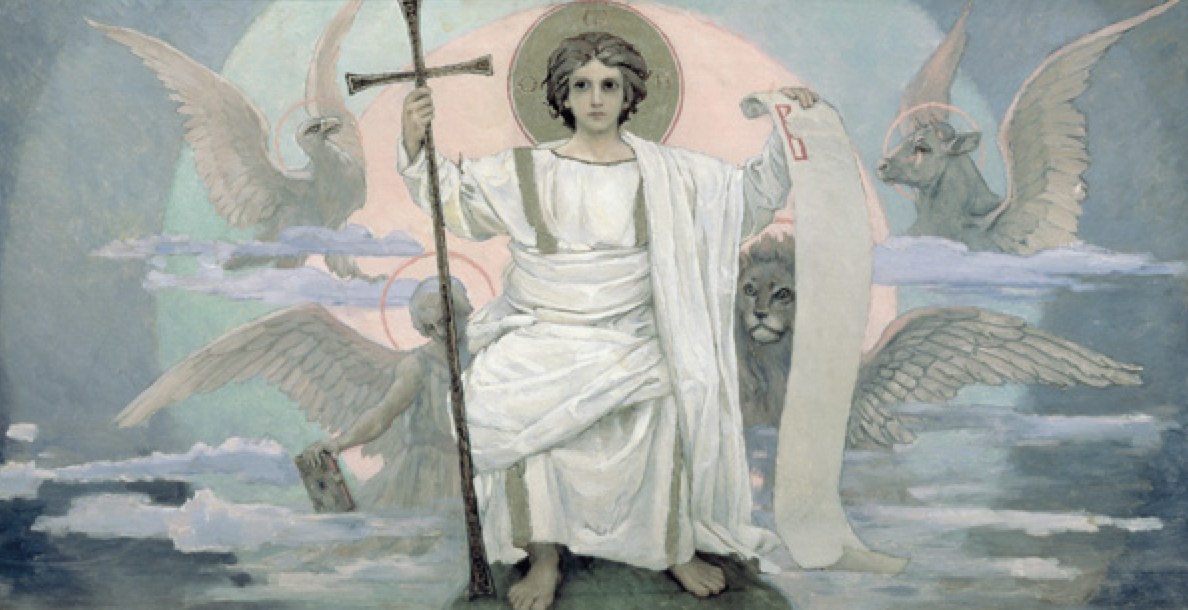
The Cosmic Christ. (Bridgeman Art Library)
Realized Eschatology
Colossians is one of a handful of New Testament documents to emphasize what theologians call “realized eschatology,” the belief that blessings and benefits associated with the end times are available already in this present life. In this regard, the letter may be compared with the Gospel of John and especially with the letter to the Ephesians.
Colossians presents what God has done as a completed action, with immediate consequences for those who believe in Christ. The emphasis is on what has already transpired rather than on what is still to come: believers have already been rescued from the power of darkness (1:13); they have already been transferred to the kingdom of God’s beloved Son (1:13); they have already been raised with Christ (2:12; 3:1). The spiritual powers that might oppose them have already been disarmed, and Christ has already made a public display of his triumph over them (2:15). This last reference draws upon the image of Roman conquerors parading their vanquished foes through the streets after winning a decisive victory. We might have guessed that a biblical author would use this image to describe something scheduled to occur on judgment day or in the interim following Christ’s return (see 1 Cor. 15:23-26), but Colossians says that it has already occurred. When? Colossians is not primarily concerned with temporal chronology (cf. 1 Cor. 15:23-24; 2 Thess. 2:2-3); the point could be that this public triumph is something that has already occurred—in the future! Realized eschatology typically adopts an eternal perspective rather than a historical one, and from the perspective of eternity, what is still future to us may be regarded as accomplished. The point, at any rate, is to stress the absolute certainty of God’s accomplishment, an appreciation of which impacts life in the present.
The claim that the Colossians “have been raised with Christ” (2:12; 3:1) is likewise meant in a spiritual sense: believers still live on the earth and must be concerned about life and relationships within the structures that this world affords (3:18-4:1). Their status as people who have already been raised is something that is currently “hidden” (3:3) and that will be revealed only when Christ returns (3:4); it is experienced in the present “through faith” (2:12). The point seems to be that the Colossians should count their resurrection with Christ as an assured reality that defines their values and shapes their life decisions (3:1-3) even though it may appear to be still future from the pedantic perspective of human history.
The specific point of emphasizing realized eschatology in the Colossian context is to assure these readers that no power in the universe is able to affect believers who have put their trust in Christ. The elemental spirits may control destinies in this world (that point is not argued), but those who have been baptised into Christ have died and been raised to a new life in a kingdom that lies beyond those spirits’ jurisdiction (1:13).
Knowledge and Maturity
There is a notable emphasis in Colossians on growth in knowledge and on developing spiritual maturity (1:9-10, 28; 2:2; 4:12). Does this emphasis imply that the Colossians are particularly ignorant or especially immature (cf. 1 Cor. 3:1-3)? To the contrary, the ironic point made throughout this letter is that the Colossian Christians have already learned everything they need to know (1:7; 2:6-7); the gospel itself is growing and bearing fruit in them (1:5-6), and if they just remain steadfast, Christ will present them to God as “holy and blameless and irreproachable” (1:22-23)—it would be hard to become more “mature” than that! They have come to fullness in Christ (2:10), in whom the fullness of God dwells (1:19; 2:9).
The issue, perhaps, is that proponents of the philosophy that the letter seeks to counter are advocating programs and practices that will enable these believers to reach a more advanced level in their spiritual development. But in Christ, the Colossians already have “all the treasures of wisdom and knowledge” (2:3). The new ideas have “only an appearance of wisdom” with no real value (2:23). Those who promote such things are “puffed up without cause by a human way of thinking” (2:18), and the failure of their program becomes clear when one looks at the results: it has led these supposedly advanced spiritual people to condemn (2:16) and disqualify (2:18) those whom God has redeemed (1:14) and reconciled (1:21).
Real growth comes from God (2:19; cf. 1:6; 3:10): the body grows, and one need only stay a part of that body to grow to full maturity. The body is the church, with Christ as its head (1:18, 22, 24; 2:17, 19; 3:15). Growth and maturity, according to Colossians, involve not the discovery of anything new but rather continuing in Christ and remaining steadfast with regard to what they have been taught (2:6-7). Such maturity becomes evident in the fruit that it bears: lives worthy of the Lord, marked by good works (1:10; cf. Eph. 4:1). Christian maturity leads not to judging others but rather to love and peace and thanksgiving (3:14-15; cf. 2:2).
The latter portion of Colossians explicates some specific consequences of growth in knowledge and maturity (3:1-4:1). The vices to be avoided (3:5, 8–9) are exemplary of an old way of being human that the Colossians are to “strip off,” and the virtues to be exhibited (3:12-15) are exemplary of a new way of being human with which the Colossians are to clothe themselves (3:9-10). This metaphor of taking off and putting on clothing invokes the image of early Christian baptisms, in which the initiates shed their garments and then were clothed with a new white robe to symbolize their transformed identity in Christ. The new humanity granted in baptism affects relationships, for there is no longer to be any discrimination on the basis of origin or status (3:11). Thus, Colossians concludes with what may be our earliest example of a Christian Haustafel (“household table”): the family and social relationships that mark the daily lives of believers are to be conducted under the lordship of Jesus Christ.
Colossians 2:14 uses a memorable image for how God forgave human trespasses (2:13) through Christ’s death. When a person was crucified, the Roman executioners would attach a list of the condemned person’s crimes to the cross. Colossians says that the record of human failings—the list of all accusations that could be brought against human beings—was “nailed to the cross” of Christ. This is a colorful way of saying “Jesus died for our sins.” See also Colossians 1:14, 20, 22.
The letter continues by turning to ethical implications of the recipients’ status in Christ (3:1-4:6). The Colossians should focus completely on the heavenly kingdom to which they now belong, reject practices that marked their life before Christ, and pursue conduct that befits God’s chosen ones (3:1-17). A specific table of household duties spells out responsibilities of wives, husbands, children, fathers, slaves, and masters (3:18-4:1). They should devote themselves to prayer and exercise wisdom in their relations with outsiders (4:2-6). The letter concludes with instructions and greetings (4:7-17) and with a final greeting from Paul in his own hand (4:18).
Colossians begins with a typical salutation and greeting (1:1-2). A prayer of thanksgiving for the readers’ faith and love emphasizes that the gospel that they heard from Paul’s fellow servant Epaphras has been growing in them and bearing fruit (1:3-8). The authors (identified as Paul and Timothy) continue to pray that the Colossians might be filled with knowledge of God’s will, grow in knowledge of God, and be strengthened by God, who is responsible for their current position and status (1:9-14). This opening prayer segues into a liturgical meditation on the magnificence of Christ as the “firstborn of all creation” and the “firstborn from the dead.” Christ is “the image of the invisible God” and the one in whom “the fullness of God was pleased to dwell”; all things were created in him and through him and for him, and in him all things hold together (1:15-20).
The letter goes on to present theological implications of the foregoing exposition of who Christ is and what he has done (1:21-2:23). The Colossians are assured of their perfection before God, provided they continue in the faith, and it is to this end that Paul has been willing to suffer and toil on their behalf, in accord with his commission from God to make known the mystery of “Christ in you, the hope of glory” (1:21-2:7). The Colossians are then warned about being deceived by empty philosophy that suggests that their baptism into Christ has been inadequate to secure their position with God or that religious observances or experiences will enable them to grow into the fullness that is found in Christ alone (2:8-23). Such philosophy is denounced as representing mere human tradition (2:8, 22) and as being in accord with spiritual powers that Christ has vanquished (2:8, 15, 20).
Colossians.
Related Concepts
- christs-triumph
- church-as-body
- colossian-heresy
- community-ethics
- creation-through-christ
- cross
- development-of-pauline-thought
- early-church-reception
- ecological-responsibility
- elemental-spirits
- ethics-of-the-new-life
- false-philosophy
- firstborn-of-all-creation
- forgiveness-of-trespasses
- greek-style
- hebrew-scripture-allusions
- hidden-life-in-christ
- holy-family
- mystical-ascent
- new-humanity-without-discrimination
- preeminence-of-christ
- putting-off-and-putting-on
- raised-with-christ
- relation-to-ephesians
- relation-to-philemon
- rulers-and-authorities
- setting-the-mind-on-things-above
- spiritual-gifts
- unity
- vice-and-virtue