New Testament — Topic 26
Philippians is studied by scholars as a theological resource that deals with complex topics such as incarnational Christology and the meaning of suffering, and it is expounded by preachers as a motivational tract that encourages humility and harmony. Still, it is perhaps valued most highly at a popular level as an inspirational example of Christian optimism. Many individual verses stand out as favorites in the canons of Christian piety. Early in this letter, Paul promises the Philippians, “The one who began a good work among you will bring it to completion by the day of Jesus Christ” (1:6). Then, at the close, he asserts, “My God will fully satisfy every need of yours according to his riches in glory in Christ Jesus” (4:19). Along the way, he confesses his own confidence: “I can do all things through him who strengthens me” (4:13). And he assures the Philippians, “The peace of God which surpasses all understanding will keep your hearts and minds in Christ Jesus” (4:7). We know from other letters that Paul was not always this cheerful or congenial (see 2 Cor. 2:4; Gal. 3:1-3), but Philippians stands as a testimony to his transcendent confidence and hope. The affirmative, perhaps idealistic, outlook of Paul’s letter to the Philippians is summarized in one verse, where he urges his readers to focus on positive aspects of life and faith:
Whatever is true, whatever is honorable,
whatever is just, whatever is pure,
whatever is pleasing, whatever is commendable,
if there is any excellence
and if there is anything worthy of praise,
think about these things. (4:8)
Paul’s letter to the Philippians is addressed to Christians in the Roman colony of Philippi, a medium-sized farming community whose unpretentious appearance was no measure of its ultimate significance in world history. Philippi is located in what is now northern Greece, about one hundred miles east of Thessalonica. In Paul’s day, both of those cities belonged to the Roman province of Macedonia. Thessalonica was the capital, but Philippi was also an important site because, like Thessalonica, it was a stop along the Via Egnatia, a Roman road that stretched from the Bosphorus Strait across modern- day Bulgaria, Greece, and Albania to the Adriatic Sea. Philippi was also just ten miles inland from Neapolis, the eastern port through which people (and goods) from Asia came into Macedonia when arriving by sea. Thus, the town of Philippi, though surrounded by farmlands, was located at the junction where the route inland from the sea connected with the major thoroughfare of the Via Egnatia.
Some four hundred years before Paul, Philip II (the father of Alexander the Great) had conquered this area, and in naming Philippi after himself, he must have had a sense of the city’s potential importance. The Romans took over two centuries later, and then in 42 BCE Philippi earned renown as the site where Marc Antony and Octavian (later to become Caesar Augustus) defeated Brutus and Cassius, the assassins of Julius Caesar. Veterans of the victorious armies were settled here, and Philippi became something of a retirement community for military personnel, a pleasant haven where former soldiers could enjoy a decent standard of living augmented by conferral of Roman citizenship and consequent exemption from all taxes. Of course, not all of the population would have been so blessed, but the value that came to be placed on Roman citizenship in this locale (see Acts 16:37-38) adds poignancy to Paul’s comment in Philippians that Christians enjoy a far greater citizenship “in heaven” (3:20; cf. 2 Cor. 5:1-2).
Then, around 50–51 CE, something happened that no one had seen coming but that determined what would become the city’s greatest claim to fame. The apostle Paul arrived and founded a very small church. Why is that so important? It was the first church on European soil (cf. 4:15). As a result, to this day, Philippi is known less for being the site of a famous battle than for being “the birthplace of Western Christianity.” According to the book of Acts, Paul and his companions first brought the gospel to Europe in response to a vision that Paul had of a Macedonian man pleading for help (Acts 16:6-10). They landed at the port of Neapolis, traveled up to Philippi, and remained there for “some days” (Acts 16:11-12). Paul’s own letters reveal that he would remember those days as a time of suffering, when he and his co-workers were “shamefully mistreated” (1 Thess. 2:2; cf. Acts 16:16-40). Nevertheless, his converts in the city proved exceptionally loyal, supporting him financially as he ministered elsewhere (Phil. 4:10, 16; 2 Cor. 11:8-9) and contributing to his collection for Jerusalem in ways that exceeded all expectations (2 Cor. 8:1-4; 9:1-5). His letter to them is written to acknowledge receipt of yet another gift, for now they are supporting him in his time of imprisonment (Phil. 4:10, 18).
We would love to know more about the particular circumstances under which Paul wrote to the Philippians, but details escape us. All that we know for certain is that he is in prison (1:7, 13–14, 17). When might this have been, and where? Paul appears to have experienced some such captivity in Ephesus (1 Cor. 15:32; 2 Cor. 1:8-9), in Caesarea (Acts 23:23-26:30), and in Rome (Acts 28:16-31). Since in Philippians he mentions the “imperial guard” (1:13) and “the emperor’s household” (4:22), many readers think that he is writing to the Philippians from Rome, but such terms could be used to refer to authorities in other cities as well. Since he indicates there is a good deal of back-and- forth travel between Philippi and his current location (2:19-28), many think that he is in Ephesus (about a one-week journey from Philippi), but longer trips between Philippi and either Rome or Caesarea are also feasible. To complicate matters further, it seems likely that Paul was in prison in other locations and at other times as well (see 2 Cor. 11:23, which mentions multiple imprisonments in a letter written before Paul was jailed in Caesarea or Rome). Scholarship remains divided on the question of where (and when) Paul wrote this letter. The lack of resolution is frustrating to those who want to place Paul’s letters in chronological order and trace the development of themes from one letter to the next. It is, however, a matter of little concern for understanding the letter to the Philippians in its own right. If Philippians was written from Ephesus, it is one of Paul’s earlier letters (ca. 54–56); if from Rome, it is one of his last (ca. 61–63 [a letter from Caesarea would be dated ca. 58–60]). We wish that we knew which was the case, but either way, the messages that Paul wants to convey in the letter are fairly clear.
We may note in passing a couple of oddities about the letter. One section (3:1b–4:3) has a markedly different tone than the rest (warnings against enemies in a letter that is otherwise happy and upbeat). And one passage seems to indicate that Epaphroditus has just arrived (4:18), whereas another implies that he has been with Paul for a considerable period of time (2:25-30). For these and other reasons, some scholars wonder if the letter in our possession might be a composite of two or three letters that Paul wrote to the Philippians.
Nevertheless, the letter as we have it fits the general form for what is called a “friendship letter.” Paul’s main purpose in writing may be simply to update his friends and ministry partners on his personal situation (1:12-26), to ease their minds with regard to the health of Epaphroditus (2:25-30), and to thank them for the gift that Epaphroditus delivered (4:10-20). He offers words of consolation as an antidote for any discouragement that they might be feeling over his imprisonment or their own suffering. Intertwined with such concerns is some teaching on matters relevant to the church’s situation, so that they will not be intimidated by their enemies (1:28), led astray by false teachers (3:2), or hindered by internal dissension (4:2-3). It is possible that the emphasis on joy has been prompted by such concerns: Paul stresses positive responses to the gospel not because he happens to be feeling particularly happy or confident at this point in time, but rather because this church is in danger of allowing anxiety to get the better of them. The matters provoking such anxiety are not trivial, and Paul is willing to deal with them. Nevertheless, most scholars think that the primary focus of the letter is not on addressing problems but on cementing and celebrating the relationship that Paul enjoys with the Philippians in Christ.
Rejoice in the Lord always!” Paul exclaims in what is probably his most upbeat letter. “Again, I will say, rejoice!” (Phil. 4:4). This brief letter to the Philippians not only contains a magnificent example of what may have been an early Christian hymn (2:6-11) but also is laced with happy and confident passages just begging to be turned into gospel choruses for rousing revival meetings or amusing ditties for kids at summer camp. There is, of course, much more to the letter. “Beware of the dogs … who mutilate the flesh” (3:2). No one ever turns that into a camp song. But, on the whole, Philippians is a positive and upbeat letter. Prominent topics include friendship (1:3, 7–8; 4:1, 15), contentment (4:11-12), thanksgiving (1:3; 4:6), peace (4:7, 9), joy (1:4, 18; 2:2, 17–18, 28, 29; 3:1; 4:1, 4, 10), unity (1:27; 2:2, 14; 4:2), spiritual growth (1:6, 9–11, 25; 2:12-13; 3:12-15), perseverance (1:27; 2:16; 3:16; 4:1), and the certainty of answered prayer (1:3-6, 19; 4:6, 19).
The tone of this letter is all the more remarkable when we consider that it was written from prison. Paul is under arrest (1:7, 13–14, 17), and he realizes that this time he might not get off with a beating (cf. 2 Cor. 6:4-5; 11:23-24). The end of his life could be near (1:20), but that prospect does not extinguish his enthusiasm. He has given up everything for Christ, and he regards as mere rubbish things that many people would value (3:7-8). He has long since learned to be content in any and every circumstance (4:11-12), including, apparently, prison. What is death to a person whose goal (3:12) is to know the power of Christ’s resurrection and to attain resurrection from the dead (3:10-11)? For such a person, living can only mean continuing to serve and love Christ, and dying can only bring gain (1:21).
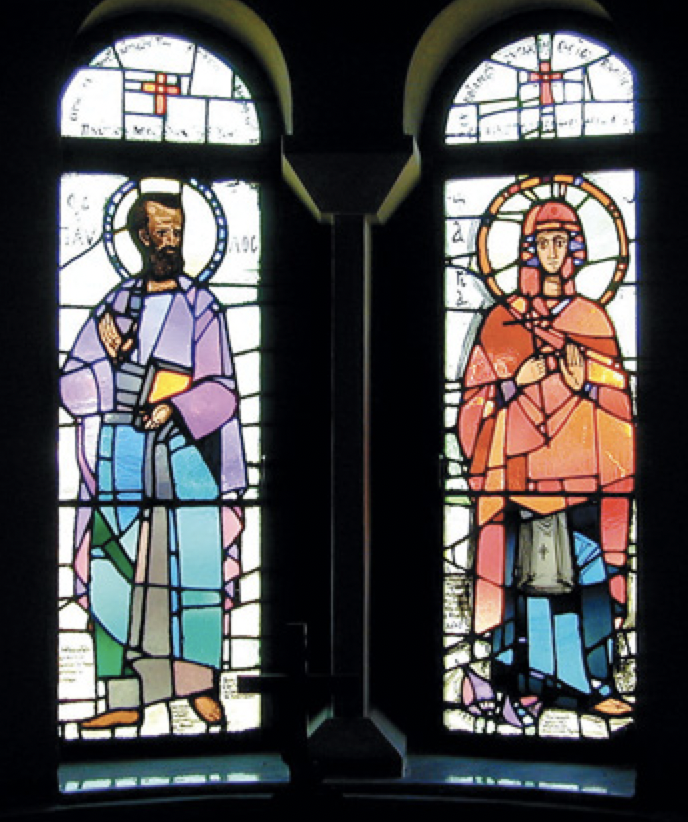
Paul and Lydia. According to the book of Acts, Paul’s first convert in the city of Philippi was a woman named “Lydia,” whom he met at a prayer meeting by a river (16:11-15). A dealer in textiles (“purple goods”), Lydia apparently was a wealthy woman, and she hosted Paul and his missionary team while they worked in the city. These stained-glass windows of Paul and Lydia appear in a modern church in Philippi; the two are remembered as co-founders of the congregation.
- Introduction
- Overview
- Historical Background
- Major Themes in Philippians
- Conclusion
Incarnation
In Christian theology, the term incarnation refers to the doctrine that Jesus was God come to earth as a human being. The key biblical passages for this doctrine are John 1:1-18 and Philippians 2:6-11. The passage in Philippians is particularly interesting because it is so early, indicating that Christians had some notion of incarnation before any of the Gospels were written. Indeed, if Paul is quoting from liturgical materials already in existence by this time, then the idea is even earlier.
The passage describes the career of Christ Jesus in three stages:
· first, he was in “the form of God” (2:6);
· second, he was born in human likeness, and he lived and died as a human being (2:7-8);
· third, he was exalted by God to be Lord of all (2:9-11).
preexistence: the Christian doctrine that Christ existed (in the form of God) before he became the man Jesus who lived and died on earth.
Theologians discuss and debate many details of what Paul intends to say in this passage, but most recognize that the text contains one of the earliest references in Christian literature to the concept of preexistence—that is, the idea that Christ existed (in the form of God) before he became the man Jesus who lived and died on earth. Christ is God and man in one person. This is the fundamental idea that constitutes the essence of Christianity.
The Christ Hymn
The most celebrated passage in Paul’s letter to the Philippians is 2:6-11, often called the “Christ Hymn.” Its poetic quality marks it as material that probably was used in early Christian worship as a creed or responsive reading or, indeed, as an actual hymn that was put to music and sung or chanted. Paul might have composed the piece himself, or he might be quoting material familiar to the Philippians from their liturgy.
Here is one of several ways in which the text might be arranged in verses that resemble a modern hymn:
Though he was in the form of God
He did not regard equality with God
As something to be exploited
But emptied himself
Taking the form of a slave
Being born in human likeness
And being found in human form
He humbled himself
And became obedient unto death
—even death on a cross!
Therefore, God also highly exalted him
And gave him the name
That is above every name
So that at the name of Jesus
Every knee should bend
In heaven and on earth and under the earth
And every tongue should confess
That Jesus Christ is Lord
To the glory of God the Father.
The focus of the hymn is on Christ Jesus (2:6), but it celebrates his career with allusions to the Old Testament. The voluntary humiliation of Christ in the first part draws upon Isaiah 52:13-53:12, and the universal submission to him at the end quotes from Isaiah 45:23 (cf. Rom. 14:11). Also, Christ’s willingness to give up his “equality with God” may be seen as a contrast to Adam’s desire to attain equality with God in Genesis 3:1-7 (cf. Rom. 5:12-19).
Around the year 110, Pliny the Younger, a Roman governor, wrote a letter to the emperor Trajan to inform him of Christians. He said that when Christians gather at their meetings, they “chant verses alternately amongst themselves in honor of Christ as if to a God” (Epistolae 10.96). The “Christ Hymn” of Philippians 2:6-11 seems like a perfect example of the sort of liturgical material that this Roman governor heard the Christians using.
In Christian theology, the concept of incarnation would raise questions about the nature of Christ and of God: How can there be only one God if Jesus has “the form of God” and “equality with God” (2:6)? Why do Christians worship Jesus and say that he is their Lord (2:10-11; cf. Rom. 14:11)? In terms of official doctrine, Christians would not sort these things out for hundreds of years, finally reaching tentative agreements at the councils of Nicea in 325 and Chalcedon in 451. At those meetings, churches endorsed views that are now called “the doctrine of the Trinity” and “the doctrine of the two natures of Christ.” But Paul’s letter to the Philippians reveals that the sentiments that were later worked out intellectually were being expressed in Christian devotion and worship from a very early time.
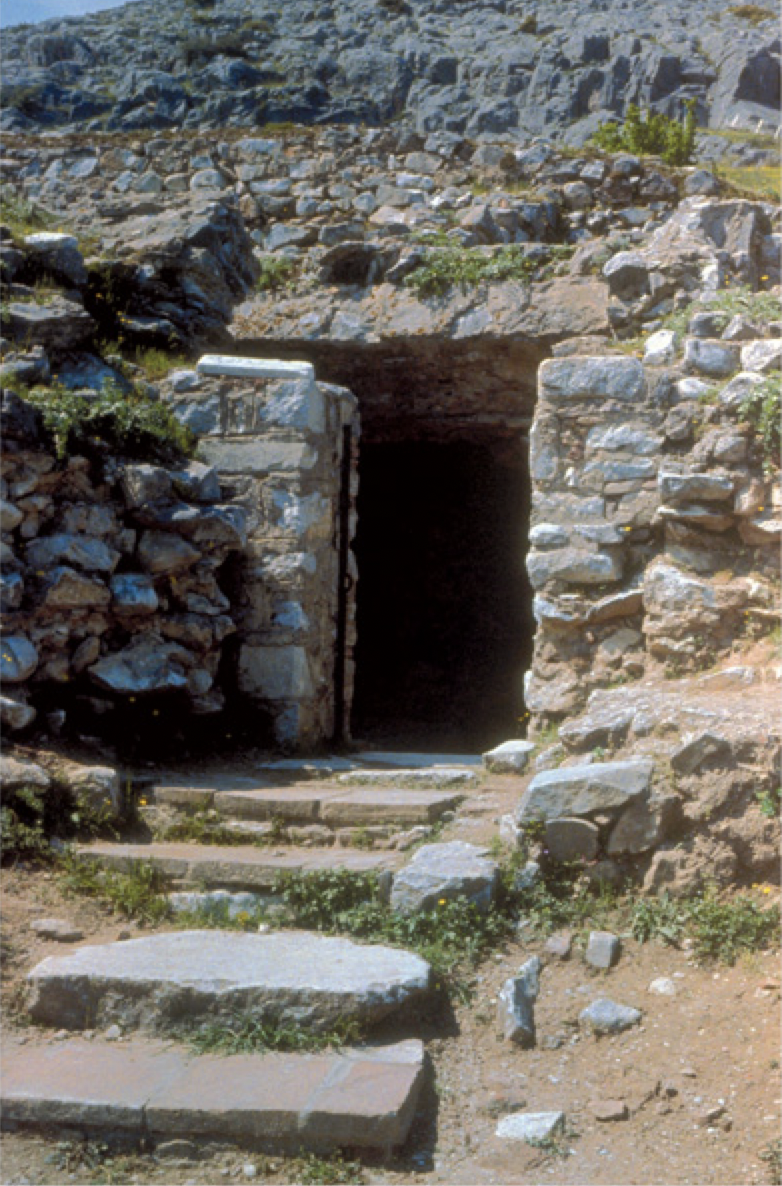
Philippian Jail. Paul’s letter to the Philippians is written from prison (in Ephesus or Colossae or Rome), but Paul also spent a night in jail while he was in Philippi (see Acts 16:12-40). This picture shows a cell in the ancient city similar to the one in which Paul would have been kept. Most jails at the time were dark chambers in which prisoners could be held until their trial. Prisoners often were kept in chains for additional security.
Humility
Paul urges the Philippians to do nothing out of selfish ambition but rather to place the interests of others ahead of their own (2:3-4). He calls this self- effacing attitude “humility” (2:3), which is not to be equated with low self- esteem (thinking ill of oneself). Humility refers to putting others first and consciously seeking what is best for others rather than what is best for oneself. This is closely connected to what Paul means by “love” (Rom. 12:10; 14:15; 1 Cor. 13:4-7; Gal. 5:13; cf. Phil. 1:9, 16; 2:1-2), and it is also closely connected to what he means by people having “the mind of Christ” (1 Cor. 2:16; cf. Rom. 12:2; Phil. 2:5). The promotion of humility as a defining mark of Christian character runs through all of Paul’s letters, but it seems to receive special attention in Philippians. Indeed, most of the letter can be read in light of this theme.
Euodia and Syntyche
Near the close of his letter to the Philippians, Paul urges two women, Euodia and Syntyche, to “be of the same mind in the Lord,” and he appeals to someone else in the church (his “loyal companion”) to help them (4:2-3). The women were co-workers of Paul, and apparently they have had a falling out. This could be a personal matter—a spat that requires an impartial mediator to help facilitate conflict resolution. Or, since the women appear to be prominent in the church (4:3), they could be leaders of major factions with different ideas on congregational policies and programs. Their inability to see eye to eye could pose a threat to the unity of the church as a whole. Some interpreters think the rift between Euodia and Syntyche might be a primary reason for Paul’s attention to the themes of unity and humility throughout the letter. Although he does not address the two women by name until the end, other verses perhaps are quietly addressed to them and to their followers as well (see 1:27; 2:1-5, 14–15; 3:15-16).
The reason Paul quotes from the “Christ hymn” (2:6-11) in this letter is to remind the Philippians of the all-time best example for humility: Christ Jesus did not exploit his prerogatives as one who was equal with God but rather “emptied himself” and “humbled himself” by becoming human. And he didn’t just become human: he became obedient unto death. And he didn’t just become obedient unto death: he became obedient unto death on a cross (2:6-8). “Let the same mind be in you,” Paul tells the Philippians (2:5). Christ Jesus is the ultimate paradigm for one who puts the interests of others first, and his followers are to emulate him in this regard (cf. Mark 8:34; 10:43-45). To show that it can be done, Paul cites other examples: Timothy shows a genuine and unselfish interest in the Philippians’ welfare (2:19-24), and their own Epaphroditus risked everything for the sake of others (2:25-30). And Paul himself can be their role model (3:17; 4:9): he rejoices when his rivals succeed, as long as Christ is preached (1:17-18); when he considers matters of life and death, it is with regard to what will prove most fruitful for others (1:22-25); he rejoices that the Philippians have sent him a gift, not because he needs the money but rather because they will profit from having shown such kindness (4:14, 17, 19). Just as Christ Jesus emptied himself for the sake of humanity, Paul is willing to be poured out as a sacrifice for the Philippians (2:17). He gives up his legitimate reasons for claiming earthly honor in a way that echoes Christ’s decision not to exploit a much greater divine honor (3:4-8). Paul feels that he can invite the Philippians to imitate him in this regard because he knows that he is imitating Christ (3:17; cf. 1 Cor. 11:1).
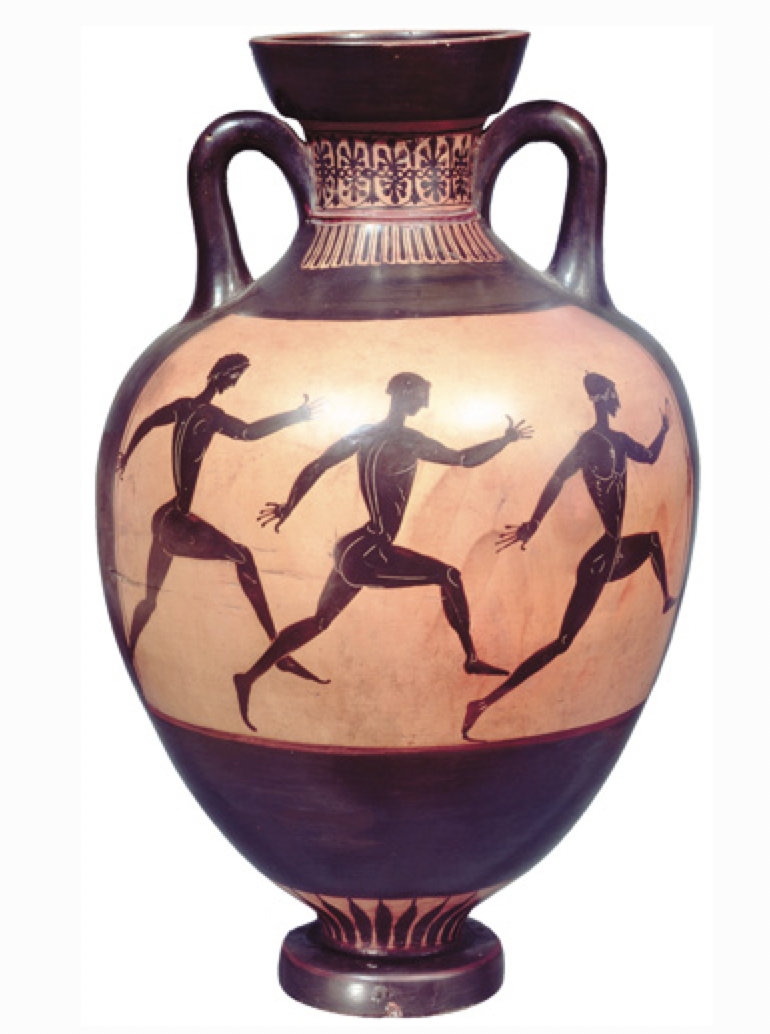
Running for the Prize. Track and field events were especially popular in the Greco-Roman world. In Philippians, Paul uses the analogy of a footrace to speak of the perseverance that attends the Christian life. A runner must move forward with single-minded focus on the prize; in the same manner, the believer is drawn toward God in Christ, forgetting what lies behind and pressing on toward the heavenly goal. (Bridgeman Art Library)
Paul accompanies his plea for humility with a promise of ultimate exaltation. God exalted Christ Jesus (2:9-11), and Paul’s hope likewise is in the power of Christ’s resurrection (3:10-11). His call to put others ahead of self-cuts against the grain of conventional wisdom but is grounded in a sublime paradox recognized in many strands of early Christian tradition: those who humble themselves will be exalted (Matt. 23:11-12; Luke 14:11; 18:14; James 4:10; 1 Pet. 5:6).
Suffering __
Philippians offers some reflection on the inevitability and potential value of human suffering. The main point is simply that although Christians suffer on account of their faith, they will ultimately be united with Christ in a world beyond death (1:21, 23, 28; 3:10-11, 14, 20–21; cf. Rom. 8:18). Paul knows that the Philippians are experiencing opposition to their faith (1:27-29). He reminds them that he suffered the same when he first came to them (1:30) and, of course, that he is suffering still as a prisoner for Christ (1:17). Paul does not try to answer the question of why such bad things happen to good people; he simply recognizes that they do, and he encourages hope in the promise of ultimate vindication (3:14, 20–21; 4:19). Beyond this, however, he does indicate that suffering can have positive effects (cf. Rom. 8:28). His imprisonment has actually served to advance the gospel by emboldening others and providing even his captors with an inspiring and powerful testimony to Christ (1:12-14). And there is more. In some undefined way, Paul thinks that Christians who suffer for their faith are actually sharing in the suffering of Christ (3:10). The experience bonds them to Christ in a way that makes them “like him in his death,” which in turn enables them to know the power of his resurrection (3:10-11). For this reason, Paul tells the Philippians that they may view their suffering for Christ as a favor from God: it is a privilege that God has granted them (1:29; cf. Acts 5:41).
Bishops and Deacons
Paul mentions “bishops and deacons” in his opening salutation to the Philippians (1:1). Much more is said about the qualifications and responsibilities of persons holding such church offices elsewhere in the New Testament (1 Tim. 3:1-13; Titus 1:7-9). We do not know, however, that the terms meant the same thing in every locale. The word bishop (episkopos) means “overseer,” and the word deacon (diakonos) means “one who serves.” At the time Paul wrote to the Philippians, these words may have been fairly generic designations for church leaders rather than technical terms for particular orders of clergy.
Fellowship
Paul stresses Christian “fellowship” (in Greek, koinōnia [used in 1:5; 2:1; 3:10]) in this letter, first with regard to the fellowship that he shares with the Philippians, and second with regard to the fellowship that he wants them to have with one another. Scholars have often noted that this letter exhibits a strong penchant for Greek words that begin with the prefix syn- (meaning “together” or “with,” similar to the English prefix co-). Paul attaches this prefix to all sorts of words throughout the letter, to verbs such as “struggle” (1:27; 4:3) and “rejoice” (2:17, 18) and to nouns such as “sharer” (1:7), “soul” (2:2), “soldier” (2:25), and “imitator” (3:17). In 4:3, four different words bear the syn- prefix, such that the verse might be translated, “I urge you, my co-companion, to co-assist these women, for they have co- struggled with me in the gospel, together with Clement and the rest of my co- workers.” Clearly, Paul wants to emphasize for the Philippians that “we are all in this together.” No other church has shared with him in “the matter of giving and receiving” like this one (4:15); they are his partners in the gospel (1:5) who share in God’s grace with him (1:7).
In other letters, Paul often describes his relationship with the recipients as that of a father addressing his children (1 Cor. 4:14; 2 Cor. 6:13; 12:14; Gal. 4:19; 1 Thess. 2:11; cf. Philem. 10); in this letter, Paul repeatedly refers to the Philippians as his siblings (1:12, 14; 2:25; 3:1, 13, 17; 4:1, 8, 21), and he speaks of their relationship as a partnership (1:5). He emphasizes that as faithful followers of Christ, they have had common experiences (1:29-30), and as fellow citizens of heaven, they share a common hope and destiny (3:20). Indeed, he seems to feel that they are “with him” in his imprisonment (1:7), sharing now in his distress (4:14) as they have shared (and continue to share) in his joy. They are each other’s cause for joy (2:17-18; 4:1). Still, Paul says that his joy will be complete only when they come to experience the same level of accord with one another that they have experienced up to now with him (2:2).
The letter opens with a customary but brief salutation (1:1-2) and a report of Paul’s prayers of thanksgiving for the church (1:3-11). Paul then fills the Philippians in on the circumstances regarding his current imprisonment: it has served to advance the gospel (1:12-18), but he looks forward to being set free in response to their prayers (1:19-26). After these preliminaries, he offers an extended appeal for humility and unity in the church (1:27-2:18): they are to live in a manner worthy of the gospel even though this means suffering (1:27-30), and they are to follow the example of Christ Jesus in setting aside personal interests for the sake of others (2:1-18). Embedded in this appeal is a poetic account of how Christ “emptied himself” for the sake of humanity and was subsequently exalted by God to become Lord of all (2:6-11). Paul then discusses his hopes for future visits to the church and provides an update on the status of one of their members, Epaphroditus, who became ill while visiting Paul (2:19-30). At this point, the letter seems to be winding down (3:1), but instead of concluding, Paul launches into another major appeal, warning the Philippians against false teachers and calling on them to imitate him as one who suffers for Christ in hope of the resurrection (3:1-4:1). Embedded in this appeal is a brief autobiographical section in which Paul lists personal attributes and achievements that might be considered badges of honor in the Jewish world, but that he denounces as “rubbish” for the sake of knowing Christ and obtaining the righteousness of God that comes through faith (3:4-11). Then, he offers a series of pastoral exhortations (4:2-9), expresses his thanks to the church for the concern and support that they have offered him (4:10-20), and concludes with final greetings (4:21-23).
Philippians.
Related Concepts
- 1-corinthians-216
- 1-timothy-3
- annunciation
- athanasius
- body-of-christ
- christian-optimism
- church-order
- day-of-jesus-christ
- early-christian-worship
- ecumenical-councils
- epaphroditus
- euodia-and-syntyche
- exaltation
- historicity-of-revelation
- humility
- imitation-of-christ
- imprisonment-of-paul
- incarnation
- isaiah-4523
- john-114
- joycontentment
- kenosisself-emptying
- koinoniafellowship
- letter-form
- literary-criticism
- lordship-of-christ
- measure
- obedience
- on-the-incarnation
- only-begotten-son
- partnership
- partnership-in-the-gospel
- pauline-epistles
- pauline-theology
- peace-of-god
- perseverance
- philippi
- philippian-church
- philippians-3
- preexistence
- pride
- provenance
- resurrection
- roman-citizenship
- self-giving
- shared-joy
- shared-suffering
- suffering
- titus-1
- unity
- unityconcord
- virtue
- worship-of-jesus