New Testament — Topic 25
Other distinctive themes in Ephesians include an emphasis on growth in knowledge (1:17-18; 3:5, 18; 4:17-24; 5:10, 17) and on speaking the truth (4:15, 21, 25; 5:9, 11–14; 6:14). Ephesians also has a more liturgical feel than any epistle except Hebrews and 1 Peter; it strikes many as being saturated with the language and practice of prayer (1:13-14, 16–19; 3:13-21; 5:19-20; 6:18-20). The word agapē (“love”) is used more often here than in any letter except 1 Corinthians and 1 John (see 1:4, 15; 2:4; 3:17, 19; 4:2, 15, 16; 5:2; 6:23; also, the verb “to love” in 5:25, 28, 33; 6:24).
Some have noted a penchant in Ephesians for describing the Christian position with reference to body posture. With regard to the heavenly kingdom, believers are seated (2:6; cf. 1:20), fully at rest because they are saved by grace and their position in paradise is assured. With regard to this world, believers are exhorted to walk, actively moving toward the goal of holiness that is their destiny (the Greek word for “walk” [peripateō] is translated “live” by the NRSV and other English Bibles in 4:1, 17; 5:2, 8, 15; cf. 2:2, 10). And, finally, with regard to the devil, believers are called to stand (6:11, 14), holding firm against the opposition, clothed in God’s armor and shielded by faith (6:10-17).
Ephesians is different in certain ways from what are called Paul’s “undisputed letters.”
Distinctive Wording
· It contains extremely long sentences (in Greek 1:3-14 is one sentence, as are 1:15-23; 3:1-7).
· It makes repetitive use of adjectives and synonyms (1:19 uses four words for “power”).
· It makes abundant use of the word all (about fifty times).
· It uses “devil” (4:27; 6:11) instead of “Satan” (Rom. 16:20; 1 Cor. 5:5; 7:5; 2 Cor. 2:11; 11:14; 12:7; 1 Thess. 12:18).
· It refers to Paul as “least of saints” (Eph. 3:8) rather than as “least of apostles” (1 Cor. 15:19). Christ (4:11) rather than God (1 Cor. 12:28) is the one who appoints apostles, prophets, and others in the church.
· The church is the body with Christ as head (1:22-23; cf. Col. 1:18) rather than being the whole body of Christ with the head as one of its members (1 Cor. 12:20-21, 27).
· Readers are told to imitate God (5:1) rather than Paul (1 Cor. 4:6; 11:1; Phil. 3:17; but cf. 1 Thess. 1:6).
· It uses “kingdom of Christ and God” (5:5; cf. Col. 1:13) rather than “kingdom of God” (Rom. 14:17; 1 Cor. 4:20; 6:9, 10; 15:50; Gal. 5:21; 1 Thess. 2:12).
· People are “saved” by faith (2:5, 8) rather than “justified” by faith (Rom. 3:28; 5:1; Gal. 2:16; 3:24).
· It speaks of works as “good works” (2:9-10) rather than as “works of the law” (Gal. 2:16; 3:2, 5, 10, 12).
· It uses “church” for the universal church (1:22; 3:10, 21; 5:23, 24, 25, 27, 29, 32) rather than for a local congregation (e.g., Rom. 16:23; 1 Cor. 4:17; 14:23; but cf. 1 Cor. 10:32; 15:9).
· It refers to Christ as “the Beloved” (1:6), an expression not used for Christ in Paul’s undisputed letters (but cf. Col. 1:13).
· It speaks of “the heavenly places” (1:3, 20; 2:6; 3:10; 6:12) rather than simply “heaven” (1 Cor. 8:5; 2 Cor. 12:2; Phil. 3:20) or “the heavens” (2 Cor. 5:1).
· The church is built on the foundation of the apostles and prophets, with Christ as cornerstone (2:19-20) rather than on the foundation of Christ alone (1 Cor. 3:10-11).
Distinctive Concepts
· The second coming of Christ has faded in significance, since the power and glory of heaven are experienced now (1:3; 2:4-7; cf. Rom. 8:18-25; 2 Cor. 4:7-18).
· Jews and Gentiles are merged equally into a new humanity (2:14-16) as opposed to Gentiles being provisionally grafted into the tree of Israel (Rom. 11:13-21).
· Marriage is highly esteemed (5:21-23) rather than being merely allowed for the sake of controlling lust (1 Cor. 7:8-9).
· The law is said to have been abolished by Christ (2:15) rather than being described as something that the coming of faith has not overthrown (Rom. 3:31).
· The reconciliation of Jews and Gentiles is depicted as an accomplished reality (2:11-18) rather than as a future hope (Rom. 11:25-32).
· Salvation is a present reality (2:7-10) rather than a future hope (Rom. 5:9-10; 10:9, 13; 1 Cor. 3:15; 5:5; but cf. Rom. 8:24; 1 Cor. 1:18; 15:2; 2 Cor. 2:15).
· Exaltation of believers to heaven is a present reality (2:6) rather than a future hope (1 Cor. 15:23; 1 Thess. 4:16-17).
There are possible variations on these views. If Paul wrote Colossians but not Ephesians, then, as indicated above, the person responsible for Ephesians may have used Colossians as a template.
One point on which most scholars agree is that Ephesians appears to be addressed to a mainly Gentile readership (2:11-12; 3:1). The overall purpose of the letter is to offer encouragement to these believers by articulating God’s plan for them and exhorting them to fulfill the role that they have been chosen to play in that plan. The focus is on the identity of believers in Christ and in the church and in the world: the author wants his readers to realize who they are and to pursue the values and lifestyle appropriate to that identity (2:10).
The city of Ephesus is located in what is now western Turkey, across the Aegean Sea from Athens (see map above). In New Testament times it was both the capital city and the leading commercial center in the Roman province of Asia (not to be confused with the continent of Asia today). Even today, visitors thrill to see the ruins of an amphitheater that seated perhaps as many as twenty-five thousand people (possibly referred to in Acts 19:29-30), and Ephesus was also home to the magnificent Temple of Artemis (referred to in Acts 19:27), one of the fabled seven wonders of the world. It was a thoroughly Roman city that had often earned the title of neōkoros for the region, meaning that it served as the official headquarters for the imperial cult, in charge of festivities and rituals honoring and worshiping the emperor. A brief letter to the church in Ephesus is found in Revelation 2:1-7, which portrays the Christian community there as orthodox and faithful but lacking in the love and works that it had exhibited “at first.”
The book of Acts says that Paul paid a brief visit to Ephesus on his second missionary journey (18:19-21) and returned on his third journey (19:1-41; cf. 20:17-38) to spend between two and three years there (19:10; 20:31). All of Asia heard the word of the Lord (19:10), but the introduction of Christianity to this pagan setting caused “no little disturbance” among those whose livelihood depended on practices Christians denounced as demonic or idolatrous (19:23-41). Paul’s time in Ephesus usually is dated in the early-to-mid-50s, and he is believed to have written 1 Corinthians from there (possibly other letters as well). He refers to times of trouble in the city (1 Cor. 15:32; 2 Cor. 1:8), and it is often thought that he was imprisoned there for a time. He says that he had many adversaries in Ephesus, but that there was also “a wide door for effective work” that justified a considerable expense of time in this location (1 Cor. 16:8-9).
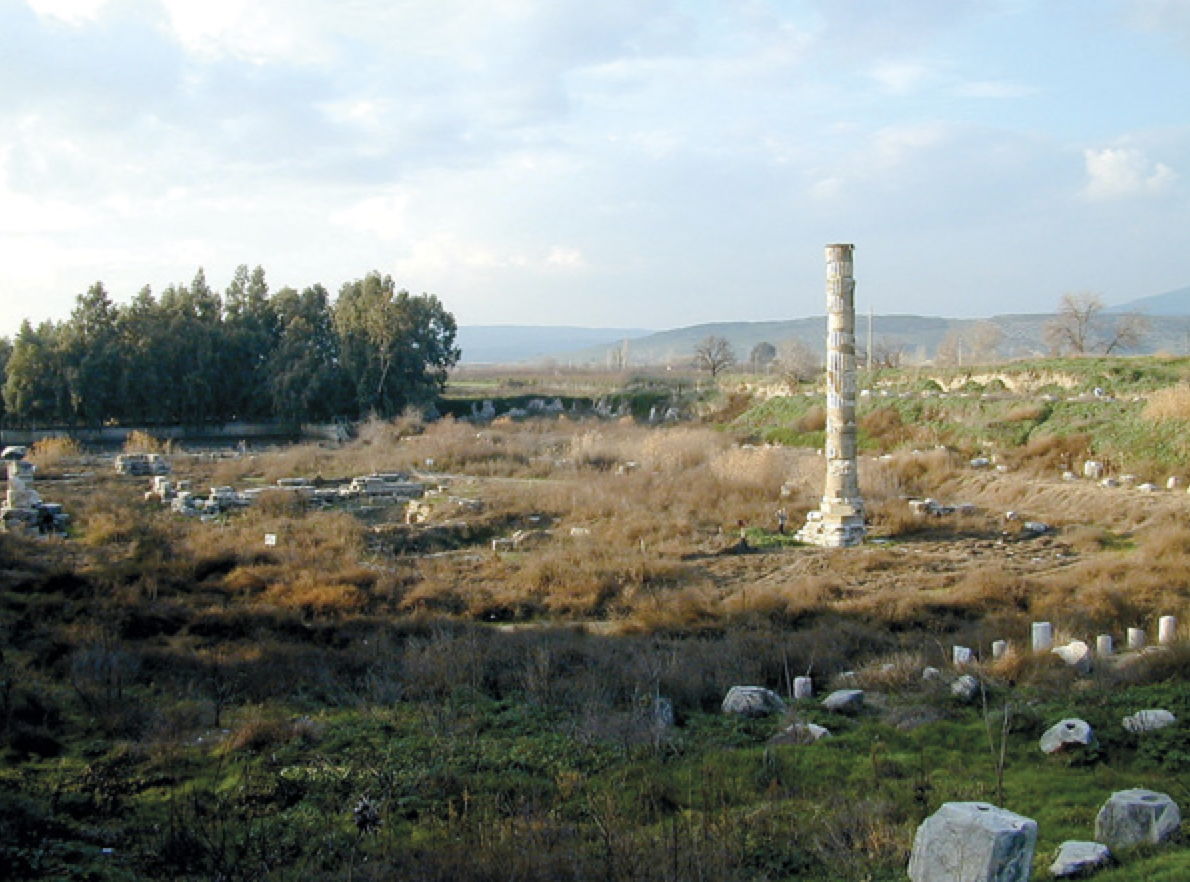
Temple of Artemis. This is all that remains of the famed Temple of Artemis, listed by Plutarch as one of the seven wonders of the ancient world. The mere suggestion that Paul’s preaching might detract from the temple’s glory caused an anti-Christian riot (see Acts 19:23-41).
Given Paul’s close association with the church in Ephesus and his relatively long tenure in the city, it is not surprising that we find a letter from Paul to “the saints who are in Ephesus” (1:1) in our New Testament. What is surprising, however, is that the contents of that letter betray no hint of that well-established relationship. There are no references to the specific circumstances of that community or to Paul’s previous ministry among them. Typically, Paul likes to reminisce about such things (e.g., 1 Cor. 2:1; Gal. 4:12-15; 1 Thess. 2:1-12). In Ephesians, there are no personal greetings to individual members of the church. By contrast, when Paul wrote to the Romans, he greeted twenty-six individuals by name (Rom. 16:3-15), and that was in a letter to a church that he had never visited. The letter to the Ephesians has an impersonal tone: Paul says, “I have heard of your faith in the Lord Jesus” (1:15; cf. 4:21) and indicates that, surely, they have also heard about him and his commission from God (3:2). Such comments suggest that the author and recipients know each other by reputation only, but in fact Paul had spent from two to three years in Ephesus as a very visible leader of that church (Acts 20:31).
We may need to look beyond the text of English Bibles to find an explanation for this curious state of affairs. The words “in Ephesus” that are found in Ephesians 1:1 in almost all English translations of the Bible actually do not appear in the oldest and most consistently reliable Greek manuscripts. If those ancient manuscripts are correct, then the letter that we call “Ephesians” may not have presented Paul’s words to the church in Ephesus as such but rather to “the saints who are faithful in Christ Jesus” (wherever they might be).
Some scholars think that this letter was probably written as a general address intended for widespread distribution. They sometimes question whether it should properly be called a “letter” at all, since it is more like a homily or theological tract to which an epistolary opening and closing have been attached. It could have been a circular writing sent to many churches, and the copy sent to Ephesus simply happens to be one that survived. One second- century writer, Marcion, actually refers to what we know as “the letter to the Ephesians” as “the letter to the Laodiceans,” indicating his belief that it had been addressed to the church in Laodicea (for an indication that some letter from Paul had been sent there, see Col. 4:16). Nevertheless, although we have manuscripts that do not mention any specific church in the address, all manuscripts that do specify a church mention Ephesus. The letter (if we may call it that) came to be closely associated with the Ephesian church at a very early time, suggesting perhaps that this was the location in which it was most prominently read and valued.
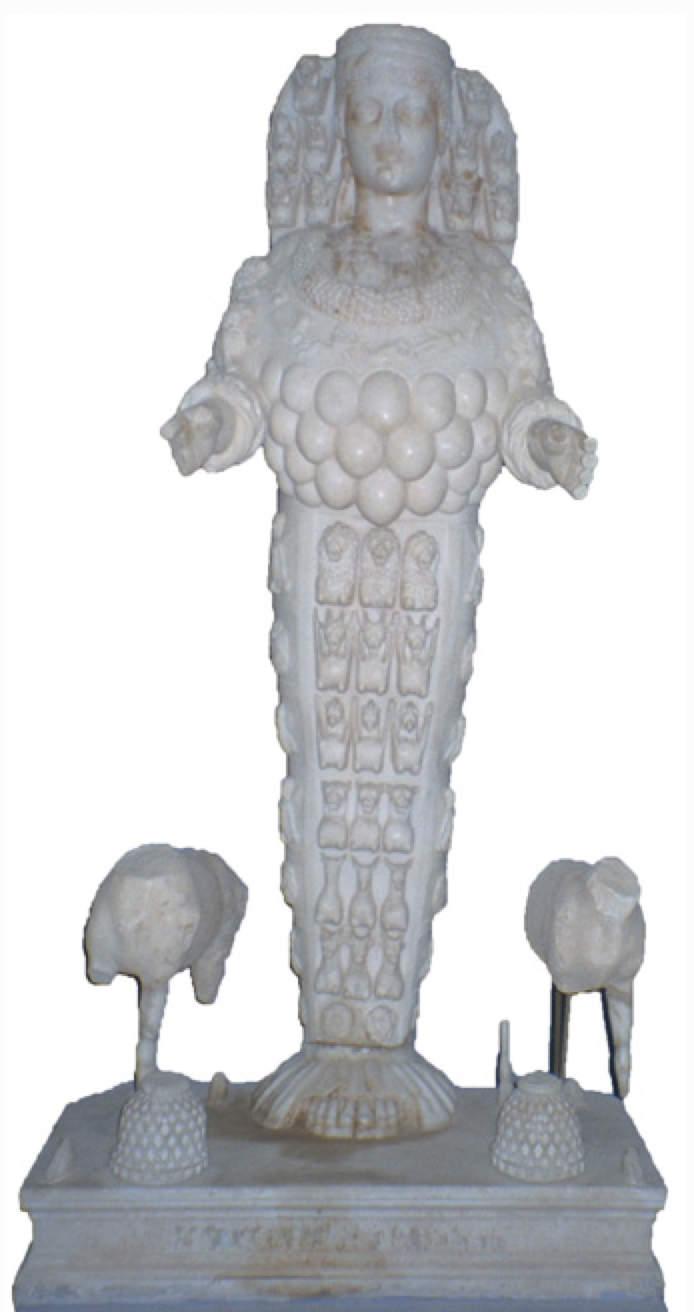
Artemis. The goddess Artemis was the principal deity of Ephesus. She was one of the most popular goddesses throughout the ancient world, but the citizens of Ephesus claimed to be her most ardent devotees, and they had the temple to prove it. A mother goddess, Artemis is easily recognizable by the numerous globes on her chest. These are usually thought to be breasts, although an alternative theory holds that they may be eggs. Either way, Artemis was regarded as a provider of fertility and as an overseer of children.
In any case, the work that we now know as “the letter to the Ephesians” indicates that Paul is writing from prison (3:1; 4:1; 6:20). There is quite a bit of discussion as to which imprisonment is meant, since Paul appears to have been locked up several times (2 Cor. 6:5; 11:23).
Good times! Paul’s letter to the Ephesians portrays the present as a time of blessing (1:3), when believers feel like they are already in heaven (2:6). Everything is going as planned (1:9-10; 3:8-10), and it can only get better from here (2:7). Most of all, this is a time of peace: the walls that divide people have come down, and hostility has given way to reconciliation (2:14-17). There is a profound sense of “oneness” (4:4-6).
Of course, this is the church that we’re talking about, not the world at large. Still, the idyllic picture of Christian community may seem at odds with what we observe in other letters of Paul: factionalism (1 Cor. 1:11-12), arguments (Rom. 14:1-6), heresy (Gal. 1:6-7), scandalous behavior (1 Cor. 5:1), painful confrontations (Gal. 2:11), persecution (1 Thess. 2:14; 3:4), and a generous amount of gossip, backbiting, and instances of people meddling in each other’s affairs (2 Cor. 12:20; 1 Thess. 4:11). So, when did things get so peaceful?
At first glance, Ephesians appears to be addressed to a church in which there is no conflict. But wait—there is indeed conflict. In fact, there is a war going on, but it is not a war with enemies made of flesh and blood. The battle now is against “spiritual forces of evil in the heavenly places” (6:12), against the devil (6:11) and his minions, the principalities and powers that exercise their influence in a dimension not perceptible to human senses (2:2; 3:10). The saints of God are children of light, bringing what is good and right and true into a realm that must otherwise be described as “this present darkness” (5:8-9; 6:12).
In Ephesians, the focus has shifted from the mundane to the ethereal. The instances of friction and harassment that have troubled the church before may or may not have died down, but in any case, they pale in significance when one looks at the big picture. The emphasis of this letter is on the universal significance of what God has done in Jesus Christ, and “universal” is meant here in a literal sense: the focus is on what Christ means not simply for Christians or even for all humanity but rather for everything in heaven and on earth (1:9-10, 20–23).
In our Orthodox tradition we call this epistle “the letter of Paul to the Ephesians,” although some modern interpreters do not think that Paul wrote it, some do not think that it was written to the Ephesians, and quite a few do not even think that it is a letter.
The following arguments have been put forward to cast doubt on Paul’s
authorship. The letter has sentences which, on average, are much longer than
in Paul’s other letters. In chapter 1, for example, 12 verses are taken up
with translating just one sentence from the original Greek (Ephesians 1 v.
3-14). Likewise, there is only a limited overlap of vocabulary and,
theologically, some issues are expressed differently whilst others, such as
the second coming of Jesus, are completely omitted.
However, the epistle itself claims to be written by Paul (1:1), and the Holy
Church of Christ our Lord has recognized Paul as the author, writing under the
inspiration of the Holy Spirit. Because Paul dictated some of his letters,
differences in content and style would be expected.
- Introduction
- Powerful Spiritual Beings
- Overview
- Historical Background
- Parallels between Ephesians and Colossians
- Distinctive Aspects of Ephesians
- Major Themes in Ephesians
- Conclusion
The Mysterious Plan of God
The Greek word mystērion (“mystery”) is used six times in Ephesians (1:9; 3:3, 4, 9; 5:32; 6:19), always with reference to something divine. We perhaps think of a mystery as something puzzling that needs to be figured out, but the Greek term has a different connotation: it refers to something hidden that cannot possibly be figured out, but which can be known only if revealed by someone possessing inside information. A divine mystery can be revealed only by God (3:5), though in this case God has commissioned Paul and other “holy apostles and prophets” to disclose the mystery to the church (3:1-5, 8–9; 6:19). God also has chosen the church to reveal the mystery to the world and, indeed, to the cosmic powers of the universe (3:9-11).
The mystery concerns God’s plan to unite all things in Christ (1:9-10). In particular, God plans to unite all people in Christ, including those who traditionally have been identified as “Jews” or “Gentiles” (3:5-6) but who may now be identified as a “new humanity” (2:15). This has been God’s intention all along, “hidden for ages” (3:9; cf. 3:5) but coming to fruition now in “the fullness of time” (1:10).
The plan seems to be accomplished in (at least) two stages: crucifixion and exaltation. First, the death of Jesus on the cross has effected forgiveness of trespasses so that all people are now on equal footing before God (1:7; 2:4, 13, 16–18). There is no longer any divine preference for Israel, for Christ has broken down the dividing wall that separated Jews from Gentiles and has abolished the law that set Jews apart (2:14-15). This reference to a “dividing wall” invokes the image of an actual wall in the Jerusalem temple that literally separated the “Court of the Gentiles” from the inner sanctuaries to which only Jews could be admitted; the Jewish law that Christ has abolished served as a metaphorical dividing wall because it defined the terms of a covenant that applied to Israel only. The cross of Christ creates a new way to be human, a way that does not privilege one national or ethnic group above another.
The second stage of God’s plan to unify all reality in Christ came with the exaltation of Christ, with his resurrection and subsequent installment in heaven as God’s supreme agent, with authority over all other powers and principalities (1:19-22). Jesus Christ now possesses immeasurable power to eradicate the oppressive influence of all spiritual forces that have held people captive (1:21-22; 2:1-2; 4:8; 6:12).
According to Ephesians, there are two signs that this plan of God is being realized. The first sign is the Holy Spirit (1:13). Without going into detail, the author of this letter assumes that his readers will know that they have been marked with the seal of the Spirit (1:13-14; 4:30) and will agree that this is a pretty sure sign that God’s plan is working out. But then there is a second, ultimate sign that God’s plan is unfolding: the unity of the church (4:4-6, 11–16), especially the unity of Jews and Gentiles in the church (2:11-21). The peace (2:14-15; 4:3) and lack of hostility (2:14) that the church exhibits serve as a revelation even to the cosmic powers of the universe that God’s mysterious plan has taken effect (3:10-11).
Elevation of the Church
Attention is often paid to the ecclesiology of Ephesians, for there is considerable focus on the nature and function of the church. We may note, first, that in this letter the word church (in Greek, ekklēsia) is never used to refer to a local congregation but is only used with reference to “the universal church” (1:22; 3:10, 21; 5:23, 24, 25, 27, 29, 32). The “church” in Ephesians is synonymous with “all people who have been reconciled with God through Jesus Christ.”
The devotion of Christ to the church is emphasized; indeed, the sexual intimacy of a husband and wife may be construed as a living metaphor for the loving union of Christ and the church (5:31-32). Elsewhere, Paul says that Christ died for sinners (Rom. 5:6, 8) or even for all (2 Cor. 5:14-15); in Ephesians, Christ died for the church (5:25). Christ has also sanctified the church (through cleansing by the washing of water with the word—a baptismal image) in order to present the church to himself in splendor without spot or blemish (5:25-26). Thus, the unity and holiness of the church appear to have been the goal of Christ’s suffering and death, and he continues to nourish and cherish the church toward these outcomes (5:29). As indicated above, the church has a central place in God’s plan for the unity of all creation. That plan was executed for the church (1:22) and is now being carried out through the church (3:10).
The church in Ephesians is both a spiritual and earthly institution. Spiritually, the church is the body of Christ (1:22-23; 4:12), or the body of which Christ is the head (5:23; cf. Col. 1:18). This offers a slight twist on the image employed elsewhere (Rom. 12:4-8; 1 Cor. 12:12-27), for it implies interdependence between Christ and the church: the body would, of course, be dead without its head, but the head also needs its body in order to function. In another somewhat strange or mixed metaphor, the church is described as a living building, one that grows into a holy temple that serves as the dwelling place of God (2:19-22). But the church is also an earthly institution, with a fairly well-defined polity and governance. There are apostles and prophets (2:20; 3:5; 4:11), in addition to evangelists, pastors, and teachers (4:11) who apparently serve particular functions in accord with their gifts. The actual work of ministry, however, is not carried out by these officers or leaders but rather is entrusted to “the saints”—that is, to the laity who compose the rank-and-file membership of various congregations. The task of church leaders is to “equip the saints for the work of ministry” so that all may come to experience God’s plan for unity in its fullness (4:12-13).
The oneness of the church also seems to provide the touchstone for moral conduct in Ephesians: all of the thirty-six ethical imperatives provided in 4:1-6:20 seem related to the affirmation that “we are members of one another” (4:25). Accordingly, believers should treat each other as extensions of themselves (see 5:28-30). This might be regarded as a metaphysical actualization of the Golden Rule: the point is not simply that one should “do to others as you would have them do to you” (Matt. 7:12); the point now is that what you do to others you actually do to yourself. This is never truer than with regard to members of one’s own household; Ephesians seems to regard the Christian household as a miniature version of the church (which may be called the “household of God” [see 2:19; cf. 1 Tim. 3:15]).
Idealized Status of Believers
Ephesians describes the present status of Christians in terms of an idealistic spiritual reality. It was God’s plan before the foundation of the world for people to be “holy and blameless before him in love” (1:4), and those who make up the church are destined to be “without blemish” (5:27). Such an ideal has not been fully realized, but according to Ephesians, there is some sense in which perfection has been obtained. Since the church is the body of Christ, when God raised Christ from the dead and seated him in heaven, the church was exalted with him (1:20); already, now, those who believe in Christ have been raised up and are seated with him in the heavenly places (2:6; cf. 1:3). They are empowered, furthermore, to actualize the implications of this spiritual exaltation in their daily lives on earth. The same power that raised Jesus from the dead and exalted him is available for those who believe (1:19-20) and is able to accomplish far more than they could ever imagine (3:20); they need only come to know the immeasurable greatness of this power (1:17-19). When they do, they will live in unity and holiness, manifesting their true spiritual identity in their current lives; for believers, to live in this way is simply a matter of being who they are, of becoming the people they have always been destined to be (2:10).
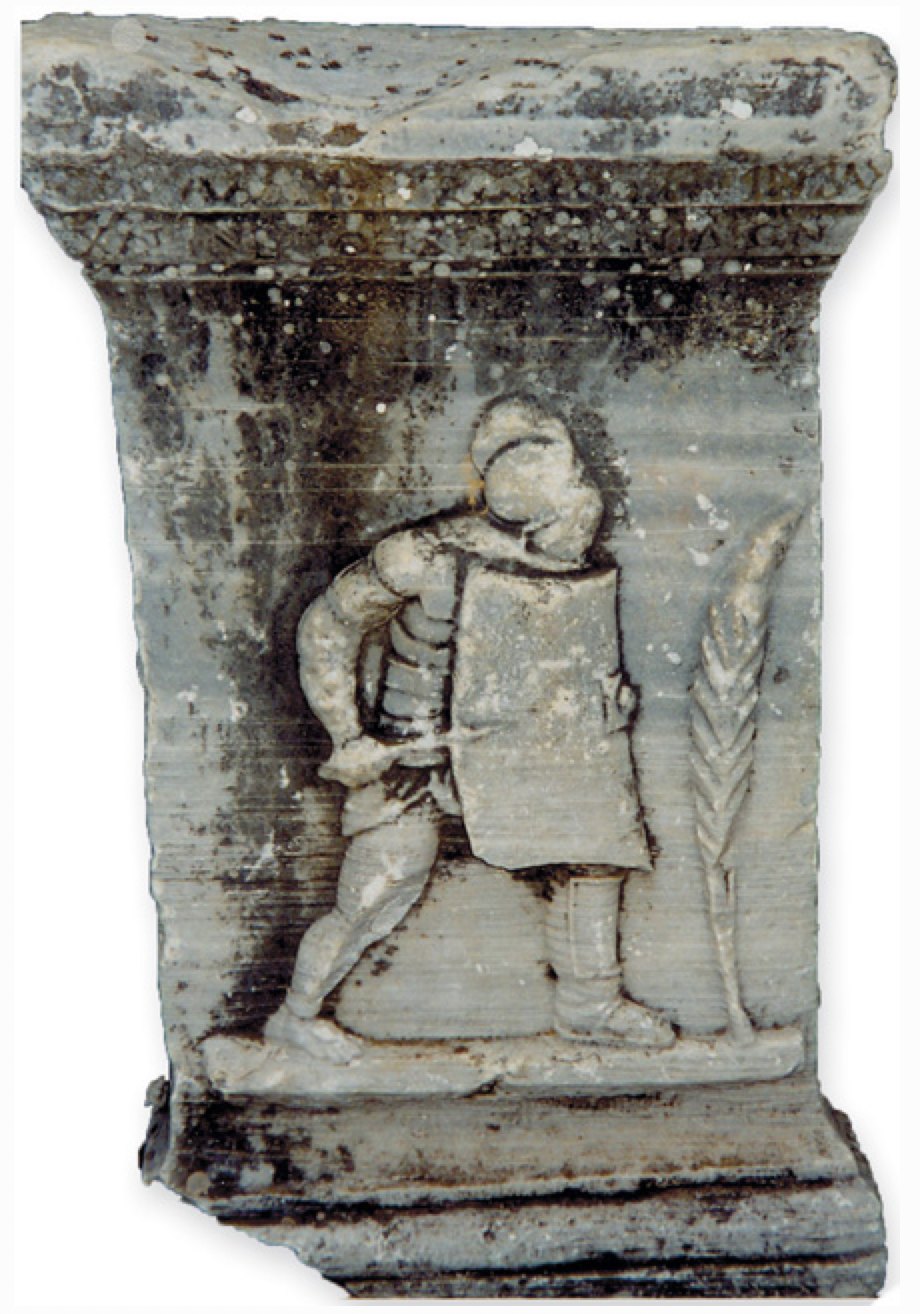
The Armor of God. Ephesians 6:10-17 uses the image of a well-prepared Roman soldier to describe the protection and power that God grants to the faithful. Armor and weapons are metaphors for spiritual gifts and qualities: belt = truth, breastplate = righteousness, shoes = proclaiming gospel, shield = faith, helmet = salvation, sword = word of God.
Some interpreters think that this motif is at odds with the teaching of Paul found in other letters. In other letters, Paul mocks those who believe that they have been elevated to some ideal status in this life (1 Cor. 4:8-13), and he emphasizes identification with the crucified Christ rather than with the risen Lord (Rom. 6:3-5; 1 Cor. 2:2; 15:31; Gal. 2:19-20; Phil. 3:10); the triumphalist understanding advanced in Ephesians is said to have more in common with the ideas of the “super-apostles” confronted by Paul in Corinth (2 Cor. 11:5; 12:11) than with anything that Paul himself would have promulgated. The apparent discrepancy can be explained in terms of context. In 2 Corinthians, Paul was resisting the notion that life in Christ meant a reprieve from service or suffering. In Ephesians, the point is that those who are in Christ are no longer subject to the control of spiritual enemies; they need not fear magical incantations or curses that may be invoked on them by their non-Christian neighbors, nor do they need to worry about incurring the wrath of Roman deities whose favors they no longer curry. Christ has exalted them spiritually above such powers. The idealism, furthermore, is balanced by an awareness that human action is still required: believers must clothe themselves with the new self that God provides (4:24); they must “take up” the armor of God (6:13); they must exert effort at maintaining the unity of the Spirit in the bond of peace (4:3); they must be faithful in prayer (6:18); and they must be deliberate about leading a life worthy of that to which they have been called (4:1).
After a fairly typical salutation (1:1-2), the author (who identifies himself as “Paul, an apostle of Christ Jesus”) presents an elegant blessing of God that serves as a liturgical overture to the letter (1:3-14). He declares that God is bringing to fulfillment a plan to gather all things in Christ: those who were destined to be God’s blameless children have been forgiven their trespasses as a result of the redemption that comes through Christ’s blood, and they have been sealed with the Holy Spirit as a pledge of further redemption still to come. The blessing segues into a thanksgiving as the writer acknowledges his recipients’ faith and love (1:15-17). He prays that they might be fully enlightened with regard to what God has in store for them and with regard to what the power of the risen and exalted Christ will accomplish in and through the church, which is his body (1:15-23). Once dead in trespasses, they have been saved by grace and exalted with Christ to fulfill their destiny as people created for a life of good works (2:1-10). By reconciling all people to God through the cross, Christ has created a new humanity, marked by peace rather than hostility; this is manifest in the church, where Jews and Gentiles alike have access to God and, indeed, compose what is now God’s spiritual dwelling place (2:11-22). This new unity of humanity is “the mystery of Christ,” revealed to Paul when he was commissioned by God; now, the church’s role in the divine drama is to make the mystery known, not only to the world of unbelievers, but also to spiritual powers in heavenly places (3:1-13). The author prays again that his readers might comprehend the immeasurable love of Christ manifested in all of this (3:14-19), and he offers a brief doxology to conclude the first part of the letter (3:20-21).
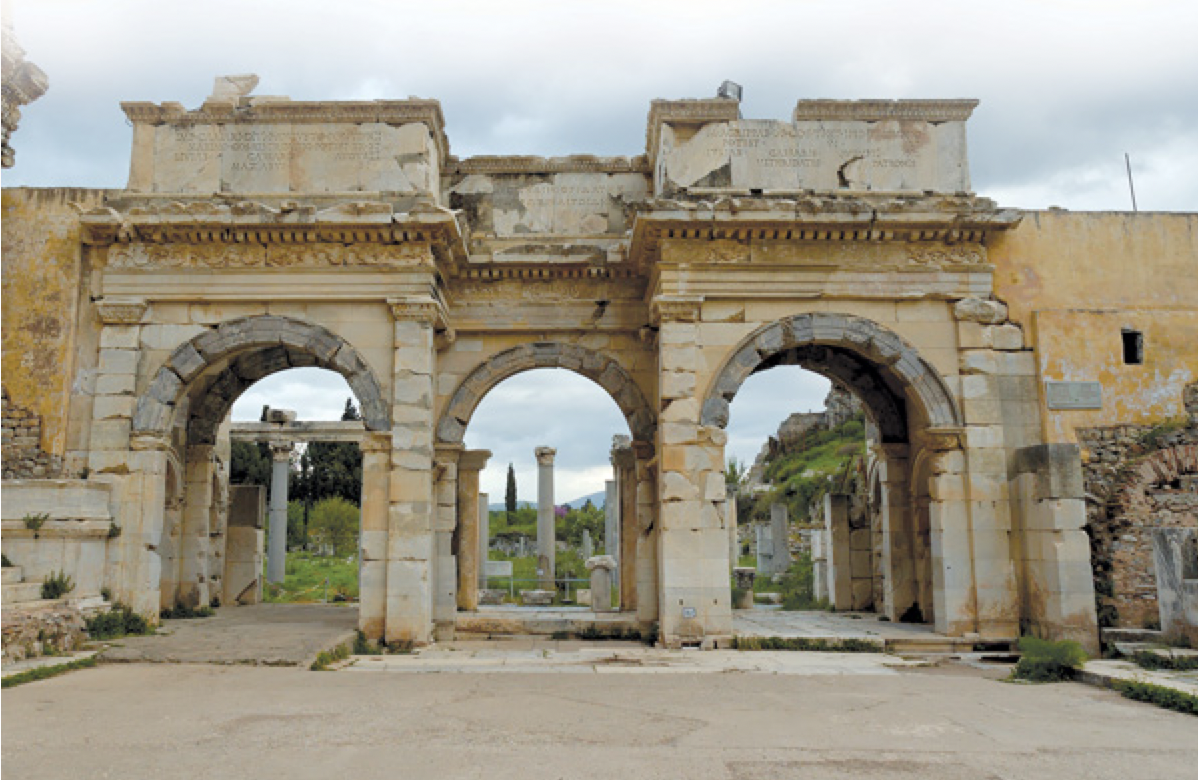
Ephesus Gate. The ruins of ancient Ephesus provide some indication of the grandeur that the city must have had in the days of Paul. This magnificent gateway was built about the same time that Jesus was born (4–2 BCE). An inscription on the gate dedicates the structure to Caesar Augustus, who is identified as “Son of God.” Paul passed through this gate (and beneath that inscription) whenever he entered the city.
The second half of the letter explicates practical implications of what was proclaimed in the first part: the readers are urged to live a life worthy of their calling (4:1), which means life with others in a community that functions as a single entity (4:2-16). The specifics of such a life are spelled out with reference to a number of behaviors that will set those in the church apart from others, as imitators of God and children of light (4:17-5:20). A series of household instructions indicates how they are to conduct themselves in family and social relationships (5:21-6:9), and an appeal to guard against the wiles of the devil encourages the readers to be dressed in spiritual armor provided by God (6:10-17). The letter concludes with exhortations to prayer (6:18-19), a commendation of Tychicus, the letter carrier (6:20-21), and a double benediction (6:23-24).
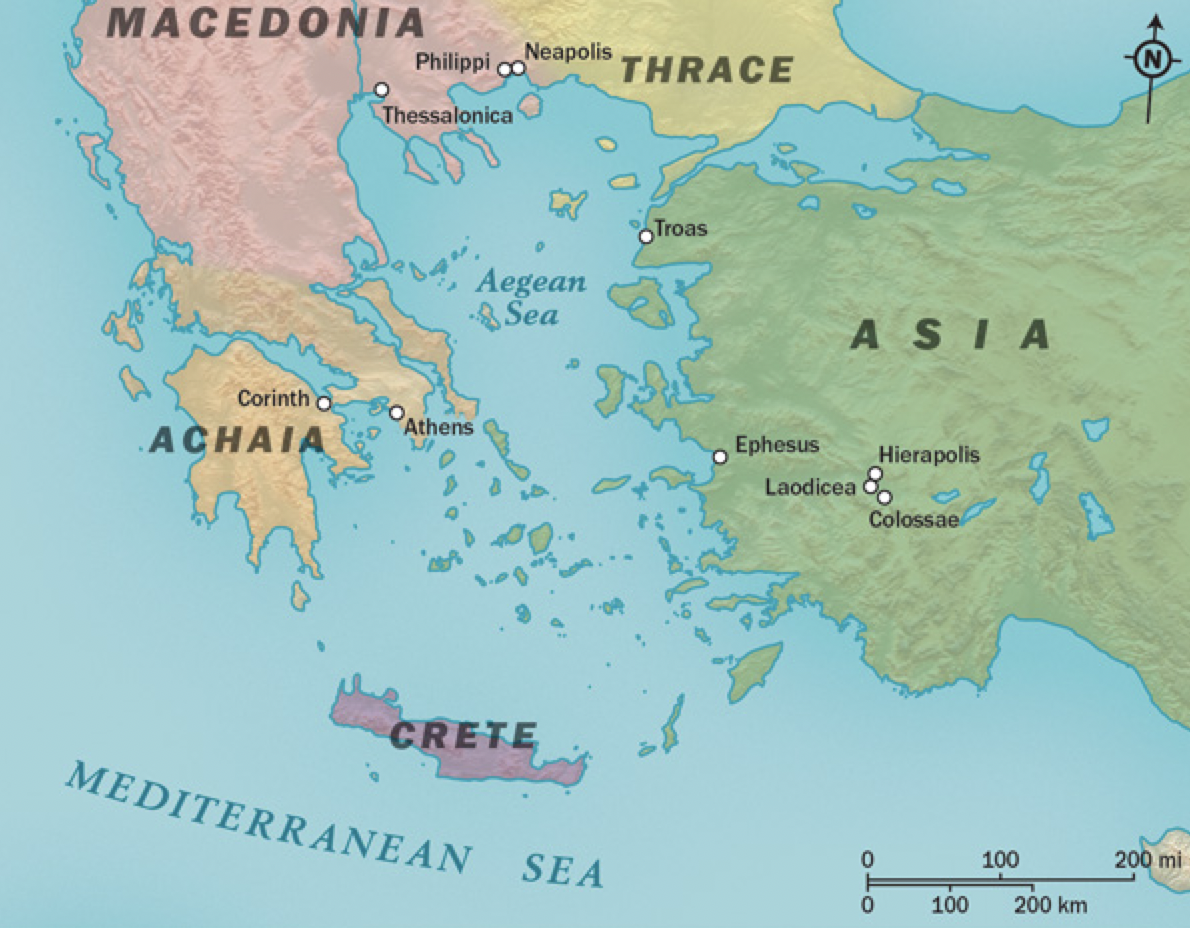
Pauline Cities around the Aegean Sea.
Similar topics are treated, often in the same order, and sometimes with identical wording.
Redemption and forgiveness 1:7 1:14-20
All things in heaven and earth are in Christ 1:10 1:20
I have heard of your faith 1:15 1:4
I thank God always for you 1:16 1:3
Pray that God will give you wisdom 1:17 1:9
Riches of a glorious inheritance/mystery 1:18 1:27
God made you alive 2:5 2:13
Aliens reconciled through Christ’s death 2:12-13 1:21-22
Christ has abolished the law 2:15 2:14
Paul is suffering for their sake 3:1 1:24
Divine commission given to Paul 3:2 1:25
Divine mystery made known to Paul 3:3 1:26
Paul a servant of the gospel 3:7 1:23, 25
Lead a worthy life 4:1 1:10
Humility, meekness, patience 4:2 3:12
Bear with one another 4:2 3:13
Christ is head of the body 4:15-16 2:19
Put off old nature, put on new nature 4:22-32 3:5-10, 12
No immorality among you 5:3-6 3:5-9
Walk wisely and make the most of your time 5:15 4:5
Sing psalms, hymns, and spiritual songs 5:19 3:16
Give thanks to God 5:20 3:17
Tables of household duties 5:21-6:9 3:18-4:1
for wives 5:22-24 3:18
for husbands 5:25-33 3:19
for children 6:1-3 3:20
for fathers 6:4 3:21
for slaves 6:5-8 3:22-25
for masters 6:9 4:1
Paul the prisoner exhorts persistence in prayer 6:18-20 4:2-3
Tychicus will inform church about Paul 6:21 4:7
Tychicus sent to encourage their hearts 6:22 4:8
This question of Pauline authenticity is determinative for understanding the historical origins of the letter, but we must first note two other matters:
1. Ephesians is remarkably similar to the letter of Paul to the Colossians; in fact, the two epistles have been called “literary siblings.” Somewhere between one-half and one-third of the 155 verses in Ephesians have close parallels to the material found in Colossians, often to the point of occurring in the same order of presentation. A few passages are repeated almost word for word (cf. Eph. 1:4 with Col. 1:22; Eph. 1:15 with Col. 1:4; Eph. 6:21-22 with Col. 4:7-8). Most scholars believe that Colossians was written first and that whoever wrote Ephesians was familiar with the contents of Colossians. One possibility is that Paul wrote both letters: first, he wrote Colossians to a specific congregation, and then he produced Ephesians as a more general letter dealing with the same subject matter. Another possibility, however, is that someone had a copy of Colossians and used it as a template for creating Ephesians.
2. Ephesians is remarkably dissimilar to what are called the “undisputed letters of Paul” (i.e., the seven letters that all scholars agree are written by him). Distinctive Aspects of Ephesians lists some of the distinctive anomalies that characterize this letter. A number of these matters might be regarded as minor stylistic quirks, but others seem to convey differences that could be theologically significant. Scholars differ in their assessment of whether such features present Ephesians as actually inconsistent with Paul’s undisputed letters or as simply different from them. They also differ in their understanding of whether such features can be adequately explained (e.g., by claiming that Paul allowed an amanuensis considerable freedom in crafting the letter, or that the Ephesian context required different language and imagery, or that Paul’s ideas had developed over time).
In terms of authorship, then, many different scenarios have been proposed, but these tend to fall into two basic categories:
· Some scholars think that Paul did write Ephesians. If so, he produced it probably around the same time as Colossians and Philemon, sending all three compositions to the province of Asia by way of Tychicus (Eph. 6:21; Col. 4:7). He may have written these letters during his Roman imprisonment in the early 60s or possibly during an earlier imprisonment (e.g., in Caesarea or even in Ephesus itself).
· Some scholars think that one of Paul’s disciples or companions wrote Ephesians in the years after Paul’s death on his own instructions, to provide the church with a generic statement of what the apostle himself wanted to write, but did not manage. In this case, the letter might be dated to the decade of the 70s or maybe even to the 80s.
The cosmic dimension of Christ’s victory over powerful spiritual beings is emphasized in Ephesians (see 1:20-21; 3:10) and also in Colossians (see 1:13; 2:10, 15).
We read about:
rulers (Eph. 1:21; 2:2; 3:10; 6:12; Col. 1:16; 2:10, 15; cf. Rom. 8:38; 1 Cor. 15:24)
authorities (Eph. 1:21; 3:10; 6:12; Col. 1:13, 16; 2:10, 15; cf. 1 Cor. 15:24)
powers (Eph. 1:21; cf. Rom. 8:38; 1 Cor. 15:24) c
osmic powers (Eph. 6:12)
dominions (Eph. 1:21; Col. 1:16)
thrones (Col. 1:16)
Six different designations are used in Greek, though English Bibles do not translate the words consistently; the phrase “elemental spirits of the universe” (Col. 2:8, 20) seems generic.
Who or what are these spiritual beings? The author and original readers of Ephesians would have believed that they were living creatures, not biological entities “of blood and flesh” (6:12), but just as real as humans or animals. Angels and demons may be the best-known examples of such beings, along with the devil, who is called “the ruler of the power of the air” (2:2), and elsewhere in the New Testament is referred to as “the god of this world” (2 Cor. 4:4). Jews and Christians often identified the gods of other religions as powerful spiritual beings as well, not denying their existence but rather identifying them as inferior rivals to the one true God.
In Ephesians, these powerful spiritual beings are presented as evil forces intent on dominating people’s lives and influencing world affairs. They are the true enemies of believers (6:12). Ephesians says that Christ has been elevated to a position of dominance over them (1:20-21), that the church shares in this exaltation (1:22-23; 2:6; 3:10), and that God equips believers for the ongoing struggle against such spiritual forces of evil in “this present darkness” (6:12).
Ephesians.
Related Concepts
- abolition-of-the-law
- access-to-god
- apostles-and-prophets
- assurance
- baptismchrismation
- belt-of-truth
- body-of-christ
- children-of-light
- christs-self-giving
- church-as-revealer
- church-polity
- community
- cornerstone
- cosmic-reconciliation
- cosmic-revelation
- discernment
- dividing-wall
- dwelling-place-of-god
- edification
- election
- exaltation
- fullness-of-time
- future-hope
- gifts
- grace-and-works
- head-and-members
- hope
- identity
- inheritance
- interdependence
- laity
- law
- living-temple
- concepts/love-agapē
- marriage-as-mystery-532
- maturity
- moral-exhortation
- concepts/mystērion
- nourishing-and-cherishing-529
- one-body
- peace
- plan-of-god-oikonomia
- revelation
- spiritual-gifts
- standing-firm
- temple
- this-present-darkness
- truth
- truth-speaking
- unity
- wisdom