New Testament — Topic 24
Galatians is not a polemic against good works. It is a defense of the Gospel of transformation. Paul’s enemies were not the “good works” of love, but the “works of the law” of ethnic ritual. They wanted to add circumcision and dietary laws to the Gospel. Paul said: No. Christ is sufficient. The Spirit is sufficient. Faith working through love is sufficient.
But this faith is not passive. It is a living, active, transformative faith that produces the fruit of the Spirit. It is a faith that crucifies the flesh, bears the burdens of others, and creates a new creation.
For the Orthodox Christian, Galatians is a summons to freedom — freedom from the tyranny of legalism, freedom from the fear of condemnation, freedom from the bondage of the passions. It is a summons to love — the love that serves, the love that suffers, the love that transforms. It is a summons to theosis — to become by grace what Christ is by nature, sons of God, heirs of the Kingdom.
This is the Orthodox Gospel. This is the heart of Galatians. This is the message that sets us free.
The letter to the Galatians is written by Paul to a number of congregations in a Roman province located in modern-day Turkey (1:2). Although the Romans called the entire province “Galatia,” the only people in the area who called themselves “Galatians” were descendants of Celtic tribes that had settled in the northern part of the province. According to the book of Acts, Paul visited some cities in the southern part of Galatia on his first missionary journey (see Acts 13:14-15; 14:1 [all of the cities mentioned are in the south]). He does not appear to have ventured north to where the people known as “the Galatians” lived. He might have done this, however, on his second journey a few years later (see Acts 16:6; 18:23 [the northern part of the province could be included here, though it is not specifically mentioned]).
In between these two missionary journeys an important council was held in Jerusalem to deal with some of the same issues that are addressed by Paul in this letter (see Acts 15). Biblical scholars want to know whether Paul wrote the letter before or after that council. Since he addresses the people to whom he is writing as “Galatians” (3:1), not just “residents of Galatia,” it is often thought that the letter is addressed to people in the northern part of the province. In that case, it would have to have been composed after the council (since Paul had not visited the northern part of the province on his first trip to the area). Initially, this does seem to make sense because in Galatians 2:1-10, Paul talks about a meeting that he had with apostles in Jerusalem, which often is understood to be his own account of that famous council. The problem, however, is that Paul’s description of this meeting differs in key respects from the description of the Jerusalem council found in Acts 15. For this reason, some scholars think that the meeting that Paul describes in Galatians 2:1-10 is not the Jerusalem council but rather an earlier, different event. The assumption, then, is that Paul probably wrote Galatians before the Jerusalem council occurred (since, on this reckoning, he does not mention that council). The problem with this suggestion is that if Paul wrote the letter that early, it would have to have been to the southern Galatian cities that he visited on his first journey. It then seems odd that he would address his recipients as “Galatians” (3:1), a term more appropriate for the people in the north.

Galatian. The people known as the Galatians were descended from the Gauls, a European Celtic tribe that migrated into northern Asia Minor in the third century BCE. This picture shows the features of a typical Galatian man.
The bottom line is that we cannot know for certain when this letter was written or to whom. If Paul is writing to people in southern Galatia, the letter may be dated around 48, possibly from Antioch in Syria, to which Paul returned at the conclusion of his first journey. If it is addressed to the northern Galatians, then it may have been written in the mid-50s, possibly from Ephesus. What we know with certainty is that the members of these churches were Gentiles who had been introduced to Christianity by Paul but who had since become attracted to ideas that Paul rejects. Paul notes that it was because of a physical infirmity that he first proclaimed the gospel to them (4:13). Apparently, he had intended to go elsewhere, but some problem (possibly with his eyes [see 4:15]) caused him to be laid up for a while. Making the best of things, he turned his evangelistic efforts toward those who inhabited the area where he was recuperating. They received him with goodwill and accepted the gospel. After he moved on, however, some other teachers came to the area, proclaiming a rival version of the faith. These interlopers undermined Paul’s understanding of the gospel and turned some of the Galatians against Paul.
What was this “rival version” of the Christian faith? In the early years of Christianity, there appear to have been some Jews who believed in Jesus but who thought that salvation in Christ was for Jewish people only. They believed that Gentiles who wanted to become Christians first needed to become Jews. Gentiles attracted to Christianity should be circumcised and commit themselves to living in accord with the Torah (Jewish law). Then, as converted, law- observant Jews, they could receive the salvation that Jesus the Jewish Messiah had accomplished for Israel. Advocates of such an understanding of Christianity have traditionally been called “Judaizers.”
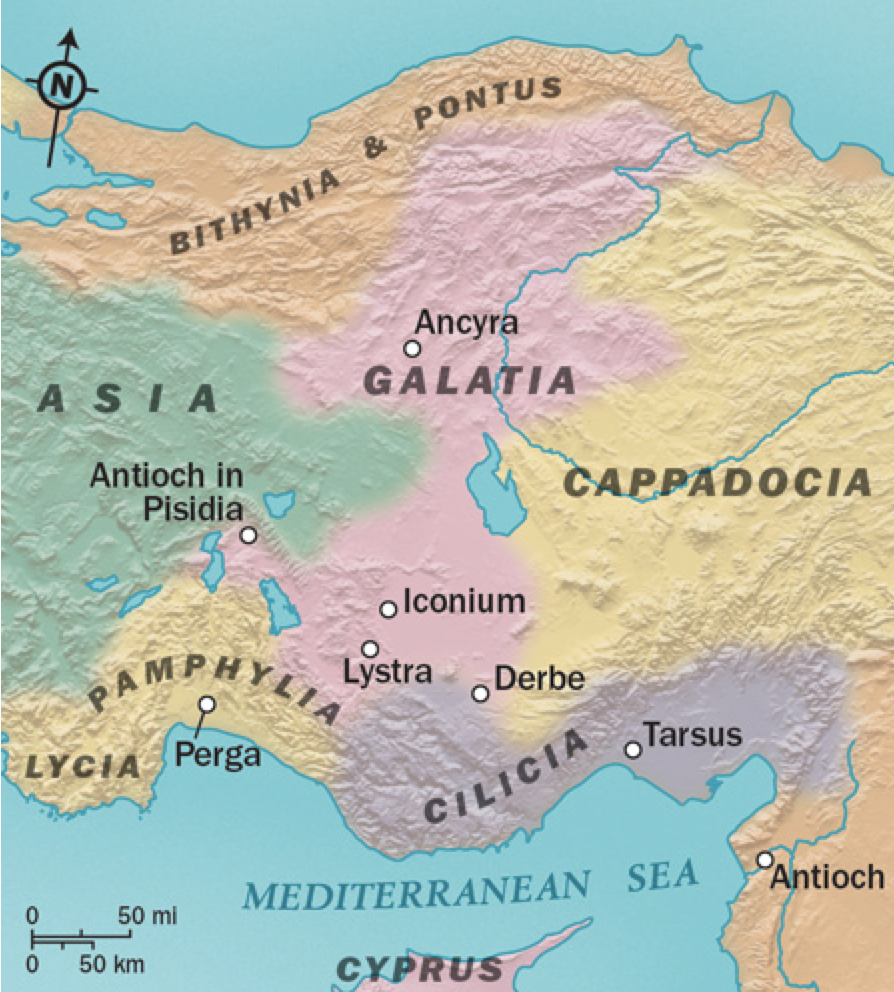
Northern and Southern Galatia.
Their argument was: Yes, Jesus is the Messiah, but He is the Messiah of Israel. To be part of Israel, you must become a Jew — through circumcision, dietary laws, and Sabbath observance. Grace in Christ is not enough; you must also keep the Law.
Paul saw this as a denial of the Gospel itself. Not a minor disagreement, but a fundamental betrayal. Hence the letter’s white-hot urgency: “I marvel that you are turning away so soon from Him who called you in the grace of Christ, to a different gospel” (Galatians 1:6, NKJV).
We don’t know how widespread this vision of a law-observant Jewish Christianity was in the first century, since there are only scattered and sometimes obscure references to it in the New Testament (Acts 15:1-2, 5; Gal. 2:4; Phil. 3:2). It is also possible that those who called for Gentiles to accept circumcision and keep the Jewish law did so with varying degrees of intensity. There is no indication that Paul’s opponents in Galatia made salvation dependent upon circumcision or acceptance of the law. Perhaps they simply told the Galatian Christians that being circumcised and following the law was a commendable “next step” to take, the way to a deeper and fuller realization of their faith. Such details would have mattered little to Paul. He maintains that any reliance on the law as a means to obtaining a right (or better) relationship with God is incompatible with the gospel of grace and faith in Christ.
The Epistle to the Galatians is one of the most explosive documents in human history. It was the battle-cry of the Reformation. But long before Luther, this letter was the Church’s sword against the Judaizers, and it remains a foundational text for Orthodox theology — not because it teaches salvation by faith alone in a forensic sense, but because it teaches the freedom of the sons of God against every form of legalism, whether Jewish or Christian.
For Orthodox students, Galatians is essential because it addresses the core question: What does it mean to be saved? Is salvation a legal transaction, a moral achievement, or an organic, transformative union with Christ? The Orthodox answer, grounded in the Fathers, is the latter. Galatians is Paul’s most passionate defense of the Gospel as participation in the divine life , not adherence to a code.
You foolish Galatians!” Paul rails against the recipients of his most intense and combative letter (3:1). And that’s how the poor Galatians have been remembered ever since. They probably said and did many things that were not foolish (4:12-15), but Christians know them best for this, their walk-on role as targets of a blistering rebuke from an apostle dumbfounded by their folly.
Some of Paul’s other letters also address situations in which individuals or entire congregations have disappointed him, but the letter to the Galatians stands out from the pack. These people have aroused his ire in a manner that surpasses anything we find elsewhere. Why? What could be worse than, say, the Corinthians getting drunk at the Lord’s Supper (1 Cor. 11:20-21)?
Circumcision is a surgical procedure that removes the foreskin of the male genital organ. It has been and still is practiced by many cultures for a variety of reasons: it is sometimes cosmetic or linked to health concerns, but in many traditions the rite has taken on symbolic meaning connected with puberty, fertility, or spiritual devotion.
In ancient Israel, male children typically were circumcised on the eighth day of their life (Gen. 17:12; Lev. 12:3). Both Jesus (Luke 1:59; 2:21) and Paul (Phil. 3:5) are said to have been circumcised in keeping with this sacred tradition, which still is practiced by most Jewish groups today.
In Israelite and Jewish religion, circumcision was regarded as “the sign of the covenant”: males were circumcised to indicate that they belonged to the chosen people of God, that they were heirs of the promises to Abraham, and that they intended to keep the Torah, given by God to Moses. Prophets sometimes spoke of circumcision in symbolic terms, accusing those who were stubborn or unreceptive of having “an uncircumcised ear” (Jer. 6:10) or an “uncircumcised heart” (Lev. 26:41).
The apostle Paul favors the symbolic meaning of circumcision (Rom. 2:29) but regards the physical act as irrelevant, since all people are now made right with God through Christ (1 Cor. 7:19; Gal. 5:6; 6:15). Paul’s strong opposition to circumcision voiced in certain passages (e.g., Gal. 5:2) has nothing to do with the value of the act itself: he is not opposed to Jews (or Gentiles) observing religious traditions that they find meaningful, but he is incensed by the notion that any such tradition is necessary to affect one’s status with God, which, for Paul, is maintained solely by grace through faith.
The Galatians want to be circumcised! That seems to be the crux of this crisis (5:2-3). And why is that such a big deal? Paul himself says, “Neither circumcision nor uncircumcision counts for anything” (5:6; also 6:15).
We might think, then, that Paul would regard circumcision as merely superfluous, a ritual that is meaningless but basically harmless (provided the knife doesn’t slip! [see 5:12]). But, no, it’s a much bigger deal than that. Paul maintains that the Galatians are deserting God and perverting the gospel of Christ (1:6-7).
The epistle to the Galatians is known as Paul’s “angry letter.” He is not interested in engaging his opponents in a polite debate over the issue of circumcision. It is too late for that—things have already gotten personal. His opponents have attacked his credibility and impugned his integrity. Paul is angry with these opponents, and he is angry with the Galatians for listening to them.
This is Paul’s only letter that does not open with words of thanksgiving for the recipients (cf., e.g., Rom. 1:8-10; 1 Cor. 1:4-9; 2 Cor. 1:3-11; Phil. 1:3-11; 1 Thess. 1:2-5; Philem. 4–7). Is this because he can find nothing to be thankful for? Or is he just too worked up to realize that he has left out what normal decorum would commend?
I. The Central Theological Problem: “Works of the Law”
1.1. What Did Paul Mean by “Works of the Law”?
The Greek phrase is ἔργα** νόμου** (erga nomou). In the context of Galatians, this refers primarily to the ceremonial and ritual works of the Mosaic Law : circumcision, dietary regulations, festival observances, and sacrificial rituals. These were the “boundary markers” that distinguished Jews from Gentiles.
Paul’s argument is not that “good works” are irrelevant for salvation. His argument is that the ceremonial works of the Torah cannot justify — cannot make a person righteous — because they were never intended to. They were a pedagogue (Galatians 3:24), a temporary guardian, to lead us to Christ.
1.2. The Reformation Misreading
Luther, Calvin, and the Reformers read “works of the law” as any human effort to please God , including moral good works. From this, they developed the doctrine of sola fide : salvation is by faith alone, and works — even Spirit-empowered works — cannot establish, maintain, or improve one’s standing with God. Works are merely the fruit and evidence of salvation, never its cause or condition.
This was a reaction against the medieval Catholic system of merits, indulgences, and penance. But in rejecting Roman legalism, the Reformers created a new legalism: a forensic framework in which salvation is a legal verdict, and the Christian life is merely the outward evidence of an inward status.
1.3. The Orthodox Reading
The Orthodox Church has never read Galatians through the lens of the Reformation. For the Fathers, Paul’s polemic against “works of the law” is a polemic against ethnic, ceremonial Judaism as a means of salvation. It is not a polemic against good works as such. In fact, Paul himself says:
“For in Christ Jesus neither circumcision nor uncircumcision avails anything, but faith working through love.” (Galatians 5:6, NKJV).
Here is the Orthodox key: faith working through love. Faith is not a passive instrument; it is a living, active principle. It is not opposed to works; it produces works. The Reformers separated faith from works; the Orthodox tradition sees them as inseparable.
II. Justification and Theosis in Galatians
2.1. The Meaning of Justification ( Δικαιοσύνη**)**
As with Romans, the Orthodox understanding of justification in Galatians is transformative, not forensic. To be justified is to be made righteous, not merely declared righteous. It is to be brought into a right relationship with God — a relationship of communion, not just a legal status.
Paul says: “I have been crucified with Christ; it is no longer I who live, but Christ lives in me; and the life which I now live in the flesh I live by faith in the Son of God, who loved me and gave Himself for me” (Galatians 2:20, NKJV).
This is not a legal transaction. This is ontological transformation. Christ lives in the believer. The believer participates in the death and resurrection of Christ. This is theosis — union with God — in seed form.
2.2. Adoption as Sons
Paul’s language of adoption (huiothesia) is central to Galatians:
“But when the fullness of the time had come, God sent forth His Son, born of a woman, born under the law, to redeem those who were under the law, that we might receive the adoption as sons. And because you are sons, God has sent forth the Spirit of His Son into your hearts, crying out, ‘Abba, Father!’” (Galatians 4:4-6, NKJV).
Adoption is not a legal fiction. It is a real participation in the Sonship of Christ. The Holy Spirit, sent into our hearts, makes us cry “Abba, Father” — the very cry of the eternal Son. We become by grace what Christ is by nature : sons of God.
2.3. The Fruit of the Spirit
If Galatians were about “faith alone,” we would expect Paul to say nothing about how the Christian lives. But the entire fifth chapter is about the fruit of the Spirit :
“But the fruit of the Spirit is love, joy, peace, longsuffering, kindness, goodness, faithfulness, gentleness, self-control. Against such there is no law.” (Galatians 5:22-23, NKJV).
These are not optional extras. They are the necessary evidence of life in the Spirit. A “faith” that does not produce these fruits is not the faith of Galatians. As St. James says, “faith without works is dead” (James 2:26).
III. Freedom in Christ: The Heart of Galatians
3.1. Freedom From and Freedom For
The central theme of Galatians is freedom. “Stand fast therefore in the liberty by which Christ has made us free, and do not be entangled again with a yoke of bondage” (Galatians 5:1, NKJV).
But this freedom is not license. It is not freedom to sin. It is freedom from the law as a means of justification, and freedom for the service of God in love:
“For you, brethren, have been called to liberty; only do not use liberty as an opportunity for the flesh, but through love serve one another.” (Galatians 5:13, NKJV).
The Reformers emphasized freedom from works; the Orthodox tradition emphasizes freedom for love. We are free from the law’s condemnation so that we may freely love God and neighbor. This is the “law of Christ” (Galatians 6:2) — the law of love, written on the heart by the Holy Spirit.
3.2. The New Creation
Paul’s final word in Galatians is not about justification by faith, but about new creation :
“For in Christ Jesus neither circumcision nor uncircumcision avails anything, but a new creation. And as many as walk according to this rule, peace and mercy be upon them, and upon the Israel of God.” (Galatians 6:15-16, NKJV).
The goal of salvation is not merely forgiveness of sins. It is a new creation — a transformed humanity, a new way of being, a new Israel. This is theosis: participation in the divine life, which makes us truly new.
IV. Patristic Understanding
4.1. St. John Chrysostom
In his Homilies on Galatians , Chrysostom emphasizes that Paul’s quarrel is with the ceremonial law , not with good works. He writes:
“When Paul says that a man is not justified by works of the law, he does not mean that good works are useless. He means that the observances of the Law — circumcision, sacrifices, festivals — cannot justify. But faith, working through love, is the source of all good works.”
Chrysostom also emphasizes the real presence of Christ in the believer. “Christ lives in me” is not a metaphor. It is a mystical reality.
4.2. St. Augustine
Augustine’s Commentary on Galatians focuses on the relationship between law and grace. For Augustine, the law is good, but it cannot save. It commands but does not enable. Only grace — the Holy Spirit — gives us the power to fulfill the law. “The law was given that grace might be sought; grace was given that the law might be fulfilled.”
Augustine also speaks of the freedom of the Christian : freedom from the law as a means of justification, but not freedom from the law as a guide for living. The Christian, led by the Spirit, fulfills the law naturally, as a child of God.
4.3. St. Cyril of Alexandria
Cyril sees in Galatians a profound statement about the Incarnation and theosis. Christ became man so that we might become divine. He was “born under the law” so that we might be freed from the law. He took on our humanity so that we might take on His divinity. The believer is not just forgiven; he is deified by participation in Christ through the Holy Spirit.
V. Ascetical Understanding
5.1. Freedom from Legalism
For the Orthodox Christian, Galatians is a call to freedom from legalism. We do not fast, pray, or give alms to earn God’s favor. We do these things because we are already loved by God, and we desire to respond to that love, because we love God. The ascetical life is not a merit system; it is a path of love.
5.2. The Battle Against the Flesh
Paul’s contrast between the flesh and the Spirit (Galatians 5:16-25) is the foundation of Orthodox asceticism. The “flesh” (sarx) is not the body as such, but the fallen, self-centered nature — the passions, the ego, the desire for pleasure and control. The Spirit is the power of God in us, enabling us to crucify the flesh and live in love.
“And those who are Christ’s have crucified the flesh with its passions and desires.” (Galatians 5:24, NKJV).
This is not a one-time act but a daily struggle. The ascetical life — fasting, prayer, watchfulness, repentance — is the means by which we cooperate with the Spirit in crucifying the flesh.
5.3. Bearing One Another’s Burdens
“Bear one another’s burdens, and so fulfill the law of Christ.” (Galatians 6:2, NKJV).
The “law of Christ” is not a new legal code. It is the law of love — self- sacrificial love, modeled on Christ. The Christian is not an isolated individual seeking personal salvation. He is a member of the Body of Christ, called to bear the burdens of others, to suffer with them, to serve them. This is the communal dimension of theosis: we are saved together , not alone.
VI. Is Galatians Central to Orthodox Theology?
6.1. Yes.
Galatians is central to Orthodox theology because it teaches:
The universality of salvation — Jew and Gentile are one in Christ (Galatians 3:28).
The freedom of the sons of God — we are not slaves but sons, not under law but under grace.
The transformative nature of salvation — we are not merely forgiven but made new (Galatians 6:15).
The necessity of love — faith works through love (Galatians 5:6).
But Galatians is not central in the way the Reformers made it central. It is not a manifesto for sola fide as a forensic doctrine. It is not a rejection of good works. It is not a declaration that the Christian life is merely the fruit of a legal status.
For Orthodoxy, Galatians is central because it protects the freedom and universality of the Gospel.
6.2. The Orthodox Synthesis
The Orthodox synthesis, drawn from the Fathers, is this:
Justification is the beginning of salvation — the forgiveness of sins and the restoration of communion with God.
Sanctification is the ongoing process — the transformation of the whole person by the Holy Spirit.
Theosis is the goal — union with God, participation in the divine life.
Faith is the foundation — trust in Christ, surrender to Him, obedience to His Gospel.
Works are the fruit — the evidence of faith, the product of the Spirit’s activity.
Grace is the power — the uncreated energy of God, enabling us to will and to work for His good pleasure (Philippians 2:13).
This is not “faith plus works” as if we add our efforts to God’s grace. It is synergy — God’s grace working in and through our free will, making us active participants in our own salvation.
__
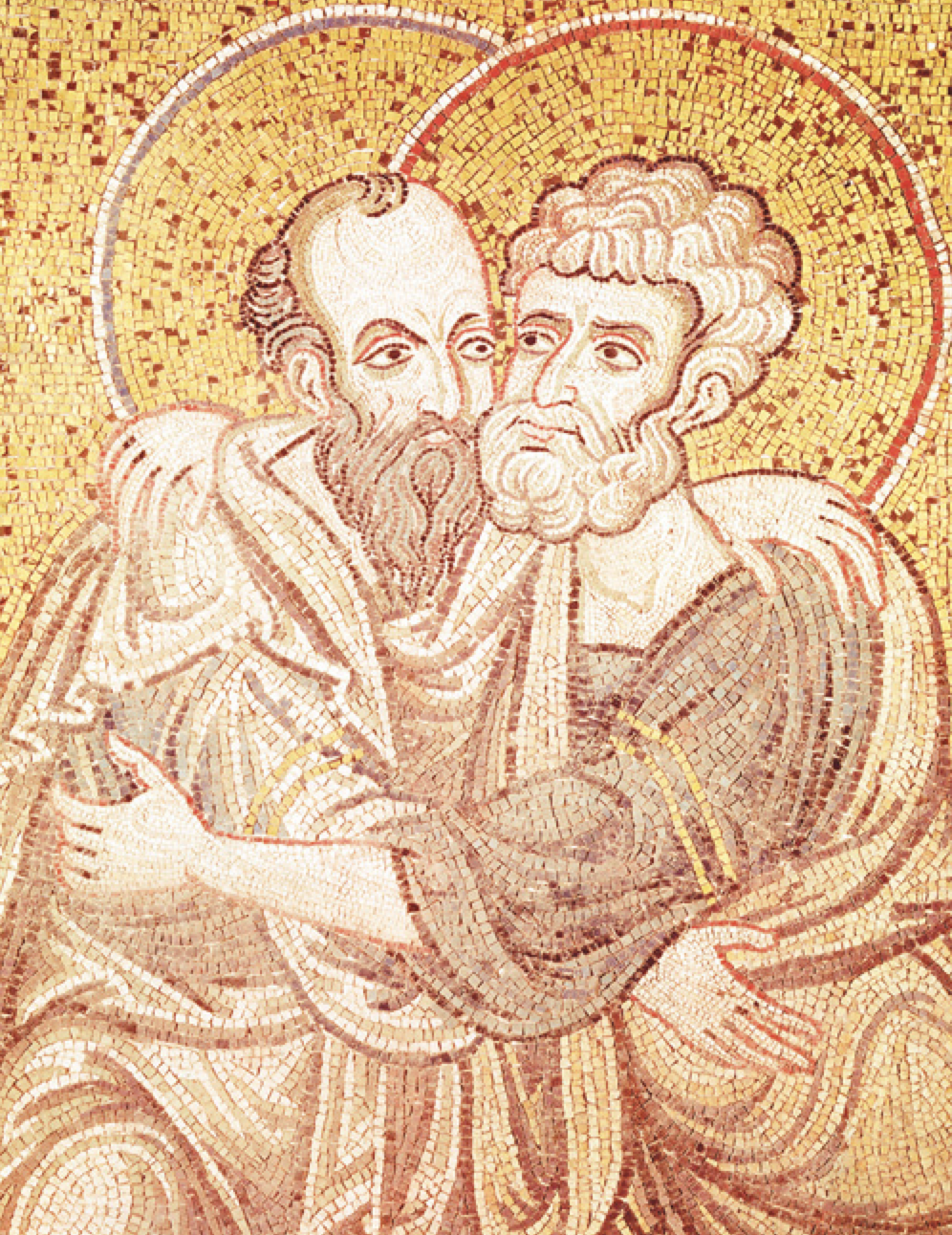
Paul and Peter Embrace. Paul and Peter appear to have had a somewhat feisty relationship. They respected each other, but they did not always agree or get along (Gal. 2:11-14), and sometimes they were viewed as competitors (1 Cor. 1:12; 3:21-23). Thus, the image of Paul and Peter embracing each other became a motif in certain periods of Christian art—a symbol of reconciliation or, especially, of ecumenical unity. This example comes from a twelfth-century mosaic in Sicily. (Bridgeman Art Library)
- Introduction. The Battle for Christian Freedom
- Overview
- Historical Background
- Major Themes in Galatians
- Northern and Southern Galatian Theories
- Justification again
- Conclusion: The Gospel of Freedom and Transformation
- Galatians.
Paul’s Claim to Authority
Before Paul explains why the proponents of circumcision are misguided, he has to deal with another matter. His opponents have muddied the waters by attacking him personally. Thus, he needs to reestablish his credentials as one whose words carry authority. The basic allegation seems to be that Paul misunderstood or at least misrepresented the gospel message that he received from the apostles and other leaders of the church. His opponents probably remind people that he came in late, as one who had never known the earthly Jesus. Dependent upon others, he possessed only a derivative authority and should be listened to only when his ideas matched those of people who really knew what they were talking about—people such as Peter and John, who had been among Jesus’ original disciples, or Jesus’ brother James, who now led the church in Jerusalem.
Paul begins the Epistle by defending his apostleship — not from men, but from Jesus Christ Himself (Galatians 1:1). He recounts his conversion, his withdrawal to Arabia, his meeting with Peter and James, and his confrontation with Peter at Antioch (Galatians 2:11-14). This autobiographical section is crucial: Paul’s Gospel is not a human invention but a divine revelation.
Northern and Southern Galatian Theories
“Northern Galatian Theory” —Sequence of Events
Paul evangelizes cities in southern Galatia (Acts 13:14-15; 14:1).
Conference takes place in Jerusalem (Acts 15; Gal. 2:1-10).
Paul evangelizes Galatian tribes in northern Galatia (Acts 16:6; 18:5).
Paul writes the letter of Galatians to churches in northern Galatia.
The northern Galatian theory recognizes that the people usually known as the “Galatians” lived in the northern part of the province visited by Paul after the Jerusalem conference.
“Southern Galatian Theory” —Sequence of Events
Paul evangelizes cities in south Galatia (Acts 13:14-15; 14:1).
Paul meets with church leaders in Jerusalem (Gal. 2:1-10).
Paul writes the letter of Galatians to churches in south Galatia. Conference takes place in Jerusalem (Acts 15).
The southern Galatian theory resolves what would be inconsistencies between Galatians 2:1-10 and Acts 15 if these were viewed as describing the same event.
Paul has a twofold response to this charge: (1) he did not derive his understanding of the gospel from the other apostles; (2) his understanding of the gospel does not differ substantially from theirs.
Let’s take the second point first. Paul states for the record that he has shared his understanding of the gospel with James and Peter and John and that they have given it their endorsement (2:6). He says that he met with these church leaders in Jerusalem and specifically discussed the question of circumcision with them. He even brought Titus, an uncircumcised Gentile Christian, to the meeting with him, and all of these church leaders agreed with Paul: neither Titus nor (by implication) any other Gentile should be compelled to be circumcised (2:3).
This, we might think, would be all that Paul needed to say. Indeed, we might assume that he would call upon people such as Peter and James to back him up. Perhaps he could get them to send reference letters to the Galatians on his behalf, letting them know that, contrary to what they have been told, Paul’s gospel does indeed meet with their approval (cf. 2 Cor. 3:1). But this is not at all the route that he wants to take.
Rather, Paul’s main point in responding to the charge against him is the first one listed above. In effect, he claims that it doesn’t matter whether or not his gospel has the support of prominent church leaders, because the message that he proclaims is one that he received directly from Jesus himself, by way of divine revelation (1:11-12; cf. 1:1). Paul seems to be saying, “My opponents are dead wrong when they say that the gospel I preach contradicts that of the apostles, but even if they were right, it wouldn’t matter. The gospel that I preach does not need their endorsement—it comes from God.”
To drive this point home, Paul voluntarily shares a story that his opponents would likely have used against him (or, perhaps, he offers his version of an incident that they actually were using against him). There was one time when he found himself publicly at odds with Peter and, by implication, with James, on whose counsel Peter appears to have been operating. It happened at Antioch, Paul’s home base of operations, and though it is not clear that Paul won the argument in that setting, he recounts the event with absolute confidence that he was right and the early church’s most highly respected leaders were wrong (2:11-14). Paul’s mandate for authority, then, comes from the truth of the gospel itself and requires no endorsement from particular church officials.
After a customary salutation (1:1-4), Paul immediately declares his astonishment that the Galatians are deserting God and embracing a false message that perverts the gospel of Christ (1:6-9). He then turns defensive, responding to charges that he is a people-pleaser (1:10). He recounts segments of his autobiography to counter allegations that he picked up the gospel message secondhand, or that he does not proclaim the gospel in a manner approved by other apostles (1:11-2:10). Continuing in the autobiographical mode, he relates an incident at Antioch that set him at odds with Peter (called “Cephas,” his Aramaic name) and other respected church leaders (2:11-14). Reporting that incident serves as a segue to discussion of matters at hand, for it brings into sharp focus a question that the Galatians themselves need to consider: whether one is made right with God by doing works of the law or by trusting in Jesus Christ (2:15-21).
Seizing the offensive, Paul tells the Galatians that they are fools for allowing anyone to convince them the crucified Christ is insufficient for them. With a number of arguments, many of them drawn from scripture, he reiterates his point that trusting in Christ is incompatible with relying on works of the law as a means to receiving God’s Spirit or being declared righteous by God (3:1-18). He considers the true purpose of the law (3:19-4:11) and then turns conciliatory, appealing to the Galatians as his children in the faith and calling them to turn back from a course that will lead them into bondage (4:12-5:1). He warns them against accepting circumcision as a qualification for belonging to God and vents his anger against those who urge them to do so (5:2-12).
The Polemic of Galatians. More than any other letter, Galatians shows Paul on the attack. As one who apparently has been maligned by his opponents, he shows that he can give as good as he gets. Here are some of the charges that he makes against his opponents:****
They upset and confuse the Galatians (1:7; 5:10).
They pervert the gospel of Christ (1:7).
They have bewitched the Galatians (3:1).
They are manipulative, trying to secure the Galatians’ loyalty by first courting them and then making them feel excluded (4:17).
They prevent the Galatians from obeying the truth (5:7).
Their real motivation is to avoid persecution from Jews (6:12).
They are hypocrites who don’t obey the law themselves (6:13).
They want to boast of their success at getting the Galatians circumcised (6:13).
Twice in this letter Paul levels a curse against his opponents (1:8-9) and once he says that he wishes that they would castrate themselves (5:12).
Finally, Paul launches into a soaring treatise on the meaning of freedom, emphasizing its paradoxical fulfillment in loving service rather than in self- indulgence. He identifies the outcome and evidence of true freedom with the fruit that the Holy Spirit bears in people whose lives have been transformed by God’s grace (5:13-25). He then concludes the letter with a quick series of exhortations (5:26-6:10) and a summary paragraph written in his own hand, exalting the cross of Jesus (6:11-18).
Galatians.
Related Concepts
- 1-corinthians-1545
- adoption-as-sons
- ambassador-for-christ
- ascension
- bearing-burdens
- choice
- christification
- circumcision
- communal-theosis
- communion
- communion-with-god
- conquest
- crucifixion-with-christ
- divine-human-cooperation
- divine-inspiration
- forensic-righteousness
- freedom
- glorification
- glory
- good-works
- healing
- heart
- holy-humility
- holy-spirit
- hope
- human-responsibility
- imputation
- inaugurated-eschatology
- judaizers
- justification
- legalism
- macarius
- moral-effort
- new-birth
- nuptial-union
- obedience-of-faith
- old-covenant
- orthodox-soteriology
- perseverance
- personhood
- reformation-critique
- resurrection
- revelation
- revelation-211
- salvation
- sin
- sonship-of-christ
- st-gregory-palamas
- st-john-chrysostom
- st-theophan-the-recluse
- synergy
- theosis
- union-with-christ
- union-with-god
- works-of-the-law
- zions-restoration