New Testament — Topic 23
So, what happened next? Did Paul win his battle with the super-apostles? Did the Corinthian church finally get its act together in a way befitting his “full confidence” in them (7:16)? We have two reasons to believe that matters were resolved to Paul’s satisfaction. First, his letters to the Corinthians (at least two of them) were copied and preserved—somebody in the church had high regard for Paul’s words. Second, Paul wrote his letter to the Romans from Corinth within a year of writing 2 Corinthians to Corinth. In Romans, he indicates that the funds for Jerusalem have been successfully collected (Rom. 15:25-26), and he passes on greetings from prominent Corinthian Christians with whom he seems to be on good terms (Rom. 16:1, 23). All of this hints at a happy ending.
Prepare for the sequel. About forty years later—three decades after Paul’s death—another letter to Corinth appeared, this one ascribed to Clement, who is said to be a bishop of Rome. He complains that the Corinthian congregation is divided into factions. He also says, “It is a shameful report, beloved, extremely shameful and unworthy of your training in Christ, that on account of one or two persons the steadfast and ancient church of the Corinthians is being disloyal to the elders!” (1 Clement 47:6).
Factions in the church? Troublemakers undermining the authority of established leaders? Where have we heard that before?
Let’s pick up Paul’s adventures with Corinth where we left off in the last chapter. Paul founded the church in Corinth and, after leaving, wrote a now lost letter to the congregation (mentioned in 1 Cor. 5:9). Then, while he was in Ephesus, he received two different reports of various problems in the church and wrote the letter that we know as 1 Corinthians in an attempt to adjudicate those matters.
After that, things really got messy. Paul had said that he was going to take a trip to Macedonia and then visit the Corinthian church on his way back to Ephesus (1 Cor. 16:5-7). He changed his mind and decided to visit Corinth on his way to Macedonia as well (2 Cor. 1:15-16). Perhaps he caught them unawares; in any event, the visit did not go well. He had some kind of confrontation with people who he believed were sinning (2 Cor. 13:2), and someone in the church did something intended to hurt or humiliate him, something that later he would claim actually hurt the entire congregation (2 Cor. 2:5). Paul left in a huff and canceled his plans to visit them on the return trip (1 Cor. 16:6-7). This exacerbated tensions and led to accusations that he was unreliable (2 Cor. 1:15-23). His explanation for the change of plans is telling: he says that he canceled the trip to avoid “another painful visit”; he simply could not bear suffering pain from those who should make him rejoice. He also wanted to spare the Corinthians the pain that he knew he would inflict on them if he came to them at this particular time (2 Cor. 1:23; 2:1-3). Without knowing all the details, we still clearly see that Paul’s relationship with the church had deteriorated.
We get a hint in the last few chapters of 2 Corinthians as to what part of the problem might have been. At some point, a group of people whom Paul sarcastically refers to as the “super-apostles” (11:5; 12:11) arrived in Corinth; whether they were already there at the time of his unannounced painful visit to the church, we cannot say. We know nothing about these super- apostles except what can be gathered from Paul’s comments: they were of Jewish ancestry (11:22), and they presented themselves as ministers of Christ (11:23). Paul, however, regarded them as ministers of satan in disguise (11:13-15): they presented the Corinthians with a different Jesus, preached a different gospel, and imparted a different spirit (11:4).
The conflict between Paul and the super-apostles appears to have been more a contest of authority than a disagreement over particular doctrines or practices. Indeed, a major issue seems to have been the question of what constitutes a basis for authority within the church. Paul claimed that the super-apostles employed worldly standards for excellence in order to establish themselves and promote their authority. They in turn maligned Paul as appearing bold in his letters but not in person (10:1). They said, “His bodily presence is weak and his speech contemptible” (10:10), a remark that has given rise to much speculation. To what were they referring when they criticized his “bodily presence”? Was Paul of short stature or slight build? Did he have some kind of physical disability (cf. 12:7-9)? And what was wrong with his speech? Did he stutter or have a speech impediment? Was he a lousy preacher? We cannot know, but what seems obvious is that the super-apostles claimed that he lacked charisma. Compared to what the Greco-Roman world had to offer in the way of skilled orators and public presenters, Paul simply was unimpressive. Paul, of course, said as much about himself (1 Cor. 2:1-5; 2 Cor. 11:6), but he did not draw the same conclusions from his lack of showmanship that the super-apostles wanted the Corinthians to draw (2 Cor. 11:5; 12:11).
After Paul decided to forgo “another painful visit” to Corinth, he attempted to resolve problems in the church by writing them a desperate and difficult letter. This was actually his third composition to the church, and like the first letter (referred to in 1 Cor. 5:9), it has been lost (but see box 14.2). Paul refers to the letter a few times in the letter that we know as 2 Corinthians (see 2:3-4, 9; 7:12), and Bible readers sometimes simply assume that he is referring in those passages to the letter that we know as 1 Corinthians. This is an understandable misconception; however, a closer look reveals that Paul is referring to a different letter, one that he wrote after 1 Corinthians and after his subsequent painful visit to the church. In this other letter he apparently gave the church an ultimatum, challenging them to prove their obedience to him by disciplining the individual who had wronged him (2 Cor. 2:9; 7:12). Paul says that he wrote this letter “out of much distress and anguish of heart and with many tears” (2 Cor. 2:4), and he indicates that after sending it by way of Titus, he regretted having done so (2 Cor. 7:8).
From 2 Corinthians we learn that around this time Paul also experienced a terrible trial in Asia (probably in the city of Ephesus). The opposition to his ministry brought on some sort of “deadly peril” that led Paul and his associates to believe that they were going to die (1:8-9). Most scholars think that they were imprisoned for their faith, and some think that Paul may have written his letter to the Philippians or some of the other “prison letters” at this time. In any case, the experience provided Paul with some perspective on ministry that is evident in his subsequent communications with the Corinthians. After the ordeal had passed, he left Ephesus for missionary work in Troas and then moved on to Macedonia, still anxious to hear from the Corinthians (2:12-13).
At last, Titus (who had carried Paul’s challenging [but now lost] letter to the Corinthians) arrived with incredibly good news: the Corinthians had repented of all the ways in which they had grieved Paul (7:9-11), and they had disciplined the guilty party who had treated him so badly (2:6-7). Paul was overjoyed (7:4), and his confidence in the church was restored (7:16). In response, he wrote to the church a fourth time, expressing his relief and joy at their favorable response and encouraging them to forgive and console the one who had been disciplined (2:6-10). This fourth letter was sent from Macedonia (2:13; 7:5) somewhere between 55 and 58. We call it “2 Corinthians.”
Such, in broad outline, is the history of Paul’s dealings with Corinth up to the time that he wrote 2 Corinthians. There is, however, one potentially complicating factor. As we noted, some scholars believe that the letter that we currently know as 2 Corinthians is actually a composite containing various letters and notes that Paul sent to the Corinthians at different times. By this reckoning, only the first seven chapters represent Paul’s fourth letter to the church (or perhaps just 1:1-6:13; 7:2-16); chapters 8 and 9 might be additional letters that he sent regarding the collection for Jerusalem; and the last four chapters (10–13) perhaps represent still another letter dealing with the problem of the super-apostles. These theories become very complicated, with numerous variations (see box 14.2 on p. 297).
Sequels can be disappointing. There is a blockbuster Hollywood movie, and next summer we get a lackluster follow-up. There is a breakthrough rock album, and a year later the band delivers its “sophomore slump.”
About a year after writing 1 Corinthians, another letter emerged from the pen of the apostle Paul, a letter that we know as 2 Corinthians. It has all the marks of a typical sequel: hasty production and sloppy composition. A book review editor for the Corinthian Post may have thought that the apostle had lost his touch. The former letter (1 Corinthians) was organized topically, whereas this one seems to wander all over the place: Paul jumps around in his thinking, goes off on tangents, and then returns to finish a point that we had almost forgotten about. The letter is also marked by abrupt changes in tone: Paul is hurt (2:1-4), happy (7:13-16), hopeful (1:7, 10), and horrified (11:13-21). Why can’t he just pick a mood and stick with it?
Some people think that 2 Corinthians was written on the move, that Paul dictated it over a period of days or weeks, responding as the occasion suited him. Others think that 2 Corinthians is not a letter at all but rather a compilation of bits and pieces from various letters that Paul wrote at different times, in which case (to use the Hollywood sequel analogy) there may have been many deleted scenes that ended up on the cutting-room floor.
The bottom line, however, is that 2 Corinthians has not been a disappointment to scholars, ministers, or everyday Christians. It has become one of Paul’s most read and studied works. There are passages of incredible beauty, such as the opening prayer in 1:3-7 and the testimony to Christian hope in 4:16-5:5. And there are rich theological passages, including some of the Bible’s earliest references to the preexistence (8:9) and divinity of Christ (4:4) and to the work of God that is accomplished through him (5:17-19). It’s enough to make us wish we had sequels to all of Paul’s letters.
- Introduction
- Overview
- Historical Background
- Major Themes in 2 Corinthians
- Conclusion
Paul’s Ministry
Paul devotes the bulk of this letter to discussing the character and content of his ministry. He emphasizes, first of all, the integrity with which his ministry is always carried out (7:2). He and his associates are not “peddlers of God’s word” (2:17) or self-promoters (4:5) who falsify God’s word (4:2) to their own advantage. They operate with sincerity (1:12; 2:17) and with complete openness (4:2), enduring hardships (6:4-5) and exhibiting virtues (6:6-7) that reveal them to be true servants of God (6:4) and ambassadors for Christ (5:20). Second, Paul stresses that he has developed a close personal relationship with the Corinthians. He seems to be as committed to them emotionally as he is professionally, speaking openly of his affection for them (2:4; 6:12; 11:11) and of the personal pain that he experiences when they are in conflict (2:1-4). Indeed, he remains solicitous of them, styling their relationship as one of not-quite-requited love (6:11-13; 7:2; cf. 12:15).
More importantly, Paul stresses that his ministry is of God: he has been sent by God to do God’s work, and God is working through him to accomplish it (2:14, 17; 3:4-6; 4:1, 7; 5:2, 18, 20). That work itself is glorious; it is a spiritual ministry that brings a new covenant (3:6) and more: a new creation (5:17). Indeed, what God is doing through Paul reveals a glory that surpasses anything previously envisioned (3:7-18). And yet this is a ministry carried out by mere humans, by mortal beings who suffer trials and tribulations (4:16; 5:2-4; 6:4-10; see also 11:21-33). Just as precious treasure might be contained in nondescript jars of clay, so too the glorious gospel of God is advanced by frail and fragile agents whose lives exhibit the paradoxes that such a gospel entails (4:7-12).
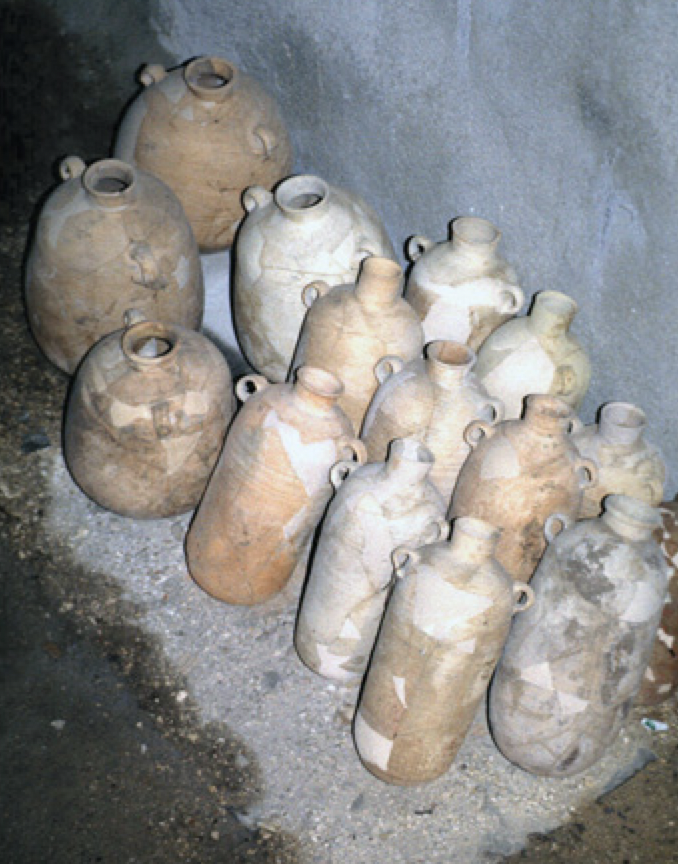
Jars of Clay. Earthen jugs were common in Paul’s world. Paul likens human beings to clay jars in which someone has placed a priceless treasure: the spirit is precious, but the flesh is weak; life is eternal, but in this present world we are frail beings subject to the powers of death and decay.
Fund-Raising
Paul devotes two chapters of this letter to the collection that he is taking up for Jerusalem, making 2 Corinthians 8–9 the most extensive discussion of fund-raising in the New Testament. Paul had agreed with leaders among the Jewish Christians in Jerusalem that he would collect an offering from the Gentile churches that he founded for “the poor” in Jerusalem (Gal. 2:10; cf. Acts 11:29-30; 24:17). This was not simply an act of charity but also an opportunity to demonstrate the unity of Gentile and Jewish believers. Paul mentions the collection elsewhere (Rom. 15:25-27; 1 Cor. 16:1-4), and, we might assume, he often solicited donations with words similar to what we find here. Indeed, since chapter 9 seems to introduce the subject as though it were a new topic, some scholars think that we are in possession of two letters that Paul wrote concerning this offering (2 Cor. 8 to the city of Corinth, and 2 Cor. 9 to the whole province of Achaia). Be that as it may, these two chapters are often used by Christian churches to teach financial stewardship and encourage generous giving.
Paul presents the opportunity to give as a privilege—a favor from God (8:1-2)—and he promotes a principle of sharing resources, so that there might be neither excess nor want among God’s people (8:13-15). Since “God loves a cheerful giver” (9:7), participation in the offering is to be voluntary (9:5), and contributions are to be offered according to individual means (8:3, 11–13). Still, to motivate the Corinthians to give generously (8:7), Paul points to the liberality of their neighbors the Macedonians (8:1-5). They don’t want to be outdone by the Macedonians, do they? Then, he goes on to say that he has actually bragged to the Macedonians about them, and he hopes that they won’t embarrass him by failing to come up with what he expects (8:24; 9:2-4). On a deeper level, however, Paul hopes that their generosity will be inspired by the sacrifice of Christ (8:9). Further, the ultimate rationale for such giving lies in his belief that people are stewards or caretakers of all that they have received from God (see 1 Cor. 4:1-2). If the Corinthians realize how abundantly they have been blessed with God’s gifts (9:8; cf. 1 Cor. 4:7), they will want to use what they have received to help others and to bring glory to God, who has been so generous to them (9:12-14).
Apostolic Authority
Throughout 2 Corinthians, Paul emphasizes and defends his authority as an apostle. To appreciate this fully, we need to go back to his earlier correspondence with the church and notice the authoritative manner in which he speaks in 1 Corinthians. He claims to have the authority to excommunicate members of the church from afar (1 Cor. 5:3-5). He issues rulings on matters for which there is no clear “word of the Lord” (1 Cor. 7:12, 25, 40; cf. 7:10), and he insists that only those who accept what he has to say in his letters are to be recognized as prophets in the church (1 Cor. 14:37-38). He offers himself to the church as an ideal role model, blatantly calling upon the Corinthians to “be imitators of me, as I am of Christ” (1 Cor. 11:1; cf. 4:16). It is not difficult to imagine that such statements appeared heavy-handed to some in the church or that they might have provided Paul’s opponents with grist for painting him as an egotistical self-promoter. And if Paul can claim that kind of authority, what is to prevent others from claiming it as well?
In 2 Corinthians, we see that this potential for a power struggle has come to fruition. There are now people in the Corinthian church who, Paul says, are “disguising themselves as apostles of Christ” (11:13). This raises the question “How does one know a true apostle from a false one?” Paul says in 1 Corinthians that apostles must be appointed in the church by God (12:28); one cannot simply choose to be an apostle.
Taking the two letters together, we find that Paul mentions four qualifications for apostleship:
1. He refers to “the signs of a true apostle,” reminding the Corinthians of signs and wonders and mighty works (miracles?) that he did in their midst (2 Cor. 12:12).
2. He identifies true apostles as people who have “seen the Lord”—that is, who were witnesses to the risen Jesus (1 Cor. 9:1). This may explain why Paul included himself on the short list of persons to whom the risen Jesus appeared in his discussion of Christ’s resurrection in 1 Corinthians 15:3-8; it may also explain why he says “last of all … he appeared to me” (1 Cor. 15:8). The appearances are over and done; Paul doesn’t want there to be any volunteer apostles (like these folks in Corinth?) suddenly claiming that Jesus appeared to them too.
3. He describes the role of an apostle as founding churches. He is an apostle to the Corinthians because they are his converts (his “work in the Lord”) and, accordingly, the seal of his apostleship (1 Cor. 9:1-2). He is their father in the faith (1 Cor. 4:14-15) and has earned the right to address (and discipline) them as his children (1 Cor. 4:14; 2 Cor. 6:13; 12:14). Thus, in 2 Corinthians, he mocks would-be apostles who try to establish their authority with letters of recommendation (2 Cor. 3:1). The Corinthian believers themselves are Paul’s letter of recommendation, written on human hearts by Christ, using the Spirit of God as ink (2 Cor. 3:2-3). For this reason, Paul is particularly perturbed that the super-apostles (who in fact are not apostles) have overstepped their bounds by coming into his “sphere of action” and trying to establish themselves by building on what he has done (2 Cor. 10:13-16). Hypothetically, if these people want commendation from the Lord (2 Cor. 10:18), they should set out for lands where the gospel has not yet been proclaimed (2 Cor. 10:16), make new converts for the faith, and exercise authority over churches that they founded themselves.
4. He thinks of apostles as persons who serve as spokespersons for an authoritative tradition. In 1 Corinthians, Paul said that he “handed on” to the Corinthians what he “in turn had received” (1 Cor. 15:3; cf. 11:2, 23). Now, in 2 Corinthians, he suggests that the “false apostles” (2 Cor. 11:13) are proclaiming “a different gospel” (2 Cor. 11:4; cf. Gal. 1:6-8)—that is, a gospel different from the one that has been handed on. Paul admits that he might be untrained in speech, but he claims that he is not deficient “in knowledge” (2 Cor. 11:6). Knowledge of what? Most likely, he means that he is a reliable apostle because, unlike these interlopers, he has legitimate knowledge of what God has done in Jesus Christ.
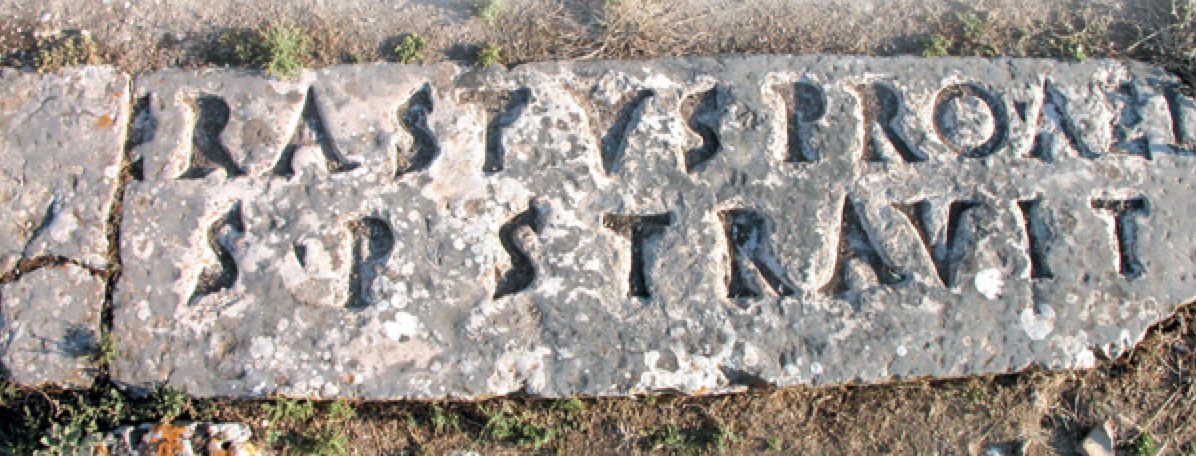
The Erastus Inscription. This pavement stone in Corinth still bears the name of Erastus, the city treasurer mentioned in the Bible as belonging to the Corinthian church (Rom. 16:23; 1 Tim. 4:20).
Such general ideas of what it means to be an apostle may not have been absolute for Paul. In Romans 16:7, he refers to Andronicus and Junia as “prominent among the apostles,” though there is no indication that either of them worked miracles, saw the risen Jesus, or founded a church. The context in Corinth clearly is one of conflict, which may have colored Paul’s remarks.
In any event, in 2 Corinthians, Paul yields none of his apostolic authority to his rivals, nor does he ease up on any of his grandiose claims. He has been given divine power to punish the disobedient (10:2-6), and he lets the Corinthians know that they will experience the full weight of this punitive authority if they don’t live right (13:1-2). This grieves him, because ultimately the authority that the Lord has given to him is for building up, not tearing down (10:8; 12:19; 13:10; cf. Jer. 1:10). If he seems harsh with the Corinthians, he says, it is only because they are so obstinate (12:20-21) and so easily fooled by those who take advantage of them (11:19-20).
Boasting
Paul is generally opposed to self-commendation and boasting; it is unseemly (Rom. 1:30; 1 Cor. 13:4) and credits mere human beings with what should be attributed to God (Rom. 3:27; 11:18; 1 Cor. 1:29; 3:21-23; 4:7; 9:16). His usual slogan is “Let the one who boasts, boast in the Lord” (1 Cor. 1:31; 2 Cor. 10:17; cf. Jer. 9:24; see also Gal. 6:14). In 2 Corinthians, however, Paul brags quite a bit about himself and his credentials: he has authority over the Corinthians (10:8); he comes from good Israelite stock (11:22); he is an exceptional minister of Christ (11:23); he has made sacrifices and endured hardships for the sake of the gospel (11:23-29); he has received visions and revelations from the Lord (12:1-7); and he has worked signs and wonders (12:12). Why is Paul so given to praising himself? He says that he has been forced into it because the super-apostles have offered unfounded claims to superiority (10:10; 11:5-6; 12:11). He has been forced into it also because the Corinthians, who should be commending him, have not done so (12:11; cf. 5:12). He often brags about them (1:14; 7:4, 14; 8:7; 9:2-3), but they don’t return the favor. He is forced to commend himself because no one else will do so.
This may seem a bit silly, and apparently that’s the whole point! Paul admits that he is a fool to talk this way (11:1, 16–19, 21, 23; 12:11). An obvious implication of such an admission is that the super-apostles are fools when they talk this way too. Apparently, the super-apostles were big on commendation (3:2; 10:18; 11:13), comparing themselves to others to see who measured up (10:12; 11:12). They liked to call attention to their abilities and achievements in ways that Paul thought evaluated them “according to human standards” (11:18). By admitting to his own foolishness, Paul exposes theirs. With biting irony, he says (in effect), “I am nothing, but that doesn’t make me inferior to them” (see 12:11). The difference is that Paul is well aware that he is nothing (cf. 1 Cor. 3:7), whereas the super-apostles do not seem to have grasped the reality of their nothingness.
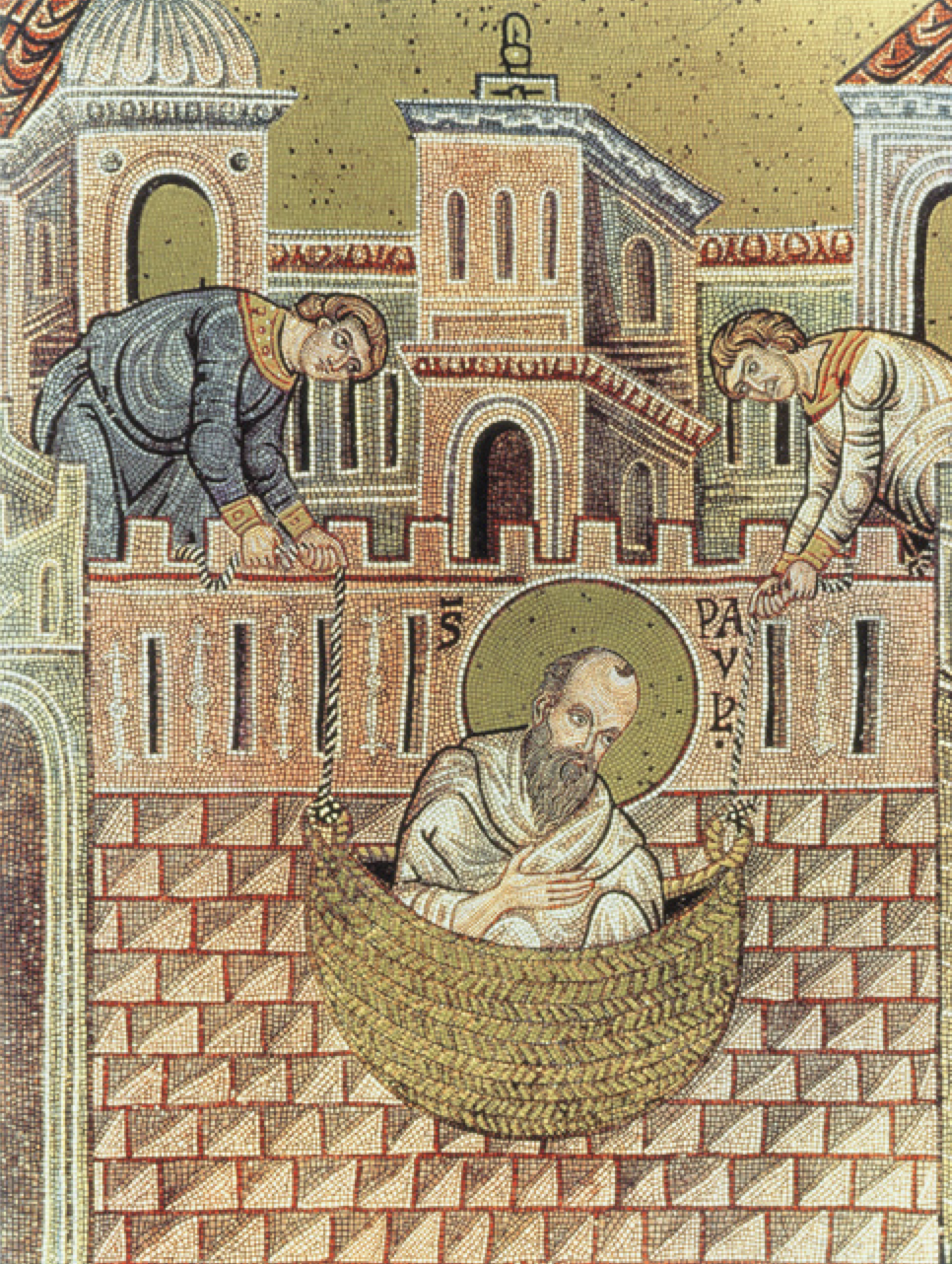
Paul Being Lowered in a Basket. This colorful incident from Paul’s biography is mentioned in Acts 9:23-25 and 2 Corinthians 11:32-33. Most people would not brag about having fled or hidden from their enemies, but Paul employs this as an example of how God uses those who are weak in this world. (Bridgeman Art Library)
Finally, Paul turns the table on his opponents by suggesting a different contest: instead of comparing strengths, why not compare weaknesses? After all, he reasons, our inadequacies are what ultimately prove that it is God who is responsible for our accomplishments. If we really want to establish which of us is being used by God, we should check to see which of us is the most inadequate. Paul, of course, assumes that the super-apostles will not join him in this venture; human failings and weaknesses are things that they try to deny or cover up. So, Paul goes it alone: he talks about a humiliating incident when he had to be smuggled out of a city in a basket (11:32-33); he reminds the Corinthians of an affliction that he has to put up with (12:7); and he admits to times when God has rejected his prayer requests (12:8-9). He boasts gladly of things that expose his weakness, things that prove he is nothing, because these are what should grant the Corinthians absolute assurance that it is God who is responsible for all that comes of his ministry (12:9-10).
The letter begins with a typical opening (1:1-2) and prayer (1:3-7), to which Paul appends a brief report on how God delivered him and his companions from a terrible ordeal that they faced in the Roman province of Asia (1:8-11). After this, he offers a somewhat defensive explanation for his recent dealings with the church, including his rationale for canceling a promised visit and for writing them an unusually harsh letter instead (1:12-2:13). This leads to an extended commentary on what Paul considers to be the meaning and value of his ministry among the Corinthians (2:14-6:13). Paul discusses both the character and the content of that ministry, emphasizing what God has accomplished through him and his associates. Then, he exhorts the Corinthians to avoid partnerships with unbelievers (6:14-7:1), insists that he has always had their best interests at heart (7:2-4), and returns at last to the subject of his recent relations with the community (7:5-16, picking up from 2:13): he rejoices that the difficult letter that he sent them did bring them to repentance, and he affirms his newfound confidence in them. On a new note, Paul takes up the subject of the collection that he is taking for Jerusalem, and he offers a number of incentives for his readers to contribute generously to this cause (8:1-9:15). Then, the tone of the letter changes abruptly as he returns to a defense of his ministry, employing bitter sarcasm as he compares himself to a group of “super-apostles” (11:5; 12:11) who have maligned him in the Corinthian church (10:1-13:10). The letter ends with a few quick exhortations (13:11-12) and a final benediction (13:13).
2 Corinthians.
Related Concepts
- 1-corinthians-1545
- ambassador-for-christ
- ambassadors-for-christ
- apostolic-ministry
- authority
- authority-for-building-up
- boasting
- canonical-form-of-the-letter
- cheerful-giving
- co-authorship
- collection-for-jerusalem
- commendation
- different-gospel
- discernment-of-spirits
- equality-among-gods-people
- false-apostles
- father-in-the-faith
- foolishness
- glory
- grace-perfected-in-weakness
- holy-spirit
- hope
- inaugurated-eschatology
- irony
- jew-gentile-relations
- letter-as-substitute
- letters-of-recommendation
- ministry-of-the-spirit
- mortification-and-life
- moses
- new-birth
- paul
- pauline-authorship
- pauline-chronology
- pauline-mission
- personal-presence
- power-of-god
- prophetic-vocation
- resurrection
- revelation-211
- salvation
- self-commendation
- self-emptying-sacrifice
- severe-letter
- sphere-of-action
- spiritual-parenthood
- st-john-chrysostom
- stewardship
- suffering
- super-apostles
- the-poor
- thorn-in-the-flesh
- transformation-into-glory
- union-with-christ
- witness-to-the-resurrection
- words-of-the-lord
- zions-restoration