New Testament — Topic 22
Paul’s first letter to the Corinthians is almost as long as his letter to the Romans and, along with that letter, is regarded as one of his major works. To some extent, Romans is more theoretical, presenting key theological ideas in a fairly systematic way; 1 Corinthians is more practical, focused on specific issues that have arisen in a particular context. Taken together, the letters offer us a portrait of Paul as theologian and pastor, and what stands out is how interconnected those roles are for him: Romans reveals him to be pastoral in addressing theological issues, and 1 Corinthians reveals him to be theological in dealing with pastoral concerns.
But Paul’s adventures with the Corinthians have only just begun! After writing 1 Corinthians, he would visit the church again, write them at least two more letters, and continue to grapple with their problems (which, unfortunately, did not subside but actually grew worse). Eventually, he would spend a considerable amount of time in the city, for it was from Corinth that he would write his letter to the Romans. If problems still existed in the church at that point, he does not mention them to the Roman Christians; he does, however, warn the church in Rome to “keep an eye on those who cause dissensions and offenses” (Rom. 16:17). Apparently, he has seen enough conflict in Corinth to last him a lifetime. Nip that stuff in the bud, he tells the Romans. Otherwise, it could be Corinth all over again.
In New Testament times, much of modern-day Greece was divided into two Roman provinces, Macedonia and Achaia (see map 13.1 on p. 276). The capital of Macedonia was Thessalonica, and the capital of Achaia was Corinth, one of the largest and most prosperous cities of the ancient world. Corinth was slightly more than fifty miles from Athens and often was viewed as a crass antithesis to that intellectual center. The city, after all, had been settled by freed slaves as recently as 44 BCE. A poet of the day summed up what may have been a popular sentiment: “What inhabitants, O luckless city, have you received? … Alas for the great calamity to Greece! … Such a crowd of scoundrelly slaves!” (Crinagoras, Greek Anthology 9.284).
Still, Corinth had what seemed to be an ideal location. The city was situated on a narrow strip of land: the Adriatic Sea lay to the west and the Aegean Sea to the east. Several Roman emperors proposed cutting a canal across the isthmus to allow ships to pass back and forth from Italy to Asia. The Corinthians would have loved that, but in the meantime, they did the next best thing. They established ports on either side of their little strip of land with a very nice road (called the Diolkos) between them. A ship could unload at either port and have its cargo and crew transferred by land to another ship just nine miles away. In fact, smaller ships were sometimes hoisted out of the water and pulled along the road on rollers to be deposited back into the ocean on the other side. Although this was labor intensive, many trading companies considered the Corinthian option preferable to sending their ships all the way around Achaia by way of the Mediterranean Sea.


Then and Now: The Corinthian Canal. Corinth is situated on a narrow strip of land separating the Aegean Sea from the Adriatic Sea. In Paul’s day, boats sometimes were put on rollers and hauled across the land for nine miles. Many centuries later (in 1893), a canal was finally dug, fulfilling a plan that had been proposed but never enacted by numerous Roman emperors.
Corinth was famous for a number of other things. The city produced a metal compound called “Corinthian bronze” that was highly valued. It hosted an annual competition called “the Isthmian games” that was second only to Athens’ Olympian games in popularity. Corinth also prided itself on being a haven for the newly rich, offering enterprising men and women their best shot at upward social mobility. Furthermore, Corinth was proud of its reputation as a city that was open to new ideas and tolerant of diversity. By New Testament times, the city of Corinth had come to be associated with lavish lifestyles and conspicuous consumption. It was also famous for its amusements: theaters, temples, casinos, and brothels. Throughout the empire, the expression “to act like a Corinthian” came to be Roman slang for engaging in sexual promiscuity (Crinagoras, Greek Anthology 9.284).
According to the book of Acts, Paul stayed in Corinth for at least eighteen months on his second missionary journey, when Gallio was the proconsul there (18:1-17). This places his sojourn in the city somewhere between 50 and 53. He lived with Aquila and Priscilla, a married couple with whom he apparently had a lot in common: they were Jewish Christians, and, like Paul, they made their living as tent-makers or leather-workers (Acts 18:2-3; cf. 1 Cor. 16:19). Paul evangelized the city with his companions Silas (sometimes called Silvanus) and Timothy (Acts 18:5; 2 Cor. 1:19). The congregation that emerged was diverse ethnically and socially. Most of Paul’s converts were Gentiles (1 Cor. 12:2), but not all. Crispus (1 Cor. 1:14; cf. Acts 18:8) and Sosthenes (1 Cor. 1:1; cf. Acts 18:17) had been leaders of Jewish synagogues. Most of the Corinthian Christians also appear to have come from the lower classes (1 Cor. 1:26), but not all. Gaius (1 Cor. 1:14) had a house big enough to host gatherings of the entire church (Rom. 16:23), and Erastus was the city treasurer (Rom. 16:23; 2 Tim. 4:20). As we will see, the social integration of persons from different ethnic groups and economic classes may have been one significant cause of conflict in the church.
Sometime after founding the church, Paul wrote the Corinthians a letter to which he makes brief reference in 1 Corinthians 5:9 (see box 14.1 on p. 295). We know almost nothing about this “lost letter,” except that one thing Paul told the Corinthians in the letter was to avoid association with sexually immoral people (by which he meant immoral Christians). In any case, Paul heard back from them in two ways. First, he received a visit from some folks he refers to as “Chloe’s people” (1:11)—possibly servants or family members of a woman who was a member of the church. Second, he received a letter from the church asking him questions about a number of matters (see 7:1, 25; 8:1, 4; 12:1; 16:1, 12). This letter appears to have been hand-delivered by three church members, Stephanas, Fortunatus, and Achaicus (16:15-18), who no doubt supplied some information orally as well. In response to these reports, Paul wrote the letter that we know as 1 Corinthians (though it was actually his second letter to the church). He was in Ephesus at the time (16:8), and our best guess places the year of composition somewhere between 53 and 57. The letter is co-written with Sosthenes (1:1), who, according to the book of Acts, had been beaten publicly by an angry mob when the proconsul Gallio had refused to rule against Paul on his initial visit to the city (Acts 18:12-17).
Denominational politics, doctrinal disputes, liturgical preferences—why can’t Christians just learn to get along? It is an old question, as old as Christianity itself. The letter in our New Testament called “1 Corinthians” reveals that church conflict is nothing new.
Paul’s first letter to the Corinthians is perhaps best known for some of its individual passages. Many know it as “the book that gets read at weddings” (see 1 Cor. 13). Some think of it as “the book with all that stuff about speaking in tongues” (see 1 Cor. 12; 14). But taken as a whole, the letter may be popularly regarded as Paul’s epistle to “that church with problems.” All churches have problems, of course, but 1 Corinthians seems to deal with nothing but problems, one right after another. Some of those problems sound just like ones encountered in congregations today; others are linked to cultural situations that may seem foreign to modern readers.
It is a letter explicitly addressed to spiritual babies—Paul can only give them milk, since they are not ready for solid food (3:1-2). Students may think that this promises an easy read, but things are not that simple. For one thing, these are babies who are “sanctified in Christ, called to be saints” (1:2), which means that Paul has high expectations of them. He wants to offer them spiritual wisdom that surpasses anything discernible through mere human wisdom (2:13-14). They have tremendous potential: they have the “mind of Christ” (2:16; cf. Phil. 2:5).
A couple of other matters complicate our study of this letter. First, Paul apparently wrote several letters to this fractious church, some of which have been lost to us. The letter that we know as 1 Corinthians actually appears to be his second letter to the church—yes, that’s confusing, but at least 1 Corinthians was written prior to the letter that we know as 2 Corinthians (so it is the first of the letters that we still have). Our 2 Corinthians usually is identified as Paul’s fourth letter to the church, at least in part, but let’s leave that aside until our next chapter (if you can’t wait, there is a summary box on p. 295).
The Corinthians also wrote to Paul, but we do not have copies of what they sent him. Sometimes, he seems to cite things that they said (6:12, 13; 7:1; 8:1, 4, 8; 9:4; 10:23; 14:22; possibly 14:34-35) and then responds by correcting or condemning their position (see box 13.1). Thus, some verses in this letter express views that Paul wants his readers not to adopt but rather to reject. By paying attention to context, interpreters usually can tell which passages these are, but disagreements do occur, and such disagreements can lead to (you guessed it) church conflict!
- Introduction
- Overview
- Historical Background
- Major Themes in 1 Corinthians
- Some Practical Matters
- Conclusion
Church Unity
Paul is concerned that there are divisions in the church (1:10-11; 11:18-19). Members identify themselves in terms of allegiance to one or another prominent leader. Some identify themselves as disciples of Paul, though he has not authorized them to do so (1:12; 3:4); others follow Apollos (1:12; 3:4-6, 22; 4:6; 16:12; cf. Acts 18:24-19:1; Titus 3:13) or Peter, here called “Cephas” (1:12; 3:22; 9:5; 15:5; cf. Gal. 2:7-9, 11–14). Paul does not side with “the Paul party” but rather condemns all factions for placing too much attention on mere human beings (3:5-7, 21–23), which inevitably leads to “jealousy and quarreling” (3:3). In contrast to this image of a divided church, Paul offers two images of his own. First, the congregation should know that it is “the temple of God” (3:16-17); God’s Holy Spirit dwells in the community as a whole. There is only one Spirit, given to all, and whatever one individual or faction does to destroy the unity of the congregation is an assault on God’s holy dwelling place. Second, Paul says that the church is “the body of Christ” and the individual members are like various body parts: hands, feet, ears, eyes (12:12-27; cf. Rom. 12:4-5; Eph. 4:14-16). The parts are quite different from each other, but all are needed and important. Thus, Paul presents the unity of the church not as an ideal or goal to be realized but rather as an accomplished reality that needs to be recognized (12:27): individuals (and various factions) are all connected to each other whether they know it or not (and whether they like it or not). When any one part of the body suffers, the whole body is affected. The church must learn to act as the unified entity that it actually is.
Wisdom and Power
Paul is troubled that the Corinthians are enamored of worldly wisdom and power. In fact, this may be a root cause for the divisions in the church: the Corinthians seek to identify with the human leaders whom they regard as the most wise and powerful. This matter will come up again in 2 Corinthians, where Paul takes on a group of interlopers who made a big splash in this congregation apparently by flaunting their wisdom and power as signs of divine blessing and authority (2 Cor. 10–12). The bottom line, Paul insists in 1 Corinthians, is that what God considers wise and strong does not accord with the world’s judgments on such matters (1:19-20). Exhibit A is “Christ crucified” (1:23-24): God’s greatest act of wisdom and power was accomplished by what appears to the world to be an exhibition of weakness and folly (1:18; cf. 2 Cor. 13:4). The cross of Christ alone should be enough to get the Corinthians to rethink their value system, but Paul suggests that they also take a good look at themselves: they are not the wisest or most powerful people around, yet God chose them (1:26-27). And, finally, he offers himself as an example: he is not ashamed to admit that he is a fool (4:9-10; cf. 2 Cor. 11:16-17) and a weakling (2:3; 4:9-10; cf. 2 Cor. 10:10; 11:30; 12:5, 9–10; 13:4, 9) by worldly standards. All of these considerations reveal a God who prizes what the world rejects, who works through what the world regards as weak and foolish (1:18-29; 2:14; 3:18-20; cf. 2 Cor. 12:9-10; 13:4). The Corinthians’ high evaluation of wisdom and power represents a fundamental misunderstanding of the gospel.
Christ Crucified
Paul says that when he was with the Corinthians, he decided to know nothing among them “except Jesus Christ and him crucified” (2:2; cf. 1:23; 11:26). Many interpreters have noted that if this really was the case, his congregation didn’t seem to get the message. They at least failed to realize what the message of the cross means for their daily lives. As people who experienced miracles (12:10, 28; cf. 2 Cor. 12:12) and received all sorts of exciting spiritual gifts (1:7; 2:12; 12:4-10), the Corinthians seemed to think that they were already enjoying the full benefits of salvation, living a glorious life that could be characterized by freedom from want or trouble. Paul mocks such attitudes, addressing those whom he knows to be spiritual infants (3:1) with sarcasm: “Already you have all you want! Already you have become rich!” (4:8). Look at yourselves, he tells them. You live like kings because of Christ! Not like us poor apostles who have to suffer hardship for the sake of the gospel. Not you! We are treated like garbage in this world, but you are like kings (4:8-13)! In reality, Paul thinks that Christians live in a world where the forces of evil remain powerful (5:5; 7:5; 8:5; 10:20-21; cf. 2 Cor. 2:11; 4:4; 11:14-15; 12:7), the experience of God’s presence is limited (7:7; 8:2; 13:9, 12; 15:50, 53; cf. 2 Cor. 5:6), temptations to sin are rampant (7:28; 10:12; cf. 2 Cor. 11:3; 12:21), and hardship and suffering are to be expected (15:30-32; cf. 2 Cor. 1:8-9; 4:7-12; 6:4-5; 7:5; 8:2; 11:23-29; 12:7, 10). The problem, Paul thinks, is that the Corinthians are intent on identifying only with the risen Christ, not with the crucified Christ. Paul makes clear elsewhere that life in the present world is marked by a participation in the death of Jesus (Rom. 6:3-5; Gal. 2:19-20; Phil. 3:10; cf. 1 Cor. 11:26; 15:31; 2 Cor. 1:5-6; 4:8-12). That is why he decided to know nothing among them but “Christ crucified”: the message of the cross was what they needed to hear.
Resurrection of the Body
Chapter 15 of 1 Corinthians is often regarded as a theological high point of the New Testament. Paul waxes eloquent about the resurrection of Christ, providing a list of historical witnesses to that event (15:5-8) and claiming that if Christ had not been raised, then preaching would be vain, faith would be futile, people would still be in their sins (15:14-17), and Christians would be the most pitiable people on earth (15:19). The point that Paul really wants to make, however, is not simply that Christ rose from the dead but that he did so as the “first fruits” of a resurrection that eventually will include all who belong to him (15:23). One major concern for Paul is to show that those who have died in Christ have not perished (15:18). Death has lost its sting (15:54-57) because, as the final and ultimate enemy of God, death will be destroyed in the victorious reign of Christ (15:24-26). But Paul also insists that this will be a resurrection of the body, not just the soul or spirit. The actual bodies of believers will be raised and transformed from something perishable to something imperishable (15:35-54). This is a very important point for Paul, and we might wonder why it demands so much attention. It is possible that some of the Corinthians interpreted resurrection as a spiritual experience in which people could participate here and now—an exaltation to a higher plane of spiritual living that they believed had become a reality (4:8-13; 15:12, 19). Paul will return to this theme in 2 Corinthians, where he says that Christians are like fragile jars of clay that contain a precious treasure (2 Cor. 4:7). The outer shell—the human body—is frail, subject to decay, temptation, sickness, and pain. How can anyone living in such a body believe they have already attained some heavenly plane of existence? Rather, believers currently live under a burden, longing to be clothed with heavenly glorified bodies (2 Cor. 5:1-10). In 1 Corinthians, Paul says that Christ’s resurrection grants assurance that they will be so clothed; just as Christ was raised with a new, transformed body, so all who belong to him will be raised with new bodies that are glorious, powerful, spiritual, and immortal (15:43-44, 53–54). But this will happen at Christ’s second coming, not before (15:23, 51–52). By failing to understand that resurrection is future (15:20-34) and corporal (15:35-50), the Corinthians have exaggerated the benefits of their current situation and failed to grasp the significance of what God ultimately has in store for them. The doctrine also has practical consequences: those who do not believe in a resurrection of the body are likely to lapse into moral indifference, but those who do believe in such a resurrection will persevere and remain faithful, even when experiencing trials (15:32).
Christian Freedom
Paul addresses what he considers to be an egregious misunderstanding of Christian freedom, which some Corinthians have interpreted as license to do as they please. Some of them apparently go to prostitutes (6:16-18), and one member of the church is living in an incestuous relationship with his stepmother (5:1). The latter incident actually seems to have become an occasion for boasting (5:2, 6). Why would the congregation be proud of a church member openly doing what most people in the world would have regarded as immoral? The likely answer is that some of the Corinthians construe such permissiveness as a radical enactment of the gospel. “All things are lawful for me!” they say (6:12; cf. 10:23). Where would they have gotten such a notion? It is possible that they got it from Paul himself. In some of his other letters Paul does talk about Christians being free from the law (Rom. 4:15; 6:14; 7:4, 6; 10:4; Gal. 3:24; 5:18). In those passages, however, his point is that Christian behavior is not to be equated with simply obeying rules: Christians live by the Spirit in a new covenant of grace, and they do what is right because it is right, not just because it is required. The Corinthians, it seems, heard only half of what Paul said and missed the point. In any case, he now clarifies his position: the question a Christian should ask is not “Am I allowed to do this?” but rather “Is this a good thing to do?” Even if all things are lawful (allowed), the Christian wants to do only those things that are beneficial (6:12), that build up the community (10:23), and that bring glory to God (6:20). Paul also notes, with some irony, that the Corinthian concept of freedom leads to what is actually bondage: those who adopt a “do as you please” attitude toward life end up becoming slaves to their own passions, dominated by compulsive desires that are neither fulfilling nor healthy (6:12).
After the customary opening (1:1-3) and thanksgiving (1:4-9), Paul takes up a few matters that have been brought to his attention by some members of the church whom he refers to as “Chloe’s people” (1:11). The first of these is that there are factions in the church, with different members claiming to follow various human leaders (1:10-4:21). After dealing with this problem at length, Paul touches briefly on three other matters that Chloe’s people probably reported to him: a man is living in a sexual relationship with his stepmother (5:1-13); members of the church are suing each other in secular courts (6:1-8); and some members evince an “anything goes” philosophy that justifies visiting prostitutes and other immoral behavior (6:9-20).
Paul turns next to questions that the Corinthians have asked him in a letter (7:1). First, he considers the question of whether sexual abstinence might not always be the best policy (even for married people), and he offers some extended teaching on marriage, divorce, and celibacy (7:1-40). Then, he takes up the question of whether it is appropriate for Christians to eat food that was dedicated to idols, and this leads into a general discussion of Christian freedom and responsibility (8:1-11:1). Interposed into this latter discussion is an excursus in which Paul discusses his own rights as an apostle (9:1-14) and his decision to waive those rights (9:15-27). Finally, he turns his attention to several issues that have arisen with regard to Christian worship: the importance of head-coverings for women (11:2-16), proper conduct at the Lord’s Supper (11:17-34), and the role of spiritual gifts such as prophecy and speaking in tongues (12:1-14:40). Embedded in the discussion of spiritual gifts is a poetic ode to love (13:1-13).
Having addressed the questions presented to him, Paul continues to instruct the Corinthians regarding what he considers to be matters “of first importance” (15:3): the death, burial, and resurrection of Christ (15:1-58). Then, he offers a few words regarding the collection that he is taking for Jerusalem (16:1-4) and concludes the letter with comments on travel plans (16:5-12) and some final exhortations and greetings (16:13-24).
The Lord’s Supper
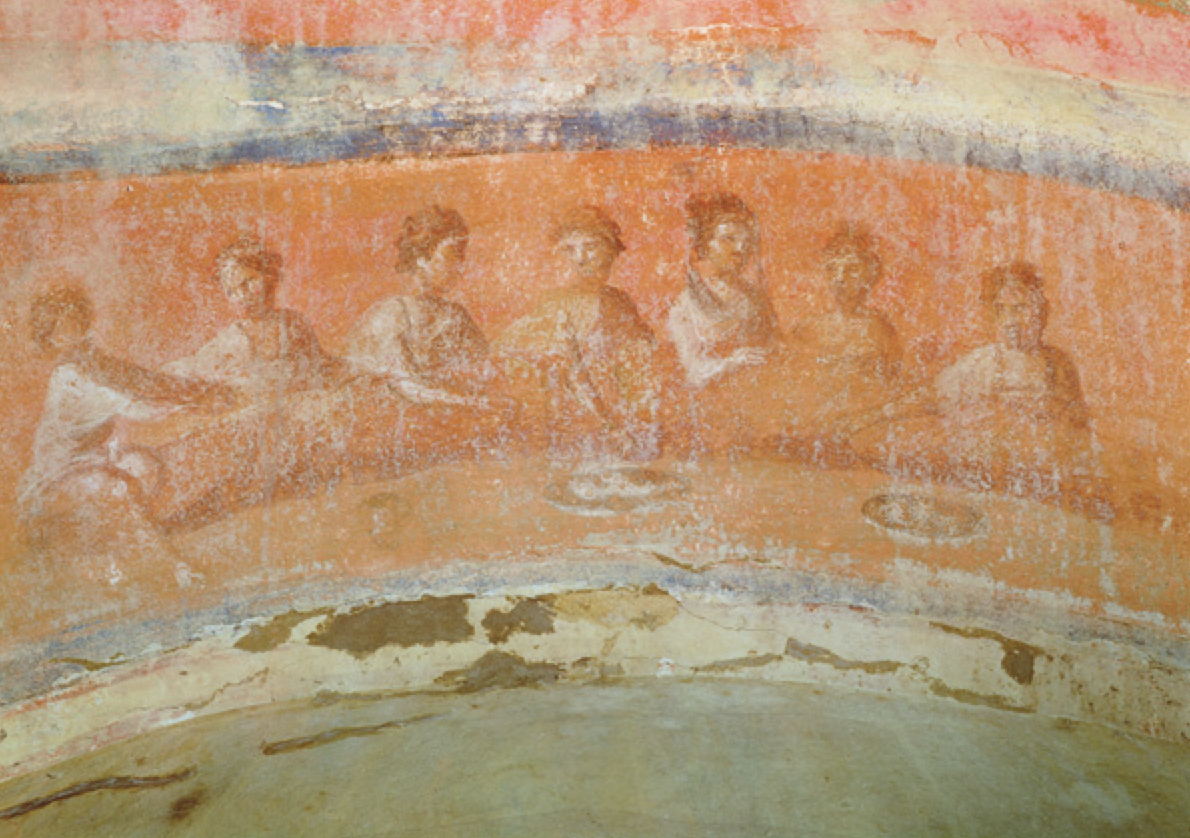
The community gathers regularly for a common meal or “love feast” (cf. Jude 12) at which the Lord’s Supper is observed (11:17-34). This is a full meal—sort of like a potluck dinner with the Lord’s Supper at the end. The food, however, is not getting distributed equitably (11:21). Why not? There could be many reasons, but since Paul says they should “wait for one another” (11:33), many interpreters think that the problem arose from people arriving at different times and eating in shifts. The wealthier members of the church came early and shared with each other whatever they had brought. Members of the lower classes, who labored until dark, came later, bringing whatever meager contributions they could afford. They arrived to find that the elite had already enjoyed a nice banquet and were sated with expensive food and sometimes drunk on fine liquor (11:21). There might be some leftovers, but the second-shift meal for latecomers (probably the great majority of the congregation) was a decidedly lower-class affair. This may have seemed appropriate to those familiar with Greco-Roman banquets, at which servants always ate separately and considered it a privilege to receive scraps from the feast as a supplement to what they would have had otherwise. Paul, however, thinks that replicating such inequities at this meal shows “contempt for the church of God” (11:22). He is appalled that a meal to be eaten in remembrance of Jesus (11:24) has become an occasion for humiliating the poor (11:22). The meal is intended to mark the institution of a new covenant (11:25) and the sharing (in Greek, koinōnia) of the bread and wine is to be done in a way that conveys unity not division (10:16-17).
The Love Feast. This painting of an early Christian celebration of a ritual meal is found in the catacomb of Priscilla (see 1 Cor. 11:23-26). (Bridgeman Art Library)
Excommunication
In 1 Corinthians 5, Paul instructs the church regarding one of their members, a man who is living in a sinful relationship: “Drive out the wicked person from among you!” (5:13). They should not associate with him anymore; they should not even eat with him (5:11). Paul indicates that excluding this man from Christian fellowship will be tantamount to handing him over to Satan “for the destruction of the flesh” (5:5), by which he may mean that the person will no longer be under God’s protection, and so his flesh will be more susceptible to the ravages of disease and death (cf. 11:30). Paul hopes that this drastic action will bring about the repentance necessary for the man to be saved (5:5), but his broader concern is to preserve the purity of the community as a whole (5:6-7). If these words seem harsh, they may be only a sample of the sorts of punishment that Paul threatens to mete out when he visits the congregation (4:18-21; cf. 2 Cor. 12:20-13:4).
Within Christianity, the practice of expelling unrepentant persons from the church (and sometimes ostracizing them socially) is called “excommunication” because the excluded persons are no longer allowed to commune or partake of the Lord’s Supper. Christian churches typically cite 1 Corinthians 5 as theological justification for the practice and refer to Matthew 18:15-17 as outlining a procedure by which the disciplinary removal is to be carried out (see also 2 Cor. 2:6-11; Gal. 6:1).
Sexual Morality
Paul considers numerous matters related to sexual conduct in 1 Corinthians (especially in chaps. 5–7, but also 10:8). Talk about a divisive issue! There are people in this church who see nothing wrong with having sex with prostitutes (6:15-18), and there are people who think that having sex is always wrong, even for married couples (7:1). What these extremists have in common is a commitment to being spiritual. Some of the Corinthians apparently think that Christians can do as they please with their bodies, since the spirit is all that matters; others claim that Christians should try to avoid anything that involves the flesh, since only spiritual activities bring glory to God. One group seems to regard fleshly bodies as irrelevant, while the other seems to regard them as inherently dirty or bad. Paul rejects both positions: bodies do matter (6:13, 15, 19), and they are not intrinsically bad—they can be used for God’s glory (6:20). Ultimately, Paul thinks that the Corinthians’ misplaced values regarding sexual matters stem from a misguided understanding of spirituality, one that could be corrected if they understood his teaching on resurrection of the body (see pp. 281–82). In the middle of his discussion of sexual matters, he suddenly declares, “God raised the Lord and will also raise us” (6:14). His point is that the risen Christ is the firstfruits of a resurrection that will involve transformed bodies, not just liberated souls. This indicates that “The Lord is for the body” (against those who think that the body is bad) and “The body is for the Lord” (against those who think that the body is irrelevant) (see 6:13).
Paul’s basic stance is that sexual relations are acceptable only within marriage (7:2), but that within marriage, sexual relations are not to be denied (7:3-4). He also takes the following positions:
celibacy is preferable to marriage (7:6-8, 25–28, 32–34, 37–38, 39–40), but it requires the gift of being able to maintain sexual abstinence (7:7, 9, 36); divorce is to be avoided, if at all possible (7:10-13, 16), and when it does occur, the divorced persons should not remarry (7:11); marriage should always be to a believer (“in the Lord” [7:39]), but if one ends up married to an unbeliever, that union should stand unless the unbeliever ends it (7:12-16).
In discussing these matters, Paul keeps in mind biblical commandments (7:19) and draws on sayings of Jesus (7:10). He also offers what are simply his own opinions (7:12, 25), albeit the opinions of one who claims to have the Spirit of God (7:25, 40).
He appears to be operating with at least three guiding principles:
(1) the personal conduct of individual Christians affects the community as a whole;
(2) Christians are to live as persons who assume that the Lord is coming soon (7:29-31);
(3) Christians ought to make decisions in light of what will enable them to be of greatest service to the Lord (7:32-35).
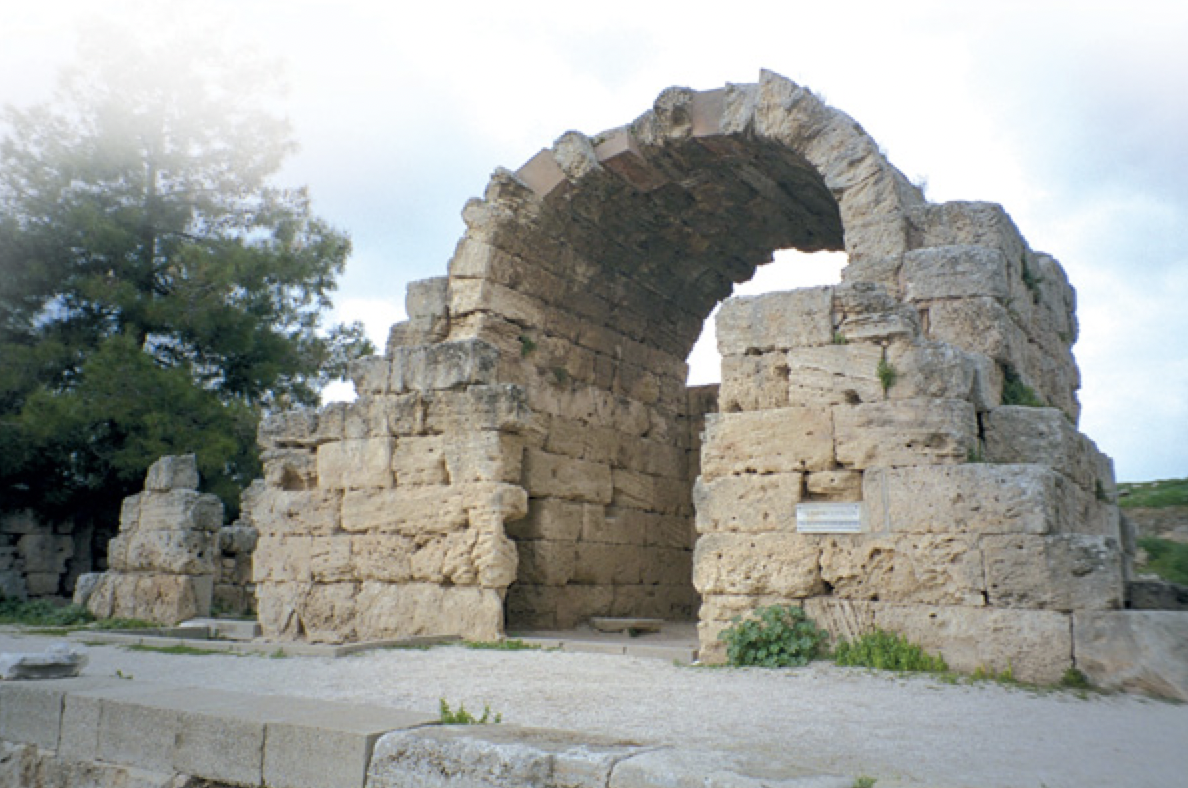
Marketplace at Corinth. In Paul’s day, the streets of Corinth were lined with small shops like this one. It is likely that Paul used such a shop for his tent-making and leather-work business. In addition, it was in shops like these that controversial “idol meat” was sold. Jews and Christians knew that animals often were butchered in sacrificial rites at local temples, and buyers could not know for certain that meat sold in the marketplace had not come from such a sacrifice.
Food Sacrificed to Idols
Paul devotes considerable attention to the question of whether Christians should eat food sacrificed to idols (chaps. 8–10). There may be a couple of different issues involved here. In Roman society, the gods were blessed and propitiated at virtually all public events, including birthdays, weddings, banquets, business parties, and other affairs that Christians who had any dealings with non-Christians might be invited to attend. Paul does not think that Christians should remain aloof from people outside the church (5:10) or adopt judgmental attitudes toward them (5:12). Still, he sounds a word of caution with regard to participation in pagan social activities. He believes that the pagan gods are actually demons—powerful spirits, and evil ones at that (8:4-5; 10:20). Just as Christians share in the body and blood of Christ when they consume bread and wine at the Lord’s Supper, so they may become partners with demons if they eat and drink food at a meal that involves the worship of idols (10:14-22).
A related matter concerns the consumption of food bought in the general marketplace. Almost all of the meat sold in the Roman markets came from animals slaughtered in homage to some god. This made sense: if an animal was going to be killed anyway, why not butcher it as a sacrifice to an idol and score a few points with the deity for which that idol stood? Many Jews refused to purchase or consume such food, instead obtaining their meat from “kosher shops.” The question for the Corinthian Christians was “Should we be as scrupulous as Jews on this matter?” Paul thinks that food is basically just food, and Christians who do not acknowledge the pagan idols or gods should be able to eat meat from the general market with a clear conscience (10:25-27). Still, he qualifies this advice with a pastoral concern: those whose faith is strong enough to eat the “idol food” without acknowledging the idols must be sensitive to believers whose faith is not so strong (8:7, 9). They must be willing to give up their right to eat such food if doing so would compromise their witness to unbelievers, scandalize other Christians, or tempt less mature converts to become involved in what, for them, actually would be pagan worship (8:10-13; 10:27-28, 32–33).
This willingness to give up one’s rights for the sake of others may be Paul’s dominant concern with regard to this whole “food sacrificed to idols” controversy. He begins his discussion of the topic by insisting that love must trump knowledge as a guide to Christian behavior (8:1-3), and he ends it with an exhortation for those with superior knowledge to seek what is advantageous to others, not themselves (12:24, 31). In the middle, he embarks on a long excursus regarding his own rights as an apostle. He has the right to be married (like Peter and the other apostles), but he surrenders this for the sake of his mission (9:5). He has the right to be paid a salary by the Corinthians, but he has foregone that as well (9:6-14). The Corinthians who know that there is nothing inherently wrong with idol meat might want to think twice before telling him, “We have a right to our food and drink” (9:4). Being a Christian is not a matter of insisting on one’s rights (9:12, 15, 18) but of doing whatever is necessary “for the sake of the gospel” (9:23) and of doing everything “for the glory of God” (10:31).
Love
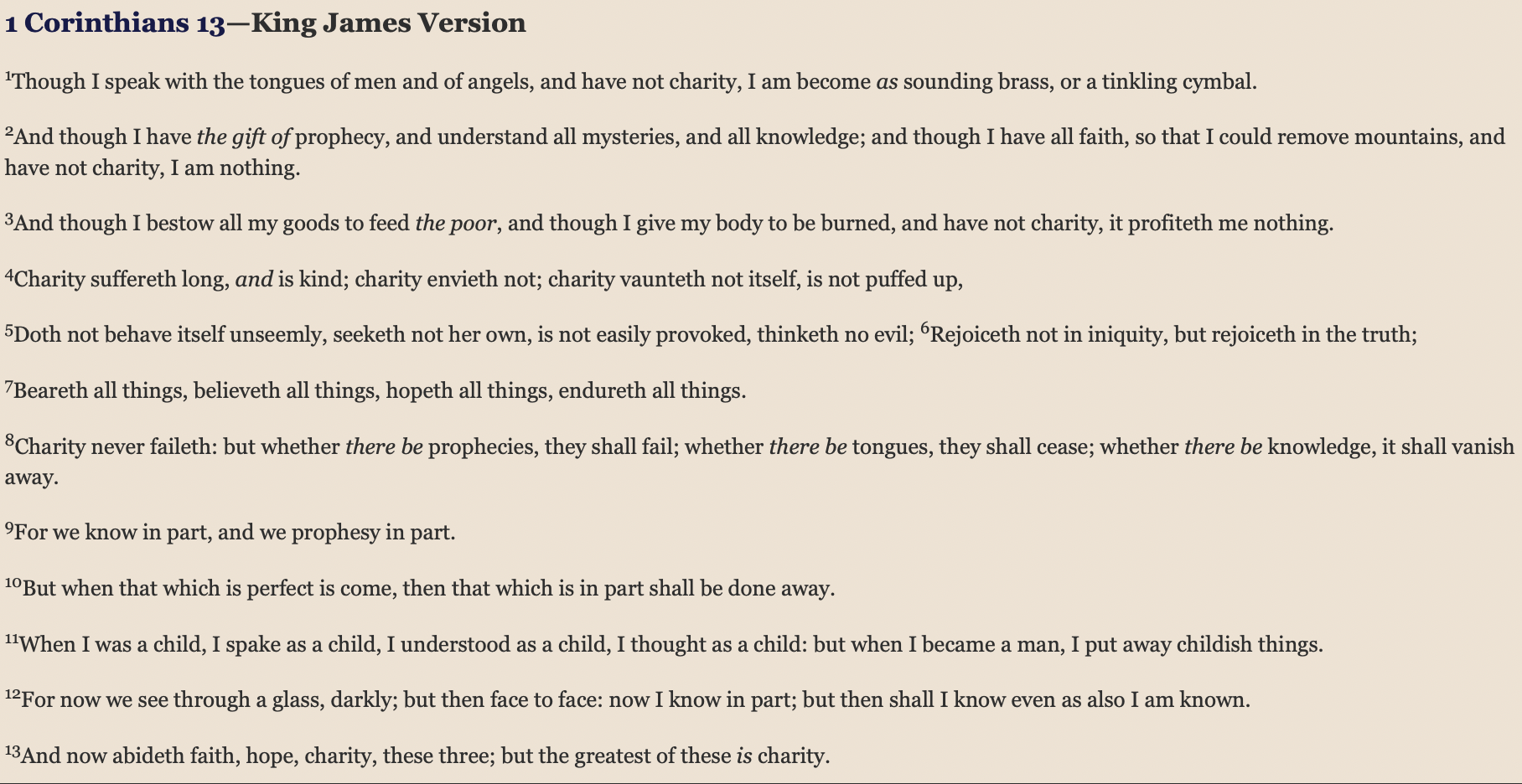
One of the best-known and most beloved passages in all of scripture is 1 Corinthians 13, a poetic tribute to love. The Greek word for “love” used here is agapē. It refers to love that is unmotivated, that is not necessarily dependent on the loveliness of its object and that in fact confers goodness on that object: the beloved becomes lovely by virtue of being loved.
Paul defines this love in terms of unselfish behavior. One shows agapē love by treating other people in ways that put their interests ahead of one’s own (13:4-7). Without such love, nothing else matters, for all human achievements and knowledge are only transitory (13:1-3, 8–12). Only three things unite humans with God throughout eternity: faith, hope, and love—and the greatest of these is love (13:13).
Like Psalm 23, this chapter of Paul’s letter to the Corinthians is treasured for its literary and artistic beauty. As such, it often is cited in the traditional language of the King James Version, which translates agapē with the word charity rather than love (see box 13.3).
Spiritual Gifts
Paul devotes three chapters of this letter to a discussion of “spiritual gifts,” by which he seems to mean manifestations of the Holy Spirit (12:7) activated by God (12:6) in the lives of individual church members (12:11) for the common good (12:7). Paul can speak of “gifts” (Greek, charismata) in a broader sense to encompass many things: it is a gift when God enables one to practice sexual abstinence (7:7) or endows people with attributes that qualify them to be leaders in the church (Rom. 12:6-8; cf. 12:28). The focus of 1 Corinthians 12–14, however, seems to be on something more specific: the gifts he is talking about here are typically exercised when the church comes together (14:26) and God speaks or acts in remarkable ways through various individuals for the edification of the community (7:7; 14:12, 26–27, 29–30). Paul lists nine of these gifts: the utterance of wisdom, the utterance of knowledge, faith, healing, the working of miracles, prophecy, the discernment of spirits, various kinds of tongues, and the interpretation of tongues (12:8-10). Of these, the gift of tongues receives the most attention because it is the one that has been a source of controversy within the church.
glossolalia: speaking in tongues, that is, the phenomenon by which the Spirit enables a person to speak in known languages they have never learned (e.g., Acts 2:4-8) or in ecstatic languages unintelligible to any who do not possess the gift of interpretation (e.g., 1 Cor. 14:26-28).
The topic of speaking in tongues (glossolalia) also comes up in the book of Acts (2:4; 10:46; 19:6), though the phenomenon described there may be somewhat different from what is mentioned in 1 Corinthians. In Acts, believers are miraculously inspired to speak in languages that they have never learned but that are understandable to hearers who know these languages (2:6-7), whereas in 1 Corinthians, there is no indication that the “tongues” are potentially recognizable languages (14:2, 9, 23)—the ecstatic speech may in fact be regarded as the language of angels (13:1), unintelligible to any human being. Further, the incidents of speaking in tongues in Acts appear to have been single occurrences; there is no indication in Acts that those who spoke in tongues on any one occasion ever did so again. In 1 Corinthians, however, those who possess this gift seem to be able to speak in tongues any time they choose (14:15, 18, 27). We are not sure why the gift of tongues has become problematic in Corinth. Possibly, it is being exercised in ways that are disruptive to worship, or perhaps those who are exercising the gift are trying to show off how spiritual they are. It seems also that some people in the community are overreacting to these problems by trying to prohibit speaking in tongues altogether (14:39). In any case, it is no accident that Paul interrupts his discussion of spiritual gifts twice, once to present his stirring analogy of the church as the diverse but unified body of Christ (12:22-27), and a second time to extol love as the “more excellent way” (12:31) without which nothing else matters (13:1-13).
As for more specific counsel on the spiritual gifts, Paul says that the public exercise of such gifts should edify the whole community (12:7; 14:12, 26). This basically excludes tongues, since unintelligible messages are intrinsically unedifying (14:2, 4, 6–11, 16–19, 23). There is also some concern about how ecstatic speech will be perceived by unbelievers (14:23; cf. Acts 2:13). Paul does, however, allow the public use of tongues when someone is present who possesses the gift of being able to interpret the divine language (14:5, 13, 26–27). And he not only allows but also encourages speaking in tongues in private for the purpose of self-edification (14:4-5). He himself speaks in tongues, more than any of them (14:18), and his wish is for them all to do so as well (14:5). Still, those who have been showing off their spiritual prowess by delivering ecstatic but unintelligible messages to the community would do well to seek “the greater gifts” (12:31)—those that better serve the community. Prophecy (speaking God’s word in normal, understandable words) may be less exotic, but it is generally more helpful to the church (14:1-5, 22–25, 29). And, as a bottom line, Paul simply insists that everything be done “decently and in order” (14:40) because “God is not a God of disorder but of peace” (14:33).
1 Corinthians.
Related Concepts
- acts
- apostolic-weakness
- body-and-soul
- body-of-christ
- calling
- canonical-discipline
- christ
- christs-self-giving
- church-unity
- communion
- community
- corinthian-triumphalism
- cross
- deposing-of-emperors
- discernment-of-the-body
- edification
- election
- ethics
- excommunication
- first-fruits
- foolishness
- freedom
- glossolalia
- head-and-body
- heart-transformation
- heavenly-kingdom
- hell
- holy-spirit
- hope
- identity
- idol-food
- incorporation
- interpretation
- jeremiah-31
- concepts/koinōnia
- last-supper
- law
- lords-supper
- maturity
- maximus-the-confessor
- moral-perseverance
- mutual-edification
- nicholas-cabasilas
- organic-unity
- papal-opposition
- pastoral-correction
- patriarchal-authority
- penance
- princely-conflicts
- purity
- remembrance
- resurrection
- rights
- self-sacrifice
- spirit
- spiritual-authority
- spiritual-gifts
- suffering
- transformation
- unity
- wisdom
- worldly-wisdom
- worship-order