New Testament — Topic 38
Revelation 2–3 presents seven letters dictated by Jesus to the angels or messengers of seven churches. How are these letters to be understood?
A historical approach views the letters as actual correspondences addressed to churches that existed in Asia Minor at this time. Archaeologists have excavated in some of the cities where these churches were located, and scholars have sought to document and clarify specific problems or incidents mentioned in the letters, such as the martyrdom of Antipas (2:13) and the heresy of the Nicolaitans (2:6, 15).
An idealist approach treats the letters as generic advice to seven types of churches that might be found in any age: a “Thyatiran church” is one given to gross corruption (2:18-29), and a “Laodicean church” is one in which people are lacking in zeal (3:14-22).
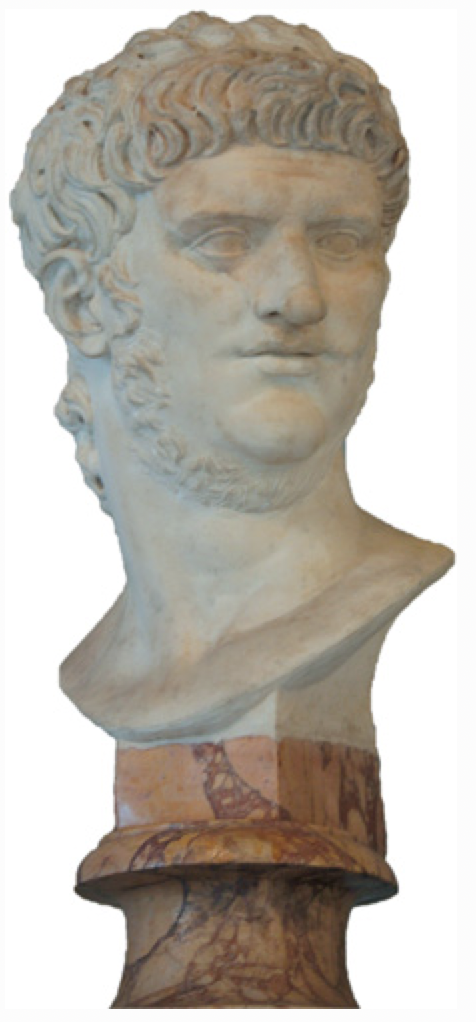
Nero. Nero, the Roman emperor from 54 to 68 CE, is remembered as a monster who murdered Christians in gruesome ways, killed his own mother, and executed the philosopher Seneca. The letters of his name, written in Hebrew, have a numerical value of 666.
A futurist approach may take these letters as representing Christ’s description of what at the time were still future eras of church history. A scenario popularized by The Scofield Reference Bible (1909) identified those eras as follows: (1) faithful apostolic church (Ephesus); (2) persecuted postapostolic church (Smyrna); (3) worldly Constantinian church (Pergamum); (4) corrupt medieval church (Thyatira); (5) orthodox Reformation church (Sardis); (6) missionary early American church (Philadelphia); (7) lukewarm modern church (Laodicea).
In Revelation 13:18, we are told that the beast who oppresses God’s faithful ones has “the number of a person,” and this number is 666 or, in some Greek manuscripts, 616. What does this mean?
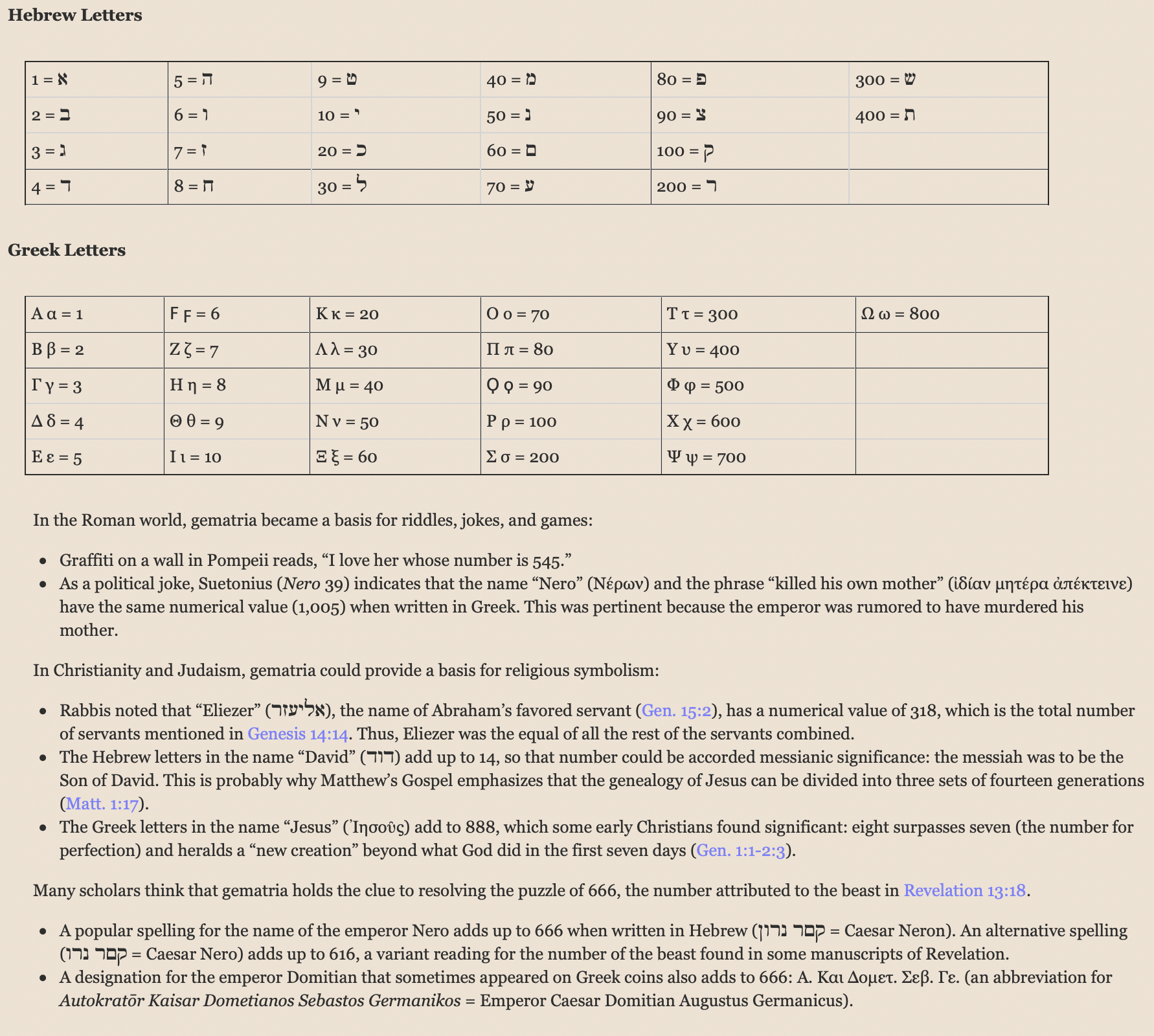
Historical readings usually take the number as a reference to Nero, the Roman emperor famous for persecuting Christians. His name was spelled “Neron Caesar” or, sometimes, “Nero Caesar.” In Hebrew, letters of the alphabet also serve as numerals (a system called “gematria”), and when “Neron Caesar” is written in Hebrew, the letters have a numerical value equal to 666, while the Hebrew letters for “Nero Caesar” have a value of 616. Other scholars have noted an alternative connection to a different emperor, Domitian: the numerical value of the Greek letters that appeared on certain coins bearing his inscription also totaled 666. See box 29.2 on pages 528–29.
Idealist readings usually take the number as a symbol for anyone supremely evil. Just as the number “seven” represents what is pure or perfect, the number “six” symbolizes impurity or imperfection. A threefold six is “triple bad” (constantly falling short), and anyone who repeatedly fails or opposes God may be said to have earned this number.
Futurist readings usually assume the number to be a code for some evil person who is to come into the world at the end of time. Irenaeus warned the church to be wary of anyone named “Evanthas,” “Lateinos,” or “Teitan” because the letters of those names in Greek equal this fateful sum. In the thirteenth century, some Franciscans noted that the Greek name of Pope Benedict XI (benediktos) made him suspect for the same reason, and in recent years, some Protestant Christians have cast aspersions on the current pontiff (Pope Benedict XVI). Ronald Wilson Reagan was once identified as a candidate simply because he had six letters in each of his three names!
With regard to these three basic approaches to Revelation (historical, idealist, futurist), we should note that the use of one approach some of the time does not rule out preference for a different approach at another time. Many popular readings of Revelation see a shift at 4:1 from “messages for the early church” to “visions for the church at the end of time.” Accordingly, such readings might take a historical approach to interpreting the seven letters (which come before 4:1) but adopt a futurist or idealist approach when it comes to figuring out the number of the beast (which comes after 4:1).
The practice of gematria consists of assigning a numerical value to a word or phrase by adding together the values of the individual letters. This works in Hebrew and in Greek, where the letters of the alphabet can also serve as numerals. In Greek, the mark signifying 6 was not used as a letter in New Testament times.
In the academic world, biblical scholars have tried to base their conclusions regarding the best approach to Revelation on what they have learned about the book’s genre (discussed above). They frequently conclude three things: (1) to the extent that the book of Revelation is like a letter, it should be read as a communication intended primarily for people at the time when it was written (not primarily for people born long after it was written); (2) to the extent that Revelation is prophecy, it also should be understood as addressing the current circumstances of its original readers, since that is what prophecy typically does: like most prophets, the author of Revelation discloses things about the future not so that people at a later time will have a guide to those events when they happen but rather so that the disclosures might affect the attitudes and behavior of people in his own day; (3) to the extent that Revelation is an apocalypse, it should be read as a book that employs imaginative symbolic language to convey general truth about God and the world rather than as one that tries to provide detailed predictions regarding specific future events.
Accordingly, there is a clear preference in academic scholarship for historical readings of this book, with some allowance for idealist application. Futurist readings generally are disparaged in academic circles, though they remain very popular in church and society as a whole. To avoid overstatement, however, we should note that most scholars do grant that the book of Revelation intends to portray what will happen at the end of time in a broad and general sense. What they object to is the detailed futurist interpretations that try to line up references in Revelation with specific people or occurrences in the modern world. Most scholars hold that such interpretations are incompatible with the book’s intent, for they blatantly attempt to understand Revelation in ways that its original readers would not (and could not) have understood it.
By any reckoning, Revelation can be one of the more confusing or disorienting books of the Bible. Those who try to take it as a fairly literal projection of “things to come” still end up disagreeing over how to construe the eschatological timetable. And those who understand Revelation as more of an imaginative proclamation to readers of its own day still end up struggling to discover what messages were being conveyed and why the author chose this medium as the means for conveying them. Furthermore, everyone agrees that the book of Revelation is heavily symbolic, but they do not necessarily agree on which elements of the book are symbolic and which are not. Did John want his readers to believe that heaven literally has pearly gates and streets of gold (21:21)? And what about that millennial reign with Christ (20:6)? Is this something that John wants his readers to believe will literally happen on earth, or is it instead a figurative way of describing an ultimate triumph of peace and justice?
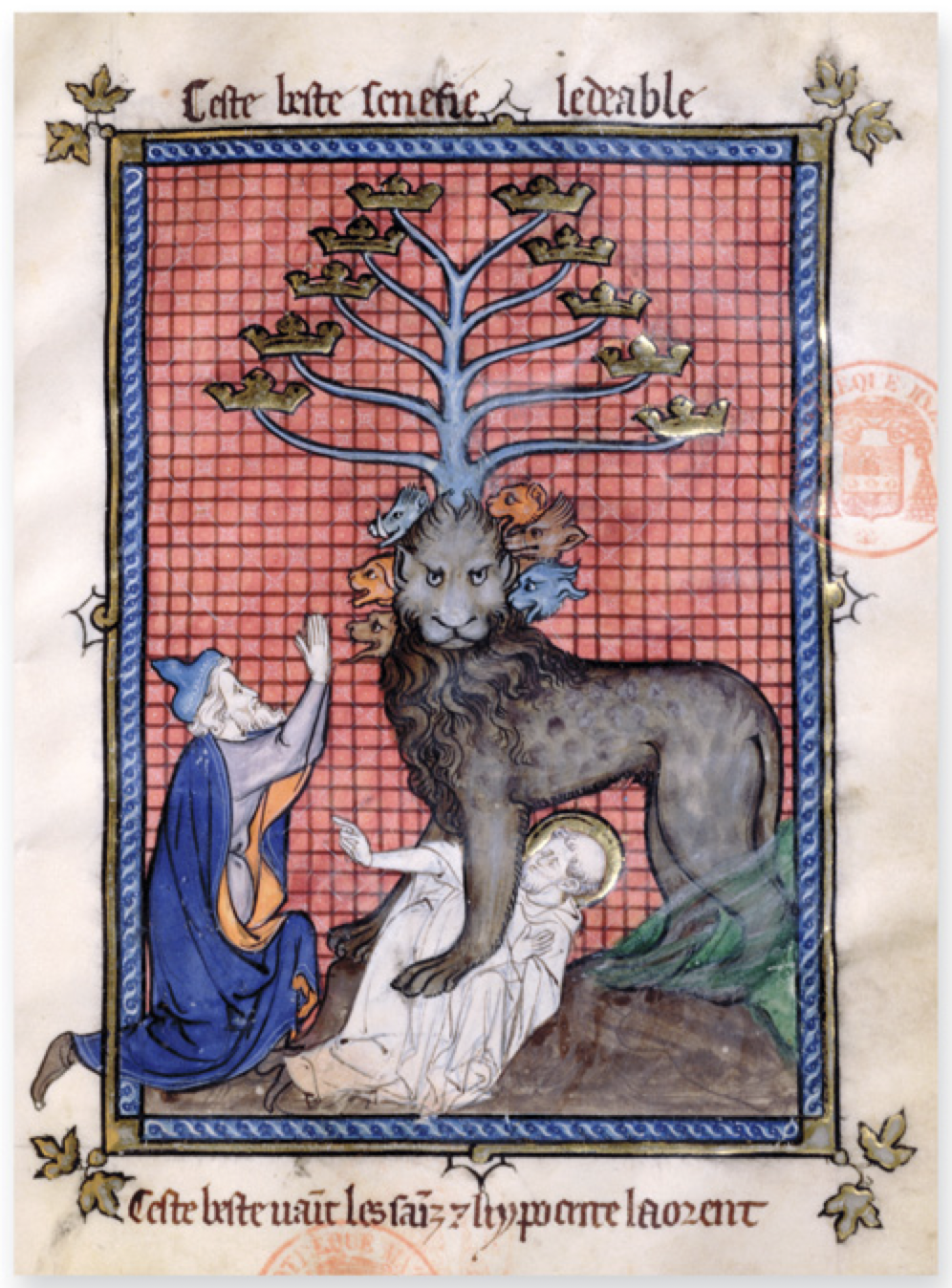
The Beast, a Saint, and a Hypocrite. The one whom Revelation calls “the beast” tramples a devoted believer of Christ while a hypocritical believer pays homage to the beast.
Unlike most apocalypses, Revelation does not pretend to be written by some famous religious figure out of the distant past. The person responsible for this book identifies himself as a Christian named “John” who was on the island of Patmos “because of the word of God and the testimony of Jesus” (1:9). The latter reference probably indicates that he has been banished from the mainland for witnessing to his faith and sent into exile on this island. But who is this person? In a popular vein, he often has been identified with the apostle John, who was one of the twelve disciples of Jesus. This view, however, was sharply challenged by authorities in the early church, and most modern scholars do not think that it can be maintained. Most interpreters today simply view the author of Revelation as a Christian prophet named “John” who is otherwise unknown to us.
Nevertheless, scholars do seek to surmise certain facts about the author from the book itself. He is steeped in the Old Testament and familiar with the imagery and style of Jewish apocalypses. Indeed, this John (whoever he was) appears to write Greek as one whose native language was Hebrew or Aramaic. So it is often suggested that (like the apostle) he was a Jewish Christian from Palestine who immigrated to Asia Minor at some point during or after the Jewish war with Rome. Since he seems to assume that the churches in that part of the world will regard him as a prophet (1:3; 22:7, 10, 18–19), he may have served those churches in a capacity similar to that of the itinerant prophet Agabus mentioned in Acts 21:10-11. Eventually, he ended up on the island of Patmos, probably banished from the mainland by political authorities.
There is probably no other book in the Bible for which the divide between scholarly interpretation and popular reception is as wide as it is with the book of Revelation. Scholars usually focus on determining what the book of Revelation meant to its first-century readers, while at a popular level Revelation is taken as a blueprint for understanding or predicting events taking place in the world today. These tendencies do have their exceptions, but they raise the fundamental question of what the book of Revelation intends to communicate and of what a basic approach to understanding this book should entail.
Over the years, Christians intent on understanding Revelation have taken three different approaches:
· Historical. The book is understood with reference to the time and place in which it was written. Its main purpose was to disclose the truth about what was happening in the world at that time.
· Idealist. The book is understood with reference to universal themes and symbols. Its main purpose was to provide spiritual insight that is meaningful for every time and place.
· Futurist. The book is understood with reference to times and places after its composition. Its main purpose was to predict what would come to pass in generations yet to come.
To illustrate how these approaches lead to divergent or competing interpretations, let’s apply them to a couple of examples.
- Overview
- What Sort of Book Is This?
- How Is This Book to Be Read?
- Example One: The Seven Letters
- Example Two: The Number of the Beast
- Gematria
- Historical Setting
- When was the Revelation written?
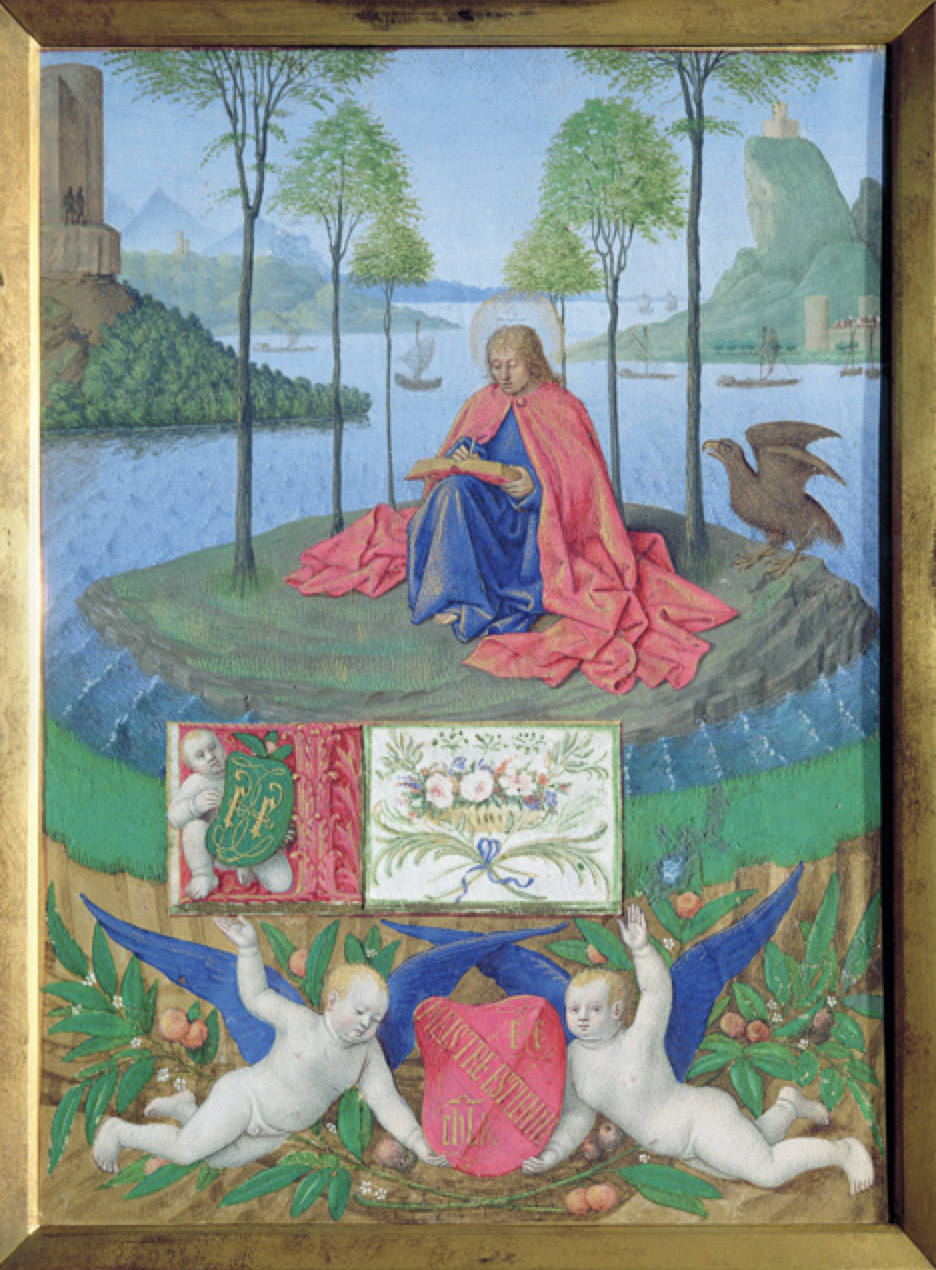
This book opens with an expanded title and a beatitude for its reader (1:1-3). After a salutation similar to those with which many New Testament letters begin (1:4-8), John reports that he received a revelation while “in the spirit on the Lord’s day” (1:10) and that he was directed to write this in a book and send it to seven churches.
The first thing that he sees is a spectacular image of the Son of Man, who dictates seven letters to him, specific messages for each of the churches (chaps. 2–3).
After recording these letters, John sees a door open in heaven, and he is taken up into the heavenly realm itself. There, he beholds the throne of God, angels, and other wondrous creatures (chap. 4). The one seated on the divine throne holds a scroll bound with seven seals, and there is a search to find someone who is worthy to open this scroll. The only one worthy is the Lion of Judah, who, as it turns out, looks not like a lion but rather like a lamb that has been slaughtered (chap. 5).
One by one, this Lamb opens the seals of the scroll, and as he does this, catastrophes strike the earth until, with the sixth seal, stars fall from the sky and the sky itself rolls up like a scroll and disappears (chap. 6). Then, angels intervene to ensure the safety of God’s faithful ones: 144,000 people of Israel are marked for protection, and John sees an innumerable multitude of people, robed in white, from all nations being brought before the Lamb (chap. 7). The Lamb opens the seventh seal, initiating a half-hour of silence in heaven (8:1).
Seven angels appear, each with a trumpet, and as these trumpets are blown, more disasters strike the earth (chaps. 8–9). But following the sixth trumpet, there is a brief interlude: an angel appears with a small scroll, shouting with a sound of seven thunders. John is told to seal up what the seven thunders said and not write it down, and he is given the scroll to eat; it tastes sweet but makes his stomach bitter (chap. 10). He then takes some measurements in heaven and is told about two witnesses who will come to the earth, be martyred, raised from death, and taken up into heaven. Finally, the seventh angel blows the seventh trumpet, and God’s temple in heaven is opened amid loud shouts of praise (chap. 11).
Great portents appear in heaven: a cosmic, pregnant woman and a red dragon, which turns out to be Satan. War breaks out as Michael the archangel leads the heavenly forces to defeat Satan (chap. 12). On earth, a series of beasts blaspheme God, oppress the saints, and insist on conformity to idolatrous ways (chap. 13). Angels call for saints to endure this tribulation, and John beholds a vision of the Son of Man reaping the earth with a massive sickle; the wrath of God comes mightily upon the earth, as evidenced by an awful river of blood (chap. 14). Seven angels with seven bowls appear, and each bowl brings a terrible plague upon the earth (chaps. 15–16).

Patmos. Located thirty-seven miles from the mainland in the Aegean Sea, Patmos is a rocky and rugged island, about two miles wide and nine miles long. Roman authorities used it as a place of exile for political dissidents.
John is invited to witness the judgment of a great whore, who is identified as the city of Babylon. Her downfall is lamented on earth but celebrated in heaven (chaps. 17–18). Amid great canticles of praise, John then sees heaven opened, and a rider who is called “Faithful and True” comes on a white horse to wage a final victorious war against all the kings of earth. The flesh of those kings is consumed in a grotesque but spectacular banquet, and the beasts responsible for the tribulation mentioned earlier are thrown into a lake of fire (chap. 19). Satan is imprisoned, and those who proved faithful in the previous trials are allowed to reign with Christ on earth for one thousand years. After that time, Satan is released for a final battle and then is thrown into the lake of fire to be tormented forever and ever (chap. 20).
Then John sees a new heaven and a new earth, and a new Jerusalem coming down from heaven. He concludes his book with a thrilling vision of paradise: gates of pearl and streets of gold, and a city in which there is no fear or pain or trouble of any kind (chaps. 21–22).
What are we to make of such a book? Scholars sometimes say that Revelation shares the features of three different types of literature.
First, the book is something like a letter. It begins (1:4-8) and ends (22:21) like a letter, and it is supposed to be sent to seven churches (1:11). Perhaps this book was composed as a “circular letter” to be distributed and read in particular congregations, as were some of the letters of Paul (Col. 4:16). If so, then some of the content might apply to specific situations in those churches or be intended to address questions that members of those churches were asking.
Second, the book is presented as a prophecy (1:3; 22:7, 10, 18–19). The reader is expected to “keep” the words of this book, implying that the message is something that can be obeyed—a call to repentance, perhaps, or an exhortation to perseverance. In some sense, the book may be compared to writings of certain Old Testament prophets who also claimed to be passing on direct communications from God and who sometimes did so through symbolic language or by recounting visionary experiences (see Ezekiel, Zechariah, and especially Daniel). Prophets often announced what God was about to do and detailed blessings and woes that were to come upon people when God acted (assuming that everything continued on its present course [for one instance in which a change in course allowed the predicted judgment to be averted, see Jonah]). To the extent that Revelation is read as a prophecy, its content may be regarded as a series of colorful exhortations or warnings about what will happen when God’s purposes are fulfilled.
Third, the book has much in common with a genre of literature known as apocalypse. This type of writing is not well known today, but it was popular at the time when Revelation was produced. As a result of archaeological discoveries in the last century, we now have copies of numerous apocalypses that were read by Jews and Christians in the centuries just before and after the time of Jesus. These books are different from Revelation in certain ways, but they do display some marked similarities (see box 29.1 on p. 524). They typically report divine or transcendent visions that are granted to a seer and then interpreted by angels or other spiritual beings. As in Revelation, the seer sometimes is transported to a heavenly or spiritual realm to describe what is seen there. Symbolism is prominent, and the content of the visions often involves bizarre creatures, fantastic spectacles, and mysterious events similar to those found in Revelation. Such books tend to be dualistic in their outlook, which means that they describe a universe where there are clear distinctions between good and evil; the story pits angels against demons or saints against sinners with little allowance for ambiguity. And the themes of such works typically are matters of cosmic significance: the end of the world, the defeat of evil, the vindication of the righteous.
Many scholars think that some confusing aspects of Revelation can be best understood in light of what the book’s original readers would have known about “how to read an apocalypse.” For example, some scholars maintain that apocalypses often employed visions in a concurrent rather than consecutive manner, and readers knew that the visions were more kaleidoscopic than chronological. If this is true of Revelation, then it might be a mistake to regard the different visions in the book as laying out scenarios that will occur one after another at the end of time. Rather, different visions might offer repeated depictions of the same events. This would explain how the world could appear to come to an end in chapter 6 and yet be described as still experiencing various cataclysms in chapter 8, or why God’s righteous ones appear to be gathered into heaven in chapter 9 only to be described as suffering persecution on earth in chapter 13. The one basic story of judgment and salvation is being told over and over again through visions that use different symbols or images to describe the same occurrences.
The dominant theory places it during the reign of the Roman emperor Domitian (81–96), most likely toward the end of that period. This was the view of the early church, as reflected in testimony from Irenaeus, Tertullian, Clement of Alexandria, and Origen. The time period also fits concerns addressed in the book: Domitian referred to himself as a god and demanded emperor worship in a manner similar to what is attributed to “the beast” in Revelation (13:4). Domitian, however, is not known to have inflicted the sort of violent persecution on Christians that is prominent in this book (2:10, 13; 6:9; 17:6; 18:24; 20:4). The emperor Nero (54–68) was more famous in that regard, and some scholars think that connections to him can be found as well (such as the interpretation of 666 as a cipher for “Caesar Neron” mentioned above). Do those connections mean that the book might have been written earlier, during Nero’s reign? Possibly. Or, perhaps, the book simply means to present Domitian as a “second Nero.” Some scholars take a reference to the beast having recovered from a mortal wound (13:3) as a hint that Domitian is “Nero redivivus”: everyone thought the beast was gone when Nero died, but now it is back. Discussion continues, but the most common approach today is to date Revelation around 95, during the reign of Domitian. One popular suggestion accepts this date but holds that our version of the book could be a “second edition,” an expansion of an earlier work that hailed from the time of Nero.
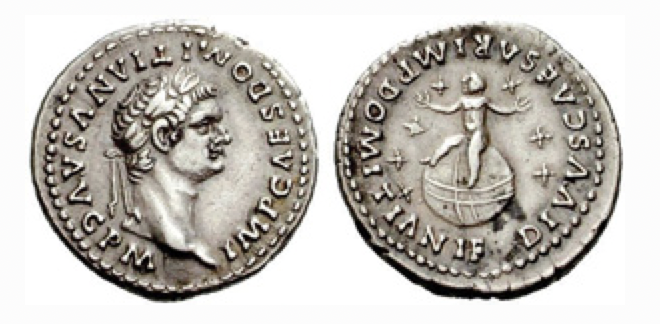
The Divine Caesar. This Roman coin shows the emperor Domitian enthroned upon the earth with seven stars encircling his open hands. The inscription reads, “To the Divine Caesar.” The book of Revelation presents Jesus Christ as the divine ruler of earth and describes him as holding seven stars in his hand (1:16).
The visions of Revelation were received by John on the island of Patmos and sent to seven churches in Asia Minor: Ephesus, Smyrna, Pergamum, Thyatira, Sardis, Philadelphia, and Laodicea. Our New Testament also contains a “letter of Paul” to Ephesus and mentions a letter from Paul to Laodicea as well (see Col. 4:13-16). In the early second century (probably just fifteen years after Revelation), Ignatius of Antioch wrote letters to churches in Philadelphia, Smyrna, and Laodicea. The book of Acts makes mention of Thyatira (16:14) and contains colorful stories about early missionary work in Ephesus (18:18-20:1).
All of these cities were located in the Roman province of Asia, which is to say that all were part of the Roman Empire. They were somewhat distant from the capital city itself, but they remained dependent on that city for stability and prosperity. Loyalty to Rome was intense, as the general populations of these cities competed for Roman attention and favor. For example, Ephesus and Pergamum were rivals for the honor of being named neōkoros (“temple warden”), the city responsible for overseeing emperor worship for the entire province. On more than one occasion this official designation was withdrawn from one of these two cities and granted to the other, with attendant changes in fortune and prestige. And, of course, the main claim to fame of Ephesus was its magnificent temple to the Roman goddess Artemis (see Acts 19:23-41).
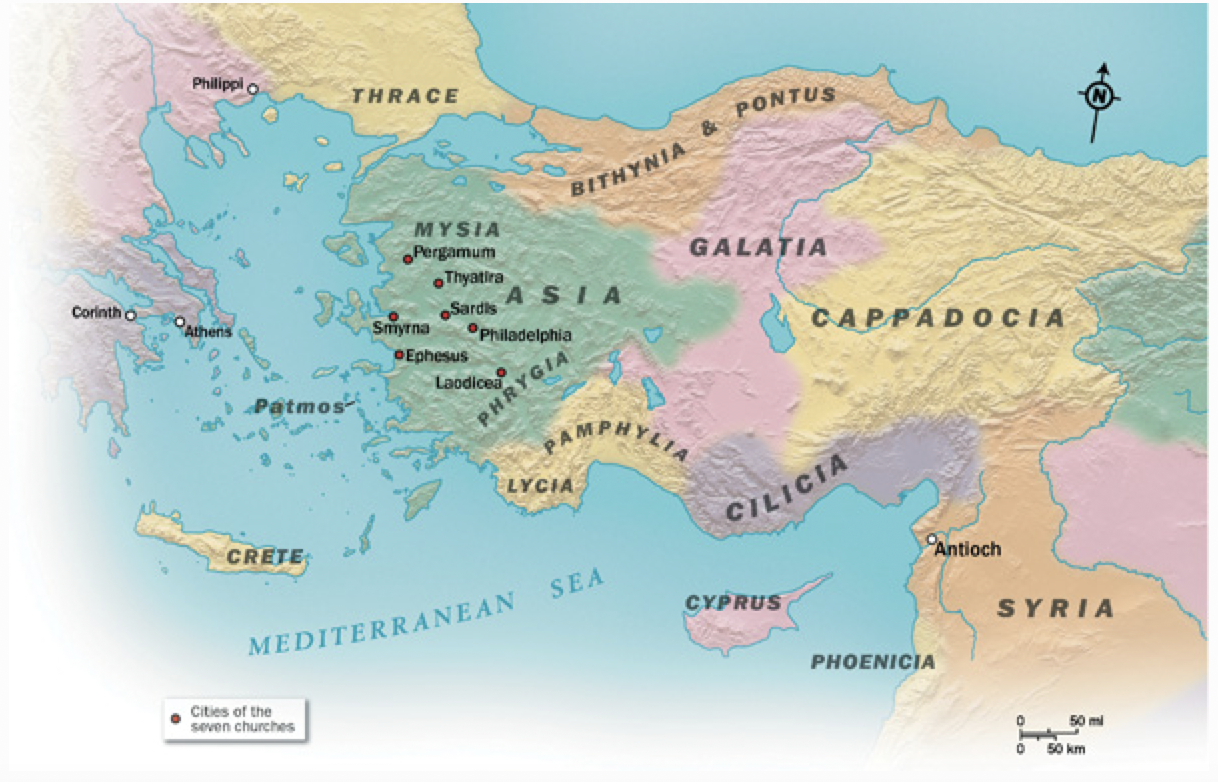
Asia Minor: Churches of Revelation.
What was life like for the small (but growing) groups of Christians in these cities? Many Christians no doubt were viewed as disloyal and unpatriotic for despising the very things that most people considered to be emblems of local pride and national honor. They also were considered to be antisocial for shunning the banquets, festivals, and public amusements that were the stuff of ordinary people’s lives. And they were thought to be irreligious for refusing even to acknowledge (much less propitiate) the gods whose favor was deemed essential for continued protection and prosperity. In short, there was tension between Christians and the general population, and many believers appear to have suffered as a result. Some were victims of violence, even to the point of death. Others had to deal with the reality of being publicly shamed in a culture in which social disgrace was often regarded as a fate worse than death. And many had to endure penalties and discrimination that led to economic hardship. For example, Christians may have been excluded from joining various trade guilds in which membership was all but essential for success in business or advancement in one’s chosen profession.
The book of Revelation reflects that in addition to having problems with Roman society in general, the Christians in these churches appear to have been on poor terms with the Jews in the local synagogues (2:9; 3:9). And even within the Christian fold all was not well: some people who called themselves Christians were advocating ideas and practices that the book of Revelation regards as abhorrent. Though we do not know for certain who the so-called followers of Balaam (2:14) or Jezebel (2:20) were, it seems likely that they were Christians who had adopted an accommodating stance toward the Roman environment. Thus, some teachers or prophets in these churches apparently were telling the people to just “lighten up” and “go with the flow”: cooperate with the powers that be and learn to adapt; figure out how the world works and try to fit in; let the emerging religion of Christianity develop a compatibility with culture that will make it more appealing to society as a whole.
The stated purpose of the book of Revelation is to reveal “what must soon take place” (1:1). It attempts to do this in ways that will (1) inspire confidence in those whose obedience to God may prove costly; (2) stir up indignation toward those who defy God and promote injustice; (3) provoke repentance on the part of those who have been overly accommodating; (4) inspire praise for God from those who realize the Lord of history is worthy of their trust.
- Section_1: The Revelation of the Son of Man and the Letters to the Seven Churches
- Section 2: The Heavenly Liturgy – The Throne Room of God
- Section 3: The Great Conflict – The dragon, the beasts, and the Faithful
- Section 4: The Telos – The New Creation
Theme 2.1: The Throne in Heaven and the Sealed Scroll (Revelation 4-5)
Orthodox Focus: To reveal that the core reality behind all creation and history is the eternal, unceasing worship of the Holy Trinity. The vision of the Throne Room is the ultimate context for understanding earthly struggles, revealing that the Divine Liturgy on earth is a participation in this heavenly reality. The central problem of history — a world in rebellion — is resolved not by force but by the sacrificial victory of the Lamb Who is worthy to unlock its meaning.
Exposition: The Door Standing Open in Heaven
The focus of the Apocalypse shifts from the earthly struggles of the seven churches to the ultimate heavenly reality. John hears a voice saying, “Come up here, and I will show you things which must take place after this” (4:1, NKJV). Immediately, he is “in the Spirit” and beholds a door standing open in heaven. This is a fundamental Orthodox principle: to understand “things which must take place” (eschatology), one must first be granted a vision of heavenly reality (theology). The meaning of history is only decoded from the perspective of the Throne of God.
The Vision of the Throne (Chapter 4)
What John sees is not a prophecy of a future event but the eternal, unchanging state of heaven, centered on the worship of God the Father. The description is rich with symbolic imagery drawn primarily from Ezekiel 1 and Isaiah 6:
A Throne Set in Heaven: The central, unchanging fact of existence is that God is the King (Pantocrator). Everything exists in relation to His sovereign rule.
One Sat on the Throne: The overwhelming vision of God is described in terms of brilliant, gem-like light: “He who sat there was like a jasper and a sardius stone in appearance; and there was a rainbow around the throne, in appearance like an emerald” (4:3). This is apophatic theology in visual form: God is incomprehensible, beautiful, and luminous.
The Twenty-Four Elders: “Around the throne were twenty-four thrones, and on the thrones I saw twenty-four elders sitting, clothed in white robes; and they had crowns of gold on their heads” (4:4). Orthodox tradition interprets these elders as representing the whole people of God — the 12 tribes of Israel and the 12 apostles of the Church — united in their glorified state. Their white robes signify purity and victory, and their golden crowns (stephanoi) are the martyrs’ crowns of conquest. They are the celestial council of saints.
The Seven Lamps of Fire: “From the throne proceeded lightnings, thunderings, and voices. Seven lamps of fire were burning before the throne, which are the seven Spirits of God” (4:5). This symbolizes the Holy Spirit in His sevenfold energy (cf. Isaiah 11:2-3), perpetually burning before the Father.
The Sea of Glass: “Before the throne there was a sea of glass, like crystal” (4:6). This signifies the transcendent purity, peace, and stability of the heavenly realm, contrasting with the chaotic “sea” of earthly turmoil.
The Four Living Creatures: These magnificent beings, “full of eyes in front and in back” (4:6, 8), are the highest order of angels, often identified with the Cherubim. Their forms — like a lion, calf, man, and eagle — are symbols of all created life (nobility, strength, intelligence, and swiftness) and in later tradition became symbols of the Four Evangelists. Their ceaseless cry is the Trisagion Hymn: “Holy, holy, holy, Lord God Almighty, Who was and is and is to come!” (4:8).
This entire scene is one of perpetual adoration. The living creatures give glory, and the twenty-four elders respond by falling down in worship, casting their crowns before the throne — a gesture of humility acknowledging that all victory and authority come from God — and singing a hymn of creation: “You are worthy, O Lord, To receive glory and honor and power; For You created all things, And by Your will they exist and were created” (4:11).
The Problem of the Sealed Scroll (Chapter 5)
The vision then introduces a profound dilemma. In the right hand of Him Who sat on the throne is “a scroll written inside and on the back, sealed with seven seals” (5:1). This scroll contains the meaning, the purpose, and the ultimate destiny of creation — the full account of “what must take place.” A mighty angel proclaims, “Who is worthy to open the scroll and to loose its seals?” (5:2). The answer is devastating: “No one in heaven or on the earth or under the earth was able to open the scroll, or to look at it” (5:3). John weeps bitterly because the meaning of history remains hidden, locked, and inaccessible to all creation.
The resolution comes from one of the elders: “Do not weep. Behold, the Lion of the tribe of Judah, the Root of David, has prevailed to open the scroll and to loose its seven seals” (5:5). John looks to see this conquering Lion, but what he sees is utterly different and infinitely more profound: “Behold, in the midst of the throne and of the four living creatures, and in the midst of the elders, stood a Lamb as though it had been slain” (5:6).
This is the pivotal moment of the entire Apocalypse and the heart of Orthodox Christian faith. The one found “worthy” to unlock the meaning of all things is not a powerful military Messiah, but a sacrificed Lamb. His victory (“has prevailed”) was won not by inflicting violence but by enduring it. The marks of Its slaughter are still visible, yet it is standing — alive, resurrected, and triumphant. The Lamb has “seven horns and seven eyes” (5:6), symbolizing the perfect power (horn) and perfect wisdom (eyes) of the Holy Spirit which He possesses.
This Lamb takes the scroll from the Father’s hand. This act triggers a new and explosive wave of worship that surpasses the song of creation. All creation joins in a crescendo of praise to the Lamb for His work of redemption :
The Four Living Creatures and Twenty-Four Elders fall down before the Lamb. They sing a new song : “You are worthy to take the scroll, And to open its seals; For You were slain, And have redeemed us to God by Your blood Out of every tribe and tongue and people and nation, And have made us kings and priests to our God; And we shall reign on the earth” (5:9-10). This is the hymn of the redeemed.
The Voice of Many Angels around the throne number “myriads of myriads and thousands of thousands” (5:11), crying out: “Worthy is the Lamb who was slain To receive power and riches and wisdom, And strength and honor and glory and blessing!” (5:12).
Every Creature Everywhere joins in a final universal doxology: “To Him who sits on the throne, and to the Lamb, Be praise and honor and glory and power, Forever and ever!” (5:13).
The Four Living Creatures say “Amen!” and the Elders fall down and worship (5:14).
Orthodox Synthesis: The Liturgy of the Cosmos
The Heavenly Liturgy: Chapters 4-5 are the biblical blueprint for the Orthodox Divine Liturgy. The church building, with the altar (Throne), the apse (heaven), the iconostasis (the veil), and the liturgical actions, are designed to bring the faithful into this very reality. The priest’s exclamation, “Let us lift up our hearts!” and the response, “We lift them up to the Lord!” is an invitation to enter through the “door standing open in heaven.” The Trisagion Hymn (“Holy God, Holy Mighty, Holy Immortal…”), the Eucharistic prayers, and the continual prostrations are all participations in the worship John witnessed.
The Lamb Who Was Slain: The central figure of heavenly worship is the crucified and risen Christ. The Eucharist is the “Lamb of God who takes away the sin of the world,” present on the altar as the One Who was slain. His sacrifice is not a past event but an eternal reality present in heaven and made accessible on earth.
The Answer to the World’s Crisis: The meaning of history (the scroll) can only be understood through the Cross. Suffering, evil, and chaos are not resolved by political or military power but by the paradoxical victory of self-sacrificial love. The Lion conquers as the Lamb.
Theosis as the Goal: The song of the elders reveals the purpose of redemption: to be made “kings and priests to our God” (5:10). This is the vocation of every Christian — to share in Christ’s royal and priestly ministry, to offer the world back to God in thanksgiving, and to ultimately reign with Him in life eternal. This is the essence of theosis.
This vision provides the ultimate comfort for the Church: whatever horrors are unleashed by the opening of the seals in the following chapters, they occur under the ultimate sovereignty of the One on the Throne and the victorious Lamb. The battle is already won. The liturgy has already begun. Our role is to join the song.
Theme 2.2: The Opening of the Seals and the Trumpets (Revelation 6-11) Orthodox Focus: To interpret the breaking of the seven seals and the sounding of the seven trumpets not as a linear sequence of future disasters, but as a profound revelation of the nature of a fallen world under God’s providential allowance and judgment. These visions reveal the perennial realities of war, famine, death, persecution, and divine chastisement that characterize the age between Christ’s first and second comings. They serve as a call to repentance and patient endurance for the Church, assuring her that even in turmoil, the prayers of the saints are heard and their ultimate victory is secure in the Lamb.
Exposition: The Lamb Opens the Seals
The worship of Chapter 5 culminates in the Lamb taking the scroll and beginning to open its seals (Chapter 6). Each broken seal reveals a new vision, not of the far future, but of the ongoing experience of a world in rebellion against its Creator.
The First Four Seals: The Four Horsemen (6:1-8)
As the first four seals are broken, four horsemen are unleashed. The Fathers universally saw these not as specific individuals but as symbols of the general conditions that plague humanity due to sin.
First Seal (White Horse): “And I looked, and behold, a white horse. He who sat on it had a bow; and a crown was given to him, and he went out conquering and to conquer” (6:2). While some modern interpretations see this as Christ or the Antichrist, the patristic view is more nuanced. St. Andrew of Caesarea notes that this can symbolize either the proclamation of the Gospel going forth to conquer souls or “the seduction of false apostles and the victories of the evil one by which he conquers those who are wounded by the arrows of his deceit.” The white color can signify the false piety of spiritual deception.
Second Seal (Red Horse): “Another horse, fiery red, went out. And it was granted to the one who sat on it to take peace from the earth, and that people should kill one another; and there was given to him a great sword” (6:4). This is clearly the spirit of war and civil strife , the inevitable fruit of hatred and discord.
Third Seal (Black Horse): “So I looked, and behold, a black horse, and he who sat on it had a pair of scales in his hand. And I heard a voice… saying, ‘A quart of wheat for a denarius, and three quarts of barley for a denarius; and do not harm the oil and the wine’” (6:5-6). This horseman represents famine and economic injustice , where basic necessities become desperately expensive, plunging the poor into crisis.
Fourth Seal (Pale Horse): “So I looked, and behold, a pale horse. And the name of him who sat on it was Death, and Hades followed with him” (6:8). The fourth horseman is Death itself , the ultimate consequence of sin, wielded through “sword, hunger, death, and the beasts of the earth.”
St. Irenaeus of Lyons (2nd century) understood these horsemen as the multifaceted reality of divine chastisement permitted to awaken humanity: “For by these four powers the Lord God admonishes those who are on the earth… inviting them to repentance. ”
The Fifth Seal: The Cry of the Martyrs (6:9-11)
The fifth seal reveals the souls of those “who had been slain for the word of God and for the testimony which they held” (6:9). They cry out, “How long, O Lord, holy and true, until You judge and avenge our blood on those who dwell on the earth?” (6:10). This is not a cry for petty vengeance but a plea for God’s ultimate justice to set right a creation stained by innocent blood.
They are each given “a white robe” — the garment of victory and resurrection glory — and told “to rest a little while longer, until both the number of their fellow servants and their brethren, who would be killed as they were, was completed” (6:11). This is a crucial Orthodox truth: the Church’s struggle involves persecution and martyrdom until the end of time. The martyrs are not lost; they are alive in Christ, awaiting the final consummation.
The Sixth Seal: Cosmic Upheaval (6:12-17)
The sixth seal brings a vision of cosmic collapse: a great earthquake, the sun blackened, the moon turned to blood, stars falling, and the sky receding (6:12-14). The powerful of the earth, from kings to slaves, hide in terror, crying to the mountains to fall on them “to hide us from the face of Him who sits on the throne and from the wrath of the Lamb!” (6:16).
The Fathers interpreted this symbolically. St. Andrew of Caesarea writes that this signifies “the final transformation of the world” and the dread that will seize all who are unprepared at the Second Coming. The “wrath of the Lamb” is the inescapable encounter with divine love experienced as judgment by those who have rejected it.
An Interlude: The Sealing of the Saints (Chapter 7)
Before the seventh seal is opened, an interlude provides comfort and assurance. Four angels hold back the winds of judgment, and another angel cries, “Do not harm the earth, the sea, or the trees till we have sealed the servants of our God on their foreheads” (7:3).
The 144,000 Sealed (7:4-8): This number, meticulously counted from 12x12x1000, symbolizes the fullness of the people of God — the spiritual Israel, the Church, comprising both Jews and Gentiles. It is not a literal count but a symbolic one of completeness. St. Bede the Venerable explains: “The number twelve, multiplied by itself and then by a thousand, signifies the totality of saints gathered from every tribe of the spiritual Israel.” The “seal” is the gift of the Holy Spirit in Chrismation, which protects the faithful not from physical suffering, but from spiritual apostasy.
The Great Multitude (7:9-17): John then sees the glorious outcome: “a great multitude which no one could number, of all nations, tribes, peoples, and tongues, standing before the throne and before the Lamb, clothed with white robes, with palm branches in their hands” (7:9). This is the same group as the 144,000, now seen from heaven’s perspective after their victory. They have “come out of the great tribulation” (7:14) — the entire age of the Church’s struggle. Their robes are washed white in the Blood of the Lamb through Baptism and martyrdom. Their eternal state is one of perfect worship and comfort: “They shall neither hunger anymore nor thirst anymore… and God will wipe away every tear from their eyes” (7:16-17).
The Seventh Seal and the Seven Trumpets (Chapters 8-9, 11:15-19)
The opening of the seventh seal (8:1) brings “silence in heaven for about half an hour,” a moment of awe and anticipation before the next cycle of visions begins: the seven trumpets.
An angel offers the prayers of the saints (the incense) on the golden altar before the throne, and the fire from the altar is thrown to the earth, causing “thunderings, lightnings, and an earthquake” (8:5). This powerful image shows that the prayers of the faithful directly invoke God’s action in the world.
The first six trumpets (8:6-9:21) echo the plagues of Egypt and depict intensified and more focused judgments meant to lead people to repentance. They affect nature (sea, rivers, water sources) and humanity (painful locorpions, demonic cavalry). Yet, repeatedly, “the rest of mankind, who were not killed by these plagues, did not repent” (9:20). The focus is on the hardness of the human heart.
Another interlude (Chapter 10) features a mighty angel with a little scroll, which John eats, finding it sweet as honey but bitter in his stomach (10:10). This symbolizes the sweet yet bitter task of prophesying: the sweetness of God’s word and the bitterness of proclaiming judgment to an unrepentant world.
Chapter 11 introduces the “two witnesses” (11:3-13), whom the Fathers interpreted as the ongoing prophetic and martyrial witness of the Church (often associated with the ministries of Elijah, Moses, or Enoch) against the spirit of the world (“the great city,” Babylon). Their persecution, death, and resurrection symbolize the pattern of the Church’s life: opposed by the world, seemingly defeated, but ultimately vindicated by God.
The Seventh Trumpet: The Climax of History (11:15-19)
The seventh trumpet does not bring another plague but a triumphant proclamation:
“The kingdoms of this world have become the kingdoms of our Lord and of His Christ, and He shall reign forever and ever!” (11:15).
This is the ultimate goal. The twenty-four elders worship God, declaring that the time has come for the final judgment, the reward of the saints, and the destruction of the destroyers (11:18). Finally, “the temple of God was opened in heaven, and the ark of His covenant was seen in His temple” (11:19). The seventh trumpet reveals the end of all things: the victory of God’s Kingdom is announced as a present reality, even as it awaits its final consummation.
Patristic Synthesis: The Meaning of the Judgments
The Holy Fathers provide the key to interpreting these terrifying visions with spiritual profit.
St. Andrew of Caesarea: He consistently emphasizes that the purpose of these events is pedagogical and medicinal , not vengeful. “The threats of the prophecies are not for the ruin of souls, but for their conversion… God does not rejoice in the destruction of the living.” The horsemen and trumpets are God’s “strange work” (cf. Isa. 28:21) to call humanity away from self-destruction.
St. John Chrysostom: His focus is on the intercession of the saints and the value of suffering. The vision of the souls under the altar teaches that the martyrs are alive in Christ and that their witness is powerful. The trials on earth are meant to refine the faithful: “Fire gold, but do not burn it; so also God tests the soul by means of temptations.”
St. Bede the Venerable: He offers a Christological and Ecclesial reading. The 144,000 are the Church militant, sealed by the Spirit. The great multitude is the Church triumphant. The two witnesses represent the Church’s dual mission of teaching (the Law and the Prophets) and performing good works, which always meets resistance but is never ultimately overcome.
St. Augustine: In his City of God , he provides the overarching framework: these visions depict the ongoing struggle between the City of God and the City of Man. The judgments reveal the inherent misery and instability of a world built without God, while the interludes reveal the hope and ultimate destiny of those whose citizenship is in heaven.
Conclusion for the Church: The message of the seals and trumpets is one of sober hope. The world will experience turmoil and suffering; the Church will face persecution. This is the “great tribulation.” Yet, the faithful are sealed by God, their prayers are powerful, and their martyrs are victorious. The Lamb is in control, and the seventh trumpet has already sounded the ultimate victory of God. The call is to endurance, repentance, and fearless witness.
Theme 3.1: The Woman, the dragon, and the beasts (Revelation 12-14)
Orthodox Focus: To reveal the metaphysical architecture of the spiritual war underlying all earthly history. This section unveils the source of evil (the dragon), the ultimate target of his rage (the God-bearing Woman and Her offspring), and his primary instruments of deception (the two beasts). The Orthodox interpretation centers on the Theotokos as the personal embodiment of the faithful Church and the ultimate guarantee of the devil’s defeat through the victory of Her Seed, Christ.
Exposition: The Cosmic War Unveiled
The Woman Clothed with the Sun (12:1-2)
The vision opens with a great and wondrous sign (semeion mega) in heaven: “a woman clothed with the sun, with the moon under her feet, and on her head a garland of twelve stars” (12:1, NKJV). She is pregnant, crying out in labor. This imagery, drawn from Joseph’s dream (Genesis 37:9-11), identifies the Woman as the people of God — the Old Testament Israel that gave birth to the Messiah. However, the Church Fathers, in a characteristically multi- layered reading, also see the Woman as a specific person: the Virgin Mary (Theotokos), Who personally and perfectly embodied the faithful remnant of Israel and physically gave birth to the Savior. St. Andrew of Caesarea states: “The ‘woman’ refers to the Holy Virgin Mary, from whom Christ according to the flesh was born… But in a more sublime sense, the ‘woman’ is the Church of Christ.” The sun, moon, and stars signify the light of divine grace, authority, and the twelve tribes/apostles.
The Great Red Dragon (12:3-4)
A second, opposing sign appears: “a great, fiery red dragon having seven heads and ten horns, and seven diadems on his heads” (12:3). This is explicitly identified as “that serpent of old, called the devil and satan, who deceives the whole world” (12:9). His seven diademed heads signify the totality of his pretended worldly authority and knowledge, while the ten horns (from Daniel 7) symbolize complete destructive power. His tail sweeping a third of the stars from heaven (12:4) is understood as the rebellion and fall of the angelic orders who followed him. The dragon stands before the Woman, waiting “to devour her Child as soon as it was born” (12:4), a clear reference to Herod’s massacre of the innocents and all subsequent attempts to destroy Christ and His Church.
The Male Child and the War in Heaven (12:5-12)
The Woman gives birth to “a male Child who was to rule all nations with a rod of iron” (12:5, cf. Psalm 2:9). This is unquestionably Christ. He is “caught up to God and His throne” in His Ascension. The Woman then flees into the wilderness, “where she has a place prepared by God, that they should feed her there one thousand two hundred and sixty days” (12:6). This signifies God’s protective care for the Church (and the Theotokos) throughout the age of persecution, sustained by the heavenly nourishment of the Eucharist and Divine Wisdom.
A war then breaks out in heaven. Michael and his angels fight against the dragon and his angels (12:7). The dragon is defeated and cast down to the earth. A loud voice proclaims the significance of this event:
“Now salvation, and strength, and the kingdom of our God, and the power of His Christ have come, for the accuser of our brethren, who accused them before our God day and night, has been cast down. And they overcame him by the blood of the Lamb and by the word of their testimony, and they did not love their lives to the death.” (12:10-11)
This is a pivotal moment. The dragon’s accusation against humanity (as in Job 1-2) has been silenced forever by the Blood of the Lamb, which justifies believers. His defeat in heaven is permanent, but his rage is now concentrated on earth against the Woman and “the rest of her offspring, who keep the commandments of God and have the testimony of Jesus Christ” (12:17) — that is, the Church.
The beast from the Sea (13:1-10)
Now enraged on earth, the dragon delegates his authority. He stands on the shore of the sea (a symbol of chaos and the Gentile nations) and calls forth a monstrous beast. This beast has features of Daniel’s four beasts (Daniel 7), combining all the godless empires of history into one symbol of satanic political power opposed to God. It has “blasphemous names on its heads” (13:1) and one of its heads has “a mortal wound that was healed” (13:3), a parody of the slain-and-risen Lamb, often associated with the idea of a recurring, seemingly indestructible evil empire (e.g., Rome, or any state that demands idolatrous allegiance). The world marvels and worships the dragon who gave the beast authority, and the beast itself (13:4).
This beast is granted to make “war with the saints and to overcome them” (13:7). Its power is universal. Its activity is characterized by “blasphemy” (13:6) against God and His Name. St. John Chrysostom interprets this as the enduring reality of state power, when it becomes demonic, demanding what belongs only to God: “When you see… a ruler not ruling according to God’s will, but seizing what is greater than his dignity… this is the Antichrist.” The call to the saints is for “endurance and faith” (13:10).
The beast from the Earth (The False Prophet) (13:11-18)
The dragon calls a second beast from the earth (or land), representing a religious or ideological power in service to the first beast. It has “two horns like a lamb” — posing as Christ-like and spiritual — but it speaks “like a dragon” (13:11). The function of this false prophet is to deceive humanity into worshiping the first beast through great signs and wonders (13:13-14). It enforces this worship through economic coercion: “no one may buy or sell except one who has the mark or the name of the beast, or the number of his name” (13:17).
The famous “number of the beast,” 666 (13:18), has been endlessly speculated upon. The Fathers understood it symbolically. In Greek numerology, 666 falls short of the holy number 7 and the divine 777. It represents ultimate imperfection, the repeated failure of created beings to reach divinity without Christ. St. Irenaeus wrote that it is the number of “apostasy and rebellion” present in every age. The “mark” (charagma) is the seal of allegiance to the world system, contrasted with the “seal of God” received by the faithful in Chapter 7. It is the choice between loyalty to Christ or to the world’s idolatrous demands.
The Lamb and the 144,000 on Mount Zion (14:1-5)
In stark contrast to the satanic trinity (dragon, beast, false prophet), Chapter 14 opens with the true object of worship: the Lamb standing on Mount Zion (the heavenly Jerusalem). With Him are the 144,000, “who had His Father’s name written on their foreheads” (14:1). They are the same sealed company from Chapter 7, now seen victorious in heaven. They sing a “new song” that only they can learn, the song of redemption through trial. They are described as “not defiled with women, for they are virgins” and “without fault” (14:4-5). This is not a literal statement about marital status but a metaphor for the entire Church, which has kept herself pure from spiritual fornication (idolatry) with the beast and remains faithful as a pure bride to Christ.
The Three Angelic Messages and the Harvest (14:6-20)
The scene culminates with three angels flying mid-heaven, proclaiming the eternal Gospel, the fall of Babylon, and the terrible fate of those who worship the beast (14:6-11). These are God’s final calls to repentance before the harvest of the earth. A voice from heaven pronounces a blessing on “the dead who die in the Lord from now on” (14:13), assuring them that their suffering is not in vain.
The vision ends with two harvests. The Son of Man, wearing a golden crown, reaps the earth with a sickle (14:14-16). This is the gathering of the faithful into God’s barn. Then another angel reaps the “vine of the earth” and throws it into “the great winepress of the wrath of God” (14:17-20). This is the judgment upon the unrepentant, the wickedness of the world system being crushed in the winepress of God’s justice.
Patristic Synthesis: The Personal and Cosmic Struggle
The Holy Fathers provide the key to applying this cosmic drama to the life of every Christian.
St. Andrew of Caesarea: He consistently emphasizes that the beasts represent not only end-times figures but the perpetual spirit of antichrist. “The ‘beast’ means either the devil himself, or the antichrist who is to come at the end of the age, or the empire which is opposed to Christ… and the ‘earth’ is the apostate synagogue or the life of the flesh-bound.” He sees the Woman’s flight into the wilderness as the Church’s experience of being preserved by God through asceticism and withdrawal from worldly attachments.
St. Irenaeus of Lyons: In his seminal work Against Heresies , he extensively analyzes the number 666 as a symbol of the recapitulation of all apostasy and rebellion against God, finding it in the name “Lateinos” (the Latin empire) but emphasizing its symbolic nature as the summing up of all imperfection.
St. John of Damascus: He connects the veneration of the Theotokos directly to this chapter. The Woman’s victory is the guarantee of the Church’s victory. By honoring Her, the faithful honor the One whose “seed,” Christ, crushed the serpent’s head. Her person is inextricably linked to the triumph over evil.
St. Ephrem the Syrian: His writings are filled with imagery of the Church as a mother and virgin. He sees the 144,000 virgins as a symbol for all Christians, male and female, who are called to spiritual virginity — a single- hearted, undivided devotion to Christ that refuses the seductions of the “harlot” Babylon.
Conclusion for the Church: The message of this vision is one of clarity and courage. It reveals that all persecution, ideological seduction, and economic pressure are manifestations of a deeper spiritual war against the dragon, who is already defeated. The choice is presented with ultimate clarity: the Seal of God or the mark of the beast; worship of the Creator or the creature; citizenship in Zion or in Babylon. The Church, following the example of the Theotokos, is called to be the God-bearing mother who, though pursued and often hidden in the wilderness, is miraculously sustained and will ultimately give birth to the salvation of the world. The call is to virgin purity of faith, patient endurance, and the unwavering testimony that overcomes the dragon “by the blood of the Lamb.”
Theme 3.2: The Bowls of Wrath and the Fall of Babylon (Revelation 15-18)
Orthodox Focus: To reveal the culmination of God’s righteous judgment against intractable evil, symbolized by Babylon. This section depicts the final and complete outpouring of divine justice (the seven bowls) upon a world that has persistently refused repentance. The fall of Babylon is not a future geopolitical event but the prophesied and certain destruction of the entire world system built on idolatry, luxury, and violence. For the Orthodox faithful, this is a call to radical separation from the spirit of the world and a sober recognition of God’s ultimate victory over all forms of corruption.
Exposition: The Cup of His Wrath
The Song of Moses and the Lamb (Chapter 15)
The vision of judgment opens not with anger, but with worship. John sees “those who have the victory over the beast, over his image and over his mark and over the number of his name, standing on the sea of glass, having harps of God” (15:2, NKJV). These are the martyrs, now victorious. They sing two songs fused into one: “the song of Moses… and the song of the Lamb” (15:3).
This is profoundly significant. The Song of Moses (Exodus 15) was sung after God’s victory over Pharaoh at the Red Sea. The Song of the Lamb is the new song of redemption through Christ’s blood. The message is clear: God is about to enact a new and ultimate Exodus, delivering His people from the spiritual Pharaoh — satan — and his city, Babylon. Their song praises God’s justice: “Great and marvelous are Your works, Lord God Almighty! Just and true are Your ways, O King of the saints!” (15:3). Orthodox theology holds that the saints in glory understand and affirm the perfect justice of God’s judgments, even when they are severe.
Seven angels then emerge from the heavenly temple, “clothed in pure bright linen, and having their chests girded with golden bands” (15:6). They are given “seven golden bowls full of the wrath of God who lives forever and ever” (15:7). The temple fills with smoke from the glory of God, and “no one was able to enter the temple till the seven plagues of the seven angels were completed” (15:8). This signifies that the time for intercession has ceased; the prayers of the saints for justice (cf. 6:10) are now being answered definitively.
The Pouring of the Seven Bowls (Chapter 16)
The seven bowls recapitulate and intensify the plagues of Egypt and the earlier trumpet judgments, but with a crucial difference: while the trumpets affected only a third of creation, the bowls bring complete devastation. They represent the fullness of divine wrath poured out on a system that has utterly rejected God.
First Bowl: A foul and loathsome sore falls upon those who have the mark of the beast and worship his image (16:2). This mirrors the Egyptian boils (Exodus 9:8-12) and signifies the inner corruption and spiritual disease of a life given to idolatry.
Second Bowl: The sea becomes like the blood of a dead man, and every living creature in the sea dies (16:3). The source of worldly commerce and travel is utterly corrupted.
Third Bowl: The rivers and springs become blood (16:4). The angel of water declares this justice is deserved because they “have shed the blood of saints and prophets” (16:6). The Altar itself responds, “Yes, O Lord God Almighty, true and righteous are Your judgments” (16:7).
Fourth Bowl: Men are scorched with fierce heat from the sun (16:8-9). Instead of repenting, they “blasphemed the name of God… and they did not repent and give Him glory.” This highlights the terrifying hardening of the human heart.
Fifth Bowl: Darkness covers the beast’s kingdom, and people gnaw their tongues from pain and misery (16:10-11). Yet again, “they blasphemed the God of heaven because of their pains and their sores, and did not repent of their deeds.” This spiritual darkness is a manifestation of their chosen separation from God, the True Light.
Sixth Bowl: The great river Euphrates is dried up, preparing the way for the “kings from the east” (16:12). Three unclean spirits like frogs come from the mouths of the dragon, the beast, and the false prophet. These are “demonic spirits, performing signs, which go out to the kings of the earth and of the whole world, to gather them to the battle of that great day of God Almighty” (16:14). This is the final, grand deception, gathering the world’s armies for a war against God Himself. Christ interjects with a beatitude: “Behold, I am coming as a thief. Blessed is he who watches, and keeps his garments…” (16:15). This is a direct call to the Church for ascetic vigilance (nepsis) and moral purity amidst the unfolding chaos.
Seventh Bowl: A loud voice from the heavenly throne says, “It is done!” (16:17). There are noises, thunderings, lightnings, and “a great earthquake such as had not occurred since men were on the earth” (16:18). The great city (Babylon) is split into three parts, and the cities of the nations fall. Every island flees, and mountains disappear. Giant hailstones fall upon people, who continue to blaspheme God (16:19-21). The seventh bowl signifies the total and cataclysmic end of the present world order.
The Vision of the Great Harlot, Babylon (Chapter 17)
An angel then offers to show John “the judgment of the great harlot who sits on many waters” (17:1). He is carried away in the Spirit to see a woman sitting on a scarlet beast, full of blasphemous names. The woman is “arrayed in purple and scarlet, and adorned with gold and precious stones and pearls, having in her hand a golden cup full of abominations and the filthiness of her fornication” (17:4). On her forehead is written: “MYSTERY, BABYLON THE GREAT, THE MOTHER OF HARLOTS AND OF THE ABOMINATIONS OF THE EARTH.” (17:5).
The angel explains the vision:
The waters she sits on are “peoples, multitudes, nations, and tongues” (17:15).
The beast she rides is the same beast from the sea (Chapter 13), the satanic political power.
The woman is “that great city which reigns over the kings of the earth” (17:18).
The Fathers interpreted Babylon not as a single city but as the global system of godless civilization — the “world” (kosmos) in its negative, Johannine sense. St. Andrew of Caesarea writes: “By ‘Babylon’ he means the future Rome, or perhaps the whole world of the godless, which will be handed over to destruction… She is called a ‘harlot’ because she seduces the inhabitants of the earth away from piety and persuades them to commit spiritual fornication, that is, idolatry.” Her luxurious appearance symbolizes the seductive allure of material wealth, comfort, and power that draws humanity away from God. Her golden cup offers pleasant intoxication but contains only spiritual poison.
The Lament Over Fallen Babylon (Chapter 18)
Chapter 18 is a solemn dirge, a funeral song for this fallen system. A mighty angel cries, “Babylon the great is fallen, is fallen!” (18:2). God’s people are commanded to “Come out of her, my people, lest you share in her sins, and lest you receive of her plagues” (18:4). This is the constant cry of the Holy Spirit to the Church throughout history: to be in the world but not of it, to avoid deep entanglement and complicity with a system built on exploitation and vanity.
The kings of the earth, the merchants, and the seafarers all mourn her loss, not out of love, but because the source of their wealth and luxury has been destroyed (18:9-19). Their lament catalogs the vast array of worldly goods — from gold and jewels to perfumes, ivory, and slaves — that constituted the economy of Babylon (18:12-13). This highlights the system’s foundation on materialism and human trafficking.
In stark contrast, heaven rejoices. A strong angel throws a great millstone into the sea, declaring, “Thus with violence the great city Babylon shall be thrown down, and shall not be found anymore!” (18:21). The chapter concludes with the reason for her judgment: “And in her was found the blood of prophets and saints, and of all who were slain on the earth” (18:24). Babylon is condemned for her violence against humanity and her persecution of the righteous.
Patristic Synthesis: The Spirit of Babylon and the Call to Sanctity
The Holy Fathers interpret these chapters as a timeless warning against worldliness.
St. John Chrysostom: His preaching constantly warned against the lust for wealth and luxury, which he saw as the primary engine of Babylon. “We are not commanded to give away all our goods for no reason, but to avoid seizing those of others and to share our own with those in need… For the passion for wealth is a tyranny, the worst of all.” For him, the fall of Babylon is the inevitable collapse of a life built on such passions.
St. Augustine of Hippo: In The City of God , he provides the definitive framework. Babylon is the City of Man , “which is built up by the love of self extending to the contempt of God.” It stands in eternal opposition to the City of God , “which is built up by the love of God extending to the contempt of self.” The fall of Babylon is the ultimate fate of every earthly kingdom that does not submit to the reign of Christ.
St. Cyprian of Carthage: A martyr himself, he emphasized the command to “Come out of her.” “The world is soaked in mutual blood; and homicide, which is a crime when individuals commit it, is called a virtue when it is carried on publicly… We are strangers and aliens in this world. How can we be at home in a world which we are leaving?”
St. Basil the Great: He connects the luxury of Babylon to the neglect of the poor. The long list of merchandise in Revelation 18 is a indictment of economic inequality. “The bread in your box belongs to the hungry; the cloak in your closet belongs to the naked; the shoes you do not wear belong to the barefoot; the money in your vault belongs to the destitute.”
Conclusion for the Church: The message of the bowls and the fall of Babylon is one of sober hope and urgent exhortation. It assures the persecuted Church that God sees the blood of the martyrs and will not let the cry for justice go unanswered forever. It is a severe warning against spiritual complacency and assimilation into a world system destined for destruction. The faithful are called to “come out” — to live a life of simplicity, almsgiving, and prophetic distance from the values of Babylon. The call is to heed the words of the Apostle John: “Do not love the world or the things in the world… For all that is in the world—the lust of the flesh, the lust of the eyes, and the pride of life—is not of the Father but is of the world. And the world is passing away, and the lust of it; but he who does the will of God abides forever” (1 John 2:15-17).
Theme 3.3: The Final Victory and the Last Judgment (Revelation 19-20)
Orthodox Focus: To reveal the ultimate consummation of history in the glorious Second Coming of Christ, the final destruction of evil, and the Universal Judgment. This passage is the theological climax of the cosmic conflict, affirming the bodily return of Christ, the resurrection of the dead, and the restoration of all creation. The Orthodox interpretation of the “thousand-year reign” (millennium) is not a literal earthly kingdom but a symbolic representation of the present age of the Church, where the souls of the martyrs reign with Christ in heaven, awaiting the final resurrection.
Exposition: The Marriage Supper of the Lamb
The fall of Babylon (Chapters 17-18) is immediately followed by the sound of triumphant worship in heaven. A great multitude cries out:
“Alleluia! Salvation and glory and honor and power belong to the Lord our God! For true and righteous are His judgments, because He has judged the great harlot who corrupted the earth with her fornication; and He has avenged on her the blood of His servants shed by her.” (19:1-2, NKJV)
The twenty-four elders and the four living creatures fall down in worship. This praise culminates in an announcement of the Wedding Feast of the Lamb:
“Let us be glad and rejoice and give Him glory, for the marriage of the Lamb has come, and His wife has made herself ready. And to her it was granted to be arrayed in fine linen, clean and bright, for the fine linen is the righteous acts of the saints.” (19:7-8)
This is the destiny of the Church: to be the pure Bride, united to Christ in an everlasting covenant of love. The “righteous acts of the saints” are not merely human works but the fruits of divine grace working in them. An angel commands John to write the beatitude: “Blessed are those who are called to the marriage supper of the Lamb!” (19:9). This Supper is the eternal fulfillment of the Eucharist, the great feast of the Kingdom of God.
The Second Coming: The Word of God (19:11-21)
Heaven is opened, and the perspective shifts from the feast to the battlefield. The Victor appears not as a slain Lamb, but as a divine Warrior- King:
“Behold, a white horse, and He who sat on him was called Faithful and True, and in righteousness He judges and makes war… His eyes were like a flame of fire, and on His head were many crowns… He was clothed with a robe dipped in blood, and His name is called The Word of God.” (19:11-13)
This is Christ, the Divine Logos , returning in glory. The “robe dipped in blood” does not signify His own blood but the blood of His enemies (cf. Isaiah 63:1-3), symbolizing the definitive execution of justice. The armies of heaven follow Him, “clothed in fine linen, white and clean” (19:14) — the same attire as the Bride, indicating that the glorified saints participate in His triumphant coming.
From His mouth proceeds “a sharp sword, that with it He should strike the nations” (19:15) — the same sword of His discerning Word from 1:16. He will rule (poimainei – shepherd) the nations with a rod of iron. This is the final and absolute establishment of His kingship.
The battle itself reveals that it is not a contest but an execution of judgment. The beast and the false prophet are captured and “cast alive into the lake of fire burning with brimstone” (19:20). Their armies are utterly defeated by the sheer word of the Rider on the horse. This signifies the complete and final end of all satanically-inspired political and religious power.
The Thousand-Year Reign: The First Resurrection (20:1-6)
An angel descends with the key to the bottomless pit and seizes the dragon, that ancient serpent, who is the devil and satan. He binds him and casts him into the bottomless pit, “and shut him up, and set a seal on him, so that he should deceive the nations no more till the thousand years were finished” (20:3).
This binding is the decisive limiting of satan’s power accomplished by Christ’s victory on the Cross. As Christ Himself said, “How can one enter a strong man’s house and plunder his goods, unless he first binds the strong man?” (Matthew 12:29). The “thousand years” is a symbolic number indicating a long, complete period — the entire age of the Church.
During this time, John sees thrones, and those sitting on them to whom judgment was committed:
“And I saw the souls of those who had been beheaded for their witness to Jesus and for the word of God, who had not worshiped the beast or his image, and had not received his mark on their foreheads or on their hands. And they lived and reigned with Christ for a thousand years.” (20:4)
This is the “first resurrection.” The Orthodox Church, following the interpretation of St. Andrew of Caesarea and the majority of the Fathers, understands this not as a physical resurrection but the translation of the souls of the martyrs and saints into heaven at their death. There, they reign with Christ, participating in His royal priesthood. They are alive, conscious, and victorious. This is the current state of the departed saints. As St. John Chrysostom taught, the martyrs enjoy a special state of blessedness immediately after death.
This view, called amillennialism (or more accurately in Orthodoxy, symbolic millennialism), rejects a literal future thousand-year earthly reign. It sees the millennium as describing the present reign of the souls of the righteous dead with Christ in heaven, which will be followed immediately at the end of the age by the general resurrection and judgment.
The Final Rebellion and the Last Judgment (20:7-15)
At the end of the “thousand years” (i.e., at the end of the Church age), satan is released for a short time. He deceives the nations (Gog and Magog, symbols of all the hostile powers of the earth) and gathers them for battle. They surround the camp of the saints (the Church on earth) and the beloved city (the heavenly Jerusalem). But fire comes down from God and devours them (20:9). The devil, who deceived them, is cast into the lake of fire to join the beast and the false prophet, “and they will be tormented day and night forever and ever” (20:10).
Then comes the end. A great white throne appears, and Him who sat on it. Earth and heaven flee away, and there is no place for them. All the dead, great and small, stand before the throne. Books are opened — the record of every human life. Another book is opened, which is the Book of Life.
“And the dead were judged according to their works, by the things which were written in the books… And anyone not found written in the Book of Life was cast into the lake of fire.” (20:12, 15)
This is the General Resurrection and the Universal Judgment. The sea, Death, and Hades give up their dead. All humanity, from Adam to the last person, will be raised bodily and stand before the Creator. The “lake of fire” is the state of eternal separation from God, which the Fathers sometimes describe not as a physical place but as the experience of God’s love as a consuming fire for those who rejected it. St. Isaac the Syrian wrote that the “torment” of hell is the remorseful realization of having spurned divine love.
Death and Hades themselves are destroyed in the lake of fire (20:14), signifying the final abolition of the last enemies. This marks the end of the old order of corruption and mortality.
Patristic Synthesis: The Telos of Creation
The Holy Fathers provide the profound theological context for this climax.
St. Andrew of Caesarea: His commentary is foundational. On the millennium, he writes: “The ‘first resurrection’ is the uprising and reanimation of the soul from the death of sin… Others understand it as the rest and joy of the saints in the kingdom after their departure from here…” He emphasizes the spiritual, non-literal nature of the text.
St. Maximus the Confessor: His cosmological vision sees the final judgment as the ultimate separation of the will of each creature: those who have aligned their will with God’s (thelesis) enter into life, while those whose will is turned in on itself (gnōmē) experience this self-chosen state as torment. The fire is the same divine energy experienced differently.
St. John of Damascus: In his Exact Exposition of the Orthodox Faith , he systematizes the doctrine of the Second Coming, the resurrection of the body (which will be spiritual and immortal), and the final judgment, affirming it as a core dogma of the faith.
Conclusion for the Church: The message of the final victory is one of sober hope and immense gravity. It assures the Church that Christ will return visibly, gloriously, and triumphantly to fully establish His Kingdom. It affirms the bodily resurrection of all people and the reality of eternal accountability. The “thousand-year reign” is a comfort, revealing that the martyrs and saints are already in glory with Christ. The Last Judgment is a call to repentance, holiness, and compassion, reminding the faithful that their every thought, word, and deed will be revealed in God’s light. The ultimate hope is not annihilation, but the restoration of all things in Christ, where God will be “all in all” (1 Corinthians 15:28). The call is to live now in the light of that awesome day.
Theme 4.1: The New Heaven, New Earth, and New Jerusalem (Revelation 21-22:5)
Orthodox Focus: To reveal the final glorious destiny of creation: not annihilation, but transformation and deification (theosis). The vision of the New Jerusalem is the fulfillment of God’s eternal plan for communion with humanity, the ultimate answer to the curse of Genesis, and the final state of the Church as the deified Bride in eternal union with Christ. This is the hope of the Christian faith — the restoration of all things in Christ, where creation is flooded with the uncreated energies of God, and humanity dwells in face-to-face communion with the Holy Trinity.
Exposition: Behold, I Make All Things New
The terrifying vision of the Last Judgment gives way to the most sublime and hopeful revelation in all of Scripture. John sees “a new heaven and a new earth” (21:1, NKJV). The word used for “new” is kainos , meaning new in quality and essence, not neos , which would imply merely new in time. This is not the destruction of the first creation but its total transfiguration and renewal, its liberation “from the bondage of corruption into the glorious liberty of the children of God” (Romans 8:21).
The defining characteristic of this new order is the absence of the fallen world’s defining miseries: “for the first heaven and the first earth had passed away. Also there was no more sea” (21:1). In the biblical imagination, the “sea” often represents chaos, alienation, and the abode of evil forces (cf. the beast from the sea). Its absence signifies the final pacification and ordering of all creation; no source of chaos or separation remains.
Most profoundly, John sees “the holy city, New Jerusalem, coming down out of heaven from God, prepared as a bride adorned for her husband” (21:2). This is the culmination of the bridal imagery from Chapter 19. The City is not a static place but a dynamic reality: it is the Church, the People of God, in her glorified, perfected, and eternal state. She is the Bride and the City simultaneously, for the people of God are the living temple and dwelling place of God.
A loud voice from heaven proclaims the theological heart of the vision:
“Behold, the tabernacle of God is with men, and He will dwell with them, and they shall be His people. God Himself will be with them and be their God. And God will wipe away every tear from their eyes; there shall be no more death, nor sorrow, nor crying. There shall be no more pain, for the former things have passed away.” (21:3-4)
This is the fulfillment of the covenant promise made throughout salvation history (Leviticus 26:11-12; Jeremiah 31:33; Ezekiel 37:27). The Greek word for “dwell” is skēnōsei , meaning “will tabernacle” with them. It evokes the Incarnation, where the Word “became flesh and dwelt [eskēnōsen] among us” (John 1:14). In the New Jerusalem, the incarnational presence of God becomes all-encompassing and eternal.
The Description of the City (21:9-27)
One of the angels who had the seven bowls offers to show John “the Bride, the Lamb’s wife” (21:9). He is carried away in the Spirit to a great and high mountain — the same location from which Ezekiel viewed the restored temple (Ezekiel 40:2) — and sees the holy city descending.
The city is described with unimaginable splendor, its essence being the uncreated light of God’s glory:
It has the glory of God: Its light is “like a most precious stone, like a jasper stone, clear as crystal” (21:11).
It is perfectly secure: It has a great wall with twelve gates (inscribed with the names of the twelve tribes) and twelve foundations (inscribed with the names of the twelve apostles) (21:12-14). This symbolizes the unity of the Old and New Testaments and the unshakeable foundation of the apostolic faith. The gates are never shut (21:25), for all enemies have been vanquished.
Its measurements are perfect: The city is a perfect cube, 12,000 furlongs (approx. 1,500 miles) in length, width, and height (21:16). This immense size signifies it can contain all the redeemed of all time. The cubic shape echoes the Holy of Holies in the Tabernacle and Temple (1 Kings 6:20), signifying that the entire City is the innermost sanctuary where God dwells.
It is built of living stone: The wall is jasper, the city is pure gold like clear glass, and the foundations are adorned with twelve precious stones (21:18-20). This reflects the uncreated energies of God, transforming created matter into a transparent medium of divine light. As St. Maximus the Confessor taught, the logoi of all created things are found in the Logos, and here they are fully realized in Him.
It needs no created light: “The city had no need of the sun or of the moon to shine in it, for the glory of God illuminated it. The Lamb is its light.” (21:23). This fulfills the prophecy of Isaiah 60:19-20. The uncreated Light of Tabor, glimpsed by the disciples at the Transfiguration, now fills all of reality.
Its gates are always open: “And the nations of those who are saved shall walk in its light, and the kings of the earth bring their glory and honor into it.” (21:24). The “nations” represent the redeemed peoples of the earth, and their “glory and honor” are the unique cultural gifts of each nation, now purified and offered in worship to God.
The River and Tree of Life (22:1-5)
The vision moves to the very center of the City, the throne of God and of the Lamb. From it flows “a pure river of water of life, clear as crystal” (22:1). This river fulfills the prophecy of Ezekiel 47:1-12 and echoes the river that flowed from Eden (Genesis 2:10). It represents the life-giving energies of the Holy Spirit, flowing eternally from the Father through the Son.
On either side of the river is the “tree of life” (22:2), another reversal of the Edenic curse (Genesis 3:22-24). It bears twelve fruits, one for each month, and its leaves are “for the healing of the nations.” The Greek word for healing is therapeia (therapy), signifying the ongoing process of restoration, fulfillment, and growth in the divine life for all eternity. Theosis is not a static state but an eternal journey deeper into the infinite love of God.
The final state of the redeemed is described in terms of perfect worship and royal priesthood:
“His servants shall serve Him.” (22:3): Their entire existence is one of liturgical service (latreia).
“They shall see His face.” (22:4): This is the ultimate beatitude, the face-to-face communion that Moses desired (Exodus 33:11) and which Christ promised to the pure in heart (Matthew 5:8).
“His name shall be on their foreheads.” (22:4): They are fully identified as belonging to God, the final fulfillment of the sealing in Chapter 7.
“There shall be no night there: They need no lamp nor light of the sun, for the Lord God gives them light. And they shall reign forever and ever.” (22:5): The cycle of time and darkness ends in the eternal Day of the Lord. The reign of the saints (cf. 20:4, 5:10) is now consummated; having been fully conformed to the Kenotic King, they share in His eternal, loving reign over the new creation.
Patristic Synthesis: The Fulfillment of Theosis
The Holy Fathers saw this vision as the literal goal of the Christian life.
St. Gregory of Nyssa: In his Life of Moses , he describes the soul’s endless journey (epektasis) into God. The New Jerusalem is the reality of this eternal progression. “The true sight of God consists in this, that the one who looks up to God never ceases in that desire… This is the real meaning of seeing God: never to have this desire satisfied.” The River of Life forever nourishes this holy desire.
St. Maximus the Confessor: He taught that the entire purpose of the divine economy is the deification of creation. The New Jerusalem is the state where the logoi (inner principles) of all created things are perfectly harmonized in the Logos (Christ). The precious stones of the city’s foundations represent the diverse virtues and qualities of the saints, all shining with the unique refraction of divine light they were created to manifest.
St. Symeon the New Theologian: He emphasized the experiential reality of the Uncreated Light. The vision of the City having “no need of the sun” was for him a confirmation of the mystical experience of the saints, who even now partake of the Light of Tabor. “He who is united to God is illumined by His light… and he becomes light himself, just as iron placed in the fire becomes fire.”
St. Irenaeus of Lyons: His famous dictum, “The glory of God is a living man; and the life of man is the vision of God,” finds its ultimate fulfillment here. The New Jerusalem is the maximal glorification of God through the maximal vivification of humanity.
Conclusion for the Church: The vision of the New Jerusalem is not a mere distant hope but the present reality toward which the entire liturgical and ascetical life of the Church is oriented. The Eucharist is the “medicine of immortality” and the foretaste of the Marriage Supper. The Church building, with its holy of holies (altar), icons (the cloud of witnesses), and congregated faithful, is an icon of the heavenly City. The call for the Christian is to live now as a citizen of this Jerusalem, to thirst for the Water of Life, to desire the healing Leaves of the Tree, and to purify one’s heart for the ultimate Beatitude: to see God face to face and to reign in love with Him forever.
Theme 4.2: Epilogue: Invitation, Warning, and Promise (Revelation 22:6-21)
Orthodox Focus: To receive the final, urgent exhortation of the Apocalypse as a direct address to the Church in every generation. This epilogue authenticates the entire prophetic vision, issues a final call to participate in the life of God, delivers a severe warning against altering the revealed truth, and culminates in the ancient prayer of the Church: “Come, Lord Jesus!” It frames the Book of Revelation not as a sealed secret for a few, but as an open, relevant, and life-giving word for all believers, calling for immediate response — faithful obedience, vigilant expectation, and eager desire for the Bridegroom’s return.
Exposition: The Faithful and True Words
The angel who has shown John these things now delivers the final authentication of the vision: “These words are faithful and true” (22:6, NKJV). This solemn declaration echoes the opening of the book (1:2, 5, 9) and the proclamation of the new creation (21:5), forming an inclusio that brackets the entire revelation with the guarantee of divine truthfulness. The purpose of this authentication is to establish the authority of the message and the urgency of the response.
The speaker identifies Himself: “And the Lord God of the holy prophets sent His angel to show His servants the things which must shortly take place” (22:6). This is immediately followed by a powerful, personal interjection from Christ Himself: “Behold, I am coming quickly!” (22:7). This is the second of three such declarations in the epilogue (vv. 7, 12, 20), each accompanied by a beatitude. The first beatitude is pronounced: “Blessed is he who keeps the words of the prophecy of this book.” The blessing is not for the one who merely understands the complex imagery, but for the one who guards (tēreō) it — who embodies its message of faithfulness, endurance, and worship in their daily life.
John’s reaction is one of overwhelmed reverence. Overcome by the glory of the angelic messenger, he falls down to worship at his feet. The angel immediately corrects him with a Christological rebuke that defines all true angelic ministry: “See that you do not do that. For I am your fellow servant, and of your brethren the prophets, and of those who keep the words of this book. Worship God!” (22:9). This final prohibition against idolatry reinforces the central command of the entire biblical narrative: worship belongs to God alone.
The Open Invitation and the Final Warning
The angel then issues a command that defines how the Church is to handle this book: “Do not seal the words of the prophecy of this book, for the time is at hand” (22:10). This stands in direct contrast to the command given to Daniel to “seal the book until the time of the end” (Daniel 12:4). In Christ, the time is now; the end is immanent. The prophecies are for immediate application, not future obscurity.
This leads to a sobering statement of existential finality, describing the fixed spiritual state that results from one’s response to the Gospel:
“He who is unjust, let him be unjust still; he who is filthy, let him be filthy still; he who is righteous, let him be righteous still; he who is holy, let him be holy still.” (22:11)
This is not a command to persist in sin, but a prophetic declaration that a time of final confirmation is coming. It echoes the hardening of Pharaoh’s heart — a divine ratification of the choices a person has consistently made. It is an urgent call to repentance now , before the heart becomes permanently fixed in its orientation toward or away from God.
Christ speaks again, reiterating His imminent coming and its consequences:
“And behold, I am coming quickly, and My reward is with Me, to give to every one according to his work.” (22:12)
This affirms the Orthodox teaching on the synergy of divine grace and human freedom. Salvation is a gift, but the “reward” (the degree of participation in divine glory) is bestowed according to one’s works—the fruit that grace has produced in a life of faithfulness (cf. 1 Corinthians 3:12-15).
Christ then proclaims His divine identity using the language of the Alpha and Omega from the beginning of the book (1:8), but now applies it to Himself in full Trinitarian clarity: “I am the Alpha and the Omega, the Beginning and the End, the First and the Last” (22:13). He is the eternal source and goal of all history.
The seventh and final beatitude is pronounced: “Blessed are those who do His commandments, that they may have the right to the tree of life, and may enter through the gates into the city” (22:14). This is the ultimate fulfillment of the promise to the overcomers. The “right” (exousia , authority) to the Tree of Life is granted to those who have lived in communion with God through obedience to His commandments of love.
Outside the city are those who have chosen a different path: “But outside are dogs and sorcerers and sexually immoral and murderers and idolaters, and whoever loves and practices a lie” (22:15). This is not a spatial description but a relational one — “outside” signifies a state of existence separated from the source of life, defined by the passions that characterize the old, fallen order.
The Testimony of Jesus and the Final Plea
The speaker is identified one final time: “I, Jesus, have sent My angel to testify to you these things in the churches” (22:16). He is the ultimate source of the revelation. He confirms His messianic identity as “the Root and the Offspring of David,” the fulfillment of Old Testament prophecy, and His divine nature as “the Bright and Morning Star.” The Morning Star (Venus) appears in the darkest hour just before dawn, heralding the coming day. Christ is this Star, the sure hope of the final victory that shines in the present darkness of the Church’s pilgrimage.
The Spirit and the Bride are now heard in unison. The Holy Spirit, Who has inspired the prophets, speaks through the Church: “The Spirit and the Bride say, ‘Come!’” (22:17a). This is the cry of the entire Church, both heavenly and earthly, in her liturgy and her prayer. This is not a passive waiting but an active yearning for the consummation.
This cry then expands into an invitation to the whole world: “And let him who hears say, ‘Come!’” The hearer (the catechumen, the newly illumined) is to join the cry. Finally, the invitation extends to all who are thirsty for true life: “And let him who thirsts come. Whoever desires, let him take the water of life freely” (22:17b). This is the everlasting Gospel offer, echoing the words of Christ to the Samaritan woman (John 4:14) and on the last day of the feast (John 7:37). The Apocalypse ends as it began — with grace.
The Solemn Warning and the Prayer of the Church
The book concludes with the most severe warning in all Scripture against tampering with divine revelation:
“If anyone adds to these things, God will add to him the plagues that are written in this book; and if anyone takes away from the words of the book of this prophecy, God shall take away his part from the Book of Life, from the holy city, and from the things which are written in this book.” (22:18-19)
This warning guards the integrity of the message against the distortions of heresy, Gnostic reinterpretation, or sensationalist speculation. It applies to the whole book, demanding that it be received in its entirety as a sacred trust.
The final words belong to the Lord and the Church. Christ gives His ultimate promise: “Surely I am coming quickly.” (22:20).
The response of the Church, across all centuries and in every liturgy, is the prayer of the heart, spoken by the Apostle and echoed by every believer: “Amen. Even so, come, Lord Jesus!” (22:20).
The Apocalypse ends not with fear, but with fervent desire; not with a closed book, but with an open invitation; not with a curse, but with a final benediction: “The grace of our Lord Jesus Christ be with you all. Amen.” (22:21). The final word of the Bible is charis — grace. The same grace that saved the world is the grace that will sustain the Church until the Bridegroom arrives.
Patristic Synthesis: Sealing the Prophetic Word
The Fathers understood this epilogue as the divine seal on the entire canonical text.
St. Andrew of Caesarea: On the warning against altering the text, he writes: “This is said not only about this book, but… about every word of the Divine Scriptures… For the one who either adds to or takes away from the Scriptures is estranged from the hope of the righteous and from the life which is according to God.” He saw this as a direct condemnation of heretics who twisted Scripture to their own ends.
St. John Chrysostom: He emphasized the epilogue’s call to active desire. The prayer “Come, Lord Jesus!” should be, he taught, the constant disposition of the Christian heart, shaping all of life toward expectation and readiness. “Do you see how [John] is hastening Christ’s coming? This is the voice of the Church… Let us also cry out with this cry, and let us do those things which are pleasing to Him.”
St. Augustine: In The City of God , he connects the “Water of Life” offered freely to the grace of God poured out through the sacraments of the Church, particularly Baptism. The invitation to “come” is the call to enter into the life of the City of God, which is both a present reality and a future hope.
St. Symeon the New Theologian: For the mystics, the “Morning Star” was a symbol of the divine light already experienced in prayer. The cry “Come!” was both an eschatological hope and a present plea for a deeper manifestation of Christ in the soul. “He who has within him the light of the Holy Spirit… is not afraid of the terrors described, but yearns for that day as the fulfillment of his desire.”
Conclusion for the Church: The message of the epilogue is the message of the entire Book of Revelation, distilled to its essence: Live in the reality of Christ’s imminent return. This is not a call to calculate dates but to cultivate a state of heart. The Church is to be a community that hears the words of this prophecy, keeps them in faithful obedience, says “Come!” in her liturgical prayer, and extends the invitation to all who thirst. The Christian life is framed by this expectation, from the first prayer of the day to the final “Amen” of the Divine Liturgy. The book closes as it opened: with grace, because the Christian story — from Genesis to Revelation — is, from beginning to end, the story of God’s grace overcoming human sin through the Lamb who was slain.
Theme 1.1: The Prologue & The Vision of the Son of Man (Revelation 1)
Orthodox Focus: To establish the fundamental Christocentric and liturgical nature of the entire Apocalypse. The vision is not a cryptic codex for future events but a revelation of the transcendent, glorious Christ who is presently active in and sovereign over His Church, especially in times of persecution. In other words, the Orthodox Church does not treat Revelation as a coded calendar of future events. Yet, the future events are also important and revealed here, but we try to regard Rev. as a profound mystical, liturgical, and theological text about the ongoing cosmic struggle and the ultimate victory of Christ. To conclude, Rev. is a Book not only about the future, but also about the present life of the Church.
Exposition (NKJV Text Integrated)
The Book of Revelation opens not with terror, but with a blessing and a revelation of its true Author: “The Revelation of Jesus Christ, which God gave Him to show His servants — things which must shortly take place” (1:1). The word “Revelation” is Apokalypsis in Greek, meaning an “unveiling” or “uncovering.” From the outset, the Orthodox understanding is clear: this is an unveiling of Jesus Christ Himself, given by God the Father through an angel to His servant John for the Church.
John identifies himself as “your brother and companion in the tribulation and kingdom and patience of Jesus Christ” (1:9). He is not a distant seer but a fellow sufferer, exiled on the island of Patmos “for the word of God and for the testimony of Jesus Christ” (1:9). This context of persecution and faithful witness is essential; the vision is granted to strengthen the Church undergoing trial, assuring them of Christ’s ultimate victory.
The core of the chapter — and the key to the entire book — is the majestic vision of the Son of Man. On “the Lord’s Day” (1:10) (Sunday, the day of Resurrection and Eucharistic celebration), John is caught up in the Spirit and hears a voice commanding him to write what he sees to seven churches.
He turns to see the voice and beholds “One like the Son of Man” (1:13) :
“Clothed with a garment down to the feet and girded about the chest with a golden band. His head and hair were white like wool, as white as snow, and His eyes like a flame of fire; His feet were like fine brass, as if refined in a furnace, and His voice as the sound of many waters; He had in His right hand seven stars, out of His mouth went a sharp two-edged sword, and His countenance was like the sun shining in its strength.” (Revelation 1:13-16, NKJV)
This description is not of the humble Jesus of Nazareth but of the glorified, divine, and eternal Christ, Pantocrator (ὁ Παντοκράτωρ - “the Almighty,” 1:8), using imagery from the Old Testament prophecies of Daniel (Dan. 7:9, 13) and Ezekiel (Ezek. 1:24-28). Each symbol reveals an aspect of His nature and authority:
Garment & Golden Band: His high-priestly role, mediating between God and humanity.
White Hair: His eternal existence and divine wisdom (“the Ancient of Days,” Dan. 7:9).
Eyes like Flame: His omniscient gaze that pierces all deception and judges the thoughts of the heart.
Feet of Fine Brass: His stability, strength, and the tested purity of His judgment.
Voice like Many Waters: The overwhelming power and majesty of His word.
Sharp Two-Edged Sword: The living, active, and discerning power of His word (Hebrews 4:12), which both judges and defends.
Countenance like the Sun: His uncreated, divine glory (Taboric light).
This is the Christ who is depicted in the great dome of every Orthodox church: Christ Pantocrator, the Ruler of All, holding the universe in His hand, His gaze encompassing all.
When John falls “at His feet as dead” (1:17) in holy fear, the response is quintessential Gospel: “Do not be afraid; I am the First and the Last. I am He who lives, and was dead, and behold, I am alive forevermore. Amen. And I have the keys of Hades and of Death” (1:17-18). The terrifying Judge is first and foremost the Savior who conquered death by His own death. His resurrection is the source of the Church’s hope and courage.
He explains the mystery: “The seven stars are the angels of the seven churches, and the seven lampstands which you saw are the seven churches” (1:20). The “angels” (ἄγγελοι - angeloi) are understood in Orthodoxy both as the guardian angels of the churches and as a symbol of the ruling bishops. The crucial truth is that Christ “walks in the midst” (1:13) of the lampstands. He is not a distant ruler but intimately present within and among His Church, especially in her liturgical life, which is a participation in the heavenly reality.
Orthodox Synthesis & Patristic Insights
Christ as Pantocrator: This vision establishes the fundamental Orthodox doctrine of Christ as the divine, omnipotent, and eternal God, the second Person of the Holy Trinity. The imagery is the foundation for the iconography of Christ Pantocrator.
Liturgical Context: The vision occurs on “the Lord’s Day,” linking the Apocalypse to the Eucharistic assembly. The entire book is best understood when read through the experience of the Divine Liturgy, where heaven and earth meet.
The Purpose of the Vision: St. Andrew of Caesarea (5th-6th century), whose commentary is the most authoritative in Orthodoxy, states that the Revelation was given “to represent in word and to show in deed the things which are, and the things which will take place in their time, and to reveal the truth to the servants of God in a mystical way.” It is a spiritual comfort for the struggling Church.
Overcoming Fear: Christ’s command, “Do not be afraid,” followed by the proclamation of His death and resurrection, is the antidote to all apocalyptic fear. The message is one of hope rooted in Christ’s victory.
Symbolism, not Literalism: The Orthodox Church has always approached these images symbolically and theologically, not as a literal physical description or a coded news report. The symbols communicate the reality of Christ’s divine nature and power in a way that mere words cannot.
To sum up, this 1st chapter provides the essential lens:_ everything that follows in Revelation is to be understood as the outworking of this sovereign Christ walking among His people, guiding history toward its final consummation in Him._
Theme 1.2: The Letters to the Seven Churches (Revelation 2-3)
Orthodox Focus: To understand the seven letters as Christ’s timeless diagnosis of the soul’s condition and the state of the Church. They are not merely historical documents but a prophetic call to repentance (metanoia), vigilance (nepsis), and faithfulness, revealing the spiritual warfare facing every Christian and every local church. The promises to those who “overcome” (ho nikon) are foretastes of deification (theosis).
Exposition: (Rev. 2–3)
The majestic vision of the Son of Man in Chapter 1 culminates in a powerful action: Christ holds the seven stars, the angels of the seven churches, and walks among the seven golden lampstands (1:12-13, 20). This image of intimate presence and sovereign authority is the foundation for the seven letters that follow in Chapters 2 and 3. Each letter is addressed to the “angel” (angelos) of the church. In Orthodox interpretation, this term encompasses both the guardian angel of the community and its earthly bishop, who is called to be an icon of the heavenly messenger, embodying and protecting the divine message.
Each letter follows a profound and consistent pattern, dictated by Christ Himself:
The Address: “To the angel of the church in [city] write…”
The Christological Title: A specific attribute of Christ from the vision in Chapter 1 is reiterated, tailoring His authority to the specific need of that church.
The Diagnosis: “I know your works…” Christ, with His eyes “like a flame of fire,” sees the true, inner state of the community—its trials, its perseverance, its failures, and its compromises.
The Exhortation: A command tailored to the diagnosis: “Remember therefore…”, “Repent…”, “Hold fast what you have…”, or “Be faithful unto death…”
The Promise: “He who has an ear, let him hear what the Spirit says to the churches. To him who overcomes (ho nikon)…” A eschatological promise is given to the victor, drawn from the imagery of Paradise.
This pattern is not for seven first-century congregations alone. The number seven signifies completeness and universality. These letters represent the whole Church throughout history; every local church and every individual soul will find its spiritual condition reflected in one or more of these messages.
A Detailed Walkthrough: Diagnosis and Promise
1. Ephesus (The Orthodox Church of Zeal Grown Cold – Rev. 2:1-7)
Christ Revealed As: “He who holds the seven stars in His right hand, who walks in the midst of the seven golden lampstands” (2:1). He is the One who holds the bishops and is present in His Church.
Commendation: “I know your works, your labor, your patience… you have tested those who say they are apostles and are not, and have found them liars” (2:2). The Ephesians are orthodox, zealous for correct doctrine, and hardworking.
Condemnation: “You have left your first love. Remember therefore from where you have fallen; repent and do the first works” (2:4-5). This is the great danger for the faithful: to uphold doctrinal purity and external rituals while losing the primary commandment of fervent love for God and neighbor. The faith becomes a duty, not a relationship.
Promise to the Overcomer: “I will give to eat from the tree of life, which is in the midst of the Paradise of God” (2:7). The promise is a return to Eden, to eternal life and communion with God—the ultimate healing from the coldness of heart.
2. Smyrna (The Suffering Church – Rev. 2:8-11)
Christ Revealed As: “The First and the Last, who was dead, and came to life” (2:8). He is the conqueror of death, addressing a church facing martyrdom.
Commendation: “I know your works, tribulation, and poverty (but you are rich)” (2:9). Christ sees their material poverty and spiritual wealth. They are under assault from “those who say they are Jews and are not, but are a synagogue of Satan” (2:9)—a reference to those who persecute Christians, likely both hostile Jews and Roman authorities.
Exhortation: “Do not fear any of those things which you are about to suffer… be faithful until death, and I will give you the crown of life” (2:10). There is no condemnation, only strengthening for the coming trial. The call is to martyrdom (martyria means witness).
Promise to the Overcomer: “He shall not be hurt by the second death” (2:11). The first death (physical) has no ultimate power over those who are in Christ; they are immune to the second death—eternal separation from God.
3. Pergamos (The Worldly Church – Rev. 2:12-17)
Christ Revealed As: “He who has the sharp two-edged sword” (2:12). This is the sword of discerning truth from error, addressing a church compromising with the world.
Commendation: “You hold fast to My name, and did not deny My faith even in the days in which Antipas was My faithful martyr” (2:13). They have maintained confession under pressure.
Condemnation: They tolerate the teachings of Balaam (who taught Israel to idolatry and sexual immorality) and the Nicolaitans (a gnostic-like sect promoting spiritual compromise) (2:14-15). The church is commended for its orthodoxy but condemned for its lack of discipline, allowing destructive practices and teachings to coexist with faith.
Exhortation: “Repent, or else I will come to you quickly and will fight against them with the sword of My mouth” (2:16). Christ will Himself wage war against the error within His own Church.
Promise to the Overcomer: “I will give some of the hidden manna to eat… and a white stone with a new name written” (2:17). The hidden manna is the Eucharistic Christ, the true spiritual nourishment. The white stone signifies acquittal and victory, and the new name signifies a new identity in Christ.
4. Thyatira (The Tolerant Church – Rev. 2:18-29)
Christ Revealed As: “The Son of God, who has eyes like a flame of fire, and His feet like fine brass” (2:18). His divine judgment sees into the depths of their compromise.
Commendation: “I know your works, love, service, faith, and your patience; and as for your works, the last are more than the first” (2:19). This is a church of great activity and growing works.
Condemnation: They tolerate “that woman Jezebel,” a false prophetess teaching spiritual fornication (idolatry) and eating things sacrificed to idols (2:20). This represents a deep compromise with the pagan culture, likely for economic and social advantage (Thyatira was a guild city). Tolerance of serious sin for the sake of peace or prosperity is condemned.
Exhortation: “Hold fast what you have till I come” (2:25). To the faithful remnant, the command is to hold on.
Promise to the Overcomer: “I will give him the morning star” (2:28). Christ Himself is the morning star (cf. 22:16). The promise is nothing less than intimate union with Him.
5. Sardis (The Dead Church – Rev. 3:1-6)
Christ Revealed As: “He who has the seven Spirits of God and the seven stars” (3:1). He holds the fullness of the Holy Spirit and the leadership of the Church, which Sardis lacks.
Commendation: Almost none. “You have a name that you are alive, but you are dead” (3:1). This is a church with a reputation for vitality but devoid of spiritual life. It is orthodoxy without energy, tradition without spirit.
Exhortation: “Be watchful (grēgoreō), and strengthen the things which remain that are ready to die… Remember how you have received and heard; hold fast and repent” (3:2-3). The call is to the ascetic discipline of vigilance (nepsis) and a return to the foundations of the faith.
Promise to the Overcomer: “He who overcomes shall be clothed in white garments… I will confess his name before My Father and before His angels” (3:5). The white garments are the garments of baptismal and martyrial purity. The promise is public acknowledgment by Christ in the heavenly liturgy.
6. Philadelphia (The Faithful Church – Rev. 3:7-13)
Christ Revealed As: “He who is holy, He who is true, He who has the key of David, He who opens and no one shuts, and shuts and no one opens” (3:7). He is the sovereign door-keeper of the Kingdom.
Commendation: “You have a little strength, have kept My word, and have not denied My name” (3:8). This church is not powerful by worldly standards, but it is faithful in its confession and obedience.
Promise: “I have set before you an open door, and no one can shut it” (3:8). Christ provides the opportunity for mission and entry into the Kingdom. He will make their persecutors acknowledge His love for Philadelphia (3:9). They are kept from the “hour of trial” (3:10)—not necessarily removed from persecution, but preserved spiritually through it.
Exhortation: “Hold fast what you have, that no one may take your crown” (3:11). The call is to persevere in their current faithfulness.
Promise to the Overcomer: “I will make him a pillar in the temple of My God… I will write on him the name of My God… and My new name” (3:12). The victor will be a permanent, stable fixture in the New Jerusalem, fully identified as belonging to God.
7. Laodicea (The Lukewarm Church – Rev. 3:14-22)
Christ Revealed As: “The Amen, the Faithful and True Witness, the Beginning of the creation of God” (3:14). He is the ultimate Truth, judging the self-deception of Laodicea.
Commendation: None. This is the most rebuked of all the churches.
Condemnation: “You are neither cold nor hot… you are lukewarm… Because you say, ‘I am rich, have become wealthy, and have need of nothing’—and do not know that you are wretched, miserable, poor, blind, and naked” (3:15-17). Their material wealth and comfort have led to a state of spiritual complacency, self-sufficiency, and pathetic wretchedness. This is the church that has fully accommodated itself to the world.
Exhortation: “Buy from Me gold refined in the fire [true faith], that you may be rich; and white garments [purity], that you may be clothed… anoint your eyes with eye salve [spiritual discernment], that you may see. As many as I love, I rebuke and chasten. Therefore be zealous and repent” (3:18-19). The call is to acquire true spiritual wealth through repentance.
Promise to the Overcomer: “To him who overcomes I will grant to sit with Me on My throne, as I also overcame and sat down with My Father on His throne” (3:21). The ultimate promise of theosis : sharing in the divine life and reign of Christ.
Orthodox Synthesis: The Timeless Spiritual Application
The letters to the seven churches are the beating heart of the Orthodox approach to the Apocalypse. They are read not as history but as theology and ascetic instruction.
A Mirror for the Soul: Every believer is called to hear “what the Spirit says to the churches” and see their own spiritual state reflected: the loss of first love (Ephesus), the fear of suffering (Smyrna), compromise (Pergamos, Thyatira), dead formalism (Sardis), weak but faithful obedience (Philadelphia), or lukewarm self-sufficiency (Laodicea).
A Guide for Repentance: The constant refrain is “Repent.” The book is, first and foremost, a call to metanoia — a change of mind and heart. This is the foundational Christian message.
The Call to Nepsis : The command to “be watchful” (3:2) is the ascetic discipline of spiritual vigilance, guarding the heart from the deception of the enemy, the world, and one’s own passions.
The Goal of Theosis : The promises to “him who overcomes” are not merely rewards but descriptions of the process of deification: eating from the Tree of Life, receiving the hidden manna, a new name, becoming a pillar in God’s temple, and sharing Christ’s throne. They describe the ultimate union of humanity with God.
The Church’s Condition: These letters describe the constant and cyclical states of the Church Militant on earth. There is no perfect historical era; every age has its Ephesus, its Smyrna, and its Laodicea. The Church is always both holy and in need of purification.
Revelation.
The Revelation study plan
Section_1: The Revelation of the Son of Man and the Letters to the Seven Churches (Rev. 1-3)
Theme 1.1: The Prologue & The Vision of the Son of Man (Ch. 1)
Content: The title and purpose of the book (1:1-3). John’s situation and vision on Patmos (1:4-10). The majestic vision of Christ amidst the lampstands (1:12-20).
Orthodox Focus: Christ as Pantocrator (Almighty), the High Priest walking among His Church (the lampstands). The connection between suffering (exile) and revelation. The significance of the “I Am” statements.
Theme 1.2: The Letters to the Seven Churches (Ch. 2-3)
Content: Analysis of the seven letters: their praises, criticisms, calls to repentance, and promises.
Orthodox Focus: These are real letters to historical churches with timeless spiritual meaning. They represent the entire Church throughout time. The call to nepsis (spiritual vigilance), overcoming (nikonti), and resisting heresy and compromise. The promises are seen as foretastes of deification (theosis).
Section_2: The Heavenly Liturgy – The Throne Room of God (Rev. 4-11)
Theme 2.1: The Throne in Heaven and the Sealed Scroll (Ch. 4-5)
Content: Vision of God’s throne, the 24 elders, and the four living creatures (Ch. 4). The sealed scroll and the Lamb who is found worthy to open it (Ch. 5).
Orthodox Focus: This is the key to the entire book. The liturgical worship of Heaven is the reality behind all existence. The “Lamb as though slain” (5:6) is the crucified Christ, Who alone is worthy to unfold the meaning of history. This scene is the model for the Divine Liturgy.
Theme 2.2: The Opening of the Seals and the Trumpets (Ch. 6-11)
Content: The first six seals (6:1-17), the sealing of the 144000 (7:1-8), and the multitude of martyrs (7:9-17). The seven trumpets (Ch. 8-9). The little scroll and the two witnesses (Ch. 10-11).
Orthodox Focus: The seals and trumpets are not sequential events but revelations of the recurring patterns of history: war, famine, death, persecution, and divine judgment calling the world to repentance. The 144000 and the great multitude represent the whole people of God (the Church of the Lamb). The two witnesses are often seen as witnesses of the Law and the Prophets, or the ongoing martyrdom of the Church.
Section_3: The Great Conflict – The dragon, the beasts, and the Faithful (Rev. 12-20)
Theme 3.1: The Woman, the dragon, and the beasts (Ch. 12-14)
Content: The Woman clothed with the sun (12:1-6), the war in heaven (12:7-12), the dragon persecutes the woman (12:13-17). The beast from the sea and the beast from the earth (false prophet) (Ch. 13). The Lamb and the 144,000 on Zion (14:1-5). The three angelic messages and the harvest of the earth (14:6-20).
Orthodox Focus: The Woman is both the Theotokos (Mary) and the Church, who gives birth to Christ and is protected by God. The Dragon is satan. The beasts represent all Christ-denying political power (Sea beast) and all false ideology and religious deception (Earth beast) throughout history. The “mark of the beast” is loyalty to a godless system versus the “seal of God” (Chrismation).
Theme 3.2: The Bowls of Wrath and the Fall of Babylon (Ch. 15-18)
Content: The song of Moses and the Lamb (Ch. 15). The seven bowls of God’s wrath (Ch. 16). The vision of the great harlot, Babylon (Ch. 17). The lament over fallen Babylon (Ch. 18).
Orthodox Focus: The bowls complete God’s judgments. “Babylon” is not a future city but the symbol of the world system in opposition to God—characterized by luxury, idolatry, and persecution of the saints. Its fall is certain.
Theme 3.3: The Final Victory and the Last Judgment (Ch. 19-20)
Content: The marriage supper of the Lamb (19:1-10). The second coming of Christ: The Word of God on a white horse (19:11-21). The binding of satan, the thousand-year reign (millennium) (20:1-6). The final rebellion and defeat of satan (20:7-10). The Great White Throne Judgment (20:11-15).
Orthodox Focus: Christ’s Second Coming is a glorious, personal victory. The “thousand years” is understood symbolically, not literally. The predominant Orthodox view (following St. Andrew of Caesarea) is that the first resurrection (20:5-6) is the spiritual rebirth of the soul in Baptism and the reign of the souls of the martyrs and saints with Christ in heaven now (the present age of the Church). The Final Judgment is the ultimate separation of good and evil.
Section_4: The Telos – The New Creation (Rev. 21-22)
Theme 4.1: The New Heaven, New Earth, and New Jerusalem (Ch. 21-22:5)
Content: The passing away of the first creation (21:1). The descent of the New Jerusalem (21:2-8). The measurement and description of the City (21:9-27). The river of life and the tree of life (22:1-5).
Orthodox Focus: This is the goal (telos) of all creation: deification and participation in the divine life. The New Jerusalem is the Church in her glorified, eternal state. The imagery is Eucharistic: God dwelling with humanity, the water of life, the healing of the nations. It is the fulfillment of God’s plan from Genesis.
Theme 4.2: Epilogue: Invitation, Warning, and Promise (Ch. 22:6-21)
Content: The authenticity of the vision. The final invitation to come and drink the water of life. The warning against altering the words of the prophecy. The promise of Christ’s return. The final grace.
Orthodox Focus: The book ends as it began: with grace (22:21). It is a call to faithfulness, to participation in the life of Christ (“Come!”), and to live in the hopeful expectation of His return. “Amen. Come, Lord Jesus!” (22:20).
Related Concepts
- 144000
- 666
- adoption-as-sons
- apostolic-call
- ascension
- ascetical-model
- babylon
- beasts
- bride-of-christ
- canon-of-st-andrew-of-crete
- chrismation
- christotokos
- city-of-man
- conversion
- creator
- demonology
- divine-energy
- divine-sovereignty
- dragon
- ephesus-431
- eschatology
- exorcism
- final-judgment
- first-resurrection
- gematria
- concepts/gods-relenting-niḥam
- great-lent
- great-multitude
- heaven
- holy-spirit
- human-mind
- isaiah-53
- joel
- john-the-baptist
- judgment
- king
- kingdom-of-god
- lampstands
- last-days
- last-judgment
- loyalty
- mariology
- mark-of-the-beast
- metanoia
- millennium
- mother-of-god
- natural-contemplation
- nepsis
- nero
- nestorius
- new-jerusalem
- nikontiovercoming
- number-of-the-beast
- numerology
- overcoming
- pantocrator
- participation-in-christ
- passion
- persecution
- present-age
- present-age-of-the-church
- priesthood
- prohibitions
- proskomede
- protection
- psalm-50
- renunciation
- resurrection
- righteousness-of-god
- sackcloth
- satan
- seal
- seal-of-god
- sealed-scroll
- seals
- second-coming
- seven-churches
- sonship
- st-andrew-of-caesarea
- st-cyril
- sword-of-the-spirit
- symbolism
- temple
- theodore-of-mopsuestia
- theotokos
- throne-room
- transformation
- trisagion
- trumpets
- victory
- victory-over-the-devil
- virgin-mary
- vision-of-god
- war-in-heaven
- watchfulness
- wealth
- what-has-not-been-assumed-has-not-been-healed
- white-robes
- witness
- woman-clothed-with-sun
- world-system
- worldliness