New Testament — Topic 20
A Life-Changing Revelation
Paul tells us in his letters that he persecuted the early Christian church violently and tried to destroy it (1 Cor. 15:9; Gal. 1:13, 23; Phil. 3:6; cf. 1 Tim. 1:13; Acts 22:3-5, 19; 26:9-11). He never says exactly what it was about the new faith that provoked his ire, but he does say that he was driven by zeal for ancestral traditions, which he apparently believed were being challenged. But then Paul received a revelation from God that turned his life around (Gal. 1:15-16). What, exactly, happened? Paul says that the risen Jesus appeared to him in the same way that he had appeared to many of his followers in the days following his crucifixion (1 Cor. 15:3-8; cf. 9:1). He gives no details regarding what Jesus said or did, but as a result of the experience, Paul’s life was forever changed. Christians traditionally refer to this episode in Paul’s life as his “conversion,” but Paul himself seems to have regarded it more as the reception of a prophetic call or simply as a moment of enlightenment: God corrected his misguided zeal (cf. Rom. 10:2) and gave him a new purpose in life. Paul did not quit one religion to join another (as the word conversion might imply), but he did begin proclaiming the faith that he previously had tried to destroy and he would always regard the divine revelation that brought about this change as an act of unmerited grace that God had performed on his behalf (Rom. 1:5; 1 Cor. 15:10).
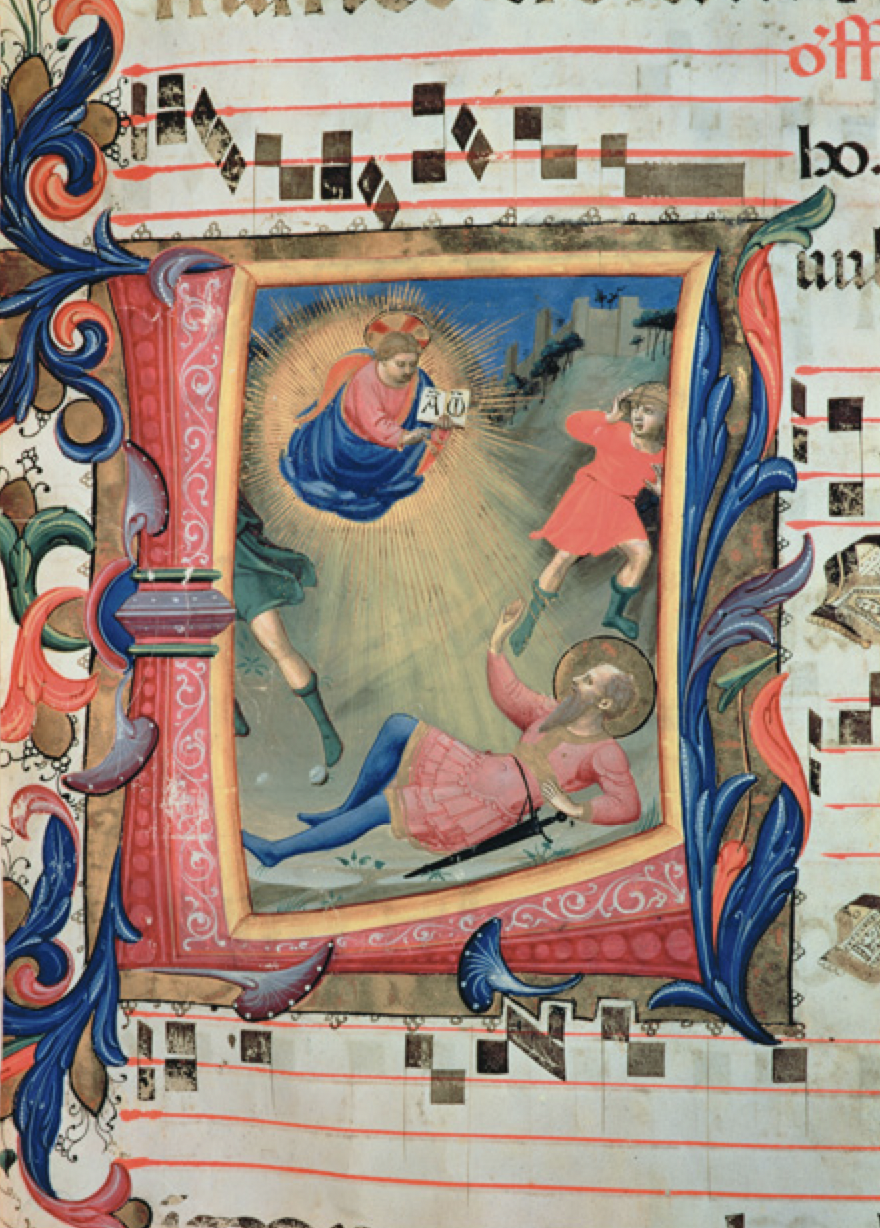
Paul says in his letter to the Galatians that at a time when he was violently persecuting the church, God “was pleased to reveal his Son to me, so that I might proclaim him among the Gentiles” (Gal. 2:13-16; cf. Acts 9:1-22). The event is commemorated here in a decoration on a fifteenth-century manuscript. (Bridgeman Art Library)
(Introducing the New Testament: A Historical, Literary, and Theological Survey) The book of Acts provides narrative descriptions of these pivotal events in Paul’s life. With regard to persecuting the church, Acts says that Paul (then known as Saul) was present in Jerusalem for the murder of Stephen, the first Christian martyr, holding the coats of those who stoned him and approving of the deed (7:58; 8:1; 22:20); he also ravaged the church, going from house to house and dragging men and women away to prison (8:3). According to Acts, Paul had believers bound and punished (tortured?) in order to force them to deny their faith, and when they would not do so, he voted to have them condemned to death (26:10-11; cf. 22:4, 19). Further, Acts tells us that Paul wanted to expand this persecution to other areas as well (9:1-2, 13–14, 21; 22:5) and that he was on his way to Damascus to do so when the dramatic conversion experience occurred. The story of that transforming event is recounted three times in Acts with lively and colorful details not mentioned elsewhere (see 9:1-22; 22:6-21; 26:4-23).
A Remarkable Man
Whatever else we say about Paul, he does not appear to have been typical—he was not “a typical Jew” or “a typical Christian” or “a typical citizen of the Greco-Roman world.” Paul was both controversial and persuasive. As is often noted, one reason Paul wrote so many letters, is that people argued with him, and yet one reason we still have those letters is that his views usually prevailed. He remains a towering figure of intellectual brilliance, regarded by secular and religious historians alike as one of the greatest moral teachers of history and as the most influential Christian theologian who has ever lived. Jonathan Edwards called Paul “the most fruitful and thrifty of the apostolic branches to shoot forth from the trunk of the risen Christ, so that the bigger part of the future tree came from this branch.” It is also worth noting that the letters of Paul are the only writings that we have from any Pharisee who belonged to what is called the Second Temple period of Judaism (537 BCE to 70 CE); thus, despite Paul’s ultimate identification with Christianity, he remains an important figure for Jewish studies as well.
But there is more to Paul than this. Although there is much in his letters that is difficult to understand (see 2 Pet. 3:16), there is also much that appeals to those who are not intellectuals or particularly interested in “theology” as such. There are passages of remarkable beauty—Shakespeare could have done no better than 1 Corinthians 13—and there are sections so overtly inspiring that a million sermons could be offered to unfold their meaning for people in countless cultures and circumstances. There are also troubling texts in which Paul seems shortsighted or just plain mean: he condemns Jews (1 Thess. 2:14-16), accepts slavery (1 Cor. 7:21-22), and silences women (1 Cor. 14:34-35). Of course, various proposals have been offered to explain those texts, and we will note some of these in the chapters that follow.
To fully appreciate how remarkable this man Paul is, we should approach his writings in light of two sobering thoughts. First, we are reading the works of a martyr. Paul suffered gravely for proclaiming the gospel as he did and eventually died for his beliefs; he cared so deeply about what he had to say that he was willing to endure humiliation, physical torment, and ultimately death in order to say it. Second, we are reading the works of a convert (at least in some sense of the term). Before he became a follower of Jesus, Paul actually tried to destroy the Christian church, employing violence against those who confessed the very faith for which he himself would later suffer violence. Something happened to transform him from an infamous enemy of that faith into its most prominent promoter and spokesperson, and from a man willing to kill for his convictions to a man willing to die for them.
Chronology of Paul’s Life and Letters
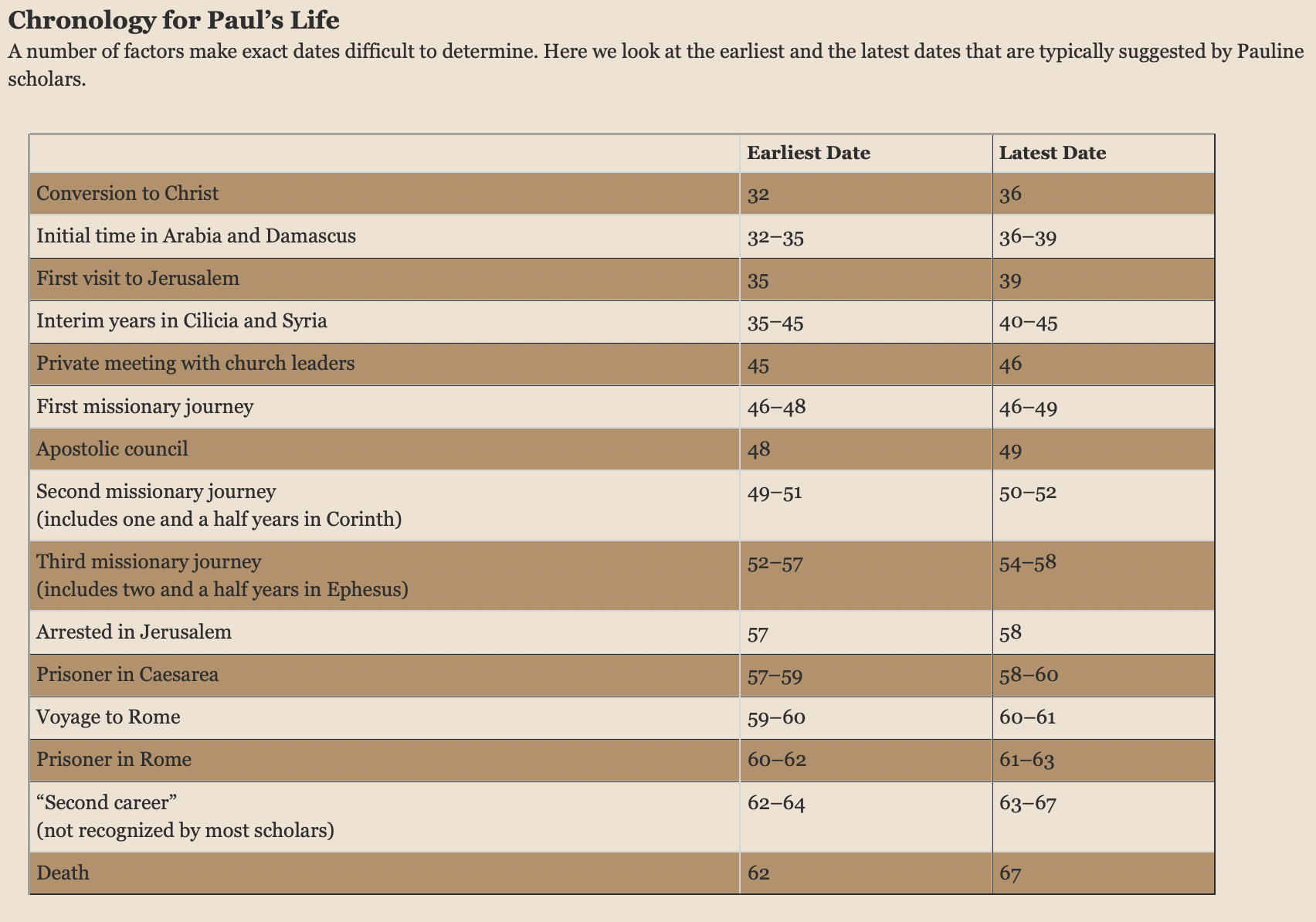
Neither Paul’s letters nor the book of Acts provide dates that designate when the events to which they refer took place. Even the information that they do provide is sometimes ambiguous: when Paul says that he went to Jerusalem for a second time “after fourteen years” (Gal. 2:1), does he mean fourteen years after the first visit or fourteen years after his life-changing encounter with Christ? Yet, certain points turn out to be surprisingly helpful. Acts 18:12 says that Paul was in Corinth (during his second missionary journey) when Gallio was the proconsul there. Roman records indicate that Gallio served as proconsul of Corinth from the summer of 51 to the summer of 52. Accordingly, most scholars working on a Pauline chronology situate Paul’s eighteen-month stay in Corinth in the early 50s and then work forward and backward in an attempt to assign dates for other events in his life.
The more pressing question for students of the New Testament may be “When were the various letters written?” This question can be answered with varying degrees of confidence for different letters.
Early Years in Judaism
Whenever Paul reflects upon his birth and upbringing, he emphasizes his Jewish identity (see Rom. 11:1; 2 Cor. 11:22; Gal. 1:13-14; Phil. 3:4-6). In his letters, he does not tell us when or where he was born, but he does tell us that he was circumcised on the eighth day of his life, as was traditional among devout Jews. He was born and raised as “a member of the people of Israel,” as a “descendant of Abraham,” and more specifically as a member of the tribe of Benjamin. He is proud to identify himself as “a Hebrew born of Hebrews” and, indeed, as a Pharisee. He maintains that he observed the Jewish law in a manner that was “blameless” and that he “advanced in Judaism” beyond many of his peers.
The book of Acts provides many more details about Paul’s early life than what is related in the letters. First, Acts indicates that Paul’s Jewish name was “Saul” (7:58-13:9; 22:7; 26:14). This was the name of Israel’s first king, who had also belonged to the tribe of Benjamin and who was remembered as one of that tribe’s more illustrious members. “Paul” was the apostle’s Latin name. Saul did not come to be called “Paul” at the time of his conversion or as a result of that event; rather, Saul/Paul seems to have had two names: his given Hebrew name (“Saul”) and a more Roman-sounding name (“Paul”) for use in the Gentile world (similarly, Silas was called “Silvanus”).
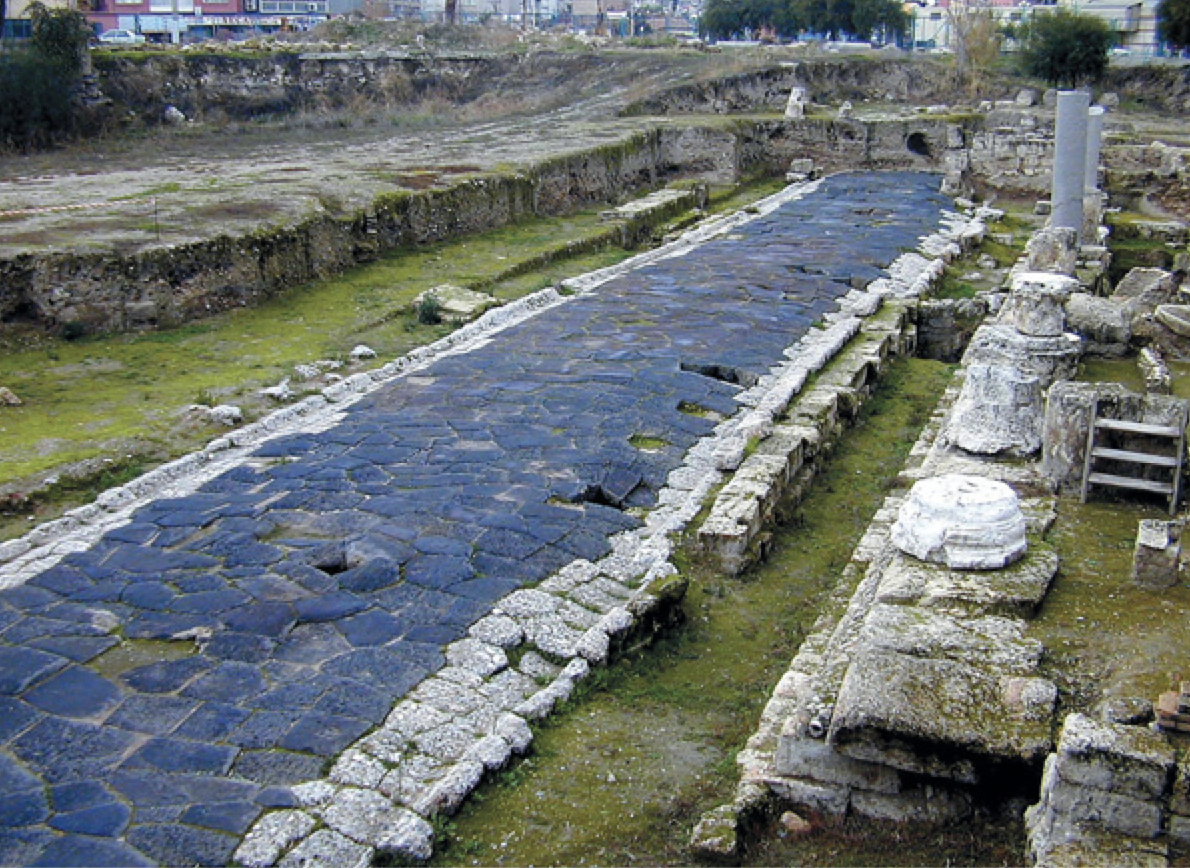
Tarsus. The book of Acts reports that Paul was a native of Tarsus, a Roman city in the province of Cilicia (22:3). This picture shows the main street of that city, a road about twenty-three feet wide and paved with basalt; almost 2,200 years old, the road is still in decent shape. Paul walked this road and conducted business in the shops that lined it on both sides. Growing up in the Hellenistic environment of Tarsus perhaps is what gave Paul the ability to communicate effectively with Gentiles.
The book of Acts also tells us that Paul was brought up in Jerusalem, where he studied “at the feet of Gamaliel” (22:3), a famous rabbi of the era (see 5:34-39). But, according to Acts, Paul was actually a native of Tarsus, the capital city of Cilicia (22:3; cf. 9:11; 21:39), and furthermore, he was a Roman citizen (16:37-38; 22:25-29). Some scholars suspect that this information from Acts is idealized, providing Paul with perfect pedigrees for both Jewish and Roman audiences. If he really did have such credentials (a student of Gamaliel, a Roman citizen), why doesn’t he mention any of this in his letters, particularly in those instances where he lists things of which he could boast if he were so inclined (2 Cor. 11:16-12:13)? Still, there is nothing in Paul’s letters that contradicts this information outright, and those letters do seem to be written by someone who is equally at home in Jewish and Gentile environments (1 Cor. 9:19-23).
Final Years
Paul’s undisputed letters tell us nothing certain about what happened after the period of his missionary work in the areas surrounding the Aegean Sea. In one of his later letters he says that he wants to come to Rome and hints that he would like for the church there to assist him with a westward missionary journey all the way to Spain (Rom. 15:22-24). But did that happen?
The book of Acts reports, that after the period of Paul’s great missionary work he was arrested in Jerusalem, imprisoned for two years in Caesarea, and then, after a perilous sea voyage, was imprisoned for another two years in Rome (21:17-28:31). This information is generally accepted as a reliable postscript to what can be known about Paul’s life from his letters. Some scholars believe that certain of Paul’s letters perhaps were written while he was a prisoner in Rome, and if that is the case, those letters might be read as a witness to Paul’s thoughts and priorities at this time. Even then, however, we would obtain few biographical details about his life situation.
We have to go outside the New Testament to find specific information concerning what happened to Paul after he was taken to Rome. Church tradition says that he was executed under the emperor Nero (Eusebius, Ecclesiastical History 2.22.3) and that he was killed in the same manner as was John the Baptist, by beheading (Tertullian, Prescription against Heretics 36). These traditions are generally accepted as reliable. Some church traditions, however, suggest that Paul was released for a time between his two-year imprisonment in Rome and his martyrdom under Nero, and that during that period his missionary work continued beyond what is reported in Acts. This idea first appears in the writings of Clement of Rome, about thirty years after Paul’s death. Clement says that Paul “traveled to the extreme west” (1 Clement 5:7), which suggests to some that Paul actually did make it to Spain as he had intended (Rom. 15:23); a later witness, the Muratorian Fragment (ca. 180), explicitly mentions Spain rather than simply referring to “the extreme west.” But this notion that Paul had a “second career” as a missionary between his imprisonment in Rome and his martyrdom has not found universal acceptance among scholars. Those who do accept the tradition think that positing a second career for Paul helps to account for anomalies in some of the Pauline letters that might otherwise cause those letters to be regarded as pseudepigraphical.
Interim Years
Paul indicates in his letters that the first few years following his encounter with Christ were spent in the region of Arabia and in the city of Damascus, in southern Syria (Gal. 1:15-24; cf. 2 Cor. 11:32-33). After three years, he went to Jerusalem and stayed with Peter for fifteen days; he also met James the brother of Jesus at that time. Then he went into the regions of Syria and Cilicia and spent more than a decade there. Those years are often viewed as a time of formation for Paul, a period during which he honed his missionary skills and developed his theological understanding of the gospel. For one thing, he became persuaded that uncircumcised Gentiles could be put right with God through faith in Christ without first becoming Jews. It was this conviction that brought him back to Jerusalem after fourteen years to have “a private meeting” with leaders of the church. He shared the gospel that he was proclaiming among Gentiles, and Peter, James, John, and others gave him their support. Sometime after this, however, a controversy erupted in Antioch, focused on whether Gentile and Jewish believers could share table fellowship together (see box 15.6 on p. 315). Paul took one view, but “people from James,” Peter, and Barnabas (Paul’s co-worker) took a different view.
The book of Acts also contains some information regarding these interim years of Paul’s life: we read of his time in Damascus (9:19b–25), of a visit to Jerusalem (9:26-30), and of time spent in Tarsus and Antioch (9:30; 11:19-30). The information provided in these narratives goes beyond what Paul says in his letters and sometimes seems to be in tension with Paul’s own account. For example, in Acts, Paul seems to become well known among the believers in Jerusalem (9:26-29), which is not something we would have surmised from his letters (see Gal. 1:22). More to the point, Acts reports on an apostolic council in Jerusalem at which the question of Gentile inclusion was discussed and a compromise decision reached: no circumcision required, but other restrictions would apply (15:1-35). If the meeting of this council is the same event as the “private meeting” that Paul says he had with church leaders in Galatians 2:1-10, then the two accounts of that meeting have to be regarded as widely diverse and probably irreconcilable. Some scholars think that the accounts refer to two completely different meetings: a private meeting between Paul and a few apostles in Galatians 2:1-10 and a churchwide apostolic council in Acts 15:1-35. In any case, most scholars do not think that the account of the apostolic council reported in Acts 15 warrants much attention in Pauline biography. Even those who regard the account as historically accurate must admit that Paul does not appear to have taken what transpired there very seriously: there is no evidence in his letters that he ever favored or promulgated the compromise that the book of Acts indicates was reached at that council.
-
Who was the founder of Christianity?
- A Remarkable Man
- The Life of Paul
- Early Years in Judaism
- A Life-Changing Revelation
- Interim Years
- Missionary Work in the Mediterranean World
- Final Years
- Chronology of Paul’s Life and Letters
- Paul’s Theology
Missionary Work in the Mediterranean World
We know from Paul’s letters that he eventually left the areas of Syria and Cilicia in which he had been at home for a considerable period of time and ventured out into the provinces of the Roman Empire north of the Mediterranean Sea. The bulk of this work appears to have occurred in four major areas: Galatia, Asia, Macedonia, and Achaia. As the maps on pages 240–41 illustrate, these areas correspond to modern-day Turkey and Greece. Paul also mentions that he proclaimed the gospel in Illyricum (Rom. 15:19), a region far to the north overlapping with what is now Albania, but nothing else is ever said about that particular evangelistic effort (either in Paul’s letters or in the book of Acts).
Paul’s letters provide a few clues as to how he went about his mission strategy.
First, he appears to have targeted urban commercial centers as prime locations for founding churches that could help him take the gospel to the world. Four cities are mentioned repeatedly: Ephesus (in Asia), Philippi and Thessalonica (in Macedonia), and Corinth (in Achaia). All four of these cities were major cosmopolitan centers, situated on important trade routes around the Aegean Sea. Paul’s emphasis on urban ministry affects his writing: scholars often note that whereas Jesus used agrarian images appropriate to rural life in Palestine (farming, fishing, shepherding), Paul uses images more appropriate to urban life: political identification (Phil. 3:20), commerce (Philem. 18), athletic competition (1 Cor. 9:24-27; Phil. 2:16), legal proceedings (Rom. 7:1; Gal. 3:15; 4:1-2), public festivities (1 Thess. 2:19), and even the slave trade (Rom. 7:14; 1 Cor. 7:22).
Second, Paul worked as the leader of a missionary team. Numerous assistants and emissaries are mentioned in his letters, though we are left to imagine just what their job descriptions might have been. In some cases, trusted assistants such as Timothy (1 Cor. 4:17; 16:10; Phil. 2:19, 23; 1 Thess. 3:2, 6) and Titus (2 Cor. 7:6-8, 13–15) seem to function as his troubleshooters: he sends them to churches where there are problems, investing them with authority to act on his behalf in negotiating settlements.
Third, Paul indicates in his letters that he often supported himself financially by practicing a trade within the community (1 Cor. 9:14-15; 2 Cor. 11:9; 1 Thess. 2:9). In this way, he took care not to place any financial burden on the fledgling churches, and he avoided giving potential converts any reason to suspect he was after their money (cf. 2 Cor. 2:17; Titus 1:11). Once a church was established, however, he drew upon its resources to support his ministry in other locales (2 Cor. 11:8-9; Phil. 4:15-16).
Fourth, Paul insists that his missionary work was independent of any human (ecclesiastical) authority. He tries to be respectful of other church leaders (1 Cor. 3:4-6) and is even involved in taking up a collection for the church in Jerusalem (Rom. 15:25-26; 1 Cor. 16:1; 2 Cor. 8–9; Gal. 2:10), but he takes orders from no one but Jesus Christ (Gal. 1:1, 11–12). Perhaps for this reason, Paul indicates that his typical goal is to proclaim the gospel in new areas and to found churches in places where other missionaries have not worked—he does not want to “build upon another’s foundation” (Rom. 15:20; cf. 2 Cor. 10:13-16). He then assumes that he has a special relationship with his converts: they are his children in the faith (1 Cor. 4:15; Gal. 4:19), and he has apostolic authority over them (1 Cor. 5:3-5; 2 Cor. 10:8; 13:10). Accordingly, he resents missionaries who, after he has moved on, come to churches that he established and undermine his authority while he is absent from the community (2 Cor. 11:4; Gal. 1:6-9).
Paul’s letters reveal other scattered bits of information that might be useful in reconstructing a biography for this prominent period of his life. We learn, for instance, that he is not currently married and that he regards the single, celibate life as ideal for a Christian who is expecting Jesus to return soon (1 Cor. 7:7, 25–40; cf. 9:5). We also learn that he suffers from some sort of affliction that he calls his “thorn in the flesh” (2 Cor. 12:7-9), but despite many guesses, no one has ever been able to determine what this was (see box 14.3 on p. 301).
Paul’s letters also contain several references to trials and tribulations that he endured while engaged in missionary work. He says that he was shamefully mistreated at Philippi (1 Thess. 2:2), that he fought with (metaphorical?) wild beasts in Ephesus (1 Cor. 15:32), and that he suffered such affliction in Asia as to despair of life itself (2 Cor. 1:8-9). And then, in one startling summary passage he declares,
Five times I have received from the Jews the forty lashes minus one. Three times I was beaten with rods. Once I received a stoning. Three times I was shipwrecked; for a night and a day I was adrift at sea; on frequent journeys, in danger from rivers, danger from bandits, danger from my own people, danger from Gentiles, danger in the city, danger in the wilderness, danger at sea, danger from false brothers and sisters; in toil and hardship, through many a sleepless night, hungry and thirsty, often without food, cold and naked. And, besides other things, I am under daily pressure because of my anxiety for all the churches. (2 Cor. 11:24-28)
The book of Acts fills out the picture of Paul’s missionary work with colorful stories of the adventures that he and his colleagues had as they traveled about the Roman world. Most important to scholars, perhaps, Acts provides an itinerary for Paul’s travels. It presents his work in such a way that traditionally he has been understood as embarking on three missionary journeys (see maps on pp. 192–94):
First Missionary Journey (Acts 13:1-14:28)—to the island of Cyprus and to cities in southern Asia Minor, including Pisidian Antioch, Lystra, Derbe, and Iconium, for a total distance of about 1,400 miles. Second Missionary Journey (Acts 15:36-18:32)—through Asia Minor to Macedonia (especially Philippi, Thessalonica, and Beroea), and then on to Achaia (especially Athens and Corinth), for a total distance of about 2,800 miles. Third Missionary Journey (Acts 18:23-21:15)—through Galatia and Phrygia to Ephesus, then on to Macedonia and Achaia, for a total distance of about 2,700 miles.
No such itinerary is discernible from Paul’s letters, which make no reference to distinctive trips. Some scholars think that the scheme of three missionary journeys is a literary device created by Luke in order to organize the stories that he wanted to tell in Acts. More often, however, the itineraries are regarded as plausible and are employed as a general outline for making sense of this critical phase of Paul’s life. In particular, Acts presents Paul as spending at least eighteen months in Corinth on his second journey (18:11; cf. 18:18) and as spending at least twenty-seven months in Ephesus on the third journey (19:8-10; cf. 20:31). These “long tenure” stays in key cities fit well with most reconstructions of Paul’s life and ministry.
When it comes to mission strategy, the book of Acts also presents Paul as working a trade to support himself while seeking to evangelize certain communities. Acts tells us further that the particular trade that Paul practiced was some form of tent-making, a vocation that he shared with his friends and co-workers Priscilla and Aquila (18:3). It is usually thought that such an occupation placed Paul among the more fortunate members of the Roman Empire’s impoverished population: he was poor, but he may have been a step above those who were living at a mere subsistence level (or worse).
Acts consistently portrays Paul as first going to Jewish synagogues in each area where he worked and then turning to the Gentiles only after the Jews had rejected his message (13:5-7, 13, 44–48; 14:1-7; 17:1-2, 10; 18:5-6; 19:8-9). We would never have gathered from Paul’s letters that this was his approach; in the letters, Paul seems to indicate that God called him specifically to proclaim the gospel to Gentiles and that this was one thing that set him apart from other missionaries (Rom. 11:13; Gal. 1:16; 2:7; but cf. 1 Cor. 9:20).
Another aspect of Paul’s mission work that is especially striking in Acts is the prominence of the miracles that God works through him (on this, see pp. 210–11). We do not hear about any of these specific miracles in Paul’s letters: he never tells us that he cast demons out of people (Acts 16:16-18) or healed the sick (Acts 14:8-10; 28:8), much less that his very handkerchiefs and aprons came to possess extraordinary divine power (Acts 19:12), or that he could punish opponents with curses that struck them blind (Acts 13:9-11). Paul does indicate in his letters that God worked “signs and wonders” through him, but he does so without getting any more specific about what those signs and wonders entailed (Rom. 15:19; 2 Cor. 12:12; cf. Acts 14:3; 15:12).
Paul’s Theology
Paul speaks often of the “gospel” (euangelion, literally “good news”) that has been revealed to him by God. In some sense this gospel is a message that can be conveyed through proclamation (Rom. 10:14-17), but it is also more than that. It is a dynamic force that Paul identifies as the “power of God for salvation to everyone who believes” (Rom. 1:16; cf. 1 Cor. 1:18). We will learn more about this gospel as we examine each of Paul’s letters one by one, but we can note here that it is very much a gospel of Jesus Christ (Rom. 1:3-4).
Paul believes that Jesus Christ has died for our sins (Rom. 4:25; 5:6-8; 1 Cor. 15:3; Gal. 1:4; 1 Thess. 5:10). Moreover, God raised Jesus from the dead (Rom. 4:24-25; 1 Cor. 15:4; Gal. 1:1; 1 Thess. 4:14). Jesus is now at the right hand of God in heaven, where He intercedes for believers (Rom. 8:34), and He will come again (1 Thess. 4:13-18). Those who confess that Jesus is Lord and place their trust in Him will be saved (Rom. 10:9). After death, they will live forever in a glorious realm that renders the troubles of this present life insignificant by comparison (Rom. 8:18). Furthermore, Paul believes that, in some sense, this wonderful new age of God has already begun. Through Jesus Christ, believers are reconciled with God (Rom. 5:8-11; cf. 2 Cor. 5:18-21). They are justified (made right with God) by faith (Rom. 3:24-26; Gal. 2:16). They become children of God (Rom. 8:14-17; Gal. 4:4-7) and receive the Holy Spirit (Rom. 5:5; 8:9; 1 Cor. 3:16; 2 Cor. 1:21-22; 5:5; Gal. 3:2-5; 4:6). Their lives are transformed in a way that can only be described as “a new creation” (2 Cor. 5:17).
Paul’s interest in Jesus seems to have focused especially on the last week of His life—His institution of the Lord’s Supper (1 Cor. 11:23-26) and especially His death, burial, and resurrection (1 Cor. 15:3-7). Since Paul knew disciples of Jesus, as well as James the brother of Jesus, he must have known some of the stories about Jesus that we find in our Gospels and probably other stories as well. He does cite words or instructions of Jesus in a few places (1 Cor. 7:10-11; 9:14; 11:23-25; 2 Cor. 12:9; cf. Acts 20:35), but for the most part he displays little interest in the details of Jesus’ earthly life and ministry. He never mentions, for instance, that Jesus told parables or that he worked miracles or that He had numerous arguments with the Pharisees over various matters of the law (a striking omission, since Paul himself is a Pharisee). Paul’s focus, rather, is on “Christ crucified” (1 Cor. 1:23) and on the risen Christ Who is Lord of all (Phil. 2:9-11). This, in fact, is what some scholars had in mind when they dubbed Paul “the real founder of Christianity.” They claim that Paul transformed the gospel from the message of Jesus (i.e., the message Jesus preached [see Mark 1:14-15]) to a message about Jesus. But Paul himself probably would have regarded his emphasis on the latter part of Jesus’ career as focusing on the events that brought to a climax everything that Jesus had sought to say and do in the years prior to those events.
Theologically, Paul understands Jesus Christ to be the image of God (2 Cor. 4:4; Phil. 2:6; Col. 1:15; cf. 1 Cor. 15:49), the One Who makes God visible and accessible to human beings. He often quotes scripture passages in which the word Lord originally referred to the God of Israel and interprets them in such a way that the word Lord now refers to Jesus Christ (see, e.g., the treatment of Joel 2:32 in Rom. 10:13; cf. Rom. 10:9). He also speaks of Christ as having been “in the form of God” and as having chosen not to regard “equality with God as something to be exploited” (Phil. 2:6 [for discussion of how this passage is interpreted, see pp. 349–52]). Paul clearly has an exalted view of Christ as One Who is more than just a prophet, or even a messiah, or any other human servant of God.
We should also note the depth of Paul’s religious feeling for Christ and the manner in which he speaks of Christ in relational terms. He is consumed with Jesus Christ and the gospel; he doesn’t want to think or talk or write about anything else (see 1 Cor. 2:2; 2 Cor. 10:3-5; Phil. 3:7-8). He feels compelled to proclaim the gospel (1 Cor. 9:16), and he accepts his call to do so as a great honor: the gospel is a prized treasure with which he has been entrusted (Gal. 2:7; 1 Thess. 2:4). When he shares the gospel with others, he is fulfilling the purpose for which he was born (Rom. 1:1; Gal. 1:15). Thus, Paul is committed not simply to a cause or an ideology but rather to a person: he knows Jesus Christ (Phil. 3:7-10) and can say, “It is no longer I who live, but it is Christ Who lives in me” (Gal. 2:20). And he is not claiming to be exceptional in this regard; rather, union with Christ is a reality to be experienced by all believers (Rom. 6:5; 8:10; 1 Cor. 6:17; 2 Cor. 13:5; cf. Col. 3:3). Paul speaks of Christians as “those who are in Christ Jesus” (Rom. 8:1; 16:7; 2 Cor. 5:17) and describes the church as “the body of Christ” (Rom. 12:4-5; 1 Cor. 12:27). Accordingly, Paul’s gospel is very much a message for a community; it is good news for the church, the new people of God formed in Christ and empowered by the Holy Spirit.
Paul’s theology is eminently practical in that everything he believes about God and Christ has direct implications for how people live in the present world. Simply put, those who experience God’s salvation through Christ are to live not for themselves but rather for Christ, Who died and was raised for them (2 Cor. 5:14-15), and “the only thing that counts is faith working through love” (Gal. 5:6). Paul devotes generous portions of his letters to instruction on moral and behavioral matters. He addresses controversial issues (e.g., Rom. 14:5-6; 1 Cor. 8:1-13; 12:1-14:40) and lists both virtues to be pursued and vices to be avoided (Rom. 1:29-31; 13:13; 1 Cor. 5:10-11; 6:9-10; 2 Cor. 6:6-7; Gal. 5:19-23).
How does Paul determine what sort of behavior is appropriate for those who are now in Christ? There is no question that his ethical positions are informed by the Hebrew scriptures—the moral commandments of Torah—but Paul also claims that Christians are no longer “under the law” (Rom. 6:14-15; 1 Cor. 9:20; Gal. 3:23-25), and interpreters struggle to determine exactly what he means by that (see pp. 264–65, 313–18). In a few instances, Paul makes reference to a human “conscience” that may serve as a moral guide (Rom. 2:15; 2 Cor. 1:12; 4:2), but this cannot be absolute, since conscience can be weak and is easily defiled (1 Cor. 8:7-12; 10:25-29).
Ultimately, Paul’s ethics are shaped by the expectation that believers will imitate Christ with regard to sacrificial humility: they will seek the good of others rather than what is pleasing or beneficial to themselves (Rom. 15:1-3; Phil. 2:4-8). Thus, for Paul, the cross becomes the emblem not only of Christian salvation but also of Christian conduct. Furthermore, for Paul, all ethics are community ethics, for the individual believer is united spiritually with others in such a way that all individual actions have consequences for others (1 Cor. 12:11-26). Paul’s ethics are also shaped by an expectation that Christ is coming soon and that the time remaining to do what must be accomplished in this world is short (Rom. 13:11-14; 1 Cor. 7:29-31; 1 Thess. 4:13-5:11). And, finally, Paul is certain that believers have divine assistance in living as God would have them live; they are transformed from within, by a renewing of their minds (Rom. 12:1), and they are imbued with the Holy Spirit, who produces in them the fruit that is pleasing to God (Gal. 5:22-23).
The Life of Paul
Paul alludes to various aspects of his life in key portions of his undisputed letters: Philippians 3:4-6 (his upbringing); Galatians 1:13-17 (his calling); Galatians 1:18-2:14 (his trips to Jerusalem); 1 Thessalonians 2:1-12 (his ministry); 2 Corinthians 11:23-29 (his hardships). In addition, the book of Acts relates numerous narratives of his life (7:58-8:3; 9:1-30; 11:25-30; 12:25-28:31) and presents speeches in which he offers brief summaries of his own biography (see especially 22:1-21; 26:2-23). The approach of academic scholarship is to look first at what Paul says in the letters and then at the material in Acts as a secondary and supplemental source.
Who was the founder of Christianity?
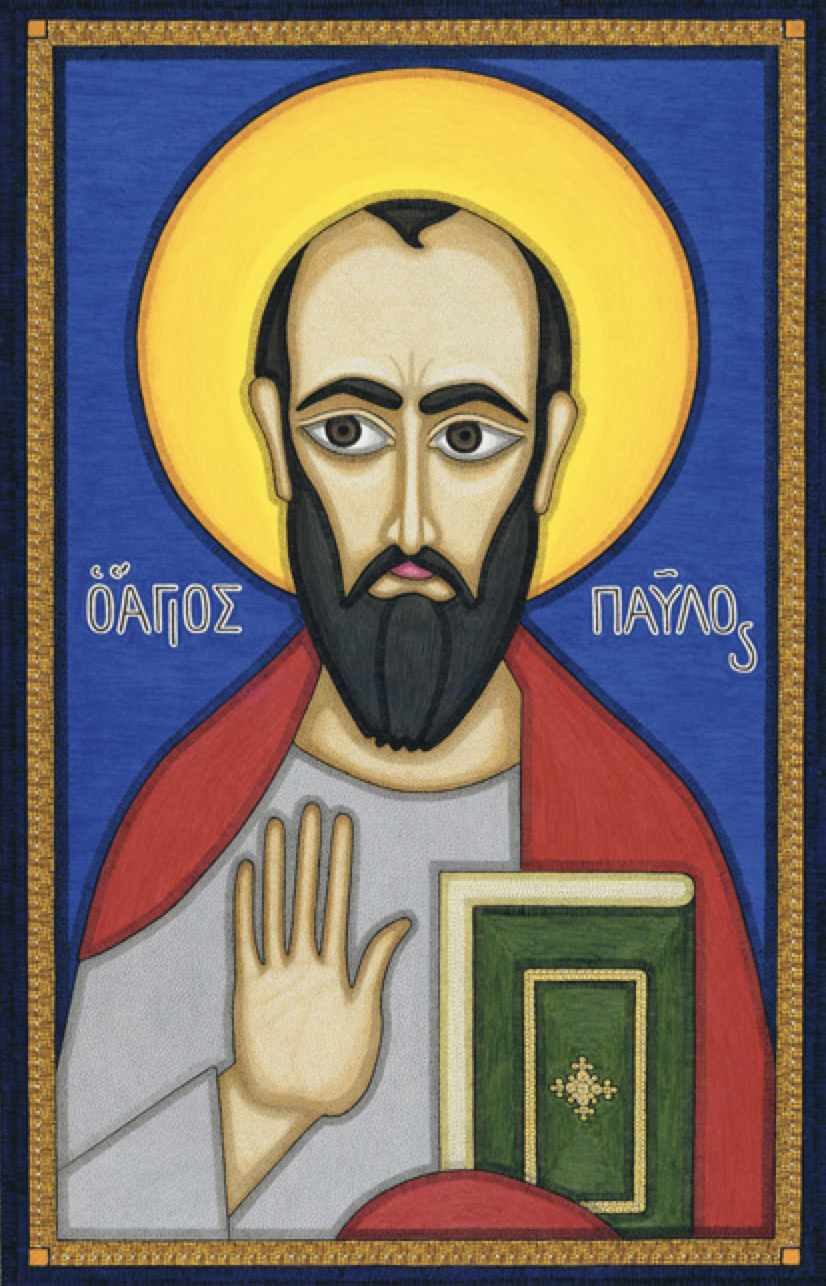
Religion professors sometimes like to stump their students with a trick question: Who was the founder of Christianity? The students, of course, say “Jesus,” and the professors respond, “No. It was Paul.”
The point is that Jesus was a Jewish peasant, Who said and did some remarkable things in Galilee, but by the end of His career there was nothing on earth even remotely resembling a world religion. It was Paul who took the message of Jesus—and about Jesus—to the world. By the end of Paul’s career, the people who believed in Jesus were organized into churches, communities of faith that had confessions and liturgies and bishops and deacons. And these churches were scattered throughout the Roman Empire. Almost anywhere one went, there were Christians—adherents of a new religion. “Paul did this,” the religion professors will say. “Not Jesus.”
This idea that Paul was the true founder of Christianity is an exaggeration. For one thing, it ignores the fact that there were many other apostles and missionaries involved in the spread of the Christian faith and the development of its various institutions. Beyond that, Paul clearly regarded himself as little more than an ambassador or emissary for Jesus, carrying out the directives of his Lord (cf. 2 Cor. 5:18-20). He makes no claim to be innovative in his doctrine or ideas; rather, he passes on what he has received (1 Cor. 15:3-9), and he considered his teaching to be consistent with what Jesus himself thought and did.
Still, Paul is a figure of monumental significance. Almost half of the books of the New Testament are said to be written by him (thirteen out of twenty- seven), and more than half of the book of Acts is devoted to recounting his exploits. He was responsible not only for expanding the Christian movement numerically and geographically but also for extending it along ethnic lines (through the inclusion of Gentiles).
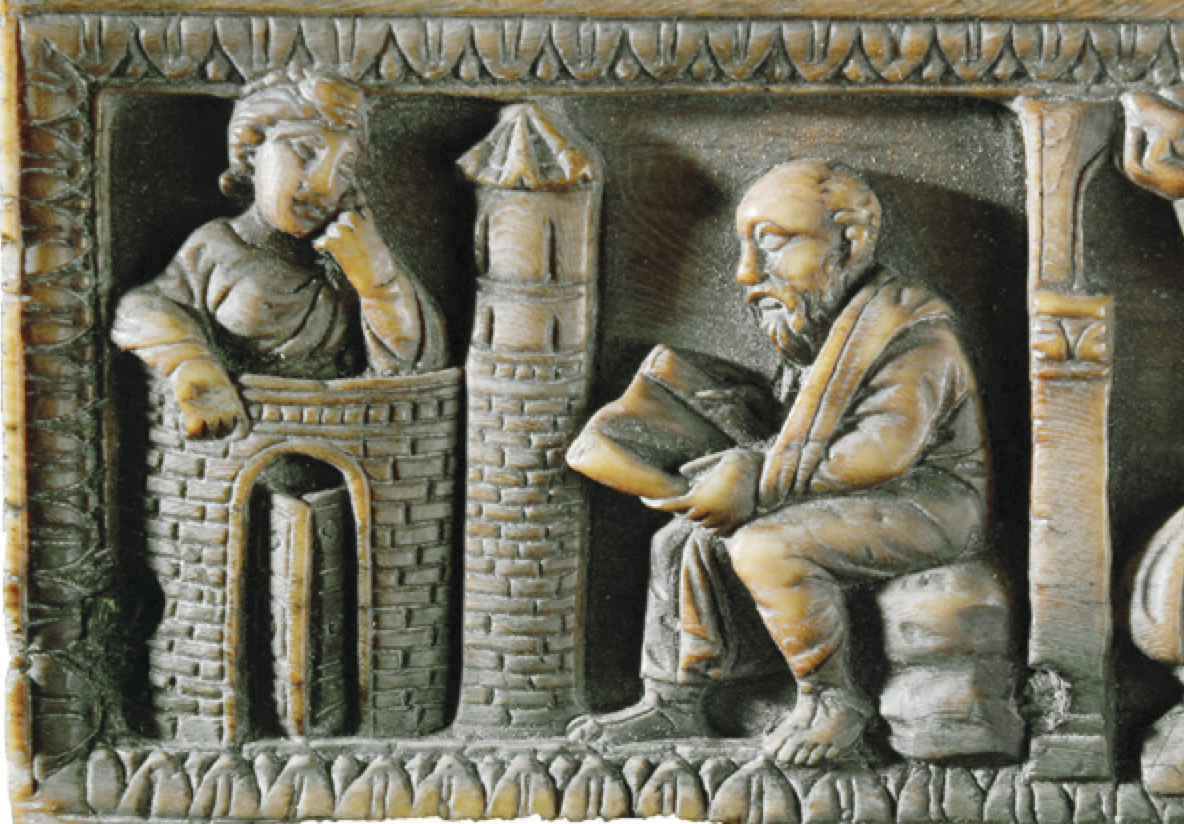
Thecla: A Legendary Disciple of Paul. A second-century novel, The Acts of Paul and Thecla, relates legendary tales of an otherwise unknown disciple of Paul who embraces his teaching on sexual abstinence and celibacy (cf. 1 Cor. 7:25-35). A woman named “Thecla” hears Paul’s teaching and breaks her engagement to a wealthy man, who then seeks to have her executed. Thecla has many adventures that demonstrate how God protects those whom God favors, especially virgins. The picture above is of a fifth-century ivory panel from a church in which the story of Thecla (listening attentively to Paul as he teaches) remained popular.
Paul.
Related Concepts
- 1-corinthians-1545
- 2-corinthians-519
- abba-dorotheus
- ambassador
- ambassador-for-christ
- apostleship
- boasting
- body-of-christ
- calling
- children-in-the-faith
- children-of-wrath
- christ
- christ-crucified
- church-planting
- collection-for-jerusalem
- community-ethics
- confession-of-jesus-as-lord
- conscience
- conversion
- damascus-road
- diaspora-judaism
- ecological-responsibility
- election
- enemies-of-god
- ethical-exhortation
- evangelists
- exalted-christology
- freedom
- freedom-in-christ
- fruit-of-the-spirit
- galatians-311
- gentile-mission
- heart
- hebrews-1038
- hellenistic-judaism
- high-christology
- holy-spirit
- hope
- hope-of-glory
- imitation-of-christ
- inaugurated-eschatology
- indwelling
- inheritance
- jewish-identity
- judass-remorse
- kerygma
- law
- law-written-on-the-heart
- legal-proceedings-imagery
- lordship
- message-of-jesus-vs-message-about-jesus
- mission-to-gentiles
- moral-discernment
- mysticism
- natural-law
- new-birth
- new-people-of-god
- pauline-team
- peace
- peace-with-god
- pharisaism
- phil-2
- phil-2-hymn
- philippians-hymn
- pilates-wifes-dream
- proclamation
- prophetic-call
- reconciliation
- resurrection
- resurrection-appearances
- revelation-211
- rival-missionaries
- roman-citizenship
- salvation
- scriptural-interpretation
- self-examination
- self-rule
- sin
- sonship
- spiritual-gifts
- st-john-chrysostom
- tarsus
- tent-making
- thorn-in-the-flesh
- those-in-christ-jesus
- tradition-and-innovation
- tradition-and-reception
- union-with-christ
- unity
- urban-imagery
- urban-ministry
- watchfulness
- weak-and-strong
- weak-brother
- weakness-and-power
- zeal-for-ancestral-traditions
- zions-restoration