New Testament — Topic 17
The Crucifixion, the Resurrection and the Ascension of the Lord.
- The Crucifixion. (Mat. 27:33-44; Mark 15:22-32; Luke 23:33-38; John 19:18-24) The Repentance of the Wise Robber. (Luke 23:39-43)
- The Mother of God at the Cross. (John 19:25-27)
- The Death of Christ. (Mat. 27:45-56; Mark 15:33-41; Luke 23:44-49; John 19:28-37).
- The Burial of the Lord Jesus Christ. (Mat. 27:57-66; Mark 15:42-47; Luke 23:50-56; John 19:38-42).
- The Resurrection. The Arrival of the Women Myrrh-Bearers at the Tomb. Jesus Appears to Mary Magdalene. The Bribing of the Guards.
- Lord’s Appearance to His Disciples on the Road to Emmaus. The Appearance to the Ten Disciples. Thomas’s Disbelief. The Appearance at the Sea of Tiberias.
- The Restoration of Apostle Peter. (John 21:15-25). The Appearance in Galilee. (Mat. 28:16-20; Mark 16:15-18 and Luke 24:46-49).
- The Ascension of the Lord.
Lord’s Appearance to His Disciples on the Road to Emmaus. The Appearance to
the Ten Disciples. Thomas’s Disbelief. The Appearance at the Sea of Tiberias.
Lord’s Appearance to His Disciples on the Road to Emmaus.
(Luke 24:13-35 and Mark 16:12)
Evangelist Luke — according to the tradition, being one of those two disciples — was the only one to describe this event in detail, the other one being Cleopas, a relative of the Mother of God. Both were among the seventy disciples of Christ. Saint Mark briefly mentions this event as well (16:12). Even the very vivid description of the narrative of this event, and the fullness of the portrayal with all its inner sufferings, shows that one of its two participants undoubtedly was Luke himself, who according to the custom of the holy writers, does not call himself by name. The disciples were heading towards Emmaus, a settlement located approximately 7 miles to the west of Jerusalem. They were traveling there at the slow pace, it would require nearly 3 hours to fulfill the trip, while for a quick return trip, it would take them 1 ½ - 2 hours. This was the “same day,” i.e., the very day of Christ’s resurrection. They were walking slowly, discussing among themselves all the sad events associated with the Lord’s last days on earth that laid as heavy burden upon their hearts. As it can be seen further on, they also discussed the events of the current day, which evidently couldn’t affirm their faith in the authenticity of Christ’s resurrection, for they walked in sadness. Along the way, the Lord Himself joined them as a traveler, heading in the same direction. “But their eyes were restrained, so they did not know Him.”
Saint Mark explains that the Lord appeared to them “in another form,” i.e., in a different appearance, that’s why they did not recognize Him. The Lord did that intentionally, because it wasn’t good for Him to be recognized immediately. He did that, so as to edify them giving the necessary instructions in their spiritual state. As Saint Theothylactus thinks, He wanted them, “to reveal their perplexity, expose their wound and then accept the medicine; to appear before them, after a long break, as more pleasing; to instruct them through Moses and the Prophets, and only then to be recognized; so that they might believe that His Body is no longer the same, which can be seen by everyone in general, but that while it is the same body that resurrected and suffered, at the same time, it can be visible only to those, whom He allows to see Him.”
Being omniscient — He wanted to know from them, what was the reason for their sorrow: “What kind of conversation is this that you have with one another as you walk and are sad?” With this question, the Lord is trying to provoke the disciples to reveal their feelings before Him. Cleopas then perceives the Lord to be a Judean, having arrived at Jerusalem from some other country for the Passover, as one could not visualize that a Palestinian resident wouldn’t know all about what happened during those days. The disciples then confessed their sorrow to the Lord. However, characteristically, they refer to their Teacher as just to a “prophet,” at the same time stating that their expectations of Him, as of the Messiah, had not been realized: “We were hoping that it was He who was going to redeem Israel.” Moreover, they themselves still don’t know what to think of everything that happened, because some women, having been to the tomb early, related some amazing things: they didn’t find His Body, but saw the appearance of the Angels, who said that He was alive. Evidently, Luke and Cleopas left Jerusalem before hearing about the appearance of the Lord to Mary Magdalene and the other myrrh-bearers. “And certain of those who were with us went to the tomb” — here, evidently, the conversation is about the Apostles Peter and John, about what narrates the latter (John 20:1-10) — “but Him they did not see” — and because of this they find themselves in a predicament, for they do not know what to think of all this.
Without still revealing Himself, the Lord begins His dialogue, letting them understand that the reason for their uncertainty in the spiritual state lies within them — in their incomprehension and in the sluggish state of their hearts. “Ought not the Christ to have suffered these things and to enter into His glory?” — He directly calls their Teacher as Christ and explains, that everything happened in accordance with the Old Testament prophesies about Christ, that exactly through the sufferings, the Messiah had to “enter into His glory” — the glory of His spiritual and not terrestrial kingdom.
The disciples listened to their mysterious companion with greater attention and inner zeal, and their hearts got so pre-disposed towards Him, that they started to persuade Him to stay with them for the night, pleading that the night was approaching and to travel alone at night in Palestine was not at all safe. The Lord stayed, and when it was time for supper, as the eldest, “He took the bread, blessed and broke it, and gave it to them.” Evidently this gesture, characteristic of their Teacher, served as an impulse that their eyes became open, and “they knew Him; and He vanished from their sight.” As it can be seen from the Evangelists’ narratives, the glorified Body of the Lord was already extraordinary. It wasn’t like the former mortal human body: there were no barriers to it, and it could appear and become invisible suddenly.
Why was it that only then the Lord allowed Himself to be recognized? The purpose of His appearance was to explain to the disciples, how all the prophesies of the Old Testament had been realized through Him. If only they recognized Him instantly, the impulsive joy that would have undoubtedly taken them might have hindered the quiet reflection about the authenticity of His resurrection and conviction in its reality. As the Lord guided them slowly towards the profound conviction in this truth, by their own admission, making their hearts inflame, He finally revealed Himself to them, having ignited them with such burning faith, inaccessible to any doubts or temptations.
Notwithstanding that the night had fallen, they immediately hurried to Jerusalem, to share their joy with the other disciples. They in turn related to them that “The Lord is risen indeed, and has appeared to Simon!” According to Saint Mark (16:12-13), Luke’s and Cleopas’s story was not believed by the other disciples. It has to be assumed that what confused them, were the incomprehensible appearances of the Lord, first here, then elsewhere, which was impossible for an ordinary person, and as well, that He appeared to the travelers to Emmaus “in another form.” They didn’t understand the Lord’s new being upon the resurrection, consequently their faith was not yet very firm — they didn’t know the nature of His resurrected Body. That’s why when He appears to them collectively, behind the closed doors, they regard Him as a ghost.
The Appearance to the Ten Disciples.
(Mark 16:14; Luke 24:36-45 and John 20:19-23).
Saint Mark speaks briefly about this appearance, while Saints Luke and John, narrate about this in detail, being the complement of one another. As indicated by Saint Luke, the Lord appeared to the ten disciples (Thomas was absent, according to Saint John), just when Luke and Cleopas, who returned from Emmaus, were continuing their narration, as though for the purpose of dispelling all the disciples’ doubts and curing them of their remnants of disbelief. According to Saint John, this was “the same day at evening, being the first day of the week.” Here, John abandons the normal Jewish calculation of time according to which, the evening is the beginning of the next day. Because of the fear of Jews, the doors of the house were locked — “for the sake of the fear”; evidently, some rumor reached the disciples that the body of Christ was as if stolen by them. That’s why they naturally feared some type of violent measures on the part of those Jews that were hostile towards them. And so — “when the doors were shut,” “Jesus came and stood in the midst, and said to them, “Peace be with you.” Here, a special quality of the glorified Body of Christ manifested itself, according to which material substances were not an obstacle for passing through them. The Lord’s miraculous appearance through the closed doors caused confusion among the disciples, about which Saint Luke says: “But they were terrified and frightened, and supposed they had seen a spirit” — they thought that this was only the Lord’s spirit, detached from the body and having come to them from “sheol”, i.e., that He appeared to them as dead and not alive. In order to assure them that it was Him indeed, the Lord shows them His hands and feet, the wounds, which testify that it is the same body that was crucified on the cross. He offers them to touch Him, so as to convince themselves that it is Him and not His ghost. The Lord partakes of the food in front them (probably some baked fish and honeycomb left over from the supper), with the aim of eradicating the last remnants of doubt in the disciples. “The disciples were glad when they saw the Lord” — their doubts dispersed and the joy, about which the Lord foretold them at the Last Supper, enveloped them: “But I will see you again and your heart will rejoice, and your joy no one will take from you”(John 16:22).
According to Saint Mark, the Lord reproached them for their disbelief and their hard-heartedness that they didn’t believe those that had seen Him resurrected, i.e., the women myrrh-bearers, Luke and Cleopas (Mark 16:14).
“These are the words which I spoke to you” — everything that happened — this is the fulfillment of that, which I repeatedly foretold you before, saying about My forthcoming sufferings and resurrection. All this had been predicted in the Old Testament — “the Law of Moses ” “prophesies ” and “Psalms ”. That was why all that had to be fulfilled. Here, the Lord is pointing at the three-part division of the Old Testament holy books, which existed among the Jews. They divided their sacred books into three sections:1) The law , which embraced the Five Books of Moses; 2) The Prophets , which included nearly all the rest of the historical and Prophetic books, and 3) The Psalms , or angiographs , to which were assigned the instructive books and minor historical ones. Thus, through the indications of the Lord Himself, the whole Old Testament, in its complete composition, is filled with prophecies about Him. Before, the Apostles didn’t comprehend those prophecies correctly: now, through the extraordinary blessed enlightenment, the Lord “opened their understanding, that they might comprehend the Scriptures”.
Saint John adds that the Lord then told them for the second time: “Peace to you!” Having said that, He then through the visible sign of breathing reported to them the preliminary grace of the Holy Spirit — before the day of Pentecost — instructing them: “Receive the Holy Spirit. If you forgive the sins of any, they are forgiven them; if you retain the sins of any, they are detained.” The full descending of the Holy Spirit’s gifts on the Apostles occurred on the day of the Pentecost; but evidently, before this day, it was essential that the Apostles would receive those gifts of the Holy Spirit, that would strengthen them in the absolute and firm belief in the genuineness of Christ’s resurrection, that would help them to understand the Gospel correctly, and especially to awake within the 11 Apostles the belief in their Divine mission — the faith in that they were not only the former traveling companions and listeners of the Lord Jesus Christ, but “the Apostles” — His envoys, appointed by Him for the great service of spreading the good news of the Gospel throughout the world: “ As the Father has sent Me, I also send you.” This was the commencement of the Spirit, which was essential for the strengthening of the apostolic assembly. With that breathing, all the Apostles were given the power to absolve sins, which was previously promised to Peter — for professing Christ as the Living Son of God (Mat. 16:19) — as well as to the other Apostles (Mat. 18:18).__
Thomas’s Disbelief.
(John 20:24-31)
Evangelist John notes that when the Lord first appeared to all His disciples, who were gathered together, Thomas (called the Twin , or Didimus , in Greek) was absent. As it can be seen from the Gospel, the character of this Apostle was distinctive in its persistence, bordering with stubbornness, which was natural for the people of a simple, yet firmly formed viewpoint. Even when the Lord was going to Judea to resurrect Lazarus, Thomas expressed his conviction that nothing would come out of that journey: “Let us also go, that we may die with Him”(John 11:16). When the Lord stated to His disciples in His farewell speech: “And where I go you know, and the way you know,” Thomas started to contradict: “Lord, we do not where You are going, and how can we know the way?”(John 14:5).
That’s why the Teacher’s death at the cross produced an especially painful, depressing impression on Thomas: it was as though he stagnated in the conviction that the loss of Him was irretrievable. He was so depressed that he even wasn’t with the other disciples on the day of the resurrection; he evidently decided that there was no reason for them to be together, because everything was finished, everything had fallen apart and now, every disciple had to return to his previous, individual and independent life. And then, having met the other disciples and suddenly hearing from them: “We have seen the Lord.” Consistent with his character, he sharply and definitively refuses to believe their words. Regarding the resurrection of his Teacher as impossible, he declares that he would believe that not only if he saw that with his own eyes, but also felt the nail wounds on the Lord’s hands and feet with his own hands, as well as the wound made by a spear to His side. “And put my hand into His side” — it can be seen through these words of Thomas, that the wound, inflicted by a soldier to the Lord, was very deep.
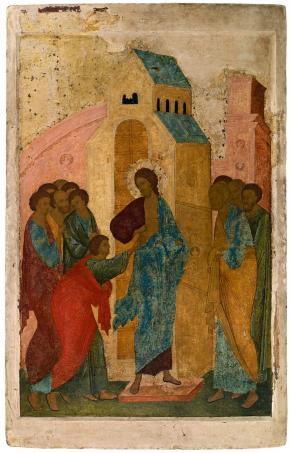
In ten days after the Lord’s first appearance to the ten Apostles, the Lord again appeared with “the doors being shut”, evidently in the same house. This time, Thomas was with them. Perhaps, under the influence of communication with the other disciples, the obdurate disbelief began to leave him, and his soul, slowly but surely started anew to be capable of believing. The Lord appeared specially to fire his faith. As in the first case, the Lord appeared among them quite unexpectedly, and after wishing them peace, the Lord turned to Thomas: “Reach your finger here, and look at My hands…” The Lord is answering to Thomas’s doubts with his own words, with which he preconditioned his belief in the Lord’s resurrection. Obviously, Thomas should have been stunned by the very fact that the Lord knew of his doubts. And the Lord added: “Do not be disbelieving, but believing,” i.e., you are in the position to decide definitively: there are now only two ways before you — the absolute belief and decisive spiritual hard-heartedness. Although the Gospel doesn’t say whether Thomas really touched the Lord’s wounds — it can be assumed that he did. In any case, belief fired within him, and he exclaimed: “My Lord and my God!”, confessing with those words, not only his belief in Christ’s Resurrection, but also in His Divinity.
Nonetheless, this belief was still based on the sensuous verifications. That’s why, edifying Thomas, the other Apostles and all the people, the Lord reveals to the ultimate path towards faith, praising those that have achieved it, in other ways than Thomas did: “Blessed are those who have not seen and yet have believed.” And in the past, the Lord more than once gave preference to that belief, which is based on the word rather than on a miracle. The spread of the Lord’s teaching throughout the world would have been made impossible, if everyone demanded the similar confirmation for his belief like Thomas did, or continuous miracles in general. That’s why the Lord praises those, who attain faith only through trust, through trusting the testimony by word and the teaching of Christ. This is the best way to believe.
Saint John concludes his Gospel with this final passage. His 21st chapter was written later, as they think, concerning the rumor, stating that he was to live until the Second Coming of Christ. For the moment, Saint John concludes his narrative with the testimony that “truly Jesus did many other signs in the presence of His disciples, which are not written in this book.” Even though Saint John had a goal of supplementing the narratives of the first three Evangelists, he recorded not everything , far from that. At the same time, as it can be seen, he feels that what has been written is sufficient “that you may believe that Jesus is the Christ, the Son of God, and that believing you may have life in His name” — and that little what has been recorded, is sufficient to support the belief in Christ’s Divinity and for salvation through this faith.
The Appearance at the Sea of Tiberias.
(John 21:1-14).
Even before His sufferings, the Lord had warned His disciples that upon His resurrection, He would appear to them in Galilee. This was also stated by the Angels to the women-myrrh-bearers, at the Lord’s tomb (Mat. 26:32 and 28:7). Having spent the full 8 days of the Passover in Jerusalem, the Apostles returned to Galilee, where, naturally enough, they again began to practice their profession — catching fish on the Lake of Gennesaret to earn their living.
Here “Jesus showed Himself again to the disciples at the Sea of Tiberias.” According to Saint John, that was the third appearance of the Lord to His disciples, gathered together. That time there were seven of them: Simon, Peter, Thomas, Nathanael, the sons of Zebedee, i.e., James and John, and two more, who were not named. In this outline, because of his humility, Saint John places himself and his brother last, not even mentioning their names, whereas, in the other Gospels, they are usually placed after Andrew and Peter. The Apostles fished throughout the whole night but caught nothing. This undoubtedly should have reminded them of that night, which according to Saint Luke (5:5 and others) preceded their selection for apostolic mission 3 years before. And that time, once again, something similar occurred.
“But when the morning had now come, Jesus stood on the shore; yet the disciples did not know that it was Jesus” — an expression of a sudden appearance. Perhaps the disciples didn’t recognize Him because, as with Luke and Cleopas, He might appear “in another form,” or perhaps simply because the darkness of night or the morning fog had not yet to disappear. The Lord turned to them with: “Children, have you any food?” , as it can be seen further, the word “food” was meaning fish. To their negation, the Lord suggested them to cast their net “on the right side of the boat ” and again, the miracle that they experienced three years before was repeated: because of the huge size of the catch, they couldn’t haul in the net. Undoubtedly, that miracle like the first one, symbolized their future fruitful apostolic activity, in which their personal labors would be under the Lord’s directives.
“That disciple whom Jesus loved,” i.e., John, as he usually calls himself, stunned by that miraculous catch, immediately knew in his heart, Who that mysterious stranger that stood on the beach was, and informed Peter of His supposition: “It is the Lord!” Not daring to appear before the Lord undressed, Peter put on his “outer garment” and plunged into the sea, to emerge before the Lord from the water, on the other side, fully clothed. This event shows us the distinctive characters of these two Apostles: John — elevated, Peter — zealous, John, more able to observe, Peter — more decisive in action. As Blessed Theothylactus says: “John is more acute, Peter more ardent; John was the first to recognize the Lord, while Peter, the first to hurry towards Him.”
In the meantime, the other disciples came in their boat, dragging the net with the fish. Because the catch was so large, they did not dare to haul the fish into the boat so that it would not be capsized under the weight of the caught fish. That’s why they were dragging the net towards the beach, where they could haul it onto the beach more easily, without any risk.
“Then, as soon as they had come to land, they saw a fire of coals there, and fish laid on it, and bread”. Once again, the Lord had miraculously prepared food for them, but so that they could also try the bread of their own labors, He said: “Bring some of the fish which you have just caught.” Simon Peter returned to the boat and evidently, with the help of the other disciples, dragged the net, filled with 153 fish, ashore. The other apparent miracle was the fact that the net didn’t burst from such a large amount of fish. In any case, it can be assumed that this miraculous catch of fish produced a profound impression on John — he even remembered the number of the caught fish for the rest of his life. It must have been to their particular reverence that amazed by what had happened, the Apostles stood away from the Lord at a respectful distance. That’s why He invited them to come closer and begin the meal with the words: “Come and eat breakfast.” The Lord too must have been standing at some distance, because further it is said: “Jesus then came.” As a host, He began to treat them to bread and fish. “None of the disciples dare ask Him, ‘Who are You? ’ — knowing that it was the Lord — the disciples saw something extraordinary in the appeared Lord: evidently, He didn’t appear to be as they were accustomed to see Him, because upon the resurrection, His body became exceptional, glorified, filled with special greatness and Divinity. However, they knew that it was undoubtedly Him.
The Ascension of the Lord.
The Ascension of the Lord.
(Luke 24:50-53 and Mark 16:19-20).
E vangelist Luke has the most detailed narrative about the final appearance of the Resurrected Jesus Christ, which concludes with His ascension into Heaven. Evangelist Mark also speaks about this briefly. This appearance took place in Jerusalem, where subsequently, — after 40 days — the Apostles again arrived from Galilee, during which time the Lord appeared to them several times, teaching them about God’s Kingdom. Saint Luke conveys that in the first chapter of the Acts (1:2-5). The Lord gave instructions to the Apostles to remain in Jerusalem, until they were endued with powers from above, pledging to send upon them the Promise of His Father. This has to be understood as the descending of the Holy Spirit, to assist in their task of the universal sermon. The Lord then led His disciples out of Jerusalem to Bethany, situated on the eastern slopes of the Mount of Olives, where “He lifted up His hands and blessed them,” and evidently pronouncing the traditional words, as it was typical of in the Old Testament, which the Evangelists didn’t record. The symbolic act of lifting the hands during a blessing, is well known in the Old Testament e.g., Leviticus 9:22.
“Now it came to pass, while He blessed them, that He was parted from them and carried up into Heaven.” “What a wonderful kind of act,” — comments the Moscow Metropolitan Philaret on this event: “The Lord is blessing and doesn’t stop but continues while ascending into Heaven. What does this mean? It means that He doesn’t want to cease His blessing, but continues endlessly to bless His Church and all that believe in Him. Let us ponder brethren, that even now His hands are lifted over us, and His gaze, and His blessing. What shame and fear to those who forget this in the earthly hustle and bustle, what joy is to those that love Him.” The disciples worshipped the ascending to His Father Human God, “and returned to Jerusalem with great joy.” This joy emanated from the fact that they then saw with their own eyes the glory of their Lord and Teacher, and were anticipating the fulfillment of His promise to send down the Holy Spirit. It was as though they were born again — no doubt, as a result of the Resurrected Lord’s 40-day stay with them, Who taught them the mysteries of God’s Kingdom. In this prayerful state of the elevated spiritual ascension, they “were continually in the temple, praising and blessing God” for everything that they had to endure, see and hear, and for their forthcoming high mission of preaching the Evangelic teaching.
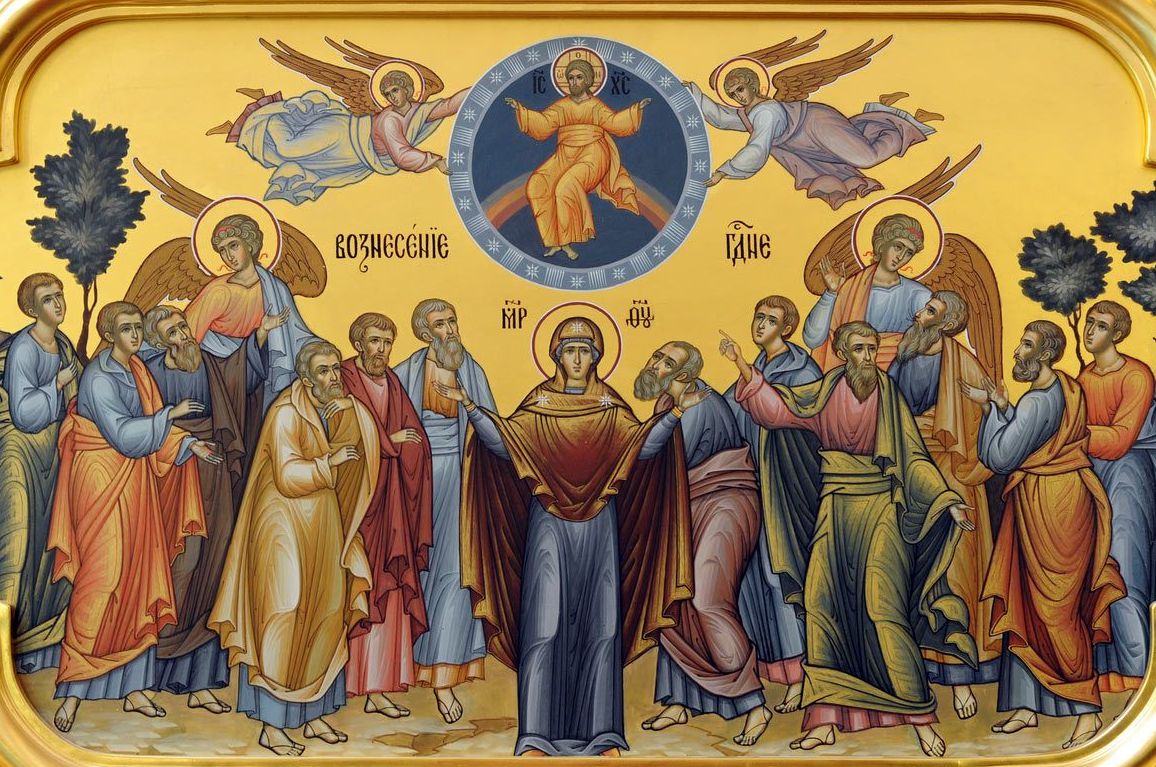
Saint Mark adds that the Lord, having ascended into Heaven, “sat down at the right hand of God.” This is a graphic phrase, based on a number of visions (Acts 7:36), which means that the Lord had accepted the Divine authority over humanity and the whole world with God the Father, because being placed on the right-hand side, in the Biblical language, means the separation of authority between the one, who is seated, with that who is placed on the right side.
Saint Mark concludes his Gospel with the testimony of what had happened after the descent of the Holy Spirit: about how the Apostles “went out” of Jerusalem, certainly “preached everywhere ”, throughout the whole world, with “the Lord working with them,” with God’s help, “and confirming the Word through the accompanying signs,” — i.e., proving the truth of their words by the accompanying their sermons with miracles. This is narrated in detail in the Apostolic Book of Acts.
All the Gospels end with the word: “Amen”, which means: truly so , that is it all happened the way, as it was narrated in the Gospel.
The Burial of the Lord Jesus Christ. (Mat. 27:57-66; Mark 15:42-47; Luke
23:50-56; John 19:38-42).
The Burial of the Lord Jesus Christ.
(Mat. 27:57-66; Mark 15:42-47; Luke 23:50-56; John 19:38-42).
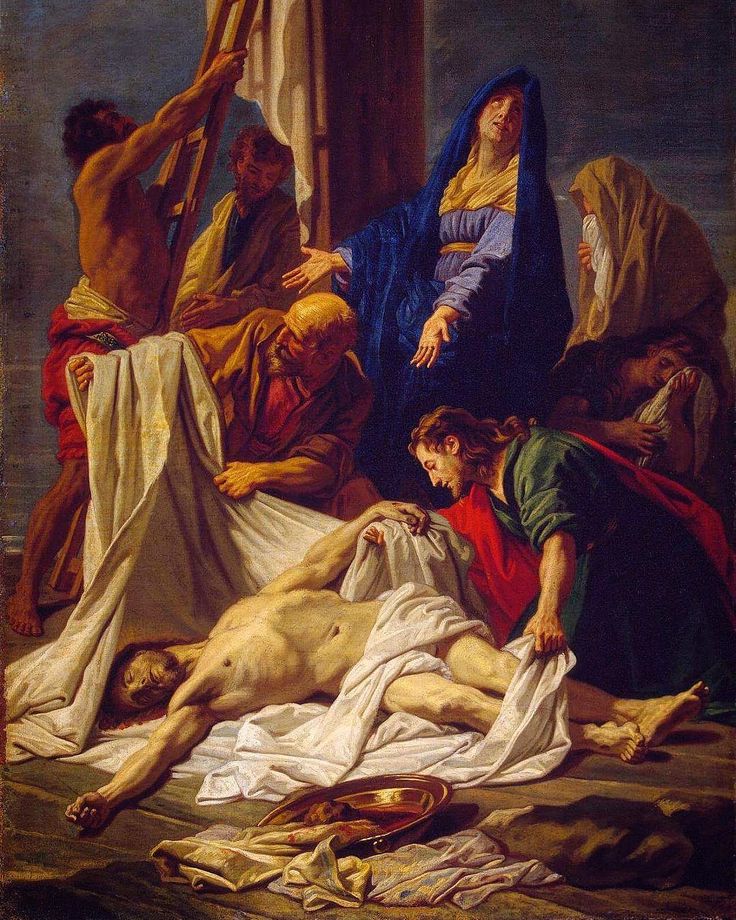
The Lord’s burial is narrated of harmoniously by all the four Evangelists, at the same time each conveys his own details. The burial took place when the evening came, although before the arrival of Saturday, i.e., it has to be supposed that it must have been one or two hours before the sunset, when Saturday began. This is clearly indicated by all the four Evangelists: Mat. 27:57, Mark 15:42, Luke 23:54 and John 19:42. This is especially emphasized by Saints Mark and Luke. At that time, as Saint Mark testifies, Joseph arrived from the Jewish town of Arimathea near Jerusalem. He was a member of the Sanhedrin, a pious, clandestine follower of Christ, as St. Mark states, and according to Saint John, that was not involved in Christ’s condemnation (Luke 23:51). Approaching Pilate, he asked for Christ’s body to be buried. According to the Roman custom, crucified bodies were left on the crosses as birds’ bag. However, it was possible to obtain the permission from the authorities for the body to be buried. Pilate expressed surprise that Jesus had already died, as the crucified sometimes hung there for several days. Having checked with the centurion, who confirmed Christ’s death, he ordered to give the Body to Joseph. According to Saint John, Nicodemus — who previously came to Jesus at night (see John chap. 3) — arrived, bringing with him about 100 pounds of myrrh and aloe mixture. Joseph bought a long and expensive shroud. They took the Body down and according to the custom, anointed it with aromatic oils, wound the shroud around it and placed it in a new burial cave in Joseph’s garden, situated close to Golgotha. As the sun was setting in the west, everything was performed hastily, but diligently. Having rolled a stone across the entrance, they left. All that time, the women that stood at Golgotha before, observed the activity.
Saint John Chrysostom and also Blessed Theothylactus consider that “Mary the mother of James and Joses”, mentioned by the Evangelists, was the Ever Holy Theotokos, “for James and Joses were the sons of Joseph and his first wife. As the Mother of God was called the wife of Joseph, then She was rightfully called the mother, i.e., the stepmother of his sons.” The others were of the opinion that it was Mary, the wife of Cleopas, the cousin of the mother of God. As narrated by Saint Matthew (27:61), they all were sitting close to the opening of the cave. Then according to Saint Luke, they later returned and prepared aromatic herbs and paste, so that at the end of Saturday’s quiet and in accordance with the Jewish custom, they would anoint the body of Christ (Luke 23:56). According to Saint Mark, those women, named “myrrh-bearing” didn’t purchase the aromatic herbs on the day the Lord was interred, but after Saturday had passed, i.e., at Saturday night. There are no contradictions here. Evidently, there was very little time left on Friday evening before the sunset. They prepared it partly on Friday, and what they didn’t finish, they did on Saturday evening.
Evangelist Matthew narrates about another important circumstance, which occurred on the day after the burial — “On the next day, which followed the Day of Preparation,” i.e., Saturday, the high priests and Pharisees gathered at Pilate’s residence (not even thinking about violating the rest on the Sabbath) and asked him to place a guard at the tomb for three days. They declared their motive as: “We remember, while He was still alive, how that deceiver said, ‘After three days I will rise.’ Therefore, command that the tomb be made secure until the third day, lest His disciples come by night and steal Him away, and say to the people, ‘He has risen from the dead.’ So, the last deception will be worse than the first.’” As “the first deception” they call the Lord Jesus Christ’s teaching about Himself as the Son of God, the Messiah, while the “last deception” — the sermon about Him as the resurrected Conqueror of hell and death. They feared that sermon more, and in that they were quite right, as the future history of spreading the Christianity showed. Pilate dryly answered their request: “You have a guard; go your way, make it as secure as you know how.” At the disposal of the members of the Sanhedrin there were the Roman soldiers-guards for the time of the feast, which they used in order that peace would be maintained, because of the huge gathering of people from all the countries in the world in Jerusalem. Pilate offers that they utilize those guards as they wished, so that later they would not be able to blame anyone for anything. “So, they went and made the tomb secure, sealing the stone and setting the guard” — i.e., placing a cord and a seal on the stone, with which the tomb was closed in the presence of the soldiers, who remained at the tomb to guard it.
Thus, without realizing it, the evil enemies of the Lord prepared undisputable proof of His glorious resurrection from the dead.
The Crucifixion. (Mat. 27:33-44; Mark 15:22-32; Luke 23:33-38; John
19:18-24) The Repentance of the Wise Robber. (Luke 23:39-43)
The Crucifixion.
(Mat. 27:33-44; Mark 15:22-32; Luke 23:33-38; John 19:18-24)
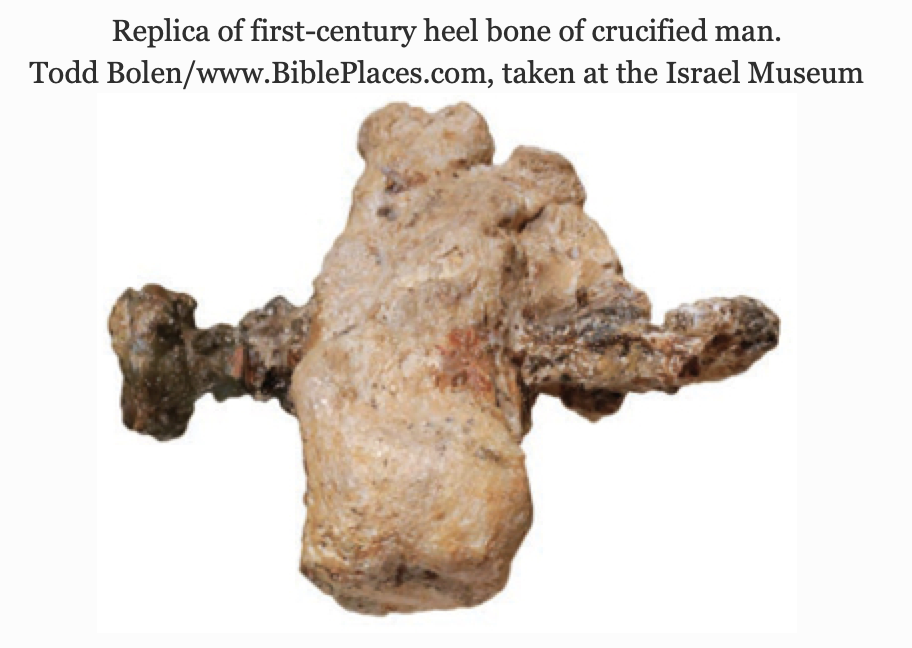
I n accordance with all the 4 Evangelists, the Lord was brought to the place called Golgotha , meaning “the place of execution” and was crucified between two robbers. Saint Luke writes that they too were led with the Lord to their death. Golgotha , or “place of execution,” was a small hill, towards the northwest of Jerusalem and situated outside its walls. It is uncertain as to why this hill carried such a name. It is thought that perhaps because it either resembled a skull, or because it was littered with numerous skulls of the people executed there. According to the ancient tradition, the last remains of the father of mankind — Adam — reposed here. In his Epistle to the Hebrews, Saint Apostle Paul points at the special meaning of the fact that “Jesus… suffered outside the gate” (Heb. 13:12). When they brought Jesus to Golgotha, they gave Him drink. According to Saint Mark 15:23, it was wine mingled with myrrh, while according to Saint Matthew 27:34, it was vinegar mixed with gall. This drink, which stupefied and dulled the senses, was given to the people condemned to crucifixion, so as to somewhat reduce the painful sufferings. The Romans called him “soporific.” According to the Jewish rabbis’ testimony that wine was mixed with crushed resin, which dulled the senses of the condemned and thereby alleviated his sufferings. Myrrh is the type of resin — that is why Saint Mark mentions it. The seasoning of wine with myrrh gave it a tart and bitter taste. That’s why Saint Matthew calls it “gall,” and the wine “vinegar,” which apparently is the wine that had gone sour. “But when He had tasted it, He would not drink” — the Lord did not take in that drink, wishing in full consciousness to drink the whole cup of sufferings up to the end.
“Now it was the third hour, and they crucified Him” — like that Saint Mark says (15:25). This as though contradicts to Saint John’s testimony, that at six o’clock, the Lord was still at Pilate’s trial (John 19:14). However, it must be understood that as with night, that was divided into 4 watches — three hours in each — the same happened with the day that was divided into 4 sections, each one called after the last hour of each watch: the third hour, the sixth hour and the ninth hour. Assuming that that the final sentence was announced by Pilate from the rostrum at the end of the third hour, according to the Jewish system, i.e., in the terms of nowadays time — around 9 am, then Saint John was quite right to say that it was the 6th hour, because the second section of the day, comprised of the 4th, 5th and 6th hours, which the Jews called after the last hour like the 6th hour, began. On the other hand, Saint Mark could state that it was the third hour, because in the sense of the second quarter of the day, the 6th hour was just commencing and only the third hour of the first quarter passed.
“And they crucified Him” — the crosses were of various forms and crucifixions varied. Sometimes, the person was nailed to the cross while it was lying on the ground, and then fixed in the ground vertically; sometimes the cross was first fixed in the ground, and then the condemned man was raised and nailed to it. Sometimes the crucifixion was upside down (as was the case with Apostle Peter, according to his own wish). Sometimes the hands and feet were nailed to the cross, while other times, they were simply tied to it. The arms and legs sometimes were nailed, and sometimes just fixed, tied. The body of the crucified hung helplessly in terrifying convulsions; all the muscles had painful cramps; wounds of the nails, tore under the weight of the body; as the result of nail-wounds and loss of blood, the victim was tormented with unbearable thirst. The sufferings of the crucified were so great and incredibly tormenting, and besides long (sometimes the crucified hung on the cross for three days and longer, without dying), so such a form of execution was applied only to the greatest criminals and was regarded as the most horrifying and shameful of all the types of execution. So that the nailed hands would not tear prematurely, sometimes a foot- rest/crossbar was nailed at the bottom, on which the condemned could stand. On the top, remaining free end of the cross, horizontally there was nailed a board, with the inscription of the fault of the condemned.
Through the indescribable sufferings, the Lord did not remain completely silent: He spoke seven times from the cross. The first time He said a prayer for His crucifiers, the second time He bestowed Heavenly joy to the repentant criminal, the third time — entrusted His Pure Mother to Saint Apostle John, the fourth time was an exclamation: “My God, My God, why have You forsaken Me?” His fifth word was — “I thirst,” the sixth — “It is finished,” the seventh — “Father, into Your hands I commit My spirit.”
The Lord’s first utterance was a prayer for His executioners, which is quoted by Saint Luke (23:24): “Father forgive them, for they know not what they do.” None of those who were crucifying Jesus were aware that He was the Son of God. “For had they known, they would not have crucified the Lord of glory”(1 Cor. 2:8), states Apostle Paul. He even spoke of this to the Hebrews in his second sermon, while healing the lame: “I know that you did it in ignorance, as did also your rulers”(Acts 3:17). Of course, the Roman soldiers were not aware that they were crucifying the Son of God; being so blinded by their hatred and having sentenced the Lord to death, the Jews really did not think that they were crucifying their Messiah. However, this unawareness doesn’t justify their crime, because they had the opportunity and means to know. The Lord’s Prayer testifies of the greatness of His spirit and serves us as an example, so that we too do not take revenge on our enemies, but pray for them to God.
“Now Pilate wrote a title…” Saint John testifies that on Pilate’s order, according to the tradition, a small wooden plaque with the inscription about the Lord’s guilt was made (John 19:19-22). Wishing to hurt the Sanhedrin once again, Pilate ordered the following to be inscribed: “Jesus of Nazareth, the King of the Jews.” Because the members of the Sanhedrin accused the Lord of appropriating that royal honor, Pilate ordered that to be written as His guilt, to shame the Sanhedrin; the Jewish king, Who was crucified on the demand of the representatives of the Jewish people. Contrary to the custom, the plaque was inscribed in three languages: local/national Jewish, Greek and the prevalent Roman — that of the conquerors. The aim of that was to allow every person to read that inscription. Not realizing it, Pilate fulfilled a higher providential purpose: at the moment of His lowest point of humiliation, the Lord Jesus Christ was announced to the entire world as a King. The Lord’s accusers took this to be a cruel mockery, and demanded that Pilate should change the inscription, but the proud Roman sharply refused them, letting them feel his power.
“Then they crucified Him, and divided His garments, casting lots…” The Roman law decreed that the clothes of the condemned person belonged to the soldiers that crucified him. According to the testimony of Philon, there were four soldiers that carried out the crucifixion. Saint John — who was narrating about the division of the Lord’s clothes, attests that the outer garments were torn into 4 parts, “To each soldier a part,” while the undergarment — the tunic — was not stitched but woven, or knitted (from the top down), starting with the opening for the head. If that tunic was to be torn apart, the parts would have no value. That’s why the soldiers cast lots in order that the winner would get the whole tunic. According to the tradition, the Blessed Mother of God wove that tunic. Doing that, the soldiers unconsciously fulfilled the ancient prophecy about the Messiah from Psalm 21:19, which is quoted by Saint John: “They divided My garments among them, and for My clothing they cast lots.”
Further on, the first three Evangelists narrate on the mockery and blasphemy that the Lord was subjected to by the soldiers, as well as by His enemies among the people, passing Him by, and of course, by the high priests, Scribes, elders and Pharisees. Those blasphemies had the one, mutual basis in the comparison of the past with the present. Recalling everything that the Lord said and did, they pointed at His current helplessness, and sarcastically suggested Him to perform a miracle that was evident and clear to all — to come down from the cross , promising hypocritically, of course, that in that case they would believe in Him. According to Saint Matthew’s words, both the robbers, crucified on His right and left side, participated in that blasphemy.
The Repentance of the Wise Robber.
(Luke 23:39-43)
Completing the first two Evangelists’ narration, Saint Luke narrates about the repentance and appeal to the Lord of one of the robbers. One of them, evidently getting more embittered from the tortures and seeking an object upon which he could turn his hatred, began to blaspheme the Lord, imitating the example of His enemies. The other robber, obviously not corrupted to such an extent, having retained some religious feelings, began to admonish his companion. “Do you not even fear God, seeing you are under the same condemnation? And we indeed justly, for we receive the due rewards of our deeds; but this Man has done nothing wrong.” Evidently, he heard the torment and crying of the Jerusalem women, accompanying the Lord to Golgotha; perhaps the sign on the Lord’s cross produced an impression that made him think over their words: “saved others,” or perhaps the most important sermon about Christ for him was the Lord’s prayer for His enemies, the crucifiers.
In one way or another, his conscience spoke up strongly, and he wasn’t afraid to openly defend the Lord among the mockery and blasphemy. Besides, there came such complete and decisive break within his soul that expressing his belief in the crucified Lord as the Messiah, he turned to Him with the repentant words: “Lord, remember me when You come into Your Kingdom!” In other words: “remember me, Lord, when You come to rule.” He doesn’t ask for glory or joy, but for the smallest thing, just like the Canaanite woman wishing to receive a breadcrumb from the Lord’s supper. From then on, those words of the wise robber became an example of genuine, deep repentance, and they have even entered into usage in our church services. This remarkable confession brightly testified to the power of faith in the repentant robber. The One in pain, exhausted and dying, he acknowledges as a King, Who will come into His Kingdom that He will establish. This confession was such, that it was even beyond the powers of those closest to the Lord, who were unable to bear the thought of the suffering Messiah. Here undoubtedly was the influence of God’s grace that had enlightened the robber, so that he might be the example and edification to all generations and nations. That confession earned him the highest reward that one can imagine: “Assuredly, I say to you, today you will be with Me in Paradise” — said the Lord, i.e., today he will enter Heaven, which will again be opened to the people through the redeeming death of Christ.
The Mother of God at the Cross. (John 19:25-27)
The Mother of God at the Cross.
(John 19:25-27)
As an eyewitness and participant of the event, only Evangelist John narrates about how the Lord Jesus Christ entrusted the Ever-Pure Mother of God to his care and concern from the cross. When the malicious enemies started to slowly move away from the cross, the Ever- Holy Theotokos, Her sister Mary Clopas, Mary Magdalene “and the disciple whom He loved”(as Saint John often calls himself in the Gospel), who were standing nearby, approached it. With the departure of Christ from this world, His Ever-Pure mother would have remained alone, and there would be no one to look after Her. That’s why with the words: “Woman, behold Your son” and to His disciple: “Behold your Mother!” the Lord entrusts His Ever-Pure Mother to His beloved disciple. “And from that hour that disciple took Her to his own home” — as the Church tradition testifies, from that point on until Her death, the Ever-pure mother lived at Saint John’s, who cared for Her like a loving son. This is especially significant for the following reason. Not missing the opportunity to blaspheme against the Holy Mother of God, the Protestants and sectarians reject the fact that She was and remained a Virgin. They say that after Jesus She bore other children, born through naturally from Joseph, and that they were those “Lord’s brothers” that are mentioned in the Gospel. However, there arises the question: if the Ever-Holy Theotokos had Her own children, who undoubtedly could and should take care of Her as of their own Mother, then why was it necessary to entrust Her to a stranger — Saint John? It has to be assumed that the Ever-Holy Virgin Mary and Saint John the Theologian remained at the cross till the end, because Saint John points out in his Gospel, that he was an eyewitness of the Lord’s death himself, and of everything that followed (John 19:35).
The Death of Christ. (Mat. 27:45-56; Mark 15:33-41; Luke 23:44-49; John
19:28-37).
The Death of Christ.
(Mat. 27:45-56; Mark 15:33-41; Luke 23:44-49; John 19:28-37).
According to the testimony of the first three Evangelists, the Lord’s death on the cross was preceded by the darkness that covered the land: “Now when the sixth hour had come, there was darkness over the whole land until the ninth hour”, i.e., in our time — from noon till 3 p.m. Saint Luke adds that “the sun was darkened.” This could not have been a normal eclipse, because the Jewish Passover on the 14th of Nisan, always happens at the full moon, whereas an eclipse occurs only with the new moon — not the full moon. This was a miraculous sign, which testified to the astonishing and extraordinary event — the death of God’s beloved Son. The Roman astronomer Flagonus observed that darkness, during which even the stars were visible. The Greek historian Phallus also testifies to this extraordinary eclipse of the sun. Saint Dionysius the Areopagite (when he was still a heathen) mentions this in his letters to Apollophanus. However, it’s notable, how both Saint John Chrysostom and Blessed Theothylactus emphasize, that this “darkness was over all the earth,” and not in some part only — as it happens with an ordinary eclipse. Evidently, that darkness followed after the sneering and mockery at crucified Christ; and it stopped that sneering, causing the mood among the people, as narrated by Saint Luke: “And the whole crowd who came together to that sight, seeing what had been done, beat their breasts”(Luke 23:48). “And at the ninth hour Jesus cried out with a loud voice, saying, ‘Eloi, Eloi, lama sabachthani?” Saint Mark reports these words as “Eloi” instead of “Ili.” Of course, this lamentation was not that of despondency, but only an expression of the profound grief of Human God. In order for the redeeming sacrifice could be accomplished, it was essential that Human God would drink the chalice of human sufferings to its bottom. For this was necessary that crucified Jesus could not feel the joy of His unity with God the Father. God’s entire wrath, which, owing to the Divine truth, had to be vented on the sinful humanity, at that moment, was as if concentrated on Christ alone , and it was as if God had left Him. Amid the heaviest physical and spiritual sufferings that can be imagined, that separation was the most agonizing, causing that painful cry to come off the lips of Jesus.
In Hebrew, “Eloi” was pronounced as “Elyahoo ”. That’s why the Lord’s lamentation served as a new cause for mocking at Him: “ Look, He is calling for Elijah!” The sarcasm of this derision was based on the fact that before the Messiah’s coming, the Jews were expecting the arrival of Elijah. Laughing at the Lord, they were as if saying: even now, crucified and abused, He still imagines, that He is the Messiah and is calling for Elijah to help Him. The first two Evangelists narrate that one of the soldiers immediately ran and took a sponge, filled it with vinegar and having placed it on the end of a reed, gave Him to drink. Evidently, this was sour wine, which was the ordinarily beverage of the Roman soldiers, especially in hot weather. The sponge that was absorbing liquid, was placed on a reed, i.e., the stem of a plant (called as “hyssop” by Saint John), because those hanging on the cross were quite high above the ground, making it simply impossible to come up and give them drink. The crucifixion caused extraordinarily strong and torturing thirst in the crucified sufferers, and Saint John narrates that apparently the Lord just before that exclaimed: “I thirst!”(19:28-30), adding to this: “That the Scripture might be fulfilled.” In depicting the sufferings of the Messiah, the Psalmist in the 69th Psalm, verse 21, truly foretold that: “And in my thirst they gave me vinegar to drink.” According to Saint John, having received the sour wine, the Lord exclaimed: “It is finished!”, i.e., the matter, predetermined at the Divine council, was accomplished — there happened the redemption of the human race and its reconciliation with God through the death of the Messiah(John 19:30).
According to Saint Luke, that was followed by the Lord crying out: “Father, into Your hands I commit My spirit”(Luke 23:46), “and bowing His head, He gave up His spirit ” (John 19:30). All first three Evangelists narrate, that at that moment of Christ’s death, “the veil in the temple was torn in two from top to bottom,” i.e., the curtain that separated the Sanctuary from the Holiest of Holy, tore in half by itself. As it was that time for the offering of the evening sacrifice — nearly 3 o’clock in the afternoon (by our time) — then apparently a priest, who was there, witnessed that miraculous tearing of the curtain.
This symbolized the end of the Old Testament and the beginning of the New Testament, which opened to humans the Kingdom of Heaven that was previously closed for them. “The earth quaked” — as a sign of God’s wrath at those who put to death His Beloved Son, a strong earthquake occurred. From that earthquake “rocks were split”, i.e., the rocky hills split, revealing the caves, used for burials. As a sign of the Lord’s triumph over death — “many bodies of the Saints who had fallen asleep were raised” — on the third day when the Lord resurrected, those bodies that were buried in those caves, resurrected and appeared in Jerusalem to the people that knew them.
All the three Evangelists narrate that those miraculous signs, which accompanied the Lord’s death, had such a profound and jolting effect on the Roman centurion, that (according to the first two Evangelists) he pronounced: “Truly this was the Son of God!”, while Saint Luke writes: “Certainly this was a righteous Man!” The tradition says that this centurion, whose name was Longinus, became a Christian and later a martyr for Christ (his memory is on October 16). According to Saint Luke, all the people that gathered at Golgotha were also bewildered: “beat their breasts and returned” — these sharp changes in moods are quite natural of an agitated crowd. All three Evangelists point out that the witnesses of the Lord’s death and the events accompanying it were “many women who followed Jesus from Galilee, ministering to Him, were there looking on from afar,” and among them, as enumerated by Saints Matthew and Mark, were: Mary Magdalene, Mary, the mother of James and of Joses, and the mother of the Zebedee sons, Salome.
Only Saint John narrates about the events following the death of Jesus, and as usual, complements the first three Evangelists’ narration, and as he confirms in his narrative, he was a witness of all that. Because it was Friday — in Greek “paraskevi” meaning “a preparation,” i.e., “the day before Saturday,” and that Saturday was “a great day”, as it coincided with the first day of the Passover, so as not to leave the crucified bodies on crosses on such a “great day,” the Jews (the enemies of Christ or the members of the Sanhedrin) asked Pilate “that their legs may be broken.” Having killed them this way, “they might be taken away”, i.e., taken down and buried before the night came, when it would be the time to partake of the Passover. In order to quicken their demise, the cruel Roman custom had the legs of the crucified broken, i.e., shattered. Having received Pilate’s permission, the soldiers broke the legs of the two robbers crucified with Christ, who were still alive. “But when they came to Jesus and saw that He was already dead, they did not break His legs. But one of the soldiers pierced His side with his spear, and immediately blood and water came out”(John 19:33-34; 1 John 5:8).
The negatively disposed critics occupied much time, discussing the question whether it was possible for blood and water to flow from Christ’s wound, proving that it was impossible as blood could not flow from a cold dead body. This is because blood remains in a fluid state in a dead body for a very short time, not more than an hour, and the separation of fluid from blood occurs only with the onset of decomposition, and with certain illnesses like typhoid, ague, etc. All these arguments are unfounded. After all, we don’t know the full details of the Lord’s crucifixion and death, and therefore cannot make an opinion about these details. However, it is a well-known fact that the crucified suffer from a feverish condition. The very piercing of the rib undoubtedly occurred very soon after the death — and in any case, certainly not after one hour — as the night was approaching and the Jews were hurrying to complete their malicious deed. Apart from that, there is no need to examine the flow of blood and water, as a natural manifestation. Saint John himself underlines this by considering it miraculous in his Gospel (“And he who has seen has testified, and his testimony is true” — 19:35). The Purest Body of Human God could not be subjected to the ordinary law of decomposition of the human body. Probably, from the moment of death, It began to enter into a transforming state, which ended with Its resurrection in a new, glorified and spiritualized appearance. The holy Fathers explain that in the symbolic sense, this is a sign of the mysterious unification of the faithful with Christ in the mysteries of baptism and the Eucharist: “we are born through water and nourished by blood and flesh” (Blessed Theothylactus and Saint John Chrysostom). Standing at the cross and witnessing all that, Saint John testifies that what he says is true and that he is not being deluded, confirming this — “and his testimony is true”(John 19:35).
The flow of blood from Christ’s perforated side signifies that He became our Redeemer, having cleansed us with water in the Mystery of Baptism, and nourishing us with His Blood in the Mystery of Communion. That’s why in his first Epistle, the same Apostle John writes : “This is He who came by water and blood — Jesus Christ; not only by water, but by water and blood. And it is the Spirit that bears witness, because the Spirit is truth. For there are three that bear witness in Heaven: the Father, the Word, and the Holy Spirit; and these three are one. And there are three that bear witness on earth: the Spirit, the water, and the blood; and these three agree as one”(1 John 5:6-8).__
“For these things were done,” i.e., not only the piercing of the side, but also that the Lord’s legs were not broken, “that the Scripture should be fulfilled.” This was foretold in the Book of Exodus 12:46: the Paschal lamb, that was the image of the Lord Jesus Christ, had to be eaten without any bones being broken and what remained, had to be burned. There is another section of the Bible that prophesies: “they shall look unto me whom they have pierced”(Zech. 12:10). In this segment, Jehovah is depicted as the Messiah that had been pierced by His people, and having looked upon the wounded Messiah, the same people present themselves as the confessing to Him with weeping and sobbing. These words were slowly being fulfilled upon the Jews that condemned Christ to death — and will continue to be fulfilled till the end of the world, before which there will be a universal conversion of the Jews to Christ, as foretold by Saint Apostle Paul in his Epistle to the Romans 11:25-26.
The Burial of the Lord Jesus Christ. (Mat. 27:57-66; Mark 15:42-47; Luke
23:50-56; John 19:38-42).
The Burial of the Lord Jesus Christ.
The Resurrection. The Arrival of the Women Myrrh-Bearers at the Tomb. Jesus
Appears to Mary Magdalene. The Bribing of the Guards.
The Resurrection
Narrating about this greatest event, all the four Evangelists say nothing about the mysterious and the incomprehensible for us side of it. They don’t describe how it happened, and how the Resurrected Lord came out of the tomb without breaking the seal. They speak only of the earth-quake, which was the result of the Lord’s Angel rolling the stone away from the entrance of the tomb (after the Lord had risen — which is emphasized in our church songs — and not as is commonly thought, that the Angel rolled the stone away so that the Lord might come out of the tomb), and of the Angel’s speech addressed to the women myrrh-bearers that came to the tomb, and a further range of appearances of the Resurrected Lord to the them and to His disciples.
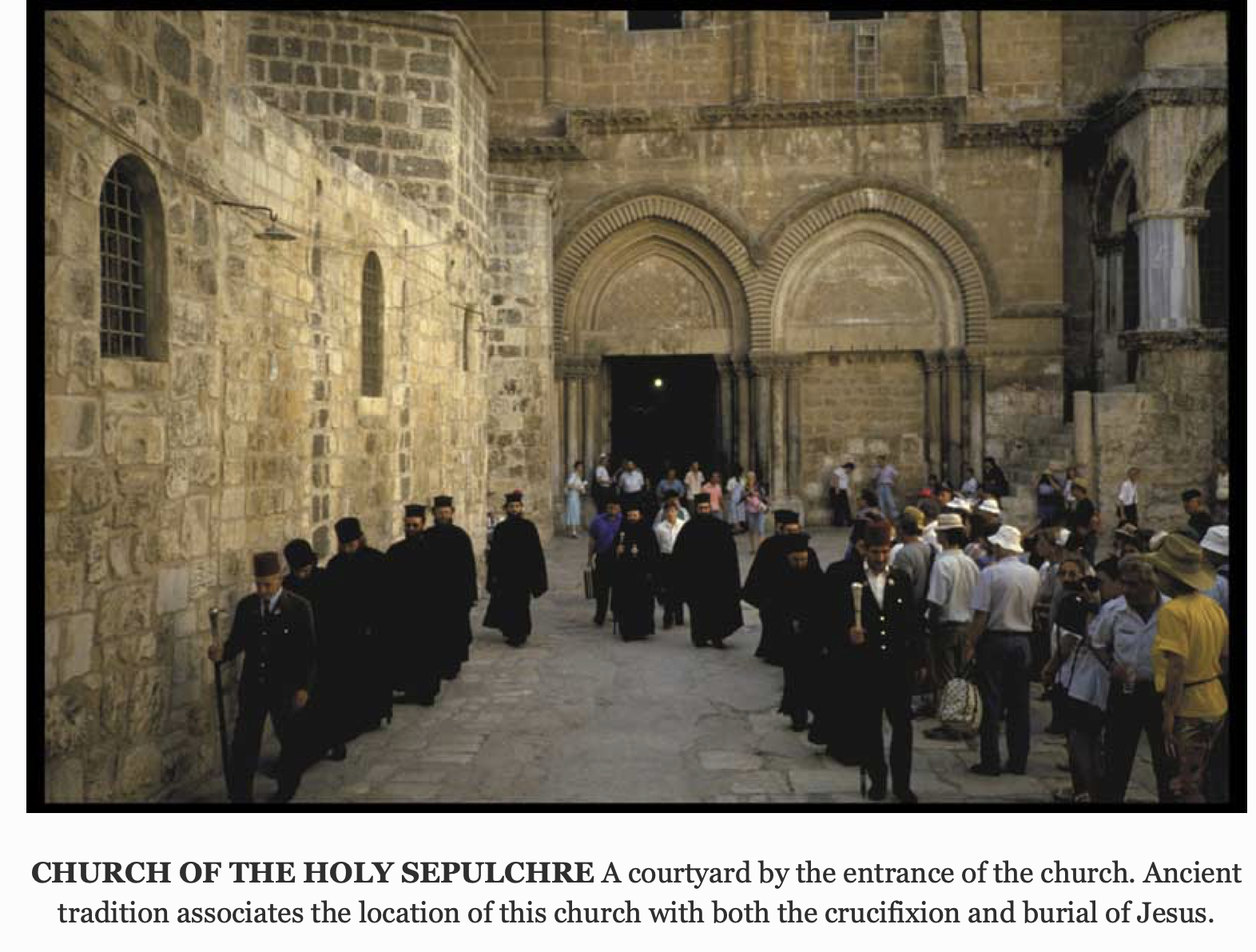
The Arrival of the Women Myrrh-Bearers at the Tomb.
(Mat. 28:1-8; Mark 16:1-8; Luke 24:1-12 and John 20:1-10).
To the women that were present at Golgotha and then at the Lord’s burial, it seemed that His priceless Body was too hastily prepared for the burial, and they were grief-stricken because they were not involved in the Jewish custom of anointing His body. That’s why in accordance with the law, after spending all Saturday at rest, on the first day of the week — at sunrise — they hurried to the tomb in order to fulfill their wish and final duty of love to their Beloved Teacher. At the head of those deeply committed to Christ women, who entered into the history with the name of “myrrh-bearers ” (as testified by all the four Evangelists) was Mary Magdalene ; she was followed by the “other Mary” or Mary, the mother of James, Salome and the others that followed the Lord from Galilee (Luke 23:55). It was a whole multitude of women, some of whom walked fast, nearly running while the others walked slowly, without any great haste. Therefore, it is not surprising that, the time of their arrival at the tomb as determined by the Evangelists varies, what at the first glance creates a feeling of contradiction between them, which in reality does not exist.
Before all: who is this “other Mary,” twice mentioned as such by Saint Matthew in his narration about the Lord’s burial (Mat. 27:61), and then — in that about the resurrection (Mat. 28:1). According to the ancient Church tradition, enunciated in the Sinarksis on the day of the Passover, it was none other than the Mother of God. Why isn’t it mentioned directly? As the Sinarksis explains, “so that it would not appear questionable” (that the testimony of such an enormous event belonged to His Mother), the Evangelists say: the Lord appeared first to Mary Magdalene (Mark 16:9), who saw an Angel sitting on the stone.
Salome was the mother of the “sons of Zebedee” — Apostles James and John. Joanna, mentioned by Saint Luke (24:10), was the wife of Chuza, King Herod’s steward. The other women-myrrh-bearers are not mentioned by name, but Saint Luke clearly states that there were “other women with them”(Luke 24:10). Among these “others,” the Church tradition also points at: Mary and Martha, the sisters of Lazarus, who was resurrected by the Lord, Mary, the wife of Clopas and Susanna, and many others, “As Divine Luke narrates: those serving to Christ and the disciples with their possessions” (Synaksarion on the week of the Women Myrrh-bearers).
The women myrrh-bearers were awaiting the end of the Sabbath rest. Moreover, as Saint Luke states, some of them had purchased some aromatic spices on Friday evening (23:56), while the others — “when the Sabbath was passed,” i.e., on Saturday evening (Mark 16:1).
The Evangelists use different expressions, concerning the time of the myrrh- bearers’ arrival at the tomb.
Saint Matthew — “Now after the Sabbath, as the first day of the week began to dawn…”
Saint Mark — “Very early in the morning, on the first day of the week… when the sun had risen”
Saint Luke — “Now on the first day of the week, very early in the morning…”
Saint John — “Now on the first day of the week Mary Magdalene went to the tomb early, while it was still dark…”
Thus, all these indications of time coincide, only that they speak of different moments of the coming morning, from which can be seen that the women-myrrh-bearers didn’t all arrive at one and the same time. Saint John’s description is the one that differs most from the other Evangelists’ ones, which is understandable, for as usual, he omits what had been narrated by the first three Evangelists, but completes them with what relates to Mary Magdalene and the two disciples. In comparing the narratives of the four Evangelists, there emerges a full picture of everything that happened. The earthquake, described by Saint Matthew alone, that occurred when the Angel rolled the stone, took place before the arrival of the women-myrrh- bearers. The purpose to this was to make the guards run away and reveal the tomb empty. The Lord ressurected prior to that, just as it is sung in our church cants: “ While the t o mb w as sealed , Thou, O life, didst shine forth from the grave, O Christ God….” (Troparion on the week of Thomas). That’s why the depiction of Christ’s Resurrection, with the stone removed, Christ emerging from the tomb, and the guards falling on the ground with fear — is wrong. The Angel descended from Heaven and rolled the stone, only after Christ had risen. That brought the guards in the state of trembling and stupor, and made them flee to Jerusalem.
By comparing the four Evangelists’ narratives, a clear picture of the sequence of events appears. As it can be seen from Saint John’s narrative, the first to arrive at the tomb was Mary Magdalene, “while it was still dark”(John 20:1). She wasn’t alone, but with a multitude of myrrh-bearers, as narrated by the first three Evangelists. Because of her special love for the Lord and her lively temperament, she overtook the other women and arrived while it was still dark, whereas the other women approached the tomb when the day was breaking. That she was not alone can be seen from John’s narrative, because when she returned to Apostles Peter and John, she spoke in the plural and not in the singular: “We do not know where they have laid Him”(John 20:2). Thus, it is clearly evident from the Greek text, and that’s the way it was translated into the Russian language. Seeing the stone removed from the entrance (she did not see the Angel that later appeared to the women), she thought that the Lord’s Body had been carried away, and immediately ran to inform Apostles Peter and John about this. On the way back, she of course met the other women, occupied with the idea about who would move the stone for them, Mark 16:3), and told them of her fears. While she was going to the Apostles, the rest of the women-myrrh-bearers approached the tomb, saw the Angel, heard the good news of Christ’s resurrection, and hurried back to the Apostles to share the great joy with them. All of this is narrated in detail by the first three Evangelists (Mat. 28:5-8; Mark 16:4-8 and Luke 24:3-8).
Meanwhile, as a result of the news brought to them by Mary Magdalene, (and perhaps by the other myrrh-bearers, whom they didn’t believe — “And their words seemed to them like idle tales, and they did not believe them” Luke 24:11) the two Apostles — Peter and John — rapidly went, or even ran to the tomb. Being younger than Peter, John ran faster and therefore approached the tomb sooner, when the women had left, but did not go inside. Perhaps, it was his timidity of being alone in the garden that held him back. However, hunched over and peering into the opened tomb, he saw some swaddling-cloth lying on the ground.
Immediately after Simon Peter arrives, who, being bolder and more courageous, decides to enter the tomb and sees just the swaddling-cloth lying on the ground and a face cloth that was wrapped around the Lord’s head, “not lying with the linen cloths, but folded together in a place by itself”(John 20:3-7). “Then the other disciple, who came to the tomb first,” i.e., John , “and he saw and believed,” i.e., believed in the truth of Christ’s resurrection, because if they robbed the Body, there would have been no need to unwind and divest the swaddling-cloth from it and then leave them in such a neat order. “For as yet they did not know the Scripture, that He must rise again from the dead” — until the Lord “opened their understanding, that they might comprehend the Scriptures”(Luke 24:25), there was much that they didn’t understand clearly: they didn’t comprehend the Lord’s words about His forthcoming sufferings and resurrection (as it can be seen, for example, in Luke 18:34 and Mark 9:10), and therefore were in need of material evidence. Such an evidence of the verity of Christ’s resurrection to John, was that the swaddling-cloth and the face cloth were left in the tomb, carefully folded. That fact convinced John of what had happened. About Peter, Saint Luke stays that “he departed, marveling to himself at what had happened”(Luke 24:12). After his triple renouncement of Christ, the state of his spirit was very heavy and was not inclined towards the living belief. And thus, apparently after his return from the tomb, the merciful Lord appeared in front of Peter in order to console him and pacify his heart. This is mentioned briefly by Saint Luke 24:34 and Saint Apostle Paul in 1 Cor. 15:5. As it can be seen from these segments, the Lord appeared to Peter alone, before the other Apostles.
Jesus Appears to Mary Magdalene.
(John 20:11-18; Mark 16:9-11; Mat. 28:9-10).
After Apostles Peter and John had left the tomb, Mary Magdalene, who perhaps arrived there with them or just after them, was left on her own. Her soul was in upheaval and she was crying, thinking that the Lord’s Body had been stolen. Crying, she leaned towards the opening of the tomb, and saw inside two Angels, sitting on the bier upon which the bodies of the dead were placed, inside the burial cave. Her grief was so great that it deadened all the other feelings. That’s why Magdalene is not staggered by the sight of those Angels, and to their consoling question: “Woman, why are you weeping?” she simply — as though speaking to the terrestrial creatures — expresses her grief in the same words as she had expressed it before to Apostles Peter and John: “Because they have taken away my Lord, and I do not know where they have laid Him.” Having said this, maybe by chance, in the state of perplexity, and then again perhaps, driven by an instinctive inner feeling, she turned around and saw Jesus, but did not recognize Him. Apparently, she didn’t recognize Him, because He appeared “in another form”, like to the Emmaus travelers, in the “humble and ordinary” appearance (Saint John Chrysostom). That’s why she mistook Him for a gardener. Maybe she didn’t recognize Him, because her eyes were full of tears, as she was overwelmed by grief and didn’t expect to see the Lord alive. She didn’t even recognize His voice when He asked her: “Woman, why are you weeping? Who are you seeking?” Taking Him for a gardener (which is quite natural, because who else would be in the garden so early other than a gardener), she says to Him: “Sir, if you have carried Him away, tell me where you have laid Him, and I will take Him away,” not even considering whether she, being a weak woman, would be able to lift Him. The Lord then revealed Himself by calling her name with a special and much- familiar to her intonation: “Mary!” — this shows that after her words to the seeming gardener, she turned her gaze towards the tomb, — “and said to Him, ‘Rabboni!” which is to say, Master” and obviously, full of indescribable joy, fell at His feet wishing to cling to them, perhaps to convince herself that she was seeing real alive Jesus and not a spirit. The Lord forbad her to do that, saying : “Do not cling to Me, for I have not yet ascended to My Father; but go to My brethren and say to them, ‘I am ascending to My Father and your Father, and to My God and your God.’” It is as though the Lord told her: “Believe My word and not your sense of touch”. Another meaning of this forbiddance is that the Lord wanted to tell Mary: “Leave Me, as you cannot remain with Me permanently. Don’t detain Me, but go and proclaim My resurrection. It is needed that I should not remain with you but ascend to the Heavenly Father.” A good explanation of this forbiddance in touching the Lord can be found in the matins hymn of the eighth verse: “Because the woman was thinking in earthly terms, she was sent away and forbidden to touch His garment.”
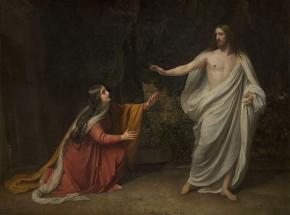
“Mary Magdalene came and told the disciples that she had seen the Lord, and that He had spoken these things to her” — comparing these words with the narration of Saint Matthew, we have to assume that along the way, Mary Magdalene encountered the “other Mary,” and the Lord again appeared to both of them (the second appearance ), “saying: rejoice!” They stretched themselves at His feet. He repeated anew His behest that they should go to His disciples (having called them “His Brethren”), and announce His resurrection to them, repeating that, which the Angel stated prior to that: “Tell My brethren to go to Galilee.” The resurrected Lord, already the glorified Messiah ready to go to His Father, very touchingly calls His disciples “brethren”. He wasn’t ashamed to call them as such — as Apostle Paul later emphasized that in his Epistle to the Hebrews 2:11-12).
Saint Mark states that the women myrrh-bearers were so overcome with excitement and horror (of course, reverential), that they “said nothing to anyone.” This has to be understood in the sense that, when they were running along the way, they did not mention anything to anyone about what they saw and heard. Further on, Evangelist Mark himself (as well as other Evangelists, Luke 24:9) narrates that having come home, they told everything to the Apostles (Mark 16:8 and 6:10
According to the Evangelic stories, it would seem that the Lord’s first appearance was to Mary Magdalene (Mark 16:9-10). However, from the ancient times, our Church preserves the tradition, that before Mary Magdalene, the resurrected Lord first appeared to His Ever- Pure Mother — which is quite natural and understandable. Up to this day within the temple of Resurrection at Jerusalem, they show the place of the Lord’s appearance to His Ever-Pure Mother, not far from the “cuvuclia”. The tradition, sanctified with centuries, cannot be but based on the real fact. And if it was not mentioned in the Gospel, it is because in general, there is much that is not recorded, as Saint John testifies (21:25; 20:30-31). It has to be assumed that because of the Ever-Pure Mother of God’s humility, it wasn’t to Her liking that the concealed secrets of Her life would be made known — that’s why there is extremely little said about Her in the Gospel, except for the very essential facts, directly connected with the life of the Lord Jesus Christ Himself. Evidently, the Evangelists didn’t want to mention the Ever-Blessed Theotokos at all, as the witness of the genuineness of Christ’s Resurrection, because the testimony of the mother would have been met with skepticism by those that doubted (see the Synaksarion of the Paschal week). The Evangelists say, that the women myrrh- bearers’ story about what they saw and heard at the tomb about the appearance of the resurrected Lord Himself, seemed senseless to them and were not believed (Luke 24:11). If even the Apostles didn’t believe them, would strangers believe the witness of the Mother?
The Bribing of the Guards.
(Mat. 28:11-15).
“Some of the guard,”(that ran from the Lord’s tomb) who apparently were in charge and responsible for leaving their position, informed the high priests of everything that had occurred, — exactly to them and not to Pilate, because they were placed after their command and not the procurator’s one. The high priests gathered the Sanhedrin and decided to bribe the guards to slander the truth of the Lord’s Resurrection. “They bought His blood,” — states Saint John Chrysostom — “when He was alive, and with His crucifixion and resurrection, they again are using money to undermine the truth of the resurrection.” “Tell them, ‘His disciples came at night and stole Him away while we slept’” — that’s what they taught the soldiers to say. “Their words are completely unbelievable and have no plausibility,” reasons Saint John Chrysostom: “In what manner did His disciples steal the body, these poor and simple people, who didn’t even dare to show themselves? And wasn’t there a seal placed at the tomb? Wasn’t that area surrounded by many guards, soldiers and ordinary Jews? And for what purpose would they steal Him? Is it so that they could invent a teaching about the resurrection? But how would it occur to the people that wished to live in anonymity, to invent something like that? And how did they remove the sealed stone? How did they remain undetected by so many guards? And what benefit would it bring to them, if Christ didn’t resurrect?” All the interpreters of the Gospel note in a just way, that all the endeavors of the Sanhedrin — to retain the Lord’s Pure Body in the tomb as secure as possible, were invented and executed as though purposely to confirm the authenticity of the event, with all historical clarity, which the members of the Sanhedrin wanted to obscure and present like false. After all, the stealing of bodies was completely unheard of among the Jews, fearing desecrating themselves through touching a corpse (Num. 19:11-12).
How could it happen that the guards fell into a deep sleep at the precise time, when the actual theft was expected on the third day? Their sleep must have been extraordinarily deep, if they couldn’t even hear the stone of the tomb being rolled away. Even if they decided to fall asleep — which is totally untypical of the Roman soldiers — they would have done so in front of the entrance, so that it would have been impossible to roll the stone without crushing them. The most unbelievable thing about this is that the frightened and scattered disciples would decide to commit such a senseless theft, with which they would have gained no benefit, but an apparent enormous danger. Remarkable is also the fact that the soldiers would spread such reports about themselves, without arousing amazement among their listeners about why they weren’t punished for such breach of duty. Notwithstanding the obviousness of the hateful Jews’ fabrication, their stubborn unwillingness to believe in the authenticity of Christ’s resurrection only confirms this great Christian truth.
Lord’s Appearance to His Disciples on the Road to Emmaus. The Appearance to
the Ten Disciples. Thomas’s Disbelief. The Appearance at the Sea of Tiberias.
Lord’s Appearance to His Disciples on the Road to Emmaus.
(Luke 24:13-35 and Mark 16:12)
The Appearance to the Ten Disciples.
(Mark 16:14; Luke 24:36-45 and John 20:19-23).
Thomas’s Disbelief.
(John 20:24-31)
The Appearance at the Sea of Tiberias.
(John 21:1-14).
The Restoration of Apostle Peter. (John 21:15-25). The Appearance in
Galilee. (Mat. 28:16-20; Mark 16:15-18 and Luke 24:46-49).
The Restoration of Apostle Peter.
(John 21:15-25).
“So, when they had eaten breakfast, Jesus said to Simon Peter, ‘Simon, son of Jonah, do you love Me more than these?’” — before the Lord’s sufferings, Simon — more than anyone else — had promised his loyalty to Him: “Even if all are made to stumble because of You, I will never be made to stumble”(Mat. 26:33); “I will lay down my life for Your sake”(John 13:37); “If I have to die with you, I will not deny You!”(Mark 14:31); “Lord, I am ready to go with You, both to prison and to death”(Luke 22:33). In spite of that ardent reassuring, Peter renounced the Lord three times, and of course through this lost his apostolic calling and apostolic rights — he ceased to be an Apostle. This is noted by Evangelist Mark — undoubtedly from Apostle Peter’s words — who narrates that the Angel which appeared to the women myrrh-bearers, said: “But go, tell His disciples — and Peter…” singling out Peter as the one, who through his renouncement, had fallen away from the Apostolic image, placing him as the last, after the other Apostles.
For his sincere and profound repentance, the Lord mercifully restores Peter to his apostolic worthiness. Peter renounced for three times, so three times the Lord forces him to answer the question: “Do you love Me?” — with “ Yes, Lord; You know that I love You!” And after every affirmation, the Lord entrusts him — as an Apostle — to feed His lambs, His sheep. Peter was aggrieved because he was asked for the third time: “Do you love Me?” — “You know that I love You”(that’s why on the 29th of June, in the church service, on the day of commemoration of the holy supreme Apostles Peter and Paul, the verse for “Glory” is sung).
The Roman-Catholics, quite fruitlessly and without a base, wish to see in this a special endowment of rights and seniority to the Apostle Peter by the Lord — in comparison with the other Apostles. “The lambs,” which the Lord entrusts to Peter to feed, are the youngest, newly born, so to speak, members of Christ’s Church, which are in need of special attention of the shepherd. “The lambs” are the ordinary, spiritually mature members of the Church, which do not need special and diligent care. It is very characteristic that the Lord asks Peter for the first time: “Simon, son of Jonah, do you love Me more than these?”, as if hinting at Peter’s promise to the Lord of his greater fidelity and loyalty, than the other disciples. Also very characteristic is the fact that the Lord calls Peter by his former name — “Simon ” — and not Peter, because having renounced, he revealed his instability, the lack of spiritual firmness, and through that ceased to be “Peter ”, i.e., “the rock.” Humbly acknowledging the depth of his fall, Peter doesn’t now compare his love for the Lord with that of the other disciples. He even doesn’t dare to reassure the Lord of his love for Him, but only alludes to His omniscience: “You know that I love You.” Moreover, through his humility, instead of the word “love” — “agapan ” used by the Lord in His question and meaning full and complete love, Peter uses another word — “filin ” meaning the personal sincere attachment and loyalty. Asking Peter for the third time, the Lord uses that same word “filin.” That saddened Peter that his personal attachment to Him was as if being subjected to doubt by the Lord. That’s why, on the third time, he confesses his love with the exceptional force, referring to His omniscience. Just as he had renounced the Lord for the third time with the exceptional force, oaths and swearing, the Lord is now compelling Peter — for the third time — to confess his love for Him, with the same exceptional force.
The Lord combines the restoration of Peter in his Apostolic calling with the prediction, that his currently attested love for the Him will lead to his martyr-like death at the end of his Apostolic mission. “When you were younger, you girded yourself and walked where you wished; but when you are old, you will stretch out your hands, and another will gird you and carry you where you do not wish ” — here, under the guise of a helpless elder, being dealt with against his will, the Lord symbolically predicts the martyr’s violent death. Indeed, Peter was in fact crucified in Rome during the reign of Nero, in the year 68. “Follow Me” — were the last definitive words of restoring fallen Peter’s to his apostolic rank.
After those words, the Lord left and evidently the disciples followed Him. Seeing the Lord’s beloved disciple John, Peter was overtaken with the desire to know his future — if a martyr’s death for Christ awaited him. But the Lord did not wish to reveal the type of death of His beloved disciple. He answered Peter, that it was not his business to know that: “What is that to you? You follow Me.” Here we find another refutation of the Roman-catholic false teaching, about that the Lord entrusted the other disciples to Peter and that he had been appointed as their “prince.” If the Lord in fact entrusted Peter, as His vicar, the other disciples, then Peter would of course be fully entitled to ask about John, and the Lord wouldn’t have responded with: “What is that to you?”
The words said by the Lord about John, gave a reason to think that he wouldn’t die, but would live till the Second Coming of Christ: “If I will that he remain till I come, what is that to you?” However, the Evangelist himself refutes this, underlining the fact that the Lord’s speech was conditional: “If I will that he remain…”
The narrative about this and in fact his Gospel, Saint John concludes with a testimony: “This is the disciple who testifies of these things, and wrote these things; and we know that his testimony is true. ” This confirms this Gospel to belong to Saint John the Theologian, and the truth of everything that he narrated in the Gospel. In conclusion, Saint John again repeats that much “that Jesus did” was not recorded in the Gospel, because if everything was to be recorded in detail, “I suppose that even the world itself could not contain the books that would be written.” Although this may seem an exaggeration, a hyperbolical expression, the discourse here is namely about the immensity of the Lord’s works , the meaning of which the limited world is unable to absorb. Some assume that the last two verses — 24 and 25 — were subsequently added to John’s Gospel by his readers of the ancient times, who wanted to confirm the truth of this Gospel for eternity.
The Appearance in Galilee.
(Mat. 28:16-20; Mark 16:15-18 and Luke 24:46-49).

“Then the eleven disciples went away into Galilee, to the mountain which Jesus had appointed for them. When they saw Him, they worshipped Him; but some doubted” — as the Angels told the women myrrh-bearers that the Lord was preceding them in Galilee, then it must be assumed that the Apostles were not the only ones to rush towards Galilee in order to see Him, as He had promised to be there. Many think that it was that specific appearance of the Lord on the mountain, about which the Apostle Paul writes about in 1 Corinthians 15:6, that the Lord “was seen by over five hundred brethren at once.” The name of the mountain is not mentioned, but it was most likely the Transfiguration Mount Tabor, where the disciples had a chance to witness the transfigured glorious state of the Lord, in which He then appeared to them. Some of those gathered “doubted,” which definitely shows that it couldn’t be a massive hallucination, as the unbelievers attempt to convince.
“And Jesus came,” i.e., approached them so as to dispel all doubts that it was really Him, “and spoke to them, saying, “All authority has been given to Me in Heaven and on earth.” Since the beginning of the world, as the Begotten Son of God, He had the full authority in heaven and on earth: now, as the Conqueror of hell and death, He acquired the similar authority over everything and as the Redeemer of the world — over mankind. Having appeared on the earth as a human, the Son of God curbed Himself in the use of His Divine authority, because He didn’t want to accomplish the redemption of mankind matter purely through His omnipotence. Through His resurrection, He assumed the fullness of His Divine authority already as Human God. And then it depended on Him to crown the whole matter of mankind’s salvation by sending the Holy Spirit, establishing His Church and sending the Apostles to preach throughout the whole world.
“Go therefore and make disciples of all the nations,” writes Saint Matthew, or as Saint Mark relays: “Go into all the world and preach the Gospel to every creature,” or as Saint Luke conveys the authority given by the Lord to His Apostles: “Thus it is written, and thus it was necessary for the Christ to suffer and to rise from the dead the third day, and the repentance and remission of sins should be preached in His name to all nations, beginning at Jerusalem. And you are witnesses of these things.” Now, the Lord doesn’t restrict their sermons to be preached just the Judeans as before (Mat. 10:5-6; 15:24), but sends them out to teach all the nations , because the whole world had been redeemed through Christ’s sufferings, and should be summoned to Christ’s Kingdom. “Baptising them in the name of the Father and of the Son and of the Holy Spirit” — Human God is giving His disciples the right, and imposes the responsibility, of baptising all the peoples in the name of the Holy Trinity. This means that those baptising are not acting on their own volition, but by the authority granted to them by the Trinity of God. And those receiving baptism accept through this the responsibility of believing in the Holy Trinity, and dedicating their lives to the Divine Trinity, Which called, atoned and revived them. Baptism is the symbolic sign of the cleansing of a person’s sins through the invisible action of the Holy Spirit, and the sign of the person’s entry into Christ’s Church for a new, revived life in God. Baptism should be preceded with instructions, and those receiving It, should follow all that was decreed by Christ the Savior: “Teaching them to observeall things that I have commanded you.”
Saint Mark adds to it the miraculous signs that will appear as a consequence to those, that have believed: “In My name they will cast out demons; they will speak with new tongues, they will take up serpents; and if they drink anything deadly, it will by no means hurt them; they will lay hands on the sick, and they will recover.” From the man’s sin, the whole world has come to the state of disorder, and the evil has become its master: those who have believed in Christ the Redeemer will receive the authority to conquer all types of the evil, as well as the fallen spirits, who incite people towards evil works. These miracles, which the subsequent history of the Church testifies of, were truly performed by the Apostles and many true Christians. Thus, through His disciples and their successors, the Lord reinstates the harmony that the world lost.
“I am with you always, even to the end of the age,” — charging the Apostles with the heavy task of spreading the good news of the Gospel throughout the whole world, the Lord encourages them, promising His mysterious, invisible presence with them “always, even to the end of ages.” However, because the Apostles did not live to “the end of ages,” then this promise has to be applied to all of their successors. This doesn’t mean that to the end of ages, the Lord will not be with His disciples. “No, it is then that He will be present” (Blessed Theothylactus). It simply means that till the end of ages, He will be found unseen among the faithful, as the head of the Church, established by Him, guiding it towards mankind’s salvation.
The Ascension of the Lord.
The Ascension of the Lord.
(Luke 24:50-53 and Mark 16:19-20).
The Crucifixion.
The Repentance of the Wise Robber.
(Luke 23:39-43)
The Crucifixion. (Mat. 27:33-44; Mark 15:22-32; Luke 23:33-38; John
19:18-24) The Repentance of the Wise Robber. (Luke 23:39-43)
The Crucifixion.
The Repentance of the Wise Robber.
(Luke 23:39-43)
The Death of Christ. (Mat. 27:45-56; Mark 15:33-41; Luke 23:44-49; John
19:28-37).
The Death of Christ.
The Mother of God at the Cross. (John 19:25-27)
The Mother of God at the Cross.
(John 19:25-27)
The Restoration of Apostle Peter. (John 21:15-25). The Appearance in
Galilee. (Mat. 28:16-20; Mark 16:15-18 and Luke 24:46-49).
The Restoration of Apostle Peter.
(John 21:15-25).
The Appearance in Galilee.
(Mat. 28:16-20; Mark 16:15-18 and Luke 24:46-49).
The Resurrection. The Arrival of the Women Myrrh-Bearers at the Tomb. Jesus
Appears to Mary Magdalene. The Bribing of the Guards.
The Resurrection
The Arrival of the Women Myrrh-Bearers at the Tomb.
(Mat. 28:1-8; Mark 16:1-8; Luke 24:1-12 and John 20:1-10).
Jesus Appears to Mary Magdalene.
(John 20:11-18; Mark 16:9-11; Mat. 28:9-10).
The Bribing of the Guards.
(Mat. 28:11-15).
Related Concepts
- 1-cor-28
- 1-john-5
- 1-john-56-8
- access-to-god
- acts-317
- acts-7
- agape-vs-philia
- angel-at-the-tomb
- apostolic-college
- apostolic-ministry
- apostolic-mission
- apostolic-witness
- appearance-in-another-form
- ascension
- beatitude
- betrothal-of-joseph
- binding-and-loosing
- blessed-are-those-who-have-not-seen
- bribing-of-the-guards
- christ-the-king
- church-membership
- confession-of-christ
- cry-of-dereliction
- cuvuclia-in-jerusalem
- dereliction-of-christ
- divine-authority
- emmaus
- eve-from-adams-side
- exaltation
- exodus-12
- firstborn
- fulfillment-of-prophecy
- great-commission
- greek-terminology
- high-priesthood-of-christ
- holy-trinity
- irony-of-the-passion
- john-the-theologian
- joseph-of-arimathea
- joseph-the-betrothed
- josephs-children
- josephs-children-by-a-first-wife
- love-of-god
- mark-1617-18
- mary-magdalene
- mary-magdalene-as-gardener
- mary-mother-of-james-and-joses
- miraculous-signs
- mission
- mission-and-preaching
- mother-of-god-at-the-cross
- old-and-new-testament
- opening-of-the-understanding
- other-mary
- papal-claims
- paradise-reopened
- pastoral-care
- pedagogy-of-faith
- pentecost
- peters-primacy
- peters-restoration
- power-to-bind-and-loose
- primacy-controversy
- propitiation
- protestant-exegesis
- restoration-of-creation
- restoration-of-peter
- resurrection
- resurrection-appearances
- resurrection-witnesses
- roman-catholic-polemic
- sacrament-of-baptism
- sacrifice-outside-the-camp
- scripture-interpretation
- session
- session-at-the-right-hand
- spiritualized-body
- synaxarion
- synaxarion-of-paschal-week
- temple-veil
- the-appearance-to-the-mother-of-god
- the-church-born-from-christs-side
- the-cross-as-sacrifice
- the-crucifixion
- the-other-mary
- the-prayer-for-enemies
- the-wounds-as-evidence
- theanthropic-body
- theanthropic-suffering
- theophylacts-interpretation
- theotokos-at-the-cross
- thomass-disbelief
- threefold-denial
- troparion-of-thomas-sunday
- typology-of-the-temple
- universal-authority
- universality-of-the-gospel
- virgin-birth
- voluntary-suffering