New Testament — Topic 16
The Last Days of the Lord’s Terrestrial Life. Part 4.
Great Friday.
The Sanhedrin’s Sentence.
(Mat. 27:1; Mark 15:1 and Luke 22:66-71)
This second, official gathering of the Sanhedrin is mentioned briefly, only in one verse, by Evangelists Matthew and Mark: the narrative of Saint Luke is more detailed. This gathering was called to observe the formality of the outward justice of the death sentence, announced to Jesus at the previous night session. The Talmud — the collection of all the ancient Jewish laws — states that in the criminal matters, the final sentence must not be announced before the next day after the trial starts. However, neither Caiaphas, nor the Sanhedrin wanted to postpone the final sentence till the time after the feast of the Passover. That’s why they hastened to observe at least the formality of the secondary trial. That time, the Sanhedrin gathered at dawn in the greater number (to them joined the Scribes — as it is said by Saint Luke 22:66), and not at Caiaphas’s house but in the Sanhedrin hall. After spending all the time till the dawn in the courtyard of the high priest, being humiliated by the high priest guards and servants, the Lord was brought there.
They led Him into the hall of the Sanhedrin assembly and asked: “If You are the Christ tell us.” They did that, partly because there were the new members that were not present at the night session, and partly because they were hoping to hear something new from the Lord. Before giving them a direct answer, the Lord exposes them, showing that being the All-Seeing, He knows their thoughts. The trial was formed purely for the sake of formalism: the Lord’s fate had already been determined, irrespective of what He said. That’s why the Lord replied: “If I tell you, you will by no means believe. And if I also ask you, you will by no means answer Me or let Me go,” i.e., it is pointless for Me to talk: if I asked you about that, what could lead to the clarification of My Messianic worthiness and the end of your blindness, you all the same would not answer Me. You would not give Me the opportunity to justify Myself before you and to be set free: but know this — after all that has to happen because of your malice, you will see me no other way, but in the glory of My Father: “Hereafter the Son of Man will sit on the right hand of the power of God.”
“Are You then the Son of God?” —they again asked persistently, and the Lord formally confirmed that with: “You rightly say that I am!” According to the Jewish judicial protocols, such an answer meant a firm and decisive “Yes! I am the Son of God.” Pleased that the Lord had openly declared Himself the Son of God, and thereby gave them the right to accuse Him of blasphemy, the members of the Sanhedrin announced that there was no need for the further examination and announced Him the death sentence. In reality, they had no right to commit anyone to death. That’s why, in order to get the death sentence confirmed, they needed to receive the Roman governor Pontius Pilate’s agreement.
The Death of Judas.
(Mat. 27:3-10).
Only Evangelist Matthew tells us about the further fate of Judas the betrayer. “Then Judas, His betrayer, seeing that He had been condemned, was remorseful and brought back the thirty pieces of silver to the chief priests and elders” — it is of course possible, that Judas didn’t expect Jesus to be sentenced to death, or in general, being blinded by avarice, didn’t think of the consequences of his betrayal. When his Teacher was condemned and his greed satiated with the possession of the silver coins, his conscience suddenly awoke: the whole horror of his mindless act appeared before him. He repented, but unfortunately that repentance was mixed with despair within him and not with the hope for God’s all-forgiving mercy. This type of repentance is just the unbearable agony of the conscience, without any hope for change. That’s why it is fruitless and useless, and that’s why it led Judas towards a suicide. “And brought back the thirty pieces of silver” — that, what a short time before seemed so tempting, at that time, when he began to feel the pangs of conscience, seemed to him quite repugnant. Such is any sin in general. It’s not silver coins that he should have thrown down before the high priests, but himself — before the Lord Jesus Christ, pleading for forgiveness of his sin, and of course, he would have then been forgiven then. However, he is considering without the help from above but only with his forces to change what he had done: returning the money, he testifies: “I have sinned by betraying innocent blood.” According to Saint John Chrysostom, this testimony increases the guilt of both Judas and the high priests: “His — because he didn’t repent, or when he did, it was too late, and he condemned himself, because he confessed that he betrayed the Lord uselessly; their guilt is increased, because when they had the opportunity to repent and change their mind, they didn’t repent.” They treated Judas heartlessly, coldly and mockingly. “What is that to us? You see to it!” This indicates their extreme moral coarseness. “Then he threw down the pieces of silver in the temple and departed, and went and hanged himself”. He threw down the unaccepted coins in the temple, thinking that perhaps this act might calm his pangs of conscience — but in vain: the inner tortures brought him to such a state, that he went and hanged himself. Following this, he apparently fell to the ground, as Apostle Peter states in Acts (1:18): “and falling headlong, he burst open in the middle and all his entrails gushed out.”
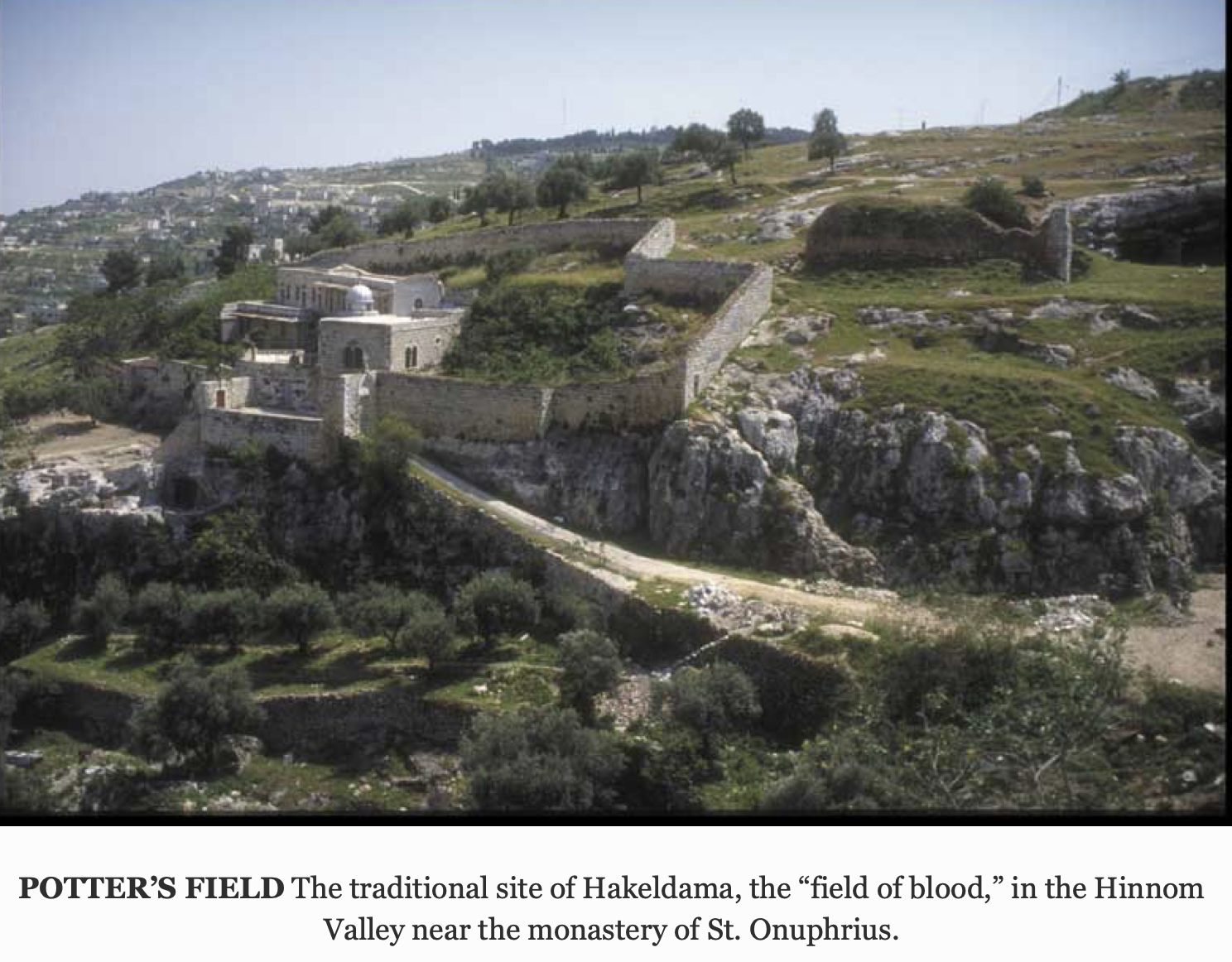
Even with all their corruption, the high priests found it impossible to utilize that money for the temple — “put them into the treasury,” i.e., into the temple treasury, as it was the “price of blood.” By the way, they apparently were basing their action on Deut. 23:18, and in this case, their hatred towards the Lord Jesus Christ became apparent, just as it became apparent that they valued His betrayal at 30 pieces of silver. The Pharisees’ tendency to fulfill a minor commandment, while violating an important one — not to condemn the innocent — characterizes them very definitely. There was a field belonging to a known potter, which was useless because it was used for excavating clay, firing clay pots and “bury strangers in ” — the Jews and proselytes that died among the huge numbers, which gathered in Jerusalem for the Passover and other significant feast-days. Thus, the Prophet Jeremiah’s prophesy was fulfilled: “And they took the thirty pieces of silver, the value of Him who was priced, Whom they of the children of Israel priced”: “And gave them for the potter’s field.” However, nothing resembling these words can be found by the Prophet Jeremiah: the only part in 32:7, speaks in general terms of the purchase of the potter’s field. Perhaps it was a later transcriber’ insertion.
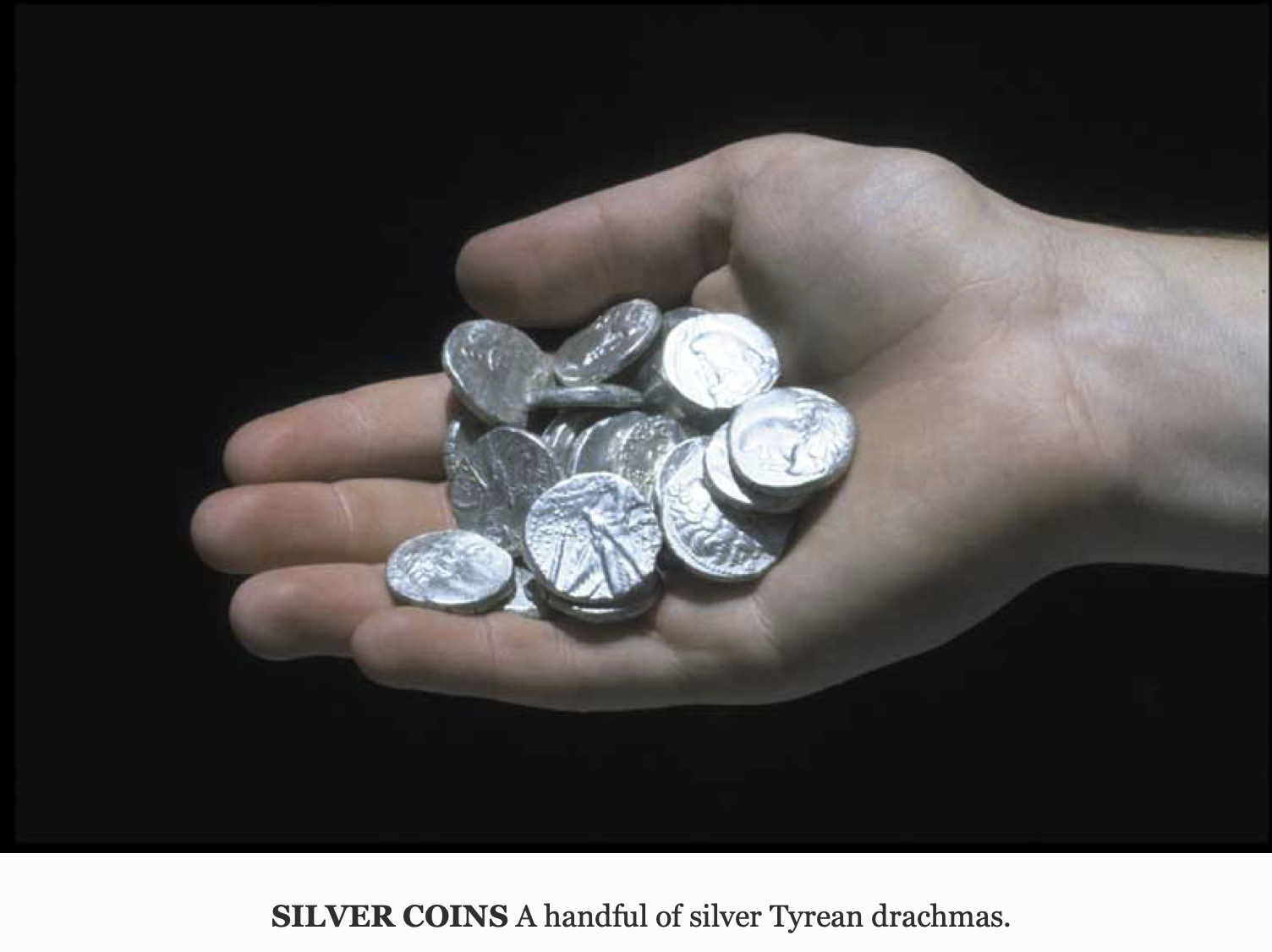
We find the similar statements, made by the Prophet Zechariah 11:12-13. In Jeremiah chaps. 18-19 the potter is also mentioned of, and it is possible that Zechariah took his image from there. Besides, in ancient times it was a common thing to abbreviate the personal names, and it’s possible that the transcriber might by mistake put Jeremiah’s abbreviated name (Jriah) instead of Zachariah’s (Zriah). The meaning of this section of the Book of Zechariah is this: God had placed the Prophet as the representative of the High Shepherd God, to graze the sheep of the house of Israel. The Jews didn’t listen to the Prophet i.e., they didn’t listen to God Himself. In order to demonstrate to the Jews, how little they value the care of the Prophet and consequently of God Himself, God directs to the Prophet to ask them: what sum would they give him for his pastoral efforts? They gave him the price of a slave — 30 pieces of silver, i.e., they valued the Prophet’s labors, and consequently of God Himself, as trivial, like those of a slave. God then said to the Prophet: put this great sum (it is irony, of course), at which they valued Me, into the temple treasury. And I took it (said the Prophet), and threw it unto the potter, in the house of the Lord (Zech. 11:11-12). This prophecy was fulfilled with the betrayal of the Lord Jesus Christ. The Jews evaluated their Good Shepherd, Jesus Christ at 30 pieces of silver — the price of a slave — and with that money purchased the land from the potter.
Great Friday.
At the Trial of Pilate.
(Mat. 27:1-2, 11-32; Mark 15:1-19; Luke 23:1-25 and John 18:28-19:16)
“A nd they bound Jesus, led Him away, and delivered Him to Pilate” — Since the times of Israel’s subordination to the Romans, the right to pronounce death sentences had been taken away from the Sanhedrin, as can be seen from John 18:31. The stoning of Stephen was a willful act. According to the law, the accused of blasphemy were punished by stoning. However, the Jews unconsciously fulfilled God’s will by wanting to sentence the Lord Jesus Christ to a more denigrating death — crucifixion on the cross — and with this aim, after the Sanhedrin pronounced the death sentence, they brought Him to the governor Pontius Pilate, i.e., the ruler.
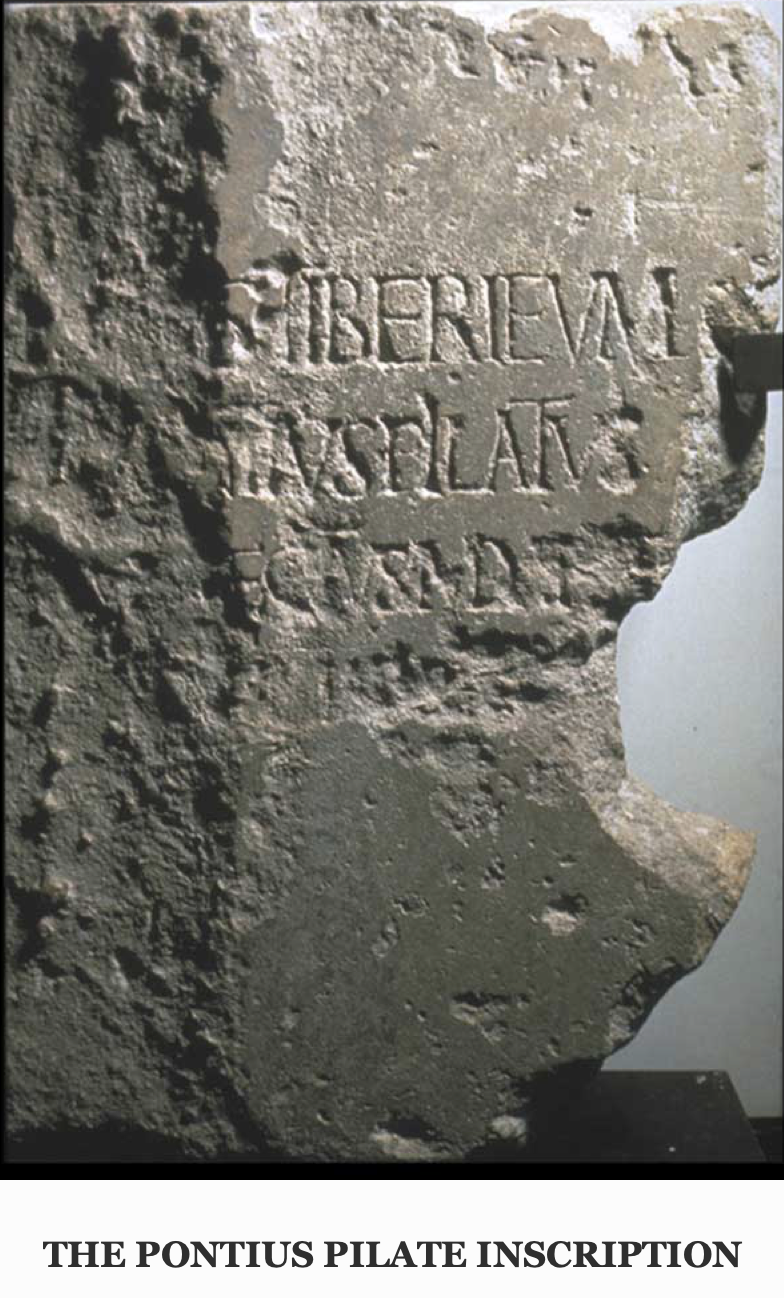
Pontius, named Pilate, was the fifth procurator or ruler of Judea. He received that post in the year 26 AD from the Roman Emperor Tiberius. He was a proud, arrogant and cruel person, and at the same time indecisive and cowardly. He hated the Jews and in turn was hated by them. Soon after Christ’s crucifixion, he was summoned to Rome, tried and imprisoned in northern Gaul, where he committed suicide. Procurators usually resided in Caesarea. However, on the feast-day of the Passover, they moved to Jerusalem, where they could keep an eye on the order. Saint Evangelist John has the most detail on Pilate’s trial. He narrates that the Jews led Jesus to the Praetorium, the Roman governor’s court of justice. In all probability, it was situated to the northwest of the temple, near or inside Antonius’s fortress where the Roman garrison was placed. They didn’t enter it because to touch anything heathen was counted as desecration, and might have prevented them from partaking of Pascha. This is the clear indication that the Passover was approaching that night, and that Christ partook of the Pascha on the eve of the feast-day, and He brought Himself as a sacrifice, as the true Paschal Lamb, at the day of the Old Testament Passover, which was the symbol of His suffering. Pilate, in this instance, made a concession to the Jewish customs (it is well known that the Romans attempted to spare the customs and traditions of the conquered nations, so as not to rise them too much against themselves), by walking out to them to the rostrum — an open, elevated area in front of the Procurator’s quarters — and inquired: “What accusation do you bring against this Man?” The first two Evangelists begin their narrative about Pilate’s trial with the interrogation of the Lord, the third — with His accusations by those who brought Him, while Saint John — with a question from Pilate to those who brought the Lord: thus, from the very opening and further, concerning the subsequent narratives, Saint John adheres to the more detailed and sequential order of the judicial procedure, thereby completing the first three Evangelists.
“Why, what evil has He done? I have found no reason for death in Him” — the Jews didn’t want a new examination of Christ’s case: they were hoping that Pilate would be the executioner of their sentence. Pilate knew too well the type of people he was dealing with. He therefore immediately placed the accusers in their place, in relation to himself, as to the representative of the Roman authority: I cannot make a judgment, without first hearing the details, so therefore “You take Him and judge Him according to your law.” Indeed, the Sanhedrin was empowered to judge and carry out the punishment for certain transgressions without the Roman sanction: the only exception was the death penalty. Pilate invites them to use their right. Changing their proud attitude to one of submissiveness, the Jews acknowledge the limitations of their rights, that they couldn’t subject the criminal, who in their opinion is worth of death, to the execution. “It is not lawful for us to put anyone to death,” “that the saying of Jesus might be fulfilled which He spoke, signifying by what death He would die.” Indeed, not once the Lord foretold that He would be betrayed to the heathens (Mat. 20:19), that He would be raised from the ground, i.e., be crucified (Mat. 26:2; John 12:32). After that, the Lord’s enemies were obliged to express their accusations against Him, what we find by Saint Luke: “We found this fellow perverting the nation, and forbidding to pay taxes to Caesar, saying that He Himself is Christ, a King”(Luke 23:2) — the sly hypocrites, who themselves hated the Romans, invent that slanderous accusation of purely political nature, so as to make it easier to gain the confirmation of the death sentence for Jesus. As Saint John narrates (18:33), Pilate asked the Lord in privacy, inside of the praetorium, the question, concerning that accusation: “Are You the King of the Jews?” — “Are you speaking for yourself about this, or did others tell you this concerning Me?”, asked the Lord: it was necessary to know the source of that question — if Pilate himself was asking that, the answer would be negative, because Christ was not a king, in the sense Pilate was; if Pilate’s question was a repetition of what the Jews were saying, then the answer would be affirmative, because Christ was indeed the King of Truth.
Christ was not a political king of the Jews, but was the theocratic ruler of the universe. So, the Lord made Pilate say in what sense he was applying the word ‘king” to Him”, i.e., if he personally was accusing Him of appropriating that title, or if he was just repeating the Jews’ accusations. Pilate’s answer is filled with contempt for the Judaism: “Am I a Jew? Your own nation and the chief priests have delivered You to me. What have You done?” — i.e., he doesn’t admit any royal worthiness in Christ, but just wants to know, why the people and high priests delivered Him, accusing Him of appropriating the title of a king. Jesus answers: “My Kingdom is not of this world” — the Lord confirms that He is truly a King, but in the spiritual and not political sense of the word, not the type of king as he imagines. “Pilate therefore said to Him, ‘Are You a King then?’ — having understood that Jesus is not a political pretender for the terrestrial kingdom, Pilate expresses his doubts about the possibility of existence of some other spiritual realm. Then the Lord confirms that He is truly a King , the King of the spiritual Kingdom of Truth, and that He came to earth so as to testify of the Truth — meaning of course, under the word “truth,” the religious truth of His Divine teaching. His subjects are those who are able to heed this Truth. Being a coarse heathen, Pilate of course couldn’t comprehend those words of the Lord and said disdainfully: “What is truth?” But he realized that the Kingdom of Jesus was not political, and was in no way a threat to the Roman rule.
At that time, the heathen Greco-Roman world reached such a level of mental and moral decay, that it lost its faith in the possibility of truth existence in general, and didn’t believe that there was such a thing as truth. Pilate’s historic question “What is truth?” serves as the expression of despondent disbelief in truth, the answer to which he even didn’t want to hear, but simply walked out to the Jews and stated that he found no fault in Jesus. That declaration deeply stung the pride of the Sanhedrin members, and they — as the first three Evangelists narrate — began to insistently accuse the Lord of many things, wanting, whatever it took, to achieve His conviction.
Listening to that, the Lord kept silent all the time , “so that the governor marveled greatly”(Mat. 27:14). At that point, they mentioned that He was inciting the people, teaching throughout Judea, beginning from Galilee (Luke 23:5). Pilate then inquired “if the Man were a Galilean? ” and sent Him to King Herod, who at that time — because of the feast days — also resided in Jerusalem. Only Evangelist Luke narrates of Christ’s trial before Herod (23:7- 12). Apparently, Pilate was hoping to receive more definite information from Herod on the personality and works of the accused, which to him were not completely clear. From the further remark of Saint Luke — that from that moment Pilate and Herod became friends — it can be concluded that Pilate sent Christ to Herod on purpose and that way stopped the animosity that existed between them. Perhaps he was hoping to receive a favorable response about Christ from Herod, in order to liberate Him from the hands of His persistent accusers. No wonder he later points to the fact, that Herod too didn’t find any fault in Him, which deserved the death sentence. (Luke 23:15).
Herod was very glad to see Jesus. This was the same Herod Antipas that murdered John the Baptist, and hearing of Christ’s works, thought that He was John resurrected from the dead. Herod was hoping to see a miracle from the Lord: not to start believing in Him, but only to satisfy his curiosity, like we watch the shows where magicians seemingly swallow snakes, swords etc. and marvel at that (Blessed Theothylactus). Apparently, Herod regarded the Lord as someone like a sorcerer. He posed many questions to Him, hoping to hear something interesting, but to all his questions, the Lord preserved total silence. The high priests and Scribes accused the Lord incessantly, apparently trying to prove that His sermons were as much dangerous for Herod as they were for Caesar. Having mocked at the Lord, Herod dressed Him in the white vestment and sent Him back to Pilate. With Romans, a candidate for an authoritative or honored position (the very word “candidate,” comes from the Latin word “candidus” meaning white, bright), used to wear the white (bright) vestment. By dressing the Lord in that type of attire, Herod wanted to express that he regarded Jesus only as some comical candidate to the royal Jewish throne, and that he did not consider Him as a serious and dangerous criminal. And Pilate understood that.
Referring to that even Herod found nothing that warranted the death sentence, Pilate proposes to the high priests, Scribes and the people, that after punishing the Lord, he will release Him. He thought to satisfy them with some minor punishment. With that, he remembered that there was an old Jewish custom, according to which, before the Passover, they came to the governor with the request to have one of the condemned prisoners released, and himself offered: “Whom do you want me to release to you? Barrabas, or Jesus who is called Christ?”(Mat. 27:17). The first two Evangelists add to this: “For he knew that they had handed Him over because of envy”(Mat. 27:18). Apparently, Pilate was hoping that he would find a different feeling for Jesus among the common people, and that they would ask exactly Jesus to be released. It was to that multitude of people, which gathered in front of the procurator’s house, that Pilate directed his question: “Which of the two do you want me to release to you?” While he was sitting on his judgment seat, situated in the open, elevated judicial place, called in Greek “lifostron,” or in Jewish — “gavvapha,” a messenger appeared before him with the message from his wife: “Have nothing to do with that Just Man, for I have suffered many things today in a dream because of him.” Some of the ancient Christian writers mention her name, as Claudia Proculus. They presumed that she confessed the Jewish faith, or was at least disposed towards it, while the tradition states that she later became a Christian. Probably she heard much about the Lord Jesus Christ, and was afraid that by condemning Him, her husband would bring upon him God’s punishment. It is unknown what type of dream she had, but it can be supposed that Jesus the Galilean appeared in her dream as Righteous, being tortured innocently. And in her dream, she suffered because of the thought that her own husband appeared as His executioner. While the messenger was reporting to Pilate his wife’s message, the Jewish leaders began to influence the people, so that they would ask Pilate to release Barabbas — and the people succumbed to their sinful suggestions. When Pilate for the second time asked the question: “Which of the two do you want me to release to you?” they replied: “Barabbas.” “What then shall I do with Jesus who is called Christ?” asked Pilate. They responded with: “Let Him be crucified!”; according to Saint Luke, they cried out: “Crucify Him!”
Pilate, still wishing to release Jesus, raised his voice, saying: “Why, what evil has He done?” “But they cried out all the more, ‘Crucify Him!’” Euthymius Zigaben underlines the point: “They are not saying: Let Him be killed, but let Him be crucified, so that the very type of death would show Him as a villain”. Like that the prophecy about the very type of Christ’s death for us, had to be fulfilled. Corrupted by their spiritual leaders, the people preferred Barabbas to the Lord Jesus Christ. The Evangelists tell us that Barrabas was a well-known malefactor, who with the band of accomplices, committed murders and made in the city a certain sedition (Mat. 27:16; John 18:40; Luke 23:19 and Mark 15:7).
Hearing the enraged roar of the people, which he apparently didn’t expect, Pilate became completely bewildered. He was afraid that his further persistence in defending the Righteous might provoke a serious disturbance among the people, which would have to be quelled with armed force, and that the infuriated high priests would then be able to report about that to Caesar, accusing him of causing that disturbance by defending the federal criminal, as they were trying to portray the Lord Jesus. Under the pressure of such feelings, Pilate decided to satisfy the people’s lust for blood by handing over the Innocent for scourging. He probably hoped that by making such a concession to the people’s fury, he would be still able to save Jesus from the death on the cross. “So, then Pilate took Jesus and scourged Him”(John 19:1). All the Evangelists narrate of the scourging. According to the first two Evangelists, the soldiers led Jesus into the praetorium to have Him scourged (in Slavonic: praetorium —“the judgment place”), i.e., into the courtyard, probably to have more room, because the area in front of the courtyard was congested with people. They then called up the whole regiment, or cohort, against Him. The soldiers removed the top attire from Jesus and began to scourge Him. With the Romans, such a type of scourging was assigned for serious crimes, and mainly for the slaves. The whips were made of ropes or belts, and their ends were embedded with the bone and metal sticks. This torture was so painful, that many died during the scourging. Usually, the condemned individual was tied to a post, in a leaning position. The soldiers then whipped his bare back, what from the initial blows, caused deep flesh wounds that bled profusely. That was the terrible punishment, to which Pilate inflicted the One, in Whom he found no fault. However, it has to be assumed that it was done to satisfy the crowd’s lust for blood and save Him from the cruciferous death.
Having finished the scourging, the cruel soldiers began to mock at the Sufferer: they dressed Him in a “purple robe,” i.e., a soldier’s red cape, akin to those mantles worn by kings and highest military leaders. Those mantles were without sleeves and worn around the shoulders so that the right arm remained free. That cape was supposed to represent the royal mantle for the King of the Jews. They placed a crown made of sharp thorns on His head, and put a cane in His hands, which supposedly represented a royal scepter. Having done all that for to mock at the Divine Sufferer, the soldiers then began to kneel before Him. Swearing at Him, they began to say, as though greeting Him: “Hail! King of the Jews.” Together with that, they slapped Him across the cheeks, spat on Him, grabbed the cane from His hands, and beat Him on the head, so that the thorns of the crown would drive deeper and cause greater wounds.
According to the first two Evangelists, those events happened after Christ had been finally condemned to death. However, Saint John’s aim was to expand and explain the narratives of the first three Evangelists, and he pointed at the fact that the scourging and acts of mockery over Christ took place earlier, and presumably, were undertaken by Pilate with the specific aim of liberating Christ from the death sentence at least in such a way. In order to cause the feeling of compassion for Jesus in the Jews, Pilate ordered Him to be brought out, tortured and exhausted. He hoped that the awful sight would cause their hearts to shudder, and that they would no longer insist on the Lord’s death. This is how a heathen, not knowing the true God and His commandments on how to love the neighbor, thought. Alas, however, this was not the way the spiritual leaders and chiefs of God’s chosen nation thought, raging in their indefatigable hatred. When the Lord was led out onto the rostrum, Pilate said: “Behold, I am bringing Him out to you, that you may know that I find no fault in Him,” and pointing to Jesus, added: “Behold the Man!”
Pilate was addressing to the trial of their conscience with that exclamation: it was as though he was saying — here is the Person, lonely, humiliated, and tortured: is it possible that He looks like a dangerous rebel: by His very appearance, doesn’t He evoke more pity than fear? Together with that, apparently unintentionally, Pilate said the truth: even in His humiliated state, the Lord revealed more spiritual greatness and moral beauty of the true Man, which He has be according to the Creator’s design, than He would have in the state of glory and royal brilliance. The meaning of Pilate’s words for the Christians is: here is the model of the Man, which all the Christians should try to reach.
However, nothing touched the high priests and their servants. As they saw exhausted and tortured Christ, they started to clamor: “Crucify, crucify Him!” Such persistence of the accusers aroused sadness in Pilate, and forced him to exclaim with abruptness and causticity: “You take Him and crucify Him, for I find no fault in Him ”: If you are so insistent, then you crucify Him at your own responsibility. I, as the representative of justice, cannot participate in such an unworthy act of condemning the Man that is completely innocent. Apart from extreme annoyance and impatience, Pilate’s words expressed nothing else. Consequently, the Lord’s enemies, in presenting a new accusation, continued to seek Pilate’s agreement to the death sentence: “We have a law, and according to our law He ought to die, becauseHe made Himself the Son of God. ”
Hearing this, Pilate “was the more afraid.” Of course, Pilate could only understand the expression — “the Son of God” in the heathen sense, meaning the semi-gods, heroes, that were numerous in the heathen mythology. But this was enough to confuse him, as he recalled of his wife’s warning, which saw some mysterious dream about that enigmatic Person. Pilate then leads Jesus into the praetorium and privately asks Him: “Where are You from?”, i.e., where did You originate from, are You from heaven or earth? Are You indeed the Son of God? “But Jesus gave him no answer.” — It was useless responding to the question. The Lord attempted to explain to Pilate, Who He is, but His words only provoked a flippant and facetious remark (John 19:9). How could a, coarse, heathen-skeptic understand the teaching about the true Son of God?
Conquering his fear, Pilate decided to show his authority as well as to influence Jesus to answer: “Are You not speaking to me?” The Lord responds to these vain words with the Divine wisdom: “You could have no power at all against Me unless it had been given you from above” — it is only due to God’s permission that I am in your hands. Having delivered His people into the slavery of the heathen, Roman rule, God passed the authority over Me to you through it. Nevertheless, you will be guilty of condemning Me, because you do so against your conscience. However, the greater sin will be on them that had not been given authority over Me from above, on those who had done this willfully, through hatred, i.e., on the Sanhedrin, on Caiaphas as its instrument, on Judas Iscariot. Evidently, Pilate liked the Lord’s wise words, and “from then on Pilate sought to release Him.” The accusers then decided to resort to extreme measures — to threaten the procurator himself by accusing him of treachery against Caesar’s authority: “If you let this Man go, you are not Caesar’s friend…” That frightened Pilate, because the Emperor at the time was the suspicious and extremely cruel Tiberius, who was always willing to listen to the informers.__
That threat caused the decision on the whole matter. Settling himself in the judge’s seat on the rostrum, Pilate formally and solemnly concludes the trial. That’s why the Evangelist notes the day and hour when the Lord was condemned : “Now it was the Preparation Day of the Passover, and about the sixth hour,” i.e., it was Friday before the Passover and the sixth hour, being around 12 of the noon by our time. This indication by Saint John would seem to differ with the other Evangelists, especially with Saint Mark, who notes: “Now it was the third hour, and they crucified Him”(Mark 15:25), while from the sixth to the ninth hour, there was darkness over all the land (Mat. 27:45; Mark 15:33 and Luke 23:44). However, the matter is that the day, like night, was divided into 4 parts of three hours. Consequently, the New Testament mentions only the 1st, 3rd, 6th and 9th hour. Saint John doesn’t say “the hour was the sixth,” but “about the sixth hour,” i.e., “like the sixth hour”: according to our time, this could be the whole period between the 9th hour in the morning till noon. Finally, there is an opinion (of Gladkov) that Saint John is indicating the Roman calculation of time, which corresponds to ours, i.e., it was around 6 o’clock in the morning, as we count now, beginning from the midnight.
“And he said to the Jews, ‘Behold your King!” — although it’s difficult to say what Pilate tried to express with those words, one can’t help seeing in them the last attempt to free the Lord from death. Apparently, annoyed at being forced to carry out the sentence against his own conscience, he once again severely reproaches the whole Sanhedrin: he is as though saying — you dream of the return of independence, of some sort of high calling among all the nations of the world: nobody would be capable to fulfill this high task, but this Person, the One who calls himself the spiritual King of Israel. How is it that instead of bowing in front of Him, you demand His death? Do you want me, the hated by you Roman governor, to take away your King who can fulfill all your cherished dreams?
Evidently, the accusers understood those words likewise, because they started to howl with especial fury: “Away with Him, away with Him! Crucify Him!” According to Bishop Michael’s words — “this howl came from the wound, inflicted into the most sensitive part” but “before giving in completely, Pilate once more twists the knife in this wound with the words: “Shall I crucify your King?” — if Jesus calls Himself your King, then with this declaration, He promises you liberation from the Roman rule: how can you demand that I, the representative of the Roman authority, will commit Him to death? Think again, what are you doing?” — In response to this admonishment, blinded by their hatred towards Jesus, the high priests pronounced the frightening and fatal words that became the sentence for all the future history of the Jewish people: “We have no king but Caesar!” Before, the high priests were saying: “We have no other King, except God”: and that time, just for the sake of achieving Christ’s crucifixion, they renounce everything, declaring that they do not have, nor wish to have any other king than Roman Caesar.
Having suffered defeat at his attempts to liberate Christ, Pilate finally decided to give way to the wishes of the Jews and “delivered Him to them to be crucified.” Saint Matthew informs that prior to that, Pilate washed his hands (Mat. 27:24): “When Pilate saw that he could not prevail at all, but rather that a tumult was rising, he took water and washed his hands before the multitude, saying, ‘I am innocent of the blood of this Person. You see to it“. The Jews had a custom of washing the hands as a proof of being innocent in shedding the blood of another, when someone was found killed (Deut. 21:6-8). Pilate took advantage of that custom, as a sign that he freed himself of the responsibility for the execution of Jesus, Whom he regarded as an innocent and Righteous. “You see to it” — you yourselves will answer for the consequences of this unjust murder.
The malicious Jews agreed to everything, not thinking of the consequences, just to get the procurator’s confirmation about the death penalty: “His Blood be on us and on our children,” i.e., if this is a crime, then let God’s wrath fall on us and our descendants. “Such senseless fury” — comments Saint John Chrysostom — “such evil passion…even if you had cursed yourselves: but why to incur the curse on your descendants?” This curse that the Jews incurred upon themselves was soon fulfilled: in the year 70 AD, during the Roman siege of Jerusalem, a vast number of Jews were crucified on crosses. It also came to pass (through the fulfillment of Moses’ prophecy in Deut. 28:49-57, 64-67) in the further history of the Jews, from thereon scattered around the world and being continually subjected to countless “massacres”, which they constantly faced, so that the prophesy of Moses from the Deuteronomy could be fulfilled (chap. 28:49-57; 64-67).
“Then he released Barrabas to them; and when he had scourged Jesus, he delivered Him to be crucified,” i.e., having confirmed the Sanhedrin’s death sentence, Pilate supplied them with soldiers to carry out the execution of the Lord Jesus Christ, by crucifixion.
Having washed his hands, Pilate of course couldn’t get rid of his responsibility (as he had wanted) by that act: after all, he was the high judge, knowing that the Accused was completely innocent. Since that time, the expression “to wash the hands” became a proverb. God’s punishment reached Pilate for his faint-heartedness and unjust condemnation of the One, Whom he himself called Righteous. He was banished to Vienne (spelled Vienna in some older Latin texts), located in the region of Gaul (modern-day France), where in two years, exhausted by anguish, tortured by conscience and despondency, he committed a suicide. A monument claimed to be Pilate’s tomb is still shown in Vienne.
Great Friday.
Peter’s Renouncement.
(Mat. 26:69-75; Mark 14:66-72; Luke 22:55-62; John 18:16-18, 25-27).
All four Evangelists narrate about Peter’s renouncement, although some differences in their narrations are obvious. At any rate, these differences do not concern the matter’s essence: the Evangelists only complete and interpret one another, so that through the comparison of their testimonies, the precise and full history of this event can be built.
During the trial over the Lord, first at Annas’ and then at Caiaphas’, Peter stayed in one and the same inner courtyard of the high priests’ house, where the doorkeeper at the request of Saint John, who was known to the high priest brought him. The fact that it was one and the same courtyard of the high priests’ house, where Annas and Caiaphas resided in the separate sectors, effaces the seeming contradiction between the narratives of, Evangelist John, on the one hand, and of the first three Evangelists on the other. Saint John presents Peter’s renouncement as beginning and finishing in Annas’s courtyard, while the other three Evangelists, not even mentioning Christ’s interrogation by Annas, narrate as though the whole three renouncements took place in Caiaphas’ courtyard. It is obvious that it was the common courtyard. When with Saint John’s help (who knew the high priest), Peter came into the courtyard, the servant girl, that let him come in, told him: “You are one of His disciples, aren’t you?” “I am not” replied Peter, and stood closer to the fire that was set because of the cold and bad weather.
However, the servant girl didn’t leave him alone. According to Saint Mark (14:67), staring at his face, illuminated by the fire, she affirmatively declared: “You also were with Jesus of Nazareth,” and also said to the bystanders: “This man was also with Him”(Luke 22:36). Peter continued his renouncement, saying: “Woman, I do not know Him”(Luke 22:57 ), “I neither know nor understand what you are saying”(Mark 14:68 and Mat. 26:70). This is how the first renouncement happened, beginning at the gate and finishing by the fire. As Saint Mark narrates, Peter, wishing to get rid of the persistent servant girl, walked away from the fire to the front of the court- yard, at the threshold of the gates so that if needed he could run away. Much time passed. Noticing him again, the same servant girl (Mark 14:69) began to tell those standing next to him: “This is one of them.” She was joined by another servant girl (Mat. 26:71), also saying: “This fellow also was with Jesus of Nazareth.” Yet another addressed Peter with: “You also are of them”(Luke 22:58). Once again, Peter moved closer to the fire, but here as well some (John 18:25) started saying : “You are also one of His disciples, aren’t you?” He denied it, saying “No!” This was the second renouncement, and on the basis of John’s verses 24 and 25, chapter 18, one can assume that it occurred at the same time when Jesus was being led from Annas to Caiaphas. After the second renouncement, a period of one hour passed (Luke 22:59).
The sunrise was close, and with it the “crowing of the rooster”(Mark 13:35). The trial over the Lord, carried out by high priest Caiaphas, was about to be finished. One of the servants (a relative of Malchus, whose ear was cut by Peter) said to Peter: “Did I not see you in the garden with Him?”(John 18:26), while another added: “Surely this fellow also was with Him, for he is a Galilean”(Luke 22:59). This was followed by many saying: “Surely you are one of them; for you are a Galilean, and your speech shows it”(Mark 14:70), “For your speech betrays you”(Mat.26:73). Fear overcame Peter and “he began to curse and swear, ‘I do not know this Man of whom you speak. A second time a rooster crowed,” as Saint Mark testifies, undoubtedly quoting the words of Peter himself (Mark 14:71-72).
According to Saint Mark’s testimony, when the rooster crowed the first time after the first renouncement (verse 68), “And the Lord turned and looked at Peter. Then Peter remembered the word of the Lord, how He had said to him, ‘Before the rooster crows, you will deny Me three times.’ So, Peter went out and wept bitterly.” The third renouncement occurred under similar circumstances, and evidently coincided with the moment when the Lord — already condemned and subjected to humiliation and beating — was led into the courtyard out of Caiaphas’ house. Here, being guarded, the Lord had to wait for the dawn (Luke 63-65) and the new, official assembly of the Sanhedrin, which would hand down the formal sentence. A rooster’s crow and the Lord’s glance, cast at him, evoked burning and bitter remorse in Peter’s soul: he ran away from the place of his downfall, and weeps bitterly over it.

Great Friday.
The Cruciferous Way to Golgotha.
(Mat. 27:31-32; Mark15:20-21; Luke 23:26-32; John 19:16-17).
All 4 Evangelists narrate about the Lord’s way to Golgotha. The first two — Saints Matthew and Mark — speak of this identically. “And when they had mocked Him, they took the purple off Him, put His own clothes on Him, and led Him away to be crucified. Now as they came out, they found a man of Cyrene, Simon by name. Him they compelled to bear His cross.” Saint John narrates about that very briefly, not mentioning anything about Simon of Cyrene. The most detailed narrative is that of Saint Luke. Saint John reports that as it was accepted generally, concerning those who were sentenced to death through the crucifixion, the Lord carried His own cross to the place of execution. However, He was so exhausted after His inner struggle in Gethsemane, and after the sleepless night and terrible tortures, that He did not have the strength to carry the cross to the destination. Moved, of course not by compassion but by the desire to reach the place and accomplish their evil deed sooner, the Lord’s enemies grabbed along the way an individual named Simon. He was an emigrant from Cyrene, a town in Libya, on the northern shore of Africa, to the west of Egypt (where many recently migrated Jews lived), and was returning to the city from the field, when he was forced to carry the Lord’s cross. Saint Mark adds that Simon was the father of Alexander and Rufus, later known in the early Christian Church, mentioned in the Epistle to the Romans by Saint Paul (16:13).
Saint Luke adds that “a great multitude of the people followed Him, and women who also mourned and lamented Him.” He was followed not only by His enemies, but by His commiserating worshippers. Notwithstanding that the custom prohibited to express sympathy to a condemned man, being led to the execution, many women in the crowd showed their empathy to the Lord through loud sobbing. Their compassion was so deep and genuine, that the Lord found He had to respond and turned to them with the whole homily. Presumably, it occurred at the time when the procession stopped so that the Lord’s cross could be transferred to Simon the Cyrenian. “Daughters of Jerusalem, do not weep for Me, but weep for yourselves and for your children…” “Daughters of Jerusalem” — is a tender form of addressing, indicating the Lord’s kind disposition to those women, who had expressed such moving compassion. The Lord as if forgets of His forthcoming sufferings, He turns His spiritual gaze to the chosen nation’s future, to that frightening punishment that will reach them for rejecting the Messiah. “Weep for yourselves and for your children” — with these words the Lord warns them of the catastrophes that might reach them and their children.__
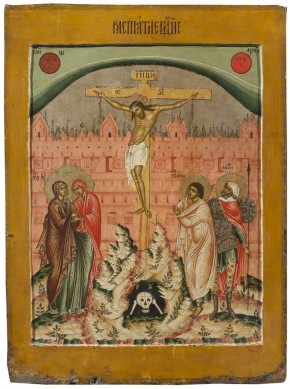
Here, it is as though the Lord had in mind that frightening oath, which the Jews brought upon themselves so flippantly when they screamed: “His Blood be on us and on our children”(Mat. 27:25). “The days are coming…” — the days of terrible calamities are approaching, when the highest blessing of childbirth will transform into a curse, and those that had previously been regarded as being under God’s wrath as childless, not child-bearing, will be regarded as blessed. “Then they will begin to say to the mountains, ‘Fall on us!’ and to the hills, ‘Cover us!’” — that’s how great the disasters will be. Undoubtedly, the dialogue is about the destruction of Jerusalem in the year 70, by Titus.
“For if they do these things in the green wood, what will be done in the dry?” — evidently, this was a folk saying. Under “the green wood,” The Lord means Himself; under “the dry” — the Jewish people. If they didn’t show mercy to Him, who’s Innocent, then what will they do with the guilty nation? “The fire is heading towards Israel (see Ezek. 20:47); if the fire destroyed green wood, with what ferocity will it destroy the dry?”
Great Friday.
The Trial over the Lord, Held by the High Priests.
(John 18:12-23; Mat. 26:57-68; Mark 14:53-65; Luke 22:54-, 63-65).

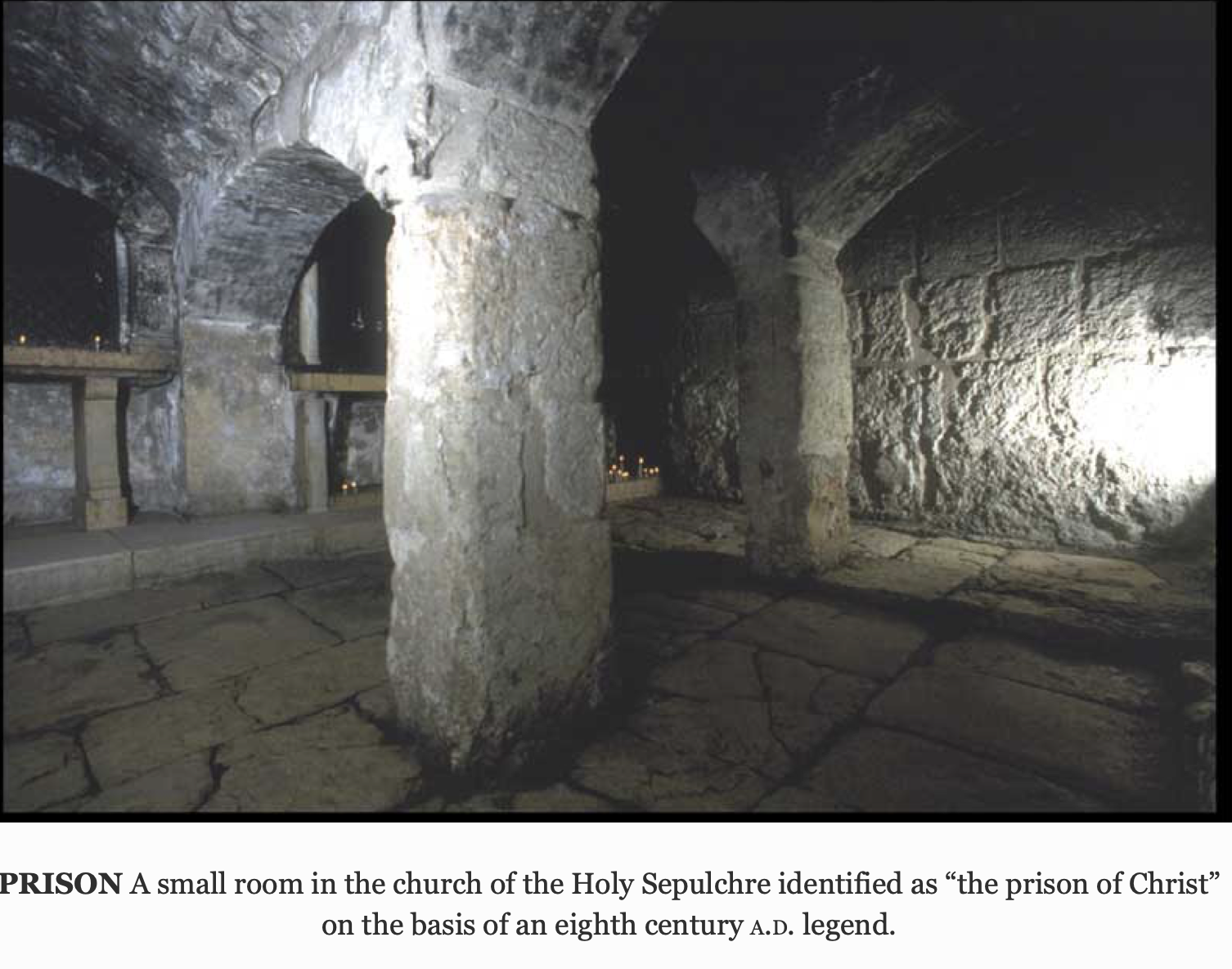
H aving taken the Lord Jesus, the enemies led Him bound (Saint John) to the house of the high priests. In contrast to the first three Evangelists testimonies, Saint John is the only one to mention that the Lord was brought first to Annas, who conducted a preliminary interrogation, and then sent Him to Caiaphas. Saint John also explains why the Lord was first brought to Annas and not to Caiaphas — who was the ruling high priest that year — as Annas (or, Annanas as he was called to by Joseph Flavius) “was the father-in-law of Caiaphas.” The Lord’s captors thought that by doing that, they would show special attention and honor to the famous relative of the ruling high priest. Besides, sly old Annas had special respect among his public. However, it must be assumed that after he was replaced from the post of the ruling high priest, Annas continued to live in the high priests dwelling, especially as the new high priest Caiaphas was his close relative. Although both lived in the same residence and shared a common courtyard, they each had separate quarters in the large high priests’ house.
Completing the narration of the first Evangelists, Saint John narrates that Jesus was followed not only by Peter, about whose renouncement tell all the four Evangelists, but “so did another” — undoubtedly it was Saint John himself, as he was known to the high priest, even though it is unknown to whom exactly and why: according to the tradition — through his fishing. That’s why he entered inside the high priest’s courtyard, and then told the doorkeeper to let Peter. According to Saint John, here happened the first renouncement of Peter, when, during the Lord’s interrogation by Annas, he was standing close to the open fire warming himself.
Cunning Annas did not accuse the Lord of anything, but just asked Him what He preached and who His disciples were. With this, he intentionally set the ominous tone of the further proceedings, having cast suspicion upon Jesus as some kind of the leader of a hidden conspiracy, with the secret teaching and clandestine aims. However, the Lord revealed his cunningness with His answer: “I spoke openly to the world. I always taught in synagogues and in the temple, where the Jews always meet, and in secret I have said nothing”. To prove this, the Lord offered to interrogate the witnesses that had heard Him preaching. Notwithstanding that there was nothing offensive for the high priest in this reply, one of the servants, apparently wishing to please the high priest, hit the Lord on the cheek with the palm of his hand, saying: “Do You answer the high priest like that?” If Jesus endured this silently, it could have been taken that He accepted that blow as just, and the pride of the over-zealous servant would have increased through the silent acceptance of his action. Therefore, in order to stop the evil in its initial stage and put sense into the servant, the Lord objected: “If I have spoken evil, bear witness of the evil; but if well, why do you strike Me?” — i.e., if you can prove that I was teaching the people something bad, then reveal it, prove it, but don’t hit Me without any reason.
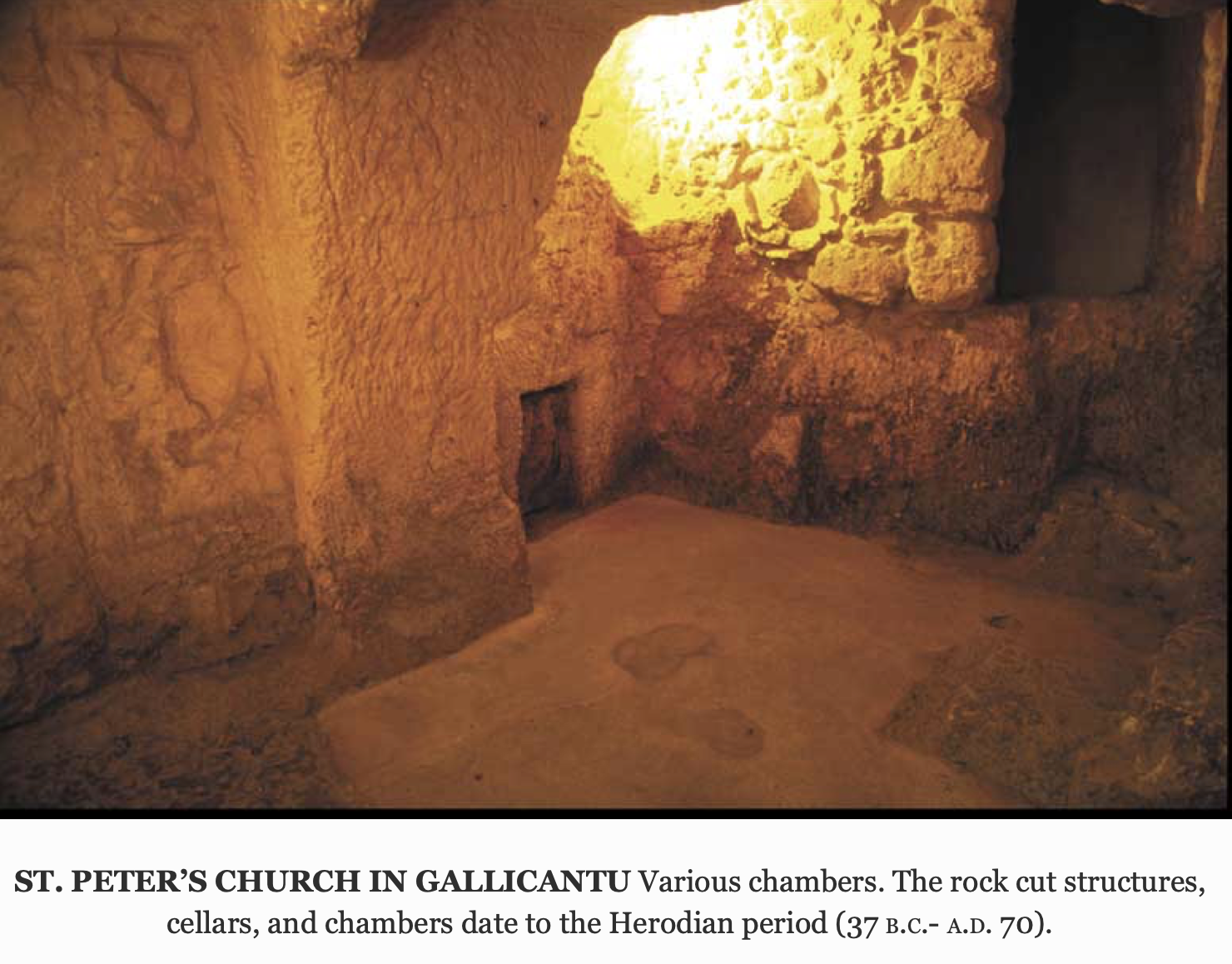
Saint John states further that Annas sent bound Jesus to high priest Caiaphas (verse 24). Apparently, the Lord was led only through the internal courtyard of the same house, where there was set the fire, close to which Peter (who had once already renounced Christ) was standing and warming himself. Both Saints Matthew and Mark give detailed narrations about what happened at Caiaphas’. It so happened, that there was a gathering of all the high priests, elders and Scribes — in a word, nearly all the Sanhedrin. Despite the late hour of the night, they all hurried to give evidence against Jesus, so that they would have everything necessary for the next official morning meeting of the Sanhedrin, where they could officially announce the death sentence on Him. For that, they began to seek false witnesses, which could accuse Jesus of some criminal act, but “they found none.” Finally, two false witnesses came forth — as the law required that there should be no less than two, in order to sentence the accused (Num. 35:30; Deut. 17:6 and others). They remembered the words said by the Lord in Jerusalem, when He first drove out the traders from the temple, modifying them with evil intention and assigned to them a different meaning. At the time, the Lord said: “Destroy this temple, and in three days I will raise it up”(John 2:19). He didn’t say: “I could destroy it; and “in three days I will raise it up” — in Church-Slavonic “erect”, in Greek “egero,” but He didn’t say “create,” which is a completely different word in Greek: “ikodomiso”. The Lord was speaking of the temple of His Body, while the false witnesses presented those words as some sort of boasting, in which, essentially, there wasn’t anything criminal. That’s why Saint Mark states: “But not even then did their testimony agree”(Mark 14:59).
Throughout this, the Lord remained silent, because there was no need to respond to such absurd and moreover confused accusations (according to Saint Mark, the other witnesses testified somewhat differently). This was annoying Caiaphas, so he decided to compel the Lord to make such confession, that would be a reason to announce the death sentence as of a blasphemer. According to the judicial customs of those days, he addressed the Lord with a resolute question: “I put You under oath by the living God: tell us if You are the Christ, the Son of God?”
“I put You under oath” — was the usual formula of the oath, calling upon God to be the witness. This was applied when the court demanded the accused to answer the question put to him by the accusers and to do it truthfully. The Lord could not ignore answering to such a direct question, particularly as it was asked under the oath, especially as He had no futher need to hide His Messianic Divine worthiness. On the contrary, He had to testify about it triumphantly. And He answers: “It is as you said,” i.e., “Yes, it is true — I am Christ,” and further adds to this: “Hereafter you will see the Son of Man sitting at the right hand of the Power, and coming on the clouds of heaven.” This of course, refers to the words of Psalm 109:1, in which the Messiah is depicted as sitting to the right of God, and also — to Daniel’s prophesies in 7:13-14 of the Messiah as the “Son of Man,” coming on the clouds of heaven. What the Lord tried to say is that all those impious judges would soon see the manifestation of His Divine power, as of the Son of God, through many signs and miracles. “Then the high priest tore his clothes, saying, “He has spoken blasphemy!” — to the Jews, the tearing of clothing was the usual expression of sorrow and lamentation.
Although it was forbidden for a high priest to tear his clothing (Lev. 10:6; 21:10), in doing so, Caiaphas wanted to express his especial grief, which even forced him to forget that forbiddance. Of course, this was just a hypocritical act on his part, so that he could declare the Lord’s acknowledgment of Himself as being the Messiah — a blasphemy. “What do you think?” — What is your opinion on this matter? — asks Caiaphas of those present, and receives the desired response: “He is deserving of death.” They then started to swear and mock at Christ just like an already convicted criminal: they spat in His face, as a sign of extreme loathing and denigration, hit His ears, beat Him on the head, His cheeks, taunting and asking: “Prophesy to us Christ! Who is the one who struck You?” i.e., if You are the all- knowing Messiah, then name the person who hits you, without knowing or seeing him. This last act shows that the whole judgment was a rough spectacle, which concealed bloodthirsty and savage hatred. Those were not judges but animals, unable to conceal their rage.
Great Friday. At the Trial of Pilate. (Mat. 27:1-2, 11-32; Mark 15:1-19;
Luke 23:1-25 and John 18:28-19:16)
Great Friday.
At the Trial of Pilate.
Great Friday. Peter’s Renouncement. (Mat. 26:69-75; Mark 14:66-72; Luke
22:55-62; John 18:16-18, 25-27).
Great Friday.
Peter’s Renouncement.
Great Friday. The Cruciferous Way to Golgotha. (Mat. 27:31-32;
Mark15:20-21; Luke 23:26-32; John 19:16-17).
Great Friday.
The Cruciferous Way to Golgotha.
Great Friday. The Sanhedrin’s Sentence. (Mat. 27:1; Mark 15:1 and Luke
22:66-71) The Death of Judas. (Mat. 27:3-10).
Great Friday.
The Sanhedrin’s Sentence.
(Mat. 27:1; Mark 15:1 and Luke 22:66-71)
The Death of Judas.
(Mat. 27:3-10).
Great Friday. The Trial over the Lord, Held by the High Priests.
Great Friday.
The Trial over the Lord, Held by the High Priests.
- Great Friday. The Trial over the Lord, Held by the High Priests.
- Great Friday. Peter’s Renouncement. (Mat. 26:69-75; Mark 14:66-72; Luke 22:55-62; John 18:16-18, 25-27).
- Great Friday. The Sanhedrin’s Sentence. (Mat. 27:1; Mark 15:1 and Luke 22:66-71) The Death of Judas. (Mat. 27:3-10).
- Great Friday. At the Trial of Pilate. (Mat. 27:1-2, 11-32; Mark 15:1-19; Luke 23:1-25 and John 18:28-19:16)
- Great Friday. The Cruciferous Way to Golgotha. (Mat. 27:31-32; Mark15:20-21; Luke 23:26-32; John 19:16-17).
Great Friday. The Trial over the Lord, Held by the High Priests.
Great Friday.
The Trial over the Lord, Held by the High Priests.
Great Friday. Peter’s Renouncement. (Mat. 26:69-75; Mark 14:66-72; Luke
22:55-62; John 18:16-18, 25-27).
Great Friday.
Peter’s Renouncement.
Great Friday. The Sanhedrin’s Sentence. (Mat. 27:1; Mark 15:1 and Luke
22:66-71) The Death of Judas. (Mat. 27:3-10).
Great Friday.
The Sanhedrin’s Sentence.
(Mat. 27:1; Mark 15:1 and Luke 22:66-71)
The Death of Judas.
(Mat. 27:3-10).
Great Friday. At the Trial of Pilate. (Mat. 27:1-2, 11-32; Mark 15:1-19;
Luke 23:1-25 and John 18:28-19:16)
Great Friday.
At the Trial of Pilate.
Great Friday. The Cruciferous Way to Golgotha. (Mat. 27:31-32;
Mark15:20-21; Luke 23:26-32; John 19:16-17).
Great Friday.
The Cruciferous Way to Golgotha.
Related Concepts
- ad-70-titus
- annas-interrogation
- behold-the-man
- blasphemy
- caiaphas
- christ-as-exemplar
- christ-as-king-of-israel
- christ-before-pilate
- chronology-of-the-passion
- covenant-judgment
- crowd-psychology
- crown-of-thorns
- daniel-713-14
- daughters-of-jerusalem
- death-sentence
- despair
- destruction-of-jerusalem
- deut-216-8
- deut-2318
- deut-28
- divine-mercy
- divine-teaching
- envy-of-the-chief-priests
- exodus-12
- ezekiel-2047
- great-friday
- green-wood-and-dry-wood
- guilt
- hatred
- herod-antipas
- high-priests
- historical-reliability
- injustice
- jeremiah
- jeremiah-327
- jewish-christian-polemic
- johannine-supplement
- john-1911
- judas
- judas-iscariot
- judass-blood-money
- judass-remorse
- judgment
- king-of-the-jews
- kingdom-of-truth
- legalismhypocrisy
- lxx
- majesty
- matthews-fulfillment-formula
- messianic-dignity
- mockery-and-scourging
- natural-law
- new-pascha
- oath-formula
- old-testament-in-the-new
- pagan-decadence
- paschal-amnesty
- passoverpascha
- patience
- peters-denial
- pilate
- pilates-cowardice
- pilates-guilt
- pilates-interrogation
- pilates-marvel
- pilates-skepticism
- pilates-wifes-dream
- political-messianism
- price-of-blood
- proof-text
- prophetic-rebuke
- psalm-109
- psalm-1091
- sanhedrin
- sanhedrin-trial
- skepticism
- suffering-servant
- suicide
- theocracy
- theocratic-rule
- titus
- truth
- washing-of-hands
- weak-and-strong
- zechariah
- zechariah-1112-13