New Testament — Topic 13
The Last Days of the Lord’s Terrestrial Life. Part 1.
Driving the Dealers Out from the Temple. (Mat. 21:12-17; Mark 11:15-19;
Luke 19:45-48).
Driving the Dealers Out from the Temple.
(Mat. 21:12-17; Mark 11:15-19; Luke 19:45-48).
The first three Evangelists narrate about this event. Also, the narration of Saint Mark differs to that of Saints Matthew and Luke, in the fact, that according to him, the Lord entered the temple and after having “looked around at all things, as the hour was already late, He went out to Bethany with the twelve.” And it was only the following day (after the condemnation of the fig tree), that He entered the temple and drove out the traders. There is no contradiction here: in describing events, the Apostles did not always adhere to a chronological order. The presentation of logical sequence of events was more important to them.
Some accept that there were two cleanings of the temple from trading merchants: once on the day of the Lord’s entry in Jerusalem, and the second time on the following day. Three years earlier, when the Lord came to Jerusalem for His first Pascha after His Baptism, He found the yards and porches of the temple transformed into trading areas, so He drove out the merchants. At the Pascha of the following year, the Lord apparently did not find any trading activity within the temple area. On the third Pascha of the Lord’s service, He didn’t visit Jerusalem. At the fourth Pascha, the Jews were worried about the fact if Jesus would attend this holiday. Realizing that the authorities had pronounced their death sentence to the Lord, the merchants (with the permission of the high priests), packed the temple grounds and side porches with animals, pitched tents that offered a variety of goods, set up tables with money-exchange facilities and benches with doves — which were bred by the high priests in order to increase their income — and began trading. Upon entering Jerusalem, the Lord headed directly to the temple and drove out the merchants that were trading there.
The Lord’s entry into the temple was quite unexpected for them. After the triumphant greeting by the people with the cries of “Hosanna” no one dared to oppose Him when, in His first year of ministry, He “began to drive out those who bought and sold in the temple, and overturned the tables of the money changers and the seats of those who sold doves. And He would not allow anyone to carry wares through the temple,” i.e., items that had nothing to do with the church services in the temple. Evidently, at that moment, the Divine greatness and might shined in the face of the Lord so that nobody presumed to react against Him. Instead, they involuntarily submitted. The high priests also didn’t dare to take measures against the Lord, seeing “how all the people were astonished by His teachings”(Mark 11:18 and Luke 19:48).
Driving the Dealers Out from the Temple. (Mat. 21:12-17; Mark 11:15-19;
Luke 19:45-48).
Driving the Dealers Out from the Temple.
(Mat. 21:12-17; Mark 11:15-19; Luke 19:45-48).
Great Monday
Great Monday.
The Curse of the Fruitless Fig Tree.
(Mat. 21:18-22; Mark 11:12-14).
Two Evangelists, Saints Matthew and Mark, tell that after the Lord’s triumphant entry into Jerusalem, He spent the night with His disciples in Bethany, In the morning of the next day, while walking back to Jerusalem, the Lord noticed a fig tree. While wishing to partake of its fruit, He couldn’t find any on it although it was covered with leaves, and said: “Let no fruit grow on you ever again” — “Immediately the fig tree withered away”, what amazed the disciples greatly. The Evangelists say that the Lord “was hungry” and that’s why He was looking for the fruit. This is not surprising, because the Lord Jesus Christ, possessing human nature, was subjected to all human weaknesses, and was like us in all respects, except sin. After all, He wasn’t only God, but Human God. It is characteristic that He never used His Divine almighty powers to satisfy His human needs, but resorted to normal human means, rejecting once and forever the devil’s temptation to turn stones into bread. With this, Saint Mark notes that the fig tree didn’t have any fruit because it wasn’t the right time.
Then why was the fig tree subjected to a curse? — Because it was deceiving and deluding through its appearance. Usually, leaves appear on a fig tree after it had given fruit. However, through its lush greenery, that tree promised fruit to the passerby when in fact it had nothing but leaves. The Church teaches that the fig tree was a symbol of the representatives and leaders of the Jewish Old Testament Church — the high priests, Scribes and Pharisees, who wore the look of fulfillers of God’s Law, but in reality, bore no fruits of faith. As a punishment for their hypocrisy, the Lord doomed them to wither, and as we will see later, predicted that “the Kingdom of God will be taken from you and given to a nation bearing the fruits of it”(Mat. 21:43).
The Hellenes’ Desire to See Jesus Christ.
(John 12:20-50).
After the Lord’s triumphant entry into Jerusalem, which apparently was on the following day, some Hellenes approached Apostle Philip and asked him: “Sir, we wish to see Jesus.” Hellenes — in reality meant Greeks, but in Judea, all heathens were called like that. Evidently, these were so-called “proselytes,” i.e., the heathens were converted to the Jewish faith. Philip passed on the request to Andrew. Philip and Andrew were the only Lord’s disciples that bore Greek names. There was a number of Greeks living in Decapolis, and as Philip was born in Galilean Bethsaida, it is quite possible that the Greeks turned specifically to him, because they knew him. That they addressed him “sir” shows that they regarded the disciple of the very famous Teacher with special respect. Their words: “We wish to see Jesus” are not an indication of idle curiosity, because everybody could see Him as He was walking around the temple courtyard, teaching. Evidently, those Hellenes sought to get closer to the Lord, they wanted to speak with Him. Bishop Michael supposes that, knowing the Scribes’ and Pharisees’ hatred towards the Lord, they wanted to propose Him to visit their land with sermon, (just like king Avgar of Edessa did, according to the tradition). In any case, those words expressed the heathens’ desire to join Christ’s Kingdom that was about to be revealed. This was the first sign of conversion to Christ of the whole heathen world — as the result of His cruciferous sufferings and redeeming sacrifice for the sins of all mankind. That’s why the request of the Hellenes forced Christ to immerse His thoughts in the forthcoming sufferings and the profound meaning of His Cross. This explains why such inspired speech went off from His lips, which is described only by Evangelist John.
“The hour has come that the Son of Man should be glorified.” What is that hour? In relation to Christ Himself — it is the hour of His sufferings on the cross, death and resurrection; in relation to the prince of the world, the devil, the hour of his banishment; in relation to mankind, the hour of their invitation to Christ, raised on the cross. The Lord calls Himself here “the Son of Man” indicating that He will have to bear sufferings and death as a human, in order to enter into His glory as Human God and through this attract the whole human race to Him. Just as in the visible nature, death isn’t always the cause of destruction, but on the contrary, is the beginning of life. Just as a grain of wheat must die in the ground to multiply, so the Lord’s death will become the beginning of the new life, which will multiply the followers of His Kingdom on earth. Likewise, the Lord’s followers shouldn’t be afraid of death (“love his life”) but should sacrifice their earthly lives in order to obtain the eternal one. However, the Lord’s human nature is agitated with the thought of the imminent dreadful sufferings: “Now My soul is troubled.” This is the beginning of that struggle between the human and Divine natures of Christ, which later attained its utmost tension in the garden of Gethsemane. The physical nature impels to pray: “Father, save Me from this hour,” but the Divine nature immediately conquers this confusion, compelling to pray: “Father, glorify Your name,” i.e., “Let the purpose of My coming to earth be fulfilled.”
In response, God the Father Himself strengthened His Beloved Son for His imminent sufferings, by thundering from heavens: “I have both glorified it and will glorify it again,”
i.e., “I have already glorified through many works, signs and miracles, and will again glorify through the imminent cruciferous sufferings, death and resurrection.” The effect of the heavenly voice was not the same on all the listeners, which is explained by their different spiritual state. Those that didn’t believe in Christ were saying that it was just thunder, while the others said that it was the voice of an Angel speaking to Him. In responding to those erroneous ideas, the Lord explains that the voice was “for your sake,” i.e., so that they might believe in Him and be clever at least during His last hours on earth, because the hour of judgment of “the ruler of this world”(the devil) and his banishment from the human souls is approaching. As the “ruler of this world” the devil, is called to in many parts of the Word of God as that ruling all non-believers and those hostile to Christ. “And I, if I am lifted up from the earth, will draw all peoples to Myself”, i.e., the Lord’s crucifixion and subsequent ascension into Heaven will lead to the conversion to Christ of the whole human race. The people understood that “lifted up from the earth” meant that the Lord was speaking of His death, and therefore expressed their bewilderment as to who would rule on earth, as their understanding of the Messiah was that of the earthly ruler, who would reign on earth forever. In response, the Lord exhorted them that while He was still among them, to utilize their time by believing in Him — the Light to the whole world. Then, leaving them, He apparently went to the Mount of Olives or Bethany, where He spent the nights — teaching in the temple during the day.
Further on, the Evangelist reflects with sadness about the reasons of the Jews’ disbelief in the Lord, pointing to the fact that it was foretold by the Prophet Isaiah (53:1 and 6:9-10), as about the chosen nation’s heart-hardness. The cause of hostility towards the Lord is also their preference of human fame to God’s glory. In conclusion, Saint John cites the Lord’s last admonitory words, said to the Jews in the temple, that He came to save the world and His Word will judge people on the final day, because this Word is nothing else than the commandment to mankind from the Heavenly Father Himself.
Great Tuesday. Part 1
Great Tuesday
The Withered Fig Tree.
(Mat. 21:20-22; Mark 11:20-26).
The circumstances surrounding the Lord’s curse of the fig tree are explained by Saint Mark in more detail than Saint Matthew. He narrates that as the Lord walked with His disciples from Bethany to Jerusalem, apparently along the same road as the day before, the disciples noticed that the fig tree had withered. Answering to the amazement expressed by them about that incident, the Lord instructs them in the power of faith, saying that if they have God’s faith and overcome all doubts, they would be able to perform even greater miracles: “If you say to this mountain ‘Be removed and be cast into the sea,’ it will be done.” Of course, the removal of the mountain is only an example that for faith, free of doubt — nothing is impossible. That’s why all prayers of appeal must be uttered with faith in order that they would be answered. In verses 25-26, Saint Mark adds that the condition for the prayer’s efficacy lies in forgiving the neighbor. Not to forgive is an insult to God’s love, and therefore, without forgiveness there can be no genuine firm faith, and, consequently, no effectual prayer.
The Conversation with the Elders.
(Mat. 21:23-27; Mark 11:27-33 and Luke 20:1-8).
When the Lord again returned to the temple and as usual began to teach, the high priests and elders approached Him with a sly question: “By what authority are You doing these things? And who gave You this authority?” i.e., what right had He to take charge in the temple — drive the traders out and instruct them. Clearly, this is not a question of the people wanting to know the truth, but the sly questions of hateful enemies seeking to catch the Lord in His words. However, the Lord does not directly answer their devious question, but Himself catches them in their words. He asks them: “The baptism of John — where was it from? From Heaven or from men?” This question about John’s baptisms simultaneously raised the question of his worthiness as of a Prophet and his Divine mission. John testified about Jesus as being the Messiah, the Son of God, Who had taken the sins of the world upon Himself. To acknowledge that He was sent by God, would mean that He had to be acknowledged as Jesus the Messiah, and then the question about with what power the Lord performed that, what annoyed the Jews, would be solved automatically.
The curiosity seekers were placed in an obviously difficult position. Being aware that the people revered Saint John as a Prophet, they were afraid that the people would stone them if they decided to answer that John wasn’t a prophet. To admit openly that John was a Prophet would mean the acceptance of his testimony about Jesus as being the Son of God. Consequently, they declined to give a definite answer, saying: “We do not know.” Such Sanhedrin, which was incapable of carrying out a decision on such an important issue that was subjected to its jurisdiction, proved itself to be irresponsible and undeserving the answer from the Lord. That’s why the Lord responded with: “Neither will I tell you by what authority I do these things.” It would have been superfluous to answer, because they obviously knew perfectly well by what authority the Lord acted, yet consciously continued to oppose that power. All three forecasters describe this event in complete accord.
The Parable about the Two Sons.
(Mat. 21:28-32).
Continuing His conversation with them, the Lord related a parable, wishing that they would bring over the sentence to themselves. “A man had two sons” — as it can be seen from the previous examples, the man means God, the first son — publicans and fornicators,
i.e., sinners in general, while the second son — the Scribes and Pharisees, i.e., everyone in general that regards himself righteous. “Go, work today in My vineyard”: the word “vineyard” means church, while the work in it — the pious deeds, the fulfillment of God’s commandments. Sinners respond to God’s directive with: “I will not” with their very life, but then repent — just as the publicans and fornicators repented hearing John the Baptist’s sermons — and begin to fulfill God’s will. The Pharisees and the false-righteous respond with “I go”, i.e., they seem to fulfill God’s will in words, but not in deeds, because they don’t accept the Lord’s sermons about repentance. Not understanding the meaning of the parable and being curious, they responded to the Lord’s question, which of the two sons had fulfilled God’s will with: “The first.” The Lord then revealed the meaning of the parable, targeted at judging them. He pointed out to them that the people, whom they despised as sinners, appeared more worthy than them, to enter the Messiah’s Kingdom — Christ’s Church.
The Parable about the Wicked Vinedressers.
(Mat. 21:33-46; Mark 12:1-12; Luke 20:9-19)
Some landowner, meaning the Lord God, established a “vineyard,” which means to be the Church of the Old Testament. Having set a hedge around it, which the analysts interpret as the law of Moses and all institutions in general, elected to safeguard God’s chosen people, the Jews, from the heathen’s influence; dug a “winepress” in it, a pool or a hole, in which the juice was extracted, and erected a “watchtower” for the guards, to guard the vineyard against robbers and wild animals. The Holy Fathers suppose that the words “winepress” and “watchtower” meant an altar and a church. Having arranged everything for the comfort of the vinedressers, “he leased it” to them — as was the custom — with the plan that after harvest the grapes, all of them or the certain amount, would be brought to the landowner. Under the “vinedressers” are meant the leaders of the Jewish people, primarily the high priests and members of the Sanhedrin. The landowner then left: which meant that the Lord entrusted to them His full authority over the Jewish people, so that later they might present to Him the fruits of their management — show that they raised the people properly, in the spirit of God’s law. After a while, the landowner sent his “servants”, who are to be meant like Prophets. But the wicked vinedressers “took his servants, beat one, killed one, and stoned another” — this is how the Jewish leaders treated God’s messengers, the Prophets. They governed the people with no care about their spiritual development, pursuing their own personal avarice and interests, which prompted them to viciously kill God’s Prophets, who reminded them of their responsibilities.
The whole history of the Old Testament testifies of this (Jerem. 44:4-6; 2 Chron. 24:20- 21; Nehem. 9:26 and others). Finally, the landowner sent “his son” (according to Mark, his only beloved son); the last extraordinary God’s messenger to the Jewish people was the One and only Son of God, Jesus Christ Himself. “This is the heir” said the evil vinedressers: “Come, let us kill him and seize his inheritance.” The Lord Jesus Christ is called “the heir” in the sense that everything was given to Him by His Father. So as not to lose their authority over the Jewish people, the Jewish high priests and elders decided to kill Him. “So, they took him and cast him out of the vineyard and killed him” — that’s how the Jewish high priests, taking the Lord Jesus Christ outside Jerusalem (which was the holy center of the Old Testament Church, its walls) killed Him.
Having finished His parable, the Lord wished that the listeners would pronounce the sentence for themselves, which according to Saint Matthew they did indeed, while according to Saint Mark, the Lord on His part confirmed the fairness of the sentence. While according to Saint Luke, having realized that they pronounced the sentence upon themselves, the high priests and elders exclaimed: “Certainly not,” i.e., this will not happen to us. The expression: “When the owner will come” must not be understood as Christ’s Second Coming, because further on it says that God Himself will “give the vineyard to others.” Consequently, life will continue after the destruction of Jerusalem, the abolition of the high priests’ services and the Sanhedrin’s power. The cultivation of God’s vineyard will be then handed over “to others”
— the Apostles and their successors, the pastors of Christ’s Church.
Concluding His parable, the Lord applies to Himself the 22-23 verses of the Psalm 118 (117 in Slavic tradition), calling Himself the Rock , which the builders have rejected, i.e., the leaders of the Jewish people, but Which became “the chief cornerstone” — the main stone of the grand building of the New Testament Church. From the human point of view, the coming of the Son of God Himself was the “Lord’s doing” and “is marvelous” in the eyes of the people. Calling Himself a rock, the Lord points at the two types of people, who will not believe in Him and who will, for this, be subjected to punishment: the first type will be those, to whom He will be the Stumbling Block, i.e., temptation, while the others, remaining unrepentant, that will rise up against the Lord obdurately and begin to struggle against the spread of His Kingdom. The guilt of the latter is greater. Those, who have stumbled over the stone and crashed, can be restored and healed, while the erasure of faith expresses final destruction, which will overtake all those embittered enemies of Christ. As the result of such disobedience of the Jews, who were initially appointed to be God’s chosen people, “the Kingdom of God will be taken from you and given to a nation bearing the fruits of it,” i.e., to God’s new nation
— all future members of God’s Kingdom or Christ’s Church, which are presented here as one nation, the new Israel. Having realized the total profound meaning of the parable, the high priests and Pharisees “sought to lay hands on Him, but feared the multitude,” i.e., the opportunity of public indignation in defense of the Lord, Who was revered as a Prophet.
The Parable about the Invited to a Wedding Banquet.
(Mat. 22:1-14)
By its content and basic thought, this parable is similar to the parable about the guests invited to the banquet, narrated in Luke’s Gospel (chap. 14:16-24). However, these parables undoubtedly were pronounced at different times. The parable about those invited to the banquet was narrated by the Lord on Saturday in the Pharisee’s house, long before His triumphant entry into Jerusalem, whereas this parable was told by the Lord after His entry into Jerusalem, in all probability, on Tuesday. The main thought in the first parable is that because of the earthly cares, many will refuse God’s Kingdom. The parable about the wedding feast of the king’s son is associated with the parable about the wicked vinedressers. Both the parables, following one another, speak of the servants, some of whom were subjected to abuse, while the others killed, and also of the nasty demise of the offenders and killers. Here, as in the first parable, under the invited guests must be understood the Jewish people, while the king’s servants represent the Old Testament Prophets. Under the extermination of the killers and the burning of their town must essentially be understood the ruin of the Jewish people and Jerusalem’s destruction. Inviting all those that are met along the way to the wedding feast, means the calling into God’s Kingdom of all those, which followed, when the Jews rejected the Apostolic sermon (see Acts 13:46). All are invited to the wedding — God’s Kingdom: the good and the wicked , because to enter it doesn’t require holiness or merit: they are called to God’s kingdom not for their deeds, but on the mercy of the Calling.
The judgment that will establish the difference between the good and wicked, worthy of entering into God’s Kingdom and those unworthy will happen later. Consequently, those that are called should bear themselves worthy of their position — to be clothed in the “wedding” attire. In ancient times, kings and princes of the East had a custom of giving the special occasion attire to the invited guests, which they had to wear to the feast. Likewise, everybody that is called to God’s Kingdom, is given bright clothing of spiritual purity at the baptism. The one, who had neglected this clothing and joined the spiritual feast in the attire that had been desecrated by sin, deserves condemnation and punishment. According to Saint John Chrysostom’s explanation, “to enter in dirty clothing means to have unclean life, to lose the grace. That’s why it is said: “he was speechless!” - Not having anything to defend himself, he condemned himself and became subjected to the extreme punishment.” Those who refused to dress in the attire given by the king were driven outside of the brightly-lit pavilion of the king’s feast and into the outside (hellish) darkness, where they ground their teeth because of grief and cold. Likewise, those unrepentant sinners that had sullied their spiritual attire with their sins will be ejected from the body of those saved in Christ’s Church on the Dread Judgment. The common concluding thought of this parable with that of Saint Luke’s is: “Many are called, but few are chosen” — means that many that responded to the sermon of the Gospel are called into Christ’s Kingdom. However, the true members of this Kingdom are not everyone that was called, but only the chosen ones. Thus, all the Jews were called into Christ’s Church, but only a few entered It: in exactly the same way as the other nations, although called, presented and will present only few true Christians among them.
Having heard all that and being humiliated by the Lord, the members of the Sanhedrin began consulting among themselves, what measures to take against Him. They planned to send some people who would be able to catch Him in His words , so that it would be easier to accuse and hand Him over Him to justice.
Great Tuesday. Part 2
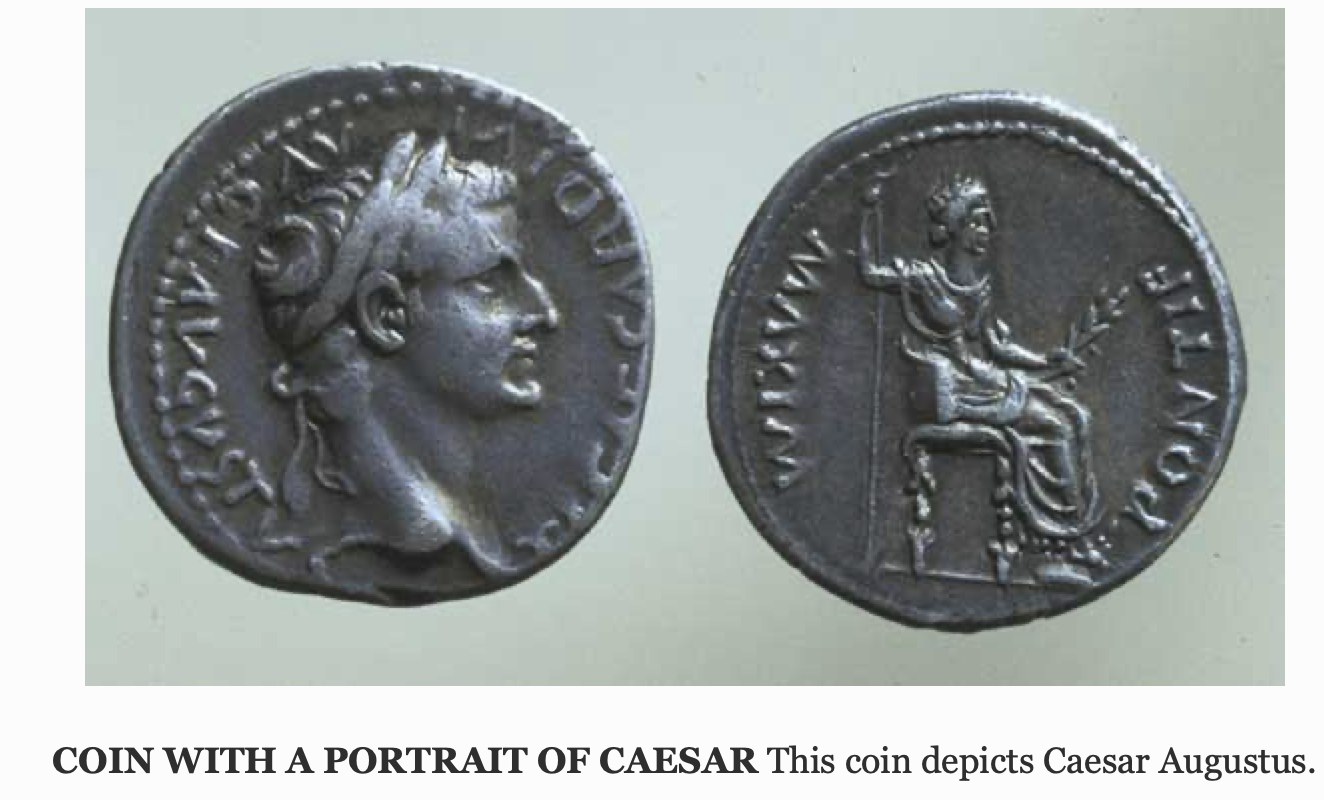
About Paying Taxes to Caesar.
(Mat. 22:15-22; Mark 12:13-17; Luke 20:20-26).
Among their disciples and the Herodians, the adherents of Herod, to whom not everybody wanted to pay taxes as he was of another tribe, the Pharisees chose the most cunning people and sent them to the Lord with a devious question: “Tell us, therefore, what do You think? Is it lawful to pay taxes to Caesar, or not?” That sneaky question was aimed at catching the Lord. If He answered that they had to pay taxes to the heathen emperor, hated by the Jews, He would alienate Himself from the people, and if He told not to pay them, He would be immediately accused before the Romans of trying to incite the people. Those posing the question had the following hidden thought behind it: The Jewish people are God’s people that recognize only God as their King. Therefore, it could not serve the foreigner, especially the heathen king, as he would then appear as God’s enemy; consequently, what had they to do — pay the taxes to Caesar or maintain their firm loyalty to God? The Lord wisely answered that they had to do both thing — “Render therefore to Caesar the things that are Caesar’s, and to do the things that are God’s”, i.e., fulfill your obligations in the relation to God as well as in the relation to the state authority, for the latter doesn’t contradict the first.
The Shaming of the Sadducees.
(Mat. 22:23-33; Mark 12:18-27; Luke 20:27-40).
After the Pharisees and Herodians were covered with shame, some Sadducees immediately approached the Lord, who represented a sect that didn’t believe in the resurrection of souls and eternal life (see Acts 23:8). They constantly argued with the Pharisees, striving to prove that in the books of Moses there were no indications of the immortality of the soul, but they contained some statements that contradicted to the teachings about the resurrection of the dead, like for example the law about the levirate marriage. It was that argument that they presented to the Lord Jesus Christ to be solved. They invented the story about seven brothers who took the same woman as their wife after the death of the previous husband. From their point of view, that determination of Moses’ law refuted the teaching about the future life, because “when they rise, whose wife she will be?” Saint John Chrysostom rightly notes the improbability of such a story, because the Jews, remarkable for their superstition, would never marry a woman, whose husbands kept dying one after another. The Lord gave the Sadducees a wise answer, exposing them for not comprehending the future eternal life, where there will be no physical sensation, and the people will live a different life
— spiritual, angelic, “but are like Angels in Heaven”. If people were totally obliterated after death, then God would not have said to Moses, appearing in the burning bush: “I am the God of Abraham, the God of Isaac, and the God of Jacob” because “God is not the God of the dead, but of the living”, i.e., those forefathers that have died are alive to God, because God cannot be God of the non-existent. Saint Luke notes that even the Scribes were pleased with the response and could not help saying: “Teacher, You have spoken well.” The people, seeing the Sadducees shame, marveled at the Lord’s wisdom.
About the Greatest Commandment.
(Mat. 22:34-46; Mark 12:28-37; Luke 20:40-44).
Having heard of the Sadducees’ shame, the Pharisees immediately gathered in the temple and decided to propose to Jesus, the most difficult (in their opinion) of all questions — which was the greatest commandment within the law. If we take into account that the Jewish Scribes made distinctions between the major and minor commandments in the law, about what they have been constantly quarreling, the guile of the question becomes quite clear. Some regarded the main commandment that of the sacrifice, others — about the Sabbath, still others — that of the circumcision. Generally speaking, they regarded the laws of rites as being the most important ones. The Lord answered that question by quoting the words of Deuteronomy (6:5): “Love the Lord thy God with all thine heart, and with all thy soul, and with all thy might,” and added, that “the second is like it: ‘you shall love your neighbor as yourself.”(Lev. 19:18). Saint Mark adds that the Lord’s answer made such a profound impression upon the very lawyer that he exclaimed: “Well said teacher. You have spoken the truth.” His sincerity impressed the Lord, and seeing that that sinner could reform, He said to him: “You are not far from the Kingdom of God.” After all those unsuccessful attempts to catch the Lord with His words, the Pharisees did not dare to ask Him any further questions about anything. However, in order to show them their lack of knowledge of the Scriptures and how ignorant they were in their false understanding of the Messiah, the Lord posed them a question: “What do you think about the Christ? Whose Son is He?” Without giving it any thought, they answered: “David’s”, because naturally thinking, David was promised that the Messiah would emerge from his kin. And in response, the Lord as though answered — so you think that Christ was just a man, but David himself said with the Holy Spirit: ‘ The Lord said to my Lord, “Sit at My right hand… If Messiah-Jesus was a mere descendant of David, then how could He have existed at the time David was writing about Him. Consequently, if He existed then and David called Him his Lord, He was not a mere human as the Pharisees thought, but also God, i.e., Human God. Blinded by the letter of the law and having lost the keys towards the correct understanding of its meaning, the Pharisees could give no reply to the Lord’s question. Thus, the Lord exposed their ignorance, concerning the law, while simultaneously gave them the testimony of His Divine worthiness and eternal existence. Having experienced such a serious defeat, the Pharisees didn’t dare to tempt the Lord with their insidious questions, while the people listened to Him with great enjoyment (Mark 12:37).
The Exposure of the Scribes and Pharisees.
(Mat. 23:1-39; Mark 12:38-40; Luke 20:45-47)
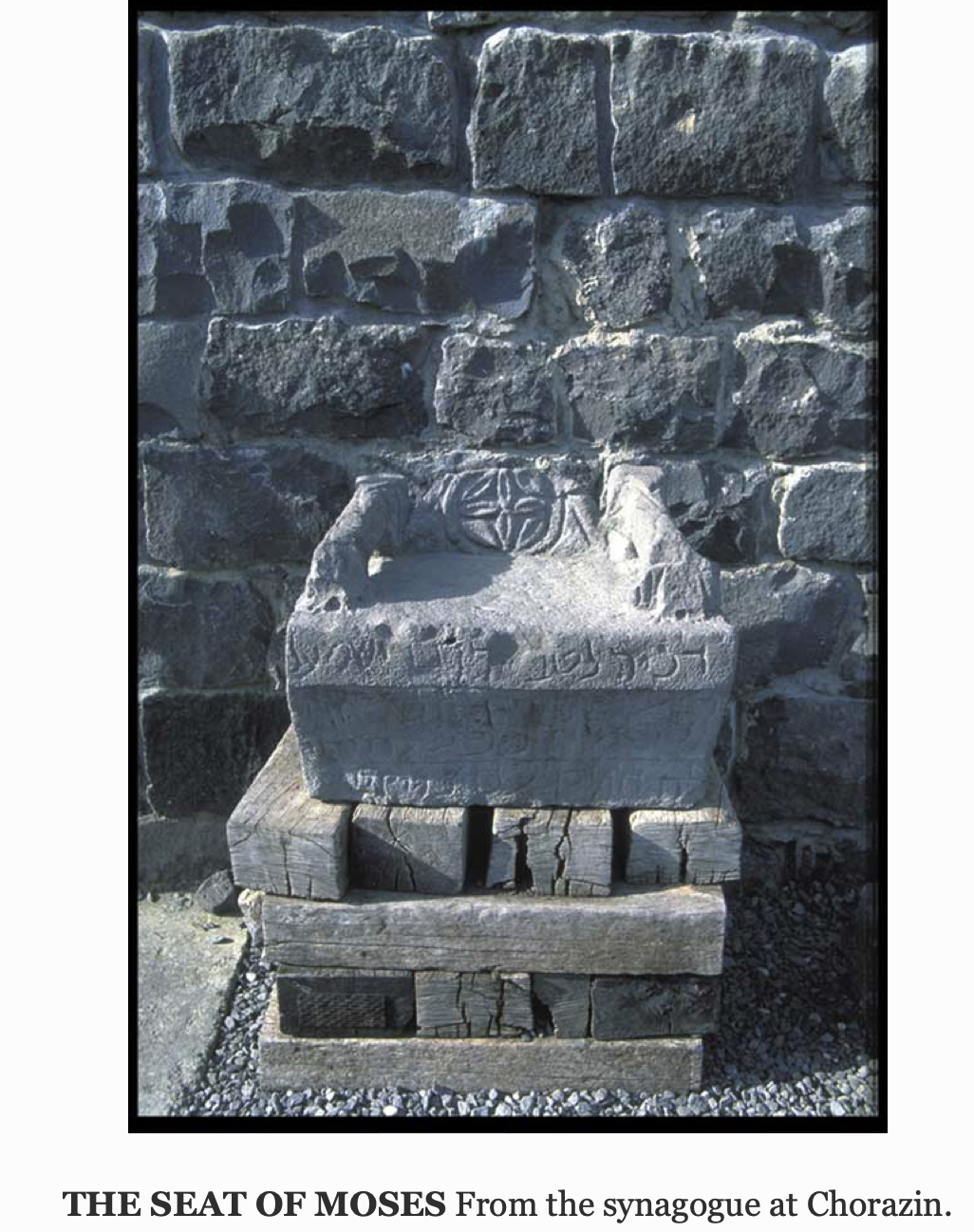
Having shamed the Pharisees and made them speechless, the Lord in order to warn His disciples and the people against the Pharisee spirit, pronounced a formidable accusatory speech against them, in which He condemned their main delusion, concerning the teaching and life itself. This speech is narrated in full only by Evangelist Matthew, while Saint Mark and Luke present only the excerpts from it. The Lord began that speech with the words: “The Scribes and the Pharisees sit in Moses’ seat,” i.e., they have occupied Moses’ place and appropriated the exclusive right to interpret and teach the people the Law of Moses. “Therefore, whatever they tell you to observe, that observe and do, but do not do according to their works” — here the Pharisees are accused of teaching the law while not living according to it themselves. Of course, “whatever” has to be understood with a limitation, because the Savior himself often accused the Scribes and Pharisees in their incorrect understanding and interpretation of the Law commandments. “They bind heavy burdens, hard to bear…” — just as heavy loads upon the animals, they “lay them on men’s shoulders,” all the multiple and varied resolutions of the law of Moses (Acts 15:10), strictly demanding from the people their fulfillment up to the last detail, while themselves do not want to assist them in it. When the Pharisees do fulfill something that they demand from the others, it is not for the sake of pleasing God, but to show off and receive the public praise. “They make their phylacteries broad”, i.e., without any need but just to impress people and enlarge those leather bags or boxes, which contained the sheets of papyrus or parchment with the phrases from the law: Exodus 13:1-9; Deut. 6:4-10 and 11:13-22, which during the prayer, they were attached with belts — one to the forehead and the other to the left arm.
The custom of carrying these depositories came out from the literary interpretation of the words from Exodus 13:9; “And it shall be for a sign unto thee upon thine hand, and for a memorial between thine eyes.” The Jews believed that those depositories protected them against the evil spirits, “and enlarge the borders of their garments” — those were the four brushes being sown to the edge of the outer garment, and the ruby-colored threads coming from the brushes along the edges. To make them and to wear was directed by the law, as a reminder of God’s commandments and in order to distinguish the Jews from other nations (Num. 15:37-40). Because of their vanity, the Pharisees made those brushes bigger than normal. “Love…the best seats in the synagogue, and the best places at feasts” — in those times, people dined not sitting but reclined on the special long and broad pillows, resting against the table, which resembled the letter U. The privileged places and those of honor were in the centre of the table, and were the seats the Pharisees sought: while in synagogues they demanded to occupy the places closest to the lectern.
“And do not be called teachers ”. This means: “Do not seek to be honored as teachers, fathers and instructors, because in the personal sense, the only Father to everyone is God, and the only Instructor and Teacher is Christ. Such forbiddance to be called a teacher, father or instructor, must not be interpreted literally — like the sects do — because as can be seen through the Apostolic Epistles, the very Apostles used those terms in relation to themselves: 1 John 2:13; Ephes. 6:4; Phil. 2:22; Acts 13:1; James 3:1; Romans 2:20, 4:16; 1 Cor. 4:15,
12:28-29, 1 Tim. 2:7; 2 Tim. 4:3; Heb. 5:12, 13:7, 17. It’s should not be permitted that the Apostles violated what was given to them Christ’s commandment by using those names. The correct interpretation is that this commandment related to the Apostles personally, warning them against extolling one before another and suggesting that they all are equal among themselves and anyone wishing to become greater, must become a servant to the rest. One should not render honor that is befitting only God to the man, and it is excessive to revere teachers and instructors as though they are pronouncing their own words and not the Word of God. “But woe to you, Scribes and Pharisees, hypocrites! For you shut up the Kingdom of Heaven against men…” because you did not believe in the Messiah Christ, and turned others away from that saving faith. “You devour widows’ houses…” you deceive widows with your seeming piety and plunder their possessions. “You travel land and sea…” you receive the converts from heathens and do not care about instructing them in true faith — and further corrupt them with the bad example of your hypocritical life. “Woe to you, blind guides, who say, ‘Whoever swears by the temple, it is nothing; but whoever swears by the gold of the temple, he is obliged to perform it” — the Jewish scholars made distinctions between minor and major oaths, and taught that it wasn’t necessary to fulfill the first. They regarded swearing with the church gold or a gift as major, while with the church itself or its altar, as minor. The Lord points out that to swear with any of these items means to swear with God Himself and therefore — one must not break the oath. “Woe to you, scribes and Pharisees, hypocrites! For you pay tithe of mint and anise and cummin, and have neglected the weightier matters of the law: justice and mercy and faith.” In fulfilling the law regarding tithes (Num. 18:20-24; Deut. 14:22-28), the Pharisees used to pay their tithes even of those herbs that were not mentioned in the law because of their insignificance. The Lord exposed them because while they strictly fulfill the trivial, they ignore the important, such as: justice in court matters, benevolence towards the poor and miserable, faithfulness to God and His law.
“Who strain out a gnat and swallow a camel!” — this was a proverb in the East: concerned about trifles while neglecting the important things, the Pharisees were akin to those who strain out a gnat that has fallen into a drink, but swallow a whole camel (naturally, in the hyperbolic sense), i.e., permit grave sins. “You cleanse the outside of the cup and dish, but inside they are full of extortion and self-indulgence” — the outward cleanliness of the vessel, which concerned the Pharisees, is compared with the inward content of the vessel — the food, gained through plunder and injustice. First of all, it is necessary to care about this inner cleanliness, so that to acquire the daily bread in the honest way. “You are like whitewashed tombs” i.e., whitewashed with lime. Every year, on the 15th day of the month of Adar, the caves that served as burial places had their coffins whitewashed so that they would not be approached and touched by passers-by, as that would — according to the law (Num. 19:16) — cause the unclean state for 7 days. From the outside, those whitewashed coffins looked attractive: just as the Pharisees, who outwardly seemed righteous, but in reality, were hypocrites and lawbreakers. Further the Lord exposes the Pharisees for building tombstones to the Prophets and adorning monuments to the righteous, who were slain by their fathers. They seemingly worship the slain righteous, but in reality are worse than their fathers (from whom they originated and feel proud about it), because they are ready to kill the Lord Himself . “Fill up, then, the measure of your father’s guilt” — i.e., you will surpass the villainy of your fathers. “I send you Prophets…” — means the sending of the Apostles and their colleagues to preach evangelical teaching; here, the Lord predicts how the Jews will pursue and persecute them, resembling their fathers that murdered the Old Testament Prophets. “That on you may come all the righteous blood” : being evil, the Pharisees will accept the responsibility for all the righteous, whose blood was shed — not only killed by them but by their ancestors, beginning with the blood of Abel killed by his brother Cain, up to the blood of Zechariah, the son of Berechiah, murdered between the temple and the altar.
Some surmise that upon the orders of king Jehoash, Zechariah was stoned to death in the yard of the Lord’s house (2 Chron. 24:20). Though that very Zechariah was called the son of Jehoiada, this may be his second name, because it was a Jewish custom to have two names. Some ancient interpreters like Saints Basil the Great, Gregory the Theologian and others, surmised that he was the father of John the Baptist. For all the transgressions committed by the leaders of the Jewish people — the Pharisees and Scribes — the Lord announces the severe sentence to Jerusalem: “Your house is left to you desolate,” what happened 36 years later, when in the year 70, Titus Flavius with the Roman troops subjected Jerusalem to total destruction. The Lord speaks about this event with deep sadness, pointing at all His love for the malicious people, akin to a bird’s love for its fledglings. “You shall see Me no more till you say, “Blessed is He who comes in the name of the Lord!” — This means the time of Christ’s Second Coming, when even the unbelievers will be forced against their will to worship His Divinity.
The Widow’s Mite.
(Mark 12:41-44 and Luke 21:1-4).
About the “widow’s mite” that had become an aphorism, concordantly narrate two Evangelists: Saint Mark and Saint Luke. There was a treasury, or a large collection plate, located in the so-called “women’s section” of the temple where people placed their free-will donations. It was customary to donate generously before the feast day of Pascha: everybody entering the temple placed a donation on the plate, according to his means and zeal. The wealthy donated large sums, while a poor widow gave two mites. A “mite” was the smallest coin — equal to a quarter of one kopeck: two mites equaled the smallest Roman coin, which was called “quadrant”. Quadrant was equal to half a kopeck or the quarter of as, and 10 as was equal to one denary – it is about 20 kopecks. The Lord stated that the poor widow “has put in more than all”, i.e., not concerning the sum but in comparison with the others’ means. All the others gave from a surfeit that would not cause them problems, when she dedicated to God all that she had, putting in the last.
- The Lord’s Entry into Jerusalem. (Mat. 21:1-11; Mark 11:1-11; Luke 19:28-44; John 12:12-19).
- Driving the Dealers Out from the Temple. (Mat. 21:12-17; Mark 11:15-19; Luke 19:45-48).
- Great Monday
- Great Tuesday. Part 1
- Great Tuesday. Part 2
The Lord’s Entry into Jerusalem. (Mat. 21:1-11; Mark 11:1-11; Luke
19:28-44; John 12:12-19).
The Lord’s Entry into Jerusalem.
(Mat. 21:1-11; Mark 11:1-11; Luke 19:28-44; John 12:12-19).
All four Evangelists describe this great event which serves as the threshold to Christ’s sufferings, accepted for mankind’s sake and its salvation, in quite some detail, but Saint John describes it more briefly than the other three.
The Lord Jesus Christ was about to go to Jerusalem, so that all the prophecies of the Prophets about Him, as of the Messiah, would be fulfilled. He was going to drink the cup of redemption, give His life to deliver many and then to enter into His glory. Consequently, the Lord conducted Himself completely opposite to His previous manner, He desired that His last entry into Jerusalem should be especially triumphant. The first three Evangelists convey the details on the preparation that accompanied that triumphant entry. When the Lord and His disciples, surrounded by the many people that accompanied Him from Bethany and those they came across along the way, came close to the Mount of Olives, He sent two of His disciples ahead with the order to bring a donkey and her colt. The Mount of Olives was called so because of the multitude of the olive trees, growing on it (“elea” is an olive). It is situated to the west of Jerusalem, and is separated from it by the stream of Cedron, which almost absolutely withered in the summer. On the western slopes of the mount, facing Jerusalem, there was the Gethsemane garden. On the eastern slopes there laid two settlements (mentioned by Saints Mark and Luke — Bethphage and Bethany (Matthew speaks only of the first). The view of all parts of Jerusalem from the Mount of Olives was superb.
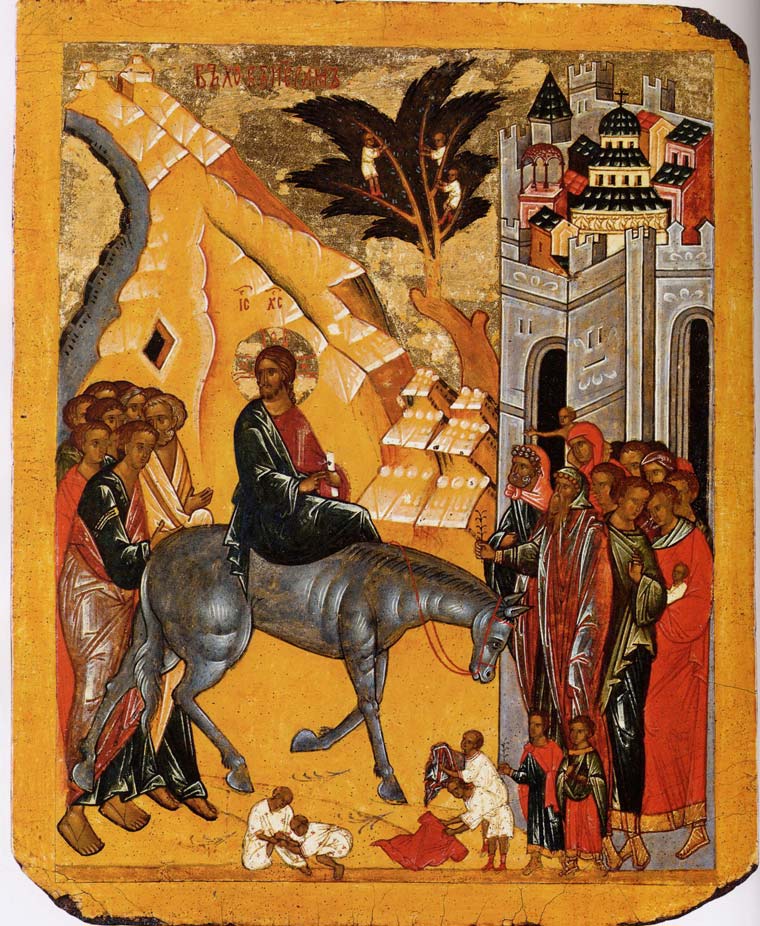
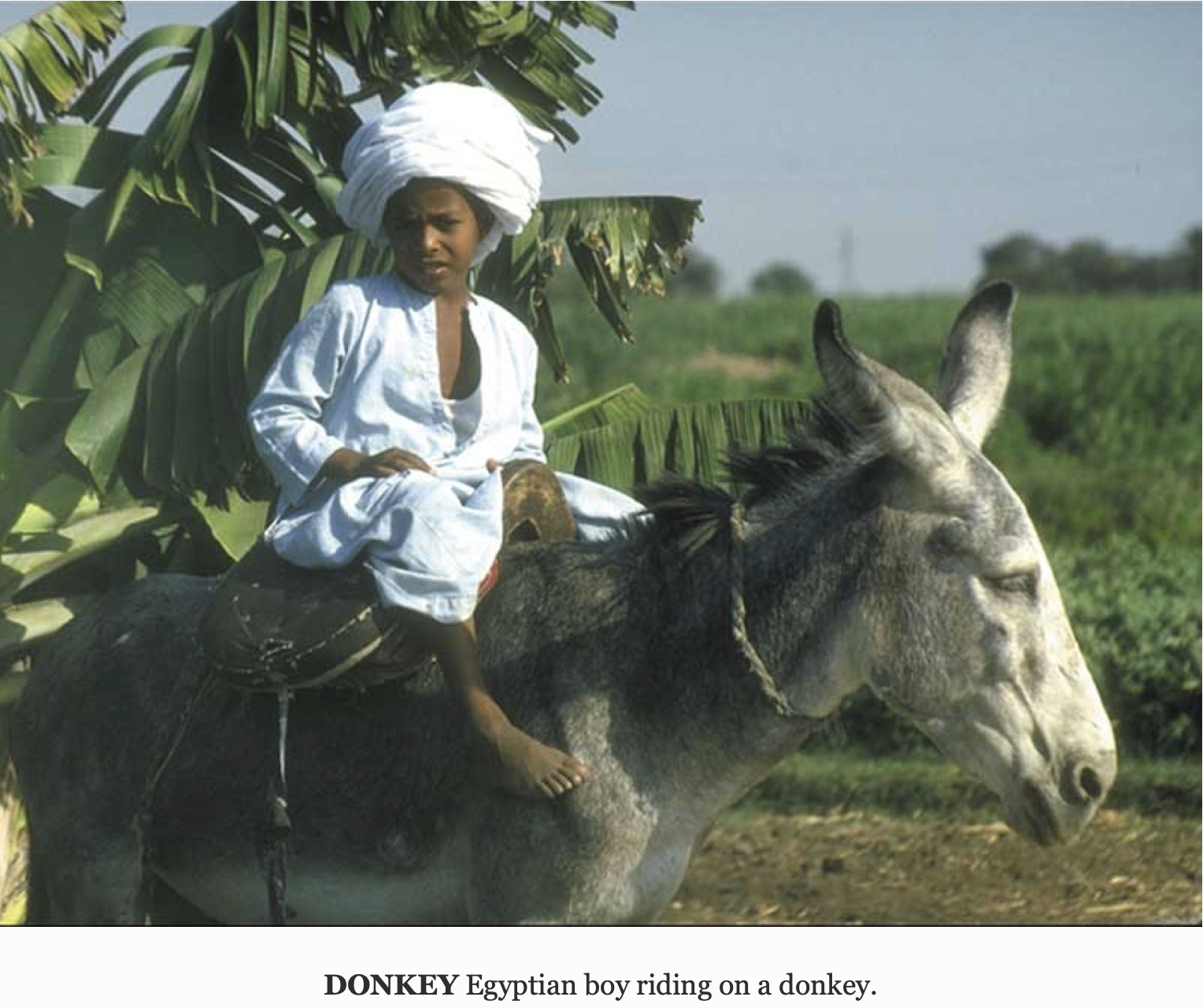
There were two roads from Bethany to Jerusalem: one came around the Mount from the south, while the other traversed through the very top of the Mount: the latter was the shorter route, although more difficult and exhausting. There were very few horses in Palestine and they were used exclusively for warfare. Donkeys, mules and camels were used for the household needs and traveling. To saddle a horse was the sign of war, while to saddle a donkey or mule — the sign of peace. In times of peace, even kings and civil leaders traveled on these animals.
That way, the Lord Jesus Christ’s entry into Jerusalem on a donkey was the symbol of peace: the King of the world travels to His capital on a donkey — it is the emblem of peace. It is remarkable that because of the Lord’s words, the owners of the animals gave them up immediately when they were told by the Apostles, for Whom they were taking them. Noting the incredibility of this circumstance, Saint John Chrysostom says that the Lord wanted to reveal through that fact that “When the cruel Jews came to seize Him, He could have prevented that and make them speechless, but He didn’t want that”. Evangelists Matthew and John point out that it was the fulfillment of Prophet Zechariah’s prophecy, quoting it in the short form, which in full reads: “Rejoice greatly, O daughter of Zion; shout, O daughter of Jerusalem: behold, thy King cometh unto thee: He is just, and having salvation; lowly, and riding upon an ass, even upon a colt the foal of an ass”(Zech. 9:9). This prophecy is very close to that of the Prophet Isaiah, from whom Saint Matthew borrows the first words: “Say ye to the daughter of Zion, behold, thy salvation cometh; behold, His reward is with Him, and His recompense before Him”(Isaiah 62:11).
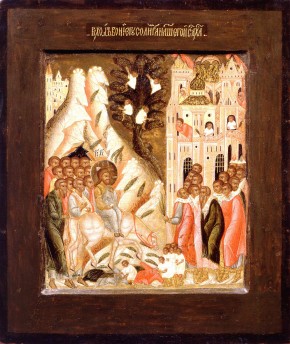
Realizing the magnificence of these moments, the Apostle themselves attempt to adorn this procession with the air of solemnity: they cover the donkey and the young colt with their own clothing, which should as if substitute the golden fabric, which adorned the horses of kings. “After they threw their clothes on him…” As it is clearly seen from the narratives of Saints Mark, Luke and John, the Lord rode on the colt while, apparently, the donkey walked alongside. Following the example of the disciples, “a very great multitude spread their clothes on the road” while “others”, being poor and not having the outer garments, “cut down branches from the trees and spread them on the road”, to make the path soft and comfortable for the colt, thereby serving and honoring its Rider. Further on, comparing the narratives of all the Evangelists, one can imagine the following scene: “Then, as He was now drawing near the descent of the Mount of Olives”(Luke 19:37), i.e., when they approached the edge of the downward slope, from which opened the amazing sight of Jerusalem opened up, “the whole multitude of the disciples began to rejoice and praise God” for the salvation of the world, brought by Christ, and especially for all the miracles “they had seen.” Saint John adds to this: “A great multitude that had come to the feast, when they heard that Jesus was coming to Jerusalem, took branches of palm trees and went out to meet Him”(John 12:12-13).__
Hence, two multitudes of people blended: one was traveling with the Lord from Bethany, while the other moved from Jerusalem to meet Him. The sight of Jerusalem, seen from the mount in all its glory, evoked elation among the masses that burst into joyful and loud exclamations: “Hosanna! Blessed is He who comes in the name of the Lord! The King of Israel!” In the literal sense, the word “Hosanna” translated from ancient Jewish, means: “Save us”, grant us salvation. This exclamation was used as an expression of joy and reverence, akin to today’s “Long live!”. “Hosanna in the Highest” — is a wish so that in heaven the same joyful exclamation “Hosanna” would also be brought as a gift to the King of Israel, the Son of David. “Blessed is He who comes in the name of the Lord ” — means: worthy of the blessing or worship is the One, Who comes from Jehovah with His directions, His authority, just as the messengers and leaders arrive from the earthly king in order to substitute him (compare John 5:43). Evangelist Mark attaches to it the following exclamation: “Blessed is the kingdom of our father David. That comes in the name of the Lord!”
_
_
David’s Kingdom had to be re-established by the Messiah, Whose throne was to remain forever and His authority had to spread over all nations. It is in these words that the sons of Israel are glorifying Christ, coming to restore this kingdom of David. Saint Luke conveys another exclamation: “Peace in Heaven,” in the sense that all true spiritual blessings and eternal salvation descend from Heaven.
Saint John explains that the Lord’s recent resurrection of Lazarus was the cause for such joyous greetings of Him, while Saint Luke’s reason is in the Lord’s miracles in general. Our Church perceives this event as the special Divine arrangement and the instilling of the Holy Spirit, about which the Synaksarion on the Week of Palms tells: “This was caused by the Holy Spirit.” From this point of view, the Lord’s reply to the sly and full of hatred advice of the Pharisees is understandable: “Teacher, rebuke Your disciples(because You, like ourselves, understand how all this is indecent and dangerous for Yourself)” — “If these should keep silent, the stones would immediately cry out”(Luke 19:39-40); i.e., this praise to Christ the Messiah has been set in the hearts and lips of the people by God Himself, and if the people would oppose this directive, then soulless stones would replace these people in worshipping the Lord. The Church also sees in these words the allegorical reference to the heathens, who formerly had the hearts of a stone, but consequently replaced Israel, which rejected Christ. The same meaning is contained in Apostle Matthew’s narration about the Lord’s response to the Pharisees, indignant through their hatred and envy about the fact that the children in the temple exclaimed: “Hosanna to the Son of David!” — “Have you never read, ‘Out of the mouth of babes and nursing infants, You have perfected praise?’” , that is God Himself perfected His praise out of the mouth of babies and sucklings (Psalm 8:3; Mat. 21:15-16).
As Saint Luke relates (19:41-44) looking at the city, the Lord “wept over it” because of its soon destruction. Remarkably, when the Romans started their siege of Jerusalem in the year 70, they pitched their camp on the exact place of the Mount of Olives where Christ the Savior was at that time. The very siege began not long before Pascha . “If you had known, even you, especially in this your day, the things that make for your peace! But now they are hidden from your eyes.” — O people of Israel, if only now you comprehended that this is for your salvation; but you stubbornly close your eyes not to see. In rejecting Me, you hasten your own destruction … “Because you did not know the time of your visitation ”, i.e., that favorable time, when God showed His special mercy and beckoned you towards salvation through the Messiah that was sent to you.
Saint Matthew observes that “when He had come into Jerusalem, all the city was moved” — so great the impact from this triumphant meeting was.
The Lord’s Entry into Jerusalem. (Mat. 21:1-11; Mark 11:1-11; Luke
19:28-44; John 12:12-19).
The Lord’s Entry into Jerusalem.
(Mat. 21:1-11; Mark 11:1-11; Luke 19:28-44; John 12:12-19).
_
_
Related Concepts
- abolition-of-the-high-priesthood-and-sanhedrin
- abraham-isaac-and-jacob
- acts-1346
- angelic-life
- ascension
- authority-in-the-church
- authority-of-christ
- christs-authority
- christs-hunger-at-the-fig-tree
- christs-love-for-israel
- christs-word-as-commandment-of-the-father
- chrysostoms-interpretation
- church-and-state
- church-as-new-israel
- civil-obedience
- cleansing-the-outside-of-the-cup
- conversion-of-the-gentiles
- cross
- demonology
- deuteronomy-65
- divine-worthiness
- doubt
- election
- eschatological-judgment
- exodus-36
- faith-and-unbelief
- fruitfulness
- fruits-of-faith
- fulfilment-of-prophecy
- gentile-calling
- gethsemane
- gethsemane-struggle
- glorification
- gods-love
- gospel-criticism
- gospel-harmony
- grain-of-wheat
- grain-of-wheat-falling-into-the-ground
- harmony-of-the-gospels
- herodians
- high-priests-avarice
- hosanna
- human-paralysis-before-god
- hypocrisy
- immortality-of-the-soul
- inerrancy-of-scripture
- jewish-expectation-of-an-earthly-messiah
- judgment
- judgment-on-israel
- judgment-on-unbelief
- justification-by-works-vs-repentance
- kingdom-of-god
- levirate-marriage
- leviticus-1918
- lifting-up
- lifting-up-from-the-earth
- liturgical-acclamation
- liturgical-interpretation
- love-of-neighbour
- luke-1941-44
- mark-1125-26
- matthew-2143
- messianic-expectation
- mission-to-the-gentiles
- moses-seat
- new-israel
- new-testament-church
- now-my-soul-is-troubled
- obedience
- outward-versus-inward-purity
- palm-sunday
- paschal-donation
- penitence
- pharisaic-hypocrisy
- poverty
- prayer-of-christ
- prayers-efficacy
- pre-existence-of-christ
- prophecy-of-ad-70
- prophetic-sign-acts
- proselytes
- ps-118
- psalm-110-1091
- replacement-theology-typological
- resurrection
- revelation
- ruler-of-this-world
- sadducees
- scribes-ranking-of-commandments
- second-coming
- sectarian-literalism
- self-dedication
- self-denial
- self-offering
- service
- son-of-david
- spiritual-discernment
- supersession-of-israel
- synoptic-problem
- taxation
- temple-treasury
- temple-worship
- temptation
- the-barren-fig-tree
- the-chief-cornerstone
- the-vineyard-leased-to-others
- the-wedding-banquet
- theanthropic-person
- treasury
- tribute-to-caesar
- two-cleansings-of-the-temple
- two-natures
- two-wills
- two-wills-and-two-natures
- universal-salvation
- vainglory
- wedding-banquet
- wedding-garment
- whitewashed-tombs
- withered-fig-tree
- woes
- woes-against-the-scribes-and-pharisees
- zechariah-99