New Testament — Topic 2
The canon of the New Testament. Its origin in general.
Document. From the thirty-ninth Letter of Holy Athanasius, Bishop of
Alexandria, on the Paschal festival.
From Letter XXXIX. - (For 367.) Of the particular books and their number, which are accepted by the Church. From the thirty-ninth Letter of Holy Athanasius, Bishop of Alexandria, on the Paschal festival; wherein he defines canonically what are the divine books which are accepted by the Church.
…1. They have fabricated books which they call books of tables, in which they show stars, to which they give the names of Saints. And therein of a truth they have inflicted on themselves a double reproach: those who have written such books, because they have perfected themselves in a lying and contemptible science; and as to the ignorant and simple, they have led them astray by evil thoughts concerning the right faith established in all truth and upright in the presence of God.
…2. But since we have made mention of heretics as dead, but of ourselves as possessing the Divine Scriptures for salvation; and since I fear lest, as Paul wrote to the Corinthians, some few of the simple should be beguiled from their simplicity and purity, by the subtilty of certain men, and should henceforth read other books - those called apocryphal - led astray by the similarity of their names with the true books; I beseech you to bear patiently, if I also write, by way of remembrance, of matters with which you are acquainted, influenced by the need and advantage of the Church.
3. In proceeding to make mention of these things, I shall adopt, to commend my undertaking, the pattern of Luke the Evangelist, saying on my own account: “Forasmuch as some have taken in hand,” to reduce into order for themselves the books termed apocryphal, and to mix them up with the divinely inspired Scripture, concerning which we have been fully persuaded, as they who from the beginning were eyewitnesses and ministers of the Word, delivered to the fathers; it seemed good to me also, having been urged thereto by true brethren, and having learned from the beginning, to set before you the books included in the Canon, and handed down, and accredited as Divine; to the end that anyone who has fallen into error may condemn those who have led him astray; and that he who has continued steadfast in purity may again rejoice, having these things brought to his remembrance.
4. There are, then, of the Old Testament, twenty-two books in number; for, as I have heard, it is handed down that this is the number of the letters among the Hebrews; their respective order and names being as follows. The first is Genesis, then Exodus, next Leviticus, after that Numbers, and then Deuteronomy. Following these there is Joshua, the son of Nun, then Judges, then Ruth. And again, after these four books of Kings, the first and second being reckoned as one book, and so likewise the third and fourth as one book. And again, the first and second of the Chronicles are reckoned as one book. Again Ezra, the first and second are similarly one book. After these there is the book of Psalms, then the Proverbs, next Ecclesiastes, and the Song of Songs. Job follows, then the Prophets, the twelve being reckoned as one book. Then Isaiah, one book, then Jeremiah with Baruch, Lamentations, and the epistle, one book; afterwards, Ezekiel and Daniel, each one book. Thus far constitutes the Old Testament.
5. Again it is not tedious to speak of the [books] of the New Testament. These are, the four Gospels, according to Matthew, Mark, Luke, and John. Afterwards, the Acts of the Apostles and Epistles (called Catholic), seven, viz. of James, one; of Peter, two; of John, three; after these, one ofJude. In addition, there are fourteen Epistles of Paul, written in this order. The first, to the Romans; then two to the Corinthians; after these, to the Galatians; next, to the Ephesians; then to the Philippians; then to the Colossians; after these, two to the Thessalonians, and that to the Hebrews; and again, two to Timothy; one to Titus; and lastly, that to Philemon. And besides, the Revelation of John.
6. These are fountains of salvation, that they who thirst may be satisfied with the living words they contain. In these alone is proclaimed the doctrine of godliness. Let no man add to these, neither let him take ought from these. For concerning these the Lord put to shame the Sadducees, and said, “Ye do err, not knowing the Scriptures.” And He reproved the Jews, saying, “Search the Scriptures, for these are they that testify of Me.”
7. But for greater exactness I add this also, writing of necessity; that there are other books besides these not indeed included in the Canon, but appointed by the Fathers to be read by those who newly join us, and who wish for instruction in the word of godliness. The Wisdom of Solomon, and the Wisdom of Sirach, and Esther, and Judith, and Tobit, and that which is called the Teaching of the Apostles, and the Shepherd. But the former, my brethren, are included in the Canon, the latter being [merely] read; nor is there in any place a mention of apocryphal writings. But they are an invention of heretics, who write them when they choose, bestowing upon them their approbation, and assigning to them a date, that so, using them as ancient writings, they may find occasion to lead astray the simple.
Document. From the thirty-ninth Letter of Holy Athanasius, Bishop of
Alexandria, on the Paschal festival.
History of the Word κανών
The development and chief meanings of the word in Greek are the following. The Greek κανών denotes primarily а __straight rod, and from this comes numerous derivative uses of the term, in many of which the idea of straightness is manifest. Since а rod was employed to keep other things straight, or as а test of straightness, κανών __ frequently refers to а level or plumbline, the tool used bу а carpenter or а mason in determining the right direction of а piece of wood or а stone that is used in а building. Besides being straight, for other uses the κανών __ had to bе incapable of bending. Thus, the word refers to the beam of а balance as well as the scribe’s ruler (translated bу the Latin regula). It is from this literal sense of а level or а ruler that all the metaphorical senses аге derived.
Very broadly, а κανών __ provides one with а criterion or standard(Latin norma) bу reference to which the rectitude of opinions or actions mау bе determined. With reference to literature and style, the grammarians of Alexandria gave the name κανών __ to the collection of classical works deemed worthy of being followed as models because of the purity of their language. In chronology the canons were the chief epochs or eras, which served to determine all intermediate dates. In music the monochord, bу which all other tonal relationships are controlled, was described as the κανών μουσικός. The schedule or ordinance fixing the amount of grain or other tribute to bе paid bу а province gives its name to the amount itself, and so κανών __ comes to mean а (yearly) tax. Finally, in Latin during the Middle Ages**** the word was used for the straight metal tube directing а gunpowder projectile, and in this sense it eventually became ‘cannon’.
In the New Testament κανών occurs only in the Epistles of Paul, and then only rarely (four times in two passages). For example, ‘Peace and mercy bе upon all who walk according to this κανών __(Gal 6:16), here referring to acknowledged Christian behavior.
As for the use of κανών __ bу early patristic writers, we are not surprised that they often employ the word in the sense of rule or norm. From about A.D.**** 300 onwards the word occurs also in the plural number. Thus, the regulations or decrees promulgated bу councils and synods are designated κανόνες of Christian action. The first Council that gave the name canons to its decisions оn doctrine and discipline was that held at Antioch in A.D.**** 341. Not far from this meaning is the use of ‘canon’ to designate religious or monastic rules, as well as those who live according to а certain ecclesiastical rule.
Another development in the use of the word κανών __(and one that bears closely upon its subsequent reference to the books of Scripture) was the application of the word to а list, index, or table-terms that carry the suggestion of something fixed and established, bу which one may orient oneself. The astronomical tables of Claudius Ptolemaeus _(_с . A.D. 150) offered fixed reference points in the changes of the seasons. In а related usage, the ten κανόνες that Eusebius drew up for his edition of the four Gospels were not some kind of rules or principles, but were systematically arranged lists of numerals that corresponded to the numbered sections in the text of the Gospels, bу which one could quickly locate parallel passages. The method bу which they had been elaborated, and the directions for their use, were set forth in an accompanying letter that Eusebius addressed to his friend Carpianus. Somewhat similar were the canones drawn up in Latin bу Priscillian _(_с . 375), listing the subject-matter in the Pauline Epistles, with references attached.
Within the broad spectrum of these many applications of the word κανών , it is not surprising that eventually the word came also to bе applied to the list of books regarded as authoritative for Christians. This use of κανών __ was late in developing; so far as we have evidence, it was not until the second half of the fourth century that κανών __ were applied to the Scriptures. The first instance is in Athanasius’ Decrees of the Synod of Nicaea, written soon after 350, in which (no. 18) he describes the Shepherd of Hermas as not belonging to the canon. In A.D. 363 the Council of Laodicea in Phrygia declared _(_Саn . 59) that only the canonical books , as opposed to the uncanonical books , ought to bе read in Church. In 367 Athanasius identified which books are in fact the canonical books __ in opposition to the apocrypha; this is the earliest listing of the twenty-seven books of the New Testament. The use of the word κανών __ for the whole collection is still later, the clearest instance occurring in а poem (Iambi ad Seleucum) composed about A.D. 380 bу Amphilochius, bishop of Iconium. The expression ‘canon of the New Testament’ occurs for the first time in the Apocriticus of Macarius Magnes, an apologia written about A.D. 400.
- History of the Word κανών
- The origin of the canon of the New Testament in general.
- Document. From the thirty-ninth Letter of Holy Athanasius, Bishop of Alexandria, on the Paschal festival.
The origin of the canon of the New Testament in general.
The recognition of the canonical status of the several books of the New Testament was the result of а long and gradual process, in the course of which certain writings, regarded as authoritative, were separated from а much larger body of early Christian literature. This was one of the most important developments in the thought and practice of the early Church.
Despite the silence of patristic writers as far as explicit accounts of the canonization process are concerned, there is a general unanimity among modern scholars as to what must have been some of the factors that brought about the recognition of the New Testament canon. It will be helpful to sketch briefly some of the more firmly established landmarks.
1. From the first day of its existence the Christian Church possessed а canon of sacred writings - the Jewish Scriptures, written originally in Hebrew and widely used in а Greek translation called the Septuagint. The precise boundaries of the Jewish canon may not yet have been finally fixed, but there was already sufficient definition for its books to be referred to collectively as “Scripture” (ἡ γραφή) or “the Scriptures” (αἱ γραφάι), and citations from it were introduced by the formula “it stands written” (γέγραπται).
Jesus accepted the Hebrew Scriptures as the word of God and frequently argued from them in his teaching and controversies. And in this respect he was followed by the first Christian preachers and teachers, who appealed to them to prove the correctness of the Christian faith. The high regard of the primitive Church for the Old Testament (to use the traditional Christian designation for the Hebrew Scriptures) was fundamentally due to the conviction that its contents had been inspired by God ( 2 Tim. 1:16; 2 Pet. 1. 20).
2. In the oldest Christian communities there was also another authority which had taken its place alongside the Jewish Scriptures, and that was the words of Jesus, as they were handed down in oral tradition. During his public ministry Jesus had claimed to speak with an authority in no way inferior to that of the ancient Law, and had placed his utterances side by side with its precepts by way of fulfilling or even correcting and repealing them. This is clearly shown, for example, by his position on the question of divorce (Mark 10:2 and parallels) and on unclean foods (Mark 7:14-19), pronouncements that are reinforced by the implications of the so-called antitheses reported by Matthew in the Sermon on the Mount (Matt. 5:21-48: “of old it was said… but I say to you”).
It is not surprising, therefore, that in the early Church the remembered words of Jesus were treasured and quoted, taking their place beside the Law and the Prophets and being regarded as of equal or superior authority to them. It is to such “words of the Lord”, for example, that the apostle Paul appeals so confidently on various occasions to enforce some lesson ( 1 Cor. 9:14; cf. Luke 10: 7), or to settle some difficulty (1 Thess. 4:15; 1 Cor. 7:10), or to confirm some rite (1 Cor. 11:23).
At first Jesus’ teachings circulated orally from hearer to hearer, becoming, so to speak, the nucleus of the new Christian canon. Then narratives were compiled recording the remembered words, along with recollections of his deeds of mercy and healing. Some documents of this kind underlie our Gospels, and are referred to in the preface to the Third Gospel (Luke 1:1-4).
3. Parallel with the oral circulation of Jesus’ teachings were apostolic interpretations of the significance of his person and work for the lives of believers. These interpretations, along with exhortations, were communicated directly to newly established congregations during the earliest missionary activity. Ву means of epistles, moreover, it was possible to continue, in some measure, the oversight of congregations after the missionaries had moved on to other areas, or even to communicate directives to believers in cities not previously visited (as, for example, in the Epistles to the Romans and to the Colossians).
On occasions when Paul had to decide а matter on which there was no dominical word, he appealed to his claim that he was one “commissioned by the Lord”, and had the Spirit of God ( 1 Cor. 7:25, 40). He regarded his instructions or commands (1 Cor. 14:37) to be “of the Lord” - in other words, that the Lord himself was speaking through him (cf. 1 Thess. 2:13). In virtue of his authoritative commission, Paul even claims that he can place under а curse any other gospel as not coming from God (Gal. 1:7-9; cf. 2 Thess. 3:17). In а similar way, other teachers of the apostolic age also claim authority in issuing precepts and directives (Неb.10:26-7; 13:18-19; 3 John 5-10).
The circulation of Paul’s Epistles began already during his lifetime. This is evident from the apostle’s command that there should be an exchange of (copies of) epistles between the Colossians and the Laodiceans (Col. 4:16). He also addresses the Galatian Epistle “to the churches of Galatia” (Gal. 1:2), and urges that 1 Thessalonians be read “to all the brethren” (1 Thess. 5:27).
The writers of these apostolic Epistles, though confident that they speak with authority, reveal no consciousness that their words would come to be regarded as а permanent standard of doctrine and life in the Christian Church. They write for an immediate purpose, and just as they would have wanted to speak, had they been able to be present with those whom they address. It is natural that such Epistles were cherished and read again and again by the congregations that had first received them, and by others who came to appreciate copies of such valued testimonies from the apostolic age.
4. As time went on, а Christian literature grew in volume and was circulated throughout different congregations. Toward the close of the first Christian century Clement of Rome wrote an epistle to the church at Corinth, and early in the second century Ignatius, bishop of Antioch, while en route to his martyrdom at Rome, dispatched six short epistles to various churches and one to Polycarp of Smyrna. In these and still more in later Christian literature of the second century the writers incorporated ideas and familiar phrases of the apostolic writers, and in а few cases expressly quoted them. Whatever may have been their conscious attitude toward such apostolic documents, it is clear that their thinking was moulded by them from the very first.
At the same time allusions to the superior standing of apostolic writers, living so close to the time of the earthly ministry of Jesus, more and more set the earlier documents apart from contemporary writings and helped to consolidate them as а distinct body of literature. The epistle of Clement and the epistles of Ignatius, for example, clearly breathe the spirit of the sub- apostolic era. Although both display а certain air of authority, there is no longer any consciousness of apostolic authority. They look back at the venerable figures of the apostles as leaders in an age now past ( 1 Clem. 5.3-7; 42.1 ff.; 47.1 ff.; Ign. Trall. 2.2; Magn. 6.1; 7. 2; 13.1). It is not surprising, therefore, that readers could and did distinguish between the ‘tone’ of certain documents, which subsequently were identified as canonical, and that of the ever-growing body of patristic literature.
Early Patristic Quotations of the New Testament
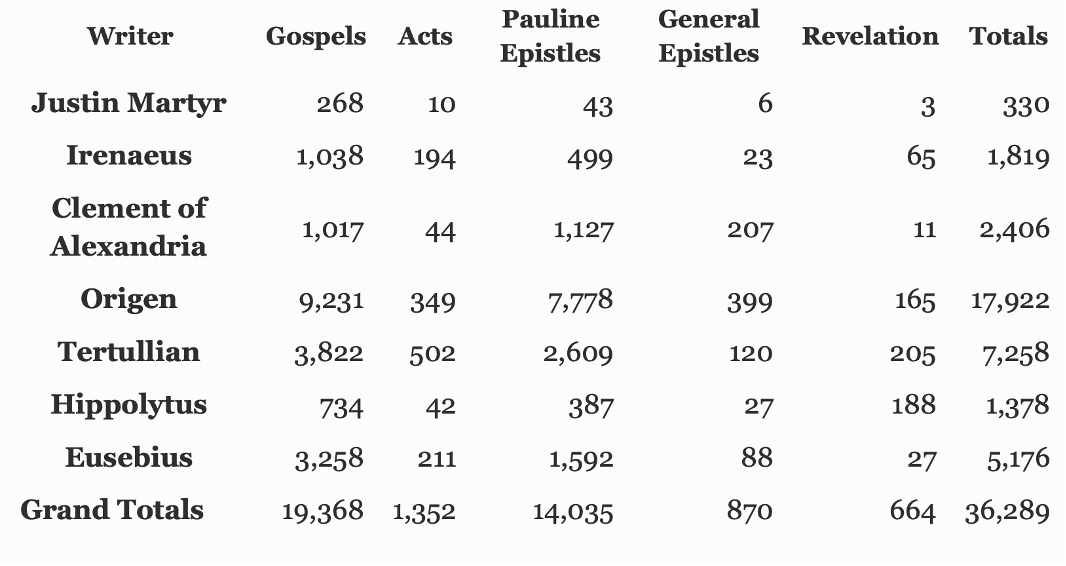
Note: Justin Martyr also made 266 allusions to various New Testament writings.
5. In the age that followed that of the apostles, the expression “the Lord and the apostles” represented the standard of appeal to which reference was made in all matters of faith and practice. At first а local church would have copies of only а few apostolic Epistles, and perhaps one or two Gospels. In the collections that were gradually formed, а place was found beside the Gospels and the Epistles for two other kinds of books - the Acts of the Apostles and the Apocalypse of John. The credentials of the former rested upon its being the continuation of the earlier book by Luke (Acts 1:1 f.), and the sacredness of the latter was vouched for by the blessing pronounced on the one who would read and on those who listened to its prophetic words (Rev. 1:3).
It was this kind of public reading of Christian documents to which Justin Martyr refers about A.D. 150. He tells us that on Sundays at services of divine worship it was customary to read “the memoirs of the Apostles [i.e. the Gospels] or the writings of the Prophets” ( 1 Apol. 67.3). Thus it came about that Christian congregations grew accustomed to regard the apostolic writings as, in some sense, on а par with the older Jewish Scriptures, and such liturgical custom, though doubtless varying in different congregations, set its seal on certain Gospels and Epistles as worthy of special reverence and obedience.
6. In the second and third centuries translations were made of apostolic writings into Latin and into Syriac, and eventually also into the Coptic dialects of Egypt. The beginnings of such versions were doubtless in the context of services of public worship, when the reading of short sections of the Greek text was followed by а translation into the vernacular. At first the rendering would have been oral, but soon written copies would have been made available. The range of books so translated formed а collection of Scripture in these districts, though in some cases this collection included books not generally recognized elsewhere; for example, the Syrian and Armenian churches included Paul’s Third Epistle to the Corinthians.
Thus, side by side with the old Jewish canon, and without in any way displacing it, there had sprung up а new, Christian canon. This history of its formation is the history, not of а series of sporadic events, but of а long, continuous process. It was а task, not only of collecting, but also of sifting and rejecting. Instead of being the result of а deliberate decree by an individual or а council near the beginning of the Christian era, the collection of New Testament books took place gradually over many years by the pressure of various kinds of circumstances and influences, some external and others internal to the life of congregations. Different factors operated at different times and in different places. Some of the influences were constant, others were periodic; some were local, others were operative wherever the Church had been planted.
The New Testament Canon in the First Four Centuries
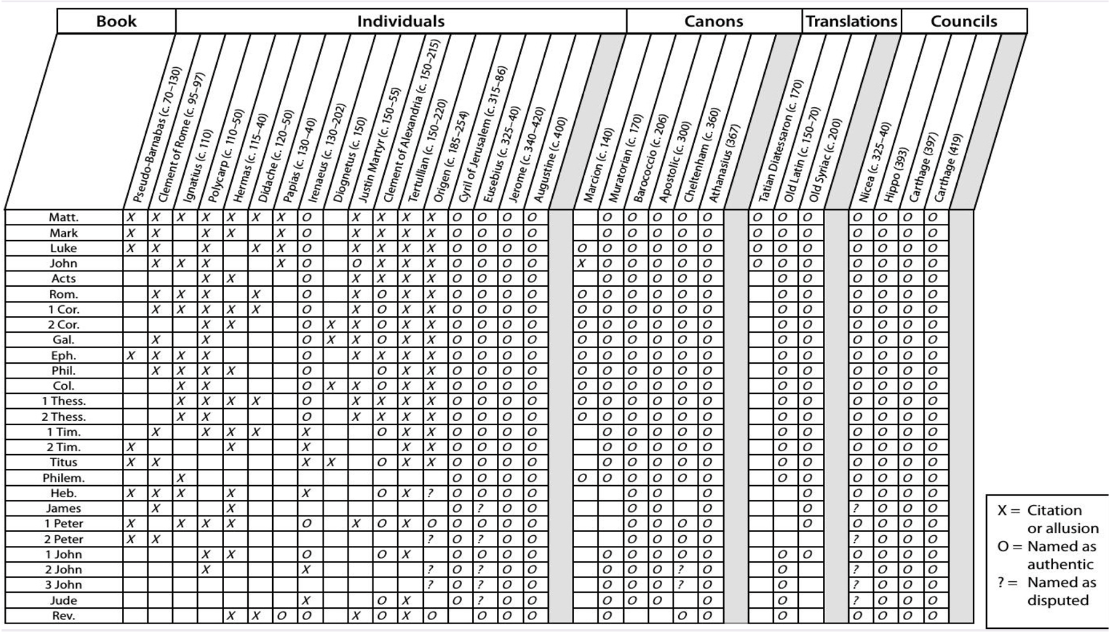
In the earliest period, that of the so-called Apostolic Fathers, not much more is disclosed than testimony as to the bare existence here and there of one or another Gospel or Epistle of the New Testament. In subsequent generations we can gradually perceive the outlines of а collection of four Gospels and of а number of Epistles attributed to Paul and to other early leaders in the apostolic Church. Finally, after many years, during which books of local and temporary canonicity came and went, the limits of the New Testament canon as we know it were set forth for the first time in а Festal Letter (see document 1 below) written A.D. 367 by Athanasius, bishop of Alexandria.
Related Concepts
- 2-peter-120-21
- alphabet-symbolism
- apocrypha
- apostolic-deposit
- apostolic-fathers
- apostolic-preaching
- authority-for-building-up
- biblical-studies
- books-of-tables
- canonical-books
- catechumenate
- church-tradition
- co-authorship
- conciliar-reception
- council-of-laodicea
- council-of-laodicea-canon-59
- criterion-of-truth
- deceit
- deceit-of-the-simple
- deuterocanonical-books
- doctrine-of-godliness
- dominical-sayings
- ecclesiastical-books
- edification
- epistles
- false-apostles
- festal-letters
- fountains-of-salvation
- gospel-formation
- hebrew-canon
- holy-spirit
- human-personality
- justin-martyr
- lection
- letter-as-substitute
- letters-of-recommendation
- lex-orandi
- liturgical-reading
- living-words
- norma
- normaregula
- patristic-literature
- paul
- pauline-authorship
- personal-presence
- providential-development
- providential-history
- public-worship
- regula
- right-faith
- sermon-on-the-mount
- sphere-of-action
- sufficiency-of-scripture
- super-apostles
- the-doctrine-of-godliness
- theopneustia
- translation-and-interpretation
- words-of-the-lord