Liturgics — 8. The Matins
-
The Matins and its features.
-
The Matins.
Matins And Its Ideological Contents.
Matins is a service of the daily cycle, performed according to the Charter
after the Midnight office (and if Matins is part of the All-Night Vigil, then
it is performed immediately after Vespers). This is the longest service of the
daily cycle, because ancient Christians, during the time of persecution, would
mainly organise services at night and in the early morning. 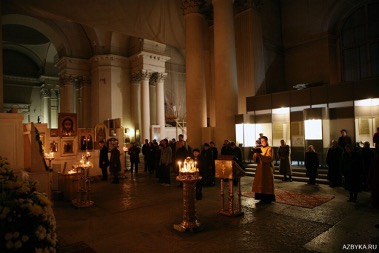
Matins is always served in the church, with the Royal doors open. In practice, the priest is dressed in an epitrachelion, a phelonion and epimanikia throughout the whole Matins.
At present, in parish practice, Matins is usually celebrated in the evening immediately after Vespers (in some places on Sundays after Compline). This takes place both in the case of the All-Night Vigil (when, according to the Rule, it is really necessary to celebrate Matins after Vespers), and in all others cases.
The text of Matins covers the following topics:
• the situation of humanity after the Fall of Man (the Six Psalms);
• Nativity of Christ, His embodiment (“God is the Lord…”);
• the most complete description of the celebrated event, the glorification of the celebrated saint (that is, the canon, as well as (if any) the polyeleos and the stichera sung on “Let us praise”).
In the Matins there are both fixed and changeable prayers. The unchangeable texts of Matins can be found in the Missal, the Psalter and the Book of Hours, whereas the changeable ones are in the Oktoichos, the Menaion and the Triodion.
Types of Matins.
**
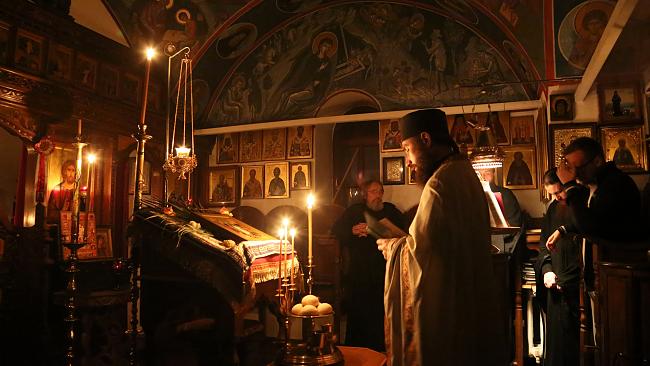 **The Charter of the Orthodox Church distinguishes three
types of Matins.
1. Everyday Matins is performed on weekly days in the case of saints without a sign or the ones sung on the 6thtone. This type of matins, unlike the other ones, does not have festive elements (that is, the polyeleos or the Great doxology are not sung).
2. Matins with the Great doxology is celebrated on weekdays on the feast days of saints with doxology, marked in the Typicon with a sign in the form of a red bracket with three dots inside. Also, Matins with great doxology is appointed by the Charter on the days of apodosis of the twelfth feasts. This Matins differs from the daily one by the singing of the Great doxology and the festive ending.
3. Polyeleic Matins, as can be understood from its name, differs from other types of matins in the singing of polyeleos. This is the most solemn of Matins. Polyeleic Matins, according to the Charter, is appointed on all great, vigil and polyeleic feasts, as well as on Sundays[1].
It is important to note that this classification does not include Paschal Matins, which takes place on all days of Bright Week and the service of which differs significantly from the Polyeleic Matins. Therefore, Paschal Matins occupies an exceptional place among all the other types of Matins[2]. In addition, the daily and polyeleic matins celebrated on the weekly days of the Great Lent also have many features, so their service, which takes into account all the elements of the Great Lent, is usually explained in the sections devoted to services of the Great Lent.
Daily Matins.
The daily Matins, as already mentioned, is celebrated on weekly days in the case of saints without a sign (one or two), as well as saints sung on the 6thtone, marked in the Typicon with a sign in the form of a black bracket with three dots inside. At All-day Matins, the Royal doors do not open (as we have already noted, the veil is always open during Matins), there the Holy Scripture is not read[3]. The priest is dressed only in an epitrachelion, although in practice he also puts on epimanikia and a phelonion. In addition, at the All-day matins (as opposed to the midnight office and hours), the lanterns are lit (see chapter 25 of the Typicon).
The Contents of the Daily Matins.
The rite of daily matins is set given in chapter 9 of the Typicon. At present Matins, in practice, is usually celebrated in the evening, and, therefore, immediately after the end of Vespers (or Compline, if it was served), the priest enters the altar, opens the veil of the Royal gates (in the case of Compline), blesses the censer and, standing before the throne with a censer in his hand, proclaims: “Blessed is our God …”.
Reader: “Amen. Come, let us worship…” Ktetor Psalms(19 and 20). “Glory, now and always[4]**.” Trisagion, “Our Father…”. **
During the reading of the Ktetor psalms, the priest incenses the entire church incense, so the reader must read slowly, so that at the end of “Our Father …” the priest , having already reached the pulpit, could pronounce the exclamation: “For Yours is the Kingdom …”.[5]
Reader : “Amen ” and then reads the troparia from the Book of Hours on the row : “O Lord, save Thy people…”, “Glory”: “As You were voluntarily raised upon the cross.”, “Now and always”: “The intercession is terrible and shameless”.
At this point, the priest enters the altar and, after the troparia are finished, he stands in front of the altar with a censer in his hand and pronounces an abbreviated Litany of Fervent Supplication, consisting of four petitions. After the litanies, an exclamation follows: “For You are a merciful and loving God…”.
Choir : “Amen.In the name of the Lord bless us, father.”
The priest , whilst makin the sign of the cross with the censer, proclaims: “Glory to the Holy, and the Consubstantial, and the Life-making, and Indivisible Trinity, now and forever and to the ages of ages.”
Choir : Amen.****
The reader stands in the church in front of the central lectern with the church icon or the festive icon and reads the Minor doxology (“Glory to God in the highest …”) and the six Psalms (Psalms 3, 37, 62, 87, 102, 142) from the Book of Hours or the Psalter.[6] During the second part of the Six Psalms (after “Glory, now and always”, “Alleluia” (thrice), “Lord, have mercy” (thrice), “Glory, now and always”) the priest, standing on the pulpit, secretly reads the morning prayers from the Missal.[7]
Reader(at the end of the Six Psalms): “Glory, now and always” , “Alleluia ” (three times).
At the end of the reading of the Six Psalms, the deacon leaves through the north door, bows three times with the priest towards the altar, then bows to the priest once, asking him for permission to pronounce the litany. In turn, the priest gives this permission with a bow and enters the altar through the southern door.
The deacon pronounces the Great litany “In peace let us pray to the Lord…”.
The choir responds to each petition with: “Lord, have mercy”.
The priest(at the end of the litany): “For to You belong…”.
Choir : Amen.
Then the deacon and the choir take turns to sing “God is the Lord …” with the verses of the 117thpsalm (“God the Lord …” is sung in accordance with the tone of the first troparion).****
In total,“God is the Lord…” is sung 4 times by the choir, once after each verse, according to the following scheme:
Deacon : “God is the Lord and hath appeared unto us. Blessed is he that cometh in the name of the Lord. O give thanks unto the Lord, for He is good, for His mercy endureth forever.”
Choir : “God is the Lord and hath appeared unto us. Blessed is he that cometh in the name of the Lord.”
Deacon : “Surrounding me they compassed me, and by the name of the Lord I warded them off.”
Deacon : “I shall not die, but live, and I shall tell of the
works of the Lord.”
Deacon : “The stone which the builders rejected, the same is
become the head of the corner. This is the Lord’s doing, and it is marvelous
in our eyes.’’ 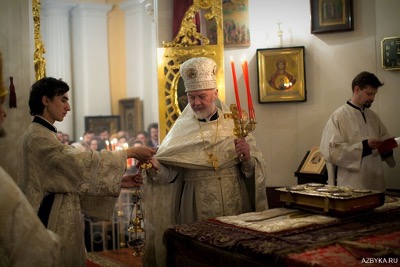
Then the choir sings the troparia according to the Charter.
Chorus : “Lord, have mercy” (three times). “Glory”.
Reader : “Now and always”. Kathisma, according to the Charter (during the summer timetable, as well as always on the eve or afterfeast of the twelfth holiday - 2 kathisma, during the winter timetable - 3 kathisma).
After that, two options are possible:
- during the period before and after the Twelve Great Feasts, during the period of singing the Colored Triod and on Saturdays (after the performance of the kathisma):
Reade r: “Glory, now and always.” “Alleluia”(three times). The deacon pronounces the Small litany “Again and again…”.
Priest(exclamation): “For you are a good and loving God…”
Choir : Amen.
The reader reads the Sessional Hymns of the Menaion or the Triodion (and the Oktoichos on Saturdays).
- on the remaining seven days, for each kathisma : Reader: “Glory, now and always.” “Alleluia”(three times), “Lord, have mercy”(three times), Oktoichos Sessional Hymns.
After the Sessional Hymns, in all cases:
Choir : “Lord, have mercy ” (three times), “Glory”.
Reader : “Now and always ,” Psalm 50 (“Have mercy on me, O God…”).
The choir sings the irmos of the first song of the canon.
The canon. The irmoses are taken from the canon, which, according to the Charter, comes first. Then the troparia of the canon are read, which, according to the Charter, are combined with the verses of the corresponding biblical odes, but in practice they are read with refrains. Before the penultimate troparion, “Glory” is read, before the last - “Now and always” (in practice, however, it is allowed to read “Glory, now and always” after all the troparia of this ode have been completed).
Katavasia (after the 3rd, 6th, 8th, 9th odes) - irmos of the last canon.
After the 3rd ode of the canon, the choir performs a katavasia.
The deacon pronounces the Small litany “Again and again…”.
Priest(exclamation): “For You are our God…”.
 The reader reads the
Sessional Hymns according to the Charter.
After the 6th ode of the canon, the choir performs a katavasia.
The deacon pronounces the Small litany “Again and again…”.
Priest(exclamation): “For You are the King of Peace… ”.
The reader reads the kontakion and ikos according to the Charter.
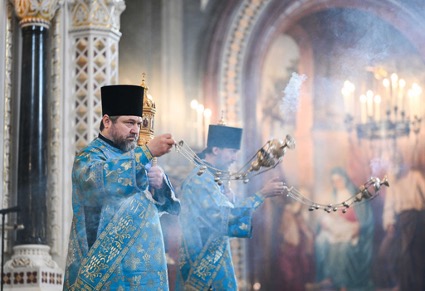
On the 8thode, the deacon cents the altar.
At the end of the 8thode, instead of “Glory”, the reader says: “Let us bless the Father, and the Son, and the Holy Spirit, the Lord.”
After the 8thode of the canon, the choir sings: “We praise, we bless, we worship the Lord” and perform a katavasia.
Deacon(standing with a censer on the pulpit, in front of the icon of the Mother of God): “The Theotokos and Mother of the Light let us
magnify in song.”
The choir sings the song of the Most Holy Theotokos (“My soul magnifies the Lord …” and the refrain “Most honourable …”), meanwhile, the deacon censes the temple.
After the 9thode of the canon, the choir performs a katavasia.
Chorus : “It is truly right…” (except for the periods of prefeast or afterfeast of the Twelfth Great Feasts, as well as the period of the Colour Triodion).
Priest(exclamation): “For all the Hosts of Heaven praise You…”.
The reader reads the exapostilarions according to the Charter.
Reader : “Praise the Lord from the heavens…” and Psalms of Praise- 148, 149, 150 (Book of Hours).
| If there are no Psalms of Praise: | If there are Psalms of Praise : |
|---|---|
| Reader : “Glory, now and always”, to Thee glory is due”, “Glory to Thee Who hast showed us the light”, “Glory to God in the highest” (all-day doxology). | The choir sings 4 stichera on “praise”, beginning from “Praise Him for His mighty acts”. Reader: “Glory to Thee Who hast showed us the light”, “Glory to God in the highest” (all-day doxology). |
After the reading of the doxology, the deacon enters the pulpit through the north door and pronounces the Supplication litany “Let us fulfill our morning prayer to the Lord...”.
Priest(exclamation): “For You are a God of mercy, compassion, and love for mankind…”.
Choir : Amen.
Priest : “Peace be with all.”
Choir : “And with your spirit.”
Deacon: “Let us bow our heads unto the Lord”.
Chorus : “To You, O Lord.”
The priest secretly reads the prayer of the beant head , “Holy Lord, living in the highest and looking down on the humble …”, and then proclaims: “For Thine it is to show mercy and to save us …”.
Choir : “Amen ”, then sings the aposticha according to the Charter.
Reader : “It is good…”, ****[8]****Trisagion and “Our Father…”.
The choir performs the troparia according to the Charter.
The deacon pronounces the Litany of Fervent Supplication “Have mercy on us, O God, according to Thy great mercy…”.
The choir sings “Lord, have mercy”(thrice) after each petition.
Priest(exclamation): “For You are a merciful and loving God…”.
Choir : Amen.
Deacon : “Wisdom ” and immediately goes to the altar.
Chorus : “Bless.”
Priest : “He that is blessed, Christ our God…”
Choir : “Amen. Establish, O God, the holy Orthodox Faith of Orthodox Christians unto the ages of ages.” (during the performance of this hymn, the veil of the royal doors closes).
Reader : “Come, let us worship…”. And the 1st hour follows.
At the end of the 1st hour, the priest pronounces a complete dismissal according to the Charter.
FEATURES OF ALL-DAY MATINS
In the case of a saint without a sign (small saint)
The charter of such a service is found in the 10th statutory chapter of the General Menaion and in the Menologium (chapter 48 of the Typicon) in the text of services to saints without a sign (September 25, September 27, November 2, etc.).****
After “God is the Lord …” : troparion of the saint (twice); “Glory, now and always”: The Theotokos from the 4th annex of the Menaion according to the tone of the troparion.
Kathismas according to the Charter (2 - during the summer schedule, 3 - during the winter schedule; see chapter 17 of the Typicon).
Sessional Hymns after the kathisma - from the Oktoichos.
Canon : 1st canon of Oktoichos at 6 , 2nd canon of Oktoichos at 4 ; canon of the saint from the Menaion at 4.
Katavasia - the irmos of the Menaion canon; sung only after the the 3rd, 6th, 8thand 9thodes.
After the 3 rdode: Sessional hymn of the saint; “Glory, now and always”: Theotokion (on Wednesday or Friday - Theotokos of the Cross) of the Menaion.
After the 6 thode: the kontakion and ikos of the saint (sometimes the ikos is missing in the Menaion; in such cases only the kontakion of the saint is read).
After the 9 thode:
• if there is no Exapostilarion in the Menaion , then the exapostilarion of the Oktoichos is read; “Glory, now and always”: Theotokion (Cross-theotokos) of the Oktoichos;
• if the Exapostilarion is indicated in the Menaion , then the exapostilarion of Oktoichos is read; “Glory”: Exapostilarion of the saint; “Now and always”: the Theotokion of the Menaion (on Wednesdays and Fridays - the Cross Theotokion of the Oktoichos: “ Standing at the Cross…”).
“Let every breath…” and stichera after “Praise…” are not sung. 
Aposticha : stichera of the Oktoichos with all-day refrains of Matins (“We were filled in the morning…” and “And let the brightness of the Lord..”); [9]“Glory”: stichera of the saint; “Now and always”: Theotokion of the 2nd appendix of the Menaion (Irmology) according to the tone of “Glory”; on Wednesday or Friday - the Holy Cross of the Menaion on the row.
If in the Menaion there is no “Glory” sticheron, then the Theotokos (Cross- Theotokos) Oktoichos is sung for “Glory, now and always”.
After “It is good …”: troparion of the saint; “Glory, now and always”: The Theotokion of the 4th annex of the Menaion according to the tone of the troparion, indicated “at the end of Matins.”
**In the case of a saint “sung on the 6 thtone” **
The charter for the service of a sixfold saint on the weekly day can be found in the 9th Charter Chapter of the Common Menaion. Some indications are also found in the texts of services for the sixfold saints in the 48th chapter of the Typicon (for example, September 5, September 6, September 24, etc.).
After “God is the Lord …”: troparion of the saint (twice); “Glory, now and always”: The Theotokion from the 4th annex of the Menaion according to the tone of the troparion.
Sessional Hymns after the kathisma - from the Oktoichos.
Canon : 1st canon of Oktoichos at 4, 2nd canon of Oktoichos at 4; saint’s canon at 6.
Katavasia - the irmos of the Menaion canon; sung only on the 3rd, 6th, 8th and 9th odes.
After the 3rd ode: the Sessional Hymn of the saint (twice); “Glory, now and always”: Theotokion (on Wednesdays and Fridays - the Cross of the Theotokos) of the Menaion.
After the 6 thode: kontakion and ikos of the saint.
After the 9thode: Exapostilarion of Oktoichos; “Glory”: Exapostilaria of the saint; “Now and always”: the Theotokion of the Menaion (on Wednesdays and Fridays, the Cross of the Theotokos of the Oktoichos “Standing at the Cross …” is read).
Stichera on “Praise…” (if any): 4 stichera of the saint; “Glory”: sticheron of the saint; “Now and always”: Theotokion of the 2nd annex according to the tone of “Glory”; on Wednesdays or Fridays, the Holy Cross of the Menaion is sung in a row.
Aposticha : stichera of the Oktoichos with daily refrains of Matins (“We were filled in the morning…” and “And let the brightness of the Lord…”); “Glory”: sticheron of the saint; “Now and always”: Theotokion of the 2nd annex of the Menaion (Irmology) according to the tone of “Glory”; on Wednesdays or Fridays, the Cross of the Theotokos from the Menaion is sung in a row.
After “It is good …”: troparion of the saint; “Glory, now and always”: Theotokion of the 4th annex of the Menaion (Irmology) according to the tone of the troparion, indicated “at the end of Matins.”
In the case of two saints
The charter of such a service is found in the 10th charter chapter of the General Menaion and in the Menologium (48th chapter of the Typicon) in the text of services for two saints without a sign (September 2, September 3, etc.).
After “God is the Lord …”: troparion of the 1st saint (twice); “Glory”: troparion of the 2nd saint; “Now and always”: Theotokion from the 4th annex of the Menaion according to the tone of the troparion of the 2nd saint.
Sessional Hymns after the kathisma – from the Okteochos.
** Canon** : 1st canon of Oktoichos at 6 , 2nd canon of Oktoichos at 4 ; canon of the saint from the Menaion at 4.
Katavasia - the irmos of the canon of the second saint; sung only after the the 3rd, 6th, 8thand 9thodes.
After the 3 rdode: kontakion and ikos (if any) pf the 2ndsaint; Sessional Hymn of the 1stsaint; “Glory”: Sessional Hymn of the 2ndsaint; “Now and always”: Theotokion (on Wednesday or Friday - Theotokos of the Cross) of the Menaion.
After the 6 thode: the kontakion and ikos of the 1stsaint.[10]
After the 9 thode:
• if there is only one Exapostilarion in the Menaion(for one of the saints), then the exapostilarion of the Oktoichos is read; “Glory”: exapostilarion of the saint; “Now and always”: Theotokion of the Menaion (on Wednesdays and Fridays - the Cross Theotokion of the Oktoichos: “ Standing at the Cross…”)
• if both Exapostilaria are indicated in the Menaion , then the exapostilarion of Oktoichos is read, then the Exapostilarion of the 1stsaint; “Glory”: Exapostilarion of the 2ndsaint; “Now and always”: the Theotokion of the Menaion (on Wednesdays and Fridays - the Cross Theotokion of the Oktoichos: “ Standing at the Cross…”).
If there is no stichera for “Glory” in the Menaion, then, after the Oktoikh stichera, the Theotokos (Cross-Bogorodichen) Oktoikh is sung immediately after the stichera for “Glory, now and always”.
After “It is good …”: troparion of the 1st saint; “Glory”: troparion of the 2nd saint; “Now and always”: Theotokion of the 4th annex of the Menaion (Irmology) according to the tone of the troparion of the 2nd saint, indicated “at the end of Matins.”
In the case of one saint (sixfold or small) on a Saturday
The charter of the daily Satturday service is found in chapter 12 of the Typicon.
After “God is the Lord …” : troparion of the saint (twice); “Glory, now and always”: The Sunday Theotokion (from the 3rd annex of the Menaion) according to the tone of the troparion.
Kathismas – the 16th and 17th, and for each of the kathisma there is a small litany.
Sessional Hymns after the kathismas – from the Oktoichos; after the 16th kathisma, on “Glory, now and always”, the Sunday Theotokion of the outgoing tone is read.
Canon:
The sign of the service| In a church of the feasts of the Lord or the
Theotokos| In a church of a saint****
---|---|---
A saint without a sign****| Canon of the church – 6Canon of the Menaion – 41st canon of the Oktoichos - 4 | Canon of the Menaion – 6Canon of the church – 41st canon of the Oktoichos - 4
A saint sung on the 6thtone****| Canon of the church – 4Canon of the Menaion
– 61st canon of the Oktoichos - 4********| Canon of the Menaion – 6Canon of
the church – 41st canon of the Oktoichos - 4****
Katavasia - irmos of the 1st canon of the Oktoichos; sung only on the 3rd, 6th, 8th and 9th odes.
After the 3 rdode: the Sessional Hymn of the saint (if it is a six-fold saint, then the Sessional Hymn is read twice); “Glory, now and always”: Theotokion Menaion.
After the 6 thode: the kontakion and ikos of the saint (sometimes the ikos is absent in the Menaion; in such cases only the kontakion of the saint is read).
After the 9 thode:
• if there is no Exapostilarion in the Menaion, then the exapostilarion of Oktoichos is read; “Glory, now and always”: Theotokion of the Oktoichos;
• if there is an Exapostilarion in the Menaion , then the saint’s Exapostilarion is read; “Glory”: Exapostilarion of the Oktoichos; “Anow and always”: The Theotokion of the Oktoichos.
There are usually no stichera on “Praise…”. However, in the case of the remembernce of a sixfold saint who has stichera of Praise (September 6, September 24, October 7), the following is sung: 4 stichera of the saint; “Glory”: sticheron of the saint; “Now and always”: Theotokion of the 2nd annex according to the tone of the “Glory” stichera.
Aposticha: 3 Praise stichera of the Oktoichos (since the funeral stichera are given in the Oktoichos) with daily refrains of Matins (“We were filled in the morning…” and “And let the brightness of the Lord…”); “Glory”: sticheron of the saint; “Now and always”: Theotokion of the 2ndannex of the Menaion according to the tone of the “Glory” sticheron.
If there is no sticheron for “Glory” in the Menaion, then, after the stichera of the Oktoichos for “Glory, now and always” the Praise Theotokion of the Oktoichos of is sung.
After “It is good …”: troparion of the saint; “Glory, now and always”: The Theotokion of the 4th annex of the Menaion (Irmology) of the same tone as the troparion, which is indicated “at the end of Matins.”
In the case of two saints on a Saturday
After “God is the Lord …”: troparion of the 1st saint (twice); “Glory”: troparion of the 2nd saint; “Now and always”: Sunday Theotokion (from the 3rdannex of the Menaion) according to the tone of the troparion of the 2nd saint.
Kathisma - 16th and 17th, and for each of the kathisma there is a Small litany.
Sessional Hymns after the kathismas – from the Oktoichos; after the 16th kathisma, on “Glory, now and always”, the Sunday Theotokion of the outgoing tone is read.****
Canon : canon of the 1st saint at 6 , canon of the 2nd saint at 4 ; ast canon of the Okteochos at 4.
After the 3 rdode: kontakion and ikos (if any) of the 2ndsaint; Sessional Hymn of the 1stsaint; “Glory”: Sessional Hymn of the 2ndsaint; “Now and always”: Theotokion (on Wednesday or Friday - Theotokion of the Cross) of the Menaion.
After the 6 thode: the kontakion and ikos of the 1stsaint.[11]
After the 9 thode:
• if there is no Exapostilarion in the Menaion , then the exapostilarion of the Oktoichos is read; “Glory, now and always Theotokion of the Oktoichos
If there is only one Exapostilarion in the Menaion , then the exapostilarion of the Oktoichos is read; then “Glory”: Exapostilarion of the Oktoichos; “Now and always”: Theotokion of the Oktoichos
• if both Exapostilaria are indicated in the Menaion , then the following is read: exapostilarion of the 1stsaint, the Exapostilarion of the 2ndsaint; “Glory”: Exapostilarion of the Oktoichos; “Now and always”: the Theotokion of the Oktoichos
Aposticha : 3 Praise stichera of the Oktoekhos (since the funeral stichera are given in the Oktoichos) with daily refrains of Matins (“We were filled in the morning…” and “And let the brightness of the Lord…”); “Glory”: sticheron of the saint; “Now and always”: Theotokion of the 2ndannex of the Menaion according to the tone of the “Glory” sticheron.
After “It is good …”: troparion of the 1stsaint; “Glory”: troparion of the 2ndsaint, “Now and always”: The Theotokion of the 4th annex of the Menaion (Irmology) of the same tone as the troparion, which is indicated “at the end of Matins.”
In the case of one saint (six-fold or small) during the period before or after
the one of the Twelve Great Feasts
The charter of a service to one saint during the period before or after the feast can be found in the 12th charter chapter of the General Menaion and in the texts of September 7, September 10, September 15 and others.
After “God is the Lord …” : troparion of the feast (twice); “Glory”: troparion of the saint, “Now and always”: troparion of the feast.
Kathisma according to the Charter (2 kathisma are always read, including the winter schedule - in this case, the 3rd kathisma is transferred to the next- coming Vespers).
Sessional Hymns after the kathismas – Sessional Hymn of the feast, “Glory, now and always”: and once again the same Sessional Hymn.
Canon:
• if the service for a saint is without a sign : the canon of the feast -8, and the canon of the saint - 4.
Katavasia - the irmos of the saint’s canon; this is sung after each ode (since the option of “We sing to the Lord …” is used, which implies singing a katavasia for each song).
After the 3 rdode: kontakion and ikos (if any) of the saint, Sessional Hymn of the saint; “Glory, now and always”: Sessional Hymn of the feast.
After the 6 thode: kontakion and icos of the feast.
After the 9 thode: “It is proper …” is not sung. Exapostilarion of the saint; “Glory, now and always”: the Exapostilarion of the holiday . However, if the saint does not have an Exapostilarion , then the Exapostilarion of the feast is read twice(with “Glory, now and always”). If there are two festive Exapostilaria , then the 1st Exapostilarion of the feast is read; then “Glory, now and always”: 2nd Exapostilarion of the feast;
• if the service is to a sixfold saint(September 15): the canon of the feast at 6 and the canon of the saint at 6 are read.
Katavasia - the irmos of the saint’s canon; this sung for every song.
_After the 3 rdode _: kontakion and icos of the feast, Sessional Hymn of the saint (twice); “Glory, now and always”: Sessional Hymn of the feast.
After the 6 thode: kontakion and ikos of the saint.
After the 9 thode: “It is proper …” is not sung. Exapostlarion of the saint (twice); “Glory, now and always”: the Exapostilarion of the feast.
Stichera on “Praise…”(if any): two options are possible here:
• stichera of the feast - 4; “Glory”: sticheron of the saint (or feast); “Now and always”: the sticheron of the feast (for example, see December 21, 22, 23, January 3);
• stichera of the saint - 4; “Glory”: sticheron of the saint; “Now and always”: the sticheron of the feast (see, for example, September 16, 20, December 29).
However, most often the Praise stichera are absent from the Menaion and therefore are not sung at all.
The aposticha : the stichera of the feast with their (festive) refrains. “Glory”: sticheron of the saint; “Now and always”: the sticheron of the feast. If there is no sticheron of the saint , then the sticheron of the feast is sung on “Glory, now and always”.
After “It is good …”: troparion of the saint; “Glory, now and always”: troparion of the feast. If the troparion of the saint is absent, then only the troparion of the feast is sung, once.
In the case of two saints during the period before or after one of the Twelve Great Feasts
The charter of a service for two saints during the period before or after the
feast can be found in the 12th charter chapter of the General Menaion and in
the service texts of September 11, November 23 and 24, December 27, and
others. 
After “God is the Lord …” : troparion of the feast, troparion of the 1st saint; “Glory”: troparion of the 2nd saint; “Now and always”: troparion of the feast.
Kathisma according to the Charter (2 kathisma are always read, including the winter schedule).
Sessional Hymns after the kathismas: Sessional Hymns of the feast; “Glory, now and always”: once again the same Sessional Hymn.
Canon : canon of the feast - 6, canon of the 1st saint - 4, canon of the 2nd saint - 4.
Katavasia - irmos of the canon of the 2nd saint, which is sung for each song.
After the 3 rdode: kontakion and ikos of the 1st saint, kontakion and ikos (if any) of the 2nd saint; Sessional Hymn of the 1st saint; “Glory”: Sessional Hymn of the 2nd saint; “Now and always”: Sessional Hymn of the feast.
After the 6 thode: kontakion and icos of the feast.
After the 9 thode: “It is proper …” is not sung. The Exapostilarion of the 1st saint is read, “Glory”: the Exapostilarion of the 2nd saint; “Now and always”: the luminary of the holiday.
However, if only one of the saints has an Exapostilarion, then the Exapostilarion of the saint is read; “Glory, now and always”: the Exapostilarion of the feast. If neither of the saints has an Exapostilarion,, then the Exapostilarion of the feast is read twice (on “Glory, now and always”). If there are two festive Exapostilaria, then the 1st Exapostilarion of the feast is read; then “Glory, now and always”: the 2nd Exapostilarion of the feast.
The aposticha : the stichera of the feast with their (festive) refrains. “Glory”: sticheron of the saint; “Now and always”: the sticheron of the feast. If there is no sticheron of the saint, then the sticheron of the feast is sung on “Glory, now and always”.
After “It is good …”: troparion of the 1stsaint; “Glory”: troparion of the 2ndsaint; “Now and always”: troparion of the feast.
MATINS WITH THE GREAT DOXOLOGY
In the church year, there are only around thirty days when it is necessary to celebrate Matins with a great doxology. One could distinguish three main types of doxology services.
• services to saints with a doxology, when the Oktoichos is sung at matins (September 23, October 23, July 25);
• services Theotokos feasts with a doxology, when the Oktoichos is not sung (December 9, July 2, August 31);
• divine services on the days of the apodosis of the Twelve Great feasts.
As well as this, there exist many services with a doxology that cannot be attributed to any of these types. These are considered as exceptions (September 1 and 13, December 26, January 7, the 5th and 6th Saturdays of Great Lent, Mid-Pentecost, 1stand 16thAugust and others).
Structure of Matins with Great Doxology.
At the end of the Midnight Office (or, if Matins is celebrated in the evening, then immediately after the end of Vespers or Compline), the priest enters the altar, opens the veil of the royal doors (if it was Compline or Midnight Office), blesses the censer and, standing in front of the throne with the censer in his hand, proclaims**: “Blessed is our God…”.**
Reader:“Amen. Come, let us worship…” Ktetor Psalms(19 and 20). “Glory, now and always.” Trisagion, “Our Father…”.
During the reading of the Ktetor psalms, the priest censes the entire church, whilst the reader must read slowly, so that by the end of “Our Father …” the priest , already on the pulpit, could pronounce the exclamation: “For Yours is the Kingdom …”.
Reader : “Amen ” and then reads the troparia from the Book of Hours on the row : “O Lord, save Thy people …”, “Glory”: “As You were voluntarily raised upon the cross …”, “Now and always”: “Terrible and shameful intercession …”.
At this point, the priest enters the altar and, at the end of the troparia, stands in front of the altar with a censer in his hand and pronounces an abbreviated Litany of Fervent Supplication, consisting of four petitions. At the end of the litanies, the priest proclaims: “For You are a merciful and loving God..…”.
Choir : “Amen. In the name of the Lord bless, father.”
The priest , while making the sign of the cross with the censer, proclaims: “Glory to the Saints, and the Consubstantial, and the Life-Giving, and Indivisible Trinity, always, now and ever and forever and ever.”
Choir: Amen.
The reader stands in the center of the temple in front of the lectern with a festive icon and reads “Glory to God in the highest …” and the sixth psalm (psalms 3, 37, 62, 87, 102, 142).
At the beginning of the second part of the Six Psalms, the priest goes to the pulpit through the north door and secretly reads the morning prayers from the Missal.
Reader : “Glory, now and always”, “Alleluia”(three times).
The deacon pronounces the Great litany “In peace let us pray to the Lord… ”.
The choir responds to each petition: “Lord, have mercy.”
Priest(at the end of the litanies): “For to You belong… ”.
Choir : Amen.
Then the deacon and the choir take turns to read and sing “God is the Lord…” with the verses of Psalm 117.
Then the choir sings the troparia according to the Charter.
Chorus : “Lord, have mercy ” (three times). “Glory ”.
Reader : “Now and always ”. Kathismas according to the Charter. Only 2 kathismas are always read, and if the doxology service is performed during the winter schedule, then the 3rd kathisma is transferred to Vespers the next day.
Reader(after finishing the kathismas): “Glory, now and always ”, “Alleluia…” (three times).
The deacon pronounces the small litany “Again and again…”.
Priest(exclamation): “For to You all Glory…” (exclamation after the 2ndkathisma – “For you are a good and loving God…”.
Choir : Amen.
The reader reads the Sessional Hymns according to the Charter.
Choir : “Lord, have mercy ” (three times),“Glory ”.
Reader : “Now and always ,” Psalm 50 (“Have mercy on me, O God… ”).
The choir sings the irmos of the first song of the canon.
Canon. Irmoses are taken from the canon, which comes first according to the Charter,.
Then the troparia of the canon are read. These, as the Charter says, are combined with verses of the corresponding biblical odes (moreover, the festive version of “We sing to the Lord” is used -see Irmologion). However, in practice, the troparia of the canon are read with refrains. Before the penultimate troparion, “Glory” is read, before the last - “Now and always” (in practice, however, it is allowed to read “Glory, now and always” at the end of all the troparions of this ode).
Ordinary katavasia(see Typikon, chapter 19), is sung for each ode.
After the 3rd ode of the canon, the choir performs a katavasia.
Priest(exclamation): “For You are our God…”.
The reader reads the Sessional Hymns according to the Charter.
After the 6th ode of the canon, the choir performs a katavasia.
Priest(exclamation): “For You the King of the world…”.
On the 8th ode , the deacon censes the altar.
At the end of the 8th ode , instead of “Glory” the reader says: “Let us bless the Father, and the Son, and the Holy Spirit, the Lord.”
After the 8th ode of the canon, the choir sings: “We praise, we bless, we worship the Lord…” and perform a katavasia.
The deacon(standing with a censer on the pulpit, in front of the icon of the Mother of God): “The Theotokos and Mother of the Light let us****magnify in song ”.
The choir sings the song of the Most Holy Theotokos (“My soul magnifies the Lord…” and the chorus “Most honorable…”), whilst the deacon censes the church.
After the 9th ode of the canon, the choir performs a katavasia.
Priest(exclamation): “For all the Hosts of Heaven praise You…”.
The reader reads the Exapostilarion according to the Charter.
The choir sings: “Let every breath praise the Lord…”.
Reader : “** Praise Him, sun and moon**…” and the subsequent verses of Praise psalms (148, 149, 150 - Book of Hours).
The choir sings 4 stichera, beginning with the verse “Praise Him for His mighty acts…”. These stichera are called stichera “on praise” or laudatory.
During the singing of the stichera for “Now and always,” the deacon opens the royal doors.
Priest : “Glory to You, Who showed us the light.”
The choir sings the Great doxology “Glory to God in the highest…”.
At the end of the doxology, the Trisagion is sung in the following way: “Holy God, Holy Mighty, Holy Immortal, have mercy on us”(three times). “Glory, now and always.” “Holy Immortal, have mercy on us.” “Holy God, Holy Mighty, Holy Immortal, have mercy on us.”
The deacon pronounces the Augmented litany “Have mercy on us, O God, according to Thy great mercy...”.****
The choir sings “Lord, have mercy ” (three times) after each petition.
Priest(exclamation): “For You are a merciful and loving God… ”.
Choir : Amen.
The deacon pronounces the Litany of Fervent Supplication: “Let us fulfill our morning prayer to the Lord…”.
Priest(exclamation): “For Thou art a God of mercy, compassion, and love for mankind…”.
Choir : Amen.
Priest : “Peace be with all.”
Choir : “And to your spirit.”
Deacon : “Let us bow our heads to the Lord”.
Chorus : “To you, O Lord.”
The priest secretly reads the prayer of the bowed head , “Holy Lord, living in the highest and looking down on the humble …”, and then proclaims: “For Yours it is to show mercy and to save us …”.
Choir : Amen.
Deacon : Wisdom.
Chorus : “Bless.”
Priest : “He that is is blessed, Christ our God…”.
Choir : “Amen. Establish, O God … ”.
Priest : “O most Holy Theotokos, save us.”
Chorus : “More honourable than the Cherubim…”
Priest : “Glory to Thee, Christ God…”.
Chorus : “Glory, now and always.” “Lord, have mercy(thrice). Bless.”
Priest(from the pulpit): “Christ our true God…” (dismissal according to the Charter).
Chorus : “Save, O Lord, and have mercy……”.
Features of Matins with Great Doxology.
Features of matins in the case of a glorious saint on a weekly day (except Saturday)
The charter of the service to the glorious saint on a weekly day can be found in the chapter 48 of the Typicon in the text of services of September 23 (Conception of John the Baptist) and October 23 (Apostle James, brother of the Lord). As well as this, some indications can be found found in the 8th charter chapter of the General Menaion.
Sessional hymns after the kathismas : sessional hymn of the saint (twice); “Glory, now and always”: Theotokion of the Menaion.
Canon : 1st canon of Oktoichos at 4, 2nd canon of Oktoichos at 4; canon of the saint at 6.
Katavasia – ordinary, according to the Charter.
After the 3rd ode : the Sessional hymn of the saint (twice); “Glory, now and always”: Theotokion of the Menaion.
After the 6th ode : kontakion and ikos of the saint.
After the 9th ode: the Exapostilarion of the saint (twice); “Glory, now and always”: Theotokion of the Menaion.
Stichera on “Praise…” : 4 stichera of the saint; “Glory”: sticheron of the saint; “Now and always”: the apostich Theotokion of the 1st annex according to the tone of the “Glory” stichera.[12]
After the doxology : troparion of the saint; “Glory, now and always”: Sunday Theotokion according to the tone of the troparion.
Features of matins in the case of a glorious saint on a Saturday
If a saint with a doxology is celebrated on a Saturday, then the canons of Oktoichos are not sung. As well as this, the singing of the troparia always ends with the singing of the Sunday Theotokion of the outgoing tone. Part from this, the service has the same features as on other days of the week.
After “God is the Lord …” : troparion of the saint (twice); “Glory, now and always”: The Sunday Theotokion of the present (outgoing) tone (see Typikon, chapter 52).
Canon :
• in the church of a feast of the Lord or the Theotokos : the canon of the church in tone 6 and the canon of the saint in tone 8;
• in the temple of a saint : the canon of the Theotokos of the present tone from Sunday matins, from Oktoichos on 6 and the canon of the saint in tone 8 (see Typicon, chapter 11).
After the doxology : troparion of the saint; “Glory, now and always”: Sunday Theotokion of the present tone (see Typikon, chapter 52).
Features of matins in the case of the Apodosis of one of the Twelve Great Feasts
The last day of the afterfeast of the twelfth feast is called the Apodosis of the feast. On this day, the Charter appoints to celebrate the daily Vespers and Matins with a great doxology. The divine service itself consists of hymns that were sung during the feast itself, and therefore the service of the Apodosis of the feast largely duplicates the service on the day of the feast itself, with the exception of those parts that are absent from the doxology service (paroemias, lities, polyeleos, etc.). The service to an ordinary saint is postponed to another day, with the exception of November 25th.
After “God is the Lord …”: troparion of the feast (twice); “Glory, now and always”: troparion of the feast.
Sessional Hymns after the kathismas : sessional hymn of the feast; “Glory, now and always”: the same sessional hymn.
Canon : the 1st canon of the feast on the 8th and the 2nd canon of the feast on the 6th (if the feast has one canon, then the canon of the feast is sung on the 14th).
Katavasia – ordinary, according to the Charter.
After the 3rd ode : sessional hymn of the holiday; “Glory, now and always”: the same sessional hymn. If an Ypakoë is supposed to be read instead of a sessional hymn on a certain feast, then this humn is read once, without being repeated (for example, December 31, August 23).
After the 6 thode: kontakion and icos of the feast.
On the 9th ode, “More honourable …” is not sung. Before the irmos, each troparion and katavasia, the refrains of the feast are sung.
After the 9 thode: the Exapostilarion of the feast; “Glory, now and always”: another (or the same) Exapostilarion of the feast.
Stichera on “Praise…”: 4 stichera of the feast; “Glory, now and always”: the sticheron of the feast.
After the doxology : troparion of the feast.
Features of matins in the case of a glorious feast of the Theotokos
There are three feasts of the Theotokos on which it is necessary to celebrate Matins with a great doxology. These are December 9, July 2, August 31. On these days, the features of the service are in many ways similar to the services of the great Theotokion feasts, although the parts that belong exclusively to the all-night vigil (paroemias, litia, polyeleos, etc.) are not used.
After “God is the Lord…”: troparion of the feast (twice); “Glory, now and always”: troparion of the feast.
Sessional hymns after the kathismas : sessional hymn of the feast; “Glory, now and always”: the same sessional hymn.
Canon : 1st canon of the feast at 8 and 2nd canon of the feast at 6.
Katavasia – ordinary, according to the Charter.
After the 3rd ode : sessional hymn of the feast; “Glory, now and always”: the same sessional hymn.
After the 6 thode: kontakion and icos of the feast.
After the 9 thode: the Exapostilarion of the holiday; “Glory, now and always”: another (or the same) Exapostilarion of the feast.
Stichera on “Praise…” : 4 stichera of the feast; “Glory, now and always”: the sticheron of the feast.
After the doxology : troparion of the feast.
Matins with Poyeleos.
Polyeleic matins are performed in the following cases:
• on great, vigilant and polyeleic feasts;
• on all Sundays.****
The structure of polyeleic Matins celebrated on a Sunday
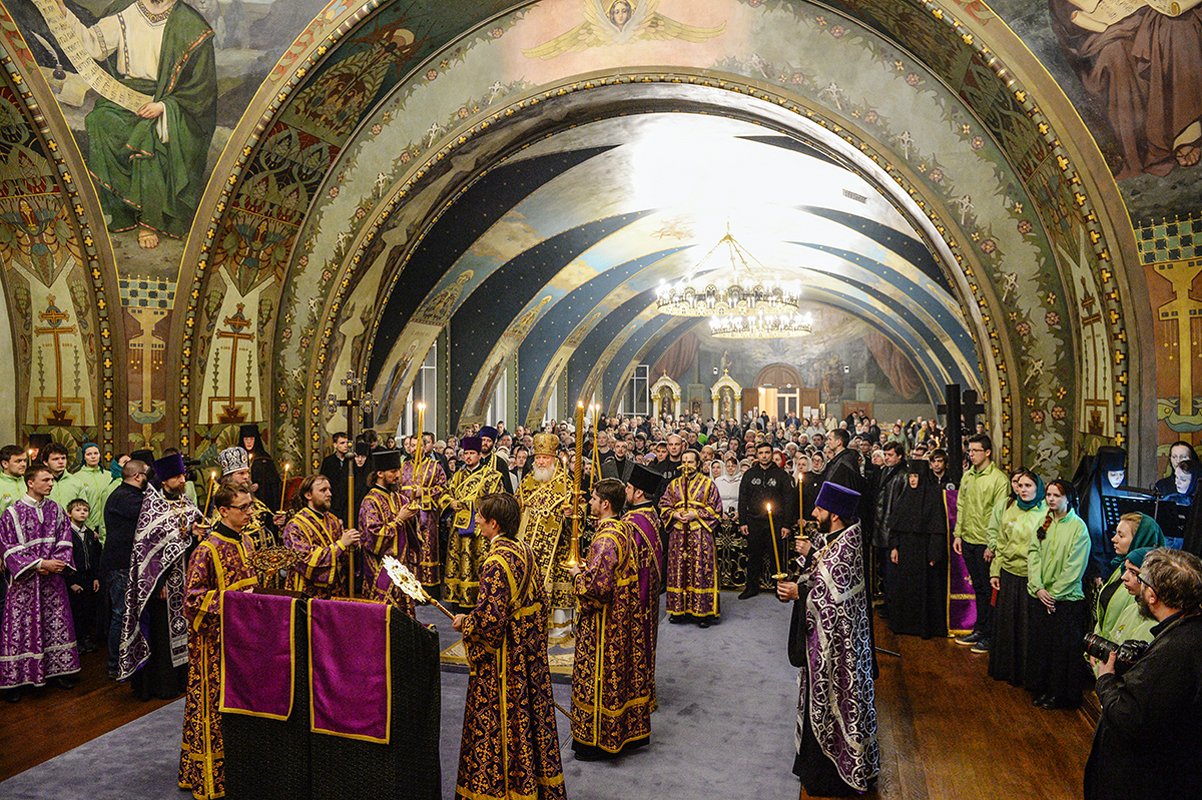 At the end of the Midnight Office (or, if Matins
is celebrated in the evening, then immediately after the end of Vespers or
Compline), the priest enters the altar, opens the veil of the Royal doors (if
it was Compline or Midnight Office), blesses the censer and, whilst standing
in front of the throne with the censer in his hand, proclaims: “Blessed is
our God…”
Reader : “Amen. Come, let us worship...” Ktetor Psalms(19th and 20th). “Glory, now and always.” Trisagion and “Our Father…”.
During the reading of the ktetor psalms, the priest censes the entire church, whilst the reader must read slowly, so that at the end of “Our Father …” the priest, already on the pulpit, could say the exclamation: “As Yours is the Kingdom …”.
Reader : “Amen ” and then reads the troparia from the Book of Hours on the row: “O Lord, save Thy people ...”, “Glory ”: “As You were voluntarily raised upon the cross…”, “Now and always ”: “The intercession is terrible and shameless…”.
Meanwhile, the priest enters the altar and, once the troparia are finished, stands in front of the altar with a censer in his hand and pronounces an abbreviated Litany of Fervent Supplication consisting of four petitions. At the end of the litany, he exclams: “For You are a merciful and loving God...”.
Choir : “Amen. In the name of the Lord, Father, bless.”
The priest , making, as usual, the sign of the cross with the censer, proclaims: “Glory to the holy, and consubstantial, and lifecreating, and indivisible Trinity, always, now and ever, and
unto the ages of ages.”
Choir : Amen.
The reader stands in the сentre of the church, in front of the lectern with the festive icon, and begins reading “Glory to God in the highest …”[13]and the Six Psalms (Psalms 3, 37, 62, 87, 102, 142).
During the 2nd part of the Six Psalms, the priest on the pulpit secretly reads the morning prayers from the Missal.
Reader : “Glory, now and always”, “Alleluia…” (three times).
The deacon pronounces the Great litany “In peace let us pray to the Lord… ”.
Priest(at the end of the litanies): “As it befits Thee…”.
Choir : Amen.
Reader : “Now and always ”. Kathismas according to the Charter. Only 2 kathismas are read, and if the doxology service is performed during the winter schedule, then the 3rd kathisma is transferred to Vespers the next day. If an all-night vigil is performed, then the 3rd kathisma is not read at all.
Reader(after reading the kathisma): “Glory, now and always ”, “Alleluia…” (three times).
Priest(exclamation): “For to You all glory…”
Choir : Amen.
The reader reads the Sessional Hymns according to the Charter. Meanwhile, the sexton bringsout the censer and candles for the deacon and the priest intothe middle of thechurch.
The choir sings psalms 134 (“Praise the name of the Lord...”) and 135 (“O give thanks unto the Lord…”). In the Book of Church Songs, the verses of the psalms are sung with the refrain “Alleluia, Alleluia, Alleluia.” In the Charter this hymn is called a polyeleos (this word means “much mercy”) because of the frequent repetition of the phrase ”… for His mercy endureth forever” in the 135th psalm. At the beginning of the singing of the polyeleos, the deacon opens the Кoyal doors and the clergy proceeds into the middle of the church.[14]
The clergy sing the Megalynarion of the feast. Then the canonarch or the choir recite the verses of the chosen psalm (a hymn composed of verses from various psalms[15], selected in accordance with the content of the feast), and, after each verse, the choir sings the Megalynarion.
During the singing of the polyeleos and the Megalynarion, the whole church is censed, beginning with the festive icon on the lectern. In practice, the church in censed either during the singing of the Megalynarion with the verses from the chosen psalm, or whilst the priest censes the main part of the church and the narthex , ascends onto the ambon, censes the Royal doors and the icon, returns to the festive icon, censes from the front, then goes back to his place in the middle of the church, censes the deacon and gives him the censer.
Choir: “Glory, now and always.” “Alleluia, Alleluia, Alleluia, glory to You, O God”(twice).
Clergy : “Alleluia, Alleluia, Alleluia, glory to You, God ” and the Megalynarion for the last time.
The deacon pronounces the Small litany “Again and again …”.
Priest(exclamation): “For blessed is Your name, and glorified is
Your kingdom…”.
Meanwhile, the deacon entera the altar through the southern door to fetch the Gospel. Sextons go to the altar with him (one through the southern door, the other through the north).
Choir : Amen.
The reader reads the Sessional hymns and the polyelei according to the Charter. The choir sings the 1st degree antiphon of the 4th tone “From my youth ...”.
At the beginning of the singing of the antiphon, the sextons bring out small candles to the pulpit, each from their side (that is, one goes out through the northern door, the other through the southern one) and stand in front of the Royal gates, facing east. During the singing of singing “Glory, now and always” the deacon approaches the altar, bows towards the altar the priest together, with the sexton, takes the Gospel and goes out to the pulpit through the Royal gates. The sextons go ahead of the deacon and stand one step below the pulpit facing each other.
Deacon : “Let us stand. Wisdom. Let us stand.” “Prokeimenon, tone 4…(recited the text of the prokeimenon of the feast).”
Then the choir sings the prokeimenon.
The deacon says a verse of the prokeimenon.
The choir sings the prokeimenon.
The deacon pronounces the first half of the prokeimenon , and the choir sings the rest.
Deacon : “Let us pray to the Lord ”.
Choir : “Lord, have mercy.”
Priest : **“******For holy art Thou, O our God, and Thou
restest in the saints…”.
Choir : Amen.
Deacon : “Let every breath praise the Lord.” The choir sings “Let every breath…” on the tone 4. The deacon pronounces the verse “Praise God in His saints…”. The choir sings “Let every breath…” on the tone 4. Deacon : “Let every breath”, and the choir finishes: “Praise the Lord.”
Deacon : “And that He will vouchsafe unto us the hearing of
the Holy Gospel…”.
Chorus : “Lord, have mercy ” (three times).
At this point, the deacon descends from the pulpit and, holding the Gospel, goes to the middle of the church towards the priest. The sextons walk in before the deacon and stand on both sides of the priest facing each other. The deacon holds the Gospel in his hands, and the priest opens the needed conception and prepares to read it.
Deacon : “Wisdom! Aright! Let us hear the Holy Gospel..”
Priest : “Peace be to all.”
Choir: “And to your spirit.”
Priest : “The reading is from the Holy Gospel according to … (says the name of the evangelist).
Chorus : “Glory to Thee, O Lord, glory to Thee”.
Deacon : “Let us stand.”
The priest reads the Gospel.
Choir(after the reading): “Glory to Thee, O Lord, glory to Thee.”
Reader : Psalm 50 (“Have mercy on me, O Go d…”).
During the reading of the psalm, the deacon brings the Gospel back to the altar through the Royal doors. The sextons holding candles walk before him and enter the altar through the side doors, each from his own side.
Choir : “Glory ”: “Through the prayer of… (calls the rank and name of the saint), **O Merciful One, blot out the multitude of our transgressions.” “Now and always”: “Through the prayers of the Theotokos, O Merciful One,**blot out…”. “Have mercy on me, O God, according to Thy great mercy, and according to the multitude of Thy compassions, blot out my transgression”.
After that the choir sings the sticheron of the feast (“stichera after psalm 50).
During the singing of the sticheron the deacon exits the altar onto the pulpit (usually through the southern door) and stands in front of the icon of the Savior.
Deacon : “Save, O God, Thy people…” (first petition of the lity).
Chorus : “Lord, have mercy ” (12 times).
Priest : “Through the mercy and compassions and love for mankind…”.
Chorus : “Amen ” and sings the irmos of the first ode of the canon. In practice, at this point people are anointed with holy oil, and particles of bread consecrated at Vespers are distributed among the congregation (if a vigil is being performed).[16]
Canon. The irmoses are taken from the canon which comes first according to the Charter,.
Then the troparia of the canon are read. According to the Charter, they are combined with the verses of the corresponding biblical hymns (and the festive version of “We sing to the Lord” is used, see Irmologion). However, in practice, the troparia of the canon are read with refrains. Before the penultimate troparion, “Glory ” is read, before the last - “Now and always”(in practice, however, it is allowed to read “Glory, now and always” at the end of all of the troparia of the given ode).
Ordinary katavasia(see Typikon, chapter 19), is sung for each song.
After the 3rd ode of the canon, the choir performs a katavasia. The deacon pronounces the small litany “Again and again…”. The priest(exclamation): “For You are our God…”. The reader reads the Sessional hymns according to the Charter.
After the 6th ode of the canon, the choir performs a katavasia. The deacon pronounces the small litany “Again and again …”. The priest(exclamation): “For You are the King of the world...”. The reader reads the kontakion and ikos according to the Charter.
On the 8th ode , the deacon censes the altar. At the end of the 8th ode , instead of “Glory” the reader says: “Let us bless the Father, and the Son, and the Holy Spirit, the Lord.”
_After the 8 thode _of the canon, the choir sings: “We praise, we bless, we worship the Lord” and perform a katavasia.
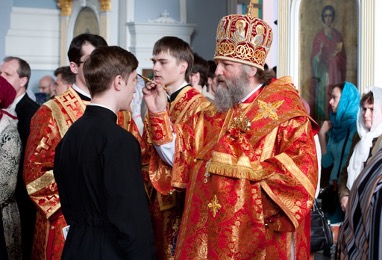 Deacon(standing with a censer on
the pulpit, in front of the icon of the Mother of God): “The Theotokos and
Mother of the Light let us magnify in song.”
_After the 9 thode _of the canon, the choir performs a katavasia.
Priest(exclamation): “For all the Hosts of Heaven praise You...”.
The reader reads the exapostilaria according to the Charter.
The choir sings hymns of praise at 6 (beginning with the verse “To execute on them the written judgment…”) or at 4 (beginning with the verse “Praise Him for His mighty acts… ”). During the singing of the “Now and always” sticheron, the deacon opens the Royal doors.
Priest : “Glory to Thee, Who has showed us the light.” The choir sings the Great doxology “Glory to God in the highest…”.
After the doxology, the Trisagion is sung in the following way: “Holy God, Holy Mighty, Holy Immortal, have mercy on us” (three times). “Glory, now and always.” “Holy Immortal, have mercy on us.” “Holy God, Holy Mighty, Holy Immortal, have mercy on us”.
The deacon pronounces the Augmented litany “Have mercy on us, O God, according to Thy great mercy… ”.
The choir sings “Lord, have mercy”(three times) after each petition.
Priest(acclamation): “For You are a merciful and loving God…”.
Choir : Amen.
The deacon pronounces the Litany of Fervent Supplication “Let us complete our morning prayer to the Lord…”.
Priest(acclamation):**“******For You are a God of mercy, compassion, and love for mankind…”.
Choir : Amen.
Priest : “Peace be to all”.
Choir : “And to your spirit”.
Deacon : “Let us bow our heads to the Lord”.
Choir : “To You, O Lord”.
The priest secretly reads the prayer of homage , “Holy Lord, living in the highest and looking down on humble…” , and then proclaims: “For Thine it is to show mercy and to save us…”.
Choir : Amen.
Deacon : “Wisdom”.
Choir : “Bless.”
Priest : “He that is blessed, Christ our God,…”
Choir : “Amen. Establish, O God … ”.
Priest : “O most Holy Theotokos, save us. ”
Choir : ” More honourable than the Cherubim… ”
Priest : “Glory to Thee, O Christ God… ”.
Choir : “Glory, now and always.” “Lord, have mercy(thrice). Bless.”
Priest(from the pulpit): “May Christ our true God…” (dismissal according to the Charter).
Chorus: “Save, O Lord, and have mercy… …”.
After the dismissal of Matins, while singing a special self-voiced stichera, it is supposed to anoint the people with oil from a festive lamp. The specified rank is described in detail in the sequence on September 26. In practice, the anointing is done while singing the canon.
[1]Despite the fact that on the Sunday Matins the polyeleos are not always sung according to the Charter (it is often replaced by the singing of the “Undefiled”, that is, of the 17th kathisma), the scheme of Sunday matins generally corresponds to the scheme of polyeleic matins, with the exception of some particular features.
[2]In the “Clergyman’s Handbook”, Paschal Matins is seen as the third type of Matins, whereas matins with the Great doxology and polyeleic matins are combined into one type - “feast matins” (see: The Clergyman’s Handbook, vol. 1, p. 363). However, this classification seems not entirely correct to us, since the very combination of Matins with the Great Doxology and the Polyeleic matins into one group should be recognized as unreasonable. As for Paschal Matins, it takes place during a certain period of the year (only on Bright Week), whilst the first three mentioned types (Everyday matins, Matins with doxology, and Polyeleic) take place throughout the whole year.
[3]Of course, during the days of Passion Week, even though the polyeleos or doxology are not sung at matins, matins are nevertheless performed with a large number of features, so that it cannot be considered an All-day matins “in its purest form.”
[4]“Generally, a number of psalms, whether they are read as a kathisma or as fixed parts of the daily worship, always end with: Glory … now and always … Alleluia three times, with three bows. But in the second part of the Midnight Office, Psalms 120 and 133, and, at the beginning of Matins, Psalms 19 and 20 do not end with these words. This is because, in these two cases, the Trisagion follows immediately after the psalms, without any intermediate prayers – this is the same heavenly praise to the triune Lord, usually also accompanied by three bows. Both the increase in the number of bows and the sixfold repetition of two almost similar doxologies was seen as inappropriate, exceeding the measure, and, therefore, one of the doxologies was omitted” (Bishop Afanasy (Sakharov), “On the Commemoration of the Dead according to the Charter of the Orthodox Church”. P. 23).
[5]The exclamation “For Yours is the Kingdom…” by the priest on the pulpit is a modern practice, whilst the Typicon offers a different prescription: “The reader and the priest must stay attentive when he says: “For Yours is the Kingdom”: he should be standing in the middle of the church” (see Typicon, chapters 7 and 9).
[6]“The Six Psalms must not be read in a patter or indistinctly, somewhere in the corner of the kliros, but loudly and prayerfully in front of the church pulpit” (Bishop Athanasius (Sakharov), On the Six Psalms // Liturgical Instructions for the Clergy for 2008. Moscow, 2007. P. 766).
[7]In order to finish reading the morning prayers by the end of the Six Psalms, the priest can begin to read them while still in the altar, during the reading of the 1st part (that is, Psalms 3, 37 and 62). The priest should also begin reading morning prayers in advance, if he is serving alone, without a deacon.
[8]The first verses of Psalm 91.
[9]On some days, immediately after the stichera of the Oktoichos, before the “Glory” sticheron, the sticheron of the saint with its refrain is sung; this is possible both on the days of remembrance of saints without a sign, and in the case of a sixfold saint or two saints (for example, November 2, November 3, November 11, etc.).
[10]In rare cases, after the 6thode, a kontakion is assigned to the 2nd saint, and after the 3rd ode, a kontakion is assigned to the 1st saint (see, for example, November 2).
[11]In rare cases, after the 6thode, a kontakion is assigned to the 2nd saint, and after the 3rd ode, a kontakion is assigned to the 1st saint (see, for example, November 2).
[12]On September 23rdand July 25th, a special sticheron is sung immediately on “Glory, now and always”.
[13]If the all-night vigil is celebreated, then matins begins from this moment – from the reading of the Six psalms. Following the tradition, before that the choir sings “Glory to God in the highest”.
[14]In modern practice, at the beginning of the singing of the polyeleos, the Royal doors always open and the clergy always go into the middle of the church. However, the Typicon (see Chapter 2, the last “behold”) distinguishes between the singing of the polyeleos at the all-night vigil and at polyeleic service, when the all-night vigil is not celebrated. In the first case (at the all-night vigil), the Royal doors open, the clergy go through the Royal doors to the centre of the church and cense, starting from the middle of the church. However, if the vigil is not performed (“so the Megalynarion is sung besides the vigil”), then the Royal doors remain closed, the censing of the church begins from the altar, and during the censing the priest and the deacon exit the altar through the north door and return through the south door.
[15]Sometimes biblical hymns are added to the selected psalm. For example, on the Nativity of John the Baptist and on the Beheading of John the Baptist, verses from the song of the prophet Zechariah are used (see: Luke 1: 68–79).
[16]According to the Charter, the anointing with holy oil takes place after the dismissal of Matins. On the other hand, the transfer of this rite to the time of the singing of the canon is one of the disadvantages of modern liturgical practice, since the noise and movement of the people make it difficult to listen carefully to the troparia of the canon, although many of these troparia (especially Sunday canons and the canons of the Twelve Great Feasts) are real pearls of patristic theology.
Related Concepts
- acrostichon
- afterfeast
- altar
- apodosis
- aposticha
- biblical-odes
- blessed-bread
- canon
- daily-matins
- entry-of-the-theotokos
- exapostilarion
- feast-ranks
- festal-rank
- festal-services
- first-hour
- gospel-reading
- great-feast
- hours
- hymnography
- ikos
- katavasia
- kathisma
- liturgical-books
- liturgical-space
- luminary
- matins
- matins-with-great-doxology
- monastic-practice
- morning-prayer
- nativity
- ninth-ode
- odes
- oktoichos
- parables
- paschal-matins
- penitence
- polyeleic-matins
- polyeleos
- psalm-136
- psalter
- scripture
- st-andrew-of-crete
- sunday-gospels
- theotokion
- trisagion
- twelfth-feasts