Liturgics — 5. The Burial. The Farewell for the afterlife
-
The Burial Ceremony.
- The Services performed in rememberance of the departed.
-
The Burial Ceremony.
-
Rites following the Burial.
The body of the deceased is buried in the earth , where it will rest until the end of time and resurrection. But the love of the Mother Church for her child, who has passed away, never stops. Like a child-caring mother, the Church prays on certain days for the deceased Christian and brings the Most Holy Bloodless Sacrifice for his repose. These days of special prayer for the deceased are the following: the third , ninth , fortieth and annual after his death (including the day of his death itself).
On these days, the commemoration of the deceased is blessed by an ancient tradition of the Christian Church.
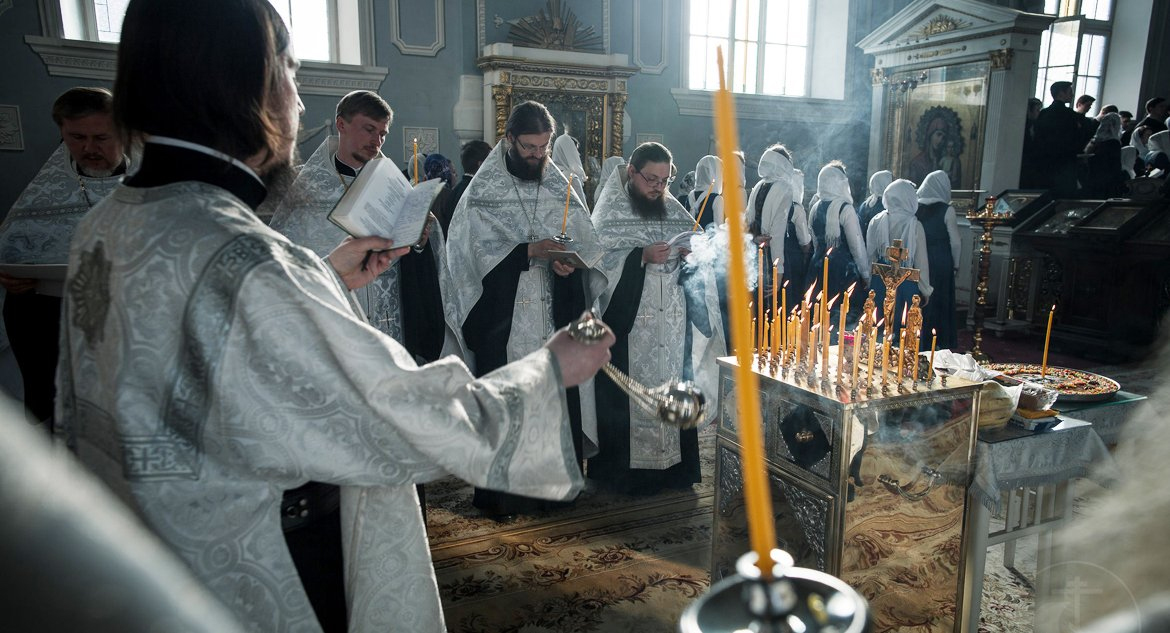 Furthermore, the Christian Church
commemorates the dead on the ninth day after their death in honour of the
nine orders of angels, who, as servants of the King of Heaven and intercessors
to Him for us, intercede for mercy on the deceased.
The commemoration of the newly deceased on the fortieth day after his death, following the tradition of the apostles, has its roots in the forty-day crying of the Israelites after the death of Moses. Moreover, it is known that a forty-day period is very significant in the history and traditions of the Church as a time needed for preparing to receive the divine gift of the Heavenly Father. For example, the prophet Moses was honoured to speak with God on Mount Sinai and to receive from Him the Tablets of the Law after a forty- day fast. The prophet Elias (Elijah) reached Mount Horeb after forty days. The Israelites reached the Promised Land after forty years of traveling through the desert. Even Our Lord Jesus Christ Himself ascended into heaven on the fortieth day after His Resurrection. With this as an argument, the Christian Church established a commemoration of the dead on the fortieth day after their death, so that the soul of the deceased ascends the holy mountain of Heavenly Sinai, is rewarded with the sight of God, achieves the blessedness promised to it and settles in heavenly settlements with the righteous.
The Church also remembers the deceased on the anniversary of their death. The reason for this is obvious. It is known that the largest liturgical cycle is the annual circle, after which all fixed holidays are repeated again. The anniversary of the death of a loved one is always celebrated, even if just with a heartful commemoration by his loving relatives and friends. For an Orthodox believer, this is a birthday for a new, eternal life.
Through the Church tradition, the Holy Fathers, who were honoured to receive divine Revelation, brings us the joyful news about the mystery of the trials of the soul after its departure from the body. In the first two days , as the sacred tradition says, the soul of the deceased is still on earth , and, accompanied by an angel, it visits the places that fills it with memories of earthly joys and sorrows, good and evil deeds. In this way the soul spends its first two days. On the third day the Lord, as in His own Resurrection, orders the soul to ascend to heaven to worship Him as the God of all. It is important, therefore, that the Church prays for the soul of the deceased, who has appeared before the Face of Justice.
After that the soul, as if on its way back from the Face of God, enters, accompanied by angels, the heavenly abodes and observes their inexpressible beauty. The soul stays in this way for six days - from the third to the ninth. On the ninth day, the Lord orders the angels to once again present the soul before Him for worship. With fear and trembling, the soul stands before the Throne of the Supreme. But even then the Holy Church prays for the deceased, bidding the Merciful Judge to place the soul of her reposed son or daughter together with the saints.
After the soul has worshiped the Lord for a second time, the angels take the soul to hell, and it contemplates the bitter anguish of unrepentant sinners. Finally, on the fortieth day after death, the soul ascends for the third time to the Throne of the Merciful Lord. Now its fate is being decided - it is assigned the place deserved by the person’s deeds.
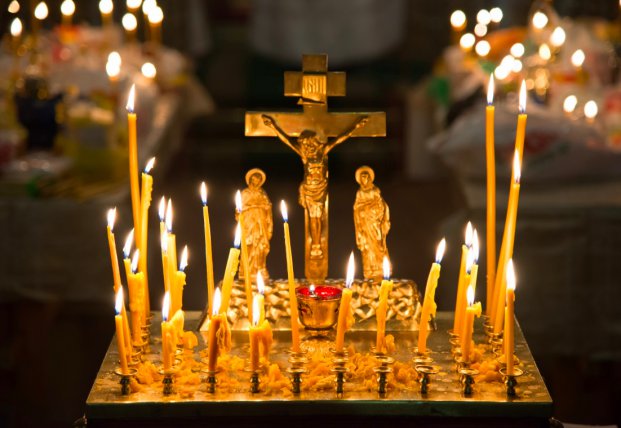 It is for
this reason that the Church prayers and commemoration on this day are
especially important. In this way the Church is bidding the Lord to forgive
the sins of the deceased and to allow him to be placed in paradise together
with the saints. Memorial services(Russian “ panikhida ” , Greek “
mnemosynon ” , Romanian and Serbian “ parastas / parastos ”) and
Lity are served on these days.
As well as this, the Church has established special days for solemn, ecumenical commemoration of all the dead. These days are as follows: meat- fare Saturday , Saturdays of the second , third and fourth****weeks of the Great****Lent , Tuesday of St.ThomasWeek , Saturday****before the day of the Holy****Pentecost. In addition, in Russia , a special****day to commemorate “Orthodox soldiers who sacrificed their lives on the battlefield for their faith and fatherland” is established. This day is celebrated on Saturday****before the day of Saint****Demetrius of Thessalonica (before26October) and on 29****August , on the day of the Beheading of Saint JohntheBaptist.
On the first day of Easter and on the day of Nativity, memorial services and burials before and after the Liturgy are not performed until evening. The commemoration of the dead during the Liturgy on the days of Easter and Nativity and on other big holidays, as well as on Sundays, should be performed only during the Liturgy of Preparation and after the consecration of the Holy Gifts, during the singing “It is truly right”. A Litany for the Departed, “for the sake of the festive celebration”, is not served on these days (Typicon, chapter 59, 169, etc., Nomocanon of the Euchologion).
On the first week of the Great Lent, the Holy week and Paschal week, as well as on the weekly days of Lent, memorial services are not performed in church. The dead are commemorated on Saturdays of the 2nd, 3rd and 4th weeks of the Great Lent. If the 3rd or 9th day after death happens on the weekly days of the Great Lent, a memorial service for the newly deceased is served on the Saturday closest to these days. Only on the 40th day, no matter what day it is, is a memorial service lead in church.
A 40-days prayer (Russian “sorokoust”) is not read during the Great Lent and Easter, it begins from the Week of the Apostle Thomas and continues to be read for the next 40 days.
The Memorial Service (Panikhida or Parastas).
After the usual beginning, the Psalm 90 is read (instead of Psalm 6), after which the great Litany for the Departed is pronounced. Then instead of “God is the Lord” - “Alleluia” and the troparia “O Thou Who with Wisdom Profound” are sung.
After “Alleluia” and the troparia, the Psalm 119 or “Undefiled” are sung on the parastas. They are divided into 2 statutes: on the 1st statute - “Blessed are the undefiled in the way”, the refrain: “Remember, Lord, the souls of Thy servants (or the soul of Thy servant)”, on the 2nd statute - “I am Yours, save me”, refrain: “Lord, rest the souls (or the soul of Your servant) Your servants.”
** **After
the troparia, during the memorial service (and during the parastás after the
Psalm 119 “Undefiled”), troparia after the “undefiled” are sung: “The Choir of
the Saints have found the Fountain of Life” with the refrain: “Blessed are
You, O Lord”.
Then a small Litany for the Departed is pronounced, a sedalion “Give rest, O our Saviour” is sung, Psalm 50 is read and the canon is sung, divided by and ending with small Litanies for the Departed (after the 3rd, 6th and 9th hymns).
During the memorial service, the canon of the 6th tone is sung: “Like Israel walked on dry land” or the 8th tone: “Having traversed the waters”. The canon of the 8th tone is sung at the parastas: “Having traversed the waters”. Instead of the reading of the troparia, a refrain is sung in chorus by the clergy for every song, and is repeated by the clergy: “Give rest, Lord, the souls of Thy departed servants”. On the parastas, the troparia of the canon are read with the refrain: “O God, You are more awesome than Your holy places” After the 3rd hymn, a sedalen (or Sessional Hymn) is sung, after the 6th, the kontakion “With the Saints give rest” and the ikos “Thou art the One Immortal” are performed.
After this canon, the memorial service, as well as the parastas, ends with a lity: the Trisagion is read and a litany is pronounced: “Have mercy upon us, God”, after which there is a dismissal, and “Eternal be his memory” is sung.
Ecumenical Memorial Services or Ecumenical Parents’ Saturday
As well as commemorating each deceased individually, the Church, on the same basis, remembers on certain days of the year all the fathers and brothers who passed away from time immemorial and who by their faith were worthy of a Christian death; as well as those who, being ambushed by sudden death, were not farewelled into the afterlife with prayers of the Church. The Memorial services performed at this time, as indicated by the Charter of the Ecumenical Church, are called ecumenical, and the days on which the commemoration is performed are called ecumenical parents’ Saturdays. In the circle of the liturgical year, such days of universal remembrance are as follows:
1. Cheesefare Saturday
Whilst dedicating the Cheesefare Week to the memory of the Last Judgment, the Church prays not only for its living members, but also for all those who have immemorially died from time, who lived in piety, of those of all generations, ranks and backgrounds, especially for those who died of sudden death; and prays to the Lord for mercy for them. The solemn ecumenical commemoration of the departed on Cheesefare Saturday (as well as on Trinity Saturday) brings great benefit and aid to our dead fathers and brothers, and at the same time serves as an expression of the completeness of the Church life that we live. Because salvation is possible only in the Church, that is, in a community of believers, the members of which are not only those who are alive, but also all those who have died in faith. And communion with them through prayer, remembering them in prayer is a symbol of our common unity in the Church of Christ.
2. Trinity Saturday
The commemoration of all deceased pious Christians takes place on the Saturday before Pentecost, due to the fact that the preparation of the salvation of humankind was concluded by the Descent of the Holy Spirit. But the deceased also take part in this salvation. Therefore, on Pentecost, the Church, sending up prayers for the revitalisation of all the living by the Holy Spirit, pleads on this very day, for the sake of the departed , that the blessing of the All-Holy and All-sanctifying Spirit of the Comforter, Whom they were honoured to be filled with even during their life, would be a source of pleasure, because through the Holy Spirit “every soul is alive”. Therefore, the Church dedicates Saturday, the eve of the celebration, to the remembrance of the dead and to prayer for them. St. Basil the Great, who compiled the touching prayers of the Vespers service of Pentecost, states in those prayers that the Lord on this day especially eagerly deigns to accept prayers for the dead and even for “those who are held in hell.”
3. Parents’ Saturdays of the 2nd, 3rd and 4th weeks of the Great Lent
** **During the Great Lent – of the days of
fasting, of spiritual achievement, of the feat of repentance and of acts of
charity towards others, the Church encourages believers to be in the closest
union of Christian love and peace not only with the living, but also with the
dead; to make, on appointed days, prayerful commemoration of those who have
departed from this life. There is also another reason why the Saturdays of
these weeks of Lent are appointed by the Church to commemorate the dead: they
are not commemorated on weekly days of the Great Lent (like during funeral
litanies, litias, memorial services, 3rd, 9th and 40th days after death,
40-days prayer), since a full Liturgy, with the celebration of which the
commemoration of the dead is associated, is not served every day anymore. In
order not to deprive the dead of the saving intercession of the Church on the
days of the great Lent, these indicated Saturdays are singled out.
On all these Parents’ Saturdays , the service is performed according to a special Charter that can be found in the Typicon and the Lenten Triodion.
4. Parents’ days in the Russian Orthodox Church
In addition to the Saturdays mentioned above, which are dedicated to the remembrance of the dead by the entire Orthodox Church since ancient times, additional days are dedicated to this in the Russian Orthodox Church, namely:
Radonitsa(Day of Rejoicing) is a universal commemoration of the dead, which takes place on the Monday or Tuesday after St. Thomas’ Sunday. As a matter of fact, no special prayers for the dead, according to the Charter, are meant to be read on this day, and the commemoration is performed simply following the pious custom of the Russian Orthodox Church. After an ordinary Vespers service, a full memorial service with Easter hymns is served. A prokeimenon, Apostle and Gospel extracts for the departed are read during the Liturgy.
The basis for this commemoration of the dead on Radonitsa, is, on the one hand, remembrance of the descent of Jesus Christ into hell and His victory over death, joined together with St. Thomas Sunday; and, on the other hand, the permission given by the Church Charter to make the usual commemoration of the dead after Passion Week, Bright Week, beginning from St Thomas Monday. On this day, believers come to the graves of their loved ones with a feeling of joy about the Resurrection of Christ. It is because of this that the very day of commemoration in Russian is called Radonitsa (as said before, this term is etymologically linked with the Russian word for “joy” – радость, radost’).
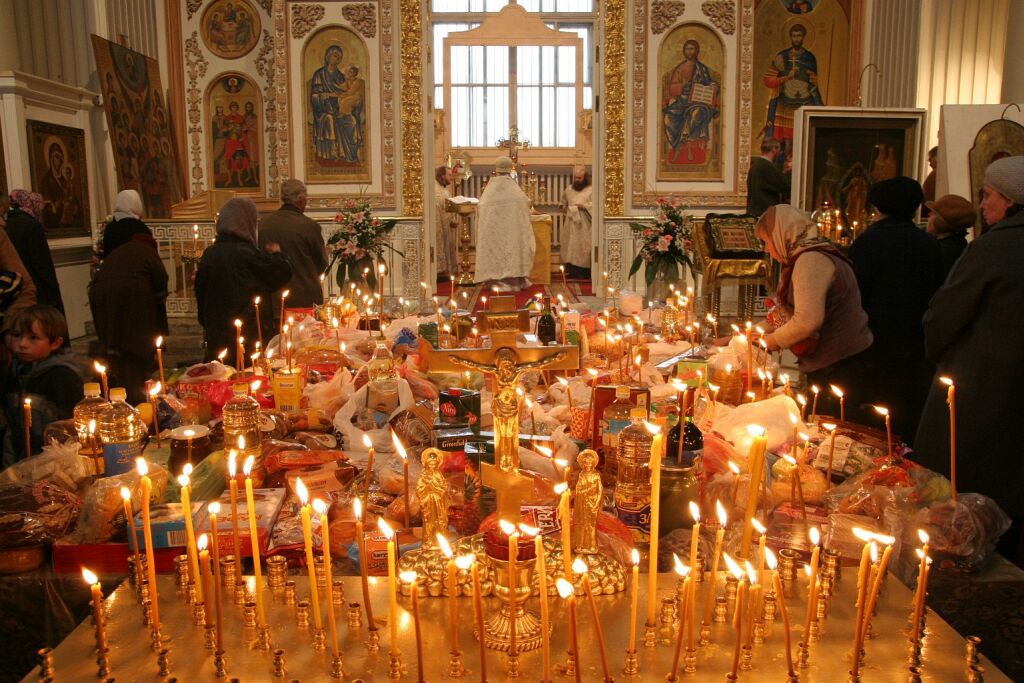
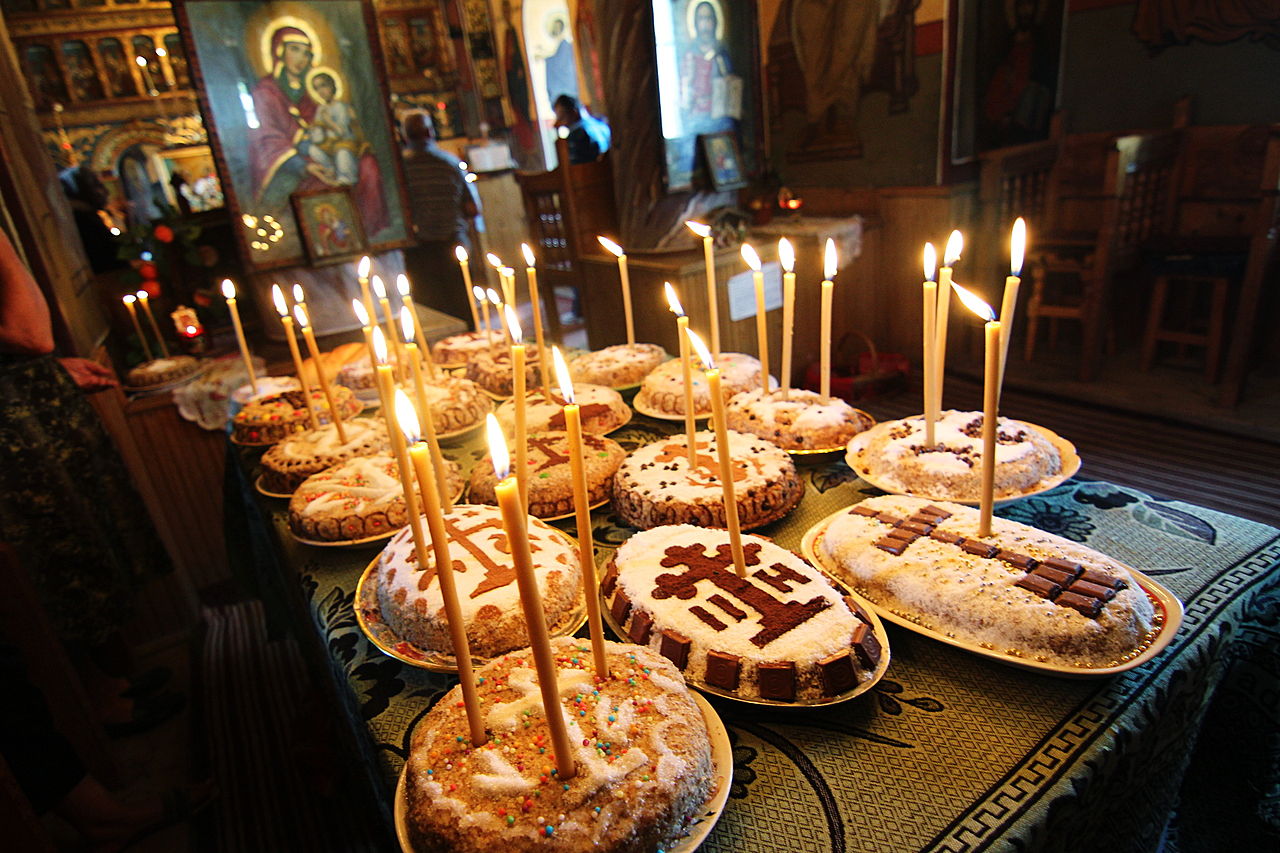
It is important to say that there is an ancient pious tradition to bring special food products for Memorial Services to Church. These can be Koliva (or Kutia - a dish made of boiled wheatberries or rice and honey), bread, blini, biscuits, pies, fruits, berries, flour, whine, oil and all kinds of flour-based cooking. After the Service, the priest blesses them and they are then left for the Church or eaten as a memorial by all present.
A Guidance into Afterlife.
The service connected to the death of a Christian does not begin only when a person comes to his inevitable, when his remains lie in the church in anticipation of its last rite and prayer, when relatives, the sad and yet passive witnesses of the parting of the deceased with the world of the living, stand around. No, this divine service begins every Sunday - during the ascension of the Church to Heaven, when “all worldly cares” are laid aside. The burial service, moreover, takes place at any Christian feast, though most deeply it is rooted in the joy of the celebration of Christ’s resurrection. One could say that the whole Church life is the sacrament of our death, because it is all the proclamation of the Lord’s death and a profession of His Resurrection.
Being a Christian has always meant - and means - the following: to know with a mysterious, supernatural and yet an absolutely definite faith that Christ is the very essence and foundation of life , for “in Him was life, and the life was the light of men” (John 1:4).
All Christian dogmas are explanations, consequences, not reasons for this faith, for “if Christ is not risen, then our preaching is empty and your faith is also empty” (1 Cor 15:14). This faith means accepting that Christ Himself is Life and Light, for “the life was manifested, and we have seen, and bear witness, and declare to you that eternal life which was with the Father and was manifested to us” (1 John 1, 2). The starting point of the Christian faith is not “believing”, but loving. Any belief is incomplete and transitory. “For we know in part and we prophesy in part. But when that which is perfect has come, then that which is in part will be done away…” (1 Cor 13:9-10), and “whether there are prophecies, they will fail; whether there are tongues, they will cease; whether there is knowledge, it will vanish away”, only “love never fails” (1 Cor 13:8).
Only accepting Christ as Life and communicating with Him, only confidence in His presence can fill the proclamation of Christ’s death and the confession of His Resurrection with meaning.
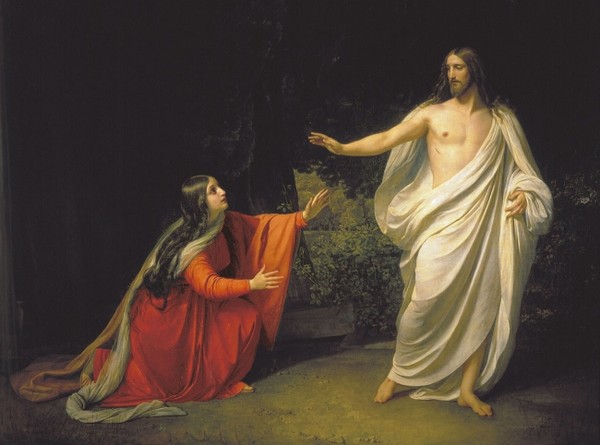 In this world, the
Resurrection of Christ could never become an “objective fact”. The resurrected
Christ appeared before Mary, and she “saw Jesus standing there, and did not
know that it was Jesus” (John 20:14). “After these things Jesus showed Himself
again to the disciples at the Sea of Tiberias… But when the morning had now
come, Jesus stood on the shore; yet the disciples did not know that it was
Jesus. (John 21: 4). And on the road to Emmaus, the eyes of the disciples
“were restrained, so that they did not know Him” (Luke 24:16). The preaching
of the Resurrection still appears foolish in the eyes of this world.
It is not based on pre-Christian teaching about immortality, with which it is
often confused. Death , even for a Christian, remains an incomprehensible
transition into the mysterious future. The immense feeling of joy that the
disciples felt when they saw their Resurrected Teacher, the passion with which
they walked along the road to Emmaus, were not consequences of the secrets of
“another world” that were revealed to them. The reason for their rejoice was
that they had seen the Lord. And He sent them, His disciples, to preach - not
a new doctrine of death, but the idea of repentance and forgiveness of sins,
of a new life, of the Kingdom of Heaven. They proclaimed what they knew
themselves: that Christ Himself is the Eternal****Life , the
fulfillment, the Resurrection , the Joy of the world.
The Church is the entrance into the world of the resurrected Christ, the promise of eternal life, “peace and joy in the Holy Spirit” (Rom 14, 7). It is the expectation of the everlasting Kingdom. Not simply of “another world”, but of the end of everything that exists, of life in Christ. For in Him, death itself has become an act of life, because He filled it with Himself, with his love and light. In Him, as the apostle says, “all things are yours, whether… the world or life or death or the present or the future—all are yours, and you are of Christ, and Christ is of God” (1 Cor 3, 21-23). And if a Christian does make this new life his own, if he makes the desire for the coming of Christ and his Kingdom his own, and if he believes that Christ is Life – then even the Christian’s death will become a mysterious act of communion with Eternal Life. For from now on, no one can deprive him from God’s love. We cannot know how or where our hopes will be fulfilled, but we do know that everything must come to an end in Christ, through Whom everything was made. We also know that it was in Christ that the great Passover of humankind was fully completed. We know that the Easter of mankind has begun and that the light of “the life of the world to come” appears to us in joy and peace of the Holy Ghost, for Christ is risen, and life is reigning.
Preparation for the Deceased for the Burial.
According to the Church, the human body is the temple of the soul, sanctified by the grace of the Sacraments. The holy Apostle Paul writes: “For this corruptible must put on incorruption, and this mortal must put on immortality.” (1 Cor. 15:53). Therefore, ever since the apostolic times, the Church has lovingly cared for the remains of its deceased brothers in faith. The image of burying the dead is given in the Gospels, where the burial of our Lord Jesus Christ Himself is described. Although the Orthodox rite and the Old Testament traditions of preparing the body of the deceased for burial do not altogether coincide, they, nevertheless, have a common structure. This can be noticed, for example, in the following aspects: washing the body, dressing it, placing it in the coffin, reading and singing funeral prayers, and committing it to the earth.
The washing of the body with water represents the person’s future resurrection and him standing, clean and pure, before God. This tradition can be found as early as in the book of the Acts, where one of the first Christian women, Saint Tabitha, a disciple of Apostle Peter, is mentioned. “This woman was full of good works and charitable deeds which she did. But it happened in those days that she became sick and died.” (9, 36-37).
The bodies of deceased bishops and priests are not****washed with water. Instead, they are wiped with a sponge soaked in holy****oil. This is performed not by the laity, but by the clergy (priests or deacons). The body of a deceased monk is also not washed, only wiped with warm water “before making a cross on the forehead of the deceased, on the chest, on the arms, on the legs, on the knees, and nothing more” (Big Breviary Book). Then “he is dressed in clothes appropriate to his image , and those clothes are sewn into a mantle, which becomes like a coffin for him; above the mantle, three crosses from the same vestment are made in remembrance of Christ, the Cross of Which the monk carried in himself, and upon all this is placed an icon of the One Whom he loved - that is, the icon of Christ” (“The New Tablet”, in Russian «Новая Скрижаль»).
The body of the clergyman is dressed in all the clothes that correspond to his rank, which symbolises the fact that at the Last Judgment he will be held accountable not only for the fulfillment of his Christian duty, but also for the fulfillment of his pastoral service. His clothes should be new and of light colours. A Cross is placed in the right hand of the deceased bishop or priest, and a Gospel book is placed on his chest, thus following the example of Apostle Barnabas, who, according to the legend, bequeathed to Saint Mark to put the Gospel of Matthew with him when he is buried. As a sign that the priest was a performer of the Sacred Mysteries, after death his face is covered with an aër(a veil) as a sign of honour, for the Holy Scripture equates priests to angels who stand, “hiding their faces” before the throne of the Almighty.
The body of a deceased deacon is laid in the coffin in full diaconal vestments , with a censer placed in his hand. The deacon’s face is not covered with an aër.
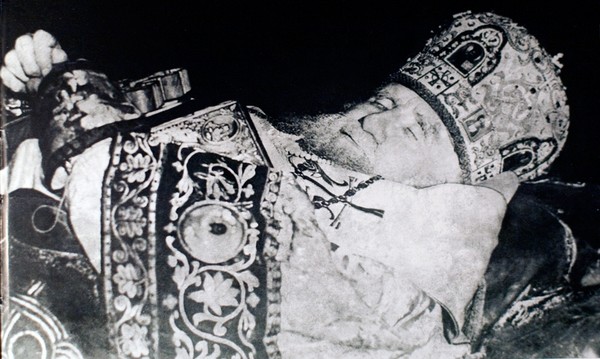
A deceased bishop , having been abluted with holy oil, is dressed in all
his appropriate clothing. This is accompanied by singing: “Let your soul
rejoice in the Lord,” with ripidia, censers, a trikirion and a dikirion. After
being dressed, the body is placed in a seat, and the protodeacon proclaims:
“Let your light shine before men,” then it is laid on a table and covered with
a large aër.
According to Church rules, the Cross granted to a priest is not laid upon him. A skufia or kalimavkion is placed on the deceased priest, just like miters and epigonations are laid upon the dead who, during their lifetime, did receive these awards.
Church and secular medals, however, are not placed to the deceased. As for priests and deacons that were restricted from serving, they can be placed in the coffin in garments of their rank with the permission of a bishop.
Bodies of deceased psalm-readers can be dressed in a surplice(stikharion), but only those who had received one. The Gospel and the aër remain in the coffin and are buried along with the body of the deceased clergyman.
The body of a deceased layman , in addition to ordinary clothes, can sometimes be dressed in a shroud - a white cover that reminds us of the white clothes worn during the ceremony of Baptism. The corpse, washed and clothed, rests on a prepared table, face up, towards the east. Before this the coffin is sprinkled with holy water (if the deceased is a bishop, it is also crossed with a trikirion, a dikirion and ripidion). The mouth of the deceased must be closed, the hands folded crosswise on the chest as evidence of the deceased’s faith in the Crucified. The placing into the grave is performed while reading the prayers: the Trisagion, the Lord’s prayer – and while singing the stichera. Sometimes the body is put into the coffin before the memorial service. If the deceased is a priest, before the memorial service the irmoses “He is my Helper and Protector” are sung, and on the days of Holy Easter the stichera “Let God arise…”, “Holy Easter will be shown to us today”.
The forehead of the deceased is adorned with a wreath , which symbolises the crown that the holy Apostle Paul speaks of: “Finally, there is laid up for me the crown of righteousness, which the Lord, the righteous Judge, will give to me on that Day, and not to me only but also to all who have loved His appearing.” (2 Tim. 4:8). The Savior, together with the Mother of God and John the Baptist standing before Him, is depicted on the wreath. The body of the deceased is covered with a sacred veil, as evidence of the belief of the Church that the he is under the protection of Christ. A mantle is laid upon the coffin of a bishop, and a cover is placed over the mantle itself. An icon of the Savior or the Crucifixion is placed in the hands of the deceased. Four candlesticks with candles are placed around the coffin: one at the head, another at the feet, and two on each side of the coffin; together they depict the Cross and symbolise the transition of the deceased into the Kingdom of true light.
Funeral and Burial.
The Charter of the Church was created in ancient Christian times. And the Church has preserved the “Office of defunct laymen bodies” since ancient times, when monastic life had a huge impact on the life of Christian laymen. The Orthodox Euchologion retained the Charter recommendations in both the procedure of carrying the body of the deceased out of the house and in the transportation of the body into the church. According to the Charter, this is performed whilst singing the Trisagion: ” Holy God, Holy Mighty, Holy Immortal, have mercy on us”.
Despite the mournful nature of this service, the Orthodox funeral procession is especially solemn. Although the relatives of the deceased are in mourning clothes and the clergy are dressed in dark (but not black) robes, the Trisagion Song, which is sung throughout the whole service, marks the decedent’s fidelity to the Lifegiving Trinity. The Trisagion Song symbolises the posthumous preaching of the deceased about the Lord, with faith in Whom he died, and the hope of being complicit to the angels that eternally glorify the Giver of Life. This song, the Trisagion, was composed as an imitation of the Seraphim hymn, filled with its spirit and, at the same time, with our humble plea for mercy. When the body of a deceased bishop or priest is taken out of the house, the irmoses of the Great Canon (“He is my Helper and Protector”) are sung: and when the body of a monk is taken out, stichera “What worldly sweetness” are sung.
The body of the deceased is carried by his relatives and friends, accompanied by clergymen. “This is because,” Dionysius the Areopagite piously says, “if the deceased led a God-loving life in both his soul and body, then, together with a righteous soul the body should also be honoured, for it also took part in sacred labours. The Divine Justice grants the soul, along with its own body, its well-deserved rewards, for the body was the soul’s accomplice in life”.
The sound of the bell during the transportation of the body of the deceased into the church announces to the living that they have one less brother, and, at the same time, it serves as a foreshadowing of the trumpet sound of the Archangel, which will sound on the last day of the world and will be heard in all ends of the earth.
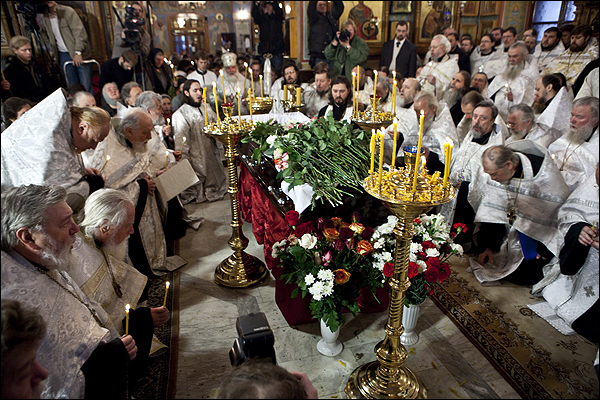 In the old days
the funeral procession was even more solemn. In the “Apostolic Constitutions”
it is prescribed to accompany the dead Christians whilst singing psalms: “When
burying the dead, carry them out with psalms, if they were faithful to the
Lord, for precious in the sight of the Lord is the death of His saints.” (Book
6, ch. 5). In one of his Conversations St. John Chrysostom quotes the words of
some of the psalms that were sung during the burial: “You are my hiding place;
You shall preserve me from trouble, You shall surround me with songs of
deliverance.” (Ps. 31:7). ” The Lord preserves the simple; I was brought low,
and He saved me.” (Ps. 114:6). “Yea, though I walk through the valley of the
shadow of death, I will fear no evil; for You are with me; Your rod and Your
staff, they comfort me.” (Ps. 22, 4).
Not later than the 5th century appeared the tradition to sing the Trisagion when the body of a deceased Christian is carried out of the church. Emperor Theodosius and his sister Pulcheria extended the use of the Trisagion to all Church services.
Since ancient times, Christians who participated in the funeral procession would carry lighted****candles. St. John Chrysostom explained the meaning of candles used during burial as an expression of great faith, hope and love in prayer for the deceased.
In the 4th century, continuously returning years of famine and epidemics left behind numerous corpses of poor people and unknown travelers. Presbyters did not have time to bury them. It was then that in populous cities special “deans ” or “diggers ” societies were created. Their members took the responsibility of all the preparations for burial. First such a society was formed in Constantinople, where the number of “diggers” reached thousands of people, and from there it spread to other cities. Since the activities of this society were of great importance and required a selfless service, only the best of Christians were allowed to join it. The decision of allowing someone to join was up to the Patriarch or a local bishop. Diggers would bury the bodies of the poor, of executed criminals, unknown travelers. They would also wash and dress the bodies of the dead and take control over the burial service. Clerical writers and even pagans were surprised by the unselfishness and determination of the diggers, by their ardent love for the dead, in whom they saw not a lifeless corpse, but a living brother called to a better life.
When the coffin with the body of the deceased is brought into the church, it is placed in the middle, opposite the royal doors. The face of the deceased is open and faces east (therefore, with feet towards the altar), just like Christians at prayer, so that the departed soul prays with its brothers still living on earth.
We have evidence of the ancient custom of placing the dead, with an open face, in the church, facing east , and of celebrating the Divine Liturgy on that day. In the 4th century, St. Gregory of Nyssa, who wrote the Vita of his sister Macrina, says that young women who stood in the church next to her tomb would stop their psalmody to look at her face, which was radiating light. Saint Jerome writes about a Christian woman Paula, whose body was placed for burial in the middle of the temple. In the works of the 4th century, we find certain evidence that on the day of the burial of a Christian, a Liturgy was performed. For example, the burial of Emperor Constantine the Great was performed after serving the Liturgy. Saint Ambrose of Milan and Saint Augustine were buried in this way.
Today the funeral service is also usually performed after the Liturgy. In the Orthodox Church there are special funeral rites: 1) for the laity , 2) for monks , 3) for priests , 4) for infants. In the Easter week, all these categories somewhat change.
Related Concepts
- 2-timothy-48
- afterlife
- angelic-hymn
- blessing
- bloodless-sacrifice
- christ-as-life
- christ-as-life-and-light
- church-communion
- clergy-burial
- communion-of-saints
- easterpascha
- ecumenical-parents-saturdays
- funeral-preparation
- funeral-procession
- funeral-rites
- great-lent
- infant-burial
- liturgical-order
- liturgical-rites
- liturgical-year
- memorial-days
- memorial-services
- monastic-burial
- panikhida
- particular-judgment
- pentecost
- prayer-for-the-dead
- preparation-of-the-body
- resurrection
- russian-custom
- russian-liturgical-customs
- st-thomas-sunday