Liturgics — 10. The All-Night Vigil
-
The significance of the All-Night Vigil.
- The features of the All-Night Vigil.
- The types of connection of celebration of different saints during an All-Night Vigil.
-
The All-Night Vigil.
ALL-NIGHT VIGIL
THE SEQUENCE OF THE GREAT VESPERS AS A PART OF THE VIGIL
The service of the Great Vespers, celebrated as part of the vigil, is set out in the 2nd chapter of the Typicon[1]. According to the Charter, the All-Night Vigil is performed on all Sundays, on great and vigilant holidays, as well as on a church holiday. If the All-Night Vigil begins with Great Vespers (and not with Compline), then after the 9th hour, a small Vespers is served, then, according to the monastery charter, a supper (evening meal) takes place, after which, after a short period of time, Great Vespers begins.
According to the Charter, the whole church is censed before the beginning of Vespers, but in practice, before the first exclamation, the deacon opens the Royal doors and the priest censes only the altar (the deacon precedes him with a candle), after which the deacon goes to the ambon and proclaims: “Arise.”
Choir: “O Lord, bless!”
The priest performs the sign of the cross with the censer and proclaims: “Glory to the holy, and consubstantial, and lifecreating, and indivisible Trinity, always, now and ever, and unto the ages of ages.”
Choir : “Amen.”
Clergy : “Come, let us worship God our King. Come, let us worship and fall down before Christ, our King and our God. Come, let us worship and fall down before Christ Himself, our King and our God. Come, let us worship and fall down before Him.”
The choir sings thepsalm 103.
During the singing of the introductory psalm, the priest censes the iconostasis, the choir, the people and the whole churh, and the deacon precedes him with a candle. At the end of the censing, the deacon closes the Royal doors, and the priest goes through the north door to the soleas and, with his head bare, reads the prayers of the Light in front of the Royal doors[2].
Chorus : “Glory, and now”, “Alleluia, Alleluia, Alleluia, glory to Thee, O God ” (three times).
The deacon pronounces the great litany: “In peace let us pray to the Lord.”
Priest(after the litanies): “For unto Thee is due…”.
Choir : “Amen”. “Blessed is the man…”(on Sunday the entire kathisma is sung, and on weekdays only the 1st antiphon of the 1st kathisma is sung). “Glory, and now”, “Alleluia ...” (thrice).
The deacon pronounces the small litany “Again and again…” (after the litanies, he enters the altar, takes the priest’s blessing for censing and censes the entire church).
Priest(acclamation): “For Thine is the dominion**…** ”.
It must be noted that on Sunday Vespers, according to the Charter, a small litany is served after each antiphon of the kathisma. In this case, the exclamation “For Thine is the dominion**…** ” is read after the 1st antiphon, and on the 2nd antiphon - “For a good God art Thou…”, on the 3rd - “** For**** Thou art our God, God who shows mercy and to saves us**…”[3].
Choir : “Amen”. “Lord, I have called …” (of the tone of the 1st sticheron).
Choir(or reader): “Set, O Lord…” (Psalms 140, 141, 129,116).
The choir then sings 10 (from “Bring my soul out of prison…”) or 8 stichera (from “Out of the depths have I cried unto Thee, O Lord**..**.”), depending on the Charter. During the singing of the “And now” dogmatic or the sticheron of the feast there is the entrance with the censer.
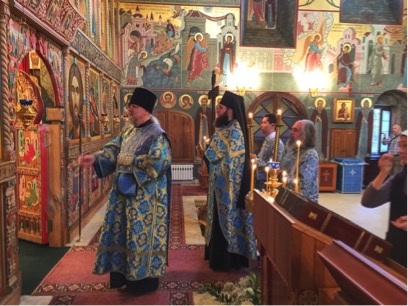
The entrance with the censer is explained above [4], in the sequence of
Great Vespers, which is performed separately from Matins.
Deacon(after the dogmatic or stichera, making the sign of the cross with a censer): “Wisdom, aright.”
Chorus : “O Gentle Light…:
The deacon enters the altar, censes the throne from four sides, the high place and the priest, and then hands over the censer. The priest kisses the icons on the Royal doors and, following the deacon, enters the altar, after which the priest and deacon kiss the altar and proceed to the high place. The priest stands to the right of the high place, and the deacon to the left, facing the people.
Deacon : “Let us attend.”
Priest: “Peace be unto all.”
At this point, the candle-bearers bow to the high place, then to each other and then carry the candlesticks to the place, but do not extinguish the candles (they should be extinguished only after the prokeimenon is sung).
Deacon : “Wisdom. Let us attend.”
Then the deacon and choir perform the prokeimenon of the day. At Sunday Vespers, the great prokeimenon “The Lord is King…”, which has three verses, is sung.
If the parables are read in honour of the holiday, then, after the singing of the prokeimenon, the deacon proclaims: “Wisdom.” Immediately, the deacon closes the Royal doors, then returns to the high place, stands to the left of it and remains here until the end of the reading of parables. However, if parables from the New Testament are read (on the feasts of the apostles, the Charter appoints parables from the Catholic Epistles to be read), then the Royal doors remain open until the end of the parables.
Reader: “The reading is from…” (announces the parable).
Deacon: “Let us attend.”
The reader reads the 1st parable. A similar dialogue between the deacon and the reader takes place before the other parables. At the end of the last parable, the deacon, having kissed the edge of the throne on the north side, goes to the ambon to pronounce the augmented litany.
The deacon pronounces the augmented litany “Let us all say…”.
Priest(exclamation): “For a merciful God art Thou, and the Lover of mankind…”.
Choir : “Amen :. “Vouchsafe, Lord…” During the performance of this hymn, the deacon goes to the icon of the Savior, where he stands, waiting for the hymn to end.
The deacon pronounces the****Litany of Fervent Supplication : “Let us complete our evening prayer to the Lord…”****
Priest(exclamation): “For a good God art Thou, and the Lover of mankind…”.
Choir : “Amen.”
Priest(blessing the people): “Peace be unto all.”
Choir : “And to thy spirit**.”**
Deacon : “Let us bow our heads unto the Lord.”
Chorus : “To Thee, O Lord.”
The sextons enter holding candles through the side doors (one from each side) and place the candles in front of the Royal gates.
The priest secretly reads the prayer of head bowing : “O Lord our God, bowing the heavens …”, and then proclaims: “Blessed and most glorified be the dominion of Thy kingdom**…”.**
Chorus : “Amen ” and sings the litia stichera according to the Charter.
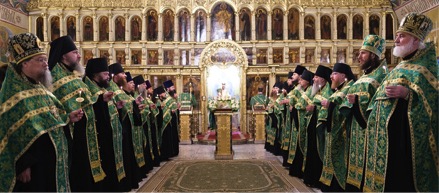 During the singing of the stichera, the clergy go out
into the narthex to perform the lity in the following way: the candle-bearers
go ahead, then the deacon and the priest walk out through the northern door
(the Royal doors are closed)[5]. The priest is dressed only in an
epitrachelion. In the narthex, the sextons let the priest pass, then they
place candles directly against the Royal doors, at the entrance to the main
part of the church. Meanwhile the deacon censes the altar according to the
order, then goes out through the north door to the pulpit, censes the
iconostasis, descends from the ambon and censes the icon of the feast, then
goes to the porch, where he censes the priest (and concelebrants during a
cathedral service). Then the deacon returns to the ambon, censes the choir
and the people from the pulpit, the Royal gates, local icons, descends again
and censes the icon of the feast, goes to the narthex, censes the head
priest , bows and gives the censer to the sexton [6].
Deacon : “Save, O God, Thy people…”.
Chorus : “Lord, have mercy” (40 times).
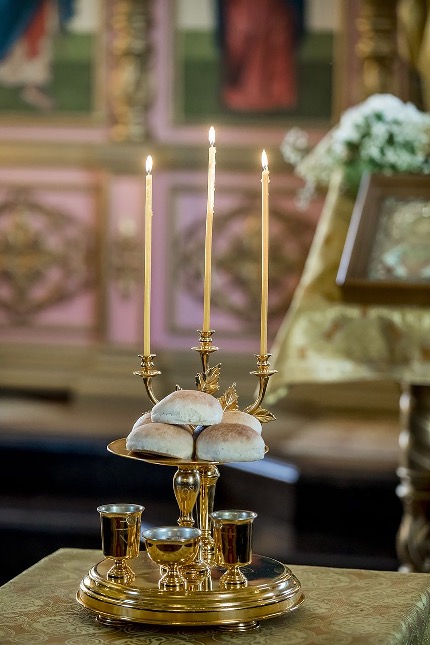
In practice, during the singing of “Lord, have mercy,” the sexton places the lity table in the center of the church and brings out a lity set, on which there are already five loaves, some grains of wheat, small vessels with wine and oil.
Deacon: “We are still praying for the great Lord…”.
Chorus: “Lord, have mercy” (30 times).
Deacon: “We still pray for a God-protected country…”[7].
Chorus: “Lord, have mercy” (50 times).
Deacon: “Again we pray that this city…”.
Chorus: “Lord, have mercy” (three times).
Deacon: “Again we pray also that the Lord God may hearken unto the voice…”.
Chorus: “Lord, have mercy” (three times).
Priest (exclamation): “Hearken unto us, O God our Saviour,…”.
Choir: Amen.
Priest (blessing the people): “Peace be unto all.”
Choir: “And to thy spirit.”
Deacon: Let us bow our heads unto the Lord.
Chorus: “To Thee, O Lord.”
The priest loudly reads the prayer : “O Master plenteous in mercy…”.
Choir: “Amen” and sings the apostichon according to the Charter.
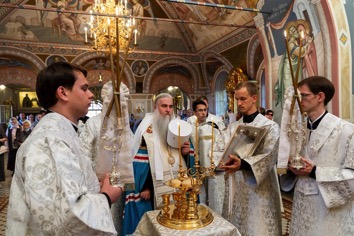 At the beginning of the singing of
the stichera, the clergy, preceded by sexton with candles, enters the main
part of the church. The priest stands in front of a table on which there is a
lity dish with bread. The deacon stands to the right of the priest, the
sextons place the candles behind the central lectern with the icon of the
feast.
Chorus: “Now lettest Thou…”.
Reader: Trisagion, “Our Father …”. The sexton brings out the censer and gives it to the deacon.
Priest (exclamation): “For Thine is the Kingdom…”.
Chorus: “Amen” and sings the troparia according to the Charter [8] (during the singing of the troparia, the deacon censes the lity dish and the loaves three times from four sides, then the priest and once again the dish with loaves from the front).
Deacon: Let us pray to the Lord.
Chorus: “Lord, have mercy.”
Priest: “O Lord Jesus Christ our God, Who didst bless the five loaves and didst satisfy the five Thousand…”.
At the very beginning of the prayer, the priest takes one of the loaves (the one that lies on top) and makes the sign of the cross over the loaves with it. When pronouncing the words ”… these loaves, wheat, wine, and oil…” the priest points to these substances with his right hand, thus drawing the sign of the cross.
Chorus: Amen. “Blessed be the name of the Lord…” (three times) and the 33rd psalm (up till half-way).
The deacon carries the lity dish to the altar [9], trying not to drop it; before the deacon are the priest-bearers, who enter the altar through the corresponding side doors. The priest follows the deacon, stops at the ambon and waits for the end of the singing of the psalm.
Priest (from ambon): “The blessing of the Lord be upon you…”. And enters the altar through the south door.
Choir: Amen.
In practice, all this is immediately followed by Matins, beginning with the reading or singing of the verses “Glory to God in the highest …” before the Six Psalms. According to the monastic charter, however, a rather long period of time is supposed between Vespers and Matins, during which the breaking of bread and the eating of consecrated bread and wine are performed and the Holy Scripture and its interpretation are read. However, as early as in the 17th century, as the Typicon notes (“now this rite has been greatly abolished in the churches”), was omitted, so that at present, Matins directly follows Vespers at the All-Night Vigil.
THE JOINING OF THE GREAT VESPERS, SERVED AS PART OF THE VIGIL, WITH A FEAST IN HONOUR OF SAINTS
In the case of a saint without a sign.
The features of such a service can be found in the 2nd chapter of the Typicon.
“Blessed is the man…” (the whole kathisma, divided into three antiphons, is sung).
Ten stichera on “Lord, I have cried…”; seven Sunday stichera of the Octoechos and three of the saint; “Glory”: sticheron of the saint; “And now”: Sunday dogmatic of the current tone. Lity stichera: sticheron of the church.
The sticheron of the church is taken from the service for the church feast, but the Typicon does not clearly regulate which particular church sticheron should be sung on the lity. There is evidence to believe that if a holiday has lity stichera, then at the Sunday all-night vigil any lity sticheron (often the first) is sung. However, the service of the Menaion on a church feast does not have lity stichera (for example, the church is consecrated in honour of a saint who does not have a festive sign in the Typicon), then any sticheron of the given holiday is sung ). At the same time, preference should be given to more solemn stichera sung on “Glory” on “Lord, I have cried …” or on the sticheron. Interestingly, in the ancient lists of the Typicon, it is indicated to sing the sticheron of the church on the lity according to the tone of the Octoechos, that is, to choose from the church stichera a sticheron, the tone of which corresponds to the tone of this Sunday, in order to maintain musical correspondence with other parts of the service.
“Glory, and now”:
• In a Lord’s or Mother of God church another church sticheron is sung;
• in the church of a saint - the of the 1st appendix according to the tone of the sticheron of the church.
Aposticha : 4 Sunday stichera of the Octoechos, with their refrains. “Glory”: sticheron of the saint; “And now”: Theotokion apostichon of the 1st appendix according to the tone of the “ Glory ” sticheron. If the saint does not have “Glory” , then “Glory, and now” is sung, then the apostichon Theotokion of the Octoechos as usual.
After “Now lettest Thou…”: troparion “O Theotokos Virgin…” (three times).
In the case of a saint’s feast with six stichera or with a doxology.
The charter of such a service is set out in the 5th chapter of the Typicon.
“Blessed is the man…” (the whole kathisma, which is divided into three antiphons, is sung).
Ten stichera on “Lord, I have cried…”; six Sunday stichera of the Octoechos and four of the saint; “Glory”: sticheron of the saint; “And now”: Sunday dogmatic of the present tone.
Lity stichera: sticheron of the church. “Glory, and now”:
• In a Lord’s or Mother of God church the second church sticheron is sung;
• in the church of a saint - the of the 1st appendix according to the tone of the sticheron of the church.
If the saint is with a doxology, then after the sticheron of the church, the aposticha of the saint are sung. “Glory”: sticheron of the saint; “And now”: the apostichon Theotokion of the 1st appendix according to the tone of the “Glory” sticheron.
Aposticha: four Sunday stichera of the Octoechos, with their refrains. “Glory”: sticheron of the saint; “And now”: the apostichon Theotokion of the 1st appendix according to the tone of the “Glory” sticheron.
In the case of a saint with a service containting the polyeleos
The charter of this service is set out in the 4th chapter of the Typicon.
“Blessed is the man…” (the whole kathisma is sung, divided into three antiphons).
10 stichera on “Lord, I have cried …”: 4 Sunday stichera and 6 of the saint; “Glory”: the sticheron of the saint; “And now”: the Sunday dogmatic of the current tone.
3 Prophecies of the saint.
Stichera on the litia: sticheron of the church; “Glory”: sticheron of the saint (from the apostichon); “And now”: the Theotokion of the apostichon of the 1st appendix according to the tone of the “Glory” sticheron. If the saint has litia stichera (on some polyeleic feasts of the apostles, the litia stichera are given in Minea), then these stichera are sung after the church sticheron.
The aposticha: 4 Sunday stichera of the Octoechos, with their choruses. “Glory”: sticheron of the saint; “And now”: the Theotokion of the apostichon of the 1st appendix according to the tone of the «Glory» sticheron.
After “Now lettest Thou…”: troparion “O Theotokos Virgin…” (three times).
In the case of a saint celebrated by an all-night vigil
The charter of such a service is given in the 3rd chapter of the Typicon.
10 stichera on “Lord, I have cried …”: 4 Sunday stichera and 6 of the saint; “Glory”: the sticheron of the saint; “And now”: the Sunday dogmatic of the present tone.
3 Prophecies of the saint.
Stichera on the lity: sticheron of the church and of the saint; “Glory”: sticheron of the saint; “And now”: the Theotokion of the apostichon of the 1st appendix according to the tone of the «Glory» sticheron.
After “Now lettest Thou…”: troparion “O Theotokos Virgin…” (two times) and troparion of the saint (once).
GREAT VESPERS, PERFORMED AS PART OF THE VIGIL, DURING THE PRE- OR POST- CELEBRATION OF ONE OF THE TWELVE GREAT FEASTS
 The case of a polyeleic saint during the
pre- or post-celebration of one of the twelve great feats
The charter of such a service is found in the Mark’s Chapters (Markova glava
- name of a special chapter, explaining how a celebration is performed on special occasions or when encoutering another feast) of all the twelve great feats (see September 8, September 15, November 21 and other days). In this case, the Sunday service is combined with the pre- or post-celebration service and the polyeleic service of the saint.
“Blessed is the man…”(the whole kathisma is sung, divided into three antiphons).
10 stichera on “Lord, I have cried …”: 3 Sunday stichera, 3 of the feast, 4 of the saint; “Glory”: the sticheron of the saint; “And now”: the Sunday dogmatic of the present tone.
3 Prophecies of the saint.
Stichera on the litia: sticheron of the feast (from the apostichon of the given day); “Glory”: sticheron of the saint; “And now”: the sticheron of the feast. If the saint has litia stichera, then they are sung after the stichera of the feast.
The aposticha: 4 Sunday stichera of the Octoechos, with their choruses. “Glory”: sticheron of the saint; “And now”: the sticheron of the feast.
After “Now lettest Thou…”: troparion “O Theotokos Virgin…” (two times) and troparion of the feast (once).
The case of a minor or six-fold saint during the pre- or post-celebration of the twelve great feasts
The charter of such a service is found in the Mark chapters of all the twelve great feasts (see September 8, September 15, November 21 and other days). In this case, the Sunday service is combined with the service of the pre- or post-celebration and the service of the saint.****
10 stichera on “Lord, I have cried…”:
• if it is a six - fold saint: 3 Sunday stichera, 3 of the feast, 4 of the saint; “Glory”: the sticheron of the saint; “And now”: the Sunday dogmatic of the present tone;
• if the saint is wiThout a sign, then 4 Sunday stichera are sung, 3of the feast, 3 of the saint; “Glory”: sticheron of the feast; “And now”: the Sunday dogmatic of the present tone.
Stichera on the litia: stichera of the feast (from the aposticha of the vespers of given day); “Glory”: sticheron of the saint (from the apostichon); “And now”: sticheron of the feast. In the case of a minor saint wiThout a sticheron, “Glory, and now” and the sticheron of the feast are sung.
Apostichon: 4 Sunday stichera of the Octoechos, with their choruses. “Glory”: sticheron of the saint; “And now”: sticheron of the feast. In the case of a minor saint wiThout a sticheron, “Glory, and now” and the sticheron of the feast are sung. After “Now lettest Thou…”: troparion “O Theotokos Virgin…” (two times) and the troparion of the feast (once).
TWO MORE VERSIONS OF THE GREAT VESPERS AS PART OF THE VIGIL
The case of the a great feats of the Lord (on any day) or of a feast of the Mother of God on a weekday
The features of such a service can be found in the Typicon in the sequences of September 8 and 14.
Kathisma: on a Lord’s feast: if the feast takes place on a Sunday, then the whole 1st kathisma is sung. If it takes place on a Monday, then the 1st antiphon of the 1st kathisma is sung. If it takes place on other days of the week, then there is no kathisma at all. On a feast of the Mother of God: “Blessed is the man…” (1st antiphon of the 1st kathisma).
Stichera on “Lord, I have cried …”: 8 or 10 (rarely) stichera of the feast; “Glory, and now”: sticheron of the feast.
3 parables of the feast.
Stichera on the litia: stichera of the feast; “Glory, and now”: sticher on of the feast.
Aposticha: 3 stichera of the holiday with their choruses. “Glory, and now”: the sticheron of the feast.
After “Now lettest Thou…”: troparion “O Theotokos Virgin…” (three times)
The case of the vigilant saint during the singing of the Octoechos
The features of such a service can be found in the Typicon in the sequence of the saints, indicated by a red cross in a semicircle (for example, September 26, November 13). As well as this, some instructions can be found in the 6th statutory chapter of the General Minea (“About the holy one who has a vigil, if he is absent on weekdays except for Sunday”).
“Blessed is the man…” (1st antiphon of the 1st kathisma).
Stichera on “Lord, I have cried…”: 8 stichera of the saint; “Glory”: Sticheron of the saint; “And now”: the Sunday dogmatic according to the tone of the “Glory” sticheron. On a Saturday, the dogmatic of the present (outgoing) tone is sung.
3 parables of the saint.
Stichera on the litia: sticheron of the church; “Glory”: sticheron of the saint; “And now”: the usual Theotokion of the Menaion (of the same tone). If only the first words of the Theotokion are indicated in the Menaion, then it is necessary to search for the corresponding text in the 1st or 2nd appendixes of the Menaion by the tone of the “Glory” sticheron. If there is no Theotokion in the Menaion at all, then the Theotokion of the apostichon of the 1st appendix according to the tone of the «Glory» sticheron is sung.
The aposticha: 3 stichera of the saint, with their choruses. “Glory”: sticheron of the saint; “And now”: the Theotokion of the apostichon of the 1st appendix according to the tone of the «Glory» sticheron.
After “Now lettest Thou…”: troparion “O Theotokos Virgin…” (two times) and troparion of the saint (once). “And now”: the usual Theotokion of the Menaion (of the same tone). If only the fist words of the Theotokion are indicated in the Menaion, then it is necessary to search for the corresponding text in the 1st or 2nd appendixes of the Menaion by the tone of the “Glory” sticheron. If there is no Theotokion in the Menaion at all, then the Theotokion of the apostichon of the 1st appendix according to the tone of the «Glory» sticheron is sung.
After “Now lettest Thou…”: troparion of the saint (two times) and “O Theotokos Virgin…” (once).
The case of a vigil saint or during the pre- or post-celebration of the twelve great feasts
The charter of such a service is presented in the 11th chapter of the General Menaion (“About the saint, who has a vigil or polyeleon, in pre- or post- celebrations, except for Sundays”). As well as this, its features can be found in the Typicon in the sequences of April 23 (to the Great Martyr George the Victorious) and May 8 (to the Apostle John the Theologian).
“Blessed is the man…” (1st antiphon of the 1st kathisma).
8 stichera on “Lord, I have cried…”: 3 stichera of the feast; 5 stichera of the saint; “Glory”: sticheron of the saint; “And now”: the sticheronof the feast. On a Saturday, “And now”, the dogmatic of the present (outgoing) tone is sung.
3 parables of the saint.
Stichera on the litia: sticheron of the church; stichera of the saint; “Glory”: sticheron of the saint; “And now”: sticheron of the feast.
The aposticha: stichera of the saints, with their choruses. “Glory”: sticheron of the saint; “And now”: sticheron of the feast.
After “Now lettest Thou…”: troparion of the saint (twice), troparion “O Theotokos Virgin…” (once).
SUNDAY MATINS AND ITS DIFFERENCE FROM POLYELEIC MATINS ON A WEEKDAY
The sequence of Sunday Matins is described in detail in the 2nd chapter of the Typicon and has a number of features peculiar only to Sundays.
On Sunday Matins, the Polyeleon is sung in the following cases (see Typicon, Chapter 17):
• in the period from the afterfeast of the Feast of the Cross to the pre- celebration of the Nativity of Christ (that is, from September 22 to December 19 inclusive);
• in the last three weeks before the Great Lent
• in other periods of the year, the polyeleon is sung only if a polyeleic feast takes place on a Sunday.
The 17th kathisma (“Psalm 119”) is sung instead of the polyeleon at Sunday matins in the following periods (if there is no polyeleic feast on that week):
• from the 1st Week of the Great Lent to the afterfeast of the Feast of the Cross;
• from the pre-celebration of the Nativity of Christ to the Week of the Publican and the Pharisee inclusive.
Therefore, at the end of the reading of the kathismas and sessional hymns, there are two possible options:
1. If there is no polyeleic holiday: the choir sings the Psalm 118 (“Blessed are the undefiled…”) or polyeleon: and, if it is necessary on that day, psalms 134 (“Praise ye the Lord …”) and 135 (“O give thanks unto the Lord; for He is good: for His mercy endureth for ever”).
If the 17th kathisma is sung, then the Royal gates remain closed and the priest and the deacon cense the entire church, starting from the altar, with the Royal gates closed (in this case, the deacon opens the Royal gates only before reading the Gospel). If the polyeleon is sung, then the deacon opens the Royal gates and the clergy goes out to the middle of the church, after which the entire church is censed.
Chorus: “Blessed art Thou, O Lord…” and troparia “The assembly of angels…”. At the end of the troparia, “Alleluia, Alleluia, Alleluia, glory to Thee, O God” is sung (three times).
2. In the case of a vigilant or polyeleic holiday: the choir sings the polyeleon: psalms 134 (“Praise ye the Lord …”) and 135 (“O give thanks unto the Lord”).
At the beginning of the singing of the polyeleon, the deacon opens the Royal gates and the clergy goes to the middle of the church.
The clergy sings the megalynarionof the feast. Then the canonarch or choir recites the verses of the chosen psalm, and after each verse the choir sings the megalynarion.
During the singing of the polyeleon and Megalynarion, the entire church is censed. In practice, either censing is performed entirely during the megalynarionwith the verses of the chosen psalm, or the priest censes the icon of the feast from four sides, the altar, the iconostasis and the people during the singing of the polyeleon, and during the megalynarionhe censes the main part of the church and the porch, rises to the pulpit, where he censes the doors of the Royal gates and local icons. Then the priest goes back to the festive icon, censes it from the front front, takes his place, censes the deacon and gives him the censer.
Deacon: “Let еvery breath”, the choir sings: “Praise the Lord.”
Deacon: “And that He will vouchsafe unto us the hearing of the Holy Gospel…”.
Meanwhile, the deacon descends from the pulpit and proceeds with the Gospel to the priest standing in the middle of the church. The sextons walk in front of the deacon and stand on both sides of the priest facing each other. The deacon holds the Gospel in his hands, and the priest opens the necessary extract and prepares to read it.
Chorus: “Lord, have mercy” (three times).
Deacon: “Wisdom! Aright! Let us hear the Holy Gospel.”
Priest: “Peace be unto all.”
Chorus: “And to thy spirit.”
The priest: “The reading is from the Holy Gospel according to… (calls the name of the evangelist).”
Chorus: “Glory to Thee, O Lord, glory to Thee.”
Deacon: “Let us attend.”
The priest reads the Gospel. On Sunday Matins, one of the 11 Sunday morning Gospel readings is read in order, starting from the Week of All Saints, in which the 1st Gospel is read:
The 1st Gospel — Mt. 116 extr. 7th Gospel — John 63 extr. 2nd Gospel — Mk. 70 extr. 8th Gospel - In. 64 extr. 3rd Gospel — Mk. 71 extr. 9th Gospel — In. 65 extr. 4th Gospel — Lk. 112 extr. 10th Gospel — John 66 extr. 5th Gospel - Luke 113 extr. 11th Gospel — John 67 extr. 6th Gospel — Lk. 114 extr.
Chorus (at the end of the reading): “Glory to Thee, O Lord, glory to Thee.”
Chorus: “Having beheld the Resurrection of Christ…”.
During the singing of this hymn, the deacon stands on the pulpit facing the people, holding the Gospel in his hands, and the sextons with candles stand on a step below the pulpit facing each other. At the end of ” Having beheld the Resurrection of Christ…”, the sextons carry the small candles to the altar, and the deacon descends from the pulpit and places the Gospel on the central lectern of the Gospel , as its content is related to the Gospel reading read at Matins. There are also 11 Gospel exapostilaria (like the Gospels), and the “ordinal number” of the exapostilarion that is being read corresponds to the number of the morning Gospel.
The stichera on “Praise …” are sung, starting with the verse “To do among them the judgment that is written…”. However, 8, not 6 stichera are sung. For this special verses are sung before the last two verses. Usually (if there is no polyeleic feast) these verses are the Sunday choruses: “Arise, O Lord my God, let Thy hands be lifted high…” and “I will confess Thee, O Lord, with my whole heart…”.
After the “Glory” sticheron, the Gospel sticheron is sung, which, like the Sunday exapostilarion, is by its content connected with the Sunday morning Gospel. These stichera are in the same appendix of the Octoechos as the exapostilarion. At the same time, for stichera from the 1st to the 8th, the “ordinal number” coincides with the tone of the sticheron, the 9th sticheron is sung on the 5th tone, the 10th - on the 6th tone, the 11th - on the 8th tone.
On “And now” at Sunday matins, the Theotokion is always sung: “Most blessed art Thou, O Virgin Theotokos…”.
After the doxology, one of the two final Sunday troparia is sung:
• in weeks of the 1, 3, 5, 7 tones: “Today is salvation come unto the world…”;
• in weeks of the 2, 4, 6, 8 tones: “Having аrisen from the tomb, and having burst the bonds of hades…”.
The priest begins the dismissal with the words “May Christ our true God, Who rose from the dead…”.
FEATURES OF SUNDAY MATINS IN DIFFERENT CASES
The case of a minor saint
After “God is the Lord …”: the Sunday troparion (twice); “Glory”: troparion of the saint, “And now”: the Sunday is Theotokion according to the tone of the troparion of the saint.
Sessional hymns and kathismas: the Sunday sessional hymns of the Octoechos. After the 1st kathisma on “Glory, and now”, the Sunday Theotokion of the present tone is read. However, if this Theotokion was sung on “And now” after “God the Lord…” (due to the absence of the troparion of the saint or when the tones of the Sunday troparion and the troparion of the saint coincide, which happens relatively rarely), then it is necessary to read the ordinary Theotokion of the Octoechos here (see Typicon, chapter 52, “On a Sunday, at Matins, on God is the Lord”).
Sessional hymns and parables: Ypakoë of the tone (Octoechos). The Sunday prokeimenon, Gospel and sticheron after Psalm 50.
Canon: Sunday on 4, to the Cross and Sunday on 3, to the Mother of God (from the Octoechos) on 3, to a saint on 4. Ordinary katavasia, according to the Statute.
After the 3rd hymn : kontakion and the ikos of the saint, the sessional hymn of the saint; “Glory, and now”: Theotokion of the Menaion.
After the 6th hymn : Sunday kontakion and ikos.
After the 9th hymn : “Holy is the Lord our God”, the exapostylarion of the Gospel; “Glory”: exapostylarion of the saint; “And now”: The Theotokion of the Sunday exapostylarion. If the saint does not have an exapostylarion, then the exapostylarion of the Gospel is read; “Glory, and now”: The Theotokion of the Sunday exapostylarion.
Stichera on “Praise…”: 8 stichera of Octoechos (the last two stichera with Sunday choruses “Arise, O Lord my God, let Thy hands be lifted high…” and ” I will confess Thee, O Lord, with my whole heart…”); “Glory”: the Gospel sticheron; “And now”: ” Most blessed art Thou…”.
After the doxology: the final Sunday troparion.
Theсase of two saints
There is no separate chapter in the Typicon where all the features that a service has in such a case would be indicated. In chapter 52 only the singing of troparia in the case of two saints on a Sunday is mentioned (however, this comment is valuable as well, because it assumes the very possibility of combining the Sunday service with a service of two saints). The main and only source is the 4th statutory chapter of the General Menaion “Of the non- celebrated saint or two absent ones on a Sunday”.
After “God is the Lord …”: Sunday troparion (once), troparion of the 1st saint; “Glory”: troparion of the 2nd saint, “And now”: Sunday Theotokion according to the tone of the troparion of the 2nd saint.
Sessional hymns after the kathimas: the Sunday sessional hymns of the Octoechos. After the 1st kathisma on “Glory, and now”, the Sunday Theotokion of the present tone is read. However, if this Theotokion was sung on “And now” after “God the Lord…” (when the tones of the Sunday troparion and the troparion of the 2nd saint coincide), then it is necessary to read the ordinary Theotokion of the Octoechos here (see Typicon, chapter 52, “On a Sunday, at Matins, on God is the Lord”).
Canon: Sunday on 4, to the Mother of God (from the Octoechos) on 2, to the 1stsaint on 4, to the 2ndsaint on4.. Ordinary katavasia, according to the statute.
After the 3rd hymn : kontakion and ikos of the 1stsaint, kontakion and ikos of the 2ndsaint, the sessional hymn of the 1st saint; “Glory”: sessional hymn of the 2ndsaint; “And now”: Theotokion of the Menaion.
After the 6th hymn : Sunday kontakion and ikos.
After the 9th hymn : “Holy is the Lord our God”, the exapostylarion of the Gospel; exapostylarion of the 1st saint; “Glory”: exapostylarion of the 2ndsaint; “And now”: The Theotokion of the Sunday exapostylarion. If only one saint has an exapostylarion, then the exapostylarion of the Gospel is read; “Glory”: the exapostylarion of the saint; “And now”: The Theotokion of the Sunday exapostylarion. If neither of the saints has a lamp, then the exapostylarion of the Gospel is read; “Glory, and now”: The Theotokion of the Sunday exapostylarion.
Stichera on “Praise…”: 8 stichera of Octoechos (the last two stichera with Sunday choruses “Arise, O Lord my God, let Thy hands be lifted high…” and “I will confess Thee, O Lord, with my whole heart…”); “Glory”: the Gospel sticheron; “And now”: ” Most blessed art Thou…”.
After the doxology: the final Sunday troparion.
The case of a sixfold or a saint with a doxology
The features of this service are given in chapter 5 of the Typicon.
Sessional hymns and kathismas: the Sunday sessional hymns of the Octoechos. After the 1st kathisma on “Glory, and now”, the Sunday Theotokion of the present tone is read. However, if this Theotokion was sung on “And now” after “God the Lord…” (when the tones of the Sunday troparion and the troparion of the saint coincide), then it is necessary to read the ordinary Theotokion of the Octoechos here (see Typicon, chapter 52, “On a Sunday, at Matins, on God is the Lord”).
Canon: Sunday on 4, to the Cross and Sunday on 2, to the Mother of God (from the Octoechos) on 2, to a saint on 4. Ordinary katavasia, according to the Statute.
After the 3rd hymn : kontakion and the ikos of the saint, the sessional hymn of the saint (twice); “Glory, and now”: Theotokion of the Menaion.
After the 6th hymn : Sunday kontakion and ikos.
After the 9th hymn : “Holy is the Lord our God”, the exapostylarion of the Gospel; “Glory”: exapostylarion of the saint; “And now”: The Theotokion of the Sunday exapostylarion.
Stichera on “Praise…”:
• if there are stichera on “Praise” in the service of the saint: 4 stichera of the Octoechos; 4 stichera of the saint with the «Glory» sticheron. Note here that the last two choruses are not the Sunday ones, but of the saint (from the vespers apostichon or, in the case of a sixfold saint, from the Common Menaion); “Glory”: the Gospel sticheron; “And now”: “Most blessed art Thou…”;
• if the saint does not have stichera on “Praise” : 8 stichera of the Octoechos (the last two stichera with the choruses are “Arise, O Lord my God, let Thy hands be lifted high…” and ” I will confess Thee, O Lord, with my whole heart…”); “Glory”: the Gospel sticheron; “And now”: “Most blessed art Thou…”. After the doxology: the final Sunday troparion.
The case of a Vigilant or Polyeleic saint
The features of this service are given in chapters 3 and 4 of the Typicon.
 After “God is the Lord …”: the Sunday troparion (twice);
“Glory”: troparion of the saint, “And now”: the Sunday is Theotokion according
to the tone of the troparion of the saint.
The megalynarionand the chosen psalm of the saint.
Sessional hymns and polyeleion: Ypakoë of the tone (Octoechos), sessional of the saint after the 1st kathisma, sessional hymn of the saint after the 2ndkathisma, “Glory”: sessional hymn of the saint after the polyeleion, “And now”: Theotokion of the sessional hymn after the polyeleion.
The Sunday prokeimenon, Gospel and sticheron after Psalm 50.
Canon:
• in the case of a vigilant or polyeleic saint with two canons: the Sunday canon on 4, to the Mother of God (from the Octoechos) on 2 and to a saint on 8;
• in the case of a polyeleic saint who has one canon: the Sunday canon on 4, to the Cross and Sunday on 2, to the Mother of God (from the Octoechos) on 2 and to a saint on 6.
The ordinary katavasia, according to the Charter.
After the 3rd hymn: kontakion and the ikos of the saint, the sessional hymn of the saint; “Glory, and now”: Theotokion of the Menaion (if there are two sessional hymns in the Menaion, then, after the icos, the 1stsessional hymn is read, then “Glory”: 2ndsessional hymn, “And now”: Theotokion of the Menaion.
After the 6th hymn: Sunday kontakion and ikos.
After the 9th hymn: “Holy is the Lord our God”, the exapostylarion of the Gospel; “Glory”: exapostylarion of the saint; “And now”: The Theotokion of the Sunday exapostylarion.
Stichera on “Praise…”: 4 stichera of Octoechos (note that the last two choruses are not the Sunday ones, but from the apostichon of the Great Vespers of the saint); “Glory”: the Gospel sticheron; “And now”: “Most blessed art Thou…”.
After the doxology: the final Sunday troparion.
[1]We strongly recommend that all clergymen carefully read Chapter 2 of the Typicon. Although the practice of performing an all-night vigil at the present significantly differs from the statutory regulations, a lot of valuable information can still be found in the Charter.
[2]Unfortunately, in practice, the choir quickly sings only some verses of Psalm 103, because the priest does not have the opportunity to read the exapostylarion prayers in the time set by the Statute and hence reads them during the Great litany (if he is serving with a deacon) or does not read them at all (if he is serving alone, without a deacon).
[3]In the 2nd chapter of the Typicon, this exclamation is given in its incomplete form (only the first words “For Thou art our God…” are indicated), so there are two possible alternatives: the short “For Thou art our God…” (as at Matins, after the 3rd hymn of the canon) and the more complete one.
[4]“For Thou art our God, God who shows mercy and to saves us , and unto Thee do we send up glory…” (as in the liturgy of the Presanctified Gifts). Obviously, the second option is the correct one, since the rite of the Great Vespers correlates with the rite of the liturgy of the Presanctified Gifts, which is always performed in conjunction with Vespers (see: Collection of solutions to Perplexing questions from Pastoral Practice. Kiev, 2005. p. 78).
[5]During a cathedral service, during the litia, the priests can exit through the north and south doors (the head priest leaves through the north door) accordingly to the side on which they will be standing. During an episcopal service, if the bishop is serving in a small vestment (mantle, stole, omophorion), in practice, the Royal gates are opened, and only the bishop exits through them, after which the Royal gates are immediately closed. In this case, priests and deacons also exit through the side doors (north and south).
[6]Since the litany is performed in the narthex, then, according to the Statute, the deacon must cense only the porch: that is, the icons in the narthex, the priest and the brethren (who also go to the narthex to perform the litany). However, the absence of a narthex in many Russian churches became the reason for the appearance of the complex and irregular practice of performing incense at the litia (as described in the main text).
[7]In modern practice, this petition is often omitted, so the deacon only pronounces 4 petitions at the litia.
[8]In practice, at the beginning of the singing of troparia on “Now lettest Thou…”, the sexton often opens the Royal gates. However, it is difficult to find an explanation for this practice, as, firstly, chapter 23 of the Typicon does not mention anything about the opening of the Royal gates at this time, and, secondly, the opening of the Royal gates itself is a prerogative of the clergy (who are in the middle of the church at this point) and should not be performed by them.
[9]According to the Statute, the litia dish is carried by the obedientiary, who divides the loaves into parts according to the number of worshippers.
Related Concepts
- altar
- aposticha
- censing
- charter
- combination-of-services
- dogmatic
- entrance
- exapostilarion
- feast
- feast-ranks
- feast-services
- feasts
- festal-rank
- festal-vespers
- five-loaves
- general-menaion
- gospel-reading
- great-feast
- hymnography
- koinonikon
- liturgical-space
- lity
- lord-i-have-cried
- luminary
- megalynarion
- menaion
- ninth-ode
- octoechos
- parables
- parablesprophecies
- paremias
- polyeleos
- praise
- prokeimenon
- psalm-103
- psalm-118
- psalm-119
- psalm-136
- psalm-33
- psalmody
- psalter
- rubrics
- saints
- saints-commemoration
- saints-service
- stichera
- sunday-gospels
- sunday-service
- sunday-services
- theotokion
- tone
- tone-system
- troparia
- typicon
- weekly-cycle