Liturgics — 6. The Eucharist. The Center of a Christian’s litugical life
-
The theological meaning of the Eucharist.
- The Gospel explanation of the Eucharist.
- The Terms used in the Sacrament of the Eucharist.
-
The Eucharist and its Meaning.
-
The Eucharist in the Gospel. Conditions and consequences of Communion. The Transformation of the Holy Gifts.
First of all, it should be noted that our forthcoming lesson about the Eucharistis the mostimportant , responsible and difficult of our courses about Church Sacraments. The spiritual meaning of the Liturgy is somehow difficult to understand for the human mind; for the mystical content of the grace-filled transfiguration that happens to us in the Eucharist can never be fully explained even in the language of the most exalted theology. As St. John of Damascus says, “But if you enquire how this happens, it is enough for you to learn that it was through the Holy Spirit, just as the Lord took on Himself flesh that subsisted in Him and was born of the holy Mother of God through the Spirit. And we know nothing further save that the Word of God is true and energizes and is omnipotent, but the manner of this cannot be searched out”.[1]
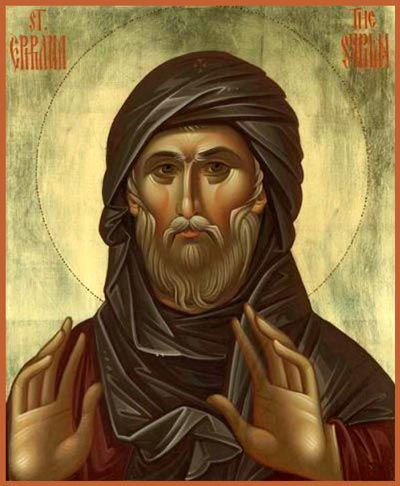 If a person has
the courage to assert that he has truly comprehended the Mystery that takes
place during the Eucharist, then this means that he is in a state of spiritual
delusion, demonic seduction. The ancient Church Fathers repeatedly warned us
about the danger of trying to understand the Mystery of the Eucharist with the
help of the selfish and proud – and yet so imperfect and limited! - human
mind. “The mysteries of Christ are an immortal fire. Therefore, do not be
inquisitive, so as not to burn yourself whilst taking communion of the
Mysteries,” St. Ephrem the Syrian sternly warns us[2].
And yet the Church Fathers did dare to write about the Eucharist, discussing it to the extent that, with the help of Divine grace, and not out of proud egoism, the product of their thoughts is accessible to the Christian consciousness. Let us too try to follow the Church Fathers in these reflections, stepping carefully in their footsteps and trying not to deviate either to the right or to the left from the path of Eucharistic theology they paved.
The term “Eucharist ” means “thanksgiving ” when translated into English . In the era of the ancient Christian Church, this could mean “prayer” in general. We understand that the “Eucharistic” as gratitude to God for all the gifts that He bestows on humans through His mercy and love is the essential base of the Christian worldview. The gratitude which a Christian should express to his Creator in every significant worldly act he performs and with his every good thought, has as its crown, its peak, the Sacrament of the Eucharist - the Sacrament in which every Orthodox person should take part as often as possible. Otherwise, he simply cannot be considered an Orthodox Christian.
Even apostle Paul persistently urged Christians: “In everything give thanks” (1 Thess. 5:18); these words, when translated from the Greek language of the New Testament into English, literally mean “create the Eucharist in everything.” It is possible to draw a certain parallel of this words of apostle Paul with the spiritual meaning of the Sacrament of the Eucharist itself for a Christian: the Apostle encourages us to be always grateful to God, ascending precisely through this good spiritual state of our soul to the highest aim of Christian church life - to the mystery of the Sacrament of Thanksgiving, to communion with the true Eucharistic Body and Blood of Christ.
But why is this Sacrament called the Sacrament of the Eucharist - of Thanksgiving? Different Church authors and ancient writers give different interpretations of this name of the Sacrament. For example, Jeremiah, Patriarch of Constantinople (XVI c.), writes: “… the rite, after which the great Sacrament of Communion is performed, is called the Eucharist (Thanksgiving) because here we have an impulse to thank rather than ask; for here we receive more than we ask, and there is nothing that God could not give us here.”[3]
 Indeed, the
Eucharist is the limit of all possible human aspirations. Here we are united
with Christ, we receive the Son of God in ourselves - what more could we wish
for? The Eucharist has revealed itself as one of the greatest fruits and
gifts of the event of the Embodiment of the Son of God — together with the
Lord’s Death on Golgotha that is His Sacrifice united with the Eucharistic
Sacrifice. Through communion with Christ, Who gives Himself to us in the
Eucharistic Chalice, we truly share with Him both His sufferings on the Cross
and the glory of His deified Flesh. As St. Gregory the Theologian teaches,
“through the Bloodless Sacrifice, we, together with Christ, become
participants of His suffering and Divinity”.[4]In this way, through achieving
unity with the Lord and partaking of His glorified Flesh and Blood, which is
the human nature of the Son of God, which the Savior took during His
Embodiment and which He healed in Himself, we can be truly healed and deified.
Christ, Who from now on is living in Christians through the Gift of the
Eucharistic Communion, as it were, “actualizes” Himself in us. He makes the
sense of our existence the very meaning and product of the Redemption
accomplished through Him. For a person who does not partake of the Eucharist,
such an entry into the feat and triumph of the Atonement in any other way
than Liturgical Communion is impossible, inaccessible. For a person who does
not live the life of the Eucharist, the joy of Salvation forever remains
something external and distant in relation to him. Indeed, in order for us to
personally enter into this joy, into this victory of the Atonement, it is
necessary for the Atonement to triumph over sin and death in us ourselves, to
shine in each of us with the healing light of the Divine grace, recreating the
very depths of our being. This is exactly what happens in the Eucharist: only
in it do we become active and genuine participants in the most sacral of
Sacraments: the Redemptive Sacrifice of Christ. It is thanks to the Holy Gifts
that Christians acquire that holy image of existence, towards which every
person in this redeemed world is now called – that is, to life in Christ and
the Life of Christ. As St. Ephraim the Syrian says, through the Eucharist “we
have received life in Christ; it is His Body that we ate instead of the fruit
of the tree (of life), it is His Meal that has replaced the paradise of
desire for us, and it is by His righteous Blood that we have been washed from
curses, and it is through the hope of the resurrection that we expect future
hope and already live His Life, which has become our pledge”.[5]Thus, the
Eucharist is the ultimate and perfect gift of the Embodiment of the Word. As
St. John Chrysostom teaches, in Christ His Embodiment “was not satisfied only
by becoming a man, He was shriveled and mortified; but He still gives Himself
to us - not only by faith, but by the very deed does he make us part of His
Body … Christ Himself feeds us with His own blood, and through (this) unites
us with Himself”.[6]
In this way, we can definitely state that, after the Eucharistic Communion, we have nothing more to ask God for, we can only thank Him for the Gift that He has given us: for His Body and Blood. It is for this reason that many experienced priests (for example, St. John of Kronstadt) try not to serve any additional molebens (services of supplication or intercession) after a Liturgy: for what else could one pray for after the Eucharist, after God has already given us Himself in its sacred rites? However, sometimes we could think: well, we have received communion, and yet we lack something else in our life - health, family or material well-being, - anything. So then we begin to order molebens, we ask the Lord for more and more gifts. But if we do not understand that, after Communion of the Holy Mysteries of Christ, all this, all these circumstances of our life, become secondary, insignificant in relation to the most important Gift - Christ’s Self-gifting, then we do not yet fully belong to the Church of Christ. The sacrament of the Eucharist is that limit of deification accessible to us in this world , beyond which there is nothing more to look for. After all, as St. Maximus the Confessor says thanks to Communion Christians “can, by adoptionand grace, be called gods, since God has completely filled them, leaving nothing in them that would be deprived of His presence … Through Communion, a person is honoured to become from human god…”.[7]
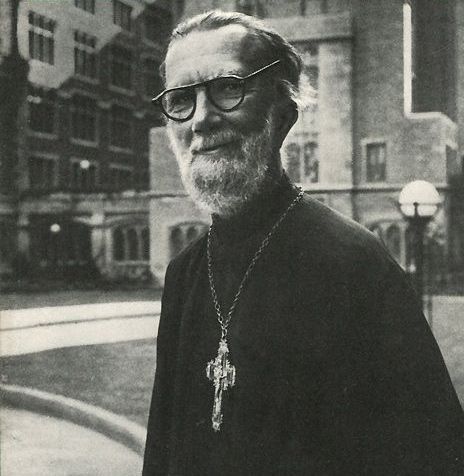 Father George Florovsky, a
remarkable Russian theologian of the 20th century, tries to give his own
explanation for the term “Eucharist”. He writes: “The Eucharist is more of a
hymn than a prayer — hence the very name, thanksgiving. Of course, this is
Golgotha, and the slain Lamb is on the throne, the Body broken and the Blood
shed. But Golgotha is also a mystery of joy, not of fear, a mystery of love
and glory… “Now the Son of Man is glorified.” And if, out of unworthiness, we
tremble before the Cross, then we tremble with reverence, amazed before the
inexpressible fullness of Divine love. For [now George Florovsky quotes the
words of St. Philaret of Moscow] “the beginning and the middle and the end of
the cross of Christ are all one love of God …” Through the Cross joy hath
come to all the world”[8]. Thus, the Eucharist cannot be thought of separately
from Golgotha. According to the teaching of the Church (more on this later),
the Sacrament of Communion , the Eucharistic Sacrifice and the Calvary
Sacrifice, the death of the Lord on the Cross - are both the same
Sacrifice. These two historical moments might be separated in time and have
a different appearance, not coinciding chronologically. Nevertheless, the
Eucharist and Golgotha are the same Sacrifice. Through the Sacrifice of
Golgotha, which is the terrible Sacrifice of God’s death for the whole
world , we acquire the ultimate, highest gift of Christ: the ability to
unite with our Creator — with God who became Man, through working on our
Salvation and partaking of the fruits of this Sacrifice for us of the Son of
God. And in this sense, Golgotha is not only the horror****of God’s death
; Golgotha is joy, it is a victory that revealed — in the ultimate
humiliation of the Son of God — His own ultimate triumph over death and over
sin: it is the victory of God, Who became Man, Who died for us and through
this redeemed us. But the Eucharist, as Archbishop Vasily (Krivoshein) writes,
is the same “mystery of God’s love for people”[9] bestowed on us through the
Eucharistic Chalice, it is love inseparable from the love manifested by Christ
on Golgotha - in His ultimate humility on the cross and the ultimate glory on
the Cross.
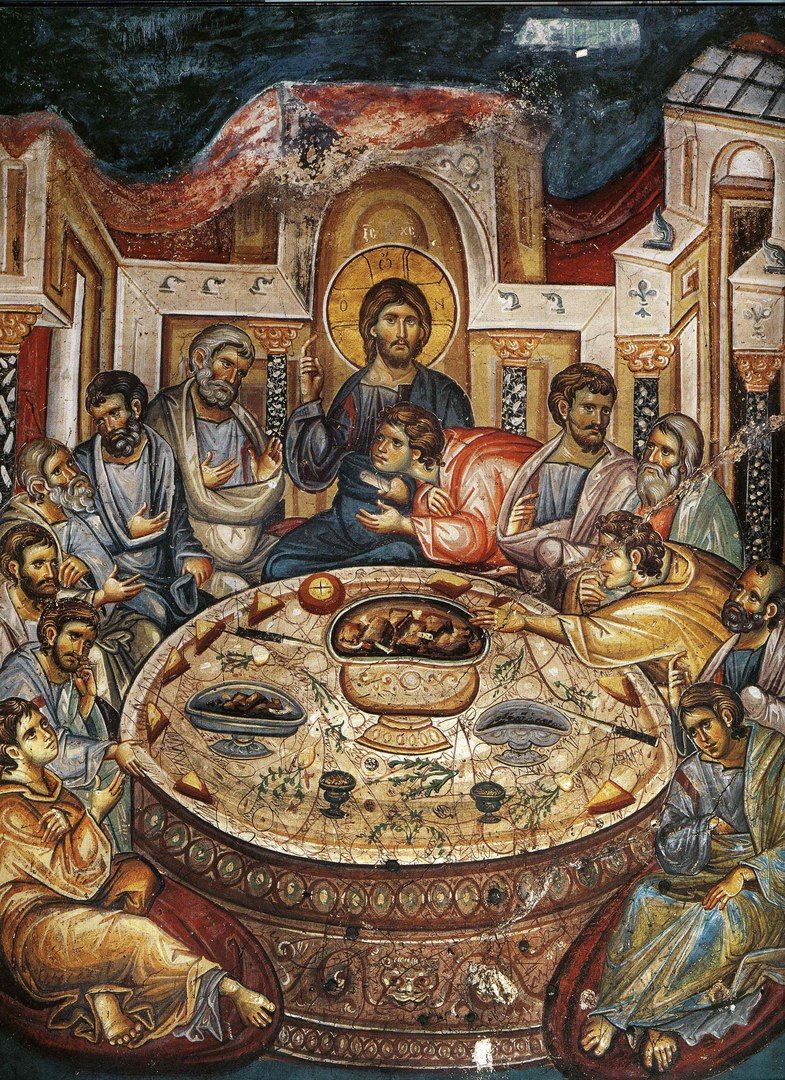
The whole of our church life, the whole system of Orthodox worship, all patristic heritage - lead us to the Eucharist, encourage us to approach the Eucharistic Chalice, raise us to partake Communion with God. Quoting the words of Sergei Fudel, a Russian spiritual writer of the 20th century, “Christianity is the Last Supper ”. [10] Thus, Christianity is our constant coexistence with the Lord and His apostles in that same ancient New Testament Zion chamber, at that same festive Easter supper. Christianity is an unceasing Paschal supper, because in the Church (as it has been said before), time works in a completely different way than in our everyday life … Through entering into Divine reality, a reality that transcends time and abides above time, we find that we are able to become witnesses and participants in any event of the Sacred history of the Salvation of the humanity. Similarly, in the Eucharist, we also enter another reality, into Divine eternity, where we participate with Christ in the Paschal feast that preceded His arrest and crucifixion. That is why we can assert that there is no “one hundred and first” or “one million and first” Liturgy in the Church. With every time we are present at a divine service of the Eucharist , the Eucharist itself, as the Sacrament, is always one and only. We always join the same Last Supper of the Lord, becoming His dinner companions. Whilst preaching in church at the Liturgy, St. John Chrysostom speaks of this as follows: “Believe that this supper (that is, the Eucharist celebrated then by St. John) is still the same at which Jesus presided. There is no difference between this Eucharist and that one”.[11]
Once only 13 people were present at the Last Supper in the Zion chamber: those were the Lord and His twelve disciples. However, with each new Eucharistic service celebrated in the world, their number grows. Moreover, in addition to the Lord and His apostles, in that Zion chamber already invisibly lived those millions, if not billions, of people who later, many centuries later, would partake of the Holy Mysteries of Christ, participating in the same one and only Eucharist.
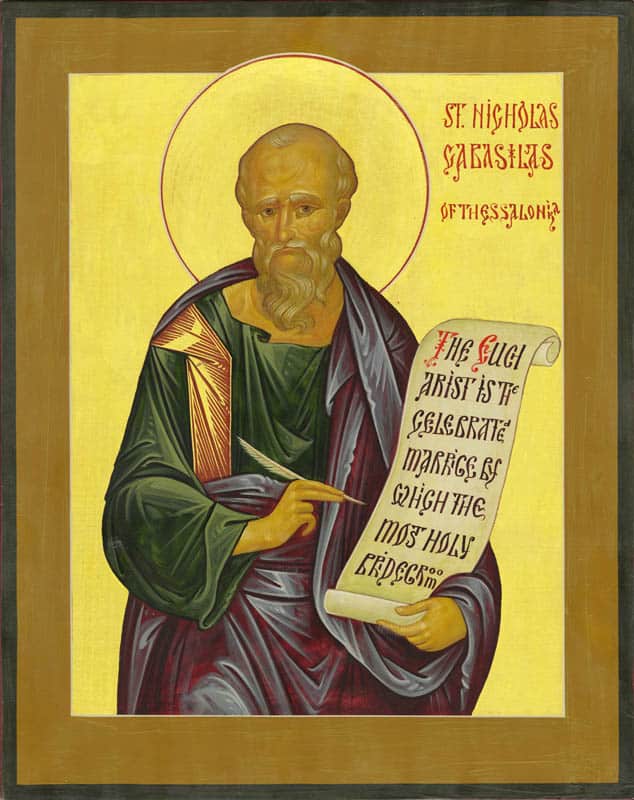 When speaking
of the Sacrament of the Eucharist, one cannot but recall the words of the
Apostle Paul that the Church is the body of Christ (see Colossians 1:24). As
St. Nicholas Cabasilas writes, “If someone could see … the Church of Christ
in the very form in which it is united with Christ and participates in His
Flesh, he would see it as nothing else but the Body of the Lord”.[12]But the
Eucharist is also the Body of Christ: the Body into which bread is
transformed. We see that the nature of the Church itself is Eucharistic. And,
although here it is impossible to put an equal sign between the Church and the
Holy Gifts, at the same time we can assert that the limit, the pinnacle of
communion with God in the Church, its fullness and glory, is precisely
achieved, maximally realised in the Eucharistic Sacrifice, in communion with
this Christian sacrifice. In addition, it is through the Eucharist that one of
the most important principles of the existence of the Church—its
catholicity—is fully obtained. It is in the Eucharist that the Church
initially recognises itself as the one and entire Body of Christ. St. Cyril of
Alexandria testifies to this very clearly. He says that the guarantee of such
a Eucharistic nature of the Church, the basis of her catholic unity, is the
fact that, in every particle of Communion, we are miraculously given exactly
the entire fullness of the Body of Christ - materialistically indivisible,
invariably integral, and at the same time, distributed to a big number of
Christians at each Liturgy. St. Cyril writes: Christ “determined a certain …
way to ensure that … we converge and mingle in unity with God and with each
other, although separating from each other in our souls and bodies into a
separate person … through the sacramental Communion (Eucharist) Christ makes
believers co-corporeal both to Himself and to each other. Indeed, who could
separate and tear away from the natural union with one another those who are
bound into union with Christ through a single Holy Bode? After all, if “we all
partake of that one bread,” then we are all one body (see 1 Cor. 10:17), for
Christ cannot be divided. Therefore, the Church is also called the Body of
Christ, and we, in the understanding of St.Paul, are individual members (1
Cor. 12:27). We all, united with one Christ through the Holy Body, as having
received Him alone and indivisible in our bodies, should consider our members
to belong more to Him than to us ourselves.”[13]
Thus, the Eucharist is a living and active evidence of the unity and catholicity of our Orthodox Church. At the same time, in the Liturgy we transcend not only the limitations of time, but also the limitations of our location. Imagine one person standing at the Liturgy in the Cathedral of Christ the Savior in Moscow, and the other in a small church somewhere in a distant Siberian village - hundreds and hundreds of kilometers are between them. But if both of them are not only standing at the service, but also partaking of the Holy Mysteries of Christ, then they thereby have liturgically transcended the huge spatial alienation and separation - and have spiritually united in the Eucharistic communion.
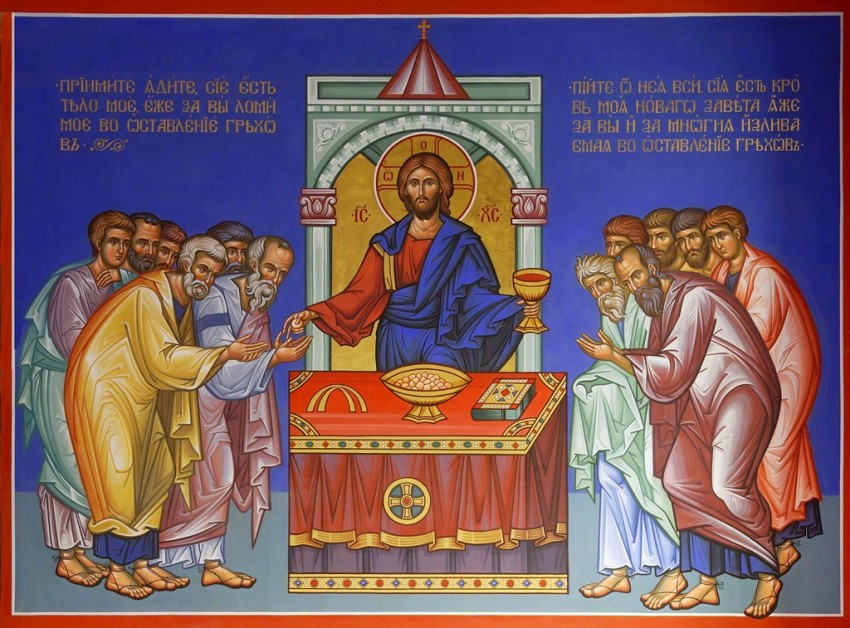 Sometimes it
happens that, during the celebration of the Liturgy, some priests omit the
litany of the catechumens, giving the following argument: “Well, why should I
read it, I know all my parishioners; today in church there is not a single
person who would be preparing to receive Baptism. Why should I read this
litany for some non-existent catechumens?” The priest would show you five
grandmothers standing in the church who have been going to this church for the
last 90 years and, of course, were baptised when this priest was not even yet
born into this world. Why should they listen to the litany of the catechumens?
But this approach is fundamentally wrong. Why? Because the Eucharist is one
and united. And if here, in this church, there is not a single catechumen who
is preparing to receive Baptism, that does not mean that there are no
catechumens at all at the same Liturgy, although perhaps in another church, in
another place. Invariably preserving this litany for our service, even if
there is not a single catechumen in the church, we once again confirm the same
truth: the Eucharist is one, and the priest in the church, actively
implementing all the same Eucharistic unity, must pray not only for those
parishioners, that are now standing in front of him in the church, but also
for all the people in thousands of Orthodox churches. The Church does not
accept any spatial or temporal mediations and divisions and in no way limits
itself to the walls of this or that church, for the Church lives and abides in
Divine eternity and infinity…
The bread and winein the Eucharist are changedinto the Body and Blood of Lord Jesus Christ by the action through the Holy Spirit , the personal , hypostatic descent of the Third Person of the Most Holy Trinity on the Holy Gifts - this is how we Orthodox believe.
The faith of the Eastern Orthodox Church in the descent of the Holy Spirit on the Eucharistic Gifts and in their sanctification with the force of this descent (in contrast to the Catholic opinion) is very, very ancient. For example, St. Cyril of Jerusalem writes about the Eucharistic Miracle: “We pray to God to send down the Holy Spirit on the present Gifts, so that He would change the bread into the Body of Christ, and the wine into the Blood of Christ. For the Holy Spirit sanctifies and transfigures everything that It touches … ” [14]The famous commentator of the Divine Liturgy, St. Herman of Constantinople, teaches: “… The Holy Spirit, invisibly present by the will and goodwill of the Father, presents in Itself a Divine action and through the hand of the priest testifies, proves and attains (the transformation) of the offered Holy Gifts into the Body and Blood of our Lord Jesus Christ…”.[15]
In the Eucharist, we partake of the true Body and Blood of Christ. The Church very exaltedly teaches and testifies about Christian symbols that help us draw closer to God and to unite with Him. However, the Sacraments are no longer symbols, but the very reality of communion with God , to which every Orthodox Christian should aspire. This is absolutely true with respect to the Sacrament of the Eucharist. In this case, there is no longer any question of a “symbol” of communion with God (such an interpretation of the Eucharist is taught only by Protestants). No, we partake of the evangelical, authentic Body and Blood of the Lord and our God Jesus Christ - even if our eyes see only a small piece of bread soaked in wine slightly diluted with water.
 So, we take into ourselves exactly the true Body and Blood of
Christ. This ultimate realism of partaking those very authentic Body and
Blood of the God-man which through Embodiment became an inseparable component
of His hypostatic being and were accepted into unity the life of His Divine
Person, was always very important for the ancient Church Fathers. It was with
this Body and Blood that Christ, after becoming a human, walked the earth,
feared, suffered, died on the Cross, resurrected, and ascended to the Father.
As mentioned earlier, the conciliar principle of the existence of the Church is established in the Eucharist: after all, the Eucharist, for centuries and millennia, unites all the scattered around the world and disparate members of the Church into a single Body. The basis for this doctrine can be found in the First Epistle of the Apostle Paul to the Corinthians: “…The bread which we break, is it not the communion of the body of Christ? For we being many are one bread, and one body: for we are all partakers of that one bread.” (1 Cor. 10:16-17).
Remembering these words of the Apostle Paul, it is impossible not to mention the (interpreted in the quoted passage from his Epistle) symbolic meaning of the Eucharistic bread offered in the Sacrament. It was no coincidence that the Lord chose bread to celebrate the Eucharist. One could think that He could choose anything from what was on the Paschal table at the Last Supper: there were fruit salad (charoset), bitter herbs (lettuce) and the Easter lamb. But why did the Lord choose something different to be changed into His Body, namely bread?
It should be noted that bread is a very important and ancient religious symbol both for Old Testament Israel and for the entire pagan world. And the Lord uses precisely this symbolic substance – to make it easier for us to understand the essence of the transfiguration that takes place in the Eucharist, and to make us aware of what exactly happens to all of us thanks to our partaking of the Body and Blood of Christ. So, what is bread in the symbolism of ancient religiosity? Bread is the symbol of ultimate spiritual and material unity. Why? Let us remember where bread comes from and how it is produced …
First, let us imagine the field where this future bread is sown. At the moment the bread is the form of many spikelets, each growing separately and isolated from the rest. Then the ripened spikelets are collected, threshed and left as mixed with each other, but still separate grains. We can no longer say which of them previously belonged to this or that spikelet, but at the same time each of them is still a separate grain. Then this wheat is ground and turned into flour. Now you can’t separate one grain from another any more, you can’t make out the grains, all the former spikelets form a new indistinguishable unity, although this flour still exists in the form of countless small dust particles. And then each of these dust particles of flour is sintered together with others - and a single, inseparable, whole bread is obtained. Now the former multitude of separately standing spikelets suddenly transforms into an amazing unity, called bread. This is similar to what happens in the Eucharist: a great number of believers are made — thanks to the Eucharist, this pinnacle of the whole of Church life — into the one Body of Christ. Through eating the Body of Christ, the Christians themselves get realisedas the Body of Christ: as the Church, the Head of which is the Lord Himself. From now on, each member of this Body remains inseparable from the other - followingthe image of the one Eucharistic bread offered into the Body of Christ.
[1]Saint John of Damascus. An Exact Exposition of the Orthodox Faith, 4, 13 // Saint John of Damascus. A source of knowledge. Pg. 302.
[2]Saint Ephrem the Syrian. Against the investigators of the nature of the Son of God. Creations. V.3. Sergiev Posad, 1912. Pg.384.
[3]Quoted from: Spiritual Flower Garden. Part 2. pg. 198.
[4]Saint Gregory the Theologian. Word 4. The first accusatory against Emperor Julian // St. Gregory the Theologian. Creations. V. 1. pg. 84.
[5]Venerable Ephrem the Syrian. Interpretation of the Four Gospels, 21 // Saint Ephrem the Syrian. Creations. V. 8. Trinity Lavra of Saint Sergius, 1995. pg. 333.
[6]Saint John Chrysostom. Conversation 82 on saint Matthew Evangelist // Selected creations of our father among the saints John Chrysostom. Commentary on saint Matthew the Evangelist. V. 2. M., 1993. pg. 826-827.
[7]Saint Maximus the Confessor. Mystagogy // Creations of St. Maximus the Confessor. Book. 1. pg. 174, 178.
[8]Florovsky G., archpriest. Eucharist and catholicity // Fathers of the first centuries. Kirovograd, 1993. pg. 36-37.
[9]Vasily (Krivoshein), archbishop. Rev. Simeon the New Theologian. Paris, 1980. pg. 113.
[10]Fudel S. I. Notes on the Liturgy and the Church. Pg. 10.
[11]See: Saint John Chrysostom. Conversation 50 on the holy Evangelist Matthew // Selected creations of our father among the saints John Chrysostom. Commentary on Saint Matthew the Evangelist. T. 2. S. 521.
[12]Saint Nicholas Cabasilas. Explanation of the Divine Liturgy // St. Nicholas Cabasilas. Christ. Church. Theotokos. Pg. 170.
[13]Saint Cyril of Alexandria. Commentary on the Gospel of John. Book. 11, ch. 12 // Works of St. Cyril Archbishop of Alexandria. Book. 3. M., 2002. pp. 755-756.
[14]Saint Cyril, Archbishop of Jerusalem. Catechetical and occult teachings. Pg. 335.
[15]Saint Herman of Constantinople . The Story of the Church and the Application of the Sacraments , 41, pg. 79, 81.
The Eucharist in the Gospel.
The Gospel preaching on the Sacrament of the Eucharist is observed primarily in chapter 6 of the Gospel of John - in the so-called “discourse on the Bread of Life”. Let us once again recall its main ideas explained by the Lord Himself: “I am the living bread which came down from heaven. If anyone eats of this bread, he will live forever; and the bread that I shall give is My flesh, which I shall give for the life of the world. <…> …Most assuredly, I say to you, unless you eat the flesh of the Son of Man and drink His blood, you have no life in you. Whoever eats My flesh and drinks My blood has eternal life, and I will raise him up at the last day. For My flesh is food indeed, and My blood is drink indeed. He who eats My flesh and drinks My blood abides in Me, and I in him” (John 6:51, 53-56).
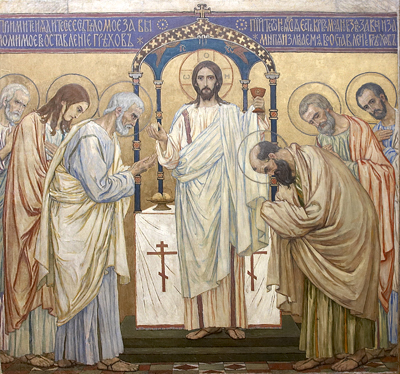However, we do not find the description of the very moment of the establishment of the Sacrament of the Eucharist in the Gospel of John. There is the story of the Last Supper, but the circumstances of the establishment of the Sacrament and the words that the Lord pronounces, commanding His disciples to celebrate the Eucharist, are not reflected in the Gospel of John. Other evangelists testify to this: Matthew (Matthew 26:26-29), Mark (Mark 14:22-25) and Luke (Luke 22:15-20). As well as this, we find the text of the establishing words of the Sacrament of the Eucharist in the 11th chapter of the First Epistle to the Corinthians: “Lord Jesus on the same night in which He was betrayed took bread; and when He had given thanks, He broke it and said, “Take, eat; this is My body which is broken for you; do this in remembrance of Me.” In the same manner He also took the cup after supper, saying, “This cup is the new covenant in My blood. This do, as often as you drink it, in remembrance of Me.” (1 Cor. 11, 23-25)
The Gospel story of the Last Supper is connected with a paradox, which many commentators of the New Testament have paid attention to. The Lord gives the disciples His Body and Blood before His own Crucifixion, before the Sacrifice for the sake of the sin of the world was brought on Golgotha. At the same time, it should be remembered that, according to patristic teaching, we partake precisely of the glorified, resurrected, the Flesh of the Son of God, Who ascended into Heaven and sat at the right hand of the Father. For example, St. Ignatius of Antioch (Theophorus) testifies that “the Eucharist is the Flesh of our Savior, which suffered, but which the Father resurrected”[1]; and St. John Chrysostom develops this idea: “Christ left us His Flesh, and ascended with it.”[2] Thus, we see: on the day of the Last Supper, the Son of God has not yet died on the Cross and has not risen and ascended to Heaven, but is already giving the apostles precisely His glorified Body and Blood. How can this apparent paradox be resolved? In terms of the usual earthly flow of time, the sequence of events of the Gospel story is clearly violated here. However, the true logic and the true sequence of events are preserved here in a different plane - in the supra-mundane nature of Divine eternity, in the plan of our Salvation.
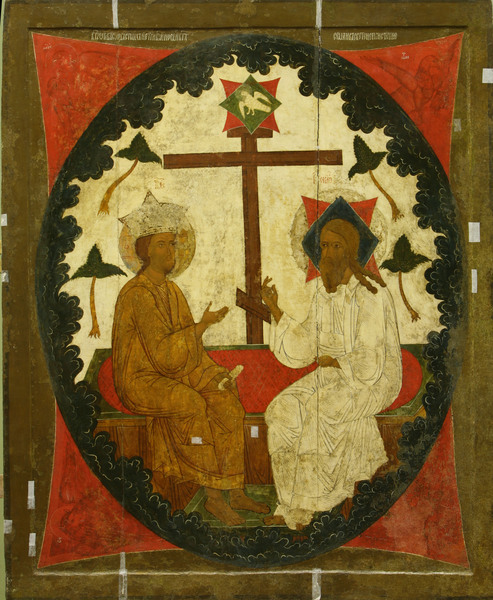Even before the creation of the world, God already knows that the first man will fall by sin, and by decision at the Pre-Eternal Trinity Council****prepares in advance an effective medicine for man’s healing: the Embodiment and Sacrificial death of the Son of God for the sake of the redemption of the sin of Adam that has not yet been committed. So, the Lamb of God is prepared in the bowels of the Most Holy Trinity and is destined for slaughter before the creation of the world. Apostle Peter writes about this in his First Epistle: “…you were not redeemed with corruptible things, like silver or gold, from your aimless conduct received by tradition from your fathers, but with the precious blood of Christ, as of a lamb without blemish and without spot. He indeed was foreordained before the foundation of the world, but was manifest in these last times for you” (1 Pet. 1:18-20). It was this transtemporal nature of the Liturgy that gave the apostles the opportunity to partake of the glorified Body and Blood of Christ, to participate in the sorrow of Golgotha, the joy of the Resurrection, and to the height of the Mount of Olives even before their Lord was taken into custody. It was this transtemporal nature of the Eucharist that made possible the mystical Change of Bread and Wine into the same Body and Blood of Jesus that they now saw in front of them at the Paschal table — as the human face of the Son of God who ate with them at the festive meal. This is what allows St. John Chrysostom to utter the terrible and even frightening words: Christ at the Last Supper “drank His Own Blood”.[3]We can see that, according to Chrysostom, at the Last Supper the Lord takes bread and wine into Himself, brings them into union with Himself and thereby changes them into the Eucharistic Gifts - into His own Body and Blood, and then gives them from the miraculous power of the Eucharist that has been accomplished - from the bread He broke and the wine He had drunk (that have already changed, becoming His Body and Blood) to His disciples.
Conditions and consequences of Communion.
Let us move on to the topic already mentioned regarding the unworthy Communion of the Holy Gifts in connection with the possible communion of Judas during the Last Supper. This topic in the Church’s consciousness turned out to be inextricably linked with another important problem - with the question of the possibility of performing the Sacraments by unworthy priests. According to St. Nicholas Cabasilas, Divine grace in the Sacrament of the Eucharist, in the Holy Gifts, acts “in two ways: one way is in the way They are sanctified by it; the other (way) – in the way that it (grace) sanctifies us through Them ( the Gifts). No human iniquity can hinder the first mode of action of grace in the Gifts, but since their sanctification is not a matter of human virtue, human unrighteousness cannot hinder it either. But the second [way] also requires our diligence, and therefore meets with an obstacle in our negligence. For grace sanctifies us through the Gifts (only) if it finds us capable of sanctification; if it meets us unprepared, then it will not bring any benefit, and even cause countless harm.” Thus, according to St. Nicholas Cabasilas, the Liturgy is celebrated in its entirety even by the hand of a priest who is not personally worthy to take part in this sacrament; his sins cannot prevent the grace of God from celebrating the Eucharist. But for the priest himself, this Sacrament will serve as judgment and condemnation. The same thing happens with unworthily partaking of the laity, to whom this Sacrament can also bring not spiritual benefits, but, on the contrary, “countless harm.”[4]
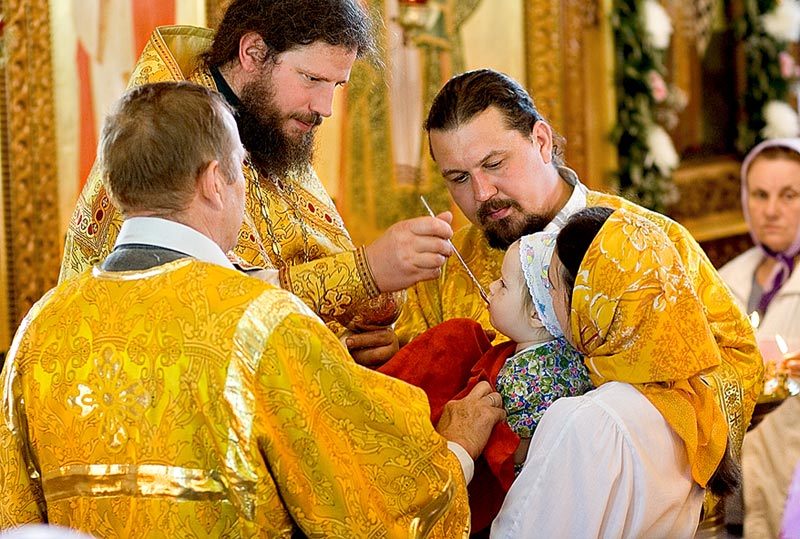 We could ask
ourselves another important question: how often should an Orthodox Christian
take communion? Here is how saint Nicodemus of the Holy Mountain and Saint
Macarius of Corinth answer this question: “Ah, my brothers, if only once we
could see with our spiritual eyes what lofty and what great blessings we are
deprived of if we do not receive communion unceasingly, then, of course, we
would do everything we could and take communion, if possible, every day.”[5]At
the same time, there is also danger with excessively frequent communion:
getting used to the Shrine, when Communion becomes for us, albeit good, but
still a “habit”, when, due to human weakness and callousness, the feeling of
the eternal novelty of this Liturgical Miracle begins to be lost in our soul.
So, we should take Communion as often as possible , but to the extent that
Communion itself becomes habitual and ordinary for us. For every Christian,
the frequency of his participation in the Sacrament of the Eucharist should be
determined individually - in consultation with a confessor priest.
Alas, often we do not only not get used to Communion, but, on the contrary, we almost forget about its existence. This problem has existed in the Church since ancient times. Sometimes one hears that the tradition of rare communion arose only quite recently - in the Russian Empire, whereas before that Christians both in Russia and in the Byzantine world would take communion very often. But even St. John Chrysostom at the turn of the 4thand 5thcenturies was forced to denounce in church sermons those Christians who communed the Body and Blood of Christ only once a year – during Great Lent: “Coming to Communion a year later, do you really think that you have forty days enough to cleanse your sins for all time? And then, after a week, will you again indulge in the former? And you think to propitiate God? You are joking, o man! I say this not in order to forbid you to approach once a year, but rather desiring that you incessantly approach the Holy Mysteries …”[6]
Only in the Eucharist does a Christian find and receive true and eternal life : life in God, life in Christ. In the ancient Anaphora (the Eucharistic Canon, the central prayer of the Liturgy) of Serapion of Thmuis (4th century), we find the following appeal to God: “Make us living people, grant us the Holy Spirit.”[7] It is the bestowal of the Holy Spirit, realized in the Church Sacraments, and, first of all, in the Sacrament of the Eucharist, which gives us all the fullness of Divine gifts, that is the guarantee of the eternal life of a Christian. The same person who abides outside of God and the Church, outside of Eucharistic Communion, can only outwardly appear alive, existing biologically, but being in fact spiritually dead, having no guarantee of eternal life in God. This is precisely why many ancient Fathers of the Church, based on the words of the Savior, “Whoever eats My flesh and drinks My blood has eternal life, and I will raise him up at the last day.” (John 6:54), understood the Eucharist precisely as a pledge of the coming resurrection of Christians. Of course, these words of the Savior by no means mean that only the righteous will be resurrected: sinners will also be resurrected on the Day of Judgment. Simply two different images of the resurrection will be revealed then: the image of the resurrection in Christ - for life in the Kingdom of Heaven, in the Heavenly Jerusalem, and the image of the resurrection into eternal spiritual death - for hellish torment. The Lord, in the words cited earlier from the conversation about the Bread of Life, expresses a simple and clear thought, as if saying: “On the last day I will resurrect all the righteous in the form of My glory and give them eternal life, because they received the guarantee of this glory while still on earth — having accepted Me in the Sacrament of the Eucharist and even then having become not only My image, but also My Flesh and Blood.” The ancient Holy Fathers liked returning to this idea in the Gospel about the future resurrection of the partakers of the Eucharist in the coming imperishability of deification, in the image of the glory of Christ. Thus, St. Irenaeus of Lyons writes: “Our bodies, nourished by the Eucharist, buried in the earth and decomposed in it, will rise in due time, since the Word of God freely gives imperishability to the decayable.”[8]
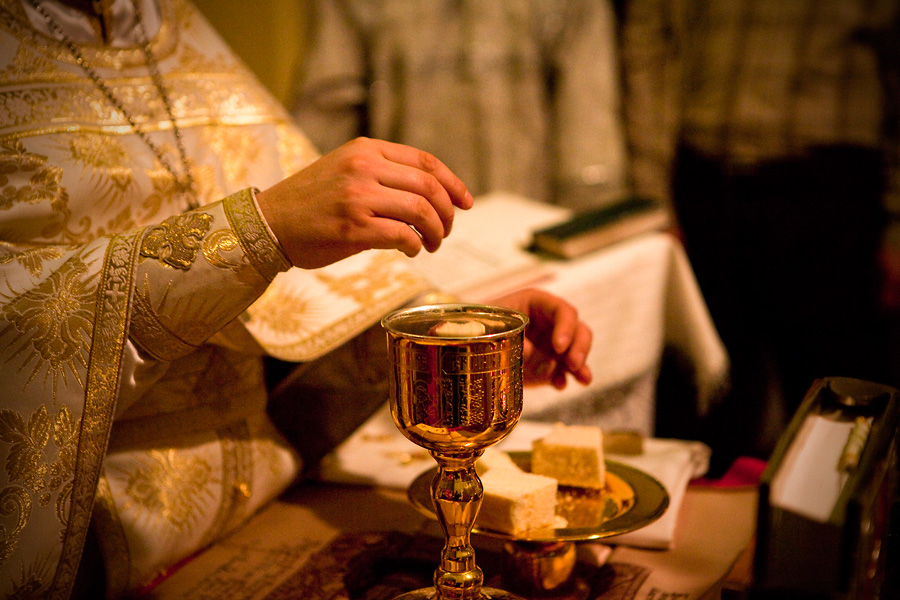 But what does it mean to unite with Christ in
the Eucharist? Of course, through the Eucharist we cannot directly partake
of the Divine nature of the Lord: after all, as St. Cyril of Alexandria
testifies, “the nature of God (in the Eucharist) is not partaken”.[9] The
divine nature for earthly creatures always remains uninvolved. But, at the
same time, it is through the Eucharist, through talking the human Flesh and
Blood of Christ, that we can truly achieve deification: as our own bodily
union with the Son of God, with Christ, and at the same time as participation
in the fullness of His Divine energies and grace. The Holy Fathers tell us
that in the Eucharist we partake in a saving way for us of the deified and
glorified Body and Blood of the Lord, partake of the human nature of the
incarnated Son of God, the Second face of the Most Holy Trinity, that is, the
human nature precisely permeated by the Divine — as His energies. He is the
essence of the Life-Giving God who became man, Whose human nature is forever
united in Him and His Hypostasis, with the Divine nature. And that is why the
Body which He took in the Embodiment and which became the Flesh of Life Itself
and permeated with the power of His grace, efficiency and Divine energies,
bestows this Divine life on His participants. As St. Cyril of Alexandria
writes, Christ in the Eucharist promises us “a blessing, consisting of the
taking of the Holy Flesh and Blood, which elevates a person to complete
imperishability… The Holy Body of Christ gives life to those in whom it will
be, and strengthens towards immortality, uniting with our bodies, for (here)
is implied the Body of not of someone else, but of Life Itself by nature,
having in itself all the power of the Word connected with it and, as it were,
endowed with His property, or rather, already full of His effectiveness,
through which everything is animated and preserved in being … Therefore …
let us approach the Divine and heavenly grace and let us ascend to the holy
taking of Christ. It is in this way that we, … having become partakers of
the Divine nature (2 Pet. 1, 4), ascend to life and imperishability”.[10]By
taking in the Body of the Lord, united in His Hypostasis and Personalitywith
the Divine, and partaking of His Divine energies, in which God is wholly
present, we partly even “come into contact” in Christ with His Divine nature,
but, at the same time, we still remain uninvolved in this impregnable Divine
essence.
For St. Cyril of Alexandria, whose legacy we have just referred to, as well as for many other ancient Holy Fathers, the idea that we take in the true historical human nature of Christ is extremely significant. What is extremely important for St Cyril is the realism of the perception of the Sacrament of the Eucharist. He even dares to call the taking of the Flesh and Blood of Christ the eating of a man, “man-eating.” He writes about Communion: “Is this not really a certain kind of man-eating for us … (For) we partake (in the Eucharist) not of the Divinity itself, but of our own Flesh of the Word, which became life-giving due to the fact that it became the His Flesh, living for the sake of the Father… And just as the Body of the Word Itself became life- giving through the fact that It became His own through true, although incomprehensible and inexpressible unity, we too, we who use the communion of His holy Body and Blood, are wholly revived, since the Word abides in us not only as Divinity through the Holy Spirit (that is, through the grace bestowed by the Holy Spirit), but also as a Human through His holy Flesh and precious Blood”.[11]
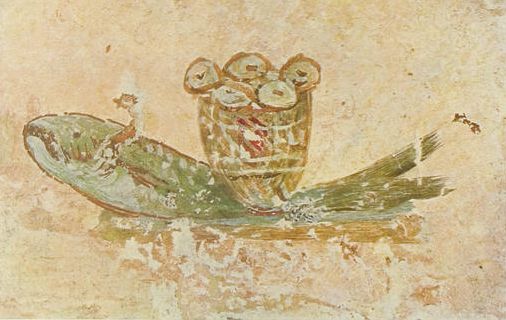 But can we comprehend that blessed
change that happens to a Christian who partakes of the Holy Mysteries?
The Holy Fathers give an answer to this question - a very unexpected, terrible answer, which much obliges us. According to them, the Eucharist transforms us, our bodies, into itself.
We know that any food that we take into our body becomes part of the body, physically completing it, making up for everything that is missing in it. We digest this food, it is partly excreted from our body, and everything we need is absorbed and becomes our body. With the Eucharist, however, everything happens differently: it goes without a trace, and, in all its fullness, unites with our bodily nature. As Chrysostom says, the Eucharist “goes not like ordinary food—no, don’t think like that. But just as if you, having thrown wax into the fire, would not lose anything, and would have nothing left, similarly, here also imagine the Sacrament united with the essence of our body.”[12]
Moreover, according to the Holy Fathers, it is not the Eucharist that becomes us , but we who become it. It is not the Body of Christ after Communion that becomes our body, but our bodies that change into the Body of Christ. The Holy Fathers testify to this repeatedly in their writings. For instance, St. Gregory of Nyssa teaches: “Just as a small amount of leaven is mixed, according to the word of the apostle, with the whole dough, so His Body raised by God to immortality, entering our body, changes it and completely transforms it into His own essence.”[13] St. Nicholas Cabasilas speaks similarly: “In Communion, the Lord completely changes the one who has received the Sacrament and transforms it into His own property; even dust, having taken on a royal appearance, is no longer dust, but the Body of the King, more blessed than which it is impossible to invent. Therefore, the Eucharist and the last Sacrament, so that it is impossible to extend further, is impossible to apply more. After the Eucharist, there is nothing left for us to strive for.” [14] St. Hilarius of Poitiers also writes about this, emphasizing that in Communion not only do we take into ourselves the Body and Blood of Christ, but the Lord also makes our body and blood His own. Through the Eucharist, we become the Body of Christ, as it were, in a continuing Embodiment, in which the Lord takes our bodies into Himself, just as He once - at the time of the Annunciationand Nativity - assimilated His own individual human nature. St. Hilarius teaches: “About what the unity by nature in us after receiving Communion is, Christ Himself testified thus: “He who eats My Flesh and drinks My Blood abides in Me, and I in him” (John 6:56)… The Lord will take into Himself the flesh of the Communioner, as He took on His own Flesh… The purpose of our life is to have in ourselves, despite us being bodily, the Flesh of the abiding Christ… We naturally live in the Flesh of Christ, that is, we acquire the nature of His Flesh…”.[15] Of course, this patristic analogy does not mean that we are irrevocably “transformed” into the Body and Blood of Christ. Naturally, we do not lose our own individuality, we do not cease to be ourselves, we remain limited and capable of sinning. But at the same time, while maintaining spiritual purity after the Communion of the Holy Mysteries, carefully observing the received Holy Gifts in ourselves and striving to be worthy of them, we are able to live one life with Christ, for His Blood begins to run through our veins, and our body belongs to not only to us, but also to Him.
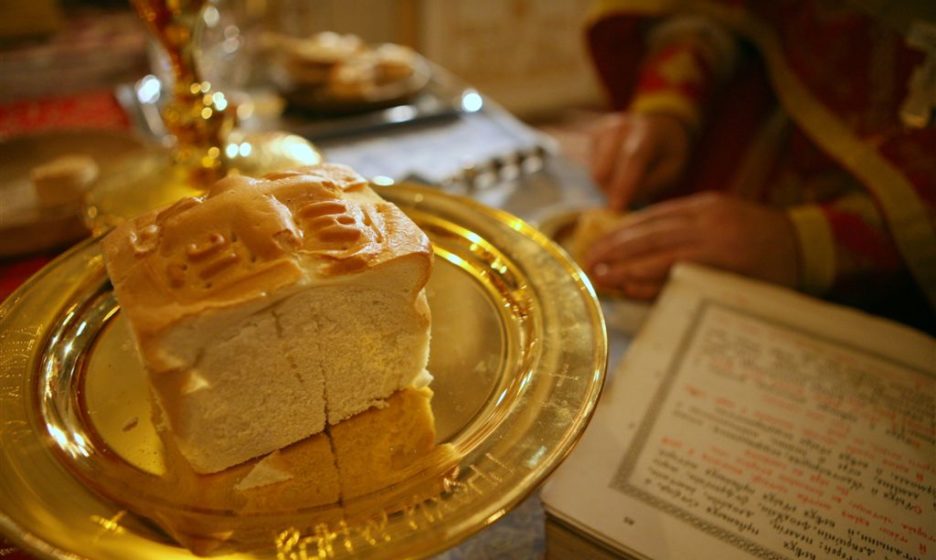 Incidentally, the idea that the Eucharist does
not only grant us deification, the ultimate communion with God, burning in us
with the radiance of Divine grace; but at the same time burns the sin nesting
in us, which is not able to withstand contact with the Body and Blood of the
Son - is very common in the Church traditions. Of course, for this it is
necessary that we also freely strive to be freed from this sin, that we also
thirst for life in Christ, and by no means are rooted in sin. Here is what St.
John of Damascus says about this: “… let us partake of Divine coal, so that
the fire of the love that is in us, having taken ignition from coal, burns our
sins and enlightens our hearts, and so that by the presence of Divine fire we
are kindled and deified” …[16]
On the Transformation of the Holy Gifts.
What happens at the moment of the transubstantiation of the Gifts with bread and wine, with their material, earthlynature? There are two main synonymous concepts that express the change that takes place in the Sacrament of the Eucharist with bread and wine: “transsubstantiation ” and “transformation ”. In the Eucharist, bread and wine are transubstantiated and transformed into the Body and Blood of Christ — that is, they change their essence and cease to be bread and wine in the true sense of the word, retaining only external, secondary signs of the former Eucharistic substances. They only seem to be bread and wine for us, yet actually they are already the Body and Blood of Christ. The absolute majority of the Holy Fathers of the Orthodox East shared this point of view: so thought, for example, Saints Cyril of Jerusalem, Cyril of Alexandria, Ambrose of Milan, Saint Augustine. The same position is formulated in a number of doctrinal definitions of local councils of Orthodox churches in the 17thcentury. St. Augustine verbally expresses the opinion that, after the transubstantiation of the Gifts in the Eucharist, there is a “visible substance and an invisible being”, and “one is seen, and the other is comprehended by the mind.” [17]St. Cyril of Jerusalem expresses the same idea: in the Eucharist, “the visible bread is not bread, although it is felt by taste, but it is the Body of Christ; and the visible wine is not wine, but the blood of Christ.”[18]
However, in the legacy of several ancient Eastern Fathers of the Church, there is also occasionally a different, a second point of view regarding the fate of bread and wine in the Eucharistic Gifts. In this case, the transformation taking place in the Eucharist is already conceived as a mystical union of the essences of bread and wine with the essences of the Body and Blood of Christ. Moreover, this does not at all mean that the Body and Blood, the bread and wine coexist in any way, adjoin each other in the Eucharistic Chalice, for these are two natures of the same reality. It is the Body and at the same time bread; it is Blood and at the same time wine. A similar idea can be found in the writings of Saint Theodoret of Cyrus, Saint Eutyches of Constantinople, and in the “Letter to Monk Caesarius” said to belong to Saint John Chrysostom. Here is what Blessed Theodoret of Cyrus writes: “… even after consecration, the mysterious symbols do not come out of their own nature, since they remain in their original essence and remain in the way, appearance, and touch the same as they were; but it is That What they have become that is known by the mind and contemplated by faith and receives worship - since it is That which is contemplated by faith”. [19]As Saint Eutychius of Constantinople (6thcentury) teaches, Christ at the Last Supper “mysteriously slaughtered Himself when, after the Supper, He took bread with His own hands, gave thanks, showed it and broke it, uniting Himself with this alternative image.”[20]
Such are the two existing theological positions regarding the question of the fate of bread and wine in the Sacrament of the Eucharist. And yet, the absolute majority of the ancient Holy Fathers adheres to the first point of view – this being the main in Orthodox theology, - affirming the absolute transformation and disappearance of the essence of bread and wine when they transformed into the Body and Blood of Christ.
[1]Hieromartyr Ignatius Theophorus. Epistle to the Smyrnians, 7 // Writings of the apostles. pp. 304-305.
[2]Quoted from: Florovsky G. Archpriest. Eucharist and catholicity. Pg. 29.
[3]Saint John Chrysostom. Conversation 82 on St. Matthew the Evangelist / / Selected creations of our father among the saints John Chrysostom. Commentary on Saint Matthew the Evangelist. V. 2. Pg. 821.
[4]Saint Nicholas Cabasilas. Explanation of the Divine Liturgy // St. Nicholas Cabasilas. Christ. Church. Theotokos. pp. 165-166.
[5]Saint Nicodemus of the Holy Mountain. Saint Macarius of Corinth. The most useful book for the soul about the unceasing Communion of the Holy Mysteries of Christ. Sumy, 2001, p. 71.
[6]Saint John Chrysostom. Conversation 17 on the Epistle to the Hebrews // The Complete Works of St. John Chrysostom. V. 12. Book. 1. Pg. 154.
[7]Quoted from: Uspensky N.D. Anaphora // Theological Works. No. 13. pg. 75.
[8]Hieromartyr Irenaeus of Lyons. Creations. Library of Fathers and Teachers of the Church. M., 1996. Pg. 450.
[9]Saint Cyril of Alexandria. Defense of the Twelve Chapters against Eastern Bishops. Defense 11 // Acts of the Ecumenical Councils. V. 1. St. Petersburg, 1996. pg. 440.
[10]Saint Cyril of Alexandria. Commentary on the Gospel of John. Book. 3, ch. 6 // Works of St. Cyril Archbishop of Alexandria. Book. 2. M., 2001. Pp. 789-790.
[11]Saint Cyril of Alexandria. Against Nestorius. Quoted from: Sylvester (Malevansky), Bishop. Experience of Orthodox dogmatic theology (with a historical exposition of dogmas). V. IV. Kyiv, 1897. Pg. 505.
[12]Quoted from: Fokin A. The Transposition of the Holy Gifts in the Sacrament of the Eucharist according to the teachings of St. John Chrysostom // Alpha and Omega. No. 2/3 (9/10). M., 1996. Pg. 129.
[13]Quoted from: Klehman O. Origins. pg. 107.
[14]Saint Nicholas Cabasilas. Seven words about life in Christ // St. Nicholas Cabasilas. Christ. Church. Theotokos. Pg. 51.
[15]Saint Hilarius of Pictavisky. About the Trinity. Cit. from: Popov I.V. Saint Hilary, Bishop of Poitiers// Popov I.V. Works on Patrology. V. 1. Holy Fathers II-IV centuries. Sergiev Posad, 2004. Pg. 724.
[16]Saint John of Damascus. An exact exposition of the Orthodox faith, 4, 13 // Rev. John of Damascus. Source of knowledge. Pg. 303.
[17]Quoted from: Fokin A. The Transposition of the Holy Gifts in the Sacrament of the Eucharist according to the teachings of St. John Chrysostom // Alpha and Omega. No. 2/3 (9/10). Pg. 118.
[18]Saint Cyril, Archbishop of Jerusalem. Catechetical and occult teachings. Pg. 332.
[19]Blessed Theodoret of Cyrus. Eranistes. Dialogue II // Pg. 83 Col. 168.
[20]Saint Eutychius, Patriarch of Constantinople. Word about Easter and the Holy Eucharist // Collection of ancient Liturgies, Eastern and Western, translated into Russian. Issue. 4. M., 1999. Pg. 60.
Related Concepts
- 1-cor-1017
- 1-peter-118-20
- 2-peter-14
- adoption
- anaphora
- biblical-interpretation
- bloodless-sacrifice
- body-of-christ
- christ
- christ-as-true-god-and-true-man
- church-unity
- consecration
- cross
- cyril-of-alexandria
- devil
- divine-coal
- divine-eternity
- energies
- epiclesis
- eucharistic-bread
- eucharistic-controversy
- freedom
- gratitude
- holy-gifts
- holy-spirit
- human-nature
- image-and-likeness
- irenaeus-of-lyons
- john-of-damascus
- judas
- judgment
- last-supper
- leaven
- liturgical-vocabulary
- love-of-god
- maximus-the-confessor
- obedience
- orthodox-critique
- orthodox-sacramental-theology
- positive-redemption
- preparation-for-communion
- priesthood
- purification
- real-presence
- sacred-history
- salvation
- symbol-vs-reality
- the-two-ways
- theological-meaning
- transformation-of-the-gifts
- transtemporality
- unity
- wax-in-fire