Liturgics — 1. The Orthodox Church and its inner structure. The Clergy and the Laymen

All Orthodox churches, regardless of their architectural features, are divided
into three parts: a sanctuary , a nave(or naos) and a narthex.
They are commonly oriented to the East, which symbolizes the arrival of Jesus
Christ, often referred to as as ‘Orient’, ‘Light’ or ‘Dayspring’in Sacred
Texts (e.g. Luke 1:78).
The narthex(from Ancient Greek narthex νάρθηξ ‘giant fennel’, later ‘casket’ probably because of its shape). is a space at the entrance of the church which serves as a porch. It is usually divided by doors from the two other parts and it was anciently used by the repentants and those who had the intention to get baptized (catechumens) to pray while attending the liturgy.
The nave(from Latin navis ‘ship’) is the main part of the church where Christians gather for praying. In the early ages, it had a vessel-like structure which gave him the meaning of a ship of salvation conducted by God through the life storm (Mark 4:37-39). Traditionally, only the baptized believers were permitted to enter this section. Nowadays, many of the liturgical actions aimed at the common prayer are performed in this section, e.g. special chants, celebrations and reading of the Holy Scriptures. This part of the church is usually the largest one and it can enclose other chapels on its sides. An icon of the honored saint or religious event is placed on a special stand called lectern in the middle of the nave and changed daily.
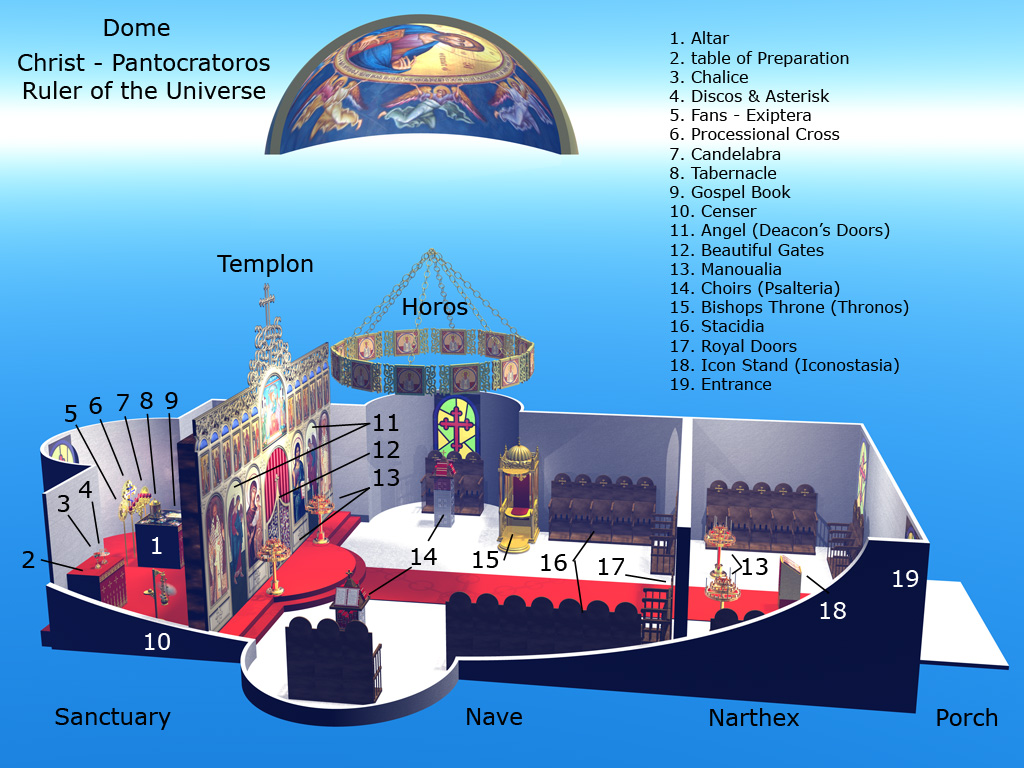
The sanctuary(from the Latin sanctuarium ‘sacred place’) is the most
important and holy part of a church, which is always located on its eastern
side. According to the Christian tradition, which goes back to the Gospels
(Matthew 26:26-29, Mark 14:22-25, Luke 22:13-20), it is the place where God
Himself is present in the form of the bread and the wine of the Holy
Communion. It is separated from the nave by a partition wall called
iconostasis(from Greek eikonostasion ‘icon stand’) explained further.
In front of this wall of icons, there is an elevation named the
soleas(Greek solion and Latin solea ‘elevated place ’) which forms
a central semicircular extension in the middle known as the ambon(from the
Greek ambon ‘pulpit’). On this spot, the clergy proclaims most of the
liturgical texts and prayers dedicated to the people. The soleas and the
ambon, as well as the floor of the sanctuary itself, are normaly one or two-
steps higher than the floor in the nave.
Opposite to the ambon in the very middle of the altar partition, there are double doors called Holy or Royal****Doors which close from the side of the sanctuary at some moments of the service and after it. A curtain made of fabric, the catapetasma , is used to hide the sanctuary from the nave. The height of these Doors can go up to several meters depending on the size of the church. The iconostasis is flanked by two single-leaf doors, called North and South or Deacons’ Doors, intended for the use of the auxiliary clergy. Some small churches or side-chapels possess only one of the Deacons’ Doors[1].
[1]In ancient times, the altar barrier consisted of columns, between which either marble slabs or metal gratings were installed from below, and a beam was placed on top. The Holy Doors were placed in the center of the altar barrier. Later, icons began to be installed in the spaces between the columns, as well as on top of the beam connecting them. This is how the iconostasis was gradually formed. It can be single-rowed or multi-rowed.
1. General overview of the Church structure.
2. The Sanctuary.
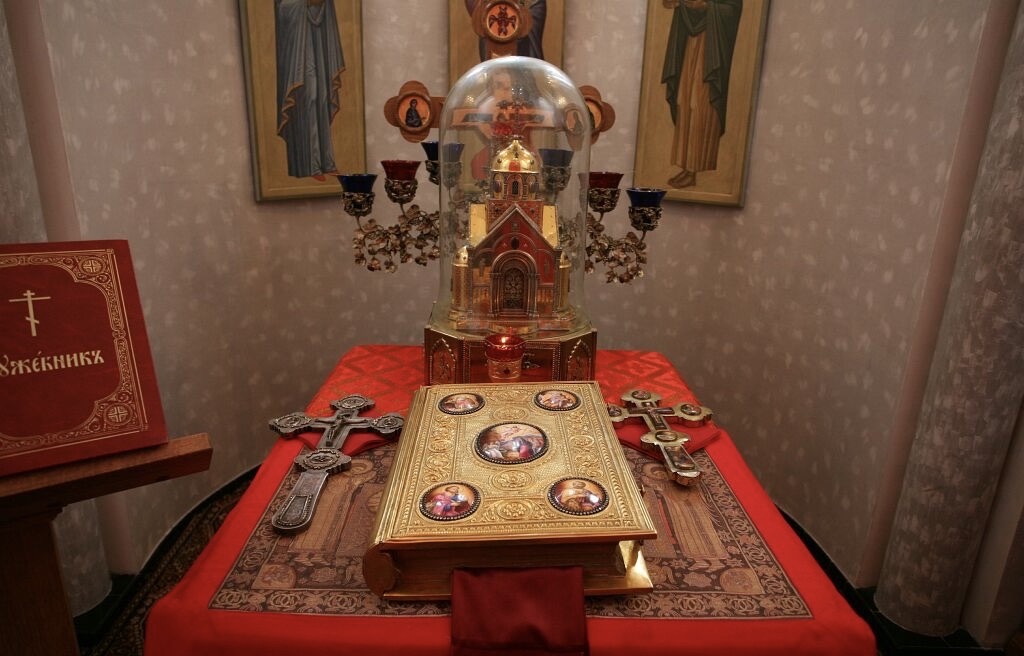
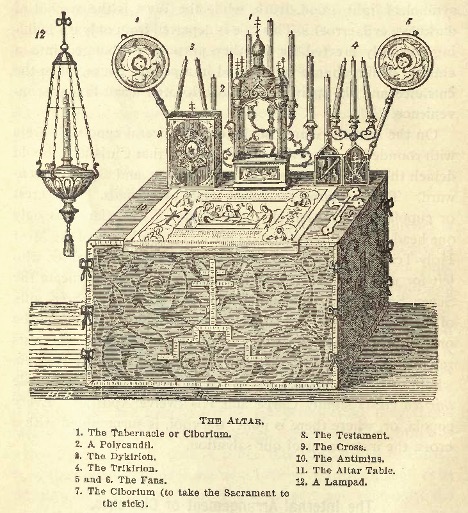 In the middle of the sanctuary, opposite to the
royal doors, there is a table made of stone or wood, the Altar(or the
Holy Table)[1], with the Holy Cross and the Book of Gospels laying on it.
Behind, one can see aseven-branched lampstand surrounded by a large cross and
an icon on shafts, used during processions.
The main purpose of the Altar is to serve as a place for the administration of the Blessed Sacraments (or Holy Communion) during the Divine Liturgy. There is also a tabernacle on the Altar - a vessel with spare Blessed Sacraments to give Communion to those unable to frequent the service.Only members of the clergy are allowed to touch the Altar, since it is the symbol of the throne of God[2].
In some churches, a canopy on four pillars is placed over the Altar (the ciborium).
The altar is consecrated according to a special rite by the ruling bishop (or, on his behalf, by the priest)[3].
On the Holy Table lies the antimension(from Greek ‘against the table’) – a piece of cloth depicting the Burial of Jesus Christ, the instruments of His execution and the four Evangelists.
The Blessed Sacraments are placed on the antimension during the Liturgy; it is personally signed by the ruling bishop, which means his blessing for the sacred rite. After the Divine Liturgy, the antimension is folded in a special way and wrapped in another piece of cloth, larger in size - the eiliton , symbolizing the shroud that Jesus Christ was wrapped with at birth, as well as the shroud in which His Body was wrapped at burial. Inside the eiliton there is a sponge , which serves to immerse the Holy Lamb into the holy chalice during the Divine Liturgy. It symbolizes the sponge filled with bile and vinegar presented to the Christ on the Calvary.
According to the modern practice of the Russian Orthodox Church, a relic of a
martyr or another saint is put into the antimension, which reminds of the
ancient tradition of celebrating the Eucharist on the tombs of martyrs[4].
The farthest part of the altar, at its eastern wall, is called the cathedra. ****In Byzantine churches, this place was designed as an amphitheater with high steps on which the clergy sat at certain moments of the service. In modern churches, the bishop’s seat is located in the middle of the cathedra and can be surrounded by chairs for the celebrating priests.
[1]A small piece of a martyr’s or another saint’s relics are placed under the altar or inside it, according to the 7th canon of the VII Ecumenical Council.
[2]Hence the Slavonic name of the Altar престол ‘throne’.
[3]A wooden altar, as a rule, has vestments: the lower one is a simple white linen cloth fastened with a rope wound over it which symbolizes the shroud, which was wrapped around the Body of the Savior at His burial. The upper one is usually made of brocade or other similar fabric and it is a sign of the royal garments of Christ as a King.
[4]Ancient Russian antimenses did not have relics. The inscription on the antimension indicates the title and the name of the bishop who consecrated it, the date of consecration and the church for which the antimension is intended. The issuance of an antimension to an individual priest is allowed only in special cases (for example, if the priest carries out missionary service where there are no churches).
3. The Prothesis. The Choir.
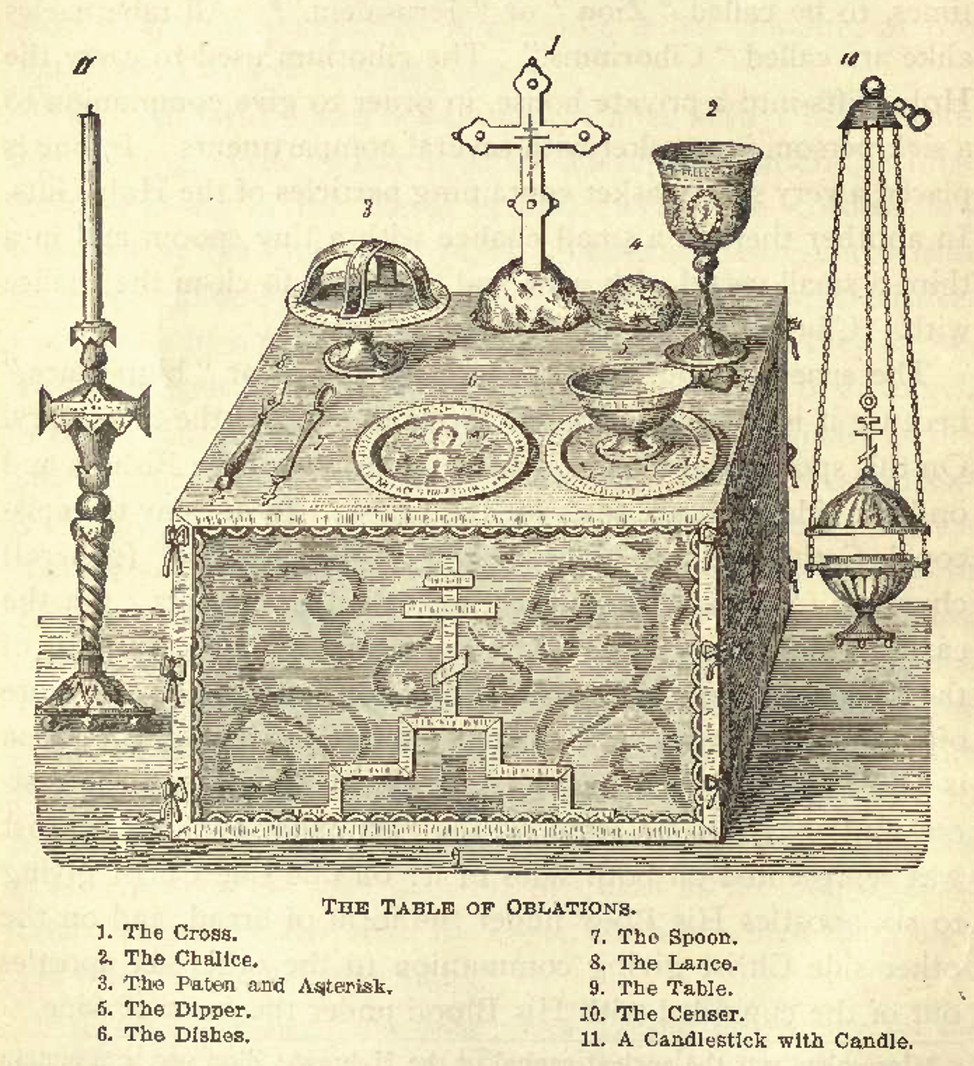 The sanctuary can be divided into different
parts: the main one with the altar in its centre, the northern part, where the
Prothesis is placed, and the southern part, where the liturgical vestments
of the clergy are often kept. In some churches (with three apses), the
northern and southern parts of the sanctuary are separate rooms connected to
the main part by aisles; in other churches, the sanctuary is a single room.
The Prothesis(or Table of Oblation) is a table for performing proskomedia(preparation of the bread and the wine for the Eucharist), but it is also a separate place in the sanctuary where this very table is located. In Russian churches, the Prothesis is usually outwardly similar to the altar; in Greek temples, a niche in the wall is often used as a Prothesis.
According to the 19th Canon of the Laodicean Council, only members of the
clergy are allowed to enter the sanctuary. However, at the present time,
laymen (sextons) assisting in the performance of the divine service may alsobe
admitted to the sanctuary. In convents (women’s monasteries), the sextons’
service can be performed by nuns (Canon 15 of Nicephorus the Confessor)._
_
All Orthodox celebrations are been performed with the participation of chanters. In ancient times, the choir was standing either near the ambon - in the center of the church or close to one of the columns, or on the upper tier of the church - in the galleries located along its perimeter (hence their name - choirs). In several Russian monateries these galleries were located behind the iconostasis so the chanting was heard from the Sanctuary itself. Nowadays chanters stand either in the choir balcony or gallery, or in specially arranged kliros in the northern and southern parts of the solea [1].
[1] In Russian church architecture, the church building can consist of two parts: the summer part with a high dome and a winter part with a low ceiling, which is related to the peculiarities of the climate. In addition to the main sanctuary, the church may have side sanctuaries, usually used for liturgies on weekdays or early liturgies on holidays. This happens because Church rules prohibit from celebrating two Divine Liturgies on one altar on the same day, so if there are two or more liturgies on a holiday, the most solemn (later) one is celebrated in the main altar.
-
- General overview of the Church structure.
-
- The Sanctuary.
-
- The Prothesis. The Choir.
**Sacred vessels **[1] ****are objects used during the Eucharist and other services for the communion of prayers.
These include a **diskos **(paten), a chalice , an asterisk , a **spear **(or lance), a spoon , a **tabernacle **and a ciborium.
The **diskos **is a round paten elevated by a stand (or «foot») permanently attached underneath, on which the Holy Lamb, the particules commemorating the Theotokos, the Saints, the living and the departed are placed.
The **chalice **is a bowl fixed atop a round stand, into which the Eucharistic wine mixed with water is poured.
Nowadays, the diskos and the chalice are made of an unbreakable material - metal (usually silver-plated or gilded). In ancient times, diskos and chalices could be made not only of metal, but also of glass, ceramic and wood.
The **asterisk **consists of two strips of metal laid one on top of the other and joined in the center by a brad or screw so they can form a cross when turned perpendicular to each other. At the end of the proskomedia, the asterisk is placed on the diskos on top of the Holy Sacrements, then they are covered with the **veils **(two cross-shaped pieces of material) and the **aër **(one large rectangular veil), which symbolize the swaddling clothes of Jesus Christ at His Nativity and the grave clothes used at His burial before the resurrection. They were primarily used to prevent anything from falling into the chalice and paten. After the Great Entrance, the Holy Sacrements are placed on the altar, the aërs and the veil are removed. The asterisk is removed during the Eucharistic prayer.
The spear(or lance) is a knife, with the help of which the Lamb is cut out of a large **prosphora **(from Greek _prosphoron _‘offering’ - liturgical bread), and memorial particles are removed from other smaller prosphoras. The spear has the shape of a spearhead, sharpened on both sides and inserted into a wooden or bone handle. With the help of the spear, the consecrated Eucharistic bread is divided into parts for the communion of the faithful.
The **spoon **is a metal spoon with a long handle, designed for the communion of the laity, as well as for the consumption by the priest or the deacon of the Blessed Sacrements left after the communion of the faithful.
The **tabernacle **is intended for storage, and the **ciborium **– for the transfer of spare Blessed Sacrements, previously consecrated and preserved for special occasions (for example, the communion of the ill and dying). The ciborium is usually a small rectangular box in which a priest can take the Blessed Sacrements out of the church, putting it in a special chest bag. Often the ciborium is placed inside a special ark containing a chalice and a spoon, intended for the communion of believers outside the church.
Sacred vessels also include a vessel for storing the **chrism **(myrrh, myron, holy anointing oil, consecrated oil), used to perform the sacrament of the anointing.
[1]According to the 21stСanon of the Laodicean Council, only the clergy is allowed totouch the sacred vessels.
The Sanctuary includes some other liturgical vessels and church objects: a plate , a ladle , vessels for wine , a censer , a **baptismal **font , a **water-blessing **bowl , a **candlestick ****for ****the lity **[1].
The plates serve as containers to the prosphoras and their particles when making a proskomedia. Metal ladles with handles are used to pour water and wine into the chalice during the proskomedia, and also to add warm water or zeon (ζέον or теплота) in the chalice before the communion.
The **censer **is a special vessel, suspended on chains, with the help of which the clergymen perform censing. A hot coal with incense on top of it is placed inside the censer allowing the fragrance to emanate. The priest, with rhythmic movements, swings the censer towards the altar, icons, wall frescoes, as well as other clergy and laity, symbolizing the prayer of believers, as well as the grace of God promised to those who turn to Him with prayer.
There is a special prayer for the blessing of the censer which says: “Incense we offer Thee, O Christ our God, as an odor of spiritual fragrance. Receive it upon thy heavenly altar and send down in return upon us the gift of Thine Holy Spirit”.
The **vessel for the holy water **is a large vessel on a low stand, similar to a baptismal font, with three holes on the edge for candles. It is used for the sanctifiction of water, including during the water-blessing prayer service.
The **candlestick for the lity **is a metal tray on which are fixed a plate, three cups and candlesticks for three candles. It is designed for the blessing of bread, wheat, wine and oil during the lity, usually performed during the all-night vigil.
Liturgical items also include the **altar cross **and the Holy Gospel:
The **Liturgical Gospel **is not only used to read the passages of the Holy Scriptures prescribed by the charter, but is also taken out of the altar during the Small Entrance and during processions. The veneration by kissing of the Gospel is performed by believers at Sunday morning, and the veneration of the Holy Cross completes their participation in the Divine Liturgy (as well as in all services of Easter week). The sacrement of the confession is performed in front of the cross and the Gospel, and after the prayer of permission, the confessors kiss these as a sign of a promise to correct their lives.
Some other utensils are in use during services performed by bishops: a **dikirion **and a trikirion , ripidions , **eagle rugs **and a primikirion.
A **dikirion **and a **trikirion **are two hand-held candlesticks for two and three candles, respectively, which are carried in front of the bishop during the service and with which he blesses the faithful.
The **ripidion **is a metal circle on a long shaft with the image of a six- winged seraphim. During the Divine Liturgy, two or four ripidia bowerthe chalice, the diskos and the Gospel; they are also carried out during the Little and Great Entrance and at other moments of _bishop’s service _prescribed by the charter.
**Eagle rugs **are round rugs with a symbolic image of the city and an eagle soaring above it. The ruling bishop stands on it as a sign of church authority within his diocese.
The **primikirion **is a hand-held candlestick with one candle, which is carried in front of the bishop during the divine services.
Among other Church utensils the **candlesticks **and the **icon ****lamps **should also be named.
Previously, they were intended to illuminate the church, but today their meaning is mainly symbolic: a burning fire symbolizes a prayer offered to God.
Candlesticks exist come in different sizes. Small ones are placed on the holy altar, in front of the Blessed Sacrements on the prothesis at the end of the Divine Liturgy, in front of the holy relics during the consecration of the church. Candlesticks for one candle are used by deacons and candle-bearers during the censing of the church, the reading of the Gospel, the Little and the Great Entrances during the Divine Liturgy. A tall floor candlestick is placed in front of the Royal Doors during the communion of the clergy.
Throughout the church, there are also large candlesticks in front of the icons, on which the worshipers put candles. A special large rectangular candlestick with a cross is intended for the funeral prayer.
**Lamps **are fixed on chains in front of the icons in the iconostasis and other most revered icons in the church. They are also installed in the center of large candlesticks. The main lamp (from the Greek polykandelon ‘many candles’) is located in the very center of the temple, usually under the dome. In the old days it consisted of rows of lamps (Greek: kandelon, hence паникадило in Russian). The chandelier exists in many shapes, the most elaborated including the **choros **- a lamp in the form of a large circle, with icons, ornaments and pendants, symbolizing the celestial bodies.
[1]Liturgical utensils of this kind can be touched not only by clergymen, but also by laymen.
1. Sacred vessels.
Sacred vessels[1]**** are objects used during the Eucharist and other services for the communion of prayers.
These include a diskos(paten), a chalice , an asterisk , a spear(or lance), a spoon , a tabernacle and a ciborium.
The diskos is a round paten elevated by a stand (or «foot») permanently attached underneath, on which the Holy Lamb, the particules commemorating the Theotokos, the Saints, the living and the departed are placed.
The chalice is a bowl fixed atop a round stand, into which the Eucharistic wine mixed with water is poured.
The asterisk consists of two strips of metal laid one on top of the other and joined in the center by a brad or screw so they can form a cross when turned perpendicular to each other. At the end of the proskomedia, the asterisk is placed on the diskos on top of the Holy Sacrements, then they are covered with the veils(two cross-shaped pieces of material) and the aër(one large rectangular veil), which symbolize the swaddling clothes of Jesus Christ at His Nativity and the grave clothes used at His burial before the resurrection. They were primarily used to prevent anything from falling into the chalice and paten. After the Great Entrance, the Holy Sacrements are placed on the altar, the aërs and the veil are removed. The asterisk is removed during the Eucharistic prayer.
The spear(or lance) is a knife, with the help of which the Lamb is cut out of a large prosphora(from Greek prosphoron ‘offering’ - liturgical bread), and memorial particles are removed from other smaller prosphoras. The spear has the shape of a spearhead, sharpened on both sides and inserted into a wooden or bone handle. With the help of the spear, the consecrated Eucharistic bread is divided into parts for the communion of the faithful.
The spoon is a metal spoon with a long handle, designed for the communion of the laity, as well as for the consumption by the priest or the deacon of the Blessed Sacrements left after the communion of the faithful.
The tabernacle is intended for storage, and the ciborium – for the transfer of spare Blessed Sacrements, previously consecrated and preserved for special occasions (for example, the communion of the ill and dying). The ciborium is usually a small rectangular box in which a priest can take the Blessed Sacrements out of the church, putting it in a special chest bag. Often the ciborium is placed inside a special ark containing a chalice and a spoon, intended for the communion of believers outside the church.
Sacred vessels also include a vessel for storing the chrism(myrrh, myron, holy anointing oil, consecrated oil), used to perform the sacrament of the anointing.
2. Church utensils.
The Sanctuary includes some other liturgical vessels and church objects: a plate , a ladle , vessels for wine , a censer , a baptismal****font , a water-blessing****bowl , a candlestickforthe****lity[1]****.
The censer is a special vessel, suspended on chains, with the help of which the clergymen perform censing. A hot coal with incense on top of it is placed inside the censer allowing the fragrance to emanate. The priest, with rhythmic movements, swings the censer towards the altar, icons, wall frescoes, as well as other clergy and laity, symbolizing the prayer of believers, as well as the grace of God promised to those who turn to Him with prayer.
The vessel for the holy water is a large vessel on a low stand, similar to a baptismal font, with three holes on the edge for candles. It is used for the sanctifiction of water, including during the water-blessing prayer service.
The candlestick for the lity is a metal tray on which are fixed a plate, three cups and candlesticks for three candles. It is designed for the blessing of bread, wheat, wine and oil during the lity, usually performed during the all-night vigil.
Liturgical items also include the altar cross and the Holy Gospel:
The Liturgical Gospel is not only used to read the passages of the Holy Scriptures prescribed by the charter, but is also taken out of the altar during the Small Entrance and during processions. The veneration by kissing of the Gospel is performed by believers at Sunday morning, and the veneration of the Holy Cross completes their participation in the Divine Liturgy (as well as in all services of Easter week). The sacrement of the confession is performed in front of the cross and the Gospel, and after the prayer of permission, the confessors kiss these as a sign of a promise to correct their lives.
Some other utensils are in use during services performed by bishops: a dikirion and a trikirion , ripidions , eagle rugs and a primikirion.
A dikirion and a trikirion are two hand-held candlesticks for two and three candles, respectively, which are carried in front of the bishop during the service and with which he blesses the faithful.
The ripidion is a metal circle on a long shaft with the image of a six- winged seraphim. During the Divine Liturgy, two or four ripidia bowerthe chalice, the diskos and the Gospel; they are also carried out during the Little and Great Entrance and at other moments of bishop’s service prescribed by the charter.
Eagle rugs are round rugs with a symbolic image of the city and an eagle soaring above it. The ruling bishop stands on it as a sign of church authority within his diocese.
The primikirion is a hand-held candlestick with one candle, which is carried in front of the bishop during the divine services.
Among other Church utensils the candlesticks and the icon****lamps should also be named.
Lamps are fixed on chains in front of the icons in the iconostasis and other most revered icons in the church. They are also installed in the center of large candlesticks. The main lamp (from the Greek polykandelon ‘many candles’) is located in the very center of the temple, usually under the dome. In the old days it consisted of rows of lamps (Greek: kandelon, hence паникадило in Russian). The chandelier exists in many shapes, the most elaborated including the choros - a lamp in the form of a large circle, with icons, ornaments and pendants, symbolizing the celestial bodies.
-
- Sacred vessels.
-
- Church utensils.
In this text we will get to know all the ranks of ministers and clergy, their vestments and possible honours. Since members of the highest ranks of the Church are first ordained in the lower ranks and have all the vestments of the lower ranks, it is important to examine the ranks of the clergy, moving gradually from the lower ones to the higher ones.
1. CLERGY, THEIR FUNCTIONS AND VESTMENTS
Clergymen are persons who help the clergy in conducting church services. Four types of clergymen can be distinguished: an acolyte, a chanter, a reader, a subdeacon.
A “ponomar ” - in Russian this word means “door-keeper”. In ancient times this term was used to refer to those who stood at the door of the church and watched over that none of the infidels would enter. In the Typicon the acolyte is denoted by the terms censer firer and paraecclesiarch (see chapters 1, 2).
At present, the acolyte lights and serves the censer, and lights and extinguishes the lamps, candles, and the main chandelier. Also in practice it is the acolyte who goes with candles before the clergy during the Entrance at Great Vespers (although the Typicon considers these actions to be the responsibility of the readers, see Chapter 2) and at the Small and Great Entrance at liturgy (as well as on other occasions). In addition, it is the duty of the acolyte to ring the bells (before the service and in certain solemn moments of the service). Finally, the acolyte assists the priest and deacon on other occasions as needed, and also does the cleaning of the altar. Although the Typicon do not prescribe a special liturgical garment for the acolyte, in practice the acolyte, with the blessing of the priest, wears a sticharion. The Typicon does not order any consecration for the acolyte, it is evident that in this case the blessing of the Priest is the only and sufficient condition.
A chanter is someone who sings during the divine service. Singing during a service is very high and comparable to the angelic praise of the Lord, and it is not by chance that in the liturgical books the choir, like the angelic rank, is called the rank. It is important to note that it is the duty of the monastery superior to sing during the church service, i.e. the Typicon, which describes the monastic order of service, does not mention any specific persons, laymen, who might sing in church. In modern parish worship, however, the singing at the service is performed by devout laypeople, often women. Singers, therefore, like acolytes, belong to the clergy, but they have neither a rank of ordination, nor any special vestments.
A reader is a church servant who has the right to read (and chant) during the Divine Service. The Typicon also prescribes that it is the reader who brings out candles during solemn entrances (e.g. the Entrance at Great Vespers, see Chapter 2). This is the first rank of the clergy in the proper sense, since the reader has a special ordination and a special vestments. Also note that the cheirothesia for the reader states that the rank of the reader is “the first degree of the priesthood”. This means that any candidate who takes holy orders must first be ordained to the rank of reader.
As previously mentioned, there is a special ordination procedure for becoming a reader, which is known as a “cheirothesia”. The order of the chirothesia is explained in the Bishop’s Canon and is performed only by the bishop in the centre of the church before the liturgy or, in practice, during the singing of the antiphons. During the chirothesia the bishop cuts the consecrated person’s hair crosswise, and then the reader puts on a short phelonion and reads a passage from the Apostle as a sign of the first fulfilment of his duty to read during the Divine Service. At the end of the rite, the reader puts on a sticharion.
The Greek term cheirothesia literally has the same translation as cheirotonia - “ordination”, the only difference being the verbs from which these terms are derived (cheirothesia comes from “heir”, “hand”, and typhimi, “to lay”, while cheirotonia comes from heir and the verb teino, “to stretch out”). In ecclesiastical usage, however, these synonyms have different meanings: cheirothesia means to be ordained to the church service (ordination to the degree of reader or subdeacon), while cheirotonia (ordination) means the ordination to the priesthood. This is another fundamental difference between a cheirothesia and a cheirotonia: the ordination to the rank of reader (or subdeacon) takes place in the centre of the church, while the ordination to the priesthood takes place in the altar.
Although the right to ordain to readers is the prerogative of the archbishop, the canons make an exception to this rule for monasteries: the 14th Canon of the Ecumenical Council allows monasteries to ordain cheirothesias to priests - hegumens and archimandrites.
As can be seen from our above brief description of the sacrament of cheirothesia, the reader has two vestments: a chasuble and a short phelonion. He wears the short phelonion only once, at the laying on of hands, the alb becomes his permanent liturgical vestment.
Subdeacon - Literally the term is translated: “below the deacon”, or “subordinate to the deacon”. Nowadays, however, the term “subdeacon” refers to an officiant who assists during a bishop’s liturgy. The functions of the subdeacons are varied: they vest and unclothe the bishop, give him various liturgical objects (the dikirion and trikirion, the crosier, etc.), lay the Eagle rug, and so on.
The subdeacon is the lowest rank among church ministers. This is reflected in the fact that the Church imposes certain restrictions on the subdeacons themselves, similar to those imposed on the clergy. In particular, the 15th Rule of the Trullan Council sets the minimum age for ordination as a subdeacon at 20 years old (there is no age requirement for readers). In addition, after ordination, according to rule 6 of the Trullan Council, subdeacons (as well as deacons) are not allowed to marry. Nowadays young people who have not yet married, but who intend to do so, often serve as subdeacons. In practice, therefore, the cheirothesia to the subdeacon is very rarely performed. Most often, when ordaining to the subdeaconate, the bishop only blesses candidates to wear the sticharion and the orarion.
The consecration to the subdeacon (like the consecration to the reader) is also called a cheirothesia and is only performed if the candidate has been previously (or on the same day) consecrated to the reader. The order of the cheirothesia to subdeacon is set out in the Bishops’ Canon. The cheirothesia itself is performed only by the bishop before the liturgy or, in practice, during the singing of the antiphons.
The subdeacon has two vestments: a sticharion and an orarion which he wears crosswise (unlike the deacon).
2. THE THREE ORDERS OF PRIESTHOOD
There are three orders of priesthood in the Orthodox Church: bishop , priest (or presbyter) and deacon. Each of these three types of ministry is established in apostolic times, and each of them is clearly named in Holy Scripture: bishop - Phlp. 1:1; 1 Tim. 3, 1-2; presbyter - James 5:14; Tit. 1, 5; deacon - Acts 6:1-6; 1 Tim. 3, 8, 12.
The ordination to each holy order takes place through a cheirotonia in the altar (in contrast to the cheirotonia to the reader or subdeacon, which takes place in the centre of the church).
Deacons , first-degree ministers, have the right to participate in public and private services and to serve with bishops and priests, but they do not celebrate Divine Services or administer the Sacraments alone. Candidates for the rank of deacon are first ordained as readers and subdeacons, so that only a subdeacon (whether married or a monk) may be ordained to the diaconate.
Priests , by the grace of God communicated to them by their bishops, have the right to administer the six sacraments of the Church except for ordination and certain other rites which can only be administered by a bishop (for example, the consecration of the antimension). Only deacons (married or monks) may be ordained as presbyters.
Bishops are the highest-ranking clergy who have the right to administer all the Sacraments and have the power to ordain to all orders through ordination. According to ancient tradition, definitively confirmed by the Trullan Council (12th Rule), a bishop must not be married. For this reason, only archimandrites or priests who are monks, are ordained bishops. The consecration to bishop is performed by several bishops (at least three, see the 4th Canon of the First Ecumenical Council).
The clergy of the Orthodox Church is divided into three grades:deacons, priests and bishops.
They all wear special liturgical vestments for the performance of the divine service.
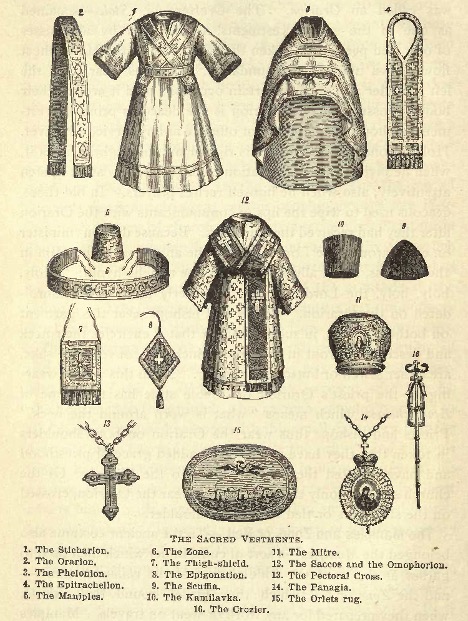
The common vestment for all three degrees is the sticharion (alb or
surplice), which is a garment up to the toes in the form of a shirt
without a collar. It is called podriznik for priests and bishops and is
sewn from thin linen or silk fabric with narrow sleeves, since it is the lower
vestment, over which other vestments are worn. The deacon’s surplice is an
upper liturgical vestment made of brocade or other fabric with wide sleeves.
The clergy - subdeacons and readers - also wear such surplice.
On the wrists, clergymen of all three degrees put on cords; deacons - under the sleeves of the surplice, priests and bishops - on top of it.
The deacon, over the surplice, on his left shoulder wears an orarion - a long strip of colored fabric with images of a cross. The orarion is reinforced with a loop on a button sewn to the left shoulder of the surplice. At some moments of the divine service, the deacon is girded with an orarion, placing its ends crosswise on the chest. In this form, the orarion is always worn by subdeacons. The double orarion is a reward for deacons.
The priest puts on the epitrachelion on top of the podriznik, without which he does not perform any sacred rite. Epitrachilios are usually made from brocade.
The priest’s upper robe is a felonion - clothing in the form of an ancient cloak. The Russian felonne has a large cutout in the front part so that the priest has his hands free to perform the sacred rites. A cross is sewn on the back of the phelonion in the upper part, under it there is an eight-pointed star.
The epitrachelion, the rudders and the phelonion constitute the small priestly vestment, in which Vespers, Matins and a number of other services are performed. When celebrating the Divine Liturgy, the priest puts on a full vestment: a priznik, an epitrachelion, a belt, cords and a phelonion.
The liturgical belt is a strip of cloth tied at the back with ribbons, with a cross in the middle.
A priest may be awarded the right to wear a legguard and a club. The gaiter is rectangular, and the club is a diamond-shaped plate on a ribbon.
As a reward, priests and protodeacons are given the right to wear a headdress
- kamilavka - during services.
The full bishop’s vestment includes the same vestments as the priestly: a priestnik (podakkosnik), an epitrakhilion, a belt, a club (for bishops it serves not as a reward, but as an obligatory element of vestments), ruffles, sakkos and omophorion.
 The omophorion is an ancient element of the
bishop’s vestments and is a wide, long strip of cloth with the image of
crosses.
Omophores are of the spirit of the species - large and small. A large omophorion is put on the bishop’s shoulders so that it goes around both shoulders and with one end descends from the left shoulder in front, and the other from the same shoulder in the back. It is used during processions of the cross and in the initial part of the Divine Liturgy, up to the Small Entrance and the Trisagion inclusive. During the readings of Holy Scripture, the bishop removes the omophorion, and during the rest of the liturgy, at its most important moments, he puts on a small omophorion.
The top vestment of the bishop - the sakkos - in appearance resembles a deacon’s surplice, however, it is shorter and wider, and instead of buttons along the edges of the side cuts, bells (bells) are sewn on it.
The miter is the liturgical headdress of the bishop. Some priests - archimandrites and honored archpriests are also endowed with the right to wear the miter (unlike the bishop, they do not have a cross at the top of the miter).
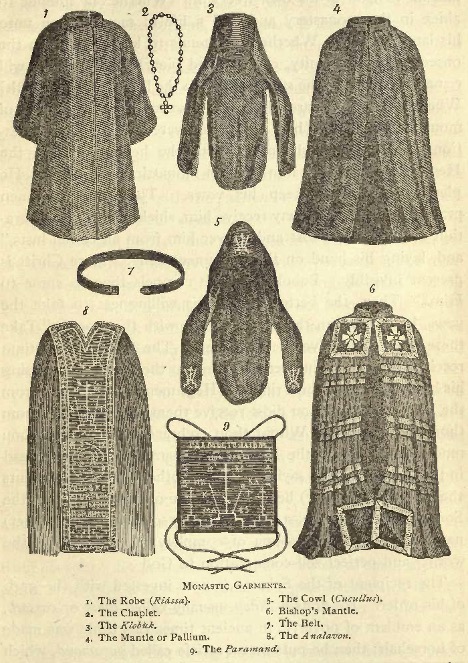
The bishop’s liturgical vestments also include the mantle and cowl. The bishop’s mantle is worn over the robe (like the monastic one). In Russian church practice, the bishop and archbishop wear purple or burgundy robes, the metropolitan has blue or blue, and the Patriarch has green. On both sides of the cut in the front part of the mantle, quadrangular plates - tablets - are sewn. Sources are also sewn onto the mantle - stripes of a different color than the main one (white and red, according to the rule). Wearing the mantle, the bishop enters the church before the beginning of the service and proceeds from the altar to the litiya during the all-night vigil.
The bishop also uses a rod during divine services.
On his chest, over the vestments, the priest wears a cross, and the bishop wears a panagia (a medallion with an icon-painting image). During divine services, bishops wear a cross and a panagia. During the divine service, patriarchs put wear two panagias and a cross.
1. The clergymen and their functions.
1. CLERGY, THEIR FUNCTIONS AND VESTMENTS
A “ponomar ” - in Russian this word means “door-keeper”. In ancient times this term was used to refer to those who stood at the door of the church and watched over that none of the infidels would enter. In the Typicon the acolyte is denoted by the terms censer firer and paraecclesiarch (see chapters 1, 2).
A chanter is someone who sings during the divine service. Singing during a service is very high and comparable to the angelic praise of the Lord, and it is not by chance that in the liturgical books the choir, like the angelic rank, is called the rank. It is important to note that it is the duty of the monastery superior to sing during the church service, i.e. the Typicon, which describes the monastic order of service, does not mention any specific persons, laymen, who might sing in church. In modern parish worship, however, the singing at the service is performed by devout laypeople, often women. Singers, therefore, like acolytes, belong to the clergy, but they have neither a rank of ordination, nor any special vestments.
The consecration to the subdeacon (like the consecration to the reader) is also called a cheirothesia and is only performed if the candidate has been previously (or on the same day) consecrated to the reader. The order of the cheirothesia to subdeacon is set out in the Bishops’ Canon. The cheirothesia itself is performed only by the bishop before the liturgy or, in practice, during the singing of the antiphons.
2. THE THREE ORDERS OF PRIESTHOOD
2. The Deacon’s and the Priest’s vestments and rewards.
3. The Bishop’s vestments and rewards.
The bishop also uses a rod during divine services.
4. The colors of the vestments.
In the Russian Orthodox Church, it is customary that the colors of the liturgical vestments correspond to the holiday to which the service is dedicated.
Most often, during divine services, vestments of gold (or yellow) color are used, symbolizing the glory of God : they are used for worship on Sundays and on some of the Lord’s holidays and other holidays.
On the feasts of Epiphany , Transfiguration and Ascension of the Lord and on the days of their after-feasts, white vestments are used.
The services of the Nativity of Christ and the Christmas period are performed in white or white and gold garments.
On the feasts of the Lord’s Entry into Jerusalem and Pentecost , the vestments are green.
On the first day of Easter , the service is performed first in white , then in red vestments; there is also a tradition to change the colors of vestments during Easter Matins as a sign that Easter is a Feast of Holidays.
During the Easter period , the usual color of liturgical vestments is red.
On holidays dedicated to the Mother of God , and on the days of their after-feasts, it is customary to use blue vestments.
On Sundays of Great Lent , during Holy Week , on the feast of the Exaltation of the Cross of the Lord , vestments of dark purple or violet color are used.
Everyday Lenten services are performed in clothes of the same color or black.
When celebrating a divine service in memory of venerated saints, the vestments are: on the days of remembrance of saints - golden , on days of remembrance of martyrs - red , on days of remembrance of holy monks - green , on the feasts of angels and archangels - white.
5. The actions of the Believers in the church.
The temple should be treated with special reverence as a place where church prayer is performed and God Himself is invisibly present.
One of the petitions of the peaceful litany, with which the most important services (the Divine Liturgy, Vespers, Matins) begin, reads like this: “For this holy temple and with faith, reverence and fear of God entering the stench [into it] let us pray to the Lord.” It is fitting to enter the temple with faith, reverence and fear of God. At the entrance to the temple, as well as at the exit from it, believers cross themselves. It is not customary to visit the temple in clothing which is too open and immodest. In the church, one should remain silence and not talk during the service.
According to the ancient custom, during divine services, men should stand in the right half of the temple, and women - in the left; at present, as a rule, worshipers can stand anywhere in the temple, except for the altar, pulpit and solea (only priests and singers can ascend the pulpit [32]). Those who find it difficult to stand can sit on the benches and chairs available in the temple.
Taking part in temple prayer, believers create the banner of the cross and make obeisances from time to time.
Bows are always performed with the words “Come, let us bow …” and “Alleluia, Alleluia, Alleluia, glory to You, God” [34], at the end of the singing or reading “It is worthy …”. During Great Lent, prostrations are also made: when reading the prayer of the Monk Ephraim the Syrian “Lord and Master of my life …”, with the exclamation “The Light of Christ enlightens everyone …” the entrance of the Liturgy of the Presanctified Gifts, with the kissing of the Shroud at the end of Holy Week. Weak people can replace bowing down to the ground with waist bows.
On the feast of Pentecost, kneeling prayers are performed in the temple.
When a bishop or priest utters the greeting “Peace be to all” or other exclamations accompanied by the sign of the cross overshadowing the people, one should bow one’s head without making the sign of the cross. When blessing those praying with the Gospel, the cross and the Eucharistic chalice, one should cross oneself before bowing their head. During other exclamations of the priest, which are not blessings, but conclude certain prayers, the sign of the cross with a bow should be performed.
A bow at the priestly exclamation at the end of each litany is obligatory. During the proclamation of prayers, preceded by the words “We bow our heads to the Lord” or: “We bow our heads to the Lord,” as well as prayers after the ambo, you should bow your head.
On holidays dedicated to the Mother of God , and on the days of their after-feasts, it is customary to use blue vestments.
When celebrating a divine service in memory of venerated saints, the vestments are: on the days of remembrance of saints - golden , on days of remembrance of martyrs - red , on days of remembrance of holy monks - green , on the feasts of angels and archangels - white.
One of the petitions of the peaceful litany, with which the most important services (the Divine Liturgy, Vespers, Matins) begin, reads like this: “For this holy temple and with faith, reverence and fear of God entering the stench [into it] let us pray to the Lord.” It is fitting to enter the temple with faith, reverence and fear of God. At the entrance to the temple, as well as at the exit from it, believers cross themselves. It is not customary to visit the temple in clothing which is too open and immodest. In the church, one should remain silence and not talk during the service.
-
- The clergymen and their functions.
-
- The Deacon’s and the Priest’s vestments and rewards.
-
- The Bishop’s vestments and rewards.
-
- The colors of the vestments.
-
- The actions of the Believers in the church.
-
A description of the main architectural features of an Orthodox church building.
- The hierarchy of the Church.
- The utensils and vestments used during Church celebrations.
Related Concepts
- aer
- altar
- angelic-praise
- anointing
- antimension
- apostle
- asterisk
- awards
- baptized-believers
- bishop
- bishops-blessing
- bishops-service
- blessing
- bows
- burial-of-christ
- byzantine-architecture
- calendar
- canons
- catapetasma
- catechumens
- cathedra
- chalice
- chanter
- cheirothesia
- cheirotonia
- chrism
- church-as-ark
- church-interior
- ciborium
- clergy
- communion-of-the-laity
- deacon
- deacons-doors
- diocesan-authority
- diskos
- easter
- eiliton
- entrances
- feasts
- great-entrance
- great-lent
- holy-lamb
- holy-spirit
- holy-table
- iconostasis
- incense
- kamilavka
- kliros
- lay-piety
- lectern
- light
- liturgical-singing
- luke-178
- mark-437-39
- marriage-discipline
- martyrs
- metropolitan
- narthex
- nativity
- nave
- orarion
- passion-of-christ
- patriarch
- penitents
- pentecost-kneeling-prayers
- phelonion
- presanctified-liturgy
- priest
- priests
- procession
- proskomedia
- prosphora
- prothesis
- protodeacon
- reader
- relics
- reserved-sacraments
- rewards
- sacred-vessels
- sanctuary
- seraphim
- ship-of-salvation
- shroud
- soleas
- spear
- sticharion
- subdeacon
- symbolism
- throne-of-god
- trisagion
- trullan-council
- veils
- vestments