History of the Russian Orthodox Church — Topic 13
- The Russian Church during the reign of Catherine II
- The Russian Church during the reign of Paul I
- The Russian Church during the reign of Alexander I
The Russian Orthodox Church during the reigns of Catherine II, Paul I and
Alexander I
The Russian Church during the reign of Alexander I
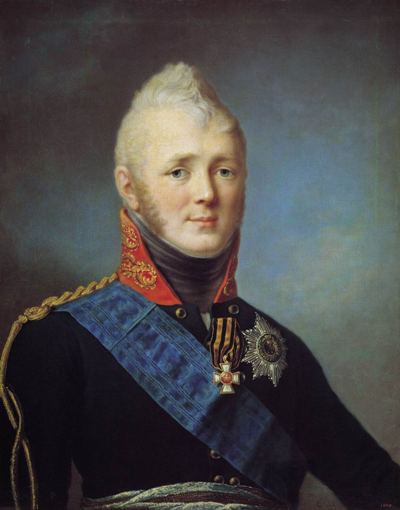
Emperor Alexander I (1777-25), the grandson of Catherine II, ascended the throne in 18011 as a man very distant from the Church. This was helped by his contemporary court life, which offered nothing instructive. It was a time of freethinking which had penetrated into Russia from Europe. According to Klyuchevsky, Catherine II entrusted the upbringing and education of Alexander and his brother Konstantin to Colonel La Harpe2, an enthusiastic admirer of the abstract ideas of French Enlightenment philosophy: “a walking - as Vasily Osipovich says - and very talkative liberal book. Atheist”. In the first years of his reign Alexander I, surrounded himself with friends of his youth, like himself, for whom the Church had little place in life. This circle of associates was called the Neglasny Committee (Private committee).
In the main church office, the Synod, the Chief Procurator was Count D. I. Khvostov, who showed little interest in direct church affairs, which were directed by Metropolitan Amvrosy (Podobedov) of St Petersburg and Novgorod. When the transformational plans of the new Tsar, which also dealt with church matters, began to take shape, the need for a more vigorous and independent chief prosecutor was felt. On December 31, 1802, Α. Yakovlev, hitherto a member of the College of Foreign Affairs, was appointed the new chief prosecutor. When he took up his duties, he first of all drew attention to the deficiencies in the administration of the Synodal Office, which was beyond the control of the Chief Procurator. He obtained the Emperor’s consent to increase his powers in this field. Because of his desire for greater subordination of the secretaries of the spiritual consistory, his relationship with Metropolitan Ambrosius and other synodals gradually deteriorated. Alexander did not like it. Sensing this, Yakovlev resigned.
On 21 October 1803 he was replaced by Duke3 A. N. Golitsyn, a close friend of the Emperor’s youth. The new chief prosecutor seemed completely unfit for his post. He was a typical secular man, who at the same time was a passionate admirer of free-thinking ideas. Golitsyn carried out the same activities, the importance of which was determined under his predecessor, but he was treated differently. The Synod reckoned with him in view of his personal closeness to the Tsar and his direct reports to him. Rewarding and promoting the hierarchs and summoning them to appear before the Synod depended more and more on the Chief Procurator. Over time, Emperor Alexander I became disillusioned with the competence of the unofficial committee. His closest associate is M.M. Speransky (1772-1839). The son of a priest, he rose through the ranks to the position of Secretary of State (the Emperor’s private secretary), and was getting closer and closer to the Tsar. He was entrusted with the drafting of the most important bills.
It was probably Speransky, who had first-hand knowledge of the material needs of the clergy, who promoted the idea of raising the level of education and material means of the clergy. A special Committee was set up to discuss this question and in July 1808 it drew up: 1) a plan for the new organisation of clerical education and 2) a plan for seeking investments to build up the capital of the Church. At the head of the entire spiritual-educational business was placed the Commission of Theological Schools, which included high clergy and some officials. This created for the first time under the Synod a central institution in charge of ecclesiastical education in the country. The direct supervision of secondary and lower educational institutions was the duty of the Academies. In them it was possible to receive higher spiritual education only after the completion of seminary course, the middle level. The lower level consisted of district and parochial schools in their districts. Three academies were left: in St. Petersburg, Moscow and Kiev.4
All the clerical schools were created as estate schools of a mixed type, with general educational and special courses. Education in them was still made compulsory for children of clergy. The system in seminaries was as follows: the academic cycle was divided into three sections (2 years each). Each one of them was called by its main subjects: rhetorical, philosophical and theological. The latter gave a special spiritual education. In the academies the course was divided into two departments (2 years each): general educational and special theological. Students of academies on completing a course became either candidates or masters. Masters and doctors in the priesthood received special crosses. New subjects were introduced in the seminaries: mathematics, church and general history, languages - Hebrew, German and French. Greek was put on an equal footing with Latin. Hermeneutics was introduced. By the end of the reign of Emperor Alexander I the level of education of the clergy was so high that in the villages there were already a lot of priests who had passed the full seminary course, while under Catherine there were still uneducated priests in the cities.
But the situation in the seminaries was still difficult. The colleges were forced to accept a lot of poor pupils over and above the state maintenance, so they had to cut down on what was going to the maintenance of the regular bursaries. There were two sources of finance for the maintenance of ecclesiastical schools: from churches (deposited in the bank) and an annual (for 6 years) grant from the state treasury. The interest on this deposit could fully provide for the maintenance of the theological schools and all the church parishes. These harmonious calculations, however, were considerably altered by the war with Napoleon. At that time the Church donated 1.5 million rubles to the war effort. The enemy’s invasion caused terrible destruction. After the War of 1812 many churches and monasteries had to be restored and the devastated clergy had to be helped. Here too the synodal money was spent. The remaining funds could hardly be used to maintain the theological schools alone. Clergy allowances had to be abandoned.
At the beginning of the Patriotic War the Emperor Alexander I, was seized by a spontaneous religious upsurge. But this was not yet his true conversion to the Church. The Tsar had turned to mysticism, fashionable at the time. Earlier, in 1808, a diminutive, but promising figure, the hieromonk Philaret (Drozdov), had appeared in the arena of church-state history. Metropolitan Amvrosy immediately assessed Philaret and brought him close to him. In 1812 he was appointed Rector of the St. Petersburg Theological Academy. In due course the Emperor’s favourite, Duke Golitsyn, became Minister of Ecclesiastical Affairs and National Education. His increasing fondness for mysticism caused much excitement. Metropolitan Amvrosy even tried to protest about it, but did not succeed with the emperor, and he soon gave up governing the diocese in the capital. The situation was becoming more and more aggravated. Everything connected with non-Orthodoxy found full support from Golitsyn, who even covered up the Khlystovite rallies. The Bible Society established in Russia was headed by Freemasons. Golitsyn forbade the spiritual censorship to pass printing against harmful works.
Metropolitan Michael (Desnitsky) struggled with the Minister. It must be said that it was Golitsyn who promoted him to such a high office, probably having the wrong idea about him. As he became metropolitan of the capital, Michael began to call in his sermons to stand firm for true Orthodoxy. In 1821 he openly opposed Golitsyn. Emperor Alexander, he implored in letters to save the Church “from a blind minister”. “When this writing reaches you,” Mikhail reported, “I will no longer be in the world. I have told people nothing but the truth: especially now, when in my deeds I am preparing to give an account to the Most High Judge”. He did die two weeks after sending the letter. This made a huge impression on the Emperor and increased the hostility of society towards Golitsyn.
The main struggle with Golitsyn was led by Hieromonk Fotiy (Spassky). Not being theologically educated, and not having an academic education, he nevertheless stood firm on the foundations of Orthodox doctrine, and, unafraid of the omnipotent minister, went ahead. Golitsyn, dissatisfied with Fotiy’s opposition, had him appointed rector of the neglected Derevyanitsky monastery in Novgorod. Bringing soon the cloister in exemplary order, he made exemplary also Skovorodskuyu cloister, which he was already archimandrite. In 1822 Fotiy was received by the tsar and made a great impression on him by his person and what he said about the dangers threatening the Church. The Tsar had already had his doubts about the validity of mysticism. Thanks to the influence of the Archimandrite, a sublime decree on the closure of Masonic and other secret societies followed in 1822. Strengthening his denunciation of Golitsyn, Fotiy anathematised him. May 15, 1824 issued a decree on dismissal of Golitsyn at his own request. Admiral A. S. Shishkov became the new Minister of Education. The Synod moved to the former order of work: now the Chief Procurator, Duke Meshchersky could address directly to the supreme power.
During the reign of Alexander I, the Jesuits actively began their activities. The general liberal atmosphere of the first reign of the Emperor and the broad freedom of religion facilitated their activity. Their schools and missions covered the whole of western, southern Russia and spread to Siberia, where there were some exiled Poles. In high society at the time, it was fashionable to employ the children of French abbots as tutors. In 1815 the Tsar had the Jesuits expelled from both capitals. When, even after that, they continued their intrigues and propaganda from Polotsk, in 1820 the Tsar decreed their complete expulsion from Russia.
On 6 December 1812 the Bible Society was founded in Russia. Its aim was to disseminate the Bible among all the peoples of Russia in their natural languages. The Tsar and Golitsyn were very sympathetic to this project. The Emperor himself enrolled as a member of the society with an annual fee of 10,000 rubles and a lump sum of 25,000 rubles. Golitsyn was elected president. From 1814, orthodox hierarchs began to participate in Society: metropolitans of Kiev Serapion and Saint Petersburg Amvrosy, archbishops of Chernigov Michael (Desnitsky) and Tver Serafim (Glagolevsky), bishop Philaret (Drozdov). Catholic, Uniate and Armenian hierarchs also took part. There were also Protestants. Over time the network of the Society spread throughout the empire. Its property now consisted of money, houses, books, printing supplies
- amounting to about 2 million rubles, despite the enormous expenses it incurred in printing and distributing its books and brochures. It existed solely on donations, which poured down like a river. The Society kept the translators it needed, and every year it published new translations of the Bible and parts of it in different languages in several printers at once.
At the end of 1815 Emperor Alexander set a task before the Society: to compile a text in Russian. The Synod instructed the Commission of Ecclesiastical Schools to find scholars and translators at the St. Petersburg Academy. All translations were to go to the Bible Society for review, and after approval, to be published. The translation was entrusted to the Rector of Academy Archimandrite Philaret and other members of the Academy (1816). Two years later in 1818 the Fourth Gospel5 was printed. By 1821 the entire New Testament was completed and in 1825 the first volume of the Old Testament (up to the Book of Ruth included) was printed, but it was not printed6 due to the death of Emperor Alexander I or due to the forthcoming closure of the Society. What happened?
Quite soon another aspect of the Society’s activities became clear. Many of its secular members had connections with the Masonic-mystical circles. In general, a passion for mysticism was then in vogue. The excited religiosity and the heated imagination found too little nourishment in the traditional Church. Intellectuals and moderns were not satisfied with the usual forms of piety, which they sought in some “inner church”, aspiring to higher religious states, miracles, visions, the descent of the Holy Spirit… The Society became the epicentre of such sentiments over time. Everything that sought “salvation” outside the canonical Church clung to the society. And the society became a center of all kinds of mystical sects. Besides biblical books, in which many mistakes were made during translations, various mystical books were also published here, with which libraries and schools were flooded.
This, of course, could not go unnoticed and roused against the Society many educated people of the time. Metropolitan Serafim (Glagolevsky) of St. Petersburg, at first a member of the Society, understood this game and sharply opposed it. Golitsyn was removed as minister of education and president of the Society. His place in 1824 was taken by Metropolitan Seraphim. In the same year, spiritual censorship of doctrinal books was introduced. The influence of the mystics was thereby weakened. In 1822 the Masonic lodges were closed down. But finally, the harmful movement ceased in 18257 with the accession to the throne of Emperor Nicholas I. By his order the mystical books were taken away from all libraries. A special committee was set up at the St. Petersburg Academy to examine them and remove books, harmful to Orthodoxy, from circulation.
The Russian Church during the reign of Catherine II
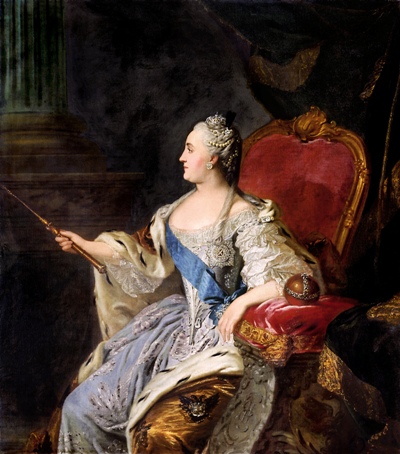
In 1762 Peter III was succeeded by his wife Catherine II (1762-1796) in a bloodless coup.8 Peter III’s antics were initially tolerated by both the people and his wife. The decisive factor was the military betrayal committed by the hapless ruler: he made a separate peace with the almost defeated Prussia (mortally offending the guards and the army which had been shedding blood in what turned out to be a pointless war), and, having joined the Russian army with that of Friedrich, turned against his recent ally, Denmark. A conspiracy was formed, led by the Orlov brothers. On 28 June 1762 the Guards proclaimed Catherine the Autocrat Empress. The Senate and the Synod also swore an oath of allegiance to her.
Although a pure-blooded German, Catherine fully embraced Russian culture and became russified. During her marriage to the infantile Peter, who had no interest in her at all, she carried out much self-education. She was called an enlightened monarch, because she wanted to rule in the spirit of the ideas of the European Enlightenment, and to make Russia a truly enlightened European country. From the position of the Empress, the coup d’état on 28 June was also explained by religious motives. According to her she had been enthroned for the defence of Orthodox law. She called herself head of the Greek Church,9 and regarded her official activities as a religious duty. Two months after her accession the Senate returned the lands to the Church which had been secularised by decree of Peter III.
By the end of 1762, however, the government issued a manifesto on the establishment of a special commission to consider the issue of the management of the Church’s lands. According to the logic of the document this land fund was not used for its intended purpose, but for the luxuries of the clergymen. It is interesting that the commission included representatives of progressive clergy such as Archbishop Dimitriy Sechenov of Novgorod. True it was not mentioned yet about secularization of monastic lands, but the commission, knowing the mood of the Empress, recommended the alienation of monastic lands.
The result of its work was the Manifesto of February 26, 1764 on secularization of the church estates. Catherine herself appeared before the Synod and made a pathos speech, in which she directly stated that the church fiefdoms were stolen from the state. Clergymen cannot own land without being unjust to the state and without distracting themselves from their direct cause
- the clear application of the dogmas of the faith. “You are the successors of the apostles,” she broadcast, “to whom God instilled a contempt for riches, who were very poor. Their kingdom was not of this world.” The empress thus appealed to the arguments of the non-possessors. Under the new manifesto all the estates of the Church with their peasants were transferred to the State College of Economy.
Changes also occurred in the administrative structure of the Russian Church: dioceses and monasteries were divided into three classes. Three were declared first-class: Novgorod, St. Petersburg and Moscow; second-class - eight; third- class - fifteen. The bishops received a salary in accordance with the rank of their diocese. For the monasteries there were also introduced staffing levels, on which also depended their economic and financial security. Not all monasteries were included in this staffing scheme, however. There remained about 80% of the monasteries that were out of this network, that is, out of state. They were instructed either to dissolve themselves, or to become self- supporting at the expense of their pilgrims.
In due course the Collegium of Economy was abolished, and all the church fiefdoms merged with the state lands. The monastic peasants became known as state peasants. The position of the latter was much easier than that of private or monastic serfs. This manifesto was a terrible blow to the monastic economy. The monasteries were left with areas unpopulated by peasants, so that there were no workers on them: forested areas, wastelands. Some historians (P.V.Znamensky, I.K.Smolich), contrary to the generally accepted, in the Сhurch science assessment of this event, gave a rather unexpected qualification. The secularization decree issued under Catherine the Great is said to have been the first step towards the abolition of serfdom in Russia. More than one million monastic peasants were freed from serfdom10. They were turned into state peasants, which greatly simplified their lives, because it relieved them of additional burdens in favour of the monastic economy.
Returning to the events of 1764, we must also note the reaction of the episcopate to this measure. Of course, the seizure of land caused justifiable indignation among the hierarchy, but it remained prudently silent, with the exception of a few. The most vocal opponent of secularization was Bishop Arsenii Maciejevich of Rostov11. Arsenii Maciejewicz - originally from Volyn, studied at the Kiev Academy. Throughout his life he consistently held the views of Joseph Volotsky. In many respects this was the inner reason of exacerbation of his relations with the secular power: and during the reign of Elizabeth Petrovna, and then under Peter III, and at last, under Catherine II,
- when the secular tendency in state-church relations was clearly revealed. On the Sunday of the Solemnity of Orthodoxy, Arseniy pronounced an excommunication on February 9, 1763 in Rostov, with the anathemas against “those, who violated and offended God’s holy churches and monasteries”, and “those, who received estates, given by the ancient monks of God”. Immediately afterwards he asked to be retired. In March of the same year, he sent two reports to the Synod composed in the same spirit. The Synod reported to the Empress about Arsenii as “an insult to Her Majesty”. Catherine put Arsenii on trial before the Synod “for perverted and outrageous interpretations of the Holy Scriptures and encroaching on the tranquility of her subjects”. He was arrested and placed in the Simonov monastery under tight guard. Under interrogation the hierarch firmly defended his position, even in the presence of the Empress.
As a result, he was accused of insulting Her Imperial Majesty, deprived of his ministry and sent into exile to the Korelsky monastery. But even here he did not cease: he spoke out boldly against Catherine, continued to scold the government’s actions with regard to the monastic estates, expressed doubts about Catherine’s rights to the throne, sympathised with the Grand Duke Pavel Petrovich, etc. All this served as material for a second trial of Arsenii. The case was now given a political character. At the end of 1767 Arsenii was deprived of monasticism and sentenced to eternal imprisonment. He was sent to Tallinn, where he was imprisoned. The guards were forbidden to speak to him. All windows were bricked up, leaving a small hole in the top for food. He died on February 28, 1772. Arsenii was restored to bishop dignity and in 2000 he was glorified - he was glorified as a saint martyr.
But Catherine went further. It has already been said that she was greatly influenced by the ideas of the Age of Enlightenment. One of them was the idea of establishing freedom of religion in Russia. On coming to the throne, Catherine had the idea of carrying out wide-ranging reforms in a progressive European spirit. For this purpose, she asked the public to submit their proposals. Among the submitted drafts were the so-called conditia (clauses), authored by the Chief Procurator of the Synod I. Melissino. Their content was as follows:
1. permitted complete freedom of religion for foreigners;
2. freedom for schismatics to conduct worship in public and to have priests;
3. to loosen and reduce the fasts;
4. to purge the Church of so-called “superstitions” and feigned miracles concerning relics and icons;
5. To abolish the custom of carrying icons around the home;
6. to shorten the duration of church services,
7. to reduce the number of feast days;
8. to replace vespers and all-night services with short prayers with teachings useful to the people;
9. to discontinue the financing of monasteries, “which have a great cost”;
10. to appoint bishops from white clergy, for there were no monks in the ancient Church;
11. to allow a bishop to cohabit with his lawful wives;
12. to abolish the custom of remembering the dead;
13. to declare freedom of marriage with non-believers;
14. To not forbid the widowed to have a fourth marriage;
15. To forbid the communion of infants under ten years of age.
Thus, this was a programme of renewal of the Church, which would later be taken up almost unchanged by the renovationists of the early 20th century.12 However, the Synod managed to use the de facto right to bypass the chief prosecutors in their contacts with the supreme power. As a result, Melissino was dismissed. His successor was the army brigadier P. P. Chebyshev. It is known about him that he did not hesitate to flaunt his atheism openly, in front of a crowd of people talking to someone. Arguing with synodals, he used foul language. In every case, Chebyshev pressed the Synod, allegedly in pursuance of legality. Blaming synodals for embezzlement, he himself was caught stealing.
Under Catherine the national composition of the episcopate changed. Its dislike of natives of Ukraine was motivated by excessive ambition of the Malorossia episcopate. Beginning in 1763, candidates for the bishopric provided data on their nationality, education, and service record. The empress nominated bishops and abbots, mostly from Velikorossia. Under her a new type of bishops appeared, in the spirit of the Enlightenment. Of them the most remarkable was of course Platon Levshin (who lived between 1737 and 1812). He was born near Moscow and studied at the Moscow Theological Academy13. He was fluent in Latin, Greek and French. In his own words he became a monk “for love of the sciences”. Platon wanted to create a scholarly and cultured clergy through a good school. At the Academy he gathered a group of the best students from poor families, who were nicknamed Platonists, as they were obliged to add the lord’s name to their surname: Gilyarov-Platonov, Smirnov-Platonov, Ivantsov-Platonov etc. For them Platon established special scholarships, they were given a special table, dress, free books and writing utensils. All Platonists subscribed that upon graduation they would join the clergy. Platon opened schools in Pererva, Zvenigorod and Kaluga. Thanks to his efforts for the children of poor rural clergy, in 1797 the Bethany Seminary (Sergiev Posad) was opened. In 1792, Platon resigned from the administration of the diocese but remained a vicar of the Lavra. He lived permanently in his monastery in Bethany. His relationship with Catherine deteriorated. He died in 1812.
Platon Levshin was a new type of Russian bishop. He made every effort to develop in the white clergy a consciousness of personal dignity before the bishop. He demanded not to humiliate the clergy, and forbade the whipping of clergy in his diocese. He used reprimands, fines and, in extreme cases, deprivation of ministry as methods of punishment. On the whole he tried to elevate the social position of the clergy.
His contemporary was another famous saint - Bishop Tikhon of Voronezh (1725-1783). He was quiet and invisible to the world. He was made Bishop of Voronezh in 1763. At that time, it was the poorest and most backward diocese, with a high crime rate. Cossacks and dissenters found a place here. The saint was engaged in improvement of the morals of this violent Cossack land. He put things in order in monasteries. That monks remembered monastic vows, he ordered to read the Rite of Enfranchisement at dinner. He preached a lot, but his sermons (unlike Platon) were simple and never too much, understandable for non-bookish people. St. Tikhon was not a born administrator, but he cared about his flock, always visiting his diocese. In 1768 he retired to the Zadonsky monastery, a simple novice. Here he devoted himself to the deeds of prayer and fasting. He gave away all his priestly pension and everything he received from his acquaintances to the poor. He reposed on August 12, 1783. His veneration began immediately after his death. Prior to his official glorification in 186314 there were many healings by his prayers.
In 1796 Paul (1796-1801), the unloved son of Catherine II, ascended the throne.
The Russian Church during the reign of Paul I
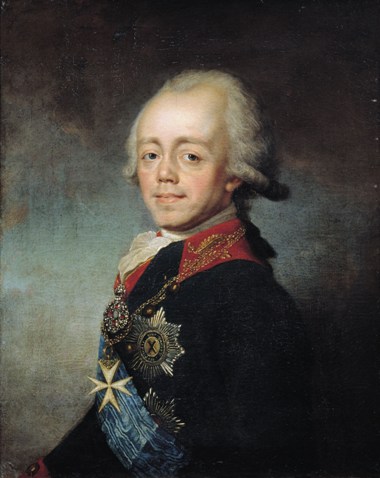
In his youth Paul I was fond of mysticism, but by the beginning of his reign he had become involved with the theocratic idea. In his Decree on the Succession to the Throne of 1797 Paul declares himself head of the Russian Orthodox Church. It is likely that the idea of a royal priesthood, Paul picked up from the Freemasons, to whom he was once close. In general Paul was a very devout man, which can be attributed to the influence of Count Panin - the most enlightened man of the era, - who was also the tutor of the Tsar.
He marked the beginning of his reign by awarding the higher clergy with secular orders. The first awards were bestowed on Metropolitan Gabriel (Petrov), his successor Ambrosius (Podobedov) and Platon (Levshin). All of the awarded bishops were obliged by the emperor to serve in the secular orders. In addition to the insignia, the order also conferred on the hierarch the rank of nobility.
Under Paul, the parish priests were exempted from corporal punishment and awarded bishops’ scarves, helmets, miters and, for the first time, pectoral crosses. The clergy were exempted from police duties (to guard the town at night). The church estates were also increased. Widows and orphans of priests were relieved, and the allocation for the clergy schools was doubled. In 1797 the St. Petersburg and Kazan seminaries received a status of Academies. Curriculums of seminaries and academies were unified.
After Malta surrendered without a fight to Napoleon’s troops in the summer of 1798, the Order was left without a seat. For help, the Knights of the Order appealed to Russian Emperor Paul. On 16 December the Russian Emperor was elected Grand Master of the Order, whereupon the words ”… and Grand Master of the Order of St John of Jerusalem” were added to his imperial title. An image of the Maltese Cross appeared on the Russian coat of arms. This led to the Jesuits becoming the emperor’s closest and most trusted associates. Of course, this rapprochement with the Roman Catholics was not understood by the Orthodox hierarchs.
Furthermore, the Orthodox did not understand Paul’s patronage of the Old Believers either. When an Old Believer hermitage on the river Kerzhenets burned down in the Nizhni Novgorod province in 1798, the Old Believers turned to the Emperor for help. For the restoration of the hermitage Paul gave money from his personal funds. This indulgent, benevolent attitude towards the Old Believers sparked a movement among them to reunite with Orthodoxy.
In 1799 a group of Moscow Old Believers submitted to the Metropolitan Platon (Levshin) of Moscow a petition, consisting of 16 clauses. These were the terms on which they agreed to join the Orthodox Church. The main condition was “The Synod permits those who are converted to monotheism to renounce the oaths imposed on the adherents of the old rites. Metropolitan Platon rewrote these paragraphs with minor notes, named this document “Clauses, or rules, of monotheism” and submitted it to the Emperor for approval. On 27 October 1800 the Emperor Paul approved these “Rules”. This was the beginning of “edinoverie” (coreligionism).
Editorial Footnotes
Related Concepts
- 20th-century-renovationism
- apostolic-poverty
- arsenii-maciejewicz
- bible-society
- catherine-ii
- catholicism
- church-administration
- church-reform
- church-renewal
- clerical-marriage
- commission-of-theological-schools
- corporal-punishment
- edinoverie
- fourth-gospel
- freedom-of-religion
- freemasonry
- golitsyn
- inner-church
- interconfessional-relations
- joseph-volotsky
- khlystovites
- kiev-academy
- liturgical-reform
- masoretic-text
- melissino
- melissinos-conditia
- metropolitan-platon-levshin
- monastic-economy
- monastic-estates
- monastic-landownership
- moscow-academy
- mystical-books
- old-believers
- old-rites
- orthodox-apologetics
- patriotism
- paul-i
- pectoral-crosses
- philaret-drozdov
- platon-levshin
- polotsk
- popular-piety
- religious-tolerance
- renovationism
- rite-of-enfranchisement
- roman-catholics
- secularization
- seminary-reform
- serafim-glagolevsky
- slavonic-language
- speransky
- st-petersburg-academy
- st-tikhon-of-zadonsk
- state-control-of-the-church
- state-peasants
- synod
- synodal-bible
- synodal-finances
- synodal-period
- theological-education
- theological-schools
- tikhon-of-zadonsk
- war-of-1812
Footnotes
-
Alexander I (1777–1825, reigned 1801–1825) came to the throne through the palace coup of 11/23 March 1801, in which his father, Paul I, was murdered by a circle of guards officers and dignitaries. Alexander had agreed to the conspiracy to depose Paul (though, by most accounts, not to his killing), a fact the text passes over in silence. The dates given as “1777-25” appear to be a truncation of 1777–1825. ↩
-
Frédéric-César de La Harpe (1754–1838) was a Swiss jurist and republican statesman, not a military officer; the rank “Colonel” is mistaken. He was engaged by Catherine II as the civilian tutor of the grand dukes Alexander and Konstantin and shaped Alexander’s early liberal outlook. ↩
-
“Duke” here renders the Russian knyaz, which in this context is properly “Prince.” Alexander Nikolaevich Golitsyn (1773–1844) was a prince, not a duke. The same mistranslation recurs below in “Duke Golitsyn” and “Duke Meshchersky.” ↩
-
This reflects the outcome of the 1808–1814 reform rather than a simple fact of three academies. Four academies were envisaged, but the Kazan Academy — raised from a seminary under Paul in 1797 (as the text itself notes later) — functioned only weakly and was effectively shut down in 1818, not being re-established until 1842. That is why only St Petersburg, Moscow and Kiev operated as academies through the rest of the period, and it accounts for the apparent contradiction with the later statement about Kazan. ↩
-
“The Fourth Gospel” is almost certainly a mistranslation of the Russian Chetveroevangelie — “the Four Gospels” (the four together) — rather than the Fourth Gospel (John). The Russian Bible Society’s translation of the four Gospels was published in 1819; the date “1818” is slightly early. ↩
-
The sentence is internally contradictory (“was printed, but it was not printed”). The underlying fact is that the first Old Testament volume (the Octateuch, Genesis–Ruth) was in fact printed in 1825 but never released. Under Nicholas I the printed sheets were held back and ultimately destroyed — by tradition burned at the brick works of the Alexander Nevsky Lavra around 1825–1826. ↩
-
The Russian Bible Society was not closed in 1825. Nicholas I acceded in December 1825 but ordered the Society’s suspension by rescript of 12 April 1826, its affairs and property passing to the Holy Synod. The formal end therefore belongs to 1826. ↩
-
The seizure of power on 28 June 1762 (Old Style) was itself bloodless, but the deposed Peter III died in custody at Ropsha about a week later (6/17 July 1762), almost certainly killed by his guards (Alexei Orlov was present). Describing the regime change as simply “bloodless” obscures this. ↩
-
After Peter the Great abolished the Moscow patriarchate (1721) and created the Holy Synod, the Russian sovereign functioned as the Church’s supreme governor under the state’s “Spiritual Regulation.” “Head of the Greek [i.e. Orthodox] Church” expresses this Erastian relationship but was never a formal canonical title, and Orthodox ecclesiology does not recognize a lay monarch as head of the Church. ↩
-
Arseny Matseevich (1697–1772) held the rank of Metropolitan of Rostov, not merely bishop. His resistance to secularization led to his being defrocked and imprisoned until his death; the Russian Orthodox Church canonized him as a confessor (hieromartyr) in 2000, as the text notes shortly afterward. ↩
-
This overstates the social reality. Roughly 900,000–1,000,000 male “souls” (around two million people in total) were affected. They were not emancipated — they became state (“economic”) peasants, still bound to the land and liable for the poll tax and state dues; the change relieved them of monastic obligations but did not free them from serfdom in the later (1861) sense. The claim, attributed to Znamensky and Smolich, that secularization was a “first step towards the abolition of serfdom” is an interpretive minority view, not a scholarly consensus. ↩
-
The reference is to the Renovationist movement (obnovlenchestvo), which took organized, schismatic form in 1922 under early Soviet sponsorship (reformist agitation had existed from about 1905). “The early 20th century” is loose; the movement properly belongs to the 1920s–1930s. The implied continuity between Melissino’s 1760s points and the Renovationists is a polemical framing rather than a demonstrated historical link. ↩
-
Anachronism. In Platon Levshin’s student years the Moscow institution was the Slavonic-Greek-Latin Academy. The Moscow Theological Academy under that name was created only in 1814, at the Trinity–St Sergius Lavra, as part of the Alexandrine reform of theological education described earlier in this very lesson. ↩
-
St Tikhon of Zadonsk was glorified (canonized) in 1861, not 1863 — the solemn canonization took place on 13 August 1861. His birth year is usually given as 1724 rather than 1725, and his death is generally dated 13 August 1783 (the text’s “August 12” differs by a day). ↩