History of the Russian Orthodox Church — Topic 12
The Russian Orthodox Church in the era of Peter I. The Synodal reform.
The Russian Orthodox Church during the Palace coups
- The Russian Church in the era of Peter I
- The Synodal reform
- The Russian Orthodox Church during the Palace coups
The Russian Church in the era of Peter I
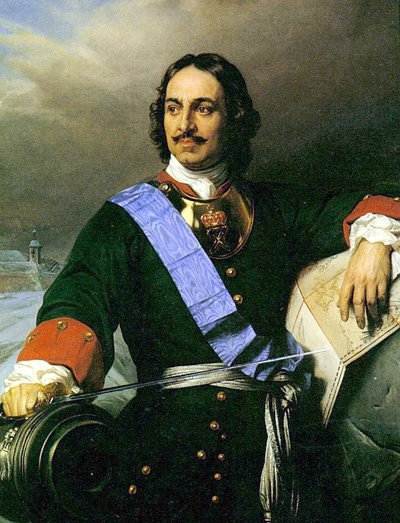
On becoming head of state, Peter I (1672-1725) saw the deafening, and sometimes overt, dissatisfaction of the clergy with the reforms he had planned. It was, however, a just reaction, as the monarch chose as the initial method of his revolutionary modernization the destruction of the old Moscow order and customs to which the Orthodox were so attached. His consciousness was quite European, in the spirit of the New Age, when the state was perceived as the dominant value. There could be no talk of any independent elements within the state. Nor was he a complete atheist, rather an indifferent one, or a pragmatist, demanding a concrete empirical benefit from all state institutions.
While Patriarch Adrian was still alive, Peter had already spoken to him about bringing order to the ecclesiastical ranks. But the Patriarch stood on firm positions: he was alienated from any innovations which had penetrated into Russia. In the course of time Peter’s dissatisfaction with the Russian clergy grew, and he often blamed most of his failures and difficulties in domestic affairs to the secret, but persistent opposition of the clergy. When in Peter’s mind all that opposed and was hostile to his reforms and plans was embodied in the clergy, he resolved to defuse this opposition. This was the aim of all his reforms as far as the organisation of the Russian Church was concerned: 1. The abolition of patriarchy, in which Peter saw papist tendencies. 2. Subordination of the Church to the monarch. He became even more convinced of the need for spiritual reform during his Great Royal Tour - a voyage to the Protestant countries of Europe. There Peter became acquainted with the English system of regulating church-state relations, where the king proclaimed himself head of the Church as well. He decided to do the same in Moscow.1
In October 1700 Patriarch Adrian died. Peter at this time was with his troops at Narva. Here, in the camp, he received two letters concerning the situation created by the death of the Patriarch. In one, the boyar Tikhon Streshnev (in charge of the affairs of the capital in the absence of the Tsar), gave an account of the death and burial of the Patriarch, of the measures taken to protect the property of the patriarchate, and asked whom to appoint a new Patriarch. In another letter, the tax official Kurbatov suggested electing, as before, a patriarchal overseer from among the bishops. All monastic and archbishop’s estates, Kurbatov has advised to copy and give them in protection to someone.
Peter did so - Metropolitan Stephan Yavorsky of Ryazan and Murom was appointed as the Locum Tenens. He was to oversee only the affairs of the Faith, all others were distributed among the state authorities. Stephan came from Malorossia. He received an excellent education: first at the Kiev Academy, then in the West, at the Catholic University in Lviv2, where he studied theology. In order to get there, he had to become an Uniat. Then he did penance, and returned to the Collegia of Kiev. Once, while in Moscow at the funeral of Boyar Shein, Stephan delivered a remarkable sermon, which pleased Peter very much. He made Stephen Archbishop of Ryazan, and from 1700, Exarch and Locum Tenens of the Patriarchal throne. This personnel move by Peter caused displeasure among the Moscovites who did not recognise Stephan’s authority, accusing him of sympathising with the Latins. Under him in 1701, the Monastic Prikaz was restored and the Patriarch’s Court, bishops’ houses and monastic lands and farms were placed under his authority. Soon after came a number of decrees which drastically reduced the independence of the clergy in the state and the independence of the clergy from the secular authorities.
The monasteries were subjected to a special purge. Monks were ordered to remain permanently in those monasteries where they would be seen by special census takers sent by the Monastic order. All the unconverted were evicted from the monasteries. The women’s monasteries were allowed to take monastic vows only for women after the age of forty. The household of monasteries was put under supervision and control of the Monastic order. At last, on December 30, 1701, the decree determined to give the monks salaries in money and bread from the monastery’s incomes, but the estates and lands could no longer be possessed by the monks.
A series of further measures facilitated the brutal persecution of dissenters and allowed the free profession of faith to foreigners, both Roman Catholics and Protestants of all creeds. Peter was peculiarly concerned about the level of morality of the Orthodox flock. By special decrees, he commanded all to confess every year, and for evasion of confession a fine was imposed. Among other things this measure had in mind to search for the Old Believers, who were taxed twice for their beliefs. There were decrees of 1718 which obliged Orthodox citizens to attend churches and stand reverently in them; otherwise, a new fine was imposed.
However, Stephen Yavorsky did not justify the Tsar’s trust: he took too much from the Latin environment, including his aversion to Protestantism, which was the basis of Peter’s plans to reform the Church. Stephen was, however, in favour of patriarchal unanimity. They were also divided by the “case of Tsarevich Alexey” who was tried in 1718 for conspiring against the Tsar. The clerics were also involved in the case, among whom was the metropolitan. The evidence against him was only circumstantial: on one occasion, on the day of the Prince’s name day, Stephan referred to him as the only hope for Russia. This alarmed Peter, which Stephen was quick to sense, and he asked to return to his Ryazan cathedra. He soon lost his importance in the state altogether and died in 1722.
The Emperor’s heart was captured by the Archimandrite of the Khutyn Monastery, Theodosius Janovsky. He made such an impression on Peter that he made him the spiritual arbiter of the building of St Petersburg. Vested with the rights of a diocesan bishop, Theodosius was very active in building churches and supervising the clergy. He took a lively part in the building of the Alexander Nevsky monastery. In 1712 he became its first archimandrite and was granted special privileges. It was he who built the Nevsky Prospect for connection of the monastery with the city. In 1716, Theodosius became Archbishop of Novgorod.3 Theodosius was of noble birth, so he was distinguished by his arrogance. When he became archbishop, he started living the high life: he had sumptuous tables and was luxuriously dressed. Following Peter’s example, the metropolitan organised assemblies - social gatherings with music and merriment. By order of the metropolitan, clergy were also obliged to attend such events.
Theodosius did not conceal his Protestant views (especially in relation to icons). There are known cases of his blasphemy above sacred icons. Thus, on the way to Moscow, having visited the Nikolo-Kolpinsky monastery, he made mockery of the icons and in witness to their false veneration cut up an image of Saint Nicholas the Wonderworker, in the presence of the brethren. Later he was also charged with embezzlement of church funds. The Synod deprived him of his ministry and exiled him to the Korelsky Monastery on the shore of the White Sea, where he died in confinement several months later.
Theophanes Prokopovich then took over the position of Peter’s spiritual guide and partner. He also studied in Rome, but then returned to Kiev of his own free will. Theophanes was well educated and a veritable walking encyclopaedia. Peter took a fancy to him during his brilliant sermon on the occasion of the victory at Poltava. From 1716 he was in St Petersburg where he had to face the envious and informers. He was accused of Protestantism and careerism. However, this did not prevent Theophanes from becoming the ideologist and apologist for the whole church reform of Peter the Great. It was under his leadership that in 1721 the charter of the Spiritual Collegia was drawn up - the branch of the state administration in charge of Church affairs. Thus began the Synodal period.
The Russian Orthodox Church during the Palace coups
The era of palace coups is generally believed to have begun with the death of Peter the Great in 1725 and lasted until the accession of Catherine II in 1762. In early November Peter the Great travelled by water to St Petersburg. He did not hold back, when he saw a boat with the soldiers run aground near Lahti and helped to haul the boat off the shoal, standing waist-deep in cold water. Peter caught a cold and began to have seizures. Gradually the disease intensified. And on January 28, 1725 Peter died. He never had time to finish his will. The pen had fallen out of his hands when he wrote two words: “Leave everything…”.4 To whom - it was unclear. This obscurity of succession engendered a new crisis of power, dubbed the “era of court coups”.
There was also another reason for this. In 1722, probably after the case of Prince Alexey (who had been at the centre of a plot against the Tsar), Peter abolished the procedure of hereditary succession to the throne (from father to eldest son). The autocrat was granted the right to appoint his own successor at his will. This, according to historian Klyuchevsky, was the cause of the subsequent crisis: the throne was given “to chance and became his plaything”. It was no longer the law that determined who sat on the throne, but the Guards, who were the “dominant force” at the time. It was with the support of the Guard that the question of the first heir was resolved - for the first time in the history of Russian autocracy, it was a woman - Catherine I.5
She reigned briefly - until her death on 5 May 1727.6 She was a weak ruler, who gave the whole rule of the country to her favourite, lord A.D. Menshikov. As evidence of Catherine’s “helplessness” it is customary to consider her February 8, 1726 establishment of the Supreme Privy Council, which received extensive powers: to appoint high officials, be in charge of finances, and direct the activities of the Senate, Synod and collegia. Metropolitans Theophanes Prokopovich7 and Ignatius Smola, archbishops Theophylact of Lopatine and George Dashkov sat in the Synod.
The Synod’s influence was severely diminished when the Supreme Privy Council was created in 1726. At first, the Synod was no longer called the governing Synod and soon it was divided into two divisions: the Department for Clerics and the Department for Secular Affairs. All this restricted the rights and competences of the Synod. The ecclesiastical department consisted of six bishops and was in charge of doctrinal, canonical and spiritual-pastoral matters while the other (where secular officials were present) was in charge of economic, administrative and judicial matters. The latter reported directly to the Senate on misdemeanours in judicial proceedings. Thus, property and economy were transferred to the Senate and the jurisdiction of the Synod was narrowed in its powers.
Under Peter II (son of Prince Alexey), who succeeded Catherine in 1727, Moscow again became the capital. The royal court, departments and, of course, the Synod moved here. Georgy Dashkov gained great power there. He came from Velikorosses, representing the interests of the old Moscow nobility, which had been oppressed under Peter and Catherine. At that time Great Russian sentiment was growing among the courtiers and the Little Russian bishops were subjected to covert discrimination. The Russian nobility from the Supreme Privy Council wanted to restore patriarchy. And it was George Dashkov who wanted to be Patriarch. Had it not been for the death of the young Peter II in 1730, this would certainly have happened. However, with the coming of a new ruler in the person of the German Kurlans Anna Ioannovna8, the Great Russian party again lost its positions.
After the death of Peter II, the “Verkhovniki” (members of the party) decided to limit the power of the new ruler with conditions. They drew up a list - all in favour of the Boyars, of course. This was probably the first attempt to create a limited monarchy in Russia. It had been resolved to invite onto the throne, the daughter of Tsar Ivan (brother of Peter Great) - Dowager Duchess of Courland Anna Ioannovna (1730-1740). Theophan Prokopovich also took part in this venture, personally communicating with the Duchess. He relied on the power of the nobility - the long-standing class antagonist to the arrogant and haughty nobility.9 It was the nobility that supported Anna, following her arrival and the breakdown of the Supreme Privy Council conditions. The Council was dissolved and the Old Russian party lost its position, its place being taken by the party of the Germans of Courland, headed by Anna Ioannovna and her favorite - Biron.
Theophanes Prokopovich was in charge of everything in the Church. He was a zealous servant of the German provisionalists who hoped for the triumph of Peter’s reforms of the church. But in reality, he was only consolidating his personal power. Thus, he decided to deal with the opposition to the new regime in the person of the Voronezh Archbishop Lev (Yurlov) and his Synodal friends George Dashkov and Ignatius (Smola). In general, the Empress Anna herself was educated in the spirit of traditional Russian piety and was pious in her own way. But at the same time, she believed in the salvific power of Peter’s laws and trusted the administrative skill of the Germans. To one of them she entrusted the leadership of Church life. It was Heinrich Johann Ostermann.10 Being a fanatical devotee of the Petrine line, Ostermann decided to embody its ecclesiastical aspect with the most brutal literalism. At this time monasteries were closed, their property was taken to the treasury, people “idle and necessary for the state” were rounded up among the clergy, the regular and legalised composition of families and relatives of the clergy was reduced, with forced dispatch to various schools and surplus surrender to the military service. Not only clergymen, but also bishops were punished for misbehaviour. There came a period of imprisonment of clergy and bishops. It was a methodical state terror. And with terror, the members of the clergy themselves were tempted to betray one another. The normal fiscal function of the government turned into a cruel method.
Anna’s successor was Ivan VI Antonovich - great-grandson of Tsar Ivan Alexeevich (brother of Peter I). Regent to the young heir was his mother - Anna Leopoldovna (niece of Emperor Anna). She ruled for only one year, and under her the affairs of the Church have improved somewhat. Anna returned from exile all the bishops who had been exiled to Siberia by her predecessor in order to win support among the hierarchy. Theophylact Lopatynsky, Ignatius Smola, Leo Yurlov, returned once again to their posts.
On 25 December 174111 the company of the Preobrazhensky Regiment proclaimed Empress Elizabeth - daughter of Peter I. She represented two mentalities: the new European one together with the old Russian pious one. Klyuchevsky says about her, that “from vespers she went to the ball, and from the ball she hurried to Matins; she reverently venerated the sacred things and rites of the Russian Church… She strictly kept fasts, which she demanded from foreign ambassadors”. Often, she made pilgrimages on foot to Sergiev Monastery. Under Elisabeth the new favourite was Alexey Razumovsky, an ignorant native of Malorossia. Although he did not enter into state affairs, he was partial to two things - the requests of the clergy and Malorossia. Among his clients was Joasaph of Belgorod, who, thanks to Razumovsky, became vicar of the Lavra. The Cossacks appealed for the restoration of hetmanship. Kirill, Razumovsky’s younger brother, to whom Alexey gave a brilliant education, became hetman.
Under Elizabeth the Russians were again put in the first place. Russian nationalism grew extraordinarily, sometimes acquiring elements of chauvinism. Thus, Elisabeth decided the Jewish question very harshly: all Jews of Jewish origin were ordered to be expelled from Russia as well as from Little Russia. At the same time, Elizabeth was extremely intolerant of the Old Believers. In 1745, all the dissenters were forbidden to call themselves Old Believers and to preach. They were obliged to wear a certain dress, pay double tax and a tax for wearing a beard. Everywhere there was a search for dissenters. All this led to an increase in the number of self-immolations by Old Believers. By abolishing the Anninist Cabinet, Elizabeth again raised the authority of the Senate and Synod in the state. Taking advantage of this, in 1742 Archbishop Amvrosy Yushkevich and Metropolitan Arseny Matsevich submitted to the Empress a report with a request to restore the Patriarchate, or the post of the head of the Synod, which outwardly resembled at least the one-man rule. At the same time, they asked to abolish the supervising body represented by the Chief Procurator. However, Elizabeth did not respect this request.
Lavish gifts were made to the monasteries: lands taken away under Anna Ioannovna were returned, and new ones were added to them. All estates were now permitted to enter monasticism. The position of the white clergy was also somewhat eased, they were exempted from a number of general duties. A decree was issued on the proper maintenance of churches and supplying them with decent icons, vestments and vessels. According to this decree, priests had to visit peasants’ huts and make sure that the Christians kept their icons clean. At the same time, the practice of corporal punishment for clergymen, confinement in consistory prisons and correctional work in the bishop’s court persisted.
Elizabeth’s successor was her nephew Peter III - the grandson of Peter I and grand-nephew of Charles XII. He was heir to both the Swedish and Russian thrones. But he was originally groomed in Sweden12, which is why his upbringing, habits and temperament remained non-Russian. He remained a Lutheran and a German at heart. Elisabeth did not like her nephew. It was as if Peter III had deliberately turned all classes, and the clergy, against him. He flaunted his contempt for the Orthodox rites and publicly mocked Russian religious feeling.13 Princess Dashkova, who was once a friend of the future Empress Catherine II, recalled: “The Emperor came to the Court Church only at the end of the service. He grimaced and mocked the elderly ladies, whom he ordered to curtsy in the French fashion without bowing, as we had before. Unfortunately the old ladies, curtsying and bowing, could hardly stand on their feet”. To Archbishop Dimitrij Sechenov of Novgorod he expressed his wish that the clergy should shave their beards. He ordered the Russian churches to be cleared of unnecessary icons, leaving only the images of the Saviour and the Mother of God.
Peter III built a Lutheran church in the Winter Palace, ordered the removal of icons from St Petersburg’s churches and convened a Synod of Lutheran pastors in Prussia to discuss measures for spreading the Lutheran confession in Russia. This caused irritation and apprehension, as did his decree of 1762 on the secularisation of the monastic fiefdoms, just a few months before he was overthrown. However, he never had time to carry out this reform.14 On June 25 of the same year another decree was issued which was scandalous for Russia at that time: on the equality of all religions. Peter III ruled for just six months, and in that time, he succeeded in turning all social forces against him. The cup of patience overflowed with the separatist peace with Prussia which had almost been defeated by the Russian troops. Peter publicly renounced all his conquests in East Prussia, and thus insulted the memory of the fallen soldiers, the guards, and the entire nation. On 28 June 1762 another coup brought Catherine II to power.
The Synodal reform
The Charter or “Ecclesiastical Regulations” is imbued with irony towards the patriarchal antiquity. Here Theophanes lays out the justice of the new form of government: the Patriarchate was abolished, a Collegium was established, which in the eyes of the reformers had several advantages: 1. collective leadership; 2. collegial decision is free from partiality, guile, dashing judgment; free from the influence of the powers that be; 3. most importantly, the Collegium is not dangerous to the power of the monarch. It is interesting to know that the Regulations were passed by a Council of six bishops and four archimandrites, though not without pressure and threats.
On January 25, 1721 Peter issued a manifesto on the establishment of the Collegium of the Theologians (within 3 weeks it would be renamed the Synod). The Collegium was headed by the President - Metropolitan Stefan Yavorsky, two vice-presidents: Theodosius Yanovsky and Theophanes Prokopovich (archbishops); four advisers in the rank of archimandrite and four assessors - protopopes of the “white” (married) clergy. Subsequently, the Synod was made up of six equally ranked bishops. The members of the Synod were primarily committed to observing the interests of the state and reporting on impending danger.
The Synod had supreme legislative, judicial and administrative power in the Church, but with the consent of the sovereign. The seat of the Synod was in St Petersburg, while the former patriarchate was run by the Synodal Office, which was located in Moscow. Peter also took care of the arrangements for the supervision of the activities of the Synod. On May 11, 1722, he ordered the presence of a special chief public prosecutor in the Synod, the first of which was colonel Ivan Boltin. His main duty was to conduct all relations between the Synod and the civil authority, and to vote against the decisions of the Synod, when they were not in accordance with the laws and decrees of Peter. The Super-Prosecutor of the Synod is called by the instructions “the sovereign’s eye and solicitor for matters of state”. He was only subject to the judgment of the sovereign. At first, his power was purely supervisory, but little by little the Public Prosecutor became the final authority of the Synod and its de facto leader.
The new institution was, in Peter’s plan, to immediately set about correcting the evils of church life. This was done by special officials called inquisitors who were to secretly watch over the regular and lawful course of church life and report back when necessary. The Regulations also obliged priests to be informed if any person had repented of their wrongdoing in confession. Priests became officials in the eyes of Peter. They were also responsible for keeping metric records on births and registering recruits. In 1723 the Eastern Patriarchs recognised the Synod as “their brother in Christ”. How was this possible? There were two reasons for this: the deliberately distorted translation of the Manifesto of 21 into Greek, and the material dependence of the Greeks on Russia.15
Editorial Footnotes
Related Concepts
- anna-ioannovna
- caesaropapism
- canonical-authority
- canonical-norms
- catherine-i
- chief-procurator
- christian-life
- church-autocephaly
- church-governance
- church-unity
- clergy-as-officials
- conciliar-forms
- confession
- diocesan-authority
- disciplinary-reform
- double-taxation
- ecclesiastical-regulations
- egypt
- enthronement
- fines
- great-royal-tour
- guards
- holy-synod
- inquisitors
- ivan-boltin
- local-council
- monastic-prikaz
- monastic-purge
- monastic-vows
- monasticism
- ober-procurator
- old-believers
- orthodox-piety
- palace-coups
- papist-tendencies
- pastoral-theology
- patriarchal-enthronement
- patriarchate
- patriarchs-job-and-hermogenes
- persecution
- peter-iii
- peter-is-reforms
- pre-sobor-presence
- primacy
- primate
- primates
- religious-conformity
- restoration-of-patriarchate
- russian-church
- saint-job
- secularization
- sermons-on-the-veneration-of-holy-icons
- seventh-ecumenical-council
- spiritual-awakening
- st-job
- state-church
- state-church-relations
- state-supervision
- state-surveillance
- state-treasury
- stephan-yavorsky
- swiss-old-catholicism
- synodalitycollegiality
- the-desert-a-city-chitty
- theodore-the-studite
- theodosius-janovsky
- theophanes-prokopovich
- time-of-troubles
- westernization
Footnotes
-
The Russian Synodal settlement owed far more to Lutheran and German Protestant models of collegial (“consistory”) church government than to the English royal supremacy. Its architect, Feofan (Theophanes) Prokopovich, drew the Spiritual Regulation largely from German Protestant administrative theory. Peter’s Grand Embassy of 1697–98 did take him to England, but the tidy “the king is head of the Church” parallel is a later simplification. ↩
-
Yavorsky studied at Jesuit colleges (in Lviv, Lublin, Poznań and Vilnius), not at a “Catholic university” in the modern sense, which did not then exist at Lviv. Temporary conversion to the Uniate (Greek Catholic) confession was the usual precondition for an Orthodox student to enrol in such Jesuit schools. ↩
-
Standard accounts place Theodosius Yanovsky’s elevation to Archbishop of Novgorod in 1721, at the founding of the Holy Synod (of which he became the first vice-president), not in 1716. ↩
-
The famous unfinished deathbed note (“Отдайте всё…”, “Leave everything…”) is a widely repeated anecdote whose authenticity is doubted by modern historians; it is not securely attested in the contemporary record of Peter’s final days and is best treated as legend. ↩
-
Catherine I was the first woman to reign as sovereign empress in her own right, but women had earlier exercised supreme power as regents — notably Elena Glinskaya (regent 1533–38) and the tsarevna Sophia Alekseyevna (regent 1682–89). ↩
-
Catherine I’s death is conventionally dated 6 May 1727 (Old Style; 17 May New Style), a day later than given here. ↩
-
Feofan (Theophanes) Prokopovich was an archbishop — of Pskov, and from 1725 of Novgorod — and never held the rank of metropolitan; the text itself styles him “archbishop” elsewhere. Grouping him among “metropolitans” conflates his rank with that of Ignatius (Smola), who was in fact a metropolitan. ↩
-
Anna Ioannovna was not German: she was a Russian Romanov, daughter of Tsar Ivan V, who had become Duchess of Courland only by marriage. The “German party” of these years refers to her Courland favourite Biron and his circle, not to Anna’s own ancestry. ↩
-
The English here obscures a distinction the Russian terms preserve. Prokopovich and Anna’s backers mobilized the broad service gentry (dvoryanstvo) against the aristocratic magnate clans — the old boyar families and the “Verkhovniki” of the Supreme Privy Council who had drafted the Conditions limiting her power. Rendering both groups as “nobility” makes the sentence read as self-contradictory. ↩
-
Andrei Ivanovich Ostermann (Heinrich Johann Friedrich Ostermann) was primarily a diplomat and vice-chancellor whose influence lay in foreign affairs; the claim that the “leadership of Church life” was entrusted to him is questionable. The ecclesiastical repression of Anna’s reign is more usually associated with Feofan Prokopovich and the state’s secret investigative chancery. ↩
-
Elizabeth’s coup took place on the night of 25 November 1741 by the Julian calendar then in use in Russia (6 December New Style), not in December by the Russian reckoning. ↩
-
Peter III (Karl Peter Ulrich) was raised at the ducal court of Holstein-Gottorp in Kiel, in Germany, not in Sweden. He was heir to the Swedish throne and educated with a Swedish future in mind, but his upbringing and milieu were German. ↩
-
Much of the lurid image of Peter III as a public mocker of Orthodoxy derives from the memoir literature of Catherine II’s circle (including Dashkova) and from propaganda justifying the coup that overthrew him. Modern scholarship (e.g. Carol S. Leonard) treats these accounts as highly partisan and reassesses his short reign, and its reforming decrees, far more cautiously. ↩
-
Peter III’s secularization decree of 1762 was in fact issued and partly set in motion before his overthrow. Catherine II briefly suspended it to conciliate the clergy, then carried through the full secularization of church lands in 1764 — so the reform was ultimately realized, under his successor, rather than simply left undone. ↩
-
The recognition of the Synod by the Patriarch of Constantinople (Jeremias III) and the other Eastern patriarchs in 1723 is well attested, but explaining it by a “deliberately distorted translation” of the manifesto is a polemical interpretation rather than an established fact. ↩